PROS & CONS OF NONPROFIT WORK ★ TYPICAL ROLES AND RESPONSIBILITIES ★ ON THE JOB: REAL PEOPLE PROFILES
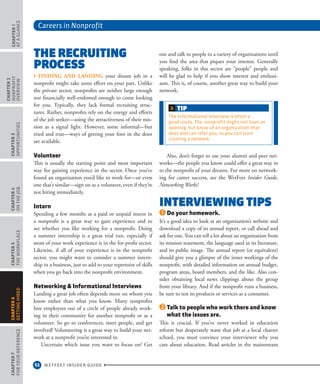
CAREERS IN NONPROFIT
★★
INSIDER GUIDE
>> The WetFeet Methodology
You hold in your hands a copy of the highest-quality research available for job seekers.
We’ve designed the WetFeet Insider Guides to help cut down on the time you spend doing job research
by doing some of the work for you. Hopefully we can make your job search as painless as possible.
Each WetFeet Insider Guide is the product of hundreds of hours of in-depth research, critical analysis,
and precise writing. We survey massive amounts of publicly available information and conduct
dozens of in-depth interviews of rank-and-file employees who work for the companies and industries
we cover. (We keep our company contacts anonymous to encourage candor.)
WetFeet writers—experts at reading between the lines—speak with company recruiting staff
members to make sure you get accurate information about the recruiting process, compensation,
and hiring targets. We also consult countless experts, from career coaches and networking gurus to
authorities on professional etiquette and personal branding, in order to provide you insight on the
latest trends affecting job seekers.
Each Insider Guide undergoes extensive editorial review and fact-checking to ensure that the
information and writing live up to our exacting standards. And because WetFeet retains all editorial
control of our Insider Guides, you can be confident you’re reading the unvarnished truth, not
corporate PR.
We’re eager to hear about your experiences on the recruiting front, and we welcome your feedback
(both positive and negative) about our products and services. Don’t hesitate to contact us at
orders@wetfeet.com.
>>The WetFeet Guarantee
You’ve got enough on your mind with your job search in full swing. So, if you don’t like this
Insider Guide, send it back within 15 days of purchase and we’ll refund your money.
Contact us at 215-546-4900 or orders@wetfeet.com
2012 edition
Insider
Guide
CareersinNonprofit
Careers in Nonprofit
WetFeet
1518 Walnut St.
Suite 1800
Philadelphia, PA 19102
Phone: (215) 546-4900
Fax: (215) 546-9921
Website: www.wetfeet.com
Careers in non-profit
2012 Edition
ISBN:978-1-58207-309-5
Photocopying Is Prohibited
Copyright 2012 WetFeet. All rights reserved. This publication is protected by the copyright laws
of the United States of America. No copying in any form is permitted. It may not be reproduced,
distributed, stored in a retrieval system, or transmitted in any form or by any means, in part or
in whole, without the express written permission of WetFeet, Inc. The publisher, author, and any
other party involved in creation, production, delivery, or sale of this WetFeet Insider Guide make no
warranty, express or implied, about the accuracy or reliability of the information found herein. To
the degree you use this guide or other materials referenced herein, you do so at your own risk. The
materials contained herein are general in nature and may not apply to particular factual or legal
circumstances. Under no circumstances shall the publisher, author, or any other party involved in
creation, production or delivery of this guide be liable to you or any other person for damages of any
kind arising from access to, or use of, its content.
All illustrations by mckibillo
Careers in Nonprofit
CHAPTer
321 4
1 nonproFits
at a glanCe
5 nonproFit
oVerVieW
6 The big picture
9 The bottom line
9 breakdown
12 Trends
17 opportUnities
18 The Nonprofit
Spectrum
22 Rankings
29 on the Job
30 career paths
30 key Jobs at
Nonprofits
32 Real people profiles
Careers in Nonprofit
765
45 the WorKplaCe
46 culture and
lifestyle
46 Workplace
Diversity
47 Travel
47 compensation
48 perks
48 vacation
48 The Inside
Scoop
51 getting hired
52 The Recruiting
process
52 Interviewing Tips
53 Getting Grilled
53 Grilling Your
Interviewer
57 For yoUr
reFerenCe
58 Industry lingo
60 Recommended
Reading
61 online Resources
contents
Nonprofits
ataGlance
1
Careers in Nonprofit
2 WETFEET INSIDER GUIDE
CHAPTER2
nonprofit
overview
CHAPTER3
Opportunities
CHAPTER4
OntheJob
CHAPTER5
TheWorkplace
CHAPTER6
GettingHired
CHAPTER7
ForYourReference
CHAPTER1
ataGlance
2 WETFEET INSIDER GUIDE
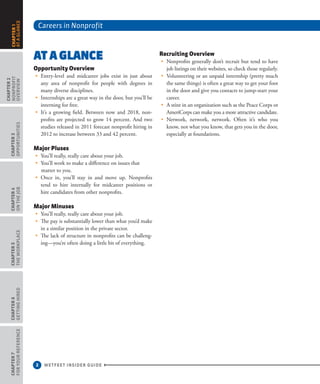
AT A GLANCE
Opportunity Overview
•	Entry-level and midcareer jobs exist in just about
any area of nonprofit for people with degrees in
many diverse disciplines.
•	 Internships are a great way in the door, but you’ll be
interning for free.
•	 It’s a growing field. Between now and 2018, non-
profits are projected to grow 14 percent. And two
studies released in 2011 forecast nonprofit hiring in
2012 to increase between 33 and 42 percent.
Major Pluses
•	 You’ll really, really care about your job.
•	 You’ll work to make a difference on issues that
matter to you.
•	Once in, you’ll stay in and move up. Nonprofits
tend to hire internally for midcareer positions or
hire candidates from other nonprofits.
Major Minuses
•	 You’ll really, really care about your job.
•	 The pay is substantially lower than what you’d make
in a similar position in the private sector.
•	 The lack of structure in nonprofits can be challeng-
ing—you’re often doing a little bit of everything.
Recruiting Overview
•	 Nonprofits generally don’t recruit but tend to have
job listings on their websites, so check those regularly.
•	 Volunteering or an unpaid internship (pretty much
the same things) is often a great way to get your foot
in the door and give you contacts to jump-start your
career.
•	 A stint in an organization such as the Peace Corps or
AmeriCorps can make you a more attractive candidate.
•	Network, network, network. Often it’s who you
know, not what you know, that gets you in the door,
especially at foundations.
3WETFEET INSIDER GUIDE
CHAPTER2
nonprofit
overview
CHAPTER3
Opportunities
CHAPTER4
OntheJob
CHAPTER5
TheWorkplace
CHAPTER6
GettingHired
CHAPTER7
ForYourReference
CHAPTER1
ataGlance
3
Nonprofit
Overview
2
The Big Picture..............................6
The Bottom Line............................9
Breakdown.....................................9
Trends..........................................12
Careers in Nonprofit
6 WETFEET INSIDER GUIDE
Chapter1
aTaGlaNcE
Chapter3
oppoRTUNITIES
Chapter4
oNThEJob
Chapter5
ThEWoRkplacE
Chapter6
GETTINGhIRED
Chapter7
FoRYoURREFERENcE
Chapter2
NoNpRoFIT
ovERvIEW
ThE BiG piCTurE
› on the surface, defining a nonprofit is simple:
It’s an organization that generates revenues not for
profit, but for the public good and so earns a tax-
exempt status from the IRS. The term covers a lot of
territory—everything from symphonies and chambers
of commerce to homeless shelters, environmental advo-
cacy groups, universities, and foundations that grant
money to those very same organizations.
Ah, money. By their very nature, nonprofits aren’t
driven by financial motive, but that doesn’t mean
finances aren’t a constant source of concern. Lacking the
income consumers feed for-profit businesses, nonprof-
its must seek other sources of funding, which gener-
ally derive from grants provided by foundations or the
government, individual donors, or fees for goods and
services. (For example, a nonprofit think tank might
charge for reports it produces.)
Nonprofits of late have expressed keener interest
in the latter type of funding, which, when approached
with an entrepreneurial spirit, can offer more reliable
income. Say, for instance, a nonprofit operates a suc-
cessful café it also rents out for events. That organiza-
tion has a source of income that isn’t as dependent upon
(and that can augment) a government-funded grant,
the whims of a foundation grant, or the collection of
memberships from hundreds or thousands of small and
corporate donors, some of whom have been hit hard by
recession or other problems.
But how else to characterize nonprofits? Thanks to
their diversity of focus, that’s no easy task. However,
there are some common elements to the third sector, as
the category of nonprofits is sometimes known. (Private
enterprise and government represent the first two
sectors).
Many who join nonprofits want to do work they
feel will meaningfully impact the world or their com-
munity. Waking up every day, going to work, and
caring about what you do offers a significant benefit
and is a powerful draw for those entering the sector. As
one insider says, “I’m looking for an added motivation
beyond applying technical skills: It’s the belief in what
the organization stands for.”
Nonprofits also tend to pay less than their private
enterprise counterparts. That means they tend to attract
people who really are passionate about the issue and
doing good in the world.
Finally, nonprofits tend to have fewer resources
than private companies. That’s because they’re funded
by charitable contributions and face pressure to put
the money they receive into their programs rather
than perks for their employees. After all, if a nonprofit
attracts people because of the meaningful work they
can do, the nonprofit doesn’t need to compete as hard
for talent; its mission trumps things such as on-campus
gyms and subsidized cafeterias that some private com-
panies offer.
Another important thing to know about nonprofits:
A few employ hundreds or even thousands of people,
but most have fewer than 50 employees. This brings
opportunity and challenges. Smaller staff sizes mean less
management and, frequently, inexperienced managers
who have grown up in the organization. (Nonprofits
have a tendency to promote from within.) It also prizes
resourceful individuals who are self-starters, not to
mention those able and willing to wear multiple hats.
One insider says: “In nonprofits, you have to be smart
7
CHAPTER1
ataGlance
WETFEET INSIDER GUIDE
CHAPTER3
Opportunities
CHAPTER4
OntheJob
CHAPTER5
TheWorkplace
CHAPTER6
GettingHired
CHAPTER7
ForYourReference
CHAPTER2
nonprofit
overview
and figure things out on the run. You can’t say, ‘That’s
not in my job description.’ You need to be self-moti-
vated because the quality of managers varies, and you
can’t rely on a person to provide clear direction or over-
see deadlines.” Some people thrive in these conditions,
but they’re not for everyone.
Pathways into Nonprofits
As you might expect, the types of opportunities at non-
profits are as diverse as the types of nonprofits, and
there are opportunities for everyone, from entry-level
employees to midcareer or executive career changers.
One sure path into nonprofits is to work on fun-
draising. Nearly all nonprofits need to raise money,
through grants or donors, and not everybody is good at
it. If you’re a proven grant writer, a terrific schmoozer,
or come with a network of high-net-worth contacts,
you’re likely to have your pick of where to work.
Entry-level jobs at nonprofits are numerous but
tend to be low paying and, in some areas, hard to get.
That’s because a lot of qualified people want to work on
some key popular issues or high-profile nonprofits, and
smaller nonprofits don’t do that much hiring. Many
entry-level nonprofit jobs are administrative, although
even in an administrative position you’ll usually have a
chance to wear other hats. Other roles, including many
in social services, can be easier to get, but are very chal-
lenging thanks to heavy workloads and emotionally
difficult work.
Those with a strong background in a subject area or
technical skills can find a wide range of opportunities.
Somebody with a strong science background, for exam-
ple, might find a job at a research nonprofit, such as the
Howard Hughes Medical Institute, which supports bio-
medical research; or the Institute for OneWorld Health,
which acts as a kind of nonprofit pharmaceutical com-
pany, seeking affordable treatments for neglected infec-
tious diseases; or at Earthwatch Institute, researching
climate change or the declining ocean health. Other
roles for scientists might be in educational nonprofits or
hospitals. And those with tech skills, in programming
or IT, are in demand across most types of nonprofits.
Holders of MBAs can find management- or exec-
utive-level position at nonprofits—examples include
working at a nonprofit focusing on microfinance, devel-
opment, or researching how the financial sector can
better help poor households, such as at the Financial
Access Initiative, which works to expand access to qual-
ity financial services for low-income individuals.
Nonprofits are increasingly hiring people with busi-
ness strategy expertise into roles such as overseeing the
future direction of City Year, which exposes young peo-
ple to a year of full-time service, or guiding one of many
programs at the African Wildlife Foundation, which
works to conserve wildlife and protect lands in Africa.
“Being strategic about grant-making and being
able to analyze, make improvements, and demonstrate
results is becoming more important for funders and
nonprofits alike,” one insider tells us.
A Brief History of Nonprofits
Between 1998 and 2008, the number of registered
nonprofits in the United States rose from 1.16 million
to 1.51 million, a 30 percent increase. Today the sec-
tor employs nearly 11 million workers. It’s the third
largest workforce in America, behind only the manu-
facturing and retail sectors—and that’s not counting
the contribution of its many volunteers. Clearly, the
nonprofit market has grown to a formidable size not
easy to ignore.
In nonprofits, you need to
be smart and flexible because
there are unpredictable
situations, and often it’s a
small staff and you may have
to wear different hats.
Careers in Nonprofit
8 WETFEET INSIDER GUIDE
CHAPTER1
ataGlance
CHAPTER3
Opportunities
CHAPTER4
OntheJob
CHAPTER5
TheWorkplace
CHAPTER6
GettingHired
CHAPTER7
ForYourReference
CHAPTER2
nonprofit
overview
The Obama administration says “no.” In 2009 it
proposed capping the rate at which high-income tax-
payers can take itemized tax deductions at 28 percent,
down from 35. The cap is projected to raise $318 bil-
lion in ten years and remains a fraught topic among
a divided Congress. Supporters of the proposal say it
will limit excessive deductions taken by abusers of the
current system; opponents say it will lower amounts of
charitable giving.
Whatever the result, one thing is certain: The non-
profit section will continue to play a prominent role in
American society. In fact, the outlook for nonprofit jobs
is very positive.
The Outlook for Nonprofit Jobs
The nonprofit sector continues to mount a cautious
recovery after suffering lower charitable giving rates and
slashed government funding during the global fiscal
contraction.
According to studies released in 2011 by career cen-
ter Idealist and nonprofit consultancy Nonprofit HR
Solutions, hiring is on the rise. Of 3,000 respondents to
the Idealist survey, 42 percent planned to hire for new
positions and only 9 percent planned to reduce staff. Of
450 respondents polled for the second survey, 33 per-
cent planned to create new positions and the majority
expected no change to their staffing rolls.
The figures suggest the nonprofit sector is begin-
ning to warm—job seekers, burnish your resumes! The
Bureau of Labor Statistics predicts the sector will
only continue to grow, particularly as the popula-
tion ages and the elderly require more direct services.
Organizations responding to both surveys say posi-
tions in direct/program services are first on their
recruiting lists in the year ahead, with fundraising next
on the list for both surveys.
Why has it gotten so big? The answer goes back
to the post-World War II years, when the American
government established a set of domestic programs.
Many applauded these programs for providing a neces-
sary social safety net; others claimed they resulted in “a
welfare state” that unnecessarily coddled citizens while
unfairly asking the public to foot the bill for this indul-
gent caretaking. Social welfare spending also competed
against private investment, critics argued, pointing to
sluggish global economic growth in the 1970s.
A decade later, the conservative administration of
Ronald Reagan took the criticisms to heart and slashed
government social spending. The private sector—espe-
cially nonprofits, said the president—would respond
by taking over the duties that federal agencies for the
socially underprivileged had shouldered.
As the government began shuttering more and
more social services, the populations who needed
them—the poor, the sick, the elderly—floundered.
Frustrated and indignant, various groups did as
Reagan predicted and established organizations that
addressed the gaps in services caused by the admin-
istration’s policies. Their efforts coincided with rapid
improvements in communications technologies;
fiber optics networks, fax machines, the Internet,
and, later, smartphones and social networks allowed
fledgling groups to mobilize and organize more easily,
contributing to the proliferation of nonprofits.
Now the sector’s size raises concern among those
alarmed by a tax code that defines nonprofit so broadly
that it sanctions the creation of groups such as Save
Your Ass Long-Ear Rescue, a Vermont-based donkey
and mule refuge, and the Red Nose Institute, a char-
ity that sends red clown noses to American military
personnel serving abroad. Critics point out that giv-
ing such organizations tax-exempt status cost the
federal government more than $50 billion in lost tax
revenue in 2008. In the uncertain economic climate
of today, they ask, can the U.S. government afford to
regulate nonprofits as loosely as it has in the past?
9
CHAPTER1
ataGlance
WETFEET INSIDER GUIDE
CHAPTER3
Opportunities
CHAPTER4
OntheJob
CHAPTER5
TheWorkplace
CHAPTER6
GettingHired
CHAPTER7
ForYourReference
CHAPTER2
nonprofit
overview
The Bottom Line
› If you’re driven by passion for an issue, care
about making a difference in the world, and don’t mind
sacrificing some compensation for the chance to change
the world, the nonprofit sector could be the perfect
place for you. Nonprofits offer opportunities to work
on virtually any type of issue you care about—from
local, state, and federal policy issues to homelessness,
education, international relief, and more.
The nonprofit sector has seen phenomenal growth for
almost half a century, and there’s no indication the growth
will lessen; plus in 2012, hiring is expected to rise. Those
interested in the sector can expect more jobs to become
available in the near future. Especially bright are oppor-
tunities for those with technical skills in the digital space.
Also, drawbacks traditionally associated with the sector
(poor compensation and little to no professional develop-
ment) might be lessening somewhat as nonprofits seek
to emulate certain traits of for-profit businesses, such as
competitive pay and performance-based recruiting.
Unlikely to change is the sector’s commitment to the
collective good, the bottom-line definition that has always
attracted its best and brightest.You too can join those ranks.
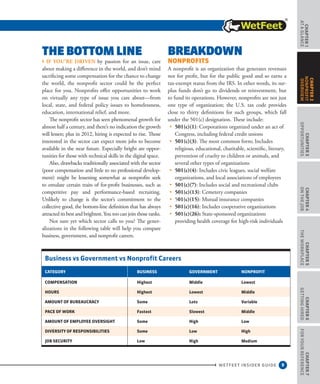
Not sure yet which sector calls to you? The gener-
alizations in the following table will help you compare
business, government, and nonprofit careers.
Breakdown
Nonprofits
A nonprofit is an organization that generates revenues
not for profit, but for the public good and so earns a
tax-exempt status from the IRS. In other words, its sur-
plus funds don’t go to dividends or reinvestment, but
to fund its operations. However, nonprofits are not just
one type of organization; the U.S. tax code provides
close to thirty definitions for such groups, which fall
under the 501(c) designation. These include:
•	 501(c)(1): Corporations organized under an act of
Congress, including federal credit unions
•	 501(c)(3): The most common form; Includes
religious, educational, charitable, scientific, literary,
prevention of cruelty to children or animals, and
several other types of organizations
•	 501(c)(4): Includes civic leagues, social welfare
organizations, and local associations of employees
•	 501(c)(7): Includes social and recreational clubs
•	 501(c)(13): Cemetery companies
•	501(c)(15): Mutual insurance companies
•	 501(c)(16): Includes cooperative organizations
•	 501(c)(26): State-sponsored organizations
providing health coverage for high-risk individuals
Business vs Government vs Nonprofit Careers
Category Business Government Nonprofit
Compensation Highest Middle Lowest
Hours Highest Lowest Middle
Amount of bureaucracy Some Lots Variable
Pace of work Fastest Slowest Middle
Amount of employee oversight Some High Low
Diversity of responsibilities Some Low High
Job security Low High Medium
Careers in Nonprofit
10 WETFEET INSIDER GUIDE
CHAPTER1
ataGlance
CHAPTER3
Opportunities
CHAPTER4
OntheJob
CHAPTER5
TheWorkplace
CHAPTER6
GettingHired
CHAPTER7
ForYourReference
CHAPTER2
nonprofit
overview
Foundations
Foundations occupy a distinct place in the nonprofit
world as grant-making bodies. There are two types:
private and public. Private foundations generally trace
their revenue to one source, be it an individual (the
J. Paul Getty Trust), a family (the Bloomberg Family
Foundation), or a corporation (Verizon, which backs
the Verizon Foundation).
In contrast, public foundations, such as the
Cleveland Foundation, dedicated to helping the lives
of residents of Greater Cleveland, gather their monies
from diverse sources that can include individual donors,
government agencies, and private foundations. Some
public foundations, like other nonprofits, also gener-
ate income by collecting fees on services or goods they
provide.
Foundations made close to $45 billion in grants in
2010 and managed more than $600 billion in assets,
according to the Foundation Center’s 2011 report “Key
Facts on Mission Investing.” So, foundations play a key
role in the nonprofit sector.
Foundations often support other nonprofits directly
and are on the front lines of positive social change.
But they also have tangible advantages. As employers,
they’re known to pay better and offer better benefits;
as a result, foundation jobs are more competitive and
scoring one is, quite frankly, often dependent on whom
you know.
Social Enterprises
Neither foundation nor nonprofit in most cases, social
enterprises are a new player in the third-sector scene.
They’re ventures that seek social and financial returns,
and they promote a new way of solving social prob-
lems, one that’s faster, more focused, and on firmer
footing.
One of the better-known examples is for-profit
footwear company TOMS Shoes, which donates one
pair of shoes to a child in need for every pair it sells.
In just four years, the company sold enough shoes to
distribute to one million children worldwide. Those
figures suggest that narrowly targeted, entrepreneur-
ial endeavors can produce results quickly, all without
expending time or effort on the uncertain outcomes of
grant applications or donor relationships.
Of course, some social enterprises do court donors
(or investors, as the entrepreneurially minded say),
and they are legally established as nonprofits, such as
Charity: Water, an organization that delivers clean
water to more than one million underserved people in
17 countries. By applying modern business know-how,
such as a slick marketing campaign and a facility in all
available platforms, to its operations, the charity grew
more than 100 percent in the first quarter of 2011
compared to the same quarter the year before.
Examples such as TOMS Shoes and Charity:
Water share a common characteristic of social enter-
prises: charismatic individuals at their helm. Labeled
social entrepreneurs, these leaders tend to display com-
pelling personalities coupled with business smarts;
although the combination is often winsome, the more
faint-hearted worry about the long-term prospects of
organizations so dependent upon the leadership and
reputation of a single individual. Because many social
enterprises are still very young, it’s still too early to tell
whether such fears are justified.
INSIDEr SCOOP
“Working for a large foundation is not that
different from working for a Fortune 500 company.
They’re looking for the best talent to drive their
goal.”
11
CHAPTER1
ataGlance
WETFEET INSIDER GUIDE
CHAPTER3
Opportunities
CHAPTER4
OntheJob
CHAPTER5
TheWorkplace
CHAPTER6
GettingHired
CHAPTER7
ForYourReference
CHAPTER2
nonprofit
overview
B-Corporations, l3Cs, and PRIs:
The Alphabet Soup of Social
Enterprises
The law has yet to catch up to the fast-moving world of
social enterprises, but it might be getting close. In 2011
the state legislatures of New York and Massachusetts
entertained regulations that would allow benefit cor-
porations (often referred to as B-corps) to be established
legally, potentially joining four other states in recog-
nizing a new kind of business entity: a for-profit that’s
obligated to stakeholders (rather than shareholders) and
principles of social benefit.
As of late 2011, the 471 B-corps represented nearly
$2.25 billion in revenues and included such diverse
businesses as the Mendocino Wine Company; Spotlight
Solar, a solar energy installation company; Sleeping Lady
Mountain Resort, a hotel in Leavenworth, Washington;
gDiapers, which makes earth-friendly diapers; and
Satori Capital, a buyout firm.
Added to the mix of hybrid organizations are low-
profit limited liability corporations or L3Cs. Yet another
blend of for- and not-for-profit entities, these differ
from B-corps businesses mainly in their taxation model,
which is more flexible. L3Cs can put tax deductions
ahead of profits while B-corps businesses must balance
the two better. L3Cs also can qualify as program-related
investments (PRIs), which are investments with social
benefits that further a foundation’s mission, allowing
them to receive funding from grant-making foun-
dations. Maine’s Own Organic Milk Company, or
MOOMilk, a consortium of organic dairy farmers, is
one business certified as an L3C in Maine, which joined
states such as Utah and Wyoming in recognizing L3Cs.
Not everyone is a fan of the hybrid businesses. Some
nonprofit executives worry that they’ll add even greater
competition for foundation dollars, and some attorneys
and policy wonks fear L3Cs will lower fiduciary standards.
It remains to be seen what L3Cs, B-corps, and PRIs
spell for the sector’s future.
When Nonprofits Die
The breakneck speed
at which nonprofits
establish themselves
overshadows the
handful that close—
not because of poor
management or lack
of funds, but because
their services are no
longer needed. That’s
right: Some orga-
nizations right the
wrongs they worked
to overcome and then
quietly leave the non-
profit space.
Perhaps the high-
est profile nonprofit
set to shut down is
Malaria No More.
The organization
formed in 2006 to
reduce dramatically
the number of deaths
in malaria zones. In a
small span of years,
the nonprofit has
raised public aware-
ness about the issue,
lobbied policymakers
to push malaria to
the top of their agen-
das, and distributed
bed nets in malaria-
prone areas, its most
effective tactic for
achieving its mission.
Nearing its end,
Malaria No More
will join organi-
zations, such as
Water Advocates
and Out2Play, that
have closed because
their founders and
boards believed
they had met their
goals. While such
occurrences are too
few to call a trend,
they offer proof to
those who enter the
nonprofit field to
cure societal ills that
some humanitarian
battles really can be
won.
Careers in Nonprofit
12 WETFEET INSIDER GUIDE
CHAPTER1
ataGlance
CHAPTER3
Opportunities
CHAPTER4
OntheJob
CHAPTER5
TheWorkplace
CHAPTER6
GettingHired
CHAPTER7
ForYourReference
CHAPTER2
nonprofit
overview
Trends
The Business-Savvy Nonprofit
The greatest trend to impact the third sector in recent
years has been a pronounced emphasis on the inte-
gration of for-profit business practices into nonprofit
operations. This has occurred on macrolevels and
microlevels as nonprofits increasingly run their orga-
nizations like businesses, incorporating revenue-gen-
erating models that lessen nonprofits’ dependence on
unstable funding sources and recruiting more employ-
ees with business or finance backgrounds.
On the macrolevel, this trend is found in nonprofits’
pursuit of diversified funding streams, with more find-
ing ways to earn their own income. Take, for example,
Housing Works in New York City. The nonprofit,
which works to end homelessness and AIDS through
advocacy and lifesaving services, also proudly markets
its entrepreneurial initiatives, which include catering
services, multiple thrift shops, and an online auction, as
well as a thriving bookstore and café in the city’s SoHo
neighborhood.
A new breed of philanthropists is also putting pres-
sure on nonprofits to become more business-savvy. No
longer content with calling their contributions dona-
tions, today’s philanthropists prefer to call them invest-
ments, with backers seeking to support a nonprofit’s
growth capital in addition to just specific programs.
One example of an organization heeding that
approach is the Nonprofit Finance Fund (NFF), which
created NFF Capital Partners in 2006 to leverage what
NFF calls philanthropic equity: capital or capacity that
leads to a nonprofit’s sustained growth. The organiza-
tion’s portfolio now features success stories such as
Ashoka’s Changemakers and VolunteerMatch, which
grew its total budget 21 percent in three years with the
help of NFF Capital Partners’ capacity-building funds.
The trend toward a more business-oriented non-
profit has nonprofit boards focusing more on perfor-
mance metrics for staff. One insider says: “There’s a
tendency for applicants to put their passions first, but
there’s nothing that allows you to have weaker skills
just because there’s a cause involved. That’s the biggest
mistake people make when they leap into nonprofits.
They think it’s about passion when it’s really about the
implementation of knowledge and mastery to a wider
goal that furthers a mission.”
ICU: Treating Transparency
Ills in Nonprofits
The emphasis nonprofits are placing on business prin-
ciples finds its twin in the public’s growing inter-
est in just how nonprofits operate. This trend exists
in part because of scandals involving the sector in
recent years—think of the ACORN (Association of
Community Organizations for Reform Now) fiasco
during President Obama’s campaign, when employees
of the nonprofit were caught on tape advising under-
cover journalists on the finer points of sex trafficking.
These scandals have eroded public trust in organizations
that claim to do good. That trust was further jeopar-
dized in 2008, when a report released by four professors
Passion creates a problem in
a marketplace when it churns
out applicants who don’t have
the skills to back the position
they’re applying for.
TIP
With nonprofits placing greater stress on
staff performance, job seekers should call out
specific metrics around their achievements
during an interview. If you spearheaded bud-
get cuts in your organization, for example,
share details and identify the savings that
resulted from your initiative
13
CHAPTER1
ataGlance
WETFEET INSIDER GUIDE
CHAPTER3
Opportunities
CHAPTER4
OntheJob
CHAPTER5
TheWorkplace
CHAPTER6
GettingHired
CHAPTER7
ForYourReference
CHAPTER2
nonprofit
overview
who study nonprofit accounting estimated that $40
billion in nonprofit funds—or 13 percent of charitable
giving—was lost to fraud and embezzlement annually.
Statistics like that give philanthropists pause, and
nonprofits have responded by implementing indepen-
dent audits on a regular basis and watching more care-
fully for possible conflicts of interest between board
members and transactions made in the charity’s name,
as well as by developing ethical codes and policies that
lay out expectations for a variety of actions, such as
business travel.
Such tactics are meant to bolster public trust in
nonprofits, which also struggle with public skepti-
cism regarding employee compensation, especially at
the executive level, where salaries can reach $300,000.
Nonprofits must balance public and donor expecta-
tions, which put a priority on program and mission
goals over administrative overhead (where salaries are
calculated), with marketplace realities: Top talent is
increasingly commanding higher pay. The sector’s turn
toward for-profit ideals helps in that regard because
funders are beginning to recognize that a nonprofit’s
success is predicated on the quality of its staff.
Competing in the Digital Age
According to Nora Ganim Barnes, coauthor of a 2010
study released by the Center for Marketing Research at
the University of Massachusetts Dartmouth, 97 per-
cent of nonprofits engage in social media, surpassing
for-profit usage. And according to Blackbaud’s Online
Giving Report, charitable donations in the digital space
for organizations of all sizes increased by almost 35 per-
cent in 2010. Then there’s the Arab Spring, made up
of grassroots revolutions in the Middle East sparked in
part by exchanges between activists participating in the
social networking sites Twitter and Facebook. Few now
question the power of the Internet to facilitate deep
social change.
This recognition has spawned a host of nonprofits
jobs related to the digital space. Online content manager,
associate web producer, and director of digital market-
ing are just some of the titles you’ll find listed in the
nonprofit sector. And, as one newbie in multimedia
production says: “I don’t think my foundation would
have hired someone my age if it hadn’t been such a new
field. They would’ve been able to attract someone with
25 years of experience, no problem. I had an opportu-
nity to get my foot in the door because I had as much
experience as someone older.”
Another insider says: “It’s easier for young people to
make inroads in the media field. This is an area where
you may not have to slave away as an intern for years
before you get hired.”
Generation Y vs the Baby
Boomers: Job Competition
Heats Up
With unemployment holding steady at about 9 percent
since 2008, competition for work in all industries has
remained fierce, with the nonprofit sector seeing new
kinds of job seekers among its applicants. It has, for
instance, entertained queries from a greater number
of experienced business professionals, especially finan-
Chatting Your Ear Off:
Nonprofits and Social Media
In summer 2011,
Craig Newmark,
founder of Craigslist,
and his team at
Craigconnects
(http://craigconnects.
org/), a site that aims
to link the world for
the common good,
studied the social
media presence of
various nonprofits.
Did nonprofits with
the highest revenue
use the medium
most effectively?
After studying
the behavior of
nonprofits in
the digital space
in August and
September of that
year, the team
concluded no. A
nonprofit’s revenue
doesn’t boost
its visibility or
interactivity in social
media, and, when you
consider social media
is about facilitating
dialogue, that augurs
well for longevity in
the online world.
Careers in Nonprofit
14 WETFEET INSIDER GUIDE
CHAPTER1
ataGlance
CHAPTER3
Opportunities
CHAPTER4
OntheJob
CHAPTER5
TheWorkplace
CHAPTER6
GettingHired
CHAPTER7
ForYourReference
CHAPTER2
nonprofit
overview
ciers laid off in the early part of the recession. Would-be
retirees also are entering the nonprofit market; sated by
a lifetime of work in the for-profit world, baby boom-
ers are seeking second careers in fields that allow them
to give back to their communities. They’re joined in
their pursuit of nonprofit work by millennials unable to
find jobs in the for-profit sector. (Millennials are those
born more or less from the late 1970s to the late ’90s.)
In fact, according to data provided by the American
Community Survey, 11 percent more young college
grads secured work in the nonprofit sector in 2009 than
the year before.
These numbers and trends make for a more crowded
job pool long thought to be the home of small, not-
so-fast swimming fish. With former or would-be for-
profit applicants entering the market, human resources
departments are seeing a wider set of skills featured on
resumes—but technically skilled job seekers would be
wrong to overvalue their abilities. As one insider told
us: “A lot of times we get calls from people saying, ‘I
worked for this ad agency, and I can do this function,’
and we explain we have professional staff who do that.
They assume we don’t have people who can do things,
that we’re not professional.”
Failing to recognize the importance of an organiza-
tion’s mission is another misstep made by some people
transitioning from the for-profit to nonprofit sector.
“This guy came from the for-profit finance world, and
he had a hard time understanding that we didn’t want
to evict every nonpaying tenant,” says one insider who
specializes in low-income housing. “We are not will-
ing to raise the rent on populations that can’t afford it.
Applicants really have to understand how important the
mission is to the nonprofit.”
Over There: Nonprofits Abroad
To many interested in the nonprofit sector, dashing
overseas to rescue a child orphaned in a natural disas-
ter is the stuff of glamour and the fulfillment of a life’s
dream. Stats suggest it’s a popular dream: Between 1998
and 2008, the number of international development
and disaster-relief nonprofits nearly doubled, with their
revenues tripling in the same period. The founders of
those organizations must’ve known there was a will-
ing army of workers ready to tackle the very real needs
posed by communities in the world’s least developed
nations or in areas struck by natural disaster.
Certainly, many established nonprofits offer inter-
national opportunities—Habitat for Humanity and the
Red Cross, for example, work across borders. Temper
your enthusiasm for such jobs with a dose of realism,
though: Competition for positions that take employees
abroad is among the most fierce in the nonprofit sec-
tor, says one insider. “A lot of young people really want
those jobs. It’s the right time for them to go overseas
because they don’t have families to support.”
But if you don’t have dual nationality or a valid work
permit for another country, it might be very hard to
become a direct employee of an international agency
registered in another country.
Perhaps one of the most obvious international orga-
nizations for U.S. citizens to work for is the United
Nations—but it’s tough to get hired there too. Luckily,
a number of other international relief agencies and
international nonprofits are based in the United States;
for starters, peruse the 50 top nonprofits listed on the
following page. And if you really want an experience
in cultural immersion, a two-year commitment to the
Peace Corps might be just the ticket.
15
CHAPTER1
ataGlance
WETFEET INSIDER GUIDE
CHAPTER3
Opportunities
CHAPTER4
OntheJob
CHAPTER5
TheWorkplace
CHAPTER6
GettingHired
CHAPTER7
ForYourReference
CHAPTER2
nonprofit
overview
Opportunities
3
The Nonprofit Spectrum..............18
Rankings......................................22
Careers in Nonprofit
18 WETFEET INSIDER GUIDE
CHAPTER1
ataGlance
CHAPTER2
nonprofit
overview
CHAPTER4
OntheJob
CHAPTER5
TheWorkplace
CHAPTER6
GettingHired
CHAPTER7
ForYourReference
CHAPTER3
Opportunities
The nonprofit
spectrum
› Nonprofits operate in a wide range of areas.
The descriptions of the many subsectors of nonprofit
opportunities below are designed to open your mind
to possibilities in areas you might care a lot about and
in other areas in which you didn’t know such cool stuff
was happening.
Use this information as a starting place for your job
search. As you figure out what nonprofit sector you’re
interested in, create parameters for your search. Define
the city or cities you’d consider working in, the type or
types of organizations you’d most like to work at, and
the issue area or areas you want to focus on. Then, begin
collecting the names of organizations that fall within
these parameters.
In The Recruiting Process section in Chapter 6, we
offer a number of suggestions for interviewing and find-
ing your way to opportunities at nonprofits. These all
start with networking: talking to your friends, your par-
ents friends, your friends of friends, people from your
alumni group, members of student and professional
organizations you belong to, strangers you meet on the
bus, people you meet through LinkedIn, Google+, and
Twitter, and cold calls or direct contacts you make.
Once you’ve identified people working at organiza-
tions you think you might like to join, do informational
interviews to determine if your hunch about where you
want to work and what you want to do is right—and to
learn more about organizations you’re interested in. The
purpose of this book is to get you pointed in a direc-
tion, but nothing substitutes for real-world interactions
with people working in a field you think you might like
to join.
Arts, Culture, and Humanities
Nonprofits in the arts, culture, and humanities offer a
range of services and programs. Work at one of these
organizations and you might find yourself perusing
old photographs to feature in an exhibit planned by
the Oregon Historical Society or coordinating volun-
teers for the fundraising drive that fuels much of the
operations of the listener-supported, noncommercial
radio station WFMU in New Jersey. This category also
includes organizations such as ProPublica, a nonprofit
newsroom that publishes stories in the public interest,
and New York Foundation for the Arts, which posts job
listings and event notices for artists, distributes grant
money, and advocates on artists’ behalf.
Education
Education is the second largest nonprofit subsector
after human services in terms of number of organiza-
tions. Education also is the second largest in terms of
revenue and assets, accounting for 18.5 percent of rev-
enue and 32.2 percent of assets, which includes physi-
cal property (think college campuses) and endowment
assets, for all nonprofits. (Endowments can be size-
able; Harvard University’s stands at $26 billion.)
Education comes in at second in one other category:
percentage of charitable contributions. In 2009, 13.2
percent of all donations were funneled to education-
related nonprofits.
Chalk that figure up to the sway of effective letters
sent by your college’s alumni office, but don’t overlook
the numerous organizations and social enterprises
working to improve the educational landscape. Teach
for America, for example, recruits recent college grads
for two-year teaching stints in underserved commu-
nities across America. The brainchild of social entre-
preneurship Wendy Kopp, the organization offers
TIP
Many people working at nonprofits have
Twitter accounts. Search Twitter to find those
working at organizations you’re interested
in or on issues you care about and start
following them. You’ll learn their interests and
get links for things to build your knowledge,
and you can even start up a conversation that
could be the precursor to an informational
interview—or even a job interview.
19
CHAPTER1
ataGlance
WETFEET INSIDER GUIDE
CHAPTER2
nonprofit
overview
CHAPTER4
OntheJob
CHAPTER5
TheWorkplace
CHAPTER6
GettingHired
CHAPTER7
ForYourReference
CHAPTER3
Opportunities
training to undergrads before helping to place them
in local community schools, differing from a B-corps
such as EduCare, which operates in the digital space.
Providing online tutoring to all grades and college
students, EduCare also donates books and school
supplies to children in need for every tutoring ses-
sion completed. Job seekers who land a position at the
company might find themselves tutoring SAT English
online or approaching school officials as sales reps
hoping to sign a university for at least a one-year deal.
Environment and Animals
Nonprofits that address the environment and ani-
mals aren’t as numerous as other charities, but they
do register in the public consciousness, with groups
such as The Nature Conservancy, the World Wildlife
Fund, and the Trust for Public Land placing in the
top 50 of nonprofit brands. Indeed, in a study of
nonprofits acting in the social media landscape, The
Nature Conservancy logged the third most number of
comments on Facebook, suggesting the organization
enjoys an active relationship with its audience.
But environmental and animal-focused nonprofits
obviously do a lot more beyond engaging the public
through social media. They spearhead a variety of
important programs, such as buying forests or award-
ing research grants to scientists studying ways to con-
serve our most threatened landscapes. The Save the
Redwoods League, for instance, spent $60 million in
2002 to purchase 25,000 acres of redwood forest in
Del Norte County in an effort to preserve redwoods
in the Mill Creek area of California.
No More Homeless Pets in Utah applies business
smarts to its marketing by putting homeless animals
in the way of average Americans—literally. The orga-
nization took a space donated by a local mall and
turned it into a pet store that looks exactly like oth-
ers in the mall, except all its pets are from shelters
and can be adopted. The World Wildlife Fund, with
its black-and-white panda logo, might have name
recognition, but it’s organizations such as No More
Homeless Pets that are leading the way with out-of-
the-box thinking that brings potential supporters to
big box retail.
Health
No question about it, nonprofits in this category,
which include hospitals and groups that award scien-
tific research grants, boast the highest percentage of
revenues and assets among all nonprofits, accounting
for 56.7 percent of revenues and 38.6 percent of assets.
Executive directors in this subsector also post the high-
est salaries among all nonprofit workers. For example,
the CEO of Partners HealthCare, which manages a
group of nonprofit hospitals in Boston, earned $3.4
million in 2008.
But although nonprofit hospitals account for more
than half of all hospitals in the United States, inte-
grating them into the daily experience of numbers of
Americans, there are many health-related nonprofits
that seek to impact lives in such a way as to avoid
hospital visits altogether. Consider PATH in Seattle:
The organization features an A-Z list of its projects,
including improvements to condoms for women (the
project is in clinical trials); immunizing populations in
Asia against Japanese encephalitis, virtually unheard of
in industrialized nations but a sad fact of life in Asian
countries; and a roadside outreach effort in east Africa
to target truckers and other mobile workers who have
higher rates of transmitting the AIDS virus.
Or take the Guttmacher Institute, an established
nonprofit since 1977 regularly recognized for its
contributions to the national policy agenda around
sexual and reproductive health. And, there is Heartland
CARES, which provides services to HIV-infected
individuals while raising awareness of issues their
constituents face.
Human Services
The big daddy of the third sector, human-services non-
profits offer the most career paths for you to wander
simply because there are so many of these organiza-
Careers in Nonprofit
20 WETFEET INSIDER GUIDE
CHAPTER1
ataGlance
CHAPTER2
nonprofit
overview
CHAPTER4
OntheJob
CHAPTER5
TheWorkplace
CHAPTER6
GettingHired
CHAPTER7
ForYourReference
CHAPTER3
Opportunities
tions. Most got their start during the Reagan years,
when cuts in government spending for social welfare
programs created gaps in service for the needy. Today,
when so many are still jobless in the gloomy eco-
nomic climate, the subsector remains an active part
of the nonprofit picture, with surveys of HR staffs
putting direct client service jobs at the top of their
list of positions to fill in 2012. That means places
such as Our Place, a Washington, DC-based private
nonprofit, might have an opening for a case manager,
or Good Shepherd Services in New York City might
need to hire a therapeutic crisis worker.
Those aren’t the only kinds of human service jobs.
Groups such as EARN, which connects low-income
families to economic tools, need financial coaches
to provide financial management training to partici-
pants of its innovative microsavings program, while
a nonprofit such as Community Voice Mail, which
offers free 24-hour voicemail accounts to those in
crisis, might be looking for another body to offer IT
help.
Again, human services is the largest subsector of
nonprofits, so there’s no shortage of organizations to
explore. The Bureau of Labor Statistics predicts it’ll
only grow larger in the years to come, as America’s
elderly population is set to increase dramatically,
causing demand for services to spike.
International and
Foreign Affairs
This area represents the smallest number of nonprof-
its—but is also the fastest growing. More organizations
form to address global issues each year. Some of the
largest and more established among them—UNICEF,
for example—have region-specific initiatives and so
hire for specific areas of the world. Wrote your thesis on
diets in Afghanistan? Medair, which brings life-saving
relief to conflict zones and disaster areas, might have
a spot for you as a nutrition adviser in Afghanistan.
Or perhaps you feel compelled to step into a role at
the International Rescue Committee, which responds
to humanitarian crises around the world (and it was
formed at the behest of Albert Einstein).
International opportunities are not limited to time-
specific situations, such as rebuilding efforts in commu-
nities after an earthquake or hurricane has struck. They
also include organizations hoping to influence foreign
policy by issuing white papers or convening influential
policymakers; the Academy for Genocide Prevention
has done this. Foundations with foreign offices, such
as the Rockefeller Foundation or the Bill  Melinda
Gates Foundation, also engage in more long-term ini-
tiatives; the latter, for instance, created a nearly $900
million trust fund dedicated to helping small farmers in
India and sub-Saharan Africa. The fund has introduced
microirrigation practices to 100,000 farmers in India,
a move that has allowed many to almost double their
income.
Public and Social Benefit
Although almost all nonprofits could be a public and
social benefit, the designation is meant to stand in for
that group of professional associations, civic organiza-
tions, and similar bodies that function as nonprofits
but are not likely to be the first or second names the
average Joe would call out when pressed for examples
of nonprofits. These include tenant associations, labor
unions, or professional groups, such as the National
Society of Black Engineers, which works with and for
its members to increase the number and success of
black professionals in the engineering field through
activities such as networking events and conferences.
Labor unions also work on behalf of their members,
representing them in disputes with employers and
negotiating favorable terms at the bargaining table.
Fraternal organizations such as the Shriners or
Lions Club are yet another set of nonprofits that fit
here, as are your brother’s Little League team, your
mother’s beloved Green Party, and the chamber of
commerce your father is always grumbling about.
21
CHAPTER1
ataGlance
WETFEET INSIDER GUIDE
CHAPTER2
nonprofit
overview
CHAPTER4
OntheJob
CHAPTER5
TheWorkplace
CHAPTER6
GettingHired
CHAPTER7
ForYourReference
CHAPTER3
Opportunities
Religion-related
Despite being almost the smallest subsector of all non-
profits (only international and foreign-affairs nonprof-
its are fewer), religion-related organizations took in a
third of all private donations in 2009. You might be
thinking here of the donation baskets passed around
your church, synagogue, or temple, but religion-
related nonprofits also include organizations such as
Catholic Charities, which places in the top ten power
brands. The nationwide organization has locations
throughout the United States and features a range of
program interests from adoption to low-income hous-
ing solutions. The Christian nonprofit Habitat for
Humanity, on the other hand, has a macrofocus (it’s
an international organization) and a microaspect (it
zeroes in on housing to the exclusion of other issues
that challenge the poor); its religious activities fall
somewhere in between the two.
Foundations
Foundations are special a type of nonprofit. (That’s
why foundations have endowments.) You can find
them across subsectors. Some, such as the Information
Technology  Innovation Foundation, are narrowly
focused on a specific subject such as technology; oth-
ers, such as the San Francisco Foundation, are targeted
toward a specific locale; and still others, such as the
Rockefeller Foundation, address a variety of issues,
such as—in the case of the Rockefeller—global health,
urbanization, climate change, and food security.
Jobs at foundations typically pay better and have
better benefits than other nonprofits. The workload
is also easier, some say, perhaps because they’re bet-
ter funded and, as a result, better staffed. As a result,
more job seekers are attracted to these positions, mak-
ing competition for them more fierce. Connections
within an organization are reportedly the best method
for getting your foot in the door, so consider vol-
unteering for a foundation or networking at events
organized by the Council on Foundations or the
Association of Small Foundations.
Social Enterprises
Social enterprises aren’t a subsector, but they offer a
work environment where you’re working to solve a
problem, albeit typically using for-profit business mod-
els for their organizational structure. Because they pri-
oritize the collective good over financial profit, a job
at one means working toward social change in a lot of
different ways. That’s because social enterprises, like
foundations, address a range of issues. Social enterprise
DoSomething, for example, aims to get more teens to
volunteer. It exhibited its business chops in a big way
when it introduced an initial public offering (IPO, or
stock market launch) in 2008. The company also dis-
plays a playful side, listing among its staff positions,
Head of Fun. Another social enterprise manufactures
goods for profits it uses to help sex-trafficking victims
find jobs: Hello Rewind in New York uses old T-shirts
to make custom laptop sleeves.
Such startups begin small and need help—in 2010
Hello Rewind listed just three employees, but its
unexpected success had the founders looking for ways
to expand the operation not long after—so you may
be able to walk in and pitch your own job. Just don’t
assume such organizations are unprofessional. Focused
on positive monetization, such outfits look for staff
with business smarts and nonprofit hearts. And who
knows, a job at one might lead you to catching the
entrepreneurship bug and starting your very own social
enterprise. How’s that for finding a job?
Social enterprises begin small
and need help, so you may be
able to walk in and pitch your
own job.
Careers in Nonprofit
22 WETFEET INSIDER GUIDE
CHAPTER1
ataGlance
CHAPTER2
nonprofit
overview
CHAPTER4
OntheJob
CHAPTER5
TheWorkplace
CHAPTER6
GettingHired
CHAPTER7
ForYourReference
CHAPTER3
Opportunities
Rankings
› The following tables provide a list of some
of the largest charities and foundations, a list of the
fastest-growing nonprofits, a list of some of the best
nonprofits to work at, and a list of some of the more
reputable nonprofits. Use these lists to get a view into
some of the bigger nonprofit organizations that are out
there as well as places that might be hiring or are just
plain great places to work.
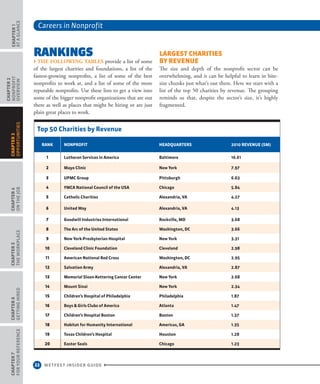
Largest Charities
by Revenue
The size and depth of the nonprofit sector can be
overwhelming, and it can be helpful to learn in bite-
size chunks just what’s out there. Here we start with a
list of the top 50 charities by revenue. The grouping
reminds us that, despite the sector’s size, it’s highly
fragmented.
Top 50 Charities by Revenue
Rank Nonprofit Headquarters 2010 Revenue ($M)
1 Lutheran Services in America Baltimore 16.61
2 Mayo Clinic New York 7.97
3 UPMC Group Pittsburgh 6.63
4 YMCA National Council of the USA Chicago 5.84
5 Catholic Charities Alexandria, VA 4.27
6 United Way Alexandria, VA 4.13
7 Goodwill Industries International Rockville, MD 3.68
8 The Arc of the United States Washington, DC 3.66
9 New York-Presbyterian Hospital New York 3.31
10 Cleveland Clinic Foundation Cleveland 2.98
11 American National Red Cross Washington, DC 2.95
12 Salvation Army Alexandria, VA 2.87
13 Memorial Sloan-Kettering Cancer Center New York 2.68
14 Mount Sinai New York 2.34
15 Children’s Hospital of Philadelphia Philadelphia 1.87
16 Boys  Girls Clubs of America Atlanta 1.47
17 Children’s Hospital Boston Boston 1.37
18 Habitat for Humanity International Americus, GA 1.35
19 Texas Children’s Hospital Houston 1.28
20 Easter Seals Chicago 1.23
23
CHAPTER1
ataGlance
WETFEET INSIDER GUIDE
CHAPTER2
nonprofit
overview
CHAPTER4
OntheJob
CHAPTER5
TheWorkplace
CHAPTER6
GettingHired
CHAPTER7
ForYourReference
CHAPTER3
Opportunities
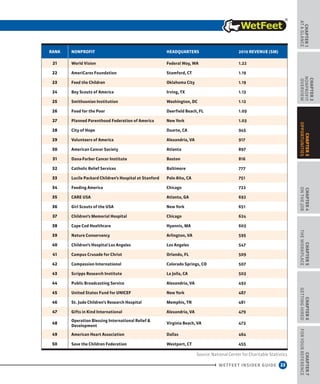
Rank Nonprofit Headquarters 2010 Revenue ($M)
21 World Vision Federal Way, WA 1.22
22 AmeriCares Foundation Stamford, CT 1.19
23 Feed the Children Oklahoma City 1.19
24 Boy Scouts of America Irving, TX 1.13
25 Smithsonian Institution Washington, DC 1.12
26 Food for the Poor Deerfield Beach, FL 1.09
27 Planned Parenthood Federation of America New York 1.03
28 City of Hope Duarte, CA 945
29 Volunteers of America Alexandria, VA 917
30 American Cancer Society Atlanta 897
31 Dana-Farber Cancer Institute Boston 816
32 Catholic Relief Services Baltimore 777
33 Lucile Packard Children’s Hospital at Stanford Palo Alto, CA 751
34 Feeding America Chicago 722
35 CARE USA Atlanta, GA 692
36 Girl Scouts of the USA New York 651
37 Children’s Memorial Hospital Chicago 624
38 Cape Cod Healthcare Hyannis, MA 603
39 Nature Conservancy Arlington, VA 595
40 Children’s Hospital Los Angeles Los Angeles 547
41 Campus Crusade for Christ Orlando, FL 509
42 Compassion International Colorado Springs, CO 507
43 Scripps Research Institute La Jolla, CA 503
44 Public Broadcasting Service Alexandria, VA 492
45 United States Fund for UNICEF New York 487
46 St. Jude Children’s Research Hospital Memphis, TN 481
47 Gifts in Kind International Alexandria, VA 479
48
Operation Blessing International Relief 
Development
Virginia Beach, VA 473
49 American Heart Association Dallas 464
50 Save the Children Federation Westport, CT 455
Source: National Center for Charitable Statistics
Careers in Nonprofit
24 WETFEET INSIDER GUIDE
CHAPTER1
ataGlance
CHAPTER2
nonprofit
overview
CHAPTER4
OntheJob
CHAPTER5
TheWorkplace
CHAPTER6
GettingHired
CHAPTER7
ForYourReference
CHAPTER3
Opportunities
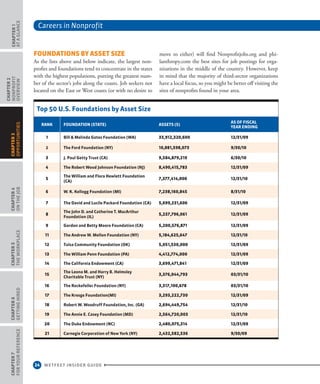
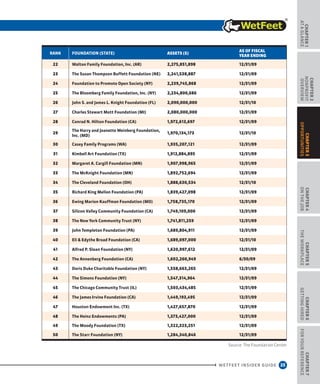
Foundations by Asset Size
As the lists above and below indicate, the largest non-
profits and foundations tend to concentrate in the states
with the highest populations, putting the greatest num-
ber of the sector’s jobs along the coasts. Job seekers not
located on the East or West coasts (or with no desire to
move to either) will find Nonprofitjobs.org and phi-
lanthropy.com the best sites for job postings for orga-
nizations in the middle of the country. However, keep
in mind that the majority of third-sector organizations
have a local focus, so you might be better off visiting the
sites of nonprofits found in your area.
Top 50 U.S. Foundations by Asset Size
Rank Foundation (State) Assets ($)
As of Fiscal
Year Ending
1 Bill  Melinda Gates Foundation (WA) 33,912,320,600 12/31/09
2 The Ford Foundation (NY) 10,881,598,073 9/30/10
3 J. Paul Getty Trust (CA) 9,584,879,219 6/30/10
4 The Robert Wood Johnson Foundation (NJ) 8,490,415,783 12/31/09
5
The William and Flora Hewlett Foundation
(CA)
7,377,414,000 12/31/10
6 W. K. Kellogg Foundation (MI) 7,238,160,845 8/31/10
7 The David and Lucile Packard Foundation (CA) 5,699,231,606 12/31/09
8
The John D. and Catherine T. MacArthur
Foundation (IL)
5,237,796,061 12/31/09
9 Gordon and Betty Moore Foundation (CA) 5,200,576,871 12/31/09
11 The Andrew W. Mellon Foundation (NY) 5,184,625,647 12/31/10
12 Tulsa Community Foundation (OK) 5,051,530,000 12/31/09
13 The William Penn Foundation (PA) 4,412,774,000 12/31/09
14 The California Endowment (CA) 3,699,471,841 12/31/09
15
The Leona M. and Harry B. Helmsley
Charitable Trust (NY)
3,376,044,793 03/31/10
16 The Rockefeller Foundation (NY) 3,317,100,678 03/31/10
17 The Kresge Foundation(MI) 3,293,222,730 12/31/09
18 Robert W. Woodruff Foundation, Inc. (GA) 2,694,449,754 12/31/10
19 The Annie E. Casey Foundation (MD) 2,564,720,003 12/31/10
20 The Duke Endowment (NC) 2,480,075,314 12/31/09
21 Carnegie Corporation of New York (NY) 2,432,582,536 9/30/09
25
CHAPTER1
ataGlance
WETFEET INSIDER GUIDE
CHAPTER2
nonprofit
overview
CHAPTER4
OntheJob
CHAPTER5
TheWorkplace
CHAPTER6
GettingHired
CHAPTER7
ForYourReference
CHAPTER3
Opportunities
Rank Foundation (State) Assets ($)
As of Fiscal
Year Ending
22 Walton Family Foundation, Inc. (AR) 2,275,851,898 12/31/09
23 The Susan Thompson Buffett Foundation (NE) 2,241,538,887 12/31/09
24 Foundation to Promote Open Society (NY) 2,239,745,868 12/31/09
25 The Bloomberg Family Foundation, Inc. (NY) 2,234,800,686 12/31/09
26 John S. and James L. Knight Foundation (FL) 2,090,000,000 12/31/10
27 Charles Stewart Mott Foundation (MI) 2,080,000,000 12/31/09
28 Conrad N. Hilton Foundation (CA) 1,972,613,697 12/31/09
29
The Harry and Jeanette Weinberg Foundation,
Inc. (MD)
1,970,134,173 12/31/10
30 Casey Family Programs (WA) 1,935,207,121 12/31/09
31 Kimbell Art Foundation (TX) 1,912,884,895 12/31/09
32 Margaret A. Cargill Foundation (MN) 1,907,998,965 12/31/09
33 The McKnight Foundation (MN) 1,892,752,694 12/31/09
34 The Cleveland Foundation (OH) 1,888,630,534 12/31/10
35 Richard King Mellon Foundation (PA) 1,839,427,098 12/31/09
36 Ewing Marion Kauffman Foundation (MO) 1,758,735,170 12/31/09
37 Silicon Valley Community Foundation (CA) 1,749,109,000 12/31/09
38 The New York Community Trust (NY) 1,741,811,259 12/31/09
39 John Templeton Foundation (PA) 1,689,804,911 12/31/09
40 Eli  Edythe Broad Foundation (CA) 1,689,097,000 12/31/10
41 Alfred P. Sloan Foundation (NY) 1,620,997,612 12/31/09
42 The Annenberg Foundation (CA) 1,602,260,949 6/30/09
43 Doris Duke Charitable Foundation (NY) 1,558,663,265 12/31/09
44 The Simons Foundation (NY) 1,547,314,964 12/31/09
45 The Chicago Community Trust (IL) 1,503,434,485 12/31/09
46 The James Irvine Foundation (CA) 1,449,193,495 12/31/09
47 Houston Endowment Inc. (TX) 1,427,657,870 12/31/09
48 The Heinz Endowments (PA) 1,373,427,000 12/31/09
49 The Moody Foundation (TX) 1,322,323,251 12/31/09
50 The Starr Foundation (NY) 1,284,340,846 12/31/09
Source: The Foundation Center
Careers in Nonprofit
26 WETFEET INSIDER GUIDE
CHAPTER1
ataGlance
CHAPTER2
nonprofit
overview
CHAPTER4
OntheJob
CHAPTER5
TheWorkplace
CHAPTER6
GettingHired
CHAPTER7
ForYourReference
CHAPTER3
Opportunities
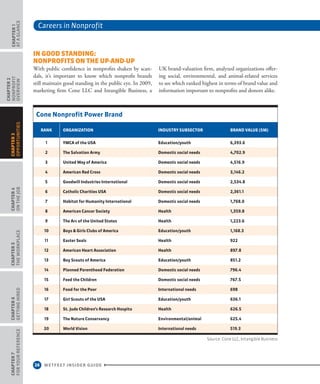
In Good Standing:
Nonprofits on the Up-and-Up
With public confidence in nonprofits shaken by scan-
dals, it’s important to know which nonprofit brands
still maintain good standing in the public eye. In 2009,
marketing firm Cone LLC and Intangible Business, a
UK brand-valuation firm, analyzed organizations offer-
ing social, environmental, and animal-related services
to see which ranked highest in terms of brand value and
information important to nonprofits and donors alike.
Cone Nonprofit Power Brand
Rank Organization Industry subsector Brand value ($M)
1 YMCA of the USA Education/youth 6,393.6
2 The Salvation Army Domestic social needs 4,702.9
3 United Way of America Domestic social needs 4,516.9
4 American Red Cross Domestic social needs 3,146.2
5 Goodwill Industries International Domestic social needs 2,534.8
6 Catholic Charities USA Domestic social needs 2,361.1
7 Habitat for Humanity International Domestic social needs 1,768.0
8 American Cancer Society Health 1,359.8
9 The Arc of the United States Health 1,223.6
10 Boys  Girls Clubs of America Education/youth 1,168.3
11 Easter Seals Health 922
12 American Heart Association Health 897.8
13 Boy Scouts of America Education/youth 851.2
14 Planned Parenthood Federation Domestic social needs 796.4
15 Feed the Children Domestic social needs 767.5
16 Food for the Poor International needs 698
17 Girl Scouts of the USA Education/youth 636.1
18 St. Jude Children’s Research Hospita Health 626.5
19 The Nature Conservancy Environmental/animal 625.4
20 World Vision International needs 519.3
Source: Cone LLC, Intangible Business
27
CHAPTER1
ataGlance
WETFEET INSIDER GUIDE
CHAPTER2
nonprofit
overview
CHAPTER4
OntheJob
CHAPTER5
TheWorkplace
CHAPTER6
GettingHired
CHAPTER7
ForYourReference
CHAPTER3
Opportunities
Best Nonprofit to Work for, 2010
Rank Operating Budget  $999,000
1 Furniture Bank of Metro Atlanta
2
Sugar Law Center for
Economic and Social Justice
3 UniversalGiving
4 VASH Hawaii Island
5 RSVP of Montgomery County
Rank Operating Budget $1–5 million
1
Atlanta Volunteer
Lawyers Foundation
2 AVID Center
3 MOUSE
4
Virginia Sexual and Domestic Violence
Action Alliance
Rank Operating Budget  $5 million
1 SPIN
2 Stand for Children
3 ACDI/VOCA
4 National Outdoor Leadership School
5 New Leaders for New Schools
6 Stanford University
Source: Charity Navigator
Fast-Growing Charities
The charities below have shown remarkable growth in
just a three-year span, with each growing its revenue
by more than 35 percent between 2008 and 2011.
Programs and services have expanded by that same rate
in that period, and each has enough savings to sustain
a similar rate of growth in the years ahead. Job security,
anyone?
Best Nonprofits to Work For
Taking into consideration such factors as their support
for employees’ work/life balance, camaraderie, benefits,
and professional development, nonprofit career firm
Opportunity Knocks takes a yearly look at the best
nonprofits to work for based on the size of organiza-
tions’ operating budgets. Below is the list for 2010.
10 Charities Growing Fast
Rank Charity
Program
Growth (%),
2008-2011
1 Arkansas Rice Depot 82.4
2 Cell Phones for Soldiers 79.9
3 Grassroot Soccer 79.3
4 Wikimedia Foundation 77.5
5 Friends of the High Line 75.8
6 Immaculate Heart Radio 61.7
7 WaterAid America 59.1
8 iMentor 56.6
9
Franklin and Eleanor Roos-
evelt Institute
52.4
10 Feed My Starving Children 51.3
Source: Charity Navigator
OntheJob
4
Career Paths................................ 30
Key Jobs at Nonprofits................ 30
Real People Profiles......................32
Careers in Nonprofit
30 WETFEET INSIDER GUIDE
CHAPTER1
ataGlance
CHAPTER2
nonprofit
overview
CHAPTER3
Opportunities
CHAPTER5
TheWorkplace
CHAPTER6
GettingHired
CHAPTER7
ForYourReference
CHAPTER4
OntheJob
Career Paths
› A typical career path at a nonprofit is, well, not
typical. In the small nonprofits that make up the vast
majority of the sector, staffers are often asked to wear
many different hats, so job titles don’t necessarily reflect
all the tasks completed for any given position. That
can be challenging; some report feeling overwhelmed
and unprepared for the duties assigned to them. But, it
also presents an opportunity for employees to broaden
their skill sets. Sometimes, this experience can lead to a
quick, vertical climb up the ranks.
However, there can be a lot of horizontal move-
ment if you’re not careful. Unlike the for-profit sector,
where there’s more emphasis on professional develop-
ment, nonprofits tend to direct their resources toward
their missions, not staff. That’s largely because of donor
concerns; donors generally want their contributions
directed toward causes, not staff development or com-
pensation. In a survey of 3,000 nonprofits conducted
by job center Idealist, 65 percent of respondents said
zero dollars were expended toward their professional
development in 2010.
In addition, nonprofits are 11 percent less likely
to promote staff than their for-profit counterparts,
according to a paper published in Industrial and Labor
Relations Review in 2007.
These factors put the responsibility on you to be
the architect of your career. Says one insider: “In for-
profits, you get a lot more mentoring, and there’s a path
to promotion. In nonprofits, if you want a promotion,
you likely aren’t going to get it in the same organization.
You have to move to a different organization.”
That said, there’s room at the top, with managerial
and executive-level positions being some of the most
popular listed on the Idealist job board in 2010. They’re
also some of the most difficult to recruit, according to
the Idealist survey. Motivated, ambitious job seekers
take note!
Key Jobs at
Nonprofits
› There isn’t one, must-have degree for people
wanting to work at a nonprofit. While many execu-
tive directors have advanced degrees in business, just
as many have backgrounds in public affairs and social
sciences. However, degrees or certificates in nonprofit
management are becoming more common among non-
profit executives, so you might consider further educa-
tion if you’re interested in a supervisory or managerial
role.
The nonprofit sector is deep and wide, with a range
of possible jobs. We’ve compiled a list of some of the
most typical, but remember: Positions vary from place
to place, so a program director at a small nonprofit
doesn’t necessarily do the same work as a program direc-
tor at a big organization such as the Red Cross.
Executive Director
The executive director is the equivalent to that of CEO
in business and reports directly to the board of direc-
tors. He or she is financially accountable for the organi-
zation, oversees all strategic planning and management,
and might be involved with other duties, including,
depending on the size of the nonprofit, fundraising and
development, board development, hiring, media rela-
tions, program development, and just about anything
else that needs to be done.
Program Director
In larger nonprofits and a handful of small ones, a tier
of midlevel management is needed. Duties include
oversight and management of a specific program or
programs, often including hiring personnel, fundrais-
ing, public relations, and all other administrative and
management duties specific to the program areas. The
program director usually reports directly to the execu-
tive director.
31
CHAPTER1
ataGlance
WETFEET INSIDER GUIDE
CHAPTER2
nonprofit
overview
CHAPTER3
Opportunities
CHAPTER5
TheWorkplace
CHAPTER6
GettingHired
CHAPTER7
ForYourReference
CHAPTER4
OntheJob
Director of Development and Fundraising
This position is the mainstay of all nonprofit organiza-
tions. The development director is responsible for rais-
ing the funds necessary to support the organization’s
budget. The job includes things such as writing grant
proposals, soliciting government funding, managing
direct-mail campaigns and individual donor solicita-
tion, creating and conducting fundraisers and other
events, arranging a fee-for-service or fee-for-product
revenue source, and, increasingly, coming up with and
implementing creative partnerships with businesses.
Director of Finance and Operations
This person manages all accounting and operations.
This usually includes grant administration, manage-
ment of personnel issues, and serving on the manage-
ment team. As more nonprofits recognize they cannot
maintain public credibility without keeping their own
house in scrupulous order, they are hiring CFOs and
the like. In some organizations, the person in charge
of finances is called the comptroller (or controller).
And some larger nonprofits have a director of opera-
tions, to whom the director of finance and a director
of human resources report. In most cases, however, the
chief financial person, whatever the actual title, reports
directly to the executive director as part of senior man-
agement.
Manager of Information Systems
A typical nonprofit might function on 10-year-old PCs
and have neither the money nor human resources to
upgrade. But nonprofits are establishing themselves
in the digital space more and more, and are hiring IT
experts and developers to do it. If technology is your
thing, you can have a huge impact.
Communications Assistant/Director
Depending on the size of the organization, commu-
nications might be handled by a more senior or more
junior staff member. Either way, duties usually entail
editing and producing a newsletter, writing press
releases, managing other communications projects,
dealing with the media, and an assortment of other
public relations activities. Overseeing an organization’s
online presence—its website or social media profile, for
instance—falls to this individual or team too.
Program Assistant
This position is just what it sounds like—you’ll be
doing all of the number-two work on whatever the
program is. A notch above administrative help, you’ll
probably still have to shoulder a fair amount of rou-
tine work in addition to trying your hand at more sub-
stantive tasks. For the entry-level job seeker, it’s a great
way to learn about an issue and work closely with your
supervisor.
Event Coordinator
You know this job is for you if you were the first to sign
up for prom committee in high school or you were your
fraternity’s social chairman. Event coordination requires
good organizational ability and logistical skills, lots
of patience, and a devotion to getting every last detail
correct.
Director of Volunteers
In nonprofits that run on the sweat of volunteer labor,
this is a critical position. Duties might include recruit-
ing and training volunteers, managing volunteer proj-
ects, database management, and related tasks.
INSIDEr SCOOP
“At a nonprofit, you are one part diplomat and one
part ambassador. Not everyone is able to
handle that well. Some speak their minds at the
wrong time; other people don’t speak up when it’s
required. It’s a subtle skill.”
Careers in Nonprofit
32 WETFEET INSIDER GUIDE
CHAPTER1
ataGlance
CHAPTER2
nonprofit
overview
CHAPTER3
Opportunities
CHAPTER5
TheWorkplace
CHAPTER6
GettingHired
CHAPTER7
ForYourReference
CHAPTER4
OntheJob
Real People
Profiles
Community Organizer
Type of Organization: Social change
Age: 24

Years in business: three

Education: BA, political science 

Hours per week: 40 to 70

Size of organization: 11 staff, 300 volunteers 

Annual salary: $33,000
What does a community organizer do?
We identify leaders from different institutions, identify
what changes they would like to see made in their com-
munity, and help facilitate a way for those leaders to
make the changes. Within my organization, I focus on
education. I go to school meetings and meet with par-
ents who we think would be good community leaders,
as well as teachers and school administrators who are
interested in working for change.
Can you give me an example of a successful
project?
Sure. A few years ago a large number of local par-
ents said they were concerned about overcrowding in
schools. Our goal is to always strategize a tangible solu-
tion. So we organized some key leaders—parents and
teachers—and met with the CEO of Chicago Public
Schools. In that meeting, parents gave testimonies and
made demands about why the area needed more and
newer schools. We just finished up the first year in a
new building that came to be as a result of that activism.
What are some drawbacks of what you do?
Sometimes the hours are pretty grueling. But that only
starts to bother you when you’re tasked with stuff like
writing a grant or other administrative duties that are
not fun and require a lot of time. In the middle of a
campaign, when people are really excited and there’s
lots of energy, you don’t mind long hours because you
feel like what you’re doing is more than a job.
Does the low salary ever get you down?
It hasn’t gotten me down because I’m younger and able
to do that. If I stick to it, there’ll be the possibility for
promotions, and lots of executive directors make high
salaries.
What is the next career step for you?
The next logical position would be lead organizer at this
or another organization. As I gain more experience and
get better at what I do, I might feel comfortable being
an executive director. But I’m not sure that will be for
me—executive directors work even more hours, and
their duties are even more administrative.
What kind of person excels at this
kind of work?
You can be trained on all aspects of organizing, but a
lot of things really need to be part of your personality.
You need to feel comfortable talking with people one-
on-one, and really make people feel comfortable around
you. You also need good instincts. You can develop that
over time, but you need to be able to think outside
the box—figure out how to strategize and who will be
good leaders for their communities. You also have to be
pretty tough. There can be lots of tension between lead-
INSIDEr SCOOP
“Community organizing is a concrete way to bring
about systemic social change. I don’t know of any
other job that gives people the opportunity to do
that.”
TIP
As nonprofits boost their digital presence,
tech-savvy employees are in demand. This
includes those with tech skills as well as social
media mavens. If you have a cause, and digital
expertise, this is a prime time to contact orga-
nizations doing what you believe in.
33
CHAPTER1
ataGlance
WETFEET INSIDER GUIDE
CHAPTER2
nonprofit
overview
CHAPTER3
Opportunities
CHAPTER5
TheWorkplace
CHAPTER6
GettingHired
CHAPTER7
ForYourReference
CHAPTER4
OntheJob
ers and elected officials, and you can’t ask for what you
want nicely because that’s not what power is about, and
you have to make sure officials don’t take advantage of
you. If you’re shy or not comfortable talking to people
you don’t know, then organizing might not be for you.
What are some aspects of the job that some
people starting out do not understand?
A lot of people don’t even know that community orga-
nizing exists. You can’t get a degree in organizing, and
when I meet people at a party, a lot of them don’t
understand what I do. A lot of my friends and family
think I’m a social worker.
So if you can’t study this at school, how do
you get involved in organizing?
In my case, I had been introduced to community
organizing while I was a junior in college, when I was
involved in a local group that worked on community
health-care issues, and I really got into it. Through that
I found an internship program in which I learned even
more, and from that I made contacts with all kinds of
organizations in my city. I kept in touch with them over
the next year, and when I was ready to find a job, one
of these contacts let me know about an open opportu-
nity. Community organizers have degrees in all kinds of
things—chemistry, English. Some people get involved
while they’re in college and drop out to work. That
doesn’t affect their pay or promotions.
Describe a typical day.
8:30 a.m. Wake up. I check my personal email,
make my lunch for the day, and look at
the newspaper online. Spend a few extra
minutes on the education section. Tidy
up my apartment. 

10:30 a.m. Arrive at the office. Check my email and
voicemail, and open the to-do list I have
open on my desktop at all times. Return
a few messages. 

11:30 a.m. Go to local coffee shop for one-on-one
meeting with a parent I met recently
to discuss their third-grade daughter’s
experience in the school, as well as
the family’s immigrant experience. (The
interview is in Spanish; my parents are
Argentinean and I am bilingual.) Ask
what issues she feels are important in the
schools, and she says better teacher com-
munication. I take notes. 

12:30 p.m. Lunch at my desk.

1:00 p.m. Meeting with my organization’s youth
organizer—many of his issues relate to
stuff I’m doing. 

2:30 p.m. More email and a little down time to do
some research. 

3:00 p.m. School council meetings at a local
school. I give the principal and key par-
ents an update on our organization.

5:30 p.m. Another parent meeting in my office. 

7.15 p.m. Attend a big meeting of a coalition of
organizations on health-care issues. Even
though I’m an education organizer, this
relates to some of my projects. I give a
couple of leaders a ride there, but my
main function is to support them and
make sure they have good backup. 

9:00 p.m. Go out and get drinks with friends.

11:00 p.m. At home, enjoying some alone time. 

12:00 a.m. Bed.
Careers in Nonprofit
34 WETFEET INSIDER GUIDE
CHAPTER1
ataGlance
CHAPTER2
nonprofit
overview
CHAPTER3
Opportunities
CHAPTER5
TheWorkplace
CHAPTER6
GettingHired
CHAPTER7
ForYourReference
CHAPTER4
OntheJob
Outreach worker II, LGSW
(Licensed Graduate
Social Worker)
Type of organization: Community health clinic

Age: 31

Years in business: four

Education: MA, social work 

Hours per week: 40

Size of organization: 200

Annual salary: $43,000
Is an advanced degree critical for the work
you do?
Yeah, absolutely. Depending on the state, you can get
an associate’s degree and maybe be a case manager. In
some agencies, you have to have a bachelor’s and then
the next thing is to get your master’s. You have to have
that to have a social work title. Oftentimes, you have to
be licensed in order to be hired, especially in medical
fields (hospitals, things like that). For a long time, social
work wasn’t thought of as a science, so there’s a lot of
education and certifications you have to have to qualify.
What’s the biggest disadvantage of your
work?
Burnout. People entering the nonprofit world need bet-
ter education around that, especially social workers. The
most common things that lead to burnout are not feel-
ing a sense of mastery, or being overwhelmed by issues
like the expectations around the number of clients you
meet with or working with people who have a lot of
traumatic experiences.
And the pay! Nobody is shocked to find out that
social workers don’t make a lot of money, so if you want
a higher salary, move into admin. That’s where you’re
going to make more money.
So why pursue this line of work?
That’s a good question. The past two weeks have been
so stressful, but the thing it comes down to is that, even
on a bad day, I can still feel good about my job. Before,
when I was in retail, if I had a good day, great, I sold a
lot of clothes and pushed consumerism forward, but
in my job now, I can look back and think I’ve done
something productive, something that serves the greater
good. So, it can be very meaningful work. You just have
to constantly look for the positives, because a lot of it is
really negative and at times you don’t succeed.
What makes a social worker feel successful?
Well, with social work, there can be concrete, clini-
cal goals. So, for instance, I might help a low-income
individual who’s HIV positive get insurance. I help
them apply and get approved for a program to pay for
their HIV meds because you can’t talk to them about
becoming a healthier person if they don’t have housing
or insurance or food. Connecting them to those ser-
vices and helping them develop as a person—that can
be very good.
Describe a typical day.
7:50 a.m. Leave home for the bus stop. The wait
for the bus can be 10 to 40 minutes.
8:45 a.m. Arrive at the office and grab coffee at the
café downstairs before listening to voice-
mail and reviewing patient charts and
my schedule for the day.
There’s a lot of emotional
burnout, especially if you do
direct client work, where not
every client you work with is
going to be a superstar
turnaround. You can’t listen
to awful stories every day.
35
CHAPTER1
ataGlance
WETFEET INSIDER GUIDE
CHAPTER2
nonprofit
overview
CHAPTER3
Opportunities
CHAPTER5
TheWorkplace
CHAPTER6
GettingHired
CHAPTER7
ForYourReference
CHAPTER4
OntheJob
9:15 a.m. See patients on clinic shifts. This can
involve meeting a variety of their needs:
financial assistance, medication issues,
scheduling appointments, or helping
them access community-based services,
such as finding transitional housing or
legal aid.
12:45 p.m. Lunch with colleagues. I try to do this
every day, even if it’s just for 15 minutes,
for my own mental health. Strongly rec-
ommended!
2:10 p.m. Meet with patients who are part of my
60-plus caseload.
4:00 p.m. Attend our weekly departmental meet-
ing and my individual clinical supervi-
sion, which goes toward becoming a
licensed clinical social worker.
5:30 p.m. Finish up my day. It’s Friday, so I’m
going out for drinks with my coworkers.
This is my time to vent, which is great,
because other social workers aren’t fazed
by venting like people outside the field.
It’s also nicer for my family and other
friends!
7:00 p.m. Get home and decompress. Make din-
ner with my husband. Maintaining good
personal relationships recharges me.
11:00 p.m. Go to sleep and try not to have work-
related dreams. I’m down to one a week.
Multimedia producer
Type of organization: Global private foundation

Age: 26

Years in business: two

Education: BFA, studio art 

Hours per week: 45

Size of organization: 1,000

Annual salary: $60,000–80,000
What does a multimedia producer do?
I produce all sorts of multimedia content—from videos
to interactive infographics—for the website. I work in
the communications department, so the goal is to get
the word out to our target audience about what we do,
but I also do a lot of stuff that’s for internal use as well.
I’m the first person to have this job at my founda-
tion. A lot of other nonprofits and foundations are
following suit, but it’s a relatively new phenomenon to
create it as a department, which I’m doing.
What’s the outlook for multimedia
opportunities in the nonprofit sector?
You know, so much of the work—videography, edit-
ing, or animation—is done by freelancers, and that isn’t
likely to change because the people at the top of their
game creatively, like a great editor, want the freedom
to work on different projects. They’re making a good
enough day rate that we’d have to make them a really
attractive in-house offer. Perhaps the idea of benefits or
having a stable nine-to-five gig would be attractive to
someone who is a little older or has a family, but I think
a lot of people wouldn’t necessarily want to go in-house.
Why did you then?
I was happy freelancing and I enjoyed the freedom it
afforded me, but I was looking for a little more sta-
bility and benefits, and I wanted to build my career
in an organization and work in a team. That’s some-
thing I really enjoy, and the strategy element that goes
with building a multimedia department. That may not
be the case for a lot of producers who enjoy making
Careers in Nonprofit
36 WETFEET INSIDER GUIDE
CHAPTER1
ataGlance
CHAPTER2
nonprofit
overview
CHAPTER3
Opportunities
CHAPTER5
TheWorkplace
CHAPTER6
GettingHired
CHAPTER7
ForYourReference
CHAPTER4
OntheJob
content and bouncing from client to client, but I was
attracted to the prospect of seeing how the multime-
dia decisions the organization makes now will play out
over time.
Are there any downsides?
Working with different clients when you’re freelance is
exciting. Also, working within a nonprofit as large in
size and stature as the one I’m in brings with it a more
corporate environment. It’s a lot more political, and
there’s a lot more hierarchy involved. You need to learn
to navigate that, and if you’re in-house, you don’t have
the option of turning down less exciting projects. I get to
do all the cool projects like interview Jimmy Carter and
Gloria Steinem, but I also have to do the little projects
for HR, like making a welcome video for the president.
What does it take to succeed in your field?
It requires a broad mix of skills. You don’t necessarily
work with multimedia or Web experts, so you have to
be a proselytizer and get them on your team, explain
why this work is important and essential to the organi-
zation, and help them help you. On the other side, you
need to deal with freelance production people and be
able to deliver amazing products, so you have to have
creative and organizational chops. As a producer, too,
I need to know a little bit about a lot of aspects of pro-
duction. I know how to edit or shoot, but I’m not great
at it: I hire the people who are experts. So, if you go for
a production position, you need production experience.
A lot of organizations are looking for a one-man band
who can do everything, but I think it’s rare to find a
person like that.
Describe a typical day.
8:00 a.m. Wake up and get ready for work.
8:50 a.m. Take the subway into the city.
9:30 a.m. Get off the train and grab a coffee
from Starbucks. There’s coffee at the
office, but they make Peet’s and I like
Starbucks. Check email when I get to
my desk.
10:30 a.m. Short check-in with my colleagues about
work we have in progress.
11:00 a.m. Go to the set for the video we’re shoot-
ing about one of the foundation’s grant-
ees. I’m interviewing some bigwigs and
am nervous.
1:00 p.m. The interviews went well! I hadn’t
worked with the shooter before, but he
did a good job with the lighting. Time
for lunch.
1:45 p.m. Sit with a freelance editor I’ve worked
with many times. We cut a video I want
to post to the site next week.
3:00 p.m. Research music to use for the video we
just cut and work on preproduction for
upcoming shoots.
4:30 p.m. Attend meetings and fire off emails
in between each one. Producing
means coordinating a lot of different
freelancers, which means a lot of
emails.
6:30 p.m. Leave the office.
I’m the first person to have
this job at my foundation.
37
CHAPTER1
ataGlance
WETFEET INSIDER GUIDE
CHAPTER2
nonprofit
overview
CHAPTER3
Opportunities
CHAPTER5
TheWorkplace
CHAPTER6
GettingHired
CHAPTER7
ForYourReference
CHAPTER4
OntheJob
Grants Manager
Type of organization: Environmental
conservation group

Age: 38

Years in business: 14 

Education: BA, English 

Hours per week: 40

Size of organization: 30

Annual salary: $60,000 to $80,000
What does your job involve?
I handle all foundation and corporate fundraising for
the organization. It means maintaining communication
and good relationships with our supporters and pro-
spective supporters. I also do a lot of writing. Writing
is the key skill, being able to have good written, inter-
personal communication skills because I have to work
across departments.
What credentials does a person need to
have to do your job?
You know, we update my job description every two
years, and we recently added knowledge about scientific
issues as a requirement. A lot of proposals around land
conservation can become very technical, so you have to
talk about resource conservation and what that means.
We also made sure to list a preference for a bachelor’s
degree in English, communications, or journalism,
because we want someone with a strong background in
writing. Knowing how to convey ideas in writing is key.
What’s the biggest drawback of your work?
The pay. After that I would say poor management. You
may encounter leadership that isn’t professional. That’s
been my experience in the past with smaller nonprofits.
The people who run them just aren’t the best at what
they do or don’t know how to manage a team.
What’s the biggest attraction then?
A casual work environment is one thing I really like, but
it’s hard to say because the place I’m working now has
such great benefits and the people are really great. You’re
working for a mission you hopefully believe in, so you
feel very fulfilled. You aren’t creating a product you can’t
stand behind.
Where do you see yourself in the
years ahead?
I don’t have a desire to be the head of a development
department, which would be the next step for me in
my career, but that’s not really where I want to go. I
would love to have my own contract consulting service.
That’s what I’m looking at: freelance grant-writing for
nonprofits.
Describe a typical day.
6:00 a.m. Wake up and get ready for work.
6:30 a.m. Spend quality breakfast- and play-time
with my 14-month-old.
8:30 a.m. Leave on my bike for the three-mile
commute to the office.
9:00 a.m. Arrive at my building and go up to my
office. Check email and reply to press-
ing needs. Check my calendar to plan
for the day and then check the calen-
dars of the director of development
(my immediate boss) and the execu-
tive director to see what’s going on for
them. If I need to get their review for
docs I need signed that day, I’ll need
to prioritize my schedule accordingly.
10:00 a.m. Attend weekly department meeting. My
team members and I go over priorities,
upcoming events, and plans we have for
future development-related events. Figure
out who’s going on vacation and when.
Careers in Nonprofit
38 WETFEET INSIDER GUIDE
CHAPTER1
ataGlance
CHAPTER2
nonprofit
overview
CHAPTER3
Opportunities
CHAPTER5
TheWorkplace
CHAPTER6
GettingHired
CHAPTER7
ForYourReference
CHAPTER4
OntheJob
11:30 a.m. Track down project managers for updates
on pending projects. Make appoint-
ments for meetings if I need more info
than what a quick chat will offer.
12:00 p.m. Run out to grab a quick lunch. I’ll eat it
at my desk and read personal emails or
catch up on current events.
12:30 p.m. Review proposal guidelines for next
deadline. Refine strategy, record it in our
database and in our tracking calendar,
and update other documents.
1:00 p.m. Read background information on the
project to prepare for the proposal we’ll
submit for it.
2:00 p.m. Meet with a project manager to go over
any questions I have that have come out
from my research.Take notes and let them
know the deadline for the submission.
3:00 p.m. More writing and research. Get in touch
with the CFO to make sure the project
budget and finances to date are ready to
send off to a potential funder.
4:00 p.m. Email the draft proposal and budget to
the project manager for her review. Draft
a letter for the executive director’s signa-
ture. File the stack of papers that have
piled up on my desk. Head home.
Assistant Legislative Director
Type of organization: National veterans advocacy
group

Age: 47

Years in business: 12 

Education: BA, anthropology and religious studies;
three years in the Army 

Hours per week: 50 to 60

Size of organization: 265

Annual salary: $80,000
What does your title mean?
My main goal is to find out what services veterans need
and try to get those needs met.
My focus is on VA [Veterans Affairs] health-care
issues, so I spend a lot of time finding out what services
and care are needed, and what is actually provided. I’m
on a number of committees at the VA, and spend a lot
of time reading budgets in order to assess what money
is necessary to run programs and to check the stability
of programs.
A big part of my job involves preparing testimony
based on our legislative agenda, testifying before con-
gressional committees, and reaching out to members of
Congress and their staffs in hopes they will craft legisla-
tion that supports our agenda.
What kind of person is successful
at lobbying?
You really need to be a self-starter. It also helps if you’re
passionate about a topic. I was wounded while serv-
ing, and I also have a strong professional health-care
background, so I have a lot of firsthand experience with
the issues I work on. That also helps me relate to veter-
ans and their families. You also have to be able to delve
deeply and quickly into issues you’re lobbying for.
How politically astute do you need to be to
succeed as a lobbyist?
While my job is nonpartisan, it absolutely involves
being politically sensitive. When dealing with members
You’re working for a mission
you hopefully believe in, so
you feel very fulfilled.
39
CHAPTER1
ataGlance
WETFEET INSIDER GUIDE
CHAPTER2
nonprofit
overview
CHAPTER3
Opportunities
CHAPTER5
TheWorkplace
CHAPTER6
GettingHired
CHAPTER7
ForYourReference
CHAPTER4
OntheJob
of Congress, you have to put yourself in their position
and understand why they are advocating as they do. Is
it for political reasons or because it’s what they believe?
What is the best part of your job?
There’s a lot of job satisfaction. Of course, it’s great to
work really hard and have your legislation passed. Even
if legislation doesn’t go through, there is a lot of oppor-
tunity to educate the veterans community. Our orga-
nization has been very respected over the years, and it’s
satisfying to know that your voice is heard as a result.
Why do you choose to be an advocate for
disadvantaged people, rather than, say, the
oil industry or land developers?
We have such a clear mission. We feel veterans are a
unique group, and being able to advocate on their
behalf is a privilege. There are politics involved, obvi-
ously, but our focus is so pure. The public is very sup-
portive of this group and its people. It’s easy to feel good
about what I do. I never have to say something I don’t
truly believe.
What are some of the job’s challenges?
It takes a long time to accomplish things. It can also be
a very hectic, stressful job. There’s a lot of multitasking.
Burnout is very common. There’s not enough time to
do everything that needs to be done.
Describe a typical day.
5:30 a.m. Wake up, get ready for the day. 

6:30 a.m. Leave the house.

7:00 a.m. Arrive at the office. Answer emails and
phone messages. 

9:00 a.m. Weekly staff meeting in which we tell
our colleagues about our plans for the
week. This week I have seven meetings
scheduled, which is typical.

10:00 a.m. Meeting with another lobbying group,
with which we are partnering on a spe-
cific initiative. 

11.15 a.m. Return to the office. Spend the next two
and a half hours reading and prepar-
ing an outline on women veterans and
minorities in the VA system. No time
to get lunch, so I eat fruit and nuts at
my desk. 

1:45 p.m. Return six phone calls and read thirty
emails. 

2:30 p.m. Interview with a journalist. I do a lot of
interviews for radio, TV, newspapers.
Sometimes the journalists want to quote
me; other times they’re looking for back-
ground information on an issue. 

3:15 p.m. Start writing testimony for the women-
and-minorities initiative. I want to fin-
ish before the end of the week so I don’t
have to work this weekend. 

6:00 p.m. Leave office.

6:15 p.m. Spend an hour at the gym.

7:30 p.m. Dinner at home.

8:00 p.m. I bring reading home most nights, when
I also like to catch up on the newspaper.
It’s great to work really
hard and have your
legislation passed.
Careers in Nonprofit
40 WETFEET INSIDER GUIDE
CHAPTER1
ataGlance
CHAPTER2
nonprofit
overview
CHAPTER3
Opportunities
CHAPTER5
TheWorkplace
CHAPTER6
GettingHired
CHAPTER7
ForYourReference
CHAPTER4
OntheJob
Senior program officer
Type of organization: Arts foundation

Age: 48

Years in business: 20

Education: BA, mechanical engineering; MBA, arts
management

Hours per week: 50 to 60

Size of organization: 40

Annual salary: $110,000
What’s involved in being a senior
program officer?
I disburse grants, which is a three-step process. First,
I research the state and look at potential grantees. The
second step is intensive: I put together the grant and
prepare it for review by our board and get it on the
board’s docket. The third stage is the entire process of
the grant itself—monitoring the project and working
with grantees.
What characteristics or skills do you need
to master those tasks?
Skillswise, it’s important to understand nonprofit man-
agement. People skills are essential. Tact and grace are
required because there’s a power imbalance: You’re giv-
ing out grants; everyone thinks you have power. You
may not have it personally, but still you have to handle
it responsibly so you don’t upset people for the wrong
reason.
What’s the best thing about your job?
Knowing you’re making a difference and making peo-
ple’s lives better. It’s nice to be able to go home at the
end of the day and say, “Geez, I’m actually making the
world a better place.”
What do you enjoy least about it?
The remuneration isn’t quite as good as the private sec-
tor. It’s pretty rare to get an extremely well-paid posi-
tion in the nonprofit, so you have to really enjoy the
benefits.
What are the misperceptions about
nonprofits?
One you hear frequently is that nonprofits need to be
run like a business. There are two sides to that. Any
nonprofit is going to have a bottom line. You can’t lose
money and have deficits every year and stay in business.
That’s absolutely true, but there’s also a double bottom
line that’s about serving the public and a mission, so it
shouldn’t really be run like a for-profit either because
that’s not the point. You have stakeholders, not share-
holders.
Describe a typical day.
6:30 a.m. Wake up, have breakfast, read the news
online, and tweet.
8:10 a.m. Leave for my 50-minute commute.
Every morning the train ride is my time
to read reports and prioritize my to-do
list.
9:00 a.m. Arrive at my building, where I check
and respond to emails. Read the clips
the clipping service provides about my
grantees. If I’m organizing a meeting or
giving a presentation, I take this as prep
time.
10:00 a.m. Meet with a coworker either face-to-face
or via video. I typically schedule a morn-
ing meeting with my supervisor, our
admin staff, or other coworker to plan
and coordinate efforts.
11:00 a.m. I use the late morning for uninterrupted
focus on my most challenging project,
which might be planning a convention,
researching potential grantees, or writing
a recommendation for a grant our board
is going to vet.
41
CHAPTER1
ataGlance
WETFEET INSIDER GUIDE
CHAPTER2
nonprofit
overview
CHAPTER3
Opportunities
CHAPTER5
TheWorkplace
CHAPTER6
GettingHired
CHAPTER7
ForYourReference
CHAPTER4
OntheJob
12:00 p.m. Take lunch with a colleague. This is typi-
cal for me, because it gives us time to
share information about our projects
and share news from the field.
1:00 p.m. After lunch is usually a good time to
make and return calls, write emails, and
reprioritize my to-do list. Because things
change so quickly, up to a quarter of my
day is spent responding to unforeseen
events.
2:00 p.m. I like this time slot for meetings with
grantees or prospective grantees. Because
they’re distributed across the state, most
of the meetings end up being confer-
ence calls, unless I’m conducting a site
visit, which I do about two or three days
a month. Local grantees or prospects
come to our office, though, like the one
today.
3:00 p.m. This time is popular for team meetings
of one sort or another—the arts team
maybe or the group from the field who
I’m planning a workshop with—but
today two folks from the team are sick,
so the meeting was canceled. Back to
my desk to answer the relentless flow of
emails.
4:00 p.m. Because I try to keep this time open and
because the meeting was canceled, I have
the head space to read another report.
I think I might even have a chance to
prep the agenda for Friday’s meeting
and could probably organize my files.
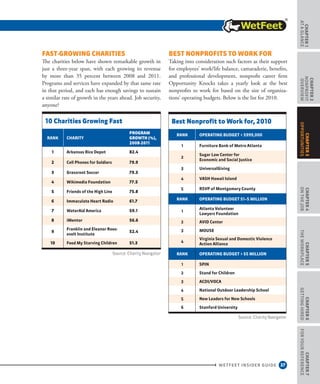
Or not.
5:00 p.m. The incoming calls and emails start to
taper off, so this is great for focused writing.
Director of Human Resources
Type of organization: International relief, state chapter

Age: 60

Years in business: 20 in human relations,
1 at this organization, 12 in nonprofits before
starting HR career

Education: BA; MBA

Hours per week: 45 to 50

Size of organization: 100 full-time employees, 1,700
volunteers

Annual salary: $80,000
What role did your education play in your
career?
At this point I don’t see that it had a lot of influence
other than from a business standpoint. I can manage
and put together a budget better than most of my col-
leagues. I can plan strategically, but a lot of that I picked

up along the way in the corporate world.
Is an MBA critical for a person to gain
those skills?
If they want to move into an executive or CEO role,
yes, it is important. Otherwise those are skills you could
learn on the job. We just interviewed someone with a
master’s degree for a position in disaster response, but
we determined that while the degree is nice, it doesn’t
equate to hands-on job experience.
How did you make the change from
for-profit to nonprofit?
I actually started my career in nonprofits, where I
worked in field management and marketing before
spending 20 years in business; most of that was for a
mutual fund company. When I decided I wanted a full-
time job again, I found this one through the newspaper.
I happened to have worked here early in my career. It’s
worked out nicely, because my plan was always to start
and end my career in nonprofits. Even though I’m not
on the front line of this organization, it does give me a
sense of pride to be involved in the work we do.
Careers in Nonprofit
42 WETFEET INSIDER GUIDE
CHAPTER1
ataGlance
CHAPTER2
nonprofit
overview
CHAPTER3
Opportunities
CHAPTER5
TheWorkplace
CHAPTER6
GettingHired
CHAPTER7
ForYourReference
CHAPTER4
OntheJob
What are the challenges of working for
a nonprofit?
The lack of resources can be frustrating. The technology
is lousy compared with what I’m used to. There’s certain
software most HR departments use, and that’s not avail-
able here.
What does it take to excel in your position?
You need to be extremely flexible and highly creative.
Sometimes you have to be confrontational. You also
need to be able to see the big picture. An organization is
much more than what’s happening inside our doors. In
that regard, the non- and for-profit worlds are not that
much different anymore.
What are some of the misconceptions
people have about working for a relief
organization?
People think they can come work here and will be sent
to exotic hot spots right away. That’s far from the reality.
People don’t realize how dangerous some of those situ-
ations are, and we’re not going to send people to those
places without experience. But that doesn’t mean you
won’t get there if that’s where you want to go.
There’s this idea that people get paid a lot of money
to work for a nonprofit. Obviously they didn’t do their
research. Lots of people also think that this is glamorous
work, and it’s not. You’re helping people, that’s true. But
it’s an awful lot of hard work.
Describe a typical day.
6:00 a.m. Wake up and take my dogs out. 

6:15 a.m. Read paper, keeping an eye out for
trends related to my job. Eat breakfast
and get ready for my day. 

8:15 a.m. At work. Check email and phone mes-
sages. Evaluate a few job descriptions.
Communicate with managers about job
evaluations. 

10:00 a.m. Employee comes into my office with an
issue. Discuss it with her. 

11:00 a.m. At my desk, do administrative work.
This includes arranging recruitment
efforts for new jobs, writing job post-
ings for the website, and communicating
with local newspapers about job ads. 

12:00 p.m. Eat lunch at my desk. I brought my
lunch. I only eat out about once per
month. 

1:00 p.m. Attend senior management meeting.

2:30 p.m. Read professional journals, newsletters,
and salary surveys. 

3:30 p.m. Support manager who is firing an
employee. 

4:30 p.m. Complete paperwork related to the firing.

5:00 p.m. Evaluate job descriptions. 

5.30 p.m. Leave the office. Spend the evening with
my husband. 

43
CHAPTER1
ataGlance
WETFEET INSIDER GUIDE
CHAPTER2
nonprofit
overview
CHAPTER3
Opportunities
CHAPTER5
TheWorkplace
CHAPTER6
GettingHired
CHAPTER7
ForYourReference
CHAPTER4
OntheJob
Culture and Lifestyle....................46
Workplace Diversity.....................46
Travel...........................................47
Compensation..............................47
Perks............................................48
Vacation.......................................48
The Inside Scoop..........................48
TheWorkplace
5
Careers in Nonprofit
46 WETFEET INSIDER GUIDE
CHAPTER1
ataGlance
CHAPTER2
nonprofit
overview
CHAPTER3
Opportunities
CHAPTER4
OntheJob
CHAPTER6
GettingHired
CHAPTER7
ForYourReference
CHAPTER5
TheWorkplace
Workplace
Diversity
› Perhaps one of the most pervasive mispercep-
tions about the nonprofit sector is that it has an ethni-
cally diverse workforce. Not so. As a survey conducted
by consultancy Nonprofit HR Solutions in 2010
revealed, the median percentage of white employees
at nonprofits totaled 80 percent. The causes vary, but
certainly the sector’s inability to attract employees of
color is significant and likely caused by chronic under-
funding of recruitment efforts and management’s
reluctance to improve the HR skills of its staff. In the
absence of strong recruitment efforts, the sector leans
heavily on word-of-mouth referrals, which means job
openings are shared within a racially homogenous
pool. For those employees of color who do enter the
sector, reports of tokenism or alienation in the work-
place are not uncommon, and some leave, maintaining
the sector’s pale cast.
Gender parity, especially as it relates to leadership, is
also skewed in nonprofits. Although the nonprofit sec-
tor features a predominantly female workforce (nearly
75 percent, according to a benchmarking report by The
White House Project in 2009), men occupy a majority
of its leadership positions. There are multiple reasons
for the imbalance, but again, recruitment is a signifi-
cant factor, as is the need to develop the talent pipeline
more keenly.
Another area in which you might encounter homo-
geneity is in the political views held by nonprofit staff.
This is caused, in part, to organizational missions. You’d
have a hard time finding pro-life coworkers if you work
for Planned Parenthood, for instance, or gun-control
advocates at the National Rifle Association.
Culture and
Lifestyle
› Head counts for a large swath of nonprofits
don’t typically exceed 50 employees, lending many
organizations the feel of a startup: informal, non-
hierarchical, and staffed by people who are emo-
tionally invested in their work. Employees in larger
nonprofits and foundations, such as the Red Cross or
the Rockefeller Foundation, which are international
and can have staffs numbering 1,000 or more, enjoy a
far more formal—even corporate—work environment.
Job duties between positions in such organizations are
more clearly delineated too, establishing a stark peck-
ing order.
However, at nonprofits of all sizes, employees feel a
kinship with the values of the organization. It’s almost
a given in a sector driven by mission, vision, and ideals,
though the focus of an organization’s work will shade its
culture a particular cast. An environmental nonprofit
will tend to attract nature enthusiasts who spend their
time at the water cooler raving about a certain national
park or outdoor sport, for instance, while a person
focused on the arts is more likely to employ former arts
students eager to discuss the latest art show or Banksy
prank.
Generally speaking, most people in nonprofits work
45 to 50-plus hours per week—and often log the odd
hours: weekends, late nights before big events, or on
deadline. The upside is, because these groups usually
have more casual work environments than a corporate
office, you might have some flexibility in your time—as
long as the work gets done.
TIP
Many well-managed nonprofits recognize
you need a life outside work, no matter how
much you love your job. Some even require
employees to take “wellness” days.
47
CHAPTER1
ataGlance
WETFEET INSIDER GUIDE
CHAPTER2
nonprofit
overview
CHAPTER3
Opportunities
CHAPTER4
OntheJob
CHAPTER6
GettingHired
CHAPTER7
ForYourReference
CHAPTER5
TheWorkplace
Average Salary of Jobs
with Related Titles
Title Average Salary
Controller/Director of finance $78,000
Executive director $60,000
Administrative assistant $30,000
Public health advisor $69,000
Director of development $62,000
Program manager $74,000
Communications assistant $37,000
Source: Simply Hired, November 2011
Travel
› A fair number of nonprofits require at least mod-
erate—and, in some cases, more extensive—staff travel.
Small grassroots and community-based organizations
won’t necessarily fit this description. But larger non-
profits, particularly those national groups with local
chapters or other affiliates, might require a fair amount
of travel, depending on your job description. Executive
directors and development directors might be required
to fly to meet with funders if under consideration for a
grant. And they are continually looking for networking
opportunities near and far to meet such funders in per-
son and pitch their programs.
Compensation
› Low pay might be the biggest drawback to work-
ing in the nonprofit sector. You will definitely make
less than you would in the for-profit world, but the
gap between the two sectors is not as stark as it used
to be, particularly for employees at foundations, where
funding is less volatile. Says one insider: “Foundations
really are trying to attract the best talent, so they want
to compensate people fairly in order to retain them.
Foundations aren’t having to raise funds or worry about
breaking even. It’s a whole different game.”
There’s a growing recognition that belief in a non-
profit’s mission will retain top talent for only so long,
particularly Generation Y employees. The people born
between the late 1970s and early 1990s leave positions
in nonprofits more frequently than their older coworkers
and, according to a study published in Public Accounting
Quarterly in 2009, value compensation more highly
than do previous generations.
There’s also rising concern about the wage gap
between men and women in nonprofits. The same study
pegged the gap at $2,000, a figure that increases the
higher a woman rises in an organization. According to
the 2009 report released by The White House Project,
female CEOs make 66 percent of what their male coun-
terparts earn, down 5 percentage points from 2000.
That’s not to say nonprofit executive directors or
CEOs aren’t sometimes compensated handsomely. In
fact, their salaries have drawn greater attention as
scandals that have plagued nonprofit accounting prac-
tices in recent years have donors questioning exactly
whose pockets their contributions are lining. Executive
directors at larger organizations can make upward of
$200,000, especially those located in the Northeast and
Middle Atlantic regions. Just don’t expect to get those
jobs without a lot of experience.
Entry-level positions are more salary-challenged.
An undergraduate starting at a nonprofit can expect to
make from $25,000 to $35,000, depending on work
experience and job title.
Average Salaries
The following data comes from Simply Hired and offers
salary benchmarks based on job postings with the word
“nonprofit” in the job listing.
TIP
The better you prove yourself to be at fund-
raising, the higher your potential pay in the
nonprofit world, regardless of your job title.
Careers in Nonprofit
48 WETFEET INSIDER GUIDE
Chapter1
aTaGlaNcE
Chapter2
NoNpRoFIT
ovERvIEW
Chapter3
oppoRTUNITIES
Chapter4
oNThEJob
Chapter6
GETTINGhIRED
Chapter7
FoRYoURREFERENcE
Chapter5
ThEWoRkplacE
pErks
› many nonProfIt emPloyees consider travel
one of the biggest perks—it can be quite competitive
deciding who gets to attend a conference in Hawaii.
Other perks include interaction with well-known pub-
lic figures, including corporate CEOs, politicians, and
other important community members. Historically,
because nonprofits have paid lower salaries than com-
panies in the for-profit sector, they’ve often offered
more generous benefits: compensatory time, more
employer-paid health insurance, and more sick-leave
days. However, as overhead costs rise and income stays
the same or decreases while competition for fewer avail-
able dollars increases, many nonprofits have had to
tighten their already too tight belts and reduce their
benefit packages.
vACATioN
› there Is no hard-and-fast rule about vacation in
the nonprofit sector. Some organizations follow policies
similar to those in the business world—two weeks a
year plus holidays. However, many nonprofits recog-
nize their employees work long, hard hours for lower
pay and choose to compensate them in other ways,
such as allowing more flexible work schedules.
ThE iNsidE sCoop
what eMPlOyees Really like
living your Passion
“You get to be who you are, not just what you do,” says
one person at a nonprofit, echoing a common senti-
ment. In other words, people working in this field find
they can fully live their values. Their job isn’t so much
work as it is a passion or a calling.
it’s the People
You’ll be working with great people. “The people I work
with are bright and committed,” says a director of a
nonprofit. It’s another common sentiment voiced by
many people we talked with. Folks at nonprofits wel-
come the opportunity to be surrounded by passionate,
like-minded individuals.
the Only Rule is…
You’ll be making up the rules as you go, at least in the
small organizations that comprise the majority of the
nonprofit sector. While that might not sound good to
someone who wants a lot of structure in his or her job,
it’s great for self-motivated, committed individuals—
people who love the flexibility to be able to apply their
best ideas to get things done.
the downward-facing dog of workplaces
A flexible work environment is one of the most appeal-
ing features of nonprofits. Many of these organizations
are less hierarchical, less bureaucratic, and less struc-
tured than their private-sector counterparts. One per-
son we spoke with says her organization brings “the
kind of environment we’re trying to promote” into the
workplace—one that relies on independent self-starters
managing their own time, rather than clock watchers
worried about face time.
you Own this Job
You’ll have considerable responsibility and ownership
of your work. One of the great things about nonprofit
49
CHAPTER1
ataGlance
WETFEET INSIDER GUIDE
CHAPTER2
nonprofit
overview
CHAPTER3
Opportunities
CHAPTER4
OntheJob
CHAPTER6
GettingHired
CHAPTER7
ForYourReference
CHAPTER5
TheWorkplace
work is that in these sometimes small and under-
resourced organizations, every hand on deck counts.
That can lead to a steep learning curve and the chance
to master new skills continuously—something many
people at nonprofits like.
Watch Out!
You Call That a Paycheck?
Low pay is typically the number-one gripe. If your heart
is where the money is, then you might want to think
twice about working for a nonprofit. Your passion for
a cause has to more than compensate for the low pay-
check in order for you to be happy in the nonprofit
arena.
Burnout
Nonprofits are often underfunded. It can be difficult to
do so much with so few resources. That, combined with
the frenetic pace of people working so hard toward a
particular goal, can make for a challenging environment.
Because the Founder Says So
The typical dysfunctions in a small nonprofit can
include lack of clear accountability, confusion about
roles and responsibilities, a dictatorial founder, poor
management, and the never-ending funding crises.
Forgoing a Life of Luxury
Cash-strapped is an adjective that can be used to describe
many nonprofits. As a result, don’t be surprised if you
find yourself green with envy when your friends in busi-
ness describe their nifty corporate intranets, and their
convenient car-service rides home when they work late,
and their free cappuccinos every morning, and…you
get the idea.
What Do You Have to Do to Get Fired
Around Here?
An insider in a large social services organization reports
that the help-all-people ethos seems to extend to capa-
bilities-challenged employees. People who would have
been promptly booted for uselessness in a corporate
environment might stay on forever in the do-good
world—and you have to work with them.
INSIDEr SCOOP
“There’s a range of management styles in
nonprofits, and you have to be able to work well
with different managers in changing situations.
You have to be a go-getter and know how to ask
for direction.”
The Recruiting Process.................52
Interviewing Tips.........................52
Getting Grilled.............................53
Grilling Your Interviewer.............53
GettingHired
6
Careers in Nonprofit
52 WETFEET INSIDER GUIDE
CHAPTER1
ataGlance
CHAPTER2
nonprofit
overview
CHAPTER3
Opportunities
CHAPTER4
OntheJob
CHAPTER5
TheWorkplace
CHAPTER7
ForYourReference
CHAPTER6
GettingHired
The Recruiting
Process
› Finding and landing your dream job in a
nonprofit might take some effort on your part. Unlike
the private sector, nonprofits are neither large enough
nor financially well-endowed enough to come looking
for you. Typically, they lack formal recruiting struc-
tures. Rather, nonprofits rely on the energy and efforts
of the job seeker—using the attractiveness of their mis-
sion as a signal light. However, some informal—but
tried and true—ways of getting your foot in the door
are available.
Volunteer
This is usually the starting point and most important
way for gaining experience in the sector. Once you’ve
found an organization you’d like to work for—or even
one that’s similar—sign on as a volunteer, even if they’re
not hiring immediately.
Intern
Spending a few months as a paid or unpaid intern in
a nonprofit is a great way to gain experience and to
see whether you like working for a nonprofit. Doing
a summer internship is a great trial run, especially if
most of your work experience is in the for-profit sector.
Likewise, if all of your experience is in the nonprofit
sector, you might want to consider a summer intern-
ship in a business, just to add to your repertoire of skills
when you go back into the nonprofit environment.
Networking  Informational Interviews
Landing a great job often depends more on whom you
know rather than what you know. Many nonprofits
hire employees out of a circle of people already work-
ing in their community for another nonprofit or as a
volunteer. So go to conferences, meet people, and get
involved! Volunteering is a great way to build your net-
work at a nonprofit you’re interested in.
Uncertain which issue you want to focus on? Get
out and talk to people in a variety of organizations until
you find the area that piques your interest. Generally
speaking, folks in this sector are “people” people and
will be glad to help if you show interest and enthusi-
asm. This is, of course, another great way to build your
network.
Also, don’t forget to use your alumni and peer net-
works—the people you know could offer a great way in
to the nonprofit of your dreams. For more on network-
ing for career success, see the WetFeet Insider Guide,
Networking Works!
Interviewing Tips
Do your homework.
It’s a good idea to look at an organization’s website and
download a copy of its annual report, or call ahead and
ask for one. You can tell a lot about an organization from
its mission statement, the language used in its literature,
and its public image. The annual report (or equivalent)
should give you a glimpse of the inner workings of the
nonprofit, with detailed information on annual budget,
program areas, board members, and the like. Also con-
sider obtaining local news clippings about the group
from your library. And if the nonprofit runs a business,
be sure to test its products or services as a consumer.
Talk to people who work there and know
what the issues are.
This is crucial. If you’ve never worked in education
reform but desperately want that job at a local charter
school, you must convince your interviewer why you
care about education. Read articles in the mainstream
TIP
The informational interview is often a
good route. The nonprofit might not have an
opening but know of an organization that
does and can refer you, so you can start
creating a network.
53
CHAPTER1
ataGlance
WETFEET INSIDER GUIDE
CHAPTER2
nonprofit
overview
CHAPTER3
Opportunities
CHAPTER4
OntheJob
CHAPTER5
TheWorkplace
CHAPTER7
ForYourReference
CHAPTER6
GettingHired
media or any new books on the topic and emphasize the
skills you bring to the job.
Think about why you want this job and
why it makes sense in the progression of
your career.
The more you’ve thought concretely about your inter-
ests, skills, and values, the more articulate you’ll be. Be
honest and direct in the interview. Many nonprofits
desperately need more employees with management
skills. Talk frankly about your relevant work experience,
your education, and all the skills you can bring to the
job. Just be careful not to oversell yourself.
Figure out if the organization has
your back.
Burnout is a real issue in the nonprofit world, and you’ll
want to know if your potential employer is as invested
in your long-term professional health as you are. Ask
about the management style there. Is your boss inter-
ested enough in how you’re doing to meet with you
regularly? Also ask about turnover. The longer staffers
stick around, the happier they probably are.
Dress the part.
In nonprofits, the dress code can vary widely. Even
if your interviewer shows up in jeans, you should
be dressed professionally without being too corpo-
rate. Women can try a pantsuit or skirt-and-jacket
ensemble that’s classy without being intimidating.
Khakis and a nice jacket are fine for guys. Use sound
judgment: What’s appropriate at a national non-
profit in Washington, DC, might be overdressed for
a grassroots, community-based organization on the
West Coast.
Ask if the position will be filled as a
flat hire.
Flat hiring means that everyone hired for a position
comes in at the same salary regardless of work experi-
ence or educational background—or gender. “Maybe I
interviewed better than someone else and could be paid
more, but at least I know my male coworker isn’t get-
ting paid more than I am when we start off,” says one
insider. “I appreciate that.”
Getting Grilled
› Some interviewers work from a script, oth-
ers wing it, and still others tailor their questions to your
particular background. Here are some questions they
might ask:
•	 Why do you want to work in this nonprofit?
•	 Where do you see yourself five or ten years down the
road?
•	 Give me an example of a time you took on a leader-
ship role.
•	 Give me an example of a time you worked as part of
a team to achieve a common goal.
•	 Are you flexible in your work style and able to play a
variety of roles to get projects done?
•	 If you’re coming from a business background: Are
you prepared to deal with a significantly different
culture, one based on a mission statement of service
to clients or citizens rather than on profits?
Grilling Your
Interviewer
› Here are some good questions to ask your inter-
viewer. Not all of them might apply to you, but most
are of general interest to anyone choosing an employer,
INSIDEr SCOOP
“You’d be amazed how many candidates don’t have
the slightest idea what a nonprofit is working on.
If you learn about a nonprofit’s work and can
discuss its mission intelligibly and enthusiastically,
you’ll improve your chances of getting hired.”
Careers in Nonprofit
54 WETFEET INSIDER GUIDE
CHAPTER1
ataGlance
CHAPTER2
nonprofit
overview
CHAPTER3
Opportunities
CHAPTER4
OntheJob
CHAPTER5
TheWorkplace
CHAPTER7
ForYourReference
CHAPTER6
GettingHired
and we’ve included some of special importance to non-
profit candidates.
•	What are the organization’s most impressive
achievements?
•	 How would you describe the culture of the organization?
•	What are the organization’s major goals for the
next few years? How does the organization measure
success? How does the organization reward success?
•	 How do you think this organization will change in
the next ten years?
•	 What kind of person does well in this organization?
•	 What have some people in this position gone on to
do in their careers?
55
CHAPTER1
ataGlance
WETFEET INSIDER GUIDE
CHAPTER2
nonprofit
overview
CHAPTER3
Opportunities
CHAPTER4
OntheJob
CHAPTER5
TheWorkplace
CHAPTER7
ForYourReference
CHAPTER6
GettingHired
Industry Lingo.............................58
Recommended Reading.............. 60
Online Resources.........................61
ForYourReference
7
Careers in Nonprofit
58 WETFEET INSIDER GUIDE
CHAPTER1
ataGlance
CHAPTER2
nonprofit
overview
CHAPTER3
Opportunities
CHAPTER4
OntheJob
CHAPTER5
TheWorkplace
CHAPTER6
GettingHired
CHAPTER7
ForYourReference
Industry Lingo
501(c)(3)
The tax code the IRS uses to identify nonprofits.
The ask
The request or appeal made for fundraising dollars. It
can occur in many forms, such as in a direct mail cam-
paign or as a question posed by a board member to a
potential donor.
At-risk
Used by nonprofits to describe socially or economically
disadvantaged individuals—people who are poor, uned-
ucated, unemployed, disabled, or belonging a minor-
ity population—who are at risk of falling through the
cracks of society.
Capital campaign
A fundraising effort directed at a specific goal, such as
growing an organization’s endowment or renovating its
buildings.
Cause marketing
A type of marketing based on the mutually beneficial
relationship between a business and a nonprofit. For
instance, a business might donate a percentage of the
profits it earns from a specific product to a nonprofit;
the positive press resulting from the donation benefits
the business.
Challenge grant
A charitable contribution made on the condition that
the funded organization will raise additional funds else-
where; this is meant to spur other potential donors to
give.
Charitable remainder trust
A legal arrangement that allows someone to make a gift
to charity but receive income from the donated prop-
erty while he or she remains alive.
Clients
The people a nonprofit aims to serve. The term is meant
to lend dignity to those receiving charity.
Community foundation
A foundation that raises funds from a variety of donors
in a community or region and generally makes grants to
nonprofit charities in the community or region.
Corporate foundation
A foundation established as a separate entity by a corpo-
ration to make charitable grants.
Endowment
A gift made by a donor or group of donors to establish
and support a particular program or facility, such as a
scholarship or an arts series. The endowment funds are
invested, the principal grows, and the income on the
investment(s) is used to run the program or facility on
an ongoing basis.
Form 990
The tax form nonprofits file annually with the IRS
that documents their financial and operational costs.
Approximately one third of nonprofits file this form.
Founderitis
A condition characterized by resistance to change or an
inability to release one’s control over an organization.
It typically afflicts the founders of nonprofits, though
for-profit board members have been known to catch it.
Sometimes called founder’s syndrome.
Independent foundation
An independent foundation usually consists of an
endowment made by a single individual or family; the
income from the endowment is used to make philan-
thropic grants.
59
CHAPTER1
ataGlance
WETFEET INSIDER GUIDE
CHAPTER2
nonprofit
overview
CHAPTER3
Opportunities
CHAPTER4
OntheJob
CHAPTER5
TheWorkplace
CHAPTER6
GettingHired
CHAPTER7
ForYourReference
In-kind gift
A donation of tangible items, such as equipment or
supplies, rather than money.
Matching grant
A grant that matches the funds provided by another
donor. Intended to stimulate donor activity.
Microfinance
Financial services, such as microlending or microcredit,
extended to communities underserviced by traditional
funding sources. In developing countries, the funds can
involve small amounts, such as a few dollars a month.
Microvolunteering
Volunteering that takes place in small increments of
time—say as little as 20 minutes—and that normally
doesn’t subject the volunteer to an application process
or training. Microvolunteering opportunities are often
posted online.
Mission statement
It’s the cornerstone of any nonprofit, summarizing the
purpose of the organization. It can serve as a useful
management tool for keeping employees on the same
page.
Operating foundation
A foundation that focuses on funding its own nonprofit
programs.
Payout requirement
The minimum amount that private foundations must
expend for charitable purposes; grant monies they dis-
burse, for example, might count toward this figure.
RFP and RFQ
Acronyms for request for proposal and request for qual-
ifications. The RFP or RFQ is a document posted by
an organization to elicit bids from providers of goods
or services for specific products or projects. Nonprofits
issue them in various situations, particularly when
receiving government funding because government
monies can’t be legally distributed unless RFPs or RFQs
have been issued.
Seed money
Funds granted to begin a program or organization.
Social enterprise
An entity that applies business principles to philan-
thropic goals. Social enterprises can be for-profit or
nonprofit ventures.
Stakeholders
All those who have an emotional or financial invest-
ment in a nonprofit, including a nonprofit’s clients,
staff, board members, and funders, as well as the sur-
rounding community.
Triple bottom line
The three criteria by which an organization may mea-
sure its success: (1) the revenue it raises, (2) the social
benefit(s) it provides, and (3) the environmental good
it does. Sometimes known as the 3Ps (profit, people,
and planet) or double bottom line if the organization
focuses on two of the three measures.
Trustee
A board member who guides the decision-making
process for grant expenditures.
Careers in Nonprofit
60 WETFEET INSIDER GUIDE
CHAPTER1
ataGlance
CHAPTER2
nonprofit
overview
CHAPTER3
Opportunities
CHAPTER4
OntheJob
CHAPTER5
TheWorkplace
CHAPTER6
GettingHired
CHAPTER7
ForYourReference
Recommended
Reading
My Life in Leadership: The Journey and
Lessons Learned Along the Way
A recipient of the Presidential Medal of Freedom in
1998, Frances Hesselbein offers a compelling memoir
of her rise from troop leader to CEO of the Girl Scouts,
which she spearheaded for 14 years before establish-
ing the Peter F. Drucker Foundation for Nonprofit
Management, now the Leader to Leader Institute. An
especially great read for those interested in studying the
path to power taken by a woman in a sector generally
spearheaded by males, despite its predominantly female
workforce.
Frances Hesselbein (Jossey-Bass, 2011)
The Future of Nonprofits: Innovate and
Thrive in the Digital Age
Nonprofits may use social media more than busi-
nesses do, but nonprofits can get even further ahead
of the curve with, say, alternative currencies or digital
channels. Authors David J. Neff and Randal C. Moss
explore some of the ways nonprofits can stoke organiza-
tional innovation in the future, drawing on a plethora
of case studies, interviews, and their own experiences in
the field to provide an attractive array of possibilities.
David J. Neff and Randal C. Moss (Wiley, 2011)
How to Become a Nonprofit Rock Star: 50
Ways to Accelerate Your Career
Climbing the ladder in the nonprofit world isn’t always
easy, especially if no one tells you where the ladder is.
This book helps you map an upward trajectory once
you’ve entered the sector and are ready to plan your pro-
fessional development.
Rosetta Thurman and Trista Harris (lulu.com, 2011)
The Networked Nonprofit: Connecting
with Social Media to Drive Change
Social media maven Beth Kanter joins author Allison
Fine to show not just why social networks are impera-
tive to nonprofit operations today, but how organi-
zations can use social media to their best advantage.
Tips and tactics from the well-respected duo earned
their effort an honorable mention for the 2010 Terry
McAdams National Nonprofit Book Award.
Beth Kanter and Allison Fine (Jossey-Bass, 2010)
Half the Sky: Turning Oppression into
Opportunity for Women Worldwide
The New York Times columnist Nicholas Kristof and
his wife make the case for investing in the health and
autonomy of women—more of whom have been killed
precisely for being female than the number of men who
have died in all the wars of the 20th century. This is
not a book about a specific nonprofit but rather how
charitable work and activism can change the world. It
includes profiles of American volunteers abroad.
Nicholas D. Kristof and Sheryl WuDunn (Vintage, 2010)
Leaving Microsoft to Change the World:
An Entrepreneur’s Odyssey to Educate
theWorld’s Children
John Wood tells the story about how he went from
being an executive at Microsoft to founding the non-
profit Room to Read, which gives the gift of education
to underprivileged children in developing countries. It’s
an inspirational book for those considering nonprofit
as a career—or shifting into nonprofit from their cor-
porate gig.
John Wood (Harpers Paperbacks, 2007)
61
CHAPTER1
ataGlance
WETFEET INSIDER GUIDE
CHAPTER2
nonprofit
overview
CHAPTER3
Opportunities
CHAPTER4
OntheJob
CHAPTER5
TheWorkplace
CHAPTER6
GettingHired
CHAPTER7
ForYourReference
Online Resources
Actions Without Borders
www.idealist.org
This international nonprofit might be best known in
America for the nonprofit jobs it posts, but it also tours
the country with career fairs and regularly publishes
reports about the nonprofit sector. See if it’s participat-
ing in a career fair near you.
Blue Avocado
www.blueavocado.org
Written in direct, jargon-free language, this online
magazine devoted exclusively to community nonprofits
reaches 50,000 subscribers every month and is a trusted
source for news about the sector.
The Chronicle of Philanthropy
www.philanthropy.com
One of the most popular journals for people working
in the nonprofit and foundation sectors. You’ll need a
subscription to access many of its articles, but it also
has a group on LinkedIn, offering a way for you to read
and join the conversations taking place among those
invested in the nonprofit and foundation worlds.
Craigslist
www.craigslist.org
You might turn to it for cheap, used bikes or your next
roommate, but because it lets cash-strapped nonprof-
its post job listings for free, Craigslist is still a go-to for
many nonprofit HR departments. Don’t overlook it in
your job search.
Devex
www.devex.com
Want to find a nonprofit job overseas? Check this
member-driven, top-rated, for-profit clearinghouse for
articles and recruiting information.
Echoing Green
www.echoinggreen.org
Echoing Green supports emerging social entrepreneur-
ship through two-year fellowships for high-impact solu-
tions to big problems.
Future Fundraising Now
www.futurefundraisingnow.com
Identified by Fast Company as one of the most influ-
ential bloggers for nonprofits when he started Donor
Power Blog in 2005, marketer Jeff Merkle continues to
make an impact with his new blog, Future Fundraising
Now.
Idealist
www.idealist.org
A social network with a robust jobs board, Idealist
“connects people, organizations, and resources to help
build a world where all people can live free and digni-
fied lives.”
LinkedIn
www.linkedin.com
Reportedly adding one new member per second, this
social network for professionals offers a way for non-
profit recruiters and other hiring managers to connect
with their peers and job seekers. Consider joining its
Non Profit  Philanthropic Job Board, an especially
active group of 12,079 members and counting.
Net Impact
netimpact.org
This is a membership-based nonprofit whose mission
is “to mobilize a new generation to use their careers to
drive transformational change in their workplaces and
the world.” Net Impact has chapters around the world
as well as educational programs, competitions, a career
center, and a well-regarded annual conference. This is a
great group to join for the networking and education it
offers idealists.
Careers in Nonprofit
62 WETFEET INSIDER GUIDE
CHAPTER1
ataGlance
CHAPTER2
nonprofit
overview
CHAPTER3
Opportunities
CHAPTER4
OntheJob
CHAPTER5
TheWorkplace
CHAPTER6
GettingHired
CHAPTER7
ForYourReference
The NonProfit Times
www.nptimes.com
News, analysis, and job listings for the nonprofit sector.
You also can follow its Twitter feed dedicated solely to
jobseekers: @nptjobs.
Opportunity Knocks
www.opportunityknocks.org
This leading source of nonprofit jobs received Best
Nonprofit Job Site in the Tom Battin Awards in
2011, so you know it’s doing many things right. Its
site doesn’t feature a widget to its Twitter account (@
OppKnocksCareer), though, so don’t forget to check
that out for up-to-the-minute announcements about
available positions and breaking news.
Philanthropy 2173
philanthropy.blogspot.com
Written by consultant Lucy Bernholz, this popular blog
offers readable analyses of current debates and emerging
trends in the foundation sector.
Skoll Foundation
www.skollfoundation.org
A nonprofit founded by Jeff Skoll that offers grants to
social entrepreneurs working in areas such as economic
and social equity, environmental sustainability, health,
institutional responsibility, peace and security, and tol-
erance and human rights.
63
CHAPTER1
ataGlance
WETFEET INSIDER GUIDE
CHAPTER2
nonprofit
overview
CHAPTER3
Opportunities
CHAPTER4
OntheJob
CHAPTER5
TheWorkplace
CHAPTER6
GettingHired
CHAPTER7
ForYourReference
The WetFeet Story
WetFeet was founded in 1994 by Stanford MBAs Gary Alpert and Steve Pollock. While exploring their
next career moves, they needed products like the WetFeet Insider Guides to guide them through their
research and interviews. But these resources didn’t exist yet—so they started writing! Since then,
millions of job seekers have used the WetFeet Insider Guides and WetFeet.com to research their next
career move.
In 2007 WetFeet became part of Universum Communications, the global leader in employer branding.
Thanks to the integration of WetFeet into the Universum group, WetFeet products are now used by
job seekers all over the world. In addition to our Insider Guides and WetFeet.com, we produce WetFeet
magazine, which features career advice tailored to undergraduate students.
 The WetFeet Name
The inspiration for our name comes from a popular business school case study about L.L. Bean, the
successful mail-order company. Leon Leonwood Bean got his start because he literally got his feet wet:
Every time he went hunting in the Maine woods, his shoes leaked. One day he set out to make a better
hunting shoe, doing such a good job that his friends lined up to buy pairs of the boots. And so L.L. Bean
was born.
The lesson we took from the Bean case? Well, it shows that getting your feet wet is the first step toward
achieving success. And that’s what WetFeet is here for: To help you get your feet wet and take the right
steps toward ever-greater career goals, whatever they may be.
If you’re driven by passion for an issue and
don’t mind sacrificing some compensation for a chance to change
the world, a career in the nonprofit sector could be the right fit. A
number of factors are conspiringto boost hiring in the sector, too.
This Insider Guide covers everything you need to know to get a job
at a nonprofit—from currenthiring trends to advice from insiders.
Profiles of real people working in the field offer an insider’s view
of opportunities at social service organizations,environmental
nonprofits, foundations, and more.
TURN TO THIS WETFEET
INSIDER GUIDE TO EXPLORE
WetFeet has earned a strong reputation among college
graduates and career professionals for its series of highly
credible, no-holds-barred Insider Guides. WetFeet’s investi-
gative writers get behind the annual reports and corporate
PR to tell the real story of what it’s like to work at specific
companies and in different industries. www.WetFeet.com
★ CURRENT TRENDS SHAPING HOW NONPROFITS
OPERATE
★ ADVICE FOR NETWORKING AND INTERVIEWING
YOUR WAY INTO A JOB
★ WHAT INSIDERS LIKE—AND DISLIKE—ABOUT
THE WORK AND CULTURE
★ PROFILES OF REAL PEOPLE WORKING IN THE
NONPROFIT SECTOR
★ A GLOSSARY OF ESSENTIAL NONPROFIT LINGO
★ THE RANGE OF NONPROFIT OPPORTUNITIES,
FROM ARTS ORGANIZATIONS TO HEALTH AND
HUMAN SERVICE AGENCIES
ISBN 978-1-58207-309-5
$ 19.95 U.S.
INSIDER GUIDE

Careers in nonprofit

  • 1.
    PROS & CONSOF NONPROFIT WORK ★ TYPICAL ROLES AND RESPONSIBILITIES ★ ON THE JOB: REAL PEOPLE PROFILES CAREERS IN NONPROFIT ★★ INSIDER GUIDE
  • 2.
    >> The WetFeetMethodology You hold in your hands a copy of the highest-quality research available for job seekers. We’ve designed the WetFeet Insider Guides to help cut down on the time you spend doing job research by doing some of the work for you. Hopefully we can make your job search as painless as possible. Each WetFeet Insider Guide is the product of hundreds of hours of in-depth research, critical analysis, and precise writing. We survey massive amounts of publicly available information and conduct dozens of in-depth interviews of rank-and-file employees who work for the companies and industries we cover. (We keep our company contacts anonymous to encourage candor.) WetFeet writers—experts at reading between the lines—speak with company recruiting staff members to make sure you get accurate information about the recruiting process, compensation, and hiring targets. We also consult countless experts, from career coaches and networking gurus to authorities on professional etiquette and personal branding, in order to provide you insight on the latest trends affecting job seekers. Each Insider Guide undergoes extensive editorial review and fact-checking to ensure that the information and writing live up to our exacting standards. And because WetFeet retains all editorial control of our Insider Guides, you can be confident you’re reading the unvarnished truth, not corporate PR. We’re eager to hear about your experiences on the recruiting front, and we welcome your feedback (both positive and negative) about our products and services. Don’t hesitate to contact us at orders@wetfeet.com. >>The WetFeet Guarantee You’ve got enough on your mind with your job search in full swing. So, if you don’t like this Insider Guide, send it back within 15 days of purchase and we’ll refund your money. Contact us at 215-546-4900 or orders@wetfeet.com
  • 3.
  • 4.
    Careers in Nonprofit WetFeet 1518Walnut St. Suite 1800 Philadelphia, PA 19102 Phone: (215) 546-4900 Fax: (215) 546-9921 Website: www.wetfeet.com Careers in non-profit 2012 Edition ISBN:978-1-58207-309-5 Photocopying Is Prohibited Copyright 2012 WetFeet. All rights reserved. This publication is protected by the copyright laws of the United States of America. No copying in any form is permitted. It may not be reproduced, distributed, stored in a retrieval system, or transmitted in any form or by any means, in part or in whole, without the express written permission of WetFeet, Inc. The publisher, author, and any other party involved in creation, production, delivery, or sale of this WetFeet Insider Guide make no warranty, express or implied, about the accuracy or reliability of the information found herein. To the degree you use this guide or other materials referenced herein, you do so at your own risk. The materials contained herein are general in nature and may not apply to particular factual or legal circumstances. Under no circumstances shall the publisher, author, or any other party involved in creation, production or delivery of this guide be liable to you or any other person for damages of any kind arising from access to, or use of, its content. All illustrations by mckibillo
  • 6.
    Careers in Nonprofit CHAPTer 3214 1 nonproFits at a glanCe 5 nonproFit oVerVieW 6 The big picture 9 The bottom line 9 breakdown 12 Trends 17 opportUnities 18 The Nonprofit Spectrum 22 Rankings 29 on the Job 30 career paths 30 key Jobs at Nonprofits 32 Real people profiles Careers in Nonprofit
  • 7.
    765 45 the WorKplaCe 46culture and lifestyle 46 Workplace Diversity 47 Travel 47 compensation 48 perks 48 vacation 48 The Inside Scoop 51 getting hired 52 The Recruiting process 52 Interviewing Tips 53 Getting Grilled 53 Grilling Your Interviewer 57 For yoUr reFerenCe 58 Industry lingo 60 Recommended Reading 61 online Resources contents
  • 9.
  • 10.
    Careers in Nonprofit 2WETFEET INSIDER GUIDE CHAPTER2 nonprofit overview CHAPTER3 Opportunities CHAPTER4 OntheJob CHAPTER5 TheWorkplace CHAPTER6 GettingHired CHAPTER7 ForYourReference CHAPTER1 ataGlance 2 WETFEET INSIDER GUIDE AT A GLANCE Opportunity Overview • Entry-level and midcareer jobs exist in just about any area of nonprofit for people with degrees in many diverse disciplines. • Internships are a great way in the door, but you’ll be interning for free. • It’s a growing field. Between now and 2018, non- profits are projected to grow 14 percent. And two studies released in 2011 forecast nonprofit hiring in 2012 to increase between 33 and 42 percent. Major Pluses • You’ll really, really care about your job. • You’ll work to make a difference on issues that matter to you. • Once in, you’ll stay in and move up. Nonprofits tend to hire internally for midcareer positions or hire candidates from other nonprofits. Major Minuses • You’ll really, really care about your job. • The pay is substantially lower than what you’d make in a similar position in the private sector. • The lack of structure in nonprofits can be challeng- ing—you’re often doing a little bit of everything. Recruiting Overview • Nonprofits generally don’t recruit but tend to have job listings on their websites, so check those regularly. • Volunteering or an unpaid internship (pretty much the same things) is often a great way to get your foot in the door and give you contacts to jump-start your career. • A stint in an organization such as the Peace Corps or AmeriCorps can make you a more attractive candidate. • Network, network, network. Often it’s who you know, not what you know, that gets you in the door, especially at foundations.
  • 11.
  • 13.
    Nonprofit Overview 2 The Big Picture..............................6 TheBottom Line............................9 Breakdown.....................................9 Trends..........................................12
  • 14.
    Careers in Nonprofit 6WETFEET INSIDER GUIDE Chapter1 aTaGlaNcE Chapter3 oppoRTUNITIES Chapter4 oNThEJob Chapter5 ThEWoRkplacE Chapter6 GETTINGhIRED Chapter7 FoRYoURREFERENcE Chapter2 NoNpRoFIT ovERvIEW ThE BiG piCTurE › on the surface, defining a nonprofit is simple: It’s an organization that generates revenues not for profit, but for the public good and so earns a tax- exempt status from the IRS. The term covers a lot of territory—everything from symphonies and chambers of commerce to homeless shelters, environmental advo- cacy groups, universities, and foundations that grant money to those very same organizations. Ah, money. By their very nature, nonprofits aren’t driven by financial motive, but that doesn’t mean finances aren’t a constant source of concern. Lacking the income consumers feed for-profit businesses, nonprof- its must seek other sources of funding, which gener- ally derive from grants provided by foundations or the government, individual donors, or fees for goods and services. (For example, a nonprofit think tank might charge for reports it produces.) Nonprofits of late have expressed keener interest in the latter type of funding, which, when approached with an entrepreneurial spirit, can offer more reliable income. Say, for instance, a nonprofit operates a suc- cessful café it also rents out for events. That organiza- tion has a source of income that isn’t as dependent upon (and that can augment) a government-funded grant, the whims of a foundation grant, or the collection of memberships from hundreds or thousands of small and corporate donors, some of whom have been hit hard by recession or other problems. But how else to characterize nonprofits? Thanks to their diversity of focus, that’s no easy task. However, there are some common elements to the third sector, as the category of nonprofits is sometimes known. (Private enterprise and government represent the first two sectors). Many who join nonprofits want to do work they feel will meaningfully impact the world or their com- munity. Waking up every day, going to work, and caring about what you do offers a significant benefit and is a powerful draw for those entering the sector. As one insider says, “I’m looking for an added motivation beyond applying technical skills: It’s the belief in what the organization stands for.” Nonprofits also tend to pay less than their private enterprise counterparts. That means they tend to attract people who really are passionate about the issue and doing good in the world. Finally, nonprofits tend to have fewer resources than private companies. That’s because they’re funded by charitable contributions and face pressure to put the money they receive into their programs rather than perks for their employees. After all, if a nonprofit attracts people because of the meaningful work they can do, the nonprofit doesn’t need to compete as hard for talent; its mission trumps things such as on-campus gyms and subsidized cafeterias that some private com- panies offer. Another important thing to know about nonprofits: A few employ hundreds or even thousands of people, but most have fewer than 50 employees. This brings opportunity and challenges. Smaller staff sizes mean less management and, frequently, inexperienced managers who have grown up in the organization. (Nonprofits have a tendency to promote from within.) It also prizes resourceful individuals who are self-starters, not to mention those able and willing to wear multiple hats. One insider says: “In nonprofits, you have to be smart
  • 15.
    7 CHAPTER1 ataGlance WETFEET INSIDER GUIDE CHAPTER3 Opportunities CHAPTER4 OntheJob CHAPTER5 TheWorkplace CHAPTER6 GettingHired CHAPTER7 ForYourReference CHAPTER2 nonprofit overview andfigure things out on the run. You can’t say, ‘That’s not in my job description.’ You need to be self-moti- vated because the quality of managers varies, and you can’t rely on a person to provide clear direction or over- see deadlines.” Some people thrive in these conditions, but they’re not for everyone. Pathways into Nonprofits As you might expect, the types of opportunities at non- profits are as diverse as the types of nonprofits, and there are opportunities for everyone, from entry-level employees to midcareer or executive career changers. One sure path into nonprofits is to work on fun- draising. Nearly all nonprofits need to raise money, through grants or donors, and not everybody is good at it. If you’re a proven grant writer, a terrific schmoozer, or come with a network of high-net-worth contacts, you’re likely to have your pick of where to work. Entry-level jobs at nonprofits are numerous but tend to be low paying and, in some areas, hard to get. That’s because a lot of qualified people want to work on some key popular issues or high-profile nonprofits, and smaller nonprofits don’t do that much hiring. Many entry-level nonprofit jobs are administrative, although even in an administrative position you’ll usually have a chance to wear other hats. Other roles, including many in social services, can be easier to get, but are very chal- lenging thanks to heavy workloads and emotionally difficult work. Those with a strong background in a subject area or technical skills can find a wide range of opportunities. Somebody with a strong science background, for exam- ple, might find a job at a research nonprofit, such as the Howard Hughes Medical Institute, which supports bio- medical research; or the Institute for OneWorld Health, which acts as a kind of nonprofit pharmaceutical com- pany, seeking affordable treatments for neglected infec- tious diseases; or at Earthwatch Institute, researching climate change or the declining ocean health. Other roles for scientists might be in educational nonprofits or hospitals. And those with tech skills, in programming or IT, are in demand across most types of nonprofits. Holders of MBAs can find management- or exec- utive-level position at nonprofits—examples include working at a nonprofit focusing on microfinance, devel- opment, or researching how the financial sector can better help poor households, such as at the Financial Access Initiative, which works to expand access to qual- ity financial services for low-income individuals. Nonprofits are increasingly hiring people with busi- ness strategy expertise into roles such as overseeing the future direction of City Year, which exposes young peo- ple to a year of full-time service, or guiding one of many programs at the African Wildlife Foundation, which works to conserve wildlife and protect lands in Africa. “Being strategic about grant-making and being able to analyze, make improvements, and demonstrate results is becoming more important for funders and nonprofits alike,” one insider tells us. A Brief History of Nonprofits Between 1998 and 2008, the number of registered nonprofits in the United States rose from 1.16 million to 1.51 million, a 30 percent increase. Today the sec- tor employs nearly 11 million workers. It’s the third largest workforce in America, behind only the manu- facturing and retail sectors—and that’s not counting the contribution of its many volunteers. Clearly, the nonprofit market has grown to a formidable size not easy to ignore. In nonprofits, you need to be smart and flexible because there are unpredictable situations, and often it’s a small staff and you may have to wear different hats.
  • 16.
    Careers in Nonprofit 8WETFEET INSIDER GUIDE CHAPTER1 ataGlance CHAPTER3 Opportunities CHAPTER4 OntheJob CHAPTER5 TheWorkplace CHAPTER6 GettingHired CHAPTER7 ForYourReference CHAPTER2 nonprofit overview The Obama administration says “no.” In 2009 it proposed capping the rate at which high-income tax- payers can take itemized tax deductions at 28 percent, down from 35. The cap is projected to raise $318 bil- lion in ten years and remains a fraught topic among a divided Congress. Supporters of the proposal say it will limit excessive deductions taken by abusers of the current system; opponents say it will lower amounts of charitable giving. Whatever the result, one thing is certain: The non- profit section will continue to play a prominent role in American society. In fact, the outlook for nonprofit jobs is very positive. The Outlook for Nonprofit Jobs The nonprofit sector continues to mount a cautious recovery after suffering lower charitable giving rates and slashed government funding during the global fiscal contraction. According to studies released in 2011 by career cen- ter Idealist and nonprofit consultancy Nonprofit HR Solutions, hiring is on the rise. Of 3,000 respondents to the Idealist survey, 42 percent planned to hire for new positions and only 9 percent planned to reduce staff. Of 450 respondents polled for the second survey, 33 per- cent planned to create new positions and the majority expected no change to their staffing rolls. The figures suggest the nonprofit sector is begin- ning to warm—job seekers, burnish your resumes! The Bureau of Labor Statistics predicts the sector will only continue to grow, particularly as the popula- tion ages and the elderly require more direct services. Organizations responding to both surveys say posi- tions in direct/program services are first on their recruiting lists in the year ahead, with fundraising next on the list for both surveys. Why has it gotten so big? The answer goes back to the post-World War II years, when the American government established a set of domestic programs. Many applauded these programs for providing a neces- sary social safety net; others claimed they resulted in “a welfare state” that unnecessarily coddled citizens while unfairly asking the public to foot the bill for this indul- gent caretaking. Social welfare spending also competed against private investment, critics argued, pointing to sluggish global economic growth in the 1970s. A decade later, the conservative administration of Ronald Reagan took the criticisms to heart and slashed government social spending. The private sector—espe- cially nonprofits, said the president—would respond by taking over the duties that federal agencies for the socially underprivileged had shouldered. As the government began shuttering more and more social services, the populations who needed them—the poor, the sick, the elderly—floundered. Frustrated and indignant, various groups did as Reagan predicted and established organizations that addressed the gaps in services caused by the admin- istration’s policies. Their efforts coincided with rapid improvements in communications technologies; fiber optics networks, fax machines, the Internet, and, later, smartphones and social networks allowed fledgling groups to mobilize and organize more easily, contributing to the proliferation of nonprofits. Now the sector’s size raises concern among those alarmed by a tax code that defines nonprofit so broadly that it sanctions the creation of groups such as Save Your Ass Long-Ear Rescue, a Vermont-based donkey and mule refuge, and the Red Nose Institute, a char- ity that sends red clown noses to American military personnel serving abroad. Critics point out that giv- ing such organizations tax-exempt status cost the federal government more than $50 billion in lost tax revenue in 2008. In the uncertain economic climate of today, they ask, can the U.S. government afford to regulate nonprofits as loosely as it has in the past?
  • 17.
    9 CHAPTER1 ataGlance WETFEET INSIDER GUIDE CHAPTER3 Opportunities CHAPTER4 OntheJob CHAPTER5 TheWorkplace CHAPTER6 GettingHired CHAPTER7 ForYourReference CHAPTER2 nonprofit overview TheBottom Line › If you’re driven by passion for an issue, care about making a difference in the world, and don’t mind sacrificing some compensation for the chance to change the world, the nonprofit sector could be the perfect place for you. Nonprofits offer opportunities to work on virtually any type of issue you care about—from local, state, and federal policy issues to homelessness, education, international relief, and more. The nonprofit sector has seen phenomenal growth for almost half a century, and there’s no indication the growth will lessen; plus in 2012, hiring is expected to rise. Those interested in the sector can expect more jobs to become available in the near future. Especially bright are oppor- tunities for those with technical skills in the digital space. Also, drawbacks traditionally associated with the sector (poor compensation and little to no professional develop- ment) might be lessening somewhat as nonprofits seek to emulate certain traits of for-profit businesses, such as competitive pay and performance-based recruiting. Unlikely to change is the sector’s commitment to the collective good, the bottom-line definition that has always attracted its best and brightest.You too can join those ranks. Not sure yet which sector calls to you? The gener- alizations in the following table will help you compare business, government, and nonprofit careers. Breakdown Nonprofits A nonprofit is an organization that generates revenues not for profit, but for the public good and so earns a tax-exempt status from the IRS. In other words, its sur- plus funds don’t go to dividends or reinvestment, but to fund its operations. However, nonprofits are not just one type of organization; the U.S. tax code provides close to thirty definitions for such groups, which fall under the 501(c) designation. These include: • 501(c)(1): Corporations organized under an act of Congress, including federal credit unions • 501(c)(3): The most common form; Includes religious, educational, charitable, scientific, literary, prevention of cruelty to children or animals, and several other types of organizations • 501(c)(4): Includes civic leagues, social welfare organizations, and local associations of employees • 501(c)(7): Includes social and recreational clubs • 501(c)(13): Cemetery companies • 501(c)(15): Mutual insurance companies • 501(c)(16): Includes cooperative organizations • 501(c)(26): State-sponsored organizations providing health coverage for high-risk individuals Business vs Government vs Nonprofit Careers Category Business Government Nonprofit Compensation Highest Middle Lowest Hours Highest Lowest Middle Amount of bureaucracy Some Lots Variable Pace of work Fastest Slowest Middle Amount of employee oversight Some High Low Diversity of responsibilities Some Low High Job security Low High Medium
  • 18.
    Careers in Nonprofit 10WETFEET INSIDER GUIDE CHAPTER1 ataGlance CHAPTER3 Opportunities CHAPTER4 OntheJob CHAPTER5 TheWorkplace CHAPTER6 GettingHired CHAPTER7 ForYourReference CHAPTER2 nonprofit overview Foundations Foundations occupy a distinct place in the nonprofit world as grant-making bodies. There are two types: private and public. Private foundations generally trace their revenue to one source, be it an individual (the J. Paul Getty Trust), a family (the Bloomberg Family Foundation), or a corporation (Verizon, which backs the Verizon Foundation). In contrast, public foundations, such as the Cleveland Foundation, dedicated to helping the lives of residents of Greater Cleveland, gather their monies from diverse sources that can include individual donors, government agencies, and private foundations. Some public foundations, like other nonprofits, also gener- ate income by collecting fees on services or goods they provide. Foundations made close to $45 billion in grants in 2010 and managed more than $600 billion in assets, according to the Foundation Center’s 2011 report “Key Facts on Mission Investing.” So, foundations play a key role in the nonprofit sector. Foundations often support other nonprofits directly and are on the front lines of positive social change. But they also have tangible advantages. As employers, they’re known to pay better and offer better benefits; as a result, foundation jobs are more competitive and scoring one is, quite frankly, often dependent on whom you know. Social Enterprises Neither foundation nor nonprofit in most cases, social enterprises are a new player in the third-sector scene. They’re ventures that seek social and financial returns, and they promote a new way of solving social prob- lems, one that’s faster, more focused, and on firmer footing. One of the better-known examples is for-profit footwear company TOMS Shoes, which donates one pair of shoes to a child in need for every pair it sells. In just four years, the company sold enough shoes to distribute to one million children worldwide. Those figures suggest that narrowly targeted, entrepreneur- ial endeavors can produce results quickly, all without expending time or effort on the uncertain outcomes of grant applications or donor relationships. Of course, some social enterprises do court donors (or investors, as the entrepreneurially minded say), and they are legally established as nonprofits, such as Charity: Water, an organization that delivers clean water to more than one million underserved people in 17 countries. By applying modern business know-how, such as a slick marketing campaign and a facility in all available platforms, to its operations, the charity grew more than 100 percent in the first quarter of 2011 compared to the same quarter the year before. Examples such as TOMS Shoes and Charity: Water share a common characteristic of social enter- prises: charismatic individuals at their helm. Labeled social entrepreneurs, these leaders tend to display com- pelling personalities coupled with business smarts; although the combination is often winsome, the more faint-hearted worry about the long-term prospects of organizations so dependent upon the leadership and reputation of a single individual. Because many social enterprises are still very young, it’s still too early to tell whether such fears are justified. INSIDEr SCOOP “Working for a large foundation is not that different from working for a Fortune 500 company. They’re looking for the best talent to drive their goal.”
  • 19.
    11 CHAPTER1 ataGlance WETFEET INSIDER GUIDE CHAPTER3 Opportunities CHAPTER4 OntheJob CHAPTER5 TheWorkplace CHAPTER6 GettingHired CHAPTER7 ForYourReference CHAPTER2 nonprofit overview B-Corporations,l3Cs, and PRIs: The Alphabet Soup of Social Enterprises The law has yet to catch up to the fast-moving world of social enterprises, but it might be getting close. In 2011 the state legislatures of New York and Massachusetts entertained regulations that would allow benefit cor- porations (often referred to as B-corps) to be established legally, potentially joining four other states in recog- nizing a new kind of business entity: a for-profit that’s obligated to stakeholders (rather than shareholders) and principles of social benefit. As of late 2011, the 471 B-corps represented nearly $2.25 billion in revenues and included such diverse businesses as the Mendocino Wine Company; Spotlight Solar, a solar energy installation company; Sleeping Lady Mountain Resort, a hotel in Leavenworth, Washington; gDiapers, which makes earth-friendly diapers; and Satori Capital, a buyout firm. Added to the mix of hybrid organizations are low- profit limited liability corporations or L3Cs. Yet another blend of for- and not-for-profit entities, these differ from B-corps businesses mainly in their taxation model, which is more flexible. L3Cs can put tax deductions ahead of profits while B-corps businesses must balance the two better. L3Cs also can qualify as program-related investments (PRIs), which are investments with social benefits that further a foundation’s mission, allowing them to receive funding from grant-making foun- dations. Maine’s Own Organic Milk Company, or MOOMilk, a consortium of organic dairy farmers, is one business certified as an L3C in Maine, which joined states such as Utah and Wyoming in recognizing L3Cs. Not everyone is a fan of the hybrid businesses. Some nonprofit executives worry that they’ll add even greater competition for foundation dollars, and some attorneys and policy wonks fear L3Cs will lower fiduciary standards. It remains to be seen what L3Cs, B-corps, and PRIs spell for the sector’s future. When Nonprofits Die The breakneck speed at which nonprofits establish themselves overshadows the handful that close— not because of poor management or lack of funds, but because their services are no longer needed. That’s right: Some orga- nizations right the wrongs they worked to overcome and then quietly leave the non- profit space. Perhaps the high- est profile nonprofit set to shut down is Malaria No More. The organization formed in 2006 to reduce dramatically the number of deaths in malaria zones. In a small span of years, the nonprofit has raised public aware- ness about the issue, lobbied policymakers to push malaria to the top of their agen- das, and distributed bed nets in malaria- prone areas, its most effective tactic for achieving its mission. Nearing its end, Malaria No More will join organi- zations, such as Water Advocates and Out2Play, that have closed because their founders and boards believed they had met their goals. While such occurrences are too few to call a trend, they offer proof to those who enter the nonprofit field to cure societal ills that some humanitarian battles really can be won.
  • 20.
    Careers in Nonprofit 12WETFEET INSIDER GUIDE CHAPTER1 ataGlance CHAPTER3 Opportunities CHAPTER4 OntheJob CHAPTER5 TheWorkplace CHAPTER6 GettingHired CHAPTER7 ForYourReference CHAPTER2 nonprofit overview Trends The Business-Savvy Nonprofit The greatest trend to impact the third sector in recent years has been a pronounced emphasis on the inte- gration of for-profit business practices into nonprofit operations. This has occurred on macrolevels and microlevels as nonprofits increasingly run their orga- nizations like businesses, incorporating revenue-gen- erating models that lessen nonprofits’ dependence on unstable funding sources and recruiting more employ- ees with business or finance backgrounds. On the macrolevel, this trend is found in nonprofits’ pursuit of diversified funding streams, with more find- ing ways to earn their own income. Take, for example, Housing Works in New York City. The nonprofit, which works to end homelessness and AIDS through advocacy and lifesaving services, also proudly markets its entrepreneurial initiatives, which include catering services, multiple thrift shops, and an online auction, as well as a thriving bookstore and café in the city’s SoHo neighborhood. A new breed of philanthropists is also putting pres- sure on nonprofits to become more business-savvy. No longer content with calling their contributions dona- tions, today’s philanthropists prefer to call them invest- ments, with backers seeking to support a nonprofit’s growth capital in addition to just specific programs. One example of an organization heeding that approach is the Nonprofit Finance Fund (NFF), which created NFF Capital Partners in 2006 to leverage what NFF calls philanthropic equity: capital or capacity that leads to a nonprofit’s sustained growth. The organiza- tion’s portfolio now features success stories such as Ashoka’s Changemakers and VolunteerMatch, which grew its total budget 21 percent in three years with the help of NFF Capital Partners’ capacity-building funds. The trend toward a more business-oriented non- profit has nonprofit boards focusing more on perfor- mance metrics for staff. One insider says: “There’s a tendency for applicants to put their passions first, but there’s nothing that allows you to have weaker skills just because there’s a cause involved. That’s the biggest mistake people make when they leap into nonprofits. They think it’s about passion when it’s really about the implementation of knowledge and mastery to a wider goal that furthers a mission.” ICU: Treating Transparency Ills in Nonprofits The emphasis nonprofits are placing on business prin- ciples finds its twin in the public’s growing inter- est in just how nonprofits operate. This trend exists in part because of scandals involving the sector in recent years—think of the ACORN (Association of Community Organizations for Reform Now) fiasco during President Obama’s campaign, when employees of the nonprofit were caught on tape advising under- cover journalists on the finer points of sex trafficking. These scandals have eroded public trust in organizations that claim to do good. That trust was further jeopar- dized in 2008, when a report released by four professors Passion creates a problem in a marketplace when it churns out applicants who don’t have the skills to back the position they’re applying for. TIP With nonprofits placing greater stress on staff performance, job seekers should call out specific metrics around their achievements during an interview. If you spearheaded bud- get cuts in your organization, for example, share details and identify the savings that resulted from your initiative
  • 21.
    13 CHAPTER1 ataGlance WETFEET INSIDER GUIDE CHAPTER3 Opportunities CHAPTER4 OntheJob CHAPTER5 TheWorkplace CHAPTER6 GettingHired CHAPTER7 ForYourReference CHAPTER2 nonprofit overview whostudy nonprofit accounting estimated that $40 billion in nonprofit funds—or 13 percent of charitable giving—was lost to fraud and embezzlement annually. Statistics like that give philanthropists pause, and nonprofits have responded by implementing indepen- dent audits on a regular basis and watching more care- fully for possible conflicts of interest between board members and transactions made in the charity’s name, as well as by developing ethical codes and policies that lay out expectations for a variety of actions, such as business travel. Such tactics are meant to bolster public trust in nonprofits, which also struggle with public skepti- cism regarding employee compensation, especially at the executive level, where salaries can reach $300,000. Nonprofits must balance public and donor expecta- tions, which put a priority on program and mission goals over administrative overhead (where salaries are calculated), with marketplace realities: Top talent is increasingly commanding higher pay. The sector’s turn toward for-profit ideals helps in that regard because funders are beginning to recognize that a nonprofit’s success is predicated on the quality of its staff. Competing in the Digital Age According to Nora Ganim Barnes, coauthor of a 2010 study released by the Center for Marketing Research at the University of Massachusetts Dartmouth, 97 per- cent of nonprofits engage in social media, surpassing for-profit usage. And according to Blackbaud’s Online Giving Report, charitable donations in the digital space for organizations of all sizes increased by almost 35 per- cent in 2010. Then there’s the Arab Spring, made up of grassroots revolutions in the Middle East sparked in part by exchanges between activists participating in the social networking sites Twitter and Facebook. Few now question the power of the Internet to facilitate deep social change. This recognition has spawned a host of nonprofits jobs related to the digital space. Online content manager, associate web producer, and director of digital market- ing are just some of the titles you’ll find listed in the nonprofit sector. And, as one newbie in multimedia production says: “I don’t think my foundation would have hired someone my age if it hadn’t been such a new field. They would’ve been able to attract someone with 25 years of experience, no problem. I had an opportu- nity to get my foot in the door because I had as much experience as someone older.” Another insider says: “It’s easier for young people to make inroads in the media field. This is an area where you may not have to slave away as an intern for years before you get hired.” Generation Y vs the Baby Boomers: Job Competition Heats Up With unemployment holding steady at about 9 percent since 2008, competition for work in all industries has remained fierce, with the nonprofit sector seeing new kinds of job seekers among its applicants. It has, for instance, entertained queries from a greater number of experienced business professionals, especially finan- Chatting Your Ear Off: Nonprofits and Social Media In summer 2011, Craig Newmark, founder of Craigslist, and his team at Craigconnects (http://craigconnects. org/), a site that aims to link the world for the common good, studied the social media presence of various nonprofits. Did nonprofits with the highest revenue use the medium most effectively? After studying the behavior of nonprofits in the digital space in August and September of that year, the team concluded no. A nonprofit’s revenue doesn’t boost its visibility or interactivity in social media, and, when you consider social media is about facilitating dialogue, that augurs well for longevity in the online world.
  • 22.
    Careers in Nonprofit 14WETFEET INSIDER GUIDE CHAPTER1 ataGlance CHAPTER3 Opportunities CHAPTER4 OntheJob CHAPTER5 TheWorkplace CHAPTER6 GettingHired CHAPTER7 ForYourReference CHAPTER2 nonprofit overview ciers laid off in the early part of the recession. Would-be retirees also are entering the nonprofit market; sated by a lifetime of work in the for-profit world, baby boom- ers are seeking second careers in fields that allow them to give back to their communities. They’re joined in their pursuit of nonprofit work by millennials unable to find jobs in the for-profit sector. (Millennials are those born more or less from the late 1970s to the late ’90s.) In fact, according to data provided by the American Community Survey, 11 percent more young college grads secured work in the nonprofit sector in 2009 than the year before. These numbers and trends make for a more crowded job pool long thought to be the home of small, not- so-fast swimming fish. With former or would-be for- profit applicants entering the market, human resources departments are seeing a wider set of skills featured on resumes—but technically skilled job seekers would be wrong to overvalue their abilities. As one insider told us: “A lot of times we get calls from people saying, ‘I worked for this ad agency, and I can do this function,’ and we explain we have professional staff who do that. They assume we don’t have people who can do things, that we’re not professional.” Failing to recognize the importance of an organiza- tion’s mission is another misstep made by some people transitioning from the for-profit to nonprofit sector. “This guy came from the for-profit finance world, and he had a hard time understanding that we didn’t want to evict every nonpaying tenant,” says one insider who specializes in low-income housing. “We are not will- ing to raise the rent on populations that can’t afford it. Applicants really have to understand how important the mission is to the nonprofit.” Over There: Nonprofits Abroad To many interested in the nonprofit sector, dashing overseas to rescue a child orphaned in a natural disas- ter is the stuff of glamour and the fulfillment of a life’s dream. Stats suggest it’s a popular dream: Between 1998 and 2008, the number of international development and disaster-relief nonprofits nearly doubled, with their revenues tripling in the same period. The founders of those organizations must’ve known there was a will- ing army of workers ready to tackle the very real needs posed by communities in the world’s least developed nations or in areas struck by natural disaster. Certainly, many established nonprofits offer inter- national opportunities—Habitat for Humanity and the Red Cross, for example, work across borders. Temper your enthusiasm for such jobs with a dose of realism, though: Competition for positions that take employees abroad is among the most fierce in the nonprofit sec- tor, says one insider. “A lot of young people really want those jobs. It’s the right time for them to go overseas because they don’t have families to support.” But if you don’t have dual nationality or a valid work permit for another country, it might be very hard to become a direct employee of an international agency registered in another country. Perhaps one of the most obvious international orga- nizations for U.S. citizens to work for is the United Nations—but it’s tough to get hired there too. Luckily, a number of other international relief agencies and international nonprofits are based in the United States; for starters, peruse the 50 top nonprofits listed on the following page. And if you really want an experience in cultural immersion, a two-year commitment to the Peace Corps might be just the ticket.
  • 23.
  • 25.
  • 26.
    Careers in Nonprofit 18WETFEET INSIDER GUIDE CHAPTER1 ataGlance CHAPTER2 nonprofit overview CHAPTER4 OntheJob CHAPTER5 TheWorkplace CHAPTER6 GettingHired CHAPTER7 ForYourReference CHAPTER3 Opportunities The nonprofit spectrum › Nonprofits operate in a wide range of areas. The descriptions of the many subsectors of nonprofit opportunities below are designed to open your mind to possibilities in areas you might care a lot about and in other areas in which you didn’t know such cool stuff was happening. Use this information as a starting place for your job search. As you figure out what nonprofit sector you’re interested in, create parameters for your search. Define the city or cities you’d consider working in, the type or types of organizations you’d most like to work at, and the issue area or areas you want to focus on. Then, begin collecting the names of organizations that fall within these parameters. In The Recruiting Process section in Chapter 6, we offer a number of suggestions for interviewing and find- ing your way to opportunities at nonprofits. These all start with networking: talking to your friends, your par- ents friends, your friends of friends, people from your alumni group, members of student and professional organizations you belong to, strangers you meet on the bus, people you meet through LinkedIn, Google+, and Twitter, and cold calls or direct contacts you make. Once you’ve identified people working at organiza- tions you think you might like to join, do informational interviews to determine if your hunch about where you want to work and what you want to do is right—and to learn more about organizations you’re interested in. The purpose of this book is to get you pointed in a direc- tion, but nothing substitutes for real-world interactions with people working in a field you think you might like to join. Arts, Culture, and Humanities Nonprofits in the arts, culture, and humanities offer a range of services and programs. Work at one of these organizations and you might find yourself perusing old photographs to feature in an exhibit planned by the Oregon Historical Society or coordinating volun- teers for the fundraising drive that fuels much of the operations of the listener-supported, noncommercial radio station WFMU in New Jersey. This category also includes organizations such as ProPublica, a nonprofit newsroom that publishes stories in the public interest, and New York Foundation for the Arts, which posts job listings and event notices for artists, distributes grant money, and advocates on artists’ behalf. Education Education is the second largest nonprofit subsector after human services in terms of number of organiza- tions. Education also is the second largest in terms of revenue and assets, accounting for 18.5 percent of rev- enue and 32.2 percent of assets, which includes physi- cal property (think college campuses) and endowment assets, for all nonprofits. (Endowments can be size- able; Harvard University’s stands at $26 billion.) Education comes in at second in one other category: percentage of charitable contributions. In 2009, 13.2 percent of all donations were funneled to education- related nonprofits. Chalk that figure up to the sway of effective letters sent by your college’s alumni office, but don’t overlook the numerous organizations and social enterprises working to improve the educational landscape. Teach for America, for example, recruits recent college grads for two-year teaching stints in underserved commu- nities across America. The brainchild of social entre- preneurship Wendy Kopp, the organization offers TIP Many people working at nonprofits have Twitter accounts. Search Twitter to find those working at organizations you’re interested in or on issues you care about and start following them. You’ll learn their interests and get links for things to build your knowledge, and you can even start up a conversation that could be the precursor to an informational interview—or even a job interview.
  • 27.
    19 CHAPTER1 ataGlance WETFEET INSIDER GUIDE CHAPTER2 nonprofit overview CHAPTER4 OntheJob CHAPTER5 TheWorkplace CHAPTER6 GettingHired CHAPTER7 ForYourReference CHAPTER3 Opportunities trainingto undergrads before helping to place them in local community schools, differing from a B-corps such as EduCare, which operates in the digital space. Providing online tutoring to all grades and college students, EduCare also donates books and school supplies to children in need for every tutoring ses- sion completed. Job seekers who land a position at the company might find themselves tutoring SAT English online or approaching school officials as sales reps hoping to sign a university for at least a one-year deal. Environment and Animals Nonprofits that address the environment and ani- mals aren’t as numerous as other charities, but they do register in the public consciousness, with groups such as The Nature Conservancy, the World Wildlife Fund, and the Trust for Public Land placing in the top 50 of nonprofit brands. Indeed, in a study of nonprofits acting in the social media landscape, The Nature Conservancy logged the third most number of comments on Facebook, suggesting the organization enjoys an active relationship with its audience. But environmental and animal-focused nonprofits obviously do a lot more beyond engaging the public through social media. They spearhead a variety of important programs, such as buying forests or award- ing research grants to scientists studying ways to con- serve our most threatened landscapes. The Save the Redwoods League, for instance, spent $60 million in 2002 to purchase 25,000 acres of redwood forest in Del Norte County in an effort to preserve redwoods in the Mill Creek area of California. No More Homeless Pets in Utah applies business smarts to its marketing by putting homeless animals in the way of average Americans—literally. The orga- nization took a space donated by a local mall and turned it into a pet store that looks exactly like oth- ers in the mall, except all its pets are from shelters and can be adopted. The World Wildlife Fund, with its black-and-white panda logo, might have name recognition, but it’s organizations such as No More Homeless Pets that are leading the way with out-of- the-box thinking that brings potential supporters to big box retail. Health No question about it, nonprofits in this category, which include hospitals and groups that award scien- tific research grants, boast the highest percentage of revenues and assets among all nonprofits, accounting for 56.7 percent of revenues and 38.6 percent of assets. Executive directors in this subsector also post the high- est salaries among all nonprofit workers. For example, the CEO of Partners HealthCare, which manages a group of nonprofit hospitals in Boston, earned $3.4 million in 2008. But although nonprofit hospitals account for more than half of all hospitals in the United States, inte- grating them into the daily experience of numbers of Americans, there are many health-related nonprofits that seek to impact lives in such a way as to avoid hospital visits altogether. Consider PATH in Seattle: The organization features an A-Z list of its projects, including improvements to condoms for women (the project is in clinical trials); immunizing populations in Asia against Japanese encephalitis, virtually unheard of in industrialized nations but a sad fact of life in Asian countries; and a roadside outreach effort in east Africa to target truckers and other mobile workers who have higher rates of transmitting the AIDS virus. Or take the Guttmacher Institute, an established nonprofit since 1977 regularly recognized for its contributions to the national policy agenda around sexual and reproductive health. And, there is Heartland CARES, which provides services to HIV-infected individuals while raising awareness of issues their constituents face. Human Services The big daddy of the third sector, human-services non- profits offer the most career paths for you to wander simply because there are so many of these organiza-
  • 28.
    Careers in Nonprofit 20WETFEET INSIDER GUIDE CHAPTER1 ataGlance CHAPTER2 nonprofit overview CHAPTER4 OntheJob CHAPTER5 TheWorkplace CHAPTER6 GettingHired CHAPTER7 ForYourReference CHAPTER3 Opportunities tions. Most got their start during the Reagan years, when cuts in government spending for social welfare programs created gaps in service for the needy. Today, when so many are still jobless in the gloomy eco- nomic climate, the subsector remains an active part of the nonprofit picture, with surveys of HR staffs putting direct client service jobs at the top of their list of positions to fill in 2012. That means places such as Our Place, a Washington, DC-based private nonprofit, might have an opening for a case manager, or Good Shepherd Services in New York City might need to hire a therapeutic crisis worker. Those aren’t the only kinds of human service jobs. Groups such as EARN, which connects low-income families to economic tools, need financial coaches to provide financial management training to partici- pants of its innovative microsavings program, while a nonprofit such as Community Voice Mail, which offers free 24-hour voicemail accounts to those in crisis, might be looking for another body to offer IT help. Again, human services is the largest subsector of nonprofits, so there’s no shortage of organizations to explore. The Bureau of Labor Statistics predicts it’ll only grow larger in the years to come, as America’s elderly population is set to increase dramatically, causing demand for services to spike. International and Foreign Affairs This area represents the smallest number of nonprof- its—but is also the fastest growing. More organizations form to address global issues each year. Some of the largest and more established among them—UNICEF, for example—have region-specific initiatives and so hire for specific areas of the world. Wrote your thesis on diets in Afghanistan? Medair, which brings life-saving relief to conflict zones and disaster areas, might have a spot for you as a nutrition adviser in Afghanistan. Or perhaps you feel compelled to step into a role at the International Rescue Committee, which responds to humanitarian crises around the world (and it was formed at the behest of Albert Einstein). International opportunities are not limited to time- specific situations, such as rebuilding efforts in commu- nities after an earthquake or hurricane has struck. They also include organizations hoping to influence foreign policy by issuing white papers or convening influential policymakers; the Academy for Genocide Prevention has done this. Foundations with foreign offices, such as the Rockefeller Foundation or the Bill Melinda Gates Foundation, also engage in more long-term ini- tiatives; the latter, for instance, created a nearly $900 million trust fund dedicated to helping small farmers in India and sub-Saharan Africa. The fund has introduced microirrigation practices to 100,000 farmers in India, a move that has allowed many to almost double their income. Public and Social Benefit Although almost all nonprofits could be a public and social benefit, the designation is meant to stand in for that group of professional associations, civic organiza- tions, and similar bodies that function as nonprofits but are not likely to be the first or second names the average Joe would call out when pressed for examples of nonprofits. These include tenant associations, labor unions, or professional groups, such as the National Society of Black Engineers, which works with and for its members to increase the number and success of black professionals in the engineering field through activities such as networking events and conferences. Labor unions also work on behalf of their members, representing them in disputes with employers and negotiating favorable terms at the bargaining table. Fraternal organizations such as the Shriners or Lions Club are yet another set of nonprofits that fit here, as are your brother’s Little League team, your mother’s beloved Green Party, and the chamber of commerce your father is always grumbling about.
  • 29.
    21 CHAPTER1 ataGlance WETFEET INSIDER GUIDE CHAPTER2 nonprofit overview CHAPTER4 OntheJob CHAPTER5 TheWorkplace CHAPTER6 GettingHired CHAPTER7 ForYourReference CHAPTER3 Opportunities Religion-related Despitebeing almost the smallest subsector of all non- profits (only international and foreign-affairs nonprof- its are fewer), religion-related organizations took in a third of all private donations in 2009. You might be thinking here of the donation baskets passed around your church, synagogue, or temple, but religion- related nonprofits also include organizations such as Catholic Charities, which places in the top ten power brands. The nationwide organization has locations throughout the United States and features a range of program interests from adoption to low-income hous- ing solutions. The Christian nonprofit Habitat for Humanity, on the other hand, has a macrofocus (it’s an international organization) and a microaspect (it zeroes in on housing to the exclusion of other issues that challenge the poor); its religious activities fall somewhere in between the two. Foundations Foundations are special a type of nonprofit. (That’s why foundations have endowments.) You can find them across subsectors. Some, such as the Information Technology Innovation Foundation, are narrowly focused on a specific subject such as technology; oth- ers, such as the San Francisco Foundation, are targeted toward a specific locale; and still others, such as the Rockefeller Foundation, address a variety of issues, such as—in the case of the Rockefeller—global health, urbanization, climate change, and food security. Jobs at foundations typically pay better and have better benefits than other nonprofits. The workload is also easier, some say, perhaps because they’re bet- ter funded and, as a result, better staffed. As a result, more job seekers are attracted to these positions, mak- ing competition for them more fierce. Connections within an organization are reportedly the best method for getting your foot in the door, so consider vol- unteering for a foundation or networking at events organized by the Council on Foundations or the Association of Small Foundations. Social Enterprises Social enterprises aren’t a subsector, but they offer a work environment where you’re working to solve a problem, albeit typically using for-profit business mod- els for their organizational structure. Because they pri- oritize the collective good over financial profit, a job at one means working toward social change in a lot of different ways. That’s because social enterprises, like foundations, address a range of issues. Social enterprise DoSomething, for example, aims to get more teens to volunteer. It exhibited its business chops in a big way when it introduced an initial public offering (IPO, or stock market launch) in 2008. The company also dis- plays a playful side, listing among its staff positions, Head of Fun. Another social enterprise manufactures goods for profits it uses to help sex-trafficking victims find jobs: Hello Rewind in New York uses old T-shirts to make custom laptop sleeves. Such startups begin small and need help—in 2010 Hello Rewind listed just three employees, but its unexpected success had the founders looking for ways to expand the operation not long after—so you may be able to walk in and pitch your own job. Just don’t assume such organizations are unprofessional. Focused on positive monetization, such outfits look for staff with business smarts and nonprofit hearts. And who knows, a job at one might lead you to catching the entrepreneurship bug and starting your very own social enterprise. How’s that for finding a job? Social enterprises begin small and need help, so you may be able to walk in and pitch your own job.
  • 30.
    Careers in Nonprofit 22WETFEET INSIDER GUIDE CHAPTER1 ataGlance CHAPTER2 nonprofit overview CHAPTER4 OntheJob CHAPTER5 TheWorkplace CHAPTER6 GettingHired CHAPTER7 ForYourReference CHAPTER3 Opportunities Rankings › The following tables provide a list of some of the largest charities and foundations, a list of the fastest-growing nonprofits, a list of some of the best nonprofits to work at, and a list of some of the more reputable nonprofits. Use these lists to get a view into some of the bigger nonprofit organizations that are out there as well as places that might be hiring or are just plain great places to work. Largest Charities by Revenue The size and depth of the nonprofit sector can be overwhelming, and it can be helpful to learn in bite- size chunks just what’s out there. Here we start with a list of the top 50 charities by revenue. The grouping reminds us that, despite the sector’s size, it’s highly fragmented. Top 50 Charities by Revenue Rank Nonprofit Headquarters 2010 Revenue ($M) 1 Lutheran Services in America Baltimore 16.61 2 Mayo Clinic New York 7.97 3 UPMC Group Pittsburgh 6.63 4 YMCA National Council of the USA Chicago 5.84 5 Catholic Charities Alexandria, VA 4.27 6 United Way Alexandria, VA 4.13 7 Goodwill Industries International Rockville, MD 3.68 8 The Arc of the United States Washington, DC 3.66 9 New York-Presbyterian Hospital New York 3.31 10 Cleveland Clinic Foundation Cleveland 2.98 11 American National Red Cross Washington, DC 2.95 12 Salvation Army Alexandria, VA 2.87 13 Memorial Sloan-Kettering Cancer Center New York 2.68 14 Mount Sinai New York 2.34 15 Children’s Hospital of Philadelphia Philadelphia 1.87 16 Boys Girls Clubs of America Atlanta 1.47 17 Children’s Hospital Boston Boston 1.37 18 Habitat for Humanity International Americus, GA 1.35 19 Texas Children’s Hospital Houston 1.28 20 Easter Seals Chicago 1.23
  • 31.
    23 CHAPTER1 ataGlance WETFEET INSIDER GUIDE CHAPTER2 nonprofit overview CHAPTER4 OntheJob CHAPTER5 TheWorkplace CHAPTER6 GettingHired CHAPTER7 ForYourReference CHAPTER3 Opportunities RankNonprofit Headquarters 2010 Revenue ($M) 21 World Vision Federal Way, WA 1.22 22 AmeriCares Foundation Stamford, CT 1.19 23 Feed the Children Oklahoma City 1.19 24 Boy Scouts of America Irving, TX 1.13 25 Smithsonian Institution Washington, DC 1.12 26 Food for the Poor Deerfield Beach, FL 1.09 27 Planned Parenthood Federation of America New York 1.03 28 City of Hope Duarte, CA 945 29 Volunteers of America Alexandria, VA 917 30 American Cancer Society Atlanta 897 31 Dana-Farber Cancer Institute Boston 816 32 Catholic Relief Services Baltimore 777 33 Lucile Packard Children’s Hospital at Stanford Palo Alto, CA 751 34 Feeding America Chicago 722 35 CARE USA Atlanta, GA 692 36 Girl Scouts of the USA New York 651 37 Children’s Memorial Hospital Chicago 624 38 Cape Cod Healthcare Hyannis, MA 603 39 Nature Conservancy Arlington, VA 595 40 Children’s Hospital Los Angeles Los Angeles 547 41 Campus Crusade for Christ Orlando, FL 509 42 Compassion International Colorado Springs, CO 507 43 Scripps Research Institute La Jolla, CA 503 44 Public Broadcasting Service Alexandria, VA 492 45 United States Fund for UNICEF New York 487 46 St. Jude Children’s Research Hospital Memphis, TN 481 47 Gifts in Kind International Alexandria, VA 479 48 Operation Blessing International Relief Development Virginia Beach, VA 473 49 American Heart Association Dallas 464 50 Save the Children Federation Westport, CT 455 Source: National Center for Charitable Statistics
  • 32.
    Careers in Nonprofit 24WETFEET INSIDER GUIDE CHAPTER1 ataGlance CHAPTER2 nonprofit overview CHAPTER4 OntheJob CHAPTER5 TheWorkplace CHAPTER6 GettingHired CHAPTER7 ForYourReference CHAPTER3 Opportunities Foundations by Asset Size As the lists above and below indicate, the largest non- profits and foundations tend to concentrate in the states with the highest populations, putting the greatest num- ber of the sector’s jobs along the coasts. Job seekers not located on the East or West coasts (or with no desire to move to either) will find Nonprofitjobs.org and phi- lanthropy.com the best sites for job postings for orga- nizations in the middle of the country. However, keep in mind that the majority of third-sector organizations have a local focus, so you might be better off visiting the sites of nonprofits found in your area. Top 50 U.S. Foundations by Asset Size Rank Foundation (State) Assets ($) As of Fiscal Year Ending 1 Bill Melinda Gates Foundation (WA) 33,912,320,600 12/31/09 2 The Ford Foundation (NY) 10,881,598,073 9/30/10 3 J. Paul Getty Trust (CA) 9,584,879,219 6/30/10 4 The Robert Wood Johnson Foundation (NJ) 8,490,415,783 12/31/09 5 The William and Flora Hewlett Foundation (CA) 7,377,414,000 12/31/10 6 W. K. Kellogg Foundation (MI) 7,238,160,845 8/31/10 7 The David and Lucile Packard Foundation (CA) 5,699,231,606 12/31/09 8 The John D. and Catherine T. MacArthur Foundation (IL) 5,237,796,061 12/31/09 9 Gordon and Betty Moore Foundation (CA) 5,200,576,871 12/31/09 11 The Andrew W. Mellon Foundation (NY) 5,184,625,647 12/31/10 12 Tulsa Community Foundation (OK) 5,051,530,000 12/31/09 13 The William Penn Foundation (PA) 4,412,774,000 12/31/09 14 The California Endowment (CA) 3,699,471,841 12/31/09 15 The Leona M. and Harry B. Helmsley Charitable Trust (NY) 3,376,044,793 03/31/10 16 The Rockefeller Foundation (NY) 3,317,100,678 03/31/10 17 The Kresge Foundation(MI) 3,293,222,730 12/31/09 18 Robert W. Woodruff Foundation, Inc. (GA) 2,694,449,754 12/31/10 19 The Annie E. Casey Foundation (MD) 2,564,720,003 12/31/10 20 The Duke Endowment (NC) 2,480,075,314 12/31/09 21 Carnegie Corporation of New York (NY) 2,432,582,536 9/30/09
  • 33.
    25 CHAPTER1 ataGlance WETFEET INSIDER GUIDE CHAPTER2 nonprofit overview CHAPTER4 OntheJob CHAPTER5 TheWorkplace CHAPTER6 GettingHired CHAPTER7 ForYourReference CHAPTER3 Opportunities RankFoundation (State) Assets ($) As of Fiscal Year Ending 22 Walton Family Foundation, Inc. (AR) 2,275,851,898 12/31/09 23 The Susan Thompson Buffett Foundation (NE) 2,241,538,887 12/31/09 24 Foundation to Promote Open Society (NY) 2,239,745,868 12/31/09 25 The Bloomberg Family Foundation, Inc. (NY) 2,234,800,686 12/31/09 26 John S. and James L. Knight Foundation (FL) 2,090,000,000 12/31/10 27 Charles Stewart Mott Foundation (MI) 2,080,000,000 12/31/09 28 Conrad N. Hilton Foundation (CA) 1,972,613,697 12/31/09 29 The Harry and Jeanette Weinberg Foundation, Inc. (MD) 1,970,134,173 12/31/10 30 Casey Family Programs (WA) 1,935,207,121 12/31/09 31 Kimbell Art Foundation (TX) 1,912,884,895 12/31/09 32 Margaret A. Cargill Foundation (MN) 1,907,998,965 12/31/09 33 The McKnight Foundation (MN) 1,892,752,694 12/31/09 34 The Cleveland Foundation (OH) 1,888,630,534 12/31/10 35 Richard King Mellon Foundation (PA) 1,839,427,098 12/31/09 36 Ewing Marion Kauffman Foundation (MO) 1,758,735,170 12/31/09 37 Silicon Valley Community Foundation (CA) 1,749,109,000 12/31/09 38 The New York Community Trust (NY) 1,741,811,259 12/31/09 39 John Templeton Foundation (PA) 1,689,804,911 12/31/09 40 Eli Edythe Broad Foundation (CA) 1,689,097,000 12/31/10 41 Alfred P. Sloan Foundation (NY) 1,620,997,612 12/31/09 42 The Annenberg Foundation (CA) 1,602,260,949 6/30/09 43 Doris Duke Charitable Foundation (NY) 1,558,663,265 12/31/09 44 The Simons Foundation (NY) 1,547,314,964 12/31/09 45 The Chicago Community Trust (IL) 1,503,434,485 12/31/09 46 The James Irvine Foundation (CA) 1,449,193,495 12/31/09 47 Houston Endowment Inc. (TX) 1,427,657,870 12/31/09 48 The Heinz Endowments (PA) 1,373,427,000 12/31/09 49 The Moody Foundation (TX) 1,322,323,251 12/31/09 50 The Starr Foundation (NY) 1,284,340,846 12/31/09 Source: The Foundation Center
  • 34.
    Careers in Nonprofit 26WETFEET INSIDER GUIDE CHAPTER1 ataGlance CHAPTER2 nonprofit overview CHAPTER4 OntheJob CHAPTER5 TheWorkplace CHAPTER6 GettingHired CHAPTER7 ForYourReference CHAPTER3 Opportunities In Good Standing: Nonprofits on the Up-and-Up With public confidence in nonprofits shaken by scan- dals, it’s important to know which nonprofit brands still maintain good standing in the public eye. In 2009, marketing firm Cone LLC and Intangible Business, a UK brand-valuation firm, analyzed organizations offer- ing social, environmental, and animal-related services to see which ranked highest in terms of brand value and information important to nonprofits and donors alike. Cone Nonprofit Power Brand Rank Organization Industry subsector Brand value ($M) 1 YMCA of the USA Education/youth 6,393.6 2 The Salvation Army Domestic social needs 4,702.9 3 United Way of America Domestic social needs 4,516.9 4 American Red Cross Domestic social needs 3,146.2 5 Goodwill Industries International Domestic social needs 2,534.8 6 Catholic Charities USA Domestic social needs 2,361.1 7 Habitat for Humanity International Domestic social needs 1,768.0 8 American Cancer Society Health 1,359.8 9 The Arc of the United States Health 1,223.6 10 Boys Girls Clubs of America Education/youth 1,168.3 11 Easter Seals Health 922 12 American Heart Association Health 897.8 13 Boy Scouts of America Education/youth 851.2 14 Planned Parenthood Federation Domestic social needs 796.4 15 Feed the Children Domestic social needs 767.5 16 Food for the Poor International needs 698 17 Girl Scouts of the USA Education/youth 636.1 18 St. Jude Children’s Research Hospita Health 626.5 19 The Nature Conservancy Environmental/animal 625.4 20 World Vision International needs 519.3 Source: Cone LLC, Intangible Business
  • 35.
    27 CHAPTER1 ataGlance WETFEET INSIDER GUIDE CHAPTER2 nonprofit overview CHAPTER4 OntheJob CHAPTER5 TheWorkplace CHAPTER6 GettingHired CHAPTER7 ForYourReference CHAPTER3 Opportunities BestNonprofit to Work for, 2010 Rank Operating Budget $999,000 1 Furniture Bank of Metro Atlanta 2 Sugar Law Center for Economic and Social Justice 3 UniversalGiving 4 VASH Hawaii Island 5 RSVP of Montgomery County Rank Operating Budget $1–5 million 1 Atlanta Volunteer Lawyers Foundation 2 AVID Center 3 MOUSE 4 Virginia Sexual and Domestic Violence Action Alliance Rank Operating Budget $5 million 1 SPIN 2 Stand for Children 3 ACDI/VOCA 4 National Outdoor Leadership School 5 New Leaders for New Schools 6 Stanford University Source: Charity Navigator Fast-Growing Charities The charities below have shown remarkable growth in just a three-year span, with each growing its revenue by more than 35 percent between 2008 and 2011. Programs and services have expanded by that same rate in that period, and each has enough savings to sustain a similar rate of growth in the years ahead. Job security, anyone? Best Nonprofits to Work For Taking into consideration such factors as their support for employees’ work/life balance, camaraderie, benefits, and professional development, nonprofit career firm Opportunity Knocks takes a yearly look at the best nonprofits to work for based on the size of organiza- tions’ operating budgets. Below is the list for 2010. 10 Charities Growing Fast Rank Charity Program Growth (%), 2008-2011 1 Arkansas Rice Depot 82.4 2 Cell Phones for Soldiers 79.9 3 Grassroot Soccer 79.3 4 Wikimedia Foundation 77.5 5 Friends of the High Line 75.8 6 Immaculate Heart Radio 61.7 7 WaterAid America 59.1 8 iMentor 56.6 9 Franklin and Eleanor Roos- evelt Institute 52.4 10 Feed My Starving Children 51.3 Source: Charity Navigator
  • 37.
    OntheJob 4 Career Paths................................ 30 KeyJobs at Nonprofits................ 30 Real People Profiles......................32
  • 38.
    Careers in Nonprofit 30WETFEET INSIDER GUIDE CHAPTER1 ataGlance CHAPTER2 nonprofit overview CHAPTER3 Opportunities CHAPTER5 TheWorkplace CHAPTER6 GettingHired CHAPTER7 ForYourReference CHAPTER4 OntheJob Career Paths › A typical career path at a nonprofit is, well, not typical. In the small nonprofits that make up the vast majority of the sector, staffers are often asked to wear many different hats, so job titles don’t necessarily reflect all the tasks completed for any given position. That can be challenging; some report feeling overwhelmed and unprepared for the duties assigned to them. But, it also presents an opportunity for employees to broaden their skill sets. Sometimes, this experience can lead to a quick, vertical climb up the ranks. However, there can be a lot of horizontal move- ment if you’re not careful. Unlike the for-profit sector, where there’s more emphasis on professional develop- ment, nonprofits tend to direct their resources toward their missions, not staff. That’s largely because of donor concerns; donors generally want their contributions directed toward causes, not staff development or com- pensation. In a survey of 3,000 nonprofits conducted by job center Idealist, 65 percent of respondents said zero dollars were expended toward their professional development in 2010. In addition, nonprofits are 11 percent less likely to promote staff than their for-profit counterparts, according to a paper published in Industrial and Labor Relations Review in 2007. These factors put the responsibility on you to be the architect of your career. Says one insider: “In for- profits, you get a lot more mentoring, and there’s a path to promotion. In nonprofits, if you want a promotion, you likely aren’t going to get it in the same organization. You have to move to a different organization.” That said, there’s room at the top, with managerial and executive-level positions being some of the most popular listed on the Idealist job board in 2010. They’re also some of the most difficult to recruit, according to the Idealist survey. Motivated, ambitious job seekers take note! Key Jobs at Nonprofits › There isn’t one, must-have degree for people wanting to work at a nonprofit. While many execu- tive directors have advanced degrees in business, just as many have backgrounds in public affairs and social sciences. However, degrees or certificates in nonprofit management are becoming more common among non- profit executives, so you might consider further educa- tion if you’re interested in a supervisory or managerial role. The nonprofit sector is deep and wide, with a range of possible jobs. We’ve compiled a list of some of the most typical, but remember: Positions vary from place to place, so a program director at a small nonprofit doesn’t necessarily do the same work as a program direc- tor at a big organization such as the Red Cross. Executive Director The executive director is the equivalent to that of CEO in business and reports directly to the board of direc- tors. He or she is financially accountable for the organi- zation, oversees all strategic planning and management, and might be involved with other duties, including, depending on the size of the nonprofit, fundraising and development, board development, hiring, media rela- tions, program development, and just about anything else that needs to be done. Program Director In larger nonprofits and a handful of small ones, a tier of midlevel management is needed. Duties include oversight and management of a specific program or programs, often including hiring personnel, fundrais- ing, public relations, and all other administrative and management duties specific to the program areas. The program director usually reports directly to the execu- tive director.
  • 39.
    31 CHAPTER1 ataGlance WETFEET INSIDER GUIDE CHAPTER2 nonprofit overview CHAPTER3 Opportunities CHAPTER5 TheWorkplace CHAPTER6 GettingHired CHAPTER7 ForYourReference CHAPTER4 OntheJob Directorof Development and Fundraising This position is the mainstay of all nonprofit organiza- tions. The development director is responsible for rais- ing the funds necessary to support the organization’s budget. The job includes things such as writing grant proposals, soliciting government funding, managing direct-mail campaigns and individual donor solicita- tion, creating and conducting fundraisers and other events, arranging a fee-for-service or fee-for-product revenue source, and, increasingly, coming up with and implementing creative partnerships with businesses. Director of Finance and Operations This person manages all accounting and operations. This usually includes grant administration, manage- ment of personnel issues, and serving on the manage- ment team. As more nonprofits recognize they cannot maintain public credibility without keeping their own house in scrupulous order, they are hiring CFOs and the like. In some organizations, the person in charge of finances is called the comptroller (or controller). And some larger nonprofits have a director of opera- tions, to whom the director of finance and a director of human resources report. In most cases, however, the chief financial person, whatever the actual title, reports directly to the executive director as part of senior man- agement. Manager of Information Systems A typical nonprofit might function on 10-year-old PCs and have neither the money nor human resources to upgrade. But nonprofits are establishing themselves in the digital space more and more, and are hiring IT experts and developers to do it. If technology is your thing, you can have a huge impact. Communications Assistant/Director Depending on the size of the organization, commu- nications might be handled by a more senior or more junior staff member. Either way, duties usually entail editing and producing a newsletter, writing press releases, managing other communications projects, dealing with the media, and an assortment of other public relations activities. Overseeing an organization’s online presence—its website or social media profile, for instance—falls to this individual or team too. Program Assistant This position is just what it sounds like—you’ll be doing all of the number-two work on whatever the program is. A notch above administrative help, you’ll probably still have to shoulder a fair amount of rou- tine work in addition to trying your hand at more sub- stantive tasks. For the entry-level job seeker, it’s a great way to learn about an issue and work closely with your supervisor. Event Coordinator You know this job is for you if you were the first to sign up for prom committee in high school or you were your fraternity’s social chairman. Event coordination requires good organizational ability and logistical skills, lots of patience, and a devotion to getting every last detail correct. Director of Volunteers In nonprofits that run on the sweat of volunteer labor, this is a critical position. Duties might include recruit- ing and training volunteers, managing volunteer proj- ects, database management, and related tasks. INSIDEr SCOOP “At a nonprofit, you are one part diplomat and one part ambassador. Not everyone is able to handle that well. Some speak their minds at the wrong time; other people don’t speak up when it’s required. It’s a subtle skill.”
  • 40.
    Careers in Nonprofit 32WETFEET INSIDER GUIDE CHAPTER1 ataGlance CHAPTER2 nonprofit overview CHAPTER3 Opportunities CHAPTER5 TheWorkplace CHAPTER6 GettingHired CHAPTER7 ForYourReference CHAPTER4 OntheJob Real People Profiles Community Organizer Type of Organization: Social change Age: 24
 Years in business: three
 Education: BA, political science 
 Hours per week: 40 to 70
 Size of organization: 11 staff, 300 volunteers 
 Annual salary: $33,000 What does a community organizer do? We identify leaders from different institutions, identify what changes they would like to see made in their com- munity, and help facilitate a way for those leaders to make the changes. Within my organization, I focus on education. I go to school meetings and meet with par- ents who we think would be good community leaders, as well as teachers and school administrators who are interested in working for change. Can you give me an example of a successful project? Sure. A few years ago a large number of local par- ents said they were concerned about overcrowding in schools. Our goal is to always strategize a tangible solu- tion. So we organized some key leaders—parents and teachers—and met with the CEO of Chicago Public Schools. In that meeting, parents gave testimonies and made demands about why the area needed more and newer schools. We just finished up the first year in a new building that came to be as a result of that activism. What are some drawbacks of what you do? Sometimes the hours are pretty grueling. But that only starts to bother you when you’re tasked with stuff like writing a grant or other administrative duties that are not fun and require a lot of time. In the middle of a campaign, when people are really excited and there’s lots of energy, you don’t mind long hours because you feel like what you’re doing is more than a job. Does the low salary ever get you down? It hasn’t gotten me down because I’m younger and able to do that. If I stick to it, there’ll be the possibility for promotions, and lots of executive directors make high salaries. What is the next career step for you? The next logical position would be lead organizer at this or another organization. As I gain more experience and get better at what I do, I might feel comfortable being an executive director. But I’m not sure that will be for me—executive directors work even more hours, and their duties are even more administrative. What kind of person excels at this kind of work? You can be trained on all aspects of organizing, but a lot of things really need to be part of your personality. You need to feel comfortable talking with people one- on-one, and really make people feel comfortable around you. You also need good instincts. You can develop that over time, but you need to be able to think outside the box—figure out how to strategize and who will be good leaders for their communities. You also have to be pretty tough. There can be lots of tension between lead- INSIDEr SCOOP “Community organizing is a concrete way to bring about systemic social change. I don’t know of any other job that gives people the opportunity to do that.” TIP As nonprofits boost their digital presence, tech-savvy employees are in demand. This includes those with tech skills as well as social media mavens. If you have a cause, and digital expertise, this is a prime time to contact orga- nizations doing what you believe in.
  • 41.
    33 CHAPTER1 ataGlance WETFEET INSIDER GUIDE CHAPTER2 nonprofit overview CHAPTER3 Opportunities CHAPTER5 TheWorkplace CHAPTER6 GettingHired CHAPTER7 ForYourReference CHAPTER4 OntheJob ersand elected officials, and you can’t ask for what you want nicely because that’s not what power is about, and you have to make sure officials don’t take advantage of you. If you’re shy or not comfortable talking to people you don’t know, then organizing might not be for you. What are some aspects of the job that some people starting out do not understand? A lot of people don’t even know that community orga- nizing exists. You can’t get a degree in organizing, and when I meet people at a party, a lot of them don’t understand what I do. A lot of my friends and family think I’m a social worker. So if you can’t study this at school, how do you get involved in organizing? In my case, I had been introduced to community organizing while I was a junior in college, when I was involved in a local group that worked on community health-care issues, and I really got into it. Through that I found an internship program in which I learned even more, and from that I made contacts with all kinds of organizations in my city. I kept in touch with them over the next year, and when I was ready to find a job, one of these contacts let me know about an open opportu- nity. Community organizers have degrees in all kinds of things—chemistry, English. Some people get involved while they’re in college and drop out to work. That doesn’t affect their pay or promotions. Describe a typical day. 8:30 a.m. Wake up. I check my personal email, make my lunch for the day, and look at the newspaper online. Spend a few extra minutes on the education section. Tidy up my apartment. 
 10:30 a.m. Arrive at the office. Check my email and voicemail, and open the to-do list I have open on my desktop at all times. Return a few messages. 
 11:30 a.m. Go to local coffee shop for one-on-one meeting with a parent I met recently to discuss their third-grade daughter’s experience in the school, as well as the family’s immigrant experience. (The interview is in Spanish; my parents are Argentinean and I am bilingual.) Ask what issues she feels are important in the schools, and she says better teacher com- munication. I take notes. 
 12:30 p.m. Lunch at my desk.
 1:00 p.m. Meeting with my organization’s youth organizer—many of his issues relate to stuff I’m doing. 
 2:30 p.m. More email and a little down time to do some research. 
 3:00 p.m. School council meetings at a local school. I give the principal and key par- ents an update on our organization.
 5:30 p.m. Another parent meeting in my office. 
 7.15 p.m. Attend a big meeting of a coalition of organizations on health-care issues. Even though I’m an education organizer, this relates to some of my projects. I give a couple of leaders a ride there, but my main function is to support them and make sure they have good backup. 
 9:00 p.m. Go out and get drinks with friends.
 11:00 p.m. At home, enjoying some alone time. 
 12:00 a.m. Bed.
  • 42.
    Careers in Nonprofit 34WETFEET INSIDER GUIDE CHAPTER1 ataGlance CHAPTER2 nonprofit overview CHAPTER3 Opportunities CHAPTER5 TheWorkplace CHAPTER6 GettingHired CHAPTER7 ForYourReference CHAPTER4 OntheJob Outreach worker II, LGSW (Licensed Graduate Social Worker) Type of organization: Community health clinic
 Age: 31
 Years in business: four
 Education: MA, social work 
 Hours per week: 40
 Size of organization: 200
 Annual salary: $43,000 Is an advanced degree critical for the work you do? Yeah, absolutely. Depending on the state, you can get an associate’s degree and maybe be a case manager. In some agencies, you have to have a bachelor’s and then the next thing is to get your master’s. You have to have that to have a social work title. Oftentimes, you have to be licensed in order to be hired, especially in medical fields (hospitals, things like that). For a long time, social work wasn’t thought of as a science, so there’s a lot of education and certifications you have to have to qualify. What’s the biggest disadvantage of your work? Burnout. People entering the nonprofit world need bet- ter education around that, especially social workers. The most common things that lead to burnout are not feel- ing a sense of mastery, or being overwhelmed by issues like the expectations around the number of clients you meet with or working with people who have a lot of traumatic experiences. And the pay! Nobody is shocked to find out that social workers don’t make a lot of money, so if you want a higher salary, move into admin. That’s where you’re going to make more money. So why pursue this line of work? That’s a good question. The past two weeks have been so stressful, but the thing it comes down to is that, even on a bad day, I can still feel good about my job. Before, when I was in retail, if I had a good day, great, I sold a lot of clothes and pushed consumerism forward, but in my job now, I can look back and think I’ve done something productive, something that serves the greater good. So, it can be very meaningful work. You just have to constantly look for the positives, because a lot of it is really negative and at times you don’t succeed. What makes a social worker feel successful? Well, with social work, there can be concrete, clini- cal goals. So, for instance, I might help a low-income individual who’s HIV positive get insurance. I help them apply and get approved for a program to pay for their HIV meds because you can’t talk to them about becoming a healthier person if they don’t have housing or insurance or food. Connecting them to those ser- vices and helping them develop as a person—that can be very good. Describe a typical day. 7:50 a.m. Leave home for the bus stop. The wait for the bus can be 10 to 40 minutes. 8:45 a.m. Arrive at the office and grab coffee at the café downstairs before listening to voice- mail and reviewing patient charts and my schedule for the day. There’s a lot of emotional burnout, especially if you do direct client work, where not every client you work with is going to be a superstar turnaround. You can’t listen to awful stories every day.
  • 43.
    35 CHAPTER1 ataGlance WETFEET INSIDER GUIDE CHAPTER2 nonprofit overview CHAPTER3 Opportunities CHAPTER5 TheWorkplace CHAPTER6 GettingHired CHAPTER7 ForYourReference CHAPTER4 OntheJob 9:15a.m. See patients on clinic shifts. This can involve meeting a variety of their needs: financial assistance, medication issues, scheduling appointments, or helping them access community-based services, such as finding transitional housing or legal aid. 12:45 p.m. Lunch with colleagues. I try to do this every day, even if it’s just for 15 minutes, for my own mental health. Strongly rec- ommended! 2:10 p.m. Meet with patients who are part of my 60-plus caseload. 4:00 p.m. Attend our weekly departmental meet- ing and my individual clinical supervi- sion, which goes toward becoming a licensed clinical social worker. 5:30 p.m. Finish up my day. It’s Friday, so I’m going out for drinks with my coworkers. This is my time to vent, which is great, because other social workers aren’t fazed by venting like people outside the field. It’s also nicer for my family and other friends! 7:00 p.m. Get home and decompress. Make din- ner with my husband. Maintaining good personal relationships recharges me. 11:00 p.m. Go to sleep and try not to have work- related dreams. I’m down to one a week. Multimedia producer Type of organization: Global private foundation
 Age: 26
 Years in business: two
 Education: BFA, studio art 
 Hours per week: 45
 Size of organization: 1,000
 Annual salary: $60,000–80,000 What does a multimedia producer do? I produce all sorts of multimedia content—from videos to interactive infographics—for the website. I work in the communications department, so the goal is to get the word out to our target audience about what we do, but I also do a lot of stuff that’s for internal use as well. I’m the first person to have this job at my founda- tion. A lot of other nonprofits and foundations are following suit, but it’s a relatively new phenomenon to create it as a department, which I’m doing. What’s the outlook for multimedia opportunities in the nonprofit sector? You know, so much of the work—videography, edit- ing, or animation—is done by freelancers, and that isn’t likely to change because the people at the top of their game creatively, like a great editor, want the freedom to work on different projects. They’re making a good enough day rate that we’d have to make them a really attractive in-house offer. Perhaps the idea of benefits or having a stable nine-to-five gig would be attractive to someone who is a little older or has a family, but I think a lot of people wouldn’t necessarily want to go in-house. Why did you then? I was happy freelancing and I enjoyed the freedom it afforded me, but I was looking for a little more sta- bility and benefits, and I wanted to build my career in an organization and work in a team. That’s some- thing I really enjoy, and the strategy element that goes with building a multimedia department. That may not be the case for a lot of producers who enjoy making
  • 44.
    Careers in Nonprofit 36WETFEET INSIDER GUIDE CHAPTER1 ataGlance CHAPTER2 nonprofit overview CHAPTER3 Opportunities CHAPTER5 TheWorkplace CHAPTER6 GettingHired CHAPTER7 ForYourReference CHAPTER4 OntheJob content and bouncing from client to client, but I was attracted to the prospect of seeing how the multime- dia decisions the organization makes now will play out over time. Are there any downsides? Working with different clients when you’re freelance is exciting. Also, working within a nonprofit as large in size and stature as the one I’m in brings with it a more corporate environment. It’s a lot more political, and there’s a lot more hierarchy involved. You need to learn to navigate that, and if you’re in-house, you don’t have the option of turning down less exciting projects. I get to do all the cool projects like interview Jimmy Carter and Gloria Steinem, but I also have to do the little projects for HR, like making a welcome video for the president. What does it take to succeed in your field? It requires a broad mix of skills. You don’t necessarily work with multimedia or Web experts, so you have to be a proselytizer and get them on your team, explain why this work is important and essential to the organi- zation, and help them help you. On the other side, you need to deal with freelance production people and be able to deliver amazing products, so you have to have creative and organizational chops. As a producer, too, I need to know a little bit about a lot of aspects of pro- duction. I know how to edit or shoot, but I’m not great at it: I hire the people who are experts. So, if you go for a production position, you need production experience. A lot of organizations are looking for a one-man band who can do everything, but I think it’s rare to find a person like that. Describe a typical day. 8:00 a.m. Wake up and get ready for work. 8:50 a.m. Take the subway into the city. 9:30 a.m. Get off the train and grab a coffee from Starbucks. There’s coffee at the office, but they make Peet’s and I like Starbucks. Check email when I get to my desk. 10:30 a.m. Short check-in with my colleagues about work we have in progress. 11:00 a.m. Go to the set for the video we’re shoot- ing about one of the foundation’s grant- ees. I’m interviewing some bigwigs and am nervous. 1:00 p.m. The interviews went well! I hadn’t worked with the shooter before, but he did a good job with the lighting. Time for lunch. 1:45 p.m. Sit with a freelance editor I’ve worked with many times. We cut a video I want to post to the site next week. 3:00 p.m. Research music to use for the video we just cut and work on preproduction for upcoming shoots. 4:30 p.m. Attend meetings and fire off emails in between each one. Producing means coordinating a lot of different freelancers, which means a lot of emails. 6:30 p.m. Leave the office. I’m the first person to have this job at my foundation.
  • 45.
    37 CHAPTER1 ataGlance WETFEET INSIDER GUIDE CHAPTER2 nonprofit overview CHAPTER3 Opportunities CHAPTER5 TheWorkplace CHAPTER6 GettingHired CHAPTER7 ForYourReference CHAPTER4 OntheJob GrantsManager Type of organization: Environmental conservation group
 Age: 38
 Years in business: 14 
 Education: BA, English 
 Hours per week: 40
 Size of organization: 30
 Annual salary: $60,000 to $80,000 What does your job involve? I handle all foundation and corporate fundraising for the organization. It means maintaining communication and good relationships with our supporters and pro- spective supporters. I also do a lot of writing. Writing is the key skill, being able to have good written, inter- personal communication skills because I have to work across departments. What credentials does a person need to have to do your job? You know, we update my job description every two years, and we recently added knowledge about scientific issues as a requirement. A lot of proposals around land conservation can become very technical, so you have to talk about resource conservation and what that means. We also made sure to list a preference for a bachelor’s degree in English, communications, or journalism, because we want someone with a strong background in writing. Knowing how to convey ideas in writing is key. What’s the biggest drawback of your work? The pay. After that I would say poor management. You may encounter leadership that isn’t professional. That’s been my experience in the past with smaller nonprofits. The people who run them just aren’t the best at what they do or don’t know how to manage a team. What’s the biggest attraction then? A casual work environment is one thing I really like, but it’s hard to say because the place I’m working now has such great benefits and the people are really great. You’re working for a mission you hopefully believe in, so you feel very fulfilled. You aren’t creating a product you can’t stand behind. Where do you see yourself in the years ahead? I don’t have a desire to be the head of a development department, which would be the next step for me in my career, but that’s not really where I want to go. I would love to have my own contract consulting service. That’s what I’m looking at: freelance grant-writing for nonprofits. Describe a typical day. 6:00 a.m. Wake up and get ready for work. 6:30 a.m. Spend quality breakfast- and play-time with my 14-month-old. 8:30 a.m. Leave on my bike for the three-mile commute to the office. 9:00 a.m. Arrive at my building and go up to my office. Check email and reply to press- ing needs. Check my calendar to plan for the day and then check the calen- dars of the director of development (my immediate boss) and the execu- tive director to see what’s going on for them. If I need to get their review for docs I need signed that day, I’ll need to prioritize my schedule accordingly. 10:00 a.m. Attend weekly department meeting. My team members and I go over priorities, upcoming events, and plans we have for future development-related events. Figure out who’s going on vacation and when.
  • 46.
    Careers in Nonprofit 38WETFEET INSIDER GUIDE CHAPTER1 ataGlance CHAPTER2 nonprofit overview CHAPTER3 Opportunities CHAPTER5 TheWorkplace CHAPTER6 GettingHired CHAPTER7 ForYourReference CHAPTER4 OntheJob 11:30 a.m. Track down project managers for updates on pending projects. Make appoint- ments for meetings if I need more info than what a quick chat will offer. 12:00 p.m. Run out to grab a quick lunch. I’ll eat it at my desk and read personal emails or catch up on current events. 12:30 p.m. Review proposal guidelines for next deadline. Refine strategy, record it in our database and in our tracking calendar, and update other documents. 1:00 p.m. Read background information on the project to prepare for the proposal we’ll submit for it. 2:00 p.m. Meet with a project manager to go over any questions I have that have come out from my research.Take notes and let them know the deadline for the submission. 3:00 p.m. More writing and research. Get in touch with the CFO to make sure the project budget and finances to date are ready to send off to a potential funder. 4:00 p.m. Email the draft proposal and budget to the project manager for her review. Draft a letter for the executive director’s signa- ture. File the stack of papers that have piled up on my desk. Head home. Assistant Legislative Director Type of organization: National veterans advocacy group
 Age: 47
 Years in business: 12 
 Education: BA, anthropology and religious studies; three years in the Army 
 Hours per week: 50 to 60
 Size of organization: 265
 Annual salary: $80,000 What does your title mean? My main goal is to find out what services veterans need and try to get those needs met. My focus is on VA [Veterans Affairs] health-care issues, so I spend a lot of time finding out what services and care are needed, and what is actually provided. I’m on a number of committees at the VA, and spend a lot of time reading budgets in order to assess what money is necessary to run programs and to check the stability of programs. A big part of my job involves preparing testimony based on our legislative agenda, testifying before con- gressional committees, and reaching out to members of Congress and their staffs in hopes they will craft legisla- tion that supports our agenda. What kind of person is successful at lobbying? You really need to be a self-starter. It also helps if you’re passionate about a topic. I was wounded while serv- ing, and I also have a strong professional health-care background, so I have a lot of firsthand experience with the issues I work on. That also helps me relate to veter- ans and their families. You also have to be able to delve deeply and quickly into issues you’re lobbying for. How politically astute do you need to be to succeed as a lobbyist? While my job is nonpartisan, it absolutely involves being politically sensitive. When dealing with members You’re working for a mission you hopefully believe in, so you feel very fulfilled.
  • 47.
    39 CHAPTER1 ataGlance WETFEET INSIDER GUIDE CHAPTER2 nonprofit overview CHAPTER3 Opportunities CHAPTER5 TheWorkplace CHAPTER6 GettingHired CHAPTER7 ForYourReference CHAPTER4 OntheJob ofCongress, you have to put yourself in their position and understand why they are advocating as they do. Is it for political reasons or because it’s what they believe? What is the best part of your job? There’s a lot of job satisfaction. Of course, it’s great to work really hard and have your legislation passed. Even if legislation doesn’t go through, there is a lot of oppor- tunity to educate the veterans community. Our orga- nization has been very respected over the years, and it’s satisfying to know that your voice is heard as a result. Why do you choose to be an advocate for disadvantaged people, rather than, say, the oil industry or land developers? We have such a clear mission. We feel veterans are a unique group, and being able to advocate on their behalf is a privilege. There are politics involved, obvi- ously, but our focus is so pure. The public is very sup- portive of this group and its people. It’s easy to feel good about what I do. I never have to say something I don’t truly believe. What are some of the job’s challenges? It takes a long time to accomplish things. It can also be a very hectic, stressful job. There’s a lot of multitasking. Burnout is very common. There’s not enough time to do everything that needs to be done. Describe a typical day. 5:30 a.m. Wake up, get ready for the day. 
 6:30 a.m. Leave the house.
 7:00 a.m. Arrive at the office. Answer emails and phone messages. 
 9:00 a.m. Weekly staff meeting in which we tell our colleagues about our plans for the week. This week I have seven meetings scheduled, which is typical.
 10:00 a.m. Meeting with another lobbying group, with which we are partnering on a spe- cific initiative. 
 11.15 a.m. Return to the office. Spend the next two and a half hours reading and prepar- ing an outline on women veterans and minorities in the VA system. No time to get lunch, so I eat fruit and nuts at my desk. 
 1:45 p.m. Return six phone calls and read thirty emails. 
 2:30 p.m. Interview with a journalist. I do a lot of interviews for radio, TV, newspapers. Sometimes the journalists want to quote me; other times they’re looking for back- ground information on an issue. 
 3:15 p.m. Start writing testimony for the women- and-minorities initiative. I want to fin- ish before the end of the week so I don’t have to work this weekend. 
 6:00 p.m. Leave office.
 6:15 p.m. Spend an hour at the gym.
 7:30 p.m. Dinner at home.
 8:00 p.m. I bring reading home most nights, when I also like to catch up on the newspaper. It’s great to work really hard and have your legislation passed.
  • 48.
    Careers in Nonprofit 40WETFEET INSIDER GUIDE CHAPTER1 ataGlance CHAPTER2 nonprofit overview CHAPTER3 Opportunities CHAPTER5 TheWorkplace CHAPTER6 GettingHired CHAPTER7 ForYourReference CHAPTER4 OntheJob Senior program officer Type of organization: Arts foundation
 Age: 48
 Years in business: 20
 Education: BA, mechanical engineering; MBA, arts management
 Hours per week: 50 to 60
 Size of organization: 40
 Annual salary: $110,000 What’s involved in being a senior program officer? I disburse grants, which is a three-step process. First, I research the state and look at potential grantees. The second step is intensive: I put together the grant and prepare it for review by our board and get it on the board’s docket. The third stage is the entire process of the grant itself—monitoring the project and working with grantees. What characteristics or skills do you need to master those tasks? Skillswise, it’s important to understand nonprofit man- agement. People skills are essential. Tact and grace are required because there’s a power imbalance: You’re giv- ing out grants; everyone thinks you have power. You may not have it personally, but still you have to handle it responsibly so you don’t upset people for the wrong reason. What’s the best thing about your job? Knowing you’re making a difference and making peo- ple’s lives better. It’s nice to be able to go home at the end of the day and say, “Geez, I’m actually making the world a better place.” What do you enjoy least about it? The remuneration isn’t quite as good as the private sec- tor. It’s pretty rare to get an extremely well-paid posi- tion in the nonprofit, so you have to really enjoy the benefits. What are the misperceptions about nonprofits? One you hear frequently is that nonprofits need to be run like a business. There are two sides to that. Any nonprofit is going to have a bottom line. You can’t lose money and have deficits every year and stay in business. That’s absolutely true, but there’s also a double bottom line that’s about serving the public and a mission, so it shouldn’t really be run like a for-profit either because that’s not the point. You have stakeholders, not share- holders. Describe a typical day. 6:30 a.m. Wake up, have breakfast, read the news online, and tweet. 8:10 a.m. Leave for my 50-minute commute. Every morning the train ride is my time to read reports and prioritize my to-do list. 9:00 a.m. Arrive at my building, where I check and respond to emails. Read the clips the clipping service provides about my grantees. If I’m organizing a meeting or giving a presentation, I take this as prep time. 10:00 a.m. Meet with a coworker either face-to-face or via video. I typically schedule a morn- ing meeting with my supervisor, our admin staff, or other coworker to plan and coordinate efforts. 11:00 a.m. I use the late morning for uninterrupted focus on my most challenging project, which might be planning a convention, researching potential grantees, or writing a recommendation for a grant our board is going to vet.
  • 49.
    41 CHAPTER1 ataGlance WETFEET INSIDER GUIDE CHAPTER2 nonprofit overview CHAPTER3 Opportunities CHAPTER5 TheWorkplace CHAPTER6 GettingHired CHAPTER7 ForYourReference CHAPTER4 OntheJob 12:00p.m. Take lunch with a colleague. This is typi- cal for me, because it gives us time to share information about our projects and share news from the field. 1:00 p.m. After lunch is usually a good time to make and return calls, write emails, and reprioritize my to-do list. Because things change so quickly, up to a quarter of my day is spent responding to unforeseen events. 2:00 p.m. I like this time slot for meetings with grantees or prospective grantees. Because they’re distributed across the state, most of the meetings end up being confer- ence calls, unless I’m conducting a site visit, which I do about two or three days a month. Local grantees or prospects come to our office, though, like the one today. 3:00 p.m. This time is popular for team meetings of one sort or another—the arts team maybe or the group from the field who I’m planning a workshop with—but today two folks from the team are sick, so the meeting was canceled. Back to my desk to answer the relentless flow of emails. 4:00 p.m. Because I try to keep this time open and because the meeting was canceled, I have the head space to read another report. I think I might even have a chance to prep the agenda for Friday’s meeting and could probably organize my files. Or not. 5:00 p.m. The incoming calls and emails start to taper off, so this is great for focused writing. Director of Human Resources Type of organization: International relief, state chapter
 Age: 60
 Years in business: 20 in human relations, 1 at this organization, 12 in nonprofits before starting HR career
 Education: BA; MBA
 Hours per week: 45 to 50
 Size of organization: 100 full-time employees, 1,700 volunteers
 Annual salary: $80,000 What role did your education play in your career? At this point I don’t see that it had a lot of influence other than from a business standpoint. I can manage and put together a budget better than most of my col- leagues. I can plan strategically, but a lot of that I picked up along the way in the corporate world. Is an MBA critical for a person to gain those skills? If they want to move into an executive or CEO role, yes, it is important. Otherwise those are skills you could learn on the job. We just interviewed someone with a master’s degree for a position in disaster response, but we determined that while the degree is nice, it doesn’t equate to hands-on job experience. How did you make the change from for-profit to nonprofit? I actually started my career in nonprofits, where I worked in field management and marketing before spending 20 years in business; most of that was for a mutual fund company. When I decided I wanted a full- time job again, I found this one through the newspaper. I happened to have worked here early in my career. It’s worked out nicely, because my plan was always to start and end my career in nonprofits. Even though I’m not on the front line of this organization, it does give me a sense of pride to be involved in the work we do.
  • 50.
    Careers in Nonprofit 42WETFEET INSIDER GUIDE CHAPTER1 ataGlance CHAPTER2 nonprofit overview CHAPTER3 Opportunities CHAPTER5 TheWorkplace CHAPTER6 GettingHired CHAPTER7 ForYourReference CHAPTER4 OntheJob What are the challenges of working for a nonprofit? The lack of resources can be frustrating. The technology is lousy compared with what I’m used to. There’s certain software most HR departments use, and that’s not avail- able here. What does it take to excel in your position? You need to be extremely flexible and highly creative. Sometimes you have to be confrontational. You also need to be able to see the big picture. An organization is much more than what’s happening inside our doors. In that regard, the non- and for-profit worlds are not that much different anymore. What are some of the misconceptions people have about working for a relief organization? People think they can come work here and will be sent to exotic hot spots right away. That’s far from the reality. People don’t realize how dangerous some of those situ- ations are, and we’re not going to send people to those places without experience. But that doesn’t mean you won’t get there if that’s where you want to go. There’s this idea that people get paid a lot of money to work for a nonprofit. Obviously they didn’t do their research. Lots of people also think that this is glamorous work, and it’s not. You’re helping people, that’s true. But it’s an awful lot of hard work. Describe a typical day. 6:00 a.m. Wake up and take my dogs out. 
 6:15 a.m. Read paper, keeping an eye out for trends related to my job. Eat breakfast and get ready for my day. 
 8:15 a.m. At work. Check email and phone mes- sages. Evaluate a few job descriptions. Communicate with managers about job evaluations. 
 10:00 a.m. Employee comes into my office with an issue. Discuss it with her. 
 11:00 a.m. At my desk, do administrative work. This includes arranging recruitment efforts for new jobs, writing job post- ings for the website, and communicating with local newspapers about job ads. 
 12:00 p.m. Eat lunch at my desk. I brought my lunch. I only eat out about once per month. 
 1:00 p.m. Attend senior management meeting.
 2:30 p.m. Read professional journals, newsletters, and salary surveys. 
 3:30 p.m. Support manager who is firing an employee. 
 4:30 p.m. Complete paperwork related to the firing.
 5:00 p.m. Evaluate job descriptions. 
 5.30 p.m. Leave the office. Spend the evening with my husband. 

  • 51.
  • 53.
    Culture and Lifestyle....................46 WorkplaceDiversity.....................46 Travel...........................................47 Compensation..............................47 Perks............................................48 Vacation.......................................48 The Inside Scoop..........................48 TheWorkplace 5
  • 54.
    Careers in Nonprofit 46WETFEET INSIDER GUIDE CHAPTER1 ataGlance CHAPTER2 nonprofit overview CHAPTER3 Opportunities CHAPTER4 OntheJob CHAPTER6 GettingHired CHAPTER7 ForYourReference CHAPTER5 TheWorkplace Workplace Diversity › Perhaps one of the most pervasive mispercep- tions about the nonprofit sector is that it has an ethni- cally diverse workforce. Not so. As a survey conducted by consultancy Nonprofit HR Solutions in 2010 revealed, the median percentage of white employees at nonprofits totaled 80 percent. The causes vary, but certainly the sector’s inability to attract employees of color is significant and likely caused by chronic under- funding of recruitment efforts and management’s reluctance to improve the HR skills of its staff. In the absence of strong recruitment efforts, the sector leans heavily on word-of-mouth referrals, which means job openings are shared within a racially homogenous pool. For those employees of color who do enter the sector, reports of tokenism or alienation in the work- place are not uncommon, and some leave, maintaining the sector’s pale cast. Gender parity, especially as it relates to leadership, is also skewed in nonprofits. Although the nonprofit sec- tor features a predominantly female workforce (nearly 75 percent, according to a benchmarking report by The White House Project in 2009), men occupy a majority of its leadership positions. There are multiple reasons for the imbalance, but again, recruitment is a signifi- cant factor, as is the need to develop the talent pipeline more keenly. Another area in which you might encounter homo- geneity is in the political views held by nonprofit staff. This is caused, in part, to organizational missions. You’d have a hard time finding pro-life coworkers if you work for Planned Parenthood, for instance, or gun-control advocates at the National Rifle Association. Culture and Lifestyle › Head counts for a large swath of nonprofits don’t typically exceed 50 employees, lending many organizations the feel of a startup: informal, non- hierarchical, and staffed by people who are emo- tionally invested in their work. Employees in larger nonprofits and foundations, such as the Red Cross or the Rockefeller Foundation, which are international and can have staffs numbering 1,000 or more, enjoy a far more formal—even corporate—work environment. Job duties between positions in such organizations are more clearly delineated too, establishing a stark peck- ing order. However, at nonprofits of all sizes, employees feel a kinship with the values of the organization. It’s almost a given in a sector driven by mission, vision, and ideals, though the focus of an organization’s work will shade its culture a particular cast. An environmental nonprofit will tend to attract nature enthusiasts who spend their time at the water cooler raving about a certain national park or outdoor sport, for instance, while a person focused on the arts is more likely to employ former arts students eager to discuss the latest art show or Banksy prank. Generally speaking, most people in nonprofits work 45 to 50-plus hours per week—and often log the odd hours: weekends, late nights before big events, or on deadline. The upside is, because these groups usually have more casual work environments than a corporate office, you might have some flexibility in your time—as long as the work gets done. TIP Many well-managed nonprofits recognize you need a life outside work, no matter how much you love your job. Some even require employees to take “wellness” days.
  • 55.
    47 CHAPTER1 ataGlance WETFEET INSIDER GUIDE CHAPTER2 nonprofit overview CHAPTER3 Opportunities CHAPTER4 OntheJob CHAPTER6 GettingHired CHAPTER7 ForYourReference CHAPTER5 TheWorkplace AverageSalary of Jobs with Related Titles Title Average Salary Controller/Director of finance $78,000 Executive director $60,000 Administrative assistant $30,000 Public health advisor $69,000 Director of development $62,000 Program manager $74,000 Communications assistant $37,000 Source: Simply Hired, November 2011 Travel › A fair number of nonprofits require at least mod- erate—and, in some cases, more extensive—staff travel. Small grassroots and community-based organizations won’t necessarily fit this description. But larger non- profits, particularly those national groups with local chapters or other affiliates, might require a fair amount of travel, depending on your job description. Executive directors and development directors might be required to fly to meet with funders if under consideration for a grant. And they are continually looking for networking opportunities near and far to meet such funders in per- son and pitch their programs. Compensation › Low pay might be the biggest drawback to work- ing in the nonprofit sector. You will definitely make less than you would in the for-profit world, but the gap between the two sectors is not as stark as it used to be, particularly for employees at foundations, where funding is less volatile. Says one insider: “Foundations really are trying to attract the best talent, so they want to compensate people fairly in order to retain them. Foundations aren’t having to raise funds or worry about breaking even. It’s a whole different game.” There’s a growing recognition that belief in a non- profit’s mission will retain top talent for only so long, particularly Generation Y employees. The people born between the late 1970s and early 1990s leave positions in nonprofits more frequently than their older coworkers and, according to a study published in Public Accounting Quarterly in 2009, value compensation more highly than do previous generations. There’s also rising concern about the wage gap between men and women in nonprofits. The same study pegged the gap at $2,000, a figure that increases the higher a woman rises in an organization. According to the 2009 report released by The White House Project, female CEOs make 66 percent of what their male coun- terparts earn, down 5 percentage points from 2000. That’s not to say nonprofit executive directors or CEOs aren’t sometimes compensated handsomely. In fact, their salaries have drawn greater attention as scandals that have plagued nonprofit accounting prac- tices in recent years have donors questioning exactly whose pockets their contributions are lining. Executive directors at larger organizations can make upward of $200,000, especially those located in the Northeast and Middle Atlantic regions. Just don’t expect to get those jobs without a lot of experience. Entry-level positions are more salary-challenged. An undergraduate starting at a nonprofit can expect to make from $25,000 to $35,000, depending on work experience and job title. Average Salaries The following data comes from Simply Hired and offers salary benchmarks based on job postings with the word “nonprofit” in the job listing. TIP The better you prove yourself to be at fund- raising, the higher your potential pay in the nonprofit world, regardless of your job title.
  • 56.
    Careers in Nonprofit 48WETFEET INSIDER GUIDE Chapter1 aTaGlaNcE Chapter2 NoNpRoFIT ovERvIEW Chapter3 oppoRTUNITIES Chapter4 oNThEJob Chapter6 GETTINGhIRED Chapter7 FoRYoURREFERENcE Chapter5 ThEWoRkplacE pErks › many nonProfIt emPloyees consider travel one of the biggest perks—it can be quite competitive deciding who gets to attend a conference in Hawaii. Other perks include interaction with well-known pub- lic figures, including corporate CEOs, politicians, and other important community members. Historically, because nonprofits have paid lower salaries than com- panies in the for-profit sector, they’ve often offered more generous benefits: compensatory time, more employer-paid health insurance, and more sick-leave days. However, as overhead costs rise and income stays the same or decreases while competition for fewer avail- able dollars increases, many nonprofits have had to tighten their already too tight belts and reduce their benefit packages. vACATioN › there Is no hard-and-fast rule about vacation in the nonprofit sector. Some organizations follow policies similar to those in the business world—two weeks a year plus holidays. However, many nonprofits recog- nize their employees work long, hard hours for lower pay and choose to compensate them in other ways, such as allowing more flexible work schedules. ThE iNsidE sCoop what eMPlOyees Really like living your Passion “You get to be who you are, not just what you do,” says one person at a nonprofit, echoing a common senti- ment. In other words, people working in this field find they can fully live their values. Their job isn’t so much work as it is a passion or a calling. it’s the People You’ll be working with great people. “The people I work with are bright and committed,” says a director of a nonprofit. It’s another common sentiment voiced by many people we talked with. Folks at nonprofits wel- come the opportunity to be surrounded by passionate, like-minded individuals. the Only Rule is… You’ll be making up the rules as you go, at least in the small organizations that comprise the majority of the nonprofit sector. While that might not sound good to someone who wants a lot of structure in his or her job, it’s great for self-motivated, committed individuals— people who love the flexibility to be able to apply their best ideas to get things done. the downward-facing dog of workplaces A flexible work environment is one of the most appeal- ing features of nonprofits. Many of these organizations are less hierarchical, less bureaucratic, and less struc- tured than their private-sector counterparts. One per- son we spoke with says her organization brings “the kind of environment we’re trying to promote” into the workplace—one that relies on independent self-starters managing their own time, rather than clock watchers worried about face time. you Own this Job You’ll have considerable responsibility and ownership of your work. One of the great things about nonprofit
  • 57.
    49 CHAPTER1 ataGlance WETFEET INSIDER GUIDE CHAPTER2 nonprofit overview CHAPTER3 Opportunities CHAPTER4 OntheJob CHAPTER6 GettingHired CHAPTER7 ForYourReference CHAPTER5 TheWorkplace workis that in these sometimes small and under- resourced organizations, every hand on deck counts. That can lead to a steep learning curve and the chance to master new skills continuously—something many people at nonprofits like. Watch Out! You Call That a Paycheck? Low pay is typically the number-one gripe. If your heart is where the money is, then you might want to think twice about working for a nonprofit. Your passion for a cause has to more than compensate for the low pay- check in order for you to be happy in the nonprofit arena. Burnout Nonprofits are often underfunded. It can be difficult to do so much with so few resources. That, combined with the frenetic pace of people working so hard toward a particular goal, can make for a challenging environment. Because the Founder Says So The typical dysfunctions in a small nonprofit can include lack of clear accountability, confusion about roles and responsibilities, a dictatorial founder, poor management, and the never-ending funding crises. Forgoing a Life of Luxury Cash-strapped is an adjective that can be used to describe many nonprofits. As a result, don’t be surprised if you find yourself green with envy when your friends in busi- ness describe their nifty corporate intranets, and their convenient car-service rides home when they work late, and their free cappuccinos every morning, and…you get the idea. What Do You Have to Do to Get Fired Around Here? An insider in a large social services organization reports that the help-all-people ethos seems to extend to capa- bilities-challenged employees. People who would have been promptly booted for uselessness in a corporate environment might stay on forever in the do-good world—and you have to work with them. INSIDEr SCOOP “There’s a range of management styles in nonprofits, and you have to be able to work well with different managers in changing situations. You have to be a go-getter and know how to ask for direction.”
  • 59.
    The Recruiting Process.................52 InterviewingTips.........................52 Getting Grilled.............................53 Grilling Your Interviewer.............53 GettingHired 6
  • 60.
    Careers in Nonprofit 52WETFEET INSIDER GUIDE CHAPTER1 ataGlance CHAPTER2 nonprofit overview CHAPTER3 Opportunities CHAPTER4 OntheJob CHAPTER5 TheWorkplace CHAPTER7 ForYourReference CHAPTER6 GettingHired The Recruiting Process › Finding and landing your dream job in a nonprofit might take some effort on your part. Unlike the private sector, nonprofits are neither large enough nor financially well-endowed enough to come looking for you. Typically, they lack formal recruiting struc- tures. Rather, nonprofits rely on the energy and efforts of the job seeker—using the attractiveness of their mis- sion as a signal light. However, some informal—but tried and true—ways of getting your foot in the door are available. Volunteer This is usually the starting point and most important way for gaining experience in the sector. Once you’ve found an organization you’d like to work for—or even one that’s similar—sign on as a volunteer, even if they’re not hiring immediately. Intern Spending a few months as a paid or unpaid intern in a nonprofit is a great way to gain experience and to see whether you like working for a nonprofit. Doing a summer internship is a great trial run, especially if most of your work experience is in the for-profit sector. Likewise, if all of your experience is in the nonprofit sector, you might want to consider a summer intern- ship in a business, just to add to your repertoire of skills when you go back into the nonprofit environment. Networking Informational Interviews Landing a great job often depends more on whom you know rather than what you know. Many nonprofits hire employees out of a circle of people already work- ing in their community for another nonprofit or as a volunteer. So go to conferences, meet people, and get involved! Volunteering is a great way to build your net- work at a nonprofit you’re interested in. Uncertain which issue you want to focus on? Get out and talk to people in a variety of organizations until you find the area that piques your interest. Generally speaking, folks in this sector are “people” people and will be glad to help if you show interest and enthusi- asm. This is, of course, another great way to build your network. Also, don’t forget to use your alumni and peer net- works—the people you know could offer a great way in to the nonprofit of your dreams. For more on network- ing for career success, see the WetFeet Insider Guide, Networking Works! Interviewing Tips Do your homework. It’s a good idea to look at an organization’s website and download a copy of its annual report, or call ahead and ask for one. You can tell a lot about an organization from its mission statement, the language used in its literature, and its public image. The annual report (or equivalent) should give you a glimpse of the inner workings of the nonprofit, with detailed information on annual budget, program areas, board members, and the like. Also con- sider obtaining local news clippings about the group from your library. And if the nonprofit runs a business, be sure to test its products or services as a consumer. Talk to people who work there and know what the issues are. This is crucial. If you’ve never worked in education reform but desperately want that job at a local charter school, you must convince your interviewer why you care about education. Read articles in the mainstream TIP The informational interview is often a good route. The nonprofit might not have an opening but know of an organization that does and can refer you, so you can start creating a network.
  • 61.
    53 CHAPTER1 ataGlance WETFEET INSIDER GUIDE CHAPTER2 nonprofit overview CHAPTER3 Opportunities CHAPTER4 OntheJob CHAPTER5 TheWorkplace CHAPTER7 ForYourReference CHAPTER6 GettingHired mediaor any new books on the topic and emphasize the skills you bring to the job. Think about why you want this job and why it makes sense in the progression of your career. The more you’ve thought concretely about your inter- ests, skills, and values, the more articulate you’ll be. Be honest and direct in the interview. Many nonprofits desperately need more employees with management skills. Talk frankly about your relevant work experience, your education, and all the skills you can bring to the job. Just be careful not to oversell yourself. Figure out if the organization has your back. Burnout is a real issue in the nonprofit world, and you’ll want to know if your potential employer is as invested in your long-term professional health as you are. Ask about the management style there. Is your boss inter- ested enough in how you’re doing to meet with you regularly? Also ask about turnover. The longer staffers stick around, the happier they probably are. Dress the part. In nonprofits, the dress code can vary widely. Even if your interviewer shows up in jeans, you should be dressed professionally without being too corpo- rate. Women can try a pantsuit or skirt-and-jacket ensemble that’s classy without being intimidating. Khakis and a nice jacket are fine for guys. Use sound judgment: What’s appropriate at a national non- profit in Washington, DC, might be overdressed for a grassroots, community-based organization on the West Coast. Ask if the position will be filled as a flat hire. Flat hiring means that everyone hired for a position comes in at the same salary regardless of work experi- ence or educational background—or gender. “Maybe I interviewed better than someone else and could be paid more, but at least I know my male coworker isn’t get- ting paid more than I am when we start off,” says one insider. “I appreciate that.” Getting Grilled › Some interviewers work from a script, oth- ers wing it, and still others tailor their questions to your particular background. Here are some questions they might ask: • Why do you want to work in this nonprofit? • Where do you see yourself five or ten years down the road? • Give me an example of a time you took on a leader- ship role. • Give me an example of a time you worked as part of a team to achieve a common goal. • Are you flexible in your work style and able to play a variety of roles to get projects done? • If you’re coming from a business background: Are you prepared to deal with a significantly different culture, one based on a mission statement of service to clients or citizens rather than on profits? Grilling Your Interviewer › Here are some good questions to ask your inter- viewer. Not all of them might apply to you, but most are of general interest to anyone choosing an employer, INSIDEr SCOOP “You’d be amazed how many candidates don’t have the slightest idea what a nonprofit is working on. If you learn about a nonprofit’s work and can discuss its mission intelligibly and enthusiastically, you’ll improve your chances of getting hired.”
  • 62.
    Careers in Nonprofit 54WETFEET INSIDER GUIDE CHAPTER1 ataGlance CHAPTER2 nonprofit overview CHAPTER3 Opportunities CHAPTER4 OntheJob CHAPTER5 TheWorkplace CHAPTER7 ForYourReference CHAPTER6 GettingHired and we’ve included some of special importance to non- profit candidates. • What are the organization’s most impressive achievements? • How would you describe the culture of the organization? • What are the organization’s major goals for the next few years? How does the organization measure success? How does the organization reward success? • How do you think this organization will change in the next ten years? • What kind of person does well in this organization? • What have some people in this position gone on to do in their careers?
  • 63.
  • 65.
    Industry Lingo.............................58 Recommended Reading..............60 Online Resources.........................61 ForYourReference 7
  • 66.
    Careers in Nonprofit 58WETFEET INSIDER GUIDE CHAPTER1 ataGlance CHAPTER2 nonprofit overview CHAPTER3 Opportunities CHAPTER4 OntheJob CHAPTER5 TheWorkplace CHAPTER6 GettingHired CHAPTER7 ForYourReference Industry Lingo 501(c)(3) The tax code the IRS uses to identify nonprofits. The ask The request or appeal made for fundraising dollars. It can occur in many forms, such as in a direct mail cam- paign or as a question posed by a board member to a potential donor. At-risk Used by nonprofits to describe socially or economically disadvantaged individuals—people who are poor, uned- ucated, unemployed, disabled, or belonging a minor- ity population—who are at risk of falling through the cracks of society. Capital campaign A fundraising effort directed at a specific goal, such as growing an organization’s endowment or renovating its buildings. Cause marketing A type of marketing based on the mutually beneficial relationship between a business and a nonprofit. For instance, a business might donate a percentage of the profits it earns from a specific product to a nonprofit; the positive press resulting from the donation benefits the business. Challenge grant A charitable contribution made on the condition that the funded organization will raise additional funds else- where; this is meant to spur other potential donors to give. Charitable remainder trust A legal arrangement that allows someone to make a gift to charity but receive income from the donated prop- erty while he or she remains alive. Clients The people a nonprofit aims to serve. The term is meant to lend dignity to those receiving charity. Community foundation A foundation that raises funds from a variety of donors in a community or region and generally makes grants to nonprofit charities in the community or region. Corporate foundation A foundation established as a separate entity by a corpo- ration to make charitable grants. Endowment A gift made by a donor or group of donors to establish and support a particular program or facility, such as a scholarship or an arts series. The endowment funds are invested, the principal grows, and the income on the investment(s) is used to run the program or facility on an ongoing basis. Form 990 The tax form nonprofits file annually with the IRS that documents their financial and operational costs. Approximately one third of nonprofits file this form. Founderitis A condition characterized by resistance to change or an inability to release one’s control over an organization. It typically afflicts the founders of nonprofits, though for-profit board members have been known to catch it. Sometimes called founder’s syndrome. Independent foundation An independent foundation usually consists of an endowment made by a single individual or family; the income from the endowment is used to make philan- thropic grants.
  • 67.
    59 CHAPTER1 ataGlance WETFEET INSIDER GUIDE CHAPTER2 nonprofit overview CHAPTER3 Opportunities CHAPTER4 OntheJob CHAPTER5 TheWorkplace CHAPTER6 GettingHired CHAPTER7 ForYourReference In-kindgift A donation of tangible items, such as equipment or supplies, rather than money. Matching grant A grant that matches the funds provided by another donor. Intended to stimulate donor activity. Microfinance Financial services, such as microlending or microcredit, extended to communities underserviced by traditional funding sources. In developing countries, the funds can involve small amounts, such as a few dollars a month. Microvolunteering Volunteering that takes place in small increments of time—say as little as 20 minutes—and that normally doesn’t subject the volunteer to an application process or training. Microvolunteering opportunities are often posted online. Mission statement It’s the cornerstone of any nonprofit, summarizing the purpose of the organization. It can serve as a useful management tool for keeping employees on the same page. Operating foundation A foundation that focuses on funding its own nonprofit programs. Payout requirement The minimum amount that private foundations must expend for charitable purposes; grant monies they dis- burse, for example, might count toward this figure. RFP and RFQ Acronyms for request for proposal and request for qual- ifications. The RFP or RFQ is a document posted by an organization to elicit bids from providers of goods or services for specific products or projects. Nonprofits issue them in various situations, particularly when receiving government funding because government monies can’t be legally distributed unless RFPs or RFQs have been issued. Seed money Funds granted to begin a program or organization. Social enterprise An entity that applies business principles to philan- thropic goals. Social enterprises can be for-profit or nonprofit ventures. Stakeholders All those who have an emotional or financial invest- ment in a nonprofit, including a nonprofit’s clients, staff, board members, and funders, as well as the sur- rounding community. Triple bottom line The three criteria by which an organization may mea- sure its success: (1) the revenue it raises, (2) the social benefit(s) it provides, and (3) the environmental good it does. Sometimes known as the 3Ps (profit, people, and planet) or double bottom line if the organization focuses on two of the three measures. Trustee A board member who guides the decision-making process for grant expenditures.
  • 68.
    Careers in Nonprofit 60WETFEET INSIDER GUIDE CHAPTER1 ataGlance CHAPTER2 nonprofit overview CHAPTER3 Opportunities CHAPTER4 OntheJob CHAPTER5 TheWorkplace CHAPTER6 GettingHired CHAPTER7 ForYourReference Recommended Reading My Life in Leadership: The Journey and Lessons Learned Along the Way A recipient of the Presidential Medal of Freedom in 1998, Frances Hesselbein offers a compelling memoir of her rise from troop leader to CEO of the Girl Scouts, which she spearheaded for 14 years before establish- ing the Peter F. Drucker Foundation for Nonprofit Management, now the Leader to Leader Institute. An especially great read for those interested in studying the path to power taken by a woman in a sector generally spearheaded by males, despite its predominantly female workforce. Frances Hesselbein (Jossey-Bass, 2011) The Future of Nonprofits: Innovate and Thrive in the Digital Age Nonprofits may use social media more than busi- nesses do, but nonprofits can get even further ahead of the curve with, say, alternative currencies or digital channels. Authors David J. Neff and Randal C. Moss explore some of the ways nonprofits can stoke organiza- tional innovation in the future, drawing on a plethora of case studies, interviews, and their own experiences in the field to provide an attractive array of possibilities. David J. Neff and Randal C. Moss (Wiley, 2011) How to Become a Nonprofit Rock Star: 50 Ways to Accelerate Your Career Climbing the ladder in the nonprofit world isn’t always easy, especially if no one tells you where the ladder is. This book helps you map an upward trajectory once you’ve entered the sector and are ready to plan your pro- fessional development. Rosetta Thurman and Trista Harris (lulu.com, 2011) The Networked Nonprofit: Connecting with Social Media to Drive Change Social media maven Beth Kanter joins author Allison Fine to show not just why social networks are impera- tive to nonprofit operations today, but how organi- zations can use social media to their best advantage. Tips and tactics from the well-respected duo earned their effort an honorable mention for the 2010 Terry McAdams National Nonprofit Book Award. Beth Kanter and Allison Fine (Jossey-Bass, 2010) Half the Sky: Turning Oppression into Opportunity for Women Worldwide The New York Times columnist Nicholas Kristof and his wife make the case for investing in the health and autonomy of women—more of whom have been killed precisely for being female than the number of men who have died in all the wars of the 20th century. This is not a book about a specific nonprofit but rather how charitable work and activism can change the world. It includes profiles of American volunteers abroad. Nicholas D. Kristof and Sheryl WuDunn (Vintage, 2010) Leaving Microsoft to Change the World: An Entrepreneur’s Odyssey to Educate theWorld’s Children John Wood tells the story about how he went from being an executive at Microsoft to founding the non- profit Room to Read, which gives the gift of education to underprivileged children in developing countries. It’s an inspirational book for those considering nonprofit as a career—or shifting into nonprofit from their cor- porate gig. John Wood (Harpers Paperbacks, 2007)
  • 69.
    61 CHAPTER1 ataGlance WETFEET INSIDER GUIDE CHAPTER2 nonprofit overview CHAPTER3 Opportunities CHAPTER4 OntheJob CHAPTER5 TheWorkplace CHAPTER6 GettingHired CHAPTER7 ForYourReference OnlineResources Actions Without Borders www.idealist.org This international nonprofit might be best known in America for the nonprofit jobs it posts, but it also tours the country with career fairs and regularly publishes reports about the nonprofit sector. See if it’s participat- ing in a career fair near you. Blue Avocado www.blueavocado.org Written in direct, jargon-free language, this online magazine devoted exclusively to community nonprofits reaches 50,000 subscribers every month and is a trusted source for news about the sector. The Chronicle of Philanthropy www.philanthropy.com One of the most popular journals for people working in the nonprofit and foundation sectors. You’ll need a subscription to access many of its articles, but it also has a group on LinkedIn, offering a way for you to read and join the conversations taking place among those invested in the nonprofit and foundation worlds. Craigslist www.craigslist.org You might turn to it for cheap, used bikes or your next roommate, but because it lets cash-strapped nonprof- its post job listings for free, Craigslist is still a go-to for many nonprofit HR departments. Don’t overlook it in your job search. Devex www.devex.com Want to find a nonprofit job overseas? Check this member-driven, top-rated, for-profit clearinghouse for articles and recruiting information. Echoing Green www.echoinggreen.org Echoing Green supports emerging social entrepreneur- ship through two-year fellowships for high-impact solu- tions to big problems. Future Fundraising Now www.futurefundraisingnow.com Identified by Fast Company as one of the most influ- ential bloggers for nonprofits when he started Donor Power Blog in 2005, marketer Jeff Merkle continues to make an impact with his new blog, Future Fundraising Now. Idealist www.idealist.org A social network with a robust jobs board, Idealist “connects people, organizations, and resources to help build a world where all people can live free and digni- fied lives.” LinkedIn www.linkedin.com Reportedly adding one new member per second, this social network for professionals offers a way for non- profit recruiters and other hiring managers to connect with their peers and job seekers. Consider joining its Non Profit Philanthropic Job Board, an especially active group of 12,079 members and counting. Net Impact netimpact.org This is a membership-based nonprofit whose mission is “to mobilize a new generation to use their careers to drive transformational change in their workplaces and the world.” Net Impact has chapters around the world as well as educational programs, competitions, a career center, and a well-regarded annual conference. This is a great group to join for the networking and education it offers idealists.
  • 70.
    Careers in Nonprofit 62WETFEET INSIDER GUIDE CHAPTER1 ataGlance CHAPTER2 nonprofit overview CHAPTER3 Opportunities CHAPTER4 OntheJob CHAPTER5 TheWorkplace CHAPTER6 GettingHired CHAPTER7 ForYourReference The NonProfit Times www.nptimes.com News, analysis, and job listings for the nonprofit sector. You also can follow its Twitter feed dedicated solely to jobseekers: @nptjobs. Opportunity Knocks www.opportunityknocks.org This leading source of nonprofit jobs received Best Nonprofit Job Site in the Tom Battin Awards in 2011, so you know it’s doing many things right. Its site doesn’t feature a widget to its Twitter account (@ OppKnocksCareer), though, so don’t forget to check that out for up-to-the-minute announcements about available positions and breaking news. Philanthropy 2173 philanthropy.blogspot.com Written by consultant Lucy Bernholz, this popular blog offers readable analyses of current debates and emerging trends in the foundation sector. Skoll Foundation www.skollfoundation.org A nonprofit founded by Jeff Skoll that offers grants to social entrepreneurs working in areas such as economic and social equity, environmental sustainability, health, institutional responsibility, peace and security, and tol- erance and human rights.
  • 71.
  • 75.
    The WetFeet Story WetFeetwas founded in 1994 by Stanford MBAs Gary Alpert and Steve Pollock. While exploring their next career moves, they needed products like the WetFeet Insider Guides to guide them through their research and interviews. But these resources didn’t exist yet—so they started writing! Since then, millions of job seekers have used the WetFeet Insider Guides and WetFeet.com to research their next career move. In 2007 WetFeet became part of Universum Communications, the global leader in employer branding. Thanks to the integration of WetFeet into the Universum group, WetFeet products are now used by job seekers all over the world. In addition to our Insider Guides and WetFeet.com, we produce WetFeet magazine, which features career advice tailored to undergraduate students. The WetFeet Name The inspiration for our name comes from a popular business school case study about L.L. Bean, the successful mail-order company. Leon Leonwood Bean got his start because he literally got his feet wet: Every time he went hunting in the Maine woods, his shoes leaked. One day he set out to make a better hunting shoe, doing such a good job that his friends lined up to buy pairs of the boots. And so L.L. Bean was born. The lesson we took from the Bean case? Well, it shows that getting your feet wet is the first step toward achieving success. And that’s what WetFeet is here for: To help you get your feet wet and take the right steps toward ever-greater career goals, whatever they may be.
  • 76.
    If you’re drivenby passion for an issue and don’t mind sacrificing some compensation for a chance to change the world, a career in the nonprofit sector could be the right fit. A number of factors are conspiringto boost hiring in the sector, too. This Insider Guide covers everything you need to know to get a job at a nonprofit—from currenthiring trends to advice from insiders. Profiles of real people working in the field offer an insider’s view of opportunities at social service organizations,environmental nonprofits, foundations, and more. TURN TO THIS WETFEET INSIDER GUIDE TO EXPLORE WetFeet has earned a strong reputation among college graduates and career professionals for its series of highly credible, no-holds-barred Insider Guides. WetFeet’s investi- gative writers get behind the annual reports and corporate PR to tell the real story of what it’s like to work at specific companies and in different industries. www.WetFeet.com ★ CURRENT TRENDS SHAPING HOW NONPROFITS OPERATE ★ ADVICE FOR NETWORKING AND INTERVIEWING YOUR WAY INTO A JOB ★ WHAT INSIDERS LIKE—AND DISLIKE—ABOUT THE WORK AND CULTURE ★ PROFILES OF REAL PEOPLE WORKING IN THE NONPROFIT SECTOR ★ A GLOSSARY OF ESSENTIAL NONPROFIT LINGO ★ THE RANGE OF NONPROFIT OPPORTUNITIES, FROM ARTS ORGANIZATIONS TO HEALTH AND HUMAN SERVICE AGENCIES ISBN 978-1-58207-309-5 $ 19.95 U.S. INSIDER GUIDE