CONTENTS
 INTRODUCTION
 DEFINITION
 CHARACTERISTICS
 CONCEPTUAL MODEL IN AMBULATORY NURSING PRACTICE
 CLINICAL MODEL
 LEVELS OF PREVENTION MODEL
 PRIMARY HEALTH CARE, PRIMARY CARE AND MANAGED
CARE MODELS
 AMBULATORY CARE PRACTICE SETTINGS
 ROLE OF NURSE IN AMBULATORY CARE
 TRENDS IN AMBULATORY CARE
 CONCLUSION
 JOURNAL REFERENCE
 BIBLIOGRAPHY
AMBULATORY CARE
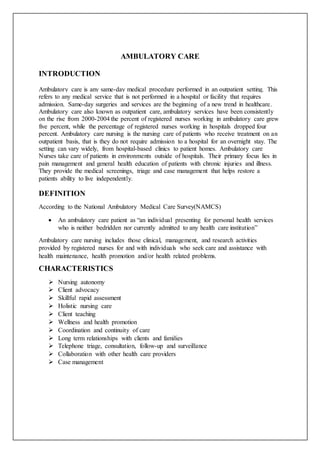
INTRODUCTION
Ambulatory care is any same-day medical procedure performed in an outpatient setting. This
refers to any medical service that is not performed in a hospital or facility that requires
admission. Same-day surgeries and services are the beginning of a new trend in healthcare.
Ambulatory care also known as outpatient care, ambulatory services have been consistently
on the rise from 2000-2004 the percent of registered nurses working in ambulatory care grew
five percent, while the percentage of registered nurses working in hospitals dropped four
percent. Ambulatory care nursing is the nursing care of patients who receive treatment on an
outpatient basis, that is they do not require admission to a hospital for an overnight stay. The
setting can vary widely, from hospital-based clinics to patient homes. Ambulatory care
Nurses take care of patients in environments outside of hospitals. Their primary focus lies in
pain management and general health education of patients with chronic injuries and illness.
They provide the medical screenings, triage and case management that helps restore a
patients ability to live independently.
DEFINITION
According to the National Ambulatory Medical Care Survey(NAMCS)
 An ambulatory care patient as “an individual presenting for personal health services
who is neither bedridden nor currently admitted to any health care institution”
Ambulatory care nursing includes those clinical, management, and research activities
provided by registered nurses for and with individuals who seek care and assistance with
health maintenance, health promotion and/or health related problems.
CHARACTERISTICS
 Nursing autonomy
 Client advocacy
 Skillful rapid assessment
 Holistic nursing care
 Client teaching
 Wellness and health promotion
 Coordination and continuity of care
 Long term relationships with clients and families
 Telephone triage, consultation, follow-up and surveillance
 Collaboration with other health care providers
 Case management
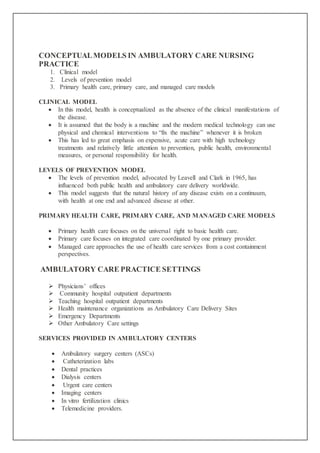
CONCEPTUALMODELS IN AMBULATORY CARE NURSING
PRACTICE
1. Clinical model
2. Levels of prevention model
3. Primary health care, primary care, and managed care models
CLINICAL MODEL
 In this model, health is conceptualized as the absence of the clinical manifestations of
the disease.
 It is assumed that the body is a machine and the modern medical technology can use
physical and chemical interventions to “fix the machine” whenever it is broken
 This has led to great emphasis on expensive, acute care with high technology
treatments and relatively little attention to prevention, public health, environmental
measures, or personal responsibility for health.
LEVELS OF PREVENTION MODEL
 The levels of prevention model, advocated by Leavell and Clark in 1965, has
influenced both public health and ambulatory care delivery worldwide.
 This model suggests that the natural history of any disease exists on a continuum,
with health at one end and advanced disease at other.
PRIMARY HEALTH CARE, PRIMARY CARE, AND MANAGED CARE MODELS
 Primary health care focuses on the universal right to basic health care.
 Primary care focuses on integrated care coordinated by one primary provider.
 Managed care approaches the use of health care services from a cost containment
perspectives.
AMBULATORY CARE PRACTICE SETTINGS
 Physicians’ offices
 Community hospital outpatient departments
 Teaching hospital outpatient departments
 Health maintenance organizations as Ambulatory Care Delivery Sites
 Emergency Departments
 Other Ambulatory Care settings
SERVICES PROVIDED IN AMBULATORY CENTERS
 Ambulatory surgery centers (ASCs)
 Catheterization labs
 Dental practices
 Dialysis centers
 Urgent care centers
 Imaging centers
 In vitro fertilization clinics
 Telemedicine providers.
ROLE OF NURSE
 RNs enhance patient safety and the quality and effectiveness of care delivery and are
thus essential and irreplaceable in the provision of patient care services in the
ambulatory setting.
 RNs are responsible for the design, administration, and evaluation of professional
nursing services within an organization in accordance with the framework established
by state nurse practice acts, nursing scope of practice, and organizational standards of
care.
 RNs provide the leadership necessary for collaboration and coordination of services,
which includes defining the appropriate skill mix and delegation of tasks among
licensed and unlicensed health care workers.
 RNs are fully accountable in all ambulatory care settings for all nursing services and
associated patient outcomes provided under their direction.
 Telehealth - Nurses in telehealth utilize a variety of technologies to triage, conduct
consultations, and deliver necessary follow-up on patient’s outcomes and status.
 Physician's office - In the physician’s clinic nurses are needed to assist the doctors
with patient consultations and procedures. Different specialties include family
medicine, cardiology, gastroenterology, endocrinology, obstetrics, ophthalmology,
dermatology, etc.
 Urgent care - The Urgent Care Association of America projects more than 15,000
immediate care centers assess and treat ailments requiring treatment beyond that of a
doctor’s office but not severe enough for the hospital.
 Community centres - In the community nurses act as patient educators, coordinators,
and advocates. In this role the ambulatory nurse may be responsible for research to
incorporate into community programs.
 Schools - Nurses in school facilities respond to medical emergencies within the
school area. In addition to this, they are responsible in assessing the health of the
students, faculty, and other school staff.
 Health Insurance companies - Health insurance companies have an interest in hiring
nurses to collaborate with health care providers to ensure coverage guidelines are
followed appropriately. Nurses can also have a role as a nurse on the 24-hour helpline.
TRENDS IN AMBULATORY NURSING CARE
Health care is changing:-
 From an illness oriented to a wellness orientation
 From an acute care emphasis to primary care
 From inpatient to outpatient services
 From individual health to community well being
 From fragmented care to managed care
 From independent institutions to integrated system
 From service duplication to a continuum of services
CONCLUSIONS
Ambulatory care nursing is one of the fastest growing areas of nursing speciality practice.
Ambulatory care nurses are not only expert clinicians but also expert communications. They
play key roles in facilitating the client’s successful progress through the integrated delivery
systems. Ambulatory nurses make quality health care accessible.
JOURNAL REFERENCE
1. Clinical medicine Journal. Anabel Carter. The Ambulatory care hospital at Derriford
hospital. Vol 14.no 3.June 2014.
 ABSTRACT: Ambulatory emergency care (AEC) is an essential component of any
acute medical unit (AMU). This statement is predicated on the clinical and financial
benefits it confers. In this article, the author outlines the implementation of the
Ambulatory Care Unit at Derriford Hospital and the first 6 months of service
provision. The initial data collated demonstrates the impact the service has had locally
on patient care and experience. It recommends ambulatory care as driver of better
patient flow and enhanced patient experience within the AMU.
2. Indian Journal of Public Health. Cost of ambulatory care by mobile health clinic run
by a Medical College in India for the year 2008-09. Vol 58.No:2.2014
 Background: The feasibility of using mobile health clinics(MHCs) to deliver health
services in urban poor areas has to be explore as the health needs of the residents are
not sufficiently addressed by the existing primary health care delivery system in India.
 Objective: To estimate the cost of providing primary health care services and the out
of pocket expenditure(OOPE) incurred, while utilizing these services provided
through the MHC based Urban Health Program of a Medical College in North India
for the year 2008-09.
 Materials and Methods: A cross-sectional study to estimate OOPE was conducted
among 330 subjects selected from patients attending the mobile health care facility.
For estimation of provider cost , 5 steps process involving identification of cost
centres, measurement of inputs, valuing of inputs, assigning of inputs to cost centres,
and estimation of unit cost were carried out.
 Results: Total annual cost of providing services under urban Health Program in the
year 2008-09 was Rs.7,691,943 Unit cost of providing outpatient curative, antenatal
care, and immunization were Rs.107.74/visit, Rs 388/visit and Rs 66.14 per
immunization, respectively. The mean OOPE incurred was Rs 29.50/visit, while
utilizing outpatient curative services and Rs 88.70/visit for antenatal services.
 Conclusion: The MHC can be considered as a viable option to provide services to
urban poor.
BIBLIOGRAPHY
 https://www.aaacn.org
 http://nursejournal.org/trauma- nursing/ambulatory-care-nursing
 http://nursingworld.org/MainMenuCategories /Policy-Advocacy/Positions-and-
Resolutions/ANAPositionStatements
 http://www.nursingexplorer.com
 https://www.rasmussen.edu/degrees/nursing/blog/what-is-ambulatory-care/

Ambulatory care

  • 1.
    CONTENTS  INTRODUCTION  DEFINITION CHARACTERISTICS  CONCEPTUAL MODEL IN AMBULATORY NURSING PRACTICE  CLINICAL MODEL  LEVELS OF PREVENTION MODEL  PRIMARY HEALTH CARE, PRIMARY CARE AND MANAGED CARE MODELS  AMBULATORY CARE PRACTICE SETTINGS  ROLE OF NURSE IN AMBULATORY CARE  TRENDS IN AMBULATORY CARE  CONCLUSION  JOURNAL REFERENCE  BIBLIOGRAPHY
  • 2.
    AMBULATORY CARE INTRODUCTION Ambulatory careis any same-day medical procedure performed in an outpatient setting. This refers to any medical service that is not performed in a hospital or facility that requires admission. Same-day surgeries and services are the beginning of a new trend in healthcare. Ambulatory care also known as outpatient care, ambulatory services have been consistently on the rise from 2000-2004 the percent of registered nurses working in ambulatory care grew five percent, while the percentage of registered nurses working in hospitals dropped four percent. Ambulatory care nursing is the nursing care of patients who receive treatment on an outpatient basis, that is they do not require admission to a hospital for an overnight stay. The setting can vary widely, from hospital-based clinics to patient homes. Ambulatory care Nurses take care of patients in environments outside of hospitals. Their primary focus lies in pain management and general health education of patients with chronic injuries and illness. They provide the medical screenings, triage and case management that helps restore a patients ability to live independently. DEFINITION According to the National Ambulatory Medical Care Survey(NAMCS)  An ambulatory care patient as “an individual presenting for personal health services who is neither bedridden nor currently admitted to any health care institution” Ambulatory care nursing includes those clinical, management, and research activities provided by registered nurses for and with individuals who seek care and assistance with health maintenance, health promotion and/or health related problems. CHARACTERISTICS  Nursing autonomy  Client advocacy  Skillful rapid assessment  Holistic nursing care  Client teaching  Wellness and health promotion  Coordination and continuity of care  Long term relationships with clients and families  Telephone triage, consultation, follow-up and surveillance  Collaboration with other health care providers  Case management
  • 3.
    CONCEPTUALMODELS IN AMBULATORYCARE NURSING PRACTICE 1. Clinical model 2. Levels of prevention model 3. Primary health care, primary care, and managed care models CLINICAL MODEL  In this model, health is conceptualized as the absence of the clinical manifestations of the disease.  It is assumed that the body is a machine and the modern medical technology can use physical and chemical interventions to “fix the machine” whenever it is broken  This has led to great emphasis on expensive, acute care with high technology treatments and relatively little attention to prevention, public health, environmental measures, or personal responsibility for health. LEVELS OF PREVENTION MODEL  The levels of prevention model, advocated by Leavell and Clark in 1965, has influenced both public health and ambulatory care delivery worldwide.  This model suggests that the natural history of any disease exists on a continuum, with health at one end and advanced disease at other. PRIMARY HEALTH CARE, PRIMARY CARE, AND MANAGED CARE MODELS  Primary health care focuses on the universal right to basic health care.  Primary care focuses on integrated care coordinated by one primary provider.  Managed care approaches the use of health care services from a cost containment perspectives. AMBULATORY CARE PRACTICE SETTINGS  Physicians’ offices  Community hospital outpatient departments  Teaching hospital outpatient departments  Health maintenance organizations as Ambulatory Care Delivery Sites  Emergency Departments  Other Ambulatory Care settings SERVICES PROVIDED IN AMBULATORY CENTERS  Ambulatory surgery centers (ASCs)  Catheterization labs  Dental practices  Dialysis centers  Urgent care centers  Imaging centers  In vitro fertilization clinics  Telemedicine providers.
  • 4.
    ROLE OF NURSE RNs enhance patient safety and the quality and effectiveness of care delivery and are thus essential and irreplaceable in the provision of patient care services in the ambulatory setting.  RNs are responsible for the design, administration, and evaluation of professional nursing services within an organization in accordance with the framework established by state nurse practice acts, nursing scope of practice, and organizational standards of care.  RNs provide the leadership necessary for collaboration and coordination of services, which includes defining the appropriate skill mix and delegation of tasks among licensed and unlicensed health care workers.  RNs are fully accountable in all ambulatory care settings for all nursing services and associated patient outcomes provided under their direction.  Telehealth - Nurses in telehealth utilize a variety of technologies to triage, conduct consultations, and deliver necessary follow-up on patient’s outcomes and status.  Physician's office - In the physician’s clinic nurses are needed to assist the doctors with patient consultations and procedures. Different specialties include family medicine, cardiology, gastroenterology, endocrinology, obstetrics, ophthalmology, dermatology, etc.  Urgent care - The Urgent Care Association of America projects more than 15,000 immediate care centers assess and treat ailments requiring treatment beyond that of a doctor’s office but not severe enough for the hospital.  Community centres - In the community nurses act as patient educators, coordinators, and advocates. In this role the ambulatory nurse may be responsible for research to incorporate into community programs.  Schools - Nurses in school facilities respond to medical emergencies within the school area. In addition to this, they are responsible in assessing the health of the students, faculty, and other school staff.  Health Insurance companies - Health insurance companies have an interest in hiring nurses to collaborate with health care providers to ensure coverage guidelines are followed appropriately. Nurses can also have a role as a nurse on the 24-hour helpline. TRENDS IN AMBULATORY NURSING CARE Health care is changing:-  From an illness oriented to a wellness orientation  From an acute care emphasis to primary care  From inpatient to outpatient services  From individual health to community well being  From fragmented care to managed care  From independent institutions to integrated system  From service duplication to a continuum of services
  • 5.
    CONCLUSIONS Ambulatory care nursingis one of the fastest growing areas of nursing speciality practice. Ambulatory care nurses are not only expert clinicians but also expert communications. They play key roles in facilitating the client’s successful progress through the integrated delivery systems. Ambulatory nurses make quality health care accessible. JOURNAL REFERENCE 1. Clinical medicine Journal. Anabel Carter. The Ambulatory care hospital at Derriford hospital. Vol 14.no 3.June 2014.  ABSTRACT: Ambulatory emergency care (AEC) is an essential component of any acute medical unit (AMU). This statement is predicated on the clinical and financial benefits it confers. In this article, the author outlines the implementation of the Ambulatory Care Unit at Derriford Hospital and the first 6 months of service provision. The initial data collated demonstrates the impact the service has had locally on patient care and experience. It recommends ambulatory care as driver of better patient flow and enhanced patient experience within the AMU. 2. Indian Journal of Public Health. Cost of ambulatory care by mobile health clinic run by a Medical College in India for the year 2008-09. Vol 58.No:2.2014  Background: The feasibility of using mobile health clinics(MHCs) to deliver health services in urban poor areas has to be explore as the health needs of the residents are not sufficiently addressed by the existing primary health care delivery system in India.  Objective: To estimate the cost of providing primary health care services and the out of pocket expenditure(OOPE) incurred, while utilizing these services provided through the MHC based Urban Health Program of a Medical College in North India for the year 2008-09.  Materials and Methods: A cross-sectional study to estimate OOPE was conducted among 330 subjects selected from patients attending the mobile health care facility. For estimation of provider cost , 5 steps process involving identification of cost centres, measurement of inputs, valuing of inputs, assigning of inputs to cost centres, and estimation of unit cost were carried out.  Results: Total annual cost of providing services under urban Health Program in the year 2008-09 was Rs.7,691,943 Unit cost of providing outpatient curative, antenatal care, and immunization were Rs.107.74/visit, Rs 388/visit and Rs 66.14 per immunization, respectively. The mean OOPE incurred was Rs 29.50/visit, while utilizing outpatient curative services and Rs 88.70/visit for antenatal services.  Conclusion: The MHC can be considered as a viable option to provide services to urban poor.
  • 6.
    BIBLIOGRAPHY  https://www.aaacn.org  http://nursejournal.org/trauma-nursing/ambulatory-care-nursing  http://nursingworld.org/MainMenuCategories /Policy-Advocacy/Positions-and- Resolutions/ANAPositionStatements  http://www.nursingexplorer.com  https://www.rasmussen.edu/degrees/nursing/blog/what-is-ambulatory-care/