HOSPITAL
The word “hospital“derived from the Latin word hospitalis which in turn
derived from french word “hospes” that means “ a guest or a visitor”
A hospital is a health care organization providing treatment to patients
thorough qualified staff and scientific equipments.
A hospital is an organization providing short-term and long-term medical
care including, diagnostic, therapeutic and rehabilitation services to the
subjects suffering or suspected to be suffering from a particular disease
or injury. It may or may not also provide services for ambulatory
patients on an out-patient basis’.
2.
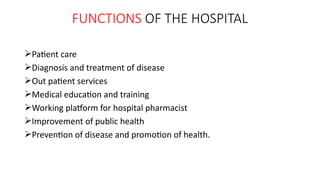
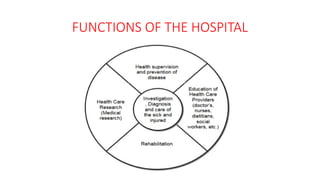
FUNCTIONS OF THEHOSPITAL
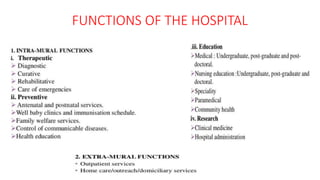
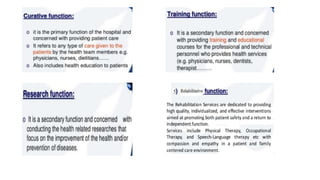
Patient care
Diagnosis and treatment of disease
Out patient services
Medical education and training
Working platform for hospital pharmacist
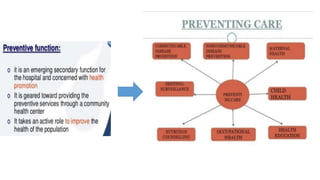
Improvement of public health
Prevention of disease and promotion of health.
3.
CLASSIFICATION OF HOSPITALS
Hospitalsare classified in different ways such as according to
1. Based on Objective/services
General hospitals Speciality hospitals Teaching cum Research Hospital Isolation Hospitals
Medicine surgery Maternity
Tuberculosis Orthopedic
Psychiatric & nervous disorders Cardiac
Communicable diseases Gynecologic
4.
CLASSIFICATION OF HOSPITALS
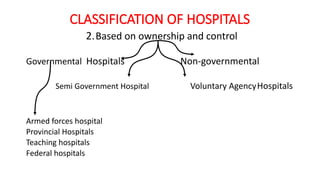
2.Basedon ownership and control
Governmental Hospitals Non-governmental
Semi Government Hospital Voluntary AgencyHospitals
Armed forces hospital
Provincial Hospitals
Teaching hospitals
Federal hospitals
5.
CLASSIFICATION OF HOSPITALS
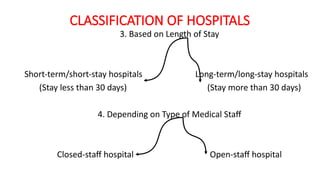
3.Based on Length of Stay
Short-term/short-stay hospitals Long-term/long-stay hospitals
(Stay less than 30 days) (Stay more than 30 days)
4. Depending on Type of Medical Staff
Closed-staff hospital Open-staff hospital
6.
CLASSIFICATION OF HOSPITALS
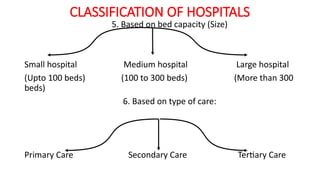
5.Based on bed capacity (Size)
Small hospital Medium hospital Large hospital
(Upto 100 beds) (100 to 300 beds) (More than 300
beds)
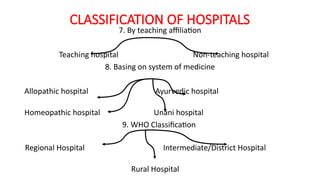
6. Based on type of care:
Primary Care Secondary Care Tertiary Care
7.
CLASSIFICATION OF HOSPITALS
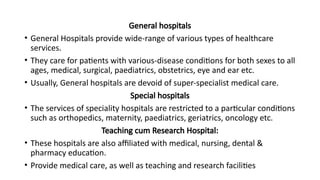
7.By teaching affiliation
Teaching hospital Non-teaching hospital
8. Basing on system of medicine
Allopathic hospital Ayurvedic hospital
Homeopathic hospital Unani hospital
9. WHO Classification
Regional Hospital Intermediate/District Hospital
Rural Hospital
8.
General hospitals
• GeneralHospitals provide wide-range of various types of healthcare
services.
• They care for patients with various-disease conditions for both sexes to all
ages, medical, surgical, paediatrics, obstetrics, eye and ear etc.
• Usually, General hospitals are devoid of super-specialist medical care.
Special hospitals
• The services of speciality hospitals are restricted to a particular conditions
such as orthopedics, maternity, paediatrics, geriatrics, oncology etc.
Teaching cum Research Hospital:
• These hospitals are also affiliated with medical, nursing, dental &
pharmacy education.
• Provide medical care, as well as teaching and research facilities
9.
Governmental or publichospital
They are owned or controlled by the government and receives government
funding. They provide free medical care to the patients. The governmental
hospitals are controlled by the Ministry of Health.
Private Hospital
Privately owned and controlled by an individual or group of physicians or
citizens or by private organization.
Purpose is to provide services for profit making.
Semi Govt Hospital
Hospitals run through mutual collaboration of government and private entity.
Voluntary Agency Hospital
Hospitals initiated by the Voluntary Organizations. These hospitals are not
meant for profit
10.
Short-term or short-stayhospitals
These are hospitals where over 90% of all patients are admitted with stay less than 30
days.
Long-term or long-stay hospitals
These are hospitals where over 90% of all patients admitted with stay of about 30 days
or more i.e. mental hospital.
Closed-staff hospital
Physicians are held responsible for all medical activities in the hospital including the
diagnosis and treatment of patient, fee paying and emergency.
Close Staff Hospital is one in which all doctors are on staff, and also doctors that aren't
on staff may not have access or privileges at said hospital.
Open-staff hospital
This type of hospital permits other physicians in the community to consult and treat
patients of the hospital.
Open Staff Hospital means Open medical staff, which means any physician can request
to practice at the facility, regardless of their hospital affiliation.
11.
Primary Care Hospital
Primarycare is the day-to-day healthcare given by a health care provider.
Typically this provider mostly Provides basic health care. It is generally
regarded as the ‘gateway’ to receiving more specialist care.
Secondary Care Hospital
It provides more complicated/specialist services particularly beyond the
scope and capacity of primary care e.g. internal medicine, gynecology, and
obstetrics.
Tertiary Care Hospital
This level deals with highly specialized services provided at provincial or
federal level e.g. cancer hospitals, mental hospitals
12.
Based on systemof medicines
1. ALLOPATHIC HOSPITALS
A system in which medical doctors and other healthcare professionals
(such as nurses, pharmacists, and therapists) are licensed to practice
and treat symptoms of diseases using drugs, radiation, or surgery.
2. AYURVEDIC HOSPITALS
A system in which medical care is provided through Ayurveda system of
medicines.
Ayur means life or living, and Veda means knowledge, so Ayurveda has
been defined as the "knowledge of living“
Ayurvedic medicine utilizes diet detoxification and purification
techniques, herbal and mineral remedies, yoga, breathing exercises,
meditation and massage (Indian)
13.
3. HOMEOPATHIC HOSPITALS
Hospitalthat uses homeopathic system of medicines for the medical care of patients
(Homeopathy, or Homeopathic Medicine, is the practice of medicine that embraces
a holistic, natural approach to the treatment of the sick. It is based on two
important theories
• “Like cures like”—disease can be cured by a substance that produces similar
symptoms (same type of disorder) in healthy people
• “Law of minimum dose” (lower the dose, greater will be effect) or dilution
increases potency (German)
4. UNANI SYSTEM HOSPITALS
A hospital setting that utilizes the unani system of medicines to fulfill the needs of
medical care to patients .
Unani medicine, also called Unani tibb, Arabian medicine, or Islamic medicine, a
traditional system of healing and health maintenance observed in South Asia.
Hijama therapy & aroma & spasm massage therapy (Asian).
14.
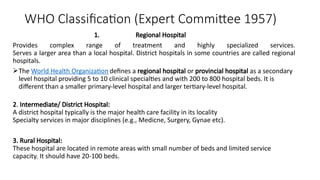
WHO Classification (ExpertCommittee 1957)
1. Regional Hospital
Provides complex range of treatment and highly specialized services.
Serves a larger area than a local hospital. District hospitals in some countries are called regional
hospitals.
The World Health Organization defines a regional hospital or provincial hospital as a secondary
level hospital providing 5 to 10 clinical specialties and with 200 to 800 hospital beds. It is
different than a smaller primary-level hospital and larger tertiary-level hospital.
2. Intermediate/ District Hospital:
A district hospital typically is the major health care facility in its locality
Specialty services in major disciplines (e.g., Medicne, Surgery, Gynae etc).
3. Rural Hospital:
These hospital are located in remote areas with small number of beds and limited service
capacity. It should have 20-100 beds.
15.
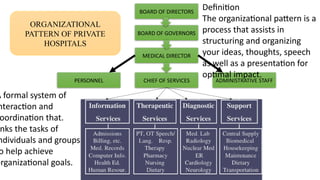
BOARD OF DIRECTORS
BOARDOF GOVERNORS
MEDICAL DIRECTOR
CHIEF OF SERVICES
PERSONNEL ADMINISTRATIVE STAFF
ORGANIZATIONAL
PATTERN OF PRIVATE
HOSPITALS
A formal system of
nteraction and
oordination that.
nks the tasks of
ndividuals and groups
o help achieve
organizational goals.
Definition
The organizational pattern is a
process that assists in
structuring and organizing
your ideas, thoughts, speech
as well as a presentation for
optimal impact.
16.
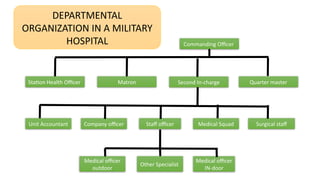
Commanding Officer
Station HealthOfficer Matron Second In-charge Quarter master
Unit Accountant Company officer Staff officer Medical Squad Surgical staff
Medical officer
outdoor
Other Specialist
Medical officer
IN-door
DEPARTMENTAL
ORGANIZATION IN A MILITARY
HOSPITAL
1. Management
• Managementis a distinct process of planning, organizing, motivating
and controlling individuals as well as allocated resources to
accomplish the stated goals of an organization.
• Hospital Management is a term very broad in scope
• Hospital management relates to management of all aspects of a
hospital which includes the coordination of all elements of a hospital.
• This may range from patient care to record keeping to inventory of
medicines and cleanliness.
19.
Management of hospitalsin Pakistan
• In broader terms, there are mainly three types of hospitals in Pakistan
1. Teaching/government hospitals
2. Private hospitals
3. Military hospitals
• Management responsibilities of a teaching/government hospitals are
done by medical superintendent who is appointed by ministry of
health.
• Military hospitals are managed by commanding officers
• While private hospitals is managed by governing body or Board of
directors/board of governors/Board of Managers. Total number of
member in governing body vary from hospital to hospital
20.
• The partnershipof some hospitals may sometime consist of large number of
members.
• From such members specified group of members is elected as board of trustees. This
group is also known as governing board, board of governors, board of managers,
boards of directors
• Governing body appoints chief executive officer responsible for the management of
entire hospital.
• The governing body is responsible for defining
1. Powers and duties of governing body officers.
2. Method of selection, Tenure and qualification of the governing body members.
3. Implementation and appropriate functioning of various committees.
3. Appointment and tenure of chief executive officers & other members of committees.
4. Evaluation of performance of employee
Management of hospitals in Pakistan
21.
2. Administration
• Administrationis defined as the act of managing duties, responsibilities,
or rules.
• The board of trustees of hospital delegate hospital’s active
management to an administrator and his staff.
• Administration of a hospital is developing, implementing, and directing
equipment & staff management programs to successfully achieve
patient care.
• Administration of a hospital is responsible for operation of whole
organization.
• The administrator of a hospital is specialist in administration and is
specially be qualified and trained for his position. Usually an
administrator holds the degree of masters of hospital administration
22.
Functions of Administrators
1)Enforce trustee policy in the daily management
2) Establish organizational structure to carry out programs of a hospital
and to meet needs of a patients
3) Develop & implement a comprehensive management reporting
system thoughout an institution.
4) Implement the governing body’s policy on the financial management
of hospital
5) Provide, maintain and safeguard appropriate physical resources in
the institution
6) Look at the weakness influencing any aspect of institution
23.
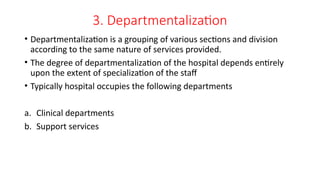
3. Departmentalization
• Departmentalizationis a grouping of various sections and division
according to the same nature of services provided.
• The degree of departmentalization of the hospital depends entirely
upon the extent of specialization of the staff
• Typically hospital occupies the following departments
a. Clinical departments
b. Support services
24.
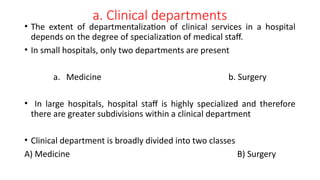
a. Clinical departments
•The extent of departmentalization of clinical services in a hospital
depends on the degree of specialization of medical staff.
• In small hospitals, only two departments are present
a. Medicine b. Surgery
• In large hospitals, hospital staff is highly specialized and therefore
there are greater subdivisions within a clinical department
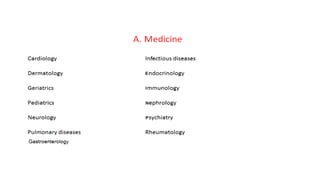
• Clinical department is broadly divided into two classes
A) Medicine B) Surgery
26.
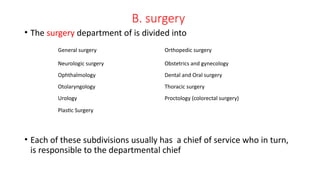
B. surgery
• Thesurgery department of is divided into
• Each of these subdivisions usually has a chief of service who in turn,
is responsible to the departmental chief
General surgery Orthopedic surgery
Neurologic surgery Obstetrics and gynecology
Ophthalmology Dental and Oral surgery
Otolaryngology Thoracic surgery
Urology
Plastic Surgery
Proctology (colorectal surgery)
27.
Support services
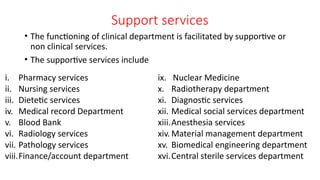
• Thefunctioning of clinical department is facilitated by supportive or
non clinical services.
• The supportive services include
ix. Nuclear Medicine
x. Radiotherapy department
xi. Diagnostic services
xii. Medical social services department
xiii.Anesthesia services
xiv. Material management department
xv. Biomedical engineering department
xvi.Central sterile services department
i. Pharmacy services
ii. Nursing services
iii. Dietetic services
iv. Medical record Department
v. Blood Bank
vi. Radiology services
vii. Pathology services
viii.Finance/account department
28.
i. Pharmacy department
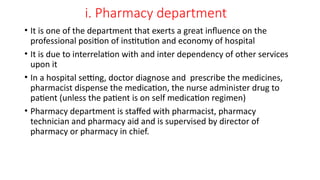
•It is one of the department that exerts a great influence on the
professional position of institution and economy of hospital
• It is due to interrelation with and inter dependency of other services
upon it
• In a hospital setting, doctor diagnose and prescribe the medicines,
pharmacist dispense the medication, the nurse administer drug to
patient (unless the patient is on self medication regimen)
• Pharmacy department is staffed with pharmacist, pharmacy
technician and pharmacy aid and is supervised by director of
pharmacy or pharmacy in chief.
29.
Pharmacy department services
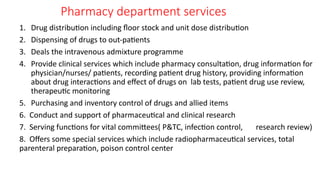
1.Drug distribution including floor stock and unit dose distribution
2. Dispensing of drugs to out-patients
3. Deals the intravenous admixture programme
4. Provide clinical services which include pharmacy consultation, drug information for
physician/nurses/ patients, recording patient drug history, providing information
about drug interactions and effect of drugs on lab tests, patient drug use review,
therapeutic monitoring
5. Purchasing and inventory control of drugs and allied items
6. Conduct and support of pharmaceutical and clinical research
7. Serving functions for vital committees( P&TC, infection control, research review)
8. Offers some special services which include radiopharmaceutical services, total
parenteral preparation, poison control center
30.
ii. Nursing services
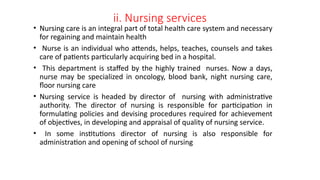
•Nursing care is an integral part of total health care system and necessary
for regaining and maintain health
• Nurse is an individual who attends, helps, teaches, counsels and takes
care of patients particularly acquiring bed in a hospital.
• This department is staffed by the highly trained nurses. Now a days,
nurse may be specialized in oncology, blood bank, night nursing care,
floor nursing care
• Nursing service is headed by director of nursing with administrative
authority. The director of nursing is responsible for participation in
formulating policies and devising procedures required for achievement
of objectives, in developing and appraisal of quality of nursing service.
• In some institutions director of nursing is also responsible for
administration and opening of school of nursing
31.
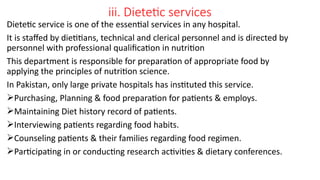
iii. Dietetic services
Dieteticservice is one of the essential services in any hospital.
It is staffed by dietitians, technical and clerical personnel and is directed by
personnel with professional qualification in nutrition
This department is responsible for preparation of appropriate food by
applying the principles of nutrition science.
In Pakistan, only large private hospitals has instituted this service.
Purchasing, Planning & food preparation for patients & employs.
Maintaining Diet history record of patients.
Interviewing patients regarding food habits.
Counseling patients & their families regarding food regimen.
Participating in or conducting research activities & dietary conferences.
32.
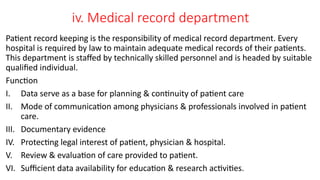
iv. Medical recorddepartment
Patient record keeping is the responsibility of medical record department. Every
hospital is required by law to maintain adequate medical records of their patients.
This department is staffed by technically skilled personnel and is headed by suitable
qualified individual.
Function
I. Data serve as a base for planning & continuity of patient care
II. Mode of communication among physicians & professionals involved in patient
care.
III. Documentary evidence
IV. Protecting legal interest of patient, physician & hospital.
V. Review & evaluation of care provided to patient.
VI. Sufficient data availability for education & research activities.
33.
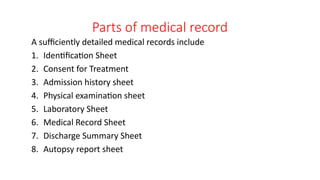
Parts of medicalrecord
A sufficiently detailed medical records include
1. Identification Sheet
2. Consent for Treatment
3. Admission history sheet
4. Physical examination sheet
5. Laboratory Sheet
6. Medical Record Sheet
7. Discharge Summary Sheet
8. Autopsy report sheet
34.
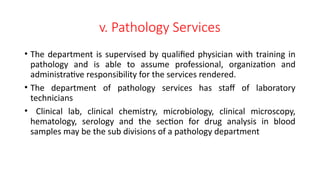
v. Pathology Services
•The department is supervised by qualified physician with training in
pathology and is able to assume professional, organization and
administrative responsibility for the services rendered.
• The department of pathology services has staff of laboratory
technicians
• Clinical lab, clinical chemistry, microbiology, clinical microscopy,
hematology, serology and the section for drug analysis in blood
samples may be the sub divisions of a pathology department
35.
Other services
• Someother support services are
• Blood bank (Physician: Hematology trained + Technician: Hematology)
• Radiology (Physician: Radiology trained + Technician: Radiology)
• Nuclear medicine (Nuclear medicine physician + Medical physicist +
Nuclear pharmacist + Technologist + Oncology Nurse)
• Radiotherapy department (physician with training in radiotherapy +
radio pharmacist + nurses + Technicians + secretarial personnel)
• Diagnostic services (Technicians) (X-ray, NMR, CT-Scan)
• Anesthesia services (Anesthesiologist +Physician anesthetist+ nurse
anesthetist+ Technicians)
36.
Biomedical engineering department
•The biomedical engineering department Is under the control of a
qualified biomedical, electrical or electronic engineer.
• This department is staffed by adequate number of engineers and
trained technicians
37.
Finance and accountdepartment
• Finances of hospital affect every patient, employee, member and
trustee
• The finance department is staffed by accountants , financial personnel
and a well trained and qualified individual supervisors
• This department is responsible for financing of all operations in a
hospital and delivery of salaries to institutional employees.
• The primary source of revenue is derived from the billing of patients
for the services rendered.
• A patient usually pay his bills by himself or the payment is reimbursed
from the third party coverage system
38.
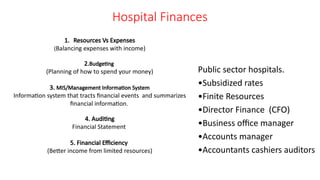
Hospital Finances
Public sectorhospitals.
•Subsidized rates
•Finite Resources
•Director Finance (CFO)
•Business office manager
•Accounts manager
•Accountants cashiers auditors
1. Resources Vs Expenses
(Balancing expenses with income)
2.Budgeting
(Planning of how to spend your money)
3. MIS/Management Information System
Information system that tracts financial events and summarizes
financial information.
4. Auditing
Financial Statement
5. Financial Efficiency
(Better income from limited resources)
39.
Hospital Finances
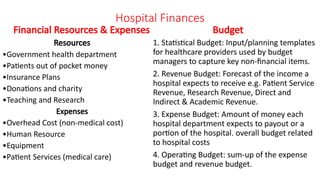
Financial Resources& Expenses Budget
1. Statistical Budget: Input/planning templates
for healthcare providers used by budget
managers to capture key non-financial items.
2. Revenue Budget: Forecast of the income a
hospital expects to receive e.g. Patient Service
Revenue, Research Revenue, Direct and
Indirect & Academic Revenue.
3. Expense Budget: Amount of money each
hospital department expects to payout or a
portion of the hospital. overall budget related
to hospital costs
4. Operating Budget: sum-up of the expense
budget and revenue budget.
Resources
•Government health department
•Patients out of pocket money
•Insurance Plans
•Donations and charity
•Teaching and Research
Expenses
•Overhead Cost (non-medical cost)
•Human Resource
•Equipment
•Patient Services (medical care)
40.
Hospital Finances
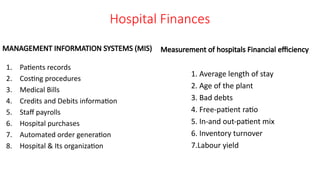
MANAGEMENT INFORMATIONSYSTEMS (MIS)
1. Patients records
2. Costing procedures
3. Medical Bills
4. Credits and Debits information
5. Staff payrolls
6. Hospital purchases
7. Automated order generation
8. Hospital & Its organization
Measurement of hospitals Financial efficiency
1. Average length of stay
2. Age of the plant
3. Bad debts
4. Free-patient ratio
5. In-and out-patient mix
6. Inventory turnover
7.Labour yield
41.
Hospital Finances
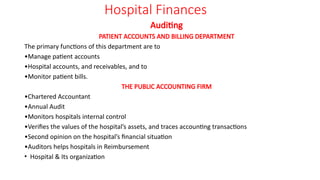
Auditing
PATIENT ACCOUNTSAND BILLING DEPARTMENT
The primary functions of this department are to
•Manage patient accounts
•Hospital accounts, and receivables, and to
•Monitor patient bills.
THE PUBLIC ACCOUNTING FIRM
•Chartered Accountant
•Annual Audit
•Monitors hospitals internal control
•Verifies the values of the hospital’s assets, and traces accounting transactions
•Second opinion on the hospital’s financial situation
•Auditors helps hospitals in Reimbursement
• Hospital & Its organization