CARDIOVASCULAR SYSTEM
Human Heart
The heart is a muscular organ that is situated in the front of the chest. It pumps blood all
through the body in a process called circulation. Apart from the heart, the blood vessels and
blood as a unit constitute the cardiovascular system.
Introduction to the Human Heart
The human heart is one of the most important organs responsible for sustaining life. It is a
muscular organ with four chambers. The size of the heart is the size of about a clenched fist.
The human heart functions throughout a person’s lifespan and is one of the most robust and
hardest working muscles in the human body.
Besides humans, most other animals also possess a heart that pumps blood throughout their
bodies. Even invertebrates such as grasshoppers possess a heart like pumping organ, though
they do not function the same way a human heart does.
Position of Heart in Human Body
The human heart is located between the lungs in the thoracic cavity, slightly towards the left
of the sternum (breastbone). It is derived from the embryonic mesodermal germ layer.
The Function of Heart
The function of the heart in any organism is to maintain a constant flow of blood throughout
the body. This replenishes oxygen and circulates nutrients among the cells and tissues.
Following are the main functions of the heart:
 One of the primary functions of the human heart is to pump blood throughout the
body.
 Blood delivers oxygen, hormones, glucose and other components to various parts of
the body, including the human heart.
 The heart also ensures that adequate blood pressure is maintained in the body
There are two types of circulation within the body, namely pulmonary circulation and
systemic circulation.
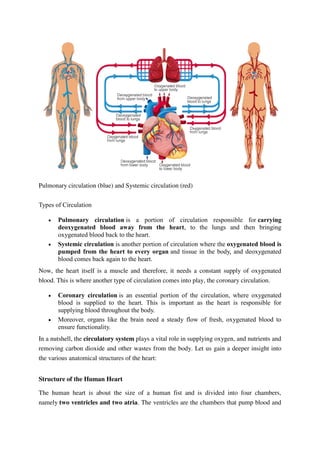
Pulmonary circulation (blue) and Systemic circulation (red)
Types of Circulation
 Pulmonary circulation is a portion of circulation responsible for carrying
deoxygenated blood away from the heart, to the lungs and then bringing
oxygenated blood back to the heart.
 Systemic circulation is another portion of circulation where the oxygenated blood is
pumped from the heart to every organ and tissue in the body, and deoxygenated
blood comes back again to the heart.
Now, the heart itself is a muscle and therefore, it needs a constant supply of oxygenated
blood. This is where another type of circulation comes into play, the coronary circulation.
 Coronary circulation is an essential portion of the circulation, where oxygenated
blood is supplied to the heart. This is important as the heart is responsible for
supplying blood throughout the body.
 Moreover, organs like the brain need a steady flow of fresh, oxygenated blood to
ensure functionality.
In a nutshell, the circulatory system plays a vital role in supplying oxygen, and nutrients and
removing carbon dioxide and other wastes from the body. Let us gain a deeper insight into
the various anatomical structures of the heart:
Structure of the Human Heart
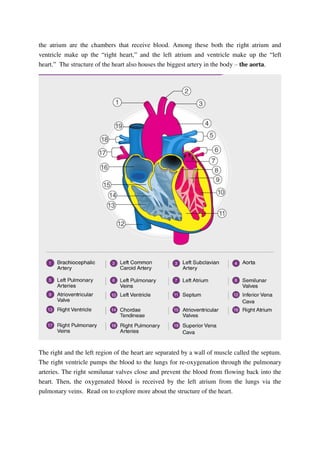
The human heart is about the size of a human fist and is divided into four chambers,
namely two ventricles and two atria. The ventricles are the chambers that pump blood and
the atrium are the chambers that receive blood. Among these both the right atrium and
ventricle make up the “right heart,” and the left atrium and ventricle make up the “left
heart.” The structure of the heart also houses the biggest artery in the body – the aorta.
The right and the left region of the heart are separated by a wall of muscle called the septum.
The right ventricle pumps the blood to the lungs for re-oxygenation through the pulmonary
arteries. The right semilunar valves close and prevent the blood from flowing back into the
heart. Then, the oxygenated blood is received by the left atrium from the lungs via the
pulmonary veins. Read on to explore more about the structure of the heart.
External Structure of Heart
One of the very first structures which can be observed when the external structure of the heart
is viewed is the pericardium.
Pericardium
The human heart is situated to the left of the chest and is enclosed within a fluid-filled cavity
described as the pericardial cavity. The walls and lining of the pericardial cavity are made up
of a membrane known as the pericardium.
The pericardium is a fibre membrane found as an external covering around the heart. It
protects the heart by producing a serous fluid, which serves to lubricate the heart and prevent
friction between the surrounding organs. Apart from the lubrication, the pericardium also
helps by holding the heart in its position and by maintaining a hollow space for the heart to
expand itself when it is full. The pericardium has two exclusive layers—
 Visceral Layer: It directly covers the outside of the heart.
 Parietal Layer: It forms a sac around the outer region of the heart that contains the
fluid in the pericardial cavity.
Structure of the Heart Wall
The heart wall is made up of 3 layers, namely:
 Epicardium – Epicardium is the outermost layer of the heart. It is composed of a
thin-layered membrane that serves to lubricate and protect the outer section.
 Myocardium – This is a layer of muscle tissue and it constitutes the middle layer
wall of the heart. It contributes to the thickness and is responsible for the pumping
action.
 Endocardium – It is the innermost layer that lines the inner heart chambers and
covers the heart valves. Furthermore, it prevents the blood from sticking to the inner
walls, thereby preventing potentially fatal blood clots.
Internal Structure of Heart
The internal structure of the heart is rather intricate with several chambers and valves that
control the flow of blood.
Chambers of the Heart
Vertebrate hearts can be classified based on the number of chambers present. For instance,
most fish have two chambers, and reptiles and amphibians have three chambers. Avian and
mammalian hearts consists of four chambers. Humans are mammals; hence, we have four
chambers, namely:
 Left atrium
 Right atrium
 Left ventricle
 Right ventricle
Atria are thin and have less muscular walls and are smaller than ventricles. These are the
blood-receiving chambers that are fed by the large veins.
Ventricles are larger and more muscular chambers responsible for pumping and pushing
blood out into circulation. These are connected to larger arteries that deliver blood for
circulation.
The right ventricle and right atrium are comparatively smaller than the left chambers. The
walls consist of fewer muscles compared to the left portion, and the size difference is based
on their functions. The blood originating from the right side flows through the pulmonary
circulation, while blood arising from the left chambers is pumped throughout the body.
Blood Vessels
In organisms with closed circulatory systems, the blood flows within vessels of varying sizes.
All vertebrates, including humans, possess this type of circulation. The external structure of
the heart has many blood vessels that form a network, with other major vessels emerging
from within the structure. The blood vessels typically comprise the following:
 Veins supply deoxygenated blood to the heart via inferior and superior vena cava, and
it eventually drains into the right atrium.
 Capillaries are tiny, tube-like vessels which form a network between the arteries to
veins.
 Arteries are muscular-walled tubes mainly involved in supplying oxygenated blood
away from the heart to all other parts of the body. Aorta is the largest of the arteries
and it branches off into various smaller arteries throughout the body.
Valves
Valves are flaps of fibrous tissues located in the cardiac chambers between the veins. They
ensure that the blood flows in a single direction (unidirectional). Flaps also prevent the blood
from flowing backwards. Based on their function, valves are of two types:
 Atrioventricular valves are between ventricles and atria. The valve between the right
ventricle and right atrium is the tricuspid valve, and the one which is found between
the left ventricle and left atrium is known as the mitral valve.
 Semilunar valves are located between the left ventricle and the aorta. It is also found
between the pulmonary artery and the right ventricle.
CARDIAC CYCLE
Cardiac Cycle Definition
“Cardiac cycle refers to the sequence of events that take place when the heart beats.”
What is Cardiac Cycle?
The cardiac cycle attributes to a comprehensive heartbeat from its production to the
commencement of the next beat. It comprises diastole, the systole, and the intervening pause.
The occurrence of a cardiac cycle is illustrated by a heart rate, which is naturally indicated as
beats per minute. A healthy human heart beats 72 times per minute which states that there are
72 cardiac cycles per minute. The cardiac cycle involves a complete contraction and
relaxation of both the atria and ventricles and the cycle last approximately 0.8 seconds.
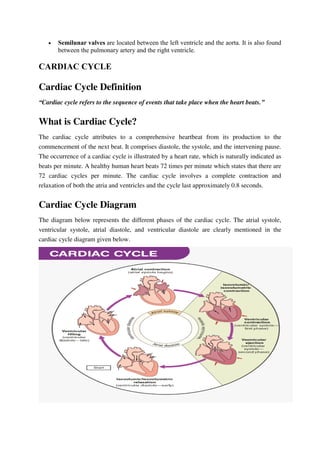
Cardiac Cycle Diagram
The diagram below represents the different phases of the cardiac cycle. The atrial systole,
ventricular systole, atrial diastole, and ventricular diastole are clearly mentioned in the
cardiac cycle diagram given below.
Cardiac Cycle Physiology
The human heart consists of four chambers, comprising left and right halves. Two upper
chambers include left and right atria; lower two chambers include right and left
ventricles. The key function of the right ventricle is to pump deoxygenated blood through the
pulmonary arteries and pulmonary trunk to the lungs. While the left ventricle is responsible
for pumping newly oxygenated blood to the body through the aorta.
Cardiac Cycle Phases
Following are the different phases that occur in a cardiac cycle:
Atrial Diastole: In this stage, chambers of the heart are calmed. That is when the aortic valve
and pulmonary artery closes and atrioventricular valves open, thus causing chambers of the
heart to relax.
Atrial Systole: At this phase, blood cells flow from atrium to ventricle and at this period,
atrium contracts.
Isovolumic Contraction: At this stage, ventricles begin to contract. The atrioventricular
valves, valve, and pulmonary artery valves close, but there won’t be any transformation in
volume.
Ventricular Ejection: Here ventricles contract and emptying. Pulmonary artery and aortic
valve close.
Isovolumic Relaxation: In this phase, no blood enters the ventricles and consequently,
pressure decreases, ventricles stop contracting and begin to relax. Now due to the pressure in
the aorta – pulmonary artery and aortic valve close.
Ventricular Filling Stage: In this stage, blood flows from atria into the ventricles. It is
altogether known as one stage (first and second stage). After that, they are three phases that
involve the flow of blood to the pulmonary artery from ventricles.
Also Read: Cardiac Output
Duration of Cardiac Cycle
In a normal person, a heartbeat is 72 beats/minute. So, the duration of one cardiac cycle can
be calculated as:
1/72 beats/minute=.0139 minutes/beat
At a heartbeat 72 beats/minute, duration of each cardiac cycle will be 0.8 seconds.
Duration of different stages of the cardiac cycle is given below:
 Atrial systole: continues for about 0.1 seconds
 Ventricular systole: continues for about 0.3 seconds
 Atrial diastole: continues for about 0.7 seconds
 Ventricular diastole: continues for about 0.5 seconds
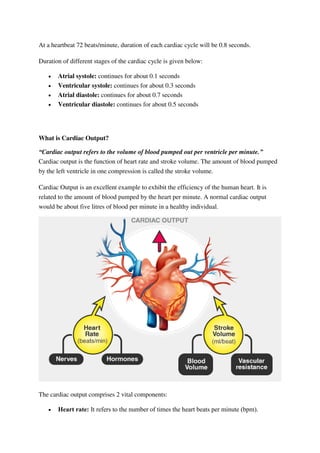
What is Cardiac Output?
“Cardiac output refers to the volume of blood pumped out per ventricle per minute.”
Cardiac output is the function of heart rate and stroke volume. The amount of blood pumped
by the left ventricle in one compression is called the stroke volume.
Cardiac Output is an excellent example to exhibit the efficiency of the human heart. It is
related to the amount of blood pumped by the heart per minute. A normal cardiac output
would be about five litres of blood per minute in a healthy individual.
The cardiac output comprises 2 vital components:
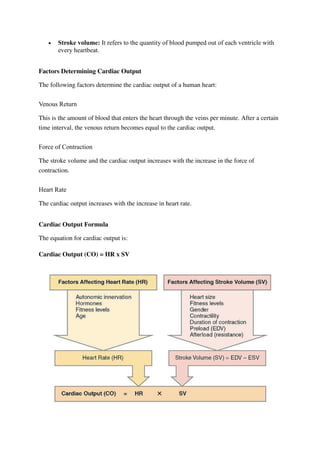
 Heart rate: It refers to the number of times the heart beats per minute (bpm).
 Stroke volume: It refers to the quantity of blood pumped out of each ventricle with
every heartbeat.
Factors Determining Cardiac Output
The following factors determine the cardiac output of a human heart:
Venous Return
This is the amount of blood that enters the heart through the veins per minute. After a certain
time interval, the venous return becomes equal to the cardiac output.
Force of Contraction
The stroke volume and the cardiac output increases with the increase in the force of
contraction.
Heart Rate
The cardiac output increases with the increase in heart rate.
Cardiac Output Formula
The equation for cardiac output is:
Cardiac Output (CO) = HR x SV
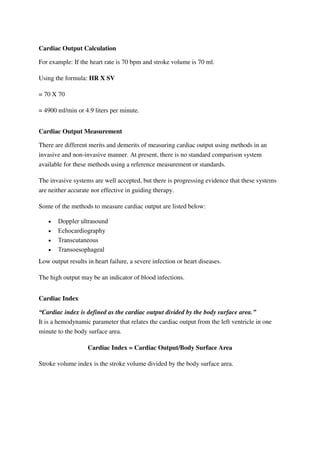
Cardiac Output Calculation
For example: If the heart rate is 70 bpm and stroke volume is 70 ml.
Using the formula: HR X SV
= 70 X 70
= 4900 ml/min or 4.9 liters per minute.
Cardiac Output Measurement
There are different merits and demerits of measuring cardiac output using methods in an
invasive and non-invasive manner. At present, there is no standard comparison system
available for these methods using a reference measurement or standards.
The invasive systems are well accepted, but there is progressing evidence that these systems
are neither accurate nor effective in guiding therapy.
Some of the methods to measure cardiac output are listed below:
 Doppler ultrasound
 Echocardiography
 Transcutaneous
 Transoesophageal
Low output results in heart failure, a severe infection or heart diseases.
The high output may be an indicator of blood infections.
Cardiac Index
“Cardiac index is defined as the cardiac output divided by the body surface area.”
It is a hemodynamic parameter that relates the cardiac output from the left ventricle in one
minute to the body surface area.
Cardiac Index = Cardiac Output/Body Surface Area
Stroke volume index is the stroke volume divided by the body surface area.
What is Electrocardiogram (ECG)?
An electrocardiogram (ECG) is a graphic record produced by an electrocardiograph that
provides details about one’s heart rate and rhythm and any other related abnormalities; it
depicts if the heart has enlarged due to hypertension (high blood pressure) or evidence of a
myocardial infarction previously (heart attack if any). Electrocardiogram (ECG) is one of the
most common and effective tests for all drugs. It is easy to perform, non-invasive, yields
outcomes instantly and is useful to identify hundreds of heart conditions.
ECGs from healthy hearts have a distinct, characteristic shape. Any inconsistency in the
rhythm of the heart or damage to the heart muscle can alter the heart’s electrical activity
thereby changing the shape on the ECG.
ECG Test
ECG test can be used to check the rhythm of the heart and the electrical movement. The
electrical signals are detected due to the attachment of the sensors to the skin which are
generated as and when the heart beats. These signals are recorded by the machine and
examined by a medical practitioner for an unusual signs.
Who is recommended an ECG test?
ECG test is a common measure in monitoring the health of those diagnosed with heart
ailments to aid in assessing the artificial cardiac pacemakers or in detecting the effects of
some medications on the vital organ – the heart.
Doctor suggests ECG for those who are at a risk of heart diseases (family history of heart
disorders), those who smoke, are obese, have diabetes, high blood pressure or cholesterol.
ECG test could also be suggested to those that show the following signs and symptoms –
 Shortness of breath
 Dizziness
 Chest pain
 Palpitations
Why ECG is done?
Two main forms of data are given by an ECG –
 Determining time taken for electromagnetic pulse to travel through the heart
 To find if areas of heart are overworked or too large
First, a surgeon will determine how long it takes for the electromagnetic pulse to travel
through the heart by calculating time intervals on the ECG. Whether the electrical activity is
natural or sluggish, fast or erratic, figuring out how long a pulse takes to travel from one part
of the heart to the next.
Second, a cardiologist may be able to find out if areas of the heart are too large or
overworked by measuring the amount of electrical activity that flows through the heart
muscle. Ten electrodes are mounted on the arms of the patient and on the top of the heart in a
traditional 12-lead ECG. The average strength of the electrical potential of the heart is then
calculated from 12 different angles (“leads”) and reported over a period of time (usually 10
seconds). Throughout the cardiac phase, the total intensity and trajectory of the electrical
depolarization of the heart are observed at each moment.
Evidence does not support the use of ECGs as an attempt for prevention among those without
symptoms or at low risk of cardiovascular disease. This is because an ECG may incorrectly
suggest a concern, leading to misdiagnosis, initiation for invasive procedures, and
overtreatment. Individuals working in certain sensitive professions, such as aeroplane pilots,
may need to have an ECG as part of their routine safety evaluations.
Objective of ECG
The overall objective of an ECG is to obtain information about the heart’s electrical function.
For this material, clinical needs are diverse and often need to be paired with knowledge of the
heart anatomy and symptoms of physical examination to be understood. Some signs for an
ECG are as follows:
An ECG is used to measure:
 Any heart damage and weaknesses in various parts of the heart muscle
 How quickly your heart beats and whether it normally beats
 The effects of drugs or devices used to control your heart (such as a pacemaker)
 The size and position of your heart chambers
 To diagnose abnormal heart rhythms

Cardio system

  • 1.
    CARDIOVASCULAR SYSTEM Human Heart Theheart is a muscular organ that is situated in the front of the chest. It pumps blood all through the body in a process called circulation. Apart from the heart, the blood vessels and blood as a unit constitute the cardiovascular system. Introduction to the Human Heart The human heart is one of the most important organs responsible for sustaining life. It is a muscular organ with four chambers. The size of the heart is the size of about a clenched fist. The human heart functions throughout a person’s lifespan and is one of the most robust and hardest working muscles in the human body. Besides humans, most other animals also possess a heart that pumps blood throughout their bodies. Even invertebrates such as grasshoppers possess a heart like pumping organ, though they do not function the same way a human heart does. Position of Heart in Human Body The human heart is located between the lungs in the thoracic cavity, slightly towards the left of the sternum (breastbone). It is derived from the embryonic mesodermal germ layer. The Function of Heart The function of the heart in any organism is to maintain a constant flow of blood throughout the body. This replenishes oxygen and circulates nutrients among the cells and tissues. Following are the main functions of the heart:  One of the primary functions of the human heart is to pump blood throughout the body.  Blood delivers oxygen, hormones, glucose and other components to various parts of the body, including the human heart.  The heart also ensures that adequate blood pressure is maintained in the body There are two types of circulation within the body, namely pulmonary circulation and systemic circulation.
  • 2.
    Pulmonary circulation (blue)and Systemic circulation (red) Types of Circulation  Pulmonary circulation is a portion of circulation responsible for carrying deoxygenated blood away from the heart, to the lungs and then bringing oxygenated blood back to the heart.  Systemic circulation is another portion of circulation where the oxygenated blood is pumped from the heart to every organ and tissue in the body, and deoxygenated blood comes back again to the heart. Now, the heart itself is a muscle and therefore, it needs a constant supply of oxygenated blood. This is where another type of circulation comes into play, the coronary circulation.  Coronary circulation is an essential portion of the circulation, where oxygenated blood is supplied to the heart. This is important as the heart is responsible for supplying blood throughout the body.  Moreover, organs like the brain need a steady flow of fresh, oxygenated blood to ensure functionality. In a nutshell, the circulatory system plays a vital role in supplying oxygen, and nutrients and removing carbon dioxide and other wastes from the body. Let us gain a deeper insight into the various anatomical structures of the heart: Structure of the Human Heart The human heart is about the size of a human fist and is divided into four chambers, namely two ventricles and two atria. The ventricles are the chambers that pump blood and
  • 3.
    the atrium arethe chambers that receive blood. Among these both the right atrium and ventricle make up the “right heart,” and the left atrium and ventricle make up the “left heart.” The structure of the heart also houses the biggest artery in the body – the aorta. The right and the left region of the heart are separated by a wall of muscle called the septum. The right ventricle pumps the blood to the lungs for re-oxygenation through the pulmonary arteries. The right semilunar valves close and prevent the blood from flowing back into the heart. Then, the oxygenated blood is received by the left atrium from the lungs via the pulmonary veins. Read on to explore more about the structure of the heart.
  • 4.
    External Structure ofHeart One of the very first structures which can be observed when the external structure of the heart is viewed is the pericardium. Pericardium The human heart is situated to the left of the chest and is enclosed within a fluid-filled cavity described as the pericardial cavity. The walls and lining of the pericardial cavity are made up of a membrane known as the pericardium. The pericardium is a fibre membrane found as an external covering around the heart. It protects the heart by producing a serous fluid, which serves to lubricate the heart and prevent friction between the surrounding organs. Apart from the lubrication, the pericardium also helps by holding the heart in its position and by maintaining a hollow space for the heart to expand itself when it is full. The pericardium has two exclusive layers—  Visceral Layer: It directly covers the outside of the heart.  Parietal Layer: It forms a sac around the outer region of the heart that contains the fluid in the pericardial cavity. Structure of the Heart Wall The heart wall is made up of 3 layers, namely:  Epicardium – Epicardium is the outermost layer of the heart. It is composed of a thin-layered membrane that serves to lubricate and protect the outer section.  Myocardium – This is a layer of muscle tissue and it constitutes the middle layer wall of the heart. It contributes to the thickness and is responsible for the pumping action.  Endocardium – It is the innermost layer that lines the inner heart chambers and covers the heart valves. Furthermore, it prevents the blood from sticking to the inner walls, thereby preventing potentially fatal blood clots. Internal Structure of Heart The internal structure of the heart is rather intricate with several chambers and valves that control the flow of blood. Chambers of the Heart Vertebrate hearts can be classified based on the number of chambers present. For instance, most fish have two chambers, and reptiles and amphibians have three chambers. Avian and
  • 5.
    mammalian hearts consistsof four chambers. Humans are mammals; hence, we have four chambers, namely:  Left atrium  Right atrium  Left ventricle  Right ventricle Atria are thin and have less muscular walls and are smaller than ventricles. These are the blood-receiving chambers that are fed by the large veins. Ventricles are larger and more muscular chambers responsible for pumping and pushing blood out into circulation. These are connected to larger arteries that deliver blood for circulation. The right ventricle and right atrium are comparatively smaller than the left chambers. The walls consist of fewer muscles compared to the left portion, and the size difference is based on their functions. The blood originating from the right side flows through the pulmonary circulation, while blood arising from the left chambers is pumped throughout the body. Blood Vessels In organisms with closed circulatory systems, the blood flows within vessels of varying sizes. All vertebrates, including humans, possess this type of circulation. The external structure of the heart has many blood vessels that form a network, with other major vessels emerging from within the structure. The blood vessels typically comprise the following:  Veins supply deoxygenated blood to the heart via inferior and superior vena cava, and it eventually drains into the right atrium.  Capillaries are tiny, tube-like vessels which form a network between the arteries to veins.  Arteries are muscular-walled tubes mainly involved in supplying oxygenated blood away from the heart to all other parts of the body. Aorta is the largest of the arteries and it branches off into various smaller arteries throughout the body. Valves Valves are flaps of fibrous tissues located in the cardiac chambers between the veins. They ensure that the blood flows in a single direction (unidirectional). Flaps also prevent the blood from flowing backwards. Based on their function, valves are of two types:  Atrioventricular valves are between ventricles and atria. The valve between the right ventricle and right atrium is the tricuspid valve, and the one which is found between the left ventricle and left atrium is known as the mitral valve.
  • 6.
     Semilunar valvesare located between the left ventricle and the aorta. It is also found between the pulmonary artery and the right ventricle. CARDIAC CYCLE Cardiac Cycle Definition “Cardiac cycle refers to the sequence of events that take place when the heart beats.” What is Cardiac Cycle? The cardiac cycle attributes to a comprehensive heartbeat from its production to the commencement of the next beat. It comprises diastole, the systole, and the intervening pause. The occurrence of a cardiac cycle is illustrated by a heart rate, which is naturally indicated as beats per minute. A healthy human heart beats 72 times per minute which states that there are 72 cardiac cycles per minute. The cardiac cycle involves a complete contraction and relaxation of both the atria and ventricles and the cycle last approximately 0.8 seconds. Cardiac Cycle Diagram The diagram below represents the different phases of the cardiac cycle. The atrial systole, ventricular systole, atrial diastole, and ventricular diastole are clearly mentioned in the cardiac cycle diagram given below.
  • 7.
    Cardiac Cycle Physiology Thehuman heart consists of four chambers, comprising left and right halves. Two upper chambers include left and right atria; lower two chambers include right and left ventricles. The key function of the right ventricle is to pump deoxygenated blood through the pulmonary arteries and pulmonary trunk to the lungs. While the left ventricle is responsible for pumping newly oxygenated blood to the body through the aorta. Cardiac Cycle Phases Following are the different phases that occur in a cardiac cycle: Atrial Diastole: In this stage, chambers of the heart are calmed. That is when the aortic valve and pulmonary artery closes and atrioventricular valves open, thus causing chambers of the heart to relax. Atrial Systole: At this phase, blood cells flow from atrium to ventricle and at this period, atrium contracts. Isovolumic Contraction: At this stage, ventricles begin to contract. The atrioventricular valves, valve, and pulmonary artery valves close, but there won’t be any transformation in volume. Ventricular Ejection: Here ventricles contract and emptying. Pulmonary artery and aortic valve close. Isovolumic Relaxation: In this phase, no blood enters the ventricles and consequently, pressure decreases, ventricles stop contracting and begin to relax. Now due to the pressure in the aorta – pulmonary artery and aortic valve close. Ventricular Filling Stage: In this stage, blood flows from atria into the ventricles. It is altogether known as one stage (first and second stage). After that, they are three phases that involve the flow of blood to the pulmonary artery from ventricles. Also Read: Cardiac Output Duration of Cardiac Cycle In a normal person, a heartbeat is 72 beats/minute. So, the duration of one cardiac cycle can be calculated as: 1/72 beats/minute=.0139 minutes/beat
  • 8.
    At a heartbeat72 beats/minute, duration of each cardiac cycle will be 0.8 seconds. Duration of different stages of the cardiac cycle is given below:  Atrial systole: continues for about 0.1 seconds  Ventricular systole: continues for about 0.3 seconds  Atrial diastole: continues for about 0.7 seconds  Ventricular diastole: continues for about 0.5 seconds What is Cardiac Output? “Cardiac output refers to the volume of blood pumped out per ventricle per minute.” Cardiac output is the function of heart rate and stroke volume. The amount of blood pumped by the left ventricle in one compression is called the stroke volume. Cardiac Output is an excellent example to exhibit the efficiency of the human heart. It is related to the amount of blood pumped by the heart per minute. A normal cardiac output would be about five litres of blood per minute in a healthy individual. The cardiac output comprises 2 vital components:  Heart rate: It refers to the number of times the heart beats per minute (bpm).
  • 9.
     Stroke volume:It refers to the quantity of blood pumped out of each ventricle with every heartbeat. Factors Determining Cardiac Output The following factors determine the cardiac output of a human heart: Venous Return This is the amount of blood that enters the heart through the veins per minute. After a certain time interval, the venous return becomes equal to the cardiac output. Force of Contraction The stroke volume and the cardiac output increases with the increase in the force of contraction. Heart Rate The cardiac output increases with the increase in heart rate. Cardiac Output Formula The equation for cardiac output is: Cardiac Output (CO) = HR x SV
  • 10.
    Cardiac Output Calculation Forexample: If the heart rate is 70 bpm and stroke volume is 70 ml. Using the formula: HR X SV = 70 X 70 = 4900 ml/min or 4.9 liters per minute. Cardiac Output Measurement There are different merits and demerits of measuring cardiac output using methods in an invasive and non-invasive manner. At present, there is no standard comparison system available for these methods using a reference measurement or standards. The invasive systems are well accepted, but there is progressing evidence that these systems are neither accurate nor effective in guiding therapy. Some of the methods to measure cardiac output are listed below:  Doppler ultrasound  Echocardiography  Transcutaneous  Transoesophageal Low output results in heart failure, a severe infection or heart diseases. The high output may be an indicator of blood infections. Cardiac Index “Cardiac index is defined as the cardiac output divided by the body surface area.” It is a hemodynamic parameter that relates the cardiac output from the left ventricle in one minute to the body surface area. Cardiac Index = Cardiac Output/Body Surface Area Stroke volume index is the stroke volume divided by the body surface area.
  • 11.
    What is Electrocardiogram(ECG)? An electrocardiogram (ECG) is a graphic record produced by an electrocardiograph that provides details about one’s heart rate and rhythm and any other related abnormalities; it depicts if the heart has enlarged due to hypertension (high blood pressure) or evidence of a myocardial infarction previously (heart attack if any). Electrocardiogram (ECG) is one of the most common and effective tests for all drugs. It is easy to perform, non-invasive, yields outcomes instantly and is useful to identify hundreds of heart conditions. ECGs from healthy hearts have a distinct, characteristic shape. Any inconsistency in the rhythm of the heart or damage to the heart muscle can alter the heart’s electrical activity thereby changing the shape on the ECG. ECG Test ECG test can be used to check the rhythm of the heart and the electrical movement. The electrical signals are detected due to the attachment of the sensors to the skin which are generated as and when the heart beats. These signals are recorded by the machine and examined by a medical practitioner for an unusual signs. Who is recommended an ECG test? ECG test is a common measure in monitoring the health of those diagnosed with heart ailments to aid in assessing the artificial cardiac pacemakers or in detecting the effects of some medications on the vital organ – the heart. Doctor suggests ECG for those who are at a risk of heart diseases (family history of heart disorders), those who smoke, are obese, have diabetes, high blood pressure or cholesterol. ECG test could also be suggested to those that show the following signs and symptoms –  Shortness of breath  Dizziness  Chest pain  Palpitations Why ECG is done? Two main forms of data are given by an ECG –  Determining time taken for electromagnetic pulse to travel through the heart  To find if areas of heart are overworked or too large
  • 12.
    First, a surgeonwill determine how long it takes for the electromagnetic pulse to travel through the heart by calculating time intervals on the ECG. Whether the electrical activity is natural or sluggish, fast or erratic, figuring out how long a pulse takes to travel from one part of the heart to the next. Second, a cardiologist may be able to find out if areas of the heart are too large or overworked by measuring the amount of electrical activity that flows through the heart muscle. Ten electrodes are mounted on the arms of the patient and on the top of the heart in a traditional 12-lead ECG. The average strength of the electrical potential of the heart is then calculated from 12 different angles (“leads”) and reported over a period of time (usually 10 seconds). Throughout the cardiac phase, the total intensity and trajectory of the electrical depolarization of the heart are observed at each moment. Evidence does not support the use of ECGs as an attempt for prevention among those without symptoms or at low risk of cardiovascular disease. This is because an ECG may incorrectly suggest a concern, leading to misdiagnosis, initiation for invasive procedures, and overtreatment. Individuals working in certain sensitive professions, such as aeroplane pilots, may need to have an ECG as part of their routine safety evaluations. Objective of ECG The overall objective of an ECG is to obtain information about the heart’s electrical function. For this material, clinical needs are diverse and often need to be paired with knowledge of the heart anatomy and symptoms of physical examination to be understood. Some signs for an ECG are as follows: An ECG is used to measure:  Any heart damage and weaknesses in various parts of the heart muscle  How quickly your heart beats and whether it normally beats  The effects of drugs or devices used to control your heart (such as a pacemaker)  The size and position of your heart chambers  To diagnose abnormal heart rhythms