

Carbon Accounting Advisory


        Agneya
Carbon
Ventures

Background
•    Climate change is one of biggest threats faced by humanity.
      –  Recent temperatures are warmer than any since direct measurements began
      –  All the 10 warmest years have occurred since 1990, including each year since 1995.


•    Greenhouse gases (GHGs) such as CO2 are believed to be responsible for this
      –  Efforts to limit the CO2 concentration in the atmosphere below 550 ppm
      –  The only way to do so is to control rate of greenhouse gases emission into the atmosphere.


•    Europe has been at the forefront of these initiatives, having established world’s first
     carbon cap-and trade system (EU-ETS) in 2005.
      –  This mechanism is intended to cap the emissions from more than 12,000 large emitters in the EU.


•    India, China, Brazil and South Africa (the BASIC) would continue to face pressures
     from the developed world to measure and report emissions, as least measure their
     GHG emissions.

•    Various voluntary initiatives such as Carbon Disclosure Project (CDP), Investor
     Network on Climate Risk (INCR), and Institutional Investor Group on Climate Change
     (IIGCC) are increasing the thrust on this area.
                                            Agneya
Carbon
Ventures

Carbon Accounting
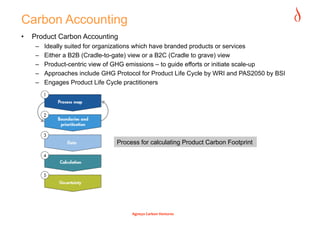
•    Product Carbon Accounting
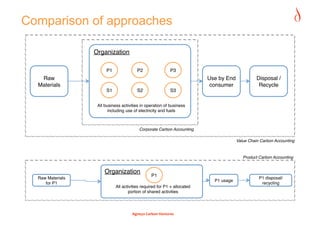
      –    Ideally suited for organizations which have branded products or services
      –    Either a B2B (Cradle-to-gate) view or a B2C (Cradle to grave) view
      –    Product-centric view of GHG emissions – to guide efforts or initiate scale-up
      –    Approaches include GHG Protocol for Product Life Cycle by WRI and PAS2050 by BSI
      –    Engages Product Life Cycle practitioners


                                   Process
for
calculating
Product
Carbon
Footprint


                                        Agneya
Carbon
Ventures

Carbon Accounting
•    Corporate Carbon Accounting
      –    Creates an overview of the entire organization’s GHG footprint
      –    Suited to all types of organizations irrespective of their domain or nature of operations
      –    Robust approach to establishing GHG inventory
      –    Applies GHG Protocol Corporate Accounting and Reporting Standard – tested worldwide
      –    Engages Corporate Communications and Corporate Branding groups
      –    Implemented in India by Tata Motors, Asian Paints, Infosys, Wipro, ACC, ONGC, Tata Steel etc.
      –  Recent implementation by Ashoka Buildcon – First infrastructure company in India to do so


•    Value-chain Carbon Accounting
      –  To understand and communicate carbon emissions in core and allied activities
      –  Activities in direct control and those associated with products or services over entire value chain
      –  An aggregate view of all the products and services of the company
      –  GHG Protocol Corporate Accounting and Reporting Standard (in use since 2004) and GHG Protocol
         Scope 3 Standard (under development and being road tested).
      –  Involves Corporate communications, Supply Chain practitioners and Marketing
      –  Allows the company to collaborate with suppliers and consumers to together understand and reduce the
         Carbon footprint of operations


                                              Agneya
Carbon
Ventures

Comparison of approaches

                  Organization

                        P1
               P2
               P3
   Raw                                                                     Use by End              Disposal /
  Materials
                                                                consumer
               Recycle
                        S1
               S2
               S3


                   All business activities in operation of business
                         including use of electricity and fuels


                                           Corporate Carbon Accounting

                                                                                         Value Chain Carbon Accounting


                                                                                            Product Carbon Accounting


                       Organization
                                                  P1
  Raw Materials                                                                                     P1 disposal/
                                                                             P1 usage
     for P1
                  All activities required for P1 + allocated
                                                                                                     recycling
                                     portion of shared activities


                                       Agneya
Carbon
Ventures

Carbon Mitigation and Neutralization
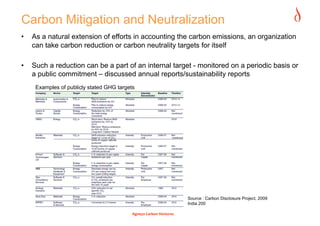
•    As a natural extension of efforts in accounting the carbon emissions, an organization
     can take carbon reduction or carbon neutrality targets for itself

•    Such a reduction can be a part of an internal target - monitored on a periodic basis or
     a public commitment – discussed annual reports/sustainability reports
      Examples of publicly stated GHG targets


                                                                      Source
:
Carbon
Disclosure
Project,
2009

                                                                      India
200


                                            Agneya
Carbon
Ventures

Thank you!

We look forward to hearing from you.


Indrajeet
+91-9028788430 / indrajeet@agneya.in


Kedar
+91-9665407848 / kedar@agneya.in


                                Agneya
Carbon
Ventures


Carbon Accounting Advisory

  • 1.
    Carbon Accounting Advisory Agneya
Carbon
Ventures

  • 2.
    Background •  Climate change is one of biggest threats faced by humanity. –  Recent temperatures are warmer than any since direct measurements began –  All the 10 warmest years have occurred since 1990, including each year since 1995. •  Greenhouse gases (GHGs) such as CO2 are believed to be responsible for this –  Efforts to limit the CO2 concentration in the atmosphere below 550 ppm –  The only way to do so is to control rate of greenhouse gases emission into the atmosphere. •  Europe has been at the forefront of these initiatives, having established world’s first carbon cap-and trade system (EU-ETS) in 2005. –  This mechanism is intended to cap the emissions from more than 12,000 large emitters in the EU. •  India, China, Brazil and South Africa (the BASIC) would continue to face pressures from the developed world to measure and report emissions, as least measure their GHG emissions. •  Various voluntary initiatives such as Carbon Disclosure Project (CDP), Investor Network on Climate Risk (INCR), and Institutional Investor Group on Climate Change (IIGCC) are increasing the thrust on this area. Agneya
Carbon
Ventures

  • 3.
    Carbon Accounting •  Product Carbon Accounting –  Ideally suited for organizations which have branded products or services –  Either a B2B (Cradle-to-gate) view or a B2C (Cradle to grave) view –  Product-centric view of GHG emissions – to guide efforts or initiate scale-up –  Approaches include GHG Protocol for Product Life Cycle by WRI and PAS2050 by BSI –  Engages Product Life Cycle practitioners Process
for
calculating
Product
Carbon
Footprint
 Agneya
Carbon
Ventures

  • 4.
    Carbon Accounting •  Corporate Carbon Accounting –  Creates an overview of the entire organization’s GHG footprint –  Suited to all types of organizations irrespective of their domain or nature of operations –  Robust approach to establishing GHG inventory –  Applies GHG Protocol Corporate Accounting and Reporting Standard – tested worldwide –  Engages Corporate Communications and Corporate Branding groups –  Implemented in India by Tata Motors, Asian Paints, Infosys, Wipro, ACC, ONGC, Tata Steel etc. –  Recent implementation by Ashoka Buildcon – First infrastructure company in India to do so •  Value-chain Carbon Accounting –  To understand and communicate carbon emissions in core and allied activities –  Activities in direct control and those associated with products or services over entire value chain –  An aggregate view of all the products and services of the company –  GHG Protocol Corporate Accounting and Reporting Standard (in use since 2004) and GHG Protocol Scope 3 Standard (under development and being road tested). –  Involves Corporate communications, Supply Chain practitioners and Marketing –  Allows the company to collaborate with suppliers and consumers to together understand and reduce the Carbon footprint of operations Agneya
Carbon
Ventures

  • 5.
    Comparison of approaches Organization P1 P2 P3 Raw Use by End Disposal / Materials consumer Recycle S1 S2 S3 All business activities in operation of business including use of electricity and fuels Corporate Carbon Accounting Value Chain Carbon Accounting Product Carbon Accounting Organization P1 Raw Materials P1 disposal/ P1 usage for P1 All activities required for P1 + allocated recycling portion of shared activities Agneya
Carbon
Ventures

  • 6.
    Carbon Mitigation andNeutralization •  As a natural extension of efforts in accounting the carbon emissions, an organization can take carbon reduction or carbon neutrality targets for itself •  Such a reduction can be a part of an internal target - monitored on a periodic basis or a public commitment – discussed annual reports/sustainability reports Examples of publicly stated GHG targets Source
:
Carbon
Disclosure
Project,
2009
 India
200
 Agneya
Carbon
Ventures

  • 7.
    Thank you! We lookforward to hearing from you. Indrajeet +91-9028788430 / indrajeet@agneya.in Kedar +91-9665407848 / kedar@agneya.in Agneya
Carbon
Ventures