Mainstreaming Energy Efficiency & Carbon Responsibility in Indian Apparel Industry Samit Jain Advit Foundation advit foundation
Our Expertise     …work experience Energy Energy Efficiency & Climate Change Capacity Building Product design for energy storage devises Energy efficiency of building Energy audit  (Investment Grade Energy Audits) Implementing ECBC code of BEE in existing & new  buildings Promotion of wind, solar, small hydro and biomass based  power projects and off-grid applications  Climate Adaptation and Mitigation services including CDM  service advit foundation (1/2)
Environment & Safety Safety and Environmental Audits System development and due deligence   Environment and Corporate Social Responsibility Reporting  as per ISO Standards & GRI guidelines Carbon Footprint analysis & Promoting Carbon neutrality  through offsetting initiative Integrated Solid Waste Management including promotion of  vermi composting, waste to energy, biomethnation,  designing scientific landfill etc advit foundation (2/2) Our Expertise     …work experience
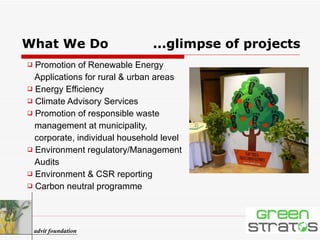
What We Do     ...glimpse of projects Promotion of Renewable Energy  Applications for rural & urban areas Energy Efficiency  Climate Advisory Services Promotion of responsible waste  management at municipality, corporate, individual household level Environment regulatory/Management  Audits Environment & CSR reporting Carbon neutral programme advit foundation
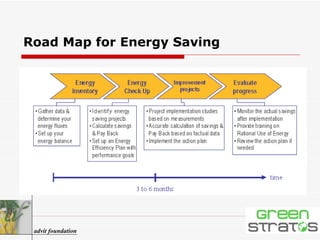
Road Map for Energy Saving advit foundation
Base Line Energy Consumption Overall on an average about 5.6 lakh units of power is procured by each apparel unit.  On an average about 1.2 lakh litres of diesel is being used.  In monetary terms per manufacturing unit about Rs. 26 lakhs of power bill & Rs. 40 lakh rupees of diesel consumption.  advit foundation Samit Jain [email_address]
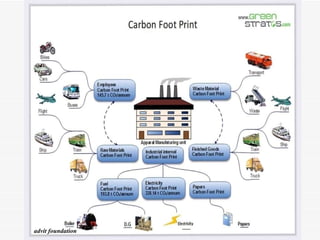
Carbon Emissions - Annually Around 800 to 850 tonnes of carbon equivalent per apparel unit.  If you expand the focus of carbon responsibility attention to immediate suppliers, vendors etc as well as non core operations of industry then the carbon footprint assessment increases by another 650 tCO2 equivalent. advit foundation
advit foundation
Common EE Measures Identified for Implementation Replace existing inefficient FTL with energy efficient high lumen output FTL  Install voltage optimizer in lighting circuits for energy saving  Provide LED lighting for production Install Solar steam generator to supplement steam generated by diesel fired boiler (The diesel consumption will be reduced)   advit foundation (1/2)
Replace existing conventional regulators with EE electronic regulators  Pre heat oil with boiler exhaust gases  Arresting wastage of water & Replacement of standard motors with energy-efficient ones  Replace existing conventional electromagnetic ballasts with energy efficient electronic ballasts Common EE Measures Identified for Implementation advit foundation (2/2)
Energy Saving & Payback On an average 4.6 lakh units of power can be saved annually in each of the units Roughly Rs. 19 lakhs can be saved annually but making an investment to the tune of Rs. 40 lakhs The average payback period is 24 months advit foundation
Reducing the carbon miles in transportation, marketing and sale of products Reduced usage of energy and water while washing and during usage stage of textile products Exploring options for recycling, take back, reusing of textile products Environment friendly disposal etc Post Production advit foundation
ESCO AS OPTION FOR FINANCING ENERGY EFFICIENCY advit foundation
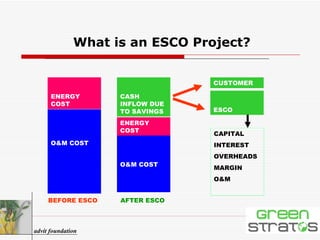
What is an ESCO Project? ESCO is an Energy Service Company ESCO conducts Energy Audit and identifies Energy saving projects Detailed Project proposal is made by the ESCO  ESCO implements the project on EPC basis (engineering, procurement and construction) ESCO Makes all the investment ESCO Gets paid from the savings achieved. advit foundation
O&M COST ENERGY COST O&M COST ENERGY COST CASH INFLOW DUE TO SAVINGS ESCO CUSTOMER BEFORE ESCO AFTER ESCO CAPITAL INTEREST OVERHEADS MARGIN O&M What is an ESCO Project? advit foundation
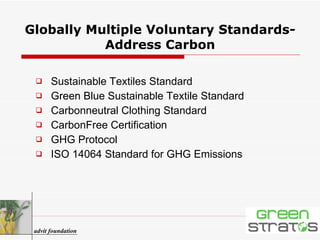
Globally Multiple Voluntary Standards- Address Carbon Sustainable Textiles Standard Green Blue Sustainable Textile Standard Carbonneutral Clothing Standard CarbonFree Certification GHG Protocol ISO 14064 Standard for GHG Emissions advit foundation
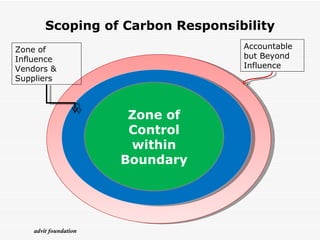
Scoping of Carbon Responsibility Zone of Control within Boundary Zone of Influence Vendors & Suppliers Accountable but Beyond Influence advit foundation
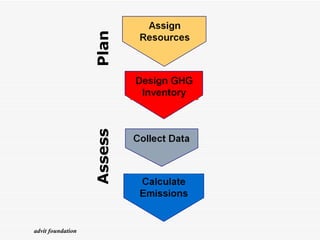
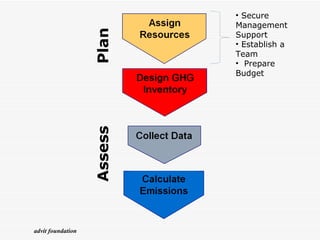
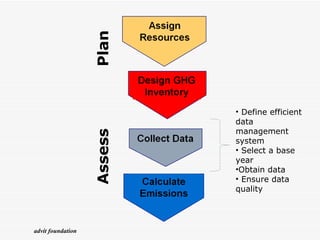
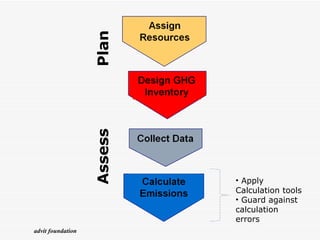
Plan Assess advit foundation
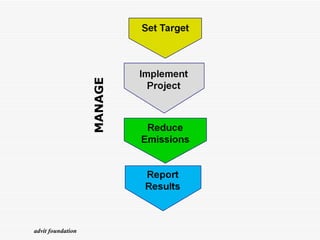
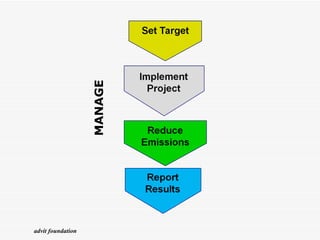
MANAGE advit foundation
Plan Assess Secure Management Support Establish a Team Prepare Budget advit foundation
Plan Top management buy in is critical & essential for time and resource allocation needs Person with organizational knowledge should head the team supported by cross functional team Financial planning and executing projects per resource availability advit foundation
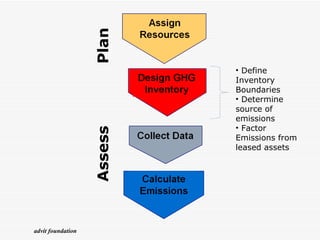
Plan Assess Define Inventory Boundaries Determine source of emissions Factor Emissions from leased assets advit foundation
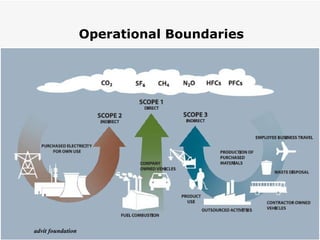
Operational Boundaries advit foundation
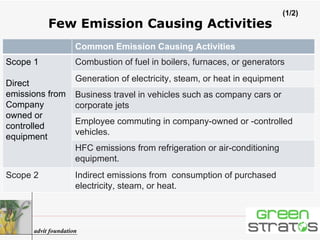
Few Emission Causing Activities (1/2) advit foundation Common Emission Causing Activities Scope 1 Direct emissions from Company owned or controlled equipment Combustion of fuel in boilers, furnaces, or generators Generation of electricity, steam, or heat in equipment Business travel in vehicles such as company cars or corporate jets Employee commuting in company-owned or -controlled vehicles. HFC emissions from refrigeration or air-conditioning equipment. Scope 2 Indirect emissions from  consumption of purchased electricity, steam, or heat.
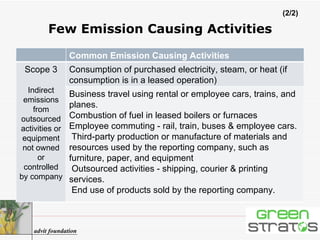
Few Emission Causing Activities advit foundation (2/2) Common Emission Causing Activities Scope 3 Indirect emissions from outsourced activities or equipment not owned or controlled by company Consumption of purchased electricity, steam, or heat (if consumption is in a leased operation) Business travel using rental or employee cars, trains, and planes. Combustion of fuel in leased boilers or furnaces Employee commuting - rail, train, buses & employee cars. Third-party production or manufacture of materials and resources used by the reporting company, such as furniture, paper, and equipment Outsourced activities - shipping, courier & printing services. End use of products sold by the reporting company.
Plan Assess Define efficient data management system Select a base year Obtain data Ensure data quality advit foundation
Plan Assess Apply Calculation tools Guard against calculation errors advit foundation
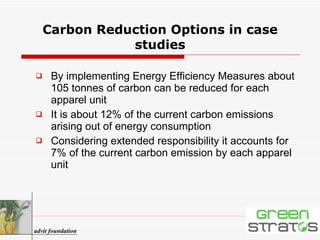
Carbon Reduction Options in case studies By implementing Energy Efficiency Measures about 105 tonnes of carbon can be reduced for each apparel unit It is about 12% of the current carbon emissions arising out of energy consumption Considering extended responsibility it accounts for 7% of the current carbon emission by each apparel unit advit foundation
MANAGE advit foundation
Reporting: what must be reported, and how it must be reported Monitoring the project Verification plans advit foundation Monitoring and Verification
Performance Monitoring  The performance monitoring system includes not only the needed sensors, wiring and data acquisition devices, but also the means to calculate, display and archive resultant parameters.  advit foundation
Energy Savings Checklist Plant drives Determine the overall efficiency of the current motor & evaluate the effects by replacing it with a high efficiency motor Examine the possibilities of a motor-controlling unit of some kind (e.g. on/off , soft-start unit), certainly for those motors running in partial load Examine the possibilities of variable speed (or at least multi-speed) drives for those motors running in partial load Compare the nominal characteristics of the engine with the load characteristics. Consider replacing oversized motors Ensure the appropriate drive is used (i.e. direct drive, v-belt, notched belt, fl at belt, etc.) (1/5) advit foundation
Boilers and steam systems Minimize hot water requirements and allow for local boosting Install or upgrade insulation on hot water/steam lines Consider decentralization of heat production for remote users Reconsider installed gas burner versus the merits of a new and more efficient gas burner with controlling unit for power adjusting and burner management (via CO and/or oxygen measurements in flue gas) Check and optimize boiler excess air level to practical minimum Check for steam leaks from boiler over pressure valves and in the distribution system Energy Savings Checklist (2/5) advit foundation
Boilers and steam systems ...contd. Check insulation of the boiler Examine the feasibility of reducing the steam pressure in the distribution net to reduce the steam temperature (and thus its correlated heat losses) Check the condensate return lines insulation, pressure (higher pressure > higher temperature) and return levels Check potential of a blowdown waste heat recovery system Check potential of waste heat recovery from incineration Check potential for utilization of fl ash steam Check cogeneration potential Energy Savings Checklist (3/5) advit foundation
Lighting Systems Evaluate possibility of replacing existing ballasts with modern low-loss ballasts Ensure lighting levels comply with requirements Consider the different lighting options and its characteristics (average life span, efficiency, light colour and colour rendering) Consider delamping, voltage reduction, motion detectors, light sensors, time switches, better reflectors and better skylighting Discourage use of extra low voltage lights due to total cost, frequent replacement and effect on air conditioning costs Energy Savings Checklist (4/5) advit foundation
Heating Ventilation & AC (HVAC) in buildings Check adequacy of ceiling insulation and install or upgrade as necessary Select the most appropriate heating system (radiation versus convection) Check if filters are maintained and replaced in time to avoid excessive pressure drops Check the potential of heat recuperation and air recycling Set heating thermostats to appropriate temperatures Check zoning of HVAC systems Discourage the use of personal radiators and fans Use time clocks to control system operation Energy Savings Checklist (5/5) advit foundation
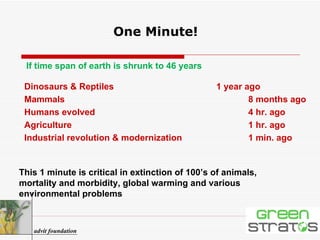
One Minute! advit foundation If time span of earth is shrunk to 46 years Dinosaurs & Reptiles  1 year ago Mammals  8 months ago Humans evolved  4 hr. ago Agriculture  1 hr. ago Industrial revolution & modernization  1 min. ago  This 1 minute is critical in extinction of 100’s of animals, mortality and morbidity, global warming and various  environmental problems
Advit Foundation 610A, Udyog Vihar, Phase V Gurgaon, Haryana Email:  [email_address] www.advit.org THANK YOU advit foundation

Advit Foundation - Energy Efficiency

  • 1.
    Mainstreaming Energy Efficiency& Carbon Responsibility in Indian Apparel Industry Samit Jain Advit Foundation advit foundation
  • 2.
    Our Expertise …work experience Energy Energy Efficiency & Climate Change Capacity Building Product design for energy storage devises Energy efficiency of building Energy audit (Investment Grade Energy Audits) Implementing ECBC code of BEE in existing & new buildings Promotion of wind, solar, small hydro and biomass based power projects and off-grid applications Climate Adaptation and Mitigation services including CDM service advit foundation (1/2)
  • 3.
    Environment & SafetySafety and Environmental Audits System development and due deligence Environment and Corporate Social Responsibility Reporting as per ISO Standards & GRI guidelines Carbon Footprint analysis & Promoting Carbon neutrality through offsetting initiative Integrated Solid Waste Management including promotion of vermi composting, waste to energy, biomethnation, designing scientific landfill etc advit foundation (2/2) Our Expertise …work experience
  • 4.
    What We Do ...glimpse of projects Promotion of Renewable Energy Applications for rural & urban areas Energy Efficiency Climate Advisory Services Promotion of responsible waste management at municipality, corporate, individual household level Environment regulatory/Management Audits Environment & CSR reporting Carbon neutral programme advit foundation
  • 5.
    Road Map forEnergy Saving advit foundation
  • 6.
    Base Line EnergyConsumption Overall on an average about 5.6 lakh units of power is procured by each apparel unit. On an average about 1.2 lakh litres of diesel is being used. In monetary terms per manufacturing unit about Rs. 26 lakhs of power bill & Rs. 40 lakh rupees of diesel consumption. advit foundation Samit Jain [email_address]
  • 7.
    Carbon Emissions -Annually Around 800 to 850 tonnes of carbon equivalent per apparel unit. If you expand the focus of carbon responsibility attention to immediate suppliers, vendors etc as well as non core operations of industry then the carbon footprint assessment increases by another 650 tCO2 equivalent. advit foundation
  • 8.
  • 9.
    Common EE MeasuresIdentified for Implementation Replace existing inefficient FTL with energy efficient high lumen output FTL Install voltage optimizer in lighting circuits for energy saving Provide LED lighting for production Install Solar steam generator to supplement steam generated by diesel fired boiler (The diesel consumption will be reduced) advit foundation (1/2)
  • 10.
    Replace existing conventionalregulators with EE electronic regulators Pre heat oil with boiler exhaust gases Arresting wastage of water & Replacement of standard motors with energy-efficient ones Replace existing conventional electromagnetic ballasts with energy efficient electronic ballasts Common EE Measures Identified for Implementation advit foundation (2/2)
  • 11.
    Energy Saving &Payback On an average 4.6 lakh units of power can be saved annually in each of the units Roughly Rs. 19 lakhs can be saved annually but making an investment to the tune of Rs. 40 lakhs The average payback period is 24 months advit foundation
  • 12.
    Reducing the carbonmiles in transportation, marketing and sale of products Reduced usage of energy and water while washing and during usage stage of textile products Exploring options for recycling, take back, reusing of textile products Environment friendly disposal etc Post Production advit foundation
  • 13.
    ESCO AS OPTIONFOR FINANCING ENERGY EFFICIENCY advit foundation
  • 14.
    What is anESCO Project? ESCO is an Energy Service Company ESCO conducts Energy Audit and identifies Energy saving projects Detailed Project proposal is made by the ESCO ESCO implements the project on EPC basis (engineering, procurement and construction) ESCO Makes all the investment ESCO Gets paid from the savings achieved. advit foundation
  • 15.
    O&M COST ENERGYCOST O&M COST ENERGY COST CASH INFLOW DUE TO SAVINGS ESCO CUSTOMER BEFORE ESCO AFTER ESCO CAPITAL INTEREST OVERHEADS MARGIN O&M What is an ESCO Project? advit foundation
  • 16.
    Globally Multiple VoluntaryStandards- Address Carbon Sustainable Textiles Standard Green Blue Sustainable Textile Standard Carbonneutral Clothing Standard CarbonFree Certification GHG Protocol ISO 14064 Standard for GHG Emissions advit foundation
  • 17.
    Scoping of CarbonResponsibility Zone of Control within Boundary Zone of Influence Vendors & Suppliers Accountable but Beyond Influence advit foundation
  • 18.
  • 19.
  • 20.
    Plan Assess SecureManagement Support Establish a Team Prepare Budget advit foundation
  • 21.
    Plan Top managementbuy in is critical & essential for time and resource allocation needs Person with organizational knowledge should head the team supported by cross functional team Financial planning and executing projects per resource availability advit foundation
  • 22.
    Plan Assess DefineInventory Boundaries Determine source of emissions Factor Emissions from leased assets advit foundation
  • 23.
  • 24.
    Few Emission CausingActivities (1/2) advit foundation Common Emission Causing Activities Scope 1 Direct emissions from Company owned or controlled equipment Combustion of fuel in boilers, furnaces, or generators Generation of electricity, steam, or heat in equipment Business travel in vehicles such as company cars or corporate jets Employee commuting in company-owned or -controlled vehicles. HFC emissions from refrigeration or air-conditioning equipment. Scope 2 Indirect emissions from consumption of purchased electricity, steam, or heat.
  • 25.
    Few Emission CausingActivities advit foundation (2/2) Common Emission Causing Activities Scope 3 Indirect emissions from outsourced activities or equipment not owned or controlled by company Consumption of purchased electricity, steam, or heat (if consumption is in a leased operation) Business travel using rental or employee cars, trains, and planes. Combustion of fuel in leased boilers or furnaces Employee commuting - rail, train, buses & employee cars. Third-party production or manufacture of materials and resources used by the reporting company, such as furniture, paper, and equipment Outsourced activities - shipping, courier & printing services. End use of products sold by the reporting company.
  • 26.
    Plan Assess Defineefficient data management system Select a base year Obtain data Ensure data quality advit foundation
  • 27.
    Plan Assess ApplyCalculation tools Guard against calculation errors advit foundation
  • 28.
    Carbon Reduction Optionsin case studies By implementing Energy Efficiency Measures about 105 tonnes of carbon can be reduced for each apparel unit It is about 12% of the current carbon emissions arising out of energy consumption Considering extended responsibility it accounts for 7% of the current carbon emission by each apparel unit advit foundation
  • 29.
  • 30.
    Reporting: what mustbe reported, and how it must be reported Monitoring the project Verification plans advit foundation Monitoring and Verification
  • 31.
    Performance Monitoring The performance monitoring system includes not only the needed sensors, wiring and data acquisition devices, but also the means to calculate, display and archive resultant parameters. advit foundation
  • 32.
    Energy Savings ChecklistPlant drives Determine the overall efficiency of the current motor & evaluate the effects by replacing it with a high efficiency motor Examine the possibilities of a motor-controlling unit of some kind (e.g. on/off , soft-start unit), certainly for those motors running in partial load Examine the possibilities of variable speed (or at least multi-speed) drives for those motors running in partial load Compare the nominal characteristics of the engine with the load characteristics. Consider replacing oversized motors Ensure the appropriate drive is used (i.e. direct drive, v-belt, notched belt, fl at belt, etc.) (1/5) advit foundation
  • 33.
    Boilers and steamsystems Minimize hot water requirements and allow for local boosting Install or upgrade insulation on hot water/steam lines Consider decentralization of heat production for remote users Reconsider installed gas burner versus the merits of a new and more efficient gas burner with controlling unit for power adjusting and burner management (via CO and/or oxygen measurements in flue gas) Check and optimize boiler excess air level to practical minimum Check for steam leaks from boiler over pressure valves and in the distribution system Energy Savings Checklist (2/5) advit foundation
  • 34.
    Boilers and steamsystems ...contd. Check insulation of the boiler Examine the feasibility of reducing the steam pressure in the distribution net to reduce the steam temperature (and thus its correlated heat losses) Check the condensate return lines insulation, pressure (higher pressure > higher temperature) and return levels Check potential of a blowdown waste heat recovery system Check potential of waste heat recovery from incineration Check potential for utilization of fl ash steam Check cogeneration potential Energy Savings Checklist (3/5) advit foundation
  • 35.
    Lighting Systems Evaluatepossibility of replacing existing ballasts with modern low-loss ballasts Ensure lighting levels comply with requirements Consider the different lighting options and its characteristics (average life span, efficiency, light colour and colour rendering) Consider delamping, voltage reduction, motion detectors, light sensors, time switches, better reflectors and better skylighting Discourage use of extra low voltage lights due to total cost, frequent replacement and effect on air conditioning costs Energy Savings Checklist (4/5) advit foundation
  • 36.
    Heating Ventilation &AC (HVAC) in buildings Check adequacy of ceiling insulation and install or upgrade as necessary Select the most appropriate heating system (radiation versus convection) Check if filters are maintained and replaced in time to avoid excessive pressure drops Check the potential of heat recuperation and air recycling Set heating thermostats to appropriate temperatures Check zoning of HVAC systems Discourage the use of personal radiators and fans Use time clocks to control system operation Energy Savings Checklist (5/5) advit foundation
  • 37.
    One Minute! advitfoundation If time span of earth is shrunk to 46 years Dinosaurs & Reptiles 1 year ago Mammals 8 months ago Humans evolved 4 hr. ago Agriculture 1 hr. ago Industrial revolution & modernization 1 min. ago This 1 minute is critical in extinction of 100’s of animals, mortality and morbidity, global warming and various environmental problems
  • 38.
    Advit Foundation 610A,Udyog Vihar, Phase V Gurgaon, Haryana Email: [email_address] www.advit.org THANK YOU advit foundation

Editor's Notes

  • #31 In an effort to make it easy to use, the Project Module is structured along the project cycle and takes the project developer along the key steps involved in GHG project accounting.