igd.com/sustainability
click here to start
Environmental
Sustainability Matrix:
Understand sustainability issues
across the supply chain

PACKAGING
- raw materials
- manufacturing
- storage
- transport
- wholesale and retail
- end user and end of life
WASTE
- raw materials
- manufacturing
- storage
- transport
- wholesale and retail
- end user and end of life
WORKSHOP - Sustainability: understanding the
FMCG perspective
SUSTAINABILITY WORKING GROUP
Contents
INTRODUCTION
ENVIRONMENTAL SUSTAINABILITY MATRIX
GREENHOUSE GASES
- raw materials
- manufacturing
- storage
- transport
- wholesale and retail
- end user and end of life
WATER
- raw materials
- manufacturing
- storage
- transport
- wholesale and retail
- end user and end of life
Introduction
Introduction
Each year more food and grocery companies are responding to
the challenges of becoming environmentally sustainable. This
demonstrates industry’s commitment to the environment, but
can require businesses to become rapidly familiar with
sustainability issues across different parts of the organisation.
The number and complexity of environmental issues that food
and grocery companies must tackle is ever expanding.
Businesses must now understand how environmental issues
interact, their relative impacts and the points in the supply chain
affected. Across the organisation, different functions need to be
aware of the impact of their activities on their own businesses
and those of their customers.
A number of initiatives have been put in place to address
environmental challenges faced by the industry. However, the
outputs are some years away and will be highly technical, limiting
their accessibility to non-specialists. Therefore IGD’s Industry
Sustainability Group developed this environmental sustainability
matrix to improve understanding of the issues across all
business functions, and to showcase opportunities for
improvement along the supply chain.
Purpose of the Environmental Sustainability Matrix
The purpose of the matrix is to help food and grocery companies
of all sizes increase understanding, assess impact and manage
sustainability related issues in their supply chains. It outlines the
main concepts, issues and challenges, and gives solutions, links
to further information and examples of best practice case
studies from industry.
The matrix focuses on four key aspects of environmental
sustainability:
• Greenhouse Gases
• Water
• Packaging
• Waste
The supply chain has been broken down into components
allowing users to explore environmental sustainability issues at
each of the following stages: Raw Materials, Manufacturing,
Storage, Transport, Wholesale and Retail and End User and End
of Life.
The target audience for the matrix is non-sustainability
practitioners within the food and grocery industry who need to
understand sustainability issues, or those who are starting out in
the area. The matrix will help them to understand the
interconnectivity of environmental sustainability issues along the
supply chain.
How to use the Matrix
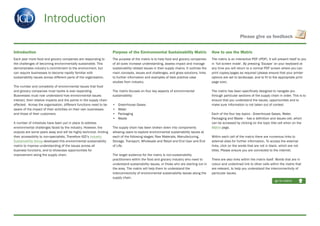
The matrix is an interactive PDF (iPDF). It will present itself to you
in ‘full screen mode’. By pressing ‘Escape’ on your keyboard at
any time you will return to a normal PDF screen where you can
print copies/pages as required (please ensure that your printer
options are set to landscape, and to fit to the appropriate print
page size).
The matrix has been specifically designed to navigate you
through particular sections of the supply chain in order. This is to
ensure that you understand the issues, opportunities and to
make sure information is not taken out of context.
Each of the four key topics - Greenhouse Gases, Water,
Packaging and Waste – has a definition and issues cell, which
can be accessed by clicking on the topic title cell when on the
Matrix page.
Within each cell of the matrix there are numerous links to
external sites for further information. To access the external
links, click on the words that are not in black, which are not
titles. Please ensure you are connected to the internet.
There are also links within the matrix itself. Words that are in
colour and underlined link to other cells within the matrix that
are relevant, to help you understand the interconnectivity of
particular issues.
go to matrix
Please give us feedback
Raw
materials
Manufacturing Storage Transport
Wholesale and
retail
End user and
end of life
Greenhouse
gases
Greenhouse gases and
raw materials
Greenhouse gases and
manufacturing
Greenhouse gases and
storage
Greenhouse gases and
transport
Greenhouse gases and
wholesale and retail
Greenhouse gases and
end user and end of life
Water
Water and
raw materials
Water and
manufacturing
Water and
storage
Water and
transport
Water and
wholesale and retail
Water and
end user and end of life
Packaging
Packaging and
raw materials
Packaging and
manufacturing
Packaging and
storage
Packaging and
transport
Packaging and
wholesale and retail
Packaging and
end user and end of life
Waste
Waste and
raw materials
Waste and
manufacturing
Waste and
storage
Waste and
transport
Waste and
wholesale and retail
Waste and
end user and end of life
Environmental Sustainability Matrix
How to use this matrix: Please select a topic area you are interested in, for example Greenhouse gases (GHG). Then along this axis please click
on the area within the supply chain that you want to know about, such as Storage. You will then be taken to a cell about GHG and Storage.
About the matrix: The below matrix is designed to help you identify impacts within the supply chain and provide you with solutions, raise other issues
that you may not have previously considered, and offer numerous links to further information and best practice case studies.
BACK TO MATRIX To suggest amends/updates to content, email: Toby.Pickard@igd.com
Please give us feedback
Definition and issues with Greenhouse Gases
Greenhouse gases (GHGs) are any of the atmospheric gases that
contribute to the greenhouse effect (warming of the Earth’s
temperature) by absorbing infrared radiation.
Although greenhouse gases occur naturally in the atmosphere,
the elevated levels especially of carbon dioxide and methane
that have been observed by the Intergovernmental Panel on
Climate Change (IPCC) are directly related, at least in part, to
human activities such as the burning of fossil fuels and the
deforestation of tropical forests.
The UK has both international (Kyoto Protocol) and domestic (UK
Climate Change Act) targets to reduce greenhouse gas
emissions.
Carbon dioxide (CO2) is the most widely known of the
greenhouse gases contributing to global warming. It accounts for
85% of all greenhouse gas emissions in the UK. The other gases
included in this ‘greenhouse gas basket’, as defined by the Kyoto
Protocol are: Carbon dioxide (CO2), Methane (CH4), Nitrous oxide
(N2O), Hydrofluorocarbons (HFCs), Perfluorocarbons (PFCs) and
Sulphur hexafluoride (SF6). (Source: UNFCCC)
Global warming potential
Each GHG has a different global warming potential (GWP), a
measure of how much a given mass of gas is estimated to
contribute to global warming. The scale is relative and calculated
over a specified time, typically 100 years, comparing the given
gas to the same mass of CO2 which is given a GWP of one.
Carbon dioxide equivalent (CO2e) is a universal unit of
measurement used in reporting GHG inventories or footprints
and to evaluate releases or avoidance of releases of different
GHG against a common basis. It relates the GWP of any GHG, to
the GWP of one unit of carbon dioxide. An example is one tonne
of methane will have a CO2e of 25 tonnes (Source: IPPC). CO2e
is sometimes abbreviated to just ‘carbon’, it is important to
clarify what is meant when the term is used.
Footprinting
Over the past decade there has been growing interest in
calculating carbon footprints, because carbon emissions are
closely linked to energy use (and cost), due to mandatory or
voluntary reporting requirements, and for reputational reasons.
In the UK, the Carbon Trust has been at the forefront of helping
businesses.
There are two main types of carbon footprint:
1. Corporate carbon footprint
Calculation of a carbon footprint requires the use of a
methodology. A widely accepted and used method for
calculating corporate carbon footprints is the World Resources
Institute and the World Business Council for Sustainable
Development’s ‘Greenhouse Gas Protocol’. Corporate carbon
footprints calculate the emissions from all the direct activities
across the organisation, including buildings’ energy use,
industrial processes and company vehicles.
2. Product carbon footprint
Over the last five years there has been an effort to enable the
carbon footprints of products and services to be calculated (e.g.
a bag of crisps; carton of juice etc).
A product carbon footprint measures the greenhouse gas
emissions at each stage of the product’s life. This includes
extraction, production and transportation of raw materials to
manufacturing, right through to its use and final reuse, recycling
or disposal. This is often called ‘embedded carbon/GHG’.
Methodologies for calculating embedded GHGs have been
developed (e.g. PAS 2050 in the UK) and continue to be
developed on a global scale.
Product carbon label
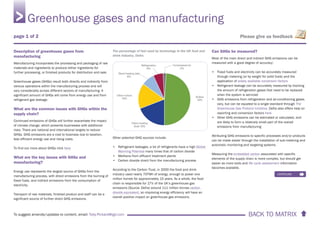
There are multiple challenges in
finding a methodology that is
applicable across product
categories, is affordable and
produces robust results. Companies
also undertake product carbon
footprinting for different reasons:
e.g. to enable them to communicate
a ‘Xg carbon’ message on particular
products; or to help them identify
and address GHG ‘hot spotshot spots’ in their
supply chains.
Source: Carbon Trust
Greenhouse gases
continues 
page 1 of 2
BACK TO MATRIX To suggest amends/updates to content, email: Toby.Pickard@igd.com
Please give us feedback
Example of the percentage of embedded GHG
emissions within different products
The table below shows the percentage of GHG emissions
produced by products at different stages of the supply chain. The
benefit of product analysis to this level is that ‘hot spots’ can be
identified. For example, the majority of the GHGs that are
embedded in a detergent occur in the ‘use by’ phase in the form
of energy used to heat the water, drive the washing machine etc.
Improved knowledge has resulted in the reformulation of some
detergents to enable consumers to wash at a lower temperature.
In contrast, the hot spot for milk is at the raw material (farm)
stage. The GHGs come from a variety of sources including
fertilisers applied to grassland, fossil fuels, energy in milking
parlours and methane emitted by dairy cattle.
Greenhouse gases
Raw material
production
Manufacture/
processing
Logistics/
distribution
Retail Use by
consumer
Recycling and
disposal
Detergent 21% 2% 2% 0.5% 67.5% 7%
Orange juice 28% 19% 47% 5% 1% 0%
Potato crisps 36% 51% 10% 0% 3%
Bread 45% 23% 4% 2% 23% 3%
Milk 73% 9% 3% 10% 3% 2%
back to matrix
page 2 of 2
Example of the percentage of embedded GHG emissions within different products
Source: The University of Manchester, Sustainable Consumption Institute, Report Consumers, business and climate change, 2009 [opens PDF, page 28]
BACK TO MATRIX To suggest amends/updates to content, email: Toby.Pickard@igd.com
Please give us feedback
Description of greenhouse gases from raw
materials
The greenhouse gases (GHGs) arising from raw materials in the
food and grocery supply chains are predominately from nitrous
oxide (from crops and livestock production), methane (from
livestock production and biodegradable waste) and carbon
dioxide (from energy use and land management).
What are the common issues with GHGs within the
supply chain?
Continued emissions of GHGs will further exacerbate the impact
of climate change, which presents businesses with additional
risks. There are national and international targets to reduce
GHGs. GHG emissions are a cost to business due to taxation,
less efficient energy use and rising costs.
To find out more about GHGs click here.
What are the key issues with GHGs and raw
materials?
GHG emissions associated with food raw materials come mainly
from the agricultural phase. Not all these emissions will be
created in the country in which the product is manufactured and
ultimately used/consumed. Supply chains are increasingly
global, and raw materials will be sourced from different
geographies reflecting availability, seasonality and cost.
Manufacturers therefore need to recognise their responsibilities
to work with suppliers of raw materials from all geographies to
reduce their GHG emissions.
Direct emissions from farming and changes in land use account
for about 7% of UK greenhouse gas emissions (Source: HM
Government). The Climate Change Act 2008 requires a reduction
in greenhouse gas emissions across the economy by at least
80% below 1990 levels by 2050, and agriculture will need to
play its part in achieving this.
The nature of raw material GHG
emissions is very different from
other sectors of the economy such
as electricity generation, transport,
manufacturing, etc. The principal
GHG for most industries is carbon
dioxide from fossil fuel combustion,
while for agricultural systems
methane and nitrous oxide are the
main GHGs. These arise from
natural, biological processes that
are difficult to manage and subject to seasonal and annual
variability as a function of the weather, crop yield, and natural
processes in the case of methane from dairy cows.
For more in-depth information about global food and farming
meeting the challenges of a low emissions world click here.
Can GHGs be measured?
• The energy (fuel, electricity etc.) required to produce raw
materials for supply chains can be measured and this can be
converted into a GHG emission equivalent
• Determining emissions of methane and nitrous oxide is much
more complex and currently only coarse estimations of
emissions are possible, which are subject to considerable
uncertainty
What can be done to reduce the impact and what
are the opportunities?
Evidence suggests that by improving on-farm efficiency, farmers
can both save money and reduce emissions.
The UK agriculture industry’s GHG Action Plan [opens PDF] aims
to help farmers improve their use of energy and nutrients, their
management of crops and livestock and reduce emissions
without compromising domestic production.
This could be achieved by:
• Use of on-farm anaerobic digestion (AD)
• Use of bio-fuels in agricultural vehicles
• Increased energy efficiency
• Increased feed efficiency
Identifying the risks, challenges and potential
pitfalls
There is a risk that driving down emissions from agriculture in
the UK will compromise production, which could result in
‘exporting’ the UK’s production and emissions to other parts of
the world.
Greenhouse gases and raw materials
continues 
page 1 of 2
BACK TO MATRIX To suggest amends/updates to content, email: Toby.Pickard@igd.com
Please give us feedback
Equally, just because food has been imported it does not
necessarily mean it will have more GHG emissions associated
with it compared to food grown in the UK. Food grown in a more
suitable climate may have lower emissions, even when including
transportation, than food grown locally. Examples of can be view
here.
However, whatever the country of origin of food there is a need to
improve agricultural GHG inventory that accurately reflects
progressive changes in farming practice, such as improvements
to livestock diets, nutrient management and manure
management.
A key challenge is establishing realistic goals for reducing
agricultural GHG emissions towards a minimum future level,
beyond which it may not be biologically possible to make further
reductions.
Industry needs to remain open to future technological
breakthroughs or innovative production systems that might be
possible in the long term.
There is a need to be mindful of potential conflicts with other
sustainability related issues, such as intensification to reduce
overall emissions versus animal welfare (i.e. lower GHG systems
are often the most intensive; which means that there may be a
trade off between lowering GHGs and animal welfare).
Where to go for more information
• Department for Environment Food and Rural Affairs
• Greenhouse Gas Action Plan [opens PDF]
• Agriculture and Horticulture Development Board (AHDB) e.g.
EBLEX’s work for the beef and sheep sectors
• Department for Energy and Climate Change
• The Milk Roadmap: One year down the Road [opens PDF]
• IGD’s Greenhouse Gas Management Report Library on igd.
com
Relationship of GHG emissions from raw materials
to other points in the supply chain
GHG emissions arising from raw materials in the food and
grocery supply chains are predominately from methane, nitrous
oxide and carbon dioxide and can contribute a significant
amount of GHG emissions compared to other areas of the supply
chain.
Case studies
• Müller - Sustainable Dairy Goodness
• Produce World Group - Managing non-financial information to
drive sustainability
• Sainsbury’s - first Carbon Trust certified carbon measure for
dairy farmers
Greenhouse gases and raw materials
back to matrix
page 2 of 2
BACK TO MATRIX To suggest amends/updates to content, email: Toby.Pickard@igd.com
Please give us feedback
Description of greenhouse gases from
manufacturing
Manufacturing incorporates the processing and packaging of raw
materials and ingredients to produce either ingredients for
further processing, or finished products for distribution and sale.
Greenhouse gases (GHGs) result both directly and indirectly from
various operations within the manufacturing process and will
vary considerably across different sectors of manufacturing. A
significant amount of GHGs will come from energy use and from
refrigerant gas leakage.
What are the common issues with GHGs within the
supply chain?
Continued emissions of GHGs will further exacerbate the impact
of climate change, which presents businesses with additional
risks. There are national and international targets to reduce
GHGs. GHG emissions are a cost to business due to taxation,
less efficient energy use and rising costs.
To find out more about GHGs click here
What are the key issues with GHGs and
manufacturing?
Energy use represents the largest source of GHGs from the
manufacturing process, with direct emissions from the burning of
fossil fuels, and indirect emissions from the consumption of
electricity.
Transport of raw materials, finished product and staff can be a
significant source of further direct GHG emissions.
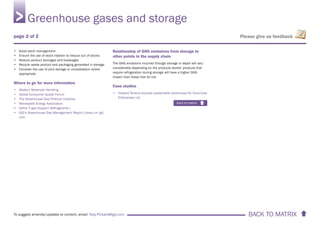
The percentage of fuel used by technology in the UK food and
drink industry, Defra
Other potential GHG sources include:
• Refrigerant leakages, a lot of refrigerants have a high Global
Warming Potential many times that of carbon dioxide
• Methane from effluent treatment plants
• Carbon dioxide direct from the manufacturing process
According to the Carbon Trust, in 2000 the food and drink
industry used nearly 70TWh of energy, enough to power one
million homes for approximately 15 years. As a whole, the food
chain is responsible for 17% of the UK’s greenhouse gas
emissions (Source: Defra) around 111 million tonnes carbon
dioxide equivalent, so improving energy efficiency will have an
overall positive impact on greenhouse gas emissions.
Can GHGs be measured?
Most of the main direct and indirect GHG emissions can be
measured with a good degree of accuracy:
• Fossil fuels and electricity can be accurately measured
through metering (or by weight for solid fuels) and the
application of widely available conversion factors
• Refrigerant leakage can be accurately measured by tracking
the amount of refrigeration gases that need to be replaced
when the system is serviced
• GHG emissions from refrigeration and air-conditioning gases
vary, but can be equated to a single standard through The
Greenhouse Gas Protocol Initiative. Defra also offers help on
reporting and conversion factors here
• Other GHG emissions can be estimated or calculated, and
are likely to form a relatively small part of the overall
emissions from manufacturing
Attributing GHG emissions to specific processes and/or products
can be made easier through the installation of sub-metering and
automatic monitoring and targeting systems.
Measuring the embedded carbon associated with specific
elements of the supply chain is more complex, but should get
easier as more tools and life cycle assessment information
becomes available.
Greenhouse gases and manufacturing
continues 
page 1 of 2
BACK TO MATRIX To suggest amends/updates to content, email: Toby.Pickard@igd.com
Please give us feedback
What can be done to reduce the impact and what
are the opportunities?
There are a number of initiatives that can be implemented to
reduce the impact of GHG emissions directly associated with
manufacturing, such as:
• Improving energy efficiency
• Switching to lower carbon fuels
(e.g. coal or oil to natural gas) or on-site generation
(e.g. Combined Heat and Power)
• Using renewable energy sources
• Changing refrigerant gas types and minimising leakage
Energy efficiency opportunities will vary across individual sites
and processes. The potential areas for greatest improvement are
typically linked to the areas of greatest energy use, for example
cooking and refrigeration.
There are a number of options available for renewable energy
(for example through renewable tariffs, direct purchase and
installation of renewables on manufacturing sites, or third party
installation and operation on a host site). The business case for
some renewables has been improved through the introduction of
incentives such as the Feed-In Tariff and the Renewable Heat
Incentive.
The financial benefits of improving energy efficiency to reduce
GHGs make it an attractive area for companies to address.
Commercial buildings are responsible for approximately 17% of
UK energy use, but despite this, the Carbon Trust estimates that
businesses in the UK waste some 10-20% of the energy they buy
due to poor control of heating, air conditioning and ventilation
and through leaving lights and appliances on when not in use.
The Carbon Trust report The Business of Energy Efficiency is
available to download here
Identifying the risks, challenges and potential
pitfalls
Many of the new renewable options do not meet the relatively
short-term payback criteria for investment required by companies
(often two years). In order to progress in some of these
technologies there may be a requirement to go into relatively
long term third party finance/design/building/operating type
agreements, which could be from 5-25 years depending on the
type and scale of installation. This would bring inherent risks and
potential liabilities for commercial and private sector investors.
The projected uplift in biomass boilers and Combined Heat and
Power (CHP) plants carries a risk associated with securing a long
term supply of fuel, and the price of this in the medium to long
term as demand rises.
Energy prices are notoriously volatile, making longer investment
decisions in utilities infrastructure a difficult process. Current
uncertainty over future Climate Change Agreements and carbon
prices within the scheme add to this uncertainty.
Some organisations offset GHG emissions through specific
schemes. However, there is a need to check the validity of such
schemes. The Department of Energy and Climate Change does
recognise a number of organisations that offer such services,
however, best practice is to reduce the GHG emissions on site as
much as possible, rather than relying on offsets. Click here to
see The UK Government’s Quality Assurance Scheme for Carbon
Offsetting.
Where to go for more information
• Department of Energy & Climate Change
• Final submission of the Food Industry Sustainability Strategy
Champions’ Group on Energy and Climate Change [opens
PDF]
• The Carbon Trust
• The Environment Agency (Carbon Reduction Commitment)
• Renewable Energy Association
• Defra: F-gas Support (Refrigerants )
• IGD’s Greenhouse Gas Management Report Library on igd.
com
Relationship of GHG emissions from manufacturing
to other points in the supply chain
The GHG emissions from manufacturing will vary considerably
depending on the product or service.
Products that require more processing or refrigeration are likely
to have a higher GHG impact.
Case studies
• Alpro UK Ltd. - CO2 Neutrality
• Heinz - Cuts energy and carbon
• Kraft Foods - Energy and carbon savings
• United Biscuits - Reducing Carbon Emissions
Greenhouse gases and manufacturing
back to matrix
page 2 of 2
BACK TO MATRIX To suggest amends/updates to content, email: Toby.Pickard@igd.com
Please give us feedback
Description of greenhouse gases from storage
Storage will take place for a number of reasons: consolidation,
change of mode of transport, product preservation and display
prior to sale. Storage takes place along the supply chain,
including by consumers (end user). Special consideration should
be given to the ‘state of storage’, for example frozen, chilled and
heated. Greenhouse gas (GHG) emissions are associated with all
of these processes.
For the purpose of this cell, the focus will predominantly be on
storage at commercial depots.
What are the common issues with GHGs within the
supply chain?
Continued emissions of GHGs will further exacerbate the impact
of climate change, which presents businesses with additional
risks. There are national and international targets to reduce
GHGs. GHG emissions are a cost to business due to taxation,
less efficient energy use and rising costs.
To find out more about GHGs click here.
What are the key issues with GHGs and storage?
Places where products are stored will produce carbon dioxide
(CO2) emissions through energy use in lighting, to operating
machinery and in creating modified atmospheres (chilled, frozen
or heated). Refrigeration leakage is likely to produce emissions
with a very high Global Warming Potential.
The location of where products are stored will impact the
distance that the product will travel. For example, poorly located
warehouses will require additional transportation, which will
result in unnecessary GHG emissions.
Can GHGs be measured?
We can measure the GHG impact of storage by directly
measuring the amount of greenhouse gas emissions from
storage facilities. It is important to recognise GHG emissions will
include energy and emissions from other GHG gases such as
refrigeration and air conditioning gases. GHG emissions from
refrigeration and air-conditioning gases vary, but can be equated
to a single standard through The Greenhouse Gas Protocol
Initiative. Defra also offers help on reporting and conversion
factors here.
Storage often takes place in association with other activities; PAS
2050, the BSI carbon measurement standard, highlights
activities that constitute storage, see PAS 2050.
What can be done to reduce the impact and what
are the opportunities?
There are a number of strategies to reduce GHG emissions from
storage:
• Reduce the need for storage: ‘Cross-docking’ can avoid the
cost and emissions associated with double handling
• Improve the location of storage relative to inward/onward
distribution to reduce transport emissions
• Ensure better synergies with transport operations – ensuring
the storage process does not become a ‘bottleneck’ with
transport being held awaiting loading and unloading
• Controlling storage atmosphere – insulate heated and chilled
areas – ensure access to storage areas retain hot/cold air
• Consider the use of alternative energy at storage sites – solar
power on roofs, wind generation, heat pumps, heat
exchanger and biomass boilers
• Consider purchasing renewable energy from utility suppliers
• Implement good housekeeping - emissions can be cut by
50% simply through checking lighting and heating and
replacing high-frequency charges for electrical battery trucks
(Marchant 2010)
• Check refrigeration equipment to ensure that there are no
leaks and review converting to lower Global Warming
Potential refrigerant gases
Identifying the risks, challenges and potential
pitfalls
Introducing new technologies at depots to reduce the amount of
GHGs produced can require significant amounts of investment,
with a relatively long payback period. Installing new technologies
that can help reduce GHGs can be challenging due to planning
regulations. It should also be noted that planning consent for
facilities may be rejected based on forecast traffic volumes, not
the facility itself.
Best practice in the following areas should avoid the most
common challenges and pitfalls likely to impact on GHG
emissions:
Greenhouse gases and storage
continues 
page 1 of 2
BACK TO MATRIX To suggest amends/updates to content, email: Toby.Pickard@igd.com
Please give us feedback
• Good stock management
• Ensure the use of stock rotation to reduce out of stocks
• Reduce product damages and breakages
• Recycle waste product and packaging generated in storage
• Consider the use of joint storage or consolidation where
appropriate
Where to go for more information
• Modern Materials Handling
• Global Consumer Goods Forum
• The Greenhouse Gas Protocol Initiative
• Renewable Energy Association
• Defra: F-gas Support (Refrigerants )
• IGD’s Greenhouse Gas Management Report Library on igd.
com
Relationship of GHG emissions from storage to
other points in the supply chain
The GHG emissions incurred through storage in depot will vary
considerably depending on the products stored: products that
require refrigeration during storage will have a higher GHG
impact than those that do not.
Case studies
• Howard Tenens sources sustainable warehouse for Coca-Cola
Enterprises Ltd
Greenhouse gases and storage
back to matrix
page 2 of 2
BACK TO MATRIX To suggest amends/updates to content, email: Toby.Pickard@igd.com
Please give us feedback
Description of greenhouse gases from transport
Transport takes place between all points of the supply chain.
However the main focus in this cell is heavy goods vehicle used
to transport raw materials and finished goods to point of
purchase. For the purpose of this cell, we refer to the movement
of resources, not people.
Transport covers different modes (road, water, air and rail) all of
which are relevant to the food and grocery industry.
What are the common issues with GHG within the
supply chain?
Continued emissions of greenhouse gas (GHG) will further
exacerbate the impact of climate change, which presents
businesses with additional risks. There are national and
international targets to reduce GHGs. GHG emissions are a cost
to business due to taxation, less efficient energy use and rising
costs.
To find out more about GHGs click here.
What are the key issues with GHGs and transport?
The food and grocery industry is accountable for approximately
25% of all HGV vehicle kilometers in the UK (Defra).
The transport of resources requires energy. This energy will be
provided in a number of different forms: liquid fuels, gaseous
fuels and electricity for example. Each fuel type has a different
GHG emissions factor. Vehicle design, size and weight, engine
size, fuel type, and driver style all play a role in the emissions
created. External factors, particularly congestion, can also be
significant factors.
Can GHGs be measured?
It is possible to measure the GHG emissions of transport by
knowing the type of fuel, the consumption rate of the mode of
travel and the distance travelled.
To see conversion factors click on the following link: July 2011
Guidelines to Defra/DECC’s Greenhouse Gas Conversion Factors
for Company Reporting [opens Excel 1.3 MB]
What can be done to reduce the impact and what
are the opportunities?
There are a number of strategies to reduce GHG emissions from
transport, these include:
• Reducing the absolute amount of transport required – better
loading patterns, route planning, redesigning products and
packaging to enhance the load factor
• Using alternative fuels, such as LPG and electric. Some
companies have started to use rail, waterways and double
deck trailers to reduce GHG associated with transportation
• Using waste product as a fuel, such as waste cooking oil
and/or second generation biofuels
• Reducing ‘empty running’
• Making best use of new technologies to improve vehicle
aerodynamics, route planning and load capacity
• Train drivers to reduce consumption through better driving
• Collaborating with other transport users and operators to
share transport
Identifying the risks, challenges and potential
pitfalls
Some lower GHG fuels may have worse air quality emissions
than the fuels they are replacing, though these can be mitigated
by new technologies.
Biofuels have been linked to increasing costs of some food
stuffs, causing ethical concerns around using food for fuel.
However, second generation biofuels could help alleviate this
challenge.
Electric vehicles do not create any emissions themselves (known
as ‘direct emissions’). However, depending on the source of
electricity used to charge them, there may be emissions
associated with this electricity from conventional power sources.
Recognising the difference between test conditions and ‘real
world’ running conditions and understanding why variations may
occur when purchasing vehicles.
Understanding the vehicle mix - goods are moved by a
combination of vans, fixed load trucks and articulated vehicles
Greenhouse gases and transport
continues 
page 1 of 2
BACK TO MATRIX To suggest amends/updates to content, email: Toby.Pickard@igd.com
Please give us feedback
Where to go for more information
• The Guidance on measuring and reporting Greenhouse Gas
emissions from freight transport operations [PDF 3.7 MB –
Please note this is a large file. You may find it easier to save
this file to your computer before opening it]
• Quick reference guide for transport operators
• Toolkit for freight transport operators to calculate their Scope
3 emissions [opens Excel 1.3 MB]
• Optimising Load Fill: A Best Practice Guide
• Optimising Transport Modes
• Transport Technology User Guide & Assessment Tool
• Consolidated Distribution
• IGD’s Greenhouse Gas Management Report Library on igd.
com
Relationship of GHG emissions from transport to
other points in the supply chain
Depending on the type of transportation mode used and the
requirements of the products being transported the GHG
emissions will vary considerably.
If the product requires chilling during transportation its GHG
emissions will be higher.
Case studies
• ASDA - Being sustainable in a recessionary environment
• Asda ‘Fewer, Friendlier Miles’
• Warburtons - Reducing carbon by reducing road miles
• HEART of ENGLAND fine foods - reducing road miles through
supply chain collaboration
• Mars and Nestlé
• Nestlé and United Biscuits – Taking a unique approach to
collaboration
• Sainsbury’s – Food deliveries made by lorry running on
rubbish
• Convert2Green and 3663 - Turning waste into fuel
Greenhouse gases and transport
back to matrix
page 2 of 2
BACK TO MATRIX To suggest amends/updates to content, email: Toby.Pickard@igd.com
Please give us feedback
Description of greenhouse gases from wholesale
and retail
The greenhouse gas (GHG) emissions associated with wholesale
and retail premises depends on a number of factors. These
include: energy source used on site, energy consumption, hot or
cold water consumption, static diesel fuel on site, the type of
refrigerants used.
There are other factors that depend on location and proximity to
depots and customers, which are not considered in this cell.
What are the common issues with GHGs within the
supply chain?
Continued emissions of GHGs will further exacerbate the impact
of climate change, which presents businesses with additional
risks. There are national and international targets to reduce
GHGs. GHG emissions are a cost to business due to taxation,
less efficient energy use and rising costs.
To find out more about GHGs click here.
What are the key issues with GHGs and wholesale
and retail?
Commercial buildings are responsible for approximately 17% of
UK energy use, but despite this, the Carbon Trust estimates that
businesses in the UK waste some 10-20% of the energy they buy
due to poor control of heating, air conditioning and ventilation
and through leaving lights and appliances on when not in use.
The Carbon Trust report The Business of Energy Efficiency is
available to download here.
Individual wholesale and retail premises vary enormously in their
environmental performance. The age and the degree to which
the property has been modified to improve insulation and
building integrity as well as the upgrading of the key technologies
of air handling, refrigeration and heating are all major factors in
the amount of GHG emissions emitted.
The pie chart gives an indication of the percentage of fuel used
by technology within the food and drink industry.
The percentage of fuel used by technology in the UK food and
drink industry, Defra
The use of hydroflurocarbon refrigerants can contribute
significantly to GHG emissions due to refrigerant gas leakage
and their very high Global Warming Potential. The food and drink
industry is one of the main users of refrigeration. For many
businesses refrigeration costs can account for up to 50% of all
electricity used on site (Source: Carbon Trust).
Can GHGs be measured?
The consumption of electricity, hot or cold water, oil or gas is
generally well metered and this can be converted into GHG
equivalent carbon emission figures. To see conversion factors
click on the following link: July 2011 Guidelines to Defra/DECC’s
Greenhouse Gas Conversion Factors for Company Reporting
[opens Excel 1.3 MB]
The type and loss of refrigerants from air conditioning units and
fridge/freezers can easily be measured through annual
consumption figures as part of strict maintenance procedures.
To see conversion factors click here.
What can be done to reduce the impact and what
are the opportunities?
Lighting costs can be as much as 40% of a building’s electricity
consumption. The correct use of lighting controls to reflect actual
occupation and daylight linking can reduce operating costs by
between 25% and 50% (Source: Energy Services and Technology
Association).
Reductions can also be delivered by:
• Improved monitoring, such as smart electricity monitors
• Better use and control of consumption, i.e. turning
equipment off when not required
• Improved insulation of the building
• Staff training and the development of energy champions to
drive performance
• Heat reclamation and improved air handling technologies
Greenhouse gases and wholesale and retail
continues 
page 1 of 2
BACK TO MATRIX To suggest amends/updates to content, email: Toby.Pickard@igd.com
Please give us feedback
• Converting to lower Global Warming Potential GHG
refrigerants and better maintenance to reduce leakage of
refrigerant gases
• The source and type of the energy is critical. Local generation
from renewable resources and the development of
community generation schemes can offer lower emissions
and other benefits
Identifying the risks, challenges and potential
pitfalls
Energy efficiency technologies to mitigate GHG emissions require
investment. Introducing new technologies can mean significant
reductions in GHG emissions, but payback periods may be long
and therefore the technology could be rejected using standard
‘return on investment’ criteria. Changes in legislation and/or
incentives (e.g. Feed-In Tariff and the Renewable Heat Incentive)
can change the economics significantly at short notice and
should be continually monitored.
Some organisations offset GHG emissions through specific
schemes. However, there is a need to check the validity of such
schemes. The Department of Energy and Climate Change does
recognise a number of organisations that offer such services,
however, best practice is to reduce the GHG emissions on site as
much as possible, rather than relying on offsets. Click here to
see The UK Government’s Quality Assurance Scheme for Carbon
Offsetting
Where to go for more information
• Guidance on how to measure and report your greenhouse
gas emissions
• The Carbon Trust
• Small Business User Guide: Guidance on how to measure
and report your greenhouse gas emissions [opens PDF 260
KB]
• RICS: Green Building Information Gateway
• BREEAM: the Environmental Assessment Method for
Buildings Around The World
• Building Research Establishment: Sustainable construction
of buildings
• Carbon Trust: Low Carbon Buildings Accelerators
• Carbon Trust: Low carbon refurbishment of buildings -
Management guide
• Building Regulations
• Business Link: Use resources efficiently in your retail
business
• IGD’s Greenhouse Gas Management Report Library on igd.
com
Relationship of GHG emissions from wholesale and
retail to other points in the supply chain
Overall, the GHG emissions associated with wholesale or retail
stores in relation to the total GHG emissions of a supply chain
will be relatively small.
For specific products the retail element can vary hugely: e.g. 0.5
% for washing powder to 10% for milk. See GHG definition page
for further information, click here
Case studies
• Morrisons – ‘Cut the Carbon Campaign’
• Sainsbury’s – Opens the UK’s greenest stores
• Tesco - Creating a Greener Store
• The Co-operative Food - Green Store CO² Refrigeration
Systems
Greenhouse gases and wholesale and retail
back to matrix
page 2 of 2
BACK TO MATRIX To suggest amends/updates to content, email: Toby.Pickard@igd.com
Please give us feedback
Description of greenhouse gases from end user
and end of life
The greenhouse gas (GHG) emissions associated with ‘end user’
are those generated by consumers at home when using/
consuming the product.
‘End of life’ greenhouse gas (GHG) emissions are predominately
those associated with the transportation, storage and processing
that is involved in all waste management after the ‘end user’ has
finished with a product/service. There will also be GHG
emissions due to disposal and/or recycling of a product from
decomposition and incineration.
What are the common issues with GHG within the
supply chain?
Continued emissions of GHGs will further exacerbate the impact
of climate change, which presents businesses with additional
risks. There are national and international targets to reduce
GHGs. GHG emissions are a cost to business due to taxation,
less efficient energy use and rising costs.
To find out more about GHGs click here.
What are the key issues with GHG and ‘end user
and end of life’?
Energy used in homes is responsible for over a quarter of all UK
emissions of carbon dioxide, the main greenhouse gas causing
climate change (Source: Directgov). Energy will be used for
storage, preparation and cooking in home. GHG emissions will
also be created from waste produced in the home.
The amount for GHG emitted per household will vary due to
different storage and cooking techniques, for example whether
lids are placed on pots when boiling water, and how products are
stored, washed etc.
Can GHGs be measured?
GHG impacts can be measured through energy use within the
home. Households can install smart meters to monitor energy
used which also show GHG emissions produced.
The consumption of electricity, oil or gas is generally well
metered and this can readily be converted into GHG equivalent
emission figures.
However, the type and loss of domestic refrigerants is unlikely to
be measured, through annual consumption figures.
Product carbon label
Some products have been carbon
footprinted which gives information
on the amount of carbon dioxide
equivalent within a product. See the
Carbon Trust product carbon label.
It is possible to measure the GHG
impact in the end of life stage but
this can be difficult for both
individual products and across a
product category because there are
so many variables, such as the
disposal or recovery method.
What can be done to reduce the impact and what
are the opportunities?
For the end user behaviour change is a key way to reduce GHGs:
• Companies can give advice on packaging and through
websites about better storage and use of products to reduce
unnecessary energy usage and food waste, and better advice
on recycling and disposal of the constituent materials. This
does of course require local authorities to provide
appropriate disposal and recycling options
• Advise consumers on the most energy efficient methods of
food preparation, for example putting a lid on a pot when
boiling water, only boiling the appropriate amount of water,
and microwaving rather than oven cooking small quantities of
reheatable meals etc.
• Develop products that require lower energy in use, such as
washing detergents that work effectively at lower
temperature
• Incentivise consumers to purchase more energy efficient
products through in-store promotions and reward schemes
• With the development of technologies such as Quick
Response (QR) Codes more information can be accessed
about a product through smart phones, this could enable
industry to inform consumers on how to reduce GHG
emissions
• Produce good quality products that are fit for purpose with an
appropriate expected lifespan to minimise waste generation
in the first instance
• Ensure product packaging protects the product sufficiently to
avoid the product becoming spoilt
• Retailers can offer recycling facilities for consumers so that
products can be re-used or recycled rather than go to landfill
Greenhouse gases and end user and end of life
Source: Carbon Trust
continues 
page 1 of 2
BACK TO MATRIX To suggest amends/updates to content, email: Toby.Pickard@igd.com
Please give us feedback
Identifying the risks, challenges and potential
pitfalls
On certain products (such as washing detergents) the amount of
GHG emissions produced by the end user will be the most
significant hot spot within the supply chain. Studies by the
Carbon Trust have highlighted this.
A major challenge and growing focus is to consider the GHG
emissions associated with consumer use when designing the
product, and to ‘design out’ these emissions.
Where to go for more information
• Energy labels
• Love food hate waste
• Energy saving tips in the kitchen: Energy Saving Trust Opens
new window
• PAS 2050
• UK standard on-pack recycling label
• Courtauld Commitment
• IGD’s Greenhouse Gas Management Report Library on igd.
com
Relationship of GHG emissions from end users and
end of life to other points in the supply chain
Depending on the service and the product concerned, the levels
of GHG emissions produced by end users will vary considerably
compared to other points in the supply chain. Those products
that require chilled or frozen storage will have a greater amount
of GHG emissions than products that can be stored at room
temperature.
Products that require significant amounts of cooking or in-home
processing (boiling water, washing clothes or kitchen utensils etc)
will have a significantly greater amount of GHG emissions than
other products.
Case studies
• Tesco - Empowering customers to tackle climate change
External website
Tesco and Unilever green guide
Start making small green changes at home and you can start
saving energy and money too.
Download the guide
Tesco green living website
http://www.tesco.com/greenerliving/go_greener/landing.page?
Marks and Spencer: Greener Living Shop
http://www.marksandspencer.com/
Greener-Living/b/344919031
Greenhouse gases and end user and end of life
back to matrix
page 2 of 2
BACK TO MATRIX To suggest amends/updates to content, email: Toby.Pickard@igd.com
Please give us feedback
Definition and issues with Water
Water is a vital resource for the food and grocery industry. The
food industry uses an estimated 430 mega litres per day of
public water supply, and directly abstracts around 260 mega
litres of water a day, which equates to 10% of water abstracted
by industry in the UK (Defra 2007 [opens PDF]).
With the UK’s water resources coming under ever increasing
pressure from growing public, commercial and industrial
demand, there is a need for the industry to address the effects
of its water consumption on national water security and scarcity,
the impact on local wildlife habitats and water quality.
Direct water within the food and grocery industry
The illustration, Figure 1, highlights the different direct uses of
water across the major stages of the food and grocery supply
chain. Energy, and its associated water use, is linked to all
activities.
Water scarcity
Water scarcity is already an issue in the UK. Per person, the UK
has less water available than most EU countries. Most of the
south and east of England is already severely water stressed.
Waterwise states that the ‘South East of England has less water
available per person than the Sudan and Syria.’ This lack of
water within the south of England has seen a reduction in the
number of water abstraction licences issued to companies.
The combination of limited availability and high demand for
water, including the expected impacts of climate change, mean
many companies are subject to increasing water-related risks.
This will impact food companies specifically with global
agriculture being the biggest user of freshwater, accounting for
70% of worldwide use. This is unlikely to change as estimates
point to an increased need for irrigation in the future if we are to
feed a growing population.
Water
Figure 1: Examples of water use along the food and grocery supply chain
Source: IGD
continues 
page 1 of 2
BACK TO MATRIX To suggest amends/updates to content, email: Toby.Pickard@igd.com
Please give us feedback
Water related risk
Water scarcity poses risks to companies as it means that they
may not have sufficient water, or water of the required quality, to
operate.
The water-related risks that companies face have been
summarised by WWF-UK as follows:
• Physical risks – deterioration in product quality/ safety; raw
material or product shortages
• Financial risks – escalating cost of direct water use,
fluctuating and/or escalating cost of raw materials/products/
services, requiring significant water input
• Regulatory risks – tightening regulation leading to cost
increases; outright bans on specific practices and
reputational risks associated with litigation
• Reputational risks – from actual or perceived irresponsible
use of water, either directly by companies or in their supply
chains
A report produced by Ceres, UBS and Bloomberg, called MURKY
WATERS? Corporate Reporting on Water Risk: A Benchmarking
Study of 100 Companies, 2010 [opens PDF], concludes that
most companies operating in water-intensive industries are
failing to provide investors with adequate information on the
water-related risks they face and in many cases have little idea
how their supply chains could be affected by water shortages.
The Earth Policy Institute believes that water scarcity is now the
single biggest threat to global food security. The World Bank has
predicted that by 2025 two-thirds of the world’s population will
not have enough drinking water.
Indirect water use
There is also an issue with indirect water use, (more commonly
known as embedded water), this is the amount of water used in
the entire process of producing, retailing and consuming
(cooking for example) a product. It is also referred to as virtual
water, water footprint, embodied water or shadow water.
The concept is very similar to embedded Greenhouse Gases but
not the same. Understanding and assessing the impact of water
is complicated. Unlike greenhouse gases the impact of water use
varies in location and time, and water can be of many different
qualities. In addition explaining the concept of embedded water
versus direct water consumption is complex.
It is estimated that the average Briton uses about 150 litres of
water per day. If the embedded water used in the production of
the goods people consume is taken into account the daily use
per person in the UK may be nearer 3,400 litres (Source:
Waterwise).
Table 1, shows the percentage of embedded water that goes into
a product, at each section of the supply chain. For example, it is
estimated that 170 litres of water is used in producing one pint
of beer, and one 150 gram burger requires 2,400 litres of water.
For more information and examples see IGD’s Embedded Water
in Food Production factsheet.
Table 1: Embedded water breakdown in different products
Source: WWF, Waterwise, Water Footprint Network and P&G
Water
RAW MATERIAL
PRODUCTION
MANUFACTURE/
PROCESSING
RETAIL USE BY
CONSUMER
RECYCLING
AND DISPOSAL
A sugar carbonated drink 97% 3% <1% <1% <1%
Potatoes 93% 7% <1% <1% <1%
A typical laundry product <1% <1% <1% 99% <1%
back to matrix
page 2 of 2
BACK TO MATRIX To suggest amends/updates to content, email: Toby.Pickard@igd.com
Please give us feedback
Description of water used in raw materials
Water is used for a number of functions within the raw material
section of the supply chain, such as consumption by humans
and animals, wash down and hygiene, but the vast majority of
the water use in this section will be for agricultural irrigation.
What are the common issues with water within the
supply chain?
The two main issues surrounding water are availability and
quality. Only 0.5% of global water is available as freshwater for
human use, with 97% salt water, and 2.5% locked into glaciers
and ice (WBCSD, 2009).
With a rapidly growing global population the availability of fresh
water is an increasing problem for many parts of the world.
Nearly half of Europe’s population live in areas defined as ‘water-
stressed’ (EEA, 2010).
For more information on the common issues, click here.
What are the key issues with water and
raw materials?
Globally, agriculture is the biggest user of freshwater. Food and
Agriculture Organization (FAO) estimates it accounts for 70% of
global freshwater use.
Companies must understand the importance of irrigation in their
supply chains and ensure it is as sustainable as possible. Some
irrigation facts:
• In the UK over 1,000 agri-businesses rely on irrigation to
produce 30% of the UK’s potatoes and 25% of all vegetables
and fruit. (Source: East of England Rural Forum, 2007)
• 17% of global cropland is irrigated which supplies 30%-40%
of the world’s food production. (Source: Wood Sebastian and
Scherr, Pilot Analysis Global Ecosystems, 2000)
• Over 60% of the world’s irrigated area is in Asia, where
demand for food is already high and population growth is
rapid. (Source: Barker and Molle, Perspectives on Asian
Irrigation, 2002)
Water required to grow crops and animals varies by type/
species and location.
Crops
The sources of water are dependent on the geographical region
in which the crops are produced: in some areas natural rainfall is
more than sufficient, in others irrigation is essential. Location is
therefore an essential determinant of water availability.
In the absence of any measured climatic data, it is often
adequate to use estimates of water requirements for common
crops (Table 2). Suppose the water need of a certain crop in a
very hot, dry climate is 1000 mm over the total growing period.
This means that over the growing period the crop needs a water
layer of 1000 mm over the whole area on which the crop is
grown.
Table 2: Approximate values of seasonal crop water needs
Source: FAO
For a better understanding of the various factors and their
interrelationship which influences the water demand of a specific
plant, the above has been drawn from the FAO Irrigation Water
Management Training Manual No. 3.
Livestock
Table 3, outlines the water requirements of different commonly
reared livestock species. Of particular note is how water
consumption is affected by temperature – geography therefore
plays a key role.
Water and raw materials
Crop Crop water need
(mm/total growing period)
Beans 300-500
Citrus 900-1200
Cotton 700-1300
Groundnut 500-700
Maize 500-800
Sorghum/millet 450-650
Soybean 450-700
Sunflower 600-1000
continues 
page 1 of 3
BACK TO MATRIX To suggest amends/updates to content, email: Toby.Pickard@igd.com
Please give us feedback
Table 3: Drinking water requirements for livestock
Sources: Luke (2003); National Research Council (1985; 1987; 1994; 1998;
2000); Pallas (1986); Ranjhan (1998).
Source: FAO
Can water be measured?
Volume, quality and water scarcity can be measured.
Volume: Measuring use rate is relatively straightforward, and can
be done through the use of water meters. Allowances should be
made for evaporation, transpiration and the efficiency of the
irrigation system.
Quality: There are a number of different measures of water quality
– the most common used by industry are Biochemical Oxygen
Demand, Chemical Oxygen Demand and Total Suspended Solids.
The degree of phosphates and nitrogen can also be measured in
discharge water, as these levels will have implications on soil
management. Key to the actual impact of these measures will be
the sensitivity of the local environment where the discharge
takes place.
Scarcity: There are different methods for measuring localised
water scarcity – physical water scarcity, economic water scarcity
or even political water scarcity can all be used to assess the
potential impacts (and there are different methods and
assumptions used to look at each of these). It is important that
consistent methods are applied when comparing regions. For
more information click here.
What can be done to reduce the impact and what
are the opportunities?
• Know where crops/raw materials are sourced from and what
the issues are within this area
• Consider crops/materials that are less water intensive in
their production
• Optimise irrigation, use boom or trickle irrigation
• Irrigate at night, ensuring the necessary safe working
systems are in place
• Level land to ensure even irrigation
• Manage droplet size on irrigation
• Avoid irrigating in windy conditions to best manage spray
patterns
• Develop water storage facilities
• Use drought resistant crop varieties
• Reduce evapotranspiration
• Form local water abstraction groups to collaborate on better
water management
• Manage wash down and cleaning techniques more efficiently
• Pre-soak vegetables prior to cleaning, this reduces water
needed for the final clean
Identifying the risks, challenges and potential
pitfalls
The FISS Champions Group on Water report [opens PDF],
published in May 2007 identifies the following challenges for
industry:
• Lack of data to enable conclusive economic decisions
• Lack of resources, time and budget
• Uncertainty about financial benefits
• Product quality issues
Water and raw materials
Species Physiological condition Average
weight
Air temperature o
C
15 25 35
Water requirements
(kg) (.......litres/animal/day.....)
Cattle African pastoral system-lactating - 2 litres milk/day
Large breed - Dry cows -279 days pregnancy
Large breed - Mid-lactation - 35 litres milk/day
200
680
680
21.8
44.1
102.8
25
73.2
114.8
28.7
102.3
126.8
Goat Lactating - 0.2 litres milk/day 27 7.6 9.6 11.9
Sheep Lactating - 0.4 litres milk/day 36 8.7 12.9 20.1
Camel Mid-lactation - 4.5 litres milk/day 350 31.5 41.8 52.2
Chicken Adult broilers (100 animals)
Laying eggs (100 animals)
17.7
13.2
33.1
25.8
62
50.5
Swine Lactating - daily weight gain of pigs 200g 175 17.2 28.3 46.7
continues 
page 2 of 3
BACK TO MATRIX To suggest amends/updates to content, email: Toby.Pickard@igd.com
Please give us feedback
• Safety and hygiene issues
• Lack of awareness of the technical feasibility of change
• Customers’ perceptions and potential risks associated with
change
• Fear of potential negative public relations associated with the
above
• Managing effluent as well as water into facilities
• Be aware of flood risk
For further information on flooding click here.
Other risks and challenges are as follows:
• Water demand is likely to increase (due to increasing
population and changing diets)
• Climate change is likely to change rainfall patterns
• More intensive rainfall will increase the risk of flooding
• Public and industry understanding of the issues is low
Where to go for more information
• IGD: Guide to Understanding, Assessing and Managing Water
in Grocery Supply Chains
• Good water stewardship: guidance for agricultural suppliers
[opens PDF]
• Environment Agency: Saving water in agriculture and
horticulture
• NFU Water
• WBCSD Global Water Tool
• Water Footprinting Network
• Regional licensing – England and Wales
• EU Water Framework Directive
• Aqueduct - Measuring and mapping water risk
• CEO Water Mandate
• CDP Water Disclosure
• Water Report Library section within igd.com
Relationships of water and raw materials to other
points in the supply chain
Food raw material production often uses a lot of water. It is
important to be mindful however that using large volumes of
water is not necessarily an issue if water availability in the
location is high. In contrast, production of raw materials for use
in some grocery products (e.g. washing detergents) is relatively
low compared to water used in other parts of the supply chain
(e.g. end user).
Case studies
• Heinz - water conservation
Water and raw materials
back to matrix
page 3 of 3
BACK TO MATRIX To suggest amends/updates to content, email: Toby.Pickard@igd.com
Please give us feedback
Description of water used in manufacturing
Manufacturing incorporates the processing and packaging of raw
materials and ingredients to produce either ingredients for
further processing, or finished products for distribution and sale.
Water is a vital commodity for manufacturing with a variety of
essential uses such as washing, cleaning, hygiene and
sanitisation, heat transfer (heating and cooling), material
conveying and as an ingredient.
What are the common issues with water within the
supply chain?
The two main issues surrounding water are availability and
quality. Only 0.5% of global water is available as freshwater for
human use, with 97% salt water, and 2.5% locked into glaciers &
ice (WCBSD 2009).
With a rapidly growing global population the availability of fresh
water is an increasing problem for many parts of the world.
Nearly half of Europe’s population live in areas defined as ‘water-
stressed’ (EEA, 2010).
For more information on the common issues, click here.
What are the key issues with water and
manufacturing?
The availability of water for manufacturing is likely to become an
increasingly important issue.
The UK food manufacturing sector has an annual turnover of
around £70billion, and water consumption costs the sector
about 0.5% of this turnover. A 20% reduction in water use would
save the sector in excess of £60 million a year (Source: FISS,
2006 [opens PDF]).
Efficient use of water is an essential requirement for any
manufacturing process to be sustainable in the future.
Consideration needs to be given to the treatment of effluent, the
output quality and cost of treatment.
Manufacturing sites may also be subject to flooding, and should
aim to mitigate this issue. For further information on flooding
click here.
Can water be measured?
Direct water consumption can be relatively easily measured
through the use of meters and is typically measured and charged
for in units of cubic metres. A degree of sub-metering on a
manufacturing site enables a more effective monitoring and
targeting regime to be applied to fully assess the efficiency of
processes and the opportunities for improvement.
A large proportion of water used in manufacturing does not go
into the finished product and will go for treatment before
entering drainage systems. If this water is recycled, water use
can be significantly reduced. This has both cost and legal
compliance implications. With many manufacturing materials
being polluting, the environmental impact of untreated effluent
from manufacturing can be significant.
What can be done to reduce the impact and what
are the opportunities?
A useful exercise is to conduct a water mass balance of a
manufacturing site to help identify all areas of consumption and
assess losses through leakage and evaporation which can be
harder to directly measure (see figure 2 below).
There are a number of water conservation measures to make
more efficient use of water in manufacturing processes, such as:
• Sub-metering, monitoring and targeting, water mapping
• Identification and repair of leaks
• Cleaning – Cleaning in Place (CIP) – water recirculation
• Staff training
• Provide plugs for sinks, fit percussion taps, dual and
waterless toilet facilities
• Recycle water used for vehicle washing
• Capture rainwater and store for future use, known as rain
water harvesting
• Use ponds to collect storm water
• Train staff to address water usage
Water and manufacturing
Figure 2: Diagram of a water mass balance
continues 
page 1 of 2
BACK TO MATRIX To suggest amends/updates to content, email: Toby.Pickard@igd.com
Please give us feedback
The Federation House Commitment (FHC) aims to reduce water
usage in companies and work towards an overall industry-wide
water reduction target of 20% by the year 2020. Any
manufacturer in the food and drink industry may join.
Identifying the risks, challenges and potential
pitfalls
The FISS Champions Group on Water report [opens PDF],
published in May 2007 identifies the following challenges for
industry:
• Lack of data to enable conclusive economic decisions
• Lack of resources, time and budget
• Uncertainty about financial benefits
• Product quality issues
• Safety and hygiene issues
• Lack of awareness of the technical feasibility of change
• Customers’ perceptions and potential risks associated with
change
• Fear of potential negative public relations associated with the
above
• Managing effluent as well as water into facilities
• Be aware of flood risk
For further information on flooding click here.
A report produced by Ceres, UBS and Bloomberg, called MURKY
WATERS? Corporate Reporting on Water Risk: A Benchmarking
Study of 100 Companies, 2010 [opens PDF], concludes that
most companies operating in water-intensive industries are
failing to provide investors with adequate information on the
water-related risks they face and in many cases have little idea
how their supply chains could be affected by water shortages.
Where to go for more information
• IGD: Guide to Understanding, Assessing and Managing Water
in Grocery Supply Chains
• Federation House Commitment
• WRAP: Water guides
• WRAP: Rippleffect
• Environmental permitting for discharges to surface water and
groundwater
• EA: Food and drink manufacturing industry environmental
management toolkit [opens PDF]
• EA: Water abstraction
• Regional licensing – England and Wales
• EU Water Framework Directive
• Aqueduct - Measuring and mapping water risk
• CEO Water Mandate
• CDP Water Disclosure
• Water Report Library section within igd.com
Relationships of water in manufacturing to other
points in the supply chain
Manufacturing relies on clean water to make quality products. In
general, manufacturers are in control of water once it enters the
factory. Projects can be carried out to reduce water consumption
by introducing a rigorous approach to water reduction.
Manufacturing companies need to appreciate the volume of
embedded water in their products, and where this embedded
water occurs, for example with food the highest volume of water
use is likely to be in the raw materials used, in laundry products
it is likely to be in the use phase, i.e. washing. For further
information click here.
Case studies
• Greenvale AP - Reducing water and energy use
• Kraft Foods - Water savings
• Warburtons - Measuring, managing and reducing water
usage
Water and manufacturing
back to matrix
page 2 of 2
BACK TO MATRIX To suggest amends/updates to content, email: Toby.Pickard@igd.com
Please give us feedback
Description of water used in storage
Storage can be defined as the placing of goods in a suitable facility,
with the intention of being retrieved at a later date. Storage will take
place for a number of reasons: consolidation, change of mode of
transport, product preservation, strategic and display prior to sale.
This cell looks at the use of water directly associated with storage
operations. This will include water used for cleaning (equipment,
clothes and personal), potentially catering and washing of buildings
and vehicles (based at sites) and toilets.
What are the common issues with water within the
supply chain?
The two main issues surrounding water are availability and quality.
Only 0.5% of global water is available as freshwater for human use,
with 97% salt water, and 2.5% locked into glaciers & ice (WCBSD
2009).
With a rapidly growing global population the availability of fresh water
is an increasing problem for many parts of the world. Nearly half of
Europe’s population live in areas defined as ‘water-stressed’ (EEA,
2010).
For more information on the common issues, click here.
What are the key issues with water and storage?
Storage sites are unlikely to be significant users of water in relation
to other points in the supply chain. However, there may be a
significantly higher impact in areas of, or at times of year of, water
shortage. Storage sites may also be subject to flooding, which can
have a significant impact on operations. Water leaks can lead to
significant increases in consumption, which are not obvious without
metering sites.
Can water be measured?
Water use can be measured at store facilities through water
metering. This, if applied over a significantly short time period, can
identify leaks as they occur. Awareness should also be raised of the
local impact of water consumption.
Facilities should also consider the impact their effluent (waste water)
may have on systems and networks. Effluent treatment is likely to be
a significant cost.
What can be done to reduce the impact and what are
the opportunities?
There are a number of strategies to reduce the impact of water at
storage facilities, which are listed below:
• Provide plugs for sinks, fit percussion taps, dual and waterless
toilet facilities
• Recycle water used for vehicle washing
• Capture rainwater and store for future use, known as rain water
harvesting
• Use ponds to collect storm water
• Train staff to address water usage
Identifying the risks, challenges and potential pitfalls
The FISS Champions Group on Water report [opens PDF], published
in May 2007 identifies the following challenges for industry:
• Lack of data to enable conclusive economic decisions
• Lack of resources, time and budget
• Uncertainty about financial benefits
• Product quality issues
• Safety and hygiene issues
• Lack of awareness of the technical feasibility of change
• Managing effluent as well as water into facilities
• Be aware of flood risk
For further information on flooding click here.
Where to go for more information
• IGD: Guide to Understanding, Assessing and Managing Water in
Grocery Supply Chains
• WRAP: Water guides
• WRAP: Rippleffect
• Environmental permitting for discharges to surface water and
groundwater
• EA: Food and drink manufacturing industry environmental
management toolkit [opens PDF]
• EA: Water abstraction
• Regional licensing – England and Wales
• EU Water Framework Directive
• Aqueduct - Measuring and mapping water risk
• CEO Water Mandate
• CDP Water Disclosure
• Water Report Library section within igd.com
Relationships of water in storage to other points in
the supply chain
The impact of water use in the storage section of the supply
chain will be relatively low compared to other areas of the chain.
However, this doesn’t mean that attempts to reduce water usage
should not be implemented, as significant savings can be made
from relatively easy to implement initiatives, such as rainwater
harvesting, staff training and by using more water efficient
machinery.
Water and storage
back to matrix
page 1 of 1
BACK TO MATRIX To suggest amends/updates to content, email: Toby.Pickard@igd.com
Please give us feedback
Description of water use in transport
Transport takes place between all points of the supply chain. For
the purposes of this section we refer to the movement of
resources, not people. Transport covers different modes (road,
water, air and rail) all of which are relevant to the grocery sector.
Transport may also include the movement of liquids by pipeline
and solids by conveyor in specific sectors.
This cell looks at the use of water directly associated with
transport operations. This is mainly water used for cleaning
vehicles (based at sites).
What are the common issues with water within the
supply chain?
The two main issues surrounding water are availability and quality.
Only 0.5% of global water is available as freshwater for human use,
with 97% salt water, and 2.5% locked into glaciers & ice (WCBSD
2009).
With a rapidly growing global population the availability of fresh water
is an increasing problem for many parts of the world. Nearly half of
Europe’s population live in areas defined as ‘water-stressed’ (EEA,
2010).
For more information on the common issues, click here
What are the key issues with water and transport?
Transportation within the supply chain is not a significant user of
water compared to other parts of the supply chain. The majority of
water used in this stage will be for cleaning the different modes of
transport, such as lorries and trains.
Can water be measured?
Water used for cleaning vehicles can be measured through water
metering. Awareness should be raised with staff of the local
impact of water consumption at sites located in water-stressed
regions.
What can be done to reduce the impact and what
are the opportunities?
There are a few processes that can be implemented to reduce the
impact of water use:
• Use recycled water in vehicle washing
• Capture rainwater and store for future use, known as rain water
harvesting
• Train staff to be mindful of water usage
Capturing and treating the waste water associated with this
stage of the chain should be considered, as effluent is likely to
be a significant cost to a site.
Identifying the risks, challenges and potential
pitfalls
The FISS Champions Group on Water report [opens PDF], published
in May 2007 identifies the following challenges for industry:
• Lack of data to enable conclusive economic decisions
• Lack of resources, time and budget
• Uncertainty about financial benefits
• Product quality issues
• Safety and hygiene issues
• Lack of awareness of the technical feasibility of change
• Managing effluent as well as water into facilities
• Be aware of flood risk
For further information on flooding click here.
Where to go for more information
• IGD: Guide to Understanding, Assessing and Managing Water in
Grocery Supply Chains
• WRAP: Water guides
• WRAP: Rippleffect
• Environmental permitting for discharges to surface water and
groundwater
• EA: Food and drink manufacturing industry environmental
management toolkit [opens PDF]
• EA: Water abstraction
• Regional licensing – England and Wales
• EU Water Framework Directive
• Aqueduct - Measuring and mapping water risk
• CEO Water Mandate
• CDP Water Disclosure
• Water Report Library section within igd.com
Relationships of water in transport to other points
in the supply chain
The impact of water use for transportation within the supply chain
will be relatively low compared to other areas of the chain.
Water and transport
back to matrix
page 1 of 1
BACK TO MATRIX To suggest amends/updates to content, email: Toby.Pickard@igd.com
Please give us feedback
Description of water used in wholesale and retail
This section looks at the use of water directly associated with
wholesale and retail operations. This will include water used for
cleaning (equipment, clothes and personal), catering/cooking
and washing of buildings and vehicles (based at sites) and
toilets.
What are the common issues with water within the
supply chain?
The two main issues surrounding water are availability and
quality. Only 0.5% of global water is available as freshwater for
human use, with 97% salt water, and 2.5% locked into glaciers &
ice (WCBSD 2009).
With a rapidly growing global population the availability of fresh
water is an increasing problem for many parts of the world.
Nearly half of Europe’s population live in areas defined as ‘water-
stressed’ (EEA, 2010).
For more information on the common issues, click here.
What are the key issues with water and wholesale
and retail?
Wholesale and retail are not significant users of water relative to
the whole supply chain, for more information click here.
Nonetheless, measures to reduce water use should be explored.
Perhaps the greatest direct water related threat to wholesale and
retail sites is due to risk of flooding, which can have a significant
impact on operations. For further information on flooding click
here.
Can water be measured?
The water used in wholesale and retail sites can be measured
through water metering. Awareness should also be raised of the
local impact of water consumption if the wholesale or retail site
is located in a water-stressed region. Facilities should also
consider the impact that effluent (waste water) will have on local
systems and networks.
What can be done to reduce the impact and what
are the opportunities?
There are a number of strategies to reduce the impact of water
in wholesale and retail:
• Sub-metering, monitoring and targeting, water mapping
• Identification and repair of leaks
• Provide plugs for sinks, fit percussion taps, dual and
waterless toilet facilities, ‘hippos’ in existing facilities
• Cleaning – Cleaning in Place (CIP) – water recirculation
• Recycle water in car and vehicle washing
• Capture rainwater and store for future use, known as rain
water harvesting
• Reduce run-off, to reduce the impact of heavy rain (and
snow) on local communities
• Use ponds to collect storm water
• Staff training to be mindful of water usage
A useful exercise is to conduct a water balance of a wholesale or
retail site to help identify all areas of consumption and assess
losses through leakage and evaporation which can be harder to
directly measure (see figure 3).
Identifying the risks, challenges and potential
pitfalls
The FISS Champions Group on Water report [opens PDF],
published in May 2007 identifies the following challenges for
industry:
• Lack of data to enable conclusive economic decisions
• Lack of resources, time and budget
• Uncertainty about financial benefits
• Product quality issues
• Safety and hygiene issues
• Lack of awareness of the technical feasibility of change
• Customers’ perceptions and potential risks associated with
change
• Fear of potential negative public relations associated with the
above
• Managing effluent as well as water into facilities
• Be aware of flood risk
Water and wholesale and retail
Figure 3: Diagram of a water mass balance
continues 
page 1 of 2
BACK TO MATRIX To suggest amends/updates to content, email: Toby.Pickard@igd.com
Please give us feedback
A report produced by Ceres, UBS and Bloomberg, called MURKY
WATERS? Corporate Reporting on Water Risk: A Benchmarking
Study of 100 Companies, 2010 [opens PDF], concludes that
most companies operating in water-intensive industries are
failing to provide investors with adequate information on the
water-related risks they face and in many cases have little idea
how their supply chains could be affected by water shortages.
Where to go for more information
• IGD: Guide to Understanding, Assessing and Managing Water
in Grocery Supply Chains
• WRAP: Water guides
• WRAP: Rippleffect
• Environmental permitting for discharges to surface water and
groundwater
• EA: Food and drink manufacturing industry environmental
management toolkit [opens PDF]
• EA: Water abstraction
• Regional licensing – England and Wales
• EU Water Framework Directive
• Aqueduct - Measuring and mapping water risk
• CEO Water Mandate
• CDP Water Disclosure
• Water Report Library section within igd.com
Relationships of water in wholesale and retail to
other points in the supply chain
The impact of water use in the wholesale and retail section of
the supply chain will be relatively low compared to other areas of
the chain. However, this doesn’t mean that attempts to reduce
water usage should not be implemented, as significant savings
can be made from relatively easy to implement initiatives, such
as rain water harvesting, staff training and by using more water
efficient machinery.
Water and wholesale and retail
back to matrix
page 2 of 2
BACK TO MATRIX To suggest amends/updates to content, email: Toby.Pickard@igd.com
Please give us feedback
Description of water used in end user and end of
life
‘End user’ is defined as the consumer who uses water in
cleaning and preparing food, in cooking and drinking, and in
washing. It is estimated that each person in the UK uses about
150 litres of water a day. Waterwise estimates the level of water
usage in the UK has been rising by 1% every year since 1930.
After consumers have used water it enters the ‘end of life’ part
of the supply chain. The key element of this part of the chain is
effluent treatment.
What are the common issues with water within the
supply chain?
The two main issues surrounding water are availability and
quality. Only 0.5% of global water is available as freshwater for
human use, with 97% salt water, and 2.5% locked into glaciers &
ice (WCBSD 2009).
With a rapidly growing global population the availability of fresh
water is an increasing problem for many parts of the world.
Nearly half of Europe’s population live in areas defined as ‘water-
stressed’ (EEA, 2010).
For more information on the common issues, click here.
What are the key issues with water and end user
and end of life?
The true value of water is not always appreciated. Consumers
may not be aware of the volumes of water they are using on a
daily basis in their homes and they almost certainly will not be
aware of the amount of embedded water they use. It is
estimated that each person in the UK accounts for up to 3,400
litres of water embedded in products and services used each day
(Waterwise).
Diets that contain products with a high embedded water quantity
will have a negative environmental impact if the water embedded
within the product has come from a water stressed area. With
global diets shifting increasingly towards having more meat, this
could have a negative environmental impact.
Can water be measured?
Water use can be readily measured, but just 30% of homes in
England and Wales have water meters. (Source: Chartered
Institute of Environmental Health).
The quality of water can be measured at local water treatment
and effluent plants. Key to the actual impact of these measures
will be the sensitivity of the local environment where the
discharge takes place.
The Water Footprint Network provides examples of the
embedded water in a range of products. For consumers, there is
no/limited information available to them regarding the water
impact of products that they consume. There is therefore limited
opportunity for them to have a positive influence on water use
and water stress via their choice of foods.
What can be done to reduce the impact and what
are the opportunities?
At the point of consumption, water use can be reduced in
absolute terms through increasing the efficiency of water using
equipment, such as dishwashers and washing machines.
Educating consumers about filling washing machines and
dishwashers to full, and creating products that can be used on
short wash cycles can save water.
Address the impact of embedded water through consumption:
• Understand more about the level and impact of embedded
water in products
• Educate consumers about not throwing food away, as this will
stop them ‘wasting’ the embedded water. WWF-UK and
WRAP’s report, The Water and Carbon Footprint of Household
Food and Drink Waste in the UK has identified the amount of
water lost with every kilogram of food wasted. Cutting food
waste can therefore deliver high water savings.
Improving water quality should also be a key aim - this can be
achieved though making more environmentally friendly products
that do not pollute water systems. This is particularly important
in the context of drinking water for both humans and animals.
Water quality requirements are set by the Environmental Agency
in the UK.
Identifying the risks, challenges and potential
pitfalls
Understanding and assessing the impact of water is complicated.
Unlike greenhouse gases the impact of water varies in location
and time, and water can be of many different qualities. In
addition explaining the concept of embedded water versus direct
water consumption is complex.
Water and end user and end of life
continues 
page 1 of 2
BACK TO MATRIX To suggest amends/updates to content, email: Toby.Pickard@igd.com
Please give us feedback
Simple messages where consumers can make a direct impact
work best. For example 99% of the embedded water in a typical
laundry product is derived in the consumer washing phase
(Source: LCA of Ariel ‘actif a froid’ 2006), so filling machines and
using a short cycle is good advice.
In the case of other products, such as soft drinks, 97% of the
embedded water is from raw material (predominantly sugar)
production, so reducing waste and absolute consumption will
have an impact here. However bear in mind there may be trade
offs between reduced water stress that results from reduced
consumption of intensely irrigated products, and the loss of
income that would result within communities that have become
dependent on the crop.
Where to go for more information
• IGD: Guide to Understanding, Assessing and Managing Water
in Grocery Supply Chains
• Water Footprint Network
• WRAP: Down the drain [opens PDF]
• Aqueduct - Measuring and mapping water risk
• Worldwide Fund for Nature (WWF): Product water footprint
assessments: Practical application in corporate water
stewardship [opens PDF]
• WWF: Water footprinting: Identifying & addressing water risks
in the value chain [opens PDF]
• Waterwise
• Net Regs: Water discharge regulations
• Water Report Library section within igd.com
Relationships of water and end user and end of life
to other points in the supply chain
Consumers will use a significant amount of water compared to
other points of the supply chain. However, this is a complex area,
as there are challenges to water measurement, cost, time and
interpretation. These challenges could make it difficult to explain
to consumers how to reduce impact.
Water footprint labels have been discussed by academics and
Non Government Organisations as one way of informing
consumers about embedded water within product, and one
European food manufacturer has put a water label on their
product. However, a water label could be misleading if it only
indicates the volume of (embedded) water used in a product
lifecycle and not a measure of water scarcity.
Case studies
• Unilever: Canada: Educating consumers about water
conservation
Water and end user and end of life
back to matrix
page 2 of 2
BACK TO MATRIX To suggest amends/updates to content, email: Toby.Pickard@igd.com
Please give us feedback
Packaging
Definition and issues with Packaging
Packaging refers to all materials used to protect products for
storage, distribution, sale and use.
Packaging forms part of each stage in the supply chain, from the
packaging used to deliver raw materials to factories, to transit
cases used in distribution to primary packaging materials (glass,
plastics etc.)
There are three main categories of packaging:
• ‘Primary’ packaging is packaging which forms a sales unit
(the packaging the shopper takes home) for the end user
• ‘Secondary’ packaging is that which contains a number of
sales units (the packaging that houses the final packaged
product)
• ‘Tertiary’ packaging is packaging that is used to group
secondary packaging together to aid handling and
transportation and prevent damage to the products
Packaging has a complex lifecycle from raw material sourcing
and design, to the implications of manufacturing. Identifying the
opportunities to innovate within these stages is the key to
introducing change and designing or manufacturing more
efficient packaging.
Packaging should be chosen to help make the supply chain as
sustainable as possible. Packaging is one part of the system for
delivering food and other goods to the end user. It therefore
needs to be considered in the context of the product’s physical
properties, the stresses and strains of the distribution system
and the end users’ needs and preferences.
Packaging is essential to protect products so that the end user
can enjoy them at their best. Primary packaging helps keep food
fresh, reduces wastage, and acts as a medium for important and
essential consumer information, along with presenting the
product in store. There is therefore a trade off between the
weight or type of packaging used and the impact on product
quality. The drive for packaging reduction remains, but more
attention is now paid to ensuring sufficient packaging to
minimise environmental impacts of food loss, and minimise
damage to other goods.
Amount of packaging used
Every year around 10 million tonnes (mt) of packaging is used in
the UK of which 70% is accounted for by the food and grocery
sector. About 4.9mt of this packaging is ‘primary’ and disposed
of by households. If it isn’t reused or recycled most of it is likely
to be disposed of in landfill (Source: WRAP). However, about 12%
is treated to recover energy (Source: INCPEN).
The main packaging materials used by the food and grocery
industry are:
• Paper/fibreboard
• Plastics films, trays, bottles etc (e.g. HDPE, LDPE, PP, PET,
PS, nylon, polycarbonate)
• Glass
• Steel
• Aluminium
Table 1 is the estimated total packaging waste arising from the
UK food and drink supply chain, by stage, and household, per
year (tonnes).
Table 1: Estimated total packaging waste arising from UK food
and drink supply chain
Source: FDF, Environment Agency, WRAP/DHL, WRAP, Eurostat
Legal requirements of packaging
The EU Directive on packaging and packaging waste, which is
implemented in the UK through two laws: the Responsibility
Regulations (Packaging Waste) and the Packaging (Essential
Requirements) Regulations states that companies are by law
required to use only the minimum amount of packaging
necessary to comply with the necessary level of safety, hygiene
and acceptance for the packed product and for the consumer.
Any business handling more than 50 tonnes of packaging and
having an annual turnover of more than £2 million must comply
with the Producer Responsibility Regulations. In effect
manufacturers, converters, pack fillers, sellers, service providers
and importers are all required to measure and report on the
packaging they handle, broken down by category, material type
and weight, along with making a financial contribution to the
cost of recovery and recycling.
Supply Chain stage Packaging (tonnes)
Manufacturing 406,000
Distribution 85,000
Retail 1,046,000
Household 3,600,000
Total 5,137,000
continues 
page 1 of 2
BACK TO MATRIX To suggest amends/updates to content, email: Toby.Pickard@igd.com
Please give us feedback
End user perception of the issue
According to the Government Review of Waste Policy in England
2011 [opens PDF]: ‘Survey after survey shows that consumers
believe packaging is a big environmental problem.’ Given that
much food and grocery packaging is used and disposed of in
homes it is therefore unsurprising that industry finds itself under
pressure to reduce the amount of packaging used.
However, more often than not this consumer view is a
misconception. Packaging can make a positive impact on the
environment by protecting far more resources than it uses and
preventing far more waste than it generates. According to the
European Commission, packaging accounts for only 5% of waste
(equivalent to 17% of municipal waste) and just 2% of
greenhouse gas emissions in Europe.
Packaging
back to matrix
page 2 of 2
BACK TO MATRIX To suggest amends/updates to content, email: Toby.Pickard@igd.com
Please give us feedback
Description of packaging used in raw materials
This cell focuses on the packaging used in the raw material
stage of the supply chain. This includes packaging used on
farms, in mills and in the manufacturing of primary ingredients. It
also includes the packaging used in the transportation of raw
material to be processed.
Packaging used in the production and transportation of raw
materials includes transit cases, returnable trays, small bags,
bulk bags and boxes, shrink wrapped pallets and many other
formats.
This cell does not focus on the manufacturing of packaging
material itself.
What are the common issues with packaging
within the supply chain?
The EU Directive on packaging and packaging waste, which is
implemented in the UK through two laws: the Responsibility
Regulations (Packaging Waste) and the Packaging (Essential
Requirements) Regulations, states that companies are by law
required to use only the minimum amount of packaging
necessary to comply with the necessary level of safety, hygiene
and acceptance for the packed product and for the consumer.
Any business handling more than 50 tonnes of packaging and
having an annual turnover of more than £2 million must comply
with the Producer Responsibility Regulations. In effect
manufacturers, converters, pack fillers, sellers, service providers
and importers are all required to measure and report on the
packaging they handle, broken down by category, material type
and weight, along with making a financial contribution to the
cost of recovery and recycling.
For more information about common issues, click here.
What are the key issues with packaging use for
raw materials?
It is generally the responsibility of the manufacturer to dispose of
packaging materials associated with the delivery of ingredients.
Packaging waste will have a negative environmental impact. Even
when packaging is reused and/or recycled packaging will have
an impact on the environment due to increased vehicle journeys,
energy required to reuse and/or recycle packaging.
Can packaging be measured?
The following can be used to measure the environmental impact
of packaging:
• Weight
• Recyclability (the extent to which the packaging is able to be
recycled)
• Recycled content
• Carbon dioxide equivalent (CO2
e)
• Volumetric efficiency of transportation may also be measured
It is possible to examine the environmental impacts by using
carbon footprinting or Life Cycle Assessment (LCA) tools. A LCA
might be a full assessment, or a streamlined assessment looking
at a narrower scope if appropriate. Selecting the correct and
comparable scope will have a significant effect on the outcome.
To understand more about the benefits to packaging from LCAs,
go to INCPEN
Through the development of voluntary agreements (e.g. WRAP’s
Courtauld Commitment), signatories have started to measure
more closely the use of raw material, weights, recycled content
and what is recyclable and recycled in practice. More recently,
with the advent of Courtauld Commitment Phase 2, the element
of carbon dioxide equivalent (CO2e) has been added as a
specific target for reduction.
What can be done to reduce the impact and what
are the opportunities?
Steps can be taken to reduce, reuse, recycle and recover
packaging used with raw materials more effectively. This can
reduce costs as well as reducing environmental impact.
The aim of Defra’s Packaging Strategy is to minimise the
environmental impact of packaging over its whole life cycle,
without compromising its ability to protect the product. This
starts with optimising packaging through:
• Designing it in line with sustainability principles, and with
re-usability, recyclability or recovery in mind – as a standard
• Delivering real reductions in packaging, under existing and
new voluntary agreements
• Market innovation and development which meet the growing
demand for re-useable and recycled packaging, across all
types of packaging
It continues with maximising the recycling of waste packaging,
through:
• More recycling by householders; recycling schemes that
collect all the main packaging materials and are easy to use
• Local authorities and businesses treating waste packaging as
a resource, leading to more recycling by businesses, and a
new emphasis on quality in household collection and sorting
• Working from where we are now towards the recycling rates
achieved by the best EU performers
Packaging and raw materials
continues 
page 1 of 2
BACK TO MATRIX To suggest amends/updates to content, email: Toby.Pickard@igd.com
Please give us feedback
A waste hierarchy can be used to assess opportunities to reduce
the environmental impact of packaging. A waste hierarchy is
about waste management. It puts preventing waste at the top
and the rest of the options provide guidance on how to handle
waste.
Waste Hierarchy
(Source: Efficient Consumer Response UK)
Prevent:
Options include reducing the weight of transit cases, ordering
ingredients in larger volume formats, investing in bulk handling,
removing inefficient packaging from the process, specifying
packaging targets to suppliers.
Redistribute/Reuse:
Returnable or reusable packaging may provide a major
environmental advantage over one trip/single use packaging. A
feasibility study and life cycle analysis would establish benefits
and comparisons for different applications. Examples of good
practice include the use of returnable, re-useable trays or cases.
Recycle:
Materials used for packaging should be selected for fitness for
purpose, however maximising recyclability and recycled content
often helps minimise materials sent to landfill. In some cases,
this may lead to weight gain rather than reduction so expert
advice may be needed.
Identifying the risks, challenges and potential
pitfalls
• Balance is required when considering alternative materials;
understanding of the supply chain is required to make an
informed decision. For example, physical strength of transit
packaging may be reduced if it contains significant recycled
content
• Re-useable packaging is only feasible and environmentally
beneficial where the infrastructure is in place to transport it
back to source
• There is a lack of viable alternative packaging materials
• Infrastructure to manage/handle new or emerging materials
or systems, investment may be required
Where to go for more information
• Saving money by reducing waste - Waste minimisation
manual: a practical guide for farmers and growers [opens
PDF]
• Agricultural Waste Plastics
• Defra: Farm waste and recycling: Packaging waste
• Learning about agricultural waste
• Environment Agency: Agricultural waste guidance
• Defra guidance to applying the waste management hierarchy
• Defra Packaging Strategy
• ECR UK - Product & Packaging Waste
• Carbon Trust Carbon Footprint Calculator
Relationship of packaging and raw materials to
other points in the supply chain
The most efficient packaging for raw materials can impact
manufacturing efficiencies. Bulk materials may use less material
than small deliveries but investment in bulk handling equipment
may be necessary.
Packaging and raw materials
back to matrix
page 2 of 2
To suggest amends/updates to content, email: Toby.Pick
(Source: Efficient Consumer Response UK)
Prevent or eliminate waste by using Reduce to clear and
the Five-to-drive
Redistribute to alternative markets: surplus for
charities, via clearance houses or for animal feed
Recycle or process into a fresh supply of the same or
similar material and reduce consumption of virgin
material. Recycling
Recover via anaerobic digestion composting, used
cooking oil, rendering, energy recovery and mechanical
heat treatment
Dispose of via landfill, thermal treatment without energy
recovery or via sewer/controlled water course
BACK TO MATRIX To suggest amends/updates to content, email: Toby.Pickard@igd.com
Please give us feedback
Description of packaging used in manufacturing
The focus of this cell is to consider packaging at the
manufacturing stage of the supply chain. This refers to the
packaging that will be used to pack goods for storage and
onward distribution.
What are the common issues with packaging
within the supply chain?
The EU Directive on packaging and packaging waste, which is
implemented in the UK through two laws: the Responsibility
Regulations (Packaging Waste) and the Packaging (Essential
Requirements) Regulations, states that companies are by law
required to use only the minimum amount of packaging
necessary to comply with the necessary level of safety, hygiene
and acceptance for the packed product and for the consumer.
Any business handling more than 50 tonnes of packaging and
having an annual turnover of more than £2 million must comply
with the Producer Responsibility Regulations. In effect
manufacturers, converters, pack fillers, sellers, service providers
and importers are all required to measure and report on the
packaging they handle, broken down by category, material type
and weight, along with making a financial contribution to the
cost of recovery and recycling.
For more information about common issues, click here.
What are the key issues with packaging and
manufacturing?
It is important to consider the efficiency of use of packaging in
the manufacturing process, as waste or extra energy costs
associated with an inappropriate packaging type or format can
outweigh the environmental benefits of the material used.
For example, a thinner plastic or film may use fewer resources
and weigh less but run inefficiently in the factory and result in
waste and idle time. There must be a balance between
minimising environmental impact and maintaining product
integrity. Packaging is the key driver of product shelf life so
(particularly in the case of short life food products) a trade off
may need to be made between greenhouse gases embedded in
the packaging material, and its role in reducing food waste
during the product’s full lifecycle.
The financial write off of packaging that can’t be used results in
unnecessary waste. This can be due to changes to labelling
regulations, changes to marketing programmes or inaccurate
forecasting. On the other hand, good selection of packaging can
enhance efficiency and reduce costs while meeting customer
expectations of packaging reduction and improved recyclability.
Can packaging be measured?
The majority of packaging materials can be measured by:
• Weight
• Recycled content
• Recyclability
• Carbon dioxide equivalent (CO2
e)
It is possible to examine the environmental impacts by using
carbon footprinting or Life Cycle Assessment (LCA) tools. A LCA
might be a full assessment, or a streamlined assessment looking
at a narrower scope if appropriate. Selecting the correct and
comparable scope will have a significant effect on the outcome.
Through the development of voluntary agreements (e.g. WRAP’s
Courtauld Commitment), signatories have started to measure
more closely the use of raw material, weights, recycled content
and what is recyclable and recycled in practice. More recently,
with the advent of Courtauld Commitment Phase 2, the element
of carbon dioxide equivalent (CO2e) has been added as a
specific target for reduction.
In addition, we can measure the impact that packaging has on
shelf life and assess the impact on product quality. Trials may
show what impact changing shelf life has on food waste and its
financial impacts on manufacturers and retailers.
What can be done to reduce the impact and what
are the opportunities?
The aim of Defra’s Packaging Strategy is to minimise the
environmental impact of packaging over its whole life cycle,
without compromising its ability to protect the product. This
starts with optimising packaging through:
• Designing it in line with sustainability principles, and with
re-usability, recyclability or recovery in mind – as a standard
• Delivering real reductions in packaging, under existing and
new voluntary agreements
• Market innovation and development which meet the growing
demand for re-useable and recycled packaging, across all
types of packaging
It continues with maximising the recycling of waste packaging,
through:
• More recycling by householders; recycling schemes that collect
all the main packaging materials and are easy to use
• Local authorities and businesses treating waste packaging as
a resource, leading to more recycling by businesses, and a
new emphasis on quality in household collection and sorting
Packaging and manufacturing
continues 
page 1 of 3
BACK TO MATRIX To suggest amends/updates to content, email: Toby.Pickard@igd.com
Please give us feedback
• Working from where we are now towards the recycling rates
achieved by the best EU performers
A waste hierarchy should be used to assess opportunities to
reduce the environmental impact of packaging in manufacturing.
Waste Hierarchy
(Source: Efficient Consumer Response UK)
Prevent:
Pack size will be a key determinant of packaging use, for
example minimising air within a more condensed pack format
will reduce the total amount of packaging used.
Other opportunities include minimising the use of inner wraps or
case dividers and optimising case and pallet configurations.
Redistribute/Reuse:
Returnable or reusable cases or trays may provide a major
environmental advantage over one trip/single use packaging. A
feasibility study and life cycle analysis may be advisable to
establish benefits and comparisons for different applications.
Examples of good practice include the use of returnable,
re-useable trays or cases.
Recycle:
There will be materials used during the manufacturing process
that can either contain a proportion of recycled material or that
can be recycled. Materials used for packaging should be selected
to maximise recyclability and recycled content, and minimise
materials sent to landfill. In some cases, this aim may work
against the aim of weight reduction.
The design of the final product presents an opportunity to
‘design in’ primary and secondary packaging that minimises
environmental impacts, particularly in connection with the use of
the packaging during product manufacture.
Identifying the risks, challenges and potential
pitfalls
Packaging must be fit for purpose for the manufacturing process.
This means minimising material weight or pack size without any
negative impact to overall pack function or to the efficiency of
the packing operation.
Reduction in the weight of card used for transit cases may
reduce total packaging weight but cause problems in transport
or storage.
Reducing packaging weight, increasing recycled content and
material substitution can all have adverse effects on machine
operations.
The use of Retail Ready Packaging (RRP) may add additional
packaging to the process, however this packaging may drive
efficiencies further down the supply chain by reducing
merchandising time in-store. Most RRP is made from card that is
recyclable.
Future challenges include developing packaging which is
returnable, reusable, biodegradable, or compostable. Some
novel materials may cause problems down the chain for
recyclers.
Radical changes to packaging format may require significant
investment by packers in new equipment. In addition, there is a
risk of financial exposure if the format is not successful, if the
customer changes supplier, or if a compelling newer better
solution arises.
Packaging and manufacturing
continues 
page 2 of 3
To suggest amends/updates to content, email: Toby.Pick
(Source: Efficient Consumer Response UK)
Prevent or eliminate waste by using Reduce to clear and
the Five-to-drive
Redistribute to alternative markets: surplus for
charities, via clearance houses or for animal feed
Recycle or process into a fresh supply of the same or
similar material and reduce consumption of virgin
material. Recycling
Recover via anaerobic digestion composting, used
cooking oil, rendering, energy recovery and mechanical
heat treatment
Dispose of via landfill, thermal treatment without energy
recovery or via sewer/controlled water course
BACK TO MATRIX To suggest amends/updates to content, email: Toby.Pickard@igd.com
Please give us feedback
Where to go for more information
• ECR UK - Product & Packaging Waste
• Defra waste management hierarchy
• Defra Packaging Strategy
• WRAP UK Packaging Benchmark
• WRAP Packaging Research Listings
• Envirowise Good Practice Guides and Case Studies
• Recoup Recyclability by Design
• Retail Ready Packaging Functional Guidelines
• Retail Packaging Material Cycles - Identifying opportunities
to reduce landfill
• RRP Assessment Tool
• Carbon Trust Carbon Footprint Calculator
Relationship of packaging used in manufacturing
to other points in the supply chain
The most efficient packaging to use in a factory may not be the
most efficient for retailers to merchandise on shelf. For example
if packaging waste is reduced by using more material per pack
(so that production lines run more efficiently), the extra
packaging will take up additional space on retail shelves.
However, minimising product size to reduce the amount of
packaging used could result in poor visibility on-shelf for
consumers.
Case studies
• Alara Wholefoods - Reducing Packaging by thinking outside
the box
• Heinz - Reducing weight, reducing cost: lightweighting can
ends
• Kraft Foods – better packaging
• Kraft Foods – Milka Packaging
• Northern Foods – Goodfella’s pizza box re-design
Packaging and manufacturing
back to matrix
page 3 of 3
BACK TO MATRIX To suggest amends/updates to content, email: Toby.Pickard@igd.com
Please give us feedback
Description of packaging used in storage
The main focus of this cell is secondary and tertiary packaging
used solely in the storage of products. Primary packaging may
have an impact depending on its format and how much it
influences the storage space required.
What are the common issues with packaging
within the supply chain?
The EU Directive on packaging and packaging waste, which is
implemented in the UK through two laws: the Responsibility
Regulations (Packaging Waste) and the Packaging (Essential
Requirements) Regulations, states that companies are by law
required to use only the minimum amount of packaging
necessary to comply with the necessary level of safety, hygiene
and acceptance for the packed product and for the consumer.
Any business handling more than 50 tonnes of packaging and
having an annual turnover of more than £2 million must comply
with the Producer Responsibility Regulations. In effect
manufacturers, converters, pack fillers, sellers, service providers
and importers are all required to measure and report on the
packaging they handle, broken down by category, material type
and weight, along with making a financial contribution to the
cost of recovery and recycling.
For more information about common issues, click here
What are the key issues with packaging during
storage?
Almost without exception, packaging provides protection to a
product while it is in storage. Correct selection and specification
of packaging will maintain, or even enhance, the quality and
shelf life of many products. Poor selection and specification may
lead to increased damage, loss of quality and reduction in shelf
life, which in turn will lead to greater product waste.
In addition to the actual materials used in secondary and tertiary
packaging, their interaction with primary packaging should also
be considered: the less robust the primary packaging the more
robust (and heavy) secondary packaging is likely to be.
A significant amount of total packaging weight is accounted for
by the cases used to store and transport products.
Can packaging be measured?
It is possible to use the following to measure packaging:
• Weight
• Recycled content
• Recyclability
• Carbon dioxide equivalent (CO2
e)
It is possible to examine the environmental impacts by using
carbon footprinting or Life Cycle Assessment (LCA) tools. A LCA
might be a full assessment, or a streamlined assessment looking
at a narrower scope if appropriate. Selecting the correct and
comparable scope will have a significant effect on the outcome.
Through the development of voluntary agreements such as
WRAP’s Courtauld Commitment, signatories have started to
measure more closely the use of raw material, weights, recycled
content and what is practically recyclable and recycled. More
recently, with the advent of Courtauld Commitment Phase 2, the
element of carbon dioxide equivalent (CO2e) has been added as
a specific target for reduction.
In addition, we can measure the impact that the packaging has
on shelf life and assess the impact on product quality. Trials may
show what impact changing shelf life has on food waste and its
financial impacts.
What can be done to reduce the impact and what
are the opportunities?
The aim of Defra’s Packaging Strategy is to minimise the
environmental impact of packaging over its whole life cycle,
without compromising its ability to protect the product. This
starts with optimising packaging through:
• Designing it in line with sustainability principles, and with
re-usability, recyclability or recovery in mind – as a standard
• Delivering real reductions in packaging, under existing and
new voluntary agreements
• Market innovation and development which meet the growing
demand for re-useable and recycled packaging, across all
types of packaging
It continues with maximising the recycling of waste packaging,
through:
• More recycling by householders; recycling schemes that
collect all the main packaging materials and are easy to use
• Local authorities and businesses treating waste packaging as
a resource, leading to more recycling by businesses, and a
new emphasis on quality in household collection and sorting
• Working from where we are now towards the recycling rates
achieved by the best EU performers
A waste hierarchy can be used to assess opportunities to reduce
the environmental impact of packaging in storage.
Packaging and storage
continues 
page 1 of 2
BACK TO MATRIX To suggest amends/updates to content, email: Toby.Pickard@igd.com
Please give us feedback
Waste Hierarchy
(Source: Efficient Consumer Response UK)
Prevention:
Packaging reductions may be achieved by increasing case sizes,
therefore altering the ratio of outer packaging to inner packaging.
This can contribute to weight reduction targets. Other
opportunities include minimising the use of case dividers and
optimising case and pallet configurations.
Redistribute/Reuse:
Returnable or reusable cases or trays may provide a major
environmental advantage over one trip/single use packaging. A
feasibility study and life cycle analysis may be advisable to
establish benefits and comparisons for different applications.
Examples of good practice include the use of returnable,
re-useable trays or cases.
Recycle:
There will be materials used in the packaging used for storage
that can either contain a proportion of recycled material or that
can be recycled. Materials used for packaging should be selected
to maximise recyclability and recycled content, and minimise
materials sent to landfill. In some cases, this aim may work
against the aim of weight reduction.
Identifying the risks, challenges and potential
pitfalls
There are potential trade offs between the weight and recycled
content of packaging material and product damage, shelf life
and product quality. Below are a number of other considerations:
• Larger case sizes may be more efficient to store and handle
but if the rate of sale in wholesale and retail stores is not
sufficient, there may be increased product waste
• Re-useable packaging is only feasible and environmentally
beneficial where the infrastructure is in place to transport
the re-useable packaging back to source
• Minimising packaging to maximise loads can effect product/
pack integrity and result in damage and wastage
Where to go for more information
• ECR UK - Product & Packaging Waste
• Defra waste management hierarchy
• Defra Packaging Strategy
• WRAP UK Packaging Benchmark
• Envirowise Good Practice Guides and Case Studies
• Recoup Recyclability by Design
• Carbon Trust Carbon Footprint Calculator
Relationship of packaging used in storage to other
points in the supply chain
The optimal packaging format for storage must also be the
optimal format for transport as these two parts of the supply
chain are closely linked – storage efficiency must also translate
into transport efficiency. The impact of use in retail store must
also be taken into consideration as case sizes must be
appropriate to a product’s rate of sale.
Packaging and storage
back to matrix
page 2 of 2
(Source: Efficient Consumer Response UK)
Prevent or eliminate waste by using Reduce to clear and
the Five-to-drive
Redistribute to alternative markets: surplus for
charities, via clearance houses or for animal feed
Recycle or process into a fresh supply of the same or
similar material and reduce consumption of virgin
material. Recycling
Recover via anaerobic digestion composting, used
cooking oil, rendering, energy recovery and mechanical
heat treatment
Dispose of via landfill, thermal treatment without energy
recovery or via sewer/controlled water course
BACK TO MATRIX To suggest amends/updates to content, email: Toby.Pickard@igd.com
Please give us feedback
Description of packaging used in transport
The focus of this cell is the environmental impact of packaging
used in transportation of goods from storage to the wholesaler
and/or retailer, plus backhauling of returnable or reuseable
packaging. Of particular relevance is secondary and tertiary
packaging, although primary packaging will have an impact to a
greater or lesser extent depending on the format.
What are the common issues with packaging
within the supply chain?
The EU Directive on packaging and packaging waste, which is
implemented in the UK through two laws: the Responsibility
Regulations (Packaging Waste) and the Packaging (Essential
Requirements) Regulations states that companies are by law
required to use only the minimum amount of packaging
necessary to comply with the necessary level of safety, hygiene
and acceptance for the packed product and for the consumer.
Any business handling more than 50 tonnes of packaging and
having an annual turnover of more than £2 million must comply
with the Producer Responsibility Regulations. In effect
manufacturers, converters, pack fillers, sellers, service providers
and importers are all required to measure and report on the
packaging they handle, broken down by category, material type
and weight, along with making a financial contribution to the
cost of recovery and recycling.
For more information about common issues, click here.
What are the key issues with packaging and
transport?
The environmental impacts of packaging used in transportation
pose sustainability challenges, with the environmental impacts
from transport occurring during product distribution, and the
manufacture and handling of secondary packaging (outer cases
made of board or shrink wrap, washing and backhauling of
returnable trays).
In addition to the actual materials used in packaging, their
interaction with primary packaging should also be considered:
for example, the more robust the primary packaging (which may
increase its environmental impact), the less robust, and
therefore heavy, the secondary packaging.
A key sustainability issue associated with transport is the
contribution to greenhouse gas emissions from transporting
products.
Can packaging be measured?
Through the development of voluntary agreements such as
WRAP’s Courtauld Commitment, signatories have started to
measure more closely the use of raw material, weights, recycled
content and what is practically recyclable and recycled.
More recently, with the advent of Courtauld Commitment Phase
2, the element of carbon dioxide equivalent (CO2
e) has been
added as a specific target for reduction.
The following can be used to measure packaging:
• Weight
• Recycled content
• Recyclability
• Carbon dioxide equivalent (CO2
e)
It is possible to examine the environmental impacts by using
carbon footprinting or Life Cycle Assessment (LCA) tools. A LCA
might be a full assessment, or a streamlined assessment looking
at a narrower scope if appropriate. Selecting the correct and
comparable scope will have a significant effect on the outcome.
What can be done to reduce the impact and what
are the opportunities?
It is possible to optimise the combination of primary and
secondary packaging to reduce transport costs and
environmental impacts. Secondary packaging can be designed to
improve load configurations, therefore reducing transport
impacts and costs.
The impact of packaging can be reduced by using less material, by
using more recyclate, by making the materials easier to recycle, or
by material substitution. In doing any of these things, it is important
to be aware of the impact on shelf life and product damage.
It is likely that increasing shelf life will provide bigger environmental
impact than other packaging changes, due to the amount of water
and greenhouse gases that have gone into the product.
The focus should be on eco-design, with packaging made in a
simpler design format, from fewer raw materials, to simplify the
manufacturing processes and reduce the number of sources of
raw materials required. These steps will improve efficiencies and
in turn help deliver significant cost savings and environmental
benefits.
Packaging and transport
continues 
page 1 of 2
BACK TO MATRIX To suggest amends/updates to content, email: Toby.Pickard@igd.com
Please give us feedback
Wholesalers/retailers and manufacturers can also maximise the
re-use of secondary/tertiary packaging (like the use of
re-useable trays for fresh products) and, where re-useable
packaging is not possible, recycle as much of the secondary and
tertiary packaging that is left on site as possible.
A waste hierarchy can be used to assess opportunities to reduce
the environmental impact of packaging.
Waste Hierarchy
(Source: Efficient Consumer Response UK)
Identifying the risks, challenges and potential
pitfalls
There are potential trade offs between the weight and recycled
content of the packaging material and product damage, shelf life
and product quality. For example, insufficient pallet wrapping
may lead to an increase in likelihood of load movement during
transportation and lightweighted packaging materials may
require more careful handling.
There are very few viable alternative secondary packaging
options. Card is widely used, is recyclable and will contain a
proportion of recycled material.
There may be specific store requirements related to case size and
delivery methods that result in extra packaging. As food and grocery
products typically travel from storage to depot to store by road.
Where to go for more information
• ECR UK - Product & Packaging Waste
• Defra Waste management hierarchy
• Defra Packaging Strategy
• WRAP UK Packaging Benchmark
• WRAP Packaging Research Listings [opens PDF]
• Envirowise Good Practice Guides and Case Studies
• Recoup Recyclability by Design
• Carbon Trust Carbon Footprint Calculator
Relationship of packaging from transport to other
points in the supply chain
The packaging used in the transportation of products must be fit
for purpose; it must protect the product during storage and be
appropriate for wholesalers/retailers to handle in store.
The key environmental sustainability issue associated with
transportation is likely to be its contribution of greenhouse gases
and particulates from moving the packaged goods, rather than
the goods themselves.
Packaging and transport
back to matrix
page 2 of 2
(Source: Efficient Consumer Response UK)
Identifying the risks, challenges and potential
pitfalls
Prevent or eliminate waste by using Reduce to clear and
the Five-to-drive
Redistribute to alternative markets: surplus for
charities, via clearance houses or for animal feed
Recycle or process into a fresh supply of the same or
similar material and reduce consumption of virgin
material. Recycling
Recover via anaerobic digestion composting, used
cooking oil, rendering, energy recovery and mechanical
heat treatment
Dispose of via landfill, thermal treatment without energy
recovery or via sewer/controlled water course
BACK TO MATRIX To suggest amends/updates to content, email: Toby.Pickard@igd.com
Please give us feedback
Description of packaging used in wholesale and
retail
The focus of this cell page is the primary packaging that the
consumer sees on shelf and takes out of the store. The
secondary packaging used to handle the products and any
tertiary packaging that may be involved in the management of
the product will also be covered in this cell.
The primary packaging is the mechanism for brands to achieve
recognition and stand out on shelf and to communicate detailed
information about product content, product usage and packaging
disposal options to consumers. In wholesale the secondary
packaging will also act as a selling face.
What are the common issues with packaging
within the supply chain?
The EU Directive on packaging and packaging waste, which is
implemented in the UK through two laws: the Responsibility
Regulations (Packaging Waste) and the Packaging (Essential
Requirements) Regulations states that companies are by law
required to use only the minimum amount of packaging
necessary to comply with the necessary level of safety, hygiene
and acceptance for the packed product and for the consumer.
Any business handling more than 50 tonnes of packaging and
having an annual turnover of more than £2 million must comply
with the Producer Responsibility Regulations. In effect
manufacturers, converters, pack fillers, sellers, service providers
and importers are all required to measure and report on the
packaging they handle, broken down by category, material type
and weight, along with making a financial contribution to the
cost of recovery and recycling.
For more information about common issues, click here.
What are the key issues with packaging and
wholesale and retail?
The issue is minimising the environmental impact of packaging
whilst keeping it fit-for purpose in terms of product protection
and as a consumer communication medium.
Very few products are sold without packaging. Correct selection
of packaging will maintain, or even enhance, the quality and
shelf life of many products. Poor selection can easily
compromise quality and shelf life, potentially leading to product
waste, which increases the environmental impact of the product.
Many wholesalers and retailers have set their own targets to
reduce packaging and there have also been industry wide
targets set to reduce packaging. With packaging having such a
tangible and visible aspect for the consumer, there is often
pressure on industry to reduce it. It is a challenge to do this
without compromising product protection or product shelf life.
Can packaging be measured?
The following measures can be used to assess packaging:
• Weight
• Recycled content
• Recyclability
• Carbon dioxide equivalent (CO2
e)
Volumetric efficiency may also be measured. Improving this
might give financial benefits from reduced transport and storage
costs, as well as environmental benefits from lower transport
emissions and reduced use of materials.
Through the development of voluntary agreements such as
Courtauld Commitment, signatories have started to measure
more closely the use of raw material, weights, recycled content
and what is practically recyclable and recycled. More recently,
with the advent of Courtauld Commitment Phase 2, the element
of carbon dioxide equivalent (CO2e) has been added as a
specific target for reduction.
The amount of secondary and/or tertiary packaging recycled or
disposed of at wholesale and/or retailer sites can be measured,
as can the amount of packaging that consumers choose to
recycle at retail sites. Regular reports are made by the various
UK governments on household recycling rates, as well as surveys
by bodies such as WRAP.
What can be done to reduce the impact and what
are the opportunities?
The aim of Defra’s Packaging Strategy is to minimise the
environmental impact of packaging over its whole life cycle,
without compromising its ability to protect the product. This
starts with optimising packaging through:
• Designing it in line with sustainability principles, and with
re-usability, recyclability or recovery in mind – as a standard
• Delivering real reductions in packaging, under existing and
new voluntary agreements
• Market innovation and development which meet the growing
demand for re-useable and recycled packaging, across all
types of packaging
Packaging and wholesale and retail
continues 
page 1 of 3
BACK TO MATRIX To suggest amends/updates to content, email: Toby.Pickard@igd.com
Please give us feedback
It continues with maximising the recycling of waste packaging,
through:
• More recycling by householders; recycling schemes that
collect all the main packaging materials and are easy to use
• Local authorities and businesses treating waste packaging as
a resource, leading to more recycling by businesses, and a
new emphasis on quality in household collection and sorting
• Working from where we are now towards the recycling rates
achieved by the best EU performers
In doing any of the above things it is important to be aware of
the impact on shelf life. It is likely that increasing shelf life will
provide a bigger environmental impact than packaging changes.
The focus should be on eco-design, with packaging made in a
simpler design format, from fewer raw materials, to simplify the
manufacturing processes and reduce the number of sources of
raw materials required. These steps will improve efficiencies and
in turn help deliver significant cost savings, and environmental
benefits.
A waste hierarchy can be used to assess opportunities to reduce
the environmental impact of packaging.
Waste Hierarchy
(Source: Efficient Consumer Response UK)
Reusing packaging can help reduce its environmental impact.
This has been trialled with washing detergents, but consumer
buy-in is often low and it involves retro fitting stores to facilitate
vending machines.
Reformulating products can also help reduce the impact of
packaging as smaller packaging can be used; concentrated
washing detergent is a good example of this. Resealable
packaging will help increase product life which will help reduce
the overall environmental impact of the product.
Wholesalers/retailers, and manufacturers can play an important
role in presenting clear information to consumers about what
and how to recycle packaging (such as the On-Pack Recycling
Logo for retailers) and in providing facilities to make it easy for
consumers and small businesses to recycle packaging.
Wholesale/retailers, and manufacturers can also maximise the
re-use of secondary and/or tertiary packaging (e.g. use of
re-useable trays for fresh products) and, where re-useable
packaging is not possible, recycle as much of the secondary and
tertiary packaging that is left on site as possible.
Identifying the risks, challenges and potential
pitfalls
Some of the key trade-offs are as follows:
• Balancing packaging reduction with shelf-life, product
damage and wastage, and on-shelf impact
Packaging and wholesale and retail
continues 
page 2 of 3
Prevent or eliminate waste by using Reduce to clear and
the Five-to-drive
Redistribute to alternative markets: surplus for
charities, via clearance houses or for animal feed
Recycle or process into a fresh supply of the same or
similar material and reduce consumption of virgin
material. Recycling
Recover via anaerobic digestion composting, used
cooking oil, rendering, energy recovery and mechanical
heat treatment
Dispose of via landfill, thermal treatment without energy
recovery or via sewer/controlled water course
BACK TO MATRIX To suggest amends/updates to content, email: Toby.Pickard@igd.com
Please give us feedback
• Re-useable packaging is only feasible and environmentally
beneficial where the infrastructure is in place to transport
the re-useable packaging back to source, and that transport
doesn’t out-weigh the benefit of using single use packaging
• The space and cost of providing recycling infrastructure is a
challenge and requires industry investment. Some councils
offer recycling of certain types of plastics but there is a lack of
consistency across the UK. All types of plastic material can be
recycled but the facilities for collection and recycling for some
materials (e.g. plastic film) are insufficient at present therefore
much of this material continues to go to landfill
• There are potential trade offs between recyclability and shelf
life. For example, skinpacks are often used to increase shelf
life of red meats, but they are often less recyclable than the
trays that they replace. Similarly, thicker packaging to allow
use of a modified atmosphere will compromise weight
reduction
• Some novel materials may cause problems down the line for
recyclers, especially where some biomaterials are used,
either on their own or in combination with conventional
materials
Where to go for more information
• ECR UK - Product & Packaging Waste
• Defra waste management hierarchy
• Defra Packaging Strategy
• WRAP UK Packaging Benchmark
• WRAP Packaging Research Listings [opens PDF]
• Envirowise Good Practice Guides and Case Studies
• Recoup Recyclability by Design
• Carbon Trust Carbon Footprint Calculator
Relationship of packaging in wholesale and retail
to other points in the supply chain
The type of consumer product and how it is packaged in a
wholesaler or retail store is a key influencer of secondary and
tertiary packaging throughout the chain.
How a product is merchandised in store will also have an impact
on the packaging required, especially if it is merchandised in
pallet displays, in pre-packed shipper units and in Retail Ready
Packaging.
Case studies
• Asda - The Packaging Challenge
• Marks & Spencer and Closed Loop Recycling - Office
Recycling
Packaging and wholesale and retail
back to matrix
page 3 of 3
BACK TO MATRIX To suggest amends/updates to content, email: Toby.Pickard@igd.com
Please give us feedback
Description of packaging used in end user and end
of life
This cell focuses on packaging that is handled by shoppers and
in homes (primary packaging). This packaging performs many
functions: protecting the product, extending its life; and providing
consumer information.
After the product has been consumed the packaging enters the
‘end of life’ stage. The main focus of this stage of the chain is
about enhancing material and energy recovery.
What are the common issues with packaging
within the supply chain?
The EU Directive on packaging and packaging waste, which is
implemented in the UK through two laws: the Responsibility
Regulations (Packaging Waste) and the Packaging (Essential
Requirements) Regulations states that companies are by law
required to use only the minimum amount of packaging
necessary to comply with the necessary level of safety, hygiene
and acceptance for the packed product and for the consumer.
According to the Government Review of Waste Policy in England
2011 [opens PDF]: ‘Survey after survey shows that consumers
believe packaging is a big environmental problem.’ Due to this
industry is often put under pressure to reduce the amount of
packaging used. IGD’s research also finds that packaging is a
major concern for consumers. To find out more click here.
For more information about common issues, click here.
What are the issues with packaging and end user
and end of life?
The issue is minimising the environmental impact of packaging,
whilst keeping it fit-for purpose in terms of product protection
and as a communication medium.
Correct selection of packaging will maintain, or even enhance,
the quality and shelf life of many products. Poor selection can
easily compromise quality and shelf life, potentially leading to
product waste, which increases the environmental impact of the
product.
With packaging having such a tangible and visible aspect for the
consumer, there is often pressure on industry to reduce it. It is a
challenge to do this without compromising product protection or
product shelf life.
Customers are increasingly aware of and concerned about
recyclability of packaging. Packaging is often sited as the number
one concern of consumers when it comes to environmental
issues relating to the food and grocery industry. They are less
aware of the role packaging plays in protecting products and
preventing waste. Over recent years the amount of packaging
used by the industry has often been portrayed as excessive by
the media. The role it plays in protecting the product and
therefore reducing overall waste and environmental impact is
often overlooked.
Can packaging be measured?
Packaging can be measured by:
• Weight
• Recycled content
• Recyclability
• Carbon dioxide equivalent (CO2
e)
The simplest measure is the weight of the materials used, but for
this stage of the chain, it is important to link this to how easy it is
to recycle the packaging, and how readily available the recycling
facilities and collections are.
Statistics on recycling rates for some materials and formats can
be used, along with sales quantities, to calculate the weight of
packaging that is potentially recyclable.
The amount of secondary and/or tertiary packaging recycled or
disposed of at wholesale/retail sites can be measured as can
the amount of packaging that consumers choose to recycle at
retail sites.
Regular reports are made by the various UK governments on
household recycling rates, as well as surveys by bodies such as
WRAP.
Through the development of voluntary agreements such as
Courtauld Commitment, signatories have started to measure
more closely the use of raw material, weights, recycled content
and what is practically recyclable and recycled. More recently,
with the advent of Courtauld Commitment Phase 2, the element
of carbon dioxide equivalent (CO2
e) has been added as a specific
target for reduction.
Packaging and end user and end of life
continues 
page 1 of 3
BACK TO MATRIX To suggest amends/updates to content, email: Toby.Pickard@igd.com
Please give us feedback
What can be done to reduce the impact and what
are the opportunities?
The impact can be reduced by:
• Using less material
• Making the materials easier to recycle
• Material substitution to materials and formats that are more
likely to be recycled
• The use of reusable or refillable packaging
Product design is the most important influence on how the
volume of packaging can be optimised. This could be via
condensing the product (e.g. laundry liquids) reducing space
inside the packs (e.g. crisp multipacks) or by removing part of
the packaging completely (e.g. Easter eggs). Also offering a wide
range of portion sizes to help people avoid food wastage at
home, adding re-sealable features, designing so all product can
be removed from the packaging.
Primary packaging is not often reuseable, however there are
examples that include offering consumer refills of detergents,
coffee, hand wash liquid etc.
Secondary packaging can be reused if the format is appropriate.
Some investment and support may be necessary in order to
encourage consumers to use refillable formats.
Recycling of glass and cardboard materials is widespread, with
many retailers offering facilities for consumers to do this at
stores. The product and packaging design should include
information for consumers about how to dispose of or recycle the
packaging. The On-Pack Recycling Logo is a good example of
how to do this.
In doing any of these things there is a need to be aware of the
impact on shelf life. It is likely that increasing shelf life will have
bigger environmental impact than other packaging changes.
A waste hierarchy can be used to assess opportunities to reduce
the environmental impact of packaging.
Waste Hierarchy
Source: Efficient Consumer Response UK)
Identifying the risks, challenges and potential
pitfalls
There are potential trade offs between recyclability and shelf life.
For example, skinpacks are often used to increase shelf life of
red meats. These are potentially less recyclable than the trays
that they replace. Similarly, thicker packaging to allow use of a
modified atmosphere would require compromising weight
reduction.
There are also potential problems with customer perception. For
example, the use of Polyethylene terephthalate (PET) as a
replacement for glass in bottles may put off customers who
perceive glass as being more environmentally friendly, or
perceive plastic as a lower quality product.
Some novel materials may cause problems in the future for
recyclers, especially where biomaterials are used, either on their
own or in combination with conventional materials.
Composting and anaerobic digestion are not widely available for
disposing of end user packaging. Industrial operators of
composting and anaerobic digestion facilities in the UK are
almost universally opposed to accepting any compostable
packaging into their facilities other than compost and food waste
collection bags.
To find out more about feedstock for anaerobic digestion click
here
Packaging and end user and end of life
continues 
page 2 of 3
@igd.com
Source: Efficient Consumer Response UK)
Prevent or eliminate waste by using Reduce to clear and
the Five-to-drive
Redistribute to alternative markets: surplus for
charities, via clearance houses or for animal feed
Recycle or process into a fresh supply of the same or
similar material and reduce consumption of virgin
material. Recycling
Recover via anaerobic digestion composting, used
cooking oil, rendering, energy recovery and mechanical
heat treatment
Dispose of via landfill, thermal treatment without energy
recovery or via sewer/controlled water course
BACK TO MATRIX To suggest amends/updates to content, email: Toby.Pickard@igd.com
Please give us feedback
Where to go for more information
• ECR UK - Product & Packaging Waste
• Defra waste management hierarchy
• Defra Packaging Strategy
• WRAP UK Packaging Benchmark
• Envirowise Good Practice Guides and Case Studies
• Recoup Recyclability by Design
• Carbon Trust Carbon Footprint Calculator
Relationships of packaging from end user and end
of life to other points in the supply chain
According to WRAP, the amount of packaging produced by
consumer is by far the greatest contributor to the overall amount
of packaging waste produced within the supply chain. WRAP
research estimates that 3.6 million tonnes of household
packaging is created within the UK each year. To put this into
context the retail sector contributes just over 1 million tonnes.
(Source: Waste arisings in the supply of food and drink to
households in the UK, 2010)
The end user use of packaging will have fundamental impacts on
the rest of the supply chain. Products that are designed with
packaging that is recoverable or reuseable may be able to avoid
landfill. The impacts of this will be seen during retailing,
transport, storage and manufacturing.
Case studies
• OPRL Ltd. - The On-Pack Recycling Label
• Asda - Carrier Bag Amnesty
Packaging and end user and end of life
back to matrix
page 3 of 3
BACK TO MATRIX To suggest amends/updates to content, email: Toby.Pickard@igd.com
Please give us feedback
Definition and issues with Waste
Waste occurs when more resources are consumed than are
necessary to produce the goods or services that customers require.
The legal definition of waste is ‘Waste means any substance or
object which the holder discards, or intends or is required to
discard.’ EU Waste Framework Directive 2008/98/EC (Nov
2008). There is no definitive list of what is and is not waste.
There are several judgements (European Court of Justice) on the
definition of waste and the meaning of ‘discard’.
A waste hierarchy summarises a ranking of dealing with waste.
Waste recovery is favoured over disposal, though prevention is
preferable to both.
Waste Hierarchy
(Source: Efficient Consumer Response UK)
According to a WRAP report, 18.4 million tonnes of waste
(costing £17 billion) is produced in the UK food and grocery
supply chain (manufacturing, distribution and retail) and
households, each year (the research date for this report was
January - December 2009). It comprises 11.3m tonnes of food
waste and 5.1m tonnes of packaging waste. Major opportunities
exist to save costs, improve resource efficiency and help the
environment.
Table 1 below, is the estimated total food waste arising from the
UK food and drink supply chain, by stage, and household, per
year (January - December 2009) in tonnes
Table 1: Estimated total food waste arising from UK food and
drink supply chain
Source: FDF, Environment Agency, WRAP/DHL, WRAP, Eurostat
Defra has identified food waste, both produced in the supply
chain and in households, as a priority waste stream for action,
as the majority still goes to landfill and causes significant
greenhouse gas production.
Waste
Supply Chain stage Food (tonnes)
Manufacturing 2,591,000
Distribution 4,000
Retail 362,000
Household 8,300,000
Total 11,257,000
page 1 of 2
Prevent or eliminate waste by using Reduce to clear and
the Five-to-drive
Redistribute to alternative markets: surplus for
charities, via clearance houses or for animal feed
Recycle or process into a fresh supply of the same or
similar material and reduce consumption of virgin
material. Recycling
Recover via anaerobic digestion composting, used
cooking oil, rendering, energy recovery and mechanical
heat treatment
Dispose of via landfill, thermal treatment without energy
recovery or via sewer/controlled water course
continues 
BACK TO MATRIX To suggest amends/updates to content, email: Toby.Pickard@igd.com
Please give us feedback
Food waste disposed of in landfill produces methane as it
decomposes which is released into the environment. Methane
has a negative impact on the environment as it has 25 times
more Global Warming Potential than carbon dioxide.
With the cost of landfill increasing and natural resources
becoming more expensive, waste is increasingly seen as a major
cost.
There is a negative impact on the environment of producing,
transporting and disposing of food that is wasted. For example,
20 million tonnes of carbon dioxide equivalent ( CO2
e) emissions
are created and 6.2 billion cubic litres of water are used to
produce food wasted by UK households that could have been
eaten every year; this equals 3% of the UK’s domestic
greenhouse gas emissions and 6% of its global water footprint.
(Source: Defra, Government Review of Waste Policy in England
2011 [opens PDF]).
Waste
back to matrix
page 2 of 2
BACK TO MATRIX To suggest amends/updates to content, email: Toby.Pickard@igd.com
Please give us feedback
Description of waste generated from raw materials
Waste that occurs from agricultural raw materials is mainly crop
off cuts, such as straw and husks, crops that cannot be sold and
animal waste. Waste from raw materials used to produce non-
food grocery items (e.g. toilet tissue) varies.
What are the common issues with waste within the
supply chain?
• Defra has identified food waste, both produced in the supply
chain and in households, as a priority waste stream for
action, as considerable quantities still go to landfill and
causes significant greenhouse gas production
• There is a negative impact on the environment of producing,
transporting and disposing of food that is wasted. For
example, 20 million tonnes of carbon dioxide equivalent
(CO2
e) emissions are created and 6.2 billion cubic litres of
water are used to produce food wasted by UK households
that could have been eaten every year; this equals 3% of the
UK’s domestic greenhouse gas emissions and 6% of its
global water footprint (Source: Defra, Government Review of
Waste Policy in England 2011 [opens PDF])
For more information on the common issues click here.
What are the key issues with waste in raw
materials?
• Environmental Permitting Regulations can be quite onerous
and time consuming for those only undertaking small waste
management operations for their own waste
• A lack of waste treatment facilities other than landfill can
make it difficult to manage waste
Can waste be measured?
Waste can be measured by the following means:
• Weight or volume of waste produced
• Cost of waste treatment or disposal
• Carbon dioxide equivalent (CO2
e)
• Savings made on reduced raw materials costs
What can be done to reduce the impact and what
are the opportunities?
A waste hierarchy can be used to assess opportunities to reduce
the environmental impact of waste at the raw material stage.
Waste Hierarchy
(Source: Efficient Consumer Response UK)
Waste and raw materials
continues 
page 1 of 2
Prevent or eliminate waste by using Reduce to clear and
the Five-to-drive
Redistribute to alternative markets: surplus for
charities, via clearance houses or for animal feed
Recycle or process into a fresh supply of the same or
similar material and reduce consumption of virgin
material. Recycling
Recover via anaerobic digestion composting, used
cooking oil, rendering, energy recovery and mechanical
heat treatment
Dispose of via landfill, thermal treatment without energy
recovery or via sewer/controlled water course
BACK TO MATRIX To suggest amends/updates to content, email: Toby.Pickard@igd.com
Please give us feedback
Economics plays a major role in whether excess material is seen
as ’waste’ (with zero or negative value), or a ‘resource’ with a
positive economic value. Making use of material traditionally
treated as waste through new processes (e.g. as digestate in the
anaerobic digestion process) can reduce reliance on other
energy sources, raw materials etc. The evolution of many waste
streams into valued ‘resource streams’ is a consequence of the
need for economies to become more ‘resource efficient’.
Identifying the risks, challenges and potential
pitfalls
If facilities are not available locally, there is a need to consider
the costs and greenhouse gas (GHG) impacts of transporting
waste to treatment sites, or transporting materials from
treatment sites to outlets (e.g. farms).
Making use of organic materials as fertilisers needs careful
consideration and nutrient planning to ensure sufficient
nutrients will be available for plant growth.
Where to go for more information
• Environmental Permitting Regulations
• Landfill Allowance Trading Scheme
• EU Landfill Directive
• Integrated Pollution Prevention and Control (IPPC)
• Animal By Products Regulation
• Waste and Resources Action Programme
Relationships of waste from raw materials to other
points in the supply chain
Waste from food raw materials in the UK and developed nations
is usually low compared to other areas of the supply chain. This
waste is often suitable for re-distribution for animal feed or for
waste to energy solutions.
Case studies
• NFU Renewable Energy Case Study
• NFU Renewable Energy Case Study - Medium scale anaerobic
digestion
Waste and raw materials
back to matrix
page 2 of 2
BACK TO MATRIX To suggest amends/updates to content, email: Toby.Pickard@igd.com
Please give us feedback
Description of waste generated from
manufacturing
Manufacturing includes the processing and packaging of raw
materials and ingredients to produce either ingredients for
further processing, or finished products for distribution and sale.
Waste of varying types and quantities is produced at virtually all
stages of manufacturing processes. These wastes can take a
variety of forms including waste raw materials and ingredients,
packaging, part or fully processed product and packaging,
general mixed waste, as well as hazardous wastes (e.g.
fluorescent tubes, waste oils, used spill kits, batteries, WEEE
Directive and chemicals). Some food wastes will also come
under the Animal By Products Regulation and these wastes must
be treated separately from other waste streams.
What are the common issues with waste within the
supply chain?
• Defra has identified food waste, both produced in the supply
chain and in households, as a priority waste stream for
action, as considerable quantities still go to landfill and
causes significant greenhouse gas production
• There is a negative impact on the environment of producing,
transporting and disposing of food that is wasted. For
example, 20 million tonnes of carbon dioxide equivalent
(CO2
e) emissions are created and 6.2 billion cubic litres of
water are used to produce food wasted by UK households
that could have been eaten every year; this equals 3% of the
UK’s domestic greenhouse gas emissions and 6% of its
global water footprint (Source: Defra, Government Review of
Waste Policy in England 2011 [opens PDF])
For more information on the common issues click here.
What are the key issues with waste in
manufacturing?
• According to Defra, a significant opportunity exists to prevent
this waste, estimated to cost businesses £5billion annually.
(Source: Government Review of Waste Policy in England
2011 [opens PDF])
• Current levels of provision and high costs of food waste
collection services continue to be a barrier to SMEs diverting
their food waste from landfill. (Source: Government Review of
Waste Policy in England 2011 [opens PDF])
• Difficulties in making use of certain wastes, such as a lack of
recycling infrastructure, makes disposal to landfill seem a
simpler option
• All waste is originally something that was initially purchased
by the organisation and for a variety of reasons has been
disgarded. Some of this waste will be due to an inefficient
use of resources through poor planning; inefficient
processing etc.
Can waste be measured?
Waste can be measured by the following means:
• Weight or volume of waste produced
• Cost of waste treatment or disposal
• Carbon dioxide equivalent (CO2
e)
• Savings made on reduced raw materials costs
All waste can be measured by weight. If it is not possible to
measure directly as it is produced, the total weight removed from
a site should be provided by the waste service provider.
Ideally waste should be measured at source and by material
type. This enables a better understanding of the true cost of the
waste and the efficiency of the manufacturing process.
When assessing the true cost of waste it is important to account
for a number of hidden costs. The disposal cost is usually just
the tip of the iceberg and for food manufacturers may be only
10-20% of the total cost.
Illustration of the true cost of disposal
Waste and manufacturing
continues 
page 1 of 3
BACK TO MATRIX To suggest amends/updates to content, email: Toby.Pickard@igd.com
Please give us feedback
What can be done to reduce the impact and what
are the opportunities?
Historically most waste from manufacturing went to landfill.
There are now an increasing number of alternative ways for
managing waste that have a reduced environmental impact
compared to landfill.
The key to managing waste is to look at all waste streams and
apply the waste hierarchy.
Waste Hierarchy
(Source: Efficient Consumer Response UK)
Source segregation of waste is essential to enable effective
measurement, but also to facilitate moving up the waste
hierarchy.
Even mixed residual waste streams can be disposed of with a
reduced environmental impact by sending it to a Material
Recycling Facility (MRF) or recovery operations rather than going
to landfill.
Recent WRAP research suggests a cost effective opportunity
exists to integrate small to medium sized enterprises into
household food waste collection schemes.
ECR UK surveys have highlighted five important areas that
businesses can work on to drive down waste - measure, engage,
forecast, design and range. These five areas can all be
supported by effective collaboration across the supply chain. To
find out more about each area and view industry case studies,
click here
Some food and grocery companies have signed up to the
Courtauld Commitment Phase 2, established by WRAP, which
commits them to reduce traditional grocery product and
packaging waste in the grocery supply chain by 5% - including
both solid and liquid wastes
Identifying the risks, challenges and potential
pitfalls
Actions to minimise or eliminate waste at one stage in the supply
chain can potentially have detrimental impacts up or down the
chain. For example, promotional activities and short notice
de-listing can lead to product and packaging waste.
Waste and manufacturing
continues 
page 2 of 3
Prevent or eliminate waste by using Reduce to clear and
the Five-to-drive
Redistribute to alternative markets: surplus for
charities, via clearance houses or for animal feed
Recycle or process into a fresh supply of the same or
similar material and reduce consumption of virgin
material. Recycling
Recover via anaerobic digestion composting, used
cooking oil, rendering, energy recovery and mechanical
heat treatment
Dispose of via landfill, thermal treatment without energy
recovery or via sewer/controlled water course
BACK TO MATRIX To suggest amends/updates to content, email: Toby.Pickard@igd.com
Please give us feedback
Initial attempts to divert waste from landfill to reduce
environmental impacts can lead to increased haulage of waste,
so offsetting some of the environmental advantages of diversion
from landfill.
Revenues received from recycling materials can divert attention
away from the ultimate aim of waste elimination.
Where to go for more information
• ECR UK - Supply Chain Waste Prevention guide
• Defra – Waste & Recycling
• WRAP
• Netregs food waste legal guidance web tool
• Defra Waste Review
• Environmental Permitting Regulations
• Landfill Allowance Trading Scheme
• EU Landfill Directive
Relationships of waste from manufacturing to
other points in the supply chain
According to WRAP, although much has been done to drive down
waste in this area, manufacturing is considered the area of
greatest opportunity for resource efficiency outside the home
(even with a high level of unavoidable waste). For example, in
some cases ‘waste allowances’ (aka shrinkage rates) remain
unchallenged by companies as they are embedded into existing
budgets. From observation, such waste allowances can
contribute significantly to the overall amount of waste. Recent
reviews in some food and drink manufacturing plants indicate
that around 16% of raw materials were wasted on a mass
balance basis. (Source: WRAP, Waste Reviews undertaken by
Oakdene Hollins [opens PDF])
Case studies
• Kraft Foods – Waste Prevention
• Alara Wholefoods - 80% Recycling Rate
• Kraft Foods - Zero waste to landfill
• Nestlé and FareShare 1st - Waste Reduction
• Nestlé fuels factories with coffee ground
• Brakes - Getting in Control of Waste; by Weight
• Müller Dairy - Managing food surpluses responsibly
• Robert Wiseman Dairies: Zero Waste to Landfill
• Unilever - Reducing waste through innovative design
Waste and manufacturing
back to matrix
page 3 of 3
BACK TO MATRIX To suggest amends/updates to content, email: Toby.Pickard@igd.com
Please give us feedback
Description of waste generated from storage
This cell focuses on waste within the storage element of the
supply chain. The storage of product will occur throughout the
supply chain.
What are the common issues with waste within the
supply chain?
• Defra has identified food waste, both produced in the supply
chain and in households, as a priority waste stream for
action, as considerable quantities still go to landfill and
causes significant greenhouse gas production
• There is a negative impact on the environment of producing,
transporting and disposing of food that is wasted. For
example, 20 million tonnes of carbon dioxide equivalent
(CO2
e) emissions are created and 6.2 billion cubic litres of
water are used to produce food wasted by UK households
that could have been eaten every year; this equals 3% of the
UK’s domestic greenhouse gas emissions and 6% of its
global water footprint (Source: Defra, Government Review of
Waste Policy in England 2011 [opens PDF])
For more information on the common issues click here.
What are the key issues with waste and storage?
According to WRAP, the estimated total transportation food and
non-packaging waste, which includes storage waste, arising from
the UK food and drink supply chain, and household, per year
(January - December 2009) is 13,000 tonnes.
Waste from storage will predominately arise from poor handling
and storing of product.
It is important to focus both on waste management within your
business and prevention of waste being produced in the first
place.
Can waste be measured?
Waste can be measured by the following means:
• Weight or volume of waste produced
• Cost of waste treatment or disposal
• Carbon dioxide equivalent (CO2
e)
• Savings made on reduced raw materials costs
The simplest method for measuring waste is by weight, normally
in tonnes. Waste contractors will be able to provide this
information and will often provide details of energy produced
from sending waste to alternative disposal routes.
Many companies have systems in place to measure the quantity
in units or value of stock written off due to problems such as
damaged product and/or out of date. This is useful when
targeting waste elimination within the business.
What can be done to reduce the impact and what
are the opportunities?
It is important to manage waste up the waste hierarchy moving
waste away from landfill into energy recovery, recycling,
re-distribution (reduced to clear or donation to charity/animal
feed) with the most important work being in waste prevention.
See the waste hierarchy for further information.
Waste Hierarchy
(Source: Efficient Consumer Response UK)
Waste and storage
continues 
page 1 of 2
Prevent or eliminate waste by using Reduce to clear and
the Five-to-drive
Redistribute to alternative markets: surplus for
charities, via clearance houses or for animal feed
Recycle or process into a fresh supply of the same or
similar material and reduce consumption of virgin
material. Recycling
Recover via anaerobic digestion composting, used
cooking oil, rendering, energy recovery and mechanical
heat treatment
Dispose of via landfill, thermal treatment without energy
recovery or via sewer/controlled water course
BACK TO MATRIX To suggest amends/updates to content, email: Toby.Pickard@igd.com
Please give us feedback
Within storage, waste may occur as a result of poor stock
management, where stock is out of date, packaged wrongly, or
from an expired promotion. Through improved stock
management waste (aka shrinkage) can be reduced.
Businesses are becoming better at managing their waste and
now the next step of waste prevention needs to be firmly on the
agenda. ECR UK surveys have highlighted five important areas
that businesses can work on to drive down waste - measure,
engage, forecast, design and range. These five areas can all be
supported by effective collaboration across the supply chain. To
find out more about each area and view industry case studies,
click here.
A major cause of waste in the supply chain has been identified
as poor forecast accuracy. Over forecasting in the long term can
lead to incorrect raw materials being purchased and in the
shorter term can lead to products being produced ahead of
demand leading to waste. To read ideas on how improved
forecasting can help to reduce waste click here.
Identifying the risks, challenges and potential
pitfalls
When reviewing the best way to manage waste, consider not only
the environmental effect of the waste management method but
also the costs and savings, Corporate Social Responsibility
benefits and hidden environmental impacts such as the amount
of transport or energy used to manage the disposal route.
Product and packaging design play an important part in
preventing waste. The drive to reduce packaging needs to be
reviewed against the food waste prevention benefits that
packaging can provide during transportation, handling, storage
and end user.
It is important to ensure that by preventing waste in one area of
the supply chain more waste isn’t forced up or down the supply
chain to another area. For example changing processes to
return damaged stock to suppliers will move the waste from one
business back up to the supplier. It may be beneficial to work in
collaboration to find handling or packaging improvements to
prevent waste completely.
Where to go for more information
• ECR UK - Supply Chain Waste Prevention guide
• EU Waste Framework Directive
• Defra – Waste & Recycling
• WRAP
• Netregs food waste legal guidance web tool
Relationships of waste from storage to other
points in the supply chain
Ensuring product moves quickly through the supply chain will
reduce the risk of unsold stock, but it may add to cost and risk
out of stocks. A lower number of stock points may make stock
easier to manage but may increase transport impacts.
Case studies
• Supply Chain Waste Prevention Guide - Case Studies
Waste and storage
back to matrix
page 2 of 2
BACK TO MATRIX To suggest amends/updates to content, email: Toby.Pickard@igd.com
Please give us feedback
Description of waste generated from transport
The focus of this cell is the environmental impact of waste in the
transportation of goods from storage to the wholesaler and/or
retailer.
What are the common issues with waste within the
supply chain?
• Defra has identified food waste, both produced in the supply
chain and in households, as a priority waste stream for
action, as considerable quantities still go to landfill and
causes significant greenhouse gas production
• There is a negative impact on the environment of producing,
transporting and disposing of food that is wasted. For
example, 20 million tonnes of carbon dioxide equivalent
(CO2
e) emissions are created and 6.2 billion cubic litres of
water are used to produce food wasted by UK households
that could have been eaten every year; this equals 3% of the
UK’s domestic greenhouse gas emissions and 6% of its
global water footprint (Source: Defra, Government Review of
Waste Policy in England 2011 [opens PDF])
For more information on the common issues click here.
What are the key issues with waste in
transportation?
According to WRAP, the estimated total transportation food and
non-packaging waste, arising from the UK food and drink supply
chain, and household, per year (January - December 2009) is
13,000 tonnes.
Waste from transport will predominately arise from poor handling
and palletising/stacking of product.
Waste can often occur as a result of not ensuring temperature
controlled transport is set correctly or functioning.
Product can be damaged during transportation if it hasn’t been
properly strapped down to the vehicle.
Can waste be measured?
Waste can be measured by the following means:
• Weight or volume of waste produced
• Cost of waste treatment or disposal
• Carbon dioxide equivalent (CO2
e)
• Savings made on reduced raw materials costs
It is possible to measure the quantity of waste produced and its
impact on the environment. The simplest method for waste going
to disposal is to measure it by weight, normally in tonnes. Waste
contractors should be able to provide this information and will
often provide details of energy produced from sending waste to
alternative disposal routes.
Many companies also classify the quantity in units or value of
stock written off, due to problems such as damaged and out of
date product. This is useful when targeting waste elimination
within the business.
What can be done to reduce the impact and what
are the opportunities?
It is important to manage waste up the waste hierarchy moving
waste away from landfill into; energy recovery, recycling,
re-distribution (reduced to clear or donation to charity/animal
feed) with the most important work being in waste prevention.
The key to managing waste is to look at all waste streams and
apply the waste hierarchy.
Waste Hierarchy
(Source: Efficient Consumer Response UK)
Waste and transport
continues 
page 1 of 2
Prevent or eliminate waste by using Reduce to clear and
the Five-to-drive
Redistribute to alternative markets: surplus for
charities, via clearance houses or for animal feed
Recycle or process into a fresh supply of the same or
similar material and reduce consumption of virgin
material. Recycling
Recover via anaerobic digestion composting, used
cooking oil, rendering, energy recovery and mechanical
heat treatment
Dispose of via landfill, thermal treatment without energy
recovery or via sewer/controlled water course
BACK TO MATRIX To suggest amends/updates to content, email: Toby.Pickard@igd.com
Please give us feedback
There are many more options now available to move waste away
from landfill and into more preferred routes. Detailed
descriptions of these disposal routes can be found at ECR UK -
Supply Chain Waste Prevention guide.
There is also a strong link between reducing damage and good
handling training practice. This will pay dividends and have
synergy with Health and Safety of employees too.
Businesses have been successful at better managing their waste
and now the next step of waste prevention needs to be firmly on
the agenda, areas such as better forecasting, product design,
handling processes, ranging, and colleague engagement. To read
ideas on how improved forecasting can help to reduce waste
click here.
Identifying the risks, challenges and potential
pitfalls
When reviewing the best way to manage waste, consider not only
the environmental effect of the waste management method but
also the costs and savings, Corporate Social Responsibility
benefits and hidden environmental impacts such as the amount
of transport or energy used to manage the disposal route.
Product and packaging design play an important part in
preventing waste. The drive to reduce packaging needs to be
reviewed against the food waste prevention benefits that
packaging can provide during transportation, handling, storage
and end user.
It is important to ensure that by preventing waste in one area of
the supply chain more waste isn’t forced up or down the supply
chain to another area. For example changing processes to
return damaged stock to suppliers will move the waste from one
business back up to the supplier. It may be beneficial to work in
collaboration to find handling or packaging improvements to
prevent waste completely.
Where to go for more information
• ECR UK - Supply Chain Waste Prevention guide
• EU Waste Framework Directive
• Defra – Waste & Recycling
• WRAP
• Netregs food waste legal guidance web tool
• Health and Safety Executive, securing loads
Relationships of waste from transport to other
points in the supply chain
Product waste generated in transport is relatively small in
relation to other parts of the supply chain. However, the value of
the product should still be considerable.
Case studies
• Nestlé and FareShare 1st - Waste Reduction
• Link to case study area on the ECR packaging & waste guide
Waste and transport
back to matrix
page 2 of 2
BACK TO MATRIX To suggest amends/updates to content, email: Toby.Pickard@igd.com
Please give us feedback
Description of waste generated from wholesale
and retail
This cell focuses on waste within the wholesale and retail area of
the supply chain. This waste predominately comes from out of
date products and damaged goods.
What are the common issues with waste within the
supply chain?
• Defra has identified food waste, both produced in the supply
chain and in households, as a priority waste stream for
action, as considerable quantities still go to landfill and
causes significant greenhouse gas production
• There is a negative impact on the environment of producing,
transporting and disposing of food that is wasted. For
example, 20 million tonnes of carbon dioxide equivalent
(CO2
e) emissions are created and 6.2 billion cubic litres of
water are used to produce food wasted by UK households
that could have been eaten every year; this equals 3% of the
UK’s domestic greenhouse gas emissions and 6% of its
global water footprint (Source: Defra, Government Review of
Waste Policy in England 2011 [opens PDF])
For more information on the common issues click here.
What are the key issues with waste and wholesale
and retail?
• Food and non-packaging waste from retail accounts for
approximately 418,000 tonnes per annum (Source WRAP)
• The majority of the waste in this section of the chain will come
from product that has passed its sell by date, damaged product
within store and poor stock management at back of store
• It is important to focus both on waste management within
business and prevention of waste in the first place
Can waste be measured?
Waste can be measured by the following means:
• Weight or volume of waste produced
• Cost of waste treatment or disposal
• Carbon dioxide equivalent (CO2
e)
• Savings made on reduced raw materials costs
The simplest method for waste going to disposal is to measure it
by weight, normally in tonnes. Waste contractors will be able to
provide this information and will often provide details of energy
produced from sending waste to alternative disposal routes.
Many companies classify the quantity in units or value of stock
written off due to problems such as damages, out of code and
reduced to clear. This is useful when targeting waste elimination
within the business.
What can be done to reduce the impact and what
are the opportunities?
It is important to manage waste up the waste hierarchy moving
waste away from landfill into; energy recovery, recycling,
re-distribution (reduced to clear or donation to charity/animal
feed) with the most important work being in waste prevention.
A waste hierarchy should be used to assess opportunities to
reduce the environmental impact of waste.
Waste Hierarchy
(Source: Efficient Consumer Response UK)
Waste and wholesale and retail
continues 
page 1 of 2
Prevent or eliminate waste by using Reduce to clear and
the Five-to-drive
Redistribute to alternative markets: surplus for
charities, via clearance houses or for animal feed
Recycle or process into a fresh supply of the same or
similar material and reduce consumption of virgin
material. Recycling
Recover via anaerobic digestion composting, used
cooking oil, rendering, energy recovery and mechanical
heat treatment
Dispose of via landfill, thermal treatment without energy
recovery or via sewer/controlled water course
BACK TO MATRIX To suggest amends/updates to content, email: Toby.Pickard@igd.com
Please give us feedback
There are many more options now available to move waste away
from landfill and into more preferred routes. Detailed descriptions
of these disposal routes can be found at ECR UK - Supply Chain
Waste Prevention guide
Businesses have been successful at better managing their waste
and now the next step of waste prevention needs to be firmly on
the agenda, areas such as better forecasting, product design,
handling processes, ranging, and colleague engagement.
A major cause of waste in the supply chain has been identified
as poor forecast accuracy. Over forecasting in the long term can
lead to incorrect raw materials being purchased and in the
shorter term can lead to products being produced ahead of
demand leading to waste. To read ideas on how improved
forecasting can help to reduce waste click here.
Some food and grocery companies have signed up to the
Courtauld Commitment Phase 2, established by WRAP, which
commits them to reduce traditional grocery product and
packaging waste in the grocery supply chain by 5% - including
both solid and liquid wastes.
Identifying the risks, challenges and potential
pitfalls
When reviewing the best way to manage waste, consider not only
the environmental effect of the waste management method but
also the costs and savings, Corporate Social Responsibility
benefits and hidden environmental impacts such as the amount
of transport or energy used to manage the disposal route.
Product and packaging design plays an important part in
preventing waste. The drive to reduce packaging needs to be
reviewed against the food waste prevention benefits that
packaging can provide during transportation, handling, storage
and end user.
It is important to ensure that by preventing waste in one area of
the supply chain more waste isn’t forced up or down the supply
chain to another area. For example changing processes to
return damaged stock to suppliers will move the waste from one
business back up to the supplier. It may be beneficial to work in
collaboration to find handling or packaging improvements to
prevent waste completely.
Where to go for more information
• ECR UK - Supply Chain Waste Prevention guide
• EU Waste Framework Directive
• Defra – Waste & Recycling
• WRAP
• Netregs food waste legal guidance web tool
• Food and catering waste from retail and wholesale
businesses
• Health and Safety Executive, securing loads
Relationships of waste from wholesale and retail
to other points in the supply chain
This area of the supply chain can have a signficiant impact on
waste in other areas of the supply chain. This should be
considered when working on waste prevention initiatives and a
collaborative approach should be adopted across the chain.
Case studies
• Sainsbury’s – Rescuing ‘fit for purpose’ food surplus from the
supply chain
• Waitrose – Reducing waste
• Sainsbury’s – Reducing Operational Waste
Waste and wholesale and retail
back to matrix
page 2 of 2
BACK TO MATRIX To suggest amends/updates to content, email: Toby.Pickard@igd.com
Please give us feedback
Description of waste generated from end user and
end of life
End user waste is the waste that the consumer produces. This
can be any material that is not used in the home. It includes
food and non-packaging materials.
What are the common issues with waste within the
supply chain?
• Defra has identified food waste, both produced in the supply
chain and in households, as a priority waste stream for
action, as considerable quantities still go to landfill and
causes significant greenhouse gas production
• There is a negative impact on the environment of producing,
transporting and disposing of food that is wasted. For
example, 20 million tonnes of carbon dioxide equivalent
(CO2
e) emissions are created and 6.2 billion cubic litres of
water are used to produce food wasted by UK households
that could have been eaten every year; this equals 3% of the
UK’s domestic greenhouse gas emissions and 6% of its
global water footprint (Source: Defra, Government Review of
Waste Policy in England 2011 [opens PDF])
For more information on the common issues click here.
What are the key issues with waste and end user
and end of life?
End users produce around 8.3 million tonnes of household food
waste each year, according to WRAP.
End user food and non-packaging waste is a complex mix of
materials that may or may not be segregated into different types.
Therefore, it is extremely difficult to achieve best practice in
collection and disposal.
Most of the food waste is avoidable and could have been eaten if
meals had been better planned, portion size better managed,
food stored correctly and leftovers reused. Less than a fifth of
food waste is truly unavoidable (e.g. bones, cores and peelings)
according to WRAP.
Food production uses a lot of natural resources, and the
proportion of product that is not consumed by end users will
result in an unnecessary use of finite natural resource, such as
embedded water and other raw materials along with the
unnecessary production of greenhouse gases.
Can waste be measured?
Waste can be measured by the following means:
• Weight or volume of waste produced
• Cost of waste treatment or disposal
• Carbon dioxide equivalent (CO2
e)
• Savings made on reduced raw materials costs
The physical amount of solid waste generated per annum can be
measured. Biodegradable municipal waste (food waste) that is
collected from the kerbside will be weighed when it enters
landfill sites. The tonnage of municipal waste disposed of into
landfill has actually decreased from 13.8 million tonnes in
2008/09 to 12.5 million tonnes in 2009/10. The proportion of
municipal waste sent to landfill has decreased year on year since
2000/01, with 46.9 per cent going to landfill in 2009/10.
(Source: Environment Agency)
Liquid waste may be more difficult to measure, due to liquids
being poured away at home. However, a WRAP report presents
the findings of a study in which householders recorded the
quantities of food and drink that they were disposing of down the
drain.
What can be done to reduce the impact and what
are the opportunities?
The key to managing waste is to look at all waste streams and
apply the waste hierarchy in priority order.
Waste Hierarchy
(Source: Efficient Consumer Response UK)
Waste and end user and end of life
continues 
page 1 of 2
BACK TO MATRIX 
(Source: Efficient Consumer Response UK)
continues 
Prevent or eliminate waste by using Reduce to clear and
the Five-to-drive
Redistribute to alternative markets: surplus for
charities, via clearance houses or for animal feed
Recycle or process into a fresh supply of the same or
similar material and reduce consumption of virgin
material. Recycling
Recover via anaerobic digestion composting, used
cooking oil, rendering, energy recovery and mechanical
heat treatment
Dispose of via landfill, thermal treatment without energy
recovery or via sewer/controlled water course
BACK TO MATRIX To suggest amends/updates to content, email: Toby.Pickard@igd.com
Please give us feedback
Prevention methods for end users and end of life include:
• Offering portion sizes that are appropriate for the occasion
• Ensuring that best before dates accurately reflect the shelf
life of the product
• Providing re-sealable packaging where appropriate
• Encouraging consumers to store or freeze unused product
where appropriate
• Educating consumers on best storage options for food
• Encouraging consumers to use their leftovers
Re-using methods for end users and end of life include:
• Using food charities
• Animal feed solution
• Encouraging consumers to dispose of appropriate waste in
home composting facilities
Recover - most solid foods can be processed to generate energy,
for example anaerobic digestion.
Disposal - Last resort using landfill or sewer and even
incineration if energy is not captured and used.
There are voluntary agreements in place for food and grocery
companies to reduce household waste. Many companies have
signed up to the Courtauld Commitment Phase 2, established by
WRAP, which is encouraging industry to reduce household food
and drink waste. One target is to reduce household food and
waste by 4% between 2009 and 2012.
Identifying the risks, challenges and potential
pitfalls
There is a potential trade off between waste food reduction and
packaging materials. A thicker, stronger multilayered packaging
material may protect food for longer but be less easily recycled
and use more energy and resources to produce.
There could be a commercial impact on businesses if the way
consumers reduce food waste is by buying less food. However,
the impact may be off-set by consumers ‘trading up’ (e.g. buying
more expensive products).
Misunderstanding by the end user of date labelling can also lead
to unnecessary food waste. There are two types of date marking,
‘best before’ and ‘use by’:
Best before is used for most foods and indicates the period for
which a food can reasonably be expected to retain its optimum
condition quality (eg. it will not be stale).
Use by is for food safety. These foods have a shelf life of a
relatively short period, after which their consumption would
present a risk of food poisoning.
Some consumers interpret ‘best before’ dates in such a way that
they believe that food is not fit for consumption beyond this date.
However, since ‘best before’ dates are more about quality than
safety, when the date expires it does not mean that the food will
necessarily be harmful, but it might begin to lose its flavour and
texture. If consumers do not eat food after its ‘best before’ date,
that food may be unnecessarily wasted.
Markings such as ‘display until’ or ‘sell by’ often appear near or
next to the ‘best before’ or ‘use by’ date. They are used by some
shops to help with stock control and are instructions for shop
staff, not shoppers. However, these messages could confuse end
users.
Where to go for more information
• Love food hate waste
• WRAP: Courtauld Commitment Phase 2
• IGD: Portion size: Understanding the consumer perspective
• IGD: Portion Size: A Review of Existing Approaches
• IGD: Voluntary guidelines on communicating portion size to
consumers
Relationships of waste from end user and end of
life to other points in the supply chain
By far the biggest amount of waste is generated in the end user
stage of the supply chain.
Case studies
• Morrisons - Great Taste Less Waste
• Sainsbury’s - Improving customer communication to help
reduce packaging & food waste
Waste and end user and end of life
back to matrix
page 2 of 2
SUSTAINABILITY: UNDERSTANDING THE
FMCG PERSPECTIVE
A practical one day workshop to help you assess and act upon the implications of
sustainability for your business
D
o you want to understand how sustainability
impacts your role, company and
relationships with others in the value chain?
Do you need to appreciate what
sustainability means for growers, manufacturers,
retailers and shoppers? Do you want to know what the
key sustainability themes are in food and grocery?
Then the IGD Academy’s Sustainability:
Understanding the FMCG Perspective workshop is
the solution for you.
The strategic importance of sustainability continues to
grow. Sustainability affects business cost, reputation
and relationships. You will learn what and how
sustainability issues impact businesses and their
supply chain partners.
Combining latest industry thinking with the knowledge
and experience of your tutors and fellow delegates,
the workshop presents an end-to-end view of
sustainability within the FMCG chain. It will help you
drive focus and resilience within your own
organisation’s sustainability strategy. The workshop
also enables you to learn from other delegates the
opportunities and challenges of integrating
sustainability into their businesses.
Previous attendees include:
BACK TO MATRIX 
continues 
Click here to find out more about the workshop.
IGD and sustainability
IGD’s Policy Issues Council (PIC) is a forum of Industry leaders,
broadly representative of IGD’s membership. It brings together
Chairmen and Chief Executives from the UK’s leading retailers,
manufacturers, wholesalers, foodservice businesses and
producers to address strategic challenges affecting the food and
grocery supply chain. Sustainability is a key priority for the PIC
and IGD.
IGD’s Industry Sustainability Group (ISG) was established in
2009 following consultation with IGD members to help the food
and grocery industry tackle key sustainability issues. This builds
on the recognition of the need for the industry to adapt to a
more resource-constrained world through the development of
insight and good practice on sustainability issues.
The Environmental Sustainability Matrix is an output from an ISG
Working Group. The Working Group was tasked to produce an
easy to access sustainability matrix, illustrating key sustainability
topics and key stages in the grocery supply chain. Companies
that were part of the Working Group can be seen below:
Matrix Working Group member companies
• Booker Group plc
• Dairy Crest Group plc
• Greencore Group plc
• Kerry Foods Ltd
• Kimberly-Clark Ltd
• National Farmers’ Union
• Nestle UK Ltd
• The Co-operative Group
• United Biscuits (UK) Ltd
• Waitrose Ltd
The matrix was regularly reviewed and critiqued by IGD’s ISG
workgroup, to ensure that the project delivered its objectives. ISG
member companies can be seen below:
Industry Sustainability Group (ISG) member
companies
• ASDA Stores Ltd
• Bakkavor Group
• Booker Group plc
• Brakes Group
• Coca-Cola Enterprises Ltd
• Compass Group plc
• Dairy Crest Group plc
• Greencore Group plc
• H J Heinz Co Ltd
• Kerry Foods Ltd
• Kimberly-Clark Ltd
• Kraft Foods
• Marks & Spencer plc
• Musgrave Group
• National Farmers’ Union
• Nestle UK Ltd
• PepsiCo UK & Ireland
• Robert Wiseman & Sons Ltd
• Sainsbury’s
• Tesco Plc
• The Co-operative Group
• Unilever plc
• United Biscuits (UK) Ltd
• Watrose Ltd
• Wm Morrison Supermarkets plc
IGD would like to thank the members of the Matrix Working
Group for all their support and help.
We would also like to thank members of IGD’s ISG, along with
the organisations and individuals that reviewed the matrix during
its development.
Further information
IGD has further information on sustainability on its sustainability
website where you can access free articles, factsheets and case
studies on a wide range of sustainability issues. Please visit the
website on the following link for more information: www.igd.com/
sustainability
go to matrix
Please give us feedback

Environmental_Sustainability_Matrix[4]

  • 1.
    igd.com/sustainability click here tostart Environmental Sustainability Matrix: Understand sustainability issues across the supply chain 
  • 2.
    PACKAGING - raw materials -manufacturing - storage - transport - wholesale and retail - end user and end of life WASTE - raw materials - manufacturing - storage - transport - wholesale and retail - end user and end of life WORKSHOP - Sustainability: understanding the FMCG perspective SUSTAINABILITY WORKING GROUP Contents INTRODUCTION ENVIRONMENTAL SUSTAINABILITY MATRIX GREENHOUSE GASES - raw materials - manufacturing - storage - transport - wholesale and retail - end user and end of life WATER - raw materials - manufacturing - storage - transport - wholesale and retail - end user and end of life
  • 3.
    Introduction Introduction Each year morefood and grocery companies are responding to the challenges of becoming environmentally sustainable. This demonstrates industry’s commitment to the environment, but can require businesses to become rapidly familiar with sustainability issues across different parts of the organisation. The number and complexity of environmental issues that food and grocery companies must tackle is ever expanding. Businesses must now understand how environmental issues interact, their relative impacts and the points in the supply chain affected. Across the organisation, different functions need to be aware of the impact of their activities on their own businesses and those of their customers. A number of initiatives have been put in place to address environmental challenges faced by the industry. However, the outputs are some years away and will be highly technical, limiting their accessibility to non-specialists. Therefore IGD’s Industry Sustainability Group developed this environmental sustainability matrix to improve understanding of the issues across all business functions, and to showcase opportunities for improvement along the supply chain. Purpose of the Environmental Sustainability Matrix The purpose of the matrix is to help food and grocery companies of all sizes increase understanding, assess impact and manage sustainability related issues in their supply chains. It outlines the main concepts, issues and challenges, and gives solutions, links to further information and examples of best practice case studies from industry. The matrix focuses on four key aspects of environmental sustainability: • Greenhouse Gases • Water • Packaging • Waste The supply chain has been broken down into components allowing users to explore environmental sustainability issues at each of the following stages: Raw Materials, Manufacturing, Storage, Transport, Wholesale and Retail and End User and End of Life. The target audience for the matrix is non-sustainability practitioners within the food and grocery industry who need to understand sustainability issues, or those who are starting out in the area. The matrix will help them to understand the interconnectivity of environmental sustainability issues along the supply chain. How to use the Matrix The matrix is an interactive PDF (iPDF). It will present itself to you in ‘full screen mode’. By pressing ‘Escape’ on your keyboard at any time you will return to a normal PDF screen where you can print copies/pages as required (please ensure that your printer options are set to landscape, and to fit to the appropriate print page size). The matrix has been specifically designed to navigate you through particular sections of the supply chain in order. This is to ensure that you understand the issues, opportunities and to make sure information is not taken out of context. Each of the four key topics - Greenhouse Gases, Water, Packaging and Waste – has a definition and issues cell, which can be accessed by clicking on the topic title cell when on the Matrix page. Within each cell of the matrix there are numerous links to external sites for further information. To access the external links, click on the words that are not in black, which are not titles. Please ensure you are connected to the internet. There are also links within the matrix itself. Words that are in colour and underlined link to other cells within the matrix that are relevant, to help you understand the interconnectivity of particular issues. go to matrix Please give us feedback
  • 4.
    Raw materials Manufacturing Storage Transport Wholesaleand retail End user and end of life Greenhouse gases Greenhouse gases and raw materials Greenhouse gases and manufacturing Greenhouse gases and storage Greenhouse gases and transport Greenhouse gases and wholesale and retail Greenhouse gases and end user and end of life Water Water and raw materials Water and manufacturing Water and storage Water and transport Water and wholesale and retail Water and end user and end of life Packaging Packaging and raw materials Packaging and manufacturing Packaging and storage Packaging and transport Packaging and wholesale and retail Packaging and end user and end of life Waste Waste and raw materials Waste and manufacturing Waste and storage Waste and transport Waste and wholesale and retail Waste and end user and end of life Environmental Sustainability Matrix How to use this matrix: Please select a topic area you are interested in, for example Greenhouse gases (GHG). Then along this axis please click on the area within the supply chain that you want to know about, such as Storage. You will then be taken to a cell about GHG and Storage. About the matrix: The below matrix is designed to help you identify impacts within the supply chain and provide you with solutions, raise other issues that you may not have previously considered, and offer numerous links to further information and best practice case studies.
  • 5.
    BACK TO MATRIXTo suggest amends/updates to content, email: Toby.Pickard@igd.com Please give us feedback Definition and issues with Greenhouse Gases Greenhouse gases (GHGs) are any of the atmospheric gases that contribute to the greenhouse effect (warming of the Earth’s temperature) by absorbing infrared radiation. Although greenhouse gases occur naturally in the atmosphere, the elevated levels especially of carbon dioxide and methane that have been observed by the Intergovernmental Panel on Climate Change (IPCC) are directly related, at least in part, to human activities such as the burning of fossil fuels and the deforestation of tropical forests. The UK has both international (Kyoto Protocol) and domestic (UK Climate Change Act) targets to reduce greenhouse gas emissions. Carbon dioxide (CO2) is the most widely known of the greenhouse gases contributing to global warming. It accounts for 85% of all greenhouse gas emissions in the UK. The other gases included in this ‘greenhouse gas basket’, as defined by the Kyoto Protocol are: Carbon dioxide (CO2), Methane (CH4), Nitrous oxide (N2O), Hydrofluorocarbons (HFCs), Perfluorocarbons (PFCs) and Sulphur hexafluoride (SF6). (Source: UNFCCC) Global warming potential Each GHG has a different global warming potential (GWP), a measure of how much a given mass of gas is estimated to contribute to global warming. The scale is relative and calculated over a specified time, typically 100 years, comparing the given gas to the same mass of CO2 which is given a GWP of one. Carbon dioxide equivalent (CO2e) is a universal unit of measurement used in reporting GHG inventories or footprints and to evaluate releases or avoidance of releases of different GHG against a common basis. It relates the GWP of any GHG, to the GWP of one unit of carbon dioxide. An example is one tonne of methane will have a CO2e of 25 tonnes (Source: IPPC). CO2e is sometimes abbreviated to just ‘carbon’, it is important to clarify what is meant when the term is used. Footprinting Over the past decade there has been growing interest in calculating carbon footprints, because carbon emissions are closely linked to energy use (and cost), due to mandatory or voluntary reporting requirements, and for reputational reasons. In the UK, the Carbon Trust has been at the forefront of helping businesses. There are two main types of carbon footprint: 1. Corporate carbon footprint Calculation of a carbon footprint requires the use of a methodology. A widely accepted and used method for calculating corporate carbon footprints is the World Resources Institute and the World Business Council for Sustainable Development’s ‘Greenhouse Gas Protocol’. Corporate carbon footprints calculate the emissions from all the direct activities across the organisation, including buildings’ energy use, industrial processes and company vehicles. 2. Product carbon footprint Over the last five years there has been an effort to enable the carbon footprints of products and services to be calculated (e.g. a bag of crisps; carton of juice etc). A product carbon footprint measures the greenhouse gas emissions at each stage of the product’s life. This includes extraction, production and transportation of raw materials to manufacturing, right through to its use and final reuse, recycling or disposal. This is often called ‘embedded carbon/GHG’. Methodologies for calculating embedded GHGs have been developed (e.g. PAS 2050 in the UK) and continue to be developed on a global scale. Product carbon label There are multiple challenges in finding a methodology that is applicable across product categories, is affordable and produces robust results. Companies also undertake product carbon footprinting for different reasons: e.g. to enable them to communicate a ‘Xg carbon’ message on particular products; or to help them identify and address GHG ‘hot spotshot spots’ in their supply chains. Source: Carbon Trust Greenhouse gases continues  page 1 of 2
  • 6.
    BACK TO MATRIXTo suggest amends/updates to content, email: Toby.Pickard@igd.com Please give us feedback Example of the percentage of embedded GHG emissions within different products The table below shows the percentage of GHG emissions produced by products at different stages of the supply chain. The benefit of product analysis to this level is that ‘hot spots’ can be identified. For example, the majority of the GHGs that are embedded in a detergent occur in the ‘use by’ phase in the form of energy used to heat the water, drive the washing machine etc. Improved knowledge has resulted in the reformulation of some detergents to enable consumers to wash at a lower temperature. In contrast, the hot spot for milk is at the raw material (farm) stage. The GHGs come from a variety of sources including fertilisers applied to grassland, fossil fuels, energy in milking parlours and methane emitted by dairy cattle. Greenhouse gases Raw material production Manufacture/ processing Logistics/ distribution Retail Use by consumer Recycling and disposal Detergent 21% 2% 2% 0.5% 67.5% 7% Orange juice 28% 19% 47% 5% 1% 0% Potato crisps 36% 51% 10% 0% 3% Bread 45% 23% 4% 2% 23% 3% Milk 73% 9% 3% 10% 3% 2% back to matrix page 2 of 2 Example of the percentage of embedded GHG emissions within different products Source: The University of Manchester, Sustainable Consumption Institute, Report Consumers, business and climate change, 2009 [opens PDF, page 28]
  • 7.
    BACK TO MATRIXTo suggest amends/updates to content, email: Toby.Pickard@igd.com Please give us feedback Description of greenhouse gases from raw materials The greenhouse gases (GHGs) arising from raw materials in the food and grocery supply chains are predominately from nitrous oxide (from crops and livestock production), methane (from livestock production and biodegradable waste) and carbon dioxide (from energy use and land management). What are the common issues with GHGs within the supply chain? Continued emissions of GHGs will further exacerbate the impact of climate change, which presents businesses with additional risks. There are national and international targets to reduce GHGs. GHG emissions are a cost to business due to taxation, less efficient energy use and rising costs. To find out more about GHGs click here. What are the key issues with GHGs and raw materials? GHG emissions associated with food raw materials come mainly from the agricultural phase. Not all these emissions will be created in the country in which the product is manufactured and ultimately used/consumed. Supply chains are increasingly global, and raw materials will be sourced from different geographies reflecting availability, seasonality and cost. Manufacturers therefore need to recognise their responsibilities to work with suppliers of raw materials from all geographies to reduce their GHG emissions. Direct emissions from farming and changes in land use account for about 7% of UK greenhouse gas emissions (Source: HM Government). The Climate Change Act 2008 requires a reduction in greenhouse gas emissions across the economy by at least 80% below 1990 levels by 2050, and agriculture will need to play its part in achieving this. The nature of raw material GHG emissions is very different from other sectors of the economy such as electricity generation, transport, manufacturing, etc. The principal GHG for most industries is carbon dioxide from fossil fuel combustion, while for agricultural systems methane and nitrous oxide are the main GHGs. These arise from natural, biological processes that are difficult to manage and subject to seasonal and annual variability as a function of the weather, crop yield, and natural processes in the case of methane from dairy cows. For more in-depth information about global food and farming meeting the challenges of a low emissions world click here. Can GHGs be measured? • The energy (fuel, electricity etc.) required to produce raw materials for supply chains can be measured and this can be converted into a GHG emission equivalent • Determining emissions of methane and nitrous oxide is much more complex and currently only coarse estimations of emissions are possible, which are subject to considerable uncertainty What can be done to reduce the impact and what are the opportunities? Evidence suggests that by improving on-farm efficiency, farmers can both save money and reduce emissions. The UK agriculture industry’s GHG Action Plan [opens PDF] aims to help farmers improve their use of energy and nutrients, their management of crops and livestock and reduce emissions without compromising domestic production. This could be achieved by: • Use of on-farm anaerobic digestion (AD) • Use of bio-fuels in agricultural vehicles • Increased energy efficiency • Increased feed efficiency Identifying the risks, challenges and potential pitfalls There is a risk that driving down emissions from agriculture in the UK will compromise production, which could result in ‘exporting’ the UK’s production and emissions to other parts of the world. Greenhouse gases and raw materials continues  page 1 of 2
  • 8.
    BACK TO MATRIXTo suggest amends/updates to content, email: Toby.Pickard@igd.com Please give us feedback Equally, just because food has been imported it does not necessarily mean it will have more GHG emissions associated with it compared to food grown in the UK. Food grown in a more suitable climate may have lower emissions, even when including transportation, than food grown locally. Examples of can be view here. However, whatever the country of origin of food there is a need to improve agricultural GHG inventory that accurately reflects progressive changes in farming practice, such as improvements to livestock diets, nutrient management and manure management. A key challenge is establishing realistic goals for reducing agricultural GHG emissions towards a minimum future level, beyond which it may not be biologically possible to make further reductions. Industry needs to remain open to future technological breakthroughs or innovative production systems that might be possible in the long term. There is a need to be mindful of potential conflicts with other sustainability related issues, such as intensification to reduce overall emissions versus animal welfare (i.e. lower GHG systems are often the most intensive; which means that there may be a trade off between lowering GHGs and animal welfare). Where to go for more information • Department for Environment Food and Rural Affairs • Greenhouse Gas Action Plan [opens PDF] • Agriculture and Horticulture Development Board (AHDB) e.g. EBLEX’s work for the beef and sheep sectors • Department for Energy and Climate Change • The Milk Roadmap: One year down the Road [opens PDF] • IGD’s Greenhouse Gas Management Report Library on igd. com Relationship of GHG emissions from raw materials to other points in the supply chain GHG emissions arising from raw materials in the food and grocery supply chains are predominately from methane, nitrous oxide and carbon dioxide and can contribute a significant amount of GHG emissions compared to other areas of the supply chain. Case studies • Müller - Sustainable Dairy Goodness • Produce World Group - Managing non-financial information to drive sustainability • Sainsbury’s - first Carbon Trust certified carbon measure for dairy farmers Greenhouse gases and raw materials back to matrix page 2 of 2
  • 9.
    BACK TO MATRIXTo suggest amends/updates to content, email: Toby.Pickard@igd.com Please give us feedback Description of greenhouse gases from manufacturing Manufacturing incorporates the processing and packaging of raw materials and ingredients to produce either ingredients for further processing, or finished products for distribution and sale. Greenhouse gases (GHGs) result both directly and indirectly from various operations within the manufacturing process and will vary considerably across different sectors of manufacturing. A significant amount of GHGs will come from energy use and from refrigerant gas leakage. What are the common issues with GHGs within the supply chain? Continued emissions of GHGs will further exacerbate the impact of climate change, which presents businesses with additional risks. There are national and international targets to reduce GHGs. GHG emissions are a cost to business due to taxation, less efficient energy use and rising costs. To find out more about GHGs click here What are the key issues with GHGs and manufacturing? Energy use represents the largest source of GHGs from the manufacturing process, with direct emissions from the burning of fossil fuels, and indirect emissions from the consumption of electricity. Transport of raw materials, finished product and staff can be a significant source of further direct GHG emissions. The percentage of fuel used by technology in the UK food and drink industry, Defra Other potential GHG sources include: • Refrigerant leakages, a lot of refrigerants have a high Global Warming Potential many times that of carbon dioxide • Methane from effluent treatment plants • Carbon dioxide direct from the manufacturing process According to the Carbon Trust, in 2000 the food and drink industry used nearly 70TWh of energy, enough to power one million homes for approximately 15 years. As a whole, the food chain is responsible for 17% of the UK’s greenhouse gas emissions (Source: Defra) around 111 million tonnes carbon dioxide equivalent, so improving energy efficiency will have an overall positive impact on greenhouse gas emissions. Can GHGs be measured? Most of the main direct and indirect GHG emissions can be measured with a good degree of accuracy: • Fossil fuels and electricity can be accurately measured through metering (or by weight for solid fuels) and the application of widely available conversion factors • Refrigerant leakage can be accurately measured by tracking the amount of refrigeration gases that need to be replaced when the system is serviced • GHG emissions from refrigeration and air-conditioning gases vary, but can be equated to a single standard through The Greenhouse Gas Protocol Initiative. Defra also offers help on reporting and conversion factors here • Other GHG emissions can be estimated or calculated, and are likely to form a relatively small part of the overall emissions from manufacturing Attributing GHG emissions to specific processes and/or products can be made easier through the installation of sub-metering and automatic monitoring and targeting systems. Measuring the embedded carbon associated with specific elements of the supply chain is more complex, but should get easier as more tools and life cycle assessment information becomes available. Greenhouse gases and manufacturing continues  page 1 of 2
  • 10.
    BACK TO MATRIXTo suggest amends/updates to content, email: Toby.Pickard@igd.com Please give us feedback What can be done to reduce the impact and what are the opportunities? There are a number of initiatives that can be implemented to reduce the impact of GHG emissions directly associated with manufacturing, such as: • Improving energy efficiency • Switching to lower carbon fuels (e.g. coal or oil to natural gas) or on-site generation (e.g. Combined Heat and Power) • Using renewable energy sources • Changing refrigerant gas types and minimising leakage Energy efficiency opportunities will vary across individual sites and processes. The potential areas for greatest improvement are typically linked to the areas of greatest energy use, for example cooking and refrigeration. There are a number of options available for renewable energy (for example through renewable tariffs, direct purchase and installation of renewables on manufacturing sites, or third party installation and operation on a host site). The business case for some renewables has been improved through the introduction of incentives such as the Feed-In Tariff and the Renewable Heat Incentive. The financial benefits of improving energy efficiency to reduce GHGs make it an attractive area for companies to address. Commercial buildings are responsible for approximately 17% of UK energy use, but despite this, the Carbon Trust estimates that businesses in the UK waste some 10-20% of the energy they buy due to poor control of heating, air conditioning and ventilation and through leaving lights and appliances on when not in use. The Carbon Trust report The Business of Energy Efficiency is available to download here Identifying the risks, challenges and potential pitfalls Many of the new renewable options do not meet the relatively short-term payback criteria for investment required by companies (often two years). In order to progress in some of these technologies there may be a requirement to go into relatively long term third party finance/design/building/operating type agreements, which could be from 5-25 years depending on the type and scale of installation. This would bring inherent risks and potential liabilities for commercial and private sector investors. The projected uplift in biomass boilers and Combined Heat and Power (CHP) plants carries a risk associated with securing a long term supply of fuel, and the price of this in the medium to long term as demand rises. Energy prices are notoriously volatile, making longer investment decisions in utilities infrastructure a difficult process. Current uncertainty over future Climate Change Agreements and carbon prices within the scheme add to this uncertainty. Some organisations offset GHG emissions through specific schemes. However, there is a need to check the validity of such schemes. The Department of Energy and Climate Change does recognise a number of organisations that offer such services, however, best practice is to reduce the GHG emissions on site as much as possible, rather than relying on offsets. Click here to see The UK Government’s Quality Assurance Scheme for Carbon Offsetting. Where to go for more information • Department of Energy & Climate Change • Final submission of the Food Industry Sustainability Strategy Champions’ Group on Energy and Climate Change [opens PDF] • The Carbon Trust • The Environment Agency (Carbon Reduction Commitment) • Renewable Energy Association • Defra: F-gas Support (Refrigerants ) • IGD’s Greenhouse Gas Management Report Library on igd. com Relationship of GHG emissions from manufacturing to other points in the supply chain The GHG emissions from manufacturing will vary considerably depending on the product or service. Products that require more processing or refrigeration are likely to have a higher GHG impact. Case studies • Alpro UK Ltd. - CO2 Neutrality • Heinz - Cuts energy and carbon • Kraft Foods - Energy and carbon savings • United Biscuits - Reducing Carbon Emissions Greenhouse gases and manufacturing back to matrix page 2 of 2
  • 11.
    BACK TO MATRIXTo suggest amends/updates to content, email: Toby.Pickard@igd.com Please give us feedback Description of greenhouse gases from storage Storage will take place for a number of reasons: consolidation, change of mode of transport, product preservation and display prior to sale. Storage takes place along the supply chain, including by consumers (end user). Special consideration should be given to the ‘state of storage’, for example frozen, chilled and heated. Greenhouse gas (GHG) emissions are associated with all of these processes. For the purpose of this cell, the focus will predominantly be on storage at commercial depots. What are the common issues with GHGs within the supply chain? Continued emissions of GHGs will further exacerbate the impact of climate change, which presents businesses with additional risks. There are national and international targets to reduce GHGs. GHG emissions are a cost to business due to taxation, less efficient energy use and rising costs. To find out more about GHGs click here. What are the key issues with GHGs and storage? Places where products are stored will produce carbon dioxide (CO2) emissions through energy use in lighting, to operating machinery and in creating modified atmospheres (chilled, frozen or heated). Refrigeration leakage is likely to produce emissions with a very high Global Warming Potential. The location of where products are stored will impact the distance that the product will travel. For example, poorly located warehouses will require additional transportation, which will result in unnecessary GHG emissions. Can GHGs be measured? We can measure the GHG impact of storage by directly measuring the amount of greenhouse gas emissions from storage facilities. It is important to recognise GHG emissions will include energy and emissions from other GHG gases such as refrigeration and air conditioning gases. GHG emissions from refrigeration and air-conditioning gases vary, but can be equated to a single standard through The Greenhouse Gas Protocol Initiative. Defra also offers help on reporting and conversion factors here. Storage often takes place in association with other activities; PAS 2050, the BSI carbon measurement standard, highlights activities that constitute storage, see PAS 2050. What can be done to reduce the impact and what are the opportunities? There are a number of strategies to reduce GHG emissions from storage: • Reduce the need for storage: ‘Cross-docking’ can avoid the cost and emissions associated with double handling • Improve the location of storage relative to inward/onward distribution to reduce transport emissions • Ensure better synergies with transport operations – ensuring the storage process does not become a ‘bottleneck’ with transport being held awaiting loading and unloading • Controlling storage atmosphere – insulate heated and chilled areas – ensure access to storage areas retain hot/cold air • Consider the use of alternative energy at storage sites – solar power on roofs, wind generation, heat pumps, heat exchanger and biomass boilers • Consider purchasing renewable energy from utility suppliers • Implement good housekeeping - emissions can be cut by 50% simply through checking lighting and heating and replacing high-frequency charges for electrical battery trucks (Marchant 2010) • Check refrigeration equipment to ensure that there are no leaks and review converting to lower Global Warming Potential refrigerant gases Identifying the risks, challenges and potential pitfalls Introducing new technologies at depots to reduce the amount of GHGs produced can require significant amounts of investment, with a relatively long payback period. Installing new technologies that can help reduce GHGs can be challenging due to planning regulations. It should also be noted that planning consent for facilities may be rejected based on forecast traffic volumes, not the facility itself. Best practice in the following areas should avoid the most common challenges and pitfalls likely to impact on GHG emissions: Greenhouse gases and storage continues  page 1 of 2
  • 12.
    BACK TO MATRIXTo suggest amends/updates to content, email: Toby.Pickard@igd.com Please give us feedback • Good stock management • Ensure the use of stock rotation to reduce out of stocks • Reduce product damages and breakages • Recycle waste product and packaging generated in storage • Consider the use of joint storage or consolidation where appropriate Where to go for more information • Modern Materials Handling • Global Consumer Goods Forum • The Greenhouse Gas Protocol Initiative • Renewable Energy Association • Defra: F-gas Support (Refrigerants ) • IGD’s Greenhouse Gas Management Report Library on igd. com Relationship of GHG emissions from storage to other points in the supply chain The GHG emissions incurred through storage in depot will vary considerably depending on the products stored: products that require refrigeration during storage will have a higher GHG impact than those that do not. Case studies • Howard Tenens sources sustainable warehouse for Coca-Cola Enterprises Ltd Greenhouse gases and storage back to matrix page 2 of 2
  • 13.
    BACK TO MATRIXTo suggest amends/updates to content, email: Toby.Pickard@igd.com Please give us feedback Description of greenhouse gases from transport Transport takes place between all points of the supply chain. However the main focus in this cell is heavy goods vehicle used to transport raw materials and finished goods to point of purchase. For the purpose of this cell, we refer to the movement of resources, not people. Transport covers different modes (road, water, air and rail) all of which are relevant to the food and grocery industry. What are the common issues with GHG within the supply chain? Continued emissions of greenhouse gas (GHG) will further exacerbate the impact of climate change, which presents businesses with additional risks. There are national and international targets to reduce GHGs. GHG emissions are a cost to business due to taxation, less efficient energy use and rising costs. To find out more about GHGs click here. What are the key issues with GHGs and transport? The food and grocery industry is accountable for approximately 25% of all HGV vehicle kilometers in the UK (Defra). The transport of resources requires energy. This energy will be provided in a number of different forms: liquid fuels, gaseous fuels and electricity for example. Each fuel type has a different GHG emissions factor. Vehicle design, size and weight, engine size, fuel type, and driver style all play a role in the emissions created. External factors, particularly congestion, can also be significant factors. Can GHGs be measured? It is possible to measure the GHG emissions of transport by knowing the type of fuel, the consumption rate of the mode of travel and the distance travelled. To see conversion factors click on the following link: July 2011 Guidelines to Defra/DECC’s Greenhouse Gas Conversion Factors for Company Reporting [opens Excel 1.3 MB] What can be done to reduce the impact and what are the opportunities? There are a number of strategies to reduce GHG emissions from transport, these include: • Reducing the absolute amount of transport required – better loading patterns, route planning, redesigning products and packaging to enhance the load factor • Using alternative fuels, such as LPG and electric. Some companies have started to use rail, waterways and double deck trailers to reduce GHG associated with transportation • Using waste product as a fuel, such as waste cooking oil and/or second generation biofuels • Reducing ‘empty running’ • Making best use of new technologies to improve vehicle aerodynamics, route planning and load capacity • Train drivers to reduce consumption through better driving • Collaborating with other transport users and operators to share transport Identifying the risks, challenges and potential pitfalls Some lower GHG fuels may have worse air quality emissions than the fuels they are replacing, though these can be mitigated by new technologies. Biofuels have been linked to increasing costs of some food stuffs, causing ethical concerns around using food for fuel. However, second generation biofuels could help alleviate this challenge. Electric vehicles do not create any emissions themselves (known as ‘direct emissions’). However, depending on the source of electricity used to charge them, there may be emissions associated with this electricity from conventional power sources. Recognising the difference between test conditions and ‘real world’ running conditions and understanding why variations may occur when purchasing vehicles. Understanding the vehicle mix - goods are moved by a combination of vans, fixed load trucks and articulated vehicles Greenhouse gases and transport continues  page 1 of 2
  • 14.
    BACK TO MATRIXTo suggest amends/updates to content, email: Toby.Pickard@igd.com Please give us feedback Where to go for more information • The Guidance on measuring and reporting Greenhouse Gas emissions from freight transport operations [PDF 3.7 MB – Please note this is a large file. You may find it easier to save this file to your computer before opening it] • Quick reference guide for transport operators • Toolkit for freight transport operators to calculate their Scope 3 emissions [opens Excel 1.3 MB] • Optimising Load Fill: A Best Practice Guide • Optimising Transport Modes • Transport Technology User Guide & Assessment Tool • Consolidated Distribution • IGD’s Greenhouse Gas Management Report Library on igd. com Relationship of GHG emissions from transport to other points in the supply chain Depending on the type of transportation mode used and the requirements of the products being transported the GHG emissions will vary considerably. If the product requires chilling during transportation its GHG emissions will be higher. Case studies • ASDA - Being sustainable in a recessionary environment • Asda ‘Fewer, Friendlier Miles’ • Warburtons - Reducing carbon by reducing road miles • HEART of ENGLAND fine foods - reducing road miles through supply chain collaboration • Mars and Nestlé • Nestlé and United Biscuits – Taking a unique approach to collaboration • Sainsbury’s – Food deliveries made by lorry running on rubbish • Convert2Green and 3663 - Turning waste into fuel Greenhouse gases and transport back to matrix page 2 of 2
  • 15.
    BACK TO MATRIXTo suggest amends/updates to content, email: Toby.Pickard@igd.com Please give us feedback Description of greenhouse gases from wholesale and retail The greenhouse gas (GHG) emissions associated with wholesale and retail premises depends on a number of factors. These include: energy source used on site, energy consumption, hot or cold water consumption, static diesel fuel on site, the type of refrigerants used. There are other factors that depend on location and proximity to depots and customers, which are not considered in this cell. What are the common issues with GHGs within the supply chain? Continued emissions of GHGs will further exacerbate the impact of climate change, which presents businesses with additional risks. There are national and international targets to reduce GHGs. GHG emissions are a cost to business due to taxation, less efficient energy use and rising costs. To find out more about GHGs click here. What are the key issues with GHGs and wholesale and retail? Commercial buildings are responsible for approximately 17% of UK energy use, but despite this, the Carbon Trust estimates that businesses in the UK waste some 10-20% of the energy they buy due to poor control of heating, air conditioning and ventilation and through leaving lights and appliances on when not in use. The Carbon Trust report The Business of Energy Efficiency is available to download here. Individual wholesale and retail premises vary enormously in their environmental performance. The age and the degree to which the property has been modified to improve insulation and building integrity as well as the upgrading of the key technologies of air handling, refrigeration and heating are all major factors in the amount of GHG emissions emitted. The pie chart gives an indication of the percentage of fuel used by technology within the food and drink industry. The percentage of fuel used by technology in the UK food and drink industry, Defra The use of hydroflurocarbon refrigerants can contribute significantly to GHG emissions due to refrigerant gas leakage and their very high Global Warming Potential. The food and drink industry is one of the main users of refrigeration. For many businesses refrigeration costs can account for up to 50% of all electricity used on site (Source: Carbon Trust). Can GHGs be measured? The consumption of electricity, hot or cold water, oil or gas is generally well metered and this can be converted into GHG equivalent carbon emission figures. To see conversion factors click on the following link: July 2011 Guidelines to Defra/DECC’s Greenhouse Gas Conversion Factors for Company Reporting [opens Excel 1.3 MB] The type and loss of refrigerants from air conditioning units and fridge/freezers can easily be measured through annual consumption figures as part of strict maintenance procedures. To see conversion factors click here. What can be done to reduce the impact and what are the opportunities? Lighting costs can be as much as 40% of a building’s electricity consumption. The correct use of lighting controls to reflect actual occupation and daylight linking can reduce operating costs by between 25% and 50% (Source: Energy Services and Technology Association). Reductions can also be delivered by: • Improved monitoring, such as smart electricity monitors • Better use and control of consumption, i.e. turning equipment off when not required • Improved insulation of the building • Staff training and the development of energy champions to drive performance • Heat reclamation and improved air handling technologies Greenhouse gases and wholesale and retail continues  page 1 of 2
  • 16.
    BACK TO MATRIXTo suggest amends/updates to content, email: Toby.Pickard@igd.com Please give us feedback • Converting to lower Global Warming Potential GHG refrigerants and better maintenance to reduce leakage of refrigerant gases • The source and type of the energy is critical. Local generation from renewable resources and the development of community generation schemes can offer lower emissions and other benefits Identifying the risks, challenges and potential pitfalls Energy efficiency technologies to mitigate GHG emissions require investment. Introducing new technologies can mean significant reductions in GHG emissions, but payback periods may be long and therefore the technology could be rejected using standard ‘return on investment’ criteria. Changes in legislation and/or incentives (e.g. Feed-In Tariff and the Renewable Heat Incentive) can change the economics significantly at short notice and should be continually monitored. Some organisations offset GHG emissions through specific schemes. However, there is a need to check the validity of such schemes. The Department of Energy and Climate Change does recognise a number of organisations that offer such services, however, best practice is to reduce the GHG emissions on site as much as possible, rather than relying on offsets. Click here to see The UK Government’s Quality Assurance Scheme for Carbon Offsetting Where to go for more information • Guidance on how to measure and report your greenhouse gas emissions • The Carbon Trust • Small Business User Guide: Guidance on how to measure and report your greenhouse gas emissions [opens PDF 260 KB] • RICS: Green Building Information Gateway • BREEAM: the Environmental Assessment Method for Buildings Around The World • Building Research Establishment: Sustainable construction of buildings • Carbon Trust: Low Carbon Buildings Accelerators • Carbon Trust: Low carbon refurbishment of buildings - Management guide • Building Regulations • Business Link: Use resources efficiently in your retail business • IGD’s Greenhouse Gas Management Report Library on igd. com Relationship of GHG emissions from wholesale and retail to other points in the supply chain Overall, the GHG emissions associated with wholesale or retail stores in relation to the total GHG emissions of a supply chain will be relatively small. For specific products the retail element can vary hugely: e.g. 0.5 % for washing powder to 10% for milk. See GHG definition page for further information, click here Case studies • Morrisons – ‘Cut the Carbon Campaign’ • Sainsbury’s – Opens the UK’s greenest stores • Tesco - Creating a Greener Store • The Co-operative Food - Green Store CO² Refrigeration Systems Greenhouse gases and wholesale and retail back to matrix page 2 of 2
  • 17.
    BACK TO MATRIXTo suggest amends/updates to content, email: Toby.Pickard@igd.com Please give us feedback Description of greenhouse gases from end user and end of life The greenhouse gas (GHG) emissions associated with ‘end user’ are those generated by consumers at home when using/ consuming the product. ‘End of life’ greenhouse gas (GHG) emissions are predominately those associated with the transportation, storage and processing that is involved in all waste management after the ‘end user’ has finished with a product/service. There will also be GHG emissions due to disposal and/or recycling of a product from decomposition and incineration. What are the common issues with GHG within the supply chain? Continued emissions of GHGs will further exacerbate the impact of climate change, which presents businesses with additional risks. There are national and international targets to reduce GHGs. GHG emissions are a cost to business due to taxation, less efficient energy use and rising costs. To find out more about GHGs click here. What are the key issues with GHG and ‘end user and end of life’? Energy used in homes is responsible for over a quarter of all UK emissions of carbon dioxide, the main greenhouse gas causing climate change (Source: Directgov). Energy will be used for storage, preparation and cooking in home. GHG emissions will also be created from waste produced in the home. The amount for GHG emitted per household will vary due to different storage and cooking techniques, for example whether lids are placed on pots when boiling water, and how products are stored, washed etc. Can GHGs be measured? GHG impacts can be measured through energy use within the home. Households can install smart meters to monitor energy used which also show GHG emissions produced. The consumption of electricity, oil or gas is generally well metered and this can readily be converted into GHG equivalent emission figures. However, the type and loss of domestic refrigerants is unlikely to be measured, through annual consumption figures. Product carbon label Some products have been carbon footprinted which gives information on the amount of carbon dioxide equivalent within a product. See the Carbon Trust product carbon label. It is possible to measure the GHG impact in the end of life stage but this can be difficult for both individual products and across a product category because there are so many variables, such as the disposal or recovery method. What can be done to reduce the impact and what are the opportunities? For the end user behaviour change is a key way to reduce GHGs: • Companies can give advice on packaging and through websites about better storage and use of products to reduce unnecessary energy usage and food waste, and better advice on recycling and disposal of the constituent materials. This does of course require local authorities to provide appropriate disposal and recycling options • Advise consumers on the most energy efficient methods of food preparation, for example putting a lid on a pot when boiling water, only boiling the appropriate amount of water, and microwaving rather than oven cooking small quantities of reheatable meals etc. • Develop products that require lower energy in use, such as washing detergents that work effectively at lower temperature • Incentivise consumers to purchase more energy efficient products through in-store promotions and reward schemes • With the development of technologies such as Quick Response (QR) Codes more information can be accessed about a product through smart phones, this could enable industry to inform consumers on how to reduce GHG emissions • Produce good quality products that are fit for purpose with an appropriate expected lifespan to minimise waste generation in the first instance • Ensure product packaging protects the product sufficiently to avoid the product becoming spoilt • Retailers can offer recycling facilities for consumers so that products can be re-used or recycled rather than go to landfill Greenhouse gases and end user and end of life Source: Carbon Trust continues  page 1 of 2
  • 18.
    BACK TO MATRIXTo suggest amends/updates to content, email: Toby.Pickard@igd.com Please give us feedback Identifying the risks, challenges and potential pitfalls On certain products (such as washing detergents) the amount of GHG emissions produced by the end user will be the most significant hot spot within the supply chain. Studies by the Carbon Trust have highlighted this. A major challenge and growing focus is to consider the GHG emissions associated with consumer use when designing the product, and to ‘design out’ these emissions. Where to go for more information • Energy labels • Love food hate waste • Energy saving tips in the kitchen: Energy Saving Trust Opens new window • PAS 2050 • UK standard on-pack recycling label • Courtauld Commitment • IGD’s Greenhouse Gas Management Report Library on igd. com Relationship of GHG emissions from end users and end of life to other points in the supply chain Depending on the service and the product concerned, the levels of GHG emissions produced by end users will vary considerably compared to other points in the supply chain. Those products that require chilled or frozen storage will have a greater amount of GHG emissions than products that can be stored at room temperature. Products that require significant amounts of cooking or in-home processing (boiling water, washing clothes or kitchen utensils etc) will have a significantly greater amount of GHG emissions than other products. Case studies • Tesco - Empowering customers to tackle climate change External website Tesco and Unilever green guide Start making small green changes at home and you can start saving energy and money too. Download the guide Tesco green living website http://www.tesco.com/greenerliving/go_greener/landing.page? Marks and Spencer: Greener Living Shop http://www.marksandspencer.com/ Greener-Living/b/344919031 Greenhouse gases and end user and end of life back to matrix page 2 of 2
  • 19.
    BACK TO MATRIXTo suggest amends/updates to content, email: Toby.Pickard@igd.com Please give us feedback Definition and issues with Water Water is a vital resource for the food and grocery industry. The food industry uses an estimated 430 mega litres per day of public water supply, and directly abstracts around 260 mega litres of water a day, which equates to 10% of water abstracted by industry in the UK (Defra 2007 [opens PDF]). With the UK’s water resources coming under ever increasing pressure from growing public, commercial and industrial demand, there is a need for the industry to address the effects of its water consumption on national water security and scarcity, the impact on local wildlife habitats and water quality. Direct water within the food and grocery industry The illustration, Figure 1, highlights the different direct uses of water across the major stages of the food and grocery supply chain. Energy, and its associated water use, is linked to all activities. Water scarcity Water scarcity is already an issue in the UK. Per person, the UK has less water available than most EU countries. Most of the south and east of England is already severely water stressed. Waterwise states that the ‘South East of England has less water available per person than the Sudan and Syria.’ This lack of water within the south of England has seen a reduction in the number of water abstraction licences issued to companies. The combination of limited availability and high demand for water, including the expected impacts of climate change, mean many companies are subject to increasing water-related risks. This will impact food companies specifically with global agriculture being the biggest user of freshwater, accounting for 70% of worldwide use. This is unlikely to change as estimates point to an increased need for irrigation in the future if we are to feed a growing population. Water Figure 1: Examples of water use along the food and grocery supply chain Source: IGD continues  page 1 of 2
  • 20.
    BACK TO MATRIXTo suggest amends/updates to content, email: Toby.Pickard@igd.com Please give us feedback Water related risk Water scarcity poses risks to companies as it means that they may not have sufficient water, or water of the required quality, to operate. The water-related risks that companies face have been summarised by WWF-UK as follows: • Physical risks – deterioration in product quality/ safety; raw material or product shortages • Financial risks – escalating cost of direct water use, fluctuating and/or escalating cost of raw materials/products/ services, requiring significant water input • Regulatory risks – tightening regulation leading to cost increases; outright bans on specific practices and reputational risks associated with litigation • Reputational risks – from actual or perceived irresponsible use of water, either directly by companies or in their supply chains A report produced by Ceres, UBS and Bloomberg, called MURKY WATERS? Corporate Reporting on Water Risk: A Benchmarking Study of 100 Companies, 2010 [opens PDF], concludes that most companies operating in water-intensive industries are failing to provide investors with adequate information on the water-related risks they face and in many cases have little idea how their supply chains could be affected by water shortages. The Earth Policy Institute believes that water scarcity is now the single biggest threat to global food security. The World Bank has predicted that by 2025 two-thirds of the world’s population will not have enough drinking water. Indirect water use There is also an issue with indirect water use, (more commonly known as embedded water), this is the amount of water used in the entire process of producing, retailing and consuming (cooking for example) a product. It is also referred to as virtual water, water footprint, embodied water or shadow water. The concept is very similar to embedded Greenhouse Gases but not the same. Understanding and assessing the impact of water is complicated. Unlike greenhouse gases the impact of water use varies in location and time, and water can be of many different qualities. In addition explaining the concept of embedded water versus direct water consumption is complex. It is estimated that the average Briton uses about 150 litres of water per day. If the embedded water used in the production of the goods people consume is taken into account the daily use per person in the UK may be nearer 3,400 litres (Source: Waterwise). Table 1, shows the percentage of embedded water that goes into a product, at each section of the supply chain. For example, it is estimated that 170 litres of water is used in producing one pint of beer, and one 150 gram burger requires 2,400 litres of water. For more information and examples see IGD’s Embedded Water in Food Production factsheet. Table 1: Embedded water breakdown in different products Source: WWF, Waterwise, Water Footprint Network and P&G Water RAW MATERIAL PRODUCTION MANUFACTURE/ PROCESSING RETAIL USE BY CONSUMER RECYCLING AND DISPOSAL A sugar carbonated drink 97% 3% <1% <1% <1% Potatoes 93% 7% <1% <1% <1% A typical laundry product <1% <1% <1% 99% <1% back to matrix page 2 of 2
  • 21.
    BACK TO MATRIXTo suggest amends/updates to content, email: Toby.Pickard@igd.com Please give us feedback Description of water used in raw materials Water is used for a number of functions within the raw material section of the supply chain, such as consumption by humans and animals, wash down and hygiene, but the vast majority of the water use in this section will be for agricultural irrigation. What are the common issues with water within the supply chain? The two main issues surrounding water are availability and quality. Only 0.5% of global water is available as freshwater for human use, with 97% salt water, and 2.5% locked into glaciers and ice (WBCSD, 2009). With a rapidly growing global population the availability of fresh water is an increasing problem for many parts of the world. Nearly half of Europe’s population live in areas defined as ‘water- stressed’ (EEA, 2010). For more information on the common issues, click here. What are the key issues with water and raw materials? Globally, agriculture is the biggest user of freshwater. Food and Agriculture Organization (FAO) estimates it accounts for 70% of global freshwater use. Companies must understand the importance of irrigation in their supply chains and ensure it is as sustainable as possible. Some irrigation facts: • In the UK over 1,000 agri-businesses rely on irrigation to produce 30% of the UK’s potatoes and 25% of all vegetables and fruit. (Source: East of England Rural Forum, 2007) • 17% of global cropland is irrigated which supplies 30%-40% of the world’s food production. (Source: Wood Sebastian and Scherr, Pilot Analysis Global Ecosystems, 2000) • Over 60% of the world’s irrigated area is in Asia, where demand for food is already high and population growth is rapid. (Source: Barker and Molle, Perspectives on Asian Irrigation, 2002) Water required to grow crops and animals varies by type/ species and location. Crops The sources of water are dependent on the geographical region in which the crops are produced: in some areas natural rainfall is more than sufficient, in others irrigation is essential. Location is therefore an essential determinant of water availability. In the absence of any measured climatic data, it is often adequate to use estimates of water requirements for common crops (Table 2). Suppose the water need of a certain crop in a very hot, dry climate is 1000 mm over the total growing period. This means that over the growing period the crop needs a water layer of 1000 mm over the whole area on which the crop is grown. Table 2: Approximate values of seasonal crop water needs Source: FAO For a better understanding of the various factors and their interrelationship which influences the water demand of a specific plant, the above has been drawn from the FAO Irrigation Water Management Training Manual No. 3. Livestock Table 3, outlines the water requirements of different commonly reared livestock species. Of particular note is how water consumption is affected by temperature – geography therefore plays a key role. Water and raw materials Crop Crop water need (mm/total growing period) Beans 300-500 Citrus 900-1200 Cotton 700-1300 Groundnut 500-700 Maize 500-800 Sorghum/millet 450-650 Soybean 450-700 Sunflower 600-1000 continues  page 1 of 3
  • 22.
    BACK TO MATRIXTo suggest amends/updates to content, email: Toby.Pickard@igd.com Please give us feedback Table 3: Drinking water requirements for livestock Sources: Luke (2003); National Research Council (1985; 1987; 1994; 1998; 2000); Pallas (1986); Ranjhan (1998). Source: FAO Can water be measured? Volume, quality and water scarcity can be measured. Volume: Measuring use rate is relatively straightforward, and can be done through the use of water meters. Allowances should be made for evaporation, transpiration and the efficiency of the irrigation system. Quality: There are a number of different measures of water quality – the most common used by industry are Biochemical Oxygen Demand, Chemical Oxygen Demand and Total Suspended Solids. The degree of phosphates and nitrogen can also be measured in discharge water, as these levels will have implications on soil management. Key to the actual impact of these measures will be the sensitivity of the local environment where the discharge takes place. Scarcity: There are different methods for measuring localised water scarcity – physical water scarcity, economic water scarcity or even political water scarcity can all be used to assess the potential impacts (and there are different methods and assumptions used to look at each of these). It is important that consistent methods are applied when comparing regions. For more information click here. What can be done to reduce the impact and what are the opportunities? • Know where crops/raw materials are sourced from and what the issues are within this area • Consider crops/materials that are less water intensive in their production • Optimise irrigation, use boom or trickle irrigation • Irrigate at night, ensuring the necessary safe working systems are in place • Level land to ensure even irrigation • Manage droplet size on irrigation • Avoid irrigating in windy conditions to best manage spray patterns • Develop water storage facilities • Use drought resistant crop varieties • Reduce evapotranspiration • Form local water abstraction groups to collaborate on better water management • Manage wash down and cleaning techniques more efficiently • Pre-soak vegetables prior to cleaning, this reduces water needed for the final clean Identifying the risks, challenges and potential pitfalls The FISS Champions Group on Water report [opens PDF], published in May 2007 identifies the following challenges for industry: • Lack of data to enable conclusive economic decisions • Lack of resources, time and budget • Uncertainty about financial benefits • Product quality issues Water and raw materials Species Physiological condition Average weight Air temperature o C 15 25 35 Water requirements (kg) (.......litres/animal/day.....) Cattle African pastoral system-lactating - 2 litres milk/day Large breed - Dry cows -279 days pregnancy Large breed - Mid-lactation - 35 litres milk/day 200 680 680 21.8 44.1 102.8 25 73.2 114.8 28.7 102.3 126.8 Goat Lactating - 0.2 litres milk/day 27 7.6 9.6 11.9 Sheep Lactating - 0.4 litres milk/day 36 8.7 12.9 20.1 Camel Mid-lactation - 4.5 litres milk/day 350 31.5 41.8 52.2 Chicken Adult broilers (100 animals) Laying eggs (100 animals) 17.7 13.2 33.1 25.8 62 50.5 Swine Lactating - daily weight gain of pigs 200g 175 17.2 28.3 46.7 continues  page 2 of 3
  • 23.
    BACK TO MATRIXTo suggest amends/updates to content, email: Toby.Pickard@igd.com Please give us feedback • Safety and hygiene issues • Lack of awareness of the technical feasibility of change • Customers’ perceptions and potential risks associated with change • Fear of potential negative public relations associated with the above • Managing effluent as well as water into facilities • Be aware of flood risk For further information on flooding click here. Other risks and challenges are as follows: • Water demand is likely to increase (due to increasing population and changing diets) • Climate change is likely to change rainfall patterns • More intensive rainfall will increase the risk of flooding • Public and industry understanding of the issues is low Where to go for more information • IGD: Guide to Understanding, Assessing and Managing Water in Grocery Supply Chains • Good water stewardship: guidance for agricultural suppliers [opens PDF] • Environment Agency: Saving water in agriculture and horticulture • NFU Water • WBCSD Global Water Tool • Water Footprinting Network • Regional licensing – England and Wales • EU Water Framework Directive • Aqueduct - Measuring and mapping water risk • CEO Water Mandate • CDP Water Disclosure • Water Report Library section within igd.com Relationships of water and raw materials to other points in the supply chain Food raw material production often uses a lot of water. It is important to be mindful however that using large volumes of water is not necessarily an issue if water availability in the location is high. In contrast, production of raw materials for use in some grocery products (e.g. washing detergents) is relatively low compared to water used in other parts of the supply chain (e.g. end user). Case studies • Heinz - water conservation Water and raw materials back to matrix page 3 of 3
  • 24.
    BACK TO MATRIXTo suggest amends/updates to content, email: Toby.Pickard@igd.com Please give us feedback Description of water used in manufacturing Manufacturing incorporates the processing and packaging of raw materials and ingredients to produce either ingredients for further processing, or finished products for distribution and sale. Water is a vital commodity for manufacturing with a variety of essential uses such as washing, cleaning, hygiene and sanitisation, heat transfer (heating and cooling), material conveying and as an ingredient. What are the common issues with water within the supply chain? The two main issues surrounding water are availability and quality. Only 0.5% of global water is available as freshwater for human use, with 97% salt water, and 2.5% locked into glaciers & ice (WCBSD 2009). With a rapidly growing global population the availability of fresh water is an increasing problem for many parts of the world. Nearly half of Europe’s population live in areas defined as ‘water- stressed’ (EEA, 2010). For more information on the common issues, click here. What are the key issues with water and manufacturing? The availability of water for manufacturing is likely to become an increasingly important issue. The UK food manufacturing sector has an annual turnover of around £70billion, and water consumption costs the sector about 0.5% of this turnover. A 20% reduction in water use would save the sector in excess of £60 million a year (Source: FISS, 2006 [opens PDF]). Efficient use of water is an essential requirement for any manufacturing process to be sustainable in the future. Consideration needs to be given to the treatment of effluent, the output quality and cost of treatment. Manufacturing sites may also be subject to flooding, and should aim to mitigate this issue. For further information on flooding click here. Can water be measured? Direct water consumption can be relatively easily measured through the use of meters and is typically measured and charged for in units of cubic metres. A degree of sub-metering on a manufacturing site enables a more effective monitoring and targeting regime to be applied to fully assess the efficiency of processes and the opportunities for improvement. A large proportion of water used in manufacturing does not go into the finished product and will go for treatment before entering drainage systems. If this water is recycled, water use can be significantly reduced. This has both cost and legal compliance implications. With many manufacturing materials being polluting, the environmental impact of untreated effluent from manufacturing can be significant. What can be done to reduce the impact and what are the opportunities? A useful exercise is to conduct a water mass balance of a manufacturing site to help identify all areas of consumption and assess losses through leakage and evaporation which can be harder to directly measure (see figure 2 below). There are a number of water conservation measures to make more efficient use of water in manufacturing processes, such as: • Sub-metering, monitoring and targeting, water mapping • Identification and repair of leaks • Cleaning – Cleaning in Place (CIP) – water recirculation • Staff training • Provide plugs for sinks, fit percussion taps, dual and waterless toilet facilities • Recycle water used for vehicle washing • Capture rainwater and store for future use, known as rain water harvesting • Use ponds to collect storm water • Train staff to address water usage Water and manufacturing Figure 2: Diagram of a water mass balance continues  page 1 of 2
  • 25.
    BACK TO MATRIXTo suggest amends/updates to content, email: Toby.Pickard@igd.com Please give us feedback The Federation House Commitment (FHC) aims to reduce water usage in companies and work towards an overall industry-wide water reduction target of 20% by the year 2020. Any manufacturer in the food and drink industry may join. Identifying the risks, challenges and potential pitfalls The FISS Champions Group on Water report [opens PDF], published in May 2007 identifies the following challenges for industry: • Lack of data to enable conclusive economic decisions • Lack of resources, time and budget • Uncertainty about financial benefits • Product quality issues • Safety and hygiene issues • Lack of awareness of the technical feasibility of change • Customers’ perceptions and potential risks associated with change • Fear of potential negative public relations associated with the above • Managing effluent as well as water into facilities • Be aware of flood risk For further information on flooding click here. A report produced by Ceres, UBS and Bloomberg, called MURKY WATERS? Corporate Reporting on Water Risk: A Benchmarking Study of 100 Companies, 2010 [opens PDF], concludes that most companies operating in water-intensive industries are failing to provide investors with adequate information on the water-related risks they face and in many cases have little idea how their supply chains could be affected by water shortages. Where to go for more information • IGD: Guide to Understanding, Assessing and Managing Water in Grocery Supply Chains • Federation House Commitment • WRAP: Water guides • WRAP: Rippleffect • Environmental permitting for discharges to surface water and groundwater • EA: Food and drink manufacturing industry environmental management toolkit [opens PDF] • EA: Water abstraction • Regional licensing – England and Wales • EU Water Framework Directive • Aqueduct - Measuring and mapping water risk • CEO Water Mandate • CDP Water Disclosure • Water Report Library section within igd.com Relationships of water in manufacturing to other points in the supply chain Manufacturing relies on clean water to make quality products. In general, manufacturers are in control of water once it enters the factory. Projects can be carried out to reduce water consumption by introducing a rigorous approach to water reduction. Manufacturing companies need to appreciate the volume of embedded water in their products, and where this embedded water occurs, for example with food the highest volume of water use is likely to be in the raw materials used, in laundry products it is likely to be in the use phase, i.e. washing. For further information click here. Case studies • Greenvale AP - Reducing water and energy use • Kraft Foods - Water savings • Warburtons - Measuring, managing and reducing water usage Water and manufacturing back to matrix page 2 of 2
  • 26.
    BACK TO MATRIXTo suggest amends/updates to content, email: Toby.Pickard@igd.com Please give us feedback Description of water used in storage Storage can be defined as the placing of goods in a suitable facility, with the intention of being retrieved at a later date. Storage will take place for a number of reasons: consolidation, change of mode of transport, product preservation, strategic and display prior to sale. This cell looks at the use of water directly associated with storage operations. This will include water used for cleaning (equipment, clothes and personal), potentially catering and washing of buildings and vehicles (based at sites) and toilets. What are the common issues with water within the supply chain? The two main issues surrounding water are availability and quality. Only 0.5% of global water is available as freshwater for human use, with 97% salt water, and 2.5% locked into glaciers & ice (WCBSD 2009). With a rapidly growing global population the availability of fresh water is an increasing problem for many parts of the world. Nearly half of Europe’s population live in areas defined as ‘water-stressed’ (EEA, 2010). For more information on the common issues, click here. What are the key issues with water and storage? Storage sites are unlikely to be significant users of water in relation to other points in the supply chain. However, there may be a significantly higher impact in areas of, or at times of year of, water shortage. Storage sites may also be subject to flooding, which can have a significant impact on operations. Water leaks can lead to significant increases in consumption, which are not obvious without metering sites. Can water be measured? Water use can be measured at store facilities through water metering. This, if applied over a significantly short time period, can identify leaks as they occur. Awareness should also be raised of the local impact of water consumption. Facilities should also consider the impact their effluent (waste water) may have on systems and networks. Effluent treatment is likely to be a significant cost. What can be done to reduce the impact and what are the opportunities? There are a number of strategies to reduce the impact of water at storage facilities, which are listed below: • Provide plugs for sinks, fit percussion taps, dual and waterless toilet facilities • Recycle water used for vehicle washing • Capture rainwater and store for future use, known as rain water harvesting • Use ponds to collect storm water • Train staff to address water usage Identifying the risks, challenges and potential pitfalls The FISS Champions Group on Water report [opens PDF], published in May 2007 identifies the following challenges for industry: • Lack of data to enable conclusive economic decisions • Lack of resources, time and budget • Uncertainty about financial benefits • Product quality issues • Safety and hygiene issues • Lack of awareness of the technical feasibility of change • Managing effluent as well as water into facilities • Be aware of flood risk For further information on flooding click here. Where to go for more information • IGD: Guide to Understanding, Assessing and Managing Water in Grocery Supply Chains • WRAP: Water guides • WRAP: Rippleffect • Environmental permitting for discharges to surface water and groundwater • EA: Food and drink manufacturing industry environmental management toolkit [opens PDF] • EA: Water abstraction • Regional licensing – England and Wales • EU Water Framework Directive • Aqueduct - Measuring and mapping water risk • CEO Water Mandate • CDP Water Disclosure • Water Report Library section within igd.com Relationships of water in storage to other points in the supply chain The impact of water use in the storage section of the supply chain will be relatively low compared to other areas of the chain. However, this doesn’t mean that attempts to reduce water usage should not be implemented, as significant savings can be made from relatively easy to implement initiatives, such as rainwater harvesting, staff training and by using more water efficient machinery. Water and storage back to matrix page 1 of 1
  • 27.
    BACK TO MATRIXTo suggest amends/updates to content, email: Toby.Pickard@igd.com Please give us feedback Description of water use in transport Transport takes place between all points of the supply chain. For the purposes of this section we refer to the movement of resources, not people. Transport covers different modes (road, water, air and rail) all of which are relevant to the grocery sector. Transport may also include the movement of liquids by pipeline and solids by conveyor in specific sectors. This cell looks at the use of water directly associated with transport operations. This is mainly water used for cleaning vehicles (based at sites). What are the common issues with water within the supply chain? The two main issues surrounding water are availability and quality. Only 0.5% of global water is available as freshwater for human use, with 97% salt water, and 2.5% locked into glaciers & ice (WCBSD 2009). With a rapidly growing global population the availability of fresh water is an increasing problem for many parts of the world. Nearly half of Europe’s population live in areas defined as ‘water-stressed’ (EEA, 2010). For more information on the common issues, click here What are the key issues with water and transport? Transportation within the supply chain is not a significant user of water compared to other parts of the supply chain. The majority of water used in this stage will be for cleaning the different modes of transport, such as lorries and trains. Can water be measured? Water used for cleaning vehicles can be measured through water metering. Awareness should be raised with staff of the local impact of water consumption at sites located in water-stressed regions. What can be done to reduce the impact and what are the opportunities? There are a few processes that can be implemented to reduce the impact of water use: • Use recycled water in vehicle washing • Capture rainwater and store for future use, known as rain water harvesting • Train staff to be mindful of water usage Capturing and treating the waste water associated with this stage of the chain should be considered, as effluent is likely to be a significant cost to a site. Identifying the risks, challenges and potential pitfalls The FISS Champions Group on Water report [opens PDF], published in May 2007 identifies the following challenges for industry: • Lack of data to enable conclusive economic decisions • Lack of resources, time and budget • Uncertainty about financial benefits • Product quality issues • Safety and hygiene issues • Lack of awareness of the technical feasibility of change • Managing effluent as well as water into facilities • Be aware of flood risk For further information on flooding click here. Where to go for more information • IGD: Guide to Understanding, Assessing and Managing Water in Grocery Supply Chains • WRAP: Water guides • WRAP: Rippleffect • Environmental permitting for discharges to surface water and groundwater • EA: Food and drink manufacturing industry environmental management toolkit [opens PDF] • EA: Water abstraction • Regional licensing – England and Wales • EU Water Framework Directive • Aqueduct - Measuring and mapping water risk • CEO Water Mandate • CDP Water Disclosure • Water Report Library section within igd.com Relationships of water in transport to other points in the supply chain The impact of water use for transportation within the supply chain will be relatively low compared to other areas of the chain. Water and transport back to matrix page 1 of 1
  • 28.
    BACK TO MATRIXTo suggest amends/updates to content, email: Toby.Pickard@igd.com Please give us feedback Description of water used in wholesale and retail This section looks at the use of water directly associated with wholesale and retail operations. This will include water used for cleaning (equipment, clothes and personal), catering/cooking and washing of buildings and vehicles (based at sites) and toilets. What are the common issues with water within the supply chain? The two main issues surrounding water are availability and quality. Only 0.5% of global water is available as freshwater for human use, with 97% salt water, and 2.5% locked into glaciers & ice (WCBSD 2009). With a rapidly growing global population the availability of fresh water is an increasing problem for many parts of the world. Nearly half of Europe’s population live in areas defined as ‘water- stressed’ (EEA, 2010). For more information on the common issues, click here. What are the key issues with water and wholesale and retail? Wholesale and retail are not significant users of water relative to the whole supply chain, for more information click here. Nonetheless, measures to reduce water use should be explored. Perhaps the greatest direct water related threat to wholesale and retail sites is due to risk of flooding, which can have a significant impact on operations. For further information on flooding click here. Can water be measured? The water used in wholesale and retail sites can be measured through water metering. Awareness should also be raised of the local impact of water consumption if the wholesale or retail site is located in a water-stressed region. Facilities should also consider the impact that effluent (waste water) will have on local systems and networks. What can be done to reduce the impact and what are the opportunities? There are a number of strategies to reduce the impact of water in wholesale and retail: • Sub-metering, monitoring and targeting, water mapping • Identification and repair of leaks • Provide plugs for sinks, fit percussion taps, dual and waterless toilet facilities, ‘hippos’ in existing facilities • Cleaning – Cleaning in Place (CIP) – water recirculation • Recycle water in car and vehicle washing • Capture rainwater and store for future use, known as rain water harvesting • Reduce run-off, to reduce the impact of heavy rain (and snow) on local communities • Use ponds to collect storm water • Staff training to be mindful of water usage A useful exercise is to conduct a water balance of a wholesale or retail site to help identify all areas of consumption and assess losses through leakage and evaporation which can be harder to directly measure (see figure 3). Identifying the risks, challenges and potential pitfalls The FISS Champions Group on Water report [opens PDF], published in May 2007 identifies the following challenges for industry: • Lack of data to enable conclusive economic decisions • Lack of resources, time and budget • Uncertainty about financial benefits • Product quality issues • Safety and hygiene issues • Lack of awareness of the technical feasibility of change • Customers’ perceptions and potential risks associated with change • Fear of potential negative public relations associated with the above • Managing effluent as well as water into facilities • Be aware of flood risk Water and wholesale and retail Figure 3: Diagram of a water mass balance continues  page 1 of 2
  • 29.
    BACK TO MATRIXTo suggest amends/updates to content, email: Toby.Pickard@igd.com Please give us feedback A report produced by Ceres, UBS and Bloomberg, called MURKY WATERS? Corporate Reporting on Water Risk: A Benchmarking Study of 100 Companies, 2010 [opens PDF], concludes that most companies operating in water-intensive industries are failing to provide investors with adequate information on the water-related risks they face and in many cases have little idea how their supply chains could be affected by water shortages. Where to go for more information • IGD: Guide to Understanding, Assessing and Managing Water in Grocery Supply Chains • WRAP: Water guides • WRAP: Rippleffect • Environmental permitting for discharges to surface water and groundwater • EA: Food and drink manufacturing industry environmental management toolkit [opens PDF] • EA: Water abstraction • Regional licensing – England and Wales • EU Water Framework Directive • Aqueduct - Measuring and mapping water risk • CEO Water Mandate • CDP Water Disclosure • Water Report Library section within igd.com Relationships of water in wholesale and retail to other points in the supply chain The impact of water use in the wholesale and retail section of the supply chain will be relatively low compared to other areas of the chain. However, this doesn’t mean that attempts to reduce water usage should not be implemented, as significant savings can be made from relatively easy to implement initiatives, such as rain water harvesting, staff training and by using more water efficient machinery. Water and wholesale and retail back to matrix page 2 of 2
  • 30.
    BACK TO MATRIXTo suggest amends/updates to content, email: Toby.Pickard@igd.com Please give us feedback Description of water used in end user and end of life ‘End user’ is defined as the consumer who uses water in cleaning and preparing food, in cooking and drinking, and in washing. It is estimated that each person in the UK uses about 150 litres of water a day. Waterwise estimates the level of water usage in the UK has been rising by 1% every year since 1930. After consumers have used water it enters the ‘end of life’ part of the supply chain. The key element of this part of the chain is effluent treatment. What are the common issues with water within the supply chain? The two main issues surrounding water are availability and quality. Only 0.5% of global water is available as freshwater for human use, with 97% salt water, and 2.5% locked into glaciers & ice (WCBSD 2009). With a rapidly growing global population the availability of fresh water is an increasing problem for many parts of the world. Nearly half of Europe’s population live in areas defined as ‘water- stressed’ (EEA, 2010). For more information on the common issues, click here. What are the key issues with water and end user and end of life? The true value of water is not always appreciated. Consumers may not be aware of the volumes of water they are using on a daily basis in their homes and they almost certainly will not be aware of the amount of embedded water they use. It is estimated that each person in the UK accounts for up to 3,400 litres of water embedded in products and services used each day (Waterwise). Diets that contain products with a high embedded water quantity will have a negative environmental impact if the water embedded within the product has come from a water stressed area. With global diets shifting increasingly towards having more meat, this could have a negative environmental impact. Can water be measured? Water use can be readily measured, but just 30% of homes in England and Wales have water meters. (Source: Chartered Institute of Environmental Health). The quality of water can be measured at local water treatment and effluent plants. Key to the actual impact of these measures will be the sensitivity of the local environment where the discharge takes place. The Water Footprint Network provides examples of the embedded water in a range of products. For consumers, there is no/limited information available to them regarding the water impact of products that they consume. There is therefore limited opportunity for them to have a positive influence on water use and water stress via their choice of foods. What can be done to reduce the impact and what are the opportunities? At the point of consumption, water use can be reduced in absolute terms through increasing the efficiency of water using equipment, such as dishwashers and washing machines. Educating consumers about filling washing machines and dishwashers to full, and creating products that can be used on short wash cycles can save water. Address the impact of embedded water through consumption: • Understand more about the level and impact of embedded water in products • Educate consumers about not throwing food away, as this will stop them ‘wasting’ the embedded water. WWF-UK and WRAP’s report, The Water and Carbon Footprint of Household Food and Drink Waste in the UK has identified the amount of water lost with every kilogram of food wasted. Cutting food waste can therefore deliver high water savings. Improving water quality should also be a key aim - this can be achieved though making more environmentally friendly products that do not pollute water systems. This is particularly important in the context of drinking water for both humans and animals. Water quality requirements are set by the Environmental Agency in the UK. Identifying the risks, challenges and potential pitfalls Understanding and assessing the impact of water is complicated. Unlike greenhouse gases the impact of water varies in location and time, and water can be of many different qualities. In addition explaining the concept of embedded water versus direct water consumption is complex. Water and end user and end of life continues  page 1 of 2
  • 31.
    BACK TO MATRIXTo suggest amends/updates to content, email: Toby.Pickard@igd.com Please give us feedback Simple messages where consumers can make a direct impact work best. For example 99% of the embedded water in a typical laundry product is derived in the consumer washing phase (Source: LCA of Ariel ‘actif a froid’ 2006), so filling machines and using a short cycle is good advice. In the case of other products, such as soft drinks, 97% of the embedded water is from raw material (predominantly sugar) production, so reducing waste and absolute consumption will have an impact here. However bear in mind there may be trade offs between reduced water stress that results from reduced consumption of intensely irrigated products, and the loss of income that would result within communities that have become dependent on the crop. Where to go for more information • IGD: Guide to Understanding, Assessing and Managing Water in Grocery Supply Chains • Water Footprint Network • WRAP: Down the drain [opens PDF] • Aqueduct - Measuring and mapping water risk • Worldwide Fund for Nature (WWF): Product water footprint assessments: Practical application in corporate water stewardship [opens PDF] • WWF: Water footprinting: Identifying & addressing water risks in the value chain [opens PDF] • Waterwise • Net Regs: Water discharge regulations • Water Report Library section within igd.com Relationships of water and end user and end of life to other points in the supply chain Consumers will use a significant amount of water compared to other points of the supply chain. However, this is a complex area, as there are challenges to water measurement, cost, time and interpretation. These challenges could make it difficult to explain to consumers how to reduce impact. Water footprint labels have been discussed by academics and Non Government Organisations as one way of informing consumers about embedded water within product, and one European food manufacturer has put a water label on their product. However, a water label could be misleading if it only indicates the volume of (embedded) water used in a product lifecycle and not a measure of water scarcity. Case studies • Unilever: Canada: Educating consumers about water conservation Water and end user and end of life back to matrix page 2 of 2
  • 32.
    BACK TO MATRIXTo suggest amends/updates to content, email: Toby.Pickard@igd.com Please give us feedback Packaging Definition and issues with Packaging Packaging refers to all materials used to protect products for storage, distribution, sale and use. Packaging forms part of each stage in the supply chain, from the packaging used to deliver raw materials to factories, to transit cases used in distribution to primary packaging materials (glass, plastics etc.) There are three main categories of packaging: • ‘Primary’ packaging is packaging which forms a sales unit (the packaging the shopper takes home) for the end user • ‘Secondary’ packaging is that which contains a number of sales units (the packaging that houses the final packaged product) • ‘Tertiary’ packaging is packaging that is used to group secondary packaging together to aid handling and transportation and prevent damage to the products Packaging has a complex lifecycle from raw material sourcing and design, to the implications of manufacturing. Identifying the opportunities to innovate within these stages is the key to introducing change and designing or manufacturing more efficient packaging. Packaging should be chosen to help make the supply chain as sustainable as possible. Packaging is one part of the system for delivering food and other goods to the end user. It therefore needs to be considered in the context of the product’s physical properties, the stresses and strains of the distribution system and the end users’ needs and preferences. Packaging is essential to protect products so that the end user can enjoy them at their best. Primary packaging helps keep food fresh, reduces wastage, and acts as a medium for important and essential consumer information, along with presenting the product in store. There is therefore a trade off between the weight or type of packaging used and the impact on product quality. The drive for packaging reduction remains, but more attention is now paid to ensuring sufficient packaging to minimise environmental impacts of food loss, and minimise damage to other goods. Amount of packaging used Every year around 10 million tonnes (mt) of packaging is used in the UK of which 70% is accounted for by the food and grocery sector. About 4.9mt of this packaging is ‘primary’ and disposed of by households. If it isn’t reused or recycled most of it is likely to be disposed of in landfill (Source: WRAP). However, about 12% is treated to recover energy (Source: INCPEN). The main packaging materials used by the food and grocery industry are: • Paper/fibreboard • Plastics films, trays, bottles etc (e.g. HDPE, LDPE, PP, PET, PS, nylon, polycarbonate) • Glass • Steel • Aluminium Table 1 is the estimated total packaging waste arising from the UK food and drink supply chain, by stage, and household, per year (tonnes). Table 1: Estimated total packaging waste arising from UK food and drink supply chain Source: FDF, Environment Agency, WRAP/DHL, WRAP, Eurostat Legal requirements of packaging The EU Directive on packaging and packaging waste, which is implemented in the UK through two laws: the Responsibility Regulations (Packaging Waste) and the Packaging (Essential Requirements) Regulations states that companies are by law required to use only the minimum amount of packaging necessary to comply with the necessary level of safety, hygiene and acceptance for the packed product and for the consumer. Any business handling more than 50 tonnes of packaging and having an annual turnover of more than £2 million must comply with the Producer Responsibility Regulations. In effect manufacturers, converters, pack fillers, sellers, service providers and importers are all required to measure and report on the packaging they handle, broken down by category, material type and weight, along with making a financial contribution to the cost of recovery and recycling. Supply Chain stage Packaging (tonnes) Manufacturing 406,000 Distribution 85,000 Retail 1,046,000 Household 3,600,000 Total 5,137,000 continues  page 1 of 2
  • 33.
    BACK TO MATRIXTo suggest amends/updates to content, email: Toby.Pickard@igd.com Please give us feedback End user perception of the issue According to the Government Review of Waste Policy in England 2011 [opens PDF]: ‘Survey after survey shows that consumers believe packaging is a big environmental problem.’ Given that much food and grocery packaging is used and disposed of in homes it is therefore unsurprising that industry finds itself under pressure to reduce the amount of packaging used. However, more often than not this consumer view is a misconception. Packaging can make a positive impact on the environment by protecting far more resources than it uses and preventing far more waste than it generates. According to the European Commission, packaging accounts for only 5% of waste (equivalent to 17% of municipal waste) and just 2% of greenhouse gas emissions in Europe. Packaging back to matrix page 2 of 2
  • 34.
    BACK TO MATRIXTo suggest amends/updates to content, email: Toby.Pickard@igd.com Please give us feedback Description of packaging used in raw materials This cell focuses on the packaging used in the raw material stage of the supply chain. This includes packaging used on farms, in mills and in the manufacturing of primary ingredients. It also includes the packaging used in the transportation of raw material to be processed. Packaging used in the production and transportation of raw materials includes transit cases, returnable trays, small bags, bulk bags and boxes, shrink wrapped pallets and many other formats. This cell does not focus on the manufacturing of packaging material itself. What are the common issues with packaging within the supply chain? The EU Directive on packaging and packaging waste, which is implemented in the UK through two laws: the Responsibility Regulations (Packaging Waste) and the Packaging (Essential Requirements) Regulations, states that companies are by law required to use only the minimum amount of packaging necessary to comply with the necessary level of safety, hygiene and acceptance for the packed product and for the consumer. Any business handling more than 50 tonnes of packaging and having an annual turnover of more than £2 million must comply with the Producer Responsibility Regulations. In effect manufacturers, converters, pack fillers, sellers, service providers and importers are all required to measure and report on the packaging they handle, broken down by category, material type and weight, along with making a financial contribution to the cost of recovery and recycling. For more information about common issues, click here. What are the key issues with packaging use for raw materials? It is generally the responsibility of the manufacturer to dispose of packaging materials associated with the delivery of ingredients. Packaging waste will have a negative environmental impact. Even when packaging is reused and/or recycled packaging will have an impact on the environment due to increased vehicle journeys, energy required to reuse and/or recycle packaging. Can packaging be measured? The following can be used to measure the environmental impact of packaging: • Weight • Recyclability (the extent to which the packaging is able to be recycled) • Recycled content • Carbon dioxide equivalent (CO2 e) • Volumetric efficiency of transportation may also be measured It is possible to examine the environmental impacts by using carbon footprinting or Life Cycle Assessment (LCA) tools. A LCA might be a full assessment, or a streamlined assessment looking at a narrower scope if appropriate. Selecting the correct and comparable scope will have a significant effect on the outcome. To understand more about the benefits to packaging from LCAs, go to INCPEN Through the development of voluntary agreements (e.g. WRAP’s Courtauld Commitment), signatories have started to measure more closely the use of raw material, weights, recycled content and what is recyclable and recycled in practice. More recently, with the advent of Courtauld Commitment Phase 2, the element of carbon dioxide equivalent (CO2e) has been added as a specific target for reduction. What can be done to reduce the impact and what are the opportunities? Steps can be taken to reduce, reuse, recycle and recover packaging used with raw materials more effectively. This can reduce costs as well as reducing environmental impact. The aim of Defra’s Packaging Strategy is to minimise the environmental impact of packaging over its whole life cycle, without compromising its ability to protect the product. This starts with optimising packaging through: • Designing it in line with sustainability principles, and with re-usability, recyclability or recovery in mind – as a standard • Delivering real reductions in packaging, under existing and new voluntary agreements • Market innovation and development which meet the growing demand for re-useable and recycled packaging, across all types of packaging It continues with maximising the recycling of waste packaging, through: • More recycling by householders; recycling schemes that collect all the main packaging materials and are easy to use • Local authorities and businesses treating waste packaging as a resource, leading to more recycling by businesses, and a new emphasis on quality in household collection and sorting • Working from where we are now towards the recycling rates achieved by the best EU performers Packaging and raw materials continues  page 1 of 2
  • 35.
    BACK TO MATRIXTo suggest amends/updates to content, email: Toby.Pickard@igd.com Please give us feedback A waste hierarchy can be used to assess opportunities to reduce the environmental impact of packaging. A waste hierarchy is about waste management. It puts preventing waste at the top and the rest of the options provide guidance on how to handle waste. Waste Hierarchy (Source: Efficient Consumer Response UK) Prevent: Options include reducing the weight of transit cases, ordering ingredients in larger volume formats, investing in bulk handling, removing inefficient packaging from the process, specifying packaging targets to suppliers. Redistribute/Reuse: Returnable or reusable packaging may provide a major environmental advantage over one trip/single use packaging. A feasibility study and life cycle analysis would establish benefits and comparisons for different applications. Examples of good practice include the use of returnable, re-useable trays or cases. Recycle: Materials used for packaging should be selected for fitness for purpose, however maximising recyclability and recycled content often helps minimise materials sent to landfill. In some cases, this may lead to weight gain rather than reduction so expert advice may be needed. Identifying the risks, challenges and potential pitfalls • Balance is required when considering alternative materials; understanding of the supply chain is required to make an informed decision. For example, physical strength of transit packaging may be reduced if it contains significant recycled content • Re-useable packaging is only feasible and environmentally beneficial where the infrastructure is in place to transport it back to source • There is a lack of viable alternative packaging materials • Infrastructure to manage/handle new or emerging materials or systems, investment may be required Where to go for more information • Saving money by reducing waste - Waste minimisation manual: a practical guide for farmers and growers [opens PDF] • Agricultural Waste Plastics • Defra: Farm waste and recycling: Packaging waste • Learning about agricultural waste • Environment Agency: Agricultural waste guidance • Defra guidance to applying the waste management hierarchy • Defra Packaging Strategy • ECR UK - Product & Packaging Waste • Carbon Trust Carbon Footprint Calculator Relationship of packaging and raw materials to other points in the supply chain The most efficient packaging for raw materials can impact manufacturing efficiencies. Bulk materials may use less material than small deliveries but investment in bulk handling equipment may be necessary. Packaging and raw materials back to matrix page 2 of 2 To suggest amends/updates to content, email: Toby.Pick (Source: Efficient Consumer Response UK) Prevent or eliminate waste by using Reduce to clear and the Five-to-drive Redistribute to alternative markets: surplus for charities, via clearance houses or for animal feed Recycle or process into a fresh supply of the same or similar material and reduce consumption of virgin material. Recycling Recover via anaerobic digestion composting, used cooking oil, rendering, energy recovery and mechanical heat treatment Dispose of via landfill, thermal treatment without energy recovery or via sewer/controlled water course
  • 36.
    BACK TO MATRIXTo suggest amends/updates to content, email: Toby.Pickard@igd.com Please give us feedback Description of packaging used in manufacturing The focus of this cell is to consider packaging at the manufacturing stage of the supply chain. This refers to the packaging that will be used to pack goods for storage and onward distribution. What are the common issues with packaging within the supply chain? The EU Directive on packaging and packaging waste, which is implemented in the UK through two laws: the Responsibility Regulations (Packaging Waste) and the Packaging (Essential Requirements) Regulations, states that companies are by law required to use only the minimum amount of packaging necessary to comply with the necessary level of safety, hygiene and acceptance for the packed product and for the consumer. Any business handling more than 50 tonnes of packaging and having an annual turnover of more than £2 million must comply with the Producer Responsibility Regulations. In effect manufacturers, converters, pack fillers, sellers, service providers and importers are all required to measure and report on the packaging they handle, broken down by category, material type and weight, along with making a financial contribution to the cost of recovery and recycling. For more information about common issues, click here. What are the key issues with packaging and manufacturing? It is important to consider the efficiency of use of packaging in the manufacturing process, as waste or extra energy costs associated with an inappropriate packaging type or format can outweigh the environmental benefits of the material used. For example, a thinner plastic or film may use fewer resources and weigh less but run inefficiently in the factory and result in waste and idle time. There must be a balance between minimising environmental impact and maintaining product integrity. Packaging is the key driver of product shelf life so (particularly in the case of short life food products) a trade off may need to be made between greenhouse gases embedded in the packaging material, and its role in reducing food waste during the product’s full lifecycle. The financial write off of packaging that can’t be used results in unnecessary waste. This can be due to changes to labelling regulations, changes to marketing programmes or inaccurate forecasting. On the other hand, good selection of packaging can enhance efficiency and reduce costs while meeting customer expectations of packaging reduction and improved recyclability. Can packaging be measured? The majority of packaging materials can be measured by: • Weight • Recycled content • Recyclability • Carbon dioxide equivalent (CO2 e) It is possible to examine the environmental impacts by using carbon footprinting or Life Cycle Assessment (LCA) tools. A LCA might be a full assessment, or a streamlined assessment looking at a narrower scope if appropriate. Selecting the correct and comparable scope will have a significant effect on the outcome. Through the development of voluntary agreements (e.g. WRAP’s Courtauld Commitment), signatories have started to measure more closely the use of raw material, weights, recycled content and what is recyclable and recycled in practice. More recently, with the advent of Courtauld Commitment Phase 2, the element of carbon dioxide equivalent (CO2e) has been added as a specific target for reduction. In addition, we can measure the impact that packaging has on shelf life and assess the impact on product quality. Trials may show what impact changing shelf life has on food waste and its financial impacts on manufacturers and retailers. What can be done to reduce the impact and what are the opportunities? The aim of Defra’s Packaging Strategy is to minimise the environmental impact of packaging over its whole life cycle, without compromising its ability to protect the product. This starts with optimising packaging through: • Designing it in line with sustainability principles, and with re-usability, recyclability or recovery in mind – as a standard • Delivering real reductions in packaging, under existing and new voluntary agreements • Market innovation and development which meet the growing demand for re-useable and recycled packaging, across all types of packaging It continues with maximising the recycling of waste packaging, through: • More recycling by householders; recycling schemes that collect all the main packaging materials and are easy to use • Local authorities and businesses treating waste packaging as a resource, leading to more recycling by businesses, and a new emphasis on quality in household collection and sorting Packaging and manufacturing continues  page 1 of 3
  • 37.
    BACK TO MATRIXTo suggest amends/updates to content, email: Toby.Pickard@igd.com Please give us feedback • Working from where we are now towards the recycling rates achieved by the best EU performers A waste hierarchy should be used to assess opportunities to reduce the environmental impact of packaging in manufacturing. Waste Hierarchy (Source: Efficient Consumer Response UK) Prevent: Pack size will be a key determinant of packaging use, for example minimising air within a more condensed pack format will reduce the total amount of packaging used. Other opportunities include minimising the use of inner wraps or case dividers and optimising case and pallet configurations. Redistribute/Reuse: Returnable or reusable cases or trays may provide a major environmental advantage over one trip/single use packaging. A feasibility study and life cycle analysis may be advisable to establish benefits and comparisons for different applications. Examples of good practice include the use of returnable, re-useable trays or cases. Recycle: There will be materials used during the manufacturing process that can either contain a proportion of recycled material or that can be recycled. Materials used for packaging should be selected to maximise recyclability and recycled content, and minimise materials sent to landfill. In some cases, this aim may work against the aim of weight reduction. The design of the final product presents an opportunity to ‘design in’ primary and secondary packaging that minimises environmental impacts, particularly in connection with the use of the packaging during product manufacture. Identifying the risks, challenges and potential pitfalls Packaging must be fit for purpose for the manufacturing process. This means minimising material weight or pack size without any negative impact to overall pack function or to the efficiency of the packing operation. Reduction in the weight of card used for transit cases may reduce total packaging weight but cause problems in transport or storage. Reducing packaging weight, increasing recycled content and material substitution can all have adverse effects on machine operations. The use of Retail Ready Packaging (RRP) may add additional packaging to the process, however this packaging may drive efficiencies further down the supply chain by reducing merchandising time in-store. Most RRP is made from card that is recyclable. Future challenges include developing packaging which is returnable, reusable, biodegradable, or compostable. Some novel materials may cause problems down the chain for recyclers. Radical changes to packaging format may require significant investment by packers in new equipment. In addition, there is a risk of financial exposure if the format is not successful, if the customer changes supplier, or if a compelling newer better solution arises. Packaging and manufacturing continues  page 2 of 3 To suggest amends/updates to content, email: Toby.Pick (Source: Efficient Consumer Response UK) Prevent or eliminate waste by using Reduce to clear and the Five-to-drive Redistribute to alternative markets: surplus for charities, via clearance houses or for animal feed Recycle or process into a fresh supply of the same or similar material and reduce consumption of virgin material. Recycling Recover via anaerobic digestion composting, used cooking oil, rendering, energy recovery and mechanical heat treatment Dispose of via landfill, thermal treatment without energy recovery or via sewer/controlled water course
  • 38.
    BACK TO MATRIXTo suggest amends/updates to content, email: Toby.Pickard@igd.com Please give us feedback Where to go for more information • ECR UK - Product & Packaging Waste • Defra waste management hierarchy • Defra Packaging Strategy • WRAP UK Packaging Benchmark • WRAP Packaging Research Listings • Envirowise Good Practice Guides and Case Studies • Recoup Recyclability by Design • Retail Ready Packaging Functional Guidelines • Retail Packaging Material Cycles - Identifying opportunities to reduce landfill • RRP Assessment Tool • Carbon Trust Carbon Footprint Calculator Relationship of packaging used in manufacturing to other points in the supply chain The most efficient packaging to use in a factory may not be the most efficient for retailers to merchandise on shelf. For example if packaging waste is reduced by using more material per pack (so that production lines run more efficiently), the extra packaging will take up additional space on retail shelves. However, minimising product size to reduce the amount of packaging used could result in poor visibility on-shelf for consumers. Case studies • Alara Wholefoods - Reducing Packaging by thinking outside the box • Heinz - Reducing weight, reducing cost: lightweighting can ends • Kraft Foods – better packaging • Kraft Foods – Milka Packaging • Northern Foods – Goodfella’s pizza box re-design Packaging and manufacturing back to matrix page 3 of 3
  • 39.
    BACK TO MATRIXTo suggest amends/updates to content, email: Toby.Pickard@igd.com Please give us feedback Description of packaging used in storage The main focus of this cell is secondary and tertiary packaging used solely in the storage of products. Primary packaging may have an impact depending on its format and how much it influences the storage space required. What are the common issues with packaging within the supply chain? The EU Directive on packaging and packaging waste, which is implemented in the UK through two laws: the Responsibility Regulations (Packaging Waste) and the Packaging (Essential Requirements) Regulations, states that companies are by law required to use only the minimum amount of packaging necessary to comply with the necessary level of safety, hygiene and acceptance for the packed product and for the consumer. Any business handling more than 50 tonnes of packaging and having an annual turnover of more than £2 million must comply with the Producer Responsibility Regulations. In effect manufacturers, converters, pack fillers, sellers, service providers and importers are all required to measure and report on the packaging they handle, broken down by category, material type and weight, along with making a financial contribution to the cost of recovery and recycling. For more information about common issues, click here What are the key issues with packaging during storage? Almost without exception, packaging provides protection to a product while it is in storage. Correct selection and specification of packaging will maintain, or even enhance, the quality and shelf life of many products. Poor selection and specification may lead to increased damage, loss of quality and reduction in shelf life, which in turn will lead to greater product waste. In addition to the actual materials used in secondary and tertiary packaging, their interaction with primary packaging should also be considered: the less robust the primary packaging the more robust (and heavy) secondary packaging is likely to be. A significant amount of total packaging weight is accounted for by the cases used to store and transport products. Can packaging be measured? It is possible to use the following to measure packaging: • Weight • Recycled content • Recyclability • Carbon dioxide equivalent (CO2 e) It is possible to examine the environmental impacts by using carbon footprinting or Life Cycle Assessment (LCA) tools. A LCA might be a full assessment, or a streamlined assessment looking at a narrower scope if appropriate. Selecting the correct and comparable scope will have a significant effect on the outcome. Through the development of voluntary agreements such as WRAP’s Courtauld Commitment, signatories have started to measure more closely the use of raw material, weights, recycled content and what is practically recyclable and recycled. More recently, with the advent of Courtauld Commitment Phase 2, the element of carbon dioxide equivalent (CO2e) has been added as a specific target for reduction. In addition, we can measure the impact that the packaging has on shelf life and assess the impact on product quality. Trials may show what impact changing shelf life has on food waste and its financial impacts. What can be done to reduce the impact and what are the opportunities? The aim of Defra’s Packaging Strategy is to minimise the environmental impact of packaging over its whole life cycle, without compromising its ability to protect the product. This starts with optimising packaging through: • Designing it in line with sustainability principles, and with re-usability, recyclability or recovery in mind – as a standard • Delivering real reductions in packaging, under existing and new voluntary agreements • Market innovation and development which meet the growing demand for re-useable and recycled packaging, across all types of packaging It continues with maximising the recycling of waste packaging, through: • More recycling by householders; recycling schemes that collect all the main packaging materials and are easy to use • Local authorities and businesses treating waste packaging as a resource, leading to more recycling by businesses, and a new emphasis on quality in household collection and sorting • Working from where we are now towards the recycling rates achieved by the best EU performers A waste hierarchy can be used to assess opportunities to reduce the environmental impact of packaging in storage. Packaging and storage continues  page 1 of 2
  • 40.
    BACK TO MATRIXTo suggest amends/updates to content, email: Toby.Pickard@igd.com Please give us feedback Waste Hierarchy (Source: Efficient Consumer Response UK) Prevention: Packaging reductions may be achieved by increasing case sizes, therefore altering the ratio of outer packaging to inner packaging. This can contribute to weight reduction targets. Other opportunities include minimising the use of case dividers and optimising case and pallet configurations. Redistribute/Reuse: Returnable or reusable cases or trays may provide a major environmental advantage over one trip/single use packaging. A feasibility study and life cycle analysis may be advisable to establish benefits and comparisons for different applications. Examples of good practice include the use of returnable, re-useable trays or cases. Recycle: There will be materials used in the packaging used for storage that can either contain a proportion of recycled material or that can be recycled. Materials used for packaging should be selected to maximise recyclability and recycled content, and minimise materials sent to landfill. In some cases, this aim may work against the aim of weight reduction. Identifying the risks, challenges and potential pitfalls There are potential trade offs between the weight and recycled content of packaging material and product damage, shelf life and product quality. Below are a number of other considerations: • Larger case sizes may be more efficient to store and handle but if the rate of sale in wholesale and retail stores is not sufficient, there may be increased product waste • Re-useable packaging is only feasible and environmentally beneficial where the infrastructure is in place to transport the re-useable packaging back to source • Minimising packaging to maximise loads can effect product/ pack integrity and result in damage and wastage Where to go for more information • ECR UK - Product & Packaging Waste • Defra waste management hierarchy • Defra Packaging Strategy • WRAP UK Packaging Benchmark • Envirowise Good Practice Guides and Case Studies • Recoup Recyclability by Design • Carbon Trust Carbon Footprint Calculator Relationship of packaging used in storage to other points in the supply chain The optimal packaging format for storage must also be the optimal format for transport as these two parts of the supply chain are closely linked – storage efficiency must also translate into transport efficiency. The impact of use in retail store must also be taken into consideration as case sizes must be appropriate to a product’s rate of sale. Packaging and storage back to matrix page 2 of 2 (Source: Efficient Consumer Response UK) Prevent or eliminate waste by using Reduce to clear and the Five-to-drive Redistribute to alternative markets: surplus for charities, via clearance houses or for animal feed Recycle or process into a fresh supply of the same or similar material and reduce consumption of virgin material. Recycling Recover via anaerobic digestion composting, used cooking oil, rendering, energy recovery and mechanical heat treatment Dispose of via landfill, thermal treatment without energy recovery or via sewer/controlled water course
  • 41.
    BACK TO MATRIXTo suggest amends/updates to content, email: Toby.Pickard@igd.com Please give us feedback Description of packaging used in transport The focus of this cell is the environmental impact of packaging used in transportation of goods from storage to the wholesaler and/or retailer, plus backhauling of returnable or reuseable packaging. Of particular relevance is secondary and tertiary packaging, although primary packaging will have an impact to a greater or lesser extent depending on the format. What are the common issues with packaging within the supply chain? The EU Directive on packaging and packaging waste, which is implemented in the UK through two laws: the Responsibility Regulations (Packaging Waste) and the Packaging (Essential Requirements) Regulations states that companies are by law required to use only the minimum amount of packaging necessary to comply with the necessary level of safety, hygiene and acceptance for the packed product and for the consumer. Any business handling more than 50 tonnes of packaging and having an annual turnover of more than £2 million must comply with the Producer Responsibility Regulations. In effect manufacturers, converters, pack fillers, sellers, service providers and importers are all required to measure and report on the packaging they handle, broken down by category, material type and weight, along with making a financial contribution to the cost of recovery and recycling. For more information about common issues, click here. What are the key issues with packaging and transport? The environmental impacts of packaging used in transportation pose sustainability challenges, with the environmental impacts from transport occurring during product distribution, and the manufacture and handling of secondary packaging (outer cases made of board or shrink wrap, washing and backhauling of returnable trays). In addition to the actual materials used in packaging, their interaction with primary packaging should also be considered: for example, the more robust the primary packaging (which may increase its environmental impact), the less robust, and therefore heavy, the secondary packaging. A key sustainability issue associated with transport is the contribution to greenhouse gas emissions from transporting products. Can packaging be measured? Through the development of voluntary agreements such as WRAP’s Courtauld Commitment, signatories have started to measure more closely the use of raw material, weights, recycled content and what is practically recyclable and recycled. More recently, with the advent of Courtauld Commitment Phase 2, the element of carbon dioxide equivalent (CO2 e) has been added as a specific target for reduction. The following can be used to measure packaging: • Weight • Recycled content • Recyclability • Carbon dioxide equivalent (CO2 e) It is possible to examine the environmental impacts by using carbon footprinting or Life Cycle Assessment (LCA) tools. A LCA might be a full assessment, or a streamlined assessment looking at a narrower scope if appropriate. Selecting the correct and comparable scope will have a significant effect on the outcome. What can be done to reduce the impact and what are the opportunities? It is possible to optimise the combination of primary and secondary packaging to reduce transport costs and environmental impacts. Secondary packaging can be designed to improve load configurations, therefore reducing transport impacts and costs. The impact of packaging can be reduced by using less material, by using more recyclate, by making the materials easier to recycle, or by material substitution. In doing any of these things, it is important to be aware of the impact on shelf life and product damage. It is likely that increasing shelf life will provide bigger environmental impact than other packaging changes, due to the amount of water and greenhouse gases that have gone into the product. The focus should be on eco-design, with packaging made in a simpler design format, from fewer raw materials, to simplify the manufacturing processes and reduce the number of sources of raw materials required. These steps will improve efficiencies and in turn help deliver significant cost savings and environmental benefits. Packaging and transport continues  page 1 of 2
  • 42.
    BACK TO MATRIXTo suggest amends/updates to content, email: Toby.Pickard@igd.com Please give us feedback Wholesalers/retailers and manufacturers can also maximise the re-use of secondary/tertiary packaging (like the use of re-useable trays for fresh products) and, where re-useable packaging is not possible, recycle as much of the secondary and tertiary packaging that is left on site as possible. A waste hierarchy can be used to assess opportunities to reduce the environmental impact of packaging. Waste Hierarchy (Source: Efficient Consumer Response UK) Identifying the risks, challenges and potential pitfalls There are potential trade offs between the weight and recycled content of the packaging material and product damage, shelf life and product quality. For example, insufficient pallet wrapping may lead to an increase in likelihood of load movement during transportation and lightweighted packaging materials may require more careful handling. There are very few viable alternative secondary packaging options. Card is widely used, is recyclable and will contain a proportion of recycled material. There may be specific store requirements related to case size and delivery methods that result in extra packaging. As food and grocery products typically travel from storage to depot to store by road. Where to go for more information • ECR UK - Product & Packaging Waste • Defra Waste management hierarchy • Defra Packaging Strategy • WRAP UK Packaging Benchmark • WRAP Packaging Research Listings [opens PDF] • Envirowise Good Practice Guides and Case Studies • Recoup Recyclability by Design • Carbon Trust Carbon Footprint Calculator Relationship of packaging from transport to other points in the supply chain The packaging used in the transportation of products must be fit for purpose; it must protect the product during storage and be appropriate for wholesalers/retailers to handle in store. The key environmental sustainability issue associated with transportation is likely to be its contribution of greenhouse gases and particulates from moving the packaged goods, rather than the goods themselves. Packaging and transport back to matrix page 2 of 2 (Source: Efficient Consumer Response UK) Identifying the risks, challenges and potential pitfalls Prevent or eliminate waste by using Reduce to clear and the Five-to-drive Redistribute to alternative markets: surplus for charities, via clearance houses or for animal feed Recycle or process into a fresh supply of the same or similar material and reduce consumption of virgin material. Recycling Recover via anaerobic digestion composting, used cooking oil, rendering, energy recovery and mechanical heat treatment Dispose of via landfill, thermal treatment without energy recovery or via sewer/controlled water course
  • 43.
    BACK TO MATRIXTo suggest amends/updates to content, email: Toby.Pickard@igd.com Please give us feedback Description of packaging used in wholesale and retail The focus of this cell page is the primary packaging that the consumer sees on shelf and takes out of the store. The secondary packaging used to handle the products and any tertiary packaging that may be involved in the management of the product will also be covered in this cell. The primary packaging is the mechanism for brands to achieve recognition and stand out on shelf and to communicate detailed information about product content, product usage and packaging disposal options to consumers. In wholesale the secondary packaging will also act as a selling face. What are the common issues with packaging within the supply chain? The EU Directive on packaging and packaging waste, which is implemented in the UK through two laws: the Responsibility Regulations (Packaging Waste) and the Packaging (Essential Requirements) Regulations states that companies are by law required to use only the minimum amount of packaging necessary to comply with the necessary level of safety, hygiene and acceptance for the packed product and for the consumer. Any business handling more than 50 tonnes of packaging and having an annual turnover of more than £2 million must comply with the Producer Responsibility Regulations. In effect manufacturers, converters, pack fillers, sellers, service providers and importers are all required to measure and report on the packaging they handle, broken down by category, material type and weight, along with making a financial contribution to the cost of recovery and recycling. For more information about common issues, click here. What are the key issues with packaging and wholesale and retail? The issue is minimising the environmental impact of packaging whilst keeping it fit-for purpose in terms of product protection and as a consumer communication medium. Very few products are sold without packaging. Correct selection of packaging will maintain, or even enhance, the quality and shelf life of many products. Poor selection can easily compromise quality and shelf life, potentially leading to product waste, which increases the environmental impact of the product. Many wholesalers and retailers have set their own targets to reduce packaging and there have also been industry wide targets set to reduce packaging. With packaging having such a tangible and visible aspect for the consumer, there is often pressure on industry to reduce it. It is a challenge to do this without compromising product protection or product shelf life. Can packaging be measured? The following measures can be used to assess packaging: • Weight • Recycled content • Recyclability • Carbon dioxide equivalent (CO2 e) Volumetric efficiency may also be measured. Improving this might give financial benefits from reduced transport and storage costs, as well as environmental benefits from lower transport emissions and reduced use of materials. Through the development of voluntary agreements such as Courtauld Commitment, signatories have started to measure more closely the use of raw material, weights, recycled content and what is practically recyclable and recycled. More recently, with the advent of Courtauld Commitment Phase 2, the element of carbon dioxide equivalent (CO2e) has been added as a specific target for reduction. The amount of secondary and/or tertiary packaging recycled or disposed of at wholesale and/or retailer sites can be measured, as can the amount of packaging that consumers choose to recycle at retail sites. Regular reports are made by the various UK governments on household recycling rates, as well as surveys by bodies such as WRAP. What can be done to reduce the impact and what are the opportunities? The aim of Defra’s Packaging Strategy is to minimise the environmental impact of packaging over its whole life cycle, without compromising its ability to protect the product. This starts with optimising packaging through: • Designing it in line with sustainability principles, and with re-usability, recyclability or recovery in mind – as a standard • Delivering real reductions in packaging, under existing and new voluntary agreements • Market innovation and development which meet the growing demand for re-useable and recycled packaging, across all types of packaging Packaging and wholesale and retail continues  page 1 of 3
  • 44.
    BACK TO MATRIXTo suggest amends/updates to content, email: Toby.Pickard@igd.com Please give us feedback It continues with maximising the recycling of waste packaging, through: • More recycling by householders; recycling schemes that collect all the main packaging materials and are easy to use • Local authorities and businesses treating waste packaging as a resource, leading to more recycling by businesses, and a new emphasis on quality in household collection and sorting • Working from where we are now towards the recycling rates achieved by the best EU performers In doing any of the above things it is important to be aware of the impact on shelf life. It is likely that increasing shelf life will provide a bigger environmental impact than packaging changes. The focus should be on eco-design, with packaging made in a simpler design format, from fewer raw materials, to simplify the manufacturing processes and reduce the number of sources of raw materials required. These steps will improve efficiencies and in turn help deliver significant cost savings, and environmental benefits. A waste hierarchy can be used to assess opportunities to reduce the environmental impact of packaging. Waste Hierarchy (Source: Efficient Consumer Response UK) Reusing packaging can help reduce its environmental impact. This has been trialled with washing detergents, but consumer buy-in is often low and it involves retro fitting stores to facilitate vending machines. Reformulating products can also help reduce the impact of packaging as smaller packaging can be used; concentrated washing detergent is a good example of this. Resealable packaging will help increase product life which will help reduce the overall environmental impact of the product. Wholesalers/retailers, and manufacturers can play an important role in presenting clear information to consumers about what and how to recycle packaging (such as the On-Pack Recycling Logo for retailers) and in providing facilities to make it easy for consumers and small businesses to recycle packaging. Wholesale/retailers, and manufacturers can also maximise the re-use of secondary and/or tertiary packaging (e.g. use of re-useable trays for fresh products) and, where re-useable packaging is not possible, recycle as much of the secondary and tertiary packaging that is left on site as possible. Identifying the risks, challenges and potential pitfalls Some of the key trade-offs are as follows: • Balancing packaging reduction with shelf-life, product damage and wastage, and on-shelf impact Packaging and wholesale and retail continues  page 2 of 3 Prevent or eliminate waste by using Reduce to clear and the Five-to-drive Redistribute to alternative markets: surplus for charities, via clearance houses or for animal feed Recycle or process into a fresh supply of the same or similar material and reduce consumption of virgin material. Recycling Recover via anaerobic digestion composting, used cooking oil, rendering, energy recovery and mechanical heat treatment Dispose of via landfill, thermal treatment without energy recovery or via sewer/controlled water course
  • 45.
    BACK TO MATRIXTo suggest amends/updates to content, email: Toby.Pickard@igd.com Please give us feedback • Re-useable packaging is only feasible and environmentally beneficial where the infrastructure is in place to transport the re-useable packaging back to source, and that transport doesn’t out-weigh the benefit of using single use packaging • The space and cost of providing recycling infrastructure is a challenge and requires industry investment. Some councils offer recycling of certain types of plastics but there is a lack of consistency across the UK. All types of plastic material can be recycled but the facilities for collection and recycling for some materials (e.g. plastic film) are insufficient at present therefore much of this material continues to go to landfill • There are potential trade offs between recyclability and shelf life. For example, skinpacks are often used to increase shelf life of red meats, but they are often less recyclable than the trays that they replace. Similarly, thicker packaging to allow use of a modified atmosphere will compromise weight reduction • Some novel materials may cause problems down the line for recyclers, especially where some biomaterials are used, either on their own or in combination with conventional materials Where to go for more information • ECR UK - Product & Packaging Waste • Defra waste management hierarchy • Defra Packaging Strategy • WRAP UK Packaging Benchmark • WRAP Packaging Research Listings [opens PDF] • Envirowise Good Practice Guides and Case Studies • Recoup Recyclability by Design • Carbon Trust Carbon Footprint Calculator Relationship of packaging in wholesale and retail to other points in the supply chain The type of consumer product and how it is packaged in a wholesaler or retail store is a key influencer of secondary and tertiary packaging throughout the chain. How a product is merchandised in store will also have an impact on the packaging required, especially if it is merchandised in pallet displays, in pre-packed shipper units and in Retail Ready Packaging. Case studies • Asda - The Packaging Challenge • Marks & Spencer and Closed Loop Recycling - Office Recycling Packaging and wholesale and retail back to matrix page 3 of 3
  • 46.
    BACK TO MATRIXTo suggest amends/updates to content, email: Toby.Pickard@igd.com Please give us feedback Description of packaging used in end user and end of life This cell focuses on packaging that is handled by shoppers and in homes (primary packaging). This packaging performs many functions: protecting the product, extending its life; and providing consumer information. After the product has been consumed the packaging enters the ‘end of life’ stage. The main focus of this stage of the chain is about enhancing material and energy recovery. What are the common issues with packaging within the supply chain? The EU Directive on packaging and packaging waste, which is implemented in the UK through two laws: the Responsibility Regulations (Packaging Waste) and the Packaging (Essential Requirements) Regulations states that companies are by law required to use only the minimum amount of packaging necessary to comply with the necessary level of safety, hygiene and acceptance for the packed product and for the consumer. According to the Government Review of Waste Policy in England 2011 [opens PDF]: ‘Survey after survey shows that consumers believe packaging is a big environmental problem.’ Due to this industry is often put under pressure to reduce the amount of packaging used. IGD’s research also finds that packaging is a major concern for consumers. To find out more click here. For more information about common issues, click here. What are the issues with packaging and end user and end of life? The issue is minimising the environmental impact of packaging, whilst keeping it fit-for purpose in terms of product protection and as a communication medium. Correct selection of packaging will maintain, or even enhance, the quality and shelf life of many products. Poor selection can easily compromise quality and shelf life, potentially leading to product waste, which increases the environmental impact of the product. With packaging having such a tangible and visible aspect for the consumer, there is often pressure on industry to reduce it. It is a challenge to do this without compromising product protection or product shelf life. Customers are increasingly aware of and concerned about recyclability of packaging. Packaging is often sited as the number one concern of consumers when it comes to environmental issues relating to the food and grocery industry. They are less aware of the role packaging plays in protecting products and preventing waste. Over recent years the amount of packaging used by the industry has often been portrayed as excessive by the media. The role it plays in protecting the product and therefore reducing overall waste and environmental impact is often overlooked. Can packaging be measured? Packaging can be measured by: • Weight • Recycled content • Recyclability • Carbon dioxide equivalent (CO2 e) The simplest measure is the weight of the materials used, but for this stage of the chain, it is important to link this to how easy it is to recycle the packaging, and how readily available the recycling facilities and collections are. Statistics on recycling rates for some materials and formats can be used, along with sales quantities, to calculate the weight of packaging that is potentially recyclable. The amount of secondary and/or tertiary packaging recycled or disposed of at wholesale/retail sites can be measured as can the amount of packaging that consumers choose to recycle at retail sites. Regular reports are made by the various UK governments on household recycling rates, as well as surveys by bodies such as WRAP. Through the development of voluntary agreements such as Courtauld Commitment, signatories have started to measure more closely the use of raw material, weights, recycled content and what is practically recyclable and recycled. More recently, with the advent of Courtauld Commitment Phase 2, the element of carbon dioxide equivalent (CO2 e) has been added as a specific target for reduction. Packaging and end user and end of life continues  page 1 of 3
  • 47.
    BACK TO MATRIXTo suggest amends/updates to content, email: Toby.Pickard@igd.com Please give us feedback What can be done to reduce the impact and what are the opportunities? The impact can be reduced by: • Using less material • Making the materials easier to recycle • Material substitution to materials and formats that are more likely to be recycled • The use of reusable or refillable packaging Product design is the most important influence on how the volume of packaging can be optimised. This could be via condensing the product (e.g. laundry liquids) reducing space inside the packs (e.g. crisp multipacks) or by removing part of the packaging completely (e.g. Easter eggs). Also offering a wide range of portion sizes to help people avoid food wastage at home, adding re-sealable features, designing so all product can be removed from the packaging. Primary packaging is not often reuseable, however there are examples that include offering consumer refills of detergents, coffee, hand wash liquid etc. Secondary packaging can be reused if the format is appropriate. Some investment and support may be necessary in order to encourage consumers to use refillable formats. Recycling of glass and cardboard materials is widespread, with many retailers offering facilities for consumers to do this at stores. The product and packaging design should include information for consumers about how to dispose of or recycle the packaging. The On-Pack Recycling Logo is a good example of how to do this. In doing any of these things there is a need to be aware of the impact on shelf life. It is likely that increasing shelf life will have bigger environmental impact than other packaging changes. A waste hierarchy can be used to assess opportunities to reduce the environmental impact of packaging. Waste Hierarchy Source: Efficient Consumer Response UK) Identifying the risks, challenges and potential pitfalls There are potential trade offs between recyclability and shelf life. For example, skinpacks are often used to increase shelf life of red meats. These are potentially less recyclable than the trays that they replace. Similarly, thicker packaging to allow use of a modified atmosphere would require compromising weight reduction. There are also potential problems with customer perception. For example, the use of Polyethylene terephthalate (PET) as a replacement for glass in bottles may put off customers who perceive glass as being more environmentally friendly, or perceive plastic as a lower quality product. Some novel materials may cause problems in the future for recyclers, especially where biomaterials are used, either on their own or in combination with conventional materials. Composting and anaerobic digestion are not widely available for disposing of end user packaging. Industrial operators of composting and anaerobic digestion facilities in the UK are almost universally opposed to accepting any compostable packaging into their facilities other than compost and food waste collection bags. To find out more about feedstock for anaerobic digestion click here Packaging and end user and end of life continues  page 2 of 3 @igd.com Source: Efficient Consumer Response UK) Prevent or eliminate waste by using Reduce to clear and the Five-to-drive Redistribute to alternative markets: surplus for charities, via clearance houses or for animal feed Recycle or process into a fresh supply of the same or similar material and reduce consumption of virgin material. Recycling Recover via anaerobic digestion composting, used cooking oil, rendering, energy recovery and mechanical heat treatment Dispose of via landfill, thermal treatment without energy recovery or via sewer/controlled water course
  • 48.
    BACK TO MATRIXTo suggest amends/updates to content, email: Toby.Pickard@igd.com Please give us feedback Where to go for more information • ECR UK - Product & Packaging Waste • Defra waste management hierarchy • Defra Packaging Strategy • WRAP UK Packaging Benchmark • Envirowise Good Practice Guides and Case Studies • Recoup Recyclability by Design • Carbon Trust Carbon Footprint Calculator Relationships of packaging from end user and end of life to other points in the supply chain According to WRAP, the amount of packaging produced by consumer is by far the greatest contributor to the overall amount of packaging waste produced within the supply chain. WRAP research estimates that 3.6 million tonnes of household packaging is created within the UK each year. To put this into context the retail sector contributes just over 1 million tonnes. (Source: Waste arisings in the supply of food and drink to households in the UK, 2010) The end user use of packaging will have fundamental impacts on the rest of the supply chain. Products that are designed with packaging that is recoverable or reuseable may be able to avoid landfill. The impacts of this will be seen during retailing, transport, storage and manufacturing. Case studies • OPRL Ltd. - The On-Pack Recycling Label • Asda - Carrier Bag Amnesty Packaging and end user and end of life back to matrix page 3 of 3
  • 49.
    BACK TO MATRIXTo suggest amends/updates to content, email: Toby.Pickard@igd.com Please give us feedback Definition and issues with Waste Waste occurs when more resources are consumed than are necessary to produce the goods or services that customers require. The legal definition of waste is ‘Waste means any substance or object which the holder discards, or intends or is required to discard.’ EU Waste Framework Directive 2008/98/EC (Nov 2008). There is no definitive list of what is and is not waste. There are several judgements (European Court of Justice) on the definition of waste and the meaning of ‘discard’. A waste hierarchy summarises a ranking of dealing with waste. Waste recovery is favoured over disposal, though prevention is preferable to both. Waste Hierarchy (Source: Efficient Consumer Response UK) According to a WRAP report, 18.4 million tonnes of waste (costing £17 billion) is produced in the UK food and grocery supply chain (manufacturing, distribution and retail) and households, each year (the research date for this report was January - December 2009). It comprises 11.3m tonnes of food waste and 5.1m tonnes of packaging waste. Major opportunities exist to save costs, improve resource efficiency and help the environment. Table 1 below, is the estimated total food waste arising from the UK food and drink supply chain, by stage, and household, per year (January - December 2009) in tonnes Table 1: Estimated total food waste arising from UK food and drink supply chain Source: FDF, Environment Agency, WRAP/DHL, WRAP, Eurostat Defra has identified food waste, both produced in the supply chain and in households, as a priority waste stream for action, as the majority still goes to landfill and causes significant greenhouse gas production. Waste Supply Chain stage Food (tonnes) Manufacturing 2,591,000 Distribution 4,000 Retail 362,000 Household 8,300,000 Total 11,257,000 page 1 of 2 Prevent or eliminate waste by using Reduce to clear and the Five-to-drive Redistribute to alternative markets: surplus for charities, via clearance houses or for animal feed Recycle or process into a fresh supply of the same or similar material and reduce consumption of virgin material. Recycling Recover via anaerobic digestion composting, used cooking oil, rendering, energy recovery and mechanical heat treatment Dispose of via landfill, thermal treatment without energy recovery or via sewer/controlled water course continues 
  • 50.
    BACK TO MATRIXTo suggest amends/updates to content, email: Toby.Pickard@igd.com Please give us feedback Food waste disposed of in landfill produces methane as it decomposes which is released into the environment. Methane has a negative impact on the environment as it has 25 times more Global Warming Potential than carbon dioxide. With the cost of landfill increasing and natural resources becoming more expensive, waste is increasingly seen as a major cost. There is a negative impact on the environment of producing, transporting and disposing of food that is wasted. For example, 20 million tonnes of carbon dioxide equivalent ( CO2 e) emissions are created and 6.2 billion cubic litres of water are used to produce food wasted by UK households that could have been eaten every year; this equals 3% of the UK’s domestic greenhouse gas emissions and 6% of its global water footprint. (Source: Defra, Government Review of Waste Policy in England 2011 [opens PDF]). Waste back to matrix page 2 of 2
  • 51.
    BACK TO MATRIXTo suggest amends/updates to content, email: Toby.Pickard@igd.com Please give us feedback Description of waste generated from raw materials Waste that occurs from agricultural raw materials is mainly crop off cuts, such as straw and husks, crops that cannot be sold and animal waste. Waste from raw materials used to produce non- food grocery items (e.g. toilet tissue) varies. What are the common issues with waste within the supply chain? • Defra has identified food waste, both produced in the supply chain and in households, as a priority waste stream for action, as considerable quantities still go to landfill and causes significant greenhouse gas production • There is a negative impact on the environment of producing, transporting and disposing of food that is wasted. For example, 20 million tonnes of carbon dioxide equivalent (CO2 e) emissions are created and 6.2 billion cubic litres of water are used to produce food wasted by UK households that could have been eaten every year; this equals 3% of the UK’s domestic greenhouse gas emissions and 6% of its global water footprint (Source: Defra, Government Review of Waste Policy in England 2011 [opens PDF]) For more information on the common issues click here. What are the key issues with waste in raw materials? • Environmental Permitting Regulations can be quite onerous and time consuming for those only undertaking small waste management operations for their own waste • A lack of waste treatment facilities other than landfill can make it difficult to manage waste Can waste be measured? Waste can be measured by the following means: • Weight or volume of waste produced • Cost of waste treatment or disposal • Carbon dioxide equivalent (CO2 e) • Savings made on reduced raw materials costs What can be done to reduce the impact and what are the opportunities? A waste hierarchy can be used to assess opportunities to reduce the environmental impact of waste at the raw material stage. Waste Hierarchy (Source: Efficient Consumer Response UK) Waste and raw materials continues  page 1 of 2 Prevent or eliminate waste by using Reduce to clear and the Five-to-drive Redistribute to alternative markets: surplus for charities, via clearance houses or for animal feed Recycle or process into a fresh supply of the same or similar material and reduce consumption of virgin material. Recycling Recover via anaerobic digestion composting, used cooking oil, rendering, energy recovery and mechanical heat treatment Dispose of via landfill, thermal treatment without energy recovery or via sewer/controlled water course
  • 52.
    BACK TO MATRIXTo suggest amends/updates to content, email: Toby.Pickard@igd.com Please give us feedback Economics plays a major role in whether excess material is seen as ’waste’ (with zero or negative value), or a ‘resource’ with a positive economic value. Making use of material traditionally treated as waste through new processes (e.g. as digestate in the anaerobic digestion process) can reduce reliance on other energy sources, raw materials etc. The evolution of many waste streams into valued ‘resource streams’ is a consequence of the need for economies to become more ‘resource efficient’. Identifying the risks, challenges and potential pitfalls If facilities are not available locally, there is a need to consider the costs and greenhouse gas (GHG) impacts of transporting waste to treatment sites, or transporting materials from treatment sites to outlets (e.g. farms). Making use of organic materials as fertilisers needs careful consideration and nutrient planning to ensure sufficient nutrients will be available for plant growth. Where to go for more information • Environmental Permitting Regulations • Landfill Allowance Trading Scheme • EU Landfill Directive • Integrated Pollution Prevention and Control (IPPC) • Animal By Products Regulation • Waste and Resources Action Programme Relationships of waste from raw materials to other points in the supply chain Waste from food raw materials in the UK and developed nations is usually low compared to other areas of the supply chain. This waste is often suitable for re-distribution for animal feed or for waste to energy solutions. Case studies • NFU Renewable Energy Case Study • NFU Renewable Energy Case Study - Medium scale anaerobic digestion Waste and raw materials back to matrix page 2 of 2
  • 53.
    BACK TO MATRIXTo suggest amends/updates to content, email: Toby.Pickard@igd.com Please give us feedback Description of waste generated from manufacturing Manufacturing includes the processing and packaging of raw materials and ingredients to produce either ingredients for further processing, or finished products for distribution and sale. Waste of varying types and quantities is produced at virtually all stages of manufacturing processes. These wastes can take a variety of forms including waste raw materials and ingredients, packaging, part or fully processed product and packaging, general mixed waste, as well as hazardous wastes (e.g. fluorescent tubes, waste oils, used spill kits, batteries, WEEE Directive and chemicals). Some food wastes will also come under the Animal By Products Regulation and these wastes must be treated separately from other waste streams. What are the common issues with waste within the supply chain? • Defra has identified food waste, both produced in the supply chain and in households, as a priority waste stream for action, as considerable quantities still go to landfill and causes significant greenhouse gas production • There is a negative impact on the environment of producing, transporting and disposing of food that is wasted. For example, 20 million tonnes of carbon dioxide equivalent (CO2 e) emissions are created and 6.2 billion cubic litres of water are used to produce food wasted by UK households that could have been eaten every year; this equals 3% of the UK’s domestic greenhouse gas emissions and 6% of its global water footprint (Source: Defra, Government Review of Waste Policy in England 2011 [opens PDF]) For more information on the common issues click here. What are the key issues with waste in manufacturing? • According to Defra, a significant opportunity exists to prevent this waste, estimated to cost businesses £5billion annually. (Source: Government Review of Waste Policy in England 2011 [opens PDF]) • Current levels of provision and high costs of food waste collection services continue to be a barrier to SMEs diverting their food waste from landfill. (Source: Government Review of Waste Policy in England 2011 [opens PDF]) • Difficulties in making use of certain wastes, such as a lack of recycling infrastructure, makes disposal to landfill seem a simpler option • All waste is originally something that was initially purchased by the organisation and for a variety of reasons has been disgarded. Some of this waste will be due to an inefficient use of resources through poor planning; inefficient processing etc. Can waste be measured? Waste can be measured by the following means: • Weight or volume of waste produced • Cost of waste treatment or disposal • Carbon dioxide equivalent (CO2 e) • Savings made on reduced raw materials costs All waste can be measured by weight. If it is not possible to measure directly as it is produced, the total weight removed from a site should be provided by the waste service provider. Ideally waste should be measured at source and by material type. This enables a better understanding of the true cost of the waste and the efficiency of the manufacturing process. When assessing the true cost of waste it is important to account for a number of hidden costs. The disposal cost is usually just the tip of the iceberg and for food manufacturers may be only 10-20% of the total cost. Illustration of the true cost of disposal Waste and manufacturing continues  page 1 of 3
  • 54.
    BACK TO MATRIXTo suggest amends/updates to content, email: Toby.Pickard@igd.com Please give us feedback What can be done to reduce the impact and what are the opportunities? Historically most waste from manufacturing went to landfill. There are now an increasing number of alternative ways for managing waste that have a reduced environmental impact compared to landfill. The key to managing waste is to look at all waste streams and apply the waste hierarchy. Waste Hierarchy (Source: Efficient Consumer Response UK) Source segregation of waste is essential to enable effective measurement, but also to facilitate moving up the waste hierarchy. Even mixed residual waste streams can be disposed of with a reduced environmental impact by sending it to a Material Recycling Facility (MRF) or recovery operations rather than going to landfill. Recent WRAP research suggests a cost effective opportunity exists to integrate small to medium sized enterprises into household food waste collection schemes. ECR UK surveys have highlighted five important areas that businesses can work on to drive down waste - measure, engage, forecast, design and range. These five areas can all be supported by effective collaboration across the supply chain. To find out more about each area and view industry case studies, click here Some food and grocery companies have signed up to the Courtauld Commitment Phase 2, established by WRAP, which commits them to reduce traditional grocery product and packaging waste in the grocery supply chain by 5% - including both solid and liquid wastes Identifying the risks, challenges and potential pitfalls Actions to minimise or eliminate waste at one stage in the supply chain can potentially have detrimental impacts up or down the chain. For example, promotional activities and short notice de-listing can lead to product and packaging waste. Waste and manufacturing continues  page 2 of 3 Prevent or eliminate waste by using Reduce to clear and the Five-to-drive Redistribute to alternative markets: surplus for charities, via clearance houses or for animal feed Recycle or process into a fresh supply of the same or similar material and reduce consumption of virgin material. Recycling Recover via anaerobic digestion composting, used cooking oil, rendering, energy recovery and mechanical heat treatment Dispose of via landfill, thermal treatment without energy recovery or via sewer/controlled water course
  • 55.
    BACK TO MATRIXTo suggest amends/updates to content, email: Toby.Pickard@igd.com Please give us feedback Initial attempts to divert waste from landfill to reduce environmental impacts can lead to increased haulage of waste, so offsetting some of the environmental advantages of diversion from landfill. Revenues received from recycling materials can divert attention away from the ultimate aim of waste elimination. Where to go for more information • ECR UK - Supply Chain Waste Prevention guide • Defra – Waste & Recycling • WRAP • Netregs food waste legal guidance web tool • Defra Waste Review • Environmental Permitting Regulations • Landfill Allowance Trading Scheme • EU Landfill Directive Relationships of waste from manufacturing to other points in the supply chain According to WRAP, although much has been done to drive down waste in this area, manufacturing is considered the area of greatest opportunity for resource efficiency outside the home (even with a high level of unavoidable waste). For example, in some cases ‘waste allowances’ (aka shrinkage rates) remain unchallenged by companies as they are embedded into existing budgets. From observation, such waste allowances can contribute significantly to the overall amount of waste. Recent reviews in some food and drink manufacturing plants indicate that around 16% of raw materials were wasted on a mass balance basis. (Source: WRAP, Waste Reviews undertaken by Oakdene Hollins [opens PDF]) Case studies • Kraft Foods – Waste Prevention • Alara Wholefoods - 80% Recycling Rate • Kraft Foods - Zero waste to landfill • Nestlé and FareShare 1st - Waste Reduction • Nestlé fuels factories with coffee ground • Brakes - Getting in Control of Waste; by Weight • Müller Dairy - Managing food surpluses responsibly • Robert Wiseman Dairies: Zero Waste to Landfill • Unilever - Reducing waste through innovative design Waste and manufacturing back to matrix page 3 of 3
  • 56.
    BACK TO MATRIXTo suggest amends/updates to content, email: Toby.Pickard@igd.com Please give us feedback Description of waste generated from storage This cell focuses on waste within the storage element of the supply chain. The storage of product will occur throughout the supply chain. What are the common issues with waste within the supply chain? • Defra has identified food waste, both produced in the supply chain and in households, as a priority waste stream for action, as considerable quantities still go to landfill and causes significant greenhouse gas production • There is a negative impact on the environment of producing, transporting and disposing of food that is wasted. For example, 20 million tonnes of carbon dioxide equivalent (CO2 e) emissions are created and 6.2 billion cubic litres of water are used to produce food wasted by UK households that could have been eaten every year; this equals 3% of the UK’s domestic greenhouse gas emissions and 6% of its global water footprint (Source: Defra, Government Review of Waste Policy in England 2011 [opens PDF]) For more information on the common issues click here. What are the key issues with waste and storage? According to WRAP, the estimated total transportation food and non-packaging waste, which includes storage waste, arising from the UK food and drink supply chain, and household, per year (January - December 2009) is 13,000 tonnes. Waste from storage will predominately arise from poor handling and storing of product. It is important to focus both on waste management within your business and prevention of waste being produced in the first place. Can waste be measured? Waste can be measured by the following means: • Weight or volume of waste produced • Cost of waste treatment or disposal • Carbon dioxide equivalent (CO2 e) • Savings made on reduced raw materials costs The simplest method for measuring waste is by weight, normally in tonnes. Waste contractors will be able to provide this information and will often provide details of energy produced from sending waste to alternative disposal routes. Many companies have systems in place to measure the quantity in units or value of stock written off due to problems such as damaged product and/or out of date. This is useful when targeting waste elimination within the business. What can be done to reduce the impact and what are the opportunities? It is important to manage waste up the waste hierarchy moving waste away from landfill into energy recovery, recycling, re-distribution (reduced to clear or donation to charity/animal feed) with the most important work being in waste prevention. See the waste hierarchy for further information. Waste Hierarchy (Source: Efficient Consumer Response UK) Waste and storage continues  page 1 of 2 Prevent or eliminate waste by using Reduce to clear and the Five-to-drive Redistribute to alternative markets: surplus for charities, via clearance houses or for animal feed Recycle or process into a fresh supply of the same or similar material and reduce consumption of virgin material. Recycling Recover via anaerobic digestion composting, used cooking oil, rendering, energy recovery and mechanical heat treatment Dispose of via landfill, thermal treatment without energy recovery or via sewer/controlled water course
  • 57.
    BACK TO MATRIXTo suggest amends/updates to content, email: Toby.Pickard@igd.com Please give us feedback Within storage, waste may occur as a result of poor stock management, where stock is out of date, packaged wrongly, or from an expired promotion. Through improved stock management waste (aka shrinkage) can be reduced. Businesses are becoming better at managing their waste and now the next step of waste prevention needs to be firmly on the agenda. ECR UK surveys have highlighted five important areas that businesses can work on to drive down waste - measure, engage, forecast, design and range. These five areas can all be supported by effective collaboration across the supply chain. To find out more about each area and view industry case studies, click here. A major cause of waste in the supply chain has been identified as poor forecast accuracy. Over forecasting in the long term can lead to incorrect raw materials being purchased and in the shorter term can lead to products being produced ahead of demand leading to waste. To read ideas on how improved forecasting can help to reduce waste click here. Identifying the risks, challenges and potential pitfalls When reviewing the best way to manage waste, consider not only the environmental effect of the waste management method but also the costs and savings, Corporate Social Responsibility benefits and hidden environmental impacts such as the amount of transport or energy used to manage the disposal route. Product and packaging design play an important part in preventing waste. The drive to reduce packaging needs to be reviewed against the food waste prevention benefits that packaging can provide during transportation, handling, storage and end user. It is important to ensure that by preventing waste in one area of the supply chain more waste isn’t forced up or down the supply chain to another area. For example changing processes to return damaged stock to suppliers will move the waste from one business back up to the supplier. It may be beneficial to work in collaboration to find handling or packaging improvements to prevent waste completely. Where to go for more information • ECR UK - Supply Chain Waste Prevention guide • EU Waste Framework Directive • Defra – Waste & Recycling • WRAP • Netregs food waste legal guidance web tool Relationships of waste from storage to other points in the supply chain Ensuring product moves quickly through the supply chain will reduce the risk of unsold stock, but it may add to cost and risk out of stocks. A lower number of stock points may make stock easier to manage but may increase transport impacts. Case studies • Supply Chain Waste Prevention Guide - Case Studies Waste and storage back to matrix page 2 of 2
  • 58.
    BACK TO MATRIXTo suggest amends/updates to content, email: Toby.Pickard@igd.com Please give us feedback Description of waste generated from transport The focus of this cell is the environmental impact of waste in the transportation of goods from storage to the wholesaler and/or retailer. What are the common issues with waste within the supply chain? • Defra has identified food waste, both produced in the supply chain and in households, as a priority waste stream for action, as considerable quantities still go to landfill and causes significant greenhouse gas production • There is a negative impact on the environment of producing, transporting and disposing of food that is wasted. For example, 20 million tonnes of carbon dioxide equivalent (CO2 e) emissions are created and 6.2 billion cubic litres of water are used to produce food wasted by UK households that could have been eaten every year; this equals 3% of the UK’s domestic greenhouse gas emissions and 6% of its global water footprint (Source: Defra, Government Review of Waste Policy in England 2011 [opens PDF]) For more information on the common issues click here. What are the key issues with waste in transportation? According to WRAP, the estimated total transportation food and non-packaging waste, arising from the UK food and drink supply chain, and household, per year (January - December 2009) is 13,000 tonnes. Waste from transport will predominately arise from poor handling and palletising/stacking of product. Waste can often occur as a result of not ensuring temperature controlled transport is set correctly or functioning. Product can be damaged during transportation if it hasn’t been properly strapped down to the vehicle. Can waste be measured? Waste can be measured by the following means: • Weight or volume of waste produced • Cost of waste treatment or disposal • Carbon dioxide equivalent (CO2 e) • Savings made on reduced raw materials costs It is possible to measure the quantity of waste produced and its impact on the environment. The simplest method for waste going to disposal is to measure it by weight, normally in tonnes. Waste contractors should be able to provide this information and will often provide details of energy produced from sending waste to alternative disposal routes. Many companies also classify the quantity in units or value of stock written off, due to problems such as damaged and out of date product. This is useful when targeting waste elimination within the business. What can be done to reduce the impact and what are the opportunities? It is important to manage waste up the waste hierarchy moving waste away from landfill into; energy recovery, recycling, re-distribution (reduced to clear or donation to charity/animal feed) with the most important work being in waste prevention. The key to managing waste is to look at all waste streams and apply the waste hierarchy. Waste Hierarchy (Source: Efficient Consumer Response UK) Waste and transport continues  page 1 of 2 Prevent or eliminate waste by using Reduce to clear and the Five-to-drive Redistribute to alternative markets: surplus for charities, via clearance houses or for animal feed Recycle or process into a fresh supply of the same or similar material and reduce consumption of virgin material. Recycling Recover via anaerobic digestion composting, used cooking oil, rendering, energy recovery and mechanical heat treatment Dispose of via landfill, thermal treatment without energy recovery or via sewer/controlled water course
  • 59.
    BACK TO MATRIXTo suggest amends/updates to content, email: Toby.Pickard@igd.com Please give us feedback There are many more options now available to move waste away from landfill and into more preferred routes. Detailed descriptions of these disposal routes can be found at ECR UK - Supply Chain Waste Prevention guide. There is also a strong link between reducing damage and good handling training practice. This will pay dividends and have synergy with Health and Safety of employees too. Businesses have been successful at better managing their waste and now the next step of waste prevention needs to be firmly on the agenda, areas such as better forecasting, product design, handling processes, ranging, and colleague engagement. To read ideas on how improved forecasting can help to reduce waste click here. Identifying the risks, challenges and potential pitfalls When reviewing the best way to manage waste, consider not only the environmental effect of the waste management method but also the costs and savings, Corporate Social Responsibility benefits and hidden environmental impacts such as the amount of transport or energy used to manage the disposal route. Product and packaging design play an important part in preventing waste. The drive to reduce packaging needs to be reviewed against the food waste prevention benefits that packaging can provide during transportation, handling, storage and end user. It is important to ensure that by preventing waste in one area of the supply chain more waste isn’t forced up or down the supply chain to another area. For example changing processes to return damaged stock to suppliers will move the waste from one business back up to the supplier. It may be beneficial to work in collaboration to find handling or packaging improvements to prevent waste completely. Where to go for more information • ECR UK - Supply Chain Waste Prevention guide • EU Waste Framework Directive • Defra – Waste & Recycling • WRAP • Netregs food waste legal guidance web tool • Health and Safety Executive, securing loads Relationships of waste from transport to other points in the supply chain Product waste generated in transport is relatively small in relation to other parts of the supply chain. However, the value of the product should still be considerable. Case studies • Nestlé and FareShare 1st - Waste Reduction • Link to case study area on the ECR packaging & waste guide Waste and transport back to matrix page 2 of 2
  • 60.
    BACK TO MATRIXTo suggest amends/updates to content, email: Toby.Pickard@igd.com Please give us feedback Description of waste generated from wholesale and retail This cell focuses on waste within the wholesale and retail area of the supply chain. This waste predominately comes from out of date products and damaged goods. What are the common issues with waste within the supply chain? • Defra has identified food waste, both produced in the supply chain and in households, as a priority waste stream for action, as considerable quantities still go to landfill and causes significant greenhouse gas production • There is a negative impact on the environment of producing, transporting and disposing of food that is wasted. For example, 20 million tonnes of carbon dioxide equivalent (CO2 e) emissions are created and 6.2 billion cubic litres of water are used to produce food wasted by UK households that could have been eaten every year; this equals 3% of the UK’s domestic greenhouse gas emissions and 6% of its global water footprint (Source: Defra, Government Review of Waste Policy in England 2011 [opens PDF]) For more information on the common issues click here. What are the key issues with waste and wholesale and retail? • Food and non-packaging waste from retail accounts for approximately 418,000 tonnes per annum (Source WRAP) • The majority of the waste in this section of the chain will come from product that has passed its sell by date, damaged product within store and poor stock management at back of store • It is important to focus both on waste management within business and prevention of waste in the first place Can waste be measured? Waste can be measured by the following means: • Weight or volume of waste produced • Cost of waste treatment or disposal • Carbon dioxide equivalent (CO2 e) • Savings made on reduced raw materials costs The simplest method for waste going to disposal is to measure it by weight, normally in tonnes. Waste contractors will be able to provide this information and will often provide details of energy produced from sending waste to alternative disposal routes. Many companies classify the quantity in units or value of stock written off due to problems such as damages, out of code and reduced to clear. This is useful when targeting waste elimination within the business. What can be done to reduce the impact and what are the opportunities? It is important to manage waste up the waste hierarchy moving waste away from landfill into; energy recovery, recycling, re-distribution (reduced to clear or donation to charity/animal feed) with the most important work being in waste prevention. A waste hierarchy should be used to assess opportunities to reduce the environmental impact of waste. Waste Hierarchy (Source: Efficient Consumer Response UK) Waste and wholesale and retail continues  page 1 of 2 Prevent or eliminate waste by using Reduce to clear and the Five-to-drive Redistribute to alternative markets: surplus for charities, via clearance houses or for animal feed Recycle or process into a fresh supply of the same or similar material and reduce consumption of virgin material. Recycling Recover via anaerobic digestion composting, used cooking oil, rendering, energy recovery and mechanical heat treatment Dispose of via landfill, thermal treatment without energy recovery or via sewer/controlled water course
  • 61.
    BACK TO MATRIXTo suggest amends/updates to content, email: Toby.Pickard@igd.com Please give us feedback There are many more options now available to move waste away from landfill and into more preferred routes. Detailed descriptions of these disposal routes can be found at ECR UK - Supply Chain Waste Prevention guide Businesses have been successful at better managing their waste and now the next step of waste prevention needs to be firmly on the agenda, areas such as better forecasting, product design, handling processes, ranging, and colleague engagement. A major cause of waste in the supply chain has been identified as poor forecast accuracy. Over forecasting in the long term can lead to incorrect raw materials being purchased and in the shorter term can lead to products being produced ahead of demand leading to waste. To read ideas on how improved forecasting can help to reduce waste click here. Some food and grocery companies have signed up to the Courtauld Commitment Phase 2, established by WRAP, which commits them to reduce traditional grocery product and packaging waste in the grocery supply chain by 5% - including both solid and liquid wastes. Identifying the risks, challenges and potential pitfalls When reviewing the best way to manage waste, consider not only the environmental effect of the waste management method but also the costs and savings, Corporate Social Responsibility benefits and hidden environmental impacts such as the amount of transport or energy used to manage the disposal route. Product and packaging design plays an important part in preventing waste. The drive to reduce packaging needs to be reviewed against the food waste prevention benefits that packaging can provide during transportation, handling, storage and end user. It is important to ensure that by preventing waste in one area of the supply chain more waste isn’t forced up or down the supply chain to another area. For example changing processes to return damaged stock to suppliers will move the waste from one business back up to the supplier. It may be beneficial to work in collaboration to find handling or packaging improvements to prevent waste completely. Where to go for more information • ECR UK - Supply Chain Waste Prevention guide • EU Waste Framework Directive • Defra – Waste & Recycling • WRAP • Netregs food waste legal guidance web tool • Food and catering waste from retail and wholesale businesses • Health and Safety Executive, securing loads Relationships of waste from wholesale and retail to other points in the supply chain This area of the supply chain can have a signficiant impact on waste in other areas of the supply chain. This should be considered when working on waste prevention initiatives and a collaborative approach should be adopted across the chain. Case studies • Sainsbury’s – Rescuing ‘fit for purpose’ food surplus from the supply chain • Waitrose – Reducing waste • Sainsbury’s – Reducing Operational Waste Waste and wholesale and retail back to matrix page 2 of 2
  • 62.
    BACK TO MATRIXTo suggest amends/updates to content, email: Toby.Pickard@igd.com Please give us feedback Description of waste generated from end user and end of life End user waste is the waste that the consumer produces. This can be any material that is not used in the home. It includes food and non-packaging materials. What are the common issues with waste within the supply chain? • Defra has identified food waste, both produced in the supply chain and in households, as a priority waste stream for action, as considerable quantities still go to landfill and causes significant greenhouse gas production • There is a negative impact on the environment of producing, transporting and disposing of food that is wasted. For example, 20 million tonnes of carbon dioxide equivalent (CO2 e) emissions are created and 6.2 billion cubic litres of water are used to produce food wasted by UK households that could have been eaten every year; this equals 3% of the UK’s domestic greenhouse gas emissions and 6% of its global water footprint (Source: Defra, Government Review of Waste Policy in England 2011 [opens PDF]) For more information on the common issues click here. What are the key issues with waste and end user and end of life? End users produce around 8.3 million tonnes of household food waste each year, according to WRAP. End user food and non-packaging waste is a complex mix of materials that may or may not be segregated into different types. Therefore, it is extremely difficult to achieve best practice in collection and disposal. Most of the food waste is avoidable and could have been eaten if meals had been better planned, portion size better managed, food stored correctly and leftovers reused. Less than a fifth of food waste is truly unavoidable (e.g. bones, cores and peelings) according to WRAP. Food production uses a lot of natural resources, and the proportion of product that is not consumed by end users will result in an unnecessary use of finite natural resource, such as embedded water and other raw materials along with the unnecessary production of greenhouse gases. Can waste be measured? Waste can be measured by the following means: • Weight or volume of waste produced • Cost of waste treatment or disposal • Carbon dioxide equivalent (CO2 e) • Savings made on reduced raw materials costs The physical amount of solid waste generated per annum can be measured. Biodegradable municipal waste (food waste) that is collected from the kerbside will be weighed when it enters landfill sites. The tonnage of municipal waste disposed of into landfill has actually decreased from 13.8 million tonnes in 2008/09 to 12.5 million tonnes in 2009/10. The proportion of municipal waste sent to landfill has decreased year on year since 2000/01, with 46.9 per cent going to landfill in 2009/10. (Source: Environment Agency) Liquid waste may be more difficult to measure, due to liquids being poured away at home. However, a WRAP report presents the findings of a study in which householders recorded the quantities of food and drink that they were disposing of down the drain. What can be done to reduce the impact and what are the opportunities? The key to managing waste is to look at all waste streams and apply the waste hierarchy in priority order. Waste Hierarchy (Source: Efficient Consumer Response UK) Waste and end user and end of life continues  page 1 of 2 BACK TO MATRIX  (Source: Efficient Consumer Response UK) continues  Prevent or eliminate waste by using Reduce to clear and the Five-to-drive Redistribute to alternative markets: surplus for charities, via clearance houses or for animal feed Recycle or process into a fresh supply of the same or similar material and reduce consumption of virgin material. Recycling Recover via anaerobic digestion composting, used cooking oil, rendering, energy recovery and mechanical heat treatment Dispose of via landfill, thermal treatment without energy recovery or via sewer/controlled water course
  • 63.
    BACK TO MATRIXTo suggest amends/updates to content, email: Toby.Pickard@igd.com Please give us feedback Prevention methods for end users and end of life include: • Offering portion sizes that are appropriate for the occasion • Ensuring that best before dates accurately reflect the shelf life of the product • Providing re-sealable packaging where appropriate • Encouraging consumers to store or freeze unused product where appropriate • Educating consumers on best storage options for food • Encouraging consumers to use their leftovers Re-using methods for end users and end of life include: • Using food charities • Animal feed solution • Encouraging consumers to dispose of appropriate waste in home composting facilities Recover - most solid foods can be processed to generate energy, for example anaerobic digestion. Disposal - Last resort using landfill or sewer and even incineration if energy is not captured and used. There are voluntary agreements in place for food and grocery companies to reduce household waste. Many companies have signed up to the Courtauld Commitment Phase 2, established by WRAP, which is encouraging industry to reduce household food and drink waste. One target is to reduce household food and waste by 4% between 2009 and 2012. Identifying the risks, challenges and potential pitfalls There is a potential trade off between waste food reduction and packaging materials. A thicker, stronger multilayered packaging material may protect food for longer but be less easily recycled and use more energy and resources to produce. There could be a commercial impact on businesses if the way consumers reduce food waste is by buying less food. However, the impact may be off-set by consumers ‘trading up’ (e.g. buying more expensive products). Misunderstanding by the end user of date labelling can also lead to unnecessary food waste. There are two types of date marking, ‘best before’ and ‘use by’: Best before is used for most foods and indicates the period for which a food can reasonably be expected to retain its optimum condition quality (eg. it will not be stale). Use by is for food safety. These foods have a shelf life of a relatively short period, after which their consumption would present a risk of food poisoning. Some consumers interpret ‘best before’ dates in such a way that they believe that food is not fit for consumption beyond this date. However, since ‘best before’ dates are more about quality than safety, when the date expires it does not mean that the food will necessarily be harmful, but it might begin to lose its flavour and texture. If consumers do not eat food after its ‘best before’ date, that food may be unnecessarily wasted. Markings such as ‘display until’ or ‘sell by’ often appear near or next to the ‘best before’ or ‘use by’ date. They are used by some shops to help with stock control and are instructions for shop staff, not shoppers. However, these messages could confuse end users. Where to go for more information • Love food hate waste • WRAP: Courtauld Commitment Phase 2 • IGD: Portion size: Understanding the consumer perspective • IGD: Portion Size: A Review of Existing Approaches • IGD: Voluntary guidelines on communicating portion size to consumers Relationships of waste from end user and end of life to other points in the supply chain By far the biggest amount of waste is generated in the end user stage of the supply chain. Case studies • Morrisons - Great Taste Less Waste • Sainsbury’s - Improving customer communication to help reduce packaging & food waste Waste and end user and end of life back to matrix page 2 of 2
  • 64.
    SUSTAINABILITY: UNDERSTANDING THE FMCGPERSPECTIVE A practical one day workshop to help you assess and act upon the implications of sustainability for your business D o you want to understand how sustainability impacts your role, company and relationships with others in the value chain? Do you need to appreciate what sustainability means for growers, manufacturers, retailers and shoppers? Do you want to know what the key sustainability themes are in food and grocery? Then the IGD Academy’s Sustainability: Understanding the FMCG Perspective workshop is the solution for you. The strategic importance of sustainability continues to grow. Sustainability affects business cost, reputation and relationships. You will learn what and how sustainability issues impact businesses and their supply chain partners. Combining latest industry thinking with the knowledge and experience of your tutors and fellow delegates, the workshop presents an end-to-end view of sustainability within the FMCG chain. It will help you drive focus and resilience within your own organisation’s sustainability strategy. The workshop also enables you to learn from other delegates the opportunities and challenges of integrating sustainability into their businesses. Previous attendees include: BACK TO MATRIX  continues  Click here to find out more about the workshop.
  • 65.
    IGD and sustainability IGD’sPolicy Issues Council (PIC) is a forum of Industry leaders, broadly representative of IGD’s membership. It brings together Chairmen and Chief Executives from the UK’s leading retailers, manufacturers, wholesalers, foodservice businesses and producers to address strategic challenges affecting the food and grocery supply chain. Sustainability is a key priority for the PIC and IGD. IGD’s Industry Sustainability Group (ISG) was established in 2009 following consultation with IGD members to help the food and grocery industry tackle key sustainability issues. This builds on the recognition of the need for the industry to adapt to a more resource-constrained world through the development of insight and good practice on sustainability issues. The Environmental Sustainability Matrix is an output from an ISG Working Group. The Working Group was tasked to produce an easy to access sustainability matrix, illustrating key sustainability topics and key stages in the grocery supply chain. Companies that were part of the Working Group can be seen below: Matrix Working Group member companies • Booker Group plc • Dairy Crest Group plc • Greencore Group plc • Kerry Foods Ltd • Kimberly-Clark Ltd • National Farmers’ Union • Nestle UK Ltd • The Co-operative Group • United Biscuits (UK) Ltd • Waitrose Ltd The matrix was regularly reviewed and critiqued by IGD’s ISG workgroup, to ensure that the project delivered its objectives. ISG member companies can be seen below: Industry Sustainability Group (ISG) member companies • ASDA Stores Ltd • Bakkavor Group • Booker Group plc • Brakes Group • Coca-Cola Enterprises Ltd • Compass Group plc • Dairy Crest Group plc • Greencore Group plc • H J Heinz Co Ltd • Kerry Foods Ltd • Kimberly-Clark Ltd • Kraft Foods • Marks & Spencer plc • Musgrave Group • National Farmers’ Union • Nestle UK Ltd • PepsiCo UK & Ireland • Robert Wiseman & Sons Ltd • Sainsbury’s • Tesco Plc • The Co-operative Group • Unilever plc • United Biscuits (UK) Ltd • Watrose Ltd • Wm Morrison Supermarkets plc IGD would like to thank the members of the Matrix Working Group for all their support and help. We would also like to thank members of IGD’s ISG, along with the organisations and individuals that reviewed the matrix during its development. Further information IGD has further information on sustainability on its sustainability website where you can access free articles, factsheets and case studies on a wide range of sustainability issues. Please visit the website on the following link for more information: www.igd.com/ sustainability go to matrix Please give us feedback