Name :- Tushar Bharat Harde
Class :- TY BSc
Roll No. :- 213730
Subject :- Plant Physiology and
Biochemistry
Sub.Code :- BOT3601
Topic :- Carbohydrates
College :- Fergusson College Pune
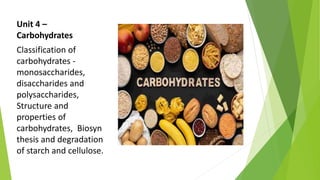
Unit 4 –
Carbohydrates
Classification of
carbohydrates -
monosaccharides,
disaccharides and
polysaccharides,
Structure and
properties of
carbohydrates, Biosyn
thesis and degradation
of starch and cellulose.
Definition
Carbohydrate is a group of organic
compounds occurring in living tissues
and foods in the form of starch,
cellulose, and sugars.
Cn(H2O)n is the generic formula for all
carbohydrates
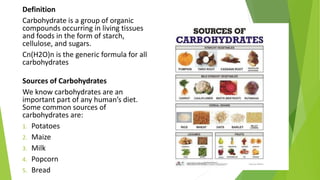
Sources of Carbohydrates
We know carbohydrates are an
important part of any human’s diet.
Some common sources of
carbohydrates are:
1. Potatoes
2. Maize
3. Milk
4. Popcorn
5. Bread
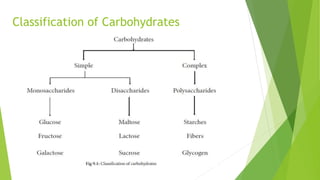
Classification of Carbohydrates
Simple Carbohydrates
1. Simple carbohydrates are the basic type of carbohydrates.
2. Soft drinks, candy, cookies and other sweet snacks contain simple carbohydrates.
3. These foods are often made with white sugar, a form of processed sugar.
4. Simple carbohydrates also are found in natural sugars.
5. Fruit, milk and vegetables contain natural sugars.
6. Honey is a natural sugar as well.
7. People eat natural sugar in its original form.
8. Simple carbohydrates are easier to handle because they are less (or simpler) complex.
Complex Carbohydrates
1. Complex carbohydrates represent an important energy source for your body.
2. They provide the sustained fuel your body needs for exercise, daily living activities and even
rest.
3. Complex carbohydrates are often single units (monosaccharides), which are bound
together.
4. The oligosaccharides contain two to ten simple units of sugar.
5. Polysaccharides contain hundreds and thousands of monosaccharides which are related.
6. Complex carbohydrates have fairly long-lasting energy.
 The different types of carbohydrates can be classified
on the basis of their behavior in hydrolysis
They are mainly classified into three groups:
Monosaccharides
Disaccharides
Polysaccharides
Monosaccharides
Monosaccharide carbohydrates are those
carbohydrates that cannot be hydrolyzed further to give
simpler units of polyhydroxy aldehyde or ketone. If a
monosaccharide contains an aldehyde group then it is
called aldose and on the other hand, if it contains a keto
group then it is called a ketose .
Disaccharides
On hydrolysis, disaccharides yield two molecules of either the same or
different monosaccharides. The two monosaccharide units are joined by
oxide linkage which is formed by the loss of water molecule and this
linkage is called glycosidic linkage. Sucrose is one of the most common
disaccharides which on hydrolysis gives glucose and fructose. Maltose and
Lactose (also known as milk sugar) are the other two important
disaccharides. In maltose, there are two α-D-glucose and in lactose, there
are two β-D-glucose which are connected by an oxide bond.
Polysaccharides
Polysaccharides contain long monosaccharide units joined together by
glycosidic linkage. Most of them act as food storage for e.g. Starch. Starch
is the main storage polysaccharide for plants. It is a polymer of α glucose
and consists of two components-Amylose and Amylopectin. Cellulose is
also one of the polysaccharides that are mostly found in plants.It is
composed of β-D- glucose units joined by a glycosidic linkage between C1
of one glucose unit and C4 of the next glucose unit.
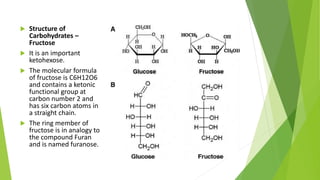
 Structure of
Carbohydrates –
Fructose
 It is an important
ketohexose.
 The molecular formula
of fructose is C6H12O6
and contains a ketonic
functional group at
carbon number 2 and
has six carbon atoms in
a straight chain.
 The ring member of
fructose is in analogy to
the compound Furan
and is named furanose.
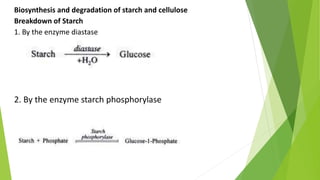
Biosynthesis and degradation of starch and cellulose
Breakdown of Starch
1. By the enzyme diastase
2. By the enzyme starch phosphorylase
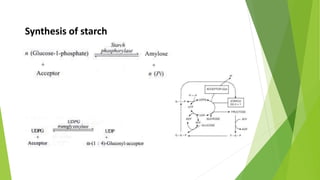
Synthesis of starch
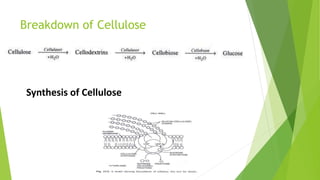
Breakdown of Cellulose
Synthesis of Cellulose
Carbohydrate

Carbohydrate

  • 1.
    Name :- TusharBharat Harde Class :- TY BSc Roll No. :- 213730 Subject :- Plant Physiology and Biochemistry Sub.Code :- BOT3601 Topic :- Carbohydrates College :- Fergusson College Pune
  • 2.
    Unit 4 – Carbohydrates Classificationof carbohydrates - monosaccharides, disaccharides and polysaccharides, Structure and properties of carbohydrates, Biosyn thesis and degradation of starch and cellulose.
  • 3.
    Definition Carbohydrate is agroup of organic compounds occurring in living tissues and foods in the form of starch, cellulose, and sugars. Cn(H2O)n is the generic formula for all carbohydrates Sources of Carbohydrates We know carbohydrates are an important part of any human’s diet. Some common sources of carbohydrates are: 1. Potatoes 2. Maize 3. Milk 4. Popcorn 5. Bread
  • 4.
  • 5.
    Simple Carbohydrates 1. Simplecarbohydrates are the basic type of carbohydrates. 2. Soft drinks, candy, cookies and other sweet snacks contain simple carbohydrates. 3. These foods are often made with white sugar, a form of processed sugar. 4. Simple carbohydrates also are found in natural sugars. 5. Fruit, milk and vegetables contain natural sugars. 6. Honey is a natural sugar as well. 7. People eat natural sugar in its original form. 8. Simple carbohydrates are easier to handle because they are less (or simpler) complex. Complex Carbohydrates 1. Complex carbohydrates represent an important energy source for your body. 2. They provide the sustained fuel your body needs for exercise, daily living activities and even rest. 3. Complex carbohydrates are often single units (monosaccharides), which are bound together. 4. The oligosaccharides contain two to ten simple units of sugar. 5. Polysaccharides contain hundreds and thousands of monosaccharides which are related. 6. Complex carbohydrates have fairly long-lasting energy.
  • 6.
     The differenttypes of carbohydrates can be classified on the basis of their behavior in hydrolysis They are mainly classified into three groups: Monosaccharides Disaccharides Polysaccharides Monosaccharides Monosaccharide carbohydrates are those carbohydrates that cannot be hydrolyzed further to give simpler units of polyhydroxy aldehyde or ketone. If a monosaccharide contains an aldehyde group then it is called aldose and on the other hand, if it contains a keto group then it is called a ketose .
  • 7.
    Disaccharides On hydrolysis, disaccharidesyield two molecules of either the same or different monosaccharides. The two monosaccharide units are joined by oxide linkage which is formed by the loss of water molecule and this linkage is called glycosidic linkage. Sucrose is one of the most common disaccharides which on hydrolysis gives glucose and fructose. Maltose and Lactose (also known as milk sugar) are the other two important disaccharides. In maltose, there are two α-D-glucose and in lactose, there are two β-D-glucose which are connected by an oxide bond. Polysaccharides Polysaccharides contain long monosaccharide units joined together by glycosidic linkage. Most of them act as food storage for e.g. Starch. Starch is the main storage polysaccharide for plants. It is a polymer of α glucose and consists of two components-Amylose and Amylopectin. Cellulose is also one of the polysaccharides that are mostly found in plants.It is composed of β-D- glucose units joined by a glycosidic linkage between C1 of one glucose unit and C4 of the next glucose unit.
  • 8.
     Structure of Carbohydrates– Fructose  It is an important ketohexose.  The molecular formula of fructose is C6H12O6 and contains a ketonic functional group at carbon number 2 and has six carbon atoms in a straight chain.  The ring member of fructose is in analogy to the compound Furan and is named furanose.
  • 9.
    Biosynthesis and degradationof starch and cellulose Breakdown of Starch 1. By the enzyme diastase 2. By the enzyme starch phosphorylase
  • 10.
  • 11.