CAPITATION
VS. FEE-FOR-
SERVICE
B Y T X C I N
T X C I N | C A P I T A T I O N V S . F E E - F O R - S E R V I C E
Introduction
Fee for Service Model
Capitation Model
Point To Ponder
About TXCIN
OVERVIEW
CAPITATION VS. FEE-FOR-SERVICE
As the current U.S. healthcare
environment trends toward value-based
care, the fee-for-service (FFS)
reimbursement model is under intense
scrutiny, often labeled as an antiquated
payment model that promotes over-
utilization by physicians and patients,
while creating fragmentation among
healthcare service providers.
INTRODUCTION
T X C I N | C A P I T A T I O N V S . F E E - F O R - S E R V I C E
From Capitation vs Fee For Service Article
Point To Ponder
HE AFFORDABLE CARE ACT OF
2010, ALONG WITH MACRA
LEGISLATION IN 2015, HAS
SLOWLY HELPED TO REDIRECT
HEALTHCARE PAYMENT REFORM
AWAY FROM FEE-FOR-SERVICE
TO A CAPITATION PAYMENT
SYSTEM.
T X C I N | C A P I T A T I O N V S . F E E - F O R - S E R V I C E
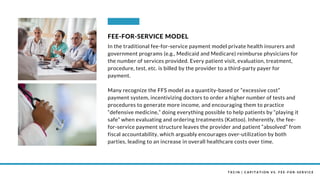
In the traditional fee-for-service payment model private health insurers and
government programs (e.g., Medicaid and Medicare) reimburse physicians for
the number of services provided. Every patient visit, evaluation, treatment,
procedure, test, etc. is billed by the provider to a third-party payer for
payment.
Many recognize the FFS model as a quantity-based or “excessive cost”
payment system, incentivizing doctors to order a higher number of tests and
procedures to generate more income, and encouraging them to practice
“defensive medicine,” doing everything possible to help patients by “playing it
safe” when evaluating and ordering treatments (Kattoo). Inherently, the fee-
for-service payment structure leaves the provider and patient “absolved” from
fiscal accountability, which arguably encourages over-utilization by both
parties, leading to an increase in overall healthcare costs over time.
FEE-FOR-SERVICE MODEL
As structured, the FFS payment model places the burden
of financial risk on the payer (i.e., the insurance
company). Simply stated, if patients need more care than
expected, the burden of cost overages lies with the payer,
not the provider.
This arrangement creates a scenario with inherent
financial uncertainty for the payer concerning medical
care costs and payment, explaining in part the ongoing
rise in health insurance premiums. In addition, the fee-
for-service payment model is also criticized by some as
being a reactive healthcare model, encouraging “later
interventions in health care, avoiding or downplaying
preventive care in favor of greater and more profitable
efforts (for doctors) when the patient’s health breaks
down” (Diffen).
FEE FOR SERVICE MODEL
(cont)
T X C I N | C A P I T A T I O N V S . F E E - F O R - S E R V I C E
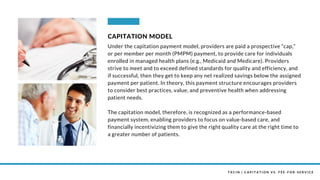
Under the capitation payment model, providers are paid a prospective “cap,”
or per member per month (PMPM) payment, to provide care for individuals
enrolled in managed health plans (e.g., Medicaid and Medicare). Providers
strive to meet and to exceed defined standards for quality and efficiency, and
if successful, then they get to keep any net realized savings below the assigned
payment per patient. In theory, this payment structure encourages providers
to consider best practices, value, and preventive health when addressing
patient needs.
The capitation model, therefore, is recognized as a performance-based
payment system, enabling providers to focus on value-based care, and
financially incentivizing them to give the right quality care at the right time to
a greater number of patients.
CAPITATION MODEL
As healthcare journalist Mark Hagland explains,
“Capitation [is] meant to be a step up in terms of creating
better incentives for efficiency, cost control, and
preventive care in health care.”
The capitation system of payment is recognized as a more
stable and financially certain payment model, offering a
monthly financial guarantee to providers (primary care
doctors, specialists, and hospitals), whether patients seek
care or not, and providing financial certainty to payers
(insurance companies) regarding the costs involved to
manage the health of patient populations. Under the
capitation payment model, the financial risk and the
control of managed care shifts from the payer to the
provider, giving providers the ability to champion quality
care, preventive medicine, and cost-efficiency, helping to
slow rising of healthcare costs.
CAPITATION MODEL
(cont)
From Capitation vs Fee For Service Article
Point To Ponder
AS THE TRANSITION TO VALUE-
BASED CARE CONTINUES, THE
QUESTION IS WHETHER OR NOT
CAPITATED PAYMENT RATES
WILL REMAIN HIGH ENOUGH TO
ALLOW FOR PROVIDER
PARTICIPATION TO BE
SUCCESSFUL.
ABOUT TXCIN
North Texas Clinically Integrated Network, Inc. (dba
TXCIN) is a non-profit ACO that began in late 2014.
A small group of independent physicians aligned to
initiate clinical integration and value-based
contracting. Partnering with RevelationMD and its
state-of-the art information platform, TXCIN has
become one of the largest, independent networks of
physicians in North Texas.
@TXCIN_
TWITTER HANDLE
www.insight-txcin.org
Knowledge Base

Capitation vs fee for service

  • 1.
  • 2.
    T X CI N | C A P I T A T I O N V S . F E E - F O R - S E R V I C E Introduction Fee for Service Model Capitation Model Point To Ponder About TXCIN OVERVIEW CAPITATION VS. FEE-FOR-SERVICE
  • 3.
    As the currentU.S. healthcare environment trends toward value-based care, the fee-for-service (FFS) reimbursement model is under intense scrutiny, often labeled as an antiquated payment model that promotes over- utilization by physicians and patients, while creating fragmentation among healthcare service providers. INTRODUCTION T X C I N | C A P I T A T I O N V S . F E E - F O R - S E R V I C E
  • 4.
    From Capitation vsFee For Service Article Point To Ponder HE AFFORDABLE CARE ACT OF 2010, ALONG WITH MACRA LEGISLATION IN 2015, HAS SLOWLY HELPED TO REDIRECT HEALTHCARE PAYMENT REFORM AWAY FROM FEE-FOR-SERVICE TO A CAPITATION PAYMENT SYSTEM.
  • 5.
    T X CI N | C A P I T A T I O N V S . F E E - F O R - S E R V I C E In the traditional fee-for-service payment model private health insurers and government programs (e.g., Medicaid and Medicare) reimburse physicians for the number of services provided. Every patient visit, evaluation, treatment, procedure, test, etc. is billed by the provider to a third-party payer for payment. Many recognize the FFS model as a quantity-based or “excessive cost” payment system, incentivizing doctors to order a higher number of tests and procedures to generate more income, and encouraging them to practice “defensive medicine,” doing everything possible to help patients by “playing it safe” when evaluating and ordering treatments (Kattoo). Inherently, the fee- for-service payment structure leaves the provider and patient “absolved” from fiscal accountability, which arguably encourages over-utilization by both parties, leading to an increase in overall healthcare costs over time. FEE-FOR-SERVICE MODEL
  • 6.
    As structured, theFFS payment model places the burden of financial risk on the payer (i.e., the insurance company). Simply stated, if patients need more care than expected, the burden of cost overages lies with the payer, not the provider. This arrangement creates a scenario with inherent financial uncertainty for the payer concerning medical care costs and payment, explaining in part the ongoing rise in health insurance premiums. In addition, the fee- for-service payment model is also criticized by some as being a reactive healthcare model, encouraging “later interventions in health care, avoiding or downplaying preventive care in favor of greater and more profitable efforts (for doctors) when the patient’s health breaks down” (Diffen). FEE FOR SERVICE MODEL (cont)
  • 7.
    T X CI N | C A P I T A T I O N V S . F E E - F O R - S E R V I C E Under the capitation payment model, providers are paid a prospective “cap,” or per member per month (PMPM) payment, to provide care for individuals enrolled in managed health plans (e.g., Medicaid and Medicare). Providers strive to meet and to exceed defined standards for quality and efficiency, and if successful, then they get to keep any net realized savings below the assigned payment per patient. In theory, this payment structure encourages providers to consider best practices, value, and preventive health when addressing patient needs. The capitation model, therefore, is recognized as a performance-based payment system, enabling providers to focus on value-based care, and financially incentivizing them to give the right quality care at the right time to a greater number of patients. CAPITATION MODEL
  • 8.
    As healthcare journalistMark Hagland explains, “Capitation [is] meant to be a step up in terms of creating better incentives for efficiency, cost control, and preventive care in health care.” The capitation system of payment is recognized as a more stable and financially certain payment model, offering a monthly financial guarantee to providers (primary care doctors, specialists, and hospitals), whether patients seek care or not, and providing financial certainty to payers (insurance companies) regarding the costs involved to manage the health of patient populations. Under the capitation payment model, the financial risk and the control of managed care shifts from the payer to the provider, giving providers the ability to champion quality care, preventive medicine, and cost-efficiency, helping to slow rising of healthcare costs. CAPITATION MODEL (cont)
  • 9.
    From Capitation vsFee For Service Article Point To Ponder AS THE TRANSITION TO VALUE- BASED CARE CONTINUES, THE QUESTION IS WHETHER OR NOT CAPITATED PAYMENT RATES WILL REMAIN HIGH ENOUGH TO ALLOW FOR PROVIDER PARTICIPATION TO BE SUCCESSFUL.
  • 10.
    ABOUT TXCIN North TexasClinically Integrated Network, Inc. (dba TXCIN) is a non-profit ACO that began in late 2014. A small group of independent physicians aligned to initiate clinical integration and value-based contracting. Partnering with RevelationMD and its state-of-the art information platform, TXCIN has become one of the largest, independent networks of physicians in North Texas. @TXCIN_ TWITTER HANDLE www.insight-txcin.org Knowledge Base