

VALUE-BASED
PURCHASING 
BY TXCIN
WHAT IS IT?
Value-based purchasing (VBP) is a
methodology of healthcare payment
reform that focuses on paying providers
for quality and value, not just volume.
Sometimes referred to as “pay-for-
performance” (P4P), value-based
purchasing is becoming the new normal
in healthcare, linking provider
reimbursements to quality measures
and cost-efficiency.
The traditional fee-for-service (FFS)
payment model is “morphing” into
alternative payment models (APMs) that
increase provider accountability for both
quality and total cost of care, while
requiring a greater focus on population
health management. Cheryl L. Damberg,
et al., explains that value-based
purchasing “refers to a broad set of
performance-based payment strategies
that link financial incentives to
providers’ improvements in quality and
slowing the growth in health care
spending.”
Value-based purchasing is
already gaining strong
momentum, and it will
certainly influence the future
of healthcare payment
reform, so it’s helpful to have
a brief history and basic
understanding of this
significant methodology. 
THE
FIRST
OF ITS
KIND:
ESRD-
QIP
This new pay-for-performance
approach scored facilities on
each measure and dinged
them with a payment
reduction of up to two percent
if their total performance score
did not meet or exceed
established performance
standards. Payment and
quality performance were now
being aligned as CMS focused
on its Quality Strategy to
improve health care and to
reduce costs.
NEXT
IN LINE:
HVBP
AND
SNF-
VBP
The HVBP rewards participating
hospitals for achieving
performance thresholds for
improved patient experience
and care coordination, patient
safety, clinical care, and
efficiency and cost reduction.
The IPPS is a system of payment
for the operating costs for acute
care hospital inpatient stays
under Medicare Part A (hospital
insurance), based on
prospectively set rates. 
HVBP AND SNF-VBP
(CONT.)
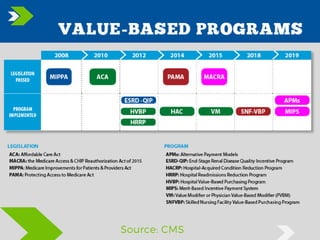
The value-based purchasing methodology
continued to gain momentum in 2014 with
the Protecting Access to Medicare Act
(PAMA), which established the Skilled
Nursing Facility Value-Based Purchasing
Program (SNF-VBP). Like other VBP
programs, the SNF-VBP uses value-based
incentive payments to reward providers for
the quality of care they give to patients.
Source: CMS
THE
CURRENT
TIME:
MIPS
AND
APMS
The Quality Payment Program
initiated a number of innovative,
alternative payment models
such as the Pioneer ACO
Program, the Medicare Shared
Savings Program (MSSP), the
Bundled Payment for Care
Improvement Initiative, and the
Comprehensive Primary Care
Initiative, among others, and all
models were strategically
designed to incentivize care
providers with shared savings,
bonuses, and other financial
rewards to venture into greater
shared risk, while focusing on
quality and efficiency. 
Want
More?
http://www.insight-
txcin.org/post/what-is-value-
based-purchasing
ABOUT
TXCIN
North Texas Clinically
Integrated Network, Inc. (dba
TXCIN) is a non-profit ACO
that began in late 2014. A
small group of independent
physicians aligned to initiate
clinical integration and value-
based contracting. Partnering
with RevelationMD and its
state-of-the art information
platform, TXCIN has become
the largest independent
network of physicians in North
Texas.

Value-Based Purchasing: What Is It?

  • 1.
  • 2.
    Value-based purchasing (VBP)is a methodology of healthcare payment reform that focuses on paying providers for quality and value, not just volume. Sometimes referred to as “pay-for- performance” (P4P), value-based purchasing is becoming the new normal in healthcare, linking provider reimbursements to quality measures and cost-efficiency.
  • 3.
    The traditional fee-for-service(FFS) payment model is “morphing” into alternative payment models (APMs) that increase provider accountability for both quality and total cost of care, while requiring a greater focus on population health management. Cheryl L. Damberg, et al., explains that value-based purchasing “refers to a broad set of performance-based payment strategies that link financial incentives to providers’ improvements in quality and slowing the growth in health care spending.”
  • 4.
    Value-based purchasing is alreadygaining strong momentum, and it will certainly influence the future of healthcare payment reform, so it’s helpful to have a brief history and basic understanding of this significant methodology. 
  • 5.
    THE FIRST OF ITS KIND: ESRD- QIP This newpay-for-performance approach scored facilities on each measure and dinged them with a payment reduction of up to two percent if their total performance score did not meet or exceed established performance standards. Payment and quality performance were now being aligned as CMS focused on its Quality Strategy to improve health care and to reduce costs.
  • 6.
    NEXT IN LINE: HVBP AND SNF- VBP The HVBPrewards participating hospitals for achieving performance thresholds for improved patient experience and care coordination, patient safety, clinical care, and efficiency and cost reduction. The IPPS is a system of payment for the operating costs for acute care hospital inpatient stays under Medicare Part A (hospital insurance), based on prospectively set rates. 
  • 7.
    HVBP AND SNF-VBP (CONT.) Thevalue-based purchasing methodology continued to gain momentum in 2014 with the Protecting Access to Medicare Act (PAMA), which established the Skilled Nursing Facility Value-Based Purchasing Program (SNF-VBP). Like other VBP programs, the SNF-VBP uses value-based incentive payments to reward providers for the quality of care they give to patients.
  • 8.
  • 9.
    THE CURRENT TIME: MIPS AND APMS The Quality PaymentProgram initiated a number of innovative, alternative payment models such as the Pioneer ACO Program, the Medicare Shared Savings Program (MSSP), the Bundled Payment for Care Improvement Initiative, and the Comprehensive Primary Care Initiative, among others, and all models were strategically designed to incentivize care providers with shared savings, bonuses, and other financial rewards to venture into greater shared risk, while focusing on quality and efficiency. 
  • 10.
  • 11.
    ABOUT TXCIN North Texas Clinically IntegratedNetwork, Inc. (dba TXCIN) is a non-profit ACO that began in late 2014. A small group of independent physicians aligned to initiate clinical integration and value- based contracting. Partnering with RevelationMD and its state-of-the art information platform, TXCIN has become the largest independent network of physicians in North Texas.