Evaluating a
Single Project:
PresentWorth
Analysis
Loan vs. Project Cash Flow
An investment made in a fixed asset is
similar to an investment made by a bank
when it lends money.
The essential characteristic of both
transactions is that funds are committed
today in the expectation of their earning
a return in the future
In the case of the bank loan, the future
return takes the form of interest plus
repayment of the principal.This is
referred to as loan cash flow.
Loan vs. Project Cash Flow
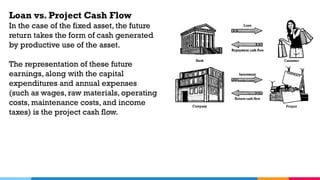
In the case of the fixed asset, the future
return takes the form of cash generated
by productive use of the asset.
The representation of these future
earnings, along with the capital
expenditures and annual expenses
(such as wages, raw materials, operating
costs, maintenance costs, and income
taxes) is the project cash flow.
PresentWorth Analysis
Under the PW criterion, the present
worth of all cash inflows associated with
an investment project is compared with
the present worth of all cash outflows
associated with that project.
The difference between the two of these
cash flows, referred to as the net present
worth (NPW), determines whether the
project is an acceptable investment.
When two or more projects are under
consideration, NPW analysis further
allows us to select the best project by
comparing their NPW figures directly.
Net Present Worth Criterion
Evaluating a Single Project
Step 1: Determine the interest rate that the
firm wishes to earn on its investments.The
interest rate you determine represents the
rate at which the firm can always invest the
money in its investment pool, the value of
capital available for lending and investing.
This interest rate is often referred to as
either a required rate of return or a minimum
attractive rate of returm (MARR). Usually, this
selection is a policy decision made by top
management. It is possible for the MARR to
change over the life of a project, but for now
we will use a single rate of interest when
calculating PW.
Net Present Worth Criterion
Step 2: Estimate the service life of the
project.
Step 3: Estimate the cash inflow for each
period over the service life.
Step 4: Estimate the cash outflow for each
period over the service life.
Step 5: Determine the net cash flows for each
period (Net cash flow= Cash inflow - Cash
outflow).
Net Present Worth Criterion
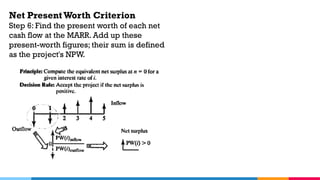
Step 6: Find the present worth of each net
cash flow at the MARR. Add up these
present-worth figures; their sum is defined
as the project's NPW.
Net Present Worth Criterion
Step 7: In this context, a positive NPW means
that the equivalent worth of the inflows is
more than the equivalent worth of the
outflows so that the project makes a profit.
Therefore, if the PW(i) is positive for a single
project, the project should be accepted: if it
is negative, the project should be rejected.
If PW (i) > 0, accept the investment.
If PW (i) = 0, remain indifferent.
If PW (i) < 0, reject the investment.
Net PresentWorth Criterion
Comparing More than One Alternative
1. If you need to select the best alternative,
based on the net-present-worth criterion.
select the one with the highest NPW, as long
as all the alternatives have the same service
lives. Comparison of alternatives with
unequal service lives requires special
assumptions.
2. Comparison of mutually exclusive
alternatives with the same revenues is
performed on a cost-only basis. In this
situation, you should accept the project that
results in the smallest PW of costs, or the
least negative PW (because you are
minimizing costs rather than maximizing
profits).
Guidelines for Selecting a
MARR
Return is what you get back in relation
to the amount you invested. Return is
one way to evaluate how your
investments in financial assets or
projects do in relation to each other and
in relation to the performance of
investments in general.
MARR = Real risk-free interest rate +
Inflation premium + Default risk
premium + Liquidity premium +
Maturity premium
Real Risk-Free Interest Rate
It is the single-period interest rate for a
completely risk-free security if no
inflation were expected.
It reflects the time preferences of
individuals for current versus future real
consumption.
Inflation Premium
It compensates investors for expected
inflation and reflects the average
inflation rate expected over the maturity
of the debt.
Nominal risk free interest rate – sum of
the real risk-free interest rate and the
inflation premium
Default Risk Premium
It compensates investors for the
possibility that the borrower will fail to
make a promised payment at the
contracted time and in the contracted
amount.
Liquidity Premium
It compensates investors for loss relative
to an investment’s fair value if the
investment needs to be converted to
cash quickly.
Maturity Premium
It compensates investors for the increased
sensitivity of the market value of debt to a
change in market interest rates as
maturity is extended, in general (holding
all else equal.
Investment Pool Concept
An investment pool is equivalent to a
firm's treasury. It is where all fund
transactions are administered and
managed by the firm's comtroller.The
firm may withdraw funds from this
investment pool for other investment
purposes, but if left in the pool, the
funds will earn interest at the MARR.
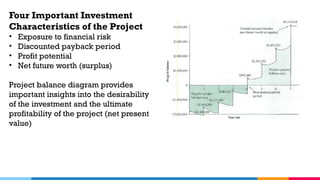
Four Important Investment
Characteristics of the Project
• Exposure to financial risk
• Discounted payback period
• Profit potential
• Net future worth (surplus)
Project balance diagram provides
important insights into the desirability
of the investment and the ultimate
profitability of the project (net present
value)
Sample Problem
A machine costs $980,000 to purchase
and will provide $200,000 a year in
benefits.The company plans to use the
machine for 13 years and then will
sell the machine for scrap, receiving
$20,000.The company interest rate is
12%. Should the machine be
purchased?
Sample Problem
Argentina is considering constructing a bridge across
the Rio de la Plata to connect its northern coast to the
southern coast of Uruguay. If this bridge is constructed,
it will reduce the travel time from Buenos Aires,
Argentina, to SĆ£o Paulo, Brazil, by over 10 hours, and
there is the potential to significantly improve the flow of
manufactured goods between the two countries.The
cost of the new bridge, which will be the longest bridge
in the world, spanning over 50 miles, will be $700
million.The bridge will require an annual maintenance
of $10 million for repairs and upgrades and is estimated
to last 80 years. It is estimated that 550,000 vehicles will
use the bridge during the first year of operation, and an
additional 50,000 vehicles per year until the tenth year.
These data are based on a toll charge of $90 per
vehicle.The annual traffic for the remainder of the life of
the bridge will be 1,000,000 vehicles per year.The
Argentine government requires a minimum rate of
return of 9% to proceed with the project. Does this
project provide sufficient revenues to offset its costs?
Sample Problem
A large food-processing corporation is
considering using laser technology to speed
up and eliminate waste in the potato-peeling
process.To implement the system, the
company anticipates needing $3 million to
purchase the industrial-strength lasers.The
system will save $1,250,000 per year in labor
and materials. However, it will incur an
additional operating and maintenance cost of
$200,000 per year. Annual income taxes will
also increase by $150,000.The system is
expected to have a 10-year service life and a
salvage value of about $300,000. If the
company’s MARR is 15%,justify the
economics of the project using the PW
method.
ThankYou
For
Listening

CAPITALIZED-COST presentation and sample problems -2.0.pptx

  • 1.
  • 2.
    Loan vs. ProjectCash Flow An investment made in a fixed asset is similar to an investment made by a bank when it lends money. The essential characteristic of both transactions is that funds are committed today in the expectation of their earning a return in the future In the case of the bank loan, the future return takes the form of interest plus repayment of the principal.This is referred to as loan cash flow.
  • 3.
    Loan vs. ProjectCash Flow In the case of the fixed asset, the future return takes the form of cash generated by productive use of the asset. The representation of these future earnings, along with the capital expenditures and annual expenses (such as wages, raw materials, operating costs, maintenance costs, and income taxes) is the project cash flow.
  • 4.
    PresentWorth Analysis Under thePW criterion, the present worth of all cash inflows associated with an investment project is compared with the present worth of all cash outflows associated with that project. The difference between the two of these cash flows, referred to as the net present worth (NPW), determines whether the project is an acceptable investment. When two or more projects are under consideration, NPW analysis further allows us to select the best project by comparing their NPW figures directly.
  • 5.
    Net Present WorthCriterion Evaluating a Single Project Step 1: Determine the interest rate that the firm wishes to earn on its investments.The interest rate you determine represents the rate at which the firm can always invest the money in its investment pool, the value of capital available for lending and investing. This interest rate is often referred to as either a required rate of return or a minimum attractive rate of returm (MARR). Usually, this selection is a policy decision made by top management. It is possible for the MARR to change over the life of a project, but for now we will use a single rate of interest when calculating PW.
  • 6.
    Net Present WorthCriterion Step 2: Estimate the service life of the project. Step 3: Estimate the cash inflow for each period over the service life. Step 4: Estimate the cash outflow for each period over the service life. Step 5: Determine the net cash flows for each period (Net cash flow= Cash inflow - Cash outflow).
  • 7.
    Net Present WorthCriterion Step 6: Find the present worth of each net cash flow at the MARR. Add up these present-worth figures; their sum is defined as the project's NPW.
  • 8.
    Net Present WorthCriterion Step 7: In this context, a positive NPW means that the equivalent worth of the inflows is more than the equivalent worth of the outflows so that the project makes a profit. Therefore, if the PW(i) is positive for a single project, the project should be accepted: if it is negative, the project should be rejected. If PW (i) > 0, accept the investment. If PW (i) = 0, remain indifferent. If PW (i) < 0, reject the investment.
  • 9.
    Net PresentWorth Criterion ComparingMore than One Alternative 1. If you need to select the best alternative, based on the net-present-worth criterion. select the one with the highest NPW, as long as all the alternatives have the same service lives. Comparison of alternatives with unequal service lives requires special assumptions. 2. Comparison of mutually exclusive alternatives with the same revenues is performed on a cost-only basis. In this situation, you should accept the project that results in the smallest PW of costs, or the least negative PW (because you are minimizing costs rather than maximizing profits).
  • 10.
    Guidelines for Selectinga MARR Return is what you get back in relation to the amount you invested. Return is one way to evaluate how your investments in financial assets or projects do in relation to each other and in relation to the performance of investments in general. MARR = Real risk-free interest rate + Inflation premium + Default risk premium + Liquidity premium + Maturity premium
  • 11.
    Real Risk-Free InterestRate It is the single-period interest rate for a completely risk-free security if no inflation were expected. It reflects the time preferences of individuals for current versus future real consumption.
  • 12.
    Inflation Premium It compensatesinvestors for expected inflation and reflects the average inflation rate expected over the maturity of the debt. Nominal risk free interest rate – sum of the real risk-free interest rate and the inflation premium Default Risk Premium It compensates investors for the possibility that the borrower will fail to make a promised payment at the contracted time and in the contracted amount.
  • 13.
    Liquidity Premium It compensatesinvestors for loss relative to an investment’s fair value if the investment needs to be converted to cash quickly. Maturity Premium It compensates investors for the increased sensitivity of the market value of debt to a change in market interest rates as maturity is extended, in general (holding all else equal.
  • 14.
    Investment Pool Concept Aninvestment pool is equivalent to a firm's treasury. It is where all fund transactions are administered and managed by the firm's comtroller.The firm may withdraw funds from this investment pool for other investment purposes, but if left in the pool, the funds will earn interest at the MARR.
  • 15.
    Four Important Investment Characteristicsof the Project • Exposure to financial risk • Discounted payback period • Profit potential • Net future worth (surplus) Project balance diagram provides important insights into the desirability of the investment and the ultimate profitability of the project (net present value)
  • 16.
    Sample Problem A machinecosts $980,000 to purchase and will provide $200,000 a year in benefits.The company plans to use the machine for 13 years and then will sell the machine for scrap, receiving $20,000.The company interest rate is 12%. Should the machine be purchased?
  • 17.
    Sample Problem Argentina isconsidering constructing a bridge across the Rio de la Plata to connect its northern coast to the southern coast of Uruguay. If this bridge is constructed, it will reduce the travel time from Buenos Aires, Argentina, to SĆ£o Paulo, Brazil, by over 10 hours, and there is the potential to significantly improve the flow of manufactured goods between the two countries.The cost of the new bridge, which will be the longest bridge in the world, spanning over 50 miles, will be $700 million.The bridge will require an annual maintenance of $10 million for repairs and upgrades and is estimated to last 80 years. It is estimated that 550,000 vehicles will use the bridge during the first year of operation, and an additional 50,000 vehicles per year until the tenth year. These data are based on a toll charge of $90 per vehicle.The annual traffic for the remainder of the life of the bridge will be 1,000,000 vehicles per year.The Argentine government requires a minimum rate of return of 9% to proceed with the project. Does this project provide sufficient revenues to offset its costs?
  • 18.
    Sample Problem A largefood-processing corporation is considering using laser technology to speed up and eliminate waste in the potato-peeling process.To implement the system, the company anticipates needing $3 million to purchase the industrial-strength lasers.The system will save $1,250,000 per year in labor and materials. However, it will incur an additional operating and maintenance cost of $200,000 per year. Annual income taxes will also increase by $150,000.The system is expected to have a 10-year service life and a salvage value of about $300,000. If the company’s MARR is 15%,justify the economics of the project using the PW method.
  • 19.