Running Header: CAPITAL BUDGETING FOR PROFITABLE DECISIONS
Signature Assignment: Capital Budgeting for Profitable Decisions
A Case Study on The Hershey Company
Stacey Troup
Managerial Accounting/MBA-612
June 14, 2019
Professor Dr. Andreas Walker
Touro University Worldwide
CAPITAL BUDGETING FOR PROFITABLE DECISIONS
Abstract
The Hershey Company is no stranger to capital budgeting techniques. This topic will
cover the various methods for evaluating a capital budgeting project with the least impact on
company liquidity while focusing on profitability and increased valuation to shareholders. With
the good comes the bad and bad decision examples will also be reviewed. Critical thinking alone
is not enough to make a capital budgeting decision, real evaluation and formulas are required to
determine if the investment is viable or if it should be discarded as payback periods are either
outweighing the life of the purchase or are out of reach altogether.
Keywords: Capital budgeting; valuations, impact on shareholder value; D/E
ratios for profitability, acceptable rates for profitable investments.
CAPITAL BUDGETING FOR PROFITABLE DECISIONS
Capital Budgeting
Capital budgeting is a managerial accounting principle which is based on the ability to
recuperate costs of a project through an investment within the firm versus reinvesting the
allocated costs to alternative incentive (such as saving with interest attached). The decision to
invest in a project from this perspective is a large one for any company as it is a multi-tiered
approach based on a five-stage review of costs, cash flows, opportunities, and risk for the
specified project. For The Hershey Company, the ability to recuperate profits for such an
investment also relies on the ability to remain able to repay the project over short term life so that
a reinvestment in future projects can be attained. Reviewing the overall project, as well as the
impact of this project on the valuation of the company, will showcase how capital budgeting
decisions are reached in order to determine both a value to a company as well as the impact on
the financial statements as well as shareholder valuation.
Capital Budgeting – Overview
Capital Budgeting is a concept that a company such as the Hershey Company relies on in
order to determine if a project is both valuable, repayable, and worthwhile for the investment that
is put forth. When determine the capital budgeting process for a project, it is imperative that the
five basic concepts of the capital budgeting process are followed, which include: Identifying the
investment; evaluate the project (profitability), selecting a project, performance monitoring, and
feedback (N.A., Steps of Capital Budgeting, 2008).
Identifying the investment is the first step to determine what type of investment is
necessary (or interesting). Where is the need for the capital improvement greatest? For a
company like Hershey, the decisions are between their manufacturing improvements, supply
chain management improvements, corporate acquisitions, and their amusement park which are
CAPITAL BUDGETING FOR PROFITABLE DECISIONS
main assets owned by the company as well as the main ways in which Hershey expands market
share (N.A., Steps of Capital Budgeting, 2008) (The Hershey Company 10-K, 2019).
Now that we have narrowed down where improvements can be made, the time for
evaluation of projects against each other to determine profitability, NPV (net present value),
throughput analysis, IRR (internal rate of return), discounted cash flows, and payback period are
all ways in which a project can be evaluated internally to determine ROI (Kenton, Capital
Budgeting, 2018). All of these evaluations result in a formula that allows the user to see how
much time it will take to pay the loan back, how much time it will take to profit from the
purchase, if the output expectations meet the investment, and if the investment should be carried
out as a whole.
Each of these methodologies has a place in determining project approval however, they
all vary greatly and have different needs for use depending on the type of business, investment,
and information available to determine such investment strategies. The throughput analysis is
surely the method of determination used within the walls of the Hershey Company when they
consider an improvement to production facilities, such as the addition of Microsoft Azure™
software with integrated AI capabilities for production of the Twizzlers™ candy brand
(Martinez, 2017). (Specifics of how Hershey used throughput analysis to determine this project
viability and success are discussed under Hershey specific evaluations to follow). The
throughput analysis uses output calculations based on materials passed through machines being
evaluated. Within manufacturing, this is the analysis most often used when considering a capital
budgeting project whereby a correction to equipment, new equipment, or other need to change
product output, profitability, waste reduction is used (Kenton, Capital Budgeting, 2018),
CAPITAL BUDGETING FOR PROFITABLE DECISIONS
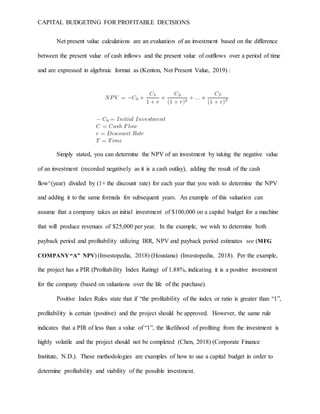
Net present value calculations are an evaluation of an investment based on the difference
between the present value of cash inflows and the present value of outflows over a period of time
and are expressed in algebraic format as (Kenton, Net Present Value, 2019) :
Simply stated, you can determine the NPV of an investment by taking the negative value
of an investment (recorded negatively as it is a cash outlay), adding the result of the cash
flow^(year) divided by (1+ the discount rate) for each year that you wish to determine the NPV
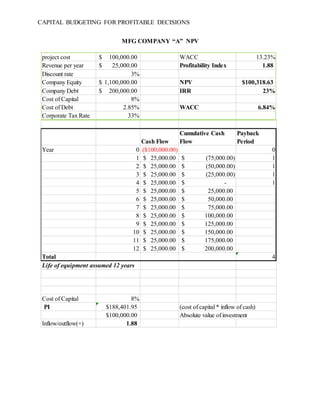
and adding it to the same formula for subsequent years. An example of this valuation can
assume that a company takes an initial investment of $100,000 on a capital budget for a machine
that will produce revenues of $25,000 per year. In the example, we wish to determine both
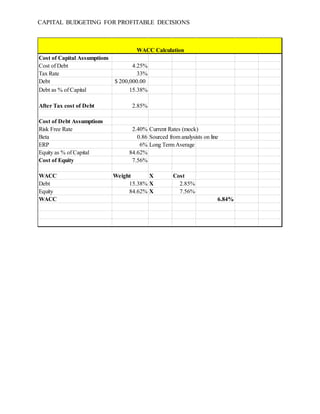
payback period and profitability utilizing IRR, NPV and payback period estimates see (MFG
COMPANY“A” NPV) (Investopedia, 2018) (Houstana) (Investopedia, 2018). Per the example,
the project has a PIR (Profitability Index Rating) of 1.88%, indicating it is a positive investment
for the company (based on valuations over the life of the purchase).
Positive Index Rules state that if “the profitability of the index or ratio is greater than “1”,
profitability is certain (positive) and the project should be approved. However, the same rule
indicates that a PIR of less than a value of “1”, the likelihood of profiting from the investment is
highly volatile and the project should not be completed (Chen, 2018) (Corporate Finance
Institute, N.D.). These methodologies are examples of how to use a capital budget in order to
determine profitability and viability of the possible investment.
CAPITAL BUDGETING FOR PROFITABLE DECISIONS
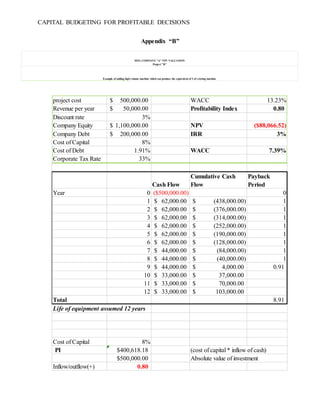
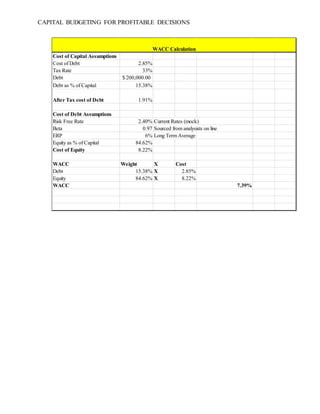
On the alternative side of things, the following example is given for a project that is not
only lacking profit but has negative numbers for ROI, PIR, etc.. By examining these two
examples, one can see how project valuation varies and ROR (rates of return) vary accordingly
even though similar methodologies are used. This example uses the idea that if a machine is
ordered that does double the work of our existing machine, how long it takes to become
profitable and if the investment is worth t based on the variables as well as the variant of the
income over the life of the machine see Appendix “B” (Investopedia, 2018).
The Hershey Company’s Capital Budgeting Projects (2010-2019)
The Hershey Company is no stranger to capital budgeting reviews. On average, the
company does one large capital budgeting project every 3 years and pays a bulk of the cost of
same up front as their liquidity measures are high (The Hershey Company 10-K, 2019). In the
last 10 years, there have been 4 major projects that the company has taken on relating to
reduction of costs, improvement in supply chain, and forward planning for sustained profitability
in the future. Among these projects are the “Next Century” program (2010-2014), the
“Operational Optimization” Program (2016-2018), The “Margin For Growth” program (2017-
2019), and the “Productivity Initiative” program (2015-2016).
Project “Next Century” was a program consisted of improvements to the supply chain
and cost restructuring plan for their offerings. The program came at a loss of 500-600 employees
(mostly production as technical improvements were made replacing staff) and was to include
costs between $140M - $170M during the three-year run but were also expected to incur ongoing
cost savings to production of $60-$80M (annually) (N.A., Hershey Announces “Next Century”
Modernization Program to Enhance Supply Chain, 2010). This was surely the first step in
CAPITAL BUDGETING FOR PROFITABLE DECISIONS
modernization for the company as it also included redesign of a former factory to newly created
office and administrative staff while placing their old facility on the market for sale.
The costs that were incurred were designed to also cover restructure things at a corporate
level in order to begin steps for continuation of the company brand into the next century. Among
these changes under this program were changes to the executive leadership, productivity
initiatives, brand building, and global capabilities improvements.
The 2015 “Productivity Initiative” (2015-2016) included key executive position changes
in order to ensure alignment with their strategy and core business visions and delivery of same.
Estimates for the project included pretax savings of $65M-$75M, with a portion of that savings
being redirected back into the company through new initiatives. With this savings comes a
reduction of 300 jobs (approximately) and pre-tax charges of $100M-$120M as a result (Hershey
Announces “Next Century” Modernization Program to Enhance Supply Chain, 2015). This is
likely the first phase of the modernization of production for Twizzlers™ using artificial
intelligence (AI) and Microsoft™ Azure™ software to adjust batches against overage and loss.
The “Operational Optimization” program introduced in 2016 was a “Phase II” program
who had beginnings within the “Productivity Initiatives” program prior. This program was
designed to continue streamlining efforts for both the China and U.S. plants to produce more
products while simultaneously reducing costs. This program resulted in a charge of $8M in
2018, $14M in 2017, and $88M in 2016, respectively. While the first phase of this program
under the Productivity program were designed to enhance the supply chain through streamlining
and reduction of unnecessary staff and methods, the “Operational Minimization” program took it
one step further, by combining the two plants located in China into one “Golden Hershey”
CAPITAL BUDGETING FOR PROFITABLE DECISIONS
production facility, while attempting to sell off their extra production facility no longer in use
(The Hershey Company 10-K, 2019) (Hershey Company 2017 10-K, 2017).
“Margin for Growth” program was approved unanimously by the Board of Directors as
the program was focused on improving “global efficiency and effectiveness, optimization of the
supply chain, streamlining the company’s operating model, and reducing administrative expenses
to achieve long-term savings”. (The Hershey Company 10-K, 2019). The project brought costs
between $375M-$425M between 2017-2019, and $55M in 2018 as a 15% reduction in workforce
was implemented on a global scale (with most of the costs being incurred from China operations
and restructuring) (The Hershey Company 10-K, 2019)
Stock Valuation During Projects (2010-2019)
As the company continued to advance their supply chain and profitability while losing
excess staff replaced by machinery, the shareholders rallied by the company in favorable ways
over the life of these projects.
Stock Review by Project
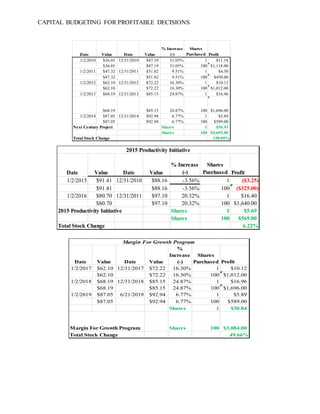
If you had purchased one (1) share of the company stock in 2010 (January 2) at $36.01
per share and maintained that purchase for the long position over the Next Century Project, the
value on December 1, 2010 was $47.19 per share, meaning you would have made $11.18 on that
purchase and increased your profits by 31.05%. The remaining stock information is as follows
(Yahoo Finance: Hershey Historical Stock Pricing, N.D.):
CAPITAL BUDGETING FOR PROFITABLE DECISIONS
Date Value Date Value
% Increase
(-)
Shares
Purchased Profit
1/2/2010 $36.01 12/31/2010 $47.19 31.05% 1 $11.18
$36.01 $47.19 31.05% 100 $1,118.00
1/2/2011 $47.32 12/31/2011 $51.82 9.51% 1 $4.50
$47.32 $51.82 9.51% 100 $450.00
1/2/2012 $62.10 12/31/2012 $72.22 16.30% 1 $10.12
$62.10 $72.22 16.30% 100 $1,012.00
1/2/2013 $68.19 12/31/2013 $85.15 24.87% 1 $16.96
$68.19 $85.15 24.87% 100 $1,696.00
1/2/2014 $87.05 12/31/2014 $92.94 6.77% 1 $5.89
$87.05 $92.94 6.77% 100 $589.00
Next Century Project Shares 1 $56.93
Shares 100 $5,693.00
Total Stock Change 158.09%
Date Value Date Value
%
Increase
(-)
Shares
Purchased Profit
1/2/2017 $62.10 12/31/2017 $72.22 16.30% 1 $10.12
$62.10 $72.22 16.30% 100 $1,012.00
1/2/2018 $68.19 12/31/2018 $85.15 24.87% 1 $16.96
$68.19 $85.15 24.87% 100 $1,696.00
1/2/2019 $87.05 6/21/2019 $92.94 6.77% 1 $5.89
$87.05 $92.94 6.77% 100 $589.00
Shares 1 $30.84
Margin For Growth Program Shares 100 $3,084.00
Total Stock Change 49.66%
Margin For Growth Program
Date Value Date Value
% Increase
(-)
Shares
Purchased Profit
1/2/2015 $91.41 12/31/2010 $88.16 -3.56% 1 ($3.25)
$91.41 $88.16 -3.56% 100 ($325.00)
1/2/2016 $80.70 12/31/2011 $97.10 20.32% 1 $16.40
$80.70 $97.10 20.32% 100 $1,640.00
2015 Productivity Initiative Shares 1 $5.69
Shares 100 $569.00
Total Stock Change 6.22%
2015 Productivity Initiative
CAPITAL BUDGETING FOR PROFITABLE DECISIONS
As is evident from these calculations, an initial investment of just $36.01 when the
company began its restructuring efforts would have grown in value with only minor “ticks” to
profitability over the years. The company has taken very proactive strides to ensure a low D/E
(debt to equity) ratio as they finance little through commercial paper offerings and usually pay
for a bulk of their capital budgeting projects with surplus cash or through cash raised by selling
Class B shares back to the trust, who are the main holder of these shares (80%) in order to
maintain voting rights for The Hershey Company, which is under its control (Hershey Trust
Company Announces Sale of Hershey Company Common Stock, 2017).
The corporate structure of The Hershey Company and The Hershey Trust Company are
comprised of The Hershey Company falling under the umbrella of the Hershey Trust Company,
which is a philanthropic division of the corporate office with many charitable offerings since
inception founding by Milton Hershey (The Hershey Trust Company, N.D.). Capital budgeting
projects are offset (often) by the offering of additional Class B shares back to the Trust Company
in exchange for cash liquidity in order to self-finance large scale projects they wish to undertake
(The Hershey Company 10-K, 2007) (Klott, 1984).
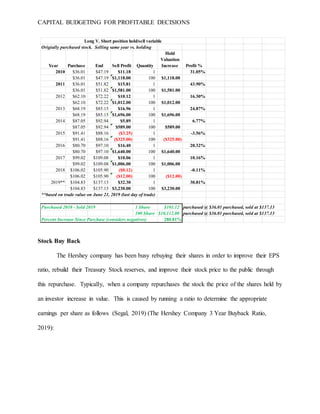
In an effort to showcase how successful the planning stages of capital budgeting
decisions have been for The Hershey Company on their shareholder value and stock pricing
calculations were done to show what would happen if you had purchased at $36.01 and sold as of
June 21, 2019 (last day of trading before paper deadline for the year):
CAPITAL BUDGETING FOR PROFITABLE DECISIONS
Stock Buy Back
The Hershey company has been busy rebuying their shares in order to improve their EPS
ratio, rebuild their Treasury Stock reserves, and improve their stock price to the public through
this repurchase. Typically, when a company repurchases the stock the price of the shares held by
an investor increase in value. This is caused by running a ratio to determine the appropriate
earnings per share as follows (Segal, 2019) (The Hershey Company 3 Year Buyback Ratio,
2019):
Origially purchased stock. Selling same year vs. holding
Year Purchase End Sell Profit Quantity
Hold
Valuation
Increase Profit %
2010 $36.01 $47.19 $11.18 1 31.05%
$36.01 $47.19 $1,118.00 100 $1,118.00
2011 $36.01 $51.82 $15.81 1 43.90%
$36.01 $51.82 $1,581.00 100 $1,581.00
2012 $62.10 $72.22 $10.12 1 16.30%
$62.10 $72.22 $1,012.00 100 $1,012.00
2013 $68.19 $85.15 $16.96 1 24.87%
$68.19 $85.15 $1,696.00 100 $1,696.00
2014 $87.05 $92.94 $5.89 1 6.77%
$87.05 $92.94 $589.00 100 $589.00
2015 $91.41 $88.16 ($3.25) 1 -3.56%
$91.41 $88.16 ($325.00) 100 ($325.00)
2016 $80.70 $97.10 $16.40 1 20.32%
$80.70 $97.10 $1,640.00 100 $1,640.00
2017 $99.02 $109.08 $10.06 1 10.16%
$99.02 $109.08 $1,006.00 100 $1,006.00
2018 $106.02 $105.90 ($0.12) 1 -0.11%
$106.02 $105.90 ($12.00) 100 ($12.00)
2019** $104.83 $137.13 $32.30 1 30.81%
$104.83 $137.13 $3,230.00 100 $3,230.00
**based on trade value on June 21, 2019 (last day of trade)
Purchased 2010 - Sold 2019 1 Share $101.12 purchased @ $36.01 purchased, sold at $137.13
100 Share $10,112.00 purchased @ $36.01 purchased, sold at $137.13
Percent Increase Since Purchase (considers negatives) 280.81%
Long V. Short position hold/sell variable
CAPITAL BUDGETING FOR PROFITABLE DECISIONS
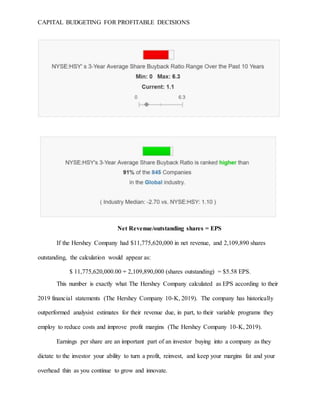
Net Revenue/outstanding shares = EPS
If the Hershey Company had $11,775,620,000 in net revenue, and 2,109,890 shares
outstanding, the calculation would appear as:
$ 11,775,620,000.00 ÷ 2,109,890,000 (shares outstanding) = $5.58 EPS.
This number is exactly what The Hershey Company calculated as EPS according to their
2019 financial statements (The Hershey Company 10-K, 2019). The company has historically
outperformed analysist estimates for their revenue due, in part, to their variable programs they
employ to reduce costs and improve profit margins (The Hershey Company 10-K, 2019).
Earnings per share are an important part of an investor buying into a company as they
dictate to the investor your ability to turn a profit, reinvest, and keep your margins fat and your
overhead thin as you continue to grow and innovate.
CAPITAL BUDGETING FOR PROFITABLE DECISIONS
The Hershey Company & Throughput Analysis
Throughput analysis is the analysis of output capacity from a particular piece of
equipment in a specific period of time. Although not verifiable, it is certain that this process was
in use when Hershey decided to implement Microsoft™ Azure with AI capabilities during the
review of wasted materials during the production of Twizzlers™ candy brand.
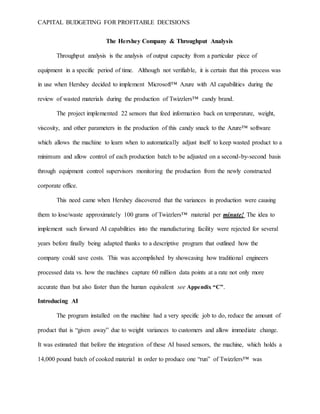
The project implemented 22 sensors that feed information back on temperature, weight,
viscosity, and other parameters in the production of this candy snack to the Azure™ software
which allows the machine to learn when to automatically adjust itself to keep wasted product to a
minimum and allow control of each production batch to be adjusted on a second-by-second basis
through equipment control supervisors monitoring the production from the newly constructed
corporate office.
This need came when Hershey discovered that the variances in production were causing
them to lose/waste approximately 100 grams of Twizzlers™ material per minute! The idea to
implement such forward AI capabilities into the manufacturing facility were rejected for several
years before finally being adapted thanks to a descriptive program that outlined how the
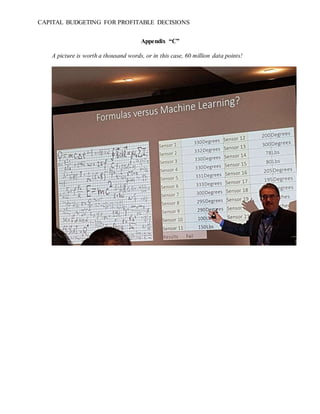
company could save costs. This was accomplished by showcasing how traditional engineers
processed data vs. how the machines capture 60 million data points at a rate not only more
accurate than but also faster than the human equivalent see Appendix “C”.
Introducing AI
The program installed on the machine had a very specific job to do, reduce the amount of
product that is “given away” due to weight variances to customers and allow immediate change.
It was estimated that before the integration of these AI based sensors, the machine, which holds a
14,000 pound batch of cooked material in order to produce one “run” of Twizzlers™ was
CAPITAL BUDGETING FOR PROFITABLE DECISIONS
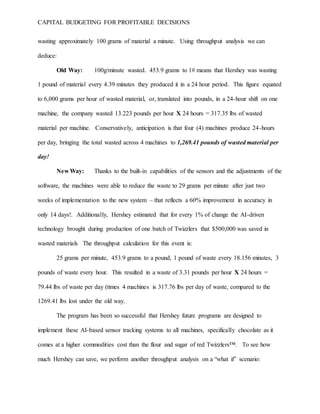
wasting approximately 100 grams of material a minute. Using throughput analysis we can
deduce:
Old Way: 100g/minute wasted. 453.9 grams to 1# means that Hershey was wasting
1 pound of material every 4.39 minutes they produced it in a 24 hour period. This figure equated
to 6,000 grams per hour of wasted material, or, translated into pounds, in a 24-hour shift on one
machine, the company wasted 13.223 pounds per hour X 24 hours = 317.35 lbs of wasted
material per machine. Conservatively, anticipation is that four (4) machines produce 24-hours
per day, bringing the total wasted across 4 machines to 1,269.41 pounds of wasted material per
day!
New Way: Thanks to the built-in capabilities of the sensors and the adjustments of the
software, the machines were able to reduce the waste to 29 grams per minute after just two
weeks of implementation to the new system – that reflects a 60% improvement in accuracy in
only 14 days!. Additionally, Hershey estimated that for every 1% of change the AI-driven
technology brought during production of one batch of Twizzlers that $500,000 was saved in
wasted materials The throughput calculation for this event is:
25 grams per minute, 453.9 grams to a pound, 1 pound of waste every 18.156 minutes, 3
pounds of waste every hour. This resulted in a waste of 3.31 pounds per hour X 24 hours =
79.44 lbs of waste per day (times 4 machines is 317.76 lbs per day of waste, compared to the
1269.41 lbs lost under the old way.
The program has been so successful that Hershey future programs are designed to
implement these AI-based sensor tracking systems to all machines, specifically chocolate as it
comes at a higher commodities cost than the flour and sugar of red Twizzlers™. To see how
much Hershey can save, we perform another throughput analysis on a “what if” scenario:
CAPITAL BUDGETING FOR PROFITABLE DECISIONS
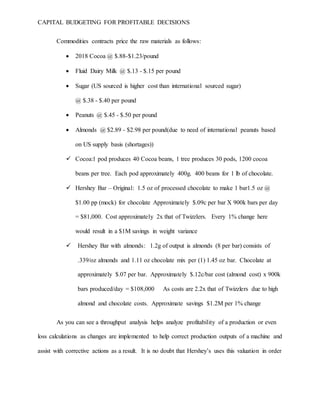
Commodities contracts price the raw materials as follows:
 2018 Cocoa @ $.88-$1.23/pound
 Fluid Dairy Milk @ $.13 - $.15 per pound
 Sugar (US sourced is higher cost than international sourced sugar)
@ $.38 - $.40 per pound
 Peanuts @ $.45 - $.50 per pound
 Almonds @ $2.89 - $2.98 per pound(due to need of international peanuts based
on US supply basis (shortages))
 Cocoa:1 pod produces 40 Cocoa beans, 1 tree produces 30 pods, 1200 cocoa
beans per tree. Each pod approximately 400g. 400 beans for 1 lb of chocolate.
 Hershey Bar – Original: 1.5 oz of processed chocolate to make 1 bar1.5 oz @
$1.00 pp (mock) for chocolate Approximately $.09c per bar X 900k bars per day
= $81,000. Cost approximately 2x that of Twizzlers. Every 1% change here
would result in a $1M savings in weight variance
 Hershey Bar with almonds: 1.2g of output is almonds (8 per bar) consists of
.339/oz almonds and 1.11 oz chocolate mix per (1) 1.45 oz bar. Chocolate at
approximately $.07 per bar. Approximately $.12c/bar cost (almond cost) x 900k
bars produced/day = $108,000 As costs are 2.2x that of Twizzlers due to high
almond and chocolate costs. Approximate savings $1.2M per 1% change
As you can see a throughput analysis helps analyze profitability of a production or even
loss calculations as changes are implemented to help correct production outputs of a machine and
assist with corrective actions as a result. It is no doubt that Hershey’s uses this valuation in order
CAPITAL BUDGETING FOR PROFITABLE DECISIONS
to determine changes to their production facility as they have been taking heavy strides to correct
imperfections (weight overages/losses) which impact their profit margins (Maddox, 2017).
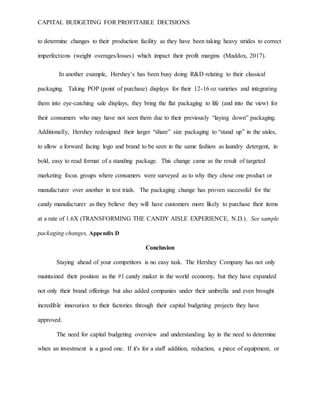
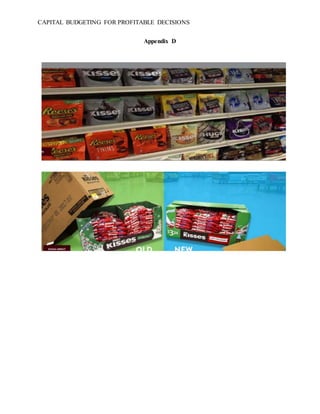
In another example, Hershey’s has been busy doing R&D relating to their classical
packaging. Taking POP (point of purchase) displays for their 12-16 oz varieties and integrating
them into eye-catching sale displays, they bring the flat packaging to life (and into the view) for
their consumers who may have not seen them due to their previously “laying down” packaging.
Additionally, Hershey redesigned their larger “share” size packaging to “stand up” in the aisles,
to allow a forward facing logo and brand to be seen in the same fashion as laundry detergent, in
bold, easy to read format of a standing package. This change came as the result of targeted
marketing focus groups where consumers were surveyed as to why they chose one product or
manufacturer over another in test trials. The packaging change has proven successful for the
candy manufacturer as they believe they will have customers more likely to purchase their items
at a rate of 1.6X (TRANSFORMING THE CANDY AISLE EXPERIENCE, N.D.). See sample
packaging changes, Appendix D
Conclusion
Staying ahead of your competitors is no easy task. The Hershey Company has not only
maintained their position as the #1 candy maker in the world economy, but they have expanded
not only their brand offerings but also added companies under their umbrella and even brought
incredible innovation to their factories through their capital budgeting projects they have
approved.
The need for capital budgeting overview and understanding lay in the need to determine
when an investment is a good one. If it's for a staff addition, reduction, a piece of equipment, or
CAPITAL BUDGETING FOR PROFITABLE DECISIONS
even the acquisition of a new company, being able to understand the methodologies of capital
budgeting will help any company determine the profitability factor of the potential purchase.
While these decisions are important, the impact on the company’s profitability, share
price, D/E ratios, and other valuations are also important. Staying within the favorable confines
of positive percentages will keep investors coming back to the company to keep investing with it
as they prove themselves able to pay their debts in a fast rate while improving either their
profitability or their net income, reducing their cost of sales/cost of revenue by improving such
factors, and staying in a cash positive light for both investor and company overall well being.
The principles of capital budgeting should be understood and followed, regardless of the type of
company or the investment that is considered as the principles can even be applied to personal
financial goals in the future.
CAPITAL BUDGETING FOR PROFITABLE DECISIONS
MFG COMPANY “A” NPV
project cost 100,000.00$ WACC 13.23%
Revenue per year 25,000.00$ Profitability Index 1.88
Discount rate 3%
Company Equity 1,100,000.00$ NPV $100,318.63
Company Debt 200,000.00$ IRR 23%
Cost of Capital 8%
Cost of Debt 2.85% WACC 6.84%
Corporate Tax Rate 33%
Cash Flow
Cumulative Cash
Flow
Payback
Period
Year 0 ($100,000.00) 0
1 25,000.00$ (75,000.00)$ 1
2 25,000.00$ (50,000.00)$ 1
3 25,000.00$ (25,000.00)$ 1
4 25,000.00$ -$ 1
5 25,000.00$ 25,000.00$
6 25,000.00$ 50,000.00$
7 25,000.00$ 75,000.00$
8 25,000.00$ 100,000.00$
9 25,000.00$ 125,000.00$
10 25,000.00$ 150,000.00$
11 25,000.00$ 175,000.00$
12 25,000.00$ 200,000.00$
Total 4
Life of equipment assumed 12 years
Cost of Capital 8%
PI $188,401.95 (cost of capital * inflow of cash)
$100,000.00 Absolute value of investment
Inflow/outflow(+) 1.88
CAPITAL BUDGETING FOR PROFITABLE DECISIONS
Cost of Capital Assumptions
Cost of Debt 4.25%
Tax Rate 33%
Debt 200,000.00$
Debt as % of Capital 15.38%
After Tax cost of Debt 2.85%
Cost of Debt Assumptions
Risk Free Rate 2.40% Current Rates (mock)
Beta 0.86 Sourced from analysists on line
ERP 6% Long Term Average
Equity as % of Capital 84.62%
Cost of Equity 7.56%
WACC Weight X Cost
Debt 15.38% X 2.85%
Equity 84.62% X 7.56%
WACC 6.84%
WACC Calculation
CAPITAL BUDGETING FOR PROFITABLE DECISIONS
Appendix “B”
project cost 500,000.00$ WACC 13.23%
Revenue per year 50,000.00$ Profitability Index 0.80
Discount rate 3%
Company Equity 1,100,000.00$ NPV ($88,066.52)
Company Debt 200,000.00$ IRR 3%
Cost of Capital 8%
Cost of Debt 1.91% WACC 7.39%
Corporate Tax Rate 33%
Cash Flow
Cumulative Cash
Flow
Payback
Period
Year 0 ($500,000.00) 0
1 62,000.00$ (438,000.00)$ 1
2 62,000.00$ (376,000.00)$ 1
3 62,000.00$ (314,000.00)$ 1
4 62,000.00$ (252,000.00)$ 1
5 62,000.00$ (190,000.00)$ 1
6 62,000.00$ (128,000.00)$ 1
7 44,000.00$ (84,000.00)$ 1
8 44,000.00$ (40,000.00)$ 1
9 44,000.00$ 4,000.00$ 0.91
10 33,000.00$ 37,000.00$
11 33,000.00$ 70,000.00$
12 33,000.00$ 103,000.00$
Total 8.91
Life of equipment assumed 12 years
Cost of Capital 8%
PI $400,618.18 (cost of capital * inflow of cash)
$500,000.00 Absolute value of investment
Inflow/outflow(+) 0.80
MFG COMPANY "A" NPV VALUATION
Project "B"
Example of adding high volume machine which can produce the equivalent of 2 of existing machine
CAPITAL BUDGETING FOR PROFITABLE DECISIONS
Cost of Capital Assumptions
Cost of Debt 2.85%
Tax Rate 33%
Debt 200,000.00$
Debt as % of Capital 15.38%
After Tax cost of Debt 1.91%
Cost of Debt Assumptions
Risk Free Rate 2.40% Current Rates (mock)
Beta 0.97 Sourced from analysists on line
ERP 6% Long Term Average
Equity as % of Capital 84.62%
Cost of Equity 8.22%
WACC Weight X Cost
Debt 15.38% X 2.85%
Equity 84.62% X 8.22%
WACC 7.39%
WACC Calculation
CAPITAL BUDGETING FOR PROFITABLE DECISIONS
Appendix “C”
A picture is worth a thousand words, or in this case, 60 million data points!
CAPITAL BUDGETING FOR PROFITABLE DECISIONS
Appendix D
CAPITAL BUDGETING FOR PROFITABLE DECISIONS
References
Chen,J.(2018, 04 28). ProfitabilityIndex Rule.RetrievedfromInvestopedia:
https://www.investopedia.com/terms/p/profitability-index-rule.asp
Corporate Finance Institute.(N.D.). Profitability Index.RetrievedfromCorporate Finance Institute:
https://corporatefinanceinstitute.com/resources/knowledge/accounting/profitability-index/
Hershey Announces“NextCentury”Modernization Programto EnhanceSupply Chain.(2015,06 19).
RetrievedfromBusinessWire:
https://www.businesswire.com/news/home/20150619005132/en/Hershey-Updates-
Leadership-Team-Announces-Productivity-Initiative
Hershey Company 2017 10-K. (2017, 12 31). RetrievedfromSEC.Gov:
https://www.sec.gov/Archives/edgar/data/47111/000004711118000011/a2017_formx10-
kq4.htm#s00F2E88DE57DB21AE151B623DB47A022
Hershey Trust Company AnnouncesSaleof Hershey CompanyCommon Stock.(2017,08 23). Retrieved
fromBusinessWire:
https://www.businesswire.com/news/home/20170823006114/en/Hershey-Trust-Company-
Announces-Sale-Hershey-Company
Houstana.(n.d.).Capital BudgetingUsingExcel.Retrievedfrom
https://www.youtube.com/watch?v=3EAvWEcXO80
Investopedia.(2018,10 15). Weighted AverageCostof Capitalin Excel. RetrievedfromInvestopedia:
https://www.investopedia.com/ask/answers/030915/what-formula-calculating-weighted-
average-cost-capital-wacc-excel.asp
Kenton,W.(2018, 05 01). CapitalBudgeting. RetrievedfromInvestopedia:
https://www.investopedia.com/terms/c/capitalbudgeting.asp
CAPITAL BUDGETING FOR PROFITABLE DECISIONS
Kenton,W.(2019, 04 24). NetPresent Value.RetrievedfromInvestopedia:
https://www.investopedia.com/terms/n/npv.asp
Klott,G. (1984, 08 28). A New Classof StockProposed by Hershey.RetrievedfromNYTimes:
https://www.nytimes.com/1984/08/28/business/a-new-class-of-stock-is-proposed-by-
hershey.html
Maddox,T. (2017, 02 24). HowHershey used IoT to save$500K for every 1% of improved efficiency in
making Twizzlers.RetrievedfromTechRepublic:https://www.techrepublic.com/article/how-
hershey-used-the-cloud-to-deploy-iot-and-machine-learning-without-a-data-scientist/
Martinez,J.(2017, 04 28). The Candy Cloud:MicrosoftAzureIsSweetforHershey.RetrievedfromPC
Magazine:https://www.pcmag.com/article/353375/the-candy-cloud-microsoft-azure-is-sweet-
for-hershey
N.A.(2008, 12 04). Steps of CapitalBudgeting.RetrievedfromAccountingEducation:
http://www.svtuition.org/2008/12/deep-study-of-capital-budgeting.html
N.A.(2010, 06 14). Hershey Announces“NextCentury”Modernization Programto EnhanceSupply Chain.
RetrievedfromBusinessWire:
https://www.businesswire.com/news/home/20100614007061/en/Hershey-Announces-
%E2%80%9CNext-Century%E2%80%9D-Modernization-Program-Enhance
Segal,T.(2019, 05 04). Why would a company buy backits own shares? RetrievedfromInvestopedia:
https://www.investopedia.com/ask/answers/042015/why-would-company-buyback-its-own-
shares.asp
The Hershey Company 10-K.(2007, 12 31). RetrievedfromSEC.Gov:
https://www.sec.gov/Archives/edgar/data/47111/000119312508033182/d10k.htm
CAPITAL BUDGETING FOR PROFITABLE DECISIONS
The Hershey Company 10-K. (2019, 05 21). Retrievedfrom2019 ProxyStatement:
https://www.thehersheycompany.com/content/dam/corporate-us/documents/annual-
reports/2019-the-hershey-company-10-k.pdf
The Hershey Company 3Year BuybackRatio.(2019, 03). RetrievedfromGuruFocus:
https://www.gurufocus.com/term/total_buyback_3y/NYSE:HSY/3-Year-Average-Share-Buyback-
Ratio/The-Hershey-Co
The Hershey Trust Company.(N.D.).RetrievedfromThe HersheyTrustCompany:
https://www.hersheytrust.com/
TRANSFORMINGTHECANDYAISLE EXPERIENCE.(N.D.).RetrievedfromHersheys:
https://www.thehersheycompany.com/en_us/blog/transforming-the-candy-aisle-
experience.html
Yahoo Finance:Hershey Historical Stock Pricing.(N.D.).RetrievedfromYahoo:
https://finance.yahoo.com/quote/HSY/history?period1=1546318800&period2=1577768400&int
erval=1mo&filter=history&frequency=1mo

Capital Budgeting for Profitable Deceision Making

  • 1.
    Running Header: CAPITALBUDGETING FOR PROFITABLE DECISIONS Signature Assignment: Capital Budgeting for Profitable Decisions A Case Study on The Hershey Company Stacey Troup Managerial Accounting/MBA-612 June 14, 2019 Professor Dr. Andreas Walker Touro University Worldwide
  • 2.
    CAPITAL BUDGETING FORPROFITABLE DECISIONS Abstract The Hershey Company is no stranger to capital budgeting techniques. This topic will cover the various methods for evaluating a capital budgeting project with the least impact on company liquidity while focusing on profitability and increased valuation to shareholders. With the good comes the bad and bad decision examples will also be reviewed. Critical thinking alone is not enough to make a capital budgeting decision, real evaluation and formulas are required to determine if the investment is viable or if it should be discarded as payback periods are either outweighing the life of the purchase or are out of reach altogether. Keywords: Capital budgeting; valuations, impact on shareholder value; D/E ratios for profitability, acceptable rates for profitable investments.
  • 3.
    CAPITAL BUDGETING FORPROFITABLE DECISIONS Capital Budgeting Capital budgeting is a managerial accounting principle which is based on the ability to recuperate costs of a project through an investment within the firm versus reinvesting the allocated costs to alternative incentive (such as saving with interest attached). The decision to invest in a project from this perspective is a large one for any company as it is a multi-tiered approach based on a five-stage review of costs, cash flows, opportunities, and risk for the specified project. For The Hershey Company, the ability to recuperate profits for such an investment also relies on the ability to remain able to repay the project over short term life so that a reinvestment in future projects can be attained. Reviewing the overall project, as well as the impact of this project on the valuation of the company, will showcase how capital budgeting decisions are reached in order to determine both a value to a company as well as the impact on the financial statements as well as shareholder valuation. Capital Budgeting – Overview Capital Budgeting is a concept that a company such as the Hershey Company relies on in order to determine if a project is both valuable, repayable, and worthwhile for the investment that is put forth. When determine the capital budgeting process for a project, it is imperative that the five basic concepts of the capital budgeting process are followed, which include: Identifying the investment; evaluate the project (profitability), selecting a project, performance monitoring, and feedback (N.A., Steps of Capital Budgeting, 2008). Identifying the investment is the first step to determine what type of investment is necessary (or interesting). Where is the need for the capital improvement greatest? For a company like Hershey, the decisions are between their manufacturing improvements, supply chain management improvements, corporate acquisitions, and their amusement park which are
  • 4.
    CAPITAL BUDGETING FORPROFITABLE DECISIONS main assets owned by the company as well as the main ways in which Hershey expands market share (N.A., Steps of Capital Budgeting, 2008) (The Hershey Company 10-K, 2019). Now that we have narrowed down where improvements can be made, the time for evaluation of projects against each other to determine profitability, NPV (net present value), throughput analysis, IRR (internal rate of return), discounted cash flows, and payback period are all ways in which a project can be evaluated internally to determine ROI (Kenton, Capital Budgeting, 2018). All of these evaluations result in a formula that allows the user to see how much time it will take to pay the loan back, how much time it will take to profit from the purchase, if the output expectations meet the investment, and if the investment should be carried out as a whole. Each of these methodologies has a place in determining project approval however, they all vary greatly and have different needs for use depending on the type of business, investment, and information available to determine such investment strategies. The throughput analysis is surely the method of determination used within the walls of the Hershey Company when they consider an improvement to production facilities, such as the addition of Microsoft Azure™ software with integrated AI capabilities for production of the Twizzlers™ candy brand (Martinez, 2017). (Specifics of how Hershey used throughput analysis to determine this project viability and success are discussed under Hershey specific evaluations to follow). The throughput analysis uses output calculations based on materials passed through machines being evaluated. Within manufacturing, this is the analysis most often used when considering a capital budgeting project whereby a correction to equipment, new equipment, or other need to change product output, profitability, waste reduction is used (Kenton, Capital Budgeting, 2018),
  • 5.
    CAPITAL BUDGETING FORPROFITABLE DECISIONS Net present value calculations are an evaluation of an investment based on the difference between the present value of cash inflows and the present value of outflows over a period of time and are expressed in algebraic format as (Kenton, Net Present Value, 2019) : Simply stated, you can determine the NPV of an investment by taking the negative value of an investment (recorded negatively as it is a cash outlay), adding the result of the cash flow^(year) divided by (1+ the discount rate) for each year that you wish to determine the NPV and adding it to the same formula for subsequent years. An example of this valuation can assume that a company takes an initial investment of $100,000 on a capital budget for a machine that will produce revenues of $25,000 per year. In the example, we wish to determine both payback period and profitability utilizing IRR, NPV and payback period estimates see (MFG COMPANY“A” NPV) (Investopedia, 2018) (Houstana) (Investopedia, 2018). Per the example, the project has a PIR (Profitability Index Rating) of 1.88%, indicating it is a positive investment for the company (based on valuations over the life of the purchase). Positive Index Rules state that if “the profitability of the index or ratio is greater than “1”, profitability is certain (positive) and the project should be approved. However, the same rule indicates that a PIR of less than a value of “1”, the likelihood of profiting from the investment is highly volatile and the project should not be completed (Chen, 2018) (Corporate Finance Institute, N.D.). These methodologies are examples of how to use a capital budget in order to determine profitability and viability of the possible investment.
  • 6.
    CAPITAL BUDGETING FORPROFITABLE DECISIONS On the alternative side of things, the following example is given for a project that is not only lacking profit but has negative numbers for ROI, PIR, etc.. By examining these two examples, one can see how project valuation varies and ROR (rates of return) vary accordingly even though similar methodologies are used. This example uses the idea that if a machine is ordered that does double the work of our existing machine, how long it takes to become profitable and if the investment is worth t based on the variables as well as the variant of the income over the life of the machine see Appendix “B” (Investopedia, 2018). The Hershey Company’s Capital Budgeting Projects (2010-2019) The Hershey Company is no stranger to capital budgeting reviews. On average, the company does one large capital budgeting project every 3 years and pays a bulk of the cost of same up front as their liquidity measures are high (The Hershey Company 10-K, 2019). In the last 10 years, there have been 4 major projects that the company has taken on relating to reduction of costs, improvement in supply chain, and forward planning for sustained profitability in the future. Among these projects are the “Next Century” program (2010-2014), the “Operational Optimization” Program (2016-2018), The “Margin For Growth” program (2017- 2019), and the “Productivity Initiative” program (2015-2016). Project “Next Century” was a program consisted of improvements to the supply chain and cost restructuring plan for their offerings. The program came at a loss of 500-600 employees (mostly production as technical improvements were made replacing staff) and was to include costs between $140M - $170M during the three-year run but were also expected to incur ongoing cost savings to production of $60-$80M (annually) (N.A., Hershey Announces “Next Century” Modernization Program to Enhance Supply Chain, 2010). This was surely the first step in
  • 7.
    CAPITAL BUDGETING FORPROFITABLE DECISIONS modernization for the company as it also included redesign of a former factory to newly created office and administrative staff while placing their old facility on the market for sale. The costs that were incurred were designed to also cover restructure things at a corporate level in order to begin steps for continuation of the company brand into the next century. Among these changes under this program were changes to the executive leadership, productivity initiatives, brand building, and global capabilities improvements. The 2015 “Productivity Initiative” (2015-2016) included key executive position changes in order to ensure alignment with their strategy and core business visions and delivery of same. Estimates for the project included pretax savings of $65M-$75M, with a portion of that savings being redirected back into the company through new initiatives. With this savings comes a reduction of 300 jobs (approximately) and pre-tax charges of $100M-$120M as a result (Hershey Announces “Next Century” Modernization Program to Enhance Supply Chain, 2015). This is likely the first phase of the modernization of production for Twizzlers™ using artificial intelligence (AI) and Microsoft™ Azure™ software to adjust batches against overage and loss. The “Operational Optimization” program introduced in 2016 was a “Phase II” program who had beginnings within the “Productivity Initiatives” program prior. This program was designed to continue streamlining efforts for both the China and U.S. plants to produce more products while simultaneously reducing costs. This program resulted in a charge of $8M in 2018, $14M in 2017, and $88M in 2016, respectively. While the first phase of this program under the Productivity program were designed to enhance the supply chain through streamlining and reduction of unnecessary staff and methods, the “Operational Minimization” program took it one step further, by combining the two plants located in China into one “Golden Hershey”
  • 8.
    CAPITAL BUDGETING FORPROFITABLE DECISIONS production facility, while attempting to sell off their extra production facility no longer in use (The Hershey Company 10-K, 2019) (Hershey Company 2017 10-K, 2017). “Margin for Growth” program was approved unanimously by the Board of Directors as the program was focused on improving “global efficiency and effectiveness, optimization of the supply chain, streamlining the company’s operating model, and reducing administrative expenses to achieve long-term savings”. (The Hershey Company 10-K, 2019). The project brought costs between $375M-$425M between 2017-2019, and $55M in 2018 as a 15% reduction in workforce was implemented on a global scale (with most of the costs being incurred from China operations and restructuring) (The Hershey Company 10-K, 2019) Stock Valuation During Projects (2010-2019) As the company continued to advance their supply chain and profitability while losing excess staff replaced by machinery, the shareholders rallied by the company in favorable ways over the life of these projects. Stock Review by Project If you had purchased one (1) share of the company stock in 2010 (January 2) at $36.01 per share and maintained that purchase for the long position over the Next Century Project, the value on December 1, 2010 was $47.19 per share, meaning you would have made $11.18 on that purchase and increased your profits by 31.05%. The remaining stock information is as follows (Yahoo Finance: Hershey Historical Stock Pricing, N.D.):
  • 9.
    CAPITAL BUDGETING FORPROFITABLE DECISIONS Date Value Date Value % Increase (-) Shares Purchased Profit 1/2/2010 $36.01 12/31/2010 $47.19 31.05% 1 $11.18 $36.01 $47.19 31.05% 100 $1,118.00 1/2/2011 $47.32 12/31/2011 $51.82 9.51% 1 $4.50 $47.32 $51.82 9.51% 100 $450.00 1/2/2012 $62.10 12/31/2012 $72.22 16.30% 1 $10.12 $62.10 $72.22 16.30% 100 $1,012.00 1/2/2013 $68.19 12/31/2013 $85.15 24.87% 1 $16.96 $68.19 $85.15 24.87% 100 $1,696.00 1/2/2014 $87.05 12/31/2014 $92.94 6.77% 1 $5.89 $87.05 $92.94 6.77% 100 $589.00 Next Century Project Shares 1 $56.93 Shares 100 $5,693.00 Total Stock Change 158.09% Date Value Date Value % Increase (-) Shares Purchased Profit 1/2/2017 $62.10 12/31/2017 $72.22 16.30% 1 $10.12 $62.10 $72.22 16.30% 100 $1,012.00 1/2/2018 $68.19 12/31/2018 $85.15 24.87% 1 $16.96 $68.19 $85.15 24.87% 100 $1,696.00 1/2/2019 $87.05 6/21/2019 $92.94 6.77% 1 $5.89 $87.05 $92.94 6.77% 100 $589.00 Shares 1 $30.84 Margin For Growth Program Shares 100 $3,084.00 Total Stock Change 49.66% Margin For Growth Program Date Value Date Value % Increase (-) Shares Purchased Profit 1/2/2015 $91.41 12/31/2010 $88.16 -3.56% 1 ($3.25) $91.41 $88.16 -3.56% 100 ($325.00) 1/2/2016 $80.70 12/31/2011 $97.10 20.32% 1 $16.40 $80.70 $97.10 20.32% 100 $1,640.00 2015 Productivity Initiative Shares 1 $5.69 Shares 100 $569.00 Total Stock Change 6.22% 2015 Productivity Initiative
  • 10.
    CAPITAL BUDGETING FORPROFITABLE DECISIONS As is evident from these calculations, an initial investment of just $36.01 when the company began its restructuring efforts would have grown in value with only minor “ticks” to profitability over the years. The company has taken very proactive strides to ensure a low D/E (debt to equity) ratio as they finance little through commercial paper offerings and usually pay for a bulk of their capital budgeting projects with surplus cash or through cash raised by selling Class B shares back to the trust, who are the main holder of these shares (80%) in order to maintain voting rights for The Hershey Company, which is under its control (Hershey Trust Company Announces Sale of Hershey Company Common Stock, 2017). The corporate structure of The Hershey Company and The Hershey Trust Company are comprised of The Hershey Company falling under the umbrella of the Hershey Trust Company, which is a philanthropic division of the corporate office with many charitable offerings since inception founding by Milton Hershey (The Hershey Trust Company, N.D.). Capital budgeting projects are offset (often) by the offering of additional Class B shares back to the Trust Company in exchange for cash liquidity in order to self-finance large scale projects they wish to undertake (The Hershey Company 10-K, 2007) (Klott, 1984). In an effort to showcase how successful the planning stages of capital budgeting decisions have been for The Hershey Company on their shareholder value and stock pricing calculations were done to show what would happen if you had purchased at $36.01 and sold as of June 21, 2019 (last day of trading before paper deadline for the year):
  • 11.
    CAPITAL BUDGETING FORPROFITABLE DECISIONS Stock Buy Back The Hershey company has been busy rebuying their shares in order to improve their EPS ratio, rebuild their Treasury Stock reserves, and improve their stock price to the public through this repurchase. Typically, when a company repurchases the stock the price of the shares held by an investor increase in value. This is caused by running a ratio to determine the appropriate earnings per share as follows (Segal, 2019) (The Hershey Company 3 Year Buyback Ratio, 2019): Origially purchased stock. Selling same year vs. holding Year Purchase End Sell Profit Quantity Hold Valuation Increase Profit % 2010 $36.01 $47.19 $11.18 1 31.05% $36.01 $47.19 $1,118.00 100 $1,118.00 2011 $36.01 $51.82 $15.81 1 43.90% $36.01 $51.82 $1,581.00 100 $1,581.00 2012 $62.10 $72.22 $10.12 1 16.30% $62.10 $72.22 $1,012.00 100 $1,012.00 2013 $68.19 $85.15 $16.96 1 24.87% $68.19 $85.15 $1,696.00 100 $1,696.00 2014 $87.05 $92.94 $5.89 1 6.77% $87.05 $92.94 $589.00 100 $589.00 2015 $91.41 $88.16 ($3.25) 1 -3.56% $91.41 $88.16 ($325.00) 100 ($325.00) 2016 $80.70 $97.10 $16.40 1 20.32% $80.70 $97.10 $1,640.00 100 $1,640.00 2017 $99.02 $109.08 $10.06 1 10.16% $99.02 $109.08 $1,006.00 100 $1,006.00 2018 $106.02 $105.90 ($0.12) 1 -0.11% $106.02 $105.90 ($12.00) 100 ($12.00) 2019** $104.83 $137.13 $32.30 1 30.81% $104.83 $137.13 $3,230.00 100 $3,230.00 **based on trade value on June 21, 2019 (last day of trade) Purchased 2010 - Sold 2019 1 Share $101.12 purchased @ $36.01 purchased, sold at $137.13 100 Share $10,112.00 purchased @ $36.01 purchased, sold at $137.13 Percent Increase Since Purchase (considers negatives) 280.81% Long V. Short position hold/sell variable
  • 12.
    CAPITAL BUDGETING FORPROFITABLE DECISIONS Net Revenue/outstanding shares = EPS If the Hershey Company had $11,775,620,000 in net revenue, and 2,109,890 shares outstanding, the calculation would appear as: $ 11,775,620,000.00 ÷ 2,109,890,000 (shares outstanding) = $5.58 EPS. This number is exactly what The Hershey Company calculated as EPS according to their 2019 financial statements (The Hershey Company 10-K, 2019). The company has historically outperformed analysist estimates for their revenue due, in part, to their variable programs they employ to reduce costs and improve profit margins (The Hershey Company 10-K, 2019). Earnings per share are an important part of an investor buying into a company as they dictate to the investor your ability to turn a profit, reinvest, and keep your margins fat and your overhead thin as you continue to grow and innovate.
  • 13.
    CAPITAL BUDGETING FORPROFITABLE DECISIONS The Hershey Company & Throughput Analysis Throughput analysis is the analysis of output capacity from a particular piece of equipment in a specific period of time. Although not verifiable, it is certain that this process was in use when Hershey decided to implement Microsoft™ Azure with AI capabilities during the review of wasted materials during the production of Twizzlers™ candy brand. The project implemented 22 sensors that feed information back on temperature, weight, viscosity, and other parameters in the production of this candy snack to the Azure™ software which allows the machine to learn when to automatically adjust itself to keep wasted product to a minimum and allow control of each production batch to be adjusted on a second-by-second basis through equipment control supervisors monitoring the production from the newly constructed corporate office. This need came when Hershey discovered that the variances in production were causing them to lose/waste approximately 100 grams of Twizzlers™ material per minute! The idea to implement such forward AI capabilities into the manufacturing facility were rejected for several years before finally being adapted thanks to a descriptive program that outlined how the company could save costs. This was accomplished by showcasing how traditional engineers processed data vs. how the machines capture 60 million data points at a rate not only more accurate than but also faster than the human equivalent see Appendix “C”. Introducing AI The program installed on the machine had a very specific job to do, reduce the amount of product that is “given away” due to weight variances to customers and allow immediate change. It was estimated that before the integration of these AI based sensors, the machine, which holds a 14,000 pound batch of cooked material in order to produce one “run” of Twizzlers™ was
  • 14.
    CAPITAL BUDGETING FORPROFITABLE DECISIONS wasting approximately 100 grams of material a minute. Using throughput analysis we can deduce: Old Way: 100g/minute wasted. 453.9 grams to 1# means that Hershey was wasting 1 pound of material every 4.39 minutes they produced it in a 24 hour period. This figure equated to 6,000 grams per hour of wasted material, or, translated into pounds, in a 24-hour shift on one machine, the company wasted 13.223 pounds per hour X 24 hours = 317.35 lbs of wasted material per machine. Conservatively, anticipation is that four (4) machines produce 24-hours per day, bringing the total wasted across 4 machines to 1,269.41 pounds of wasted material per day! New Way: Thanks to the built-in capabilities of the sensors and the adjustments of the software, the machines were able to reduce the waste to 29 grams per minute after just two weeks of implementation to the new system – that reflects a 60% improvement in accuracy in only 14 days!. Additionally, Hershey estimated that for every 1% of change the AI-driven technology brought during production of one batch of Twizzlers that $500,000 was saved in wasted materials The throughput calculation for this event is: 25 grams per minute, 453.9 grams to a pound, 1 pound of waste every 18.156 minutes, 3 pounds of waste every hour. This resulted in a waste of 3.31 pounds per hour X 24 hours = 79.44 lbs of waste per day (times 4 machines is 317.76 lbs per day of waste, compared to the 1269.41 lbs lost under the old way. The program has been so successful that Hershey future programs are designed to implement these AI-based sensor tracking systems to all machines, specifically chocolate as it comes at a higher commodities cost than the flour and sugar of red Twizzlers™. To see how much Hershey can save, we perform another throughput analysis on a “what if” scenario:
  • 15.
    CAPITAL BUDGETING FORPROFITABLE DECISIONS Commodities contracts price the raw materials as follows:  2018 Cocoa @ $.88-$1.23/pound  Fluid Dairy Milk @ $.13 - $.15 per pound  Sugar (US sourced is higher cost than international sourced sugar) @ $.38 - $.40 per pound  Peanuts @ $.45 - $.50 per pound  Almonds @ $2.89 - $2.98 per pound(due to need of international peanuts based on US supply basis (shortages))  Cocoa:1 pod produces 40 Cocoa beans, 1 tree produces 30 pods, 1200 cocoa beans per tree. Each pod approximately 400g. 400 beans for 1 lb of chocolate.  Hershey Bar – Original: 1.5 oz of processed chocolate to make 1 bar1.5 oz @ $1.00 pp (mock) for chocolate Approximately $.09c per bar X 900k bars per day = $81,000. Cost approximately 2x that of Twizzlers. Every 1% change here would result in a $1M savings in weight variance  Hershey Bar with almonds: 1.2g of output is almonds (8 per bar) consists of .339/oz almonds and 1.11 oz chocolate mix per (1) 1.45 oz bar. Chocolate at approximately $.07 per bar. Approximately $.12c/bar cost (almond cost) x 900k bars produced/day = $108,000 As costs are 2.2x that of Twizzlers due to high almond and chocolate costs. Approximate savings $1.2M per 1% change As you can see a throughput analysis helps analyze profitability of a production or even loss calculations as changes are implemented to help correct production outputs of a machine and assist with corrective actions as a result. It is no doubt that Hershey’s uses this valuation in order
  • 16.
    CAPITAL BUDGETING FORPROFITABLE DECISIONS to determine changes to their production facility as they have been taking heavy strides to correct imperfections (weight overages/losses) which impact their profit margins (Maddox, 2017). In another example, Hershey’s has been busy doing R&D relating to their classical packaging. Taking POP (point of purchase) displays for their 12-16 oz varieties and integrating them into eye-catching sale displays, they bring the flat packaging to life (and into the view) for their consumers who may have not seen them due to their previously “laying down” packaging. Additionally, Hershey redesigned their larger “share” size packaging to “stand up” in the aisles, to allow a forward facing logo and brand to be seen in the same fashion as laundry detergent, in bold, easy to read format of a standing package. This change came as the result of targeted marketing focus groups where consumers were surveyed as to why they chose one product or manufacturer over another in test trials. The packaging change has proven successful for the candy manufacturer as they believe they will have customers more likely to purchase their items at a rate of 1.6X (TRANSFORMING THE CANDY AISLE EXPERIENCE, N.D.). See sample packaging changes, Appendix D Conclusion Staying ahead of your competitors is no easy task. The Hershey Company has not only maintained their position as the #1 candy maker in the world economy, but they have expanded not only their brand offerings but also added companies under their umbrella and even brought incredible innovation to their factories through their capital budgeting projects they have approved. The need for capital budgeting overview and understanding lay in the need to determine when an investment is a good one. If it's for a staff addition, reduction, a piece of equipment, or
  • 17.
    CAPITAL BUDGETING FORPROFITABLE DECISIONS even the acquisition of a new company, being able to understand the methodologies of capital budgeting will help any company determine the profitability factor of the potential purchase. While these decisions are important, the impact on the company’s profitability, share price, D/E ratios, and other valuations are also important. Staying within the favorable confines of positive percentages will keep investors coming back to the company to keep investing with it as they prove themselves able to pay their debts in a fast rate while improving either their profitability or their net income, reducing their cost of sales/cost of revenue by improving such factors, and staying in a cash positive light for both investor and company overall well being. The principles of capital budgeting should be understood and followed, regardless of the type of company or the investment that is considered as the principles can even be applied to personal financial goals in the future.
  • 18.
    CAPITAL BUDGETING FORPROFITABLE DECISIONS MFG COMPANY “A” NPV project cost 100,000.00$ WACC 13.23% Revenue per year 25,000.00$ Profitability Index 1.88 Discount rate 3% Company Equity 1,100,000.00$ NPV $100,318.63 Company Debt 200,000.00$ IRR 23% Cost of Capital 8% Cost of Debt 2.85% WACC 6.84% Corporate Tax Rate 33% Cash Flow Cumulative Cash Flow Payback Period Year 0 ($100,000.00) 0 1 25,000.00$ (75,000.00)$ 1 2 25,000.00$ (50,000.00)$ 1 3 25,000.00$ (25,000.00)$ 1 4 25,000.00$ -$ 1 5 25,000.00$ 25,000.00$ 6 25,000.00$ 50,000.00$ 7 25,000.00$ 75,000.00$ 8 25,000.00$ 100,000.00$ 9 25,000.00$ 125,000.00$ 10 25,000.00$ 150,000.00$ 11 25,000.00$ 175,000.00$ 12 25,000.00$ 200,000.00$ Total 4 Life of equipment assumed 12 years Cost of Capital 8% PI $188,401.95 (cost of capital * inflow of cash) $100,000.00 Absolute value of investment Inflow/outflow(+) 1.88
  • 19.
    CAPITAL BUDGETING FORPROFITABLE DECISIONS Cost of Capital Assumptions Cost of Debt 4.25% Tax Rate 33% Debt 200,000.00$ Debt as % of Capital 15.38% After Tax cost of Debt 2.85% Cost of Debt Assumptions Risk Free Rate 2.40% Current Rates (mock) Beta 0.86 Sourced from analysists on line ERP 6% Long Term Average Equity as % of Capital 84.62% Cost of Equity 7.56% WACC Weight X Cost Debt 15.38% X 2.85% Equity 84.62% X 7.56% WACC 6.84% WACC Calculation
  • 20.
    CAPITAL BUDGETING FORPROFITABLE DECISIONS Appendix “B” project cost 500,000.00$ WACC 13.23% Revenue per year 50,000.00$ Profitability Index 0.80 Discount rate 3% Company Equity 1,100,000.00$ NPV ($88,066.52) Company Debt 200,000.00$ IRR 3% Cost of Capital 8% Cost of Debt 1.91% WACC 7.39% Corporate Tax Rate 33% Cash Flow Cumulative Cash Flow Payback Period Year 0 ($500,000.00) 0 1 62,000.00$ (438,000.00)$ 1 2 62,000.00$ (376,000.00)$ 1 3 62,000.00$ (314,000.00)$ 1 4 62,000.00$ (252,000.00)$ 1 5 62,000.00$ (190,000.00)$ 1 6 62,000.00$ (128,000.00)$ 1 7 44,000.00$ (84,000.00)$ 1 8 44,000.00$ (40,000.00)$ 1 9 44,000.00$ 4,000.00$ 0.91 10 33,000.00$ 37,000.00$ 11 33,000.00$ 70,000.00$ 12 33,000.00$ 103,000.00$ Total 8.91 Life of equipment assumed 12 years Cost of Capital 8% PI $400,618.18 (cost of capital * inflow of cash) $500,000.00 Absolute value of investment Inflow/outflow(+) 0.80 MFG COMPANY "A" NPV VALUATION Project "B" Example of adding high volume machine which can produce the equivalent of 2 of existing machine
  • 21.
    CAPITAL BUDGETING FORPROFITABLE DECISIONS Cost of Capital Assumptions Cost of Debt 2.85% Tax Rate 33% Debt 200,000.00$ Debt as % of Capital 15.38% After Tax cost of Debt 1.91% Cost of Debt Assumptions Risk Free Rate 2.40% Current Rates (mock) Beta 0.97 Sourced from analysists on line ERP 6% Long Term Average Equity as % of Capital 84.62% Cost of Equity 8.22% WACC Weight X Cost Debt 15.38% X 2.85% Equity 84.62% X 8.22% WACC 7.39% WACC Calculation
  • 22.
    CAPITAL BUDGETING FORPROFITABLE DECISIONS Appendix “C” A picture is worth a thousand words, or in this case, 60 million data points!
  • 23.
    CAPITAL BUDGETING FORPROFITABLE DECISIONS Appendix D
  • 24.
    CAPITAL BUDGETING FORPROFITABLE DECISIONS References Chen,J.(2018, 04 28). ProfitabilityIndex Rule.RetrievedfromInvestopedia: https://www.investopedia.com/terms/p/profitability-index-rule.asp Corporate Finance Institute.(N.D.). Profitability Index.RetrievedfromCorporate Finance Institute: https://corporatefinanceinstitute.com/resources/knowledge/accounting/profitability-index/ Hershey Announces“NextCentury”Modernization Programto EnhanceSupply Chain.(2015,06 19). RetrievedfromBusinessWire: https://www.businesswire.com/news/home/20150619005132/en/Hershey-Updates- Leadership-Team-Announces-Productivity-Initiative Hershey Company 2017 10-K. (2017, 12 31). RetrievedfromSEC.Gov: https://www.sec.gov/Archives/edgar/data/47111/000004711118000011/a2017_formx10- kq4.htm#s00F2E88DE57DB21AE151B623DB47A022 Hershey Trust Company AnnouncesSaleof Hershey CompanyCommon Stock.(2017,08 23). Retrieved fromBusinessWire: https://www.businesswire.com/news/home/20170823006114/en/Hershey-Trust-Company- Announces-Sale-Hershey-Company Houstana.(n.d.).Capital BudgetingUsingExcel.Retrievedfrom https://www.youtube.com/watch?v=3EAvWEcXO80 Investopedia.(2018,10 15). Weighted AverageCostof Capitalin Excel. RetrievedfromInvestopedia: https://www.investopedia.com/ask/answers/030915/what-formula-calculating-weighted- average-cost-capital-wacc-excel.asp Kenton,W.(2018, 05 01). CapitalBudgeting. RetrievedfromInvestopedia: https://www.investopedia.com/terms/c/capitalbudgeting.asp
  • 25.
    CAPITAL BUDGETING FORPROFITABLE DECISIONS Kenton,W.(2019, 04 24). NetPresent Value.RetrievedfromInvestopedia: https://www.investopedia.com/terms/n/npv.asp Klott,G. (1984, 08 28). A New Classof StockProposed by Hershey.RetrievedfromNYTimes: https://www.nytimes.com/1984/08/28/business/a-new-class-of-stock-is-proposed-by- hershey.html Maddox,T. (2017, 02 24). HowHershey used IoT to save$500K for every 1% of improved efficiency in making Twizzlers.RetrievedfromTechRepublic:https://www.techrepublic.com/article/how- hershey-used-the-cloud-to-deploy-iot-and-machine-learning-without-a-data-scientist/ Martinez,J.(2017, 04 28). The Candy Cloud:MicrosoftAzureIsSweetforHershey.RetrievedfromPC Magazine:https://www.pcmag.com/article/353375/the-candy-cloud-microsoft-azure-is-sweet- for-hershey N.A.(2008, 12 04). Steps of CapitalBudgeting.RetrievedfromAccountingEducation: http://www.svtuition.org/2008/12/deep-study-of-capital-budgeting.html N.A.(2010, 06 14). Hershey Announces“NextCentury”Modernization Programto EnhanceSupply Chain. RetrievedfromBusinessWire: https://www.businesswire.com/news/home/20100614007061/en/Hershey-Announces- %E2%80%9CNext-Century%E2%80%9D-Modernization-Program-Enhance Segal,T.(2019, 05 04). Why would a company buy backits own shares? RetrievedfromInvestopedia: https://www.investopedia.com/ask/answers/042015/why-would-company-buyback-its-own- shares.asp The Hershey Company 10-K.(2007, 12 31). RetrievedfromSEC.Gov: https://www.sec.gov/Archives/edgar/data/47111/000119312508033182/d10k.htm
  • 26.
    CAPITAL BUDGETING FORPROFITABLE DECISIONS The Hershey Company 10-K. (2019, 05 21). Retrievedfrom2019 ProxyStatement: https://www.thehersheycompany.com/content/dam/corporate-us/documents/annual- reports/2019-the-hershey-company-10-k.pdf The Hershey Company 3Year BuybackRatio.(2019, 03). RetrievedfromGuruFocus: https://www.gurufocus.com/term/total_buyback_3y/NYSE:HSY/3-Year-Average-Share-Buyback- Ratio/The-Hershey-Co The Hershey Trust Company.(N.D.).RetrievedfromThe HersheyTrustCompany: https://www.hersheytrust.com/ TRANSFORMINGTHECANDYAISLE EXPERIENCE.(N.D.).RetrievedfromHersheys: https://www.thehersheycompany.com/en_us/blog/transforming-the-candy-aisle- experience.html Yahoo Finance:Hershey Historical Stock Pricing.(N.D.).RetrievedfromYahoo: https://finance.yahoo.com/quote/HSY/history?period1=1546318800&period2=1577768400&int erval=1mo&filter=history&frequency=1mo