Running Header: MODERN BUDGETING: LEASE VS BUY
Signature Assignment: Modern Budgeting
A Case Study of Chobani™
Stacey Troup
Budgeting/MBA-622
August 17, 2019
Professor Dr. Ralph Ezelle
Touro University Worldwide
Running Header: MODERN BUDGETING: LEASE VS BUY
Abstract
Chobani™ case study on effective budgeting in a buy vs lease situation, applicable to
everyone seeking to start a new business and make strategic decisions on purchases to remain
profitable.
Keywords: Capital budgeting; rent vs. buy; liquidity; expansions; growth
Running Header: MODERN BUDGETING: LEASE VS BUY
Budgeting
Modern business is a highly competitive place in which the ability to properly budget for
capital improvements and expansions as well as the vision to foresee the need for
implementation of technological advancements as a way to save money and secure market share
are key for success. For this paper, a mock analysis of a production facility similar to Chobani™
will be evaluated from a lease vs. buy perspective in both building and equipment to showcase
why the need for innovation as well as the implementation of AI measures (on an ongoing basis)
keep the production facility profitable against competitive mass-produced food giants such as
Kraft™ while not only improving their bottom line but growing as a company through strategic
budgeting, business, and ethical decisions of which the (former) CEO & Chairman Hamdi
Ulukaya is famous for successfully implementing on behalf of the company, driving its overall
success.
The Chobani™ Start
While Hamdi Ulukaya, the current Chairman of Chobani™ came from Turkish dairy
farmers who produced cheese and yogurt in their native land, he, himself had no aspirations of
following in the footsteps of his family, seeking instead to enroll in business school (which he
ultimately dropped out of) in 1994 (Steiner, 2011).
After leaving business school, he began making feta cheese following a push from his
father to produce a superior product in the U.S. It was during this time that Mr. Ulukaya
discovered the plant in upstate New York, following receipt of a flyer which he received
advertising the real estate offering, that belonged to the Kraft™ company and was in the process
of being dismantled when he went to view it in person (Steiner, 2011).
Running Header: MODERN BUDGETING: LEASE VS BUY
Discovering that the remaining employees in the plant were there to remove the final
components of the closed Kraft™ factory, he hatched a plan to not only save these loyal workers
but to begin a new brand. Mr. Ulukaya took out a loan from the Small Business Administration
for $800,000 (in 2007) and purchased the plant for pennies on the dollar as a result, paving the
dream he developed of offering a superior yogurt product in the U.S. markets after having
sampled the sub-par offerings in the market at that time (Steiner, 2011). This purchase launched
the 2007 beginning of the powerhouse brand determined to make a difference (Weisul, 2012).
The original factory configuration was designed to produce smaller quantities of the
former food conglomerate’s offering. The outdated machinery was able to pack about 50,000
cases per week of the product and much of it was packaged by hand due to financial constraints
of the company. Mr. Ulukaya sites that typically a yogurt packing machine of this caliber
usually costs around $1 million dollars which the company did not have the liquidity to purchase,
and it was for this reason that much of the original offering was packed by hand in a safe
environment (Weisul, 2012).
By 2011, the brand was picking up steam and expanding at an alarming rate. It was at
this juncture that Mr. Ulukaya sought to expand the plant to keep up with current and future
production but was not in the line of fire for banks to loan money to. Through some strategic
capital budgeting decisions, they secured enough funding for their first of many improvements.
The $220 million they were able to raise increased production from 50,000 cases per week to 1.4
million cases per week and allowed for the rebranding and repackaging that the company so
desired for its new offerings. This strategic decision making enabled the brand to go from small
business loan to $700 million a year in sales in just four short years (Steiner, 2011).
Running Header: MODERN BUDGETING: LEASE VS BUY
To Lease or to Buy?
New businesses often struggle with the decision to purchase equipment or to lease
equipment as well as buildings. In the business schools, we are often only taught the option of
financing a purchase for these expenditures and not how these decisions can be bad for the
bottom line.
Chobani™ realized the need to own their plant and their upgraded equipment once they
had the liquidity and sales to support such needed improvements while improving along the way
to maintain their production capabilities and offerings to the customers. Within four (4) years of
establishing the brand, the company had the liquidity to do so through a series of coordinated
capital budgeting decisions.
The Building
The building located at 69 County Rd 25, New Berlin, NY was a shuddered plant owned
by the Kraft™ corporation which was being closed by employees during the time Chobani™
went to review it. Using the loan from the Small Business Administration ($800,000), Mr.
Ulukaya purchased the building for (what he calls) “pennies on the dollar” (Weisul, 2012) in
2007. The plant was listed at $700,000 and it is expected that this “pennies on the dollar” refers
to a purchase price somewhere between 20% and 30% of asking price, making the plant total
somewhere between $140,000 and $210,000, leaving between $590,000 and $660,000 for
repairs, hiring, inspections, and upstart costs (Weisul, 2012).
Production
The first strategic budgeting decision beyond that of the factory purchase was to bring in
a master yogurt maker from Turkey in order to produce a superior product for the U.S. Markets.
Running Header: MODERN BUDGETING: LEASE VS BUY
With the excess cash reserve, it is feasible that $100,00 was spent to relocate this individual and
(his) family to the upstate New York factory to being the surge in restructuring.
The company stayed with most of their original equipment as purchased from the defunct
Kraft™ plant, maintaining the 50,000 case per week production runs, often falling behind due to
their inadequacies in production, and maintaining a customer base in Microsoft Excel™ due to
their budgetary constraints. It took 18 months to conjure up a recipe that the founder felt
measured up to his true Greek yogurt background and was finally able to start implementing
changes.
Orders began flowing in and the company struggled to keep up production but did its best
by growing staff to 1,200 in the first few years to manage production facilities, sales, and
administrative needs of the growing company (Steiner, 2011). By 2011, the company had made
enough strategic decisions within their product lines, purchases, and staffing, to invest $220
million into production upgrades for the original facility, including new production machines for
the liquid offerings as well as the “Flips” brand which was launching at the time (Steiner, 2011).
Little is known about the specific budgeting decisions the company made as they are still
privately held (to a degree) and the financials are not made available to the public as a result, for
this reason, the estimates herein are just that, estimates.
By not only buying a building being dumped by the previous owner at a “fire sale” price,
but by maintaining the facility in an area with a much lower cost to maintain, staff, and pay
necessary taxes on, Chobani™ set themselves up in a way that is admirable and an example for
entrepreneurs everywhere. Often credited as a company that is a shining example of how to
establish a brand in a saturated economy, the budgeting decisions of the company were
paramount to their success.
Running Header: MODERN BUDGETING: LEASE VS BUY
Capital Budgeting
Capital budgeting is the budgeting of high-cost expenditures based on the return on
investment as well as the net present value of the investment. These calculations help establish
the payback period, valuation of the anticipated investment, rate of return, and other key factors
to help determine project viability.
Budgeting Examples
Using an example of estimates derived from public information obtained on the
establishment of the company, a net present value figure can be derived to help estimate what the
founder saw as an opportunity and turnover required to repay the debt he was about to incur
when he originally purchased the factory while making minor improvements to machinery
(which was purchased used) in order to get the factory operational.
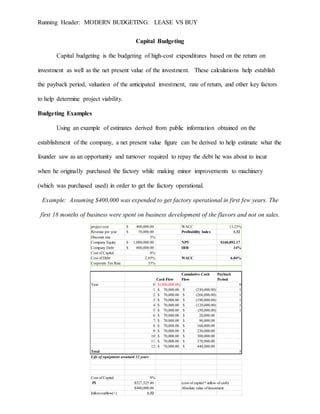
Example: Assuming $400,000 was expended to get factory operational in first few years. The
first 18 months of business were spent on business development of the flavors and not on sales.
project cost 400,000.00$ WACC 13.23%
Revenue per year 70,000.00$ Profitability Index 1.32
Discount rate 3%
Company Equity 1,000,000.00$ NPV $160,892.17
Company Debt 800,000.00$ IRR 14%
Cost of Capital 8%
Cost of Debt 2.85% WACC 6.84%
Corporate Tax Rate 33%
Cash Flow
Cumulative Cash
Flow
Payback
Period
Year 0 (400,000.00)$ 0
1 70,000.00$ (330,000.00)$ 1
2 70,000.00$ (260,000.00)$ 1
3 70,000.00$ (190,000.00)$ 1
4 70,000.00$ (120,000.00)$ 1
5 70,000.00$ (50,000.00)$ 1
6 70,000.00$ 20,000.00$
7 70,000.00$ 90,000.00$
8 70,000.00$ 160,000.00$
9 70,000.00$ 230,000.00$
10 70,000.00$ 300,000.00$
11 70,000.00$ 370,000.00$
12 70,000.00$ 440,000.00$
Total 5
Life of equipment assumed 12 years
Cost of Capital 8%
PI $527,525.46 (cost of capital * inflow of cash)
$400,000.00 Absolute value of investment
Inflow/outflow(+) 1.32
Running Header: MODERN BUDGETING: LEASE VS BUY
Estimates from the above example have sales at $70,000 for the brand per year (which is
light but just a fictitious estimate). The revenues would have the equipment repaid (or the
overall loan which included same) within 5 years, well on the way to profits.
Economic Boom
Thanks to a superior brand, the company experienced a surge in their sales in the first few
years. It is estimated that in their first year of business they were selling just 200 cases per week
to retail stores prior to catching the attention of large “big box” warehouse chains capable of
ordering mass quantities of the products for their various and vast locations (BJ’s/Costco)
(Bhasin, 2012).
This welcoming by the warehouse stores meant that by 2012, the brand went from 200
cases per week (2009) in sales to 1.5 million (Bhasin, 2012). That meant a huge boost to their
bottom line and cash reserves, and in late 2011, the company invested $220 million in their
production improvements and expansion of the original factory capabilities, having seen the need
for an immediate improvement due to driven demand for the product. Mr. Ulukaya considers
this one of his guiding principles of business, i.e. “investing in your core” (Steiner, 2011).
Part of this improvement was brought by way of Artificial Intelligence available from
Microsoft™. The AI measures were first put into the upstate New York facility as a way to
control loss and production standards, and have been implemented into both factories the
company operates. The innovation was implemented and running in just 27 days, including the
use of a newly developed CRM system available as part of the package from Microsoft™. This
meant that the company could now not only handle production, but its customer base, ordering
details, and full details of everything they needed through a circular database offering and the
addition of AI measures into production (2013) (Microsoft News Center, 2013).
Running Header: MODERN BUDGETING: LEASE VS BUY
The additional expansions and upgrades to the factory ensure that they are able to keep
up supply for the demand, introduce new products to the marketplace (such as “Flip), and expand
the market reach to new levels through superior quality and brand loyalty.
Rocky Waters
While the company expanded rapidly by using their own cash reserves from the boom of
their products taking off in the marketplace, they found themselves in a rough place in 2014
while in the process of building their Twin Falls, Idaho location, which is currently over 1
million square feet, considered the largest production facility of its kind in the U.S. Cash was
going out faster than it was coming in and the company found it hard to meet the stringent capital
demands that were placed before them (Gelles, 2018).
Deciding again to budget themselves to avoid catastrophe, they accepted a loan from
TPG Capital group for $750 million (2014) which required Mr. Ulukaya to relinquish his CEO
title (while maintaining his Chairman title), as TPG inserted 9 key staff members (as consultants)
to help the brand identify $10 million in procurement savings, $76 million in waste (due
predominantly due to expired or bad product), conceptualized and formalized the opening of new
distribution centers to improve logistics and customer service, and, finally, the consultants
implemented new technology which helped the company improve viscosity (and overall
production capabilities) (Chobani, LLC, 2014) (Catalant Staff, 2015).
TPG Capital, through this financing, holds a stake in the company while assisting with
the overall vision, similar to what a Board of Directors would do for a publically traded
company. With the interest and extra time to implement both the new plant and the innovations,
the debt to TPG grew to $900 million two years after being taken on. The loan came with certain
considerations, including that TPG will retain a zero percentage retention of ownership once the
Running Header: MODERN BUDGETING: LEASE VS BUY
loan is repaid. However, the HOPP (Healthcare of Ontario Pension Plan) will receive a 20%
position in the company through their levered financing with TPG (Gelles, 2018)
Modern Day
After completing the buildout of the Idaho factory, Chobani™ successfully maintained
control of their internal budgeting controls in a way that allowed them to open and staff the
facility, while repaying the massive $900 million dollar TPG loan in full, allowing the brand to
part ways with their financier in 2017 (Gelles, 2018).
In addition to this levered loan repayment, the company also has the ability to repurchase
the equity given to HOPP during the original terms of the loan, up to 50% of the originally sold
equity in the brand, should they desire to do so (Gelles, 2018).
Once they were back in control of the company, Chobani™ executives decided to expand
the Twin Falls, Idaho plant to improve production facilities and add a foodservice aspect which
will open the brand up to schools, hospitals, and other commercial entities, which were also at
the core of who the company sought to support (see “Ethics”) (Chobani announces major
expansion, 2017).
The company continues to grow with continued expansions at both plants, new
innovations, new markets, and growth opportunities while continuing to stick to their core values
of giving back and teamwork (Chobani announces major expansion, 2017).
Ethics & Corporate Responsibility
Mr. Ulukaya, Chobani Chairman, is no stranger to giving back. From the beginning,
Chobani™ has pledged to donate 10% of their profits to the communities while intentionally
hiring refugees from other countries as a way to payback how he, himself, came to this country
(BRUNNER, 2017).
Running Header: MODERN BUDGETING: LEASE VS BUY
As the controversy hit the U.S. in 2017, school lunch programs were at risk and children
were are risk for going without lunch because the public schools were owed a debt from the low-
income parents that they could no longer burden. The Chobani™ Chairman immediately
stepped in, donating $50,000 to Warwick, Rhode Island Schools to pay their past-due lunch bills,
and followed in 2019 when they paid nearly $85,000 to settle lunch debts for children in an
Idaho school district, while continuing to ensure that no child goes hungry or is food shamed
while trying to gain an education (Lam, 2019) (Romo, 2019).
Through the “Giving Back” division of Chobani™, the charitable donation arm has been
ensuring preservation of nutritious food for children, providing meals to homeless and at-risk
shelters in the areas they do business (specifically New York), providing funding for the Special
Olympics (since having their funding cut under the current “administration”), and many more
initiatives designed to ensure sustainability for those most in need (Impact: Giving Back, n.d.).
Not to be outdone by these incentives, the Chairman stunned everyone when he
announced he was giving shares of the company to the employees. Several employees were
stunned when this occurred, some of them receiving up to 10% of the future profits of the
company, which could result in them becoming millionaires from his very incredible gift. The
Chairman saw it as more of a partnership to ensure working together continues for years to
come, to build a brand and a company that everyone is proud of (BERR, 2016).
Creating jobs, ensuring sustainability, helping those most in need obtain access to healthy
food, and providing opportunities in the face of adversity after the original “mass-produced”
food company shuddered these factories and left the employees destitute in the past. This is
what has helped Chobani™ remain one of the most profitable, ethical companies on the planet.
Running Header: MODERN BUDGETING: LEASE VS BUY
Buying Vs. Leasing
The decision to buy or lease is really on a case by case basis. Often, technology dictates
what makes more sense for people when looking to make these types of decisions. Will the
technology need to be replaced before the standard life of the equipment is able to be written off?
Will the equipment even have a resale value due to the technology advances at the end of its life?
These are all questions that go into the decision-making process, in addition to the valuation
methods discussed above.
Where Chobani™ found success was a building in near foreclosure, a plant that was
stocked with used, unneeded equipment used for making yogurt that they were willing to sell at a
“fire sale” price, and only minimal income needing to go into renovations the first few years.
This was a strategic budgeting decision that often does not occur. So often people look to
establish their businesses in the heart of a city (like New York City), where the rents are
incredibly unimaginable and often hard to get into because of the capital requirements for the
leasing. This has made companies like We Work™ very popular for tech and consulting startups
as they are able to save money on their leases while having access to the staff and equipment
they need to maintain professional presence.
Chobani made both of these decisions, they purchased the building and used equipment
while leasing the new technology (AI) from Microsoft™ to ensure upgrades can be had without
taking a loss on the existing equipment at the end of a term. Your decisions and the decisions of
any company you start need to be based on the valuations given herein and need to have the
liquidity measures considered before any capital budgeting decision is approved.
Conclusion
While Chobani™ was successful through their strategic budgeting decisions, ability to
purchase their equipment and plant at pennies on the dollar, and had the good fortune to have a
Running Header: MODERN BUDGETING: LEASE VS BUY
superior product hit the market which took off like wildfire in just four years, this is not
commonplace for everyone.
Throughout the run, they maintained all strict capital budgeting decisions based on
liquidity and valuation. Maintaining that their cash reserves were required to pay for any
improvements needed and only taking on outside investors when costs were eating into their
ability to maintain liquidity, they repaid the loan swiftly and parted with the outside influence
that impacted their decision making, on their way to a company worth between $3 billion and $5
billion in 2016 (and growing).
Realizing that their social responsibility was to those in both their areas and those most at
need, the charitable arm has helped thousands maintain food dignity while helping homeless
shelters and at-risk families throughout the country.
Their luck and budgeting isn’t status quo for everyone. As discussed, the decision to buy
or lease is driven on both the valuation and the ability to resell the needed equipment at the end
of useful life, provided that the technology is still wanted and not outdated. Using a space like
We Work™ can help businesses maintain liquidity while making these decisions but your eye
always needs to be on the bottom line, the budget of the company, the parameters of any
potential project, and your ethical standards represented in the public as these help drive your
brand loyalty.
Running Header: MODERN BUDGETING: LEASE VS BUY
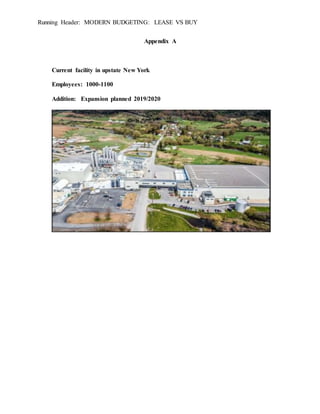
Appendix A
Current facility in upstate New York
Employees: 1000-1100
Addition: Expansion planned 2019/2020
Running Header: MODERN BUDGETING: LEASE VS BUY
References
BERR, J. (2016, 04 26). 2,000 Chobaniemployeesjustgota hugeeconomicwindfall.RetrievedfromCBS
News:https://www.cbsnews.com/news/2000-chobani-employees-just-got-a-huge-economic-
windfall/
Bhasin,K.(2012, 06 23). HowChobaniBecameA $750 Million BusinessIn Only Five Years. Retrieved
fromBusinessInsider:https://www.businessinsider.com/chobani-founder-hamdi-ulukaya-and-
the-greek-yogurt-craze-2012-6?op=1
BRUNNER,R. (2017, 03 20). How Chobani’sHamdiUlukaya IsWinning America’sCultureWar.Retrieved
fromFast Company:https://www.fastcompany.com/3068681/how-chobani-founder-hamdi-
ulukaya-is-winning-americas-culture-war
CatalantStaff.(2015, 05 25). 5 SuccessLessonsEntrepreneursCan Learn FromChobani.Retrievedfrom
Catalant:https://gocatalant.com/blog/5-success-lessons-entrepreneurs-can-learn-from-
chobani/
Chobaniannouncesmajorexpansion.(2017,11 17). RetrievedfromFeedstuffs:
https://www.feedstuffs.com/news/chobani-announces-major-expansion
Chobani,LLC.(2014, 04 23). ChobaniRaises$750 Million In CapitalFromTPG To Fund FutureGrowth.
RetrievedfromPRNewswire:https://www.prnewswire.com/news-releases/chobani-raises-750-
million-in-capital-from-tpg-to-fund-future-growth-256414221.html
Gelles,D.(2018, 06 28). Chobani,theGreek YogurtMaker,Reclaims Controlof Its Finances.Retrieved
fromThe NewYorkTimes:https://www.nytimes.com/2018/06/28/business/chobani-tpg-
healthcare-ontario-pension-plan.html
Impact:Giving Back.(n.d.).RetrievedfromChobani:https://www.chobani.com/impact/giving-back/
Irfanullah,J.A.(2011, 09 12). CapitalBudgeting Explained.RetrievedfromXplaind:
https://xplaind.com/612207/capital-budgeting
Lam, K. (2019, 06 13). Chobanito pay Idaho schooldistrict’s$85,000 lunch debt.RetrievedfromFox
Business:https://www.foxbusiness.com/features/chobani-idaho-school-district-85g-lunch-debt
MicrosoftNewsCenter.(2013). ChobaniIncreasesItsAppetiteforBusinessGrowth With Microsoft
Technologies.RetrievedfromMicrosoft:News:
https://news.microsoft.com/2013/03/19/chobani-increases-its-appetite-for-business-growth-
with-microsoft-technologies/
Rodeck,D. (n.d.). Howto AdjustforRiskin Capital Budgeting.RetrievedfromChron:
https://smallbusiness.chron.com/adjust-risk-capital-budgeting-10326.html
Romo,V.(2019, 05 10). AfterBacklash,RhodeIsland SchoolDistrict Rolls Back'Lunch Shaming'Policy.
RetrievedfromNPR:https://www.npr.org/2019/05/10/722259141/after-backlash-rhode-island-
school-district-rolls-back-lunch-shaming-policy
Running Header: MODERN BUDGETING: LEASE VS BUY
Steiner,C.(2011, 09 08). The $700 Million Yogurt Startup.RetrievedfromForbes:
https://www.forbes.com/sites/christophersteiner/2011/09/08/the-700-million-yogurt-
startup/#4cf550416a53
Weisul,K.(2012, 10 17). HowTurkish 'Dairy Boy'Hamdi Ulukaya Started $600 Million Chobani.Retrieved
fromInc.com: https://www.inc.com/kimberly-weisul/chobanis-hamdi-ulukaya-dairy-boy-made-
good.html

Modern Budgeting: The New CEO

  • 1.
    Running Header: MODERNBUDGETING: LEASE VS BUY Signature Assignment: Modern Budgeting A Case Study of Chobani™ Stacey Troup Budgeting/MBA-622 August 17, 2019 Professor Dr. Ralph Ezelle Touro University Worldwide
  • 2.
    Running Header: MODERNBUDGETING: LEASE VS BUY Abstract Chobani™ case study on effective budgeting in a buy vs lease situation, applicable to everyone seeking to start a new business and make strategic decisions on purchases to remain profitable. Keywords: Capital budgeting; rent vs. buy; liquidity; expansions; growth
  • 3.
    Running Header: MODERNBUDGETING: LEASE VS BUY Budgeting Modern business is a highly competitive place in which the ability to properly budget for capital improvements and expansions as well as the vision to foresee the need for implementation of technological advancements as a way to save money and secure market share are key for success. For this paper, a mock analysis of a production facility similar to Chobani™ will be evaluated from a lease vs. buy perspective in both building and equipment to showcase why the need for innovation as well as the implementation of AI measures (on an ongoing basis) keep the production facility profitable against competitive mass-produced food giants such as Kraft™ while not only improving their bottom line but growing as a company through strategic budgeting, business, and ethical decisions of which the (former) CEO & Chairman Hamdi Ulukaya is famous for successfully implementing on behalf of the company, driving its overall success. The Chobani™ Start While Hamdi Ulukaya, the current Chairman of Chobani™ came from Turkish dairy farmers who produced cheese and yogurt in their native land, he, himself had no aspirations of following in the footsteps of his family, seeking instead to enroll in business school (which he ultimately dropped out of) in 1994 (Steiner, 2011). After leaving business school, he began making feta cheese following a push from his father to produce a superior product in the U.S. It was during this time that Mr. Ulukaya discovered the plant in upstate New York, following receipt of a flyer which he received advertising the real estate offering, that belonged to the Kraft™ company and was in the process of being dismantled when he went to view it in person (Steiner, 2011).
  • 4.
    Running Header: MODERNBUDGETING: LEASE VS BUY Discovering that the remaining employees in the plant were there to remove the final components of the closed Kraft™ factory, he hatched a plan to not only save these loyal workers but to begin a new brand. Mr. Ulukaya took out a loan from the Small Business Administration for $800,000 (in 2007) and purchased the plant for pennies on the dollar as a result, paving the dream he developed of offering a superior yogurt product in the U.S. markets after having sampled the sub-par offerings in the market at that time (Steiner, 2011). This purchase launched the 2007 beginning of the powerhouse brand determined to make a difference (Weisul, 2012). The original factory configuration was designed to produce smaller quantities of the former food conglomerate’s offering. The outdated machinery was able to pack about 50,000 cases per week of the product and much of it was packaged by hand due to financial constraints of the company. Mr. Ulukaya sites that typically a yogurt packing machine of this caliber usually costs around $1 million dollars which the company did not have the liquidity to purchase, and it was for this reason that much of the original offering was packed by hand in a safe environment (Weisul, 2012). By 2011, the brand was picking up steam and expanding at an alarming rate. It was at this juncture that Mr. Ulukaya sought to expand the plant to keep up with current and future production but was not in the line of fire for banks to loan money to. Through some strategic capital budgeting decisions, they secured enough funding for their first of many improvements. The $220 million they were able to raise increased production from 50,000 cases per week to 1.4 million cases per week and allowed for the rebranding and repackaging that the company so desired for its new offerings. This strategic decision making enabled the brand to go from small business loan to $700 million a year in sales in just four short years (Steiner, 2011).
  • 5.
    Running Header: MODERNBUDGETING: LEASE VS BUY To Lease or to Buy? New businesses often struggle with the decision to purchase equipment or to lease equipment as well as buildings. In the business schools, we are often only taught the option of financing a purchase for these expenditures and not how these decisions can be bad for the bottom line. Chobani™ realized the need to own their plant and their upgraded equipment once they had the liquidity and sales to support such needed improvements while improving along the way to maintain their production capabilities and offerings to the customers. Within four (4) years of establishing the brand, the company had the liquidity to do so through a series of coordinated capital budgeting decisions. The Building The building located at 69 County Rd 25, New Berlin, NY was a shuddered plant owned by the Kraft™ corporation which was being closed by employees during the time Chobani™ went to review it. Using the loan from the Small Business Administration ($800,000), Mr. Ulukaya purchased the building for (what he calls) “pennies on the dollar” (Weisul, 2012) in 2007. The plant was listed at $700,000 and it is expected that this “pennies on the dollar” refers to a purchase price somewhere between 20% and 30% of asking price, making the plant total somewhere between $140,000 and $210,000, leaving between $590,000 and $660,000 for repairs, hiring, inspections, and upstart costs (Weisul, 2012). Production The first strategic budgeting decision beyond that of the factory purchase was to bring in a master yogurt maker from Turkey in order to produce a superior product for the U.S. Markets.
  • 6.
    Running Header: MODERNBUDGETING: LEASE VS BUY With the excess cash reserve, it is feasible that $100,00 was spent to relocate this individual and (his) family to the upstate New York factory to being the surge in restructuring. The company stayed with most of their original equipment as purchased from the defunct Kraft™ plant, maintaining the 50,000 case per week production runs, often falling behind due to their inadequacies in production, and maintaining a customer base in Microsoft Excel™ due to their budgetary constraints. It took 18 months to conjure up a recipe that the founder felt measured up to his true Greek yogurt background and was finally able to start implementing changes. Orders began flowing in and the company struggled to keep up production but did its best by growing staff to 1,200 in the first few years to manage production facilities, sales, and administrative needs of the growing company (Steiner, 2011). By 2011, the company had made enough strategic decisions within their product lines, purchases, and staffing, to invest $220 million into production upgrades for the original facility, including new production machines for the liquid offerings as well as the “Flips” brand which was launching at the time (Steiner, 2011). Little is known about the specific budgeting decisions the company made as they are still privately held (to a degree) and the financials are not made available to the public as a result, for this reason, the estimates herein are just that, estimates. By not only buying a building being dumped by the previous owner at a “fire sale” price, but by maintaining the facility in an area with a much lower cost to maintain, staff, and pay necessary taxes on, Chobani™ set themselves up in a way that is admirable and an example for entrepreneurs everywhere. Often credited as a company that is a shining example of how to establish a brand in a saturated economy, the budgeting decisions of the company were paramount to their success.
  • 7.
    Running Header: MODERNBUDGETING: LEASE VS BUY Capital Budgeting Capital budgeting is the budgeting of high-cost expenditures based on the return on investment as well as the net present value of the investment. These calculations help establish the payback period, valuation of the anticipated investment, rate of return, and other key factors to help determine project viability. Budgeting Examples Using an example of estimates derived from public information obtained on the establishment of the company, a net present value figure can be derived to help estimate what the founder saw as an opportunity and turnover required to repay the debt he was about to incur when he originally purchased the factory while making minor improvements to machinery (which was purchased used) in order to get the factory operational. Example: Assuming $400,000 was expended to get factory operational in first few years. The first 18 months of business were spent on business development of the flavors and not on sales. project cost 400,000.00$ WACC 13.23% Revenue per year 70,000.00$ Profitability Index 1.32 Discount rate 3% Company Equity 1,000,000.00$ NPV $160,892.17 Company Debt 800,000.00$ IRR 14% Cost of Capital 8% Cost of Debt 2.85% WACC 6.84% Corporate Tax Rate 33% Cash Flow Cumulative Cash Flow Payback Period Year 0 (400,000.00)$ 0 1 70,000.00$ (330,000.00)$ 1 2 70,000.00$ (260,000.00)$ 1 3 70,000.00$ (190,000.00)$ 1 4 70,000.00$ (120,000.00)$ 1 5 70,000.00$ (50,000.00)$ 1 6 70,000.00$ 20,000.00$ 7 70,000.00$ 90,000.00$ 8 70,000.00$ 160,000.00$ 9 70,000.00$ 230,000.00$ 10 70,000.00$ 300,000.00$ 11 70,000.00$ 370,000.00$ 12 70,000.00$ 440,000.00$ Total 5 Life of equipment assumed 12 years Cost of Capital 8% PI $527,525.46 (cost of capital * inflow of cash) $400,000.00 Absolute value of investment Inflow/outflow(+) 1.32
  • 8.
    Running Header: MODERNBUDGETING: LEASE VS BUY Estimates from the above example have sales at $70,000 for the brand per year (which is light but just a fictitious estimate). The revenues would have the equipment repaid (or the overall loan which included same) within 5 years, well on the way to profits. Economic Boom Thanks to a superior brand, the company experienced a surge in their sales in the first few years. It is estimated that in their first year of business they were selling just 200 cases per week to retail stores prior to catching the attention of large “big box” warehouse chains capable of ordering mass quantities of the products for their various and vast locations (BJ’s/Costco) (Bhasin, 2012). This welcoming by the warehouse stores meant that by 2012, the brand went from 200 cases per week (2009) in sales to 1.5 million (Bhasin, 2012). That meant a huge boost to their bottom line and cash reserves, and in late 2011, the company invested $220 million in their production improvements and expansion of the original factory capabilities, having seen the need for an immediate improvement due to driven demand for the product. Mr. Ulukaya considers this one of his guiding principles of business, i.e. “investing in your core” (Steiner, 2011). Part of this improvement was brought by way of Artificial Intelligence available from Microsoft™. The AI measures were first put into the upstate New York facility as a way to control loss and production standards, and have been implemented into both factories the company operates. The innovation was implemented and running in just 27 days, including the use of a newly developed CRM system available as part of the package from Microsoft™. This meant that the company could now not only handle production, but its customer base, ordering details, and full details of everything they needed through a circular database offering and the addition of AI measures into production (2013) (Microsoft News Center, 2013).
  • 9.
    Running Header: MODERNBUDGETING: LEASE VS BUY The additional expansions and upgrades to the factory ensure that they are able to keep up supply for the demand, introduce new products to the marketplace (such as “Flip), and expand the market reach to new levels through superior quality and brand loyalty. Rocky Waters While the company expanded rapidly by using their own cash reserves from the boom of their products taking off in the marketplace, they found themselves in a rough place in 2014 while in the process of building their Twin Falls, Idaho location, which is currently over 1 million square feet, considered the largest production facility of its kind in the U.S. Cash was going out faster than it was coming in and the company found it hard to meet the stringent capital demands that were placed before them (Gelles, 2018). Deciding again to budget themselves to avoid catastrophe, they accepted a loan from TPG Capital group for $750 million (2014) which required Mr. Ulukaya to relinquish his CEO title (while maintaining his Chairman title), as TPG inserted 9 key staff members (as consultants) to help the brand identify $10 million in procurement savings, $76 million in waste (due predominantly due to expired or bad product), conceptualized and formalized the opening of new distribution centers to improve logistics and customer service, and, finally, the consultants implemented new technology which helped the company improve viscosity (and overall production capabilities) (Chobani, LLC, 2014) (Catalant Staff, 2015). TPG Capital, through this financing, holds a stake in the company while assisting with the overall vision, similar to what a Board of Directors would do for a publically traded company. With the interest and extra time to implement both the new plant and the innovations, the debt to TPG grew to $900 million two years after being taken on. The loan came with certain considerations, including that TPG will retain a zero percentage retention of ownership once the
  • 10.
    Running Header: MODERNBUDGETING: LEASE VS BUY loan is repaid. However, the HOPP (Healthcare of Ontario Pension Plan) will receive a 20% position in the company through their levered financing with TPG (Gelles, 2018) Modern Day After completing the buildout of the Idaho factory, Chobani™ successfully maintained control of their internal budgeting controls in a way that allowed them to open and staff the facility, while repaying the massive $900 million dollar TPG loan in full, allowing the brand to part ways with their financier in 2017 (Gelles, 2018). In addition to this levered loan repayment, the company also has the ability to repurchase the equity given to HOPP during the original terms of the loan, up to 50% of the originally sold equity in the brand, should they desire to do so (Gelles, 2018). Once they were back in control of the company, Chobani™ executives decided to expand the Twin Falls, Idaho plant to improve production facilities and add a foodservice aspect which will open the brand up to schools, hospitals, and other commercial entities, which were also at the core of who the company sought to support (see “Ethics”) (Chobani announces major expansion, 2017). The company continues to grow with continued expansions at both plants, new innovations, new markets, and growth opportunities while continuing to stick to their core values of giving back and teamwork (Chobani announces major expansion, 2017). Ethics & Corporate Responsibility Mr. Ulukaya, Chobani Chairman, is no stranger to giving back. From the beginning, Chobani™ has pledged to donate 10% of their profits to the communities while intentionally hiring refugees from other countries as a way to payback how he, himself, came to this country (BRUNNER, 2017).
  • 11.
    Running Header: MODERNBUDGETING: LEASE VS BUY As the controversy hit the U.S. in 2017, school lunch programs were at risk and children were are risk for going without lunch because the public schools were owed a debt from the low- income parents that they could no longer burden. The Chobani™ Chairman immediately stepped in, donating $50,000 to Warwick, Rhode Island Schools to pay their past-due lunch bills, and followed in 2019 when they paid nearly $85,000 to settle lunch debts for children in an Idaho school district, while continuing to ensure that no child goes hungry or is food shamed while trying to gain an education (Lam, 2019) (Romo, 2019). Through the “Giving Back” division of Chobani™, the charitable donation arm has been ensuring preservation of nutritious food for children, providing meals to homeless and at-risk shelters in the areas they do business (specifically New York), providing funding for the Special Olympics (since having their funding cut under the current “administration”), and many more initiatives designed to ensure sustainability for those most in need (Impact: Giving Back, n.d.). Not to be outdone by these incentives, the Chairman stunned everyone when he announced he was giving shares of the company to the employees. Several employees were stunned when this occurred, some of them receiving up to 10% of the future profits of the company, which could result in them becoming millionaires from his very incredible gift. The Chairman saw it as more of a partnership to ensure working together continues for years to come, to build a brand and a company that everyone is proud of (BERR, 2016). Creating jobs, ensuring sustainability, helping those most in need obtain access to healthy food, and providing opportunities in the face of adversity after the original “mass-produced” food company shuddered these factories and left the employees destitute in the past. This is what has helped Chobani™ remain one of the most profitable, ethical companies on the planet.
  • 12.
    Running Header: MODERNBUDGETING: LEASE VS BUY Buying Vs. Leasing The decision to buy or lease is really on a case by case basis. Often, technology dictates what makes more sense for people when looking to make these types of decisions. Will the technology need to be replaced before the standard life of the equipment is able to be written off? Will the equipment even have a resale value due to the technology advances at the end of its life? These are all questions that go into the decision-making process, in addition to the valuation methods discussed above. Where Chobani™ found success was a building in near foreclosure, a plant that was stocked with used, unneeded equipment used for making yogurt that they were willing to sell at a “fire sale” price, and only minimal income needing to go into renovations the first few years. This was a strategic budgeting decision that often does not occur. So often people look to establish their businesses in the heart of a city (like New York City), where the rents are incredibly unimaginable and often hard to get into because of the capital requirements for the leasing. This has made companies like We Work™ very popular for tech and consulting startups as they are able to save money on their leases while having access to the staff and equipment they need to maintain professional presence. Chobani made both of these decisions, they purchased the building and used equipment while leasing the new technology (AI) from Microsoft™ to ensure upgrades can be had without taking a loss on the existing equipment at the end of a term. Your decisions and the decisions of any company you start need to be based on the valuations given herein and need to have the liquidity measures considered before any capital budgeting decision is approved. Conclusion While Chobani™ was successful through their strategic budgeting decisions, ability to purchase their equipment and plant at pennies on the dollar, and had the good fortune to have a
  • 13.
    Running Header: MODERNBUDGETING: LEASE VS BUY superior product hit the market which took off like wildfire in just four years, this is not commonplace for everyone. Throughout the run, they maintained all strict capital budgeting decisions based on liquidity and valuation. Maintaining that their cash reserves were required to pay for any improvements needed and only taking on outside investors when costs were eating into their ability to maintain liquidity, they repaid the loan swiftly and parted with the outside influence that impacted their decision making, on their way to a company worth between $3 billion and $5 billion in 2016 (and growing). Realizing that their social responsibility was to those in both their areas and those most at need, the charitable arm has helped thousands maintain food dignity while helping homeless shelters and at-risk families throughout the country. Their luck and budgeting isn’t status quo for everyone. As discussed, the decision to buy or lease is driven on both the valuation and the ability to resell the needed equipment at the end of useful life, provided that the technology is still wanted and not outdated. Using a space like We Work™ can help businesses maintain liquidity while making these decisions but your eye always needs to be on the bottom line, the budget of the company, the parameters of any potential project, and your ethical standards represented in the public as these help drive your brand loyalty.
  • 14.
    Running Header: MODERNBUDGETING: LEASE VS BUY Appendix A Current facility in upstate New York Employees: 1000-1100 Addition: Expansion planned 2019/2020
  • 15.
    Running Header: MODERNBUDGETING: LEASE VS BUY References BERR, J. (2016, 04 26). 2,000 Chobaniemployeesjustgota hugeeconomicwindfall.RetrievedfromCBS News:https://www.cbsnews.com/news/2000-chobani-employees-just-got-a-huge-economic- windfall/ Bhasin,K.(2012, 06 23). HowChobaniBecameA $750 Million BusinessIn Only Five Years. Retrieved fromBusinessInsider:https://www.businessinsider.com/chobani-founder-hamdi-ulukaya-and- the-greek-yogurt-craze-2012-6?op=1 BRUNNER,R. (2017, 03 20). How Chobani’sHamdiUlukaya IsWinning America’sCultureWar.Retrieved fromFast Company:https://www.fastcompany.com/3068681/how-chobani-founder-hamdi- ulukaya-is-winning-americas-culture-war CatalantStaff.(2015, 05 25). 5 SuccessLessonsEntrepreneursCan Learn FromChobani.Retrievedfrom Catalant:https://gocatalant.com/blog/5-success-lessons-entrepreneurs-can-learn-from- chobani/ Chobaniannouncesmajorexpansion.(2017,11 17). RetrievedfromFeedstuffs: https://www.feedstuffs.com/news/chobani-announces-major-expansion Chobani,LLC.(2014, 04 23). ChobaniRaises$750 Million In CapitalFromTPG To Fund FutureGrowth. RetrievedfromPRNewswire:https://www.prnewswire.com/news-releases/chobani-raises-750- million-in-capital-from-tpg-to-fund-future-growth-256414221.html Gelles,D.(2018, 06 28). Chobani,theGreek YogurtMaker,Reclaims Controlof Its Finances.Retrieved fromThe NewYorkTimes:https://www.nytimes.com/2018/06/28/business/chobani-tpg- healthcare-ontario-pension-plan.html Impact:Giving Back.(n.d.).RetrievedfromChobani:https://www.chobani.com/impact/giving-back/ Irfanullah,J.A.(2011, 09 12). CapitalBudgeting Explained.RetrievedfromXplaind: https://xplaind.com/612207/capital-budgeting Lam, K. (2019, 06 13). Chobanito pay Idaho schooldistrict’s$85,000 lunch debt.RetrievedfromFox Business:https://www.foxbusiness.com/features/chobani-idaho-school-district-85g-lunch-debt MicrosoftNewsCenter.(2013). ChobaniIncreasesItsAppetiteforBusinessGrowth With Microsoft Technologies.RetrievedfromMicrosoft:News: https://news.microsoft.com/2013/03/19/chobani-increases-its-appetite-for-business-growth- with-microsoft-technologies/ Rodeck,D. (n.d.). Howto AdjustforRiskin Capital Budgeting.RetrievedfromChron: https://smallbusiness.chron.com/adjust-risk-capital-budgeting-10326.html Romo,V.(2019, 05 10). AfterBacklash,RhodeIsland SchoolDistrict Rolls Back'Lunch Shaming'Policy. RetrievedfromNPR:https://www.npr.org/2019/05/10/722259141/after-backlash-rhode-island- school-district-rolls-back-lunch-shaming-policy
  • 16.
    Running Header: MODERNBUDGETING: LEASE VS BUY Steiner,C.(2011, 09 08). The $700 Million Yogurt Startup.RetrievedfromForbes: https://www.forbes.com/sites/christophersteiner/2011/09/08/the-700-million-yogurt- startup/#4cf550416a53 Weisul,K.(2012, 10 17). HowTurkish 'Dairy Boy'Hamdi Ulukaya Started $600 Million Chobani.Retrieved fromInc.com: https://www.inc.com/kimberly-weisul/chobanis-hamdi-ulukaya-dairy-boy-made- good.html