WI L L Y O UR P R A C T I C E B E R E A D Y ?
THE CLOCK IS TICKING ON
THE TRANSITION TO ICD-10
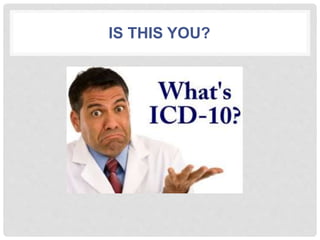
IS THIS YOU?
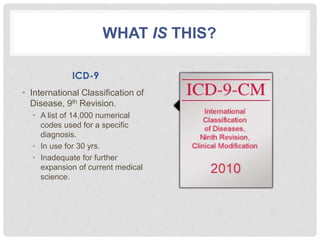
WHAT IS THIS?
ICD-9
• International Classification of
Disease, 9th Revision.
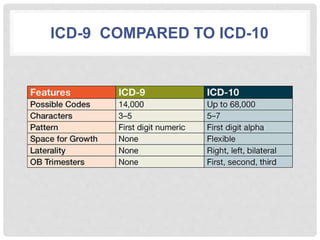
• A list of 14,000 numerical
codes used for a specific
diagnosis.
• In use for 30 yrs.
• Inadequate for further
expansion of current medical
science.
ICD-10
ICD-10
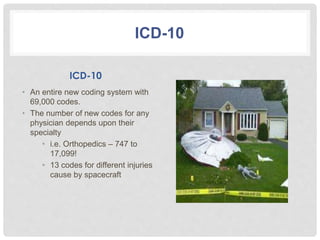
• An entire new coding system with
69,000 codes.
• The number of new codes for any
physician depends upon their
specialty
• i.e. Orthopedics – 747 to
17,099!
• 13 codes for different injuries
cause by spacecraft
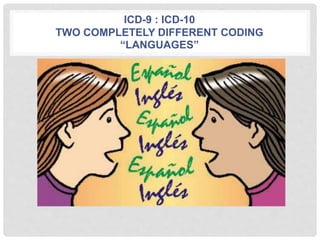
ICD-9 : ICD-10
TWO COMPLETELY DIFFERENT CODING
“LANGUAGES”
ICD-9 COMPARED TO ICD-10
OCTOBER 1, 2015
• No further delay….that is the date of transition
• Affects EVERY healthcare provider covered by the
Health Insurance portability and Accountability Act
(HIPAA) in the USA.
• Even those medical practices that are CASH ONLY
WHY IS THIS A BIG DEAL?
BECAUSE NO CLAIM WILL BE PAID IF IT DOES NOT USE THE
PROPER CODING SYSTEM.
• BEFORE Oct 1 - All claims for services and facility discharges
will be processed using ICD-9
• AFTER Oct 1 - All claims for services and facility discharges will
be processed using ICD-10.
• This means that for a time after October 1, physicians, staff and
billing personnel will be required to work within both coding
systems as they submit claims.
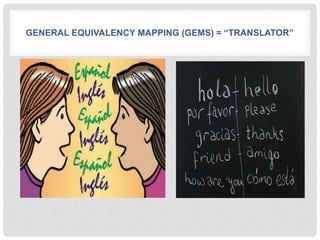
GENERAL EQUIVALENCY MAPPING (GEMS) = “TRANSLATOR”
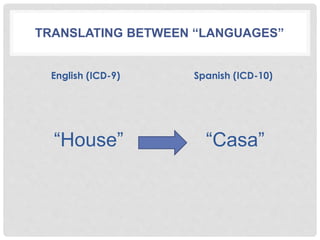
TRANSLATING BETWEEN “LANGUAGES”
English (ICD-9)
“House”
Spanish (ICD-10)
“Casa”
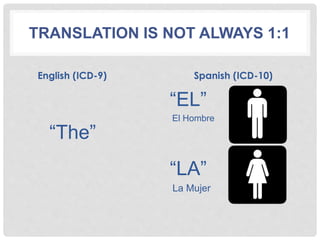
TRANSLATION IS NOT ALWAYS 1:1
English (ICD-9)
“The”
Spanish (ICD-10)
“EL”
El Hombre
“LA”
La Mujer
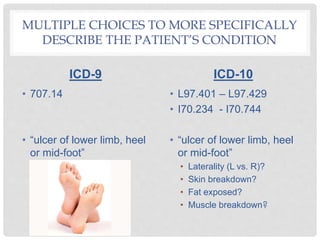
MULTIPLE CHOICES TO MORE SPECIFICALLY
DESCRIBE THE PATIENT’S CONDITION
ICD-9
• 707.14
• “ulcer of lower limb, heel
or mid-foot”
ICD-10
• L97.401 – L97.429
• I70.234 - I70.744
• “ulcer of lower limb, heel
or mid-foot”
• Laterality (L vs. R)?
• Skin breakdown?
• Fat exposed?
• Muscle breakdown?
PHYSICIANS WILL NEED TO DOCUMENT IN MORE DETAIL
ICD VS. CPT
• ICD = International Classification of Disease (diagnosis)
• i.e. “bronchitis”
• CPT = Current Procedural Terminology (treatment)
• i.e. = Antibiotic prescription
• The only coding changes for PROCEDURES will be for those that
are in a facility (hospital, surgery center, etc)
PREPARING FOR THE TRANSITION
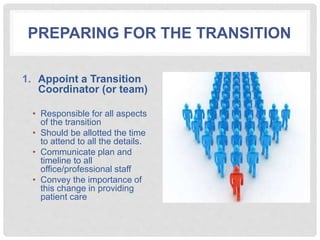
1. Appoint a Transition
Coordinator (or team)
• Responsible for all aspects
of the transition
• Should be allotted the time
to attend to all the details.
• Communicate plan and
timeline to all
office/professional staff
• Convey the importance of
this change in providing
patient care
PREPARING FOR THE TRANSITION
2. Establish a Plan
• Refer to CMS timelines
• Identify tasks to be
completed and in what
order.
• Assign start and
completion dates for each
task
• Create a budget
• Learn the required
resources (i.e. GEM)
PREPARING FOR THE TRANSITION
3. List Every Place Codes are Used
• Coding manuals
• Medical records
• Superbills
• Practice Management and Billing Systems
• Physician Orders
• Authorizations/pre-certifications
• Locations Outside the Primary Practice Site
PREPARING FOR THE TRANSITION
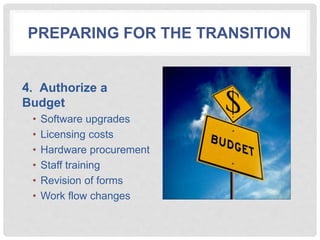
4. Authorize a
Budget
• Software upgrades
• Licensing costs
• Hardware procurement
• Staff training
• Revision of forms
• Work flow changes
PREPARING FOR THE TRANSITION
5. Begin Training
• Obtain ICD-10 coding books
early in 2014
• Look up/translate most
commonly used ICD-9 codes
• Begin “double-coding” as many
patient encounters as possible
(i.e. document both in “English”
and “Spanish”)
• Many EMRs are already loaded
with both sets of codes (like
EMRx!). If so, review those
codes with every patient
encounter.
PREPARING FOR THE TRANSITION
• Begin 6-9 months
before transition date.
• Many online sources
for training
• Certified coders may
see many ICD-10
coding modules
integrated into the
CEUs they must take to
maintain certification
PREPARING FOR THE TRANSITION
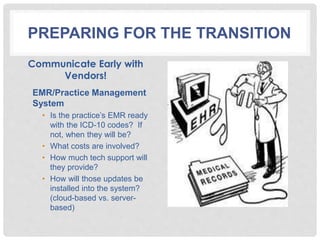
Communicate Early with
Vendors!
EMR/Practice Management
System
• Is the practice’s EMR ready
with the ICD-10 codes? If
not, when they will be?
• What costs are involved?
• How much tech support will
they provide?
• How will those updates be
installed into the system?
(cloud-based vs. server-
based)
PREPARING FOR THE TRANSITION
Communicate with Vendors
• Clearinghouses
• Coding services
• Billing services
• If their software is not up to date,
they cannot process claims!
PREPARING FOR THE TRANSITION
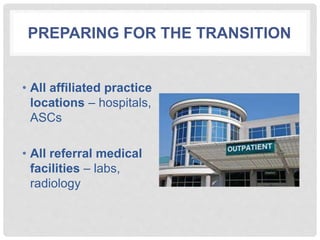
• All affiliated practice
locations – hospitals,
ASCs
• All referral medical
facilities – labs,
radiology
PREPARING FOR THE TRANSITION
• Communicate with the Insurance Companies!
• Rules for coverage
• Rules for authorization
• They will expect office personnel to be “bi-lingual”
PREPARING FOR THE TRANSITION
• Set up a Testing Schedule with all parties involved (office
staff, coders, billers, clearinghouses, insurance
companies) long before October 1st
• You want to assure the entire system from front to back
end works smoothly so there are no rejections of claims!
PREPARING FOR THE TRANSITION
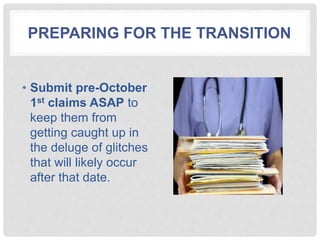
• Submit pre-October
1st claims ASAP to
keep them from
getting caught up in
the deluge of glitches
that will likely occur
after that date.
PREPARING FOR THE TRANSITION
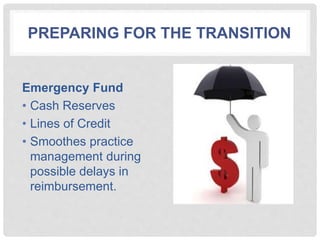
Emergency Fund
• Cash Reserves
• Lines of Credit
• Smoothes practice
management during
possible delays in
reimbursement.

icd10_slides_for_seminars_0215a

  • 1.
    WI L LY O UR P R A C T I C E B E R E A D Y ? THE CLOCK IS TICKING ON THE TRANSITION TO ICD-10
  • 2.
  • 3.
    WHAT IS THIS? ICD-9 •International Classification of Disease, 9th Revision. • A list of 14,000 numerical codes used for a specific diagnosis. • In use for 30 yrs. • Inadequate for further expansion of current medical science.
  • 4.
    ICD-10 ICD-10 • An entirenew coding system with 69,000 codes. • The number of new codes for any physician depends upon their specialty • i.e. Orthopedics – 747 to 17,099! • 13 codes for different injuries cause by spacecraft
  • 5.
    ICD-9 : ICD-10 TWOCOMPLETELY DIFFERENT CODING “LANGUAGES”
  • 6.
  • 7.
    OCTOBER 1, 2015 •No further delay….that is the date of transition • Affects EVERY healthcare provider covered by the Health Insurance portability and Accountability Act (HIPAA) in the USA. • Even those medical practices that are CASH ONLY
  • 8.
    WHY IS THISA BIG DEAL? BECAUSE NO CLAIM WILL BE PAID IF IT DOES NOT USE THE PROPER CODING SYSTEM. • BEFORE Oct 1 - All claims for services and facility discharges will be processed using ICD-9 • AFTER Oct 1 - All claims for services and facility discharges will be processed using ICD-10. • This means that for a time after October 1, physicians, staff and billing personnel will be required to work within both coding systems as they submit claims.
  • 9.
    GENERAL EQUIVALENCY MAPPING(GEMS) = “TRANSLATOR”
  • 10.
    TRANSLATING BETWEEN “LANGUAGES” English(ICD-9) “House” Spanish (ICD-10) “Casa”
  • 11.
    TRANSLATION IS NOTALWAYS 1:1 English (ICD-9) “The” Spanish (ICD-10) “EL” El Hombre “LA” La Mujer
  • 12.
    MULTIPLE CHOICES TOMORE SPECIFICALLY DESCRIBE THE PATIENT’S CONDITION ICD-9 • 707.14 • “ulcer of lower limb, heel or mid-foot” ICD-10 • L97.401 – L97.429 • I70.234 - I70.744 • “ulcer of lower limb, heel or mid-foot” • Laterality (L vs. R)? • Skin breakdown? • Fat exposed? • Muscle breakdown?
  • 13.
    PHYSICIANS WILL NEEDTO DOCUMENT IN MORE DETAIL
  • 14.
    ICD VS. CPT •ICD = International Classification of Disease (diagnosis) • i.e. “bronchitis” • CPT = Current Procedural Terminology (treatment) • i.e. = Antibiotic prescription • The only coding changes for PROCEDURES will be for those that are in a facility (hospital, surgery center, etc)
  • 15.
    PREPARING FOR THETRANSITION 1. Appoint a Transition Coordinator (or team) • Responsible for all aspects of the transition • Should be allotted the time to attend to all the details. • Communicate plan and timeline to all office/professional staff • Convey the importance of this change in providing patient care
  • 16.
    PREPARING FOR THETRANSITION 2. Establish a Plan • Refer to CMS timelines • Identify tasks to be completed and in what order. • Assign start and completion dates for each task • Create a budget • Learn the required resources (i.e. GEM)
  • 17.
    PREPARING FOR THETRANSITION 3. List Every Place Codes are Used • Coding manuals • Medical records • Superbills • Practice Management and Billing Systems • Physician Orders • Authorizations/pre-certifications • Locations Outside the Primary Practice Site
  • 18.
    PREPARING FOR THETRANSITION 4. Authorize a Budget • Software upgrades • Licensing costs • Hardware procurement • Staff training • Revision of forms • Work flow changes
  • 19.
    PREPARING FOR THETRANSITION 5. Begin Training • Obtain ICD-10 coding books early in 2014 • Look up/translate most commonly used ICD-9 codes • Begin “double-coding” as many patient encounters as possible (i.e. document both in “English” and “Spanish”) • Many EMRs are already loaded with both sets of codes (like EMRx!). If so, review those codes with every patient encounter.
  • 20.
    PREPARING FOR THETRANSITION • Begin 6-9 months before transition date. • Many online sources for training • Certified coders may see many ICD-10 coding modules integrated into the CEUs they must take to maintain certification
  • 21.
    PREPARING FOR THETRANSITION Communicate Early with Vendors! EMR/Practice Management System • Is the practice’s EMR ready with the ICD-10 codes? If not, when they will be? • What costs are involved? • How much tech support will they provide? • How will those updates be installed into the system? (cloud-based vs. server- based)
  • 22.
    PREPARING FOR THETRANSITION Communicate with Vendors • Clearinghouses • Coding services • Billing services • If their software is not up to date, they cannot process claims!
  • 23.
    PREPARING FOR THETRANSITION • All affiliated practice locations – hospitals, ASCs • All referral medical facilities – labs, radiology
  • 24.
    PREPARING FOR THETRANSITION • Communicate with the Insurance Companies! • Rules for coverage • Rules for authorization • They will expect office personnel to be “bi-lingual”
  • 25.
    PREPARING FOR THETRANSITION • Set up a Testing Schedule with all parties involved (office staff, coders, billers, clearinghouses, insurance companies) long before October 1st • You want to assure the entire system from front to back end works smoothly so there are no rejections of claims!
  • 26.
    PREPARING FOR THETRANSITION • Submit pre-October 1st claims ASAP to keep them from getting caught up in the deluge of glitches that will likely occur after that date.
  • 27.
    PREPARING FOR THETRANSITION Emergency Fund • Cash Reserves • Lines of Credit • Smoothes practice management during possible delays in reimbursement.