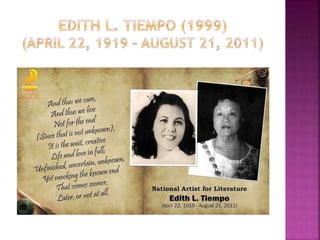
She is a poet, fictionist, teacher and literary
critic. She is one of the finest Filipino writers in English
whose works are characterized by a remarkable fusion
of style and substance, of craftsmanship and insight.
Born on April 22, 1919 in Bayombong, Nueva Vizcaya,
her poems are intricate verbal transfigurations of
significant experiences as revealed, in two of her much
anthologized pieces, “The Little Marmoset” and
“Bonsai”. As fictionist, Tiempo is as morally profound.
Her language has been marked as “descriptive but
unburdened by scrupulous detailing.” She is an
influential tradition in Philippine literature in English.
Together with her late husband, Edilberto K. Tiempo,
she founded and directed the Silliman National Writers
Workshop in Dumaguete City, which has produced some
of the country’s best writers.
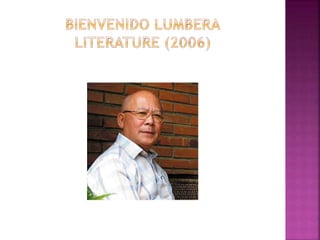
Bienvenido Lumbera, is a poet, librettist, and
scholar.
As a poet, he introduced to Tagalog literature what is
now known as Bagay poetry, a landmark aesthetic tendency
that has helped to change the vernacular poetic tradition. He
is the author of the following works: Likhang Dila, Likhang
Diwa (poems in Filipino and English), 1993; Balaybay, Mga
Tulang Lunot at Manibalang, 2002; Sa Sariling Bayan, Apat
na Dulang May Musika, 2004; “Agunyas sa Hacienda
Luisita,” Pakikiramay, 2004.
As a librettist for the Tales of the Manuvu and Rama
Hari, he pioneered the creative fusion of fine arts and
popular imagination. As a scholar, his major books include
the following: Tagalog Poetry, 1570-1898: Tradition and
Influences in its Development; Philippine Literature: A
History and Anthology, Revaluation: Essays on Philippine
Literature, Writing the Nation/Pag-akda ng Bansa.
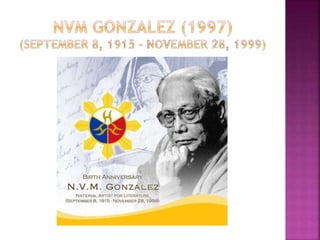
Nestor Vicente Madali Gonzalez, better
known as N.V.M. Gonzalez, fictionist, essayist,
poet, and teacher, articulated the Filipino spirit in
rural, urban landscapes. Among the many
recognitions, he won the First Commonwealth
Literary Contest in 1940, received the Republic
Cultural Heritage Award in 1960 and the Gawad
CCP Para sa Sining in 1990. The awards attest to
his triumph in appropriating the English language
to express, reflect and shape Philippine culture
and Philippine sensibility. He became U.P
.’s
International-Writer-In-Residence and a member of
the Board of Advisers of the U.P
. Creative Writing
Center. In 1987, U.P
. conferred on him the Doctor
of Humane Letters, honoris causa, its highest
academic recognition.
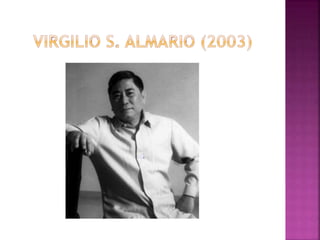
Virgilio S. Almario, also known as Rio Alma, is a poet,
literary historian and critic, who has revived and reinvented
traditional Filipino poetic forms, even as he championed
modernist poetics. In 34 years, he has published 12 books of
poetry, which include the seminal Makinasyon and
Peregrinasyon, and the landmark trilogy Doktrinang
Anakpawis, Mga Retrato at Rekwerdo and Muli, Sa
Kandungan ng Lupa. In these works, his poetic voice soared
from the lyrical to the satirical to the epic, from the dramatic
to the incantatory, in his often severe examination of the
self, and the society.
He has also redefined how the Filipino poetry is
viewed and paved the way for the discussion of the same in
his 10 books of criticisms and anthologies, among which are
Ang Makata sa Panahon ng Makina, Balagtasismo versus
Modernismo,Walong Dekada ng Makabagong Tula Pilipino,
Mutyang Dilim and Barlaan at Josaphat.
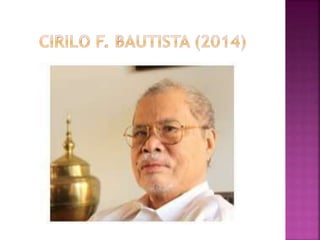
Cirilo F. Bautista is a poet, fictionist and
essayist with exceptional achievements and
significant contributions to the development of
the country’s literary arts. He is acknowledged
by peers and critics, and the nation at large as
the foremost writer of his generation.
Throughout his career that spans more
than four decades, he has established a
reputation for fine and profound artistry; his
books, lectures, poetry readings and creative
writing workshops continue to influence his
peers and generations of young writers.
Thus, Bautista continues to contribute to
the development of Philippine literature: as a
writer, through his significant body of works; as
a teacher, through his discovery and
encouragement of young writers in workshops
and lectures; and as a critic, through his essays
that provide insights into the craft of writing
and correctives to misconceptions about art.
Major works: Summer Suns (1963),
Words and Battlefields (1998), The Trilogy of
Saint Lazarus (2001), Galaw ng Asoge (2003).
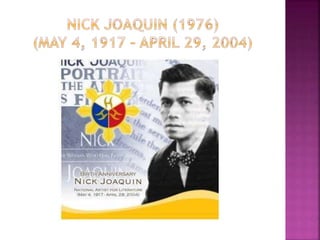
Nick Joaquin, is regarded by many as the most
distinguished Filipino writer in English writing so variedly and
so well about so many aspects of the Filipino. Nick Joaquin
has also enriched the English language with critics coining
“Joaquinesque” to describe his baroque Spanish-flavored
English or his reinventions of English based on Filipinisms.
Aside from his handling of language, Bienvenido Lumbera
writes that Nick Joaquin’s significance in Philippine literature
involves his exploration of the Philippine colonial past under
Spain and his probing into the psychology of social changes as
seen by the young, as exemplified in stories such as Doña
Jeronima, Candido’s Apocalypse and The Order of
Melchizedek. Nick Joaquin has written plays, novels, poems,
short stories and essays including reportage and journalism.
As a journalist, Nick Joaquin uses the nome de
guerre Quijano de Manila but whether he is writing
literature or journalism, fellow National Artist Francisco
Arcellana opines that “it is always of the highest skill and
quality”.
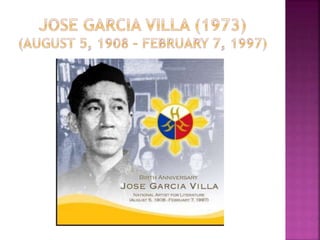
Jose Garcia Villa is considered as one of the
finest contemporary poets regardless of race or
language. Villa, who lived in Singalong, Manila,
introduced the reversed consonance rime scheme,
including the comma poems that made full use of the
punctuation mark in an innovative, poetic way. The first
of his poems “Have Come, Am Here” received critical
recognition when it appeared in New York in 1942 that,
soon enough, honors and fellowships were heaped on
him: Guggenheim, Bollingen, the American Academy of
Arts and Letters Awards. He used Doveglion (Dove,
Eagle, Lion) as penname, the very characters he
attributed to himself, and the same ones explored by
e.e. cummings in the poem he wrote for Villa
(Doveglion, Adventures in Value). Villa is also known for
the tartness of his tongue.

canonical works.pptx

  • 3.
    She is apoet, fictionist, teacher and literary critic. She is one of the finest Filipino writers in English whose works are characterized by a remarkable fusion of style and substance, of craftsmanship and insight. Born on April 22, 1919 in Bayombong, Nueva Vizcaya, her poems are intricate verbal transfigurations of significant experiences as revealed, in two of her much anthologized pieces, “The Little Marmoset” and “Bonsai”. As fictionist, Tiempo is as morally profound. Her language has been marked as “descriptive but unburdened by scrupulous detailing.” She is an influential tradition in Philippine literature in English. Together with her late husband, Edilberto K. Tiempo, she founded and directed the Silliman National Writers Workshop in Dumaguete City, which has produced some of the country’s best writers.
  • 5.
    Bienvenido Lumbera, isa poet, librettist, and scholar. As a poet, he introduced to Tagalog literature what is now known as Bagay poetry, a landmark aesthetic tendency that has helped to change the vernacular poetic tradition. He is the author of the following works: Likhang Dila, Likhang Diwa (poems in Filipino and English), 1993; Balaybay, Mga Tulang Lunot at Manibalang, 2002; Sa Sariling Bayan, Apat na Dulang May Musika, 2004; “Agunyas sa Hacienda Luisita,” Pakikiramay, 2004. As a librettist for the Tales of the Manuvu and Rama Hari, he pioneered the creative fusion of fine arts and popular imagination. As a scholar, his major books include the following: Tagalog Poetry, 1570-1898: Tradition and Influences in its Development; Philippine Literature: A History and Anthology, Revaluation: Essays on Philippine Literature, Writing the Nation/Pag-akda ng Bansa.
  • 7.
    Nestor Vicente MadaliGonzalez, better known as N.V.M. Gonzalez, fictionist, essayist, poet, and teacher, articulated the Filipino spirit in rural, urban landscapes. Among the many recognitions, he won the First Commonwealth Literary Contest in 1940, received the Republic Cultural Heritage Award in 1960 and the Gawad CCP Para sa Sining in 1990. The awards attest to his triumph in appropriating the English language to express, reflect and shape Philippine culture and Philippine sensibility. He became U.P .’s International-Writer-In-Residence and a member of the Board of Advisers of the U.P . Creative Writing Center. In 1987, U.P . conferred on him the Doctor of Humane Letters, honoris causa, its highest academic recognition.
  • 9.
    Virgilio S. Almario,also known as Rio Alma, is a poet, literary historian and critic, who has revived and reinvented traditional Filipino poetic forms, even as he championed modernist poetics. In 34 years, he has published 12 books of poetry, which include the seminal Makinasyon and Peregrinasyon, and the landmark trilogy Doktrinang Anakpawis, Mga Retrato at Rekwerdo and Muli, Sa Kandungan ng Lupa. In these works, his poetic voice soared from the lyrical to the satirical to the epic, from the dramatic to the incantatory, in his often severe examination of the self, and the society. He has also redefined how the Filipino poetry is viewed and paved the way for the discussion of the same in his 10 books of criticisms and anthologies, among which are Ang Makata sa Panahon ng Makina, Balagtasismo versus Modernismo,Walong Dekada ng Makabagong Tula Pilipino, Mutyang Dilim and Barlaan at Josaphat.
  • 11.
    Cirilo F. Bautistais a poet, fictionist and essayist with exceptional achievements and significant contributions to the development of the country’s literary arts. He is acknowledged by peers and critics, and the nation at large as the foremost writer of his generation. Throughout his career that spans more than four decades, he has established a reputation for fine and profound artistry; his books, lectures, poetry readings and creative writing workshops continue to influence his peers and generations of young writers.
  • 12.
    Thus, Bautista continuesto contribute to the development of Philippine literature: as a writer, through his significant body of works; as a teacher, through his discovery and encouragement of young writers in workshops and lectures; and as a critic, through his essays that provide insights into the craft of writing and correctives to misconceptions about art. Major works: Summer Suns (1963), Words and Battlefields (1998), The Trilogy of Saint Lazarus (2001), Galaw ng Asoge (2003).
  • 14.
    Nick Joaquin, isregarded by many as the most distinguished Filipino writer in English writing so variedly and so well about so many aspects of the Filipino. Nick Joaquin has also enriched the English language with critics coining “Joaquinesque” to describe his baroque Spanish-flavored English or his reinventions of English based on Filipinisms. Aside from his handling of language, Bienvenido Lumbera writes that Nick Joaquin’s significance in Philippine literature involves his exploration of the Philippine colonial past under Spain and his probing into the psychology of social changes as seen by the young, as exemplified in stories such as Doña Jeronima, Candido’s Apocalypse and The Order of Melchizedek. Nick Joaquin has written plays, novels, poems, short stories and essays including reportage and journalism. As a journalist, Nick Joaquin uses the nome de guerre Quijano de Manila but whether he is writing literature or journalism, fellow National Artist Francisco Arcellana opines that “it is always of the highest skill and quality”.
  • 16.
    Jose Garcia Villais considered as one of the finest contemporary poets regardless of race or language. Villa, who lived in Singalong, Manila, introduced the reversed consonance rime scheme, including the comma poems that made full use of the punctuation mark in an innovative, poetic way. The first of his poems “Have Come, Am Here” received critical recognition when it appeared in New York in 1942 that, soon enough, honors and fellowships were heaped on him: Guggenheim, Bollingen, the American Academy of Arts and Letters Awards. He used Doveglion (Dove, Eagle, Lion) as penname, the very characters he attributed to himself, and the same ones explored by e.e. cummings in the poem he wrote for Villa (Doveglion, Adventures in Value). Villa is also known for the tartness of his tongue.