Sudden Impedance Rise
(SIR)
The common cause of Stationary
Battery related UPS failures
WHITEPAPER
CANARA | PAGE 02
Table of Contents
Background	3
Abstract		 3
	 Importance of a robust battery maintenance / monitoring program 	 4
	 Canara Recommended Practices	 5
Trend Graphs	 6
Conclusion	10
Table of Figures/Tables
Figure 1: 	Only one open cell can cause a string to fail	 3
Chart 1: 	 3 cases of sudden impedance rise from a single datacenter 	 6
Chart 2: 	A flooded battery showing a sudden impedance resistance rise	 6
Chart 3: 	Battery/Unit replaced and failed in only 7 months, showing SIR	 6
Chart 4: 	The impedance rise provides earlier insight into the battery	 8
Chart 5: 	SIR indicates imminent battery failure	 8
Chart 6: 	Voltage drops, Ohmic surpasses threshold	 9
SUDDENIMPEDANCERISE|WHITEPAPER
BACKGROUND
A catastrophic power failure has just occurred; the Facilities Manager is explaining to the CIO “why”
the data center power failed when the UPS was supposed to work.
FM:	 The UPS manufacturer found an “Open Battery”.
CIO: 	 What in the world is an Open Battery?
FM: 	 Well, the UPS has 40 batteries connected together in a string. Each Battery has 6 cells and 	
	 if one cell “opens”, it fails and the string is broken much like old series wired Christmas tree 	
	 lights, and the UPS fails.
CIO: 	 When were the batteries checked last?
FM: 	 About 6 weeks ago, we performed quarterly maintenance. Everything checked 		
	 out. These batteries are only 3 years old. This shouldn’t have happened!
CIO: 	 This outage will take a week to recover from and cost more than $1,000,000. 		
	 What do we tell the CFO?
ABSTRACT
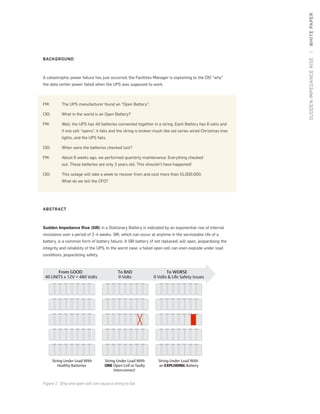
Sudden Impedance Rise (SIR) in a Stationary Battery is indicated by an exponential rise of internal
resistance over a period of 2–4 weeks. SIR, which can occur at anytime in the serviceable life of a
battery, is a common form of battery failure. A SIR battery (if not replaced) will open, jeopardizing the
integrity and reliability of the UPS. In the worst case, a failed open cell can even explode under load
conditions, jeopardizing safety.
From GOOD
String Under Load With
Healthy Batteries
String Under Load With
ONE Open Cell or faulty
interconnect
String Under Load With
an EXPLODING Battery
40 UNITS x 12V = 480 Volts
To WORSE
0 Volts & Life Safety Issues
To BAD
0 Volts
Figure 1: Only one open cell can cause a string to fail
CANARA | PAGE 04
Importance of a robust battery maintenance / monitoring program
Best Practice battery maintenance/inspection and monitoring on stationary batteries requires two
key elements.
1) Quarterly maintenance and inspection, and
2) A weekly monitoring program (at a minimum)
The reliability of any UPS system will be impaired if either program is compromised or omitted.
Maintenance and inspection programs must require personnel:
• To ensure proper torque of external connections
• To discover signs of battery swelling, electrolyte leakage, corrosion and/or bacterial growth, etc.
• To provide a crosscheck and review of monitoring data
Weekly monitoring or more often provides predictive failure analysis by trending:
• Unit internal and battery interconnection resistance (ohmic value)
• Unit/string voltage
• Battery internal temperature
• Ambient temperature
• AC ripple
• UPS discharge data
This paper focuses on one element/benefit of weekly or more often monitoring in preventing SIR
related power outages.
SUDDENIMPEDANCERISE|WHITEPAPER
Canara Recommended Practices
Canara recommends that stationary batteries should be investigated when the battery monitoring
system indicates an ohmic rise of 15% (maintenance threshold) of the initial ohmic values and
replaced when they exceed 20% (replacement threshold) of the initial ohmic values.
The decision to replace a battery should always be independently confirmed by conducting a unit
level performance capacity test. Never perform a capacity test on any battery that is suspected of
being open or shorted. The discharge test should be conducted by qualified personnel as per the
manufacturer’s specification for pass/fail criteria.
Basing measurements on the delta between the initial ohmic value and the current ohmic value is a
critical element of string life. The initial ohmic value of a battery can vary from the manufacturer’s
specification by up to 20% with no observed affect in battery life or performance. Therefore a battery
specified with an internal ohmic value of 2.25mΩ can have an initial range from 2.3-2.7mΩ. The
replacement threshold can vary from 2.875-3.375mΩ.
Note: Changes in temperature and/or changes in test equipment, impact measured values significantly.
Always ensure that the same, calibrated testing device is used through the life of a given battery.
Replacing batteries at an artificial “standard” threshold can be costly. Replacing batteries prematurely
in a string impacts the life of the string. One key criterion for string replacement is that the string be
replaced when 25% (maximum) of the batteries have been replaced. As a battery ages, the internal
ohmic value normally rises. Each new battery introduced into a string has a lower impedance/
resistance than the surrounding batteries due to their age. Introduce enough new batteries into the
string and the string can become imbalanced, overcharging some batteries while undercharging
others, accelerating the aging of the entire string.
CANARA | PAGE 06
TREND GRAPHS
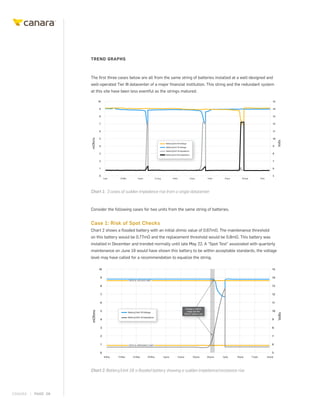
The first three cases below are all from the same string of batteries installed at a well-designed and
well-operated Tier III datacenter of a major financial institution. This string and the redundant system
at this site have been less eventful as the strings matured.
10
9
8
7
6
5
4
3
2
1
0
15
14
13
12
11
10
9
8
7
6
5
3-Jan
mOhms
Volts
20-Mar 5-June 21-Aug 6-Nov 22-Jan 9-Apr 25-Jun 10-Sept 3-Dec
Battery/Unit 36 Voltage
Battery/Unit 18 Voltage
Battery/Unit 18 Impedance
Battery/Unit 36 Impedance
Chart 1: 3 cases of sudden impedance rise from a single datacenter
Consider the following cases for two units from the same string of batteries.
Case 1: Risk of Spot Checks
Chart 2 shows a flooded battery with an initial ohmic value of 0.67mΩ. The maintenance threshold
on this battery would be 0.77mΩ and the replacement threshold would be 0.8mΩ. This battery was
installed in December and trended normally until late May 22. A “Spot Test” associated with quarterly
maintenance on June 19 would have shown this battery to be within acceptable standards, the voltage
level may have called for a recommendation to equalize the string.
10
9
8
7
6
5
4
3
2
1
0
15
14
13
12
11
10
9
8
7
6
5
8-May
mOhms
Volts
15-May 22-May 29-May 5-June 12-June 19-June 26-June 3-July 10-July 17-July 24-July
Voltage is within
range but the
Ohmic Value is not
CRITICAL VOLTAGE LIMIT
CRITICAL IMPEDANCE LIMIT
Battery/Unit 18 Voltage
Battery/Unit 18 Impedance
Chart 2: Battery/Unit 18: a flooded battery showing a sudden impedance/resistance rise
SUDDENIMPEDANCERISE|WHITEPAPER
Takeaway
SIR is clearly indicated from June 26 to July 10 and the battery was replaced by July 17. The Voltage
Trend demonstrates a corresponding fall in voltage sometimes associated with the rise in impedance/
resistance.
Case 2: Early Mortality
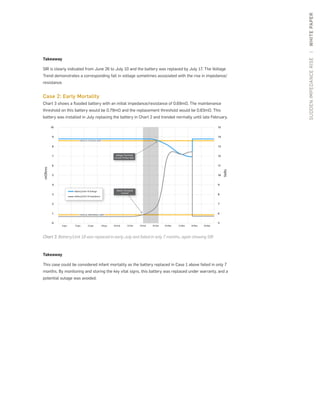
Chart 3 shows a flooded battery with an initial impedance/resistance of 0.69mΩ. The maintenance
threshold on this battery would be 0.79mΩ and the replacement threshold would be 0.83mΩ. This
battery was installed in July replacing the battery in Chart 2 and trended normally until late February.
10
9
8
7
6
5
4
3
2
1
0
15
14
13
12
11
10
9
8
7
6
5
8-Jan 15-Jan 22-Jan 29-Jan 05-Feb 12-Feb 19-Feb 26-Feb 05-Mar 12-Mar 19-Mar 26-Mar
mOhms
Volts
Voltage Threshold
crossed 10 days later
Ohmic Threshold
crossed
CRITICAL VOLTAGE LIMIT
CRITICAL IMPEDANCE LIMIT
Battery/Unit 18 Voltage
Battery/Unit 18 Impedance
Chart 3: Battery/Unit 18 was replaced in early July and failed in only 7 months, again showing SIR
Takeaway
This case could be considered infant mortality as the battery replaced in Case 1 above failed in only 7
months. By monitoring and storing the key vital signs, this battery was replaced under warranty, and a
potential outage was avoided.
CANARA | PAGE 08
Case 3: Failure within 3 years
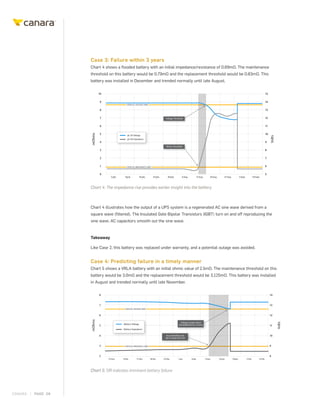
Chart 4 shows a flooded battery with an initial impedance/resistance of 0.69mΩ. The maintenance
threshold on this battery would be 0.79mΩ and the replacement threshold would be 0.83mΩ. This
battery was installed in December and trended normally until late August.
10
9
8
7
6
5
4
3
2
1
0
15
14
13
12
11
10
9
8
7
6
5
2-July
mOhms
Volts
9-July 16-July 23-July 30-July 6-Aug 13-Aug 20-Aug 27-Aug 3-Sept 10-Sept
Voltage Threshold
Ohmic Threshold
CRITICAL VOLTAGE LIMIT
CRITICAL IMPEDANCE LIMIT
Jar 36 Voltage
Jar 36 Impedance
Chart 4: The impedance rise provides earlier insight into the battery
Chart 4 illustrates how the output of a UPS system is a regenerated AC sine wave derived from a
square wave (filtered). The Insulated Gate Bipolar Transistors (IGBT) turn on and off reproducing the
sine wave. AC capacitors smooth out the sine wave.
Takeaway
Like Case 2, this battery was replaced under warranty, and a potential outage was avoided.
Case 4: Predicting failure in a timely manner
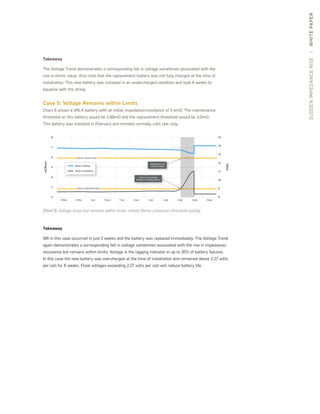
Chart 5 shows a VRLA battery with an initial ohmic value of 2.5mΩ. The maintenance threshold on this
battery would be 3.0mΩ and the replacement threshold would be 3.125mΩ. This battery was installed
in August and trended normally until late November.
8
7
6
5
4
3
2
14
13
12
11
10
9
8
27-Nov 4-Dec 11-Dec 18-Dec 25-Dec 1-Jan 8-Jan 15-Jan 22-Jan 29-Jan 5-Feb 12-Feb
mOhms
Volts
Voltage remains above
threshold limit for 2 weeks
Issue identified early
due to rapid ohmi rise
CRITICAL VOLTAGE LIMIT
CRITICAL IMPEDANCE LIMIT
Battery Voltage
Battery Impedance
Chart 5: SIR indicates imminent battery failure
SUDDENIMPEDANCERISE|WHITEPAPER
Takeaway
The Voltage Trend demonstrates a corresponding fall in voltage sometimes associated with the
rise in ohmic value. Also note that the replacement battery was not fully charged at the time of
installation. This new battery was installed in an undercharged condition and took 8 weeks to
equalize with the string.
Case 5: Voltage Remains within Limits
Chart 6 shows a VRLA battery with an initial impedance/resistance of 2.4mΩ. The maintenance
threshold on this battery would be 2.88mΩ and the replacement threshold would be 3.0mΩ.
This battery was installed in February and trended normally until late July.
8
7
6
5
4
3
2
20-May 27-May 3-Jun 10-June 17-Jun 24-Jun 1-July 8-July 15-July 22-July 29-July
mOhms
Volts
Ohmic is the leading
indicator of a failing battery
CRITICAL VOLTAGE LIMIT
CRITICAL IMPEDANCE LIMIT
Battery Voltage
Battery Impedance
Voltage does not
cross threshold
15
14
13
12
11
10
9
8
Chart 6: Voltage drops but remains within limits, where Ohmic surpasses threshold quickly
Takeaway
SIR in this case occurred in just 2 weeks and the battery was replaced immediately. The Voltage Trend
again demonstrates a corresponding fall in voltage sometimes associated with the rise in impedance/
resistance but remains within limits. Voltage is the lagging indicator in up to 30% of battery failures.
In this case the new battery was overcharged at the time of installation and remained above 2.27 volts
per cell for 6 weeks. Float voltages exceeding 2.27 volts per cell will reduce battery life.
SUDDENIMPEDANCERISE|WHITEPAPER
NORTH AMERICA
181 Third Street
Suite 150
San Rafael, CA 94901
2077 Convention Center Concourse
Suite 425
Atlanta, GA 30337
CONTACT
+1 415 462 8950	 TEL
+1 877 422 8874	 TOLL FREE
+1 415 532 2384	FAX
ONLINE
www.canara.com
inquires@canara.com
© 2016 Canara Inc. All rights reserved. Canara and the Canara logo are trademarks of Canara. All other trademarks are the property of their respective owners.
CONCLUSION
Power outages caused by SIR batteries are 100% preventable. However, a minimum of weekly,
preferably daily, battery-monitoring program is required to prevent SIR related power outages. SIR is
a major problem in the industry in both flooded and VRLA batteries. Unfortunately many data center
operators are not aware of the risk of SIR. Canara has heard similar conversations to that of the
Facilities Manager, CIO, and CFO, from prospective customers after SIR outages.
These graphs are just a few from hundreds of examples of SIR collected over the past 20 years by
Canara. Canara currently monitors close to 300,000 batteries globally and has a database with over
1.5 billion data points on trended battery performance. Each day or week, voltage and impedance/
resistance readings are polled by our servers and analyzed. Trends are identified using a combination
of analysis by monitoring software and manual data analysis. When a trend develops customers are
notified, and the failing batteries are replaced reducing the risk of an outage.

Canara wp-sudden impedancerise (1)

  • 1.
    Sudden Impedance Rise (SIR) Thecommon cause of Stationary Battery related UPS failures WHITEPAPER
  • 2.
    CANARA | PAGE02 Table of Contents Background 3 Abstract 3 Importance of a robust battery maintenance / monitoring program 4 Canara Recommended Practices 5 Trend Graphs 6 Conclusion 10 Table of Figures/Tables Figure 1: Only one open cell can cause a string to fail 3 Chart 1: 3 cases of sudden impedance rise from a single datacenter 6 Chart 2: A flooded battery showing a sudden impedance resistance rise 6 Chart 3: Battery/Unit replaced and failed in only 7 months, showing SIR 6 Chart 4: The impedance rise provides earlier insight into the battery 8 Chart 5: SIR indicates imminent battery failure 8 Chart 6: Voltage drops, Ohmic surpasses threshold 9
  • 3.
    SUDDENIMPEDANCERISE|WHITEPAPER BACKGROUND A catastrophic powerfailure has just occurred; the Facilities Manager is explaining to the CIO “why” the data center power failed when the UPS was supposed to work. FM: The UPS manufacturer found an “Open Battery”. CIO: What in the world is an Open Battery? FM: Well, the UPS has 40 batteries connected together in a string. Each Battery has 6 cells and if one cell “opens”, it fails and the string is broken much like old series wired Christmas tree lights, and the UPS fails. CIO: When were the batteries checked last? FM: About 6 weeks ago, we performed quarterly maintenance. Everything checked out. These batteries are only 3 years old. This shouldn’t have happened! CIO: This outage will take a week to recover from and cost more than $1,000,000. What do we tell the CFO? ABSTRACT Sudden Impedance Rise (SIR) in a Stationary Battery is indicated by an exponential rise of internal resistance over a period of 2–4 weeks. SIR, which can occur at anytime in the serviceable life of a battery, is a common form of battery failure. A SIR battery (if not replaced) will open, jeopardizing the integrity and reliability of the UPS. In the worst case, a failed open cell can even explode under load conditions, jeopardizing safety. From GOOD String Under Load With Healthy Batteries String Under Load With ONE Open Cell or faulty interconnect String Under Load With an EXPLODING Battery 40 UNITS x 12V = 480 Volts To WORSE 0 Volts & Life Safety Issues To BAD 0 Volts Figure 1: Only one open cell can cause a string to fail
  • 4.
    CANARA | PAGE04 Importance of a robust battery maintenance / monitoring program Best Practice battery maintenance/inspection and monitoring on stationary batteries requires two key elements. 1) Quarterly maintenance and inspection, and 2) A weekly monitoring program (at a minimum) The reliability of any UPS system will be impaired if either program is compromised or omitted. Maintenance and inspection programs must require personnel: • To ensure proper torque of external connections • To discover signs of battery swelling, electrolyte leakage, corrosion and/or bacterial growth, etc. • To provide a crosscheck and review of monitoring data Weekly monitoring or more often provides predictive failure analysis by trending: • Unit internal and battery interconnection resistance (ohmic value) • Unit/string voltage • Battery internal temperature • Ambient temperature • AC ripple • UPS discharge data This paper focuses on one element/benefit of weekly or more often monitoring in preventing SIR related power outages.
  • 5.
    SUDDENIMPEDANCERISE|WHITEPAPER Canara Recommended Practices Canararecommends that stationary batteries should be investigated when the battery monitoring system indicates an ohmic rise of 15% (maintenance threshold) of the initial ohmic values and replaced when they exceed 20% (replacement threshold) of the initial ohmic values. The decision to replace a battery should always be independently confirmed by conducting a unit level performance capacity test. Never perform a capacity test on any battery that is suspected of being open or shorted. The discharge test should be conducted by qualified personnel as per the manufacturer’s specification for pass/fail criteria. Basing measurements on the delta between the initial ohmic value and the current ohmic value is a critical element of string life. The initial ohmic value of a battery can vary from the manufacturer’s specification by up to 20% with no observed affect in battery life or performance. Therefore a battery specified with an internal ohmic value of 2.25mΩ can have an initial range from 2.3-2.7mΩ. The replacement threshold can vary from 2.875-3.375mΩ. Note: Changes in temperature and/or changes in test equipment, impact measured values significantly. Always ensure that the same, calibrated testing device is used through the life of a given battery. Replacing batteries at an artificial “standard” threshold can be costly. Replacing batteries prematurely in a string impacts the life of the string. One key criterion for string replacement is that the string be replaced when 25% (maximum) of the batteries have been replaced. As a battery ages, the internal ohmic value normally rises. Each new battery introduced into a string has a lower impedance/ resistance than the surrounding batteries due to their age. Introduce enough new batteries into the string and the string can become imbalanced, overcharging some batteries while undercharging others, accelerating the aging of the entire string.
  • 6.
    CANARA | PAGE06 TREND GRAPHS The first three cases below are all from the same string of batteries installed at a well-designed and well-operated Tier III datacenter of a major financial institution. This string and the redundant system at this site have been less eventful as the strings matured. 10 9 8 7 6 5 4 3 2 1 0 15 14 13 12 11 10 9 8 7 6 5 3-Jan mOhms Volts 20-Mar 5-June 21-Aug 6-Nov 22-Jan 9-Apr 25-Jun 10-Sept 3-Dec Battery/Unit 36 Voltage Battery/Unit 18 Voltage Battery/Unit 18 Impedance Battery/Unit 36 Impedance Chart 1: 3 cases of sudden impedance rise from a single datacenter Consider the following cases for two units from the same string of batteries. Case 1: Risk of Spot Checks Chart 2 shows a flooded battery with an initial ohmic value of 0.67mΩ. The maintenance threshold on this battery would be 0.77mΩ and the replacement threshold would be 0.8mΩ. This battery was installed in December and trended normally until late May 22. A “Spot Test” associated with quarterly maintenance on June 19 would have shown this battery to be within acceptable standards, the voltage level may have called for a recommendation to equalize the string. 10 9 8 7 6 5 4 3 2 1 0 15 14 13 12 11 10 9 8 7 6 5 8-May mOhms Volts 15-May 22-May 29-May 5-June 12-June 19-June 26-June 3-July 10-July 17-July 24-July Voltage is within range but the Ohmic Value is not CRITICAL VOLTAGE LIMIT CRITICAL IMPEDANCE LIMIT Battery/Unit 18 Voltage Battery/Unit 18 Impedance Chart 2: Battery/Unit 18: a flooded battery showing a sudden impedance/resistance rise
  • 7.
    SUDDENIMPEDANCERISE|WHITEPAPER Takeaway SIR is clearlyindicated from June 26 to July 10 and the battery was replaced by July 17. The Voltage Trend demonstrates a corresponding fall in voltage sometimes associated with the rise in impedance/ resistance. Case 2: Early Mortality Chart 3 shows a flooded battery with an initial impedance/resistance of 0.69mΩ. The maintenance threshold on this battery would be 0.79mΩ and the replacement threshold would be 0.83mΩ. This battery was installed in July replacing the battery in Chart 2 and trended normally until late February. 10 9 8 7 6 5 4 3 2 1 0 15 14 13 12 11 10 9 8 7 6 5 8-Jan 15-Jan 22-Jan 29-Jan 05-Feb 12-Feb 19-Feb 26-Feb 05-Mar 12-Mar 19-Mar 26-Mar mOhms Volts Voltage Threshold crossed 10 days later Ohmic Threshold crossed CRITICAL VOLTAGE LIMIT CRITICAL IMPEDANCE LIMIT Battery/Unit 18 Voltage Battery/Unit 18 Impedance Chart 3: Battery/Unit 18 was replaced in early July and failed in only 7 months, again showing SIR Takeaway This case could be considered infant mortality as the battery replaced in Case 1 above failed in only 7 months. By monitoring and storing the key vital signs, this battery was replaced under warranty, and a potential outage was avoided.
  • 8.
    CANARA | PAGE08 Case 3: Failure within 3 years Chart 4 shows a flooded battery with an initial impedance/resistance of 0.69mΩ. The maintenance threshold on this battery would be 0.79mΩ and the replacement threshold would be 0.83mΩ. This battery was installed in December and trended normally until late August. 10 9 8 7 6 5 4 3 2 1 0 15 14 13 12 11 10 9 8 7 6 5 2-July mOhms Volts 9-July 16-July 23-July 30-July 6-Aug 13-Aug 20-Aug 27-Aug 3-Sept 10-Sept Voltage Threshold Ohmic Threshold CRITICAL VOLTAGE LIMIT CRITICAL IMPEDANCE LIMIT Jar 36 Voltage Jar 36 Impedance Chart 4: The impedance rise provides earlier insight into the battery Chart 4 illustrates how the output of a UPS system is a regenerated AC sine wave derived from a square wave (filtered). The Insulated Gate Bipolar Transistors (IGBT) turn on and off reproducing the sine wave. AC capacitors smooth out the sine wave. Takeaway Like Case 2, this battery was replaced under warranty, and a potential outage was avoided. Case 4: Predicting failure in a timely manner Chart 5 shows a VRLA battery with an initial ohmic value of 2.5mΩ. The maintenance threshold on this battery would be 3.0mΩ and the replacement threshold would be 3.125mΩ. This battery was installed in August and trended normally until late November. 8 7 6 5 4 3 2 14 13 12 11 10 9 8 27-Nov 4-Dec 11-Dec 18-Dec 25-Dec 1-Jan 8-Jan 15-Jan 22-Jan 29-Jan 5-Feb 12-Feb mOhms Volts Voltage remains above threshold limit for 2 weeks Issue identified early due to rapid ohmi rise CRITICAL VOLTAGE LIMIT CRITICAL IMPEDANCE LIMIT Battery Voltage Battery Impedance Chart 5: SIR indicates imminent battery failure
  • 9.
    SUDDENIMPEDANCERISE|WHITEPAPER Takeaway The Voltage Trenddemonstrates a corresponding fall in voltage sometimes associated with the rise in ohmic value. Also note that the replacement battery was not fully charged at the time of installation. This new battery was installed in an undercharged condition and took 8 weeks to equalize with the string. Case 5: Voltage Remains within Limits Chart 6 shows a VRLA battery with an initial impedance/resistance of 2.4mΩ. The maintenance threshold on this battery would be 2.88mΩ and the replacement threshold would be 3.0mΩ. This battery was installed in February and trended normally until late July. 8 7 6 5 4 3 2 20-May 27-May 3-Jun 10-June 17-Jun 24-Jun 1-July 8-July 15-July 22-July 29-July mOhms Volts Ohmic is the leading indicator of a failing battery CRITICAL VOLTAGE LIMIT CRITICAL IMPEDANCE LIMIT Battery Voltage Battery Impedance Voltage does not cross threshold 15 14 13 12 11 10 9 8 Chart 6: Voltage drops but remains within limits, where Ohmic surpasses threshold quickly Takeaway SIR in this case occurred in just 2 weeks and the battery was replaced immediately. The Voltage Trend again demonstrates a corresponding fall in voltage sometimes associated with the rise in impedance/ resistance but remains within limits. Voltage is the lagging indicator in up to 30% of battery failures. In this case the new battery was overcharged at the time of installation and remained above 2.27 volts per cell for 6 weeks. Float voltages exceeding 2.27 volts per cell will reduce battery life.
  • 10.
    SUDDENIMPEDANCERISE|WHITEPAPER NORTH AMERICA 181 ThirdStreet Suite 150 San Rafael, CA 94901 2077 Convention Center Concourse Suite 425 Atlanta, GA 30337 CONTACT +1 415 462 8950 TEL +1 877 422 8874 TOLL FREE +1 415 532 2384 FAX ONLINE www.canara.com inquires@canara.com © 2016 Canara Inc. All rights reserved. Canara and the Canara logo are trademarks of Canara. All other trademarks are the property of their respective owners. CONCLUSION Power outages caused by SIR batteries are 100% preventable. However, a minimum of weekly, preferably daily, battery-monitoring program is required to prevent SIR related power outages. SIR is a major problem in the industry in both flooded and VRLA batteries. Unfortunately many data center operators are not aware of the risk of SIR. Canara has heard similar conversations to that of the Facilities Manager, CIO, and CFO, from prospective customers after SIR outages. These graphs are just a few from hundreds of examples of SIR collected over the past 20 years by Canara. Canara currently monitors close to 300,000 batteries globally and has a database with over 1.5 billion data points on trended battery performance. Each day or week, voltage and impedance/ resistance readings are polled by our servers and analyzed. Trends are identified using a combination of analysis by monitoring software and manual data analysis. When a trend develops customers are notified, and the failing batteries are replaced reducing the risk of an outage.