International Research Journal of Engineering and Technology (IRJET) e-ISSN: 2395-0056
Volume: 09 Issue: 06 | Jun 2022 www.irjet.net p-ISSN: 2395-0072
© 2022, IRJET | Impact Factor value: 7.529 | ISO 9001:2008 Certified Journal | Page 2655
Data-driven Modelling of Prognostics of Lithium-ion Batteries Using
LSTM
Shreya Shinde1, Lennard Dsouza1, Snehal Maria1, Shivam Anvekar1, Abhishek Shiwalkar2
1Student, Department of Electrical Engineering, Fr. C. Rodrigues Institute of Technology, Vashi, Navi Mumbai,
Maharashtra, India
2Professor, Department of Electrical Engineering, Fr. C. Rodrigues Institute of Technology, Vashi, Navi Mumbai,
Maharashtra, India
---------------------------------------------------------------------***---------------------------------------------------------------------
Abstract - The rechargeable lithium-ion battery has been
extensively used in mobile communication and portable
instruments due to its many advantages, such as high
volumetric and gravimetric energy density and low self-
discharge rate. Early detection of inadequate performance
facilitates the timely maintenance of battery systems. This
reduces operational costs and prevents accidents and
malfunctions. Prognostic and health management (PHM) can
ensure that a lithium-ion battery is working safely and
reliably. The main approach of the PHM evaluation of the
battery is to determine the state of health (SoH) and state of
charge (SOC) of the battery. This paper presents the
preliminary development of the data-driven prognostic, using
an LSTM (RNN) approach to predict the SoH and SoC of the
lithium-ion battery. The effectiveness of the proposed
approach was assessed in a case study using a battery dataset
from NASA's Ames Prognostics Center of Excellence (PCoE)
database. The proposed LSTM algorithm was compared
against other machine learning based on the RMSE value. The
experimental results reveal that the performance of the LSTM
algorithm could either match or outweigh other machine
learning algorithms.
Key Words: lithium-ion battery, battery management
system, Prognostic and health management, State of
Health, State of Charge, LSTM
1. INTRODUCTION
Li-ion batteries are playing a crucial role in the fields of
renewable energy systems and electric vehicles. Batteries
hold the potential to transform the transportation sector,
which now emits considerable volumes of CO2. They also
provide a solution to the intermittent energy powered by
solar and wind generators, assisting in the viability of these
green solutions. However, batteries may not be the clean
energy solution they seem at face value. Obtaining resources
for batteries, such as lithium, has become an environmental
issue[1]. The reliability of these systems depends on a
battery management system (BMS)whichmonitorsthestate
of charge (SoC) and state of health (SoH) effectively[2].
Knowing the SoH of a battery in advance enhances the
system's reliability. The proposed SoH estimation methodis
simulated in Python using the LSTM algorithm by
considering the ageing factors such as temperature,
charge/discharge rates, and depth of discharge[3].
2. SOC AND SOH ESTIMATION
Due to the restricted manufacturing process, the actual full
capacity of a new battery may differ from the nominal
battery capacity claimed by the manufacturer. As a result, a
new battery's original maximumcapacity,Qf,iscalculatedby
averaging the full capacities of multiple
charging/discharging cycles. When a battery begins a cyclic
charging/discharging operation, the inevitable aging will
lead to performance deterioration, with a decrease in the
maximum chargeable or releasable capacity, QM, which is
acquired by cumulating the battery charges either from an
empty-to-full or full-to-empty operation[5]. The "state of
health" of a battery describes the difference between an
examined battery and a new battery, taking into accountcell
ageing. It's the ratio of a battery's maximum charge to its
rated capacity[6].
For an aged battery, the capacity fading causes not only a
decrease in the maximum releasable capacity but also a
mistake in SOC estimation. The state of charge of a battery
describes the difference between a fully chargedbattery and
the same battery in use. It is associated with the remaining
quantity of electricity available in the cell[6]. It is calculated
by dividing the battery's remaining charge by the maximum
charge the battery can produce.
3. DATA SET
The lithium-ion battery data employed in the prognostics
analysis of this work was retrieved from the NASA Ames
Prognostics Center of Excellence (PCoE) data repository[4].
This dataset contains the test results of commercially
available lithium-ion 1850-sized rechargeablebatteries,and
the experiments have been performed under controlled
International Research Journal of Engineering and Technology (IRJET) e-ISSN: 2395-0056
Volume: 09 Issue: 06 | Jun 2022 www.irjet.net p-ISSN: 2395-0072
© 2022, IRJET | Impact Factor value: 7.529 | ISO 9001:2008 Certified Journal | Page 2656
conditions in the NASA prognostics testbed. The dataset
contains the test results of commercially available lithium-
ion 1850-sized rechargeable batteries. A set of four Li-ion
batteries (# 5, 6, 7, and 18) were run through three different
operational profiles (charge, discharge, and impedance) at
room temperature. Charging was carried out in a constant
current (CC) mode at 1.5A until the battery voltage reached
4.2V and then continued in a constant voltage (CV) mode
until the charge current dropped to 20mA. Discharge was
carried out at a constant current (CC) level of 2A until the
battery voltage fell to 2.7V, 2.5V, 2.2V, and 2.5V for batteries
5, 6, 7, and 18 respectively. Impedance measurement was
carried out through an electrochemical impedance
spectroscopy (EIS) frequency sweep from 0.1Hz to 5kHz.
Repeated charge and discharge cycles result in accelerated
ageing of the batteries, while impedance measurements
provide insight into the internal battery parameters that
change as ageing progresses. The experimentswerestopped
when the batteries reached end-of-life (EOL) criteria, which
was a 30% fade in rated capacity (from 2Ahr to 1.4Ahr). The
various parameters in the data set consist of charge,
discharge, and impedance fields.
3.1 Data Analysis
The following data set was parsed in Python 3.9 using the
SciPy library and the following characteristics were
observed during charge and discharge ofBatteryno.5across
a total of 164 cycles. Graphs were plotted at intervals of 30
cycles to get a clear idea of the distinct nature of the
characteristics with the passing cycles.
3.1.1 Charging Characteristics
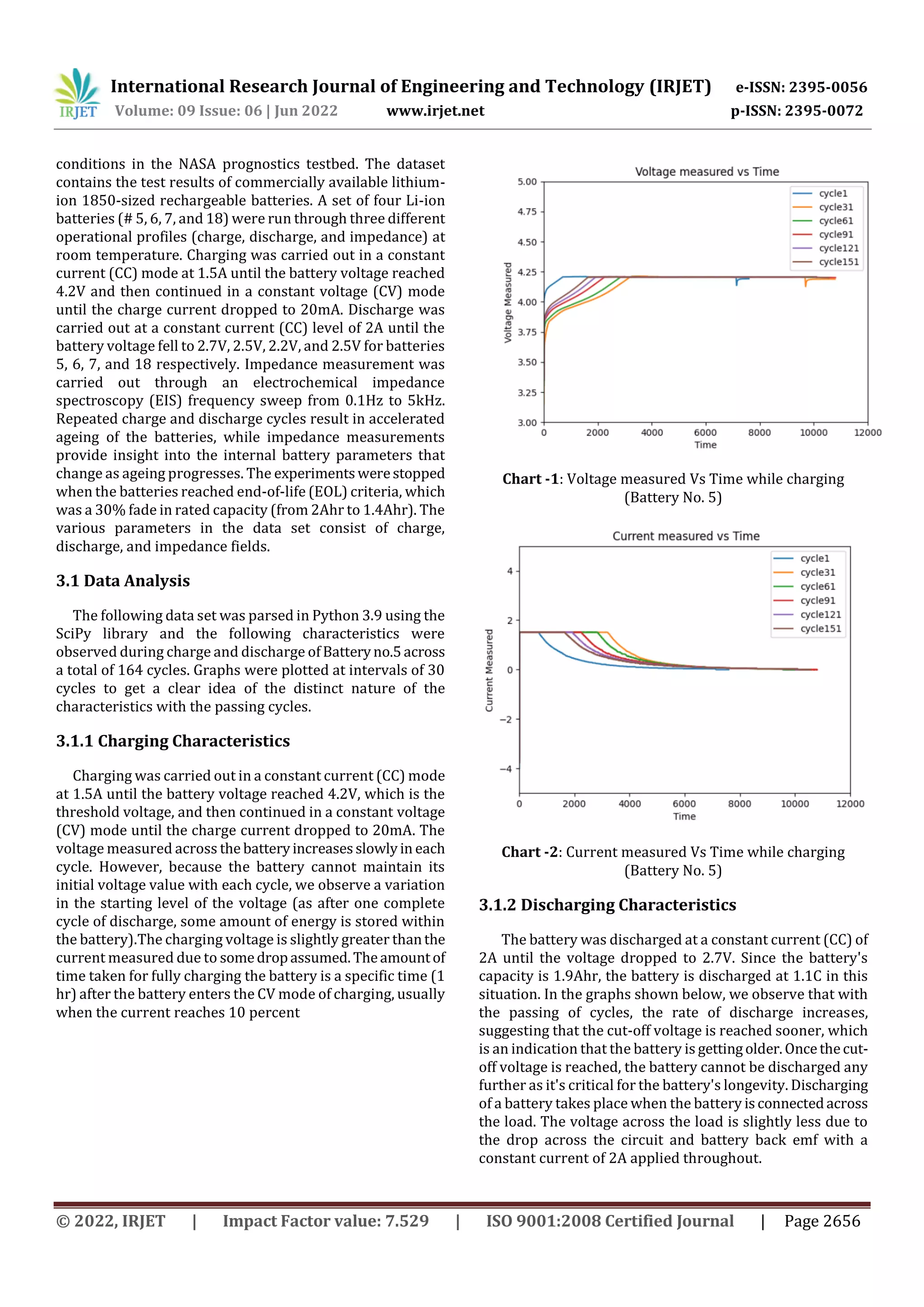
Charging was carried out in a constant current (CC) mode
at 1.5A until the battery voltage reached 4.2V, which is the
threshold voltage, and then continued in a constant voltage
(CV) mode until the charge current dropped to 20mA. The
voltage measured across the batteryincreasesslowlyin each
cycle. However, because the battery cannot maintain its
initial voltage value with each cycle, we observe a variation
in the starting level of the voltage (as after one complete
cycle of discharge, some amount of energy is stored within
the battery).The charging voltage is slightly greater thanthe
current measured due to somedropassumed. Theamountof
time taken for fully charging the battery is a specific time (1
hr) after the battery enters the CV mode of charging, usually
when the current reaches 10 percent
Chart -1: Voltage measured Vs Time while charging
(Battery No. 5)
Chart -2: Current measured Vs Time while charging
(Battery No. 5)
3.1.2 Discharging Characteristics
The battery was discharged at a constant current (CC) of
2A until the voltage dropped to 2.7V. Since the battery's
capacity is 1.9Ahr, the battery is discharged at 1.1C in this
situation. In the graphs shown below, we observe that with
the passing of cycles, the rate of discharge increases,
suggesting that the cut-off voltage is reached sooner, which
is an indication that the battery is gettingolder.Oncethecut-
off voltage is reached, the battery cannot be discharged any
further as it's critical for the battery's longevity. Discharging
of a battery takes place when the battery isconnectedacross
the load. The voltage across the load is slightly less due to
the drop across the circuit and battery back emf with a
constant current of 2A applied throughout.
International Research Journal of Engineering and Technology (IRJET) e-ISSN: 2395-0056
Volume: 09 Issue: 06 | Jun 2022 www.irjet.net p-ISSN: 2395-0072
© 2022, IRJET | Impact Factor value: 7.529 | ISO 9001:2008 Certified Journal | Page 2657
Chart -3: Measured measured Vs Time while discharging
(Battery No. 5)
Chart -4: Current measured Vs Time while discharging
(Battery No. 5)
4. HARDWARE IMPLEMENTATION
Assembly of hardware equipment was initially problematic
because to the COVID-19 outbreak, but once the college
reopened, hardware was installed to validate the data
obtained from our study paper, which we referred to for
benchmark results. This was achieved by charging and
discharging 18650 Li-ion batteries with identical
specifications (nominal voltage 3.7V, peak voltage 4.2V,
ampere-hour capacity 2000mAh) using LabVIEW software
and NI-Modules.
4.1 Working
Charging was carried out in a constant current(CC)mode
at 1.3A until the battery voltage reached 4V and then
continued in a constant voltage (CV) mode until the charge
current dropped to 19mA. Discharge was carried out at a
constant current (CC) level of 1A until thebatteryvoltage fell
to 2.7V, 2.5V, 2.2V, and 2.5V for the battery[8]. The current
sensor is always in series with the battery. Therefore,a close
resemblance was observed between the practically
performed data and the theoretically observed data in the
datasheet mentioned in our chosen researchpaper.Thedata
was acquired by connecting the chassis to the LabVIEW
using the laptop interface. An electronic load was used to
carry out the discharging of the battery, and probes from NI
modules across the battery were connected to measure the
voltage. A current sensor was connected in series to the
battery to measure the current and was calibrated using the
Arduino Uno. A K-Type Thermocouple was placed over the
battery with the help of insulation tape for accurate
measurement of the battery temperature[9]. For charging, a
calibrated chargerwasdismantledandthephaseandneutral
terminals were directly inserted into the supply charging
slots. Data for charging or discharging cycles was
continuously monitored in the LabVIEW at a frequency of 1
Hz until the end of the cycle. The challenges faced while
executing the hardware were that the LabVIEW could only
acquire data from one NI-Module at a time, which led to us
performing different cycles for the measurement of voltage
and temperature for their respective NI-Modules to get the
readings for a single cycle[10]. The data was acquired and
proved to be authentic as it followed the ideal (theoretical)
charging and discharging traits.
Fig -1: Hardware setup for generating real-time data
4.2 Block Diagram
Fig -2: block diagram for charging cycle
International Research Journal of Engineering and Technology (IRJET) e-ISSN: 2395-0056
Volume: 09 Issue: 06 | Jun 2022 www.irjet.net p-ISSN: 2395-0072
© 2022, IRJET | Impact Factor value: 7.529 | ISO 9001:2008 Certified Journal | Page 2658
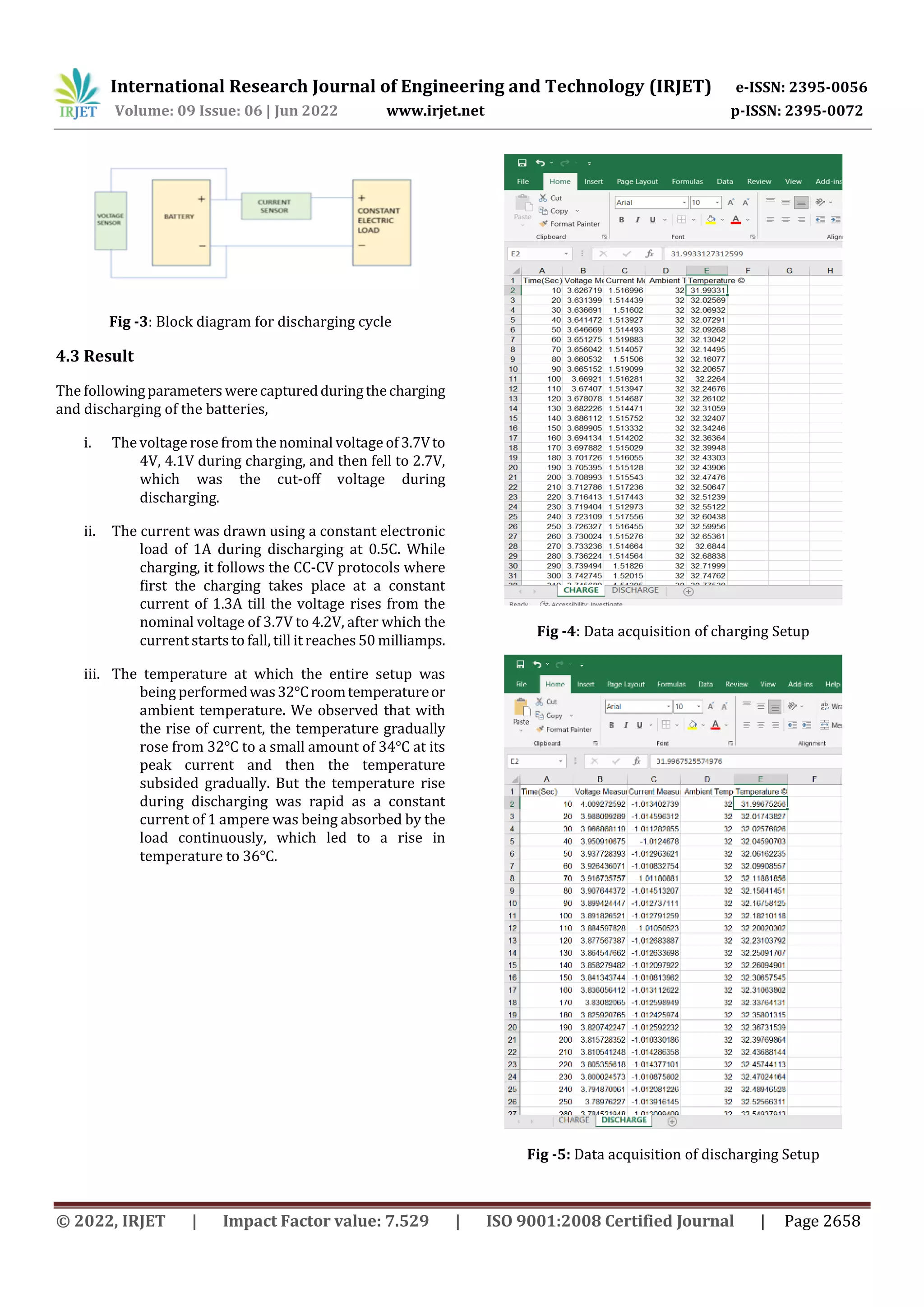
Fig -3: Block diagram for discharging cycle
4.3 Result
The followingparameters werecapturedduringthecharging
and discharging of the batteries,
i. The voltage rose from the nominal voltage of 3.7Vto
4V, 4.1V during charging, and then fell to 2.7V,
which was the cut-off voltage during
discharging.
ii. The current was drawn using a constant electronic
load of 1A during discharging at 0.5C. While
charging, it follows the CC-CV protocols where
first the charging takes place at a constant
current of 1.3A till the voltage rises from the
nominal voltage of 3.7V to 4.2V, after which the
current starts to fall, till it reaches 50 milliamps.
iii. The temperature at which the entire setup was
being performedwas32°Croomtemperatureor
ambient temperature. We observed that with
the rise of current, the temperature gradually
rose from 32°C to a small amount of 34°C at its
peak current and then the temperature
subsided gradually. But the temperature rise
during discharging was rapid as a constant
current of 1 ampere was being absorbed by the
load continuously, which led to a rise in
temperature to 36°C.
Fig -4: Data acquisition of charging Setup
Fig -5: Data acquisition of discharging Setup
International Research Journal of Engineering and Technology (IRJET) e-ISSN: 2395-0056
Volume: 09 Issue: 06 | Jun 2022 www.irjet.net p-ISSN: 2395-0072
© 2022, IRJET | Impact Factor value: 7.529 | ISO 9001:2008 Certified Journal | Page 2659
5. MACHINE LEARNING ALGORITHMS
Machine learning algorithms are good at handling data that
is multidimensional and multivariate, and theycandothisin
dynamic or uncertain environments. As ML algorithms gain
experience, they keep improving in accuracy and efficiency.
This lets them make better decisions.Sayyouneedtomakea
weather forecast model. As the amount of data, you have
keeps growing, your algorithmslearntomakemoreaccurate
predictions faster [7]. There is a lot of scopeinML tobecome
the top technology in the future[4]. The reasonisthatithasa
lot of research areas in it. This helps us improve both
hardware and software.
5.1 Proposed ML algorithm LSTM
Long Short-Term Memory networks – usually just called
“LSTMs” – are a special kind of Recurrent Neural Network,
Capable of learning long-term dependencies. They were
introduced by Hochreiter Schmidhuber (1997) and were
refined and popularized by many people. They work
tremendously well on a large variety of problems and are
now widely used[11].
Fig -6: LSTM block diagram
Recurrent networks can, in principle, use their feedback
connections to store representations of recent input events
in the form of activations (weights). This is potentially
significant for many applications, including speech
processing, non-Markovian control, and music composition.
Although theoretically fascinating, existing methods do not
provide clear practical advantages over backdrops in
feedforward nets with limited time. With conventional
“Back-Propagation Through Time" or “Real-Time Recurrent
Learning", error signals flowing backwards in time tend to
either (1) blow up or (2) vanish the temporary
backpropagated error. This may affect the model and bring
about the following consequences: Case (1) may lead to
oscillating weights. Case (2): Learning to bridge long time
lags takes a prohibitive amount of time or does not work at
all. In conjunction with an appropriate gradient-based
learning algorithm, this paper presents "Long Short-Term
Memory" (LSTM), a novel recurrent network architecture in
conjunction with an appropriate gradient-based learning
algorithm. LSTM is designed to overcome these error back-
flow problems. It can learn to bridge time intervals over
1000 steps, even in the case of noisy, incompressible input
sequences, without loss of short time lag capabilities. This is
achieved by an efficient, gradient-based algorithm. LSTM
outperforms and also learns to solve complex,artificial tasks
no other recurrent algorithm has solved before. The other
advantages of using LSTM are as follows: - For long time lag
problems, LSTM can handle noisy distributed
representations and continuous values. In contrast to finite-
state automata or hidden Markov models, LSTM does not
require an a priori choice of a finite number of states. In
principle, it can deal with unlimited state numbers. There
appears to be no need for parameter fine-tuning. LSTM
works well over a broad range of parameters such as
learning rate, input gate bias, and output gate bias. Positions
of widely separated, relevant inputsintheinputsequence do
not matter. The LSTM algorithm updates complexity per
weight and time step [12]. LSTM is local in both space and
time.
5.2 Reason for not Implementing SoC Estimation
Precise measurements of SOC are necessary to ensure safe
operation while maximizing the use of battery capacity. In
early applications, people found that the battery SOC had a
strong linear relationship with the open-circuit voltage
(OCV). To measure the accurate OCV, the battery needs
hours to rest. While in most conditions, accurate OCV is
unlikely to be obtained and is mainly not a method
considered in the case of finding a soc for lithium-ion
batteries. Due to the various internal and external
conditions, fixed mathematical transformations cannot be
accurate. The coulomb counting method (CCM) is another
straightforward method that has the advantage of simple
computation and easy implementation. CCM is widely
recommended for battery health management. However,
CCM is calculated by charge and discharge current time
integral, which is unable to eliminatecumulativeerrorandis
very sensitive to the initial value. If the initial SOC value is
inaccurate, it will affect all estimates and the error will
accumulate during the whole estimation process. The initial
SoC value is usually predicted and is not verified to be 100%
accurate. The large amount of data makes it even more
difficult for the model to give an accurate SOC value[14].
6. SOH MODELLING USING LSTM
In this section, an analysis of battery No. 06, No. 07, and No.
18 degradation datasets taken from the NASA Ames
Prognostics Center of Excellence (PCoE) database was
conducted to evaluate the effectiveness of the developed
LSTM technique. The dataset ofbatteryNo.05wasemployed
International Research Journal of Engineering and Technology (IRJET) e-ISSN: 2395-0056
Volume: 09 Issue: 06 | Jun 2022 www.irjet.net p-ISSN: 2395-0072
© 2022, IRJET | Impact Factor value: 7.529 | ISO 9001:2008 Certified Journal | Page 2660
as a training dataset. A detailed description of the
experimental data has been provided. TheSoHexperimental
results from the conventional DNN and developed LSTM
model will be presented. An LSTM-RNN network is trained
to model the complex battery dynamics under varying
ambient temperatures. A step-by-step searching method is
presented to determine the optimal network hyper-
parameters for SOH modelling[13]. The network well learns
the battery dynamics, presents good robustness against
unknown initial states and provides satisfying SOH
estimations under varying temperatures. There are natural
recursive linkages between current SOC and past inputs, as
illustrated by the Coulomb counting approach. An LSTM-
RNN network is thereforeconstructedtomodel thetemporal
dependencies of the input layer, battery current, terminal
voltage, and ambient temperature to form the input vector.
Since it is necessary to calculate the SoH of the battery, as
this is the data that will be predicted using the LSTM model,
a theoretical calculation of SOH was performed in Python
based on the formula given below:
- where,
represents the maximum practical capacity
as measured from the operating battery at the current time.
represents the rated capacity from battery
manufacturers. Theoretical value of SoH of all the batteries
was calculated and plotted in the graph showing the aging
process of the battery[15].
According to the README file of the dataset, the data is
stored in several ".mat" files. Each file corresponds to a
specific battery, and the data structure of each file contains
the parameters mentioned in the above section. For the
LSTM model proposed in Section V, it is only necessary to
collect the data related to the discharge of the battery. For
this, a function is created in Python that is in charge of
reading this data from the ".mat" file and storing it in
memory in two pandas Data Frames for later access. After
loading the dataset, a description of the data is made using
pandas functions to verify if the data loading was correct.
Fig -7: Dataset after formatting and parsing
Chart -5: Actual SoH vs cycles
6.1 Training phase for calculating SoH
The dataset is prepared in such a way that it can be used by
TensorFlow during the training phase; two structures are
constructed corresponding to the predicted input and
output. For the input data, the relevant characteristicsofthe
dataset are filtered, which are:
• Battery capacity
• Voltage
• Current
• Temperature
• Charging voltage
• Charging current
• Instant of time (from the start of the download)
For the output data, the SoH of the battery is calculated and,
in both input and output cases, the values are normalized to
a range of values between [0] and [1]. For the preparation of
the model, four dropout layers, one dense layer, and one of
the ADAM types are used as optimizers. About50epochsare
used for training the model.
International Research Journal of Engineering and Technology (IRJET) e-ISSN: 2395-0056
Volume: 09 Issue: 06 | Jun 2022 www.irjet.net p-ISSN: 2395-0072
© 2022, IRJET | Impact Factor value: 7.529 | ISO 9001:2008 Certified Journal | Page 2661
Fig -8: LSTM model created from training data-set
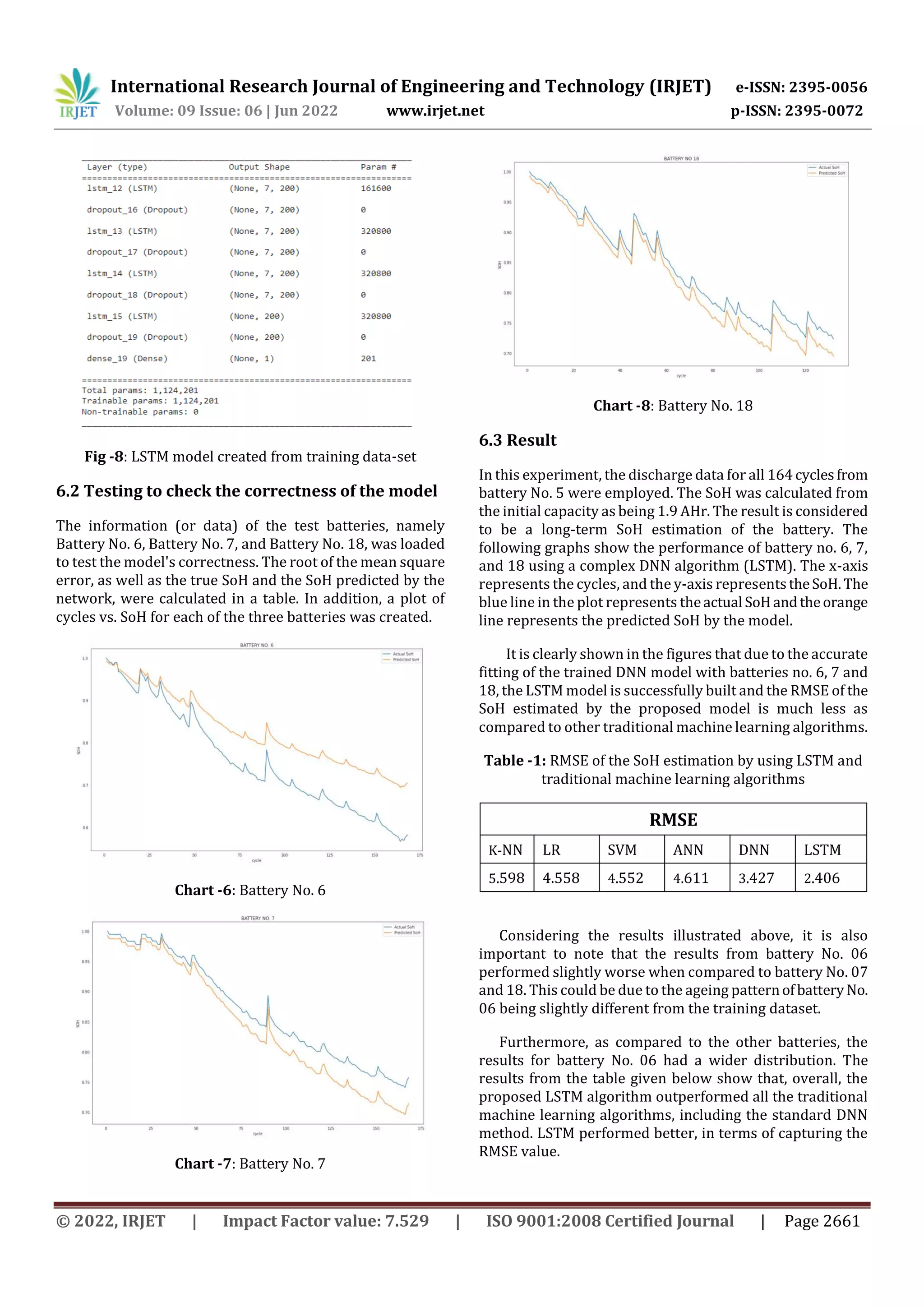
6.2 Testing to check the correctness of the model
The information (or data) of the test batteries, namely
Battery No. 6, Battery No. 7, and Battery No. 18, was loaded
to test the model's correctness. The root of the mean square
error, as well as the true SoH and the SoH predicted by the
network, were calculated in a table. In addition, a plot of
cycles vs. SoH for each of the three batteries was created.
Chart -6: Battery No. 6
Chart -7: Battery No. 7
Chart -8: Battery No. 18
6.3 Result
In this experiment, the discharge data for all 164cyclesfrom
battery No. 5 were employed. The SoH was calculated from
the initial capacity as being 1.9 AHr. The result is considered
to be a long-term SoH estimation of the battery. The
following graphs show the performance of battery no. 6, 7,
and 18 using a complex DNN algorithm (LSTM). The x-axis
represents the cycles, and the y-axis representstheSoH.The
blue line in the plot represents theactual SoHandtheorange
line represents the predicted SoH by the model.
It is clearly shown in the figures that due to the accurate
fitting of the trained DNN model with batteries no. 6, 7 and
18, the LSTM model is successfully built and the RMSE of the
SoH estimated by the proposed model is much less as
compared to other traditional machine learning algorithms.
Table -1: RMSE of the SoH estimation by using LSTM and
traditional machine learning algorithms
RMSE
K-NN LR SVM ANN DNN LSTM
5.598 4.558 4.552 4.611 3.427 2.406
Considering the results illustrated above, it is also
important to note that the results from battery No. 06
performed slightly worse when compared to battery No. 07
and 18. This could be due to the ageing patternofbattery No.
06 being slightly different from the training dataset.
Furthermore, as compared to the other batteries, the
results for battery No. 06 had a wider distribution. The
results from the table given below show that, overall, the
proposed LSTM algorithm outperformed all the traditional
machine learning algorithms, including the standard DNN
method. LSTM performed better, in terms of capturing the
RMSE value.
International Research Journal of Engineering and Technology (IRJET) e-ISSN: 2395-0056
Volume: 09 Issue: 06 | Jun 2022 www.irjet.net p-ISSN: 2395-0072
© 2022, IRJET | Impact Factor value: 7.529 | ISO 9001:2008 Certified Journal | Page 2662
Absolute errors measuredthemeanabsolutevalueof the
difference between the elementwise inputs. The absolute
error formula used as the loss function can be expressed by
the following equation:
Where, yi and are, respectively, the predicted data and the
input data of each iteration or epoch i, and k is thenumber of
iterations or epochs. In this experiment, the total number of
epochs was set to 200.
7. CONCLUSIONS
This work aims to develop an LSTM model to predict the
state of health of lithium-ion batteries. This experiment has
achieved its goal of aiding, as a benchmark, the prognostic
data-driven model for battery data using machine learning
algorithms. Based on the results from the case studies, it
shows that the LSTM algorithm provides a promising
outcome for predicting and modelling prognostic data,
especially in the battery prognostic and health management
applications. Also, based on several advantages of data-
driven modelsoverthetraditional physics-basedmodelsand
the accuracy achieved, we believe that the traditional
physics-based model maybe replaced bydata-drivenmodels
soon, in various fields and applications. This future trend of
data-driven models is in line with the recent achievement of
deep learning algorithms and artificial intelligence. These
methodologies are believed to be themainapproachesinthe
further development of data-driven models. However, the
accuracy of prediction and the higher performance of using
deep learning algorithms also come with the drawback of
higher computational time. With rapid advancements in
technology, the computational time could be substantially
reduced. The future direction of this work will focus on
developing a hybrid-deep learning model that could be
universally applicable to multiple types of prognostic data.
Due to time constraints and inaccessibility of the lab
equipment, it was not feasible to create an entire dataset of
the battery as acquiring an entire dataset would take
approximately (170×4) 680 hours. Hence, there is
uncertainty in predicting the whole nature of the battery’s
operation based on a couple of charge-discharge cycles.
However, it was found that in the practically performed
cycles, all the charging/dischargingprotocolswereobserved
quite accurately.
ACKNOWLEDGEMENT
The success of a project like this, involving high technical
expertise, patience, and the massive support of guides, is
possible when team members work together. We take this
opportunity to express our gratitudetothose whohavebeen
instrumental in the successful completion ofthisproject. We
would like to show our appreciation to Mr Abhishek
Shiwalkar and Dr Sushil S. Thale for their guidance and
support, which was instrumental in the progress of this
project. We would also like to thank our project coordinator,
Mrs Seema Jadhav for providing us with regular input about
documentation and the project timeline. We would also like
to thank Mr Nikhil Sorade for his guidance and support in
data set interpretation. A big thanks to our HOD, Dr Bindu S.
for all the encouragement given to our team. We would also
like to thank our principal, Dr S. M. Khot for giving us the
opportunity and the environment to learn and grow.
REFERENCES
[1] H. C. Hesse, M. Schimpe, D. Kucevic, and A. Jossen,
“Lithium-ion battery storage for the grid—a review of
stationary battery storage system design tailored for
applications in modern power grids,” Energies, vol. 10,
no. 12, p. 2107, 2017.
[2] R. Xiong, Y. Zhang, J. Wang, H. He, S. Peng, and M. Pecht,
“Lithium-ion battery health prognosis based on a real
battery management system used in electric vehicles,”
IEEE Transactions on Vehicular Technology, vol. 68, no.
5, pp. 4110–4121, 2018.
[3] J. Duan, X. Tang, H. Dai, Y. Yang, W. Wu, X. Wei, and Y.
Huang, “Building safe lithium-ion batteries for electric
vehicles: a review,” Electrochemical Energy Reviews,
vol. 3, no. 1, pp. 1–42, 2020.
[4] P. Khumprom and N. Yodo, “A data-driven predictive
prognostic model for lithium-ion batteries based on a
deep learning algorithm,” Energies, vol. 12, no. 4, p. 660,
2019.
[5] J. Vetter, P. Nov´ak, M. R. Wagner, C. Veit, K.-C. M¨oller, J.
Besenhard, M. Winter, M. Wohlfahrt-Mehrens, C.Vogler,
and A. Hammouche, “Ageing mechanisms in lithium-ion
batteries,” Journal of powersources,vol.147,no.1-2,pp.
269–281, 2005.
[6] S.-C. Huang, K.-H. Tseng, J.-W. Liang, C.-L. Chang, and M.
G. Pecht, “An online soc and soh estimation model for
lithium-ion batteries,” Energies, vol. 10, no. 4, p. 512,
2017
[7] J. S. Goud, R. Kalpana, and B. Singh, “An online methodof
estimating state of health of a li-ion battery,” IEEE
Transactions on Energy Conversion, vol. 36, no. 1, pp.
111–119, 2020.
[8] P. Ferrand, “Gpscan. vi: A general-purpose labview
program for scanning imaging or any application
requiring synchronous analog voltage generation and
data acquisition,” Computer Physics Communications,
vol. 192, pp. 342– 347, 2015.
International Research Journal of Engineering and Technology (IRJET) e-ISSN: 2395-0056
Volume: 09 Issue: 06 | Jun 2022 www.irjet.net p-ISSN: 2395-0072
© 2022, IRJET | Impact Factor value: 7.529 | ISO 9001:2008 Certified Journal | Page 2663
[9] S. A. Hasib, S. Islam, R. K. Chakrabortty, M. J. Ryan, D.
Saha, M. H. Ahamed, S. Moyeen, S. K. Das, M. F. Ali, M. R.
Islam, et al., “A comprehensive review of available
battery datasets, rul prediction approaches, and
advanced battery management,” Ieee Access, 2021.
[10] L. Wang, Y. Y. Tan, and X. L. Cui, “The application of
labview in data acquisition system of solar absorption
refrigerator,” in Advanced Materials Research, vol. 532,
pp. 581–585, Trans Tech Publ, 2012.
[11] S. Hochreiter and J. Schmidhuber, “Long short-term
memory,” Neural computation, vol. 9, no. 8, pp. 1735–
1780, 1997.
[12] T.-H. Wu, J.-K. Wang, C.-S. Moo, and A. Kawamura,
“State-of-charge and state-of-health estimating method
for lithium-ion batteries,” in 2016 IEEE 17th Workshop
on Control and Modeling for Power Electronics
(COMPEL), pp. 1–6, IEEE, 2016
[13] F. Yang, S. Zhang, W. Li, and Q. Miao, “State-of-charge
estimation of lithiumion batteries using lstm and ukf,”
Energy, vol. 201, p. 117664, 2020.
[14] S. Santhanagopalan and R.E.White,“Onlineestimation
of the state of charge of a lithium ion cell,” Journal of
power sources, vol. 161, no. 2, pp. 1346–1355, 2006.
[15] B. Chinomona, C. Chung, L.-K. Chang, W.-C. Su, and M.-
C. Tsai, “Long short-term memory approach to estimate
battery remaining useful life using partial data,” IEEE
Access, vol. 8, pp. 165419–165431, 2020.

Data-driven Modelling of Prognostics of Lithium-ion Batteries Using LSTM

  • 1.
    International Research Journalof Engineering and Technology (IRJET) e-ISSN: 2395-0056 Volume: 09 Issue: 06 | Jun 2022 www.irjet.net p-ISSN: 2395-0072 © 2022, IRJET | Impact Factor value: 7.529 | ISO 9001:2008 Certified Journal | Page 2655 Data-driven Modelling of Prognostics of Lithium-ion Batteries Using LSTM Shreya Shinde1, Lennard Dsouza1, Snehal Maria1, Shivam Anvekar1, Abhishek Shiwalkar2 1Student, Department of Electrical Engineering, Fr. C. Rodrigues Institute of Technology, Vashi, Navi Mumbai, Maharashtra, India 2Professor, Department of Electrical Engineering, Fr. C. Rodrigues Institute of Technology, Vashi, Navi Mumbai, Maharashtra, India ---------------------------------------------------------------------***--------------------------------------------------------------------- Abstract - The rechargeable lithium-ion battery has been extensively used in mobile communication and portable instruments due to its many advantages, such as high volumetric and gravimetric energy density and low self- discharge rate. Early detection of inadequate performance facilitates the timely maintenance of battery systems. This reduces operational costs and prevents accidents and malfunctions. Prognostic and health management (PHM) can ensure that a lithium-ion battery is working safely and reliably. The main approach of the PHM evaluation of the battery is to determine the state of health (SoH) and state of charge (SOC) of the battery. This paper presents the preliminary development of the data-driven prognostic, using an LSTM (RNN) approach to predict the SoH and SoC of the lithium-ion battery. The effectiveness of the proposed approach was assessed in a case study using a battery dataset from NASA's Ames Prognostics Center of Excellence (PCoE) database. The proposed LSTM algorithm was compared against other machine learning based on the RMSE value. The experimental results reveal that the performance of the LSTM algorithm could either match or outweigh other machine learning algorithms. Key Words: lithium-ion battery, battery management system, Prognostic and health management, State of Health, State of Charge, LSTM 1. INTRODUCTION Li-ion batteries are playing a crucial role in the fields of renewable energy systems and electric vehicles. Batteries hold the potential to transform the transportation sector, which now emits considerable volumes of CO2. They also provide a solution to the intermittent energy powered by solar and wind generators, assisting in the viability of these green solutions. However, batteries may not be the clean energy solution they seem at face value. Obtaining resources for batteries, such as lithium, has become an environmental issue[1]. The reliability of these systems depends on a battery management system (BMS)whichmonitorsthestate of charge (SoC) and state of health (SoH) effectively[2]. Knowing the SoH of a battery in advance enhances the system's reliability. The proposed SoH estimation methodis simulated in Python using the LSTM algorithm by considering the ageing factors such as temperature, charge/discharge rates, and depth of discharge[3]. 2. SOC AND SOH ESTIMATION Due to the restricted manufacturing process, the actual full capacity of a new battery may differ from the nominal battery capacity claimed by the manufacturer. As a result, a new battery's original maximumcapacity,Qf,iscalculatedby averaging the full capacities of multiple charging/discharging cycles. When a battery begins a cyclic charging/discharging operation, the inevitable aging will lead to performance deterioration, with a decrease in the maximum chargeable or releasable capacity, QM, which is acquired by cumulating the battery charges either from an empty-to-full or full-to-empty operation[5]. The "state of health" of a battery describes the difference between an examined battery and a new battery, taking into accountcell ageing. It's the ratio of a battery's maximum charge to its rated capacity[6]. For an aged battery, the capacity fading causes not only a decrease in the maximum releasable capacity but also a mistake in SOC estimation. The state of charge of a battery describes the difference between a fully chargedbattery and the same battery in use. It is associated with the remaining quantity of electricity available in the cell[6]. It is calculated by dividing the battery's remaining charge by the maximum charge the battery can produce. 3. DATA SET The lithium-ion battery data employed in the prognostics analysis of this work was retrieved from the NASA Ames Prognostics Center of Excellence (PCoE) data repository[4]. This dataset contains the test results of commercially available lithium-ion 1850-sized rechargeablebatteries,and the experiments have been performed under controlled
  • 2.
    International Research Journalof Engineering and Technology (IRJET) e-ISSN: 2395-0056 Volume: 09 Issue: 06 | Jun 2022 www.irjet.net p-ISSN: 2395-0072 © 2022, IRJET | Impact Factor value: 7.529 | ISO 9001:2008 Certified Journal | Page 2656 conditions in the NASA prognostics testbed. The dataset contains the test results of commercially available lithium- ion 1850-sized rechargeable batteries. A set of four Li-ion batteries (# 5, 6, 7, and 18) were run through three different operational profiles (charge, discharge, and impedance) at room temperature. Charging was carried out in a constant current (CC) mode at 1.5A until the battery voltage reached 4.2V and then continued in a constant voltage (CV) mode until the charge current dropped to 20mA. Discharge was carried out at a constant current (CC) level of 2A until the battery voltage fell to 2.7V, 2.5V, 2.2V, and 2.5V for batteries 5, 6, 7, and 18 respectively. Impedance measurement was carried out through an electrochemical impedance spectroscopy (EIS) frequency sweep from 0.1Hz to 5kHz. Repeated charge and discharge cycles result in accelerated ageing of the batteries, while impedance measurements provide insight into the internal battery parameters that change as ageing progresses. The experimentswerestopped when the batteries reached end-of-life (EOL) criteria, which was a 30% fade in rated capacity (from 2Ahr to 1.4Ahr). The various parameters in the data set consist of charge, discharge, and impedance fields. 3.1 Data Analysis The following data set was parsed in Python 3.9 using the SciPy library and the following characteristics were observed during charge and discharge ofBatteryno.5across a total of 164 cycles. Graphs were plotted at intervals of 30 cycles to get a clear idea of the distinct nature of the characteristics with the passing cycles. 3.1.1 Charging Characteristics Charging was carried out in a constant current (CC) mode at 1.5A until the battery voltage reached 4.2V, which is the threshold voltage, and then continued in a constant voltage (CV) mode until the charge current dropped to 20mA. The voltage measured across the batteryincreasesslowlyin each cycle. However, because the battery cannot maintain its initial voltage value with each cycle, we observe a variation in the starting level of the voltage (as after one complete cycle of discharge, some amount of energy is stored within the battery).The charging voltage is slightly greater thanthe current measured due to somedropassumed. Theamountof time taken for fully charging the battery is a specific time (1 hr) after the battery enters the CV mode of charging, usually when the current reaches 10 percent Chart -1: Voltage measured Vs Time while charging (Battery No. 5) Chart -2: Current measured Vs Time while charging (Battery No. 5) 3.1.2 Discharging Characteristics The battery was discharged at a constant current (CC) of 2A until the voltage dropped to 2.7V. Since the battery's capacity is 1.9Ahr, the battery is discharged at 1.1C in this situation. In the graphs shown below, we observe that with the passing of cycles, the rate of discharge increases, suggesting that the cut-off voltage is reached sooner, which is an indication that the battery is gettingolder.Oncethecut- off voltage is reached, the battery cannot be discharged any further as it's critical for the battery's longevity. Discharging of a battery takes place when the battery isconnectedacross the load. The voltage across the load is slightly less due to the drop across the circuit and battery back emf with a constant current of 2A applied throughout.
  • 3.
    International Research Journalof Engineering and Technology (IRJET) e-ISSN: 2395-0056 Volume: 09 Issue: 06 | Jun 2022 www.irjet.net p-ISSN: 2395-0072 © 2022, IRJET | Impact Factor value: 7.529 | ISO 9001:2008 Certified Journal | Page 2657 Chart -3: Measured measured Vs Time while discharging (Battery No. 5) Chart -4: Current measured Vs Time while discharging (Battery No. 5) 4. HARDWARE IMPLEMENTATION Assembly of hardware equipment was initially problematic because to the COVID-19 outbreak, but once the college reopened, hardware was installed to validate the data obtained from our study paper, which we referred to for benchmark results. This was achieved by charging and discharging 18650 Li-ion batteries with identical specifications (nominal voltage 3.7V, peak voltage 4.2V, ampere-hour capacity 2000mAh) using LabVIEW software and NI-Modules. 4.1 Working Charging was carried out in a constant current(CC)mode at 1.3A until the battery voltage reached 4V and then continued in a constant voltage (CV) mode until the charge current dropped to 19mA. Discharge was carried out at a constant current (CC) level of 1A until thebatteryvoltage fell to 2.7V, 2.5V, 2.2V, and 2.5V for the battery[8]. The current sensor is always in series with the battery. Therefore,a close resemblance was observed between the practically performed data and the theoretically observed data in the datasheet mentioned in our chosen researchpaper.Thedata was acquired by connecting the chassis to the LabVIEW using the laptop interface. An electronic load was used to carry out the discharging of the battery, and probes from NI modules across the battery were connected to measure the voltage. A current sensor was connected in series to the battery to measure the current and was calibrated using the Arduino Uno. A K-Type Thermocouple was placed over the battery with the help of insulation tape for accurate measurement of the battery temperature[9]. For charging, a calibrated chargerwasdismantledandthephaseandneutral terminals were directly inserted into the supply charging slots. Data for charging or discharging cycles was continuously monitored in the LabVIEW at a frequency of 1 Hz until the end of the cycle. The challenges faced while executing the hardware were that the LabVIEW could only acquire data from one NI-Module at a time, which led to us performing different cycles for the measurement of voltage and temperature for their respective NI-Modules to get the readings for a single cycle[10]. The data was acquired and proved to be authentic as it followed the ideal (theoretical) charging and discharging traits. Fig -1: Hardware setup for generating real-time data 4.2 Block Diagram Fig -2: block diagram for charging cycle
  • 4.
    International Research Journalof Engineering and Technology (IRJET) e-ISSN: 2395-0056 Volume: 09 Issue: 06 | Jun 2022 www.irjet.net p-ISSN: 2395-0072 © 2022, IRJET | Impact Factor value: 7.529 | ISO 9001:2008 Certified Journal | Page 2658 Fig -3: Block diagram for discharging cycle 4.3 Result The followingparameters werecapturedduringthecharging and discharging of the batteries, i. The voltage rose from the nominal voltage of 3.7Vto 4V, 4.1V during charging, and then fell to 2.7V, which was the cut-off voltage during discharging. ii. The current was drawn using a constant electronic load of 1A during discharging at 0.5C. While charging, it follows the CC-CV protocols where first the charging takes place at a constant current of 1.3A till the voltage rises from the nominal voltage of 3.7V to 4.2V, after which the current starts to fall, till it reaches 50 milliamps. iii. The temperature at which the entire setup was being performedwas32°Croomtemperatureor ambient temperature. We observed that with the rise of current, the temperature gradually rose from 32°C to a small amount of 34°C at its peak current and then the temperature subsided gradually. But the temperature rise during discharging was rapid as a constant current of 1 ampere was being absorbed by the load continuously, which led to a rise in temperature to 36°C. Fig -4: Data acquisition of charging Setup Fig -5: Data acquisition of discharging Setup
  • 5.
    International Research Journalof Engineering and Technology (IRJET) e-ISSN: 2395-0056 Volume: 09 Issue: 06 | Jun 2022 www.irjet.net p-ISSN: 2395-0072 © 2022, IRJET | Impact Factor value: 7.529 | ISO 9001:2008 Certified Journal | Page 2659 5. MACHINE LEARNING ALGORITHMS Machine learning algorithms are good at handling data that is multidimensional and multivariate, and theycandothisin dynamic or uncertain environments. As ML algorithms gain experience, they keep improving in accuracy and efficiency. This lets them make better decisions.Sayyouneedtomakea weather forecast model. As the amount of data, you have keeps growing, your algorithmslearntomakemoreaccurate predictions faster [7]. There is a lot of scopeinML tobecome the top technology in the future[4]. The reasonisthatithasa lot of research areas in it. This helps us improve both hardware and software. 5.1 Proposed ML algorithm LSTM Long Short-Term Memory networks – usually just called “LSTMs” – are a special kind of Recurrent Neural Network, Capable of learning long-term dependencies. They were introduced by Hochreiter Schmidhuber (1997) and were refined and popularized by many people. They work tremendously well on a large variety of problems and are now widely used[11]. Fig -6: LSTM block diagram Recurrent networks can, in principle, use their feedback connections to store representations of recent input events in the form of activations (weights). This is potentially significant for many applications, including speech processing, non-Markovian control, and music composition. Although theoretically fascinating, existing methods do not provide clear practical advantages over backdrops in feedforward nets with limited time. With conventional “Back-Propagation Through Time" or “Real-Time Recurrent Learning", error signals flowing backwards in time tend to either (1) blow up or (2) vanish the temporary backpropagated error. This may affect the model and bring about the following consequences: Case (1) may lead to oscillating weights. Case (2): Learning to bridge long time lags takes a prohibitive amount of time or does not work at all. In conjunction with an appropriate gradient-based learning algorithm, this paper presents "Long Short-Term Memory" (LSTM), a novel recurrent network architecture in conjunction with an appropriate gradient-based learning algorithm. LSTM is designed to overcome these error back- flow problems. It can learn to bridge time intervals over 1000 steps, even in the case of noisy, incompressible input sequences, without loss of short time lag capabilities. This is achieved by an efficient, gradient-based algorithm. LSTM outperforms and also learns to solve complex,artificial tasks no other recurrent algorithm has solved before. The other advantages of using LSTM are as follows: - For long time lag problems, LSTM can handle noisy distributed representations and continuous values. In contrast to finite- state automata or hidden Markov models, LSTM does not require an a priori choice of a finite number of states. In principle, it can deal with unlimited state numbers. There appears to be no need for parameter fine-tuning. LSTM works well over a broad range of parameters such as learning rate, input gate bias, and output gate bias. Positions of widely separated, relevant inputsintheinputsequence do not matter. The LSTM algorithm updates complexity per weight and time step [12]. LSTM is local in both space and time. 5.2 Reason for not Implementing SoC Estimation Precise measurements of SOC are necessary to ensure safe operation while maximizing the use of battery capacity. In early applications, people found that the battery SOC had a strong linear relationship with the open-circuit voltage (OCV). To measure the accurate OCV, the battery needs hours to rest. While in most conditions, accurate OCV is unlikely to be obtained and is mainly not a method considered in the case of finding a soc for lithium-ion batteries. Due to the various internal and external conditions, fixed mathematical transformations cannot be accurate. The coulomb counting method (CCM) is another straightforward method that has the advantage of simple computation and easy implementation. CCM is widely recommended for battery health management. However, CCM is calculated by charge and discharge current time integral, which is unable to eliminatecumulativeerrorandis very sensitive to the initial value. If the initial SOC value is inaccurate, it will affect all estimates and the error will accumulate during the whole estimation process. The initial SoC value is usually predicted and is not verified to be 100% accurate. The large amount of data makes it even more difficult for the model to give an accurate SOC value[14]. 6. SOH MODELLING USING LSTM In this section, an analysis of battery No. 06, No. 07, and No. 18 degradation datasets taken from the NASA Ames Prognostics Center of Excellence (PCoE) database was conducted to evaluate the effectiveness of the developed LSTM technique. The dataset ofbatteryNo.05wasemployed
  • 6.
    International Research Journalof Engineering and Technology (IRJET) e-ISSN: 2395-0056 Volume: 09 Issue: 06 | Jun 2022 www.irjet.net p-ISSN: 2395-0072 © 2022, IRJET | Impact Factor value: 7.529 | ISO 9001:2008 Certified Journal | Page 2660 as a training dataset. A detailed description of the experimental data has been provided. TheSoHexperimental results from the conventional DNN and developed LSTM model will be presented. An LSTM-RNN network is trained to model the complex battery dynamics under varying ambient temperatures. A step-by-step searching method is presented to determine the optimal network hyper- parameters for SOH modelling[13]. The network well learns the battery dynamics, presents good robustness against unknown initial states and provides satisfying SOH estimations under varying temperatures. There are natural recursive linkages between current SOC and past inputs, as illustrated by the Coulomb counting approach. An LSTM- RNN network is thereforeconstructedtomodel thetemporal dependencies of the input layer, battery current, terminal voltage, and ambient temperature to form the input vector. Since it is necessary to calculate the SoH of the battery, as this is the data that will be predicted using the LSTM model, a theoretical calculation of SOH was performed in Python based on the formula given below: - where, represents the maximum practical capacity as measured from the operating battery at the current time. represents the rated capacity from battery manufacturers. Theoretical value of SoH of all the batteries was calculated and plotted in the graph showing the aging process of the battery[15]. According to the README file of the dataset, the data is stored in several ".mat" files. Each file corresponds to a specific battery, and the data structure of each file contains the parameters mentioned in the above section. For the LSTM model proposed in Section V, it is only necessary to collect the data related to the discharge of the battery. For this, a function is created in Python that is in charge of reading this data from the ".mat" file and storing it in memory in two pandas Data Frames for later access. After loading the dataset, a description of the data is made using pandas functions to verify if the data loading was correct. Fig -7: Dataset after formatting and parsing Chart -5: Actual SoH vs cycles 6.1 Training phase for calculating SoH The dataset is prepared in such a way that it can be used by TensorFlow during the training phase; two structures are constructed corresponding to the predicted input and output. For the input data, the relevant characteristicsofthe dataset are filtered, which are: • Battery capacity • Voltage • Current • Temperature • Charging voltage • Charging current • Instant of time (from the start of the download) For the output data, the SoH of the battery is calculated and, in both input and output cases, the values are normalized to a range of values between [0] and [1]. For the preparation of the model, four dropout layers, one dense layer, and one of the ADAM types are used as optimizers. About50epochsare used for training the model.
  • 7.
    International Research Journalof Engineering and Technology (IRJET) e-ISSN: 2395-0056 Volume: 09 Issue: 06 | Jun 2022 www.irjet.net p-ISSN: 2395-0072 © 2022, IRJET | Impact Factor value: 7.529 | ISO 9001:2008 Certified Journal | Page 2661 Fig -8: LSTM model created from training data-set 6.2 Testing to check the correctness of the model The information (or data) of the test batteries, namely Battery No. 6, Battery No. 7, and Battery No. 18, was loaded to test the model's correctness. The root of the mean square error, as well as the true SoH and the SoH predicted by the network, were calculated in a table. In addition, a plot of cycles vs. SoH for each of the three batteries was created. Chart -6: Battery No. 6 Chart -7: Battery No. 7 Chart -8: Battery No. 18 6.3 Result In this experiment, the discharge data for all 164cyclesfrom battery No. 5 were employed. The SoH was calculated from the initial capacity as being 1.9 AHr. The result is considered to be a long-term SoH estimation of the battery. The following graphs show the performance of battery no. 6, 7, and 18 using a complex DNN algorithm (LSTM). The x-axis represents the cycles, and the y-axis representstheSoH.The blue line in the plot represents theactual SoHandtheorange line represents the predicted SoH by the model. It is clearly shown in the figures that due to the accurate fitting of the trained DNN model with batteries no. 6, 7 and 18, the LSTM model is successfully built and the RMSE of the SoH estimated by the proposed model is much less as compared to other traditional machine learning algorithms. Table -1: RMSE of the SoH estimation by using LSTM and traditional machine learning algorithms RMSE K-NN LR SVM ANN DNN LSTM 5.598 4.558 4.552 4.611 3.427 2.406 Considering the results illustrated above, it is also important to note that the results from battery No. 06 performed slightly worse when compared to battery No. 07 and 18. This could be due to the ageing patternofbattery No. 06 being slightly different from the training dataset. Furthermore, as compared to the other batteries, the results for battery No. 06 had a wider distribution. The results from the table given below show that, overall, the proposed LSTM algorithm outperformed all the traditional machine learning algorithms, including the standard DNN method. LSTM performed better, in terms of capturing the RMSE value.
  • 8.
    International Research Journalof Engineering and Technology (IRJET) e-ISSN: 2395-0056 Volume: 09 Issue: 06 | Jun 2022 www.irjet.net p-ISSN: 2395-0072 © 2022, IRJET | Impact Factor value: 7.529 | ISO 9001:2008 Certified Journal | Page 2662 Absolute errors measuredthemeanabsolutevalueof the difference between the elementwise inputs. The absolute error formula used as the loss function can be expressed by the following equation: Where, yi and are, respectively, the predicted data and the input data of each iteration or epoch i, and k is thenumber of iterations or epochs. In this experiment, the total number of epochs was set to 200. 7. CONCLUSIONS This work aims to develop an LSTM model to predict the state of health of lithium-ion batteries. This experiment has achieved its goal of aiding, as a benchmark, the prognostic data-driven model for battery data using machine learning algorithms. Based on the results from the case studies, it shows that the LSTM algorithm provides a promising outcome for predicting and modelling prognostic data, especially in the battery prognostic and health management applications. Also, based on several advantages of data- driven modelsoverthetraditional physics-basedmodelsand the accuracy achieved, we believe that the traditional physics-based model maybe replaced bydata-drivenmodels soon, in various fields and applications. This future trend of data-driven models is in line with the recent achievement of deep learning algorithms and artificial intelligence. These methodologies are believed to be themainapproachesinthe further development of data-driven models. However, the accuracy of prediction and the higher performance of using deep learning algorithms also come with the drawback of higher computational time. With rapid advancements in technology, the computational time could be substantially reduced. The future direction of this work will focus on developing a hybrid-deep learning model that could be universally applicable to multiple types of prognostic data. Due to time constraints and inaccessibility of the lab equipment, it was not feasible to create an entire dataset of the battery as acquiring an entire dataset would take approximately (170×4) 680 hours. Hence, there is uncertainty in predicting the whole nature of the battery’s operation based on a couple of charge-discharge cycles. However, it was found that in the practically performed cycles, all the charging/dischargingprotocolswereobserved quite accurately. ACKNOWLEDGEMENT The success of a project like this, involving high technical expertise, patience, and the massive support of guides, is possible when team members work together. We take this opportunity to express our gratitudetothose whohavebeen instrumental in the successful completion ofthisproject. We would like to show our appreciation to Mr Abhishek Shiwalkar and Dr Sushil S. Thale for their guidance and support, which was instrumental in the progress of this project. We would also like to thank our project coordinator, Mrs Seema Jadhav for providing us with regular input about documentation and the project timeline. We would also like to thank Mr Nikhil Sorade for his guidance and support in data set interpretation. A big thanks to our HOD, Dr Bindu S. for all the encouragement given to our team. We would also like to thank our principal, Dr S. M. Khot for giving us the opportunity and the environment to learn and grow. REFERENCES [1] H. C. Hesse, M. Schimpe, D. Kucevic, and A. Jossen, “Lithium-ion battery storage for the grid—a review of stationary battery storage system design tailored for applications in modern power grids,” Energies, vol. 10, no. 12, p. 2107, 2017. [2] R. Xiong, Y. Zhang, J. Wang, H. He, S. Peng, and M. Pecht, “Lithium-ion battery health prognosis based on a real battery management system used in electric vehicles,” IEEE Transactions on Vehicular Technology, vol. 68, no. 5, pp. 4110–4121, 2018. [3] J. Duan, X. Tang, H. Dai, Y. Yang, W. Wu, X. Wei, and Y. Huang, “Building safe lithium-ion batteries for electric vehicles: a review,” Electrochemical Energy Reviews, vol. 3, no. 1, pp. 1–42, 2020. [4] P. Khumprom and N. Yodo, “A data-driven predictive prognostic model for lithium-ion batteries based on a deep learning algorithm,” Energies, vol. 12, no. 4, p. 660, 2019. [5] J. Vetter, P. Nov´ak, M. R. Wagner, C. Veit, K.-C. M¨oller, J. Besenhard, M. Winter, M. Wohlfahrt-Mehrens, C.Vogler, and A. Hammouche, “Ageing mechanisms in lithium-ion batteries,” Journal of powersources,vol.147,no.1-2,pp. 269–281, 2005. [6] S.-C. Huang, K.-H. Tseng, J.-W. Liang, C.-L. Chang, and M. G. Pecht, “An online soc and soh estimation model for lithium-ion batteries,” Energies, vol. 10, no. 4, p. 512, 2017 [7] J. S. Goud, R. Kalpana, and B. Singh, “An online methodof estimating state of health of a li-ion battery,” IEEE Transactions on Energy Conversion, vol. 36, no. 1, pp. 111–119, 2020. [8] P. Ferrand, “Gpscan. vi: A general-purpose labview program for scanning imaging or any application requiring synchronous analog voltage generation and data acquisition,” Computer Physics Communications, vol. 192, pp. 342– 347, 2015.
  • 9.
    International Research Journalof Engineering and Technology (IRJET) e-ISSN: 2395-0056 Volume: 09 Issue: 06 | Jun 2022 www.irjet.net p-ISSN: 2395-0072 © 2022, IRJET | Impact Factor value: 7.529 | ISO 9001:2008 Certified Journal | Page 2663 [9] S. A. Hasib, S. Islam, R. K. Chakrabortty, M. J. Ryan, D. Saha, M. H. Ahamed, S. Moyeen, S. K. Das, M. F. Ali, M. R. Islam, et al., “A comprehensive review of available battery datasets, rul prediction approaches, and advanced battery management,” Ieee Access, 2021. [10] L. Wang, Y. Y. Tan, and X. L. Cui, “The application of labview in data acquisition system of solar absorption refrigerator,” in Advanced Materials Research, vol. 532, pp. 581–585, Trans Tech Publ, 2012. [11] S. Hochreiter and J. Schmidhuber, “Long short-term memory,” Neural computation, vol. 9, no. 8, pp. 1735– 1780, 1997. [12] T.-H. Wu, J.-K. Wang, C.-S. Moo, and A. Kawamura, “State-of-charge and state-of-health estimating method for lithium-ion batteries,” in 2016 IEEE 17th Workshop on Control and Modeling for Power Electronics (COMPEL), pp. 1–6, IEEE, 2016 [13] F. Yang, S. Zhang, W. Li, and Q. Miao, “State-of-charge estimation of lithiumion batteries using lstm and ukf,” Energy, vol. 201, p. 117664, 2020. [14] S. Santhanagopalan and R.E.White,“Onlineestimation of the state of charge of a lithium ion cell,” Journal of power sources, vol. 161, no. 2, pp. 1346–1355, 2006. [15] B. Chinomona, C. Chung, L.-K. Chang, W.-C. Su, and M.- C. Tsai, “Long short-term memory approach to estimate battery remaining useful life using partial data,” IEEE Access, vol. 8, pp. 165419–165431, 2020.