Canada’s First Primary Care Informatics Consulting Firm
Canada’s Rank in OECD
Studies
A Failure of EMR Policy in Canada
Karim Keshavjee, MD, MBA, CPHIMS
E-health Conference, Vancouver Canada
June 1, 2010
Outline
The Problem
Policy Analysis
Economic Analysis
Implementation Factor Analysis
Conclusion
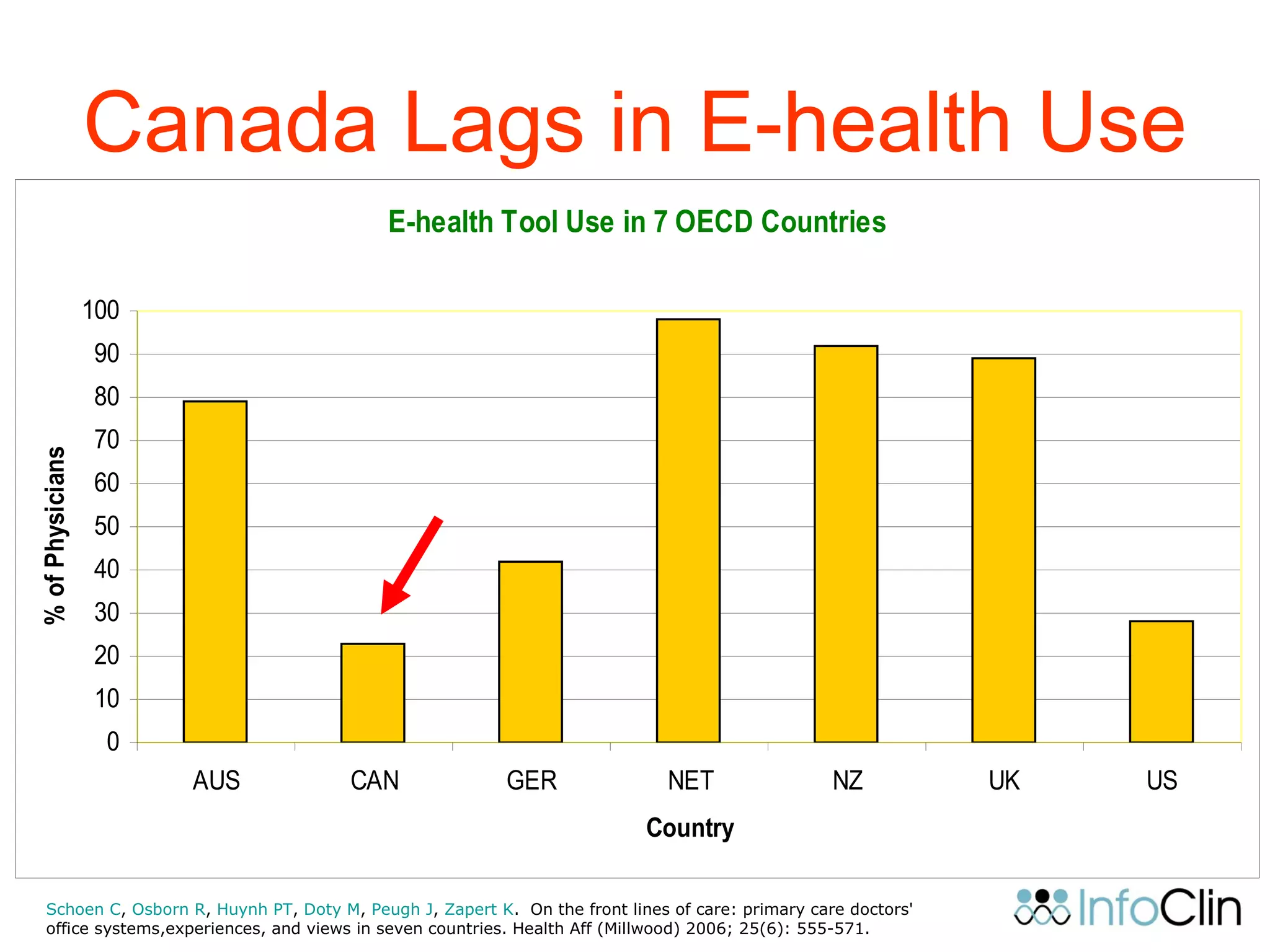
Canada Lags in E-health Use
E-health Tool Use in 7 OECD Countries
0
10
20
30
40
50
60
70
80
90
100
AUS CAN GER NET NZ UK US
Country
%ofPhysicians
Schoen C, Osborn R, Huynh PT, Doty M, Peugh J, Zapert K. On the front lines of care: primary care doctors'
office systems,experiences, and views in seven countries. Health Aff (Millwood) 2006; 25(6): 555-571.
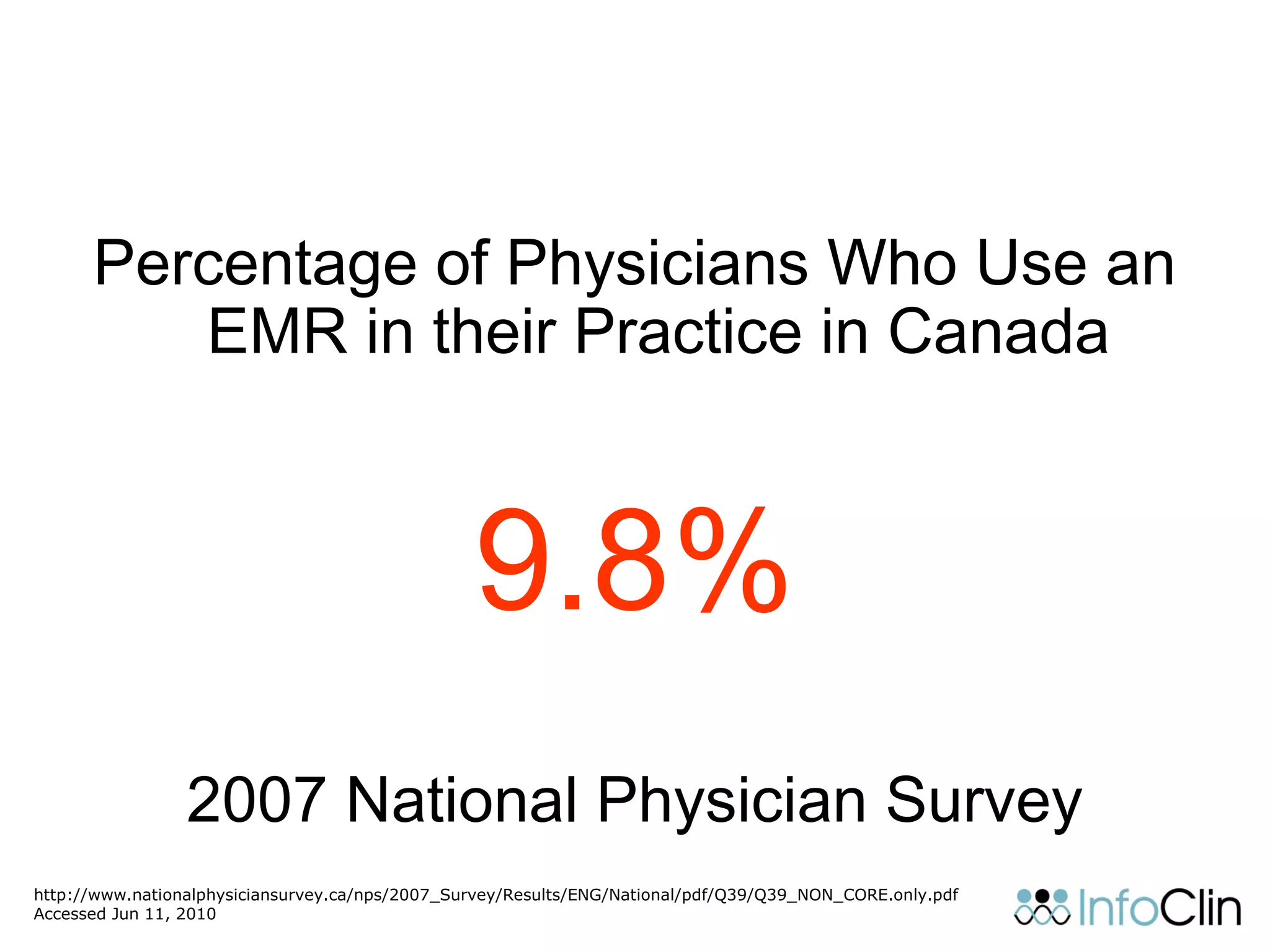
Percentage of Physicians Who Use an
EMR in their Practice in Canada
9.8%
2007 National Physician Survey
http://www.nationalphysiciansurvey.ca/nps/2007_Survey/Results/ENG/National/pdf/Q39/Q39_NON_CORE.only.pdf
Accessed Jun 11, 2010
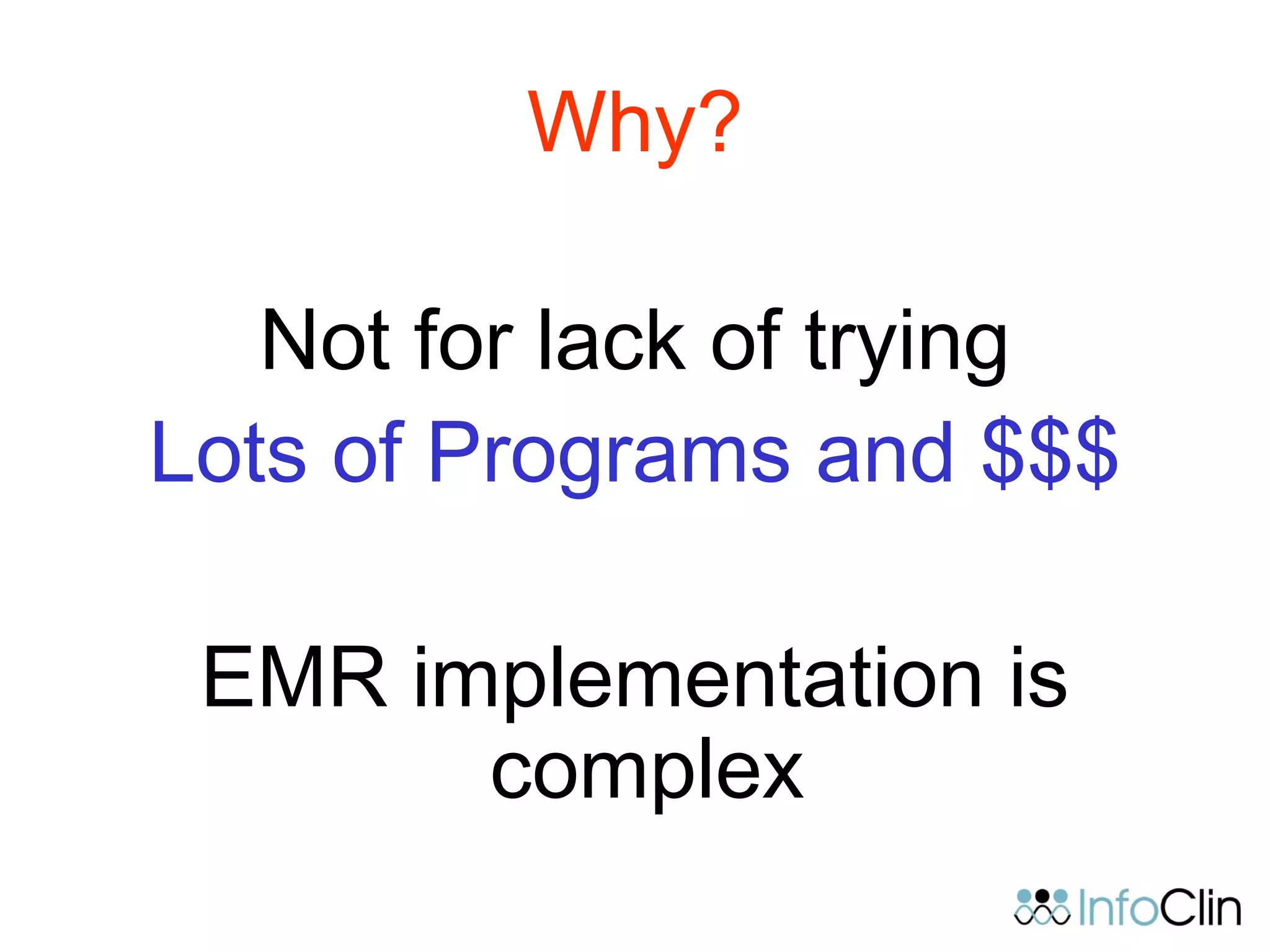
Why?
Not for lack of trying
Lots of Programs and $$$
EMR implementation is
complex
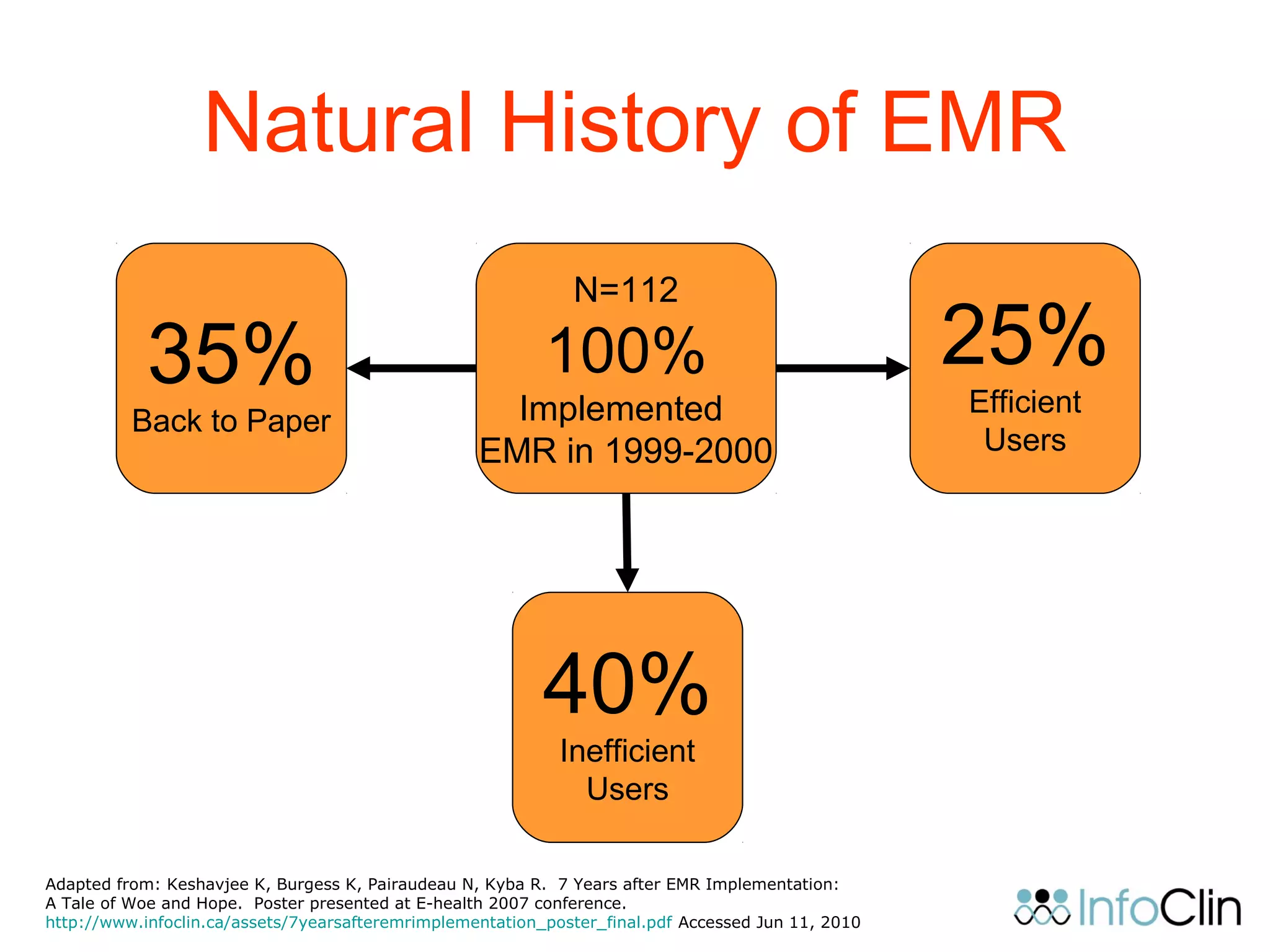
Natural History of EMR
N=112
100%
Implemented
EMR in 1999-2000
40%
Inefficient
Users
25%
Efficient
Users
35%
Back to Paper
Adapted from: Keshavjee K, Burgess K, Pairaudeau N, Kyba R. 7 Years after EMR Implementation:
A Tale of Woe and Hope. Poster presented at E-health 2007 conference.
http://www.infoclin.ca/assets/7yearsafteremrimplementation_poster_final.pdf Accessed Jun 11, 2010
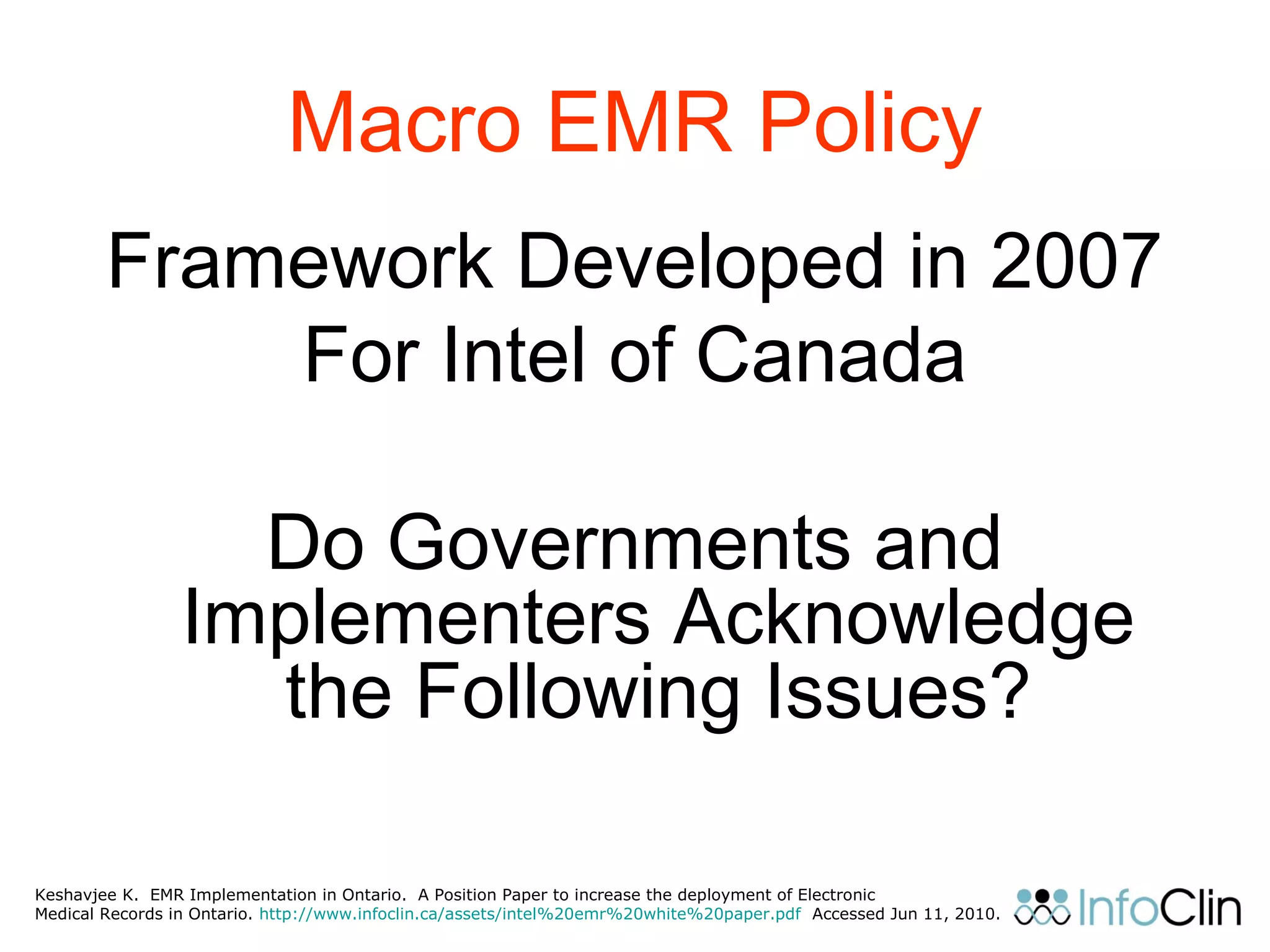
Macro EMR Policy
Framework Developed in 2007
For Intel of Canada
Do Governments and
Implementers Acknowledge
the Following Issues?
Keshavjee K. EMR Implementation in Ontario. A Position Paper to increase the deployment of Electronic
Medical Records in Ontario. http://www.infoclin.ca/assets/intel%20emr%20white%20paper.pdf Accessed Jun 11, 2010.
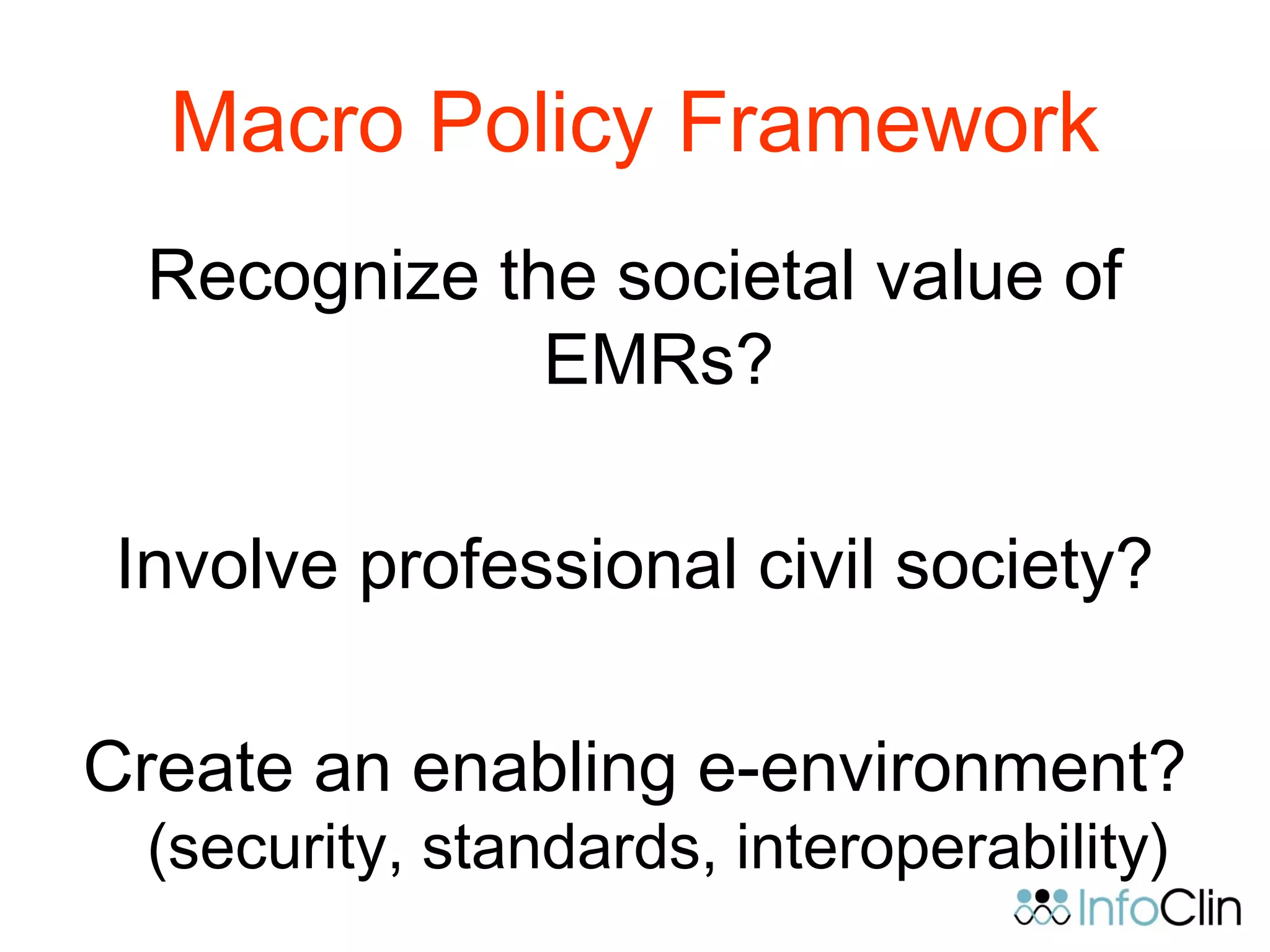
Macro Policy Framework
Recognize the societal value of
EMRs?
Involve professional civil society?
Create an enabling e-environment?
(security, standards, interoperability)
Macro Policy Framework
Encourage markets for new services?
Leverage network effects?
Engage patients and patient advocacy
groups?
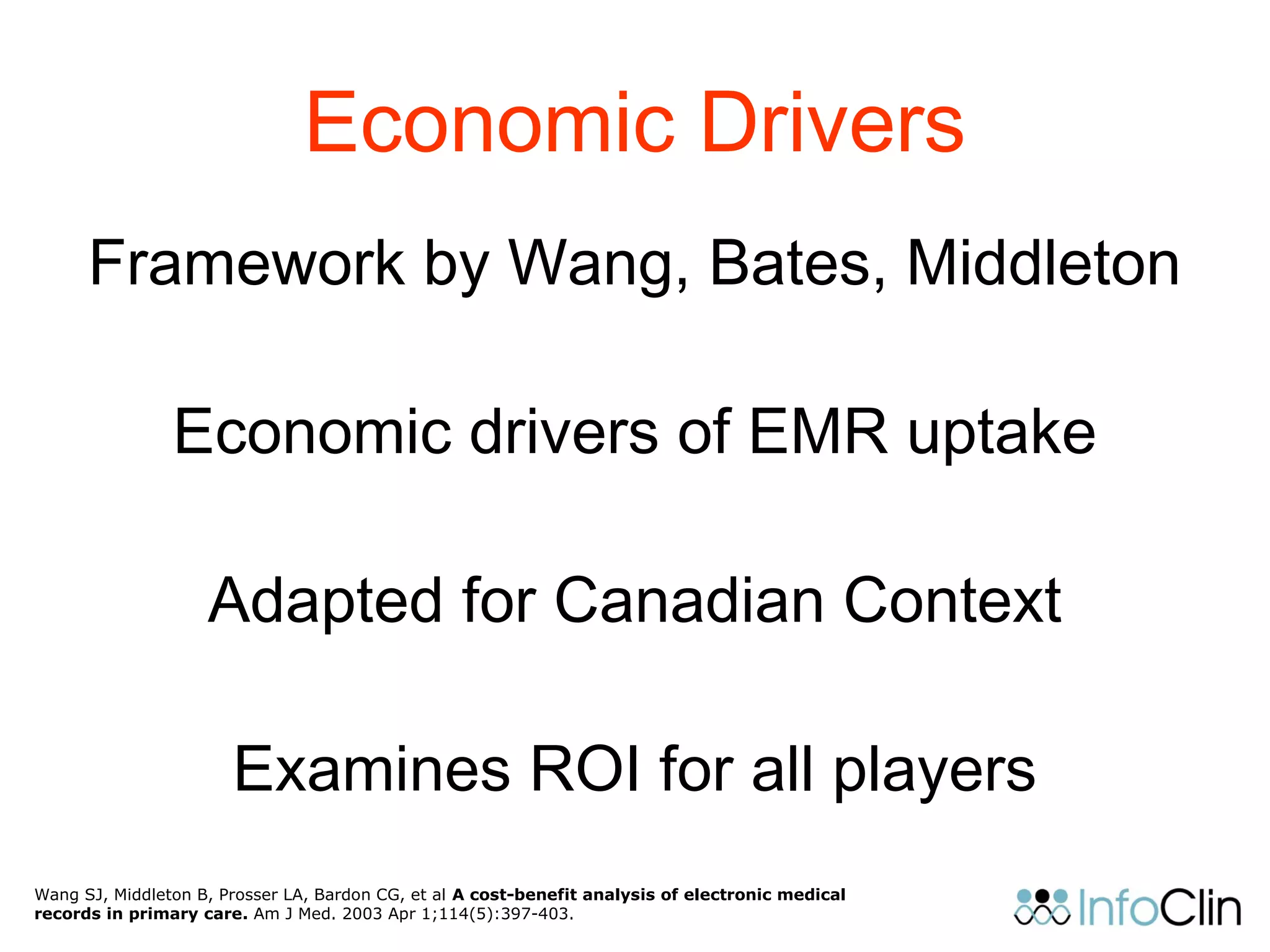
Economic Drivers
Framework by Wang, Bates, Middleton
Economic drivers of EMR uptake
Adapted for Canadian Context
Examines ROI for all players
Wang SJ, Middleton B, Prosser LA, Bardon CG, et al A cost-benefit analysis of electronic medical
records in primary care. Am J Med. 2003 Apr 1;114(5):397-403.
Implementation Programs
A best practices EMR implementation
framework
17 Factors Required for EMR success
12 Factors are Statistically Significant
(and Materially Significant)
Keshavjee K, Bosomworth J, Copen J, Lai J, Kucukyazici B, Lilani R, Holbrook A M. Best Practices in EMR Implementation:
A Systematic Review. Proc. of 11th
ISHIMR Conference, 2006.
http://www.infoclin.ca/assets/emr%20poster%2011-08-06.pdf Accessed Jun 11, 2010
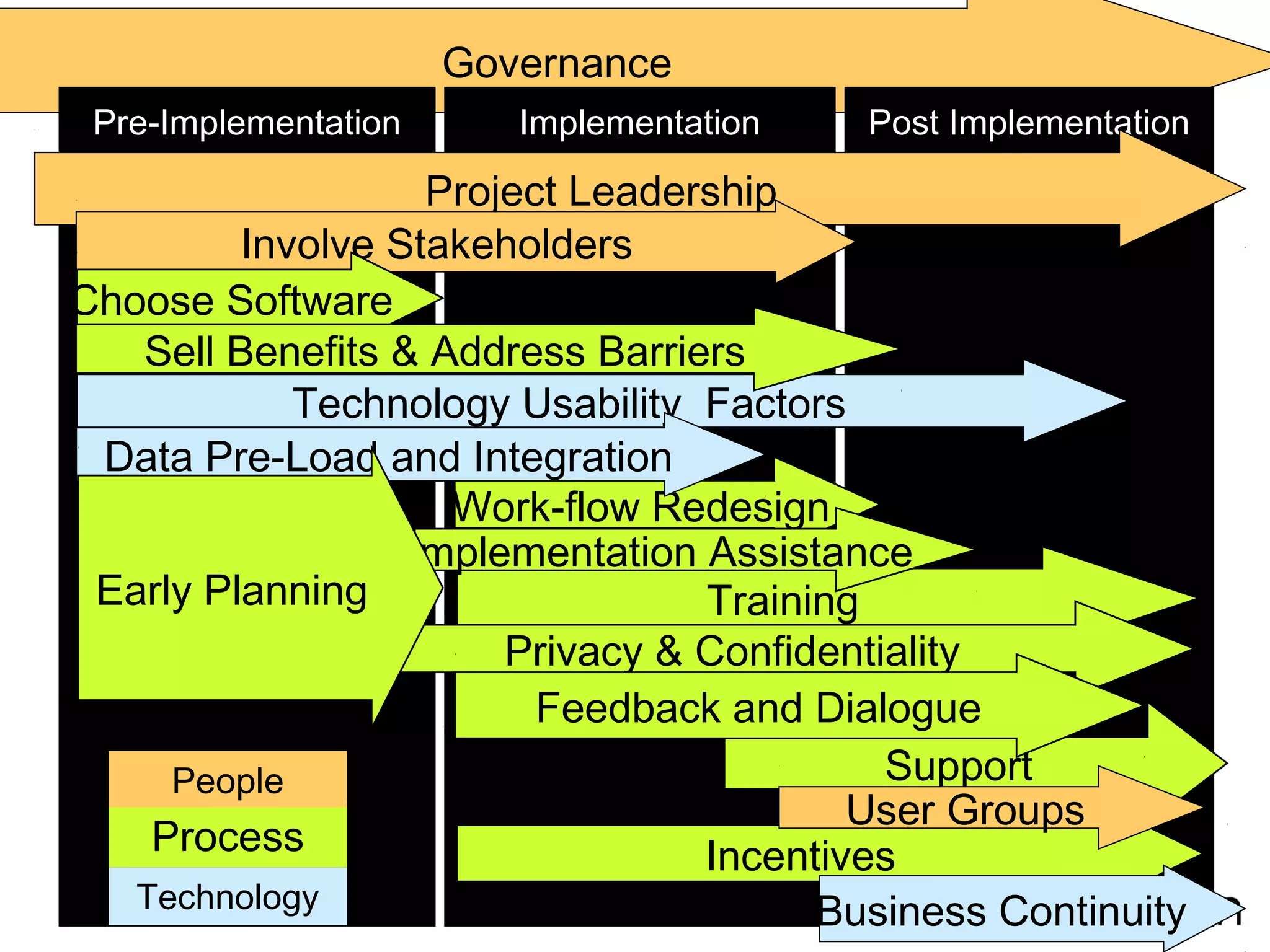
Governance
Pre-Implementation Implementation Post Implementation
Project Leadership
Involve Stakeholders
Technology Usability Factors
Work-flow Redesign
Training
Implementation Assistance
Privacy & Confidentiality
Support
Technology
Process
People
Feedback and Dialogue
Choose Software
Sell Benefits & Address Barriers
Data Pre-Load and Integration
Early Planning
Incentives
User Groups
Business Continuity
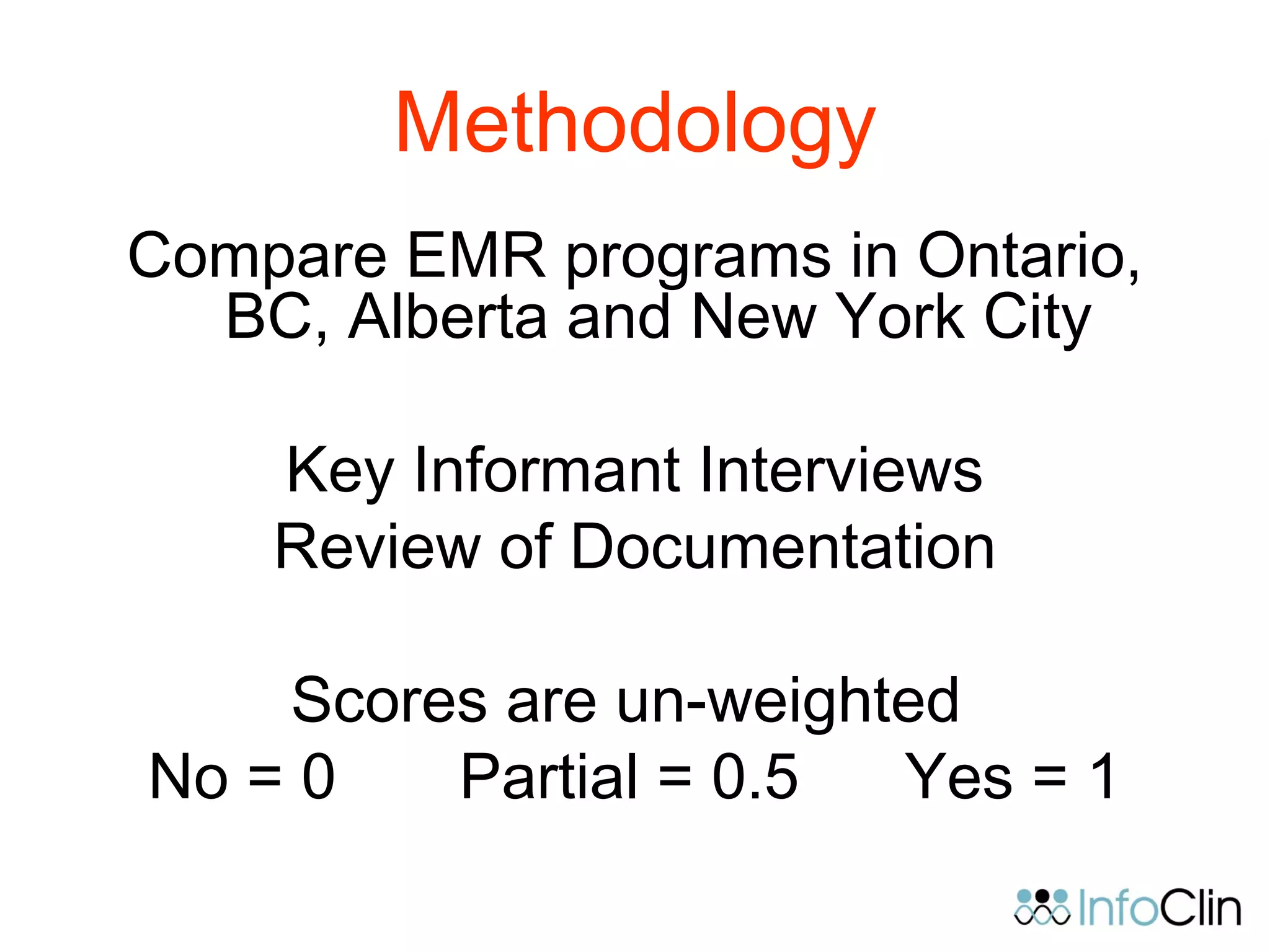
Methodology
Compare EMR programs in Ontario,
BC, Alberta and New York City
Key Informant Interviews
Review of Documentation
Scores are un-weighted
No = 0 Partial = 0.5 Yes = 1
Canada’s First Primary Care Informatics Consulting Firm
Policy Framework Analysis
Economic Analysis
Implementation Factor Analysis
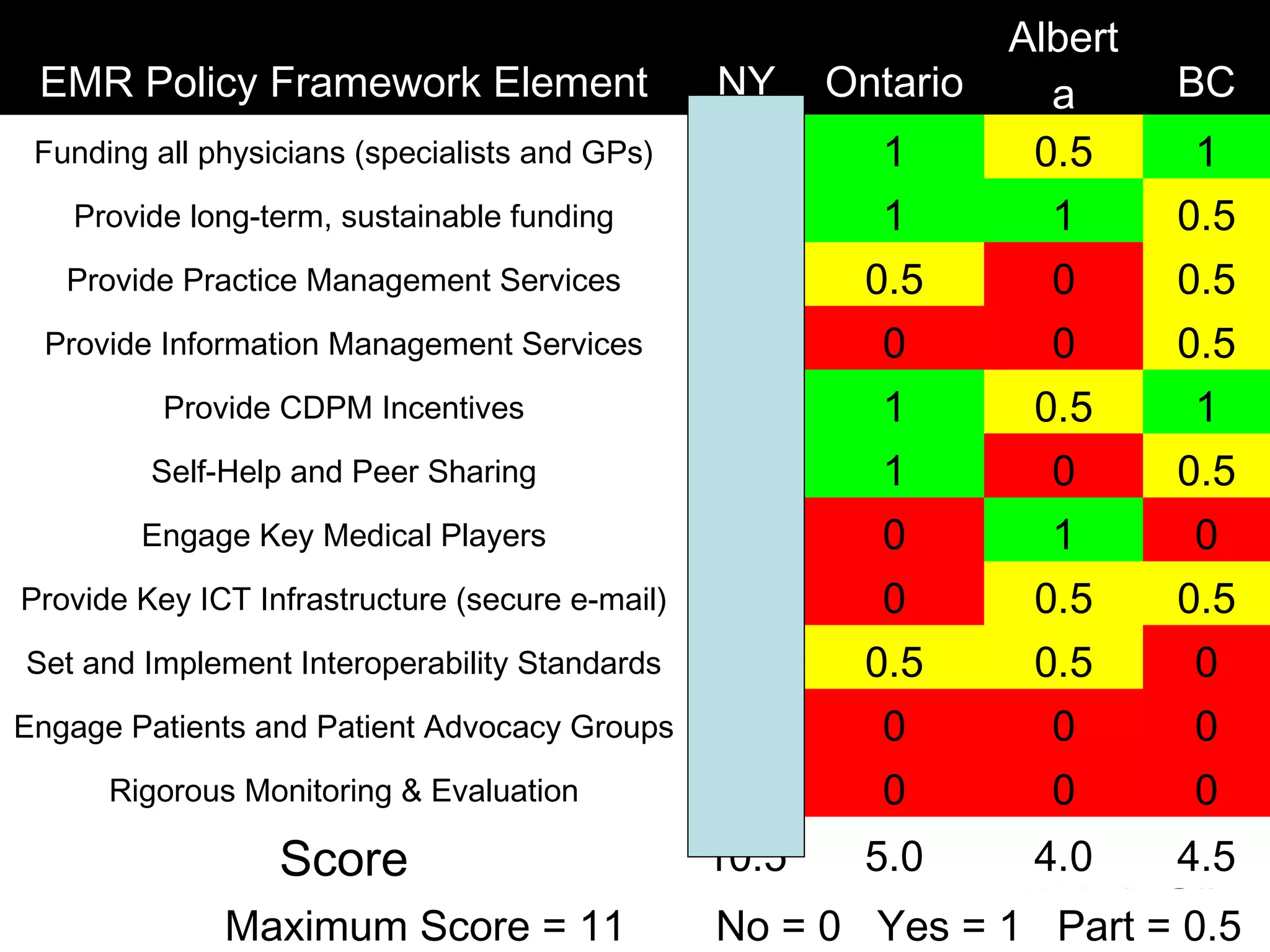
EMR Policy Framework Element NY Ontario
Albert
a BC
Funding all physicians (specialists and GPs) 1 1 0.5 1
Provide long-term, sustainable funding 1 1 1 0.5
Provide Practice Management Services 1 0.5 0 0.5
Provide Information Management Services 1 0 0 0.5
Provide CDPM Incentives 1 1 0.5 1
Self-Help and Peer Sharing 1 1 0 0.5
Engage Key Medical Players 1 0 1 0
Provide Key ICT Infrastructure (secure e-mail) 1 0 0.5 0.5
Set and Implement Interoperability Standards 1 0.5 0.5 0
Engage Patients and Patient Advocacy Groups 0.5 0 0 0
Rigorous Monitoring & Evaluation 1 0 0 0
Score 10.5 5.0 4.0 4.5
  Maximum Score = 11 No = 0 Yes = 1 Part = 0.5
Canada’s First Primary Care Informatics Consulting Firm
Policy Framework Analysis
Economic Analysis
Implementation Factor Analysis
US Canada
Costs 
Initial
Cost Annual
Over 5
years Cost Annual
Over 5
years
Hardware[1]
$6,600 (q 3 yrs) $13,200 $10,000 (q 3 yrs) $20,000
Implementation[2]
$3,400 $3,400 $5,000 $5,000
Software[3]
$1600 $1600 $9600 $4,000 $4,000
Support[4]
$1500 $1500 $9000 $2,400 $12,000
Scanning[5]
- - $12,000 $60,000
Productivity Loss
[6]
$11,200 $11,200 $5,000 $5,000
Gov’t Subsidy - - -$28,000 -$28,000
TOTAL Cost/MD $46,400     $78,000
Economic Analysis
US Canada
 Benefits (Savings)
COST $46,400 $78,000
MD Benefits
Chart Pulls[7]
$5 600 $15,000 $4,800 24% $5,760
Transcription[8]
$9,600 28% $13,440 0 0 $0
Charge Capture[9]
$383,100 2% $15,324 $188,000 0% $0
Billing Errors $9,700 78% $15,132 $9,400 $0 $0
Total MD Benefit $58,896 $5,760
Health System Benefits
Drug Reactions[10]
$6,500 34% $8,840 $6,500 34% $8,840
Drug Utilization $109,000 15% $65,400 $109,000 15% $65,400
Lab Utilization $27,600 8.80% $4,858 $27,600 8.80% $4,858
Radiol. Utilization $59,100 14% $16,548 $59,100 14% $16,548
System Benefit     $95,646     $95,646
Net (Benefit-Cost)     $108,142     $23,406
MD Net Benefit/Loss     $12,496    
-
$72,240
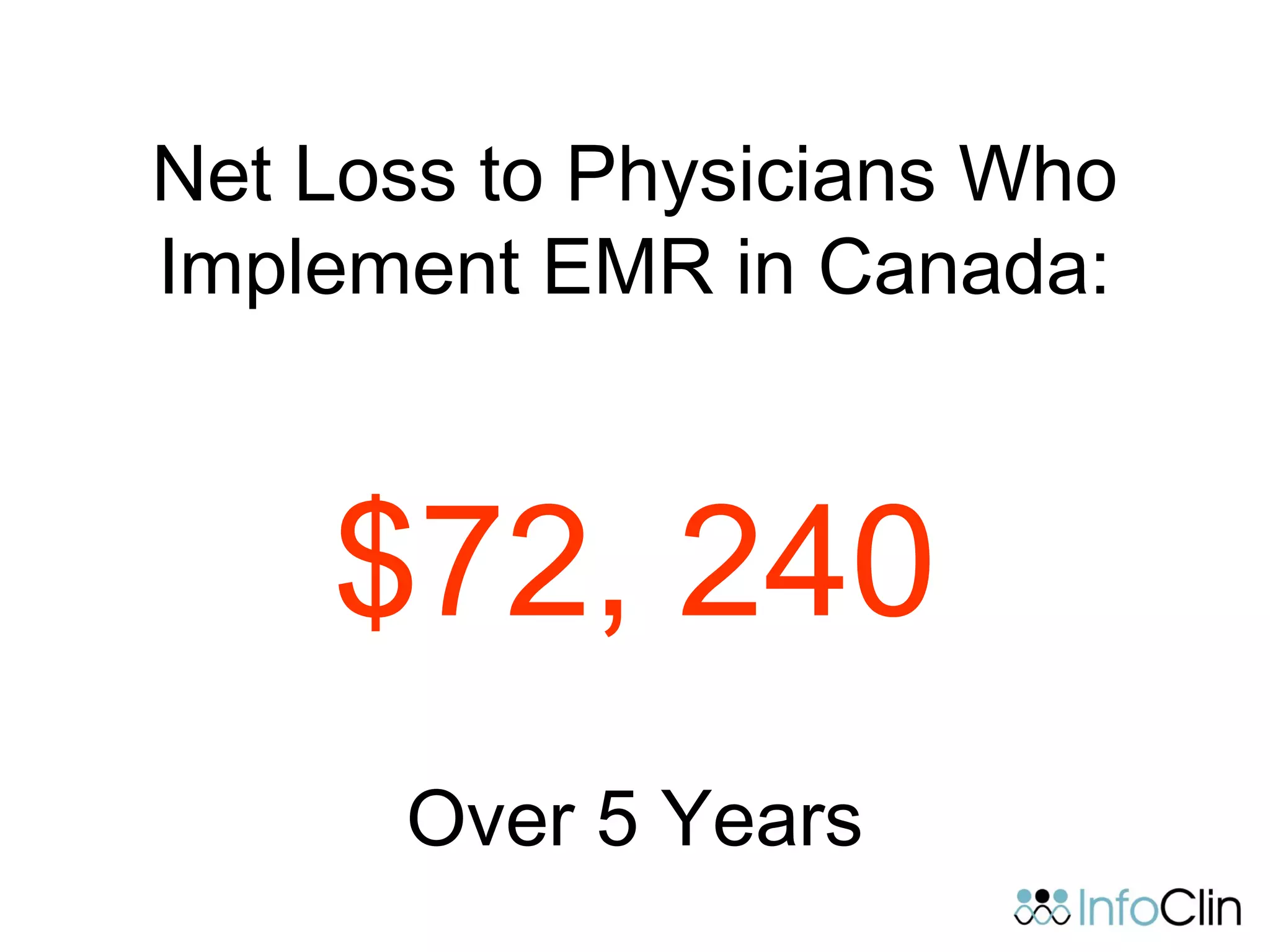
Net Loss to Physicians Who
Implement EMR in Canada:
$72, 240
Over 5 Years
Still think physicians are
‘resistant to change’?
Canada’s First Primary Care Informatics Consulting Firm
Policy Framework Analysis
Economic Analysis
Implementation Factor Analysis
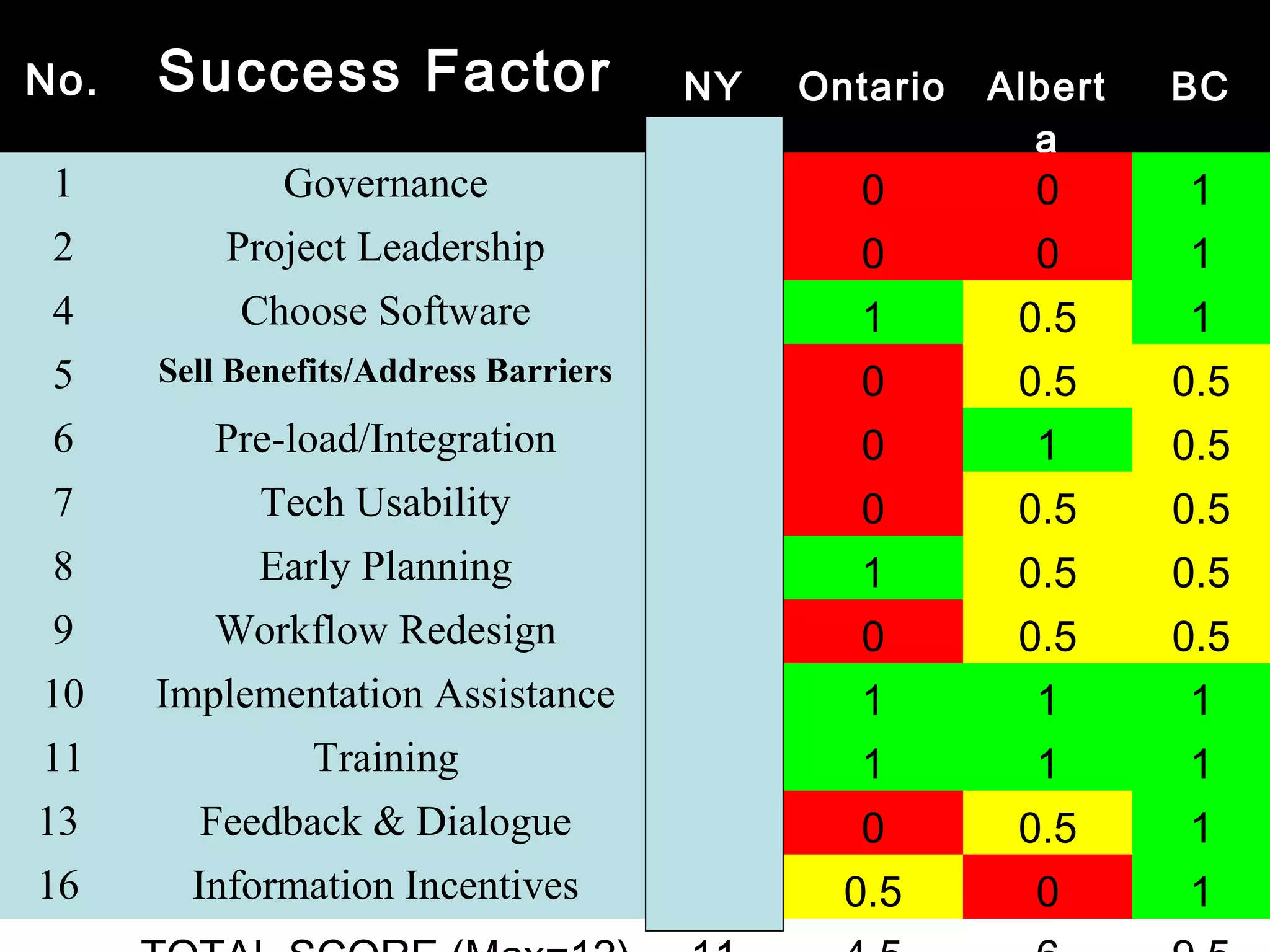
No. Success Factor NY Ontario Albert
a
BC
1 Governance 1 0 0 1
2 Project Leadership 1 0 0 1
4 Choose Software 0 1 0.5 1
5 Sell Benefits/Address Barriers 1 0 0.5 0.5
6 Pre-load/Integration 1 0 1 0.5
7 Tech Usability 1 0 0.5 0.5
8 Early Planning 1 1 0.5 0.5
9 Workflow Redesign 1 0 0.5 0.5
10 Implementation Assistance 1 1 1 1
11 Training 1 1 1 1
13 Feedback & Dialogue 1 0 0.5 1
16 Information Incentives 1 0.5 0 1
Canadian Provinces Do Poorly on
Economic and Policy Drivers of
EMR Uptake
So What?
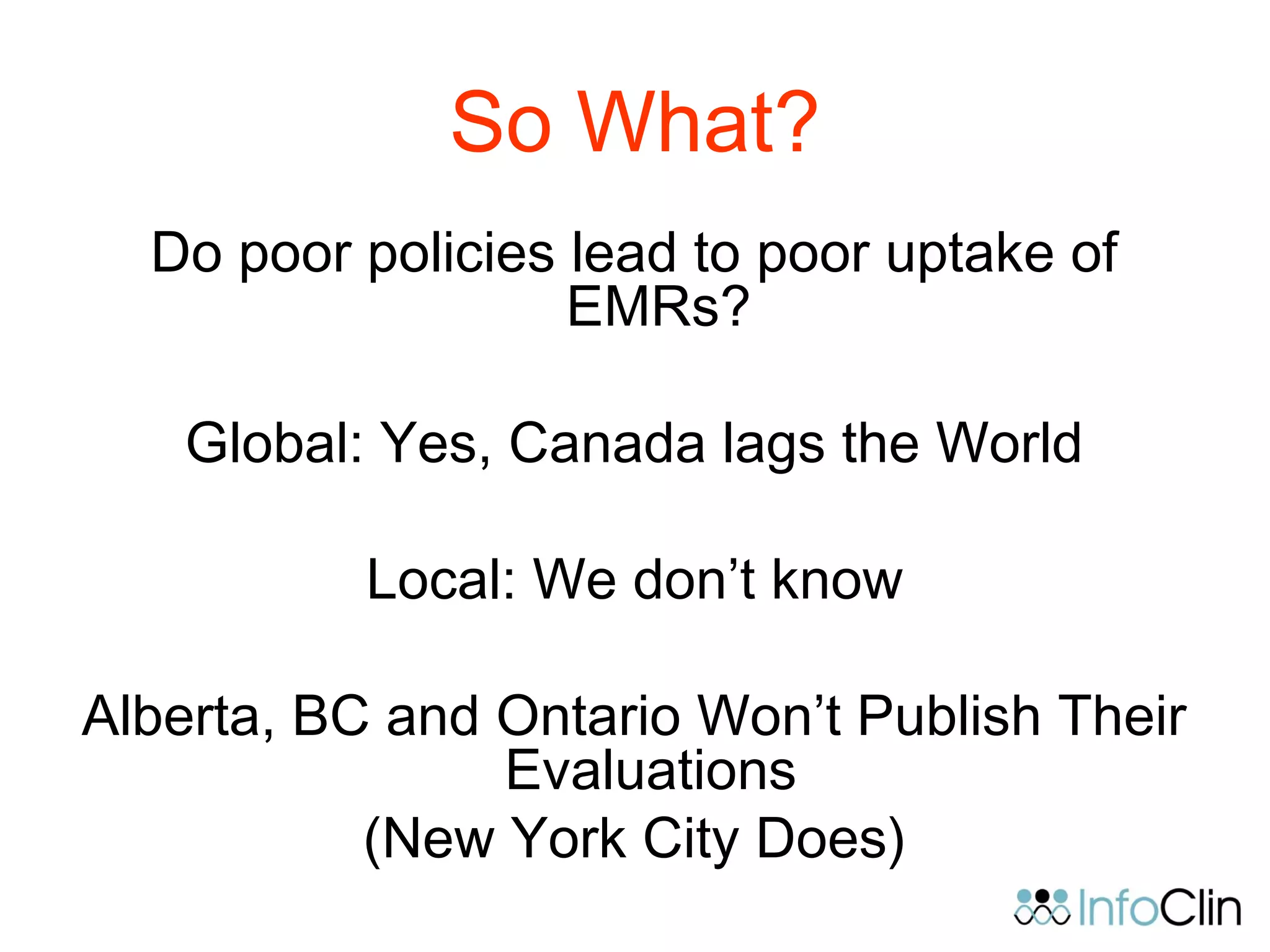
Do poor policies lead to poor uptake of
EMRs?
Global: Yes, Canada lags the World
Local: We don’t know
Alberta, BC and Ontario Won’t Publish Their
Evaluations
(New York City Does)
So What?
Physicians hear from their colleagues
and decide to ‘wait and see’
Industry notices ‘resistance to change’
We have invested tens of millions in
EMR with very little to show for it
Summary
Canadian Policies Not Conducive to EMR uptake
Economic Drivers Need Improvement
EMR Services Do Not Meet Global Best Practices
EMR Policies Need to be Updated
Focus on the Frameworks

Canada's rank in OECD studies 20100610

  • 1.
    Canada’s First PrimaryCare Informatics Consulting Firm Canada’s Rank in OECD Studies A Failure of EMR Policy in Canada Karim Keshavjee, MD, MBA, CPHIMS E-health Conference, Vancouver Canada June 1, 2010
  • 2.
    Outline The Problem Policy Analysis EconomicAnalysis Implementation Factor Analysis Conclusion
  • 3.
    Canada Lags inE-health Use E-health Tool Use in 7 OECD Countries 0 10 20 30 40 50 60 70 80 90 100 AUS CAN GER NET NZ UK US Country %ofPhysicians Schoen C, Osborn R, Huynh PT, Doty M, Peugh J, Zapert K. On the front lines of care: primary care doctors' office systems,experiences, and views in seven countries. Health Aff (Millwood) 2006; 25(6): 555-571.
  • 4.
    Percentage of PhysiciansWho Use an EMR in their Practice in Canada 9.8% 2007 National Physician Survey http://www.nationalphysiciansurvey.ca/nps/2007_Survey/Results/ENG/National/pdf/Q39/Q39_NON_CORE.only.pdf Accessed Jun 11, 2010
  • 5.
    Why? Not for lackof trying Lots of Programs and $$$ EMR implementation is complex
  • 6.
    Natural History ofEMR N=112 100% Implemented EMR in 1999-2000 40% Inefficient Users 25% Efficient Users 35% Back to Paper Adapted from: Keshavjee K, Burgess K, Pairaudeau N, Kyba R. 7 Years after EMR Implementation: A Tale of Woe and Hope. Poster presented at E-health 2007 conference. http://www.infoclin.ca/assets/7yearsafteremrimplementation_poster_final.pdf Accessed Jun 11, 2010
  • 7.
    Macro EMR Policy FrameworkDeveloped in 2007 For Intel of Canada Do Governments and Implementers Acknowledge the Following Issues? Keshavjee K. EMR Implementation in Ontario. A Position Paper to increase the deployment of Electronic Medical Records in Ontario. http://www.infoclin.ca/assets/intel%20emr%20white%20paper.pdf Accessed Jun 11, 2010.
  • 8.
    Macro Policy Framework Recognizethe societal value of EMRs? Involve professional civil society? Create an enabling e-environment? (security, standards, interoperability)
  • 9.
    Macro Policy Framework Encouragemarkets for new services? Leverage network effects? Engage patients and patient advocacy groups?
  • 10.
    Economic Drivers Framework byWang, Bates, Middleton Economic drivers of EMR uptake Adapted for Canadian Context Examines ROI for all players Wang SJ, Middleton B, Prosser LA, Bardon CG, et al A cost-benefit analysis of electronic medical records in primary care. Am J Med. 2003 Apr 1;114(5):397-403.
  • 11.
    Implementation Programs A bestpractices EMR implementation framework 17 Factors Required for EMR success 12 Factors are Statistically Significant (and Materially Significant) Keshavjee K, Bosomworth J, Copen J, Lai J, Kucukyazici B, Lilani R, Holbrook A M. Best Practices in EMR Implementation: A Systematic Review. Proc. of 11th ISHIMR Conference, 2006. http://www.infoclin.ca/assets/emr%20poster%2011-08-06.pdf Accessed Jun 11, 2010
  • 12.
    Governance Pre-Implementation Implementation PostImplementation Project Leadership Involve Stakeholders Technology Usability Factors Work-flow Redesign Training Implementation Assistance Privacy & Confidentiality Support Technology Process People Feedback and Dialogue Choose Software Sell Benefits & Address Barriers Data Pre-Load and Integration Early Planning Incentives User Groups Business Continuity
  • 13.
    Methodology Compare EMR programsin Ontario, BC, Alberta and New York City Key Informant Interviews Review of Documentation Scores are un-weighted No = 0 Partial = 0.5 Yes = 1
  • 14.
    Canada’s First PrimaryCare Informatics Consulting Firm Policy Framework Analysis Economic Analysis Implementation Factor Analysis
  • 15.
    EMR Policy FrameworkElement NY Ontario Albert a BC Funding all physicians (specialists and GPs) 1 1 0.5 1 Provide long-term, sustainable funding 1 1 1 0.5 Provide Practice Management Services 1 0.5 0 0.5 Provide Information Management Services 1 0 0 0.5 Provide CDPM Incentives 1 1 0.5 1 Self-Help and Peer Sharing 1 1 0 0.5 Engage Key Medical Players 1 0 1 0 Provide Key ICT Infrastructure (secure e-mail) 1 0 0.5 0.5 Set and Implement Interoperability Standards 1 0.5 0.5 0 Engage Patients and Patient Advocacy Groups 0.5 0 0 0 Rigorous Monitoring & Evaluation 1 0 0 0 Score 10.5 5.0 4.0 4.5   Maximum Score = 11 No = 0 Yes = 1 Part = 0.5
  • 16.
    Canada’s First PrimaryCare Informatics Consulting Firm Policy Framework Analysis Economic Analysis Implementation Factor Analysis
  • 17.
    US Canada Costs  Initial Cost Annual Over5 years Cost Annual Over 5 years Hardware[1] $6,600 (q 3 yrs) $13,200 $10,000 (q 3 yrs) $20,000 Implementation[2] $3,400 $3,400 $5,000 $5,000 Software[3] $1600 $1600 $9600 $4,000 $4,000 Support[4] $1500 $1500 $9000 $2,400 $12,000 Scanning[5] - - $12,000 $60,000 Productivity Loss [6] $11,200 $11,200 $5,000 $5,000 Gov’t Subsidy - - -$28,000 -$28,000 TOTAL Cost/MD $46,400     $78,000 Economic Analysis
  • 18.
    US Canada  Benefits (Savings) COST$46,400 $78,000 MD Benefits Chart Pulls[7] $5 600 $15,000 $4,800 24% $5,760 Transcription[8] $9,600 28% $13,440 0 0 $0 Charge Capture[9] $383,100 2% $15,324 $188,000 0% $0 Billing Errors $9,700 78% $15,132 $9,400 $0 $0 Total MD Benefit $58,896 $5,760 Health System Benefits Drug Reactions[10] $6,500 34% $8,840 $6,500 34% $8,840 Drug Utilization $109,000 15% $65,400 $109,000 15% $65,400 Lab Utilization $27,600 8.80% $4,858 $27,600 8.80% $4,858 Radiol. Utilization $59,100 14% $16,548 $59,100 14% $16,548 System Benefit     $95,646     $95,646 Net (Benefit-Cost)     $108,142     $23,406 MD Net Benefit/Loss     $12,496     - $72,240
  • 19.
    Net Loss toPhysicians Who Implement EMR in Canada: $72, 240 Over 5 Years
  • 20.
    Still think physiciansare ‘resistant to change’?
  • 21.
    Canada’s First PrimaryCare Informatics Consulting Firm Policy Framework Analysis Economic Analysis Implementation Factor Analysis
  • 22.
    No. Success FactorNY Ontario Albert a BC 1 Governance 1 0 0 1 2 Project Leadership 1 0 0 1 4 Choose Software 0 1 0.5 1 5 Sell Benefits/Address Barriers 1 0 0.5 0.5 6 Pre-load/Integration 1 0 1 0.5 7 Tech Usability 1 0 0.5 0.5 8 Early Planning 1 1 0.5 0.5 9 Workflow Redesign 1 0 0.5 0.5 10 Implementation Assistance 1 1 1 1 11 Training 1 1 1 1 13 Feedback & Dialogue 1 0 0.5 1 16 Information Incentives 1 0.5 0 1
  • 23.
    Canadian Provinces DoPoorly on Economic and Policy Drivers of EMR Uptake
  • 24.
    So What? Do poorpolicies lead to poor uptake of EMRs? Global: Yes, Canada lags the World Local: We don’t know Alberta, BC and Ontario Won’t Publish Their Evaluations (New York City Does)
  • 25.
    So What? Physicians hearfrom their colleagues and decide to ‘wait and see’ Industry notices ‘resistance to change’ We have invested tens of millions in EMR with very little to show for it
  • 26.
    Summary Canadian Policies NotConducive to EMR uptake Economic Drivers Need Improvement EMR Services Do Not Meet Global Best Practices EMR Policies Need to be Updated Focus on the Frameworks

Editor's Notes