Financial Incentives for EHR R&D MedTech
Who Is R&D Med Tech? R&D Med Tech is an Oklahoma Limited Liability Corporation (LLC), located in Muskogee, Oklahoma that provides electronic health records software, services and support to physician practices.  The company was formed by 2 principals.  Rob Raasch who has 15 years of experience as an executive in a publicly traded information technology services and management company.  David Edwards has 40 years of experience including owning medical practices and medical office support companies. In addition to the 2 principals, the company has employees who are experienced IT hardware and software professionals, certified trainers, help desk staff, experienced medical billing and collections professionals and a professional grant writer.
Why R&D MedTech and Why Greenway? R&D MedTech  provides local maintenance, training, help desk and hosting support. Greenway Medical’s PrimeSuite earned “Best In KLAS”  honors in 2006, 2007, 2008 & 2009 So what is KLAS and why is it important for evaluating EHR software? KLAS measures performance of software, professional services, and medical equipment vendors. KLAS is like the Consumer Reports or J.D. Power rankings for EHR.  KLAS is the only research firm that specializes in monitoring and reporting the performance of healthcare’s information technology (HIT) vendors.  Greenway’s PrimeSuite was among the first EHRs to receive the  2011 Comprehensive CCHIT Certification  in Ambulatory EHR  from the  Certification Commission for Healthcare Information Technology (CCHIT).
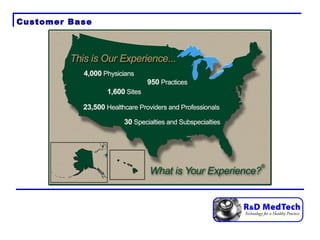
Customer Base
Prime Suite Our flagship application uses a single database to integrate the clinical, financial and administrative processes of your practice. This allows you to increase the quality of care you provide, enhance your patients satisfaction and maximize your practice’s profitability. The single database integration of EHR, practice management  and interoperability functionality eliminates errors caused by duplicate data and interface-type systems.
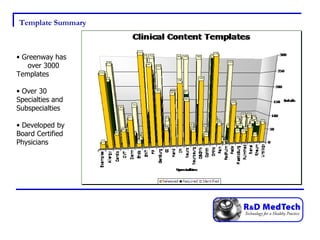
Template Summary Greenway has  over 3000 Templates Over 30 Specialties and Subspecialties  Developed by Board Certified Physicians
Training When practices look to "Go electronic", they reach for their most common real-life experiences to guide them, cognitively, about "What is this going to take?" : For most people, that's installing some software on their computer. The problem is, this experience is a poor model to understand EHR implementation :  1. It implies “This is something you can do with an instruction book and maybe a little help”.  2. It implies “This is something that is experienced at the computer, and the computer only.” 3. It implies “It generally takes a week or two to 'get really good' at it.” What it misses is :  1. EHR implementation means a THOROUGH examination of all of your clinical workflows and then in some cases, reorganizing them under a new electronic paradigm.  2. “Support” is NOT an instruction book, and NOT a 2-hour class, but a continuous, ongoing monitoring of physician, nurse, and practice management behaviors - And to achieve this requires an entire support mechanism of its own.  3. The 'learning curve' is often longer than anticipated. R&D MedTech believes there is a higher probability for a successful implementation if training is delivered in person as opposed to over the web or from a CD.  Our trainers are certified by Greenway after intensive classroom and shadowing experiences.
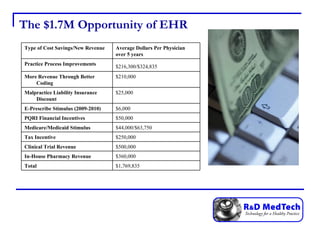
The $1.7M Opportunity of EHR $50,000 PQRI Financial Incentives $1,769,835 Total $360,000 In-House Pharmacy Revenue $500,000 Clinical Trial Revenue $250,000 Tax Incentive $44,000/$63,750 Medicare/Medicaid Stimulus  $6,000 E-Prescribe Stimulus (2009-2010) $25,000 Malpractice Liability Insurance Discount $210,000 More Revenue Through Better Coding $216,300/$324,835   Practice Process Improvements Average Dollars Per Physician over 5 years Type of Cost Savings/New Revenue
R&D Guarantee Stimulus Eligibility:  Our guarantee removes the uncertainty that the Federal Stimulus Incentive Program has created about whether the Electronic Health Record (EHR) that your practice is selecting will meet the “meaningful use” and “certification” requirements under the HITECH Act.  Quality of Service : This Program guarantees Top quality training and support by certified trainers, and a fully functional solution with swift and professional implementation.
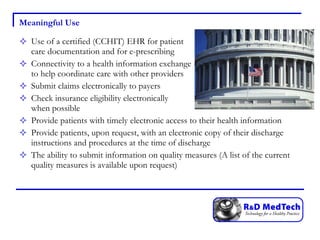
Meaningful Use Use of a certified (CCHIT) EHR for patient  care documentation and for e-prescribing Connectivity to a health information exchange  to help coordinate care with other providers Submit claims electronically to payers Check insurance eligibility electronically  when possible Provide patients with timely electronic access to their health information Provide patients, upon request, with an electronic copy of their discharge instructions and procedures at the time of discharge The ability to submit information on quality measures (A list of the current quality measures is available upon request)
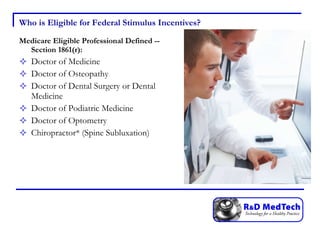
Who is Eligible for Federal Stimulus Incentives? Medicare Eligible Professional Defined -- Section 1861(r): Doctor of Medicine Doctor of Osteopathy Doctor of Dental Surgery or Dental Medicine Doctor of Podiatric Medicine Doctor of Optometry Chiropractor* (Spine Subluxation)
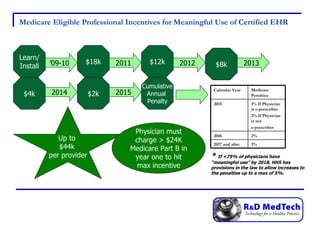
Medicare Eligible Professional Incentives for Meaningful Use of Certified EHR ’ 09-10 Learn/ Install $18k 2011 2012 $12k $8k 2013 $4k $2k 2014 2015 Cumulative Annual  Penalty Up to  $44k  per provider Physician must charge > $24K Medicare Part B in year one to hit max incentive *  If <75% of physicians have “meaningful use” by 2018, HHS has provisions in the law to allow increases to the penalties up to a max of 5%. 3% 2017 and after 2% 2016 1% If Physician is e-prescriber 2% If Physician is not  e-prescriber 2015 Medicare Penalties Calendar Year
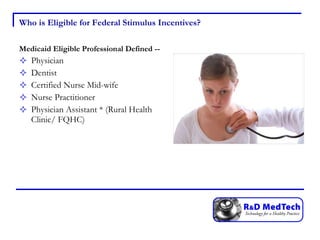
Who is Eligible for Federal Stimulus Incentives? Medicaid Eligible Professional Defined -- Physician Dentist  Certified Nurse Mid-wife Nurse Practitioner Physician Assistant * (Rural Health Clinic/ FQHC)
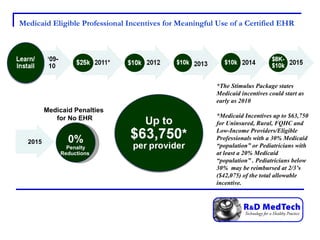
Medicaid Eligible Professional Incentives for Meaningful Use of a Certified EHR Medicaid Penalties  for No EHR *The Stimulus Package states Medicaid incentives could start as early as 2010    *Medicaid Incentives up to $63,750 for Uninsured, Rural, FQHC and Low-Income Providers/Eligible Professionals with a 30% Medicaid “population” or Pediatricians with at least a 20% Medicaid “population” . Pediatricians below 30%  may be reimbursed at 2/3’s ($42,075) of the total allowable incentive. 2015 0% Penalty Reductions
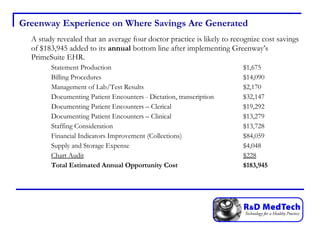
Greenway Experience on Where Savings Are Generated A study revealed that an average four doctor practice is likely to recognize cost savings of $183,945 added to its  annual  bottom line after implementing Greenway’s PrimeSuite EHR.  Statement Production $1,675 Billing Procedures $14,090 Management of Lab/Test Results $2,170 Documenting Patient Encounters - Dictation, transcription $32,147 Documenting Patient Encounters – Clerical $19,292 Documenting Patient Encounters – Clinical $13,279 Staffing Consideration $13,728 Financial Indicators Improvement (Collections) $84,059 Supply and Storage Expense $4,048 Chart Audit $228 Total Estimated Annual Opportunity Cost $183,945
Increased Revenue Through Improved Coding In 2004, CMS reviewed about 160,000 claims from 2003 and uncovered $1 billion in underpayment, mostly by Part B carriers. According to the agency, 83.1 percent of all underpayment dollars were for E&M codes, and downcoding by one level was common. Nearly one-third of underpayment dollars resulted from these codes: 99241, 99212, 99211, and 99201. A study of fourteen small practices in the September/October 2005 edition of  Health Affairs  found that each physician could raise his/her revenue by as much  $42,000 per year with increased coding levels resulting from implementation of EHR.
EHR and Medical Liability Insurance Discounts Malpractice insurance carriers are increasingly offering  2½ – 5% discounts to doctors for using an EHR in their practice .  In 2007, the Certification Commission for Healthcare Information Technology (CCHIT) published an article advocating for lower malpractice insurance premiums for physicians who implement certified electronic health record (EHR) systems.  CCHIT asserted that physicians using certified EHR systems enhance the quality and safety of their care through:  Improved aggregation, analysis and communication of patient information;  Diagnostic and therapeutic decision support  Prevention of adverse events (such as safeguards against prescribing drugs which interact with the patient's current medications)  Clinical alerts and reminders; and  Enhancing research on clinical quality improvement.
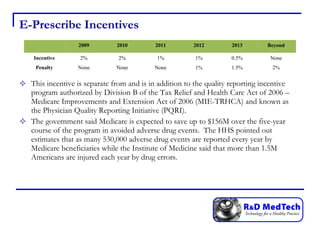
E-Prescribe Incentives This incentive is separate from and is in addition to the quality reporting incentive program authorized by Division B of the Tax Relief and Health Care Act of 2006 – Medicare Improvements and Extension Act of 2006 (MIE-TRHCA) and known as the Physician Quality Reporting Initiative (PQRI).  The government said Medicare is expected to save up to $156M over the five-year course of the program in avoided adverse drug events.  The HHS pointed out estimates that as many 530,000 adverse drug events are reported every year by Medicare beneficiaries while the Institute of Medicine said that more than 1.5M Americans are injured each year by drug errors. 2% 1.5% 1% None None None Penalty None 0.5% 1% 1% 2% 2% Incentive Beyond 2013 2012 2011 2010 2009
Physician Quality Reporting Initiative (PQRI) PQRI is a CMS sponsored program.  Participating physicians in 2010 will be awarded 2% of their total Medicare Indemnity billings for the reporting period –an increase from 1.5% in 2008. 2010 179 Quality Measures 13 Measure Groups (Diabetes, Chronic Kidney Disease, Preventive Care, Rheumatoid Arthritis, Coronary Artery Bypass Graft (CABG), Back Pain, Perioperative Care, Hepatitis C, Heart Failure (HF), Coronary Artery Disease (CAD), Ischemic Vascular Disease (IVD), HIV/AIDS, Community-Acquired Pneumonia (CAP)) 2% Reimbursement --  Individual physicians and other eligible professionals who satisfactorily reported PQRI quality measures data and thus qualified for an incentive payment for the 2008 PQRI received incentives amounts from more than $1,000 to $98,000 in incentives.
Tax Incentives The HIRE ACT of 2010 (Hiring Incentives to Restore Employment) amended Section 179 of the Tax Code to increase the small business expense for qualified property to $250,000 through December 31, 2009.  Thus, a medical practice can expense the full cost (up to $250,000) of its equipment/medical software purchase that purchased by 12/31/2010.  Thus,  your practice can expense the full amount of an EHR software purchase including software and hardware – and reduce your practice’s taxable income .
Opportunities for New Revenue Streams In addition, to the cost savings and opportunity for government incentive money, there are some new opportunities for a physician to generate revenue using EHR: Clinical Trials In-House Pharmacies
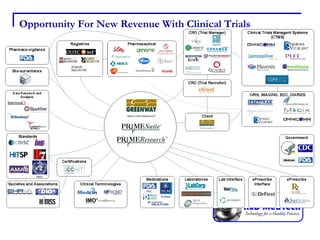
Opportunity For New Revenue With Clinical Trials
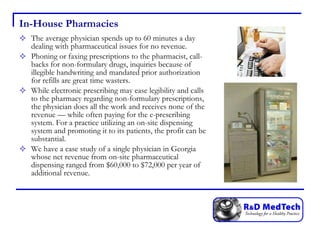
In-House Pharmacies The average physician spends up to 60 minutes a day dealing with pharmaceutical issues for no revenue.  Phoning or faxing prescriptions to the pharmacist, call-backs for non-formulary drugs, inquiries because of illegible handwriting and mandated prior authorization for refills are great time wasters.  While electronic prescribing may ease legibility and calls to the pharmacy regarding non-formulary prescriptions, the physician does all the work and receives none of the revenue — while often paying for the e-prescribing system. For a practice utilizing an on-site dispensing system and promoting it to its patients, the profit can be substantial.  We have a case study of a single physician in Georgia whose net revenue from on-site pharmaceutical dispensing ranged from $60,000 to $72,000 per year of additional revenue.
Questions? Contact:   Rob Raasch [email_address] 918-682-2285 www.RDMedTech.com

Stimulus Presentation

  • 1.
    Financial Incentives forEHR R&D MedTech
  • 2.
    Who Is R&DMed Tech? R&D Med Tech is an Oklahoma Limited Liability Corporation (LLC), located in Muskogee, Oklahoma that provides electronic health records software, services and support to physician practices. The company was formed by 2 principals.  Rob Raasch who has 15 years of experience as an executive in a publicly traded information technology services and management company.  David Edwards has 40 years of experience including owning medical practices and medical office support companies. In addition to the 2 principals, the company has employees who are experienced IT hardware and software professionals, certified trainers, help desk staff, experienced medical billing and collections professionals and a professional grant writer.
  • 3.
    Why R&D MedTechand Why Greenway? R&D MedTech provides local maintenance, training, help desk and hosting support. Greenway Medical’s PrimeSuite earned “Best In KLAS” honors in 2006, 2007, 2008 & 2009 So what is KLAS and why is it important for evaluating EHR software? KLAS measures performance of software, professional services, and medical equipment vendors. KLAS is like the Consumer Reports or J.D. Power rankings for EHR. KLAS is the only research firm that specializes in monitoring and reporting the performance of healthcare’s information technology (HIT) vendors. Greenway’s PrimeSuite was among the first EHRs to receive the 2011 Comprehensive CCHIT Certification in Ambulatory EHR from the Certification Commission for Healthcare Information Technology (CCHIT).
  • 4.
  • 5.
    Prime Suite Ourflagship application uses a single database to integrate the clinical, financial and administrative processes of your practice. This allows you to increase the quality of care you provide, enhance your patients satisfaction and maximize your practice’s profitability. The single database integration of EHR, practice management and interoperability functionality eliminates errors caused by duplicate data and interface-type systems.
  • 6.
    Template Summary Greenwayhas over 3000 Templates Over 30 Specialties and Subspecialties Developed by Board Certified Physicians
  • 7.
    Training When practiceslook to &quot;Go electronic&quot;, they reach for their most common real-life experiences to guide them, cognitively, about &quot;What is this going to take?&quot; : For most people, that's installing some software on their computer. The problem is, this experience is a poor model to understand EHR implementation : 1. It implies “This is something you can do with an instruction book and maybe a little help”. 2. It implies “This is something that is experienced at the computer, and the computer only.” 3. It implies “It generally takes a week or two to 'get really good' at it.” What it misses is : 1. EHR implementation means a THOROUGH examination of all of your clinical workflows and then in some cases, reorganizing them under a new electronic paradigm. 2. “Support” is NOT an instruction book, and NOT a 2-hour class, but a continuous, ongoing monitoring of physician, nurse, and practice management behaviors - And to achieve this requires an entire support mechanism of its own. 3. The 'learning curve' is often longer than anticipated. R&D MedTech believes there is a higher probability for a successful implementation if training is delivered in person as opposed to over the web or from a CD. Our trainers are certified by Greenway after intensive classroom and shadowing experiences.
  • 8.
    The $1.7M Opportunityof EHR $50,000 PQRI Financial Incentives $1,769,835 Total $360,000 In-House Pharmacy Revenue $500,000 Clinical Trial Revenue $250,000 Tax Incentive $44,000/$63,750 Medicare/Medicaid Stimulus $6,000 E-Prescribe Stimulus (2009-2010) $25,000 Malpractice Liability Insurance Discount $210,000 More Revenue Through Better Coding $216,300/$324,835 Practice Process Improvements Average Dollars Per Physician over 5 years Type of Cost Savings/New Revenue
  • 9.
    R&D Guarantee StimulusEligibility: Our guarantee removes the uncertainty that the Federal Stimulus Incentive Program has created about whether the Electronic Health Record (EHR) that your practice is selecting will meet the “meaningful use” and “certification” requirements under the HITECH Act. Quality of Service : This Program guarantees Top quality training and support by certified trainers, and a fully functional solution with swift and professional implementation.
  • 10.
    Meaningful Use Useof a certified (CCHIT) EHR for patient care documentation and for e-prescribing Connectivity to a health information exchange to help coordinate care with other providers Submit claims electronically to payers Check insurance eligibility electronically when possible Provide patients with timely electronic access to their health information Provide patients, upon request, with an electronic copy of their discharge instructions and procedures at the time of discharge The ability to submit information on quality measures (A list of the current quality measures is available upon request)
  • 11.
    Who is Eligiblefor Federal Stimulus Incentives? Medicare Eligible Professional Defined -- Section 1861(r): Doctor of Medicine Doctor of Osteopathy Doctor of Dental Surgery or Dental Medicine Doctor of Podiatric Medicine Doctor of Optometry Chiropractor* (Spine Subluxation)
  • 12.
    Medicare Eligible ProfessionalIncentives for Meaningful Use of Certified EHR ’ 09-10 Learn/ Install $18k 2011 2012 $12k $8k 2013 $4k $2k 2014 2015 Cumulative Annual Penalty Up to $44k per provider Physician must charge > $24K Medicare Part B in year one to hit max incentive * If <75% of physicians have “meaningful use” by 2018, HHS has provisions in the law to allow increases to the penalties up to a max of 5%. 3% 2017 and after 2% 2016 1% If Physician is e-prescriber 2% If Physician is not e-prescriber 2015 Medicare Penalties Calendar Year
  • 13.
    Who is Eligiblefor Federal Stimulus Incentives? Medicaid Eligible Professional Defined -- Physician Dentist Certified Nurse Mid-wife Nurse Practitioner Physician Assistant * (Rural Health Clinic/ FQHC)
  • 14.
    Medicaid Eligible ProfessionalIncentives for Meaningful Use of a Certified EHR Medicaid Penalties for No EHR *The Stimulus Package states Medicaid incentives could start as early as 2010 *Medicaid Incentives up to $63,750 for Uninsured, Rural, FQHC and Low-Income Providers/Eligible Professionals with a 30% Medicaid “population” or Pediatricians with at least a 20% Medicaid “population” . Pediatricians below 30% may be reimbursed at 2/3’s ($42,075) of the total allowable incentive. 2015 0% Penalty Reductions
  • 15.
    Greenway Experience onWhere Savings Are Generated A study revealed that an average four doctor practice is likely to recognize cost savings of $183,945 added to its annual bottom line after implementing Greenway’s PrimeSuite EHR. Statement Production $1,675 Billing Procedures $14,090 Management of Lab/Test Results $2,170 Documenting Patient Encounters - Dictation, transcription $32,147 Documenting Patient Encounters – Clerical $19,292 Documenting Patient Encounters – Clinical $13,279 Staffing Consideration $13,728 Financial Indicators Improvement (Collections) $84,059 Supply and Storage Expense $4,048 Chart Audit $228 Total Estimated Annual Opportunity Cost $183,945
  • 16.
    Increased Revenue ThroughImproved Coding In 2004, CMS reviewed about 160,000 claims from 2003 and uncovered $1 billion in underpayment, mostly by Part B carriers. According to the agency, 83.1 percent of all underpayment dollars were for E&M codes, and downcoding by one level was common. Nearly one-third of underpayment dollars resulted from these codes: 99241, 99212, 99211, and 99201. A study of fourteen small practices in the September/October 2005 edition of Health Affairs found that each physician could raise his/her revenue by as much $42,000 per year with increased coding levels resulting from implementation of EHR.
  • 17.
    EHR and MedicalLiability Insurance Discounts Malpractice insurance carriers are increasingly offering 2½ – 5% discounts to doctors for using an EHR in their practice . In 2007, the Certification Commission for Healthcare Information Technology (CCHIT) published an article advocating for lower malpractice insurance premiums for physicians who implement certified electronic health record (EHR) systems.  CCHIT asserted that physicians using certified EHR systems enhance the quality and safety of their care through: Improved aggregation, analysis and communication of patient information; Diagnostic and therapeutic decision support Prevention of adverse events (such as safeguards against prescribing drugs which interact with the patient's current medications) Clinical alerts and reminders; and Enhancing research on clinical quality improvement.
  • 18.
    E-Prescribe Incentives Thisincentive is separate from and is in addition to the quality reporting incentive program authorized by Division B of the Tax Relief and Health Care Act of 2006 – Medicare Improvements and Extension Act of 2006 (MIE-TRHCA) and known as the Physician Quality Reporting Initiative (PQRI). The government said Medicare is expected to save up to $156M over the five-year course of the program in avoided adverse drug events. The HHS pointed out estimates that as many 530,000 adverse drug events are reported every year by Medicare beneficiaries while the Institute of Medicine said that more than 1.5M Americans are injured each year by drug errors. 2% 1.5% 1% None None None Penalty None 0.5% 1% 1% 2% 2% Incentive Beyond 2013 2012 2011 2010 2009
  • 19.
    Physician Quality ReportingInitiative (PQRI) PQRI is a CMS sponsored program. Participating physicians in 2010 will be awarded 2% of their total Medicare Indemnity billings for the reporting period –an increase from 1.5% in 2008. 2010 179 Quality Measures 13 Measure Groups (Diabetes, Chronic Kidney Disease, Preventive Care, Rheumatoid Arthritis, Coronary Artery Bypass Graft (CABG), Back Pain, Perioperative Care, Hepatitis C, Heart Failure (HF), Coronary Artery Disease (CAD), Ischemic Vascular Disease (IVD), HIV/AIDS, Community-Acquired Pneumonia (CAP)) 2% Reimbursement -- Individual physicians and other eligible professionals who satisfactorily reported PQRI quality measures data and thus qualified for an incentive payment for the 2008 PQRI received incentives amounts from more than $1,000 to $98,000 in incentives.
  • 20.
    Tax Incentives TheHIRE ACT of 2010 (Hiring Incentives to Restore Employment) amended Section 179 of the Tax Code to increase the small business expense for qualified property to $250,000 through December 31, 2009. Thus, a medical practice can expense the full cost (up to $250,000) of its equipment/medical software purchase that purchased by 12/31/2010. Thus, your practice can expense the full amount of an EHR software purchase including software and hardware – and reduce your practice’s taxable income .
  • 21.
    Opportunities for NewRevenue Streams In addition, to the cost savings and opportunity for government incentive money, there are some new opportunities for a physician to generate revenue using EHR: Clinical Trials In-House Pharmacies
  • 22.
    Opportunity For NewRevenue With Clinical Trials
  • 23.
    In-House Pharmacies Theaverage physician spends up to 60 minutes a day dealing with pharmaceutical issues for no revenue. Phoning or faxing prescriptions to the pharmacist, call-backs for non-formulary drugs, inquiries because of illegible handwriting and mandated prior authorization for refills are great time wasters. While electronic prescribing may ease legibility and calls to the pharmacy regarding non-formulary prescriptions, the physician does all the work and receives none of the revenue — while often paying for the e-prescribing system. For a practice utilizing an on-site dispensing system and promoting it to its patients, the profit can be substantial. We have a case study of a single physician in Georgia whose net revenue from on-site pharmaceutical dispensing ranged from $60,000 to $72,000 per year of additional revenue.
  • 24.
    Questions? Contact: Rob Raasch [email_address] 918-682-2285 www.RDMedTech.com