In the Beginning . . .
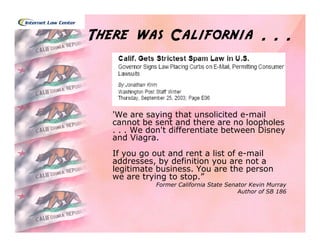
There was California . . .


   'We are saying that unsolicited e-mail
   cannot be sent and there are no loopholes
   . . . We don't differentiate between Disney
   and Viagra.
   If you go out and rent a list of e-mail
   addresses, by definition you are not a
   legitimate business. You are the person
   we are trying to stop.”
             Former California State Senator Kevin Murray
                                         Author of SB 186
84 Days Later

Controlling the   Solicited
                  Pornography
Assault of        And
Non-              Marketing Act

           Public Law
            108-187
CAN-SPAM Act of 2003
CAN-SPAM IS . . .          CAN-SPAM DOES NOT . . .

• An anti-fraud and        • “Can Spam” – except for
  disclosure statute         wireless spam
• Applies to an email      • Include a “Do Not Email
  where the “primary         Registry”
  purpose” is commercial
  advertisement or         • Impose an “ADV”
  promotion of a product     labeling requirement
  or service
                           • Create a general private
• No volume requirement      right of action
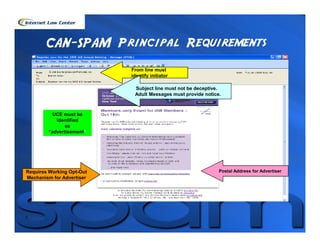
CAN-SPAM Principal Requirements
                           From line must
                           identify initiator

                            Subject line must not be deceptive.
                            Adult Messages must provide notice.


          UCE must be
           identified
               as
        “advertisement”


Requires Working Opt-Out                                      Postal Address for Advertiser
Mechanism for Advertiser
Topics
1. FTC Discretionary
   Regs
2. CAN-SPAM
   Plaintiffs
3. State Law &
   Preemption
4. Advertiser Liability
5. California
   Amendments
Regulatory Timeline
2004:   FTC Final Rule on Adult Labeling
        FCC CAN-SPAM Rules

2005:   FTC (1) Final Rule on Primary Purpose
        of Email; and (2) Proposed Discretionary Rules


2006:

2007:

2008:   FTC Final Discretionary Rules
Discretionary Regs
Definition of Valid Physical Address
• Accurately registered P.O. Box allowed


Opt-Out Requests Conditions or Expiration
• Cannot impose any conditions on opt-out requests
   – (e.g, fee or provide information)
• Abandons proposal to reduce processing time to 3 days
• Rejects call for expiration period for opt-out requests
Designated Sender Rule
                                  Must Be a
• Name must be in the “From”      Sender Under
  Line                            CAN-SPAM
• Must be Responsible for         Cannot designate
  CAN-SPAM compliance             Non-Sender

• Dropped requirement that
  Designated Sender be in
  control of the content or the
  mailing list used
CAN-SPAM Plaintiffs
          • FTC

          • State AGs

          • Internet Access Service
            Provider (IASP)
            – Adversely Effected by
              Violation

          • No Consumer Private
            Right of Action
Is the IASP Remedy a Trojan Horse?
                      Hypertouch v. Kennedy-
                      Western University
                     • Small, free service can qualify.
                     • Concern that Hypertouch is a
                       professional plaintiff can only be
                       addressed by Congress
                     • Opens door to litigation by anti-
                       spam activists as faux-IASPs


   Hypertouch and its principal have filed approx.
   40 cases under CAN-SPAM and/or California law
Is Gordon a Proper Plaintiff?
     • Gordon v. Virtumundo
       – Continued to use other people's e-
         mail addresses to collect spam . . .
         for generating lawsuit-fueled revenue

       – No harm related to
          •   Bandwidth
          •   Hardware
          •   Internet connectivity, network integrity
          •   Overhead, staffing or equipment costs
No!
• Not Plaintiff Congress
  had in mind – must       Followed in Cal
  demonstrate              Federal Court
  substantial harm         ASIS Internet
                           Services v. OPTIN
• Awards Defendant         Global
  Attorneys’ Fees – suit   (N.D. Cal. 2008)

  “ill-motivated,
  unreasonable, and
  frivolous”
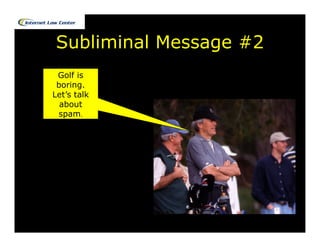
Subliminal Message #2
 Golf is
 boring.
Let’s talk
  about
 spam.
CAN-SPAM PREEMPTS ALL STATE
  REGULATION OF EMAIL EXCEPT STATE
  LAWS
• Regulating falsity or deception in email

• Not specific to email, including State trespass,
  contract, or tort law; or

• Other State laws to the extent that those laws
  relate to acts of fraud or computer crime
• Misrepresentation must be
  material

• States cannot dictate form
  of from line
  – Cannot prohibit use of multiple
    domains.

  – Not misleading to use non-
    corporate address where domain
    may be checked using “Who Is”

• State regulation must be
  based on traditional
  notions of fraud


• First Amendment requires
  that it not impinge non-
  commercial email
Preemption’s Back Door?
• Utah/Michigan
  Child Registry Laws
  – Makes sending prohibited email a
    “computer crime”
  – Free Speech Coalition, Inc. v. Shurtleff,
    Utah Federal Court refused to enjoin
    law finding it fell within exception for
    computer crime
     • DOJ filed brief supporting this position


• New Colorado Spam Law
  – Makes violation of CAN-SPAM a
    violation of state deceptive practices
    and computer fraud laws
  – Is this a backdoor to creating private
    right of action under CAN-SPAM?
Lessons from the Beehive State
                                     Registry Income/Expense ($000)


                                                                        $100
Liability              $150                       $133


                                                                                       Liabilities Exceed
                                                                                          Income 2-1
Income                    $187


            $0   $50          $100     $150    $200      $250    $300      $350      $400     $450

                       Registry Fees    Unspam Fees   Law Enforcement   Litigation Defense
“Sender” Liability
• FTC unsuccessful in
  seeking strict liability

• Advertiser liable if
  “actual knowledge, or by
  consciously avoiding
  knowing” about affiliate
  violations
   – Hypertouch v. Kennedy-
     Western University
     Strict anti-spam policies
     and policing of affiliates
     defeated allegation of
     intent.

   – ASIS Internet Services v.
     Opt-In Global, Inc.
     No duty to investigate
AB 2950
• Pushed by anti-spam activists who
  have filed over 100 suits
• Wish list
  – Advertiser liability
  – Prohibiting use of multiple domains
  – Tactics to evade email filters
  – Expand Plaintiffs to include District &
    City Attorneys
  – Venue
  – Restore Statute of Limitations to 3 Years
AB 2950
• Pushed by anti-spam activists who
  have filed over 100 suits
• Wish list


  – Expand Plaintiffs to include District &
    City Attorneys
  – Venue
  – Restore Statute of Limitations to 3 Years
AB 2950
• Pushed by anti-spam activists who
  have filed over 100 suits
• Wish list
  –

  – Expand Plaintiffs to include District &
    City Attorneys
  – Venue
  – Restore Statute of Limitations to 3 Years
Cases
Preemption                                 IASP Standing
• Omega World Travel, Inc. v.              • ASIS Internet Services, v. Optin
   Mummagraphics, Inc., 469 F.3d 348          Global, Inc., 2008 WL 1902217 (N.D.
   (4th Cir. 2006)                            Cal. March 27, 2008 )

•   Free Speech Coalition, Inc. v.         •   Gordon v. Virtumundo, Inc., supra.
    Shurtleff, No. 2:05CV949DAK, 2007
    U.S. Dist LEXIS 21556 (D. Utah Mar.    •   Hypertouch v. Kennedy-Western
    23, 2007)                                  University, 2006 WL 648688 (N.D. Cal.
                                               2006)
•   Kleffman v. Vonage Holding Corp.,
    Case No. CV 07-2406GAFJWJX (C.D.       No Strict Liability
    Cal. May 23, 2007)
                                           • ASIS Internet Services, v. Optin
                                              Global, Inc., supra.
•   Gordon v. Virtumundo, Inc., Case No.
    06-0204-JCC (W.D. Wash. May 15,
    2007)                                  •   US v. Implulse Marketing, No. CV05-
                                               1285RSL (W.D. Wash. June 8, 2007)
•   Virginia v. Jaynes, No. 062388 (Va.
    September 12, 2008)                    •   US v. Cyberheat, 2007 U.S. Dist.
                                               LEXIS 15448 (N.D. Ariz. 2007)
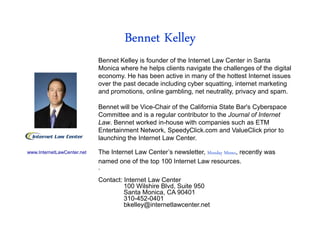
Bennet Kelley
                            Bennet Kelley is founder of the Internet Law Center in Santa
                            Monica where he helps clients navigate the challenges of the digital
                            economy. He has been active in many of the hottest Internet issues
                            over the past decade including cyber squatting, internet marketing
                            and promotions, online gambling, net neutrality, privacy and spam.

                            Bennet will be Vice-Chair of the California State Bar's Cyberspace
                            Committee and is a regular contributor to the Journal of Internet
                            Law. Bennet worked in-house with companies such as ETM
                            Entertainment Network, SpeedyClick.com and ValueClick prior to
                            launching the Internet Law Center.

www.InternetLawCenter.net   The Internet Law Center’s newsletter, Monday Memo, recently was
                            named one of the top 100 Internet Law resources.
                            .
                            Contact: Internet Law Center
                                     100 Wilshire Blvd, Suite 950
                                     Santa Monica, CA 90401
                                     310-452-0401
                                     bkelley@internetlawcenter.net
Future Presentations
October 14
• Online Advertising’s Year of Living
  Dangerously, California State Bar
  Cyberspace Committee (webinar)

November 3
• Email Compliance: Foundation of
  Reputation & Deliverability, Direct
  Marketing Association (New York)

November 21
• Affiliate & Direct Marketing, PMA
  Promotion Marketing Law Conference
  (Chicago)

Can Spam At 5

  • 2.
  • 3.
    There was California. . . 'We are saying that unsolicited e-mail cannot be sent and there are no loopholes . . . We don't differentiate between Disney and Viagra. If you go out and rent a list of e-mail addresses, by definition you are not a legitimate business. You are the person we are trying to stop.” Former California State Senator Kevin Murray Author of SB 186
  • 4.
    84 Days Later Controllingthe Solicited Pornography Assault of And Non- Marketing Act Public Law 108-187
  • 5.
    CAN-SPAM Act of2003 CAN-SPAM IS . . . CAN-SPAM DOES NOT . . . • An anti-fraud and • “Can Spam” – except for disclosure statute wireless spam • Applies to an email • Include a “Do Not Email where the “primary Registry” purpose” is commercial advertisement or • Impose an “ADV” promotion of a product labeling requirement or service • Create a general private • No volume requirement right of action
  • 6.
    CAN-SPAM Principal Requirements From line must identify initiator Subject line must not be deceptive. Adult Messages must provide notice. UCE must be identified as “advertisement” Requires Working Opt-Out Postal Address for Advertiser Mechanism for Advertiser
  • 7.
    Topics 1. FTC Discretionary Regs 2. CAN-SPAM Plaintiffs 3. State Law & Preemption 4. Advertiser Liability 5. California Amendments
  • 8.
    Regulatory Timeline 2004: FTC Final Rule on Adult Labeling FCC CAN-SPAM Rules 2005: FTC (1) Final Rule on Primary Purpose of Email; and (2) Proposed Discretionary Rules 2006: 2007: 2008: FTC Final Discretionary Rules
  • 9.
    Discretionary Regs Definition ofValid Physical Address • Accurately registered P.O. Box allowed Opt-Out Requests Conditions or Expiration • Cannot impose any conditions on opt-out requests – (e.g, fee or provide information) • Abandons proposal to reduce processing time to 3 days • Rejects call for expiration period for opt-out requests
  • 10.
    Designated Sender Rule Must Be a • Name must be in the “From” Sender Under Line CAN-SPAM • Must be Responsible for Cannot designate CAN-SPAM compliance Non-Sender • Dropped requirement that Designated Sender be in control of the content or the mailing list used
  • 11.
    CAN-SPAM Plaintiffs • FTC • State AGs • Internet Access Service Provider (IASP) – Adversely Effected by Violation • No Consumer Private Right of Action
  • 12.
    Is the IASPRemedy a Trojan Horse? Hypertouch v. Kennedy- Western University • Small, free service can qualify. • Concern that Hypertouch is a professional plaintiff can only be addressed by Congress • Opens door to litigation by anti- spam activists as faux-IASPs Hypertouch and its principal have filed approx. 40 cases under CAN-SPAM and/or California law
  • 13.
    Is Gordon aProper Plaintiff? • Gordon v. Virtumundo – Continued to use other people's e- mail addresses to collect spam . . . for generating lawsuit-fueled revenue – No harm related to • Bandwidth • Hardware • Internet connectivity, network integrity • Overhead, staffing or equipment costs
  • 14.
    No! • Not PlaintiffCongress had in mind – must Followed in Cal demonstrate Federal Court substantial harm ASIS Internet Services v. OPTIN • Awards Defendant Global Attorneys’ Fees – suit (N.D. Cal. 2008) “ill-motivated, unreasonable, and frivolous”
  • 15.
    Subliminal Message #2 Golf is boring. Let’s talk about spam.
  • 16.
    CAN-SPAM PREEMPTS ALLSTATE REGULATION OF EMAIL EXCEPT STATE LAWS • Regulating falsity or deception in email • Not specific to email, including State trespass, contract, or tort law; or • Other State laws to the extent that those laws relate to acts of fraud or computer crime
  • 17.
    • Misrepresentation mustbe material • States cannot dictate form of from line – Cannot prohibit use of multiple domains. – Not misleading to use non- corporate address where domain may be checked using “Who Is” • State regulation must be based on traditional notions of fraud • First Amendment requires that it not impinge non- commercial email
  • 18.
    Preemption’s Back Door? •Utah/Michigan Child Registry Laws – Makes sending prohibited email a “computer crime” – Free Speech Coalition, Inc. v. Shurtleff, Utah Federal Court refused to enjoin law finding it fell within exception for computer crime • DOJ filed brief supporting this position • New Colorado Spam Law – Makes violation of CAN-SPAM a violation of state deceptive practices and computer fraud laws – Is this a backdoor to creating private right of action under CAN-SPAM?
  • 19.
    Lessons from theBeehive State Registry Income/Expense ($000) $100 Liability $150 $133 Liabilities Exceed Income 2-1 Income $187 $0 $50 $100 $150 $200 $250 $300 $350 $400 $450 Registry Fees Unspam Fees Law Enforcement Litigation Defense
  • 20.
    “Sender” Liability • FTCunsuccessful in seeking strict liability • Advertiser liable if “actual knowledge, or by consciously avoiding knowing” about affiliate violations – Hypertouch v. Kennedy- Western University Strict anti-spam policies and policing of affiliates defeated allegation of intent. – ASIS Internet Services v. Opt-In Global, Inc. No duty to investigate
  • 21.
    AB 2950 • Pushedby anti-spam activists who have filed over 100 suits • Wish list – Advertiser liability – Prohibiting use of multiple domains – Tactics to evade email filters – Expand Plaintiffs to include District & City Attorneys – Venue – Restore Statute of Limitations to 3 Years
  • 22.
    AB 2950 • Pushedby anti-spam activists who have filed over 100 suits • Wish list – Expand Plaintiffs to include District & City Attorneys – Venue – Restore Statute of Limitations to 3 Years
  • 23.
    AB 2950 • Pushedby anti-spam activists who have filed over 100 suits • Wish list – – Expand Plaintiffs to include District & City Attorneys – Venue – Restore Statute of Limitations to 3 Years
  • 24.
    Cases Preemption IASP Standing • Omega World Travel, Inc. v. • ASIS Internet Services, v. Optin Mummagraphics, Inc., 469 F.3d 348 Global, Inc., 2008 WL 1902217 (N.D. (4th Cir. 2006) Cal. March 27, 2008 ) • Free Speech Coalition, Inc. v. • Gordon v. Virtumundo, Inc., supra. Shurtleff, No. 2:05CV949DAK, 2007 U.S. Dist LEXIS 21556 (D. Utah Mar. • Hypertouch v. Kennedy-Western 23, 2007) University, 2006 WL 648688 (N.D. Cal. 2006) • Kleffman v. Vonage Holding Corp., Case No. CV 07-2406GAFJWJX (C.D. No Strict Liability Cal. May 23, 2007) • ASIS Internet Services, v. Optin Global, Inc., supra. • Gordon v. Virtumundo, Inc., Case No. 06-0204-JCC (W.D. Wash. May 15, 2007) • US v. Implulse Marketing, No. CV05- 1285RSL (W.D. Wash. June 8, 2007) • Virginia v. Jaynes, No. 062388 (Va. September 12, 2008) • US v. Cyberheat, 2007 U.S. Dist. LEXIS 15448 (N.D. Ariz. 2007)
  • 25.
    Bennet Kelley Bennet Kelley is founder of the Internet Law Center in Santa Monica where he helps clients navigate the challenges of the digital economy. He has been active in many of the hottest Internet issues over the past decade including cyber squatting, internet marketing and promotions, online gambling, net neutrality, privacy and spam. Bennet will be Vice-Chair of the California State Bar's Cyberspace Committee and is a regular contributor to the Journal of Internet Law. Bennet worked in-house with companies such as ETM Entertainment Network, SpeedyClick.com and ValueClick prior to launching the Internet Law Center. www.InternetLawCenter.net The Internet Law Center’s newsletter, Monday Memo, recently was named one of the top 100 Internet Law resources. . Contact: Internet Law Center 100 Wilshire Blvd, Suite 950 Santa Monica, CA 90401 310-452-0401 bkelley@internetlawcenter.net
  • 26.
    Future Presentations October 14 •Online Advertising’s Year of Living Dangerously, California State Bar Cyberspace Committee (webinar) November 3 • Email Compliance: Foundation of Reputation & Deliverability, Direct Marketing Association (New York) November 21 • Affiliate & Direct Marketing, PMA Promotion Marketing Law Conference (Chicago)