Camera Angles, Shots,
Compositions and Movements
Camera
Shots
Extreme Long Shot
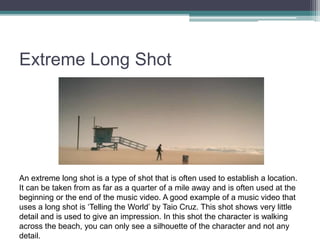
An extreme long shot is a type of shot that is often used to establish a location.
It can be taken from as far as a quarter of a mile away and is often used at the
beginning or the end of the music video. A good example of a music video that
uses a long shot is ‘Telling the World’ by Taio Cruz. This shot shows very little
detail and is used to give an impression. In this shot the character is walking
across the beach, you can only see a silhouette of the character and not any
detail.
Long Shot
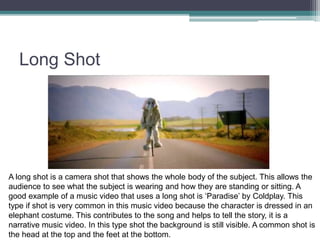
A long shot is a camera shot that shows the whole body of the subject. This allows the
audience to see what the subject is wearing and how they are standing or sitting. A
good example of a music video that uses a long shot is ‘Paradise’ by Coldplay. This
type if shot is very common in this music video because the character is dressed in an
elephant costume. This contributes to the song and helps to tell the story, it is a
narrative music video. In this type shot the background is still visible. A common shot is
the head at the top and the feet at the bottom.
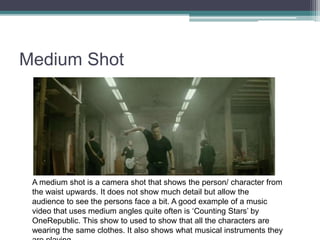
Medium Shot
A medium shot is a camera shot that shows the person/ character from
the waist upwards. It does not show much detail but allow the
audience to see the persons face a bit. A good example of a music
video that uses medium angles quite often is ‘Counting Stars’ by
OneRepublic. This show to used to show that all the characters are
wearing the same clothes. It also shows what musical instruments they
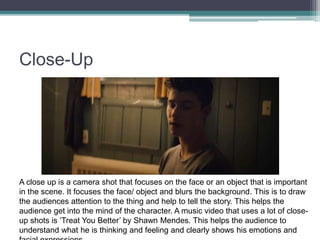
Close-Up
A close up is a camera shot that focuses on the face or an object that is important
in the scene. It focuses the face/ object and blurs the background. This is to draw
the audiences attention to the thing and help to tell the story. This helps the
audience get into the mind of the character. A music video that uses a lot of close-
up shots is ’Treat You Better’ by Shawn Mendes. This helps the audience to
understand what he is thinking and feeling and clearly shows his emotions and
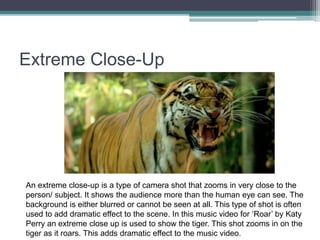
Extreme Close-Up
An extreme close-up is a type of camera shot that zooms in very close to the
person/ subject. It shows the audience more than the human eye can see. The
background is either blurred or cannot be seen at all. This type of shot is often
used to add dramatic effect to the scene. In this music video for ‘Roar’ by Katy
Perry an extreme close up is used to show the tiger. This shot zooms in on the
tiger as it roars. This adds dramatic effect to the music video.
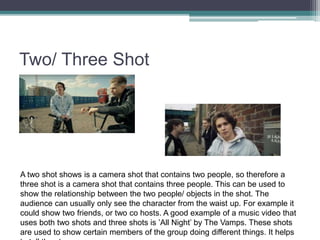
Two/ Three Shot
A two shot shows is a camera shot that contains two people, so therefore a
three shot is a camera shot that contains three people. This can be used to
show the relationship between the two people/ objects in the shot. The
audience can usually only see the character from the waist up. For example it
could show two friends, or two co hosts. A good example of a music video that
uses both two shots and three shots is ’All Night’ by The Vamps. These shots
are used to show certain members of the group doing different things. It helps
Camera
Angles
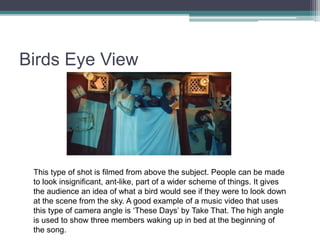
Birds Eye View
This type of shot is filmed from above the subject. People can be made
to look insignificant, ant-like, part of a wider scheme of things. It gives
the audience an idea of what a bird would see if they were to look down
at the scene from the sky. A good example of a music video that uses
this type of camera angle is ‘These Days’ by Take That. The high angle
is used to show three members waking up in bed at the beginning of
the song.
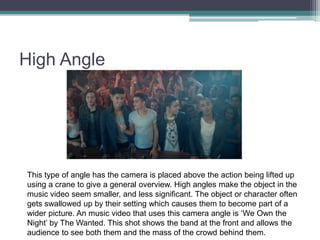
High Angle
This type of angle has the camera is placed above the action being lifted up
using a crane to give a general overview. High angles make the object in the
music video seem smaller, and less significant. The object or character often
gets swallowed up by their setting which causes them to become part of a
wider picture. An music video that uses this camera angle is ‘We Own the
Night’ by The Wanted. This shot shows the band at the front and allows the
audience to see both them and the mass of the crowd behind them.
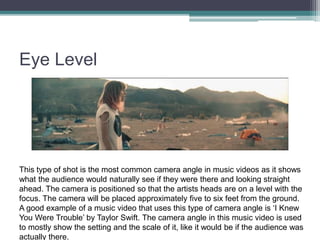
Eye Level
This type of shot is the most common camera angle in music videos as it shows
what the audience would naturally see if they were there and looking straight
ahead. The camera is positioned so that the artists heads are on a level with the
focus. The camera will be placed approximately five to six feet from the ground.
A good example of a music video that uses this type of camera angle is ‘I Knew
You Were Trouble’ by Taylor Swift. The camera angle in this music video is used
to mostly show the setting and the scale of it, like it would be if the audience was
actually there.
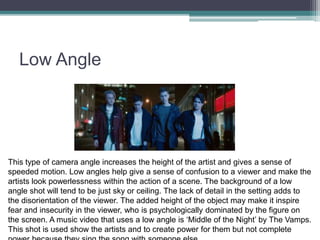
Low Angle
This type of camera angle increases the height of the artist and gives a sense of
speeded motion. Low angles help give a sense of confusion to a viewer and make the
artists look powerlessness within the action of a scene. The background of a low
angle shot will tend to be just sky or ceiling. The lack of detail in the setting adds to
the disorientation of the viewer. The added height of the object may make it inspire
fear and insecurity in the viewer, who is psychologically dominated by the figure on
the screen. A music video that uses a low angle is ‘Middle of the Night’ by The Vamps.
This shot is used show the artists and to create power for them but not complete
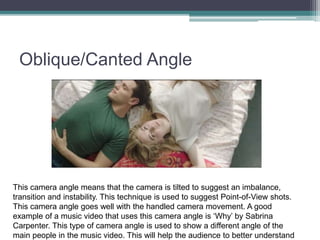
Oblique/Canted Angle
This camera angle means that the camera is tilted to suggest an imbalance,
transition and instability. This technique is used to suggest Point-of-View shots.
This camera angle goes well with the handled camera movement. A good
example of a music video that uses this camera angle is ‘Why’ by Sabrina
Carpenter. This type of camera angle is used to show a different angle of the
main people in the music video. This will help the audience to better understand
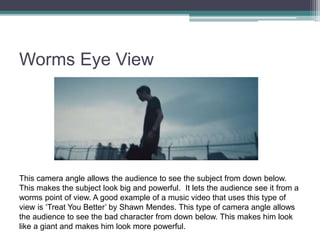
Worms Eye View
This camera angle allows the audience to see the subject from down below.
This makes the subject look big and powerful. It lets the audience see it from a
worms point of view. A good example of a music video that uses this type of
view is ‘Treat You Better’ by Shawn Mendes. This type of camera angle allows
the audience to see the bad character from down below. This makes him look
like a giant and makes him look more powerful.
Camera
Movement
s
Pan
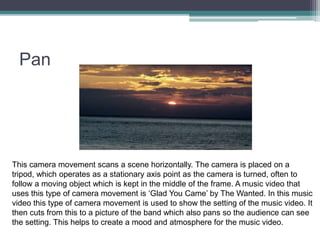
This camera movement scans a scene horizontally. The camera is placed on a
tripod, which operates as a stationary axis point as the camera is turned, often to
follow a moving object which is kept in the middle of the frame. A music video that
uses this type of camera movement is ‘Glad You Came’ by The Wanted. In this music
video this type of camera movement is used to show the setting of the music video. It
then cuts from this to a picture of the band which also pans so the audience can see
the setting. This helps to create a mood and atmosphere for the music video.
Tilt
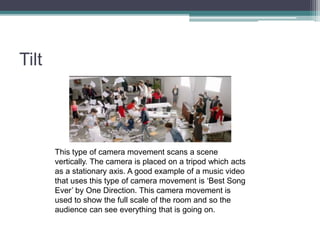
This type of camera movement scans a scene
vertically. The camera is placed on a tripod which acts
as a stationary axis. A good example of a music video
that uses this type of camera movement is ‘Best Song
Ever’ by One Direction. This camera movement is
used to show the full scale of the room and so the
audience can see everything that is going on.
Dolly/Tracking
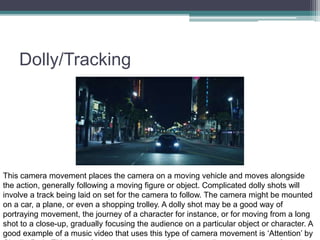
This camera movement places the camera on a moving vehicle and moves alongside
the action, generally following a moving figure or object. Complicated dolly shots will
involve a track being laid on set for the camera to follow. The camera might be mounted
on a car, a plane, or even a shopping trolley. A dolly shot may be a good way of
portraying movement, the journey of a character for instance, or for moving from a long
shot to a close-up, gradually focusing the audience on a particular object or character. A
good example of a music video that uses this type of camera movement is ‘Attention’ by
Handheld
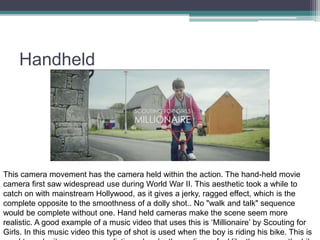
This camera movement has the camera held within the action. The hand-held movie
camera first saw widespread use during World War II. This aesthetic took a while to
catch on with mainstream Hollywood, as it gives a jerky, ragged effect, which is the
complete opposite to the smoothness of a dolly shot.. No "walk and talk" sequence
would be complete without one. Hand held cameras make the scene seem more
realistic. A good example of a music video that uses this is ‘Millionaire’ by Scouting for
Girls. In this music video this type of shot is used when the boy is riding his bike. This is
Crane
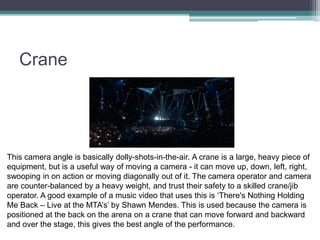
This camera angle is basically dolly-shots-in-the-air. A crane is a large, heavy piece of
equipment, but is a useful way of moving a camera - it can move up, down, left, right,
swooping in on action or moving diagonally out of it. The camera operator and camera
are counter-balanced by a heavy weight, and trust their safety to a skilled crane/jib
operator. A good example of a music video that uses this is ‘There's Nothing Holding
Me Back – Live at the MTA’s’ by Shawn Mendes. This is used because the camera is
positioned at the back on the arena on a crane that can move forward and backward
and over the stage, this gives the best angle of the performance.
Zoom
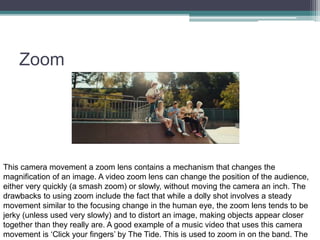
This camera movement a zoom lens contains a mechanism that changes the
magnification of an image. A video zoom lens can change the position of the audience,
either very quickly (a smash zoom) or slowly, without moving the camera an inch. The
drawbacks to using zoom include the fact that while a dolly shot involves a steady
movement similar to the focusing change in the human eye, the zoom lens tends to be
jerky (unless used very slowly) and to distort an image, making objects appear closer
together than they really are. A good example of a music video that uses this camera
movement is ‘Click your fingers’ by The Tide. This is used to zoom in on the band. The
Aerial
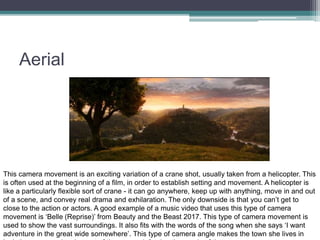
This camera movement is an exciting variation of a crane shot, usually taken from a helicopter. This
is often used at the beginning of a film, in order to establish setting and movement. A helicopter is
like a particularly flexible sort of crane - it can go anywhere, keep up with anything, move in and out
of a scene, and convey real drama and exhilaration. The only downside is that you can’t get to
close to the action or actors. A good example of a music video that uses this type of camera
movement is ‘Belle (Reprise)’ from Beauty and the Beast 2017. This type of camera movement is
used to show the vast surroundings. It also fits with the words of the song when she says ‘I want
adventure in the great wide somewhere’. This type of camera angle makes the town she lives in

Camera angle, shots, composititons and movements [autosaved] [autosaved] real one

  • 1.
  • 2.
  • 3.
    Extreme Long Shot Anextreme long shot is a type of shot that is often used to establish a location. It can be taken from as far as a quarter of a mile away and is often used at the beginning or the end of the music video. A good example of a music video that uses a long shot is ‘Telling the World’ by Taio Cruz. This shot shows very little detail and is used to give an impression. In this shot the character is walking across the beach, you can only see a silhouette of the character and not any detail.
  • 4.
    Long Shot A longshot is a camera shot that shows the whole body of the subject. This allows the audience to see what the subject is wearing and how they are standing or sitting. A good example of a music video that uses a long shot is ‘Paradise’ by Coldplay. This type if shot is very common in this music video because the character is dressed in an elephant costume. This contributes to the song and helps to tell the story, it is a narrative music video. In this type shot the background is still visible. A common shot is the head at the top and the feet at the bottom.
  • 5.
    Medium Shot A mediumshot is a camera shot that shows the person/ character from the waist upwards. It does not show much detail but allow the audience to see the persons face a bit. A good example of a music video that uses medium angles quite often is ‘Counting Stars’ by OneRepublic. This show to used to show that all the characters are wearing the same clothes. It also shows what musical instruments they
  • 6.
    Close-Up A close upis a camera shot that focuses on the face or an object that is important in the scene. It focuses the face/ object and blurs the background. This is to draw the audiences attention to the thing and help to tell the story. This helps the audience get into the mind of the character. A music video that uses a lot of close- up shots is ’Treat You Better’ by Shawn Mendes. This helps the audience to understand what he is thinking and feeling and clearly shows his emotions and
  • 7.
    Extreme Close-Up An extremeclose-up is a type of camera shot that zooms in very close to the person/ subject. It shows the audience more than the human eye can see. The background is either blurred or cannot be seen at all. This type of shot is often used to add dramatic effect to the scene. In this music video for ‘Roar’ by Katy Perry an extreme close up is used to show the tiger. This shot zooms in on the tiger as it roars. This adds dramatic effect to the music video.
  • 8.
    Two/ Three Shot Atwo shot shows is a camera shot that contains two people, so therefore a three shot is a camera shot that contains three people. This can be used to show the relationship between the two people/ objects in the shot. The audience can usually only see the character from the waist up. For example it could show two friends, or two co hosts. A good example of a music video that uses both two shots and three shots is ’All Night’ by The Vamps. These shots are used to show certain members of the group doing different things. It helps
  • 9.
  • 10.
    Birds Eye View Thistype of shot is filmed from above the subject. People can be made to look insignificant, ant-like, part of a wider scheme of things. It gives the audience an idea of what a bird would see if they were to look down at the scene from the sky. A good example of a music video that uses this type of camera angle is ‘These Days’ by Take That. The high angle is used to show three members waking up in bed at the beginning of the song.
  • 11.
    High Angle This typeof angle has the camera is placed above the action being lifted up using a crane to give a general overview. High angles make the object in the music video seem smaller, and less significant. The object or character often gets swallowed up by their setting which causes them to become part of a wider picture. An music video that uses this camera angle is ‘We Own the Night’ by The Wanted. This shot shows the band at the front and allows the audience to see both them and the mass of the crowd behind them.
  • 12.
    Eye Level This typeof shot is the most common camera angle in music videos as it shows what the audience would naturally see if they were there and looking straight ahead. The camera is positioned so that the artists heads are on a level with the focus. The camera will be placed approximately five to six feet from the ground. A good example of a music video that uses this type of camera angle is ‘I Knew You Were Trouble’ by Taylor Swift. The camera angle in this music video is used to mostly show the setting and the scale of it, like it would be if the audience was actually there.
  • 13.
    Low Angle This typeof camera angle increases the height of the artist and gives a sense of speeded motion. Low angles help give a sense of confusion to a viewer and make the artists look powerlessness within the action of a scene. The background of a low angle shot will tend to be just sky or ceiling. The lack of detail in the setting adds to the disorientation of the viewer. The added height of the object may make it inspire fear and insecurity in the viewer, who is psychologically dominated by the figure on the screen. A music video that uses a low angle is ‘Middle of the Night’ by The Vamps. This shot is used show the artists and to create power for them but not complete
  • 14.
    Oblique/Canted Angle This cameraangle means that the camera is tilted to suggest an imbalance, transition and instability. This technique is used to suggest Point-of-View shots. This camera angle goes well with the handled camera movement. A good example of a music video that uses this camera angle is ‘Why’ by Sabrina Carpenter. This type of camera angle is used to show a different angle of the main people in the music video. This will help the audience to better understand
  • 15.
    Worms Eye View Thiscamera angle allows the audience to see the subject from down below. This makes the subject look big and powerful. It lets the audience see it from a worms point of view. A good example of a music video that uses this type of view is ‘Treat You Better’ by Shawn Mendes. This type of camera angle allows the audience to see the bad character from down below. This makes him look like a giant and makes him look more powerful.
  • 16.
  • 17.
    Pan This camera movementscans a scene horizontally. The camera is placed on a tripod, which operates as a stationary axis point as the camera is turned, often to follow a moving object which is kept in the middle of the frame. A music video that uses this type of camera movement is ‘Glad You Came’ by The Wanted. In this music video this type of camera movement is used to show the setting of the music video. It then cuts from this to a picture of the band which also pans so the audience can see the setting. This helps to create a mood and atmosphere for the music video.
  • 18.
    Tilt This type ofcamera movement scans a scene vertically. The camera is placed on a tripod which acts as a stationary axis. A good example of a music video that uses this type of camera movement is ‘Best Song Ever’ by One Direction. This camera movement is used to show the full scale of the room and so the audience can see everything that is going on.
  • 19.
    Dolly/Tracking This camera movementplaces the camera on a moving vehicle and moves alongside the action, generally following a moving figure or object. Complicated dolly shots will involve a track being laid on set for the camera to follow. The camera might be mounted on a car, a plane, or even a shopping trolley. A dolly shot may be a good way of portraying movement, the journey of a character for instance, or for moving from a long shot to a close-up, gradually focusing the audience on a particular object or character. A good example of a music video that uses this type of camera movement is ‘Attention’ by
  • 20.
    Handheld This camera movementhas the camera held within the action. The hand-held movie camera first saw widespread use during World War II. This aesthetic took a while to catch on with mainstream Hollywood, as it gives a jerky, ragged effect, which is the complete opposite to the smoothness of a dolly shot.. No "walk and talk" sequence would be complete without one. Hand held cameras make the scene seem more realistic. A good example of a music video that uses this is ‘Millionaire’ by Scouting for Girls. In this music video this type of shot is used when the boy is riding his bike. This is
  • 21.
    Crane This camera angleis basically dolly-shots-in-the-air. A crane is a large, heavy piece of equipment, but is a useful way of moving a camera - it can move up, down, left, right, swooping in on action or moving diagonally out of it. The camera operator and camera are counter-balanced by a heavy weight, and trust their safety to a skilled crane/jib operator. A good example of a music video that uses this is ‘There's Nothing Holding Me Back – Live at the MTA’s’ by Shawn Mendes. This is used because the camera is positioned at the back on the arena on a crane that can move forward and backward and over the stage, this gives the best angle of the performance.
  • 22.
    Zoom This camera movementa zoom lens contains a mechanism that changes the magnification of an image. A video zoom lens can change the position of the audience, either very quickly (a smash zoom) or slowly, without moving the camera an inch. The drawbacks to using zoom include the fact that while a dolly shot involves a steady movement similar to the focusing change in the human eye, the zoom lens tends to be jerky (unless used very slowly) and to distort an image, making objects appear closer together than they really are. A good example of a music video that uses this camera movement is ‘Click your fingers’ by The Tide. This is used to zoom in on the band. The
  • 23.
    Aerial This camera movementis an exciting variation of a crane shot, usually taken from a helicopter. This is often used at the beginning of a film, in order to establish setting and movement. A helicopter is like a particularly flexible sort of crane - it can go anywhere, keep up with anything, move in and out of a scene, and convey real drama and exhilaration. The only downside is that you can’t get to close to the action or actors. A good example of a music video that uses this type of camera movement is ‘Belle (Reprise)’ from Beauty and the Beast 2017. This type of camera movement is used to show the vast surroundings. It also fits with the words of the song when she says ‘I want adventure in the great wide somewhere’. This type of camera angle makes the town she lives in