Calming the
Chaos at Work
JACKIE WOODSIDE, LICSW, CPC
WWW.JACKIEWOODSIDE.COM
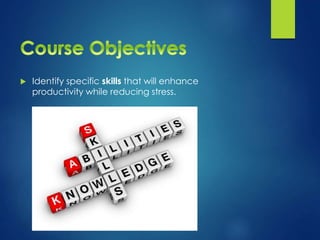
 Identify specific skills that will enhance
productivity while reducing stress.
 Apply a model of energetic consciousness to the
day-to-day experiences of time and stress.
 Identify specific behavioral patterns and ways of
thinking that reduce overall effectiveness and
productivity and add to the experience of stress
and burn out.
 Create an entirely new way of managing self-in-
time that dramatically reduces stress and
increases clarity, efficiency and productivity.
"A study by a researcher at the University of California,
San Diego says that by 2015, the sum of media asked for
and delivered to consumers would take more than
FIFTEEN HOURS PER DAY to see and hear!!
That is equal to 6.9 million gigabytes of information, or a
daily consumption of nine DVDs worth of data per
person per day."
90% of the world’s data was
generated in the last two years!
~Science Daily May 2013
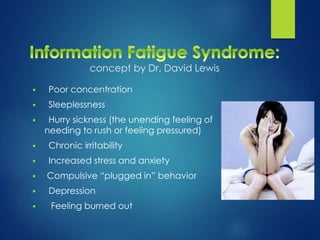
concept by Dr. David Lewis
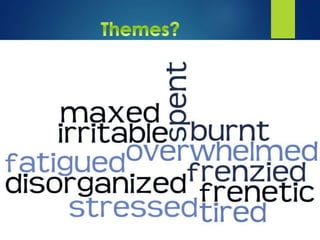
 Poor concentration
 Sleeplessness
 Hurry sickness (the unending feeling of
needing to rush or feeling pressured)
 Chronic irritability
 Increased stress and anxiety
 Compulsive “plugged in” behavior
 Depression
 Feeling burned out
80% of all American
workers
say they feel STRESS
on the job.
Gallup Poll
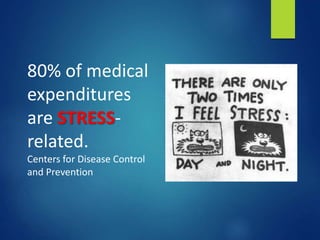
80% of medical
expenditures
are STRESS-
related.
Centers for Disease Control
and Prevention
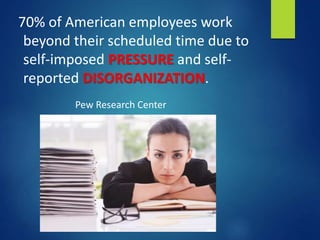
70% of American employees work
beyond their scheduled time due to
self-imposed PRESSURE and self-
reported DISORGANIZATION.
Pew Research Center
We are the most
OVERWEIGHT,
OVER
MEDICATED,
ADDICTED
generation in
history.
Dr. Brene Brown,
University of Houston
Top two deathbed
regrets:
I wish I spent MORE
TIME on what was
IMPORTANT TO ME.
I wish I didn’t WORK
SO HARD.
Bronnie Ware, “Top Five Regrets
of the Dying”
Calming the Chaos by managing
your PERSONAL ENERGY rather
than TIME or STRESS
Section II: A New Paradigm
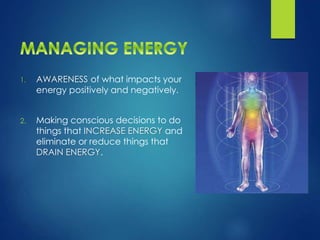
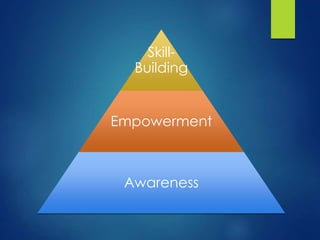
1. AWARENESS of what impacts your
energy positively and negatively.
2. Making conscious decisions to do
things that INCREASE ENERGY and
eliminate or reduce things that
DRAIN ENERGY.
3. Managing your work life by being
PRODUCTIVE rather than BUSY.
4. Employing HIGHER
CONSCIOUSNESS.
5. Employing SKILLS AND PRACTICES
that improve energy, mental clarity,
order and ease in life.
Skill-
Building
Empowerment
Awareness
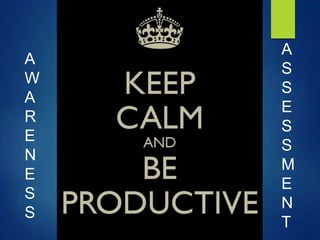
A
W
A
R
E
N
E
S
S
A
S
S
E
S
S
M
E
N
T
 Scattered
 Disorganized
 Random
 Reactive
 Stressed
 Overwhelmed
 Time as enemy
 Driven
 Anxious
 Confused
Psychological Payoffs of
Being
“Crazy Busy”
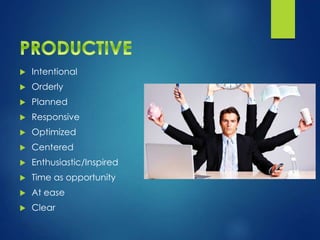
 Intentional
 Orderly
 Planned
 Responsive
 Optimized
 Centered
 Enthusiastic/Inspired
 Time as opportunity
 At ease
 Clear
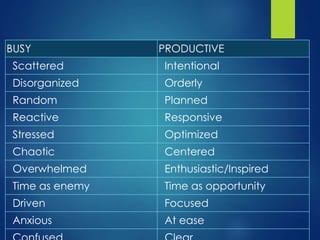
BUSY PRODUCTIVE
Scattered Intentional
Disorganized Orderly
Random Planned
Reactive Responsive
Stressed Optimized
Chaotic Centered
Overwhelmed Enthusiastic/Inspired
Time as enemy Time as opportunity
Driven Focused
Anxious At ease
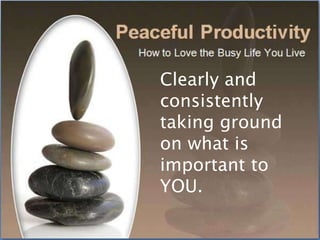
Clearly and
consistently
taking ground
on what is
important to
YOU.
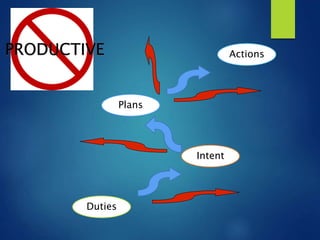
Duties
Intent
Plans
Actions
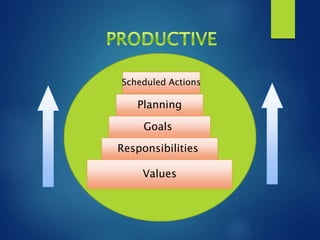
Planning
Values
Goals
Responsibilities
Scheduled Actions
Time To
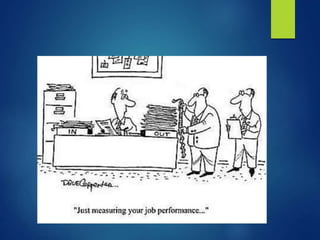
Assess My
Productivity
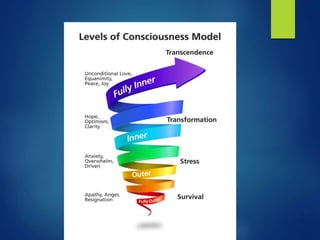
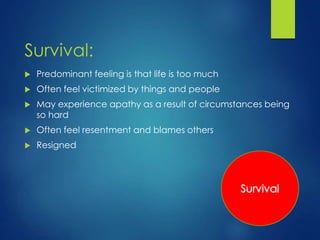
Survival:
 Predominant feeling is that life is too much
 Often feel victimized by things and people
 May experience apathy as a result of circumstances being
so hard
 Often feel resentment and blames others
 Resigned
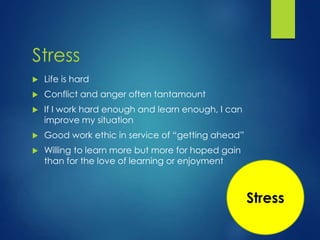
Stress
 Life is hard
 Conflict and anger often tantamount
 If I work hard enough and learn enough, I can
improve my situation
 Good work ethic in service of “getting ahead”
 Willing to learn more but more for hoped gain
than for the love of learning or enjoyment
Stress
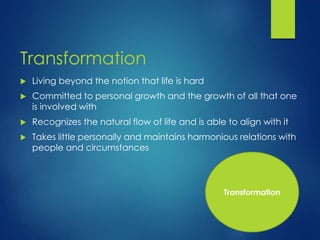
Transformation
 Living beyond the notion that life is hard
 Committed to personal growth and the growth of all that one
is involved with
 Recognizes the natural flow of life and is able to align with it
 Takes little personally and maintains harmonious relations with
people and circumstances
Transformation
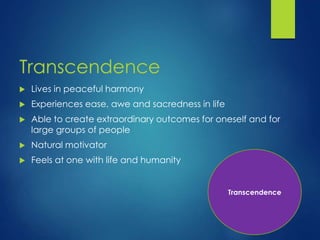
Transcendence
 Lives in peaceful harmony
 Experiences ease, awe and sacredness in life
 Able to create extraordinary outcomes for oneself and for
large groups of people
 Natural motivator
 Feels at one with life and humanity
Transcendence
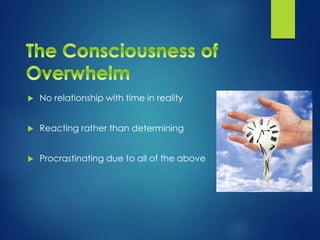
 Lack of planning
 Disorganization
 Information overload
 No relationship with time in reality
 Reacting rather than determining
 Procrastinating due to all of the above
A Disorganized Creates a
Disorganized
How much can you keep in your head?
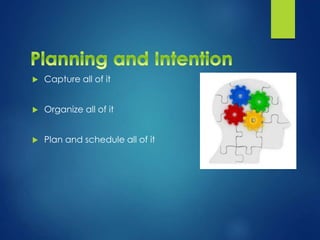
 Capture all of it
 Organize all of it
 Plan and schedule all of it
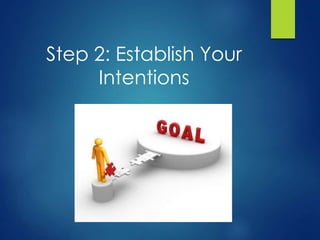
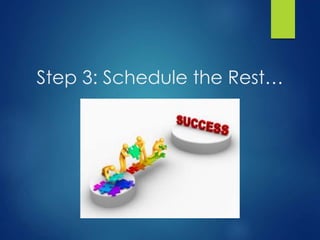
Step 1: Create Your Everything List
Step 2: Establish Your
Intentions
Step 3: Schedule the Rest…
THREE
STRIKES
RULE
END PROCRASTINATION NOW?
Ask Me How!
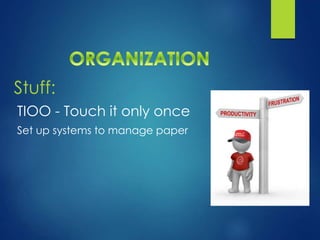
Stuff:
TIOO - Touch it only once
Set up systems to manage paper
Daily and weekly debrief
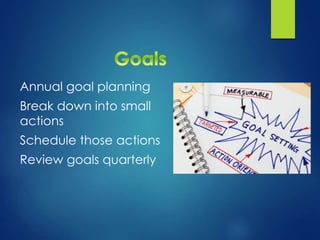
Annual goal planning
Break down into small
actions
Schedule those actions
Review goals quarterly
 Mindfulness, Present Moment Awareness
 Take Breaks Every Hour
 Manage Your Energy Boosters and Busters
 Elevate your Consciousness
 Laugh! Enjoy Your Coworkers and Your Work
 Practice Gratitude
What are you grateful for today?
What TWO things will you take away from this training
and begin implementing tomorrow?
“How often do you feel overwhelmed by the demands you place
on yourself and those placed on you by your family, friends, co-
workers, and life in general? The real problem is not everything
that’s being asked of you but forgetting that you have the
power to choose how you will respond to everything that’s
being asked of you. Claiming your ability to choose is the
dynamic difference between feeling pushed and pulled
around all the time and intentionally living – sometimes dancing
even – to the rhythm of holy empowerment.
This brings us to a fundamental question: Who is in charge of
your life?”
Kirk Byron Jones,
Addicted to Hurry
Thank you
for
Calming
the Chaos
in Your
Life!
I would love to hear from you!
www.JackieWoodside.com
Jackie@JackieWoodside.com or text me at 508-333-5520

Calming the chaos at work

  • 1.
    Calming the Chaos atWork JACKIE WOODSIDE, LICSW, CPC WWW.JACKIEWOODSIDE.COM
  • 2.
     Identify specificskills that will enhance productivity while reducing stress.
  • 3.
     Apply amodel of energetic consciousness to the day-to-day experiences of time and stress.
  • 4.
     Identify specificbehavioral patterns and ways of thinking that reduce overall effectiveness and productivity and add to the experience of stress and burn out.
  • 5.
     Create anentirely new way of managing self-in- time that dramatically reduces stress and increases clarity, efficiency and productivity.
  • 9.
    "A study bya researcher at the University of California, San Diego says that by 2015, the sum of media asked for and delivered to consumers would take more than FIFTEEN HOURS PER DAY to see and hear!! That is equal to 6.9 million gigabytes of information, or a daily consumption of nine DVDs worth of data per person per day."
  • 10.
    90% of theworld’s data was generated in the last two years! ~Science Daily May 2013
  • 11.
    concept by Dr.David Lewis  Poor concentration  Sleeplessness  Hurry sickness (the unending feeling of needing to rush or feeling pressured)  Chronic irritability  Increased stress and anxiety  Compulsive “plugged in” behavior  Depression  Feeling burned out
  • 12.
    80% of allAmerican workers say they feel STRESS on the job. Gallup Poll
  • 13.
    80% of medical expenditures areSTRESS- related. Centers for Disease Control and Prevention
  • 14.
    70% of Americanemployees work beyond their scheduled time due to self-imposed PRESSURE and self- reported DISORGANIZATION. Pew Research Center
  • 15.
    We are themost OVERWEIGHT, OVER MEDICATED, ADDICTED generation in history. Dr. Brene Brown, University of Houston
  • 16.
    Top two deathbed regrets: Iwish I spent MORE TIME on what was IMPORTANT TO ME. I wish I didn’t WORK SO HARD. Bronnie Ware, “Top Five Regrets of the Dying”
  • 19.
    Calming the Chaosby managing your PERSONAL ENERGY rather than TIME or STRESS Section II: A New Paradigm
  • 25.
    1. AWARENESS ofwhat impacts your energy positively and negatively. 2. Making conscious decisions to do things that INCREASE ENERGY and eliminate or reduce things that DRAIN ENERGY.
  • 26.
    3. Managing yourwork life by being PRODUCTIVE rather than BUSY. 4. Employing HIGHER CONSCIOUSNESS. 5. Employing SKILLS AND PRACTICES that improve energy, mental clarity, order and ease in life.
  • 27.
  • 28.
  • 31.
     Scattered  Disorganized Random  Reactive  Stressed  Overwhelmed  Time as enemy  Driven  Anxious  Confused
  • 33.
  • 34.
     Intentional  Orderly Planned  Responsive  Optimized  Centered  Enthusiastic/Inspired  Time as opportunity  At ease  Clear
  • 36.
    BUSY PRODUCTIVE Scattered Intentional DisorganizedOrderly Random Planned Reactive Responsive Stressed Optimized Chaotic Centered Overwhelmed Enthusiastic/Inspired Time as enemy Time as opportunity Driven Focused Anxious At ease
  • 38.
  • 39.
  • 40.
  • 41.
  • 44.
    Survival:  Predominant feelingis that life is too much  Often feel victimized by things and people  May experience apathy as a result of circumstances being so hard  Often feel resentment and blames others  Resigned
  • 45.
    Stress  Life ishard  Conflict and anger often tantamount  If I work hard enough and learn enough, I can improve my situation  Good work ethic in service of “getting ahead”  Willing to learn more but more for hoped gain than for the love of learning or enjoyment Stress
  • 46.
    Transformation  Living beyondthe notion that life is hard  Committed to personal growth and the growth of all that one is involved with  Recognizes the natural flow of life and is able to align with it  Takes little personally and maintains harmonious relations with people and circumstances Transformation
  • 47.
    Transcendence  Lives inpeaceful harmony  Experiences ease, awe and sacredness in life  Able to create extraordinary outcomes for oneself and for large groups of people  Natural motivator  Feels at one with life and humanity Transcendence
  • 51.
     Lack ofplanning  Disorganization  Information overload
  • 52.
     No relationshipwith time in reality  Reacting rather than determining  Procrastinating due to all of the above
  • 53.
    A Disorganized Createsa Disorganized
  • 54.
    How much canyou keep in your head?
  • 56.
     Capture allof it  Organize all of it  Plan and schedule all of it
  • 57.
    Step 1: CreateYour Everything List
  • 58.
    Step 2: EstablishYour Intentions
  • 59.
    Step 3: Schedulethe Rest…
  • 60.
  • 62.
    Stuff: TIOO - Touchit only once Set up systems to manage paper
  • 64.
  • 65.
    Annual goal planning Breakdown into small actions Schedule those actions Review goals quarterly
  • 66.
     Mindfulness, PresentMoment Awareness  Take Breaks Every Hour  Manage Your Energy Boosters and Busters  Elevate your Consciousness  Laugh! Enjoy Your Coworkers and Your Work  Practice Gratitude
  • 67.
    What are yougrateful for today?
  • 68.
    What TWO thingswill you take away from this training and begin implementing tomorrow?
  • 69.
    “How often doyou feel overwhelmed by the demands you place on yourself and those placed on you by your family, friends, co- workers, and life in general? The real problem is not everything that’s being asked of you but forgetting that you have the power to choose how you will respond to everything that’s being asked of you. Claiming your ability to choose is the dynamic difference between feeling pushed and pulled around all the time and intentionally living – sometimes dancing even – to the rhythm of holy empowerment. This brings us to a fundamental question: Who is in charge of your life?” Kirk Byron Jones, Addicted to Hurry
  • 70.
    Thank you for Calming the Chaos inYour Life! I would love to hear from you! www.JackieWoodside.com Jackie@JackieWoodside.com or text me at 508-333-5520