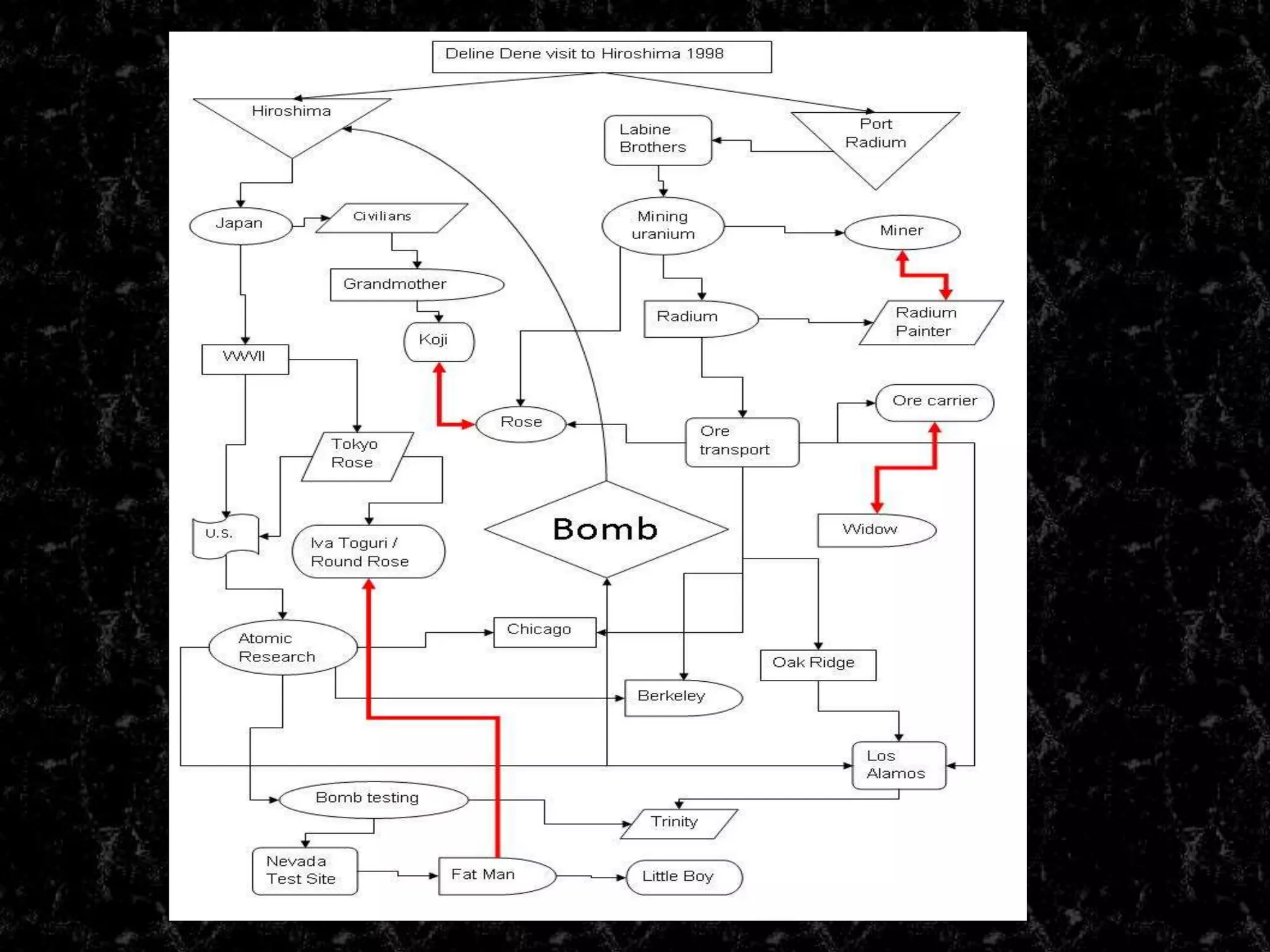
DelineDene visit Hiroshima, 1998“Recent investigations in the field of radium poisoning have led to the conclusion that precautions are necessary even in the handling of materials of low radioactivity. The ingestion of small amounts of radioactive dust or emanation [radon] over a long period of time will cause a build up of radioactive material in the body, which eventually may have serious consequences. Lung cancer, bone necrosis and rapid anemia are possible diseases due to deposition of radioactive substances in the cell tissue or bone structure of the body.” [Canada, Department of Mines, 1931]
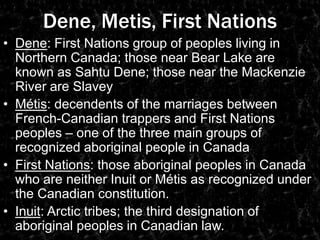
Dene, Metis, First NationsDene: First Nations group of peoples living in Northern Canada; those near Bear Lake are known as SahtuDene; those near the Mackenzie River are SlaveyMétis: decendents of the marriages between French-Canadian trappers and First Nations peoples – one of the three main groups of recognized aboriginal people in CanadaFirst Nations: those aboriginal peoples in Canada who are neither Inuit or Métis as recognized under the Canadian constitution.Inuit: Arctic tribes; the third designation of aboriginal peoples in Canadian law.
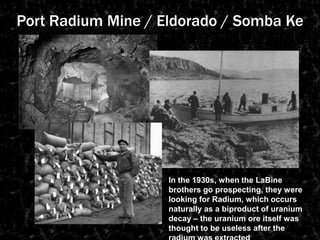
Port Radium Mine / Eldorado / SombaKeIn the 1930s, when the LaBine brothers go prospecting, they were looking for Radium, which occurs naturally as a biproduct of uranium decay – the uranium ore itself was thought to be useless after the radium was extracted
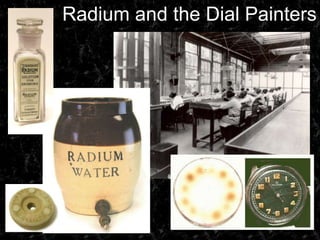
Radium and the Dial Painters
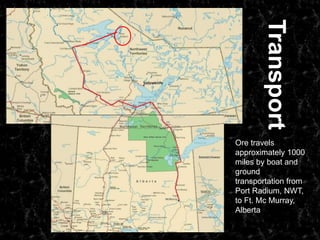
TransportOre travels approximately 1000 miles by boat and ground transportation from Port Radium, NWT, to Ft. Mc Murray, Alberta
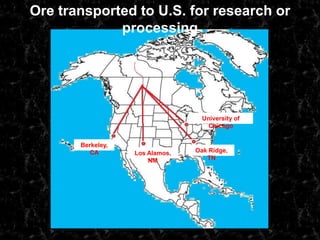
Ore transported to U.S. for research or processingUniversity of ChicagoBerkeley, CAOak Ridge, TNLos Alamos, NM
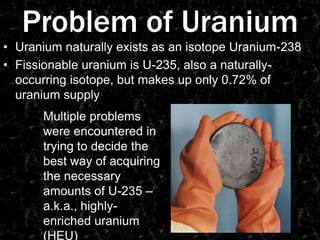
Problem of UraniumUranium naturally exists as an isotope Uranium-238Fissionable uranium is U-235, also a naturally-occurring isotope, but makes up only 0.72% of uranium supplyMultiple problems were encountered in trying to decide the best way of acquiring the necessary amounts of U-235 – a.k.a., highly-enriched uranium (HEU)
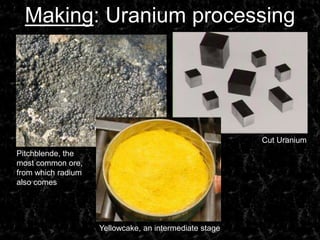
Making: Uranium processingCut UraniumPitchblende, the most common ore, from which radium also comesYellowcake, an intermediate stage
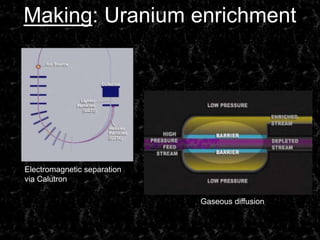
Making: Uranium enrichmentElectromagnetic separation via CalutronGaseous diffusion
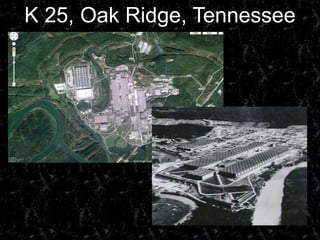
K 25, Oak Ridge, Tennessee
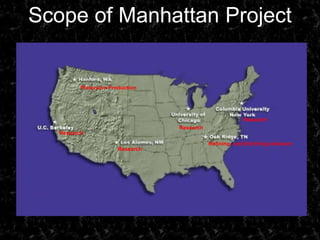
Scope of Manhattan ProjectPlutonium ProductionResearchResearchResearchRefining  and Enriching UraniumResearch
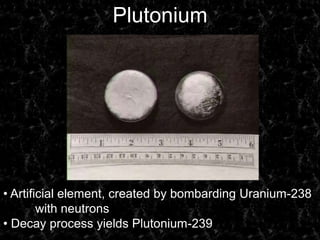
Plutonium Artificial element, created by bombarding Uranium-238        	with neutrons
 Decay process yields Plutonium-239A brief history: WWII1933 – Hitler is elected Chancellor of Germany, he quickly accumulates power until he secures a dictatorship1937 – Japanese invade Manchuria1938 – Germany annexes AustriaMarch, 1939 – Germany invades and annexes CzechoslovakiaSept. 1, 1939 – Germany invades Poland and war officially beginsMay, 1940 – Germany invades Benelux and France; Paris falls one month laterSeptember, 1940 – Tripartite Pact links Germany, Italy and Japan together as the “Axis”June, 1941 – Germany invades USSRDec. 7, 1941 – Japan bombs Pearl Harbor, US enters the war
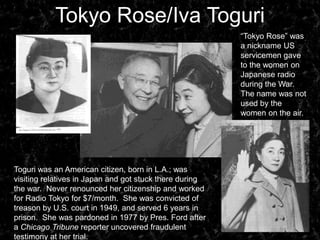
Tokyo Rose/Iva Toguri“Tokyo Rose” was a nickname US servicemen gave to the women on Japanese radio during the War.  The name was not used by the women on the air.Toguri was an American citizen, born in L.A.; was visiting relatives in Japan and got stuck there during the war.  Never renounced her citizenship and worked for Radio Tokyo for $7/month.  She was convicted of treason by U.S. court in 1949, and served 6 years in prison.  She was pardoned in 1977 by Pres. Ford after a Chicago Tribune reporter uncovered fraudulent testimony at her trial.
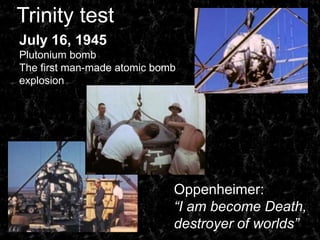
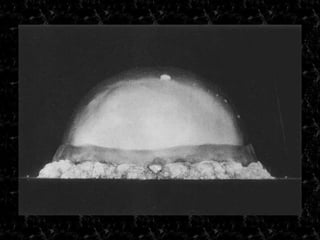
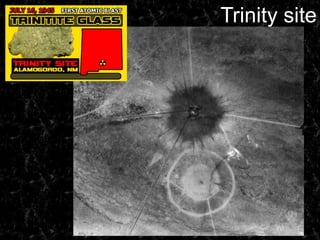
Trinity testJuly 16, 1945Plutonium bombThe first man-made atomic bomb explosionOppenheimer: “I am become Death, destroyer of worlds”
Trinity site
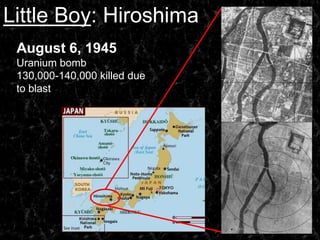
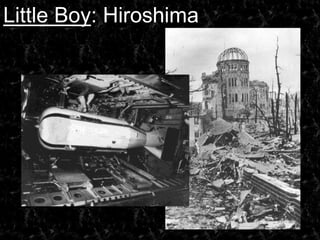
Little Boy: HiroshimaAugust 6, 1945Uranium bomb130,000-140,000 killed due to blast
Little Boy: Hiroshima
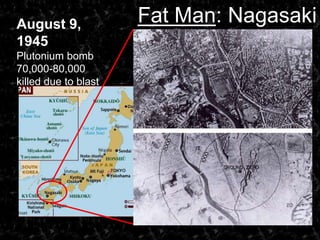
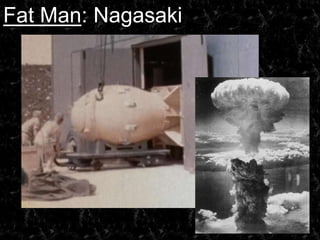
Fat Man: NagasakiAugust 9, 1945Plutonium bomb70,000-80,000 killed due to blast
Fat Man: Nagasaki
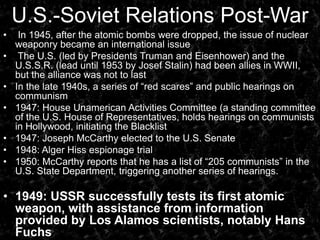
U.S.-Soviet Relations Post-War In 1945, after the atomic bombs were dropped, the issue of nuclear weaponry became an international issue The U.S. (led by Presidents Truman and Eisenhower) and the U.S.S.R. (lead until 1953 by Josef Stalin) had been allies in WWII, but the alliance was not to lastIn the late 1940s, a series of “red scares” and public hearings on communism1947: House Unamerican Activities Committee (a standing committee of the U.S. House of Representatives, holds hearings on communists in Hollywood, initiating the Blacklist1947: Joseph McCarthy elected to the U.S. Senate1948: Alger Hiss espionage trial1950: McCarthy reports that he has a list of “205 communists” in the U.S. State Department, triggering another series of hearings.1949: USSR successfully tests its first atomic weapon, with assistance from information provided by Los Alamos scientists, notably Hans Fuchs
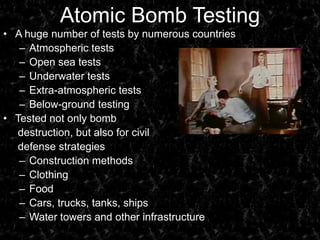
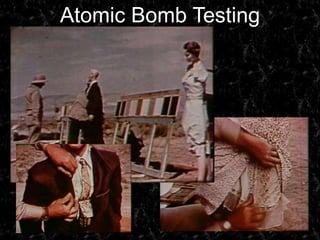
Atomic Bomb TestingA huge number of tests by numerous countriesAtmospheric testsOpen sea testsUnderwater testsExtra-atmospheric testsBelow-ground testingTested not only bomb      destruction, but also for civil      defense strategiesConstruction methodsClothingFoodCars, trucks, tanks, shipsWater towers and other infrastructure
Atomic Bomb Testing
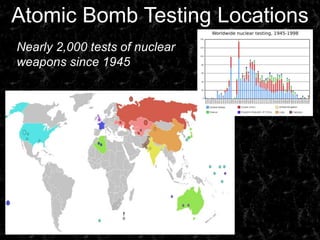
Atomic Bomb Testing LocationsNearly 2,000 tests of nuclear weapons since 1945
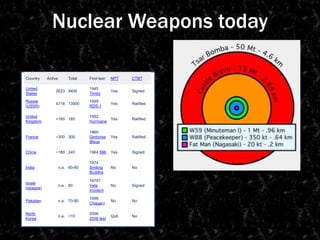
Nuclear Weapons today
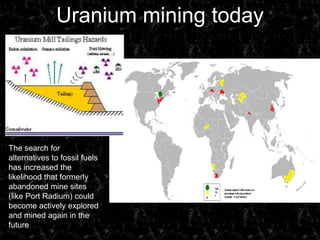
Uranium mining todayThe search for alternatives to fossil fuels has increased the likelihood that formerly abandoned mine sites (like Port Radium) could become actively explored and mined again in the future

Burning Vision Dramaturgy Presentation

  • 2.
    DelineDene visit Hiroshima,1998“Recent investigations in the field of radium poisoning have led to the conclusion that precautions are necessary even in the handling of materials of low radioactivity. The ingestion of small amounts of radioactive dust or emanation [radon] over a long period of time will cause a build up of radioactive material in the body, which eventually may have serious consequences. Lung cancer, bone necrosis and rapid anemia are possible diseases due to deposition of radioactive substances in the cell tissue or bone structure of the body.” [Canada, Department of Mines, 1931]
  • 3.
    Dene, Metis, FirstNationsDene: First Nations group of peoples living in Northern Canada; those near Bear Lake are known as SahtuDene; those near the Mackenzie River are SlaveyMétis: decendents of the marriages between French-Canadian trappers and First Nations peoples – one of the three main groups of recognized aboriginal people in CanadaFirst Nations: those aboriginal peoples in Canada who are neither Inuit or Métis as recognized under the Canadian constitution.Inuit: Arctic tribes; the third designation of aboriginal peoples in Canadian law.
  • 4.
    Port Radium Mine/ Eldorado / SombaKeIn the 1930s, when the LaBine brothers go prospecting, they were looking for Radium, which occurs naturally as a biproduct of uranium decay – the uranium ore itself was thought to be useless after the radium was extracted
  • 5.
    Radium and theDial Painters
  • 6.
    TransportOre travels approximately1000 miles by boat and ground transportation from Port Radium, NWT, to Ft. Mc Murray, Alberta
  • 7.
    Ore transported toU.S. for research or processingUniversity of ChicagoBerkeley, CAOak Ridge, TNLos Alamos, NM
  • 8.
    Problem of UraniumUraniumnaturally exists as an isotope Uranium-238Fissionable uranium is U-235, also a naturally-occurring isotope, but makes up only 0.72% of uranium supplyMultiple problems were encountered in trying to decide the best way of acquiring the necessary amounts of U-235 – a.k.a., highly-enriched uranium (HEU)
  • 9.
    Making: Uranium processingCutUraniumPitchblende, the most common ore, from which radium also comesYellowcake, an intermediate stage
  • 10.
    Making: Uranium enrichmentElectromagneticseparation via CalutronGaseous diffusion
  • 11.
    K 25, OakRidge, Tennessee
  • 12.
    Scope of ManhattanProjectPlutonium ProductionResearchResearchResearchRefining and Enriching UraniumResearch
  • 13.
    Plutonium Artificial element,created by bombarding Uranium-238 with neutrons
  • 14.
    Decay processyields Plutonium-239A brief history: WWII1933 – Hitler is elected Chancellor of Germany, he quickly accumulates power until he secures a dictatorship1937 – Japanese invade Manchuria1938 – Germany annexes AustriaMarch, 1939 – Germany invades and annexes CzechoslovakiaSept. 1, 1939 – Germany invades Poland and war officially beginsMay, 1940 – Germany invades Benelux and France; Paris falls one month laterSeptember, 1940 – Tripartite Pact links Germany, Italy and Japan together as the “Axis”June, 1941 – Germany invades USSRDec. 7, 1941 – Japan bombs Pearl Harbor, US enters the war
  • 15.
    Tokyo Rose/Iva Toguri“TokyoRose” was a nickname US servicemen gave to the women on Japanese radio during the War. The name was not used by the women on the air.Toguri was an American citizen, born in L.A.; was visiting relatives in Japan and got stuck there during the war. Never renounced her citizenship and worked for Radio Tokyo for $7/month. She was convicted of treason by U.S. court in 1949, and served 6 years in prison. She was pardoned in 1977 by Pres. Ford after a Chicago Tribune reporter uncovered fraudulent testimony at her trial.
  • 16.
    Trinity testJuly 16,1945Plutonium bombThe first man-made atomic bomb explosionOppenheimer: “I am become Death, destroyer of worlds”
  • 18.
  • 19.
    Little Boy: HiroshimaAugust6, 1945Uranium bomb130,000-140,000 killed due to blast
  • 20.
  • 21.
    Fat Man: NagasakiAugust9, 1945Plutonium bomb70,000-80,000 killed due to blast
  • 22.
  • 23.
    U.S.-Soviet Relations Post-WarIn 1945, after the atomic bombs were dropped, the issue of nuclear weaponry became an international issue The U.S. (led by Presidents Truman and Eisenhower) and the U.S.S.R. (lead until 1953 by Josef Stalin) had been allies in WWII, but the alliance was not to lastIn the late 1940s, a series of “red scares” and public hearings on communism1947: House Unamerican Activities Committee (a standing committee of the U.S. House of Representatives, holds hearings on communists in Hollywood, initiating the Blacklist1947: Joseph McCarthy elected to the U.S. Senate1948: Alger Hiss espionage trial1950: McCarthy reports that he has a list of “205 communists” in the U.S. State Department, triggering another series of hearings.1949: USSR successfully tests its first atomic weapon, with assistance from information provided by Los Alamos scientists, notably Hans Fuchs
  • 24.
    Atomic Bomb TestingAhuge number of tests by numerous countriesAtmospheric testsOpen sea testsUnderwater testsExtra-atmospheric testsBelow-ground testingTested not only bomb destruction, but also for civil defense strategiesConstruction methodsClothingFoodCars, trucks, tanks, shipsWater towers and other infrastructure
  • 25.
  • 26.
    Atomic Bomb TestingLocationsNearly 2,000 tests of nuclear weapons since 1945
  • 27.
  • 28.
    Uranium mining todayThesearch for alternatives to fossil fuels has increased the likelihood that formerly abandoned mine sites (like Port Radium) could become actively explored and mined again in the future