California - An OverviewBy Terrance Finley-Moore
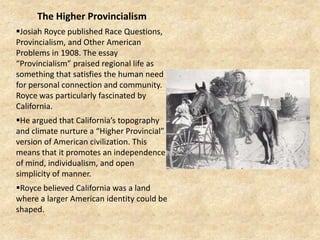
The Higher ProvincialismJosiah Royce published Race Questions, Provincialism, and Other American Problems in 1908. The essay “Provincialism” praised regional life as something that satisfies the human need for personal connection and community. Royce was particularly fascinated by California.
He argued that California’s topography and climate nurture a “Higher Provincial” version of American civilization. This means that it promotes an independence of mind, individualism, and open simplicity of manner.
Royce believed California was a land where a larger American identity could be shaped. The Higher ProvincialismSan Francisco grew as a western center of urbanism and artistic creativity throughout the 1860s.
Many notable writers published books in San Francisco, including Francis Bret Harte, Charles Warren Stoddard, and John Muir.
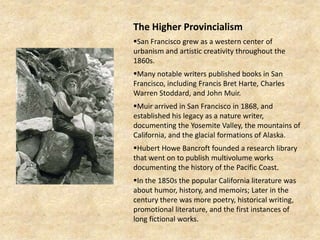
Muir arrived in San Francisco in 1868, and established his legacy as a nature writer, documenting the Yosemite Valley, the mountains of California, and the glacial formations of Alaska.
Hubert Howe Bancroft founded a research library that went on to publish multivolume works documenting the history of the Pacific Coast.
In the 1850s the popular California literature was about humor, history, and memoirs; Later in the century there was more poetry, historical writing, promotional literature, and the first instances of long fictional works.The Higher ProvincialismNorthern California became a very successful wheat producer in the 1870s and 1880s. California led the nation in wheat production until it was surpassed by Minnesota in the early 1890s.
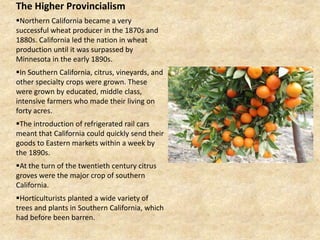
In Southern California, citrus, vineyards, and other specialty crops were grown. These were grown by educated, middle class, intensive farmers who made their living on forty acres.
The introduction of refrigerated rail cars meant that California could quickly send their goods to Eastern markets within a week by the 1890s.

California: An Overview

  • 1.
    California - AnOverviewBy Terrance Finley-Moore
  • 2.
    The Higher ProvincialismJosiahRoyce published Race Questions, Provincialism, and Other American Problems in 1908. The essay “Provincialism” praised regional life as something that satisfies the human need for personal connection and community. Royce was particularly fascinated by California.
  • 3.
    He argued thatCalifornia’s topography and climate nurture a “Higher Provincial” version of American civilization. This means that it promotes an independence of mind, individualism, and open simplicity of manner.
  • 4.
    Royce believed Californiawas a land where a larger American identity could be shaped. The Higher ProvincialismSan Francisco grew as a western center of urbanism and artistic creativity throughout the 1860s.
  • 5.
    Many notable writerspublished books in San Francisco, including Francis Bret Harte, Charles Warren Stoddard, and John Muir.
  • 6.
    Muir arrived inSan Francisco in 1868, and established his legacy as a nature writer, documenting the Yosemite Valley, the mountains of California, and the glacial formations of Alaska.
  • 7.
    Hubert Howe Bancroftfounded a research library that went on to publish multivolume works documenting the history of the Pacific Coast.
  • 8.
    In the 1850sthe popular California literature was about humor, history, and memoirs; Later in the century there was more poetry, historical writing, promotional literature, and the first instances of long fictional works.The Higher ProvincialismNorthern California became a very successful wheat producer in the 1870s and 1880s. California led the nation in wheat production until it was surpassed by Minnesota in the early 1890s.
  • 9.
    In Southern California,citrus, vineyards, and other specialty crops were grown. These were grown by educated, middle class, intensive farmers who made their living on forty acres.
  • 10.
    The introduction ofrefrigerated rail cars meant that California could quickly send their goods to Eastern markets within a week by the 1890s.