PERSONALIZING HUMAN INTERACTION THROUGH HYBRID ONTOLOGICAL PROFILING:  CULTURAL HERITAGE CASE STUDY Nima Dokoohaki , Mihhail Matskin Bangkok, Thailand, February 2nd 2009 First workshop on Semantic Web Applications and Human Aspects (SWAHA) Royal Institute of technology (KTH), Stockholm,  Sweden
Content Motivation Problem Description/Formulation Contribution User Profile Profile Structure Records (segments) Semantic network of user profile Extending CH ontologies with User keywords User Model ontology CH Metadata + Human User Metadata Conclusion/Future Work Questions
General Problem  Scenario: Constructing a Semantics-aided Museum (Cultural Heritage) knowledge Platform Clients are mobile devices which guide users through exhibit Goals: Improving structured, user behaviour and preference dependent access to cultural heritage repositories Approach taken:  User modelling and profiling Bringing personalised cultural experience closer to non-expert communities Approach taken: Personalization techniques; Collaborative Filtering  Recommender Systems
Contribution Need for a  hybrid  approach Allows description of the user attributes  Recording history of user access for personalized, adaptive and interactive experience Need for a generic  structure Structure that allows incorporation of all kinds of usage attributes [Domain independence] Weight(s) can be assigned to recorded materials [Weighted profiles] Structure that can be presented in [Interoperable] high level formats (OWL/RDF) low level formats (XML/Database)
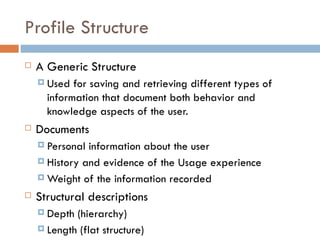
Profile Structure A Generic Structure Used for saving and retrieving different types of information that document both behavior and knowledge aspects of the user.  Documents  Personal information about the user  History and evidence of the Usage experience Weight of the information recorded Structural descriptions Depth (hierarchy)  Length (flat structure)
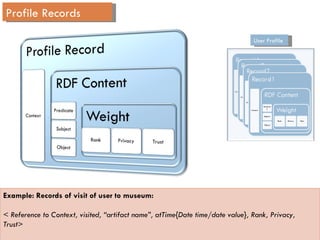
Profile Records Example: Records of visit of user to museum:  < Reference to Context, visited, “artifact name”, atTime{Date time/date value}, Rank, Privacy, Trust> <http://smartmuseum.eu/ns/context/weather#, visited, Venere, atDate 20081210 , 0.8, 0.5, 0.6> User Profile
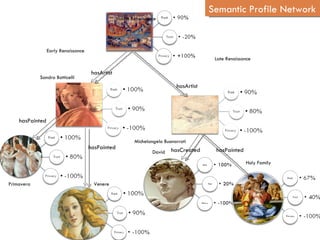
Italian Renaissance Sandro Botticelli Michelangelo Buonarroti  Primavera David Venere Holy Family Early Renaissance Late Renaissance Semantic Profile Network hasPainted hasArtist hasArtist hasCreated hasPainted hasPainted
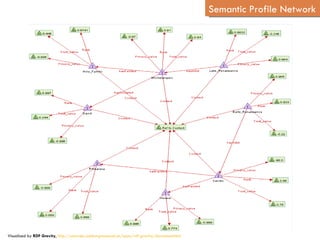
Semantic Profile Network Visualized by  RDF Gravity ,  http://semweb.salzburgresearch.at/apps/rdf-gravity/download.html
Improving personalization through cultural heritage extension with user model We can extend existing [legacy] cultural heritage keyword-set to contain Human attributes [extended] Construct a  user model  ontology   to describe attributes of our user The user model ontology concepts are used to expand legacy concepts for cultural heritage Aim :  Improving recommendations (information retrieved on user’s behalf) Through query expansion Expanded query contains user attributes (profiles)  Efficient individual/group matchmaking  Similar instances are on both sides item instances and user profiles
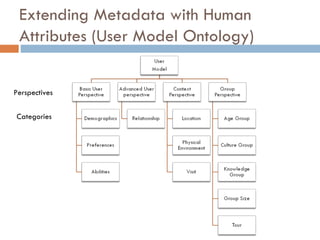
Extending Metadata with Human Attributes (User Model Ontology) Perspectives Categories
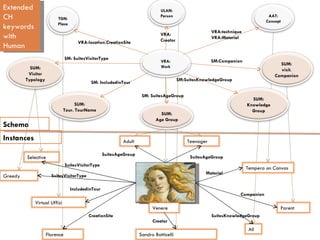
Schema Instances VRA:technique VRA:Material VRA: Creator VRA:location.CreationSite SM: SuitesAgeGroup SM:SuitesKnowledgeGroup SM: IncludedinTour SM: SuitesVisitorType SM:Companion IncludedinTour SuitesVisitorType SuitesVisitorType CreationSite Creator Material SuitesKnowledgeGroup Companion SuitesAgeGroup SuitesAgeGroup Extended  CH keywords with Human All SUM: Age Group SUM: Knowledge Group TGN: Place ULAN: Person AAT: Concept VRA: Work SUM: Tour. TourName SUM: Visitor Typology SUM: visit. Companion Greedy Virtual Uffizi Florence Adult Sandro Botticelli Venere Tempera on Canvas Teenager Selective Parent
Conclusion / Future work Conclusions User Behavior models ( Profiling / Modeling) seem to become dominant approaches in  addressing problems of  altering structure of human-system interactions, specifying and presenting of preferences of human users Personalization techniques seem to become dominant approaches in information dissemination Future work Focused study of personalization effect based on profile/model Implementing personalization services based on user profile/model Recommendation [ongoing] Improving existing recommendation based on weight values [ongoing]
Questions ?
Thank you ! Nima Dokoohaki School of Information and Communications Technology (ICT ), Royal Institute of Technology ( KTH ), Stockholm, Sweden Office: +46 (0) 8 790 4149 Cell : +46 (0) 76 269 76 30 Fax: +46 (0) 8 751 1793  [email_address] http://web.it.kth.se/~nimad/

SWAHA08 - Personalizing Human Interaction through Hybrid Ontological Profiling: Cultural Heritage Case Study

  • 1.
    PERSONALIZING HUMAN INTERACTIONTHROUGH HYBRID ONTOLOGICAL PROFILING: CULTURAL HERITAGE CASE STUDY Nima Dokoohaki , Mihhail Matskin Bangkok, Thailand, February 2nd 2009 First workshop on Semantic Web Applications and Human Aspects (SWAHA) Royal Institute of technology (KTH), Stockholm, Sweden
  • 2.
    Content Motivation ProblemDescription/Formulation Contribution User Profile Profile Structure Records (segments) Semantic network of user profile Extending CH ontologies with User keywords User Model ontology CH Metadata + Human User Metadata Conclusion/Future Work Questions
  • 3.
    General Problem Scenario: Constructing a Semantics-aided Museum (Cultural Heritage) knowledge Platform Clients are mobile devices which guide users through exhibit Goals: Improving structured, user behaviour and preference dependent access to cultural heritage repositories Approach taken: User modelling and profiling Bringing personalised cultural experience closer to non-expert communities Approach taken: Personalization techniques; Collaborative Filtering Recommender Systems
  • 4.
    Contribution Need fora hybrid approach Allows description of the user attributes Recording history of user access for personalized, adaptive and interactive experience Need for a generic structure Structure that allows incorporation of all kinds of usage attributes [Domain independence] Weight(s) can be assigned to recorded materials [Weighted profiles] Structure that can be presented in [Interoperable] high level formats (OWL/RDF) low level formats (XML/Database)
  • 5.
    Profile Structure AGeneric Structure Used for saving and retrieving different types of information that document both behavior and knowledge aspects of the user. Documents Personal information about the user History and evidence of the Usage experience Weight of the information recorded Structural descriptions Depth (hierarchy) Length (flat structure)
  • 6.
    Profile Records Example:Records of visit of user to museum: < Reference to Context, visited, “artifact name”, atTime{Date time/date value}, Rank, Privacy, Trust> <http://smartmuseum.eu/ns/context/weather#, visited, Venere, atDate 20081210 , 0.8, 0.5, 0.6> User Profile
  • 7.
    Italian Renaissance SandroBotticelli Michelangelo Buonarroti Primavera David Venere Holy Family Early Renaissance Late Renaissance Semantic Profile Network hasPainted hasArtist hasArtist hasCreated hasPainted hasPainted
  • 8.
    Semantic Profile NetworkVisualized by RDF Gravity , http://semweb.salzburgresearch.at/apps/rdf-gravity/download.html
  • 9.
    Improving personalization throughcultural heritage extension with user model We can extend existing [legacy] cultural heritage keyword-set to contain Human attributes [extended] Construct a user model ontology to describe attributes of our user The user model ontology concepts are used to expand legacy concepts for cultural heritage Aim : Improving recommendations (information retrieved on user’s behalf) Through query expansion Expanded query contains user attributes (profiles) Efficient individual/group matchmaking Similar instances are on both sides item instances and user profiles
  • 10.
    Extending Metadata withHuman Attributes (User Model Ontology) Perspectives Categories
  • 11.
    Schema Instances VRA:techniqueVRA:Material VRA: Creator VRA:location.CreationSite SM: SuitesAgeGroup SM:SuitesKnowledgeGroup SM: IncludedinTour SM: SuitesVisitorType SM:Companion IncludedinTour SuitesVisitorType SuitesVisitorType CreationSite Creator Material SuitesKnowledgeGroup Companion SuitesAgeGroup SuitesAgeGroup Extended CH keywords with Human All SUM: Age Group SUM: Knowledge Group TGN: Place ULAN: Person AAT: Concept VRA: Work SUM: Tour. TourName SUM: Visitor Typology SUM: visit. Companion Greedy Virtual Uffizi Florence Adult Sandro Botticelli Venere Tempera on Canvas Teenager Selective Parent
  • 12.
    Conclusion / Futurework Conclusions User Behavior models ( Profiling / Modeling) seem to become dominant approaches in addressing problems of altering structure of human-system interactions, specifying and presenting of preferences of human users Personalization techniques seem to become dominant approaches in information dissemination Future work Focused study of personalization effect based on profile/model Implementing personalization services based on user profile/model Recommendation [ongoing] Improving existing recommendation based on weight values [ongoing]
  • 13.
  • 14.
    Thank you !Nima Dokoohaki School of Information and Communications Technology (ICT ), Royal Institute of Technology ( KTH ), Stockholm, Sweden Office: +46 (0) 8 790 4149 Cell : +46 (0) 76 269 76 30 Fax: +46 (0) 8 751 1793 [email_address] http://web.it.kth.se/~nimad/