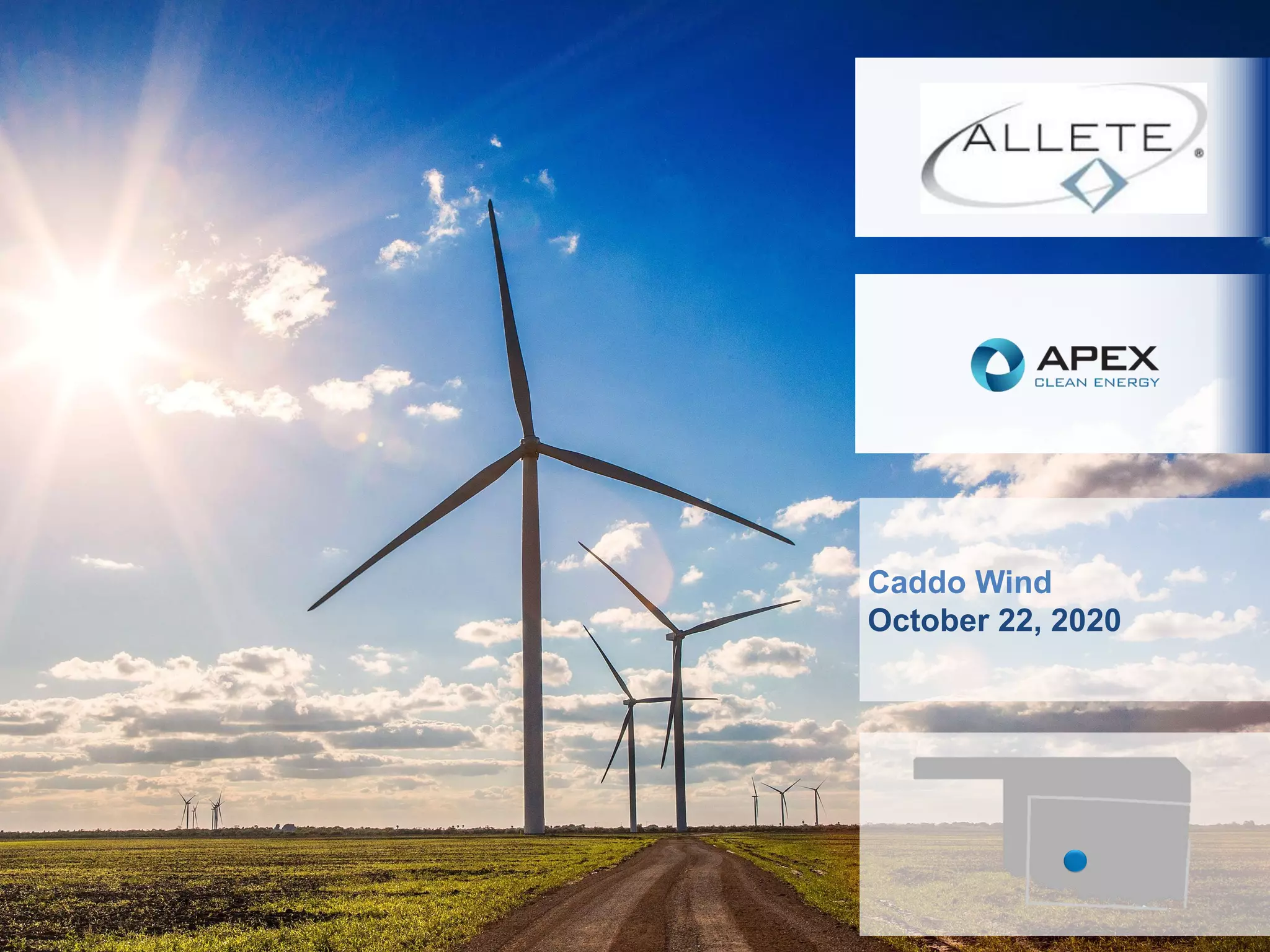
Caddo Wind
October 22, 2020
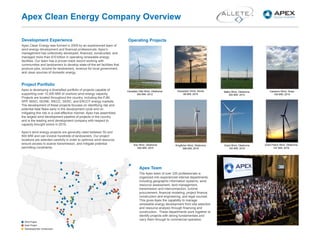
Apex Clean Energy Company Overview
Project Portfolio
Apex is developing a diversified portfolio of projects capable of
supporting over 12,000 MW of onshore wind energy capacity.
Projects are located throughout the country, including the PJM,
SPP, MISO, ISONE, WECC, SERC, and ERCOT energy markets.
The development of these projects focuses on identifying risk and
potential fatal flaws early in the development cycle and on
mitigating this risk in a cost-effective manner. Apex has assembled
the largest wind development pipeline of projects in the country
and is the leading wind development company with respect to
capacity brought online in 2015.
Apex’s wind energy projects are generally rated between 50 and
500 MW and can involve hundreds of landowners. Our project
locations are selected carefully in order to optimize wind resource,
ensure access to scarce transmission, and mitigate potential
permitting constraints.
Apex Team
The Apex team of over 230 professionals is
organized into experienced internal departments,
including geographic information systems, wind
resource assessment, land management,
transmission and interconnection, turbine
procurement, financial modeling, project finance,
construction and engineering, and legal counsel.
This gives Apex the capability to manage
renewable energy development from site selection
and resource analysis through financing and
construction. These departments work together to
identify projects with strong fundamentals and
carry them through to commercial operation.
Development Experience
Apex Clean Energy was formed in 2009 by an experienced team of
wind energy development and financial professionals. Apex’s
management has collectively developed, financed, constructed, and
managed more than $10 billion in operating renewable energy
facilities. Our team has a proven track record working with
communities and landowners to develop state-of-the-art facilities that
produce jobs, income for landowners, revenue for local government,
and clean sources of domestic energy.
Operating Projects
Cameron Wind, Texas
165 MW, 2015
Hoopeston Wind, Illinois
98 MW, 2015
Canadian Hills Wind, Oklahoma
300 MW, 2012
Wind Project
Solar Project
Operating/Under Construction
Kay Wind, Oklahoma
300 MW, 2015
Kingfisher Wind, Oklahoma
298 MW, 2016
Balko Wind, Oklahoma
300 MW, 2015
Grant Wind, Oklahoma
152 MW, 2016
Grant Plains Wind, Oklahoma
147 MW, 2016
Confidential
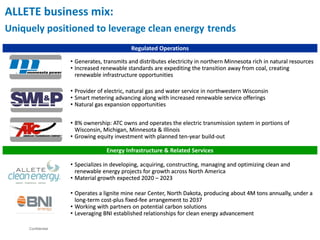
ALLETE business mix:
Uniquely positioned to leverage clean energy trends
Regulated Operations
• Generates, transmits and distributes electricity in northern Minnesota rich in natural resources
• Increased renewable standards are expediting the transition away from coal, creating
renewable infrastructure opportunities
• Provider of electric, natural gas and water service in northwestern Wisconsin
• Smart metering advancing along with increased renewable service offerings
• Natural gas expansion opportunities
• 8% ownership: ATC owns and operates the electric transmission system in portions of
Wisconsin, Michigan, Minnesota & Illinois
• Growing equity investment with planned ten-year build-out
• Specializes in developing, acquiring, constructing, managing and optimizing clean and
renewable energy projects for growth across North America
• Material growth expected 2020 – 2023
• Operates a lignite mine near Center, North Dakota, producing about 4M tons annually, under a
long-term cost-plus fixed-fee arrangement to 2037
• Working with partners on potential carbon solutions
• Leveraging BNI established relationships for clean energy advancement
Energy Infrastructure & Related Services
Expanding suite of product offerings and solutions
Increasing geographic and customer demographic footprint
Continue to enhance portfolio, diversity and performance
Leveraging strong reputation and brand in the industry
Material expansion and scaling over the next 36 months
Confidential
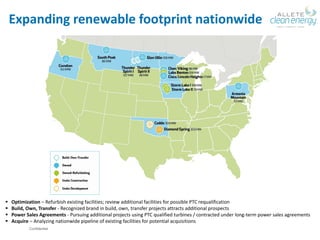
Expanding renewable footprint nationwide
▪ Optimization – Refurbish existing facilities; review additional facilities for possible PTC requalification
▪ Build, Own, Transfer - Recognized brand in build, own, transfer projects attracts additional prospects
▪ Power Sales Agreements - Pursuing additional projects using PTC qualified turbines / contracted under long-term power sales agreements
▪ Acquire – Analyzing nationwide pipeline of existing facilities for potential acquisitions
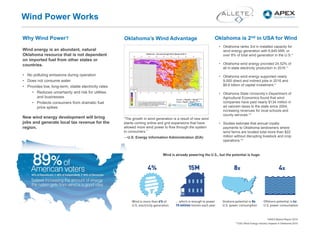
Wind Power Works
Why Wind Power?
Wind energy is an abundant, natural
Oklahoma resource that is not dependent
on imported fuel from other states or
countries.
• No polluting emissions during operation
• Does not consume water
• Provides low, long-term, stable electricity rates
• Reduces uncertainty and risk for utilities
and businesses
• Protects consumers from dramatic fuel
price spikes
New wind energy development will bring
jobs and generate local tax revenue for the
region.
Oklahoma’s Wind Advantage Oklahoma is 2nd in USA for Wind
• Oklahoma ranks 3rd in installed capacity for
wind energy generation with 6,645 MW, or
over 8% of total wind generation in the U.S.*
• Oklahoma wind energy provided 24.52% of
all in-state electricity production in 2016.*
• Oklahoma wind energy supported nearly
9,000 direct and indirect jobs in 2016 and
$9.6 billion of capital investment.*
• Oklahoma State University’s Department of
Agricultural Economics found that wind
companies have paid nearly $134 million in
ad valorem taxes to the state since 2004,
increasing revenues for local schools and
county services.**
• Studies estimate that annual royalty
payments to Oklahoma landowners where
wind farms are located total more than $22
million without disrupting livestock and crop
operations.**
“The growth in wind generation is a result of new wind
plants coming online and grid expansions that have
allowed more wind power to flow through the system
to consumers.”
—U.S. Energy Information Administration (EIA)
*AWEA Market Report 2016
**OSU Wind Energy Industry Impacts in Oklahoma 2015
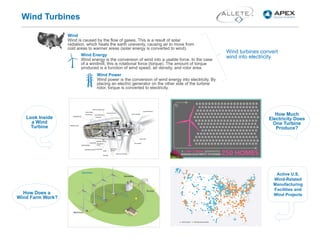
Wind Turbines
Wind
Wind is caused by the flow of gases. This is a result of solar
radiation, which heats the earth unevenly, causing air to move from
cold areas to warmer areas (solar energy is converted to wind).
Wind Energy
Wind energy is the conversion of wind into a usable force. In the case
of a windmill, this is rotational force (torque). The amount of torque
produced is a function of wind speed, air density, and rotor area.
Wind Power
Wind power is the conversion of wind energy into electricity. By
placing an electric generator on the other side of the turbine
rotor, torque is converted to electricity.
Wind turbines convert
wind into electricity
How Does a
Wind Farm Work?
Look Inside
a Wind
Turbine
Active U.S.
Wind-Related
Manufacturing
Facilities and
Wind Projects
How Much
Electricity Does
One Turbine
Produce?
Wind Energy and Health
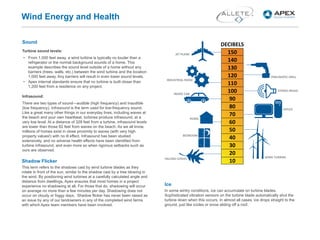
Sound
Turbine sound levels:
• From 1,000 feet away, a wind turbine is typically no louder than a
refrigerator or the normal background sounds of a home. This
example describes the sound level outside of a home without any
barriers (trees, walls, etc.) between the wind turbine and the location
1,000 feet away. Any barriers will result in even lower sound levels.
• Apex internal standards ensure that no turbine is built closer than
1,200 feet from a residence on any project.
Infrasound:
There are two types of sound—audible (high frequency) and inaudible
(low frequency). Infrasound is the term used for low-frequency sound.
Like a great many other things in our everyday lives, including waves at
the beach and your own heartbeat, turbines produce infrasound, at a
very low level. At a distance of 328 feet from a turbine, infrasound levels
are lower than those 82 feet from waves on the beach. As we all know,
millions of homes exist in close proximity to waves (with very high
property values!) with no ill effect. Infrasound has been studied
extensively, and no adverse health effects have been identified from
turbine infrasound, and even more so when rigorous setbacks such as
ours are observed.
Shadow Flicker
This term refers to the shadows cast by wind turbine blades as they
rotate in front of the sun, similar to the shadow cast by a tree blowing in
the wind. By positioning wind turbines at a carefully calculated angle and
distance from dwellings, Apex ensures that most homes in a project
experience no shadowing at all. For those that do, shadowing will occur
on average no more than a few minutes per day. Shadowing does not
occur on cloudy or foggy days. Shadow flicker has never been raised as
an issue by any of our landowners in any of the completed wind farms
with which Apex team members have been involved.
Ice
In some wintry conditions, ice can accumulate on turbine blades.
Sophisticated vibration sensors on the turbine blade automatically shut the
turbine down when this occurs. In almost all cases, ice drops straight to the
ground, just like icicles or snow sliding off a roof.
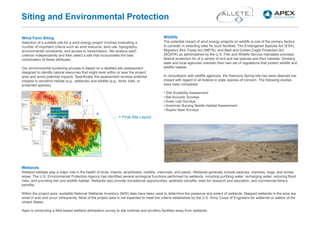
Siting and Environmental Protection
Wind Farm Siting
Selection of a suitable site for a wind energy project involves evaluating a
number of important criteria such as wind resource, land use, topography,
environmental constraints, and access to transmission. We analyze each
criterion independently and then select a site that incorporates the best
combination of these attributes.
Our environmental screening process is based on a detailed site assessment
designed to identify natural resources that might exist within or near the project
area and avoid potential impacts. Specifically, the assessment reviews potential
impacts to sensitive habitat (e.g., wetlands) and wildlife (e.g., birds, bats, or
protected species).
Wildlife
The potential impact of wind energy projects on wildlife is one of the primary factors
to consider in selecting sites for such facilities. The Endangered Species Act (ESA),
Migratory Bird Treaty Act (MBTA), and Bald and Golden Eagle Protection Act
(BGEPA) as administered by the U.S. Fish and Wildlife Service mandates provided
federal protection for of a variety of bird and bat species and their habitats. Similarly,
state and local agencies maintain their own set of regulations that protect wildlife and
wildlife habitat.
In consultation with wildlife agencies, the Diamond Spring site has been deemed low
impact with regard to all federal or state species of concern. The following studies
have been completed:
• Site Suitability Assessment
• Bat Acoustic Surveys
• Avian Use Surveys
• American Burying Beetle Habitat Assessment
• Raptor Nest Surveys
Wetlands
Wetland habitats play a major role in the health of birds, insects, amphibians, reptiles, mammals, and plants. Wetlands generally include swamps, marshes, bogs, and similar
areas. The U.S. Environmental Protection Agency has identified several ecological functions performed by wetlands, including purifying water, recharging water, reducing flood
risks, and providing fish and wildlife habitat. Wetlands also provide recreational opportunities, aesthetic benefits, sites for research and education, and commercial fishery
benefits.
Within the project area, available National Wetlands Inventory (NWI) data have been used to determine the presence and extent of wetlands. Mapped wetlands in the area are
small in size and occur infrequently. Most of the project area is not expected to meet the criteria established by the U.S. Army Corps of Engineers for wetlands or waters of the
United States.
Apex is conducting a field-based wetland delineation survey to site turbines and ancillary facilities away from wetlands.
+
+
= Final Site Layout
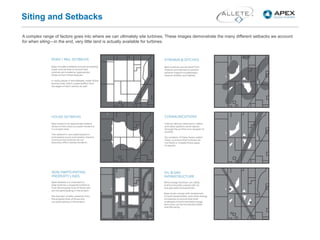
Siting and Setbacks
A complex range of factors goes into where we can ultimately site turbines. These images demonstrate the many different setbacks we account
for when siting—in the end, very little land is actually available for turbines.
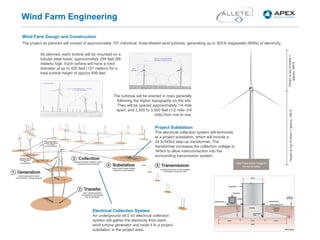
Wind Farm Engineering
As planned, each turbine will be mounted on a
tubular steel tower, approximately 294 feet (89
meters) high. Each turbine will have a rotor
diameter of up to 420 feet (127 meters) for a
total turbine height of approx 499 feet.
Wind Farm Design and Construction
The project as planned will consist of approximately 107 individual, three-bladed wind turbines, generating up to 303.6 megawatts (MWs) of electricity.
The turbines will be erected in rows generally
following the higher topography on the site.
They will be spaced approximately 1/4 mile
apart, and 2,500 to 3,500 feet (1/2 mile–3/4
mile) from row to row.
Electrical Collection System
An underground 34.5 kV electrical collection
system will gather the electricity from each
wind turbine generator and route it to a project
substation in the project area.
Heighttotopoftower=approx.294ft.Heighttotopofblade=
approx.499ft.
See Foundation Diagram
for more detail
Concrete
Inverted T- Type
Foundation
55 to 65 ft.
Approx.
10 ft.
Project Substation
The electrical collection system will terminate
at a project substation, which will include a
34.5/345kV step-up transformer. The
transformer increases the collection voltage to
345kV to allow interconnection into the
surrounding transmission system.
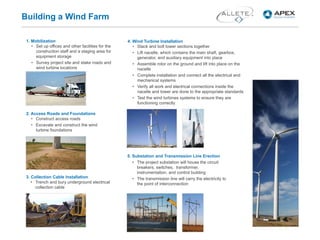
Building a Wind Farm
2. Access Roads and Foundations
• Construct access roads
• Excavate and construct the wind
turbine foundations
1. Mobilization
• Set up offices and other facilities for the
construction staff and a staging area for
equipment storage
• Survey project site and stake roads and
wind turbine locations
4. Wind Turbine Installation
• Stack and bolt tower sections together
• Lift nacelle, which contains the main shaft, gearbox,
generator, and auxiliary equipment into place
• Assemble rotor on the ground and lift into place on the
nacelle
• Complete installation and connect all the electrical and
mechanical systems
• Verify all work and electrical connections inside the
nacelle and tower are done to the appropriate standards
• Test the wind turbines systems to ensure they are
functioning correctly
3. Collection Cable Installation
• Trench and bury underground electrical
collection cable
5. Substation and Transmission Line Erection
• The project substation will house the circuit
breakers, switches, transformer,
instrumentation, and control building
• The transmission line will carry the electricity to
the point of interconnection
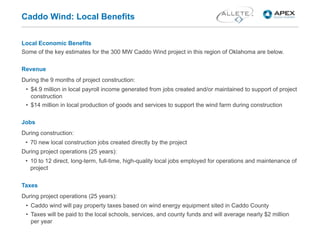
Caddo Wind: Local Benefits
Local Economic Benefits
Some of the key estimates for the 300 MW Caddo Wind project in this region of Oklahoma are below.
Revenue
During the 9 months of project construction:
• $4.9 million in local payroll income generated from jobs created and/or maintained to support of project
construction
• $14 million in local production of goods and services to support the wind farm during construction
Jobs
During construction:
• 70 new local construction jobs created directly by the project
During project operations (25 years):
• 10 to 12 direct, long-term, full-time, high-quality local jobs employed for operations and maintenance of
project
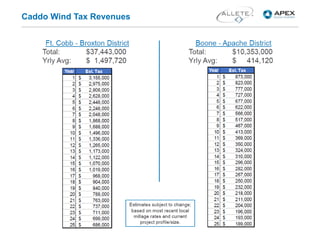
Taxes
During project operations (25 years):
• Caddo wind will pay property taxes based on wind energy equipment sited in Caddo County
• Taxes will be paid to the local schools, services, and county funds and will average nearly $2 million
per year
Caddo Wind Tax Revenues
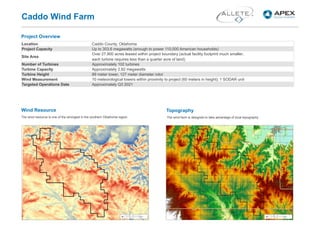
Caddo Wind Farm
Project Overview
Location Caddo County, Oklahoma
Project Capacity Up to 303.6 megawatts (enough to power 110,000 American households)
Site Area
Over 27,900 acres leased within project boundary (actual facility footprint much smaller;
each turbine requires less than a quarter acre of land)
Number of Turbines Approximately 102 turbines
Turbine Capacity Approximately 2.82 megawatts
Turbine Height 89 meter tower, 127 meter diameter rotor
Wind Measurement 10 meteorological towers within proximity to project (60 meters in height); 1 SODAR unit
Targeted Operations Date Approximately Q3 2021
Wind Resource Topography
The wind resource is one of the strongest in the southern Oklahoma region. The wind farm is designed to take advantage of local topography.
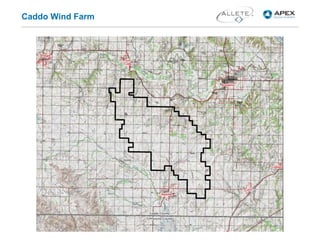
Caddo Wind Farm

Caddo Wind Virtual Public Meeting Presentation

  • 1.
  • 2.
    Apex Clean EnergyCompany Overview Project Portfolio Apex is developing a diversified portfolio of projects capable of supporting over 12,000 MW of onshore wind energy capacity. Projects are located throughout the country, including the PJM, SPP, MISO, ISONE, WECC, SERC, and ERCOT energy markets. The development of these projects focuses on identifying risk and potential fatal flaws early in the development cycle and on mitigating this risk in a cost-effective manner. Apex has assembled the largest wind development pipeline of projects in the country and is the leading wind development company with respect to capacity brought online in 2015. Apex’s wind energy projects are generally rated between 50 and 500 MW and can involve hundreds of landowners. Our project locations are selected carefully in order to optimize wind resource, ensure access to scarce transmission, and mitigate potential permitting constraints. Apex Team The Apex team of over 230 professionals is organized into experienced internal departments, including geographic information systems, wind resource assessment, land management, transmission and interconnection, turbine procurement, financial modeling, project finance, construction and engineering, and legal counsel. This gives Apex the capability to manage renewable energy development from site selection and resource analysis through financing and construction. These departments work together to identify projects with strong fundamentals and carry them through to commercial operation. Development Experience Apex Clean Energy was formed in 2009 by an experienced team of wind energy development and financial professionals. Apex’s management has collectively developed, financed, constructed, and managed more than $10 billion in operating renewable energy facilities. Our team has a proven track record working with communities and landowners to develop state-of-the-art facilities that produce jobs, income for landowners, revenue for local government, and clean sources of domestic energy. Operating Projects Cameron Wind, Texas 165 MW, 2015 Hoopeston Wind, Illinois 98 MW, 2015 Canadian Hills Wind, Oklahoma 300 MW, 2012 Wind Project Solar Project Operating/Under Construction Kay Wind, Oklahoma 300 MW, 2015 Kingfisher Wind, Oklahoma 298 MW, 2016 Balko Wind, Oklahoma 300 MW, 2015 Grant Wind, Oklahoma 152 MW, 2016 Grant Plains Wind, Oklahoma 147 MW, 2016
  • 3.
    Confidential ALLETE business mix: Uniquelypositioned to leverage clean energy trends Regulated Operations • Generates, transmits and distributes electricity in northern Minnesota rich in natural resources • Increased renewable standards are expediting the transition away from coal, creating renewable infrastructure opportunities • Provider of electric, natural gas and water service in northwestern Wisconsin • Smart metering advancing along with increased renewable service offerings • Natural gas expansion opportunities • 8% ownership: ATC owns and operates the electric transmission system in portions of Wisconsin, Michigan, Minnesota & Illinois • Growing equity investment with planned ten-year build-out • Specializes in developing, acquiring, constructing, managing and optimizing clean and renewable energy projects for growth across North America • Material growth expected 2020 – 2023 • Operates a lignite mine near Center, North Dakota, producing about 4M tons annually, under a long-term cost-plus fixed-fee arrangement to 2037 • Working with partners on potential carbon solutions • Leveraging BNI established relationships for clean energy advancement Energy Infrastructure & Related Services
  • 4.
    Expanding suite ofproduct offerings and solutions Increasing geographic and customer demographic footprint Continue to enhance portfolio, diversity and performance Leveraging strong reputation and brand in the industry Material expansion and scaling over the next 36 months
  • 5.
    Confidential Expanding renewable footprintnationwide ▪ Optimization – Refurbish existing facilities; review additional facilities for possible PTC requalification ▪ Build, Own, Transfer - Recognized brand in build, own, transfer projects attracts additional prospects ▪ Power Sales Agreements - Pursuing additional projects using PTC qualified turbines / contracted under long-term power sales agreements ▪ Acquire – Analyzing nationwide pipeline of existing facilities for potential acquisitions
  • 6.
    Wind Power Works WhyWind Power? Wind energy is an abundant, natural Oklahoma resource that is not dependent on imported fuel from other states or countries. • No polluting emissions during operation • Does not consume water • Provides low, long-term, stable electricity rates • Reduces uncertainty and risk for utilities and businesses • Protects consumers from dramatic fuel price spikes New wind energy development will bring jobs and generate local tax revenue for the region. Oklahoma’s Wind Advantage Oklahoma is 2nd in USA for Wind • Oklahoma ranks 3rd in installed capacity for wind energy generation with 6,645 MW, or over 8% of total wind generation in the U.S.* • Oklahoma wind energy provided 24.52% of all in-state electricity production in 2016.* • Oklahoma wind energy supported nearly 9,000 direct and indirect jobs in 2016 and $9.6 billion of capital investment.* • Oklahoma State University’s Department of Agricultural Economics found that wind companies have paid nearly $134 million in ad valorem taxes to the state since 2004, increasing revenues for local schools and county services.** • Studies estimate that annual royalty payments to Oklahoma landowners where wind farms are located total more than $22 million without disrupting livestock and crop operations.** “The growth in wind generation is a result of new wind plants coming online and grid expansions that have allowed more wind power to flow through the system to consumers.” —U.S. Energy Information Administration (EIA) *AWEA Market Report 2016 **OSU Wind Energy Industry Impacts in Oklahoma 2015
  • 7.
    Wind Turbines Wind Wind iscaused by the flow of gases. This is a result of solar radiation, which heats the earth unevenly, causing air to move from cold areas to warmer areas (solar energy is converted to wind). Wind Energy Wind energy is the conversion of wind into a usable force. In the case of a windmill, this is rotational force (torque). The amount of torque produced is a function of wind speed, air density, and rotor area. Wind Power Wind power is the conversion of wind energy into electricity. By placing an electric generator on the other side of the turbine rotor, torque is converted to electricity. Wind turbines convert wind into electricity How Does a Wind Farm Work? Look Inside a Wind Turbine Active U.S. Wind-Related Manufacturing Facilities and Wind Projects How Much Electricity Does One Turbine Produce?
  • 8.
    Wind Energy andHealth Sound Turbine sound levels: • From 1,000 feet away, a wind turbine is typically no louder than a refrigerator or the normal background sounds of a home. This example describes the sound level outside of a home without any barriers (trees, walls, etc.) between the wind turbine and the location 1,000 feet away. Any barriers will result in even lower sound levels. • Apex internal standards ensure that no turbine is built closer than 1,200 feet from a residence on any project. Infrasound: There are two types of sound—audible (high frequency) and inaudible (low frequency). Infrasound is the term used for low-frequency sound. Like a great many other things in our everyday lives, including waves at the beach and your own heartbeat, turbines produce infrasound, at a very low level. At a distance of 328 feet from a turbine, infrasound levels are lower than those 82 feet from waves on the beach. As we all know, millions of homes exist in close proximity to waves (with very high property values!) with no ill effect. Infrasound has been studied extensively, and no adverse health effects have been identified from turbine infrasound, and even more so when rigorous setbacks such as ours are observed. Shadow Flicker This term refers to the shadows cast by wind turbine blades as they rotate in front of the sun, similar to the shadow cast by a tree blowing in the wind. By positioning wind turbines at a carefully calculated angle and distance from dwellings, Apex ensures that most homes in a project experience no shadowing at all. For those that do, shadowing will occur on average no more than a few minutes per day. Shadowing does not occur on cloudy or foggy days. Shadow flicker has never been raised as an issue by any of our landowners in any of the completed wind farms with which Apex team members have been involved. Ice In some wintry conditions, ice can accumulate on turbine blades. Sophisticated vibration sensors on the turbine blade automatically shut the turbine down when this occurs. In almost all cases, ice drops straight to the ground, just like icicles or snow sliding off a roof.
  • 9.
    Siting and EnvironmentalProtection Wind Farm Siting Selection of a suitable site for a wind energy project involves evaluating a number of important criteria such as wind resource, land use, topography, environmental constraints, and access to transmission. We analyze each criterion independently and then select a site that incorporates the best combination of these attributes. Our environmental screening process is based on a detailed site assessment designed to identify natural resources that might exist within or near the project area and avoid potential impacts. Specifically, the assessment reviews potential impacts to sensitive habitat (e.g., wetlands) and wildlife (e.g., birds, bats, or protected species). Wildlife The potential impact of wind energy projects on wildlife is one of the primary factors to consider in selecting sites for such facilities. The Endangered Species Act (ESA), Migratory Bird Treaty Act (MBTA), and Bald and Golden Eagle Protection Act (BGEPA) as administered by the U.S. Fish and Wildlife Service mandates provided federal protection for of a variety of bird and bat species and their habitats. Similarly, state and local agencies maintain their own set of regulations that protect wildlife and wildlife habitat. In consultation with wildlife agencies, the Diamond Spring site has been deemed low impact with regard to all federal or state species of concern. The following studies have been completed: • Site Suitability Assessment • Bat Acoustic Surveys • Avian Use Surveys • American Burying Beetle Habitat Assessment • Raptor Nest Surveys Wetlands Wetland habitats play a major role in the health of birds, insects, amphibians, reptiles, mammals, and plants. Wetlands generally include swamps, marshes, bogs, and similar areas. The U.S. Environmental Protection Agency has identified several ecological functions performed by wetlands, including purifying water, recharging water, reducing flood risks, and providing fish and wildlife habitat. Wetlands also provide recreational opportunities, aesthetic benefits, sites for research and education, and commercial fishery benefits. Within the project area, available National Wetlands Inventory (NWI) data have been used to determine the presence and extent of wetlands. Mapped wetlands in the area are small in size and occur infrequently. Most of the project area is not expected to meet the criteria established by the U.S. Army Corps of Engineers for wetlands or waters of the United States. Apex is conducting a field-based wetland delineation survey to site turbines and ancillary facilities away from wetlands. + + = Final Site Layout
  • 10.
    Siting and Setbacks Acomplex range of factors goes into where we can ultimately site turbines. These images demonstrate the many different setbacks we account for when siting—in the end, very little land is actually available for turbines.
  • 11.
    Wind Farm Engineering Asplanned, each turbine will be mounted on a tubular steel tower, approximately 294 feet (89 meters) high. Each turbine will have a rotor diameter of up to 420 feet (127 meters) for a total turbine height of approx 499 feet. Wind Farm Design and Construction The project as planned will consist of approximately 107 individual, three-bladed wind turbines, generating up to 303.6 megawatts (MWs) of electricity. The turbines will be erected in rows generally following the higher topography on the site. They will be spaced approximately 1/4 mile apart, and 2,500 to 3,500 feet (1/2 mile–3/4 mile) from row to row. Electrical Collection System An underground 34.5 kV electrical collection system will gather the electricity from each wind turbine generator and route it to a project substation in the project area. Heighttotopoftower=approx.294ft.Heighttotopofblade= approx.499ft. See Foundation Diagram for more detail Concrete Inverted T- Type Foundation 55 to 65 ft. Approx. 10 ft. Project Substation The electrical collection system will terminate at a project substation, which will include a 34.5/345kV step-up transformer. The transformer increases the collection voltage to 345kV to allow interconnection into the surrounding transmission system.
  • 12.
    Building a WindFarm 2. Access Roads and Foundations • Construct access roads • Excavate and construct the wind turbine foundations 1. Mobilization • Set up offices and other facilities for the construction staff and a staging area for equipment storage • Survey project site and stake roads and wind turbine locations 4. Wind Turbine Installation • Stack and bolt tower sections together • Lift nacelle, which contains the main shaft, gearbox, generator, and auxiliary equipment into place • Assemble rotor on the ground and lift into place on the nacelle • Complete installation and connect all the electrical and mechanical systems • Verify all work and electrical connections inside the nacelle and tower are done to the appropriate standards • Test the wind turbines systems to ensure they are functioning correctly 3. Collection Cable Installation • Trench and bury underground electrical collection cable 5. Substation and Transmission Line Erection • The project substation will house the circuit breakers, switches, transformer, instrumentation, and control building • The transmission line will carry the electricity to the point of interconnection
  • 13.
    Caddo Wind: LocalBenefits Local Economic Benefits Some of the key estimates for the 300 MW Caddo Wind project in this region of Oklahoma are below. Revenue During the 9 months of project construction: • $4.9 million in local payroll income generated from jobs created and/or maintained to support of project construction • $14 million in local production of goods and services to support the wind farm during construction Jobs During construction: • 70 new local construction jobs created directly by the project During project operations (25 years): • 10 to 12 direct, long-term, full-time, high-quality local jobs employed for operations and maintenance of project Taxes During project operations (25 years): • Caddo wind will pay property taxes based on wind energy equipment sited in Caddo County • Taxes will be paid to the local schools, services, and county funds and will average nearly $2 million per year
  • 14.
  • 15.
    Caddo Wind Farm ProjectOverview Location Caddo County, Oklahoma Project Capacity Up to 303.6 megawatts (enough to power 110,000 American households) Site Area Over 27,900 acres leased within project boundary (actual facility footprint much smaller; each turbine requires less than a quarter acre of land) Number of Turbines Approximately 102 turbines Turbine Capacity Approximately 2.82 megawatts Turbine Height 89 meter tower, 127 meter diameter rotor Wind Measurement 10 meteorological towers within proximity to project (60 meters in height); 1 SODAR unit Targeted Operations Date Approximately Q3 2021 Wind Resource Topography The wind resource is one of the strongest in the southern Oklahoma region. The wind farm is designed to take advantage of local topography.
  • 16.