© 2016 Hazelcast Inc. Confidential & Proprietary ‹#›
GREG LUCK, CO-SPEC LEAD JSR107
@GREGRLUCK CEO | HAZELCAST FOUNDER | EHCACHE FORMER CTO
18 FEBRUARY 2016
How to speed up your
application using JCache
© 2016 Hazelcast Inc. Confidential & Proprietary ‹#›
Agenda
• Theory of Caching
• Java Caching (JCache), JSR-107
• Code Demo
© 2016 Hazelcast Inc. Confidential & Proprietary ‹#›
Introduction to Caching
© 2016 Hazelcast Inc. Confidential & Proprietary ‹#›
Benefits of Caching
• Performance
• Offload expensive or non-scalable parts of your architecture
• Scale up – get the most out of one machine
• Scale out – add more capacity with more machines
• Excellent Buffer against load variability
And…
• Usually very fast and easy to apply
© 2016 Hazelcast Inc. Confidential & Proprietary ‹#›
When to Use Caching
• When applications use the same data more than once
• When cost (time / resources) of making an initial copy is less
than fetching or producing the data again or when faster to
request from a Cache
© 2016 Hazelcast Inc. Confidential & Proprietary ‹#›
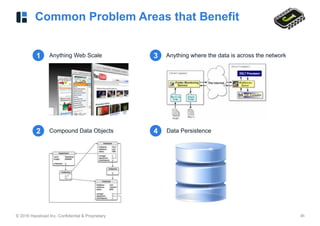
Common Problem Areas that Benefit
Anything Web Scale Anything where the data is across the network
Compound Data Objects Data Persistence
1 3
2 4
© 2016 Hazelcast Inc. Confidential & Proprietary ‹#›
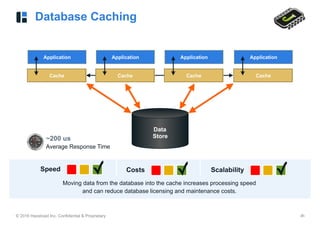
Database Caching
Moving data from the database into the cache increases processing speed 

and can reduce database licensing and maintenance costs.
Speed ✓
Data 

Store
Application
Cache
Application
Cache
Application
Cache
Application
Cache
Costs ✓ Scalability ✓
~200 us
Average Response Time
© 2016 Hazelcast Inc. Confidential & Proprietary ‹#›
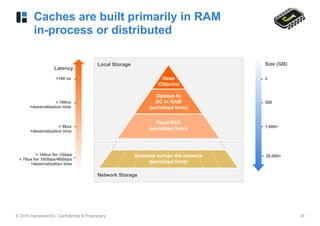
Caches are built primarily in RAM

in-process or distributed
Flash/SSD

(serialized form)
Local Storage
Heap

(Objects)
Opaque to 

GC in RAM

(serialized form)
<100 ns
< 100ns

+deserialization time
2
500
1,000+
Latency
Size (GB)
Network Storage
< 50us

+deserialization time
< 140us for 1Gbps

< 70us for 10Gbps/40Gbps

+deserialization time
20,000+Scaleout across the network

(serialized form)
© 2016 Hazelcast Inc. Confidential & Proprietary ‹#›
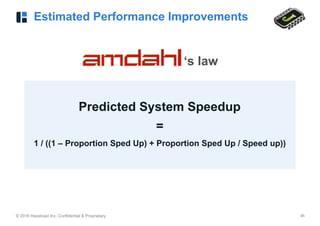
‘s law
Estimated Performance Improvements
Predicted System Speedup
=
1 / ((1 – Proportion Sped Up) + Proportion Sped Up / Speed up))
© 2016 Hazelcast Inc. Confidential & Proprietary ‹#›
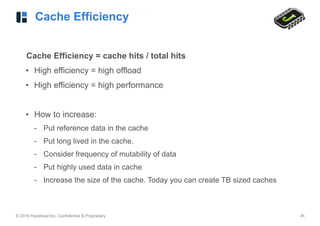
Cache Efficiency
Cache Efficiency = cache hits / total hits
• High efficiency = high offload
• High efficiency = high performance
• How to increase:
- Put reference data in the cache
- Put long lived in the cache.
- Consider frequency of mutability of data
- Put highly used data in cache
- Increase the size of the cache. Today you can create TB sized caches
© 2016 Hazelcast Inc. Confidential & Proprietary ‹#›
Problems to Consider
• Standalone Caches and the N * problem
- As each entry expires, the backing system gets N requests for data where
n is the number of standalone caches. Solution: Use a distributed cache
• Consistency with the System of Record
- How to keep the cache in sync with changes in a backing system. Solution:
Match mutability of data with data safety configuration. Update the cache
and backing store at the same time.
• Consistency with other cache nodes
- How to keep all cache nodes in sync: Solution: Use a distributed cache and
match consistency configuration with data mutability
© 2016 Hazelcast Inc. Confidential & Proprietary ‹#›
New JCache Standard (JSR107)
© 2016 Hazelcast Inc. Confidential & Proprietary ‹#›
Java Caching (JCache)
What?
• Java Caching (JCache) standardized Caching for the Java Platform*
• A common mechanism to create, access, update and remove
information from Caches
How?
• JSR-107: Java Caching Specification (JCache)
• Java Community Process (JCP) 2.9
© 2016 Hazelcast Inc. Confidential & Proprietary ‹#›
Java Caching (JCache)
Why?
• Standardize! Standardize! Standardize!
- Core Caching Concepts
- Core Caching API

• Provide application portability between Caching solutions
- Big & Small, Open & Commercial

• Caching is ubiquitous!

• Allows frameworks to depend on JCache and stop creating specific
integrations to each and every cache
© 2016 Hazelcast Inc. Confidential & Proprietary ‹#›
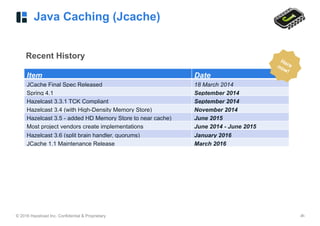
Java Caching (Jcache)
Recent History
Item Date
JCache Final Spec Released 18 March 2014
Spring 4.1 September 2014
Hazelcast 3.3.1 TCK Compliant September 2014
Hazelcast 3.4 (with High-Density Memory Store) November 2014
Hazelcast 3.5 - added HD Memory Store to near cache) June 2015
Most project vendors create implementations June 2014 - June 2015
Hazelcast 3.6 (split brain handler, quorums) January 2016
JCache 1.1 Maintenance Release March 2016
Herenow!
© 2016 Hazelcast Inc. Confidential & Proprietary ‹#›
Java Caching (JCache)
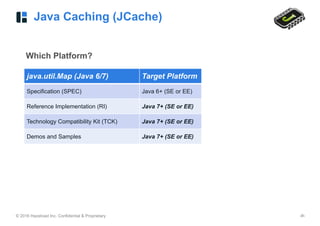
Which Platform?
java.util.Map (Java 6/7) Target Platform
Specification (SPEC) Java 6+ (SE or EE)
Reference Implementation (RI) Java 7+ (SE or EE)
Technology Compatibility Kit (TCK) Java 7+ (SE or EE)
Demos and Samples Java 7+ (SE or EE)
© 2016 Hazelcast Inc. Confidential & Proprietary ‹#›
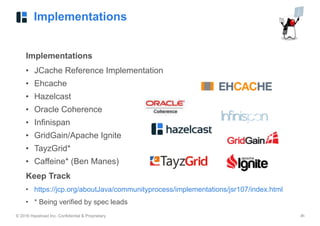
Implementations
Implementations
• JCache Reference Implementation
• Ehcache
• Hazelcast
• Oracle Coherence
• Infinispan
• GridGain/Apache Ignite
• TayzGrid*
• Caffeine* (Ben Manes)
Keep Track
• https://jcp.org/aboutJava/communityprocess/implementations/jsr107/index.html
• * Being verified by spec leads
© 2016 Hazelcast Inc. Confidential & Proprietary ‹#›
Non-Implementation: Gemfire/Geode
Gemfire/Geode have no plans to implement
Why?
• Gemfire and Geode are directly supported in Spring
• Because Spring supports JCache cache annotations you can use
Gemfire/Geode from Spring but that is it.
See:
• http://apache-geode-incubating-developers-forum.70738.x6.nabble.com/
JCache-JSR-107-support-td1255.html
Campaign to have Pivotal Support JCache:
#PivotalJCache campaign for @PivotalGemFire to support #JSR107 #JCache.
Please retweet or mention #PivotalJCache
© 2016 Hazelcast Inc. Confidential & Proprietary ‹#›
Relationship to NoSQL
Difficult/Impossible for NoSQL to fully implement the spec
• Server Side code execution including: Entry Processors, Listeners,
Write-Through etc.
• Strong Consistency is the default consistency model and is not
supported by most/all NoSQL.
Likely that Couchbase will release a partial implementation 

leaving out EntryProcessor and some other methods with an
UnsupportedOperationException if these methods are called. They
have Developer Preview 2 out.
Using With NoSQL
• Use NoSQL like a database and read-through/write-though to it using
CacheLoader/CacheWriter.
• NoSQL gives you scale our persistence - cache gives you very low
latencies
© 2016 Hazelcast Inc. Confidential & Proprietary ‹#›
Java Caching (JCache)
Project Hosting
• JCP Project:
- http://jcp.org/en/jsr/detail?id=107

• Source Code:
- https://github.com/jsr107

• Forum:
- https://groups.google.com/forum/?fromgroups#!forum/jsr107
© 2016 Hazelcast Inc. Confidential & Proprietary ‹#›
Java Caching (JCache)
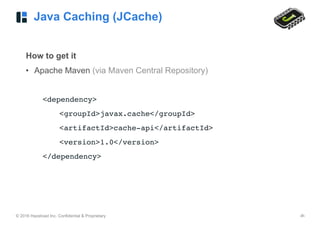
How to get it
• Apache Maven (via Maven Central Repository)
<dependency>
<groupId>javax.cache</groupId>
<artifactId>cache-api</artifactId>
<version>1.0</version>
</dependency>
© 2016 Hazelcast Inc. Confidential & Proprietary ‹#›
Caches and Caching
© 2016 Hazelcast Inc. Confidential & Proprietary ‹#›
Caches and Caching
JSR107 Cache Definition:
A high-performance, low-latency data-structure* in
which an application places a temporary copy of
information that is likely to be used more than once
© 2016 Hazelcast Inc. Confidential & Proprietary ‹#›
Maps vs Cache APIs
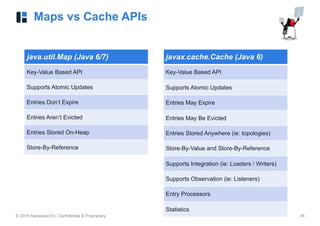
java.util.Map (Java 6/7)
Key-Value Based API
Supports Atomic Updates
Entries Don’t Expire
Entries Aren’t Evicted
Entries Stored On-Heap
Store-By-Reference
javax.cache.Cache (Java 6)
Key-Value Based API
Supports Atomic Updates
Entries May Expire
Entries May Be Evicted
Entries Stored Anywhere (ie: topologies)
Store-By-Value and Store-By-Reference
Supports Integration (ie: Loaders / Writers)
Supports Observation (ie: Listeners)
Entry Processors
Statistics
© 2016 Hazelcast Inc. Confidential & Proprietary ‹#›
JCache: Features
• java.util.ConcurrentMap like API
• Atomic Operations
• Lock-Free
• Read-Through / Write-Through Integration Support
• Cache Event Listeners
• Fully Generic API = type-safety
• Statistics
• Annotations (for frameworks and containers)
• Store-By-Value semantics (optional store-by-reference)
© 2016 Hazelcast Inc. Confidential & Proprietary ‹#›
JCache: Features
• Topology Agnostic
- Topologies not defined or restricted by the specification

• Efficiently supports:
- “local” in-memory Caching and
- “distributed” server-based Caching
© 2016 Hazelcast Inc. Confidential & Proprietary ‹#›
JCache Key Classes/Interfaces
© 2016 Hazelcast Inc. Confidential & Proprietary ‹#›
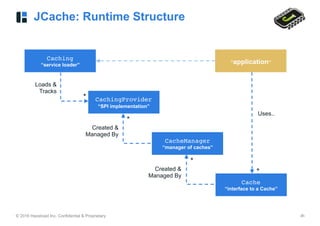
JCache: Runtime Structure
Caching

“service loader”
CachingProvider

“SPI implementation”
CacheManager

“manager of caches”
Cache

“interface to a Cache”
*
Created &
Managed By
Created &
Managed By
“application”
Uses..
Loads &
Tracks
*
*
*
© 2016 Hazelcast Inc. Confidential & Proprietary ‹#›
JCache: Cache Managers
javax.cache.CacheManager
• Establishes, configures, manages and owns named Caches
- Caches may be pre-define or dynamically created at runtime
• Provides Cache infrastructure and resources
• Provides Cache “scoping” (say in a Cluster)
• Provides Cache ClassLoaders (important for store-by-value)
• Provides Cache lifecycle management
© 2016 Hazelcast Inc. Confidential & Proprietary ‹#›
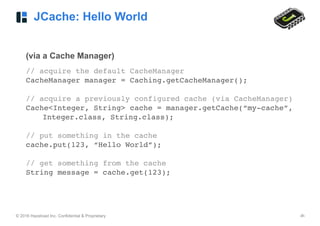
JCache: Hello World
(via a Cache Manager)
// acquire the default CacheManager
CacheManager manager = Caching.getCacheManager();
// acquire a previously configured cache (via CacheManager)
Cache<Integer, String> cache = manager.getCache(“my-cache”,
Integer.class, String.class);
// put something in the cache
cache.put(123, “Hello World”);
// get something from the cache
String message = cache.get(123);
© 2016 Hazelcast Inc. Confidential & Proprietary ‹#›
Cache Interface & Methods (in IDE)
© 2016 Hazelcast Inc. Confidential & Proprietary ‹#›
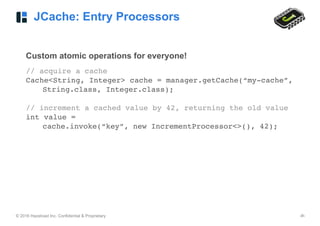
JCache: Entry Processors
Custom atomic operations for everyone!
// acquire a cache
Cache<String, Integer> cache = manager.getCache(“my-cache”,
String.class, Integer.class);
// increment a cached value by 42, returning the old value
int value =
cache.invoke(“key”, new IncrementProcessor<>(), 42);


© 2016 Hazelcast Inc. Confidential & Proprietary ‹#›
JCache: Entry Processors
Custom atomic operations for everyone!
public class IncrementProcessor<K>
implements EntryProcessor<K, Integer, Integer>, Serializable {

@Override

public Integer process(MutableEntry<K, Integer> entry,
Object... arguments) {
if (entry.exists()) {
int amount =
arguments.length == 0 ? 1 :(Integer)arguments[0];
int current = entry.getValue();
entry.setValue(count + amount);
return current;
} else {
throw new IllegalStateException(“no entry exists”);
}
}
}
© 2016 Hazelcast Inc. Confidential & Proprietary ‹#›
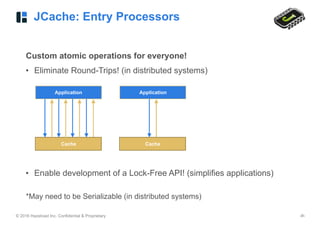
JCache: Entry Processors
Custom atomic operations for everyone!
• Eliminate Round-Trips! (in distributed systems)
• Enable development of a Lock-Free API! (simplifies applications)

*May need to be Serializable (in distributed systems)
Application
CacheCache
Application
© 2016 Hazelcast Inc. Confidential & Proprietary ‹#›
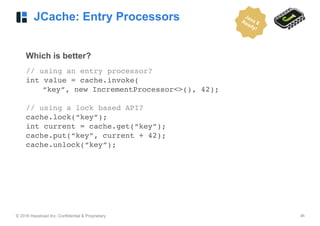
JCache: Entry Processors
Which is better?
// using an entry processor?
int value = cache.invoke(
“key”, new IncrementProcessor<>(), 42);
// using a lock based API?
cache.lock(“key”);
int current = cache.get(“key”);
cache.put(“key”, current + 42);
cache.unlock(“key”);

Java 8Ready!
© 2016 Hazelcast Inc. Confidential & Proprietary ‹#›
Annotations
• JSR107 introduces a standardized set of caching annotations,
which do method level caching interception on annotated
classes running in dependency injection containers.
• Caching annotations are becoming increasingly popular:
- Ehcache Annotations for Spring
- Spring 3’s caching annotations.
• JSR107 Annotations will be added to:
- Java EE 8 (planned?)
- Spring 4.1 (released)
© 2016 Hazelcast Inc. Confidential & Proprietary ‹#›
Annotation Operations
The JSR107 annotations cover the
most common cache operations:
• @CacheResult
• @CachePut
• @CacheRemove
• @CacheRemoveAll
© 2016 Hazelcast Inc. Confidential & Proprietary ‹#›
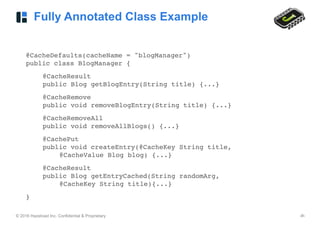
Fully Annotated Class Example
@CacheDefaults(cacheName = "blogManager")

public class BlogManager {
@CacheResult

public Blog getBlogEntry(String title) {...}
@CacheRemove

public void removeBlogEntry(String title) {...}
@CacheRemoveAll

public void removeAllBlogs() {...}
@CachePut

public void createEntry(@CacheKey String title,
@CacheValue Blog blog) {...}
@CacheResult

public Blog getEntryCached(String randomArg,
@CacheKey String title){...}
}
© 2016 Hazelcast Inc. Confidential & Proprietary ‹#›
JCache With Spring
• Spring
- uses JCache since 4.1 http://bit.ly/1V0q1Kp
- Added support for JCache cache annotations which can be mixed and
matched with Spring ones
• Spring Boot
- Auto-configuration for any JCache Provider http://bit.ly/1TPQKLx
© 2016 Hazelcast Inc. Confidential & Proprietary ‹#›
JCache With Java EE
• Java EE
- Can add JCache and an implementation to any Java EE app by adding the
jars and configuring it outside of EE.
• Java EE 8
- JCache added to EE8
- Add JCache Annotations
- Other integration possibilities:
• ejb timer store
• jbatch store
• JPA
- Adam Bien is prepared to lead a JSR to get JCache into EE8. 4
contributors so far. See See https://abhirockzz.wordpress.com/2016/01/21/
jcache-in-java-ee-8/
© 2016 Hazelcast Inc. Confidential & Proprietary ‹#›
The Future
• JCache 1.1 (2016)
- Maintenance Release being worked on, by me ☺
- Just bug fixes
• Java EE 8 Integration (2017)
• JCache 2.0 (Later)
- Transactions
- Async API
- Servlet 4.0 Integration / Session Caching
© 2016 Hazelcast Inc. Confidential & Proprietary ‹#›
Working with Hazelcast JCache
© 2016 Hazelcast Inc. Confidential & Proprietary ‹#›
Hazelcast JCache Support
Full TCK Compliant implementation for:
• Features:
• Embedded Members
• Clients (caches are stored in Members)
• HD Memory Store for members and near cache
• Very Fast Persistence with the Hot Restart Store
• Docs: http://bit.ly/1Q52yDz
© 2016 Hazelcast Inc. Confidential & Proprietary ‹#›
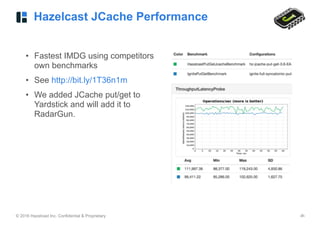
Hazelcast JCache Performance
• Fastest IMDG using competitors
own benchmarks
• See http://bit.ly/1T36n1m
• We added JCache put/get to
Yardstick and will add it to
RadarGun.
© 2016 Hazelcast Inc. Confidential & Proprietary ‹#›
Questions?
Greg Luck
• @gregrluck
• greg@hazelcast.com
Thank you

Caching and JCache with Greg Luck 18.02.16

  • 1.
    © 2016 HazelcastInc. Confidential & Proprietary ‹#› GREG LUCK, CO-SPEC LEAD JSR107 @GREGRLUCK CEO | HAZELCAST FOUNDER | EHCACHE FORMER CTO 18 FEBRUARY 2016 How to speed up your application using JCache
  • 2.
    © 2016 HazelcastInc. Confidential & Proprietary ‹#› Agenda • Theory of Caching • Java Caching (JCache), JSR-107 • Code Demo
  • 3.
    © 2016 HazelcastInc. Confidential & Proprietary ‹#› Introduction to Caching
  • 4.
    © 2016 HazelcastInc. Confidential & Proprietary ‹#› Benefits of Caching • Performance • Offload expensive or non-scalable parts of your architecture • Scale up – get the most out of one machine • Scale out – add more capacity with more machines • Excellent Buffer against load variability And… • Usually very fast and easy to apply
  • 5.
    © 2016 HazelcastInc. Confidential & Proprietary ‹#› When to Use Caching • When applications use the same data more than once • When cost (time / resources) of making an initial copy is less than fetching or producing the data again or when faster to request from a Cache
  • 6.
    © 2016 HazelcastInc. Confidential & Proprietary ‹#› Common Problem Areas that Benefit Anything Web Scale Anything where the data is across the network Compound Data Objects Data Persistence 1 3 2 4
  • 7.
    © 2016 HazelcastInc. Confidential & Proprietary ‹#› Database Caching Moving data from the database into the cache increases processing speed 
 and can reduce database licensing and maintenance costs. Speed ✓ Data 
 Store Application Cache Application Cache Application Cache Application Cache Costs ✓ Scalability ✓ ~200 us Average Response Time
  • 8.
    © 2016 HazelcastInc. Confidential & Proprietary ‹#› Caches are built primarily in RAM
 in-process or distributed Flash/SSD
 (serialized form) Local Storage Heap
 (Objects) Opaque to 
 GC in RAM
 (serialized form) <100 ns < 100ns
 +deserialization time 2 500 1,000+ Latency Size (GB) Network Storage < 50us
 +deserialization time < 140us for 1Gbps
 < 70us for 10Gbps/40Gbps
 +deserialization time 20,000+Scaleout across the network
 (serialized form)
  • 9.
    © 2016 HazelcastInc. Confidential & Proprietary ‹#› ‘s law Estimated Performance Improvements Predicted System Speedup = 1 / ((1 – Proportion Sped Up) + Proportion Sped Up / Speed up))
  • 10.
    © 2016 HazelcastInc. Confidential & Proprietary ‹#› Cache Efficiency Cache Efficiency = cache hits / total hits • High efficiency = high offload • High efficiency = high performance • How to increase: - Put reference data in the cache - Put long lived in the cache. - Consider frequency of mutability of data - Put highly used data in cache - Increase the size of the cache. Today you can create TB sized caches
  • 11.
    © 2016 HazelcastInc. Confidential & Proprietary ‹#› Problems to Consider • Standalone Caches and the N * problem - As each entry expires, the backing system gets N requests for data where n is the number of standalone caches. Solution: Use a distributed cache • Consistency with the System of Record - How to keep the cache in sync with changes in a backing system. Solution: Match mutability of data with data safety configuration. Update the cache and backing store at the same time. • Consistency with other cache nodes - How to keep all cache nodes in sync: Solution: Use a distributed cache and match consistency configuration with data mutability
  • 12.
    © 2016 HazelcastInc. Confidential & Proprietary ‹#› New JCache Standard (JSR107)
  • 13.
    © 2016 HazelcastInc. Confidential & Proprietary ‹#› Java Caching (JCache) What? • Java Caching (JCache) standardized Caching for the Java Platform* • A common mechanism to create, access, update and remove information from Caches How? • JSR-107: Java Caching Specification (JCache) • Java Community Process (JCP) 2.9
  • 14.
    © 2016 HazelcastInc. Confidential & Proprietary ‹#› Java Caching (JCache) Why? • Standardize! Standardize! Standardize! - Core Caching Concepts - Core Caching API
 • Provide application portability between Caching solutions - Big & Small, Open & Commercial
 • Caching is ubiquitous!
 • Allows frameworks to depend on JCache and stop creating specific integrations to each and every cache
  • 15.
    © 2016 HazelcastInc. Confidential & Proprietary ‹#› Java Caching (Jcache) Recent History Item Date JCache Final Spec Released 18 March 2014 Spring 4.1 September 2014 Hazelcast 3.3.1 TCK Compliant September 2014 Hazelcast 3.4 (with High-Density Memory Store) November 2014 Hazelcast 3.5 - added HD Memory Store to near cache) June 2015 Most project vendors create implementations June 2014 - June 2015 Hazelcast 3.6 (split brain handler, quorums) January 2016 JCache 1.1 Maintenance Release March 2016 Herenow!
  • 16.
    © 2016 HazelcastInc. Confidential & Proprietary ‹#› Java Caching (JCache) Which Platform? java.util.Map (Java 6/7) Target Platform Specification (SPEC) Java 6+ (SE or EE) Reference Implementation (RI) Java 7+ (SE or EE) Technology Compatibility Kit (TCK) Java 7+ (SE or EE) Demos and Samples Java 7+ (SE or EE)
  • 17.
    © 2016 HazelcastInc. Confidential & Proprietary ‹#› Implementations Implementations • JCache Reference Implementation • Ehcache • Hazelcast • Oracle Coherence • Infinispan • GridGain/Apache Ignite • TayzGrid* • Caffeine* (Ben Manes) Keep Track • https://jcp.org/aboutJava/communityprocess/implementations/jsr107/index.html • * Being verified by spec leads
  • 18.
    © 2016 HazelcastInc. Confidential & Proprietary ‹#› Non-Implementation: Gemfire/Geode Gemfire/Geode have no plans to implement Why? • Gemfire and Geode are directly supported in Spring • Because Spring supports JCache cache annotations you can use Gemfire/Geode from Spring but that is it. See: • http://apache-geode-incubating-developers-forum.70738.x6.nabble.com/ JCache-JSR-107-support-td1255.html Campaign to have Pivotal Support JCache: #PivotalJCache campaign for @PivotalGemFire to support #JSR107 #JCache. Please retweet or mention #PivotalJCache
  • 19.
    © 2016 HazelcastInc. Confidential & Proprietary ‹#› Relationship to NoSQL Difficult/Impossible for NoSQL to fully implement the spec • Server Side code execution including: Entry Processors, Listeners, Write-Through etc. • Strong Consistency is the default consistency model and is not supported by most/all NoSQL. Likely that Couchbase will release a partial implementation 
 leaving out EntryProcessor and some other methods with an UnsupportedOperationException if these methods are called. They have Developer Preview 2 out. Using With NoSQL • Use NoSQL like a database and read-through/write-though to it using CacheLoader/CacheWriter. • NoSQL gives you scale our persistence - cache gives you very low latencies
  • 20.
    © 2016 HazelcastInc. Confidential & Proprietary ‹#› Java Caching (JCache) Project Hosting • JCP Project: - http://jcp.org/en/jsr/detail?id=107
 • Source Code: - https://github.com/jsr107
 • Forum: - https://groups.google.com/forum/?fromgroups#!forum/jsr107
  • 21.
    © 2016 HazelcastInc. Confidential & Proprietary ‹#› Java Caching (JCache) How to get it • Apache Maven (via Maven Central Repository) <dependency> <groupId>javax.cache</groupId> <artifactId>cache-api</artifactId> <version>1.0</version> </dependency>
  • 22.
    © 2016 HazelcastInc. Confidential & Proprietary ‹#› Caches and Caching
  • 23.
    © 2016 HazelcastInc. Confidential & Proprietary ‹#› Caches and Caching JSR107 Cache Definition: A high-performance, low-latency data-structure* in which an application places a temporary copy of information that is likely to be used more than once
  • 24.
    © 2016 HazelcastInc. Confidential & Proprietary ‹#› Maps vs Cache APIs java.util.Map (Java 6/7) Key-Value Based API Supports Atomic Updates Entries Don’t Expire Entries Aren’t Evicted Entries Stored On-Heap Store-By-Reference javax.cache.Cache (Java 6) Key-Value Based API Supports Atomic Updates Entries May Expire Entries May Be Evicted Entries Stored Anywhere (ie: topologies) Store-By-Value and Store-By-Reference Supports Integration (ie: Loaders / Writers) Supports Observation (ie: Listeners) Entry Processors Statistics
  • 25.
    © 2016 HazelcastInc. Confidential & Proprietary ‹#› JCache: Features • java.util.ConcurrentMap like API • Atomic Operations • Lock-Free • Read-Through / Write-Through Integration Support • Cache Event Listeners • Fully Generic API = type-safety • Statistics • Annotations (for frameworks and containers) • Store-By-Value semantics (optional store-by-reference)
  • 26.
    © 2016 HazelcastInc. Confidential & Proprietary ‹#› JCache: Features • Topology Agnostic - Topologies not defined or restricted by the specification
 • Efficiently supports: - “local” in-memory Caching and - “distributed” server-based Caching
  • 27.
    © 2016 HazelcastInc. Confidential & Proprietary ‹#› JCache Key Classes/Interfaces
  • 28.
    © 2016 HazelcastInc. Confidential & Proprietary ‹#› JCache: Runtime Structure Caching
 “service loader” CachingProvider
 “SPI implementation” CacheManager
 “manager of caches” Cache
 “interface to a Cache” * Created & Managed By Created & Managed By “application” Uses.. Loads & Tracks * * *
  • 29.
    © 2016 HazelcastInc. Confidential & Proprietary ‹#› JCache: Cache Managers javax.cache.CacheManager • Establishes, configures, manages and owns named Caches - Caches may be pre-define or dynamically created at runtime • Provides Cache infrastructure and resources • Provides Cache “scoping” (say in a Cluster) • Provides Cache ClassLoaders (important for store-by-value) • Provides Cache lifecycle management
  • 30.
    © 2016 HazelcastInc. Confidential & Proprietary ‹#› JCache: Hello World (via a Cache Manager) // acquire the default CacheManager CacheManager manager = Caching.getCacheManager(); // acquire a previously configured cache (via CacheManager) Cache<Integer, String> cache = manager.getCache(“my-cache”, Integer.class, String.class); // put something in the cache cache.put(123, “Hello World”); // get something from the cache String message = cache.get(123);
  • 31.
    © 2016 HazelcastInc. Confidential & Proprietary ‹#› Cache Interface & Methods (in IDE)
  • 32.
    © 2016 HazelcastInc. Confidential & Proprietary ‹#› JCache: Entry Processors Custom atomic operations for everyone! // acquire a cache Cache<String, Integer> cache = manager.getCache(“my-cache”, String.class, Integer.class); // increment a cached value by 42, returning the old value int value = cache.invoke(“key”, new IncrementProcessor<>(), 42); 

  • 33.
    © 2016 HazelcastInc. Confidential & Proprietary ‹#› JCache: Entry Processors Custom atomic operations for everyone! public class IncrementProcessor<K> implements EntryProcessor<K, Integer, Integer>, Serializable {
 @Override
 public Integer process(MutableEntry<K, Integer> entry, Object... arguments) { if (entry.exists()) { int amount = arguments.length == 0 ? 1 :(Integer)arguments[0]; int current = entry.getValue(); entry.setValue(count + amount); return current; } else { throw new IllegalStateException(“no entry exists”); } } }
  • 34.
    © 2016 HazelcastInc. Confidential & Proprietary ‹#› JCache: Entry Processors Custom atomic operations for everyone! • Eliminate Round-Trips! (in distributed systems) • Enable development of a Lock-Free API! (simplifies applications)
 *May need to be Serializable (in distributed systems) Application CacheCache Application
  • 35.
    © 2016 HazelcastInc. Confidential & Proprietary ‹#› JCache: Entry Processors Which is better? // using an entry processor? int value = cache.invoke( “key”, new IncrementProcessor<>(), 42); // using a lock based API? cache.lock(“key”); int current = cache.get(“key”); cache.put(“key”, current + 42); cache.unlock(“key”);
 Java 8Ready!
  • 36.
    © 2016 HazelcastInc. Confidential & Proprietary ‹#› Annotations • JSR107 introduces a standardized set of caching annotations, which do method level caching interception on annotated classes running in dependency injection containers. • Caching annotations are becoming increasingly popular: - Ehcache Annotations for Spring - Spring 3’s caching annotations. • JSR107 Annotations will be added to: - Java EE 8 (planned?) - Spring 4.1 (released)
  • 37.
    © 2016 HazelcastInc. Confidential & Proprietary ‹#› Annotation Operations The JSR107 annotations cover the most common cache operations: • @CacheResult • @CachePut • @CacheRemove • @CacheRemoveAll
  • 38.
    © 2016 HazelcastInc. Confidential & Proprietary ‹#› Fully Annotated Class Example @CacheDefaults(cacheName = "blogManager")
 public class BlogManager { @CacheResult
 public Blog getBlogEntry(String title) {...} @CacheRemove
 public void removeBlogEntry(String title) {...} @CacheRemoveAll
 public void removeAllBlogs() {...} @CachePut
 public void createEntry(@CacheKey String title, @CacheValue Blog blog) {...} @CacheResult
 public Blog getEntryCached(String randomArg, @CacheKey String title){...} }
  • 39.
    © 2016 HazelcastInc. Confidential & Proprietary ‹#› JCache With Spring • Spring - uses JCache since 4.1 http://bit.ly/1V0q1Kp - Added support for JCache cache annotations which can be mixed and matched with Spring ones • Spring Boot - Auto-configuration for any JCache Provider http://bit.ly/1TPQKLx
  • 40.
    © 2016 HazelcastInc. Confidential & Proprietary ‹#› JCache With Java EE • Java EE - Can add JCache and an implementation to any Java EE app by adding the jars and configuring it outside of EE. • Java EE 8 - JCache added to EE8 - Add JCache Annotations - Other integration possibilities: • ejb timer store • jbatch store • JPA - Adam Bien is prepared to lead a JSR to get JCache into EE8. 4 contributors so far. See See https://abhirockzz.wordpress.com/2016/01/21/ jcache-in-java-ee-8/
  • 41.
    © 2016 HazelcastInc. Confidential & Proprietary ‹#› The Future • JCache 1.1 (2016) - Maintenance Release being worked on, by me ☺ - Just bug fixes • Java EE 8 Integration (2017) • JCache 2.0 (Later) - Transactions - Async API - Servlet 4.0 Integration / Session Caching
  • 42.
    © 2016 HazelcastInc. Confidential & Proprietary ‹#› Working with Hazelcast JCache
  • 43.
    © 2016 HazelcastInc. Confidential & Proprietary ‹#› Hazelcast JCache Support Full TCK Compliant implementation for: • Features: • Embedded Members • Clients (caches are stored in Members) • HD Memory Store for members and near cache • Very Fast Persistence with the Hot Restart Store • Docs: http://bit.ly/1Q52yDz
  • 44.
    © 2016 HazelcastInc. Confidential & Proprietary ‹#› Hazelcast JCache Performance • Fastest IMDG using competitors own benchmarks • See http://bit.ly/1T36n1m • We added JCache put/get to Yardstick and will add it to RadarGun.
  • 45.
    © 2016 HazelcastInc. Confidential & Proprietary ‹#› Questions? Greg Luck • @gregrluck • greg@hazelcast.com
  • 46.