Using JCache to
speed up your apps
Vassilis Bekiaris

Software Engineer, Hazelcast

@karbonized1
About me
• First computer:

Amstrad 6128 green screen
• Favorite languages I never

used in production: Ada, CLISP
• Freelancer (-2008)
• Software Architect, Team Leader, Jack of all Trades
(2008-2016)
• Software Engineer, Hazelcast (2016-)
Outline
• Caching basics
• Introducing JSR-107 (JCache)
• Using JCache
Why cache?
• Performance
• Offload expensive or non-scalable parts of your
architecture
• Buffer against load variability
• Usually fast and easy to apply
When to use caching
• When applications use the same data more than
once
• When fetching or producing the data again is
expensive
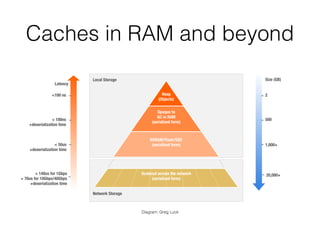
Caches in RAM and beyond
NVRAM/Flash/SSD

(serialized form)
Local Storage
Heap

(Objects)
Opaque to 

GC in RAM

(serialized form)
<100 ns
< 100ns

+deserialization time
2
500
1,000+
Latency
Size (GB)
Network Storage
< 50us

+deserialization time
< 140us for 1Gbps

< 70us for 10Gbps/40Gbps

+deserialization time
20,000+Scaleout across the network

(serialized form)
Diagram: Greg Luck
Implementation patterns
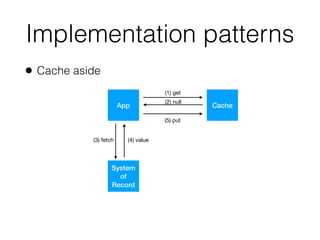
• Cache aside
App Cache
System
of
Record
(1) get
(2) null
(3) fetch (4) value
(5) put
Implementation patterns
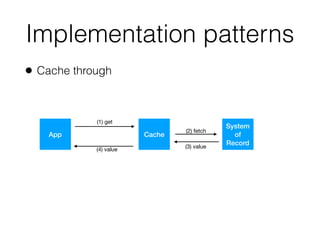
• Cache through
App Cache
System
of
Record
(1) get
(2) fetch
(3) value
(4) value
Other implementation
considerations
• In-process
• Distributed
Introducing JSR-107
• The standard way to cache for Java applications
• One of the longest running JSRs
• Started in 2001
• JSR-107 1.0 final released in March 2014
• JSR-107 1.1 maintenance release (draft review
done, expected mid-December 2017)
• Target: Java SE 6+
JCache implementations
• Apache Ignite
• Blazing Cache
• cache2k
• Caffeine
• Coherence (Oracle)
• Ehcache
• Hazelcast
• Infinispan
• …

(https://jcp.org/aboutJava/communityprocess/implementations/jsr107/index.html)
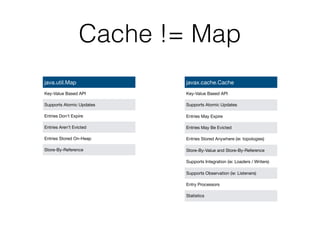
java.util.Map
Key-Value Based API
Supports Atomic Updates
Entries Don’t Expire
Entries Aren’t Evicted
Entries Stored On-Heap
Store-By-Reference
javax.cache.Cache
Key-Value Based API
Supports Atomic Updates
Entries May Expire
Entries May Be Evicted
Entries Stored Anywhere (ie: topologies)
Store-By-Value and Store-By-Reference
Supports Integration (ie: Loaders / Writers)
Supports Observation (ie: Listeners)
Entry Processors
Statistics
Cache != Map
Cache now!
• Add javax.cache:cache-api:1.0.0 to your classpath
• Add an implementation
• Hello, world!
JCache API
• Caching
• “Service loader”: locates implementation, supplies CachingProvider(s)
• CachingProvider
• Creates & manages CacheManagers (per {URI, ClassLoader})
• CacheManager
• Manages Caches lifecycle
• Cache
• That’s what your app uses!
Entry processors
• Data transformations
• Computations
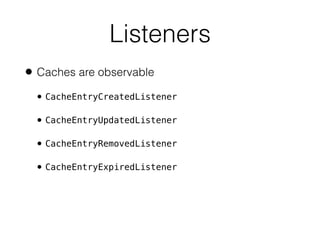
Listeners
• Caches are observable
• CacheEntryCreatedListener
• CacheEntryUpdatedListener
• CacheEntryRemovedListener
• CacheEntryExpiredListener
Cache Loader/Writer
• Integration with system of record
• Read-through, write-through
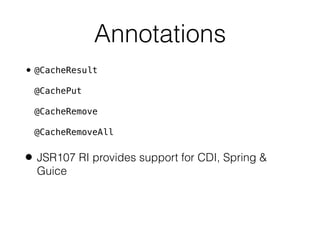
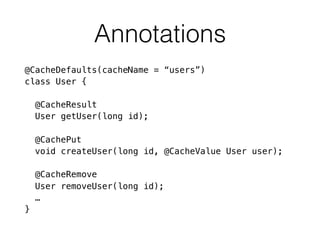
Annotations
• @CacheResult


@CachePut


@CacheRemove


@CacheRemoveAll
• JSR107 RI provides support for CDI, Spring &
Guice
Annotations
@CacheDefaults(cacheName = “users”)
class User {
@CacheResult
User getUser(long id);
@CachePut
void createUser(long id, @CacheValue User user);
@CacheRemove
User removeUser(long id);
…
}
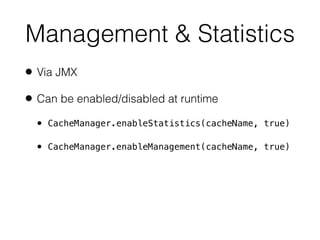
Management & Statistics
• Via JMX
• Can be enabled/disabled at runtime
• CacheManager.enableStatistics(cacheName, true)
• CacheManager.enableManagement(cacheName, true)
Integrations
• Spring
• CDI
• Payara server
JSR-107 links
• JCP Project:
• http://jcp.org/en/jsr/detail?id=107
• Source Code:
• https://github.com/jsr107
• Forum:
• https://groups.google.com/forum/?fromgroups#!
forum/jsr107
Sample code
• Sample project
• https://github.com/vbekiaris/jcache-demo
• Adding caching with JSR107 annotations to a
spring-boot sample:
• https://github.com/vbekiaris/spring-boot/tree/
jcache-jhug/add-caching-to-echoservice

Using JCache to speed up your apps

  • 1.
    Using JCache to speedup your apps Vassilis Bekiaris Software Engineer, Hazelcast @karbonized1
  • 2.
    About me • Firstcomputer:
 Amstrad 6128 green screen • Favorite languages I never
 used in production: Ada, CLISP • Freelancer (-2008) • Software Architect, Team Leader, Jack of all Trades (2008-2016) • Software Engineer, Hazelcast (2016-)
  • 3.
    Outline • Caching basics •Introducing JSR-107 (JCache) • Using JCache
  • 4.
    Why cache? • Performance •Offload expensive or non-scalable parts of your architecture • Buffer against load variability • Usually fast and easy to apply
  • 5.
    When to usecaching • When applications use the same data more than once • When fetching or producing the data again is expensive
  • 6.
    Caches in RAMand beyond NVRAM/Flash/SSD
 (serialized form) Local Storage Heap
 (Objects) Opaque to 
 GC in RAM
 (serialized form) <100 ns < 100ns
 +deserialization time 2 500 1,000+ Latency Size (GB) Network Storage < 50us
 +deserialization time < 140us for 1Gbps
 < 70us for 10Gbps/40Gbps
 +deserialization time 20,000+Scaleout across the network
 (serialized form) Diagram: Greg Luck
  • 7.
    Implementation patterns • Cacheaside App Cache System of Record (1) get (2) null (3) fetch (4) value (5) put
  • 8.
    Implementation patterns • Cachethrough App Cache System of Record (1) get (2) fetch (3) value (4) value
  • 9.
  • 10.
    Introducing JSR-107 • Thestandard way to cache for Java applications • One of the longest running JSRs • Started in 2001 • JSR-107 1.0 final released in March 2014 • JSR-107 1.1 maintenance release (draft review done, expected mid-December 2017) • Target: Java SE 6+
  • 11.
    JCache implementations • ApacheIgnite • Blazing Cache • cache2k • Caffeine • Coherence (Oracle) • Ehcache • Hazelcast • Infinispan • …
 (https://jcp.org/aboutJava/communityprocess/implementations/jsr107/index.html)
  • 12.
    java.util.Map Key-Value Based API SupportsAtomic Updates Entries Don’t Expire Entries Aren’t Evicted Entries Stored On-Heap Store-By-Reference javax.cache.Cache Key-Value Based API Supports Atomic Updates Entries May Expire Entries May Be Evicted Entries Stored Anywhere (ie: topologies) Store-By-Value and Store-By-Reference Supports Integration (ie: Loaders / Writers) Supports Observation (ie: Listeners) Entry Processors Statistics Cache != Map
  • 13.
    Cache now! • Addjavax.cache:cache-api:1.0.0 to your classpath • Add an implementation • Hello, world!
  • 14.
    JCache API • Caching •“Service loader”: locates implementation, supplies CachingProvider(s) • CachingProvider • Creates & manages CacheManagers (per {URI, ClassLoader}) • CacheManager • Manages Caches lifecycle • Cache • That’s what your app uses!
  • 15.
    Entry processors • Datatransformations • Computations
  • 16.
    Listeners • Caches areobservable • CacheEntryCreatedListener • CacheEntryUpdatedListener • CacheEntryRemovedListener • CacheEntryExpiredListener
  • 17.
    Cache Loader/Writer • Integrationwith system of record • Read-through, write-through
  • 18.
  • 19.
    Annotations @CacheDefaults(cacheName = “users”) classUser { @CacheResult User getUser(long id); @CachePut void createUser(long id, @CacheValue User user); @CacheRemove User removeUser(long id); … }
  • 20.
    Management & Statistics •Via JMX • Can be enabled/disabled at runtime • CacheManager.enableStatistics(cacheName, true) • CacheManager.enableManagement(cacheName, true)
  • 21.
  • 22.
    JSR-107 links • JCPProject: • http://jcp.org/en/jsr/detail?id=107 • Source Code: • https://github.com/jsr107 • Forum: • https://groups.google.com/forum/?fromgroups#! forum/jsr107
  • 23.
    Sample code • Sampleproject • https://github.com/vbekiaris/jcache-demo • Adding caching with JSR107 annotations to a spring-boot sample: • https://github.com/vbekiaris/spring-boot/tree/ jcache-jhug/add-caching-to-echoservice