Dr. Vaishali. G. Ghorpade, Dr. Sudarsana Rao, H., B.V. Ramana Prasad / International Journal
of Engineering Research and Applications (IJERA) ISSN: 2248-9622 www.ijera.com
Vol. 3, Issue 3, May-Jun 2013, pp.467-473
467 | P a g e
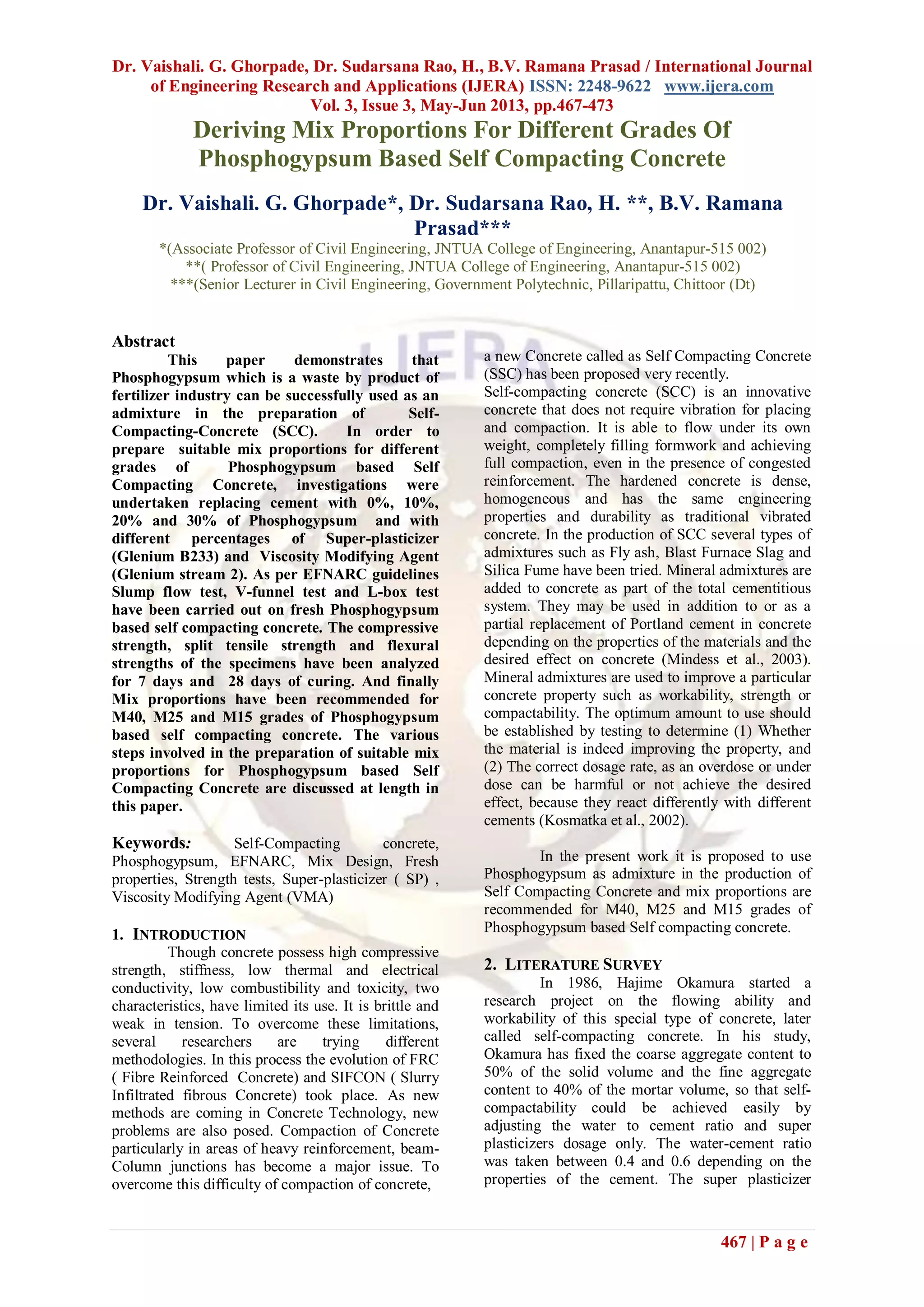
Deriving Mix Proportions For Different Grades Of
Phosphogypsum Based Self Compacting Concrete
Dr. Vaishali. G. Ghorpade*, Dr. Sudarsana Rao, H. **, B.V. Ramana
Prasad***
*(Associate Professor of Civil Engineering, JNTUA College of Engineering, Anantapur-515 002)
**( Professor of Civil Engineering, JNTUA College of Engineering, Anantapur-515 002)
***(Senior Lecturer in Civil Engineering, Government Polytechnic, Pillaripattu, Chittoor (Dt)
Abstract
This paper demonstrates that
Phosphogypsum which is a waste by product of
fertilizer industry can be successfully used as an
admixture in the preparation of Self-
Compacting-Concrete (SCC). In order to
prepare suitable mix proportions for different
grades of Phosphogypsum based Self
Compacting Concrete, investigations were
undertaken replacing cement with 0%, 10%,
20% and 30% of Phosphogypsum and with
different percentages of Super-plasticizer
(Glenium B233) and Viscosity Modifying Agent
(Glenium stream 2). As per EFNARC guidelines
Slump flow test, V-funnel test and L-box test
have been carried out on fresh Phosphogypsum
based self compacting concrete. The compressive
strength, split tensile strength and flexural
strengths of the specimens have been analyzed
for 7 days and 28 days of curing. And finally
Mix proportions have been recommended for
M40, M25 and M15 grades of Phosphogypsum
based self compacting concrete. The various
steps involved in the preparation of suitable mix
proportions for Phosphogypsum based Self
Compacting Concrete are discussed at length in
this paper.
Keywords: Self-Compacting concrete,
Phosphogypsum, EFNARC, Mix Design, Fresh
properties, Strength tests, Super-plasticizer ( SP) ,
Viscosity Modifying Agent (VMA)
1. INTRODUCTION
Though concrete possess high compressive
strength, stiffness, low thermal and electrical
conductivity, low combustibility and toxicity, two
characteristics, have limited its use. It is brittle and
weak in tension. To overcome these limitations,
several researchers are trying different
methodologies. In this process the evolution of FRC
( Fibre Reinforced Concrete) and SIFCON ( Slurry
Infiltrated fibrous Concrete) took place. As new
methods are coming in Concrete Technology, new
problems are also posed. Compaction of Concrete
particularly in areas of heavy reinforcement, beam-
Column junctions has become a major issue. To
overcome this difficulty of compaction of concrete,
a new Concrete called as Self Compacting Concrete
(SSC) has been proposed very recently.
Self-compacting concrete (SCC) is an innovative
concrete that does not require vibration for placing
and compaction. It is able to flow under its own
weight, completely filling formwork and achieving
full compaction, even in the presence of congested
reinforcement. The hardened concrete is dense,
homogeneous and has the same engineering
properties and durability as traditional vibrated
concrete. In the production of SCC several types of
admixtures such as Fly ash, Blast Furnace Slag and
Silica Fume have been tried. Mineral admixtures are
added to concrete as part of the total cementitious
system. They may be used in addition to or as a
partial replacement of Portland cement in concrete
depending on the properties of the materials and the
desired effect on concrete (Mindess et al., 2003).
Mineral admixtures are used to improve a particular
concrete property such as workability, strength or
compactability. The optimum amount to use should
be established by testing to determine (1) Whether
the material is indeed improving the property, and
(2) The correct dosage rate, as an overdose or under
dose can be harmful or not achieve the desired
effect, because they react differently with different
cements (Kosmatka et al., 2002).
In the present work it is proposed to use
Phosphogypsum as admixture in the production of
Self Compacting Concrete and mix proportions are
recommended for M40, M25 and M15 grades of
Phosphogypsum based Self compacting concrete.
2. LITERATURE SURVEY
In 1986, Hajime Okamura started a
research project on the flowing ability and
workability of this special type of concrete, later
called self-compacting concrete. In his study,
Okamura has fixed the coarse aggregate content to
50% of the solid volume and the fine aggregate
content to 40% of the mortar volume, so that self-
compactability could be achieved easily by
adjusting the water to cement ratio and super
plasticizers dosage only. The water-cement ratio
was taken between 0.4 and 0.6 depending on the
properties of the cement. The super plasticizer
Dr. Vaishali. G. Ghorpade, Dr. Sudarsana Rao, H., B.V. Ramana Prasad / International Journal
of Engineering Research and Applications (IJERA) ISSN: 2248-9622 www.ijera.com
Vol. 3, Issue 3, May-Jun 2013, pp.467-473
468 | P a g e
dosage and the final water-cement ratio were
determined so as to ensure the self-compactability,
evaluated subsequently by using the U-type test.
During his research, Okamura found that the main
cause of the poor durability performances of
Japanese concrete in structures was the inadequate
consolidation of the concrete in the casting
operations. By developing concrete that self-
consolidates, he eliminated the main cause for the
poor durability performance of the concrete. After
Okamura began his research in 1986, other
researchers in Japan have started to investigate self-
compacting concrete, looking to improve its
characteristics. One of those was Ozawa (1989) who
has done some research independently from
Okamura, and in the summer of 1988, he succeeded
in developing self-compacting concrete. By using
different types of super plasticizers, Ozawa studied
the workability of concrete and developed a
concrete which was very workable. It was suitable
for rapid placement and had a very good
permeability.
Other experiments carried out by Ozawa
(1989) focused on the influence of mineral
admixtures like fly ash and blast furnace slag on the
flowing ability and segregation resistance of self-
compacting concrete. He found out that the flowing
ability of the concrete improved remarkably when
Portland cement was partially replaced with fly ash
and blast furnace slag. After trying different
proportions of admixtures, he concluded that 10-
20% of fly ash and 25-45% of slag cement, by mass,
showed the best flowing ability and strength
characteristics.
Subramanian and Chattopadhyay
concentrated to arrive at an approximate mix
proportion of self-compacting concrete which would
give the procedure for the selection of a viscosity
modifying agent, a compatible super plasticizer and
the determination of their dosages. The Portland
cement was partially replaced with fly ash and blast
furnace slag, in the same percentages as Ozawa
(1989) has done before and the maximum coarse
aggregate size did not exceed 2.5cm. The two
researchers were tried to determine different coarse
and fine aggregate contents from those developed
by Okamura. On the basis of their trials, it was
discovered that self-compactability could be
achieved when the coarse aggregate content was
restricted to 46 percent instead of 50 percent tried
by Okamura (1997). In order to show the necessity
of using a viscosity-modifying agent along with a
super plasticizer, to reduce the segregation and
bleeding, the mixture proportion developed by the
two researchers was used to cast a few trial
specimens. In these trials, viscosity-modifying agent
was not used. The cast specimens were heavily
reinforced slabs having 2400x600x80 mm and no
vibration or any other method of compaction was
used. However, careful qualitative observations
revealed that the proportions needed to be delicately
adjusted within narrow limits to eliminate bleeding
as well as settlement of coarse aggregate. It was
difficult to obtain a mixture that was at the same
time fluid but did not bleed. This led to the
conclusion that slight changes in water content or
granulometry of aggregate may result either in a
mixture with inadequate flowing ability, or
alternatively one with a tendency for coarse
aggregate to segregate. Therefore, it became
necessary to incorporate a viscosity-modifying
agent in the concrete mixture. Viscosity-modifying
agents can be a natural polymer such as guar gum, a
semi-synthetic polymer such as hydroxyl propyl
methyl cellulose, or water-soluble polysaccharides,
including those derived from a microbial source
such as welan gum. They discovered that with a
combination corresponding to 0.1 percent of welan
gum and 0.53 percent by weight of water acrylic
copolymer type super plasticizer, a satisfactory self-
compacting mixture could be obtained.
Khayat (1997) et al. found out that all cores from
both types of concrete (SCC and conventional
concrete ) exhibited little variation in compressive
strength and modulus of elasticity in relation to
height of the wall, indicating a high degree of
strength uniformity. However, compressive strength
and modulus of elasticity were greater for SCC
samples than those obtained from the medium
fluidity conventional concrete. Dehn et al. (2000)
have focused their research work on the time
development of SCC compressive and splitting
tensile strength and the bond behavior between the
reinforcing bars and the self-compacting concrete
compared to normal concrete. Experimental results
showed higher compressive strengths (36%) and
splitting tensile strengths (28%) of the SCC
specimens compared to normal concrete specimens.
Also, the bond behavior measured at 1, 3, 7 and 28
days after concreting was better for self-compacting
concrete than that of normally vibrated concrete.
3. EXPERIMENTAL INVESTIGATIONS:
The steps involved in the investigations for
Phosphogypsum based Self compacting concrete are
explained in the following sections.
3.1 Materials used in this investigation:
 Cement: Commercially available Ordinary
Portland cement (OPC) 53 grade manufactured by
Ultratech Company was used
 Coarse aggregate: The coarse aggregate
from a local crushing unit having 20mm normal size
well-graded aggregate according to IS-383 is used
in this investigation. The coarse aggregate procured
from quarry was sieved through 20mm, 16mm,
12.5mm, 10mm and 4.75mm sieves. The material
retained on 12.5mm, 10mm and 4.75mm sieves was
filled in bags and stacked separately and used.
Dr. Vaishali. G. Ghorpade, Dr. Sudarsana Rao, H., B.V. Ramana Prasad / International Journal
of Engineering Research and Applications (IJERA) ISSN: 2248-9622 www.ijera.com
Vol. 3, Issue 3, May-Jun 2013, pp.467-473
469 | P a g e
 Fine Aggregate: The fine aggregate that
falls in zone-I was obtained from a nearby river
course. The sand obtained was sieved through all
the sieves (i.e.4.75mm, 2.36mm, 1.18mm, 600,
300, 150). Sand retained on each sieve was filled
in different bags and stacked separately for use. To
obtain zone-I sand correctly, sand retained on each
sieve is mixed in appropriate proportion
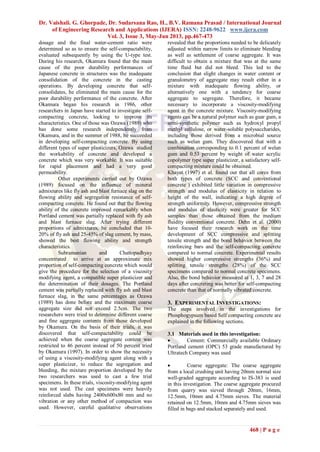
 Phosphogypsum : The Phosphogypsum
used in the investigation was obtained from
Coromandel international Ltd, Ennore, Chennai.
The Phosphogypsum passing through 90 sieve was
used throughout the experiment. The specific
gravity of Phosphogypsum was found to be 2.34.
The chemical composition is presented below.
 a) CaSO4.2H2O : 92.0-
94.0
 b) SiO2+insolubles : 4.0
max
 c) Fe2O3+Al2O3 : 0.3
max
 d) CaO : 30.0-
31.0
 e) MgO : 0.1
max
 f) Na2O+K2O : 0.3-0.4
(0.5 max)
 g) Total P2O5 : 0.6-1.0
 h) Total SO3 : 42.8-
44.0
 i) Fluorides as F : 0.4-
0.5(0.7 max)
 j) Chlorides as C : 0.3-
0.5(0.6 max)
 k) pH of 10% solution : 5.0-
6.0(4 min)

 Super-Plasticizer : The super plasticizer
used in this experiment is Glenium B233. It is
manufactured by BASF construction chemical India
pvt.ltd, Mumbai. It complies to IS: 9103-1999
standards.
 Viscosity Modifying Agent (V.M.A) :
Glenium Stream 2 which is manufactured by BASF
construction chemical India pvt.ltd, Mumbai and it
is a premier ready-to-use, liquid, organic, viscosity-
modifying admixture (VMA) specially developed
for producing concrete with enhanced viscosity and
controlled rheological properties. Concrete
containing GLENIUM STREAM 2 admixture
exhibits superior stability and controlled bleeding
characteristics, thus increasing resistance to
segregation and facilitating placement.
 Water
3.2 Mix Proportioning: Based on the Mix design
procedures and considering the EFNARC guide
lines and “The European Guidelines for typical
ranges of proportions and quantities” the following
conclusions were made and used in the Mix
designing process for preliminary mix design trials
in this investigation.
1) Total powder content ( Cementitious
material i.e. Cement + Phosphogypsum ) is taken as
600kg per cubic meter.
2) Water/powder ratio by volume of 0.80 to
1.10 and by weight 0.32 to 0.40.
3) Weight of coarse aggregate as 50% by
volume of total aggregate
4) Weight of fine aggregate as 50% by
volume of total aggregate.
5) A dosage range of 500 ml to 1500ml per
100kg of cementitious material is considered for
Super-Plasticizer (Glenium B233)
6) A dosage range of 50 to 500 ml/100 kg of
cementitious material is considered for . Viscosity
Modifying Agent (Glenium Stream 2)
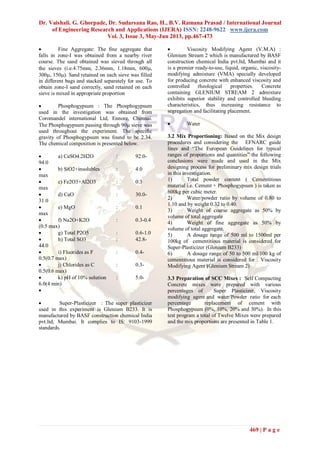
3.3 Preparation of SCC Mixes : Self Compacting
Concrete mixes were prepared with various
percentages of Super Plasticizer, Viscosity
modifying agent and water/Powder ratio for each
percentage replacement of cement with
Phosphogypsum (0%, 10%, 20% and 30%). In this
test program a total of Twelve Mixes were prepared
and the mix proportions are presented in Table 1.
Dr. Vaishali. G. Ghorpade, Dr. Sudarsana Rao, H., B.V. Ramana Prasad / International Journal
of Engineering Research and Applications (IJERA) ISSN: 2248-9622 www.ijera.com
Vol. 3, Issue 3, May-Jun 2013, pp.467-473
470 | P a g e
Table 1 : Details of mix proportions
( Note: The Values are for One Cubic metre of Self Compacting Concrete)
3.4 Conducting standard flow tests on SCC Mixes : The standard flow tests like Slump test, L-Box test,
V- funnel test were conducted on the twelve mixes ( TR1 to TR12 )and the results were compared with the
values as per EFNARC guidelines. Among these trails TR1 (SCC1), TR9 (SCC2), TR10 (SCC3) and TR12
(SCC4) mix proportions satisfy all the properties of self compaction concrete. The results are shown in Table 2.
S NO Mix ID Slump Dia (mm)
T50cm
Slump (sec)
V-Funnel
(sec)
V-Funnel at T5 min(sec)
L-Box
(h2/h1)
1 TR1 (SCC1) 650 3.4 7.1 10 0.92
2 TR2 - - - - -
3 TR3 - - - - -
4 TR4 - - - - -
5 TR5 900 2.30 - - -
6 TR6 865 2.0 - - -
7 TR7 745 2.5 11.0 14.2 0.95
8 TR8 660 5.1 10.1 13.4 0.81
9 TR9 (SCC2) 715 4.2 9.0 12.0 0.87
10 TR10 (SCC3) 665 4.1 8.20 11.1 0.91
11 TR11 522 7.2 - - -
12 TR12 (SCC4) 678 3.1 8.85 11.5 0.95
Table 2: Fresh concrete properties of SCC
3.5 Casting specimens and conducting strength tests : For those mix proportions which satisfy all the
properties of self compaction concrete i.e. for TR1 (SCC1), TR9 (SCC2), TR10 (SCC3) and TR12 (SCC4),
specimens were prepared and tested to know compressive strength, split tensile strength and flexural strength.
The results of these tests are shown in Tables 3, 4 and Table 5.
Table 3: Average Compressive strengths of cubes
Tr
.n
o
Mix
ID
%
Repla
ceme
nt of
PG
Cement
( Kg)
PG
(
Kg)
FA
( Kg)
CA
w/p
Wate
r (Li)
SP
(
Kg)
VM
A (
Kg)
Total
( Kg)
16-
12.5mm
( Kg)
12.5-
10mm
( Kg)
10-
4.75m
m
( Kg)
1 TR1 0 600 - 673.32 708.61 177.15 177.15 354.3 0.4 240 9 0.3
2 TR2 10 540 60 732.6 770 462 123.2 184.8 0.32 192 3 0.6
3 TR3 10 540 60 731.44 768.64 461.18 122.98 184.4 0.32 192 4 0.6
4 TR4 10 540 60 730.31 767.34 306.94 184.1 276.2 0.32 192 5 0.6
5 TR5 10 576 64 554.04 582.03 232.81 139.68 209.53 0.5 320 5.6 0.6
6 TR6 10 576 64 629.92 662.94 265.1 159.1 238.6 0.4 256 8.16 0.6
7 TR7 10 576 64 633 665.55 266.22 159.7 239.5 0.4 256 9 0.3
8 TR8 10 540 60 666.6 700.8 280.32 168.1 252.2 0.4 240 9 0.3
9 TR9 10 540 60 666.6 700.8 175.2 175.2 350.4 0.4 240 9 0.3
10 TR10 20 480 120 659.68 694.26 173.56 173.56 347.13 0.4 240 9 0.3
11 TR11 30 420 180 652.24 686.43 171.6 171.6 343.2 0.4 240 10 0.3
12 TR12 30 420 180 648.52 682.52 170.6 170.6 341.3 0.4 240 12 0.3
S NO MIX ID
% of
Phospho
gypsum
Compressive strength in
N/mm2
7 days 28 days
1 SCC1 0 32.80 47.95
2 SCC2 10 41.50 52.45
3 SCC3 20 32.25 33.20
4 SCC4 30 19.20 25.15
Dr. Vaishali. G. Ghorpade, Dr. Sudarsana Rao, H., B.V. Ramana Prasad / International Journal
of Engineering Research and Applications (IJERA) ISSN: 2248-9622 www.ijera.com
Vol. 3, Issue 3, May-Jun 2013, pp.467-473
471 | P a g e
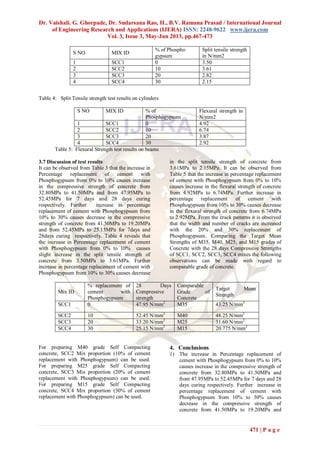
Table 4: Split Tensile strength test results on cylinders
S NO MIX ID % of
Phosphogypsum
Flexural strength in
N/mm2
1 SCC1 0 4.92
2 SCC2 10 6.74
3 SCC3 20 3.87
4 SCC4 30 2.92
Table 5: Flexural Strength test results on beams
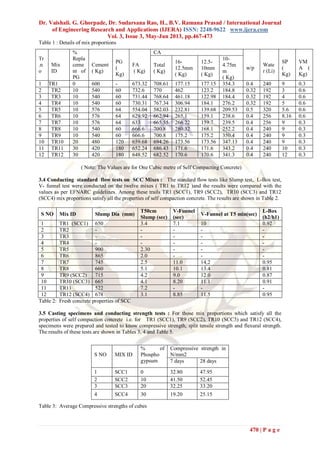
3.7 Discussion of test results
It can be observed from Table 3 that the increase in
Percentage replacement of cement with
Phosphogypsum from 0% to 10% causes increase
in the compressive strength of concrete from
32.80MPa to 41.50MPa and from 47.95MPa to
52.45MPa for 7 days and 28 days curing
respectively. Further increase in percentage
replacement of cement with Phosphogypsum from
10% to 30% causes decrease in the compressive
strength of concrete from 41.50MPa to 19.20MPa
and from 52.45MPa to 25.15MPa for 7days and
28days curing respectively. Table 4 reveals that
the increase in Percentage replacement of cement
with Phosphogypsum from 0% to 10% causes
slight increase in the split tensile strength of
concrete from 3.50MPa to 3.61MPa. Further
increase in percentage replacement of cement with
Phosphogypsum from 10% to 30% causes decrease
in the split tensile strength of concrete from
3.61MPa to 2.15MPa. It can be observed from
Table 5 that the increase in percentage replacement
of cement with Phosphogypsum from 0% to 10%
causes increase in the flexural strength of concrete
from 4.92MPa to 6.74MPa. Further increase in
percentage replacement of cement with
Phosphogypsum from 10% to 30% causes decrease
in the flexural strength of concrete from 6.74MPa
to 2.92MPa. From the crack patterns it is observed
that the width and number of cracks are increased
with the 20% and 30% replacement of
Phosphogypsum. Comparing the Target Mean
Strengths of M35, M40, M25, and M15 grades of
Concrete with the 28 days Compressive Strengths
of SCC1, SCC2, SCC3, SCC4 mixes the following
observations can be made with regard to
comparable grade of concrete.
Mix ID
% replacement of
cement with
Phosphogypsum
28 Days
Compressive
strength
Comparable
Grade of
Concrete
Target Mean
Strength
SCC1 0 47.95 N/mm2
M35 43.25 N/mm2
SCC2 10 52.45 N/mm2
M40 48.25 N/mm2
SCC3 20 33.20 N/mm2
M25 31.60 N/mm2
SCC4 30 25.15 N/mm2
M15 20.775 N/mm2
For preparing M40 grade Self Compacting
concrete, SCC2 Mix proportion (10% of cement
replacement with Phosphogypsum) can be used.
For preparing M25 grade Self Compacting
concrete, SCC3 Mix proportion (20% of cement
replacement with Phosphogypsum) can be used.
For preparing M15 grade Self Compacting
concrete, SCC4 Mix proportion (30% of cement
replacement with Phosphogypsum) can be used.
4. Conclusions
1) The increase in Percentage replacement of
cement with Phosphogypsum from 0% to 10%
causes increase in the compressive strength of
concrete from 32.80MPa to 41.50MPa and
from 47.95MPa to 52.45MPa for 7 days and 28
days curing respectively. Further increase in
percentage replacement of cement with
Phosphogypsum from 10% to 30% causes
decrease in the compressive strength of
concrete from 41.50MPa to 19.20MPa and
S NO MIX ID
% of Phospho
gypsum
Split tensile strength
in N/mm2
1 SCC1 0 3.50
2 SCC2 10 3.61
3 SCC3 20 2.82
4 SCC4 30 2.15
Dr. Vaishali. G. Ghorpade, Dr. Sudarsana Rao, H., B.V. Ramana Prasad / International Journal
of Engineering Research and Applications (IJERA) ISSN: 2248-9622 www.ijera.com
Vol. 3, Issue 3, May-Jun 2013, pp.467-473
472 | P a g e
from 52.45MPa to 25.15MPa for 7days and
28days curing respectively.
2) The increase in Percentage replacement of
cement with Phosphogypsum from 0% to 10%
causes slight increase in the Split tensile
Strength of concrete from 3.50MPa to
3.61MPa. Further increase in percentage
replacement of cement with Phosphogypsum
from 10% to 30% causes decrease in the Split
tensile strength of concrete from 3.61MPa to
2.15MPa.
3) The increase in Percentage replacement of
cement with Phosphogypsum from 0% to 10%
causes increase in the flexural strength of
concrete from 4.92MPa to 6.74MPa. Further
increase in percentage replacement of cement
with Phosphogypsum from 10% to 30% causes
decrease in the flexural strength of concrete
from 6.74MPa to 2.92MPa. From the crack
patterns it is observed that the width and
number of cracks are increased with the 20%
and 30% replacement of Phosphogypsum.
4) SCC mix requires high powder content, lesser
quantity of coarse aggregate, high range Super
plasticizer and VMA to give stability and
fluidity to the concrete mix.
5) SCC can be obtained for widely differing
Phosphogypsum contents or cement contents
as long as the paste volume constituted by the
water cement ratio is kept constant.
6) The workability of SCC is equilibrium of
fluidity, deformability, filling ability and
resistance to segregation. This equilibrium has
to be maintained for a sufficient time period to
allow for transportation, placing and finishing.
7) An industrial waste like phosphogypsum
impairs the strength development of calcined
products and hence it can be used in
construction industry for preparation of
concrete replacing some quantity of cement,
which is a valuable ingredient of concrete to
achieve economy.
8) With 10% replacement of cement with
phosphogypsum not only the compressive
strength increased significantly with age but
also the split tensile strength at 28 days
increased. However, further replacement of
cement with phosphogypsum lead to drastic
reduction in compressive strength.
9) 10% replacement of cement with
phosphogypsum gives maximum flexural
strength than the other replacement of cement
with phosphogypsum. The width and number
of cracks also increases with the 20% and 30%
replacement of phosphogypsum.
10) The Mix proportions for different grades of
Self Compacting Concrete with
Phosphogypsum are recommended as follows.
.
Grade of
Concrete
%
Replace
ment of
cement
with
Phospho
gypsum
Cement
( Kg)
PG
(
Kg)
FA
( Kg)
CA
w/p
Wate
r (L)
SP
(
Kg)
VM
A (
Kg)
Total
( Kg)
16-
12.5mm
( Kg)
12.5-
10mm
( Kg)
10-
4.75mm
( Kg)
M40 10 540 60 666.6 700.8 175.2 175.2 350.4 0.4 240 9 0.3
M25 20 480 120 659.68 694.26 173.56 173.56 347.13 0.4 240 9 0.3
M15 30 420 180 648.52 682.52 170.6 170.6 341.3 0.4 240 12 0.3
References
[1] Okamura, H, “Self-Compacting High-
Performance Concrete”, Concrete
International, pp.50-54(1997).
[2] Bartos, J. M., “Measurement of Key
Properties of Fresh Self-compacting
Concrete”, CEN/PNR Workshop, Paris
(2000).
[3] Ozawa, K., “Development of high
performance concrete based on the
durability design of concrete structures”,
EASEC-2, Vol. 1, pp.445-450 (1989).
[4] Atkins, H. N., “Highway Materials, Soils,
and Concretes”, 4th Edition, Prentice Hall,
pp.277-330(2003).
[5] Bartos, J. M., “Measurement of Key
Properties of Fresh Self-compacting
Concrete”, CEN/PNR Workshop, Paris
(2000).
[6] Ouchi, M., M. Hibino, and H. Okamura,
“Effect of Superplasticizer on Self-
Compactability of Fresh Concrete”, TRR
1574, pp.37-40 (1996).
[7] Ouchi, M. and M. Hibino, “Development,
Applications and Investigations of Self-
compacting Concrete”, International
Workshop, Kochi, Japan (2000).
Dr. Vaishali. G. Ghorpade, Dr. Sudarsana Rao, H., B.V. Ramana Prasad / International Journal
of Engineering Research and Applications (IJERA) ISSN: 2248-9622 www.ijera.com
Vol. 3, Issue 3, May-Jun 2013, pp.467-473
473 | P a g e
[8] St John, D. A., “Concrete Petrography”, A
handbook of investigative techniques,
Wiley & Sons, New York (1998).
[9] Subramanian, S. and D. Chattopadhyay,
“Experiments for mix proportioning of
self-compacting concrete”, The Indian
Concrete Journal, pp.13-20 (2002).
[10] Khayat, K.H. and Z. Guizani, “Use of
Viscosity-Modifying Admixture to
Enhance Stability of Fluid Concrete”, ACI
Materials Journal, pp.332-340 (1997).
[11] Khayat, K.H., M.Vachon, and M. C.
Lanctot, “Use of Blended Silica Fume
Cement in Commercial Concrete
Mixtures”, ACI Materials Journal, pp.183-
192 (1997).
[12] Khayat, K.H., K. Manai, A. Trudel, “In
situ mechanical properties of wall
elements cast using self-consolidating
concrete”, ACI Materials Journal, pp.491-
500 (1997).

Ca33467473

  • 1.
    Dr. Vaishali. G.Ghorpade, Dr. Sudarsana Rao, H., B.V. Ramana Prasad / International Journal of Engineering Research and Applications (IJERA) ISSN: 2248-9622 www.ijera.com Vol. 3, Issue 3, May-Jun 2013, pp.467-473 467 | P a g e Deriving Mix Proportions For Different Grades Of Phosphogypsum Based Self Compacting Concrete Dr. Vaishali. G. Ghorpade*, Dr. Sudarsana Rao, H. **, B.V. Ramana Prasad*** *(Associate Professor of Civil Engineering, JNTUA College of Engineering, Anantapur-515 002) **( Professor of Civil Engineering, JNTUA College of Engineering, Anantapur-515 002) ***(Senior Lecturer in Civil Engineering, Government Polytechnic, Pillaripattu, Chittoor (Dt) Abstract This paper demonstrates that Phosphogypsum which is a waste by product of fertilizer industry can be successfully used as an admixture in the preparation of Self- Compacting-Concrete (SCC). In order to prepare suitable mix proportions for different grades of Phosphogypsum based Self Compacting Concrete, investigations were undertaken replacing cement with 0%, 10%, 20% and 30% of Phosphogypsum and with different percentages of Super-plasticizer (Glenium B233) and Viscosity Modifying Agent (Glenium stream 2). As per EFNARC guidelines Slump flow test, V-funnel test and L-box test have been carried out on fresh Phosphogypsum based self compacting concrete. The compressive strength, split tensile strength and flexural strengths of the specimens have been analyzed for 7 days and 28 days of curing. And finally Mix proportions have been recommended for M40, M25 and M15 grades of Phosphogypsum based self compacting concrete. The various steps involved in the preparation of suitable mix proportions for Phosphogypsum based Self Compacting Concrete are discussed at length in this paper. Keywords: Self-Compacting concrete, Phosphogypsum, EFNARC, Mix Design, Fresh properties, Strength tests, Super-plasticizer ( SP) , Viscosity Modifying Agent (VMA) 1. INTRODUCTION Though concrete possess high compressive strength, stiffness, low thermal and electrical conductivity, low combustibility and toxicity, two characteristics, have limited its use. It is brittle and weak in tension. To overcome these limitations, several researchers are trying different methodologies. In this process the evolution of FRC ( Fibre Reinforced Concrete) and SIFCON ( Slurry Infiltrated fibrous Concrete) took place. As new methods are coming in Concrete Technology, new problems are also posed. Compaction of Concrete particularly in areas of heavy reinforcement, beam- Column junctions has become a major issue. To overcome this difficulty of compaction of concrete, a new Concrete called as Self Compacting Concrete (SSC) has been proposed very recently. Self-compacting concrete (SCC) is an innovative concrete that does not require vibration for placing and compaction. It is able to flow under its own weight, completely filling formwork and achieving full compaction, even in the presence of congested reinforcement. The hardened concrete is dense, homogeneous and has the same engineering properties and durability as traditional vibrated concrete. In the production of SCC several types of admixtures such as Fly ash, Blast Furnace Slag and Silica Fume have been tried. Mineral admixtures are added to concrete as part of the total cementitious system. They may be used in addition to or as a partial replacement of Portland cement in concrete depending on the properties of the materials and the desired effect on concrete (Mindess et al., 2003). Mineral admixtures are used to improve a particular concrete property such as workability, strength or compactability. The optimum amount to use should be established by testing to determine (1) Whether the material is indeed improving the property, and (2) The correct dosage rate, as an overdose or under dose can be harmful or not achieve the desired effect, because they react differently with different cements (Kosmatka et al., 2002). In the present work it is proposed to use Phosphogypsum as admixture in the production of Self Compacting Concrete and mix proportions are recommended for M40, M25 and M15 grades of Phosphogypsum based Self compacting concrete. 2. LITERATURE SURVEY In 1986, Hajime Okamura started a research project on the flowing ability and workability of this special type of concrete, later called self-compacting concrete. In his study, Okamura has fixed the coarse aggregate content to 50% of the solid volume and the fine aggregate content to 40% of the mortar volume, so that self- compactability could be achieved easily by adjusting the water to cement ratio and super plasticizers dosage only. The water-cement ratio was taken between 0.4 and 0.6 depending on the properties of the cement. The super plasticizer
  • 2.
    Dr. Vaishali. G.Ghorpade, Dr. Sudarsana Rao, H., B.V. Ramana Prasad / International Journal of Engineering Research and Applications (IJERA) ISSN: 2248-9622 www.ijera.com Vol. 3, Issue 3, May-Jun 2013, pp.467-473 468 | P a g e dosage and the final water-cement ratio were determined so as to ensure the self-compactability, evaluated subsequently by using the U-type test. During his research, Okamura found that the main cause of the poor durability performances of Japanese concrete in structures was the inadequate consolidation of the concrete in the casting operations. By developing concrete that self- consolidates, he eliminated the main cause for the poor durability performance of the concrete. After Okamura began his research in 1986, other researchers in Japan have started to investigate self- compacting concrete, looking to improve its characteristics. One of those was Ozawa (1989) who has done some research independently from Okamura, and in the summer of 1988, he succeeded in developing self-compacting concrete. By using different types of super plasticizers, Ozawa studied the workability of concrete and developed a concrete which was very workable. It was suitable for rapid placement and had a very good permeability. Other experiments carried out by Ozawa (1989) focused on the influence of mineral admixtures like fly ash and blast furnace slag on the flowing ability and segregation resistance of self- compacting concrete. He found out that the flowing ability of the concrete improved remarkably when Portland cement was partially replaced with fly ash and blast furnace slag. After trying different proportions of admixtures, he concluded that 10- 20% of fly ash and 25-45% of slag cement, by mass, showed the best flowing ability and strength characteristics. Subramanian and Chattopadhyay concentrated to arrive at an approximate mix proportion of self-compacting concrete which would give the procedure for the selection of a viscosity modifying agent, a compatible super plasticizer and the determination of their dosages. The Portland cement was partially replaced with fly ash and blast furnace slag, in the same percentages as Ozawa (1989) has done before and the maximum coarse aggregate size did not exceed 2.5cm. The two researchers were tried to determine different coarse and fine aggregate contents from those developed by Okamura. On the basis of their trials, it was discovered that self-compactability could be achieved when the coarse aggregate content was restricted to 46 percent instead of 50 percent tried by Okamura (1997). In order to show the necessity of using a viscosity-modifying agent along with a super plasticizer, to reduce the segregation and bleeding, the mixture proportion developed by the two researchers was used to cast a few trial specimens. In these trials, viscosity-modifying agent was not used. The cast specimens were heavily reinforced slabs having 2400x600x80 mm and no vibration or any other method of compaction was used. However, careful qualitative observations revealed that the proportions needed to be delicately adjusted within narrow limits to eliminate bleeding as well as settlement of coarse aggregate. It was difficult to obtain a mixture that was at the same time fluid but did not bleed. This led to the conclusion that slight changes in water content or granulometry of aggregate may result either in a mixture with inadequate flowing ability, or alternatively one with a tendency for coarse aggregate to segregate. Therefore, it became necessary to incorporate a viscosity-modifying agent in the concrete mixture. Viscosity-modifying agents can be a natural polymer such as guar gum, a semi-synthetic polymer such as hydroxyl propyl methyl cellulose, or water-soluble polysaccharides, including those derived from a microbial source such as welan gum. They discovered that with a combination corresponding to 0.1 percent of welan gum and 0.53 percent by weight of water acrylic copolymer type super plasticizer, a satisfactory self- compacting mixture could be obtained. Khayat (1997) et al. found out that all cores from both types of concrete (SCC and conventional concrete ) exhibited little variation in compressive strength and modulus of elasticity in relation to height of the wall, indicating a high degree of strength uniformity. However, compressive strength and modulus of elasticity were greater for SCC samples than those obtained from the medium fluidity conventional concrete. Dehn et al. (2000) have focused their research work on the time development of SCC compressive and splitting tensile strength and the bond behavior between the reinforcing bars and the self-compacting concrete compared to normal concrete. Experimental results showed higher compressive strengths (36%) and splitting tensile strengths (28%) of the SCC specimens compared to normal concrete specimens. Also, the bond behavior measured at 1, 3, 7 and 28 days after concreting was better for self-compacting concrete than that of normally vibrated concrete. 3. EXPERIMENTAL INVESTIGATIONS: The steps involved in the investigations for Phosphogypsum based Self compacting concrete are explained in the following sections. 3.1 Materials used in this investigation:  Cement: Commercially available Ordinary Portland cement (OPC) 53 grade manufactured by Ultratech Company was used  Coarse aggregate: The coarse aggregate from a local crushing unit having 20mm normal size well-graded aggregate according to IS-383 is used in this investigation. The coarse aggregate procured from quarry was sieved through 20mm, 16mm, 12.5mm, 10mm and 4.75mm sieves. The material retained on 12.5mm, 10mm and 4.75mm sieves was filled in bags and stacked separately and used.
  • 3.
    Dr. Vaishali. G.Ghorpade, Dr. Sudarsana Rao, H., B.V. Ramana Prasad / International Journal of Engineering Research and Applications (IJERA) ISSN: 2248-9622 www.ijera.com Vol. 3, Issue 3, May-Jun 2013, pp.467-473 469 | P a g e  Fine Aggregate: The fine aggregate that falls in zone-I was obtained from a nearby river course. The sand obtained was sieved through all the sieves (i.e.4.75mm, 2.36mm, 1.18mm, 600, 300, 150). Sand retained on each sieve was filled in different bags and stacked separately for use. To obtain zone-I sand correctly, sand retained on each sieve is mixed in appropriate proportion  Phosphogypsum : The Phosphogypsum used in the investigation was obtained from Coromandel international Ltd, Ennore, Chennai. The Phosphogypsum passing through 90 sieve was used throughout the experiment. The specific gravity of Phosphogypsum was found to be 2.34. The chemical composition is presented below.  a) CaSO4.2H2O : 92.0- 94.0  b) SiO2+insolubles : 4.0 max  c) Fe2O3+Al2O3 : 0.3 max  d) CaO : 30.0- 31.0  e) MgO : 0.1 max  f) Na2O+K2O : 0.3-0.4 (0.5 max)  g) Total P2O5 : 0.6-1.0  h) Total SO3 : 42.8- 44.0  i) Fluorides as F : 0.4- 0.5(0.7 max)  j) Chlorides as C : 0.3- 0.5(0.6 max)  k) pH of 10% solution : 5.0- 6.0(4 min)   Super-Plasticizer : The super plasticizer used in this experiment is Glenium B233. It is manufactured by BASF construction chemical India pvt.ltd, Mumbai. It complies to IS: 9103-1999 standards.  Viscosity Modifying Agent (V.M.A) : Glenium Stream 2 which is manufactured by BASF construction chemical India pvt.ltd, Mumbai and it is a premier ready-to-use, liquid, organic, viscosity- modifying admixture (VMA) specially developed for producing concrete with enhanced viscosity and controlled rheological properties. Concrete containing GLENIUM STREAM 2 admixture exhibits superior stability and controlled bleeding characteristics, thus increasing resistance to segregation and facilitating placement.  Water 3.2 Mix Proportioning: Based on the Mix design procedures and considering the EFNARC guide lines and “The European Guidelines for typical ranges of proportions and quantities” the following conclusions were made and used in the Mix designing process for preliminary mix design trials in this investigation. 1) Total powder content ( Cementitious material i.e. Cement + Phosphogypsum ) is taken as 600kg per cubic meter. 2) Water/powder ratio by volume of 0.80 to 1.10 and by weight 0.32 to 0.40. 3) Weight of coarse aggregate as 50% by volume of total aggregate 4) Weight of fine aggregate as 50% by volume of total aggregate. 5) A dosage range of 500 ml to 1500ml per 100kg of cementitious material is considered for Super-Plasticizer (Glenium B233) 6) A dosage range of 50 to 500 ml/100 kg of cementitious material is considered for . Viscosity Modifying Agent (Glenium Stream 2) 3.3 Preparation of SCC Mixes : Self Compacting Concrete mixes were prepared with various percentages of Super Plasticizer, Viscosity modifying agent and water/Powder ratio for each percentage replacement of cement with Phosphogypsum (0%, 10%, 20% and 30%). In this test program a total of Twelve Mixes were prepared and the mix proportions are presented in Table 1.
  • 4.
    Dr. Vaishali. G.Ghorpade, Dr. Sudarsana Rao, H., B.V. Ramana Prasad / International Journal of Engineering Research and Applications (IJERA) ISSN: 2248-9622 www.ijera.com Vol. 3, Issue 3, May-Jun 2013, pp.467-473 470 | P a g e Table 1 : Details of mix proportions ( Note: The Values are for One Cubic metre of Self Compacting Concrete) 3.4 Conducting standard flow tests on SCC Mixes : The standard flow tests like Slump test, L-Box test, V- funnel test were conducted on the twelve mixes ( TR1 to TR12 )and the results were compared with the values as per EFNARC guidelines. Among these trails TR1 (SCC1), TR9 (SCC2), TR10 (SCC3) and TR12 (SCC4) mix proportions satisfy all the properties of self compaction concrete. The results are shown in Table 2. S NO Mix ID Slump Dia (mm) T50cm Slump (sec) V-Funnel (sec) V-Funnel at T5 min(sec) L-Box (h2/h1) 1 TR1 (SCC1) 650 3.4 7.1 10 0.92 2 TR2 - - - - - 3 TR3 - - - - - 4 TR4 - - - - - 5 TR5 900 2.30 - - - 6 TR6 865 2.0 - - - 7 TR7 745 2.5 11.0 14.2 0.95 8 TR8 660 5.1 10.1 13.4 0.81 9 TR9 (SCC2) 715 4.2 9.0 12.0 0.87 10 TR10 (SCC3) 665 4.1 8.20 11.1 0.91 11 TR11 522 7.2 - - - 12 TR12 (SCC4) 678 3.1 8.85 11.5 0.95 Table 2: Fresh concrete properties of SCC 3.5 Casting specimens and conducting strength tests : For those mix proportions which satisfy all the properties of self compaction concrete i.e. for TR1 (SCC1), TR9 (SCC2), TR10 (SCC3) and TR12 (SCC4), specimens were prepared and tested to know compressive strength, split tensile strength and flexural strength. The results of these tests are shown in Tables 3, 4 and Table 5. Table 3: Average Compressive strengths of cubes Tr .n o Mix ID % Repla ceme nt of PG Cement ( Kg) PG ( Kg) FA ( Kg) CA w/p Wate r (Li) SP ( Kg) VM A ( Kg) Total ( Kg) 16- 12.5mm ( Kg) 12.5- 10mm ( Kg) 10- 4.75m m ( Kg) 1 TR1 0 600 - 673.32 708.61 177.15 177.15 354.3 0.4 240 9 0.3 2 TR2 10 540 60 732.6 770 462 123.2 184.8 0.32 192 3 0.6 3 TR3 10 540 60 731.44 768.64 461.18 122.98 184.4 0.32 192 4 0.6 4 TR4 10 540 60 730.31 767.34 306.94 184.1 276.2 0.32 192 5 0.6 5 TR5 10 576 64 554.04 582.03 232.81 139.68 209.53 0.5 320 5.6 0.6 6 TR6 10 576 64 629.92 662.94 265.1 159.1 238.6 0.4 256 8.16 0.6 7 TR7 10 576 64 633 665.55 266.22 159.7 239.5 0.4 256 9 0.3 8 TR8 10 540 60 666.6 700.8 280.32 168.1 252.2 0.4 240 9 0.3 9 TR9 10 540 60 666.6 700.8 175.2 175.2 350.4 0.4 240 9 0.3 10 TR10 20 480 120 659.68 694.26 173.56 173.56 347.13 0.4 240 9 0.3 11 TR11 30 420 180 652.24 686.43 171.6 171.6 343.2 0.4 240 10 0.3 12 TR12 30 420 180 648.52 682.52 170.6 170.6 341.3 0.4 240 12 0.3 S NO MIX ID % of Phospho gypsum Compressive strength in N/mm2 7 days 28 days 1 SCC1 0 32.80 47.95 2 SCC2 10 41.50 52.45 3 SCC3 20 32.25 33.20 4 SCC4 30 19.20 25.15
  • 5.
    Dr. Vaishali. G.Ghorpade, Dr. Sudarsana Rao, H., B.V. Ramana Prasad / International Journal of Engineering Research and Applications (IJERA) ISSN: 2248-9622 www.ijera.com Vol. 3, Issue 3, May-Jun 2013, pp.467-473 471 | P a g e Table 4: Split Tensile strength test results on cylinders S NO MIX ID % of Phosphogypsum Flexural strength in N/mm2 1 SCC1 0 4.92 2 SCC2 10 6.74 3 SCC3 20 3.87 4 SCC4 30 2.92 Table 5: Flexural Strength test results on beams 3.7 Discussion of test results It can be observed from Table 3 that the increase in Percentage replacement of cement with Phosphogypsum from 0% to 10% causes increase in the compressive strength of concrete from 32.80MPa to 41.50MPa and from 47.95MPa to 52.45MPa for 7 days and 28 days curing respectively. Further increase in percentage replacement of cement with Phosphogypsum from 10% to 30% causes decrease in the compressive strength of concrete from 41.50MPa to 19.20MPa and from 52.45MPa to 25.15MPa for 7days and 28days curing respectively. Table 4 reveals that the increase in Percentage replacement of cement with Phosphogypsum from 0% to 10% causes slight increase in the split tensile strength of concrete from 3.50MPa to 3.61MPa. Further increase in percentage replacement of cement with Phosphogypsum from 10% to 30% causes decrease in the split tensile strength of concrete from 3.61MPa to 2.15MPa. It can be observed from Table 5 that the increase in percentage replacement of cement with Phosphogypsum from 0% to 10% causes increase in the flexural strength of concrete from 4.92MPa to 6.74MPa. Further increase in percentage replacement of cement with Phosphogypsum from 10% to 30% causes decrease in the flexural strength of concrete from 6.74MPa to 2.92MPa. From the crack patterns it is observed that the width and number of cracks are increased with the 20% and 30% replacement of Phosphogypsum. Comparing the Target Mean Strengths of M35, M40, M25, and M15 grades of Concrete with the 28 days Compressive Strengths of SCC1, SCC2, SCC3, SCC4 mixes the following observations can be made with regard to comparable grade of concrete. Mix ID % replacement of cement with Phosphogypsum 28 Days Compressive strength Comparable Grade of Concrete Target Mean Strength SCC1 0 47.95 N/mm2 M35 43.25 N/mm2 SCC2 10 52.45 N/mm2 M40 48.25 N/mm2 SCC3 20 33.20 N/mm2 M25 31.60 N/mm2 SCC4 30 25.15 N/mm2 M15 20.775 N/mm2 For preparing M40 grade Self Compacting concrete, SCC2 Mix proportion (10% of cement replacement with Phosphogypsum) can be used. For preparing M25 grade Self Compacting concrete, SCC3 Mix proportion (20% of cement replacement with Phosphogypsum) can be used. For preparing M15 grade Self Compacting concrete, SCC4 Mix proportion (30% of cement replacement with Phosphogypsum) can be used. 4. Conclusions 1) The increase in Percentage replacement of cement with Phosphogypsum from 0% to 10% causes increase in the compressive strength of concrete from 32.80MPa to 41.50MPa and from 47.95MPa to 52.45MPa for 7 days and 28 days curing respectively. Further increase in percentage replacement of cement with Phosphogypsum from 10% to 30% causes decrease in the compressive strength of concrete from 41.50MPa to 19.20MPa and S NO MIX ID % of Phospho gypsum Split tensile strength in N/mm2 1 SCC1 0 3.50 2 SCC2 10 3.61 3 SCC3 20 2.82 4 SCC4 30 2.15
  • 6.
    Dr. Vaishali. G.Ghorpade, Dr. Sudarsana Rao, H., B.V. Ramana Prasad / International Journal of Engineering Research and Applications (IJERA) ISSN: 2248-9622 www.ijera.com Vol. 3, Issue 3, May-Jun 2013, pp.467-473 472 | P a g e from 52.45MPa to 25.15MPa for 7days and 28days curing respectively. 2) The increase in Percentage replacement of cement with Phosphogypsum from 0% to 10% causes slight increase in the Split tensile Strength of concrete from 3.50MPa to 3.61MPa. Further increase in percentage replacement of cement with Phosphogypsum from 10% to 30% causes decrease in the Split tensile strength of concrete from 3.61MPa to 2.15MPa. 3) The increase in Percentage replacement of cement with Phosphogypsum from 0% to 10% causes increase in the flexural strength of concrete from 4.92MPa to 6.74MPa. Further increase in percentage replacement of cement with Phosphogypsum from 10% to 30% causes decrease in the flexural strength of concrete from 6.74MPa to 2.92MPa. From the crack patterns it is observed that the width and number of cracks are increased with the 20% and 30% replacement of Phosphogypsum. 4) SCC mix requires high powder content, lesser quantity of coarse aggregate, high range Super plasticizer and VMA to give stability and fluidity to the concrete mix. 5) SCC can be obtained for widely differing Phosphogypsum contents or cement contents as long as the paste volume constituted by the water cement ratio is kept constant. 6) The workability of SCC is equilibrium of fluidity, deformability, filling ability and resistance to segregation. This equilibrium has to be maintained for a sufficient time period to allow for transportation, placing and finishing. 7) An industrial waste like phosphogypsum impairs the strength development of calcined products and hence it can be used in construction industry for preparation of concrete replacing some quantity of cement, which is a valuable ingredient of concrete to achieve economy. 8) With 10% replacement of cement with phosphogypsum not only the compressive strength increased significantly with age but also the split tensile strength at 28 days increased. However, further replacement of cement with phosphogypsum lead to drastic reduction in compressive strength. 9) 10% replacement of cement with phosphogypsum gives maximum flexural strength than the other replacement of cement with phosphogypsum. The width and number of cracks also increases with the 20% and 30% replacement of phosphogypsum. 10) The Mix proportions for different grades of Self Compacting Concrete with Phosphogypsum are recommended as follows. . Grade of Concrete % Replace ment of cement with Phospho gypsum Cement ( Kg) PG ( Kg) FA ( Kg) CA w/p Wate r (L) SP ( Kg) VM A ( Kg) Total ( Kg) 16- 12.5mm ( Kg) 12.5- 10mm ( Kg) 10- 4.75mm ( Kg) M40 10 540 60 666.6 700.8 175.2 175.2 350.4 0.4 240 9 0.3 M25 20 480 120 659.68 694.26 173.56 173.56 347.13 0.4 240 9 0.3 M15 30 420 180 648.52 682.52 170.6 170.6 341.3 0.4 240 12 0.3 References [1] Okamura, H, “Self-Compacting High- Performance Concrete”, Concrete International, pp.50-54(1997). [2] Bartos, J. M., “Measurement of Key Properties of Fresh Self-compacting Concrete”, CEN/PNR Workshop, Paris (2000). [3] Ozawa, K., “Development of high performance concrete based on the durability design of concrete structures”, EASEC-2, Vol. 1, pp.445-450 (1989). [4] Atkins, H. N., “Highway Materials, Soils, and Concretes”, 4th Edition, Prentice Hall, pp.277-330(2003). [5] Bartos, J. M., “Measurement of Key Properties of Fresh Self-compacting Concrete”, CEN/PNR Workshop, Paris (2000). [6] Ouchi, M., M. Hibino, and H. Okamura, “Effect of Superplasticizer on Self- Compactability of Fresh Concrete”, TRR 1574, pp.37-40 (1996). [7] Ouchi, M. and M. Hibino, “Development, Applications and Investigations of Self- compacting Concrete”, International Workshop, Kochi, Japan (2000).
  • 7.
    Dr. Vaishali. G.Ghorpade, Dr. Sudarsana Rao, H., B.V. Ramana Prasad / International Journal of Engineering Research and Applications (IJERA) ISSN: 2248-9622 www.ijera.com Vol. 3, Issue 3, May-Jun 2013, pp.467-473 473 | P a g e [8] St John, D. A., “Concrete Petrography”, A handbook of investigative techniques, Wiley & Sons, New York (1998). [9] Subramanian, S. and D. Chattopadhyay, “Experiments for mix proportioning of self-compacting concrete”, The Indian Concrete Journal, pp.13-20 (2002). [10] Khayat, K.H. and Z. Guizani, “Use of Viscosity-Modifying Admixture to Enhance Stability of Fluid Concrete”, ACI Materials Journal, pp.332-340 (1997). [11] Khayat, K.H., M.Vachon, and M. C. Lanctot, “Use of Blended Silica Fume Cement in Commercial Concrete Mixtures”, ACI Materials Journal, pp.183- 192 (1997). [12] Khayat, K.H., K. Manai, A. Trudel, “In situ mechanical properties of wall elements cast using self-consolidating concrete”, ACI Materials Journal, pp.491- 500 (1997).