By
K.Hima Bindhu
K. Krishna Tejaswini
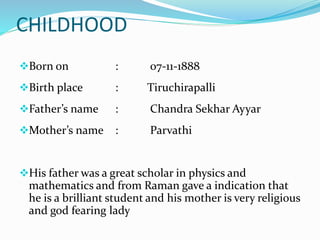
CHILDHOOD
Born on : 07-11-1888
Birth place : Tiruchirapalli
Father’s name : Chandra Sekhar Ayyar
Mother’s name : Parvathi
His father was a great scholar in physics and
mathematics and from Raman gave a indication that
he is a brilliant student and his mother is very religious
and god fearing lady
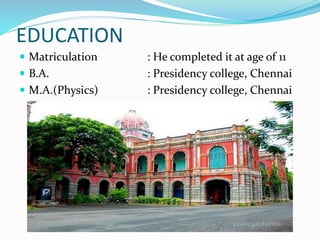
EDUCATION
 Matriculation : He completed it at age of 11
 B.A. : Presidency college, Chennai
 M.A.(Physics) : Presidency college, Chennai
EARLY JOB
 At the insistence of his father, Raman took the
Financial Civil Service examination and joined in the
Indian Finance Department as Deputy Accountant
General
Into his favorite field:
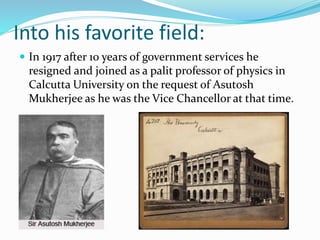
 In 1917 after 10 years of government services he
resigned and joined as a palit professor of physics in
Calcutta University on the request of Asutosh
Mukherjee as he was the Vice Chancellor at that time.
Eureka moment
 He stayed in the university till 1932 and devoted
himself to teaching and research.
 In 1921 when he, on a sea voyage from India to England
at seeking the dark blue color of the Mediterranean sea
asked himself why this was so. Because of this
seemingly simple question he won the world’s most
prestigious NOBLE PRIZE IN 1930.
Further Life
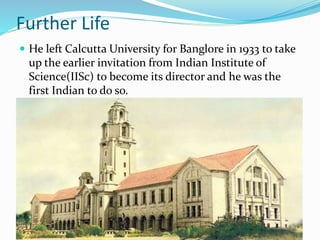
 He left Calcutta University for Banglore in 1933 to take
up the earlier invitation from Indian Institute of
Science(IISc) to become its director and he was the
first Indian to do so.
ACHIEVEMENTS
 He published 30 original research papers.
 Awarded the degree of ‘Doctor of science in 1921.
 In 1929 the British Government in India conferred on
him the knighthood title of “sir”.
 Awarded Noble prize in 1930.
 He established Indian Academy of science in 1934.
 He established Raman Research Institute in 1948.
 In 1954 he also awarded with highest civilian honor
Bharat Ratna(jewel of India).
 In 1958 he also awarded Lenin Peace Prize.
THANK YOU
Death :
 He continued scientific research from these institutes
until his death was caused by a strong heart attack on
21 November 1970.

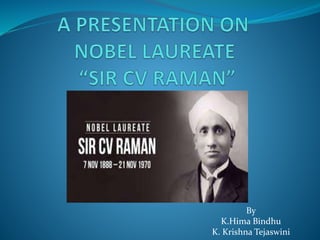
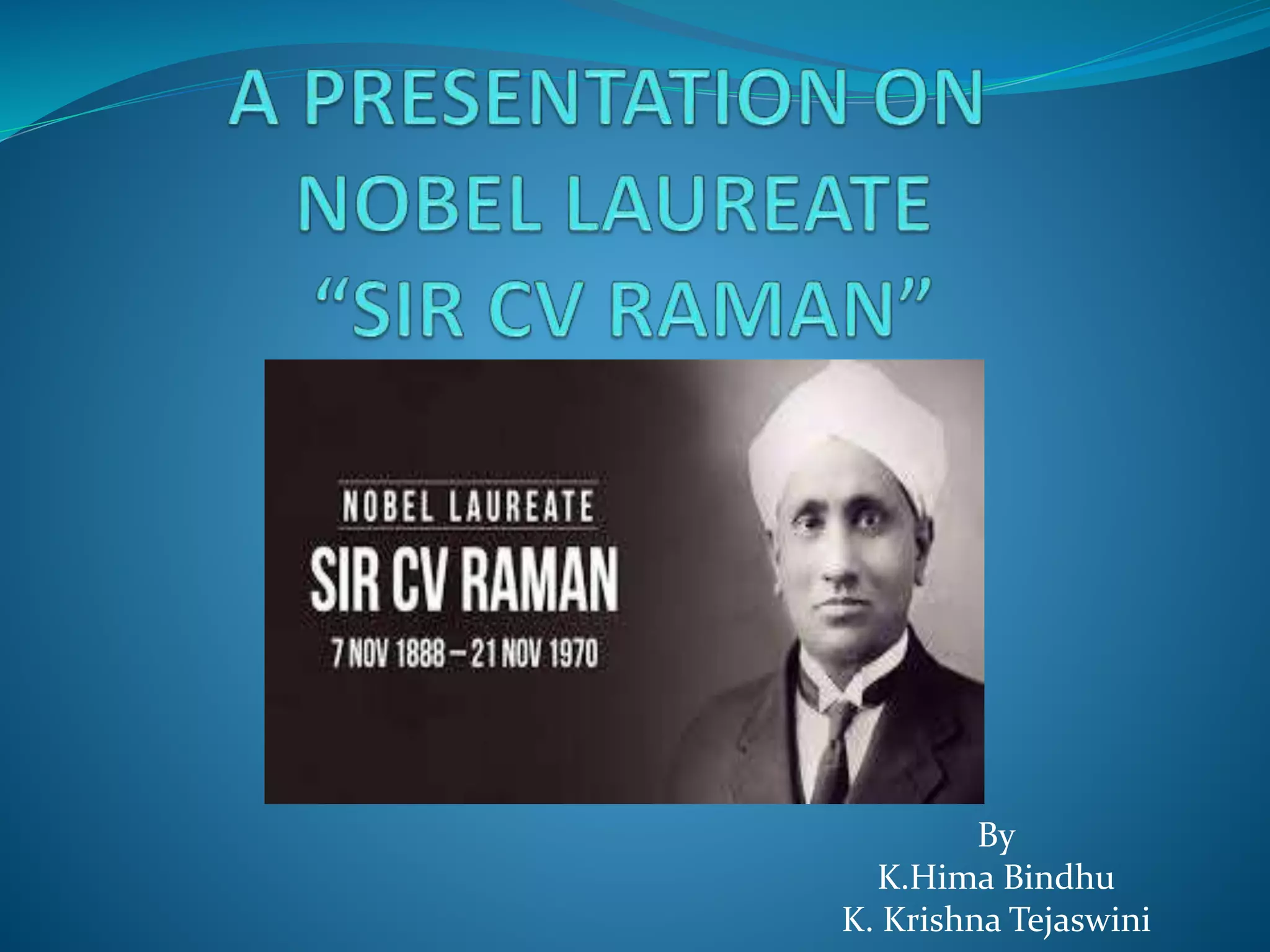
C V Raman

  • 1.
  • 2.
    CHILDHOOD Born on :07-11-1888 Birth place : Tiruchirapalli Father’s name : Chandra Sekhar Ayyar Mother’s name : Parvathi His father was a great scholar in physics and mathematics and from Raman gave a indication that he is a brilliant student and his mother is very religious and god fearing lady
  • 3.
    EDUCATION  Matriculation :He completed it at age of 11  B.A. : Presidency college, Chennai  M.A.(Physics) : Presidency college, Chennai
  • 4.
    EARLY JOB  Atthe insistence of his father, Raman took the Financial Civil Service examination and joined in the Indian Finance Department as Deputy Accountant General
  • 5.
    Into his favoritefield:  In 1917 after 10 years of government services he resigned and joined as a palit professor of physics in Calcutta University on the request of Asutosh Mukherjee as he was the Vice Chancellor at that time.
  • 6.
    Eureka moment  Hestayed in the university till 1932 and devoted himself to teaching and research.  In 1921 when he, on a sea voyage from India to England at seeking the dark blue color of the Mediterranean sea asked himself why this was so. Because of this seemingly simple question he won the world’s most prestigious NOBLE PRIZE IN 1930.
  • 7.
    Further Life  Heleft Calcutta University for Banglore in 1933 to take up the earlier invitation from Indian Institute of Science(IISc) to become its director and he was the first Indian to do so.
  • 8.
    ACHIEVEMENTS  He published30 original research papers.  Awarded the degree of ‘Doctor of science in 1921.  In 1929 the British Government in India conferred on him the knighthood title of “sir”.  Awarded Noble prize in 1930.  He established Indian Academy of science in 1934.  He established Raman Research Institute in 1948.  In 1954 he also awarded with highest civilian honor Bharat Ratna(jewel of India).  In 1958 he also awarded Lenin Peace Prize.
  • 9.
    THANK YOU Death : He continued scientific research from these institutes until his death was caused by a strong heart attack on 21 November 1970.