"The Man Who Loved Numbers"
Ramanujan was born on 22 December
1887 in Erode, Masras Presidency Madras
(now Tamil Nadu), at the residence of his
maternal grandparents in a Brahmin family.
During his school days, he impressed his
classmates, senior students and teachers
with his extraordinary intuition and
astounding proficiency in several branches
of mathematics.
In 1904, when he was just 16, Ramanujan
began investigating the series of S (1/n)
and calculated Euler’s Constant to 15
decimal places. His study of Bernoulli
numbers also commenced at this stage.
Srinivasa Ramanujan was a largely self-
taught pure mathematician. Hindered by
poverty and ill-health, his highly original
work has considerably enriched number
theory and, more recently, physics.
Ramanujan and his supporters contacted a
number of British professors, but only one
was receptive – an eminent pure
mathematician at the University of
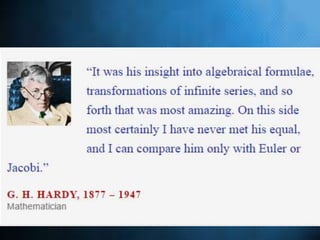
Cambridge – Godfrey Harold Hardy, known
to everyone as G. H. Hardy, who received a
letter from Ramanujan in January 1913.
The notebooks he had brought from India
were filled with thousands of identities,
equations and theorems which he had
discovered for himself in the years 1903 –
1914.
In 1919 and died soon thereafter at the
age of 32 in 1920
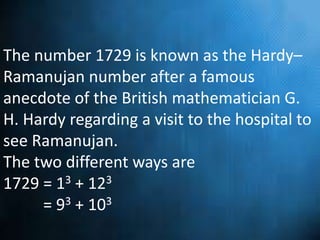
The number 1729 is known as the Hardy–
Ramanujan number after a famous
anecdote of the British mathematician G.
H. Hardy regarding a visit to the hospital to
see Ramanujan.
The two different ways are
1729 = 13 + 123
= 93 + 103
Ramanujan
Ramanujan
Ramanujan
Ramanujan
Ramanujan

Ramanujan

  • 1.
    "The Man WhoLoved Numbers"
  • 3.
    Ramanujan was bornon 22 December 1887 in Erode, Masras Presidency Madras (now Tamil Nadu), at the residence of his maternal grandparents in a Brahmin family.
  • 4.
    During his schooldays, he impressed his classmates, senior students and teachers with his extraordinary intuition and astounding proficiency in several branches of mathematics.
  • 5.
    In 1904, whenhe was just 16, Ramanujan began investigating the series of S (1/n) and calculated Euler’s Constant to 15 decimal places. His study of Bernoulli numbers also commenced at this stage.
  • 6.
    Srinivasa Ramanujan wasa largely self- taught pure mathematician. Hindered by poverty and ill-health, his highly original work has considerably enriched number theory and, more recently, physics.
  • 7.
    Ramanujan and hissupporters contacted a number of British professors, but only one was receptive – an eminent pure mathematician at the University of Cambridge – Godfrey Harold Hardy, known to everyone as G. H. Hardy, who received a letter from Ramanujan in January 1913.
  • 8.
    The notebooks hehad brought from India were filled with thousands of identities, equations and theorems which he had discovered for himself in the years 1903 – 1914.
  • 9.
    In 1919 anddied soon thereafter at the age of 32 in 1920
  • 10.
    The number 1729is known as the Hardy– Ramanujan number after a famous anecdote of the British mathematician G. H. Hardy regarding a visit to the hospital to see Ramanujan. The two different ways are 1729 = 13 + 123 = 93 + 103