www.itbook.store/books/9780321714121
Vandevoorde/Josuttis/Gregor: C++ Templates 2017/08/11 18:35 page i
ensurehelveticaisembedded_()
C++ Templates
Second Edition
www.itbook.store/books/9780321714121
This page intentionally left blank
www.itbook.store/books/9780321714121
Vandevoorde/Josuttis/Gregor: C++ Templates 2017/08/11 18:35 page iii
ensurehelveticaisembedded_()
C++ Templates
The Complete Guide
Second Edition
David Vandevoorde
Nicolai M. Josuttis
Douglas Gregor
Boston • Columbus • Indianapolis • New York • San Francisco • Amsterdam • Cape Town
Dubai • London • Madrid • Milan • Munich • Paris • Montreal • Toronto • Delhi • Mexico City
S˜ao Paulo • Sydney • Hong Kong • Seoul • Singapore • Taipei • Tokyo
www.itbook.store/books/9780321714121
Vandevoorde/Josuttis/Gregor: C++ Templates 2017/08/11 18:35 page iv
ensurehelveticaisembedded_()
Many of the designations used by manufacturers and sellers to distinguish their products are claimed as trade-
marks. Where those designations appear in this book, and the publisher was aware of a trademark claim, the
designations have been printed with initial capital letters or in all capitals.
The authors and publisher have taken care in the preparation of this book, but make no expressed or implied
warranty of any kind and assume no responsibility for errors or omissions. No liability is assumed for incidental
or consequential damages in connection with or arising out of the use of the information or programs contained
herein.
For information about buying this title in bulk quantities, or for special sales opportunities (which may include
electronic versions; custom cover designs; and content particular to your business, training goals, marketing
focus, or branding interests), please contact our corporate sales department at corpsales@pearsoned.com or
(800) 382-3419.
For government sales inquiries, please contact governmentsales@pearsoned.com.
For questions about sales outside the U.S., please contact intlcs@pearson.com.
Visit us on the Web: informit.com/aw
Library of Congress Catalog Number: 2017946531
Copyright c 2018 Pearson Education, Inc.
This book was typeset by Nicolai M. Josuttis using the LATEX document processing system.
All rights reserved. Printed in the United States of America. This publication is protected by copyright, and
permission must be obtained from the publisher prior to any prohibited reproduction, storage in a retrieval
system, or transmission in any form or by any means, electronic, mechanical, photocopying, recording, or
likewise. For information regarding permissions, request forms and the appropriate contacts within the Pearson
Education Global Rights & Permissions Department, please visit www.pearsoned.com/permissions/.
ISBN-13: 978-0-321-71412-1
ISBN-10: 0-321-71412-1
1 17
www.itbook.store/books/9780321714121
Vandevoorde/Josuttis/Gregor: C++ Templates 2017/08/11 18:35 page v
ensurehelveticaisembedded_()
To Alessandra & Cassandra
—David
To those who care
for people and mankind
—Nico
To Amy, Tessa & Molly
—Doug
www.itbook.store/books/9780321714121
This page intentionally left blank
www.itbook.store/books/9780321714121
Vandevoorde/Josuttis/Gregor: C++ Templates 2017/08/11 18:35 page vii
ensurehelveticaisembedded_()
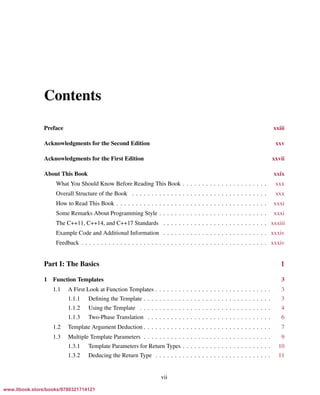
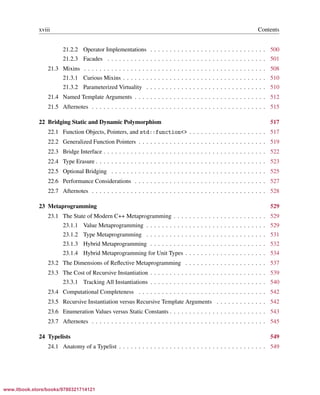
Contents
Preface xxiii
Acknowledgments for the Second Edition xxv
Acknowledgments for the First Edition xxvii
About This Book xxix
What You Should Know Before Reading This Book . . . . . . . . . . . . . . . . . . . . . . xxx
Overall Structure of the Book . . . . . . . . . . . . . . . . . . . . . . . . . . . . . . . . . . . xxx
How to Read This Book . . . . . . . . . . . . . . . . . . . . . . . . . . . . . . . . . . . . . . . xxxi
Some Remarks About Programming Style . . . . . . . . . . . . . . . . . . . . . . . . . . . . xxxi
The C++11, C++14, and C++17 Standards . . . . . . . . . . . . . . . . . . . . . . . . . . . xxxiii
Example Code and Additional Information . . . . . . . . . . . . . . . . . . . . . . . . . . . xxxiv
Feedback . . . . . . . . . . . . . . . . . . . . . . . . . . . . . . . . . . . . . . . . . . . . . . . . xxxiv
Part I: The Basics 1
1 Function Templates 3
1.1 A First Look at Function Templates . . . . . . . . . . . . . . . . . . . . . . . . . . . . . . 3
1.1.1 Defining the Template . . . . . . . . . . . . . . . . . . . . . . . . . . . . . . . . . 3
1.1.2 Using the Template . . . . . . . . . . . . . . . . . . . . . . . . . . . . . . . . . . 4
1.1.3 Two-Phase Translation . . . . . . . . . . . . . . . . . . . . . . . . . . . . . . . . 6
1.2 Template Argument Deduction . . . . . . . . . . . . . . . . . . . . . . . . . . . . . . . . . 7
1.3 Multiple Template Parameters . . . . . . . . . . . . . . . . . . . . . . . . . . . . . . . . . 9
1.3.1 Template Parameters for Return Types . . . . . . . . . . . . . . . . . . . . . . . 10
1.3.2 Deducing the Return Type . . . . . . . . . . . . . . . . . . . . . . . . . . . . . . 11
vii
www.itbook.store/books/9780321714121
Vandevoorde/Josuttis/Gregor: C++ Templates 2017/08/11 18:35 page viii
ensurehelveticaisembedded_()
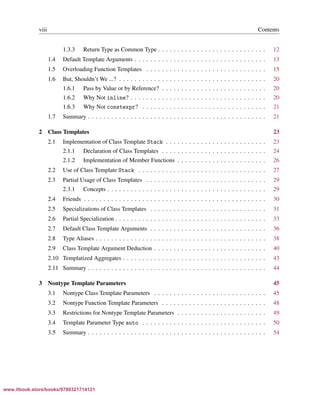
viii Contents
1.3.3 Return Type as Common Type . . . . . . . . . . . . . . . . . . . . . . . . . . . . 12
1.4 Default Template Arguments . . . . . . . . . . . . . . . . . . . . . . . . . . . . . . . . . . 13
1.5 Overloading Function Templates . . . . . . . . . . . . . . . . . . . . . . . . . . . . . . . 15
1.6 But, Shouldn’t We ...? . . . . . . . . . . . . . . . . . . . . . . . . . . . . . . . . . . . . . . 20
1.6.1 Pass by Value or by Reference? . . . . . . . . . . . . . . . . . . . . . . . . . . . 20
1.6.2 Why Not inline? . . . . . . . . . . . . . . . . . . . . . . . . . . . . . . . . . . . 20
1.6.3 Why Not constexpr? . . . . . . . . . . . . . . . . . . . . . . . . . . . . . . . . 21
1.7 Summary . . . . . . . . . . . . . . . . . . . . . . . . . . . . . . . . . . . . . . . . . . . . . . 21
2 Class Templates 23
2.1 Implementation of Class Template Stack . . . . . . . . . . . . . . . . . . . . . . . . . . 23
2.1.1 Declaration of Class Templates . . . . . . . . . . . . . . . . . . . . . . . . . . . 24
2.1.2 Implementation of Member Functions . . . . . . . . . . . . . . . . . . . . . . . 26
2.2 Use of Class Template Stack . . . . . . . . . . . . . . . . . . . . . . . . . . . . . . . . . 27
2.3 Partial Usage of Class Templates . . . . . . . . . . . . . . . . . . . . . . . . . . . . . . . 29
2.3.1 Concepts . . . . . . . . . . . . . . . . . . . . . . . . . . . . . . . . . . . . . . . . . 29
2.4 Friends . . . . . . . . . . . . . . . . . . . . . . . . . . . . . . . . . . . . . . . . . . . . . . . 30
2.5 Specializations of Class Templates . . . . . . . . . . . . . . . . . . . . . . . . . . . . . . 31
2.6 Partial Specialization . . . . . . . . . . . . . . . . . . . . . . . . . . . . . . . . . . . . . . . 33
2.7 Default Class Template Arguments . . . . . . . . . . . . . . . . . . . . . . . . . . . . . . 36
2.8 Type Aliases . . . . . . . . . . . . . . . . . . . . . . . . . . . . . . . . . . . . . . . . . . . . 38
2.9 Class Template Argument Deduction . . . . . . . . . . . . . . . . . . . . . . . . . . . . . 40
2.10 Templatized Aggregates . . . . . . . . . . . . . . . . . . . . . . . . . . . . . . . . . . . . . 43
2.11 Summary . . . . . . . . . . . . . . . . . . . . . . . . . . . . . . . . . . . . . . . . . . . . . . 44
3 Nontype Template Parameters 45
3.1 Nontype Class Template Parameters . . . . . . . . . . . . . . . . . . . . . . . . . . . . . 45
3.2 Nontype Function Template Parameters . . . . . . . . . . . . . . . . . . . . . . . . . . . 48
3.3 Restrictions for Nontype Template Parameters . . . . . . . . . . . . . . . . . . . . . . . 49
3.4 Template Parameter Type auto . . . . . . . . . . . . . . . . . . . . . . . . . . . . . . . . 50
3.5 Summary . . . . . . . . . . . . . . . . . . . . . . . . . . . . . . . . . . . . . . . . . . . . . . 54
www.itbook.store/books/9780321714121
Vandevoorde/Josuttis/Gregor: C++ Templates 2017/08/11 18:35 page ix
ensurehelveticaisembedded_()
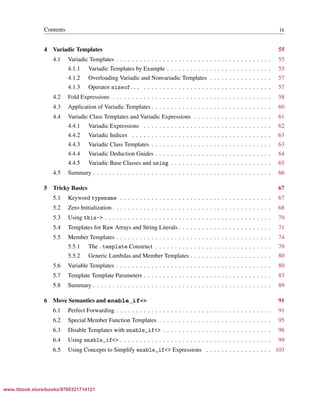
Contents ix
4 Variadic Templates 55
4.1 Variadic Templates . . . . . . . . . . . . . . . . . . . . . . . . . . . . . . . . . . . . . . . . 55
4.1.1 Variadic Templates by Example . . . . . . . . . . . . . . . . . . . . . . . . . . . 55
4.1.2 Overloading Variadic and Nonvariadic Templates . . . . . . . . . . . . . . . . 57
4.1.3 Operator sizeof... . . . . . . . . . . . . . . . . . . . . . . . . . . . . . . . . . 57
4.2 Fold Expressions . . . . . . . . . . . . . . . . . . . . . . . . . . . . . . . . . . . . . . . . . 58
4.3 Application of Variadic Templates . . . . . . . . . . . . . . . . . . . . . . . . . . . . . . . 60
4.4 Variadic Class Templates and Variadic Expressions . . . . . . . . . . . . . . . . . . . . 61
4.4.1 Variadic Expressions . . . . . . . . . . . . . . . . . . . . . . . . . . . . . . . . . 62
4.4.2 Variadic Indices . . . . . . . . . . . . . . . . . . . . . . . . . . . . . . . . . . . . 63
4.4.3 Variadic Class Templates . . . . . . . . . . . . . . . . . . . . . . . . . . . . . . . 63
4.4.4 Variadic Deduction Guides . . . . . . . . . . . . . . . . . . . . . . . . . . . . . . 64
4.4.5 Variadic Base Classes and using . . . . . . . . . . . . . . . . . . . . . . . . . . 65
4.5 Summary . . . . . . . . . . . . . . . . . . . . . . . . . . . . . . . . . . . . . . . . . . . . . . 66
5 Tricky Basics 67
5.1 Keyword typename . . . . . . . . . . . . . . . . . . . . . . . . . . . . . . . . . . . . . . . 67
5.2 Zero Initialization . . . . . . . . . . . . . . . . . . . . . . . . . . . . . . . . . . . . . . . . . 68
5.3 Using this-> . . . . . . . . . . . . . . . . . . . . . . . . . . . . . . . . . . . . . . . . . . . 70
5.4 Templates for Raw Arrays and String Literals . . . . . . . . . . . . . . . . . . . . . . . . 71
5.5 Member Templates . . . . . . . . . . . . . . . . . . . . . . . . . . . . . . . . . . . . . . . . 74
5.5.1 The .template Construct . . . . . . . . . . . . . . . . . . . . . . . . . . . . . . 79
5.5.2 Generic Lambdas and Member Templates . . . . . . . . . . . . . . . . . . . . . 80
5.6 Variable Templates . . . . . . . . . . . . . . . . . . . . . . . . . . . . . . . . . . . . . . . . 80
5.7 Template Template Parameters . . . . . . . . . . . . . . . . . . . . . . . . . . . . . . . . . 83
5.8 Summary . . . . . . . . . . . . . . . . . . . . . . . . . . . . . . . . . . . . . . . . . . . . . . 89
6 Move Semantics and enable_if<> 91
6.1 Perfect Forwarding . . . . . . . . . . . . . . . . . . . . . . . . . . . . . . . . . . . . . . . . 91
6.2 Special Member Function Templates . . . . . . . . . . . . . . . . . . . . . . . . . . . . . 95
6.3 Disable Templates with enable_if<> . . . . . . . . . . . . . . . . . . . . . . . . . . . . 98
6.4 Using enable_if<> . . . . . . . . . . . . . . . . . . . . . . . . . . . . . . . . . . . . . . . 99
6.5 Using Concepts to Simplify enable_if<> Expressions . . . . . . . . . . . . . . . . . 103
www.itbook.store/books/9780321714121
Vandevoorde/Josuttis/Gregor: C++ Templates 2017/08/11 18:35 page x
ensurehelveticaisembedded_()
x Contents
6.6 Summary . . . . . . . . . . . . . . . . . . . . . . . . . . . . . . . . . . . . . . . . . . . . . . 104
7 By Value or by Reference? 105
7.1 Passing by Value . . . . . . . . . . . . . . . . . . . . . . . . . . . . . . . . . . . . . . . . . 106
7.2 Passing by Reference . . . . . . . . . . . . . . . . . . . . . . . . . . . . . . . . . . . . . . 108
7.2.1 Passing by Constant Reference . . . . . . . . . . . . . . . . . . . . . . . . . . . 108
7.2.2 Passing by Nonconstant Reference . . . . . . . . . . . . . . . . . . . . . . . . . 110
7.2.3 Passing by Forwarding Reference . . . . . . . . . . . . . . . . . . . . . . . . . . 111
7.3 Using std::ref() and std::cref() . . . . . . . . . . . . . . . . . . . . . . . . . . . . 112
7.4 Dealing with String Literals and Raw Arrays . . . . . . . . . . . . . . . . . . . . . . . . 115
7.4.1 Special Implementations for String Literals and Raw Arrays . . . . . . . . . 116
7.5 Dealing with Return Values . . . . . . . . . . . . . . . . . . . . . . . . . . . . . . . . . . . 117
7.6 Recommended Template Parameter Declarations . . . . . . . . . . . . . . . . . . . . . . 118
7.7 Summary . . . . . . . . . . . . . . . . . . . . . . . . . . . . . . . . . . . . . . . . . . . . . . 121
8 Compile-Time Programming 123
8.1 Template Metaprogramming . . . . . . . . . . . . . . . . . . . . . . . . . . . . . . . . . . 123
8.2 Computing with constexpr . . . . . . . . . . . . . . . . . . . . . . . . . . . . . . . . . . 125
8.3 Execution Path Selection with Partial Specialization . . . . . . . . . . . . . . . . . . . . 127
8.4 SFINAE (Substitution Failure Is Not An Error) . . . . . . . . . . . . . . . . . . . . . . . 129
8.4.1 Expression SFINAE with decltype . . . . . . . . . . . . . . . . . . . . . . . . 133
8.5 Compile-Time if . . . . . . . . . . . . . . . . . . . . . . . . . . . . . . . . . . . . . . . . . 134
8.6 Summary . . . . . . . . . . . . . . . . . . . . . . . . . . . . . . . . . . . . . . . . . . . . . . 135
9 Using Templates in Practice 137
9.1 The Inclusion Model . . . . . . . . . . . . . . . . . . . . . . . . . . . . . . . . . . . . . . . 137
9.1.1 Linker Errors . . . . . . . . . . . . . . . . . . . . . . . . . . . . . . . . . . . . . . 137
9.1.2 Templates in Header Files . . . . . . . . . . . . . . . . . . . . . . . . . . . . . . 139
9.2 Templates and inline . . . . . . . . . . . . . . . . . . . . . . . . . . . . . . . . . . . . . . 140
9.3 Precompiled Headers . . . . . . . . . . . . . . . . . . . . . . . . . . . . . . . . . . . . . . 141
9.4 Decoding the Error Novel . . . . . . . . . . . . . . . . . . . . . . . . . . . . . . . . . . . . 143
9.5 Afternotes . . . . . . . . . . . . . . . . . . . . . . . . . . . . . . . . . . . . . . . . . . . . . 149
9.6 Summary . . . . . . . . . . . . . . . . . . . . . . . . . . . . . . . . . . . . . . . . . . . . . . 150
www.itbook.store/books/9780321714121
Vandevoorde/Josuttis/Gregor: C++ Templates 2017/08/11 18:35 page xi
ensurehelveticaisembedded_()
Contents xi
10 Basic Template Terminology 151
10.1 “Class Template” or “Template Class”? . . . . . . . . . . . . . . . . . . . . . . . . . . . 151
10.2 Substitution, Instantiation, and Specialization . . . . . . . . . . . . . . . . . . . . . . . . 152
10.3 Declarations versus Definitions . . . . . . . . . . . . . . . . . . . . . . . . . . . . . . . . 153
10.3.1 Complete versus Incomplete Types . . . . . . . . . . . . . . . . . . . . . . . . . 154
10.4 The One-Definition Rule . . . . . . . . . . . . . . . . . . . . . . . . . . . . . . . . . . . . 154
10.5 Template Arguments versus Template Parameters . . . . . . . . . . . . . . . . . . . . . 155
10.6 Summary . . . . . . . . . . . . . . . . . . . . . . . . . . . . . . . . . . . . . . . . . . . . . . 156
11 Generic Libraries 157
11.1 Callables . . . . . . . . . . . . . . . . . . . . . . . . . . . . . . . . . . . . . . . . . . . . . . 157
11.1.1 Supporting Function Objects . . . . . . . . . . . . . . . . . . . . . . . . . . . . . 158
11.1.2 Dealing with Member Functions and Additional Arguments . . . . . . . . . . 160
11.1.3 Wrapping Function Calls . . . . . . . . . . . . . . . . . . . . . . . . . . . . . . . 162
11.2 Other Utilities to Implement Generic Libraries . . . . . . . . . . . . . . . . . . . . . . . 164
11.2.1 Type Traits . . . . . . . . . . . . . . . . . . . . . . . . . . . . . . . . . . . . . . . 164
11.2.2 std::addressof() . . . . . . . . . . . . . . . . . . . . . . . . . . . . . . . . . 166
11.2.3 std::declval() . . . . . . . . . . . . . . . . . . . . . . . . . . . . . . . . . . . 166
11.3 Perfect Forwarding Temporaries . . . . . . . . . . . . . . . . . . . . . . . . . . . . . . . . 167
11.4 References as Template Parameters . . . . . . . . . . . . . . . . . . . . . . . . . . . . . . 167
11.5 Defer Evaluations . . . . . . . . . . . . . . . . . . . . . . . . . . . . . . . . . . . . . . . . . 171
11.6 Things to Consider When Writing Generic Libraries . . . . . . . . . . . . . . . . . . . 172
11.7 Summary . . . . . . . . . . . . . . . . . . . . . . . . . . . . . . . . . . . . . . . . . . . . . . 173
Part II: Templates in Depth 175
12 Fundamentals in Depth 177
12.1 Parameterized Declarations . . . . . . . . . . . . . . . . . . . . . . . . . . . . . . . . . . . 177
12.1.1 Virtual Member Functions . . . . . . . . . . . . . . . . . . . . . . . . . . . . . . 182
12.1.2 Linkage of Templates . . . . . . . . . . . . . . . . . . . . . . . . . . . . . . . . . 182
12.1.3 Primary Templates . . . . . . . . . . . . . . . . . . . . . . . . . . . . . . . . . . . 184
12.2 Template Parameters . . . . . . . . . . . . . . . . . . . . . . . . . . . . . . . . . . . . . . . 185
12.2.1 Type Parameters . . . . . . . . . . . . . . . . . . . . . . . . . . . . . . . . . . . . 185
www.itbook.store/books/9780321714121
Vandevoorde/Josuttis/Gregor: C++ Templates 2017/08/11 18:35 page xii
ensurehelveticaisembedded_()
xii Contents
12.2.2 Nontype Parameters . . . . . . . . . . . . . . . . . . . . . . . . . . . . . . . . . . 186
12.2.3 Template Template Parameters . . . . . . . . . . . . . . . . . . . . . . . . . . . 187
12.2.4 Template Parameter Packs . . . . . . . . . . . . . . . . . . . . . . . . . . . . . . 188
12.2.5 Default Template Arguments . . . . . . . . . . . . . . . . . . . . . . . . . . . . . 190
12.3 Template Arguments . . . . . . . . . . . . . . . . . . . . . . . . . . . . . . . . . . . . . . . 192
12.3.1 Function Template Arguments . . . . . . . . . . . . . . . . . . . . . . . . . . . . 192
12.3.2 Type Arguments . . . . . . . . . . . . . . . . . . . . . . . . . . . . . . . . . . . . 194
12.3.3 Nontype Arguments . . . . . . . . . . . . . . . . . . . . . . . . . . . . . . . . . . 194
12.3.4 Template Template Arguments . . . . . . . . . . . . . . . . . . . . . . . . . . . 197
12.3.5 Equivalence . . . . . . . . . . . . . . . . . . . . . . . . . . . . . . . . . . . . . . . 199
12.4 Variadic Templates . . . . . . . . . . . . . . . . . . . . . . . . . . . . . . . . . . . . . . . . 200
12.4.1 Pack Expansions . . . . . . . . . . . . . . . . . . . . . . . . . . . . . . . . . . . . 201
12.4.2 Where Can Pack Expansions Occur? . . . . . . . . . . . . . . . . . . . . . . . . 202
12.4.3 Function Parameter Packs . . . . . . . . . . . . . . . . . . . . . . . . . . . . . . 204
12.4.4 Multiple and Nested Pack Expansions . . . . . . . . . . . . . . . . . . . . . . . 205
12.4.5 Zero-Length Pack Expansions . . . . . . . . . . . . . . . . . . . . . . . . . . . . 207
12.4.6 Fold Expressions . . . . . . . . . . . . . . . . . . . . . . . . . . . . . . . . . . . . 207
12.5 Friends . . . . . . . . . . . . . . . . . . . . . . . . . . . . . . . . . . . . . . . . . . . . . . . 209
12.5.1 Friend Classes of Class Templates . . . . . . . . . . . . . . . . . . . . . . . . . 209
12.5.2 Friend Functions of Class Templates . . . . . . . . . . . . . . . . . . . . . . . . 211
12.5.3 Friend Templates . . . . . . . . . . . . . . . . . . . . . . . . . . . . . . . . . . . . 213
12.6 Afternotes . . . . . . . . . . . . . . . . . . . . . . . . . . . . . . . . . . . . . . . . . . . . . 213
13 Names in Templates 215
13.1 Name Taxonomy . . . . . . . . . . . . . . . . . . . . . . . . . . . . . . . . . . . . . . . . . 215
13.2 Looking Up Names . . . . . . . . . . . . . . . . . . . . . . . . . . . . . . . . . . . . . . . . 217
13.2.1 Argument-Dependent Lookup . . . . . . . . . . . . . . . . . . . . . . . . . . . . 219
13.2.2 Argument-Dependent Lookup of Friend Declarations . . . . . . . . . . . . . . 220
13.2.3 Injected Class Names . . . . . . . . . . . . . . . . . . . . . . . . . . . . . . . . . 221
13.2.4 Current Instantiations . . . . . . . . . . . . . . . . . . . . . . . . . . . . . . . . . 223
13.3 Parsing Templates . . . . . . . . . . . . . . . . . . . . . . . . . . . . . . . . . . . . . . . . 224
13.3.1 Context Sensitivity in Nontemplates . . . . . . . . . . . . . . . . . . . . . . . . 225
13.3.2 Dependent Names of Types . . . . . . . . . . . . . . . . . . . . . . . . . . . . . 228
13.3.3 Dependent Names of Templates . . . . . . . . . . . . . . . . . . . . . . . . . . . 230
www.itbook.store/books/9780321714121
Vandevoorde/Josuttis/Gregor: C++ Templates 2017/08/11 18:35 page xiii
ensurehelveticaisembedded_()
Contents xiii
13.3.4 Dependent Names in Using Declarations . . . . . . . . . . . . . . . . . . . . . 231
13.3.5 ADL and Explicit Template Arguments . . . . . . . . . . . . . . . . . . . . . . 233
13.3.6 Dependent Expressions . . . . . . . . . . . . . . . . . . . . . . . . . . . . . . . . 233
13.3.7 Compiler Errors . . . . . . . . . . . . . . . . . . . . . . . . . . . . . . . . . . . . 236
13.4 Inheritance and Class Templates . . . . . . . . . . . . . . . . . . . . . . . . . . . . . . . . 236
13.4.1 Nondependent Base Classes . . . . . . . . . . . . . . . . . . . . . . . . . . . . . 236
13.4.2 Dependent Base Classes . . . . . . . . . . . . . . . . . . . . . . . . . . . . . . . 237
13.5 Afternotes . . . . . . . . . . . . . . . . . . . . . . . . . . . . . . . . . . . . . . . . . . . . . 240
14 Instantiation 243
14.1 On-Demand Instantiation . . . . . . . . . . . . . . . . . . . . . . . . . . . . . . . . . . . . 243
14.2 Lazy Instantiation . . . . . . . . . . . . . . . . . . . . . . . . . . . . . . . . . . . . . . . . . 245
14.2.1 Partial and Full Instantiation . . . . . . . . . . . . . . . . . . . . . . . . . . . . . 245
14.2.2 Instantiated Components . . . . . . . . . . . . . . . . . . . . . . . . . . . . . . . 246
14.3 The C++ Instantiation Model . . . . . . . . . . . . . . . . . . . . . . . . . . . . . . . . . . 249
14.3.1 Two-Phase Lookup . . . . . . . . . . . . . . . . . . . . . . . . . . . . . . . . . . 249
14.3.2 Points of Instantiation . . . . . . . . . . . . . . . . . . . . . . . . . . . . . . . . . 250
14.3.3 The Inclusion Model . . . . . . . . . . . . . . . . . . . . . . . . . . . . . . . . . . 254
14.4 Implementation Schemes . . . . . . . . . . . . . . . . . . . . . . . . . . . . . . . . . . . . 255
14.4.1 Greedy Instantiation . . . . . . . . . . . . . . . . . . . . . . . . . . . . . . . . . . 256
14.4.2 Queried Instantiation . . . . . . . . . . . . . . . . . . . . . . . . . . . . . . . . . 257
14.4.3 Iterated Instantiation . . . . . . . . . . . . . . . . . . . . . . . . . . . . . . . . . . 259
14.5 Explicit Instantiation . . . . . . . . . . . . . . . . . . . . . . . . . . . . . . . . . . . . . . . 260
14.5.1 Manual Instantiation . . . . . . . . . . . . . . . . . . . . . . . . . . . . . . . . . . 260
14.5.2 Explicit Instantiation Declarations . . . . . . . . . . . . . . . . . . . . . . . . . 262
14.6 Compile-Time if Statements . . . . . . . . . . . . . . . . . . . . . . . . . . . . . . . . . . 263
14.7 In the Standard Library . . . . . . . . . . . . . . . . . . . . . . . . . . . . . . . . . . . . . 265
14.8 Afternotes . . . . . . . . . . . . . . . . . . . . . . . . . . . . . . . . . . . . . . . . . . . . . 266
15 Template Argument Deduction 269
15.1 The Deduction Process . . . . . . . . . . . . . . . . . . . . . . . . . . . . . . . . . . . . . 269
15.2 Deduced Contexts . . . . . . . . . . . . . . . . . . . . . . . . . . . . . . . . . . . . . . . . 271
15.3 Special Deduction Situations . . . . . . . . . . . . . . . . . . . . . . . . . . . . . . . . . . 273
15.4 Initializer Lists . . . . . . . . . . . . . . . . . . . . . . . . . . . . . . . . . . . . . . . . . . 274
www.itbook.store/books/9780321714121
Vandevoorde/Josuttis/Gregor: C++ Templates 2017/08/11 18:35 page xiv
ensurehelveticaisembedded_()
xiv Contents
15.5 Parameter Packs . . . . . . . . . . . . . . . . . . . . . . . . . . . . . . . . . . . . . . . . . 275
15.5.1 Literal Operator Templates . . . . . . . . . . . . . . . . . . . . . . . . . . . . . . 277
15.6 Rvalue References . . . . . . . . . . . . . . . . . . . . . . . . . . . . . . . . . . . . . . . . 277
15.6.1 Reference Collapsing Rules . . . . . . . . . . . . . . . . . . . . . . . . . . . . . 277
15.6.2 Forwarding References . . . . . . . . . . . . . . . . . . . . . . . . . . . . . . . . 278
15.6.3 Perfect Forwarding . . . . . . . . . . . . . . . . . . . . . . . . . . . . . . . . . . . 280
15.6.4 Deduction Surprises . . . . . . . . . . . . . . . . . . . . . . . . . . . . . . . . . . 283
15.7 SFINAE (Substitution Failure Is Not An Error) . . . . . . . . . . . . . . . . . . . . . . . 284
15.7.1 Immediate Context . . . . . . . . . . . . . . . . . . . . . . . . . . . . . . . . . . . 285
15.8 Limitations of Deduction . . . . . . . . . . . . . . . . . . . . . . . . . . . . . . . . . . . . 286
15.8.1 Allowable Argument Conversions . . . . . . . . . . . . . . . . . . . . . . . . . 287
15.8.2 Class Template Arguments . . . . . . . . . . . . . . . . . . . . . . . . . . . . . . 288
15.8.3 Default Call Arguments . . . . . . . . . . . . . . . . . . . . . . . . . . . . . . . . 289
15.8.4 Exception Specifications . . . . . . . . . . . . . . . . . . . . . . . . . . . . . . . 290
15.9 Explicit Function Template Arguments . . . . . . . . . . . . . . . . . . . . . . . . . . . . 291
15.10 Deduction from Initializers and Expressions . . . . . . . . . . . . . . . . . . . . . . . . 293
15.10.1 The auto Type Specifier . . . . . . . . . . . . . . . . . . . . . . . . . . . . . . . 294
15.10.2 Expressing the Type of an Expression with decltype . . . . . . . . . . . . . 298
15.10.3 decltype(auto) . . . . . . . . . . . . . . . . . . . . . . . . . . . . . . . . . . . 301
15.10.4 Special Situations for auto Deduction . . . . . . . . . . . . . . . . . . . . . . . 303
15.10.5 Structured Bindings . . . . . . . . . . . . . . . . . . . . . . . . . . . . . . . . . . 306
15.10.6 Generic Lambdas . . . . . . . . . . . . . . . . . . . . . . . . . . . . . . . . . . . . 309
15.11 Alias Templates . . . . . . . . . . . . . . . . . . . . . . . . . . . . . . . . . . . . . . . . . . 312
15.12 Class Template Argument Deduction . . . . . . . . . . . . . . . . . . . . . . . . . . . . . 313
15.12.1 Deduction Guides . . . . . . . . . . . . . . . . . . . . . . . . . . . . . . . . . . . 314
15.12.2 Implicit Deduction Guides . . . . . . . . . . . . . . . . . . . . . . . . . . . . . . 316
15.12.3 Other Subtleties . . . . . . . . . . . . . . . . . . . . . . . . . . . . . . . . . . . . 318
15.13 Afternotes . . . . . . . . . . . . . . . . . . . . . . . . . . . . . . . . . . . . . . . . . . . . . 321
16 Specialization and Overloading 323
16.1 When “Generic Code” Doesn’t Quite Cut It . . . . . . . . . . . . . . . . . . . . . . . . . 323
16.1.1 Transparent Customization . . . . . . . . . . . . . . . . . . . . . . . . . . . . . . 324
16.1.2 Semantic Transparency . . . . . . . . . . . . . . . . . . . . . . . . . . . . . . . . 325
www.itbook.store/books/9780321714121
Vandevoorde/Josuttis/Gregor: C++ Templates 2017/08/11 18:35 page xv
ensurehelveticaisembedded_()
Contents xv
16.2 Overloading Function Templates . . . . . . . . . . . . . . . . . . . . . . . . . . . . . . . 326
16.2.1 Signatures . . . . . . . . . . . . . . . . . . . . . . . . . . . . . . . . . . . . . . . . 328
16.2.2 Partial Ordering of Overloaded Function Templates . . . . . . . . . . . . . . . 330
16.2.3 Formal Ordering Rules . . . . . . . . . . . . . . . . . . . . . . . . . . . . . . . . 331
16.2.4 Templates and Nontemplates . . . . . . . . . . . . . . . . . . . . . . . . . . . . . 332
16.2.5 Variadic Function Templates . . . . . . . . . . . . . . . . . . . . . . . . . . . . . 335
16.3 Explicit Specialization . . . . . . . . . . . . . . . . . . . . . . . . . . . . . . . . . . . . . . 338
16.3.1 Full Class Template Specialization . . . . . . . . . . . . . . . . . . . . . . . . . 338
16.3.2 Full Function Template Specialization . . . . . . . . . . . . . . . . . . . . . . . 342
16.3.3 Full Variable Template Specialization . . . . . . . . . . . . . . . . . . . . . . . 344
16.3.4 Full Member Specialization . . . . . . . . . . . . . . . . . . . . . . . . . . . . . 344
16.4 Partial Class Template Specialization . . . . . . . . . . . . . . . . . . . . . . . . . . . . . 347
16.5 Partial Variable Template Specialization . . . . . . . . . . . . . . . . . . . . . . . . . . . 351
16.6 Afternotes . . . . . . . . . . . . . . . . . . . . . . . . . . . . . . . . . . . . . . . . . . . . . 352
17 Future Directions 353
17.1 Relaxed typename Rules . . . . . . . . . . . . . . . . . . . . . . . . . . . . . . . . . . . . 354
17.2 Generalized Nontype Template Parameters . . . . . . . . . . . . . . . . . . . . . . . . . 354
17.3 Partial Specialization of Function Templates . . . . . . . . . . . . . . . . . . . . . . . . 356
17.4 Named Template Arguments . . . . . . . . . . . . . . . . . . . . . . . . . . . . . . . . . . 358
17.5 Overloaded Class Templates . . . . . . . . . . . . . . . . . . . . . . . . . . . . . . . . . . 359
17.6 Deduction for Nonfinal Pack Expansions . . . . . . . . . . . . . . . . . . . . . . . . . . 360
17.7 Regularization of void . . . . . . . . . . . . . . . . . . . . . . . . . . . . . . . . . . . . . 361
17.8 Type Checking for Templates . . . . . . . . . . . . . . . . . . . . . . . . . . . . . . . . . 361
17.9 Reflective Metaprogramming . . . . . . . . . . . . . . . . . . . . . . . . . . . . . . . . . . 363
17.10 Pack Facilities . . . . . . . . . . . . . . . . . . . . . . . . . . . . . . . . . . . . . . . . . . . 365
17.11 Modules . . . . . . . . . . . . . . . . . . . . . . . . . . . . . . . . . . . . . . . . . . . . . . 366
Part III: Templates and Design 367
18 The Polymorphic Power of Templates 369
18.1 Dynamic Polymorphism . . . . . . . . . . . . . . . . . . . . . . . . . . . . . . . . . . . . . 369
18.2 Static Polymorphism . . . . . . . . . . . . . . . . . . . . . . . . . . . . . . . . . . . . . . . 372
www.itbook.store/books/9780321714121
Vandevoorde/Josuttis/Gregor: C++ Templates 2017/08/11 18:35 page xvi
ensurehelveticaisembedded_()
xvi Contents
18.3 Dynamic versus Static Polymorphism . . . . . . . . . . . . . . . . . . . . . . . . . . . . 375
18.4 Using Concepts . . . . . . . . . . . . . . . . . . . . . . . . . . . . . . . . . . . . . . . . . . 377
18.5 New Forms of Design Patterns . . . . . . . . . . . . . . . . . . . . . . . . . . . . . . . . . 379
18.6 Generic Programming . . . . . . . . . . . . . . . . . . . . . . . . . . . . . . . . . . . . . . 380
18.7 Afternotes . . . . . . . . . . . . . . . . . . . . . . . . . . . . . . . . . . . . . . . . . . . . . 383
19 Implementing Traits 385
19.1 An Example: Accumulating a Sequence . . . . . . . . . . . . . . . . . . . . . . . . . . . 385
19.1.1 Fixed Traits . . . . . . . . . . . . . . . . . . . . . . . . . . . . . . . . . . . . . . . 386
19.1.2 Value Traits . . . . . . . . . . . . . . . . . . . . . . . . . . . . . . . . . . . . . . . 389
19.1.3 Parameterized Traits . . . . . . . . . . . . . . . . . . . . . . . . . . . . . . . . . . 394
19.2 Traits versus Policies and Policy Classes . . . . . . . . . . . . . . . . . . . . . . . . . . . 394
19.2.1 Traits and Policies: What’s the Difference? . . . . . . . . . . . . . . . . . . . . 397
19.2.2 Member Templates versus Template Template Parameters . . . . . . . . . . . 398
19.2.3 Combining Multiple Policies and/or Traits . . . . . . . . . . . . . . . . . . . . 399
19.2.4 Accumulation with General Iterators . . . . . . . . . . . . . . . . . . . . . . . . 399
19.3 Type Functions . . . . . . . . . . . . . . . . . . . . . . . . . . . . . . . . . . . . . . . . . . 401
19.3.1 Element Types . . . . . . . . . . . . . . . . . . . . . . . . . . . . . . . . . . . . . 401
19.3.2 Transformation Traits . . . . . . . . . . . . . . . . . . . . . . . . . . . . . . . . . 404
19.3.3 Predicate Traits . . . . . . . . . . . . . . . . . . . . . . . . . . . . . . . . . . . . . 410
19.3.4 Result Type Traits . . . . . . . . . . . . . . . . . . . . . . . . . . . . . . . . . . . 413
19.4 SFINAE-Based Traits . . . . . . . . . . . . . . . . . . . . . . . . . . . . . . . . . . . . . . 416
19.4.1 SFINAE Out Function Overloads . . . . . . . . . . . . . . . . . . . . . . . . . . 416
19.4.2 SFINAE Out Partial Specializations . . . . . . . . . . . . . . . . . . . . . . . . 420
19.4.3 Using Generic Lambdas for SFINAE . . . . . . . . . . . . . . . . . . . . . . . . 421
19.4.4 SFINAE-Friendly Traits . . . . . . . . . . . . . . . . . . . . . . . . . . . . . . . 424
19.5 IsConvertibleT . . . . . . . . . . . . . . . . . . . . . . . . . . . . . . . . . . . . . . . . . . 428
19.6 Detecting Members . . . . . . . . . . . . . . . . . . . . . . . . . . . . . . . . . . . . . . . 431
19.6.1 Detecting Member Types . . . . . . . . . . . . . . . . . . . . . . . . . . . . . . . 431
19.6.2 Detecting Arbitrary Member Types . . . . . . . . . . . . . . . . . . . . . . . . . 433
19.6.3 Detecting Nontype Members . . . . . . . . . . . . . . . . . . . . . . . . . . . . . 434
19.6.4 Using Generic Lambdas to Detect Members . . . . . . . . . . . . . . . . . . . 438
19.7 Other Traits Techniques . . . . . . . . . . . . . . . . . . . . . . . . . . . . . . . . . . . . . 440
19.7.1 If-Then-Else . . . . . . . . . . . . . . . . . . . . . . . . . . . . . . . . . . . . . . . 440
www.itbook.store/books/9780321714121
Vandevoorde/Josuttis/Gregor: C++ Templates 2017/08/11 18:35 page xvii
ensurehelveticaisembedded_()
Contents xvii
19.7.2 Detecting Nonthrowing Operations . . . . . . . . . . . . . . . . . . . . . . . . . 443
19.7.3 Traits Convenience . . . . . . . . . . . . . . . . . . . . . . . . . . . . . . . . . . . 446
19.8 Type Classification . . . . . . . . . . . . . . . . . . . . . . . . . . . . . . . . . . . . . . . . 448
19.8.1 Determining Fundamental Types . . . . . . . . . . . . . . . . . . . . . . . . . . 448
19.8.2 Determining Compound Types . . . . . . . . . . . . . . . . . . . . . . . . . . . 451
19.8.3 Identifying Function Types . . . . . . . . . . . . . . . . . . . . . . . . . . . . . . 454
19.8.4 Determining Class Types . . . . . . . . . . . . . . . . . . . . . . . . . . . . . . . 456
19.8.5 Determining Enumeration Types . . . . . . . . . . . . . . . . . . . . . . . . . . 457
19.9 Policy Traits . . . . . . . . . . . . . . . . . . . . . . . . . . . . . . . . . . . . . . . . . . . . 458
19.9.1 Read-Only Parameter Types . . . . . . . . . . . . . . . . . . . . . . . . . . . . . 458
19.10 In the Standard Library . . . . . . . . . . . . . . . . . . . . . . . . . . . . . . . . . . . . . 461
19.11 Afternotes . . . . . . . . . . . . . . . . . . . . . . . . . . . . . . . . . . . . . . . . . . . . . 462
20 Overloading on Type Properties 465
20.1 Algorithm Specialization . . . . . . . . . . . . . . . . . . . . . . . . . . . . . . . . . . . . 465
20.2 Tag Dispatching . . . . . . . . . . . . . . . . . . . . . . . . . . . . . . . . . . . . . . . . . . 467
20.3 Enabling/Disabling Function Templates . . . . . . . . . . . . . . . . . . . . . . . . . . . 469
20.3.1 Providing Multiple Specializations . . . . . . . . . . . . . . . . . . . . . . . . . 471
20.3.2 Where Does the EnableIf Go? . . . . . . . . . . . . . . . . . . . . . . . . . . . 472
20.3.3 Compile-Time if . . . . . . . . . . . . . . . . . . . . . . . . . . . . . . . . . . . 474
20.3.4 Concepts . . . . . . . . . . . . . . . . . . . . . . . . . . . . . . . . . . . . . . . . . 475
20.4 Class Specialization . . . . . . . . . . . . . . . . . . . . . . . . . . . . . . . . . . . . . . . 477
20.4.1 Enabling/Disabling Class Templates . . . . . . . . . . . . . . . . . . . . . . . . 477
20.4.2 Tag Dispatching for Class Templates . . . . . . . . . . . . . . . . . . . . . . . . 479
20.5 Instantiation-Safe Templates . . . . . . . . . . . . . . . . . . . . . . . . . . . . . . . . . . 482
20.6 In the Standard Library . . . . . . . . . . . . . . . . . . . . . . . . . . . . . . . . . . . . . 487
20.7 Afternotes . . . . . . . . . . . . . . . . . . . . . . . . . . . . . . . . . . . . . . . . . . . . . 488
21 Templates and Inheritance 489
21.1 The Empty Base Class Optimization (EBCO) . . . . . . . . . . . . . . . . . . . . . . . . 489
21.1.1 Layout Principles . . . . . . . . . . . . . . . . . . . . . . . . . . . . . . . . . . . . 490
21.1.2 Members as Base Classes . . . . . . . . . . . . . . . . . . . . . . . . . . . . . . . 492
21.2 The Curiously Recurring Template Pattern (CRTP) . . . . . . . . . . . . . . . . . . . . 495
21.2.1 The Barton-Nackman Trick . . . . . . . . . . . . . . . . . . . . . . . . . . . . . 497
www.itbook.store/books/9780321714121
Vandevoorde/Josuttis/Gregor: C++ Templates 2017/08/11 18:35 page xviii
ensurehelveticaisembedded_()
xviii Contents
21.2.2 Operator Implementations . . . . . . . . . . . . . . . . . . . . . . . . . . . . . . 500
21.2.3 Facades . . . . . . . . . . . . . . . . . . . . . . . . . . . . . . . . . . . . . . . . . 501
21.3 Mixins . . . . . . . . . . . . . . . . . . . . . . . . . . . . . . . . . . . . . . . . . . . . . . . 508
21.3.1 Curious Mixins . . . . . . . . . . . . . . . . . . . . . . . . . . . . . . . . . . . . . 510
21.3.2 Parameterized Virtuality . . . . . . . . . . . . . . . . . . . . . . . . . . . . . . . 510
21.4 Named Template Arguments . . . . . . . . . . . . . . . . . . . . . . . . . . . . . . . . . . 512
21.5 Afternotes . . . . . . . . . . . . . . . . . . . . . . . . . . . . . . . . . . . . . . . . . . . . . 515
22 Bridging Static and Dynamic Polymorphism 517
22.1 Function Objects, Pointers, and std::function<> . . . . . . . . . . . . . . . . . . . . 517
22.2 Generalized Function Pointers . . . . . . . . . . . . . . . . . . . . . . . . . . . . . . . . . 519
22.3 Bridge Interface . . . . . . . . . . . . . . . . . . . . . . . . . . . . . . . . . . . . . . . . . . 522
22.4 Type Erasure . . . . . . . . . . . . . . . . . . . . . . . . . . . . . . . . . . . . . . . . . . . . 523
22.5 Optional Bridging . . . . . . . . . . . . . . . . . . . . . . . . . . . . . . . . . . . . . . . . 525
22.6 Performance Considerations . . . . . . . . . . . . . . . . . . . . . . . . . . . . . . . . . . 527
22.7 Afternotes . . . . . . . . . . . . . . . . . . . . . . . . . . . . . . . . . . . . . . . . . . . . . 528
23 Metaprogramming 529
23.1 The State of Modern C++ Metaprogramming . . . . . . . . . . . . . . . . . . . . . . . . 529
23.1.1 Value Metaprogramming . . . . . . . . . . . . . . . . . . . . . . . . . . . . . . . 529
23.1.2 Type Metaprogramming . . . . . . . . . . . . . . . . . . . . . . . . . . . . . . . 531
23.1.3 Hybrid Metaprogramming . . . . . . . . . . . . . . . . . . . . . . . . . . . . . . 532
23.1.4 Hybrid Metaprogramming for Unit Types . . . . . . . . . . . . . . . . . . . . . 534
23.2 The Dimensions of Reflective Metaprogramming . . . . . . . . . . . . . . . . . . . . . 537
23.3 The Cost of Recursive Instantiation . . . . . . . . . . . . . . . . . . . . . . . . . . . . . . 539
23.3.1 Tracking All Instantiations . . . . . . . . . . . . . . . . . . . . . . . . . . . . . . 540
23.4 Computational Completeness . . . . . . . . . . . . . . . . . . . . . . . . . . . . . . . . . 542
23.5 Recursive Instantiation versus Recursive Template Arguments . . . . . . . . . . . . . 542
23.6 Enumeration Values versus Static Constants . . . . . . . . . . . . . . . . . . . . . . . . . 543
23.7 Afternotes . . . . . . . . . . . . . . . . . . . . . . . . . . . . . . . . . . . . . . . . . . . . . 545
24 Typelists 549
24.1 Anatomy of a Typelist . . . . . . . . . . . . . . . . . . . . . . . . . . . . . . . . . . . . . . 549
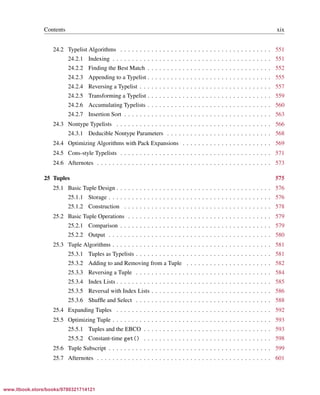
www.itbook.store/books/9780321714121
Vandevoorde/Josuttis/Gregor: C++ Templates 2017/08/11 18:35 page xix
ensurehelveticaisembedded_()
Contents xix
24.2 Typelist Algorithms . . . . . . . . . . . . . . . . . . . . . . . . . . . . . . . . . . . . . . . 551
24.2.1 Indexing . . . . . . . . . . . . . . . . . . . . . . . . . . . . . . . . . . . . . . . . . 551
24.2.2 Finding the Best Match . . . . . . . . . . . . . . . . . . . . . . . . . . . . . . . . 552
24.2.3 Appending to a Typelist . . . . . . . . . . . . . . . . . . . . . . . . . . . . . . . . 555
24.2.4 Reversing a Typelist . . . . . . . . . . . . . . . . . . . . . . . . . . . . . . . . . . 557
24.2.5 Transforming a Typelist . . . . . . . . . . . . . . . . . . . . . . . . . . . . . . . . 559
24.2.6 Accumulating Typelists . . . . . . . . . . . . . . . . . . . . . . . . . . . . . . . . 560
24.2.7 Insertion Sort . . . . . . . . . . . . . . . . . . . . . . . . . . . . . . . . . . . . . . 563
24.3 Nontype Typelists . . . . . . . . . . . . . . . . . . . . . . . . . . . . . . . . . . . . . . . . 566
24.3.1 Deducible Nontype Parameters . . . . . . . . . . . . . . . . . . . . . . . . . . . 568
24.4 Optimizing Algorithms with Pack Expansions . . . . . . . . . . . . . . . . . . . . . . . 569
24.5 Cons-style Typelists . . . . . . . . . . . . . . . . . . . . . . . . . . . . . . . . . . . . . . . 571
24.6 Afternotes . . . . . . . . . . . . . . . . . . . . . . . . . . . . . . . . . . . . . . . . . . . . . 573
25 Tuples 575
25.1 Basic Tuple Design . . . . . . . . . . . . . . . . . . . . . . . . . . . . . . . . . . . . . . . . 576
25.1.1 Storage . . . . . . . . . . . . . . . . . . . . . . . . . . . . . . . . . . . . . . . . . . 576
25.1.2 Construction . . . . . . . . . . . . . . . . . . . . . . . . . . . . . . . . . . . . . . 578
25.2 Basic Tuple Operations . . . . . . . . . . . . . . . . . . . . . . . . . . . . . . . . . . . . . 579
25.2.1 Comparison . . . . . . . . . . . . . . . . . . . . . . . . . . . . . . . . . . . . . . . 579
25.2.2 Output . . . . . . . . . . . . . . . . . . . . . . . . . . . . . . . . . . . . . . . . . . 580
25.3 Tuple Algorithms . . . . . . . . . . . . . . . . . . . . . . . . . . . . . . . . . . . . . . . . . 581
25.3.1 Tuples as Typelists . . . . . . . . . . . . . . . . . . . . . . . . . . . . . . . . . . . 581
25.3.2 Adding to and Removing from a Tuple . . . . . . . . . . . . . . . . . . . . . . 582
25.3.3 Reversing a Tuple . . . . . . . . . . . . . . . . . . . . . . . . . . . . . . . . . . . 584
25.3.4 Index Lists . . . . . . . . . . . . . . . . . . . . . . . . . . . . . . . . . . . . . . . . 585
25.3.5 Reversal with Index Lists . . . . . . . . . . . . . . . . . . . . . . . . . . . . . . . 586
25.3.6 Shuffle and Select . . . . . . . . . . . . . . . . . . . . . . . . . . . . . . . . . . . 588
25.4 Expanding Tuples . . . . . . . . . . . . . . . . . . . . . . . . . . . . . . . . . . . . . . . . 592
25.5 Optimizing Tuple . . . . . . . . . . . . . . . . . . . . . . . . . . . . . . . . . . . . . . . . . 593
25.5.1 Tuples and the EBCO . . . . . . . . . . . . . . . . . . . . . . . . . . . . . . . . . 593
25.5.2 Constant-time get() . . . . . . . . . . . . . . . . . . . . . . . . . . . . . . . . . 598
25.6 Tuple Subscript . . . . . . . . . . . . . . . . . . . . . . . . . . . . . . . . . . . . . . . . . . 599
25.7 Afternotes . . . . . . . . . . . . . . . . . . . . . . . . . . . . . . . . . . . . . . . . . . . . . 601
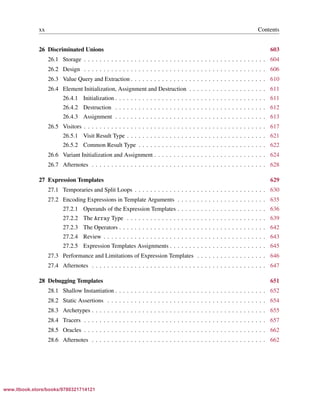
www.itbook.store/books/9780321714121
Vandevoorde/Josuttis/Gregor: C++ Templates 2017/08/11 18:35 page xx
ensurehelveticaisembedded_()
xx Contents
26 Discriminated Unions 603
26.1 Storage . . . . . . . . . . . . . . . . . . . . . . . . . . . . . . . . . . . . . . . . . . . . . . . 604
26.2 Design . . . . . . . . . . . . . . . . . . . . . . . . . . . . . . . . . . . . . . . . . . . . . . . 606
26.3 Value Query and Extraction . . . . . . . . . . . . . . . . . . . . . . . . . . . . . . . . . . . 610
26.4 Element Initialization, Assignment and Destruction . . . . . . . . . . . . . . . . . . . . 611
26.4.1 Initialization . . . . . . . . . . . . . . . . . . . . . . . . . . . . . . . . . . . . . . . 611
26.4.2 Destruction . . . . . . . . . . . . . . . . . . . . . . . . . . . . . . . . . . . . . . . 612
26.4.3 Assignment . . . . . . . . . . . . . . . . . . . . . . . . . . . . . . . . . . . . . . . 613
26.5 Visitors . . . . . . . . . . . . . . . . . . . . . . . . . . . . . . . . . . . . . . . . . . . . . . . 617
26.5.1 Visit Result Type . . . . . . . . . . . . . . . . . . . . . . . . . . . . . . . . . . . . 621
26.5.2 Common Result Type . . . . . . . . . . . . . . . . . . . . . . . . . . . . . . . . . 622
26.6 Variant Initialization and Assignment . . . . . . . . . . . . . . . . . . . . . . . . . . . . . 624
26.7 Afternotes . . . . . . . . . . . . . . . . . . . . . . . . . . . . . . . . . . . . . . . . . . . . . 628
27 Expression Templates 629
27.1 Temporaries and Split Loops . . . . . . . . . . . . . . . . . . . . . . . . . . . . . . . . . . 630
27.2 Encoding Expressions in Template Arguments . . . . . . . . . . . . . . . . . . . . . . . 635
27.2.1 Operands of the Expression Templates . . . . . . . . . . . . . . . . . . . . . . . 636
27.2.2 The Array Type . . . . . . . . . . . . . . . . . . . . . . . . . . . . . . . . . . . . 639
27.2.3 The Operators . . . . . . . . . . . . . . . . . . . . . . . . . . . . . . . . . . . . . . 642
27.2.4 Review . . . . . . . . . . . . . . . . . . . . . . . . . . . . . . . . . . . . . . . . . . 643
27.2.5 Expression Templates Assignments . . . . . . . . . . . . . . . . . . . . . . . . . 645
27.3 Performance and Limitations of Expression Templates . . . . . . . . . . . . . . . . . . 646
27.4 Afternotes . . . . . . . . . . . . . . . . . . . . . . . . . . . . . . . . . . . . . . . . . . . . . 647
28 Debugging Templates 651
28.1 Shallow Instantiation . . . . . . . . . . . . . . . . . . . . . . . . . . . . . . . . . . . . . . . 652
28.2 Static Assertions . . . . . . . . . . . . . . . . . . . . . . . . . . . . . . . . . . . . . . . . . 654
28.3 Archetypes . . . . . . . . . . . . . . . . . . . . . . . . . . . . . . . . . . . . . . . . . . . . . 655
28.4 Tracers . . . . . . . . . . . . . . . . . . . . . . . . . . . . . . . . . . . . . . . . . . . . . . . 657
28.5 Oracles . . . . . . . . . . . . . . . . . . . . . . . . . . . . . . . . . . . . . . . . . . . . . . . 662
28.6 Afternotes . . . . . . . . . . . . . . . . . . . . . . . . . . . . . . . . . . . . . . . . . . . . . 662
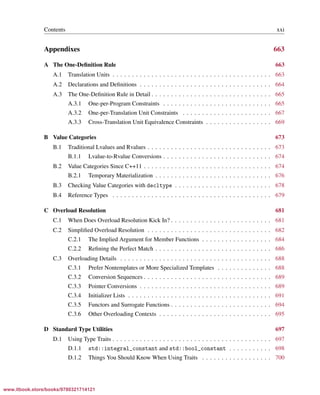
www.itbook.store/books/9780321714121
Vandevoorde/Josuttis/Gregor: C++ Templates 2017/08/11 18:35 page xxi
ensurehelveticaisembedded_()
Contents xxi
Appendixes 663
A The One-Definition Rule 663
A.1 Translation Units . . . . . . . . . . . . . . . . . . . . . . . . . . . . . . . . . . . . . . . . . 663
A.2 Declarations and Definitions . . . . . . . . . . . . . . . . . . . . . . . . . . . . . . . . . . 664
A.3 The One-Definition Rule in Detail . . . . . . . . . . . . . . . . . . . . . . . . . . . . . . . 665
A.3.1 One-per-Program Constraints . . . . . . . . . . . . . . . . . . . . . . . . . . . . 665
A.3.2 One-per-Translation Unit Constraints . . . . . . . . . . . . . . . . . . . . . . . 667
A.3.3 Cross-Translation Unit Equivalence Constraints . . . . . . . . . . . . . . . . . 669
B Value Categories 673
B.1 Traditional Lvalues and Rvalues . . . . . . . . . . . . . . . . . . . . . . . . . . . . . . . . 673
B.1.1 Lvalue-to-Rvalue Conversions . . . . . . . . . . . . . . . . . . . . . . . . . . . . 674
B.2 Value Categories Since C++11 . . . . . . . . . . . . . . . . . . . . . . . . . . . . . . . . . 674
B.2.1 Temporary Materialization . . . . . . . . . . . . . . . . . . . . . . . . . . . . . . 676
B.3 Checking Value Categories with decltype . . . . . . . . . . . . . . . . . . . . . . . . . 678
B.4 Reference Types . . . . . . . . . . . . . . . . . . . . . . . . . . . . . . . . . . . . . . . . . 679
C Overload Resolution 681
C.1 When Does Overload Resolution Kick In? . . . . . . . . . . . . . . . . . . . . . . . . . . 681
C.2 Simplified Overload Resolution . . . . . . . . . . . . . . . . . . . . . . . . . . . . . . . . 682
C.2.1 The Implied Argument for Member Functions . . . . . . . . . . . . . . . . . . 684
C.2.2 Refining the Perfect Match . . . . . . . . . . . . . . . . . . . . . . . . . . . . . . 686
C.3 Overloading Details . . . . . . . . . . . . . . . . . . . . . . . . . . . . . . . . . . . . . . . 688
C.3.1 Prefer Nontemplates or More Specialized Templates . . . . . . . . . . . . . . 688
C.3.2 Conversion Sequences . . . . . . . . . . . . . . . . . . . . . . . . . . . . . . . . . 689
C.3.3 Pointer Conversions . . . . . . . . . . . . . . . . . . . . . . . . . . . . . . . . . . 689
C.3.4 Initializer Lists . . . . . . . . . . . . . . . . . . . . . . . . . . . . . . . . . . . . . 691
C.3.5 Functors and Surrogate Functions . . . . . . . . . . . . . . . . . . . . . . . . . . 694
C.3.6 Other Overloading Contexts . . . . . . . . . . . . . . . . . . . . . . . . . . . . . 695
D Standard Type Utilities 697
D.1 Using Type Traits . . . . . . . . . . . . . . . . . . . . . . . . . . . . . . . . . . . . . . . . . 697
D.1.1 std::integral_constant and std::bool_constant . . . . . . . . . . . 698
D.1.2 Things You Should Know When Using Traits . . . . . . . . . . . . . . . . . . 700
www.itbook.store/books/9780321714121
Vandevoorde/Josuttis/Gregor: C++ Templates 2017/08/11 18:35 page xxii
ensurehelveticaisembedded_()
xxii Contents
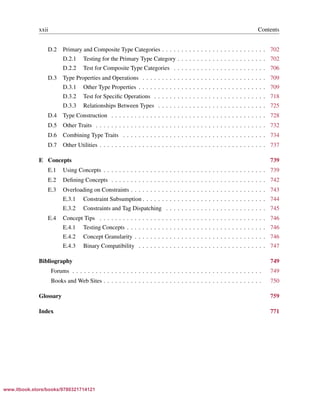
D.2 Primary and Composite Type Categories . . . . . . . . . . . . . . . . . . . . . . . . . . . 702
D.2.1 Testing for the Primary Type Category . . . . . . . . . . . . . . . . . . . . . . . 702
D.2.2 Test for Composite Type Categories . . . . . . . . . . . . . . . . . . . . . . . . 706
D.3 Type Properties and Operations . . . . . . . . . . . . . . . . . . . . . . . . . . . . . . . . 709
D.3.1 Other Type Properties . . . . . . . . . . . . . . . . . . . . . . . . . . . . . . . . . 709
D.3.2 Test for Specific Operations . . . . . . . . . . . . . . . . . . . . . . . . . . . . . 718
D.3.3 Relationships Between Types . . . . . . . . . . . . . . . . . . . . . . . . . . . . 725
D.4 Type Construction . . . . . . . . . . . . . . . . . . . . . . . . . . . . . . . . . . . . . . . . 728
D.5 Other Traits . . . . . . . . . . . . . . . . . . . . . . . . . . . . . . . . . . . . . . . . . . . . 732
D.6 Combining Type Traits . . . . . . . . . . . . . . . . . . . . . . . . . . . . . . . . . . . . . 734
D.7 Other Utilities . . . . . . . . . . . . . . . . . . . . . . . . . . . . . . . . . . . . . . . . . . . 737
E Concepts 739
E.1 Using Concepts . . . . . . . . . . . . . . . . . . . . . . . . . . . . . . . . . . . . . . . . . . 739
E.2 Defining Concepts . . . . . . . . . . . . . . . . . . . . . . . . . . . . . . . . . . . . . . . . 742
E.3 Overloading on Constraints . . . . . . . . . . . . . . . . . . . . . . . . . . . . . . . . . . . 743
E.3.1 Constraint Subsumption . . . . . . . . . . . . . . . . . . . . . . . . . . . . . . . . 744
E.3.2 Constraints and Tag Dispatching . . . . . . . . . . . . . . . . . . . . . . . . . . 745
E.4 Concept Tips . . . . . . . . . . . . . . . . . . . . . . . . . . . . . . . . . . . . . . . . . . . 746
E.4.1 Testing Concepts . . . . . . . . . . . . . . . . . . . . . . . . . . . . . . . . . . . . 746
E.4.2 Concept Granularity . . . . . . . . . . . . . . . . . . . . . . . . . . . . . . . . . . 746
E.4.3 Binary Compatibility . . . . . . . . . . . . . . . . . . . . . . . . . . . . . . . . . 747
Bibliography 749
Forums . . . . . . . . . . . . . . . . . . . . . . . . . . . . . . . . . . . . . . . . . . . . . . . . . 749
Books and Web Sites . . . . . . . . . . . . . . . . . . . . . . . . . . . . . . . . . . . . . . . . . 750
Glossary 759
Index 771
www.itbook.store/books/9780321714121
Vandevoorde/Josuttis/Gregor: C++ Templates 2017/08/11 18:35 page xxiii
ensurehelveticaisembedded_()
Preface
The notion of templates in C++ is over 30 years old. C++ templates were already documented in
1990 in “The Annotated C++ Reference Manual” (ARM; see [EllisStroustrupARM]), and they had
been described before then in more specialized publications. However, well over a decade later, we
found a dearth of literature that concentrates on the fundamental concepts and advanced techniques of
this fascinating, complex, and powerful C++ feature. With the first edition of this book, we wanted
to address this issue and decided to write the book about templates (with perhaps a slight lack of
humility).
Much has changed in C++ since that first edition was published in late 2002. New iterations of
the C++ standard have added new features, and continued innovation in the C++ community has
uncovered new template-based programming techniques. The second edition of this book therefore
retains the same goals as the first edition, but for “Modern C++.”
We approached the task of writing this book with different backgrounds and with different inten-
tions. David (aka “Daveed”), an experienced compiler implementer and active participant of the C++
Standard Committee working groups that evolve the core language, was interested in a precise and
detailed description of all the power (and problems) of templates. Nico, an “ordinary” application
programmer and member of the C++ Standard Committee Library Working Group, was interested in
understanding all the techniques of templates in a way that he could use and benefit from them. Doug,
a template library developer turned compiler implementer and language designer, was interested in
collecting, categorizing, and evaluating the myriad techniques used to build template libraries. In
addition, we all wanted to share this knowledge with you, the reader, and the whole community to
help to avoid further misunderstanding, confusion, or apprehension.
As a consequence, you will see both conceptual introductions with day-to-day examples and de-
tailed descriptions of the exact behavior of templates. Starting from the basic principles of templates
and working up to the “art of template programming,” you will discover (or rediscover) techniques
such as static polymorphism, type traits, metaprogramming, and expression templates. You will also
gain a deeper understanding of the C++ standard library, in which almost all code involves templates.
We learned a lot and we had much fun while writing this book. We hope you will have the same
experience while reading it. Enjoy!
xxiii
www.itbook.store/books/9780321714121
This page intentionally left blank
www.itbook.store/books/9780321714121
Vandevoorde/Josuttis/Gregor: C++ Templates 2017/08/11 18:35 page xxv
ensurehelveticaisembedded_()
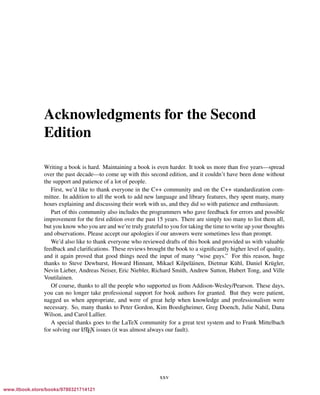
Acknowledgments for the Second
Edition
Writing a book is hard. Maintaining a book is even harder. It took us more than five years—spread
over the past decade—to come up with this second edition, and it couldn’t have been done without
the support and patience of a lot of people.
First, we’d like to thank everyone in the C++ community and on the C++ standardization com-
mittee. In addition to all the work to add new language and library features, they spent many, many
hours explaining and discussing their work with us, and they did so with patience and enthusiasm.
Part of this community also includes the programmers who gave feedback for errors and possible
improvement for the first edition over the past 15 years. There are simply too many to list them all,
but you know who you are and we’re truly grateful to you for taking the time to write up your thoughts
and observations. Please accept our apologies if our answers were sometimes less than prompt.
We’d also like to thank everyone who reviewed drafts of this book and provided us with valuable
feedback and clarifications. These reviews brought the book to a significantly higher level of quality,
and it again proved that good things need the input of many “wise guys.” For this reason, huge
thanks to Steve Dewhurst, Howard Hinnant, Mikael Kilpel¨ainen, Dietmar K¨uhl, Daniel Kr¨ugler,
Nevin Lieber, Andreas Neiser, Eric Niebler, Richard Smith, Andrew Sutton, Hubert Tong, and Ville
Voutilainen.
Of course, thanks to all the people who supported us from Addison-Wesley/Pearson. These days,
you can no longer take professional support for book authors for granted. But they were patient,
nagged us when appropriate, and were of great help when knowledge and professionalism were
necessary. So, many thanks to Peter Gordon, Kim Boedigheimer, Greg Doench, Julie Nahil, Dana
Wilson, and Carol Lallier.
A special thanks goes to the LaTeX community for a great text system and to Frank Mittelbach
for solving our LATEX issues (it was almost always our fault).
xxv
www.itbook.store/books/9780321714121
Vandevoorde/Josuttis/Gregor: C++ Templates 2017/08/11 18:35 page xxvi
ensurehelveticaisembedded_()
xxvi Acknowledgments for the Second Edition
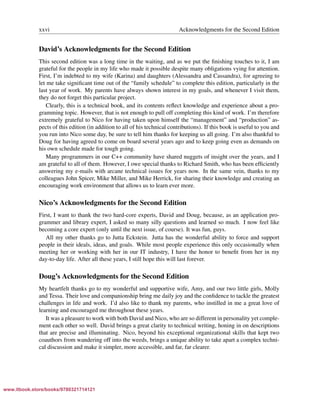
David’s Acknowledgments for the Second Edition
This second edition was a long time in the waiting, and as we put the finishing touches to it, I am
grateful for the people in my life who made it possible despite many obligations vying for attention.
First, I’m indebted to my wife (Karina) and daughters (Alessandra and Cassandra), for agreeing to
let me take significant time out of the “family schedule” to complete this edition, particularly in the
last year of work. My parents have always shown interest in my goals, and whenever I visit them,
they do not forget this particular project.
Clearly, this is a technical book, and its contents reflect knowledge and experience about a pro-
gramming topic. However, that is not enough to pull off completing this kind of work. I’m therefore
extremely grateful to Nico for having taken upon himself the “management” and “production” as-
pects of this edition (in addition to all of his technical contributions). If this book is useful to you and
you run into Nico some day, be sure to tell him thanks for keeping us all going. I’m also thankful to
Doug for having agreed to come on board several years ago and to keep going even as demands on
his own schedule made for tough going.
Many programmers in our C++ community have shared nuggets of insight over the years, and I
am grateful to all of them. However, I owe special thanks to Richard Smith, who has been efficiently
answering my e-mails with arcane technical issues for years now. In the same vein, thanks to my
colleagues John Spicer, Mike Miller, and Mike Herrick, for sharing their knowledge and creating an
encouraging work environment that allows us to learn ever more.
Nico’s Acknowledgments for the Second Edition
First, I want to thank the two hard-core experts, David and Doug, because, as an application pro-
grammer and library expert, I asked so many silly questions and learned so much. I now feel like
becoming a core expert (only until the next issue, of course). It was fun, guys.
All my other thanks go to Jutta Eckstein. Jutta has the wonderful ability to force and support
people in their ideals, ideas, and goals. While most people experience this only occasionally when
meeting her or working with her in our IT industry, I have the honor to benefit from her in my
day-to-day life. After all these years, I still hope this will last forever.
Doug’s Acknowledgments for the Second Edition
My heartfelt thanks go to my wonderful and supportive wife, Amy, and our two little girls, Molly
and Tessa. Their love and companionship bring me daily joy and the confidence to tackle the greatest
challenges in life and work. I’d also like to thank my parents, who instilled in me a great love of
learning and encouraged me throughout these years.
It was a pleasure to work with both David and Nico, who are so different in personality yet comple-
ment each other so well. David brings a great clarity to technical writing, honing in on descriptions
that are precise and illuminating. Nico, beyond his exceptional organizational skills that kept two
coauthors from wandering off into the weeds, brings a unique ability to take apart a complex techni-
cal discussion and make it simpler, more accessible, and far, far clearer.
www.itbook.store/books/9780321714121
Vandevoorde/Josuttis/Gregor: C++ Templates 2017/08/11 18:35 page xxvii
ensurehelveticaisembedded_()
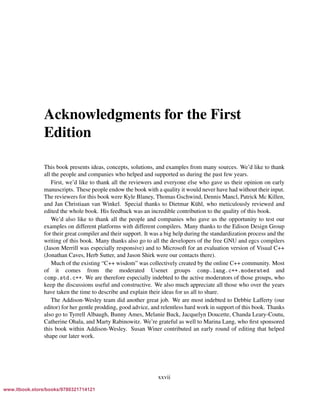
Acknowledgments for the First
Edition
This book presents ideas, concepts, solutions, and examples from many sources. We’d like to thank
all the people and companies who helped and supported us during the past few years.
First, we’d like to thank all the reviewers and everyone else who gave us their opinion on early
manuscripts. These people endow the book with a quality it would never have had without their input.
The reviewers for this book were Kyle Blaney, Thomas Gschwind, Dennis Mancl, Patrick Mc Killen,
and Jan Christiaan van Winkel. Special thanks to Dietmar K¨uhl, who meticulously reviewed and
edited the whole book. His feedback was an incredible contribution to the quality of this book.
We’d also like to thank all the people and companies who gave us the opportunity to test our
examples on different platforms with different compilers. Many thanks to the Edison Design Group
for their great compiler and their support. It was a big help during the standardization process and the
writing of this book. Many thanks also go to all the developers of the free GNU and egcs compilers
(Jason Merrill was especially responsive) and to Microsoft for an evaluation version of Visual C++
(Jonathan Caves, Herb Sutter, and Jason Shirk were our contacts there).
Much of the existing “C++ wisdom” was collectively created by the online C++ community. Most
of it comes from the moderated Usenet groups comp.lang.c++.moderated and
comp.std.c++. We are therefore especially indebted to the active moderators of those groups, who
keep the discussions useful and constructive. We also much appreciate all those who over the years
have taken the time to describe and explain their ideas for us all to share.
The Addison-Wesley team did another great job. We are most indebted to Debbie Lafferty (our
editor) for her gentle prodding, good advice, and relentless hard work in support of this book. Thanks
also go to Tyrrell Albaugh, Bunny Ames, Melanie Buck, Jacquelyn Doucette, Chanda Leary-Coutu,
Catherine Ohala, and Marty Rabinowitz. We’re grateful as well to Marina Lang, who first sponsored
this book within Addison-Wesley. Susan Winer contributed an early round of editing that helped
shape our later work.
xxvii
www.itbook.store/books/9780321714121
Vandevoorde/Josuttis/Gregor: C++ Templates 2017/08/11 18:35 page xxviii
ensurehelveticaisembedded_()
xxviii Acknowledgments for the First Edition
Nico’s Acknowledgments for the First Edition
My first personal thanks go with a lot of kisses to my family: Ulli, Lucas, Anica, and Frederic
supported this book with a lot of patience, consideration, and encouragement.
In addition, I want to thank David. His expertise turned out to be incredible, but his patience was
even better (sometimes I ask really silly questions). It is a lot of fun to work with him.
David’s Acknowledgments for the First Edition
My wife, Karina, has been instrumental in this book coming to a conclusion, and I am immensely
grateful for the role that she plays in my life. Writing “in your spare time” quickly becomes erratic
when many other activities vie for your schedule. Karina helped me to manage that schedule, taught
me to say “no” in order to make the time needed to make regular progress in the writing process,
and above all was amazingly supportive of this project. I thank God every day for her friendship and
love.
I’m also tremendously grateful to have been able to work with Nico. Besides his directly visible
contributions to the text, his experience and discipline moved us from my pitiful doodling to a well-
organized production.
John “Mr. Template” Spicer and Steve “Mr. Overload” Adamczyk are wonderful friends and
colleagues, but in my opinion they are (together) also the ultimate authority regarding the core C++
language. They clarified many of the trickier issues described in this book, and should you find an
error in the description of a C++ language element, it is almost certainly attributable to my failing to
consult with them.
Finally, I want to express my appreciation to those who were supportive of this project without
necessarily contributing to it directly (the power of cheer cannot be understated). First, my par-
ents: Their love for me and their encouragement made all the difference. And then there are the
numerous friends inquiring: “How is the book going?” They, too, were a source of encouragement:
Michael Beckmann, Brett and Julie Beene, Jarran Carr, Simon Chang, Ho and Sarah Cho, Christophe
De Dinechin, Ewa Deelman, Neil Eberle, Sassan Hazeghi, Vikram Kumar, Jim and Lindsay Long,
R.J. Morgan, Mike Puritano, Ragu Raghavendra, Jim and Phuong Sharp, Gregg Vaughn, and John
Wiegley.
www.itbook.store/books/9780321714121
Vandevoorde/Josuttis/Gregor: C++ Templates 2017/08/11 18:35 page xxix
ensurehelveticaisembedded_()
About This Book
The first edition of this book was published almost 15 years ago. We had set out to write the definitive
guide to C++ templates, with the expectation that it would be useful to practicing C++ programmers.
That project was successful: It’s been tremendously gratifying to hear from readers who found our
material helpful, to see our book time and again being recommended as a work of reference, and to
be universally well reviewed.
That first edition has aged well, with most material remaining entirely relevant to the modern C++
programmer, but there is no denying that the evolution of the language—culminating in the “Modern
C++” standards, C++11, C++14, and C++17—has raised the need for a revision of the material in
the first edition.
So with this second edition, our high-level goal has remained unchanged: to provide the definitive
guide to C++ templates, including both a solid reference and an accessible tutorial. This time, how-
ever, we work with the “Modern C++” language, which is a significantly bigger beast (still!) than the
language available at the time of the prior edition.
We’re also acutely aware that C++ programming resources have changed (for the better) since the
first edition was published. For example, several books have appeared that develop specific template-
based applications in great depth. More important, far more information about C++ templates and
template-based techniques is easily available online, as are examples of advanced uses of these tech-
niques. So in this edition, we have decided to emphasize a breadth of techniques that can be used in
a variety of applications.
Some of the techniques we presented in the first edition have become obsolete because the C++
language now offers more direct ways of achieving the same effects. Those techniques have been
dropped (or relegated to minor notes), and instead you’ll find new techniques that show the state-of-
the-art uses of the new language.
We’ve now lived over 20 years with C++ templates, but the C++ programmers’ community still
regularly finds new fundamental insights into the way they can fit in our software development needs.
Our goal with this book is to share that knowledge but also to fully equip the reader to develop new
understanding and, perhaps, discover the next major C++ technique.
xxix
www.itbook.store/books/9780321714121
Vandevoorde/Josuttis/Gregor: C++ Templates 2017/08/11 18:35 page xxx
ensurehelveticaisembedded_()
xxx About This Book
What You Should Know Before Reading This Book
To get the most from this book, you should already know C++. We describe the details of a partic-
ular language feature, not the fundamentals of the language itself. You should be familiar with the
concepts of classes and inheritance, and you should be able to write C++ programs using compo-
nents such as IOstreams and containers from the C++ standard library. You should also be familiar
with the basic features of “Modern C++”, such as auto, decltype, move semantics, and lambdas.
Nevertheless, we review more subtle issues as the need arises, even when such issues aren’t directly
related to templates. This ensures that the text is accessible to experts and intermediate programmers
alike.
We deal primarily with the C++ language revisions standardized in 2011, 2014, and 2017. How-
ever, at the time of this writing, the ink is barely dry on the C++17 revision, and we expect that most
of our readers will not be intimately familiar with its details. All revisions had a significant impact on
the behavior and usage of templates. We therefore provide short introductions to those new features
that have the greatest bearing on our subject matter. However, our goal is neither to introduce the
modern C++ standards nor to provide an exhaustive description of the changes from the prior ver-
sions of this standard ([C++98] and [C++03]). Instead, we focus on templates as designed and used
in C++, using the modern C++ standards ([C++11], [C++14], and [C++17]) as our basis, and we
occasionally call out cases where the modern C++ standards enable or encourage different techniques
than the prior standards.
Overall Structure of the Book
Our goal is to provide the information necessary to start using templates and benefit from their power,
as well as to provide information that will enable experienced programmers to push the limits of the
state-of-the-art. To achieve this, we decided to organize our text in parts:
• Part I introduces the basic concepts underlying templates. It is written in a tutorial style.
• Part II presents the language details and is a handy reference to template-related constructs.
• Part III explains fundamental design and coding techniques supported by C++ templates. They
range from near-trivial ideas to sophisticated idioms.
Each of these parts consists of several chapters. In addition, we provide a few appendixes that cover
material not exclusively related to templates (e.g., an overview of overload resolution in C++). An
additional appendix covers concepts, which is a fundamental extension to templates that has been
included in the draft for a future standard (C++20, presumably).
The chapters of Part I are meant to be read in sequence. For example, Chapter 3 builds on the
material covered in Chapter 2. In the other parts, however, the connection between chapters is con-
siderably looser. Cross references will help readers jump through the different topics.
Last, we provide a rather complete index that encourages additional ways to read this book out of
sequence.
www.itbook.store/books/9780321714121
Vandevoorde/Josuttis/Gregor: C++ Templates 2017/08/11 18:35 page xxxi
ensurehelveticaisembedded_()
How to Read This Book xxxi
How to Read This Book
If you are a C++ programmer who wants to learn or review the concepts of templates, carefully read
Part I, The Basics. Even if you’re quite familiar with templates already, it may help to skim through
this part quickly to familiarize yourself with the style and terminology that we use. This part also
covers some of the logistical aspects of organizing your source code when it contains templates.
Depending on your preferred learning method, you may decide to absorb the many details of
templates in Part II, or instead you could read about practical coding techniques in Part III (and refer
back to Part II for the more subtle language issues). The latter approach is probably particularly
useful if you bought this book with concrete day-to-day challenges in mind.
The appendixes contain much useful information that is often referred to in the main text. We have
also tried to make them interesting in their own right.
In our experience, the best way to learn something new is to look at examples. Therefore, you’ll
find a lot of examples throughout the book. Some are just a few lines of code illustrating an abstract
concept, whereas others are complete programs that provide a concrete application of the material.
The latter kind of examples will be introduced by a C++ comment describing the file containing the
program code. You can find these files at the Web site of this book at http://www.tmplbook.com.
Some Remarks About Programming Style
C++ programmers use different programming styles, and so do we: The usual questions about where
to put whitespace, delimiters (braces, parentheses), and so forth came up. We tried to be consistent
in general, although we occasionally make concessions to the topic at hand. For example, in tutorial
sections, we may prefer generous use of whitespace and concrete names to help visualize code,
whereas in more advanced discussions, a more compact style could be more appropriate.
We do want to draw your attention to one slightly uncommon decision regarding the declaration
of types, parameters, and variables. Clearly, several styles are possible:
void foo (const int &x);
void foo (const int& x);
void foo (int const &x);
void foo (int const& x);
Although it is a bit less common, we decided to use the order int const rather than const int for
“constant integer.” We have two reasons for using this order. First, it provides for an easier answer
to the question, “What is constant?” It’s always what is in front of the const qualifier. Indeed,
although
const int N = 100;
is equivalent to
int const N = 100;
there is no equivalent form for
int* const bookmark; // the pointer cannot change, but the value pointed to can
www.itbook.store/books/9780321714121
Vandevoorde/Josuttis/Gregor: C++ Templates 2017/08/11 18:35 page xxxii
ensurehelveticaisembedded_()
xxxii About This Book
that would place the const qualifier before the pointer operator *. In this example, it is the pointer
itself that is constant, not the int to which it points.
Our second reason has to do with a syntactical substitution principle that is very common when
dealing with templates. Consider the following two type declarations using the typedef keyword:1
typedef char* CHARS;
typedef CHARS const CPTR; // constant pointer to chars
or using the using keyword:
using CHARS = char*;
using CPTR = CHARS const; // constant pointer to chars
The meaning of the second declaration is preserved when we textually replace CHARS with what it
stands for:
typedef char* const CPTR; // constant pointer to chars
or:
using CPTR = char* const; // constant pointer to chars
However, if we write const before the type it qualifies, this principle doesn’t apply. Consider the
alternative to our first two type definitions presented earlier:
typedef char* CHARS;
typedef const CHARS CPTR; // constant pointer to chars
Textually replacing CHARS results in a type with a different meaning:
typedef const char* CPTR; // pointer to constant chars
The same observation applies to the volatile specifier, of course.
Regarding whitespaces, we decided to put the space between the ampersand and the parameter
name:
void foo (int const& x);
By doing this, we emphasize the separation between the parameter type and the parameter name.
This is admittedly more confusing for declarations such as
char* a, b;
where, according to the rules inherited from C, a is a pointer but b is an ordinary char. To avoid
such confusion, we simply avoid declaring multiple entities in this way.
This is primarily a book about language features. However, many techniques, features, and helper
templates now appear in the C++ standard library. To connect these two, we therefore demonstrate
1 Note that in C++, a type definition defines a “type alias” rather than a new type (see Section 2.8 on page 38).
For example:
typedef int Length; // define Length as an alias for int
int i = 42;
Length l = 88;
i = l; // OK
l = i; // OK
www.itbook.store/books/9780321714121
Vandevoorde/Josuttis/Gregor: C++ Templates 2017/08/11 18:35 page xxxiii
ensurehelveticaisembedded_()
The C++11, C++14, and C++17 Standards xxxiii
template techniques by illustrating how they are used to implement certain library components, and
we use standard library utilities to build our own more complex examples. Hence, we use not
only headers such as <iostream> and <string> (which contain templates but are not particu-
larly relevant to define other templates) but also <cstddef>, <utilities>, <functional>, and
<type_traits> (which do provide building blocks for more complex templates).
In addition, we provide a reference, Appendix D, about the major template utilities provided by
the C++ standard library, including a detailed description of all the standard type traits. These are
commonly used at the core of sophisticated template programming
The C++11, C++14, and C++17 Standards
The original C++ standard was published in 1998 and subsequently amended by a technical corri-
gendum in 2003, which provided minor corrections and clarifications to the original standard. This
“old C++ standard” is known as C++98 or C++03.
The C++11 standard was the first major revision of C++ driven by the ISO C++ standardization
committee, bringing a wealth of new features to the language. A number of these new features
interact with templates and are described in this book, including:
• Variadic templates
• Alias templates
• Move semantics, rvalue references, and perfect forwarding
• Standard type traits
C++14 and C++17 followed, both introducing some new language features, although the changes
brought about by these standards were not quite as dramatic as those of C++11.2
New features
interacting with templates and described in this book include but are not limited to:
• Variable templates (C++14)
• Generic Lambdas (C++14)
• Class template argument deduction (C++17)
• Compile-time if (C++17)
• Fold expressions (C++17)
We even describe concepts (template interfaces), which are currently slated for inclusion in the forth-
coming C++20 standard.
At the time of this writing, the C++11 and C++14 standards are broadly supported by the major
compilers, and C++17 is largely supported also. Still, compilers differ greatly in their support of the
different language features. Several will compile most of the code in this book, but a few compilers
may not be able to handle some of our examples. However, we expect that this problem will soon be
resolved as programmers everywhere demand standard support from their vendors.
2 The committee now aims at issuing a new standard roughly every 3 years. Clearly, that leaves less time
for massive additions, but it brings the changes more quickly to the broader programming community. The
development of larger features, then, spans time and might cover multiple standards.
www.itbook.store/books/9780321714121
Vandevoorde/Josuttis/Gregor: C++ Templates 2017/08/11 18:35 page xxxiv
ensurehelveticaisembedded_()
xxxiv About This Book
Even so, the C++ programming language is likely to continue to evolve as time passes. The experts
of the C++ community (regardless of whether they participate in the C++ Standardization Committee)
are discussing various ways to improve the language, and already several candidate improvements
affect templates. Chapter 17 presents some trends in this area.
Example Code and Additional Information
You can access all example programs and find more information about this book from its Web site,
which has the following URL:
http://www.tmplbook.com
Feedback
We welcome your constructive input—both the negative and the positive. We worked very hard to
bring you what we hope you’ll find to be an excellent book. However, at some point we had to stop
writing, reviewing, and tweaking so we could “release the product.” You may therefore find errors,
inconsistencies, and presentations that could be improved, or topics that are missing altogether. Your
feedback gives us a chance to inform all readers through the book’s Web site and to improve any
subsequent editions.
The best way to reach us is by email. You will find the email address at the Web site of this book:
http://www.tmplbook.com
Please, be sure to check the book’s Web site for the currently known errata before submitting reports.
Many thanks.
www.itbook.store/books/9780321714121
Vandevoorde/Josuttis/Gregor: C++ Templates 2017/08/11 18:35 page 55
ensurehelveticaisembedded_()
Chapter 4
Variadic Templates
Since C++11, templates can have parameters that accept a variable number of template arguments.
This feature allows the use of templates in places where you have to pass an arbitrary number of
arguments of arbitrary types. A typical application is to pass an arbitrary number of parameters of
arbitrary type through a class or framework. Another application is to provide generic code to process
any number of parameters of any type.
4.1 Variadic Templates
Template parameters can be defined to accept an unbounded number of template arguments. Tem-
plates with this ability are called variadic templates.
4.1.1 Variadic Templates by Example
For example, you can use the following code to call print() for a variable number of arguments of
different types:
basics/varprint1.hpp
§ ¤
#include <iostream>
void print ()
{
}
template<typename T, typename... Types>
void print (T firstArg, Types... args)
{
std::cout << firstArg << ’n’; // print first argument
print(args...); // call print() for remaining arguments
}
¦ ¥
55
www.itbook.store/books/9780321714121
Vandevoorde/Josuttis/Gregor: C++ Templates 2017/08/11 18:35 page 56
ensurehelveticaisembedded_()
56 Chapter 4: Variadic Templates
If one or more arguments are passed, the function template is used, which by specifying the first
argument separately allows printing of the first argument before recursively calling print() for the
remaining arguments. These remaining arguments named args are a function parameter pack:
void print (T firstArg, Types... args)
using different “Types” specified by a template parameter pack:
template<typename T, typename... Types>
To end the recursion, the nontemplate overload of print() is provided, which is issued when the
parameter pack is empty.
For example, a call such as
std::string s("world");
print (7.5, "hello", s);
would output the following:
7.5
hello
world
The reason is that the call first expands to
print<double, char const*, std::string> (7.5, "hello", s);
with
• firstArg having the value 7.5 so that type T is a double and
• args being a variadic template argument having the values "hello" of type char const* and
"world" of type std::string.
After printing 7.5 as firstArg, it calls print() again for the remaining arguments, which then
expands to:
print<char const*, std::string> ("hello", s);
with
• firstArg having the value "hello" so that type T is a char const* here and
• args being a variadic template argument having the value of type std::string.
After printing "hello" as firstArg, it calls print() again for the remaining arguments, which
then expands to:
print<std::string> (s);
with
• firstArg having the value "world" so that type T is a std::string now and
• args being an empty variadic template argument having no value.
Thus, after printing "world" as firstArg, we calls print() with no arguments, which results in
calling the nontemplate overload of print() doing nothing.
www.itbook.store/books/9780321714121
Vandevoorde/Josuttis/Gregor: C++ Templates 2017/08/11 18:35 page 57
ensurehelveticaisembedded_()
4.1 Variadic Templates 57
4.1.2 Overloading Variadic and Nonvariadic Templates
Note that you can also implement the example above as follows:
basics/varprint2.hpp
§ ¤
#include <iostream>
template<typename T>
void print (T arg)
{
std::cout << arg << ’n’; // print passed argument
}
template<typename T, typename... Types>
void print (T firstArg, Types... args)
{
print(firstArg); // call print() for the first argument
print(args...); // call print() for remaining arguments
}
¦ ¥
That is, if two function templates only differ by a trailing parameter pack, the function template
without the trailing parameter pack is preferred.1
Section C.3.1 on page 688 explains the more
general overload resolution rule that applies here.
4.1.3 Operator sizeof...
C++11 also introduced a new form of the sizeof operator for variadic templates: sizeof.... It
expands to the number of elements a parameter pack contains. Thus,
template<typename T, typename... Types>
void print (T firstArg, Types... args)
{
std::cout << sizeof...(Types) << ’n’; // print number of remaining types
std::cout << sizeof...(args) << ’n’; // print number of remaining args
...
}
twice prints the number of remaining arguments after the first argument passed to print(). As you
can see, you can call sizeof... for both template parameter packs and function parameter packs.
This might lead us to think we can skip the function for the end of the recursion by not calling it
in case there are no more arguments:
1 Initially, in C++11 and C++14 this was an ambiguity, which was fixed later (see [CoreIssue1395]), but all
compilers handle it this way in all versions.
www.itbook.store/books/9780321714121
Vandevoorde/Josuttis/Gregor: C++ Templates 2017/08/11 18:35 page 58
ensurehelveticaisembedded_()
58 Chapter 4: Variadic Templates
template<typename T, typename... Types>
void print (T firstArg, Types... args)
{
std::cout << firstArg << ’n’;
if (sizeof...(args) > 0) { // error if sizeof...(args)==0
print(args...); // and no print() for no arguments declared
}
}
However, this approach doesn’t work because in general both branches of all if statements in function
templates are instantiated. Whether the instantiated code is useful is a run-time decision, while the
instantiation of the call is a compile-time decision. For this reason, if you call the print() function
template for one (last) argument, the statement with the call of print(args...) still is instantiated
for no argument, and if there is no function print() for no arguments provided, this is an error.
However, note that since C++17, a compile-time if is available, which achieves what was ex-
pected here with a slightly different syntax. This will be discussed in Section 8.5 on page 134.
4.2 Fold Expressions
Since C++17, there is a feature to compute the result of using a binary operator over all the arguments
of a parameter pack (with an optional initial value).
For example, the following function returns the sum of all passed arguments:
template<typename... T>
auto foldSum (T... s) {
return (... + s); // ((s1 + s2) + s3) ...
}
If the parameter pack is empty, the expression is usually ill-formed (with the exception that for
operator && the value is true, for operator || the value is false, and for the comma operator the
value for an empty parameter pack is void()).
Table 4.1 lists the possible fold expressions.
Fold Expression Evaluation
( ... op pack ) ((( pack1 op pack2 ) op pack3 ) ... op packN )
( pack op ... ) ( pack1 op ( ... ( packN-1 op packN )))
( init op ... op pack ) ((( init op pack1 ) op pack2 ) ... op packN )
( pack op ... op init ) ( pack1 op ( ... ( packN op init )))
Table 4.1. Fold Expressions (since C++17)
You can use almost all binary operators for fold expressions (see Section 12.4.6 on page 208 for
details). For example, you can use a fold expression to traverse a path in a binary tree using operator
->*:
www.itbook.store/books/9780321714121
Vandevoorde/Josuttis/Gregor: C++ Templates 2017/08/11 18:35 page 59
ensurehelveticaisembedded_()
4.2 Fold Expressions 59
basics/foldtraverse.cpp
§ ¤
// define binary tree structure and traverse helpers:
struct Node {
int value;
Node* left;
Node* right;
Node(int i=0) : value(i), left(nullptr), right(nullptr) {
}
...
};
auto left = &Node::left;
auto right = &Node::right;
// traverse tree, using fold expression:
template<typename T, typename... TP>
Node* traverse (T np, TP... paths) {
return (np ->* ... ->* paths); // np ->* paths1 ->* paths2 ...
}
int main()
{
// init binary tree structure:
Node* root = new Node{0};
root->left = new Node{1};
root->left->right = new Node{2};
...
// traverse binary tree:
Node* node = traverse(root, left, right);
...
}
¦ ¥
Here,
(np ->* ... ->* paths)
uses a fold expression to traverse the variadic elements of paths from np.
With such a fold expression using an initializer, we might think about simplifying the variadic
template to print all arguments, introduced above:
template<typename... Types>
void print (Types const&... args)
{
(std::cout << ... << args) << ’n’;
}
www.itbook.store/books/9780321714121
Vandevoorde/Josuttis/Gregor: C++ Templates 2017/08/11 18:35 page 60
ensurehelveticaisembedded_()
60 Chapter 4: Variadic Templates
However, note that in this case no whitespace separates all the elements from the parameter pack.
To do that, you need an additional class template, which ensures that any output of any argument is
extended by a space:
basics/addspace.hpp
§ ¤
template<typename T>
class AddSpace
{
private:
T const& ref; // refer to argument passed in constructor
public:
AddSpace(T const& r): ref(r) {
}
friend std::ostream& operator<< (std::ostream& os, AddSpace<T> s) {
return os << s.ref << ’ ’; // output passed argument and a space
}
};
template<typename... Args>
void print (Args... args) {
( std::cout << ... << AddSpace(args) ) << ’n’;
}
¦ ¥
Note that the expression AddSpace(args) uses class template argument deduction (see Section 2.9
on page 40) to have the effect of AddSpace<Args>(args), which for each argument creates an
AddSpace object that refers to the passed argument and adds a space when it is used in output
expressions.
See Section 12.4.6 on page 207 for details about fold expressions.
4.3 Application of Variadic Templates
Variadic templates play an important role when implementing generic libraries, such as the C++
standard library.
One typical application is the forwarding of a variadic number of arguments of arbitrary type. For
example, we use this feature when:
• Passing arguments to the constructor of a new heap object owned by a shared pointer:
// create shared pointer to complex<float> initialized by 4.2 and 7.7:
auto sp = std::make_shared<std::complex<float>>(4.2, 7.7);
• Passing arguments to a thread, which is started by the library:
std::thread t (foo, 42, "hello"); // call foo(42,"hello") in a separate thread
www.itbook.store/books/9780321714121
Vandevoorde/Josuttis/Gregor: C++ Templates 2017/08/11 18:35 page 61
ensurehelveticaisembedded_()
4.4 Variadic Class Templates and Variadic Expressions 61
• Passing arguments to the constructor of a new element pushed into a vector:
std::vector<Customer> v;
...
v.emplace("Tim", "Jovi", 1962); // insert a Customer initialized by three arguments
Usually, the arguments are “perfectly forwarded” with move semantics (see Section 6.1 on page 91),
so that the corresponding declarations are, for example:
namespace std {
template<typename T, typename... Args> shared_ptr<T>
make_shared(Args&&... args);
class thread {
public:
template<typename F, typename... Args>
explicit thread(F&& f, Args&&... args);
...
};
template<typename T, typename Allocator = allocator<T>>
class vector {
public:
template<typename... Args> reference emplace_back(Args&&... args);
...
};
}
Note also that the same rules apply to variadic function template parameters as for ordinary para-
meters. For example, if passed by value, arguments are copied and decay (e.g., arrays become point-
ers), while if passed by reference, parameters refer to the original parameter and don’t decay:
// args are copies with decayed types:
template<typename... Args> void foo (Args... args);
// args are nondecayed references to passed objects:
template<typename... Args> void bar (Args const&... args);
4.4 Variadic Class Templates and Variadic Expressions
Besides the examples above, parameter packs can appear in additional places, including, for exam-
ple, expressions, class templates, using declarations, and even deduction guides. Section 12.4.2 on
page 202 has a complete list.
www.itbook.store/books/9780321714121
Vandevoorde/Josuttis/Gregor: C++ Templates 2017/08/11 18:35 page 62
ensurehelveticaisembedded_()
62 Chapter 4: Variadic Templates
4.4.1 Variadic Expressions
You can do more than just forward all the parameters. You can compute with them, which means to
compute with all the parameters in a parameter pack.
For example, the following function doubles each parameter of the parameter pack args and
passes each doubled argument to print():
template<typename... T>
void printDoubled (T const&... args)
{
print (args + args...);
}
If, for example, you call
printDoubled(7.5, std::string("hello"), std::complex<float>(4,2));
the function has the following effect (except for any constructor side effects):
print(7.5 + 7.5,
std::string("hello") + std::string("hello"),
std::complex<float>(4,2) + std::complex<float>(4,2);
If you just want to add 1 to each argument, note that the dots from the ellipsis may not directly follow
a numeric literal:
template<typename... T>
void addOne (T const&... args)
{
print (args + 1...); // ERROR: 1... is a literal with too many decimal points
print (args + 1 ...); // OK
print ((args + 1)...); // OK
}
Compile-time expressions can include template parameter packs in the same way. For example, the
following function template returns whether the types of all the arguments are the same:
template<typename T1, typename... TN>
constexpr bool isHomogeneous (T1, TN...)
{
return (std::is_same<T1,TN>::value && ...); // since C++17
}
This is an application of fold expressions (see Section 4.2 on page 58): For
isHomogeneous(43, -1, "hello")
the expression for the return value expands to
std::is_same<int,int>::value && std::is_same<int,char const*>::value
and yields false, while
isHomogeneous("hello", " ", "world", "!")
yields true because all passed arguments are deduced to be char const* (note that the argument
types decay because the call arguments are passed by value).
www.itbook.store/books/9780321714121
Vandevoorde/Josuttis/Gregor: C++ Templates 2017/08/11 18:35 page 63
ensurehelveticaisembedded_()
4.4 Variadic Class Templates and Variadic Expressions 63
4.4.2 Variadic Indices
As another example, the following function uses a variadic list of indices to access the corresponding
element of the passed first argument:
template<typename C, typename... Idx>
void printElems (C const& coll, Idx... idx)
{
print (coll[idx]...);
}
That is, when calling
std::vector<std::string> coll = {"good", "times", "say", "bye"};
printElems(coll,2,0,3);
the effect is to call
print (coll[2], coll[0], coll[3]);
You can also declare nontype template parameters to be parameter packs. For example:
template<std::size_t... Idx, typename C>
void printIdx (C const& coll)
{
print(coll[Idx]...);
}
allows you to call
std::vector<std::string> coll = {"good", "times", "say", "bye"};
printIdx<2,0,3>(coll);
which has the same effect as the previous example.
4.4.3 Variadic Class Templates
Variadic templates can also be class templates. An important example is a class where an arbitrary
number of template parameters specify the types of corresponding members:
template<typename... Elements>
class Tuple;
Tuple<int, std::string, char> t; // t can hold integer, string, and character
This will be discussed in Chapter 25.
Another example is to be able to specify the possible types objects can have:
template<typename... Types>
class Variant;
Variant<int, std::string, char> v; // v can hold integer, string, or character
This will be discussed in Chapter 26.
www.itbook.store/books/9780321714121
Vandevoorde/Josuttis/Gregor: C++ Templates 2017/08/11 18:35 page 64
ensurehelveticaisembedded_()
64 Chapter 4: Variadic Templates
You can also define a class that as a type represents a list of indices:
// type for arbitrary number of indices:
template<std::size_t...>
struct Indices {
};
This can be used to define a function that calls print() for the elements of a std::array or
std::tuple using the compile-time access with get<>() for the given indices:
template<typename T, std::size_t... Idx>
void printByIdx(T t, Indices<Idx...>)
{
print(std::get<Idx>(t)...);
}
This template can be used as follows:
std::array<std::string, 5> arr = {"Hello", "my", "new", "!", "World"};
printByIdx(arr, Indices<0, 4, 3>());
or as follows:
auto t = std::make_tuple(12, "monkeys", 2.0);
printByIdx(t, Indices<0, 1, 2>());
This is a first step towards meta-programming, which will be discussed in Section 8.1 on page 123
and Chapter 23.
4.4.4 Variadic Deduction Guides
Even deduction guides (see Section 2.9 on page 42) can be variadic. For example, the C++ standard
library defines the following deduction guide for std::arrays:
namespace std {
template<typename T, typename... U> array(T, U...)
-> array<enable_if_t<(is_same_v<T, U> && ...), T>,
(1 + sizeof...(U))>;
}
An initialization such as
std::array a{42,45,77};
deduces T in the guide to the type of the element, and the various U... types to the types of the
subsequent elements. The total number of elements is therefore 1 + sizeof...(U):
std::array<int, 3> a{42,45,77};
The std::enable_if<> expression for the first array parameter is a fold expression that (as intro-
duced as isHomogeneous() in Section 4.4.1 on page 62) expands to:
is_same_v<T, U1> && is_same_v<T, U2> && is_same_v<T, U3> ...
If the result is not true (i.e., not all the element types are the same), the deduction guide is discarded
and the overall deduction fails. This way, the standard library ensures that all elements must have the
same type for the deduction guide to succeed.
www.itbook.store/books/9780321714121
Vandevoorde/Josuttis/Gregor: C++ Templates 2017/08/11 18:35 page 65
ensurehelveticaisembedded_()
4.4 Variadic Class Templates and Variadic Expressions 65
4.4.5 Variadic Base Classes and using
Finally, consider the following example:
basics/varusing.cpp
§ ¤
#include <string>
#include <unordered_set>
class Customer
{
private:
std::string name;
public:
Customer(std::string const& n) : name(n) { }
std::string getName() const { return name; }
};
struct CustomerEq {
bool operator() (Customer const& c1, Customer const& c2) const {
return c1.getName() == c2.getName();
}
};
struct CustomerHash {
std::size_t operator() (Customer const& c) const {
return std::hash<std::string>()(c.getName());
}
};
// define class that combines operator() for variadic base classes:
template<typename... Bases>
struct Overloader : Bases...
{
using Bases::operator()...; // OK since C++17
};
int main()
{
// combine hasher and equality for customers in one type:
using CustomerOP = Overloader<CustomerHash,CustomerEq>;
std::unordered_set<Customer,CustomerHash,CustomerEq> coll1;
std::unordered_set<Customer,CustomerOP,CustomerOP> coll2;
...
}
¦ ¥
www.itbook.store/books/9780321714121
Vandevoorde/Josuttis/Gregor: C++ Templates 2017/08/11 18:35 page 66
ensurehelveticaisembedded_()
66 Chapter 4: Variadic Templates
Here, we first define a class Customer and independent function objects to hash and compare
Customer objects. With
template<typename... Bases>
struct Overloader : Bases...
{
using Bases::operator()...; // OK since C++17
};
we can define a class derived from a variadic number of base classes that brings in the operator()
declarations from each of those base classes. With
using CustomerOP = Overloader<CustomerHash,CustomerEq>;
we use this feature to derive CustomerOP from CustomerHash and CustomerEq and enable both
implementations of operator() in the derived class.
See Section 26.4 on page 611 for another application of this technique.
4.5 Summary
• By using parameter packs, templates can be defined for an arbitrary number of template parameters
of arbitrary type.
• To process the parameters, you need recursion and/or a matching nonvariadic function.
• Operator sizeof... yields the number of arguments provided for a parameter pack.
• A typical application of variadic templates is forwarding an arbitrary number of arguments of
arbitrary type.
• By using fold expressions, you can apply operators to all arguments of a parameter pack.
www.itbook.store/books/9780321714121
Vandevoorde/Josuttis/Gregor: C++ Templates 2017/08/11 18:35 page 771
ensurehelveticaisembedded_()
Index
-> 249
<
parsing 225
>
in template argument list 50
parsing 225
>>
versus > > 28, 226
[ ] 685
A
ABC 759, see abstract base class
about the book xxix
Abrahams, David 515, 547, 573
AbrahamsGurtovoyMeta 750
abstract base class 369
as concept 377
abstract class 759
ACCU 750
actual parameter 155
Adamczyk, Steve 321, 352
adapter
iterator 505
add_const 729
add_cv 729
add_lvalue_reference 730
add_pointer 730
addressof 166, 737
add_rvalue_reference 730
add_volatile 729
ADL 217, 218, 219, 759
aggregate 692
template 43
trait 711
Alexandrescu, Andrei 266, 397, 463, 547,
573, 601, 628
AlexandrescuAdHocVisitor 750
AlexandrescuDesign 750
AlexandrescuDiscriminatedUnions 750
algorithm specialization 465, 557
alias declaration 38
alias template 39, 312, 446
as member 178
drawbacks 446
specialization 338
aligned_storage 733, 734
aligned_union 733
alignment_of 715
allocator 85, 462
angle bracket
hack 28, 226, 759
angle brackets 4, 760
parsing 225
anonymous union 246
ANSI 760
apply 592
archetype 655
771
www.itbook.store/books/9780321714121
Vandevoorde/Josuttis/Gregor: C++ Templates 2017/08/11 18:35 page 772
ensurehelveticaisembedded_()
772 Index B
argument 155, 192, 760
by value or by reference 20
conversions 287
deduction 269, see argument
deduction
derived class 495
for function templates 192
for template template parameters 85,
197
match 682
named 512
nontype arguments 194
type arguments 194
versus parameter 155
argument deduction 7
for class templates 40
for function templates 10
argument-dependent lookup 217, 218, 219,
760
argument list
operator> 50
argument pack 200
array 43
array
as parameter in templates 71
as template parameter 186
conversion to pointer 107, 270
array
deduction guide 64
array
passing 115
qualification 453
Array<> 635
assignment operator
as template 79
with type conversion 74
associated class 219
associated namespace 219
AusternSTL 750
auto 12
auto&& 167
auto 294
and initializer lists 303
as template parameter 50, 296
deduction 303
return type 11, 296
automatic instantiation 243
avoiding deduction 497
B
back()
for vectors 26
back() for vectors 23
baggage 462
Barton, John J. 497, 515, 547
BartonNackman 751
Barton-Nackman trick 497
versus CRTP 515
base class
conversion to 689
dependent 70, 237, 238
duplicate 513
empty 489
nondependent 236
parameterized by derived class 495
variadic 65
Batory, Don S. 516
BCCL 751
bibliography 749
binary compatibility
with concepts 747
binary right fold 208
bitset 79
Blinn, Frank 516
Blitz++ 751
books 749
bool
contextually convertible to 485
conversion to 689
BoolConstant 411
bool_constant 699
BoostAny 751
Boost 751
BoostFusion 751
BoostHana 751
BoostIterator 751
www.itbook.store/books/9780321714121
Vandevoorde/Josuttis/Gregor: C++ Templates 2017/08/11 18:35 page 773
ensurehelveticaisembedded_()
Index C 773
BoostMPL 751
BoostOperators 752
BoostOptional 752
BoostSmartPtr 752
BoostTuple 752
BoostTypeTraits 752
BoostVariant 752
Borland 256, 649
bounded polymorphism 375
bridge pattern 379
Bright, Walter 266
Brown, Walter E. 547
BrownSIunits 752
by value vs. by reference 105, 638
C
C++03 752
C++11 753
C++14 753
C++17 753
C++98 752
CacciolaKrzemienski2013 753
call
default arguments 289
parameter 9
callable 157
callback 157
CargillExceptionSafety 753
category
composite type 702
for values 673
primary type 702
char*
as template argument 49, 354
char_traits 462
Chochl´ık, Mat´uvs. 547
chrono library 534
class 4, 185, 760
associated 219
as template argument 49
definition 668
dependent base 237
name injection 221
nondependent base 236
policy class 394
qualification 456
template see class template
versus struct 151
class template 23, 151, 760
argument deduction 40
as member 74, 178
declaration 24, 177
default argument 36
enable_if 477
friend 75, 209
full specialization 338
overloading 359
parameters 288
partial specialization 347
tag dispatching 479
class type 151, 760
qualification 456
C linkage 183
closure 310, 422
code bloat 348
code layout principles 490
collapsing references 277
collection class 760, see container
common_type 12, 622, 732
compiler 760
compile-time if 134, 263, 474
compiling 255, 651
models 243
complete type 154, 245, 760
complex 6
composite type (category) 702
computation
metaprogramming 538
concept 29, 103, 651, 654, 739, 760
abstract base class 377
binary compatibility 747
definition 742
disable function templates 475
with static_assert 29
conditional 171, 443, 732
evaluation of unused branches 442
implementation 440
www.itbook.store/books/9780321714121
Vandevoorde/Josuttis/Gregor: C++ Templates 2017/08/11 18:35 page 774
ensurehelveticaisembedded_()
774 Index D
conjunction 736
cons cells 571
const
as template parameter 186
rvalue reference 110
const member function 761
constant
true constant 769
constant-expression 156, 543, 761
constexpr 21, 125
as template parameters 356
for metaprogramming 530
for variable templates 473
versus enumeration 543
constexpr if 134, 263, 474
container 761
element type 401
context
deduced 271
context-sensitive 215
contextually convertible to bool 485
conversion
array to pointer 107, 270
base-to-derived 689
derived-to-base 689
for pointers 689
of arguments 287
sequence 689
standard 683
to bool 689
to ellipsis 417, 683
to void* 689
user-defined 195, 683
with templates 74
conversion function 761
conversion-function-id 216
conversion operator 761
Coplien, James 515
CoplienCRTP 753
copy constructor
as template 79
disable 102
copy-elision rules 346
copy-on-write 107
copy optimizations for strings 107
CoreIssue1395 753
CPP file 137, 761
Cppreference 749
cref() 112
CRTP 495, 761
for Variant 606
versus Barton-Nackman trick 515
curiously recurring template pattern 495,
761
for Variant 606
current instantiation 223
member of 240
cv-qualified 702
Czarnecki, Krysztof 573
Czarnecki, Krzysztof 516
CzarneckiEiseneckerGenProg 753
D
debugging 651
decay 12, 41, 270, 524, 731, 761
for arrays 107
for functions 159
implementation 407
of template parameters 186
return type 166
declaration 153, 177, 664, 761
forward 244
of class template 24
versus definition 153, 664
decltype 11, 282, 298, 414
for expressions 678
decltype(auto) 162, 301
and void 162
as return type 301
as template parameter 302
declval 166, 415, 737
decomposition declarations 306
deduced
context 271
parameter 11
deduction 269, 761
auto 303
www.itbook.store/books/9780321714121
Vandevoorde/Josuttis/Gregor: C++ Templates 2017/08/11 18:35 page 775
ensurehelveticaisembedded_()
Index E 775
avoiding 497
class template arguments 40
for rvalue references 277
from default arguments 8, 289
function template arguments 7
of forwarding references 278
deduction guide 42, 314
explicit 319
for aggregates 43
guided type 42, 314
variadic 64
default
argument see default argument
call argument deduction 8, 289
for template template parameter 197
nontype parameter 48
default argument
depending on following arguments
621
for call parameters 180
for class templates 36
for function templates 13
for templates 190
for template template parameters 85
defer evaluation 171
definition 3, 153, 664, 762
of class types 668
of concepts 742
versus declaration 153, 664
definition time 6
dependent base class 237, 762
dependent expression 233
dependent name 215, 217, 762
in using declarations 231
of templates 230
of types 228
dependent type 223, 228
deque 85
derivation 236, 489
derived class
as base class argument 495
design 367
design pattern 379
DesignPatternsGoF 753
determining types 448, 460
digraph 227, 762
Dimov, Peter 488
Dionne, Louis 463, 547
directive
for explicit instantiation 260
discriminated union 603
disjunction 736
dispatching
tag 467, 487
domination rule 515
Dos Reis, Gabriel 214, 321
DosReisMarcusAliasTemplates 754
double
as template argument 49, 356
as traits value 391
zero initialization 68
duplicate base class 513
dynamic polymorphism 369, 375
E
EBCDIC 387
EBCO 489, 593, 762
and tuples 593
EDG 266
EDG 754
Edison Design Group 266, 352
Eisenecker, Ulrich 516, 573
EiseneckerBlinnCzarnecki 754
ellipsis 417, 683
EllisStroustrupARM 754
email to the authors xxxiv
empty() for vectors 23
empty base class optimization 489, 593,
762
EnableIf
placement 472
enable_if 98, 732
and parameter packs 735
class templates 477
disable copy constructor 102
implementation 469
placement 472
www.itbook.store/books/9780321714121
Vandevoorde/Josuttis/Gregor: C++ Templates 2017/08/11 18:35 page 776
ensurehelveticaisembedded_()
776 Index F
entity templated 181
enumeration
qualification 457
versus static constant 543
erasure of types 523
error handling 651
error message 143
evaluation deferred 171
exception
safety 26
specifications 290
expansion
restricted 497
explicit
in deduction guide 319
explicit generic initialization 69
explicit instantiation
declaration 262
definition 260
directive 260, 762
explicit specialization 152, 224, 228, 238,
338, 762
explicit template argument 233
exported templates 266
expression
dependent 233
instantiation-dependent 234
type-dependent 217, 233
value-dependent 234
expression template 629, 762
limitations 646
performance 646
extended Koenig lookup 242
extent 110, 715
F
facade 501
FalseType 411
false_type 413, 699
implementation 411
file organization 137
final 493
fixed traits 386
float
as template argument 49, 356
as traits value 391
zero initialization 68
fold expression 58, 207
deduction guide 64
formal parameter 155
forums 749
forward declaration 244
forwarding
metafunction 407, 447, 452, 552
perfect 91, 280
forwarding reference 93, 111, 763
auto&& 167
deduction 278
friend 185, 209
class 209
class templates 75
function 211
function versus function template 499
name injection 221, 241, 498, 763
template 213
full specialization 338, 763
of class templates 338
of function templates 342
of member function template 78
of member templates 344
function 517, 519
function
as template parameter 186
dispatch table 257
for types 401
qualification 454
signature 328
spilled inline 257
surrogate 694
template see function template
function call wrapper 162
function object 157, 763
and overloading 694
function object type 157
function parameter pack 204
function pointer 517
FunctionPtr 519
www.itbook.store/books/9780321714121
Vandevoorde/Josuttis/Gregor: C++ Templates 2017/08/11 18:35 page 777
ensurehelveticaisembedded_()
Index G 777
function template 3, 151, 763
argument deduction 10
arguments 192
as member 74, 178
declaration 177
default call argument 180
default template argument 13
friend 211
full specialization 342
inline 20, 140
nontype parameters 48
overloading 15, 326
partial specialization 356
versus friend function 499
functor 763
and overloading 694
fundamental type
qualification 448
future template features 353
G
generated specialization 152
generation
metaprogramming 538
generic lambda 80, 309
for SFINAE 421
generic programming 380
get() for tuples 598
Gibbons, Bill 241, 515
glossary 759
glvalue 674, 763
greedy instantiation 256
Gregor, Doug 214
GregorJarviPowellVariadicTemplates 754
guard for header files 667
guided type 42, 314
Gurtovoy, Aleksey 547, 573
H
Hartinger, Roland 358
HasDereference 654
has_unique_object_representations
714
has_virtual_destructor 714
header file 137, 763
guard 667
order 141
precompiled 141
std.hpp 142
Henney, Kevlin 528
HenneyValuedConversions 754
heterogeneous collection 376
Hewlett-Packard 241, 352
higher-order genericity 214
Hinnant, Howard 488, 547
hybrid metaprogramming 532
I
identifier 216
if
compile-time 263
constexpr 134, 263, 474
IfThenElseT<> 440, 541
immediate context 285
implicit instantiation 243
INCITS 763
include file 764, see header file
#include order 141
inclusion model 139, 254
incomplete type 154, 171, 764
using traits 734
index list 570, 586
index sequence 570, 586
indirect call 764
inheritance 236, 489
domination rule 515
duplicate base class 513
initialization
explicit 69
of fundamental types 68
initializer 764
initializer list 69, 764
and auto 303
and overloading 691
initializer_list
and overloading 691
www.itbook.store/books/9780321714121
Vandevoorde/Josuttis/Gregor: C++ Templates 2017/08/11 18:35 page 778
ensurehelveticaisembedded_()
778 Index I
deduction 274
injected
class name 221, 764
friend name 221, 241, 498
inline 20, 140
and full specialization 78
for variables 178
inline variable 392
instance 6, 764
instantiated specialization 152
instantiation 5, 6, 152, 243, 764
automatic 243
costs 539
current 223
explicit definition 260
explicit directive 260
greedy 256
implicit 243
iterated 259
lazy 245
levels 542
manual 260
mechanisms 243
model 249
on-demand 243
point 250
queried 257
recursive 542
shallow 652
virtual 246
instantiation-dependent expression 234
instantiation-safe template 482
instantiation time 6
int
parsing 277
parsing literals 599
zero initialization 68
integer_sequence 586
integral_constant 566
integral_constant 698
Internet resources 749
intrusive 375
invasive 375
invoke() 160
trait 716
invoke_result 163, 717
is_abstract 714
is_aggregate 711
is_arithmetic 707
is_array 110, 704
IsArrayT<> 453
is_assignable 722
is_base_of 726
is_callable 716
is_class 705
IsClassT<> 456
is_compound 707
is_const 709
is_constructible 719
is_convertible 727
implementation 428
IsConvertibleT 428
is_copy_assignable 722
is_copy_constructible 720
is_default_constructible 720
is_destructible 724
is_empty 714
is_enum 705
IsEnumT<> 457
is_final 714
is_floating_point 703
is_function 706
is_fundamental 707
IsFundaT<> 448
is_integral 703
is_invocable 716
is_invocable_r 716
is_literal_type 713
is_lvalue_reference 705
IsLValueReferenceT<> 452
is_member_function_pointer 705
is_member_object_pointer 705
is_member_pointer 706
is_move_assignable 723
is_move_constructible 721
is_nothrow_assignable 722
is_nothrow_constructible 719
is_nothrow_copy_assignable 722
www.itbook.store/books/9780321714121
Vandevoorde/Josuttis/Gregor: C++ Templates 2017/08/11 18:35 page 779
ensurehelveticaisembedded_()
Index J 779
is_nothrow_copy_constructible 720
is_nothrow_default_constructible
720
is_nothrow_destructible 724
is_nothrow_invocable 716
is_nothrow_invocable_r 716
is_nothrow_move_assignable 723
is_nothrow_move_constructible 721
is_nothrow_swappable 725
is_nothrow_swappable_with 724
is_null_pointer 704
ISO 764
is_object 707
isocpp.org 750
is_pod 713
is_pointer 704
IsPointerT<> 451
is_polymorphic 714
IsPtrMemT<> 454
is_reference 706
IsReferenceT<> 452
is_rvalue_reference 705
IsRValueReferenceT<> 452
is_same 726
implementation 410
IsSameT 410
is_scalar 707
is_signed 709
is_standard_layout 712
is_swappable 725
is_swappable_with 724
is_trivial 712
is_trivially_assignable 722
is_trivially_constructible 719
is_trivially_copyable 712
is_trivially_copy_assignable 722
is_trivially_copy_constructible
720
is_trivially_default_constructible
720
is_trivially_destructible 724
is_trivially_move_assignable 723
is_trivially_move_constructible
721
is_union 706
is_unsigned 709
is_void 703
is_volatile 711
ItaniumABI 754
iterated instantiation 259
iterator 380, 765
iterator adapter 505
iterator_traits 399, 462
J
J¨arvi, Jaakko 214, 321, 488, 649
JosuttisLaunder 754
JosuttisStdLib 755
K
Karlsson, Bjorn 485
KarlssonSafeBool 755
Klarer, Rober 662
Koenig, Andrew 217, 218, 242
Koenig lookup 218, 242
KoenigMooAcc 755
L
lambda
as callable 160
as functor 160
closure 310
generic 80, 309, 618
primary type category 702
LambdaLib 755
launder() 617
layout
principles 490
lazy instantiation 245
left fold 208
levels of instantiation 542
lexing 224
LibIssue181 755
limit
levels of instantiation 542
linkable entity 154, 256, 765
www.itbook.store/books/9780321714121
Vandevoorde/Josuttis/Gregor: C++ Templates 2017/08/11 18:35 page 780
ensurehelveticaisembedded_()
780 Index M
linkage 182, 183
linker 765
linking 255
LippmanObjMod 755
LISP cons cells 571
list 380
literal operator 277
parsing 277, 599
literal-operator-id 216
literal type 391
trait 713
lookup
argument-dependent 217, 218
for names 217
Koenig lookup 218, 242
ordinary 218, 249
qualified 216
two-phase 249
unqualified 216
loop
split 634
Lumsdaine, Andrew 488
lvalue 674, 765
before C++11 673
lvalue reference 105
M
Maddock, John 662
make_pair() 120
make_signed 729
avoid undefined behavior 442
make_unsigned 729
avoid undefined behavior 442
manual instantiation 260
Marcus, Mat 214
match 682
best 681
perfect 682
materialization 676
Maurer, Jens 214, 267, 321, 322
max_align_t and type traits 702
max_element() 380
maximum
levels of instantiation 542
munch 226
member
alias template 178
as base class 492
class template 74, 178, 765
function see member function
function template 74, 178
initialization 69
of current instantiation 240
of unknown specialization 229, 240
template see member template
type check 431
member function 181
as template 74, 178
implementation 26
template 151, 765
virtual 182
member function template
specialization 78
member template 74, 178, 765
full specialization 344
generic lambda 80
versus template template parameter
398
virtual 182
Merrill, Jason 214, 321
metafunction forwarding 407, 447, 452,
552
metaprogramming 123, 529, 549
chrono library 534
constexpr 529
dimensions 537
for unit types 534
hybrid 532
on types 531
on values 529
unrolling loops 533
Metaware 241, 545
Meyers, Scott 516
MeyersCounting 755
MeyersEffective 755
MeyersMoreEffective 755
mixin 203, 508
www.itbook.store/books/9780321714121
Vandevoorde/Josuttis/Gregor: C++ Templates 2017/08/11 18:35 page 781
ensurehelveticaisembedded_()
Index N 781
curious 510
modules 366
MoonFlavors 756
motivation of templates 1
move constructor
as template 79
detect noexcept 443
move semantics
perfect forwarding 91
MTL 756
MusserWangDynaVeri 756
Myers, Nathan 397, 462, 515
MyersTraits 756
N
Nackman, Lee R. 497, 515, 547
name 155, 215, 216
class name injection 221
dependent 215, 217
dependent of templates 230
dependent of types 228
friend name injection 221, 241, 498
lookup 215, 217
nondependent 217
qualified 215, 216
two-phase lookup 249
unqualified 216
name()
of std::type_info 138
named template argument 358, 512
namespace
associated 219
scope 177
template 231
unnamed 666
narrowing nontype argument for templates
194
Naumann, Axel 547
negation 736
nested class 181
as template 74, 178
NewMat 756
NewShorterOED 756
Niebler, Eric 649
NIHCL 383
noexcept 290, 415
in declval 415
traits 443
nondeduced parameter 10
nondependent
base class 236
name 217, 765
nonintrusive 376
noninvasive 376
nonreference
versus reference 115, 270, 638, 687
nontemplate
overloading with template 332
nontype argument
for templates 194
nontype parameter 45, 186
restrictions 49
nullptr type category 704
numeric
parsing 277
parsing literals 599
trait 707
numeric_limits 462
O
ODR 154, 663, 765
on-demand instantiation 243
one-definition rule 154, 663, 765
operator[ ]
at compile time 599
operator>
in template argument list 50
operator""
parsing 277, 599
operator-function-id 216
optimization
for copying strings 107
for empty base class 489
oracle 662
ordering
partial 330
www.itbook.store/books/9780321714121
Vandevoorde/Josuttis/Gregor: C++ Templates 2017/08/11 18:35 page 782
ensurehelveticaisembedded_()
782 Index P
rules 331
order of header files 141
ordinary lookup 218, 249
overloading 15, 323, 681
class templates 359
for string literals 71
initializer lists 691
nonreference versus reference 687
of function templates 326
partial ordering 330
reference versus nonreference 687
templates and nontemplates 332
OverloadingProperties 754
overload resolution 681, 766
for variadic templates 335
shall not participate 131
P
pack expansion 201
nested 205
pattern 202
parameter 155, 185, 766
actual 155
array 186
auto 50, 296
by value or by reference 20
const 186
constexpr 356
ellipsis 417, 683
for base class 70, 238
for call 9
formal 155
function 186
match 682
nontype 45, 186
of class templates 288
reference 167, 187
reference versus nonreference 115,
270, 638
string 54
template template parameter 83, 187
type 185
versus argument 155
void 6
void* 186
parameterization clause 177
parameterized class 766
parameterized function 669, 766
parameterized traits 394
parameter pack 56, 204, 454, 549
and enable_if 735
deduction 275
expansion 202
fold expression 207
function 204
slicing 365
template 188, 200
versus C-style varargs 409
with deduced type 298, 569
parsing 224
maximum munch 226
of angle brackets 225
partial ordering
of overloading 330
partial specialization 33, 152, 638, 766
additional parameters 453
for code selection 127
for function templates 356
of class templates 347
participate in overload resolution 131
pass-by-reference 20, 108
pass-by-value 20, 106
pattern 379
CRTP 495, 606
pack expansion 202
PCH 141
Pennello, Tom 241
perfect forwarding 91, 280
of return values 300
temporary 167
perfect match 682, 686
perfect returning 162
placeholder class type 314
placeholder type 422
as template parameter 50
auto 294
decltype(auto) 301
www.itbook.store/books/9780321714121
Vandevoorde/Josuttis/Gregor: C++ Templates 2017/08/11 18:35 page 783
ensurehelveticaisembedded_()
Index Q 783
placement new and launder() 617
POD 151, 766
trait 713
POI 250, 668, 766
pointer
conversions 689
conversion to void* 689
iterator traits 400
qualification 451
zero initialization 68
pointer-to-member
qualification 454
point of instantiation 250, 668, 766
policy class 394, 395, 766
versus traits 397
policy traits 458
polymorphic object 667
polymorphism 369, 767
bounded 375
dynamic 369, 375
static 372, 376
unbounded 376
POOMA 756
pop_back()
for vectors 26
pop_back() for vectors 23
Powell, Gary 214
practice 137
precompiled header 141, 767
predicate traits 410
prelinker 259
preprocessor
guard 667
primary template 152, 184, 348, 767
primary type (category) 702
prime numbers 545
promotion 683
property
traits 458
prvalue 674, 767
ptrdiff_t
versus size_t 685
ptrdiff_t and type traits 702
push_back() for vectors 23
Q
qualification
of array types 453
of class types 456
of enumeration types 457
of function types 454
of fundamental types 448
of pointer-to-member types 454
of pointer types 451
of reference types 452
qualified-id 216
qualified lookup 216
qualified name 215, 216, 767
queried instantiation 257
Quora 749
R
rank 715
ratio library class 534
read-only parameter types 458
recursive instantiation 542
ref() 112
reference
and SFINAE 432
as template argument 270
as template parameter 167, 187
binding 679
collapsing 277
forwarding 111
lvalue 105
qualification 452
rvalue 105
versus nonreference 115, 270, 638,
687
reference counting 767
reference_wrapper 112
reflection
check for data members 434
check for members functions 435
check for type members 431
future 363
metaprogramming 538
remove_all_extents 731
www.itbook.store/books/9780321714121
Vandevoorde/Josuttis/Gregor: C++ Templates 2017/08/11 18:35 page 784
ensurehelveticaisembedded_()
784 Index S
remove_const 728
remove_cv 728
remove_extent 731
remove_pointer 730
remove_reference 118, 729
remove_volatile 728
requires 103, 740
clause 476, 740
expression 742
restricted template expansion 497
result_of 163, 717
result type traits 413
return perfectly 162
return type
auto 11, 296
decay 166
decltype(auto) 301
deduction 296
trailing 282
return value
by value vs. by reference 117
perfect forwarding 300
right fold 208
run-time analysis oracles 662
rvalue 674, 767
before C++11 673
rvalue reference 105
const 110
deduction 277
perfect match 687
value category 92
S
Sankel, David 547
scanning 224
semantic transparency 325
separation model 266
sequence
of conversions 689
SFINAE 129, 284, 767
examples 416
friendly 424
function overloading 416
generic lambdas 421
partial specialization 420
reference types 432
SFINAE out 131
shall not participate in overload resolution
131
shallow instantiation 652
Siek, Jeremy 515, 662
signature 328
Silicon Graphics 462
sizeof... 57
sizeof 401
size_t
versus ptrdiff_t 685
size_t type and type traits 702
small string optimization 107
Smalltalk 376, 383
Smaragdakis, Yannis 516
SmaragdakisBatoryMixins 756
Smith, Richard 214, 321
source file 767
spaces 770
specialization 31, 152, 243, 323, 768
algorithm 557
explicit 152, 224, 228, 238, 338
full 338
generated 152
inline 78
instantiated 152
of algorithms 465
of member function template 78
partial 152, 347, 638
partial for function templates 356
unknown 223
special member function 79
disable 102
templify 102
Spertus, Mike 321
Spicer, John 321, 352
SpicerSFINAE 756
spilled inlined function 257
split loop 634
SSO 107
Stack<> 23
www.itbook.store/books/9780321714121
Vandevoorde/Josuttis/Gregor: C++ Templates 2017/08/11 18:35 page 785
ensurehelveticaisembedded_()
Index T 785
Stackoverflow 749
Standard C++ Foundation 750
standard-layout type 712
standard library
utilities 697
Standard Template Library 241, 380, see
STL
static_assert 654
as concept 29
in templates 6
static constant
versus enumeration 543
static data member template 768
static if 266
static member 28, 181
static polymorphism 372, 376
std.hpp 142
StepanovLeeSTL 757
StepanovNotes 757
STL 241, 380, 649
string
[ ] 685
and reference template parameters 271
as parameter 54
as template argument 49, 354
literal as template parameters 271
string literal
as parameter in templates 71
parsing 277
passing 115
value category 674
Stroustrup, Bjarne 214, 321
StroustrupC++PL 757
StroustrupDnE 757
StroustrupGlossary 757
struct
definition 668
qualification 456
versus class 151
structured bindings 306
substitution 152, 768
Sun Microsystems 257
surrogate 694
Sutter, Herb 266, 321, 547
SutterExceptional 757
SutterMoreExceptional 757
Sutton, Andrew 214, 547
syntax checking 6
T
tag dispatching 467, 487
class templates 479
Taligent 240
taxonomy of names 215
template 768
alias 39, 312, 446
argument 155, see template argument
default argument 190
for namespaces 231
friend 213
id see template-id
inline 20, 140
instantiation 152, 243, see
instantiation
instantiation-safe 482
member template 74, 178
metaprogramming 529, 549
motivation 1
name 155, 215
nontype arguments 194
of template 28
overloading with nontemplate 332
parameter 3, 9, 155, 185
partial specialization 33
primary 152, 184, 348
specialization 31, 152
substitution 152
type arguments 194
typedef 38
union 180
variable 80, 447
variadic 55, 190, 200
.template 79, 231
->template 80, 231
::template 231
template argument 155, 192, 768
array 453
www.itbook.store/books/9780321714121
Vandevoorde/Josuttis/Gregor: C++ Templates 2017/08/11 18:35 page 786
ensurehelveticaisembedded_()
786 Index T
char* 49, 354
class 49
conversions 287
deduction 269, 768
derived class 495
double 49, 356
explicit 233
float 49, 356
named 358, 512
string 49, 271, 354
template argument list
operator> 50
template class 151, see class template
templated entity 181, 768
template function 151, see function
template
template-id 151, 155, 192, 216, 231, 768
template member function 151, see
member function template
template parameter 768
array 186, 453
auto 50, 296
const 186
constexpr 356
decay 186
function 186
reference 167, 187
string 54
string literal 271
void 6
void* 186
template parameter pack 188, 200
with deduced type 298, 569
template template argument 85, 197
template template parameter 83, 187, 398
argument matching 85, 197
versus member template 398
temploid 181
temporaries 630
temporary
perfect forwarding 167
temporary materialization 676
terminology 151, 759
this-> 70, 238
*this
value category 686
tokenization 224
maximum munch 226
to_string() for bitsets 79
Touton, James 321
tracer 657
trailing return type 282
traits 385, 638, 769, see type traits
as predicates 410
detecting noexcept 443
factory 422
fixed 386
for incomplete types 734
for value and reference 638
iterator_traits 399
parameterized 394
policy traits 458
standard library 697
template 769
value traits 389
variadic templates, multiple type traits
734
versus policy class 397
translation unit 154, 663, 769
transparency 324
trivial type 712
true constant 769
TrueType 411
true_type 413, 699
implementation 411
tuple 575, 769
EBCO 593
get() 598
operator[ ] 599
tuple_element 308
tuple_size 308
two-phase lookup 6, 238, 249, 769
two-phase translation 6
two-stage lookup 249
type
alias 38
arguments 194
category see type category
www.itbook.store/books/9780321714121
Vandevoorde/Josuttis/Gregor: C++ Templates 2017/08/11 18:35 page 787
ensurehelveticaisembedded_()
Index U 787
closure type 310
complete 154, 245
composite type (category) 702
conversion 74
definition xxxii, 38, see type alias
dependent 223, 228
dependent name 228
erasure 523
for bool_constant 699
for integral_constant 698
function 401
incomplete 154
metaprogramming 531
of *this 686
of container element 401
parameter 185
POD 151
POD trait 713
predicates 410
primary type (category) 702
qualification 448, 460
read-only parameter 458
requirement 743
safety 376
standard-layout 712
trivial 712
utilities in standard library 697
type alias 769
type category
composite 702
primary 702
typedef 38
type-dependent expression 217, 233
typeid 138
type_info 138
typelist 455, 549
typename 4, 67, 185, 229
future 354
type parameter 4
TypeT<> 460
type template 769
type traits 164, see traits
as predicates 410
factory 422
for incomplete types 734
standard library 697
_t version 40, 83
unexpected behavior 164
variadic templates, multiple type traits
734
__type_traits 462
U
UCN 216
unary fold 208
unbounded polymorphism 376
underlying_type 716
unevaluated operand 133, 667
union
anonymous 246
definition 668
discriminated 603
qualification 456
template 180
unit types metaprogramming 534
universal character name 216
universal reference 93, 111, 769, see
forwarding reference
unknown specialization 223, 228
member of 229, 240
unnamed namespace 666
unqualified-id 216
unqualified lookup 216
unqualified name 216
unrolling loops 533
Unruh, Erwin 352, 545
UnruhPrimeOrig 757
user-defined conversion 195, 769
using 4, 231
using declaration 239
dependent name 231
variadic expressions 65
utilities in the standard library 697
V
valarray 648
www.itbook.store/books/9780321714121
Vandevoorde/Josuttis/Gregor: C++ Templates 2017/08/11 18:35 page 788
ensurehelveticaisembedded_()
788 Index Z
Vali, Faisal 321
value
as parameter 45
for bool_constant 699
for integral_constant 698
functions 401
value category 282, 673, 770
*this 686
before C++11 673
decltype 678
of string literals 674
of template parameters 187
since C++11 674
value-dependent expression 234
value initialization 68
value metaprogramming 529
value traits 389
value_type
for bool_constant 699
for integral_constant 698
Vandevoorde, David 242, 321, 516, 547,
647
VandevoordeJosuttisTemplates1st 757
VandevoordeSolutions 758
varargs interface 55
variable template 80, 447, 770
constexpr 473
variadic
base classes 65
using 65
variadic template 55, 190, 200
and enable_if 735
deduction guide 64
fold expression 58
multiple type traits 734
overload resolution 335
perfect forwarding 281
variant 603
vector 23
vector 380
Veldhuizen, Todd 546, 647
VeldhuizenMeta95 758
virtual
function dispatch table 257
instantiation 246
member templates 182
parameterized 510
visitor for Variant 617
void
and decltype(auto) 162
as template parameter 6
in templates 361
void*
conversion to 689
template parameter 186
void_t 420, 437
Voutilainen, Ville 267
W
whitespace 770
Willcock, Jeremiah 488
Witt, Thomas 515
wrap function calls 162
X
xvalue 674, 770
Z
zero initialization 68
www.itbook.store/books/9780321714121

C++ Templates, 2nd edition

  • 1.
  • 2.
    Vandevoorde/Josuttis/Gregor: C++ Templates2017/08/11 18:35 page i ensurehelveticaisembedded_() C++ Templates Second Edition www.itbook.store/books/9780321714121
  • 3.
    This page intentionallyleft blank www.itbook.store/books/9780321714121
  • 4.
    Vandevoorde/Josuttis/Gregor: C++ Templates2017/08/11 18:35 page iii ensurehelveticaisembedded_() C++ Templates The Complete Guide Second Edition David Vandevoorde Nicolai M. Josuttis Douglas Gregor Boston • Columbus • Indianapolis • New York • San Francisco • Amsterdam • Cape Town Dubai • London • Madrid • Milan • Munich • Paris • Montreal • Toronto • Delhi • Mexico City S˜ao Paulo • Sydney • Hong Kong • Seoul • Singapore • Taipei • Tokyo www.itbook.store/books/9780321714121
  • 5.
    Vandevoorde/Josuttis/Gregor: C++ Templates2017/08/11 18:35 page iv ensurehelveticaisembedded_() Many of the designations used by manufacturers and sellers to distinguish their products are claimed as trade- marks. Where those designations appear in this book, and the publisher was aware of a trademark claim, the designations have been printed with initial capital letters or in all capitals. The authors and publisher have taken care in the preparation of this book, but make no expressed or implied warranty of any kind and assume no responsibility for errors or omissions. No liability is assumed for incidental or consequential damages in connection with or arising out of the use of the information or programs contained herein. For information about buying this title in bulk quantities, or for special sales opportunities (which may include electronic versions; custom cover designs; and content particular to your business, training goals, marketing focus, or branding interests), please contact our corporate sales department at corpsales@pearsoned.com or (800) 382-3419. For government sales inquiries, please contact governmentsales@pearsoned.com. For questions about sales outside the U.S., please contact intlcs@pearson.com. Visit us on the Web: informit.com/aw Library of Congress Catalog Number: 2017946531 Copyright c 2018 Pearson Education, Inc. This book was typeset by Nicolai M. Josuttis using the LATEX document processing system. All rights reserved. Printed in the United States of America. This publication is protected by copyright, and permission must be obtained from the publisher prior to any prohibited reproduction, storage in a retrieval system, or transmission in any form or by any means, electronic, mechanical, photocopying, recording, or likewise. For information regarding permissions, request forms and the appropriate contacts within the Pearson Education Global Rights & Permissions Department, please visit www.pearsoned.com/permissions/. ISBN-13: 978-0-321-71412-1 ISBN-10: 0-321-71412-1 1 17 www.itbook.store/books/9780321714121
  • 6.
    Vandevoorde/Josuttis/Gregor: C++ Templates2017/08/11 18:35 page v ensurehelveticaisembedded_() To Alessandra & Cassandra —David To those who care for people and mankind —Nico To Amy, Tessa & Molly —Doug www.itbook.store/books/9780321714121
  • 7.
    This page intentionallyleft blank www.itbook.store/books/9780321714121
  • 8.
    Vandevoorde/Josuttis/Gregor: C++ Templates2017/08/11 18:35 page vii ensurehelveticaisembedded_() Contents Preface xxiii Acknowledgments for the Second Edition xxv Acknowledgments for the First Edition xxvii About This Book xxix What You Should Know Before Reading This Book . . . . . . . . . . . . . . . . . . . . . . xxx Overall Structure of the Book . . . . . . . . . . . . . . . . . . . . . . . . . . . . . . . . . . . xxx How to Read This Book . . . . . . . . . . . . . . . . . . . . . . . . . . . . . . . . . . . . . . . xxxi Some Remarks About Programming Style . . . . . . . . . . . . . . . . . . . . . . . . . . . . xxxi The C++11, C++14, and C++17 Standards . . . . . . . . . . . . . . . . . . . . . . . . . . . xxxiii Example Code and Additional Information . . . . . . . . . . . . . . . . . . . . . . . . . . . xxxiv Feedback . . . . . . . . . . . . . . . . . . . . . . . . . . . . . . . . . . . . . . . . . . . . . . . . xxxiv Part I: The Basics 1 1 Function Templates 3 1.1 A First Look at Function Templates . . . . . . . . . . . . . . . . . . . . . . . . . . . . . . 3 1.1.1 Defining the Template . . . . . . . . . . . . . . . . . . . . . . . . . . . . . . . . . 3 1.1.2 Using the Template . . . . . . . . . . . . . . . . . . . . . . . . . . . . . . . . . . 4 1.1.3 Two-Phase Translation . . . . . . . . . . . . . . . . . . . . . . . . . . . . . . . . 6 1.2 Template Argument Deduction . . . . . . . . . . . . . . . . . . . . . . . . . . . . . . . . . 7 1.3 Multiple Template Parameters . . . . . . . . . . . . . . . . . . . . . . . . . . . . . . . . . 9 1.3.1 Template Parameters for Return Types . . . . . . . . . . . . . . . . . . . . . . . 10 1.3.2 Deducing the Return Type . . . . . . . . . . . . . . . . . . . . . . . . . . . . . . 11 vii www.itbook.store/books/9780321714121
  • 9.
    Vandevoorde/Josuttis/Gregor: C++ Templates2017/08/11 18:35 page viii ensurehelveticaisembedded_() viii Contents 1.3.3 Return Type as Common Type . . . . . . . . . . . . . . . . . . . . . . . . . . . . 12 1.4 Default Template Arguments . . . . . . . . . . . . . . . . . . . . . . . . . . . . . . . . . . 13 1.5 Overloading Function Templates . . . . . . . . . . . . . . . . . . . . . . . . . . . . . . . 15 1.6 But, Shouldn’t We ...? . . . . . . . . . . . . . . . . . . . . . . . . . . . . . . . . . . . . . . 20 1.6.1 Pass by Value or by Reference? . . . . . . . . . . . . . . . . . . . . . . . . . . . 20 1.6.2 Why Not inline? . . . . . . . . . . . . . . . . . . . . . . . . . . . . . . . . . . . 20 1.6.3 Why Not constexpr? . . . . . . . . . . . . . . . . . . . . . . . . . . . . . . . . 21 1.7 Summary . . . . . . . . . . . . . . . . . . . . . . . . . . . . . . . . . . . . . . . . . . . . . . 21 2 Class Templates 23 2.1 Implementation of Class Template Stack . . . . . . . . . . . . . . . . . . . . . . . . . . 23 2.1.1 Declaration of Class Templates . . . . . . . . . . . . . . . . . . . . . . . . . . . 24 2.1.2 Implementation of Member Functions . . . . . . . . . . . . . . . . . . . . . . . 26 2.2 Use of Class Template Stack . . . . . . . . . . . . . . . . . . . . . . . . . . . . . . . . . 27 2.3 Partial Usage of Class Templates . . . . . . . . . . . . . . . . . . . . . . . . . . . . . . . 29 2.3.1 Concepts . . . . . . . . . . . . . . . . . . . . . . . . . . . . . . . . . . . . . . . . . 29 2.4 Friends . . . . . . . . . . . . . . . . . . . . . . . . . . . . . . . . . . . . . . . . . . . . . . . 30 2.5 Specializations of Class Templates . . . . . . . . . . . . . . . . . . . . . . . . . . . . . . 31 2.6 Partial Specialization . . . . . . . . . . . . . . . . . . . . . . . . . . . . . . . . . . . . . . . 33 2.7 Default Class Template Arguments . . . . . . . . . . . . . . . . . . . . . . . . . . . . . . 36 2.8 Type Aliases . . . . . . . . . . . . . . . . . . . . . . . . . . . . . . . . . . . . . . . . . . . . 38 2.9 Class Template Argument Deduction . . . . . . . . . . . . . . . . . . . . . . . . . . . . . 40 2.10 Templatized Aggregates . . . . . . . . . . . . . . . . . . . . . . . . . . . . . . . . . . . . . 43 2.11 Summary . . . . . . . . . . . . . . . . . . . . . . . . . . . . . . . . . . . . . . . . . . . . . . 44 3 Nontype Template Parameters 45 3.1 Nontype Class Template Parameters . . . . . . . . . . . . . . . . . . . . . . . . . . . . . 45 3.2 Nontype Function Template Parameters . . . . . . . . . . . . . . . . . . . . . . . . . . . 48 3.3 Restrictions for Nontype Template Parameters . . . . . . . . . . . . . . . . . . . . . . . 49 3.4 Template Parameter Type auto . . . . . . . . . . . . . . . . . . . . . . . . . . . . . . . . 50 3.5 Summary . . . . . . . . . . . . . . . . . . . . . . . . . . . . . . . . . . . . . . . . . . . . . . 54 www.itbook.store/books/9780321714121
  • 10.
    Vandevoorde/Josuttis/Gregor: C++ Templates2017/08/11 18:35 page ix ensurehelveticaisembedded_() Contents ix 4 Variadic Templates 55 4.1 Variadic Templates . . . . . . . . . . . . . . . . . . . . . . . . . . . . . . . . . . . . . . . . 55 4.1.1 Variadic Templates by Example . . . . . . . . . . . . . . . . . . . . . . . . . . . 55 4.1.2 Overloading Variadic and Nonvariadic Templates . . . . . . . . . . . . . . . . 57 4.1.3 Operator sizeof... . . . . . . . . . . . . . . . . . . . . . . . . . . . . . . . . . 57 4.2 Fold Expressions . . . . . . . . . . . . . . . . . . . . . . . . . . . . . . . . . . . . . . . . . 58 4.3 Application of Variadic Templates . . . . . . . . . . . . . . . . . . . . . . . . . . . . . . . 60 4.4 Variadic Class Templates and Variadic Expressions . . . . . . . . . . . . . . . . . . . . 61 4.4.1 Variadic Expressions . . . . . . . . . . . . . . . . . . . . . . . . . . . . . . . . . 62 4.4.2 Variadic Indices . . . . . . . . . . . . . . . . . . . . . . . . . . . . . . . . . . . . 63 4.4.3 Variadic Class Templates . . . . . . . . . . . . . . . . . . . . . . . . . . . . . . . 63 4.4.4 Variadic Deduction Guides . . . . . . . . . . . . . . . . . . . . . . . . . . . . . . 64 4.4.5 Variadic Base Classes and using . . . . . . . . . . . . . . . . . . . . . . . . . . 65 4.5 Summary . . . . . . . . . . . . . . . . . . . . . . . . . . . . . . . . . . . . . . . . . . . . . . 66 5 Tricky Basics 67 5.1 Keyword typename . . . . . . . . . . . . . . . . . . . . . . . . . . . . . . . . . . . . . . . 67 5.2 Zero Initialization . . . . . . . . . . . . . . . . . . . . . . . . . . . . . . . . . . . . . . . . . 68 5.3 Using this-> . . . . . . . . . . . . . . . . . . . . . . . . . . . . . . . . . . . . . . . . . . . 70 5.4 Templates for Raw Arrays and String Literals . . . . . . . . . . . . . . . . . . . . . . . . 71 5.5 Member Templates . . . . . . . . . . . . . . . . . . . . . . . . . . . . . . . . . . . . . . . . 74 5.5.1 The .template Construct . . . . . . . . . . . . . . . . . . . . . . . . . . . . . . 79 5.5.2 Generic Lambdas and Member Templates . . . . . . . . . . . . . . . . . . . . . 80 5.6 Variable Templates . . . . . . . . . . . . . . . . . . . . . . . . . . . . . . . . . . . . . . . . 80 5.7 Template Template Parameters . . . . . . . . . . . . . . . . . . . . . . . . . . . . . . . . . 83 5.8 Summary . . . . . . . . . . . . . . . . . . . . . . . . . . . . . . . . . . . . . . . . . . . . . . 89 6 Move Semantics and enable_if<> 91 6.1 Perfect Forwarding . . . . . . . . . . . . . . . . . . . . . . . . . . . . . . . . . . . . . . . . 91 6.2 Special Member Function Templates . . . . . . . . . . . . . . . . . . . . . . . . . . . . . 95 6.3 Disable Templates with enable_if<> . . . . . . . . . . . . . . . . . . . . . . . . . . . . 98 6.4 Using enable_if<> . . . . . . . . . . . . . . . . . . . . . . . . . . . . . . . . . . . . . . . 99 6.5 Using Concepts to Simplify enable_if<> Expressions . . . . . . . . . . . . . . . . . 103 www.itbook.store/books/9780321714121
  • 11.
    Vandevoorde/Josuttis/Gregor: C++ Templates2017/08/11 18:35 page x ensurehelveticaisembedded_() x Contents 6.6 Summary . . . . . . . . . . . . . . . . . . . . . . . . . . . . . . . . . . . . . . . . . . . . . . 104 7 By Value or by Reference? 105 7.1 Passing by Value . . . . . . . . . . . . . . . . . . . . . . . . . . . . . . . . . . . . . . . . . 106 7.2 Passing by Reference . . . . . . . . . . . . . . . . . . . . . . . . . . . . . . . . . . . . . . 108 7.2.1 Passing by Constant Reference . . . . . . . . . . . . . . . . . . . . . . . . . . . 108 7.2.2 Passing by Nonconstant Reference . . . . . . . . . . . . . . . . . . . . . . . . . 110 7.2.3 Passing by Forwarding Reference . . . . . . . . . . . . . . . . . . . . . . . . . . 111 7.3 Using std::ref() and std::cref() . . . . . . . . . . . . . . . . . . . . . . . . . . . . 112 7.4 Dealing with String Literals and Raw Arrays . . . . . . . . . . . . . . . . . . . . . . . . 115 7.4.1 Special Implementations for String Literals and Raw Arrays . . . . . . . . . 116 7.5 Dealing with Return Values . . . . . . . . . . . . . . . . . . . . . . . . . . . . . . . . . . . 117 7.6 Recommended Template Parameter Declarations . . . . . . . . . . . . . . . . . . . . . . 118 7.7 Summary . . . . . . . . . . . . . . . . . . . . . . . . . . . . . . . . . . . . . . . . . . . . . . 121 8 Compile-Time Programming 123 8.1 Template Metaprogramming . . . . . . . . . . . . . . . . . . . . . . . . . . . . . . . . . . 123 8.2 Computing with constexpr . . . . . . . . . . . . . . . . . . . . . . . . . . . . . . . . . . 125 8.3 Execution Path Selection with Partial Specialization . . . . . . . . . . . . . . . . . . . . 127 8.4 SFINAE (Substitution Failure Is Not An Error) . . . . . . . . . . . . . . . . . . . . . . . 129 8.4.1 Expression SFINAE with decltype . . . . . . . . . . . . . . . . . . . . . . . . 133 8.5 Compile-Time if . . . . . . . . . . . . . . . . . . . . . . . . . . . . . . . . . . . . . . . . . 134 8.6 Summary . . . . . . . . . . . . . . . . . . . . . . . . . . . . . . . . . . . . . . . . . . . . . . 135 9 Using Templates in Practice 137 9.1 The Inclusion Model . . . . . . . . . . . . . . . . . . . . . . . . . . . . . . . . . . . . . . . 137 9.1.1 Linker Errors . . . . . . . . . . . . . . . . . . . . . . . . . . . . . . . . . . . . . . 137 9.1.2 Templates in Header Files . . . . . . . . . . . . . . . . . . . . . . . . . . . . . . 139 9.2 Templates and inline . . . . . . . . . . . . . . . . . . . . . . . . . . . . . . . . . . . . . . 140 9.3 Precompiled Headers . . . . . . . . . . . . . . . . . . . . . . . . . . . . . . . . . . . . . . 141 9.4 Decoding the Error Novel . . . . . . . . . . . . . . . . . . . . . . . . . . . . . . . . . . . . 143 9.5 Afternotes . . . . . . . . . . . . . . . . . . . . . . . . . . . . . . . . . . . . . . . . . . . . . 149 9.6 Summary . . . . . . . . . . . . . . . . . . . . . . . . . . . . . . . . . . . . . . . . . . . . . . 150 www.itbook.store/books/9780321714121
  • 12.
    Vandevoorde/Josuttis/Gregor: C++ Templates2017/08/11 18:35 page xi ensurehelveticaisembedded_() Contents xi 10 Basic Template Terminology 151 10.1 “Class Template” or “Template Class”? . . . . . . . . . . . . . . . . . . . . . . . . . . . 151 10.2 Substitution, Instantiation, and Specialization . . . . . . . . . . . . . . . . . . . . . . . . 152 10.3 Declarations versus Definitions . . . . . . . . . . . . . . . . . . . . . . . . . . . . . . . . 153 10.3.1 Complete versus Incomplete Types . . . . . . . . . . . . . . . . . . . . . . . . . 154 10.4 The One-Definition Rule . . . . . . . . . . . . . . . . . . . . . . . . . . . . . . . . . . . . 154 10.5 Template Arguments versus Template Parameters . . . . . . . . . . . . . . . . . . . . . 155 10.6 Summary . . . . . . . . . . . . . . . . . . . . . . . . . . . . . . . . . . . . . . . . . . . . . . 156 11 Generic Libraries 157 11.1 Callables . . . . . . . . . . . . . . . . . . . . . . . . . . . . . . . . . . . . . . . . . . . . . . 157 11.1.1 Supporting Function Objects . . . . . . . . . . . . . . . . . . . . . . . . . . . . . 158 11.1.2 Dealing with Member Functions and Additional Arguments . . . . . . . . . . 160 11.1.3 Wrapping Function Calls . . . . . . . . . . . . . . . . . . . . . . . . . . . . . . . 162 11.2 Other Utilities to Implement Generic Libraries . . . . . . . . . . . . . . . . . . . . . . . 164 11.2.1 Type Traits . . . . . . . . . . . . . . . . . . . . . . . . . . . . . . . . . . . . . . . 164 11.2.2 std::addressof() . . . . . . . . . . . . . . . . . . . . . . . . . . . . . . . . . 166 11.2.3 std::declval() . . . . . . . . . . . . . . . . . . . . . . . . . . . . . . . . . . . 166 11.3 Perfect Forwarding Temporaries . . . . . . . . . . . . . . . . . . . . . . . . . . . . . . . . 167 11.4 References as Template Parameters . . . . . . . . . . . . . . . . . . . . . . . . . . . . . . 167 11.5 Defer Evaluations . . . . . . . . . . . . . . . . . . . . . . . . . . . . . . . . . . . . . . . . . 171 11.6 Things to Consider When Writing Generic Libraries . . . . . . . . . . . . . . . . . . . 172 11.7 Summary . . . . . . . . . . . . . . . . . . . . . . . . . . . . . . . . . . . . . . . . . . . . . . 173 Part II: Templates in Depth 175 12 Fundamentals in Depth 177 12.1 Parameterized Declarations . . . . . . . . . . . . . . . . . . . . . . . . . . . . . . . . . . . 177 12.1.1 Virtual Member Functions . . . . . . . . . . . . . . . . . . . . . . . . . . . . . . 182 12.1.2 Linkage of Templates . . . . . . . . . . . . . . . . . . . . . . . . . . . . . . . . . 182 12.1.3 Primary Templates . . . . . . . . . . . . . . . . . . . . . . . . . . . . . . . . . . . 184 12.2 Template Parameters . . . . . . . . . . . . . . . . . . . . . . . . . . . . . . . . . . . . . . . 185 12.2.1 Type Parameters . . . . . . . . . . . . . . . . . . . . . . . . . . . . . . . . . . . . 185 www.itbook.store/books/9780321714121
  • 13.
    Vandevoorde/Josuttis/Gregor: C++ Templates2017/08/11 18:35 page xii ensurehelveticaisembedded_() xii Contents 12.2.2 Nontype Parameters . . . . . . . . . . . . . . . . . . . . . . . . . . . . . . . . . . 186 12.2.3 Template Template Parameters . . . . . . . . . . . . . . . . . . . . . . . . . . . 187 12.2.4 Template Parameter Packs . . . . . . . . . . . . . . . . . . . . . . . . . . . . . . 188 12.2.5 Default Template Arguments . . . . . . . . . . . . . . . . . . . . . . . . . . . . . 190 12.3 Template Arguments . . . . . . . . . . . . . . . . . . . . . . . . . . . . . . . . . . . . . . . 192 12.3.1 Function Template Arguments . . . . . . . . . . . . . . . . . . . . . . . . . . . . 192 12.3.2 Type Arguments . . . . . . . . . . . . . . . . . . . . . . . . . . . . . . . . . . . . 194 12.3.3 Nontype Arguments . . . . . . . . . . . . . . . . . . . . . . . . . . . . . . . . . . 194 12.3.4 Template Template Arguments . . . . . . . . . . . . . . . . . . . . . . . . . . . 197 12.3.5 Equivalence . . . . . . . . . . . . . . . . . . . . . . . . . . . . . . . . . . . . . . . 199 12.4 Variadic Templates . . . . . . . . . . . . . . . . . . . . . . . . . . . . . . . . . . . . . . . . 200 12.4.1 Pack Expansions . . . . . . . . . . . . . . . . . . . . . . . . . . . . . . . . . . . . 201 12.4.2 Where Can Pack Expansions Occur? . . . . . . . . . . . . . . . . . . . . . . . . 202 12.4.3 Function Parameter Packs . . . . . . . . . . . . . . . . . . . . . . . . . . . . . . 204 12.4.4 Multiple and Nested Pack Expansions . . . . . . . . . . . . . . . . . . . . . . . 205 12.4.5 Zero-Length Pack Expansions . . . . . . . . . . . . . . . . . . . . . . . . . . . . 207 12.4.6 Fold Expressions . . . . . . . . . . . . . . . . . . . . . . . . . . . . . . . . . . . . 207 12.5 Friends . . . . . . . . . . . . . . . . . . . . . . . . . . . . . . . . . . . . . . . . . . . . . . . 209 12.5.1 Friend Classes of Class Templates . . . . . . . . . . . . . . . . . . . . . . . . . 209 12.5.2 Friend Functions of Class Templates . . . . . . . . . . . . . . . . . . . . . . . . 211 12.5.3 Friend Templates . . . . . . . . . . . . . . . . . . . . . . . . . . . . . . . . . . . . 213 12.6 Afternotes . . . . . . . . . . . . . . . . . . . . . . . . . . . . . . . . . . . . . . . . . . . . . 213 13 Names in Templates 215 13.1 Name Taxonomy . . . . . . . . . . . . . . . . . . . . . . . . . . . . . . . . . . . . . . . . . 215 13.2 Looking Up Names . . . . . . . . . . . . . . . . . . . . . . . . . . . . . . . . . . . . . . . . 217 13.2.1 Argument-Dependent Lookup . . . . . . . . . . . . . . . . . . . . . . . . . . . . 219 13.2.2 Argument-Dependent Lookup of Friend Declarations . . . . . . . . . . . . . . 220 13.2.3 Injected Class Names . . . . . . . . . . . . . . . . . . . . . . . . . . . . . . . . . 221 13.2.4 Current Instantiations . . . . . . . . . . . . . . . . . . . . . . . . . . . . . . . . . 223 13.3 Parsing Templates . . . . . . . . . . . . . . . . . . . . . . . . . . . . . . . . . . . . . . . . 224 13.3.1 Context Sensitivity in Nontemplates . . . . . . . . . . . . . . . . . . . . . . . . 225 13.3.2 Dependent Names of Types . . . . . . . . . . . . . . . . . . . . . . . . . . . . . 228 13.3.3 Dependent Names of Templates . . . . . . . . . . . . . . . . . . . . . . . . . . . 230 www.itbook.store/books/9780321714121
  • 14.
    Vandevoorde/Josuttis/Gregor: C++ Templates2017/08/11 18:35 page xiii ensurehelveticaisembedded_() Contents xiii 13.3.4 Dependent Names in Using Declarations . . . . . . . . . . . . . . . . . . . . . 231 13.3.5 ADL and Explicit Template Arguments . . . . . . . . . . . . . . . . . . . . . . 233 13.3.6 Dependent Expressions . . . . . . . . . . . . . . . . . . . . . . . . . . . . . . . . 233 13.3.7 Compiler Errors . . . . . . . . . . . . . . . . . . . . . . . . . . . . . . . . . . . . 236 13.4 Inheritance and Class Templates . . . . . . . . . . . . . . . . . . . . . . . . . . . . . . . . 236 13.4.1 Nondependent Base Classes . . . . . . . . . . . . . . . . . . . . . . . . . . . . . 236 13.4.2 Dependent Base Classes . . . . . . . . . . . . . . . . . . . . . . . . . . . . . . . 237 13.5 Afternotes . . . . . . . . . . . . . . . . . . . . . . . . . . . . . . . . . . . . . . . . . . . . . 240 14 Instantiation 243 14.1 On-Demand Instantiation . . . . . . . . . . . . . . . . . . . . . . . . . . . . . . . . . . . . 243 14.2 Lazy Instantiation . . . . . . . . . . . . . . . . . . . . . . . . . . . . . . . . . . . . . . . . . 245 14.2.1 Partial and Full Instantiation . . . . . . . . . . . . . . . . . . . . . . . . . . . . . 245 14.2.2 Instantiated Components . . . . . . . . . . . . . . . . . . . . . . . . . . . . . . . 246 14.3 The C++ Instantiation Model . . . . . . . . . . . . . . . . . . . . . . . . . . . . . . . . . . 249 14.3.1 Two-Phase Lookup . . . . . . . . . . . . . . . . . . . . . . . . . . . . . . . . . . 249 14.3.2 Points of Instantiation . . . . . . . . . . . . . . . . . . . . . . . . . . . . . . . . . 250 14.3.3 The Inclusion Model . . . . . . . . . . . . . . . . . . . . . . . . . . . . . . . . . . 254 14.4 Implementation Schemes . . . . . . . . . . . . . . . . . . . . . . . . . . . . . . . . . . . . 255 14.4.1 Greedy Instantiation . . . . . . . . . . . . . . . . . . . . . . . . . . . . . . . . . . 256 14.4.2 Queried Instantiation . . . . . . . . . . . . . . . . . . . . . . . . . . . . . . . . . 257 14.4.3 Iterated Instantiation . . . . . . . . . . . . . . . . . . . . . . . . . . . . . . . . . . 259 14.5 Explicit Instantiation . . . . . . . . . . . . . . . . . . . . . . . . . . . . . . . . . . . . . . . 260 14.5.1 Manual Instantiation . . . . . . . . . . . . . . . . . . . . . . . . . . . . . . . . . . 260 14.5.2 Explicit Instantiation Declarations . . . . . . . . . . . . . . . . . . . . . . . . . 262 14.6 Compile-Time if Statements . . . . . . . . . . . . . . . . . . . . . . . . . . . . . . . . . . 263 14.7 In the Standard Library . . . . . . . . . . . . . . . . . . . . . . . . . . . . . . . . . . . . . 265 14.8 Afternotes . . . . . . . . . . . . . . . . . . . . . . . . . . . . . . . . . . . . . . . . . . . . . 266 15 Template Argument Deduction 269 15.1 The Deduction Process . . . . . . . . . . . . . . . . . . . . . . . . . . . . . . . . . . . . . 269 15.2 Deduced Contexts . . . . . . . . . . . . . . . . . . . . . . . . . . . . . . . . . . . . . . . . 271 15.3 Special Deduction Situations . . . . . . . . . . . . . . . . . . . . . . . . . . . . . . . . . . 273 15.4 Initializer Lists . . . . . . . . . . . . . . . . . . . . . . . . . . . . . . . . . . . . . . . . . . 274 www.itbook.store/books/9780321714121
  • 15.
    Vandevoorde/Josuttis/Gregor: C++ Templates2017/08/11 18:35 page xiv ensurehelveticaisembedded_() xiv Contents 15.5 Parameter Packs . . . . . . . . . . . . . . . . . . . . . . . . . . . . . . . . . . . . . . . . . 275 15.5.1 Literal Operator Templates . . . . . . . . . . . . . . . . . . . . . . . . . . . . . . 277 15.6 Rvalue References . . . . . . . . . . . . . . . . . . . . . . . . . . . . . . . . . . . . . . . . 277 15.6.1 Reference Collapsing Rules . . . . . . . . . . . . . . . . . . . . . . . . . . . . . 277 15.6.2 Forwarding References . . . . . . . . . . . . . . . . . . . . . . . . . . . . . . . . 278 15.6.3 Perfect Forwarding . . . . . . . . . . . . . . . . . . . . . . . . . . . . . . . . . . . 280 15.6.4 Deduction Surprises . . . . . . . . . . . . . . . . . . . . . . . . . . . . . . . . . . 283 15.7 SFINAE (Substitution Failure Is Not An Error) . . . . . . . . . . . . . . . . . . . . . . . 284 15.7.1 Immediate Context . . . . . . . . . . . . . . . . . . . . . . . . . . . . . . . . . . . 285 15.8 Limitations of Deduction . . . . . . . . . . . . . . . . . . . . . . . . . . . . . . . . . . . . 286 15.8.1 Allowable Argument Conversions . . . . . . . . . . . . . . . . . . . . . . . . . 287 15.8.2 Class Template Arguments . . . . . . . . . . . . . . . . . . . . . . . . . . . . . . 288 15.8.3 Default Call Arguments . . . . . . . . . . . . . . . . . . . . . . . . . . . . . . . . 289 15.8.4 Exception Specifications . . . . . . . . . . . . . . . . . . . . . . . . . . . . . . . 290 15.9 Explicit Function Template Arguments . . . . . . . . . . . . . . . . . . . . . . . . . . . . 291 15.10 Deduction from Initializers and Expressions . . . . . . . . . . . . . . . . . . . . . . . . 293 15.10.1 The auto Type Specifier . . . . . . . . . . . . . . . . . . . . . . . . . . . . . . . 294 15.10.2 Expressing the Type of an Expression with decltype . . . . . . . . . . . . . 298 15.10.3 decltype(auto) . . . . . . . . . . . . . . . . . . . . . . . . . . . . . . . . . . . 301 15.10.4 Special Situations for auto Deduction . . . . . . . . . . . . . . . . . . . . . . . 303 15.10.5 Structured Bindings . . . . . . . . . . . . . . . . . . . . . . . . . . . . . . . . . . 306 15.10.6 Generic Lambdas . . . . . . . . . . . . . . . . . . . . . . . . . . . . . . . . . . . . 309 15.11 Alias Templates . . . . . . . . . . . . . . . . . . . . . . . . . . . . . . . . . . . . . . . . . . 312 15.12 Class Template Argument Deduction . . . . . . . . . . . . . . . . . . . . . . . . . . . . . 313 15.12.1 Deduction Guides . . . . . . . . . . . . . . . . . . . . . . . . . . . . . . . . . . . 314 15.12.2 Implicit Deduction Guides . . . . . . . . . . . . . . . . . . . . . . . . . . . . . . 316 15.12.3 Other Subtleties . . . . . . . . . . . . . . . . . . . . . . . . . . . . . . . . . . . . 318 15.13 Afternotes . . . . . . . . . . . . . . . . . . . . . . . . . . . . . . . . . . . . . . . . . . . . . 321 16 Specialization and Overloading 323 16.1 When “Generic Code” Doesn’t Quite Cut It . . . . . . . . . . . . . . . . . . . . . . . . . 323 16.1.1 Transparent Customization . . . . . . . . . . . . . . . . . . . . . . . . . . . . . . 324 16.1.2 Semantic Transparency . . . . . . . . . . . . . . . . . . . . . . . . . . . . . . . . 325 www.itbook.store/books/9780321714121
  • 16.
    Vandevoorde/Josuttis/Gregor: C++ Templates2017/08/11 18:35 page xv ensurehelveticaisembedded_() Contents xv 16.2 Overloading Function Templates . . . . . . . . . . . . . . . . . . . . . . . . . . . . . . . 326 16.2.1 Signatures . . . . . . . . . . . . . . . . . . . . . . . . . . . . . . . . . . . . . . . . 328 16.2.2 Partial Ordering of Overloaded Function Templates . . . . . . . . . . . . . . . 330 16.2.3 Formal Ordering Rules . . . . . . . . . . . . . . . . . . . . . . . . . . . . . . . . 331 16.2.4 Templates and Nontemplates . . . . . . . . . . . . . . . . . . . . . . . . . . . . . 332 16.2.5 Variadic Function Templates . . . . . . . . . . . . . . . . . . . . . . . . . . . . . 335 16.3 Explicit Specialization . . . . . . . . . . . . . . . . . . . . . . . . . . . . . . . . . . . . . . 338 16.3.1 Full Class Template Specialization . . . . . . . . . . . . . . . . . . . . . . . . . 338 16.3.2 Full Function Template Specialization . . . . . . . . . . . . . . . . . . . . . . . 342 16.3.3 Full Variable Template Specialization . . . . . . . . . . . . . . . . . . . . . . . 344 16.3.4 Full Member Specialization . . . . . . . . . . . . . . . . . . . . . . . . . . . . . 344 16.4 Partial Class Template Specialization . . . . . . . . . . . . . . . . . . . . . . . . . . . . . 347 16.5 Partial Variable Template Specialization . . . . . . . . . . . . . . . . . . . . . . . . . . . 351 16.6 Afternotes . . . . . . . . . . . . . . . . . . . . . . . . . . . . . . . . . . . . . . . . . . . . . 352 17 Future Directions 353 17.1 Relaxed typename Rules . . . . . . . . . . . . . . . . . . . . . . . . . . . . . . . . . . . . 354 17.2 Generalized Nontype Template Parameters . . . . . . . . . . . . . . . . . . . . . . . . . 354 17.3 Partial Specialization of Function Templates . . . . . . . . . . . . . . . . . . . . . . . . 356 17.4 Named Template Arguments . . . . . . . . . . . . . . . . . . . . . . . . . . . . . . . . . . 358 17.5 Overloaded Class Templates . . . . . . . . . . . . . . . . . . . . . . . . . . . . . . . . . . 359 17.6 Deduction for Nonfinal Pack Expansions . . . . . . . . . . . . . . . . . . . . . . . . . . 360 17.7 Regularization of void . . . . . . . . . . . . . . . . . . . . . . . . . . . . . . . . . . . . . 361 17.8 Type Checking for Templates . . . . . . . . . . . . . . . . . . . . . . . . . . . . . . . . . 361 17.9 Reflective Metaprogramming . . . . . . . . . . . . . . . . . . . . . . . . . . . . . . . . . . 363 17.10 Pack Facilities . . . . . . . . . . . . . . . . . . . . . . . . . . . . . . . . . . . . . . . . . . . 365 17.11 Modules . . . . . . . . . . . . . . . . . . . . . . . . . . . . . . . . . . . . . . . . . . . . . . 366 Part III: Templates and Design 367 18 The Polymorphic Power of Templates 369 18.1 Dynamic Polymorphism . . . . . . . . . . . . . . . . . . . . . . . . . . . . . . . . . . . . . 369 18.2 Static Polymorphism . . . . . . . . . . . . . . . . . . . . . . . . . . . . . . . . . . . . . . . 372 www.itbook.store/books/9780321714121
  • 17.
    Vandevoorde/Josuttis/Gregor: C++ Templates2017/08/11 18:35 page xvi ensurehelveticaisembedded_() xvi Contents 18.3 Dynamic versus Static Polymorphism . . . . . . . . . . . . . . . . . . . . . . . . . . . . 375 18.4 Using Concepts . . . . . . . . . . . . . . . . . . . . . . . . . . . . . . . . . . . . . . . . . . 377 18.5 New Forms of Design Patterns . . . . . . . . . . . . . . . . . . . . . . . . . . . . . . . . . 379 18.6 Generic Programming . . . . . . . . . . . . . . . . . . . . . . . . . . . . . . . . . . . . . . 380 18.7 Afternotes . . . . . . . . . . . . . . . . . . . . . . . . . . . . . . . . . . . . . . . . . . . . . 383 19 Implementing Traits 385 19.1 An Example: Accumulating a Sequence . . . . . . . . . . . . . . . . . . . . . . . . . . . 385 19.1.1 Fixed Traits . . . . . . . . . . . . . . . . . . . . . . . . . . . . . . . . . . . . . . . 386 19.1.2 Value Traits . . . . . . . . . . . . . . . . . . . . . . . . . . . . . . . . . . . . . . . 389 19.1.3 Parameterized Traits . . . . . . . . . . . . . . . . . . . . . . . . . . . . . . . . . . 394 19.2 Traits versus Policies and Policy Classes . . . . . . . . . . . . . . . . . . . . . . . . . . . 394 19.2.1 Traits and Policies: What’s the Difference? . . . . . . . . . . . . . . . . . . . . 397 19.2.2 Member Templates versus Template Template Parameters . . . . . . . . . . . 398 19.2.3 Combining Multiple Policies and/or Traits . . . . . . . . . . . . . . . . . . . . 399 19.2.4 Accumulation with General Iterators . . . . . . . . . . . . . . . . . . . . . . . . 399 19.3 Type Functions . . . . . . . . . . . . . . . . . . . . . . . . . . . . . . . . . . . . . . . . . . 401 19.3.1 Element Types . . . . . . . . . . . . . . . . . . . . . . . . . . . . . . . . . . . . . 401 19.3.2 Transformation Traits . . . . . . . . . . . . . . . . . . . . . . . . . . . . . . . . . 404 19.3.3 Predicate Traits . . . . . . . . . . . . . . . . . . . . . . . . . . . . . . . . . . . . . 410 19.3.4 Result Type Traits . . . . . . . . . . . . . . . . . . . . . . . . . . . . . . . . . . . 413 19.4 SFINAE-Based Traits . . . . . . . . . . . . . . . . . . . . . . . . . . . . . . . . . . . . . . 416 19.4.1 SFINAE Out Function Overloads . . . . . . . . . . . . . . . . . . . . . . . . . . 416 19.4.2 SFINAE Out Partial Specializations . . . . . . . . . . . . . . . . . . . . . . . . 420 19.4.3 Using Generic Lambdas for SFINAE . . . . . . . . . . . . . . . . . . . . . . . . 421 19.4.4 SFINAE-Friendly Traits . . . . . . . . . . . . . . . . . . . . . . . . . . . . . . . 424 19.5 IsConvertibleT . . . . . . . . . . . . . . . . . . . . . . . . . . . . . . . . . . . . . . . . . . 428 19.6 Detecting Members . . . . . . . . . . . . . . . . . . . . . . . . . . . . . . . . . . . . . . . 431 19.6.1 Detecting Member Types . . . . . . . . . . . . . . . . . . . . . . . . . . . . . . . 431 19.6.2 Detecting Arbitrary Member Types . . . . . . . . . . . . . . . . . . . . . . . . . 433 19.6.3 Detecting Nontype Members . . . . . . . . . . . . . . . . . . . . . . . . . . . . . 434 19.6.4 Using Generic Lambdas to Detect Members . . . . . . . . . . . . . . . . . . . 438 19.7 Other Traits Techniques . . . . . . . . . . . . . . . . . . . . . . . . . . . . . . . . . . . . . 440 19.7.1 If-Then-Else . . . . . . . . . . . . . . . . . . . . . . . . . . . . . . . . . . . . . . . 440 www.itbook.store/books/9780321714121
  • 18.
    Vandevoorde/Josuttis/Gregor: C++ Templates2017/08/11 18:35 page xvii ensurehelveticaisembedded_() Contents xvii 19.7.2 Detecting Nonthrowing Operations . . . . . . . . . . . . . . . . . . . . . . . . . 443 19.7.3 Traits Convenience . . . . . . . . . . . . . . . . . . . . . . . . . . . . . . . . . . . 446 19.8 Type Classification . . . . . . . . . . . . . . . . . . . . . . . . . . . . . . . . . . . . . . . . 448 19.8.1 Determining Fundamental Types . . . . . . . . . . . . . . . . . . . . . . . . . . 448 19.8.2 Determining Compound Types . . . . . . . . . . . . . . . . . . . . . . . . . . . 451 19.8.3 Identifying Function Types . . . . . . . . . . . . . . . . . . . . . . . . . . . . . . 454 19.8.4 Determining Class Types . . . . . . . . . . . . . . . . . . . . . . . . . . . . . . . 456 19.8.5 Determining Enumeration Types . . . . . . . . . . . . . . . . . . . . . . . . . . 457 19.9 Policy Traits . . . . . . . . . . . . . . . . . . . . . . . . . . . . . . . . . . . . . . . . . . . . 458 19.9.1 Read-Only Parameter Types . . . . . . . . . . . . . . . . . . . . . . . . . . . . . 458 19.10 In the Standard Library . . . . . . . . . . . . . . . . . . . . . . . . . . . . . . . . . . . . . 461 19.11 Afternotes . . . . . . . . . . . . . . . . . . . . . . . . . . . . . . . . . . . . . . . . . . . . . 462 20 Overloading on Type Properties 465 20.1 Algorithm Specialization . . . . . . . . . . . . . . . . . . . . . . . . . . . . . . . . . . . . 465 20.2 Tag Dispatching . . . . . . . . . . . . . . . . . . . . . . . . . . . . . . . . . . . . . . . . . . 467 20.3 Enabling/Disabling Function Templates . . . . . . . . . . . . . . . . . . . . . . . . . . . 469 20.3.1 Providing Multiple Specializations . . . . . . . . . . . . . . . . . . . . . . . . . 471 20.3.2 Where Does the EnableIf Go? . . . . . . . . . . . . . . . . . . . . . . . . . . . 472 20.3.3 Compile-Time if . . . . . . . . . . . . . . . . . . . . . . . . . . . . . . . . . . . 474 20.3.4 Concepts . . . . . . . . . . . . . . . . . . . . . . . . . . . . . . . . . . . . . . . . . 475 20.4 Class Specialization . . . . . . . . . . . . . . . . . . . . . . . . . . . . . . . . . . . . . . . 477 20.4.1 Enabling/Disabling Class Templates . . . . . . . . . . . . . . . . . . . . . . . . 477 20.4.2 Tag Dispatching for Class Templates . . . . . . . . . . . . . . . . . . . . . . . . 479 20.5 Instantiation-Safe Templates . . . . . . . . . . . . . . . . . . . . . . . . . . . . . . . . . . 482 20.6 In the Standard Library . . . . . . . . . . . . . . . . . . . . . . . . . . . . . . . . . . . . . 487 20.7 Afternotes . . . . . . . . . . . . . . . . . . . . . . . . . . . . . . . . . . . . . . . . . . . . . 488 21 Templates and Inheritance 489 21.1 The Empty Base Class Optimization (EBCO) . . . . . . . . . . . . . . . . . . . . . . . . 489 21.1.1 Layout Principles . . . . . . . . . . . . . . . . . . . . . . . . . . . . . . . . . . . . 490 21.1.2 Members as Base Classes . . . . . . . . . . . . . . . . . . . . . . . . . . . . . . . 492 21.2 The Curiously Recurring Template Pattern (CRTP) . . . . . . . . . . . . . . . . . . . . 495 21.2.1 The Barton-Nackman Trick . . . . . . . . . . . . . . . . . . . . . . . . . . . . . 497 www.itbook.store/books/9780321714121
  • 19.
    Vandevoorde/Josuttis/Gregor: C++ Templates2017/08/11 18:35 page xviii ensurehelveticaisembedded_() xviii Contents 21.2.2 Operator Implementations . . . . . . . . . . . . . . . . . . . . . . . . . . . . . . 500 21.2.3 Facades . . . . . . . . . . . . . . . . . . . . . . . . . . . . . . . . . . . . . . . . . 501 21.3 Mixins . . . . . . . . . . . . . . . . . . . . . . . . . . . . . . . . . . . . . . . . . . . . . . . 508 21.3.1 Curious Mixins . . . . . . . . . . . . . . . . . . . . . . . . . . . . . . . . . . . . . 510 21.3.2 Parameterized Virtuality . . . . . . . . . . . . . . . . . . . . . . . . . . . . . . . 510 21.4 Named Template Arguments . . . . . . . . . . . . . . . . . . . . . . . . . . . . . . . . . . 512 21.5 Afternotes . . . . . . . . . . . . . . . . . . . . . . . . . . . . . . . . . . . . . . . . . . . . . 515 22 Bridging Static and Dynamic Polymorphism 517 22.1 Function Objects, Pointers, and std::function<> . . . . . . . . . . . . . . . . . . . . 517 22.2 Generalized Function Pointers . . . . . . . . . . . . . . . . . . . . . . . . . . . . . . . . . 519 22.3 Bridge Interface . . . . . . . . . . . . . . . . . . . . . . . . . . . . . . . . . . . . . . . . . . 522 22.4 Type Erasure . . . . . . . . . . . . . . . . . . . . . . . . . . . . . . . . . . . . . . . . . . . . 523 22.5 Optional Bridging . . . . . . . . . . . . . . . . . . . . . . . . . . . . . . . . . . . . . . . . 525 22.6 Performance Considerations . . . . . . . . . . . . . . . . . . . . . . . . . . . . . . . . . . 527 22.7 Afternotes . . . . . . . . . . . . . . . . . . . . . . . . . . . . . . . . . . . . . . . . . . . . . 528 23 Metaprogramming 529 23.1 The State of Modern C++ Metaprogramming . . . . . . . . . . . . . . . . . . . . . . . . 529 23.1.1 Value Metaprogramming . . . . . . . . . . . . . . . . . . . . . . . . . . . . . . . 529 23.1.2 Type Metaprogramming . . . . . . . . . . . . . . . . . . . . . . . . . . . . . . . 531 23.1.3 Hybrid Metaprogramming . . . . . . . . . . . . . . . . . . . . . . . . . . . . . . 532 23.1.4 Hybrid Metaprogramming for Unit Types . . . . . . . . . . . . . . . . . . . . . 534 23.2 The Dimensions of Reflective Metaprogramming . . . . . . . . . . . . . . . . . . . . . 537 23.3 The Cost of Recursive Instantiation . . . . . . . . . . . . . . . . . . . . . . . . . . . . . . 539 23.3.1 Tracking All Instantiations . . . . . . . . . . . . . . . . . . . . . . . . . . . . . . 540 23.4 Computational Completeness . . . . . . . . . . . . . . . . . . . . . . . . . . . . . . . . . 542 23.5 Recursive Instantiation versus Recursive Template Arguments . . . . . . . . . . . . . 542 23.6 Enumeration Values versus Static Constants . . . . . . . . . . . . . . . . . . . . . . . . . 543 23.7 Afternotes . . . . . . . . . . . . . . . . . . . . . . . . . . . . . . . . . . . . . . . . . . . . . 545 24 Typelists 549 24.1 Anatomy of a Typelist . . . . . . . . . . . . . . . . . . . . . . . . . . . . . . . . . . . . . . 549 www.itbook.store/books/9780321714121
  • 20.
    Vandevoorde/Josuttis/Gregor: C++ Templates2017/08/11 18:35 page xix ensurehelveticaisembedded_() Contents xix 24.2 Typelist Algorithms . . . . . . . . . . . . . . . . . . . . . . . . . . . . . . . . . . . . . . . 551 24.2.1 Indexing . . . . . . . . . . . . . . . . . . . . . . . . . . . . . . . . . . . . . . . . . 551 24.2.2 Finding the Best Match . . . . . . . . . . . . . . . . . . . . . . . . . . . . . . . . 552 24.2.3 Appending to a Typelist . . . . . . . . . . . . . . . . . . . . . . . . . . . . . . . . 555 24.2.4 Reversing a Typelist . . . . . . . . . . . . . . . . . . . . . . . . . . . . . . . . . . 557 24.2.5 Transforming a Typelist . . . . . . . . . . . . . . . . . . . . . . . . . . . . . . . . 559 24.2.6 Accumulating Typelists . . . . . . . . . . . . . . . . . . . . . . . . . . . . . . . . 560 24.2.7 Insertion Sort . . . . . . . . . . . . . . . . . . . . . . . . . . . . . . . . . . . . . . 563 24.3 Nontype Typelists . . . . . . . . . . . . . . . . . . . . . . . . . . . . . . . . . . . . . . . . 566 24.3.1 Deducible Nontype Parameters . . . . . . . . . . . . . . . . . . . . . . . . . . . 568 24.4 Optimizing Algorithms with Pack Expansions . . . . . . . . . . . . . . . . . . . . . . . 569 24.5 Cons-style Typelists . . . . . . . . . . . . . . . . . . . . . . . . . . . . . . . . . . . . . . . 571 24.6 Afternotes . . . . . . . . . . . . . . . . . . . . . . . . . . . . . . . . . . . . . . . . . . . . . 573 25 Tuples 575 25.1 Basic Tuple Design . . . . . . . . . . . . . . . . . . . . . . . . . . . . . . . . . . . . . . . . 576 25.1.1 Storage . . . . . . . . . . . . . . . . . . . . . . . . . . . . . . . . . . . . . . . . . . 576 25.1.2 Construction . . . . . . . . . . . . . . . . . . . . . . . . . . . . . . . . . . . . . . 578 25.2 Basic Tuple Operations . . . . . . . . . . . . . . . . . . . . . . . . . . . . . . . . . . . . . 579 25.2.1 Comparison . . . . . . . . . . . . . . . . . . . . . . . . . . . . . . . . . . . . . . . 579 25.2.2 Output . . . . . . . . . . . . . . . . . . . . . . . . . . . . . . . . . . . . . . . . . . 580 25.3 Tuple Algorithms . . . . . . . . . . . . . . . . . . . . . . . . . . . . . . . . . . . . . . . . . 581 25.3.1 Tuples as Typelists . . . . . . . . . . . . . . . . . . . . . . . . . . . . . . . . . . . 581 25.3.2 Adding to and Removing from a Tuple . . . . . . . . . . . . . . . . . . . . . . 582 25.3.3 Reversing a Tuple . . . . . . . . . . . . . . . . . . . . . . . . . . . . . . . . . . . 584 25.3.4 Index Lists . . . . . . . . . . . . . . . . . . . . . . . . . . . . . . . . . . . . . . . . 585 25.3.5 Reversal with Index Lists . . . . . . . . . . . . . . . . . . . . . . . . . . . . . . . 586 25.3.6 Shuffle and Select . . . . . . . . . . . . . . . . . . . . . . . . . . . . . . . . . . . 588 25.4 Expanding Tuples . . . . . . . . . . . . . . . . . . . . . . . . . . . . . . . . . . . . . . . . 592 25.5 Optimizing Tuple . . . . . . . . . . . . . . . . . . . . . . . . . . . . . . . . . . . . . . . . . 593 25.5.1 Tuples and the EBCO . . . . . . . . . . . . . . . . . . . . . . . . . . . . . . . . . 593 25.5.2 Constant-time get() . . . . . . . . . . . . . . . . . . . . . . . . . . . . . . . . . 598 25.6 Tuple Subscript . . . . . . . . . . . . . . . . . . . . . . . . . . . . . . . . . . . . . . . . . . 599 25.7 Afternotes . . . . . . . . . . . . . . . . . . . . . . . . . . . . . . . . . . . . . . . . . . . . . 601 www.itbook.store/books/9780321714121
  • 21.
    Vandevoorde/Josuttis/Gregor: C++ Templates2017/08/11 18:35 page xx ensurehelveticaisembedded_() xx Contents 26 Discriminated Unions 603 26.1 Storage . . . . . . . . . . . . . . . . . . . . . . . . . . . . . . . . . . . . . . . . . . . . . . . 604 26.2 Design . . . . . . . . . . . . . . . . . . . . . . . . . . . . . . . . . . . . . . . . . . . . . . . 606 26.3 Value Query and Extraction . . . . . . . . . . . . . . . . . . . . . . . . . . . . . . . . . . . 610 26.4 Element Initialization, Assignment and Destruction . . . . . . . . . . . . . . . . . . . . 611 26.4.1 Initialization . . . . . . . . . . . . . . . . . . . . . . . . . . . . . . . . . . . . . . . 611 26.4.2 Destruction . . . . . . . . . . . . . . . . . . . . . . . . . . . . . . . . . . . . . . . 612 26.4.3 Assignment . . . . . . . . . . . . . . . . . . . . . . . . . . . . . . . . . . . . . . . 613 26.5 Visitors . . . . . . . . . . . . . . . . . . . . . . . . . . . . . . . . . . . . . . . . . . . . . . . 617 26.5.1 Visit Result Type . . . . . . . . . . . . . . . . . . . . . . . . . . . . . . . . . . . . 621 26.5.2 Common Result Type . . . . . . . . . . . . . . . . . . . . . . . . . . . . . . . . . 622 26.6 Variant Initialization and Assignment . . . . . . . . . . . . . . . . . . . . . . . . . . . . . 624 26.7 Afternotes . . . . . . . . . . . . . . . . . . . . . . . . . . . . . . . . . . . . . . . . . . . . . 628 27 Expression Templates 629 27.1 Temporaries and Split Loops . . . . . . . . . . . . . . . . . . . . . . . . . . . . . . . . . . 630 27.2 Encoding Expressions in Template Arguments . . . . . . . . . . . . . . . . . . . . . . . 635 27.2.1 Operands of the Expression Templates . . . . . . . . . . . . . . . . . . . . . . . 636 27.2.2 The Array Type . . . . . . . . . . . . . . . . . . . . . . . . . . . . . . . . . . . . 639 27.2.3 The Operators . . . . . . . . . . . . . . . . . . . . . . . . . . . . . . . . . . . . . . 642 27.2.4 Review . . . . . . . . . . . . . . . . . . . . . . . . . . . . . . . . . . . . . . . . . . 643 27.2.5 Expression Templates Assignments . . . . . . . . . . . . . . . . . . . . . . . . . 645 27.3 Performance and Limitations of Expression Templates . . . . . . . . . . . . . . . . . . 646 27.4 Afternotes . . . . . . . . . . . . . . . . . . . . . . . . . . . . . . . . . . . . . . . . . . . . . 647 28 Debugging Templates 651 28.1 Shallow Instantiation . . . . . . . . . . . . . . . . . . . . . . . . . . . . . . . . . . . . . . . 652 28.2 Static Assertions . . . . . . . . . . . . . . . . . . . . . . . . . . . . . . . . . . . . . . . . . 654 28.3 Archetypes . . . . . . . . . . . . . . . . . . . . . . . . . . . . . . . . . . . . . . . . . . . . . 655 28.4 Tracers . . . . . . . . . . . . . . . . . . . . . . . . . . . . . . . . . . . . . . . . . . . . . . . 657 28.5 Oracles . . . . . . . . . . . . . . . . . . . . . . . . . . . . . . . . . . . . . . . . . . . . . . . 662 28.6 Afternotes . . . . . . . . . . . . . . . . . . . . . . . . . . . . . . . . . . . . . . . . . . . . . 662 www.itbook.store/books/9780321714121
  • 22.
    Vandevoorde/Josuttis/Gregor: C++ Templates2017/08/11 18:35 page xxi ensurehelveticaisembedded_() Contents xxi Appendixes 663 A The One-Definition Rule 663 A.1 Translation Units . . . . . . . . . . . . . . . . . . . . . . . . . . . . . . . . . . . . . . . . . 663 A.2 Declarations and Definitions . . . . . . . . . . . . . . . . . . . . . . . . . . . . . . . . . . 664 A.3 The One-Definition Rule in Detail . . . . . . . . . . . . . . . . . . . . . . . . . . . . . . . 665 A.3.1 One-per-Program Constraints . . . . . . . . . . . . . . . . . . . . . . . . . . . . 665 A.3.2 One-per-Translation Unit Constraints . . . . . . . . . . . . . . . . . . . . . . . 667 A.3.3 Cross-Translation Unit Equivalence Constraints . . . . . . . . . . . . . . . . . 669 B Value Categories 673 B.1 Traditional Lvalues and Rvalues . . . . . . . . . . . . . . . . . . . . . . . . . . . . . . . . 673 B.1.1 Lvalue-to-Rvalue Conversions . . . . . . . . . . . . . . . . . . . . . . . . . . . . 674 B.2 Value Categories Since C++11 . . . . . . . . . . . . . . . . . . . . . . . . . . . . . . . . . 674 B.2.1 Temporary Materialization . . . . . . . . . . . . . . . . . . . . . . . . . . . . . . 676 B.3 Checking Value Categories with decltype . . . . . . . . . . . . . . . . . . . . . . . . . 678 B.4 Reference Types . . . . . . . . . . . . . . . . . . . . . . . . . . . . . . . . . . . . . . . . . 679 C Overload Resolution 681 C.1 When Does Overload Resolution Kick In? . . . . . . . . . . . . . . . . . . . . . . . . . . 681 C.2 Simplified Overload Resolution . . . . . . . . . . . . . . . . . . . . . . . . . . . . . . . . 682 C.2.1 The Implied Argument for Member Functions . . . . . . . . . . . . . . . . . . 684 C.2.2 Refining the Perfect Match . . . . . . . . . . . . . . . . . . . . . . . . . . . . . . 686 C.3 Overloading Details . . . . . . . . . . . . . . . . . . . . . . . . . . . . . . . . . . . . . . . 688 C.3.1 Prefer Nontemplates or More Specialized Templates . . . . . . . . . . . . . . 688 C.3.2 Conversion Sequences . . . . . . . . . . . . . . . . . . . . . . . . . . . . . . . . . 689 C.3.3 Pointer Conversions . . . . . . . . . . . . . . . . . . . . . . . . . . . . . . . . . . 689 C.3.4 Initializer Lists . . . . . . . . . . . . . . . . . . . . . . . . . . . . . . . . . . . . . 691 C.3.5 Functors and Surrogate Functions . . . . . . . . . . . . . . . . . . . . . . . . . . 694 C.3.6 Other Overloading Contexts . . . . . . . . . . . . . . . . . . . . . . . . . . . . . 695 D Standard Type Utilities 697 D.1 Using Type Traits . . . . . . . . . . . . . . . . . . . . . . . . . . . . . . . . . . . . . . . . . 697 D.1.1 std::integral_constant and std::bool_constant . . . . . . . . . . . 698 D.1.2 Things You Should Know When Using Traits . . . . . . . . . . . . . . . . . . 700 www.itbook.store/books/9780321714121
  • 23.
    Vandevoorde/Josuttis/Gregor: C++ Templates2017/08/11 18:35 page xxii ensurehelveticaisembedded_() xxii Contents D.2 Primary and Composite Type Categories . . . . . . . . . . . . . . . . . . . . . . . . . . . 702 D.2.1 Testing for the Primary Type Category . . . . . . . . . . . . . . . . . . . . . . . 702 D.2.2 Test for Composite Type Categories . . . . . . . . . . . . . . . . . . . . . . . . 706 D.3 Type Properties and Operations . . . . . . . . . . . . . . . . . . . . . . . . . . . . . . . . 709 D.3.1 Other Type Properties . . . . . . . . . . . . . . . . . . . . . . . . . . . . . . . . . 709 D.3.2 Test for Specific Operations . . . . . . . . . . . . . . . . . . . . . . . . . . . . . 718 D.3.3 Relationships Between Types . . . . . . . . . . . . . . . . . . . . . . . . . . . . 725 D.4 Type Construction . . . . . . . . . . . . . . . . . . . . . . . . . . . . . . . . . . . . . . . . 728 D.5 Other Traits . . . . . . . . . . . . . . . . . . . . . . . . . . . . . . . . . . . . . . . . . . . . 732 D.6 Combining Type Traits . . . . . . . . . . . . . . . . . . . . . . . . . . . . . . . . . . . . . 734 D.7 Other Utilities . . . . . . . . . . . . . . . . . . . . . . . . . . . . . . . . . . . . . . . . . . . 737 E Concepts 739 E.1 Using Concepts . . . . . . . . . . . . . . . . . . . . . . . . . . . . . . . . . . . . . . . . . . 739 E.2 Defining Concepts . . . . . . . . . . . . . . . . . . . . . . . . . . . . . . . . . . . . . . . . 742 E.3 Overloading on Constraints . . . . . . . . . . . . . . . . . . . . . . . . . . . . . . . . . . . 743 E.3.1 Constraint Subsumption . . . . . . . . . . . . . . . . . . . . . . . . . . . . . . . . 744 E.3.2 Constraints and Tag Dispatching . . . . . . . . . . . . . . . . . . . . . . . . . . 745 E.4 Concept Tips . . . . . . . . . . . . . . . . . . . . . . . . . . . . . . . . . . . . . . . . . . . 746 E.4.1 Testing Concepts . . . . . . . . . . . . . . . . . . . . . . . . . . . . . . . . . . . . 746 E.4.2 Concept Granularity . . . . . . . . . . . . . . . . . . . . . . . . . . . . . . . . . . 746 E.4.3 Binary Compatibility . . . . . . . . . . . . . . . . . . . . . . . . . . . . . . . . . 747 Bibliography 749 Forums . . . . . . . . . . . . . . . . . . . . . . . . . . . . . . . . . . . . . . . . . . . . . . . . . 749 Books and Web Sites . . . . . . . . . . . . . . . . . . . . . . . . . . . . . . . . . . . . . . . . . 750 Glossary 759 Index 771 www.itbook.store/books/9780321714121
  • 24.
    Vandevoorde/Josuttis/Gregor: C++ Templates2017/08/11 18:35 page xxiii ensurehelveticaisembedded_() Preface The notion of templates in C++ is over 30 years old. C++ templates were already documented in 1990 in “The Annotated C++ Reference Manual” (ARM; see [EllisStroustrupARM]), and they had been described before then in more specialized publications. However, well over a decade later, we found a dearth of literature that concentrates on the fundamental concepts and advanced techniques of this fascinating, complex, and powerful C++ feature. With the first edition of this book, we wanted to address this issue and decided to write the book about templates (with perhaps a slight lack of humility). Much has changed in C++ since that first edition was published in late 2002. New iterations of the C++ standard have added new features, and continued innovation in the C++ community has uncovered new template-based programming techniques. The second edition of this book therefore retains the same goals as the first edition, but for “Modern C++.” We approached the task of writing this book with different backgrounds and with different inten- tions. David (aka “Daveed”), an experienced compiler implementer and active participant of the C++ Standard Committee working groups that evolve the core language, was interested in a precise and detailed description of all the power (and problems) of templates. Nico, an “ordinary” application programmer and member of the C++ Standard Committee Library Working Group, was interested in understanding all the techniques of templates in a way that he could use and benefit from them. Doug, a template library developer turned compiler implementer and language designer, was interested in collecting, categorizing, and evaluating the myriad techniques used to build template libraries. In addition, we all wanted to share this knowledge with you, the reader, and the whole community to help to avoid further misunderstanding, confusion, or apprehension. As a consequence, you will see both conceptual introductions with day-to-day examples and de- tailed descriptions of the exact behavior of templates. Starting from the basic principles of templates and working up to the “art of template programming,” you will discover (or rediscover) techniques such as static polymorphism, type traits, metaprogramming, and expression templates. You will also gain a deeper understanding of the C++ standard library, in which almost all code involves templates. We learned a lot and we had much fun while writing this book. We hope you will have the same experience while reading it. Enjoy! xxiii www.itbook.store/books/9780321714121
  • 25.
    This page intentionallyleft blank www.itbook.store/books/9780321714121
  • 26.
    Vandevoorde/Josuttis/Gregor: C++ Templates2017/08/11 18:35 page xxv ensurehelveticaisembedded_() Acknowledgments for the Second Edition Writing a book is hard. Maintaining a book is even harder. It took us more than five years—spread over the past decade—to come up with this second edition, and it couldn’t have been done without the support and patience of a lot of people. First, we’d like to thank everyone in the C++ community and on the C++ standardization com- mittee. In addition to all the work to add new language and library features, they spent many, many hours explaining and discussing their work with us, and they did so with patience and enthusiasm. Part of this community also includes the programmers who gave feedback for errors and possible improvement for the first edition over the past 15 years. There are simply too many to list them all, but you know who you are and we’re truly grateful to you for taking the time to write up your thoughts and observations. Please accept our apologies if our answers were sometimes less than prompt. We’d also like to thank everyone who reviewed drafts of this book and provided us with valuable feedback and clarifications. These reviews brought the book to a significantly higher level of quality, and it again proved that good things need the input of many “wise guys.” For this reason, huge thanks to Steve Dewhurst, Howard Hinnant, Mikael Kilpel¨ainen, Dietmar K¨uhl, Daniel Kr¨ugler, Nevin Lieber, Andreas Neiser, Eric Niebler, Richard Smith, Andrew Sutton, Hubert Tong, and Ville Voutilainen. Of course, thanks to all the people who supported us from Addison-Wesley/Pearson. These days, you can no longer take professional support for book authors for granted. But they were patient, nagged us when appropriate, and were of great help when knowledge and professionalism were necessary. So, many thanks to Peter Gordon, Kim Boedigheimer, Greg Doench, Julie Nahil, Dana Wilson, and Carol Lallier. A special thanks goes to the LaTeX community for a great text system and to Frank Mittelbach for solving our LATEX issues (it was almost always our fault). xxv www.itbook.store/books/9780321714121
  • 27.
    Vandevoorde/Josuttis/Gregor: C++ Templates2017/08/11 18:35 page xxvi ensurehelveticaisembedded_() xxvi Acknowledgments for the Second Edition David’s Acknowledgments for the Second Edition This second edition was a long time in the waiting, and as we put the finishing touches to it, I am grateful for the people in my life who made it possible despite many obligations vying for attention. First, I’m indebted to my wife (Karina) and daughters (Alessandra and Cassandra), for agreeing to let me take significant time out of the “family schedule” to complete this edition, particularly in the last year of work. My parents have always shown interest in my goals, and whenever I visit them, they do not forget this particular project. Clearly, this is a technical book, and its contents reflect knowledge and experience about a pro- gramming topic. However, that is not enough to pull off completing this kind of work. I’m therefore extremely grateful to Nico for having taken upon himself the “management” and “production” as- pects of this edition (in addition to all of his technical contributions). If this book is useful to you and you run into Nico some day, be sure to tell him thanks for keeping us all going. I’m also thankful to Doug for having agreed to come on board several years ago and to keep going even as demands on his own schedule made for tough going. Many programmers in our C++ community have shared nuggets of insight over the years, and I am grateful to all of them. However, I owe special thanks to Richard Smith, who has been efficiently answering my e-mails with arcane technical issues for years now. In the same vein, thanks to my colleagues John Spicer, Mike Miller, and Mike Herrick, for sharing their knowledge and creating an encouraging work environment that allows us to learn ever more. Nico’s Acknowledgments for the Second Edition First, I want to thank the two hard-core experts, David and Doug, because, as an application pro- grammer and library expert, I asked so many silly questions and learned so much. I now feel like becoming a core expert (only until the next issue, of course). It was fun, guys. All my other thanks go to Jutta Eckstein. Jutta has the wonderful ability to force and support people in their ideals, ideas, and goals. While most people experience this only occasionally when meeting her or working with her in our IT industry, I have the honor to benefit from her in my day-to-day life. After all these years, I still hope this will last forever. Doug’s Acknowledgments for the Second Edition My heartfelt thanks go to my wonderful and supportive wife, Amy, and our two little girls, Molly and Tessa. Their love and companionship bring me daily joy and the confidence to tackle the greatest challenges in life and work. I’d also like to thank my parents, who instilled in me a great love of learning and encouraged me throughout these years. It was a pleasure to work with both David and Nico, who are so different in personality yet comple- ment each other so well. David brings a great clarity to technical writing, honing in on descriptions that are precise and illuminating. Nico, beyond his exceptional organizational skills that kept two coauthors from wandering off into the weeds, brings a unique ability to take apart a complex techni- cal discussion and make it simpler, more accessible, and far, far clearer. www.itbook.store/books/9780321714121
  • 28.
    Vandevoorde/Josuttis/Gregor: C++ Templates2017/08/11 18:35 page xxvii ensurehelveticaisembedded_() Acknowledgments for the First Edition This book presents ideas, concepts, solutions, and examples from many sources. We’d like to thank all the people and companies who helped and supported us during the past few years. First, we’d like to thank all the reviewers and everyone else who gave us their opinion on early manuscripts. These people endow the book with a quality it would never have had without their input. The reviewers for this book were Kyle Blaney, Thomas Gschwind, Dennis Mancl, Patrick Mc Killen, and Jan Christiaan van Winkel. Special thanks to Dietmar K¨uhl, who meticulously reviewed and edited the whole book. His feedback was an incredible contribution to the quality of this book. We’d also like to thank all the people and companies who gave us the opportunity to test our examples on different platforms with different compilers. Many thanks to the Edison Design Group for their great compiler and their support. It was a big help during the standardization process and the writing of this book. Many thanks also go to all the developers of the free GNU and egcs compilers (Jason Merrill was especially responsive) and to Microsoft for an evaluation version of Visual C++ (Jonathan Caves, Herb Sutter, and Jason Shirk were our contacts there). Much of the existing “C++ wisdom” was collectively created by the online C++ community. Most of it comes from the moderated Usenet groups comp.lang.c++.moderated and comp.std.c++. We are therefore especially indebted to the active moderators of those groups, who keep the discussions useful and constructive. We also much appreciate all those who over the years have taken the time to describe and explain their ideas for us all to share. The Addison-Wesley team did another great job. We are most indebted to Debbie Lafferty (our editor) for her gentle prodding, good advice, and relentless hard work in support of this book. Thanks also go to Tyrrell Albaugh, Bunny Ames, Melanie Buck, Jacquelyn Doucette, Chanda Leary-Coutu, Catherine Ohala, and Marty Rabinowitz. We’re grateful as well to Marina Lang, who first sponsored this book within Addison-Wesley. Susan Winer contributed an early round of editing that helped shape our later work. xxvii www.itbook.store/books/9780321714121
  • 29.
    Vandevoorde/Josuttis/Gregor: C++ Templates2017/08/11 18:35 page xxviii ensurehelveticaisembedded_() xxviii Acknowledgments for the First Edition Nico’s Acknowledgments for the First Edition My first personal thanks go with a lot of kisses to my family: Ulli, Lucas, Anica, and Frederic supported this book with a lot of patience, consideration, and encouragement. In addition, I want to thank David. His expertise turned out to be incredible, but his patience was even better (sometimes I ask really silly questions). It is a lot of fun to work with him. David’s Acknowledgments for the First Edition My wife, Karina, has been instrumental in this book coming to a conclusion, and I am immensely grateful for the role that she plays in my life. Writing “in your spare time” quickly becomes erratic when many other activities vie for your schedule. Karina helped me to manage that schedule, taught me to say “no” in order to make the time needed to make regular progress in the writing process, and above all was amazingly supportive of this project. I thank God every day for her friendship and love. I’m also tremendously grateful to have been able to work with Nico. Besides his directly visible contributions to the text, his experience and discipline moved us from my pitiful doodling to a well- organized production. John “Mr. Template” Spicer and Steve “Mr. Overload” Adamczyk are wonderful friends and colleagues, but in my opinion they are (together) also the ultimate authority regarding the core C++ language. They clarified many of the trickier issues described in this book, and should you find an error in the description of a C++ language element, it is almost certainly attributable to my failing to consult with them. Finally, I want to express my appreciation to those who were supportive of this project without necessarily contributing to it directly (the power of cheer cannot be understated). First, my par- ents: Their love for me and their encouragement made all the difference. And then there are the numerous friends inquiring: “How is the book going?” They, too, were a source of encouragement: Michael Beckmann, Brett and Julie Beene, Jarran Carr, Simon Chang, Ho and Sarah Cho, Christophe De Dinechin, Ewa Deelman, Neil Eberle, Sassan Hazeghi, Vikram Kumar, Jim and Lindsay Long, R.J. Morgan, Mike Puritano, Ragu Raghavendra, Jim and Phuong Sharp, Gregg Vaughn, and John Wiegley. www.itbook.store/books/9780321714121
  • 30.
    Vandevoorde/Josuttis/Gregor: C++ Templates2017/08/11 18:35 page xxix ensurehelveticaisembedded_() About This Book The first edition of this book was published almost 15 years ago. We had set out to write the definitive guide to C++ templates, with the expectation that it would be useful to practicing C++ programmers. That project was successful: It’s been tremendously gratifying to hear from readers who found our material helpful, to see our book time and again being recommended as a work of reference, and to be universally well reviewed. That first edition has aged well, with most material remaining entirely relevant to the modern C++ programmer, but there is no denying that the evolution of the language—culminating in the “Modern C++” standards, C++11, C++14, and C++17—has raised the need for a revision of the material in the first edition. So with this second edition, our high-level goal has remained unchanged: to provide the definitive guide to C++ templates, including both a solid reference and an accessible tutorial. This time, how- ever, we work with the “Modern C++” language, which is a significantly bigger beast (still!) than the language available at the time of the prior edition. We’re also acutely aware that C++ programming resources have changed (for the better) since the first edition was published. For example, several books have appeared that develop specific template- based applications in great depth. More important, far more information about C++ templates and template-based techniques is easily available online, as are examples of advanced uses of these tech- niques. So in this edition, we have decided to emphasize a breadth of techniques that can be used in a variety of applications. Some of the techniques we presented in the first edition have become obsolete because the C++ language now offers more direct ways of achieving the same effects. Those techniques have been dropped (or relegated to minor notes), and instead you’ll find new techniques that show the state-of- the-art uses of the new language. We’ve now lived over 20 years with C++ templates, but the C++ programmers’ community still regularly finds new fundamental insights into the way they can fit in our software development needs. Our goal with this book is to share that knowledge but also to fully equip the reader to develop new understanding and, perhaps, discover the next major C++ technique. xxix www.itbook.store/books/9780321714121
  • 31.
    Vandevoorde/Josuttis/Gregor: C++ Templates2017/08/11 18:35 page xxx ensurehelveticaisembedded_() xxx About This Book What You Should Know Before Reading This Book To get the most from this book, you should already know C++. We describe the details of a partic- ular language feature, not the fundamentals of the language itself. You should be familiar with the concepts of classes and inheritance, and you should be able to write C++ programs using compo- nents such as IOstreams and containers from the C++ standard library. You should also be familiar with the basic features of “Modern C++”, such as auto, decltype, move semantics, and lambdas. Nevertheless, we review more subtle issues as the need arises, even when such issues aren’t directly related to templates. This ensures that the text is accessible to experts and intermediate programmers alike. We deal primarily with the C++ language revisions standardized in 2011, 2014, and 2017. How- ever, at the time of this writing, the ink is barely dry on the C++17 revision, and we expect that most of our readers will not be intimately familiar with its details. All revisions had a significant impact on the behavior and usage of templates. We therefore provide short introductions to those new features that have the greatest bearing on our subject matter. However, our goal is neither to introduce the modern C++ standards nor to provide an exhaustive description of the changes from the prior ver- sions of this standard ([C++98] and [C++03]). Instead, we focus on templates as designed and used in C++, using the modern C++ standards ([C++11], [C++14], and [C++17]) as our basis, and we occasionally call out cases where the modern C++ standards enable or encourage different techniques than the prior standards. Overall Structure of the Book Our goal is to provide the information necessary to start using templates and benefit from their power, as well as to provide information that will enable experienced programmers to push the limits of the state-of-the-art. To achieve this, we decided to organize our text in parts: • Part I introduces the basic concepts underlying templates. It is written in a tutorial style. • Part II presents the language details and is a handy reference to template-related constructs. • Part III explains fundamental design and coding techniques supported by C++ templates. They range from near-trivial ideas to sophisticated idioms. Each of these parts consists of several chapters. In addition, we provide a few appendixes that cover material not exclusively related to templates (e.g., an overview of overload resolution in C++). An additional appendix covers concepts, which is a fundamental extension to templates that has been included in the draft for a future standard (C++20, presumably). The chapters of Part I are meant to be read in sequence. For example, Chapter 3 builds on the material covered in Chapter 2. In the other parts, however, the connection between chapters is con- siderably looser. Cross references will help readers jump through the different topics. Last, we provide a rather complete index that encourages additional ways to read this book out of sequence. www.itbook.store/books/9780321714121
  • 32.
    Vandevoorde/Josuttis/Gregor: C++ Templates2017/08/11 18:35 page xxxi ensurehelveticaisembedded_() How to Read This Book xxxi How to Read This Book If you are a C++ programmer who wants to learn or review the concepts of templates, carefully read Part I, The Basics. Even if you’re quite familiar with templates already, it may help to skim through this part quickly to familiarize yourself with the style and terminology that we use. This part also covers some of the logistical aspects of organizing your source code when it contains templates. Depending on your preferred learning method, you may decide to absorb the many details of templates in Part II, or instead you could read about practical coding techniques in Part III (and refer back to Part II for the more subtle language issues). The latter approach is probably particularly useful if you bought this book with concrete day-to-day challenges in mind. The appendixes contain much useful information that is often referred to in the main text. We have also tried to make them interesting in their own right. In our experience, the best way to learn something new is to look at examples. Therefore, you’ll find a lot of examples throughout the book. Some are just a few lines of code illustrating an abstract concept, whereas others are complete programs that provide a concrete application of the material. The latter kind of examples will be introduced by a C++ comment describing the file containing the program code. You can find these files at the Web site of this book at http://www.tmplbook.com. Some Remarks About Programming Style C++ programmers use different programming styles, and so do we: The usual questions about where to put whitespace, delimiters (braces, parentheses), and so forth came up. We tried to be consistent in general, although we occasionally make concessions to the topic at hand. For example, in tutorial sections, we may prefer generous use of whitespace and concrete names to help visualize code, whereas in more advanced discussions, a more compact style could be more appropriate. We do want to draw your attention to one slightly uncommon decision regarding the declaration of types, parameters, and variables. Clearly, several styles are possible: void foo (const int &x); void foo (const int& x); void foo (int const &x); void foo (int const& x); Although it is a bit less common, we decided to use the order int const rather than const int for “constant integer.” We have two reasons for using this order. First, it provides for an easier answer to the question, “What is constant?” It’s always what is in front of the const qualifier. Indeed, although const int N = 100; is equivalent to int const N = 100; there is no equivalent form for int* const bookmark; // the pointer cannot change, but the value pointed to can www.itbook.store/books/9780321714121
  • 33.
    Vandevoorde/Josuttis/Gregor: C++ Templates2017/08/11 18:35 page xxxii ensurehelveticaisembedded_() xxxii About This Book that would place the const qualifier before the pointer operator *. In this example, it is the pointer itself that is constant, not the int to which it points. Our second reason has to do with a syntactical substitution principle that is very common when dealing with templates. Consider the following two type declarations using the typedef keyword:1 typedef char* CHARS; typedef CHARS const CPTR; // constant pointer to chars or using the using keyword: using CHARS = char*; using CPTR = CHARS const; // constant pointer to chars The meaning of the second declaration is preserved when we textually replace CHARS with what it stands for: typedef char* const CPTR; // constant pointer to chars or: using CPTR = char* const; // constant pointer to chars However, if we write const before the type it qualifies, this principle doesn’t apply. Consider the alternative to our first two type definitions presented earlier: typedef char* CHARS; typedef const CHARS CPTR; // constant pointer to chars Textually replacing CHARS results in a type with a different meaning: typedef const char* CPTR; // pointer to constant chars The same observation applies to the volatile specifier, of course. Regarding whitespaces, we decided to put the space between the ampersand and the parameter name: void foo (int const& x); By doing this, we emphasize the separation between the parameter type and the parameter name. This is admittedly more confusing for declarations such as char* a, b; where, according to the rules inherited from C, a is a pointer but b is an ordinary char. To avoid such confusion, we simply avoid declaring multiple entities in this way. This is primarily a book about language features. However, many techniques, features, and helper templates now appear in the C++ standard library. To connect these two, we therefore demonstrate 1 Note that in C++, a type definition defines a “type alias” rather than a new type (see Section 2.8 on page 38). For example: typedef int Length; // define Length as an alias for int int i = 42; Length l = 88; i = l; // OK l = i; // OK www.itbook.store/books/9780321714121
  • 34.
    Vandevoorde/Josuttis/Gregor: C++ Templates2017/08/11 18:35 page xxxiii ensurehelveticaisembedded_() The C++11, C++14, and C++17 Standards xxxiii template techniques by illustrating how they are used to implement certain library components, and we use standard library utilities to build our own more complex examples. Hence, we use not only headers such as <iostream> and <string> (which contain templates but are not particu- larly relevant to define other templates) but also <cstddef>, <utilities>, <functional>, and <type_traits> (which do provide building blocks for more complex templates). In addition, we provide a reference, Appendix D, about the major template utilities provided by the C++ standard library, including a detailed description of all the standard type traits. These are commonly used at the core of sophisticated template programming The C++11, C++14, and C++17 Standards The original C++ standard was published in 1998 and subsequently amended by a technical corri- gendum in 2003, which provided minor corrections and clarifications to the original standard. This “old C++ standard” is known as C++98 or C++03. The C++11 standard was the first major revision of C++ driven by the ISO C++ standardization committee, bringing a wealth of new features to the language. A number of these new features interact with templates and are described in this book, including: • Variadic templates • Alias templates • Move semantics, rvalue references, and perfect forwarding • Standard type traits C++14 and C++17 followed, both introducing some new language features, although the changes brought about by these standards were not quite as dramatic as those of C++11.2 New features interacting with templates and described in this book include but are not limited to: • Variable templates (C++14) • Generic Lambdas (C++14) • Class template argument deduction (C++17) • Compile-time if (C++17) • Fold expressions (C++17) We even describe concepts (template interfaces), which are currently slated for inclusion in the forth- coming C++20 standard. At the time of this writing, the C++11 and C++14 standards are broadly supported by the major compilers, and C++17 is largely supported also. Still, compilers differ greatly in their support of the different language features. Several will compile most of the code in this book, but a few compilers may not be able to handle some of our examples. However, we expect that this problem will soon be resolved as programmers everywhere demand standard support from their vendors. 2 The committee now aims at issuing a new standard roughly every 3 years. Clearly, that leaves less time for massive additions, but it brings the changes more quickly to the broader programming community. The development of larger features, then, spans time and might cover multiple standards. www.itbook.store/books/9780321714121
  • 35.
    Vandevoorde/Josuttis/Gregor: C++ Templates2017/08/11 18:35 page xxxiv ensurehelveticaisembedded_() xxxiv About This Book Even so, the C++ programming language is likely to continue to evolve as time passes. The experts of the C++ community (regardless of whether they participate in the C++ Standardization Committee) are discussing various ways to improve the language, and already several candidate improvements affect templates. Chapter 17 presents some trends in this area. Example Code and Additional Information You can access all example programs and find more information about this book from its Web site, which has the following URL: http://www.tmplbook.com Feedback We welcome your constructive input—both the negative and the positive. We worked very hard to bring you what we hope you’ll find to be an excellent book. However, at some point we had to stop writing, reviewing, and tweaking so we could “release the product.” You may therefore find errors, inconsistencies, and presentations that could be improved, or topics that are missing altogether. Your feedback gives us a chance to inform all readers through the book’s Web site and to improve any subsequent editions. The best way to reach us is by email. You will find the email address at the Web site of this book: http://www.tmplbook.com Please, be sure to check the book’s Web site for the currently known errata before submitting reports. Many thanks. www.itbook.store/books/9780321714121
  • 36.
    Vandevoorde/Josuttis/Gregor: C++ Templates2017/08/11 18:35 page 55 ensurehelveticaisembedded_() Chapter 4 Variadic Templates Since C++11, templates can have parameters that accept a variable number of template arguments. This feature allows the use of templates in places where you have to pass an arbitrary number of arguments of arbitrary types. A typical application is to pass an arbitrary number of parameters of arbitrary type through a class or framework. Another application is to provide generic code to process any number of parameters of any type. 4.1 Variadic Templates Template parameters can be defined to accept an unbounded number of template arguments. Tem- plates with this ability are called variadic templates. 4.1.1 Variadic Templates by Example For example, you can use the following code to call print() for a variable number of arguments of different types: basics/varprint1.hpp § ¤ #include <iostream> void print () { } template<typename T, typename... Types> void print (T firstArg, Types... args) { std::cout << firstArg << ’n’; // print first argument print(args...); // call print() for remaining arguments } ¦ ¥ 55 www.itbook.store/books/9780321714121
  • 37.
    Vandevoorde/Josuttis/Gregor: C++ Templates2017/08/11 18:35 page 56 ensurehelveticaisembedded_() 56 Chapter 4: Variadic Templates If one or more arguments are passed, the function template is used, which by specifying the first argument separately allows printing of the first argument before recursively calling print() for the remaining arguments. These remaining arguments named args are a function parameter pack: void print (T firstArg, Types... args) using different “Types” specified by a template parameter pack: template<typename T, typename... Types> To end the recursion, the nontemplate overload of print() is provided, which is issued when the parameter pack is empty. For example, a call such as std::string s("world"); print (7.5, "hello", s); would output the following: 7.5 hello world The reason is that the call first expands to print<double, char const*, std::string> (7.5, "hello", s); with • firstArg having the value 7.5 so that type T is a double and • args being a variadic template argument having the values "hello" of type char const* and "world" of type std::string. After printing 7.5 as firstArg, it calls print() again for the remaining arguments, which then expands to: print<char const*, std::string> ("hello", s); with • firstArg having the value "hello" so that type T is a char const* here and • args being a variadic template argument having the value of type std::string. After printing "hello" as firstArg, it calls print() again for the remaining arguments, which then expands to: print<std::string> (s); with • firstArg having the value "world" so that type T is a std::string now and • args being an empty variadic template argument having no value. Thus, after printing "world" as firstArg, we calls print() with no arguments, which results in calling the nontemplate overload of print() doing nothing. www.itbook.store/books/9780321714121
  • 38.
    Vandevoorde/Josuttis/Gregor: C++ Templates2017/08/11 18:35 page 57 ensurehelveticaisembedded_() 4.1 Variadic Templates 57 4.1.2 Overloading Variadic and Nonvariadic Templates Note that you can also implement the example above as follows: basics/varprint2.hpp § ¤ #include <iostream> template<typename T> void print (T arg) { std::cout << arg << ’n’; // print passed argument } template<typename T, typename... Types> void print (T firstArg, Types... args) { print(firstArg); // call print() for the first argument print(args...); // call print() for remaining arguments } ¦ ¥ That is, if two function templates only differ by a trailing parameter pack, the function template without the trailing parameter pack is preferred.1 Section C.3.1 on page 688 explains the more general overload resolution rule that applies here. 4.1.3 Operator sizeof... C++11 also introduced a new form of the sizeof operator for variadic templates: sizeof.... It expands to the number of elements a parameter pack contains. Thus, template<typename T, typename... Types> void print (T firstArg, Types... args) { std::cout << sizeof...(Types) << ’n’; // print number of remaining types std::cout << sizeof...(args) << ’n’; // print number of remaining args ... } twice prints the number of remaining arguments after the first argument passed to print(). As you can see, you can call sizeof... for both template parameter packs and function parameter packs. This might lead us to think we can skip the function for the end of the recursion by not calling it in case there are no more arguments: 1 Initially, in C++11 and C++14 this was an ambiguity, which was fixed later (see [CoreIssue1395]), but all compilers handle it this way in all versions. www.itbook.store/books/9780321714121
  • 39.
    Vandevoorde/Josuttis/Gregor: C++ Templates2017/08/11 18:35 page 58 ensurehelveticaisembedded_() 58 Chapter 4: Variadic Templates template<typename T, typename... Types> void print (T firstArg, Types... args) { std::cout << firstArg << ’n’; if (sizeof...(args) > 0) { // error if sizeof...(args)==0 print(args...); // and no print() for no arguments declared } } However, this approach doesn’t work because in general both branches of all if statements in function templates are instantiated. Whether the instantiated code is useful is a run-time decision, while the instantiation of the call is a compile-time decision. For this reason, if you call the print() function template for one (last) argument, the statement with the call of print(args...) still is instantiated for no argument, and if there is no function print() for no arguments provided, this is an error. However, note that since C++17, a compile-time if is available, which achieves what was ex- pected here with a slightly different syntax. This will be discussed in Section 8.5 on page 134. 4.2 Fold Expressions Since C++17, there is a feature to compute the result of using a binary operator over all the arguments of a parameter pack (with an optional initial value). For example, the following function returns the sum of all passed arguments: template<typename... T> auto foldSum (T... s) { return (... + s); // ((s1 + s2) + s3) ... } If the parameter pack is empty, the expression is usually ill-formed (with the exception that for operator && the value is true, for operator || the value is false, and for the comma operator the value for an empty parameter pack is void()). Table 4.1 lists the possible fold expressions. Fold Expression Evaluation ( ... op pack ) ((( pack1 op pack2 ) op pack3 ) ... op packN ) ( pack op ... ) ( pack1 op ( ... ( packN-1 op packN ))) ( init op ... op pack ) ((( init op pack1 ) op pack2 ) ... op packN ) ( pack op ... op init ) ( pack1 op ( ... ( packN op init ))) Table 4.1. Fold Expressions (since C++17) You can use almost all binary operators for fold expressions (see Section 12.4.6 on page 208 for details). For example, you can use a fold expression to traverse a path in a binary tree using operator ->*: www.itbook.store/books/9780321714121
  • 40.
    Vandevoorde/Josuttis/Gregor: C++ Templates2017/08/11 18:35 page 59 ensurehelveticaisembedded_() 4.2 Fold Expressions 59 basics/foldtraverse.cpp § ¤ // define binary tree structure and traverse helpers: struct Node { int value; Node* left; Node* right; Node(int i=0) : value(i), left(nullptr), right(nullptr) { } ... }; auto left = &Node::left; auto right = &Node::right; // traverse tree, using fold expression: template<typename T, typename... TP> Node* traverse (T np, TP... paths) { return (np ->* ... ->* paths); // np ->* paths1 ->* paths2 ... } int main() { // init binary tree structure: Node* root = new Node{0}; root->left = new Node{1}; root->left->right = new Node{2}; ... // traverse binary tree: Node* node = traverse(root, left, right); ... } ¦ ¥ Here, (np ->* ... ->* paths) uses a fold expression to traverse the variadic elements of paths from np. With such a fold expression using an initializer, we might think about simplifying the variadic template to print all arguments, introduced above: template<typename... Types> void print (Types const&... args) { (std::cout << ... << args) << ’n’; } www.itbook.store/books/9780321714121
  • 41.
    Vandevoorde/Josuttis/Gregor: C++ Templates2017/08/11 18:35 page 60 ensurehelveticaisembedded_() 60 Chapter 4: Variadic Templates However, note that in this case no whitespace separates all the elements from the parameter pack. To do that, you need an additional class template, which ensures that any output of any argument is extended by a space: basics/addspace.hpp § ¤ template<typename T> class AddSpace { private: T const& ref; // refer to argument passed in constructor public: AddSpace(T const& r): ref(r) { } friend std::ostream& operator<< (std::ostream& os, AddSpace<T> s) { return os << s.ref << ’ ’; // output passed argument and a space } }; template<typename... Args> void print (Args... args) { ( std::cout << ... << AddSpace(args) ) << ’n’; } ¦ ¥ Note that the expression AddSpace(args) uses class template argument deduction (see Section 2.9 on page 40) to have the effect of AddSpace<Args>(args), which for each argument creates an AddSpace object that refers to the passed argument and adds a space when it is used in output expressions. See Section 12.4.6 on page 207 for details about fold expressions. 4.3 Application of Variadic Templates Variadic templates play an important role when implementing generic libraries, such as the C++ standard library. One typical application is the forwarding of a variadic number of arguments of arbitrary type. For example, we use this feature when: • Passing arguments to the constructor of a new heap object owned by a shared pointer: // create shared pointer to complex<float> initialized by 4.2 and 7.7: auto sp = std::make_shared<std::complex<float>>(4.2, 7.7); • Passing arguments to a thread, which is started by the library: std::thread t (foo, 42, "hello"); // call foo(42,"hello") in a separate thread www.itbook.store/books/9780321714121
  • 42.
    Vandevoorde/Josuttis/Gregor: C++ Templates2017/08/11 18:35 page 61 ensurehelveticaisembedded_() 4.4 Variadic Class Templates and Variadic Expressions 61 • Passing arguments to the constructor of a new element pushed into a vector: std::vector<Customer> v; ... v.emplace("Tim", "Jovi", 1962); // insert a Customer initialized by three arguments Usually, the arguments are “perfectly forwarded” with move semantics (see Section 6.1 on page 91), so that the corresponding declarations are, for example: namespace std { template<typename T, typename... Args> shared_ptr<T> make_shared(Args&&... args); class thread { public: template<typename F, typename... Args> explicit thread(F&& f, Args&&... args); ... }; template<typename T, typename Allocator = allocator<T>> class vector { public: template<typename... Args> reference emplace_back(Args&&... args); ... }; } Note also that the same rules apply to variadic function template parameters as for ordinary para- meters. For example, if passed by value, arguments are copied and decay (e.g., arrays become point- ers), while if passed by reference, parameters refer to the original parameter and don’t decay: // args are copies with decayed types: template<typename... Args> void foo (Args... args); // args are nondecayed references to passed objects: template<typename... Args> void bar (Args const&... args); 4.4 Variadic Class Templates and Variadic Expressions Besides the examples above, parameter packs can appear in additional places, including, for exam- ple, expressions, class templates, using declarations, and even deduction guides. Section 12.4.2 on page 202 has a complete list. www.itbook.store/books/9780321714121
  • 43.
    Vandevoorde/Josuttis/Gregor: C++ Templates2017/08/11 18:35 page 62 ensurehelveticaisembedded_() 62 Chapter 4: Variadic Templates 4.4.1 Variadic Expressions You can do more than just forward all the parameters. You can compute with them, which means to compute with all the parameters in a parameter pack. For example, the following function doubles each parameter of the parameter pack args and passes each doubled argument to print(): template<typename... T> void printDoubled (T const&... args) { print (args + args...); } If, for example, you call printDoubled(7.5, std::string("hello"), std::complex<float>(4,2)); the function has the following effect (except for any constructor side effects): print(7.5 + 7.5, std::string("hello") + std::string("hello"), std::complex<float>(4,2) + std::complex<float>(4,2); If you just want to add 1 to each argument, note that the dots from the ellipsis may not directly follow a numeric literal: template<typename... T> void addOne (T const&... args) { print (args + 1...); // ERROR: 1... is a literal with too many decimal points print (args + 1 ...); // OK print ((args + 1)...); // OK } Compile-time expressions can include template parameter packs in the same way. For example, the following function template returns whether the types of all the arguments are the same: template<typename T1, typename... TN> constexpr bool isHomogeneous (T1, TN...) { return (std::is_same<T1,TN>::value && ...); // since C++17 } This is an application of fold expressions (see Section 4.2 on page 58): For isHomogeneous(43, -1, "hello") the expression for the return value expands to std::is_same<int,int>::value && std::is_same<int,char const*>::value and yields false, while isHomogeneous("hello", " ", "world", "!") yields true because all passed arguments are deduced to be char const* (note that the argument types decay because the call arguments are passed by value). www.itbook.store/books/9780321714121
  • 44.
    Vandevoorde/Josuttis/Gregor: C++ Templates2017/08/11 18:35 page 63 ensurehelveticaisembedded_() 4.4 Variadic Class Templates and Variadic Expressions 63 4.4.2 Variadic Indices As another example, the following function uses a variadic list of indices to access the corresponding element of the passed first argument: template<typename C, typename... Idx> void printElems (C const& coll, Idx... idx) { print (coll[idx]...); } That is, when calling std::vector<std::string> coll = {"good", "times", "say", "bye"}; printElems(coll,2,0,3); the effect is to call print (coll[2], coll[0], coll[3]); You can also declare nontype template parameters to be parameter packs. For example: template<std::size_t... Idx, typename C> void printIdx (C const& coll) { print(coll[Idx]...); } allows you to call std::vector<std::string> coll = {"good", "times", "say", "bye"}; printIdx<2,0,3>(coll); which has the same effect as the previous example. 4.4.3 Variadic Class Templates Variadic templates can also be class templates. An important example is a class where an arbitrary number of template parameters specify the types of corresponding members: template<typename... Elements> class Tuple; Tuple<int, std::string, char> t; // t can hold integer, string, and character This will be discussed in Chapter 25. Another example is to be able to specify the possible types objects can have: template<typename... Types> class Variant; Variant<int, std::string, char> v; // v can hold integer, string, or character This will be discussed in Chapter 26. www.itbook.store/books/9780321714121
  • 45.
    Vandevoorde/Josuttis/Gregor: C++ Templates2017/08/11 18:35 page 64 ensurehelveticaisembedded_() 64 Chapter 4: Variadic Templates You can also define a class that as a type represents a list of indices: // type for arbitrary number of indices: template<std::size_t...> struct Indices { }; This can be used to define a function that calls print() for the elements of a std::array or std::tuple using the compile-time access with get<>() for the given indices: template<typename T, std::size_t... Idx> void printByIdx(T t, Indices<Idx...>) { print(std::get<Idx>(t)...); } This template can be used as follows: std::array<std::string, 5> arr = {"Hello", "my", "new", "!", "World"}; printByIdx(arr, Indices<0, 4, 3>()); or as follows: auto t = std::make_tuple(12, "monkeys", 2.0); printByIdx(t, Indices<0, 1, 2>()); This is a first step towards meta-programming, which will be discussed in Section 8.1 on page 123 and Chapter 23. 4.4.4 Variadic Deduction Guides Even deduction guides (see Section 2.9 on page 42) can be variadic. For example, the C++ standard library defines the following deduction guide for std::arrays: namespace std { template<typename T, typename... U> array(T, U...) -> array<enable_if_t<(is_same_v<T, U> && ...), T>, (1 + sizeof...(U))>; } An initialization such as std::array a{42,45,77}; deduces T in the guide to the type of the element, and the various U... types to the types of the subsequent elements. The total number of elements is therefore 1 + sizeof...(U): std::array<int, 3> a{42,45,77}; The std::enable_if<> expression for the first array parameter is a fold expression that (as intro- duced as isHomogeneous() in Section 4.4.1 on page 62) expands to: is_same_v<T, U1> && is_same_v<T, U2> && is_same_v<T, U3> ... If the result is not true (i.e., not all the element types are the same), the deduction guide is discarded and the overall deduction fails. This way, the standard library ensures that all elements must have the same type for the deduction guide to succeed. www.itbook.store/books/9780321714121
  • 46.
    Vandevoorde/Josuttis/Gregor: C++ Templates2017/08/11 18:35 page 65 ensurehelveticaisembedded_() 4.4 Variadic Class Templates and Variadic Expressions 65 4.4.5 Variadic Base Classes and using Finally, consider the following example: basics/varusing.cpp § ¤ #include <string> #include <unordered_set> class Customer { private: std::string name; public: Customer(std::string const& n) : name(n) { } std::string getName() const { return name; } }; struct CustomerEq { bool operator() (Customer const& c1, Customer const& c2) const { return c1.getName() == c2.getName(); } }; struct CustomerHash { std::size_t operator() (Customer const& c) const { return std::hash<std::string>()(c.getName()); } }; // define class that combines operator() for variadic base classes: template<typename... Bases> struct Overloader : Bases... { using Bases::operator()...; // OK since C++17 }; int main() { // combine hasher and equality for customers in one type: using CustomerOP = Overloader<CustomerHash,CustomerEq>; std::unordered_set<Customer,CustomerHash,CustomerEq> coll1; std::unordered_set<Customer,CustomerOP,CustomerOP> coll2; ... } ¦ ¥ www.itbook.store/books/9780321714121
  • 47.
    Vandevoorde/Josuttis/Gregor: C++ Templates2017/08/11 18:35 page 66 ensurehelveticaisembedded_() 66 Chapter 4: Variadic Templates Here, we first define a class Customer and independent function objects to hash and compare Customer objects. With template<typename... Bases> struct Overloader : Bases... { using Bases::operator()...; // OK since C++17 }; we can define a class derived from a variadic number of base classes that brings in the operator() declarations from each of those base classes. With using CustomerOP = Overloader<CustomerHash,CustomerEq>; we use this feature to derive CustomerOP from CustomerHash and CustomerEq and enable both implementations of operator() in the derived class. See Section 26.4 on page 611 for another application of this technique. 4.5 Summary • By using parameter packs, templates can be defined for an arbitrary number of template parameters of arbitrary type. • To process the parameters, you need recursion and/or a matching nonvariadic function. • Operator sizeof... yields the number of arguments provided for a parameter pack. • A typical application of variadic templates is forwarding an arbitrary number of arguments of arbitrary type. • By using fold expressions, you can apply operators to all arguments of a parameter pack. www.itbook.store/books/9780321714121
  • 48.
    Vandevoorde/Josuttis/Gregor: C++ Templates2017/08/11 18:35 page 771 ensurehelveticaisembedded_() Index -> 249 < parsing 225 > in template argument list 50 parsing 225 >> versus > > 28, 226 [ ] 685 A ABC 759, see abstract base class about the book xxix Abrahams, David 515, 547, 573 AbrahamsGurtovoyMeta 750 abstract base class 369 as concept 377 abstract class 759 ACCU 750 actual parameter 155 Adamczyk, Steve 321, 352 adapter iterator 505 add_const 729 add_cv 729 add_lvalue_reference 730 add_pointer 730 addressof 166, 737 add_rvalue_reference 730 add_volatile 729 ADL 217, 218, 219, 759 aggregate 692 template 43 trait 711 Alexandrescu, Andrei 266, 397, 463, 547, 573, 601, 628 AlexandrescuAdHocVisitor 750 AlexandrescuDesign 750 AlexandrescuDiscriminatedUnions 750 algorithm specialization 465, 557 alias declaration 38 alias template 39, 312, 446 as member 178 drawbacks 446 specialization 338 aligned_storage 733, 734 aligned_union 733 alignment_of 715 allocator 85, 462 angle bracket hack 28, 226, 759 angle brackets 4, 760 parsing 225 anonymous union 246 ANSI 760 apply 592 archetype 655 771 www.itbook.store/books/9780321714121
  • 49.
    Vandevoorde/Josuttis/Gregor: C++ Templates2017/08/11 18:35 page 772 ensurehelveticaisembedded_() 772 Index B argument 155, 192, 760 by value or by reference 20 conversions 287 deduction 269, see argument deduction derived class 495 for function templates 192 for template template parameters 85, 197 match 682 named 512 nontype arguments 194 type arguments 194 versus parameter 155 argument deduction 7 for class templates 40 for function templates 10 argument-dependent lookup 217, 218, 219, 760 argument list operator> 50 argument pack 200 array 43 array as parameter in templates 71 as template parameter 186 conversion to pointer 107, 270 array deduction guide 64 array passing 115 qualification 453 Array<> 635 assignment operator as template 79 with type conversion 74 associated class 219 associated namespace 219 AusternSTL 750 auto 12 auto&& 167 auto 294 and initializer lists 303 as template parameter 50, 296 deduction 303 return type 11, 296 automatic instantiation 243 avoiding deduction 497 B back() for vectors 26 back() for vectors 23 baggage 462 Barton, John J. 497, 515, 547 BartonNackman 751 Barton-Nackman trick 497 versus CRTP 515 base class conversion to 689 dependent 70, 237, 238 duplicate 513 empty 489 nondependent 236 parameterized by derived class 495 variadic 65 Batory, Don S. 516 BCCL 751 bibliography 749 binary compatibility with concepts 747 binary right fold 208 bitset 79 Blinn, Frank 516 Blitz++ 751 books 749 bool contextually convertible to 485 conversion to 689 BoolConstant 411 bool_constant 699 BoostAny 751 Boost 751 BoostFusion 751 BoostHana 751 BoostIterator 751 www.itbook.store/books/9780321714121
  • 50.
    Vandevoorde/Josuttis/Gregor: C++ Templates2017/08/11 18:35 page 773 ensurehelveticaisembedded_() Index C 773 BoostMPL 751 BoostOperators 752 BoostOptional 752 BoostSmartPtr 752 BoostTuple 752 BoostTypeTraits 752 BoostVariant 752 Borland 256, 649 bounded polymorphism 375 bridge pattern 379 Bright, Walter 266 Brown, Walter E. 547 BrownSIunits 752 by value vs. by reference 105, 638 C C++03 752 C++11 753 C++14 753 C++17 753 C++98 752 CacciolaKrzemienski2013 753 call default arguments 289 parameter 9 callable 157 callback 157 CargillExceptionSafety 753 category composite type 702 for values 673 primary type 702 char* as template argument 49, 354 char_traits 462 Chochl´ık, Mat´uvs. 547 chrono library 534 class 4, 185, 760 associated 219 as template argument 49 definition 668 dependent base 237 name injection 221 nondependent base 236 policy class 394 qualification 456 template see class template versus struct 151 class template 23, 151, 760 argument deduction 40 as member 74, 178 declaration 24, 177 default argument 36 enable_if 477 friend 75, 209 full specialization 338 overloading 359 parameters 288 partial specialization 347 tag dispatching 479 class type 151, 760 qualification 456 C linkage 183 closure 310, 422 code bloat 348 code layout principles 490 collapsing references 277 collection class 760, see container common_type 12, 622, 732 compiler 760 compile-time if 134, 263, 474 compiling 255, 651 models 243 complete type 154, 245, 760 complex 6 composite type (category) 702 computation metaprogramming 538 concept 29, 103, 651, 654, 739, 760 abstract base class 377 binary compatibility 747 definition 742 disable function templates 475 with static_assert 29 conditional 171, 443, 732 evaluation of unused branches 442 implementation 440 www.itbook.store/books/9780321714121
  • 51.
    Vandevoorde/Josuttis/Gregor: C++ Templates2017/08/11 18:35 page 774 ensurehelveticaisembedded_() 774 Index D conjunction 736 cons cells 571 const as template parameter 186 rvalue reference 110 const member function 761 constant true constant 769 constant-expression 156, 543, 761 constexpr 21, 125 as template parameters 356 for metaprogramming 530 for variable templates 473 versus enumeration 543 constexpr if 134, 263, 474 container 761 element type 401 context deduced 271 context-sensitive 215 contextually convertible to bool 485 conversion array to pointer 107, 270 base-to-derived 689 derived-to-base 689 for pointers 689 of arguments 287 sequence 689 standard 683 to bool 689 to ellipsis 417, 683 to void* 689 user-defined 195, 683 with templates 74 conversion function 761 conversion-function-id 216 conversion operator 761 Coplien, James 515 CoplienCRTP 753 copy constructor as template 79 disable 102 copy-elision rules 346 copy-on-write 107 copy optimizations for strings 107 CoreIssue1395 753 CPP file 137, 761 Cppreference 749 cref() 112 CRTP 495, 761 for Variant 606 versus Barton-Nackman trick 515 curiously recurring template pattern 495, 761 for Variant 606 current instantiation 223 member of 240 cv-qualified 702 Czarnecki, Krysztof 573 Czarnecki, Krzysztof 516 CzarneckiEiseneckerGenProg 753 D debugging 651 decay 12, 41, 270, 524, 731, 761 for arrays 107 for functions 159 implementation 407 of template parameters 186 return type 166 declaration 153, 177, 664, 761 forward 244 of class template 24 versus definition 153, 664 decltype 11, 282, 298, 414 for expressions 678 decltype(auto) 162, 301 and void 162 as return type 301 as template parameter 302 declval 166, 415, 737 decomposition declarations 306 deduced context 271 parameter 11 deduction 269, 761 auto 303 www.itbook.store/books/9780321714121
  • 52.
    Vandevoorde/Josuttis/Gregor: C++ Templates2017/08/11 18:35 page 775 ensurehelveticaisembedded_() Index E 775 avoiding 497 class template arguments 40 for rvalue references 277 from default arguments 8, 289 function template arguments 7 of forwarding references 278 deduction guide 42, 314 explicit 319 for aggregates 43 guided type 42, 314 variadic 64 default argument see default argument call argument deduction 8, 289 for template template parameter 197 nontype parameter 48 default argument depending on following arguments 621 for call parameters 180 for class templates 36 for function templates 13 for templates 190 for template template parameters 85 defer evaluation 171 definition 3, 153, 664, 762 of class types 668 of concepts 742 versus declaration 153, 664 definition time 6 dependent base class 237, 762 dependent expression 233 dependent name 215, 217, 762 in using declarations 231 of templates 230 of types 228 dependent type 223, 228 deque 85 derivation 236, 489 derived class as base class argument 495 design 367 design pattern 379 DesignPatternsGoF 753 determining types 448, 460 digraph 227, 762 Dimov, Peter 488 Dionne, Louis 463, 547 directive for explicit instantiation 260 discriminated union 603 disjunction 736 dispatching tag 467, 487 domination rule 515 Dos Reis, Gabriel 214, 321 DosReisMarcusAliasTemplates 754 double as template argument 49, 356 as traits value 391 zero initialization 68 duplicate base class 513 dynamic polymorphism 369, 375 E EBCDIC 387 EBCO 489, 593, 762 and tuples 593 EDG 266 EDG 754 Edison Design Group 266, 352 Eisenecker, Ulrich 516, 573 EiseneckerBlinnCzarnecki 754 ellipsis 417, 683 EllisStroustrupARM 754 email to the authors xxxiv empty() for vectors 23 empty base class optimization 489, 593, 762 EnableIf placement 472 enable_if 98, 732 and parameter packs 735 class templates 477 disable copy constructor 102 implementation 469 placement 472 www.itbook.store/books/9780321714121
  • 53.
    Vandevoorde/Josuttis/Gregor: C++ Templates2017/08/11 18:35 page 776 ensurehelveticaisembedded_() 776 Index F entity templated 181 enumeration qualification 457 versus static constant 543 erasure of types 523 error handling 651 error message 143 evaluation deferred 171 exception safety 26 specifications 290 expansion restricted 497 explicit in deduction guide 319 explicit generic initialization 69 explicit instantiation declaration 262 definition 260 directive 260, 762 explicit specialization 152, 224, 228, 238, 338, 762 explicit template argument 233 exported templates 266 expression dependent 233 instantiation-dependent 234 type-dependent 217, 233 value-dependent 234 expression template 629, 762 limitations 646 performance 646 extended Koenig lookup 242 extent 110, 715 F facade 501 FalseType 411 false_type 413, 699 implementation 411 file organization 137 final 493 fixed traits 386 float as template argument 49, 356 as traits value 391 zero initialization 68 fold expression 58, 207 deduction guide 64 formal parameter 155 forums 749 forward declaration 244 forwarding metafunction 407, 447, 452, 552 perfect 91, 280 forwarding reference 93, 111, 763 auto&& 167 deduction 278 friend 185, 209 class 209 class templates 75 function 211 function versus function template 499 name injection 221, 241, 498, 763 template 213 full specialization 338, 763 of class templates 338 of function templates 342 of member function template 78 of member templates 344 function 517, 519 function as template parameter 186 dispatch table 257 for types 401 qualification 454 signature 328 spilled inline 257 surrogate 694 template see function template function call wrapper 162 function object 157, 763 and overloading 694 function object type 157 function parameter pack 204 function pointer 517 FunctionPtr 519 www.itbook.store/books/9780321714121
  • 54.
    Vandevoorde/Josuttis/Gregor: C++ Templates2017/08/11 18:35 page 777 ensurehelveticaisembedded_() Index G 777 function template 3, 151, 763 argument deduction 10 arguments 192 as member 74, 178 declaration 177 default call argument 180 default template argument 13 friend 211 full specialization 342 inline 20, 140 nontype parameters 48 overloading 15, 326 partial specialization 356 versus friend function 499 functor 763 and overloading 694 fundamental type qualification 448 future template features 353 G generated specialization 152 generation metaprogramming 538 generic lambda 80, 309 for SFINAE 421 generic programming 380 get() for tuples 598 Gibbons, Bill 241, 515 glossary 759 glvalue 674, 763 greedy instantiation 256 Gregor, Doug 214 GregorJarviPowellVariadicTemplates 754 guard for header files 667 guided type 42, 314 Gurtovoy, Aleksey 547, 573 H Hartinger, Roland 358 HasDereference 654 has_unique_object_representations 714 has_virtual_destructor 714 header file 137, 763 guard 667 order 141 precompiled 141 std.hpp 142 Henney, Kevlin 528 HenneyValuedConversions 754 heterogeneous collection 376 Hewlett-Packard 241, 352 higher-order genericity 214 Hinnant, Howard 488, 547 hybrid metaprogramming 532 I identifier 216 if compile-time 263 constexpr 134, 263, 474 IfThenElseT<> 440, 541 immediate context 285 implicit instantiation 243 INCITS 763 include file 764, see header file #include order 141 inclusion model 139, 254 incomplete type 154, 171, 764 using traits 734 index list 570, 586 index sequence 570, 586 indirect call 764 inheritance 236, 489 domination rule 515 duplicate base class 513 initialization explicit 69 of fundamental types 68 initializer 764 initializer list 69, 764 and auto 303 and overloading 691 initializer_list and overloading 691 www.itbook.store/books/9780321714121
  • 55.
    Vandevoorde/Josuttis/Gregor: C++ Templates2017/08/11 18:35 page 778 ensurehelveticaisembedded_() 778 Index I deduction 274 injected class name 221, 764 friend name 221, 241, 498 inline 20, 140 and full specialization 78 for variables 178 inline variable 392 instance 6, 764 instantiated specialization 152 instantiation 5, 6, 152, 243, 764 automatic 243 costs 539 current 223 explicit definition 260 explicit directive 260 greedy 256 implicit 243 iterated 259 lazy 245 levels 542 manual 260 mechanisms 243 model 249 on-demand 243 point 250 queried 257 recursive 542 shallow 652 virtual 246 instantiation-dependent expression 234 instantiation-safe template 482 instantiation time 6 int parsing 277 parsing literals 599 zero initialization 68 integer_sequence 586 integral_constant 566 integral_constant 698 Internet resources 749 intrusive 375 invasive 375 invoke() 160 trait 716 invoke_result 163, 717 is_abstract 714 is_aggregate 711 is_arithmetic 707 is_array 110, 704 IsArrayT<> 453 is_assignable 722 is_base_of 726 is_callable 716 is_class 705 IsClassT<> 456 is_compound 707 is_const 709 is_constructible 719 is_convertible 727 implementation 428 IsConvertibleT 428 is_copy_assignable 722 is_copy_constructible 720 is_default_constructible 720 is_destructible 724 is_empty 714 is_enum 705 IsEnumT<> 457 is_final 714 is_floating_point 703 is_function 706 is_fundamental 707 IsFundaT<> 448 is_integral 703 is_invocable 716 is_invocable_r 716 is_literal_type 713 is_lvalue_reference 705 IsLValueReferenceT<> 452 is_member_function_pointer 705 is_member_object_pointer 705 is_member_pointer 706 is_move_assignable 723 is_move_constructible 721 is_nothrow_assignable 722 is_nothrow_constructible 719 is_nothrow_copy_assignable 722 www.itbook.store/books/9780321714121
  • 56.
    Vandevoorde/Josuttis/Gregor: C++ Templates2017/08/11 18:35 page 779 ensurehelveticaisembedded_() Index J 779 is_nothrow_copy_constructible 720 is_nothrow_default_constructible 720 is_nothrow_destructible 724 is_nothrow_invocable 716 is_nothrow_invocable_r 716 is_nothrow_move_assignable 723 is_nothrow_move_constructible 721 is_nothrow_swappable 725 is_nothrow_swappable_with 724 is_null_pointer 704 ISO 764 is_object 707 isocpp.org 750 is_pod 713 is_pointer 704 IsPointerT<> 451 is_polymorphic 714 IsPtrMemT<> 454 is_reference 706 IsReferenceT<> 452 is_rvalue_reference 705 IsRValueReferenceT<> 452 is_same 726 implementation 410 IsSameT 410 is_scalar 707 is_signed 709 is_standard_layout 712 is_swappable 725 is_swappable_with 724 is_trivial 712 is_trivially_assignable 722 is_trivially_constructible 719 is_trivially_copyable 712 is_trivially_copy_assignable 722 is_trivially_copy_constructible 720 is_trivially_default_constructible 720 is_trivially_destructible 724 is_trivially_move_assignable 723 is_trivially_move_constructible 721 is_union 706 is_unsigned 709 is_void 703 is_volatile 711 ItaniumABI 754 iterated instantiation 259 iterator 380, 765 iterator adapter 505 iterator_traits 399, 462 J J¨arvi, Jaakko 214, 321, 488, 649 JosuttisLaunder 754 JosuttisStdLib 755 K Karlsson, Bjorn 485 KarlssonSafeBool 755 Klarer, Rober 662 Koenig, Andrew 217, 218, 242 Koenig lookup 218, 242 KoenigMooAcc 755 L lambda as callable 160 as functor 160 closure 310 generic 80, 309, 618 primary type category 702 LambdaLib 755 launder() 617 layout principles 490 lazy instantiation 245 left fold 208 levels of instantiation 542 lexing 224 LibIssue181 755 limit levels of instantiation 542 linkable entity 154, 256, 765 www.itbook.store/books/9780321714121
  • 57.
    Vandevoorde/Josuttis/Gregor: C++ Templates2017/08/11 18:35 page 780 ensurehelveticaisembedded_() 780 Index M linkage 182, 183 linker 765 linking 255 LippmanObjMod 755 LISP cons cells 571 list 380 literal operator 277 parsing 277, 599 literal-operator-id 216 literal type 391 trait 713 lookup argument-dependent 217, 218 for names 217 Koenig lookup 218, 242 ordinary 218, 249 qualified 216 two-phase 249 unqualified 216 loop split 634 Lumsdaine, Andrew 488 lvalue 674, 765 before C++11 673 lvalue reference 105 M Maddock, John 662 make_pair() 120 make_signed 729 avoid undefined behavior 442 make_unsigned 729 avoid undefined behavior 442 manual instantiation 260 Marcus, Mat 214 match 682 best 681 perfect 682 materialization 676 Maurer, Jens 214, 267, 321, 322 max_align_t and type traits 702 max_element() 380 maximum levels of instantiation 542 munch 226 member alias template 178 as base class 492 class template 74, 178, 765 function see member function function template 74, 178 initialization 69 of current instantiation 240 of unknown specialization 229, 240 template see member template type check 431 member function 181 as template 74, 178 implementation 26 template 151, 765 virtual 182 member function template specialization 78 member template 74, 178, 765 full specialization 344 generic lambda 80 versus template template parameter 398 virtual 182 Merrill, Jason 214, 321 metafunction forwarding 407, 447, 452, 552 metaprogramming 123, 529, 549 chrono library 534 constexpr 529 dimensions 537 for unit types 534 hybrid 532 on types 531 on values 529 unrolling loops 533 Metaware 241, 545 Meyers, Scott 516 MeyersCounting 755 MeyersEffective 755 MeyersMoreEffective 755 mixin 203, 508 www.itbook.store/books/9780321714121
  • 58.
    Vandevoorde/Josuttis/Gregor: C++ Templates2017/08/11 18:35 page 781 ensurehelveticaisembedded_() Index N 781 curious 510 modules 366 MoonFlavors 756 motivation of templates 1 move constructor as template 79 detect noexcept 443 move semantics perfect forwarding 91 MTL 756 MusserWangDynaVeri 756 Myers, Nathan 397, 462, 515 MyersTraits 756 N Nackman, Lee R. 497, 515, 547 name 155, 215, 216 class name injection 221 dependent 215, 217 dependent of templates 230 dependent of types 228 friend name injection 221, 241, 498 lookup 215, 217 nondependent 217 qualified 215, 216 two-phase lookup 249 unqualified 216 name() of std::type_info 138 named template argument 358, 512 namespace associated 219 scope 177 template 231 unnamed 666 narrowing nontype argument for templates 194 Naumann, Axel 547 negation 736 nested class 181 as template 74, 178 NewMat 756 NewShorterOED 756 Niebler, Eric 649 NIHCL 383 noexcept 290, 415 in declval 415 traits 443 nondeduced parameter 10 nondependent base class 236 name 217, 765 nonintrusive 376 noninvasive 376 nonreference versus reference 115, 270, 638, 687 nontemplate overloading with template 332 nontype argument for templates 194 nontype parameter 45, 186 restrictions 49 nullptr type category 704 numeric parsing 277 parsing literals 599 trait 707 numeric_limits 462 O ODR 154, 663, 765 on-demand instantiation 243 one-definition rule 154, 663, 765 operator[ ] at compile time 599 operator> in template argument list 50 operator"" parsing 277, 599 operator-function-id 216 optimization for copying strings 107 for empty base class 489 oracle 662 ordering partial 330 www.itbook.store/books/9780321714121
  • 59.
    Vandevoorde/Josuttis/Gregor: C++ Templates2017/08/11 18:35 page 782 ensurehelveticaisembedded_() 782 Index P rules 331 order of header files 141 ordinary lookup 218, 249 overloading 15, 323, 681 class templates 359 for string literals 71 initializer lists 691 nonreference versus reference 687 of function templates 326 partial ordering 330 reference versus nonreference 687 templates and nontemplates 332 OverloadingProperties 754 overload resolution 681, 766 for variadic templates 335 shall not participate 131 P pack expansion 201 nested 205 pattern 202 parameter 155, 185, 766 actual 155 array 186 auto 50, 296 by value or by reference 20 const 186 constexpr 356 ellipsis 417, 683 for base class 70, 238 for call 9 formal 155 function 186 match 682 nontype 45, 186 of class templates 288 reference 167, 187 reference versus nonreference 115, 270, 638 string 54 template template parameter 83, 187 type 185 versus argument 155 void 6 void* 186 parameterization clause 177 parameterized class 766 parameterized function 669, 766 parameterized traits 394 parameter pack 56, 204, 454, 549 and enable_if 735 deduction 275 expansion 202 fold expression 207 function 204 slicing 365 template 188, 200 versus C-style varargs 409 with deduced type 298, 569 parsing 224 maximum munch 226 of angle brackets 225 partial ordering of overloading 330 partial specialization 33, 152, 638, 766 additional parameters 453 for code selection 127 for function templates 356 of class templates 347 participate in overload resolution 131 pass-by-reference 20, 108 pass-by-value 20, 106 pattern 379 CRTP 495, 606 pack expansion 202 PCH 141 Pennello, Tom 241 perfect forwarding 91, 280 of return values 300 temporary 167 perfect match 682, 686 perfect returning 162 placeholder class type 314 placeholder type 422 as template parameter 50 auto 294 decltype(auto) 301 www.itbook.store/books/9780321714121
  • 60.
    Vandevoorde/Josuttis/Gregor: C++ Templates2017/08/11 18:35 page 783 ensurehelveticaisembedded_() Index Q 783 placement new and launder() 617 POD 151, 766 trait 713 POI 250, 668, 766 pointer conversions 689 conversion to void* 689 iterator traits 400 qualification 451 zero initialization 68 pointer-to-member qualification 454 point of instantiation 250, 668, 766 policy class 394, 395, 766 versus traits 397 policy traits 458 polymorphic object 667 polymorphism 369, 767 bounded 375 dynamic 369, 375 static 372, 376 unbounded 376 POOMA 756 pop_back() for vectors 26 pop_back() for vectors 23 Powell, Gary 214 practice 137 precompiled header 141, 767 predicate traits 410 prelinker 259 preprocessor guard 667 primary template 152, 184, 348, 767 primary type (category) 702 prime numbers 545 promotion 683 property traits 458 prvalue 674, 767 ptrdiff_t versus size_t 685 ptrdiff_t and type traits 702 push_back() for vectors 23 Q qualification of array types 453 of class types 456 of enumeration types 457 of function types 454 of fundamental types 448 of pointer-to-member types 454 of pointer types 451 of reference types 452 qualified-id 216 qualified lookup 216 qualified name 215, 216, 767 queried instantiation 257 Quora 749 R rank 715 ratio library class 534 read-only parameter types 458 recursive instantiation 542 ref() 112 reference and SFINAE 432 as template argument 270 as template parameter 167, 187 binding 679 collapsing 277 forwarding 111 lvalue 105 qualification 452 rvalue 105 versus nonreference 115, 270, 638, 687 reference counting 767 reference_wrapper 112 reflection check for data members 434 check for members functions 435 check for type members 431 future 363 metaprogramming 538 remove_all_extents 731 www.itbook.store/books/9780321714121
  • 61.
    Vandevoorde/Josuttis/Gregor: C++ Templates2017/08/11 18:35 page 784 ensurehelveticaisembedded_() 784 Index S remove_const 728 remove_cv 728 remove_extent 731 remove_pointer 730 remove_reference 118, 729 remove_volatile 728 requires 103, 740 clause 476, 740 expression 742 restricted template expansion 497 result_of 163, 717 result type traits 413 return perfectly 162 return type auto 11, 296 decay 166 decltype(auto) 301 deduction 296 trailing 282 return value by value vs. by reference 117 perfect forwarding 300 right fold 208 run-time analysis oracles 662 rvalue 674, 767 before C++11 673 rvalue reference 105 const 110 deduction 277 perfect match 687 value category 92 S Sankel, David 547 scanning 224 semantic transparency 325 separation model 266 sequence of conversions 689 SFINAE 129, 284, 767 examples 416 friendly 424 function overloading 416 generic lambdas 421 partial specialization 420 reference types 432 SFINAE out 131 shall not participate in overload resolution 131 shallow instantiation 652 Siek, Jeremy 515, 662 signature 328 Silicon Graphics 462 sizeof... 57 sizeof 401 size_t versus ptrdiff_t 685 size_t type and type traits 702 small string optimization 107 Smalltalk 376, 383 Smaragdakis, Yannis 516 SmaragdakisBatoryMixins 756 Smith, Richard 214, 321 source file 767 spaces 770 specialization 31, 152, 243, 323, 768 algorithm 557 explicit 152, 224, 228, 238, 338 full 338 generated 152 inline 78 instantiated 152 of algorithms 465 of member function template 78 partial 152, 347, 638 partial for function templates 356 unknown 223 special member function 79 disable 102 templify 102 Spertus, Mike 321 Spicer, John 321, 352 SpicerSFINAE 756 spilled inlined function 257 split loop 634 SSO 107 Stack<> 23 www.itbook.store/books/9780321714121
  • 62.
    Vandevoorde/Josuttis/Gregor: C++ Templates2017/08/11 18:35 page 785 ensurehelveticaisembedded_() Index T 785 Stackoverflow 749 Standard C++ Foundation 750 standard-layout type 712 standard library utilities 697 Standard Template Library 241, 380, see STL static_assert 654 as concept 29 in templates 6 static constant versus enumeration 543 static data member template 768 static if 266 static member 28, 181 static polymorphism 372, 376 std.hpp 142 StepanovLeeSTL 757 StepanovNotes 757 STL 241, 380, 649 string [ ] 685 and reference template parameters 271 as parameter 54 as template argument 49, 354 literal as template parameters 271 string literal as parameter in templates 71 parsing 277 passing 115 value category 674 Stroustrup, Bjarne 214, 321 StroustrupC++PL 757 StroustrupDnE 757 StroustrupGlossary 757 struct definition 668 qualification 456 versus class 151 structured bindings 306 substitution 152, 768 Sun Microsystems 257 surrogate 694 Sutter, Herb 266, 321, 547 SutterExceptional 757 SutterMoreExceptional 757 Sutton, Andrew 214, 547 syntax checking 6 T tag dispatching 467, 487 class templates 479 Taligent 240 taxonomy of names 215 template 768 alias 39, 312, 446 argument 155, see template argument default argument 190 for namespaces 231 friend 213 id see template-id inline 20, 140 instantiation 152, 243, see instantiation instantiation-safe 482 member template 74, 178 metaprogramming 529, 549 motivation 1 name 155, 215 nontype arguments 194 of template 28 overloading with nontemplate 332 parameter 3, 9, 155, 185 partial specialization 33 primary 152, 184, 348 specialization 31, 152 substitution 152 type arguments 194 typedef 38 union 180 variable 80, 447 variadic 55, 190, 200 .template 79, 231 ->template 80, 231 ::template 231 template argument 155, 192, 768 array 453 www.itbook.store/books/9780321714121
  • 63.
    Vandevoorde/Josuttis/Gregor: C++ Templates2017/08/11 18:35 page 786 ensurehelveticaisembedded_() 786 Index T char* 49, 354 class 49 conversions 287 deduction 269, 768 derived class 495 double 49, 356 explicit 233 float 49, 356 named 358, 512 string 49, 271, 354 template argument list operator> 50 template class 151, see class template templated entity 181, 768 template function 151, see function template template-id 151, 155, 192, 216, 231, 768 template member function 151, see member function template template parameter 768 array 186, 453 auto 50, 296 const 186 constexpr 356 decay 186 function 186 reference 167, 187 string 54 string literal 271 void 6 void* 186 template parameter pack 188, 200 with deduced type 298, 569 template template argument 85, 197 template template parameter 83, 187, 398 argument matching 85, 197 versus member template 398 temploid 181 temporaries 630 temporary perfect forwarding 167 temporary materialization 676 terminology 151, 759 this-> 70, 238 *this value category 686 tokenization 224 maximum munch 226 to_string() for bitsets 79 Touton, James 321 tracer 657 trailing return type 282 traits 385, 638, 769, see type traits as predicates 410 detecting noexcept 443 factory 422 fixed 386 for incomplete types 734 for value and reference 638 iterator_traits 399 parameterized 394 policy traits 458 standard library 697 template 769 value traits 389 variadic templates, multiple type traits 734 versus policy class 397 translation unit 154, 663, 769 transparency 324 trivial type 712 true constant 769 TrueType 411 true_type 413, 699 implementation 411 tuple 575, 769 EBCO 593 get() 598 operator[ ] 599 tuple_element 308 tuple_size 308 two-phase lookup 6, 238, 249, 769 two-phase translation 6 two-stage lookup 249 type alias 38 arguments 194 category see type category www.itbook.store/books/9780321714121
  • 64.
    Vandevoorde/Josuttis/Gregor: C++ Templates2017/08/11 18:35 page 787 ensurehelveticaisembedded_() Index U 787 closure type 310 complete 154, 245 composite type (category) 702 conversion 74 definition xxxii, 38, see type alias dependent 223, 228 dependent name 228 erasure 523 for bool_constant 699 for integral_constant 698 function 401 incomplete 154 metaprogramming 531 of *this 686 of container element 401 parameter 185 POD 151 POD trait 713 predicates 410 primary type (category) 702 qualification 448, 460 read-only parameter 458 requirement 743 safety 376 standard-layout 712 trivial 712 utilities in standard library 697 type alias 769 type category composite 702 primary 702 typedef 38 type-dependent expression 217, 233 typeid 138 type_info 138 typelist 455, 549 typename 4, 67, 185, 229 future 354 type parameter 4 TypeT<> 460 type template 769 type traits 164, see traits as predicates 410 factory 422 for incomplete types 734 standard library 697 _t version 40, 83 unexpected behavior 164 variadic templates, multiple type traits 734 __type_traits 462 U UCN 216 unary fold 208 unbounded polymorphism 376 underlying_type 716 unevaluated operand 133, 667 union anonymous 246 definition 668 discriminated 603 qualification 456 template 180 unit types metaprogramming 534 universal character name 216 universal reference 93, 111, 769, see forwarding reference unknown specialization 223, 228 member of 229, 240 unnamed namespace 666 unqualified-id 216 unqualified lookup 216 unqualified name 216 unrolling loops 533 Unruh, Erwin 352, 545 UnruhPrimeOrig 757 user-defined conversion 195, 769 using 4, 231 using declaration 239 dependent name 231 variadic expressions 65 utilities in the standard library 697 V valarray 648 www.itbook.store/books/9780321714121
  • 65.
    Vandevoorde/Josuttis/Gregor: C++ Templates2017/08/11 18:35 page 788 ensurehelveticaisembedded_() 788 Index Z Vali, Faisal 321 value as parameter 45 for bool_constant 699 for integral_constant 698 functions 401 value category 282, 673, 770 *this 686 before C++11 673 decltype 678 of string literals 674 of template parameters 187 since C++11 674 value-dependent expression 234 value initialization 68 value metaprogramming 529 value traits 389 value_type for bool_constant 699 for integral_constant 698 Vandevoorde, David 242, 321, 516, 547, 647 VandevoordeJosuttisTemplates1st 757 VandevoordeSolutions 758 varargs interface 55 variable template 80, 447, 770 constexpr 473 variadic base classes 65 using 65 variadic template 55, 190, 200 and enable_if 735 deduction guide 64 fold expression 58 multiple type traits 734 overload resolution 335 perfect forwarding 281 variant 603 vector 23 vector 380 Veldhuizen, Todd 546, 647 VeldhuizenMeta95 758 virtual function dispatch table 257 instantiation 246 member templates 182 parameterized 510 visitor for Variant 617 void and decltype(auto) 162 as template parameter 6 in templates 361 void* conversion to 689 template parameter 186 void_t 420, 437 Voutilainen, Ville 267 W whitespace 770 Willcock, Jeremiah 488 Witt, Thomas 515 wrap function calls 162 X xvalue 674, 770 Z zero initialization 68 www.itbook.store/books/9780321714121