
Presented by:
Zahid Tanveer FA13-BSE-029
 Programmer thinks about and defines the attributes
and behavior of objects.
 Often the objects are modeled after real-world entities.
 Very different approach than function-based
programming (like C).
 Object-oriented programming (OOP)
 Encapsulates data (attributes) and functions (behavior)
into packages called classes.
 So, Classes are user-defined (programmer-defined)
types.
 Data (data members)
 Functions (member functions or methods)
 In other words, they are structures + functions
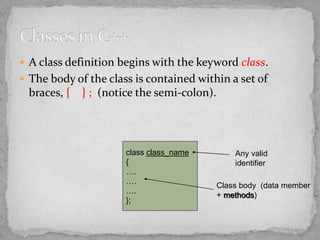
 A class definition begins with the keyword class.
 The body of the class is contained within a set of
braces, { } ; (notice the semi-colon).
class class_name
{
….
….
….
};
Class body (data member
+ methods)
Any valid
identifier
 Within the body, the keywords private: and public:
specify the access level of the members of the class.
 the default is private.
 Usually, the data members of a class are declared in
the private: section of the class and the member
functions are in public: section.
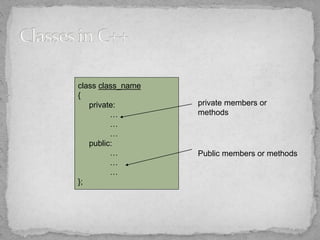
class class_name
{
private:
…
…
…
public:
…
…
…
};
Public members or methods
private members or
methods
 Member access specifiers
 public:
 can be accessed outside the class directly.
 The public stuff is the interface.
 private:
 Accessible only to member functions of class
 Private members and methods are for internal use only.
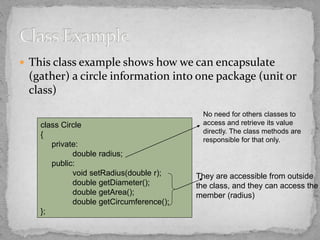
 This class example shows how we can encapsulate
(gather) a circle information into one package (unit or
class)
class Circle
{
private:
double radius;
public:
void setRadius(double r);
double getDiameter();
double getArea();
double getCircumference();
};
No need for others classes to
access and retrieve its value
directly. The class methods are
responsible for that only.
They are accessible from outside
the class, and they can access the
member (radius)
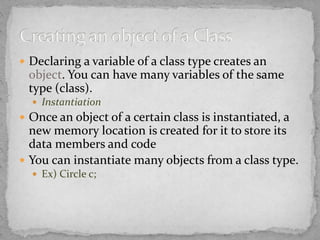
 Declaring a variable of a class type creates an
object. You can have many variables of the same
type (class).
 Instantiation
 Once an object of a certain class is instantiated, a
new memory location is created for it to store its
data members and code
 You can instantiate many objects from a class type.
 Ex) Circle c;
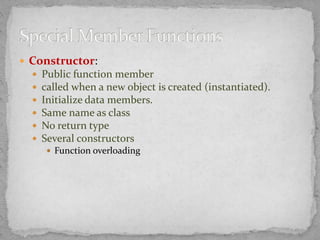
 Constructor:
 Public function member
 called when a new object is created (instantiated).
 Initialize data members.
 Same name as class
 No return type
 Several constructors
 Function overloading
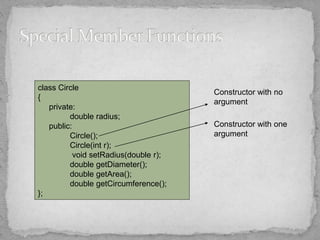
class Circle
{
private:
double radius;
public:
Circle();
Circle(int r);
void setRadius(double r);
double getDiameter();
double getArea();
double getCircumference();
};
Constructor with no
argument
Constructor with one
argument
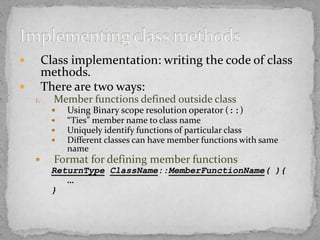
 Class implementation: writing the code of class
methods.
 There are two ways:
1. Member functions defined outside class
 Using Binary scope resolution operator (::)
 “Ties” member name to class name
 Uniquely identify functions of particular class
 Different classes can have member functions with same
name
 Format for defining member functions
ReturnType ClassName::MemberFunctionName( ){
…
}
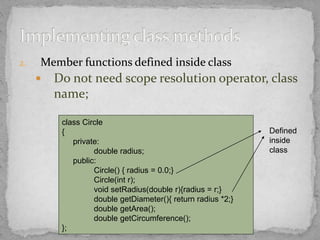
2. Member functions defined inside class
 Do not need scope resolution operator, class
name;
class Circle
{
private:
double radius;
public:
Circle() { radius = 0.0;}
Circle(int r);
void setRadius(double r){radius = r;}
double getDiameter(){ return radius *2;}
double getArea();
double getCircumference();
};
Defined
inside
class
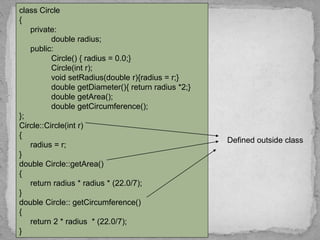
class Circle
{
private:
double radius;
public:
Circle() { radius = 0.0;}
Circle(int r);
void setRadius(double r){radius = r;}
double getDiameter(){ return radius *2;}
double getArea();
double getCircumference();
};
Circle::Circle(int r)
{
radius = r;
}
double Circle::getArea()
{
return radius * radius * (22.0/7);
}
double Circle:: getCircumference()
{
return 2 * radius * (22.0/7);
}
Defined outside class
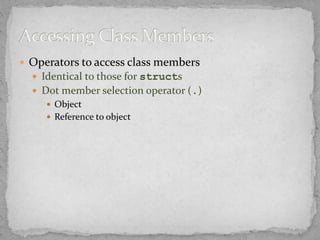
 Operators to access class members
 Identical to those for structs
 Dot member selection operator (.)
 Object
 Reference to object
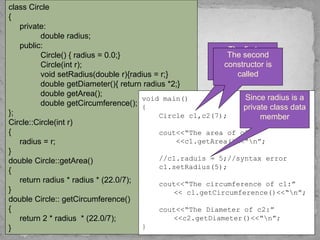
class Circle
{
private:
double radius;
public:
Circle() { radius = 0.0;}
Circle(int r);
void setRadius(double r){radius = r;}
double getDiameter(){ return radius *2;}
double getArea();
double getCircumference();
};
Circle::Circle(int r)
{
radius = r;
}
double Circle::getArea()
{
return radius * radius * (22.0/7);
}
double Circle:: getCircumference()
{
return 2 * radius * (22.0/7);
}
void main()
{
Circle c1,c2(7);
cout<<“The area of c1:”
<<c1.getArea()<<“n”;
//c1.raduis = 5;//syntax error
c1.setRadius(5);
cout<<“The circumference of c1:”
<< c1.getCircumference()<<“n”;
cout<<“The Diameter of c2:”
<<c2.getDiameter()<<“n”;
}
The first
constructor is
called
The second
constructor is
called
Since radius is a
private class data
member
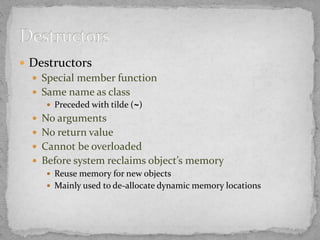
 Destructors
 Special member function
 Same name as class
 Preceded with tilde (~)
 No arguments
 No return value
 Cannot be overloaded
 Before system reclaims object’s memory
 Reuse memory for new objects
 Mainly used to de-allocate dynamic memory locations
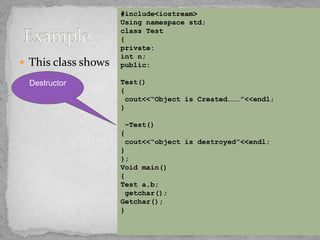
 This class shows
#include<iostream>
Using namespace std;
class Test
{
private:
int n;
public:
Test()
{
cout<<“Object is Created………”<<endl;
}
~Test()
{
cout<<“object is destroyed”<<endl;
}
};
Void main()
{
Test a,b;
getchar();
Getchar();
}
Destructor
C++ classes

C++ classes

  • 1.
  • 2.
     Programmer thinksabout and defines the attributes and behavior of objects.  Often the objects are modeled after real-world entities.  Very different approach than function-based programming (like C).
  • 3.
     Object-oriented programming(OOP)  Encapsulates data (attributes) and functions (behavior) into packages called classes.  So, Classes are user-defined (programmer-defined) types.  Data (data members)  Functions (member functions or methods)  In other words, they are structures + functions
  • 4.
     A classdefinition begins with the keyword class.  The body of the class is contained within a set of braces, { } ; (notice the semi-colon). class class_name { …. …. …. }; Class body (data member + methods) Any valid identifier
  • 5.
     Within thebody, the keywords private: and public: specify the access level of the members of the class.  the default is private.  Usually, the data members of a class are declared in the private: section of the class and the member functions are in public: section.
  • 6.
  • 7.
     Member accessspecifiers  public:  can be accessed outside the class directly.  The public stuff is the interface.  private:  Accessible only to member functions of class  Private members and methods are for internal use only.
  • 8.
     This classexample shows how we can encapsulate (gather) a circle information into one package (unit or class) class Circle { private: double radius; public: void setRadius(double r); double getDiameter(); double getArea(); double getCircumference(); }; No need for others classes to access and retrieve its value directly. The class methods are responsible for that only. They are accessible from outside the class, and they can access the member (radius)
  • 9.
     Declaring avariable of a class type creates an object. You can have many variables of the same type (class).  Instantiation  Once an object of a certain class is instantiated, a new memory location is created for it to store its data members and code  You can instantiate many objects from a class type.  Ex) Circle c;
  • 10.
     Constructor:  Publicfunction member  called when a new object is created (instantiated).  Initialize data members.  Same name as class  No return type  Several constructors  Function overloading
  • 11.
    class Circle { private: double radius; public: Circle(); Circle(intr); void setRadius(double r); double getDiameter(); double getArea(); double getCircumference(); }; Constructor with no argument Constructor with one argument
  • 12.
     Class implementation:writing the code of class methods.  There are two ways: 1. Member functions defined outside class  Using Binary scope resolution operator (::)  “Ties” member name to class name  Uniquely identify functions of particular class  Different classes can have member functions with same name  Format for defining member functions ReturnType ClassName::MemberFunctionName( ){ … }
  • 13.
    2. Member functionsdefined inside class  Do not need scope resolution operator, class name; class Circle { private: double radius; public: Circle() { radius = 0.0;} Circle(int r); void setRadius(double r){radius = r;} double getDiameter(){ return radius *2;} double getArea(); double getCircumference(); }; Defined inside class
  • 14.
    class Circle { private: double radius; public: Circle(){ radius = 0.0;} Circle(int r); void setRadius(double r){radius = r;} double getDiameter(){ return radius *2;} double getArea(); double getCircumference(); }; Circle::Circle(int r) { radius = r; } double Circle::getArea() { return radius * radius * (22.0/7); } double Circle:: getCircumference() { return 2 * radius * (22.0/7); } Defined outside class
  • 15.
     Operators toaccess class members  Identical to those for structs  Dot member selection operator (.)  Object  Reference to object
  • 16.
    class Circle { private: double radius; public: Circle(){ radius = 0.0;} Circle(int r); void setRadius(double r){radius = r;} double getDiameter(){ return radius *2;} double getArea(); double getCircumference(); }; Circle::Circle(int r) { radius = r; } double Circle::getArea() { return radius * radius * (22.0/7); } double Circle:: getCircumference() { return 2 * radius * (22.0/7); } void main() { Circle c1,c2(7); cout<<“The area of c1:” <<c1.getArea()<<“n”; //c1.raduis = 5;//syntax error c1.setRadius(5); cout<<“The circumference of c1:” << c1.getCircumference()<<“n”; cout<<“The Diameter of c2:” <<c2.getDiameter()<<“n”; } The first constructor is called The second constructor is called Since radius is a private class data member
  • 17.
     Destructors  Specialmember function  Same name as class  Preceded with tilde (~)  No arguments  No return value  Cannot be overloaded  Before system reclaims object’s memory  Reuse memory for new objects  Mainly used to de-allocate dynamic memory locations
  • 18.
     This classshows #include<iostream> Using namespace std; class Test { private: int n; public: Test() { cout<<“Object is Created………”<<endl; } ~Test() { cout<<“object is destroyed”<<endl; } }; Void main() { Test a,b; getchar(); Getchar(); } Destructor