www.phparch.com
PHP OOP
An Object Oriented Programming
Primer
Oscar Merida
Editor-in-Chief
@omerida
Hang on to your hatHang on to your hat
OOP Review
Just the basics ma'am
What is OOP?
Object Oriented Programming (OOP) is the idea of
putting related data & methods that operate on
that data, together into constructs called classes.
When you create a concrete copy of a class, flled
with data, the process is called instantiation.
An instantiated class is called an object.
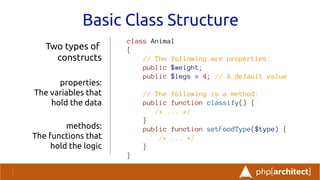
Basic Class Structure
Two types of
constructs
properties:
The variables that
hold the data
methods:
The functions that
hold the logic
class Animal
{
// The following are properties:
public $weight;
public $legs = 4; // A default value
// The following is a method:
public function classify() {
/* ... */
}
public function setFoodType($type) {
/* ... */
}
}
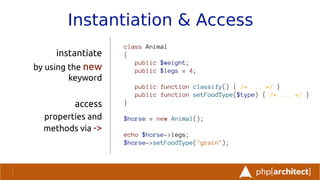
Instantiation & Access
instantiate
by using the new
keyword
access
properties and
methods via ->
class Animal
{
public $weight;
public $legs = 4;
public function classify() { /* ... */ }
public function setFoodType($type) { /* ... */ }
}
$horse = new Animal();
echo $horse->legs;
$horse->setFoodType("grain");
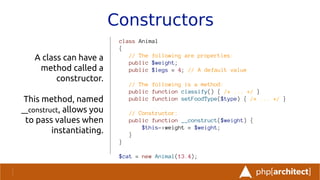
Constructors
A class can have a
method called a
constructor.
This method, named
__construct, allows you
to pass values when
instantiating.
class Animal
{
// The following are properties:
public $weight;
public $legs = 4; // A default value
// The following is a method:
public function classify() { /* ... */ }
public function setFoodType($type) { /* ... */ }
// Constructor:
public function __construct($weight) {
$this->weight = $weight;
}
}
$cat = new Animal(13.4);
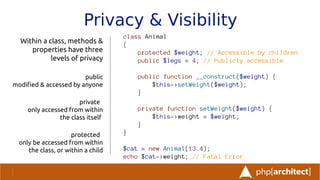
Privacy & Visibility
Within a class, methods &
properties have three
levels of privacy
public
modifed & accessed by anyone
private
only accessed from within
the class itself
protected
only be accessed from within
the class, or within a child
class Animal
{
protected $weight; // Accessible by children
public $legs = 4; // Publicly accessible
public function __construct($weight) {
$this->setWeight($weight);
}
private function setWeight($weight) {
$this->weight = $weight;
}
}
$cat = new Animal(13.4);
echo $cat->weight; // Fatal Error
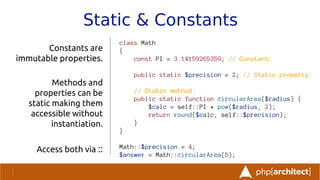
Static & Constants
Constants are
immutable properties.
Methods and
properties can be
static making them
accessible without
instantiation.
Access both via ::
class Math
{
const PI = 3.14159265359; // Constant:
public static $precision = 2; // Static property:
// Static method:
public static function circularArea($radius) {
$calc = self::PI * pow($radius, 2);
return round($calc, self::$precision);
}
}
Math::$precision = 4;
$answer = Math::circularArea(5);
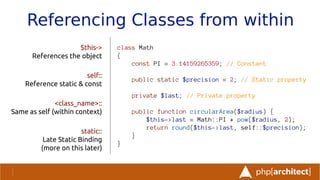
Referencing Classes from within
$this->
References the object
self::
Reference static & const
<class_name>::
Same as self (within context)
static::
Late Static Binding
(more on this later)
class Math
{
const PI = 3.14159265359; // Constant
public static $precision = 2; // Static property
private $last; // Private property
public function circularArea($radius) {
$this->last = Math::PI * pow($radius, 2);
return round($this->last, self::$precision);
}
}
Inheritance
Learning from the past
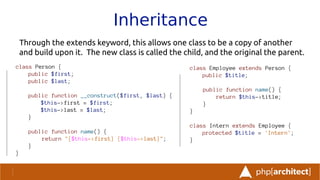
Inheritance
Through the extends keyword, this allows one class to be a copy of another
and build upon it. The new class is called the child, and the original the parent.
class Person {
public $first;
public $last;
public function __construct($first, $last) {
$this->first = $first;
$this->last = $last;
}
public function name() {
return "{$this->first} {$this->last}";
}
}
class Employee extends Person {
public $title;
public function name() {
return $this->title;
}
}
class Intern extends Employee {
protected $title = 'Intern';
}
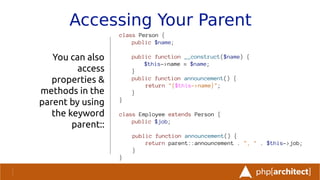
Accessing Your Parent
You can also
access
properties &
methods in the
parent by using
the keyword
parent::
class Person {
public $name;
public function __construct($name) {
$this->name = $name;
}
public function announcement() {
return "{$this->name}";
}
}
class Employee extends Person {
public $job;
public function announcement() {
return parent::announcement . ", " . $this->job;
}
}
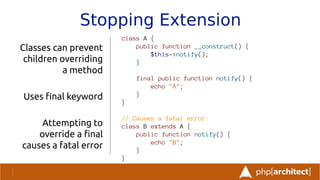
Stopping Extension
Classes can prevent
children overriding
a method
Uses fnal keyword
Attempting to
override a fnal
causes a fatal error
class A {
public function __construct() {
$this->notify();
}
final public function notify() {
echo "A";
}
}
// Causes a fatal error:
class B extends A {
public function notify() {
echo "B";
}
}
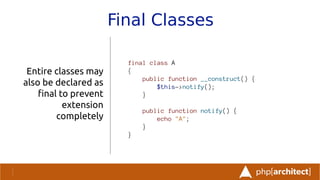
Final Classes
Entire classes may
also be declared as
fnal to prevent
extension
completely
final class A
{
public function __construct() {
$this->notify();
}
public function notify() {
echo "A";
}
}
Abstracts & Interfaces
The contracts that we make with ourselves
Abstract Class
abstract class DataStore
{
// These methods must be defined in the child class
abstract public function save();
abstract public function load($id);
// Common properties
protected $data = [];
// Common methods
public function setValue($name, $value) {
$this->data[$name] = $value;
}
public function getValue($name) {
return $this->data[$name];
}
}
Defnes an
‘incomplete’ class
using abstract
keyword on both
class & methods
Children need to
implement all
abstract methods
for the parent
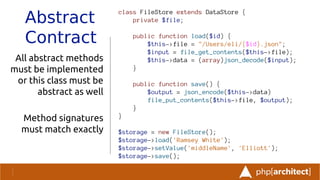
Abstract
Contract
All abstract methods
must be implemented
or this class must be
abstract as well
Method signatures
must match exactly
class FileStore extends DataStore {
private $file;
public function load($id) {
$this->file = "/Users/eli/{$id}.json";
$input = file_get_contents($this->file);
$this->data = (array)json_decode($input);
}
public function save() {
$output = json_encode($this->data)
file_put_contents($this->file, $output);
}
}
$storage = new FileStore();
$storage->load('Ramsey White');
$storage->setValue('middleName', 'Elliott');
$storage->save();
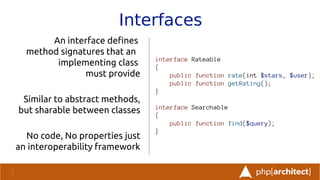
Interfaces
An interface defnes
method signatures that an
implementing class
must provide
Similar to abstract methods,
but sharable between classes
No code, No properties just
an interoperability framework
interface Rateable
{
public function rate(int $stars, $user);
public function getRating();
}
interface Searchable
{
public function find($query);
}
Interface Implementation
Uses the
implements
keyword
One class may
implement multiple
interfaces
class StatusUpdate implements Rateable, Searchable {
protected $ratings = [];
public function rate(int $stars, $user) {
$this->ratings[$user] = $stars;
}
public function getRating() {
$total = array_sum($this->ratings);
return $total/count($this->ratings);
}
public function find($query) {
/* ... database query or something ... */
}
}
Interface Extension
It is possible for an
interface to extend
another interface
Interfaces can
provide constants
interface Thumbs extends Rateable {
const THUMBUP = 5;
public function thumbsUp();
public function thumbsDown();
}
class Chat extends StatusUpdate implements Thumbs {
public function rate(int $stars, $user) {
$this->ratings[] = $stars;
}
public function thumbsUp() {
$this->rate(self::THUMBUP, null);
}
public function thumbsDown() {
$this->rate(0, null);
}
}
Traits
When you want more than a template
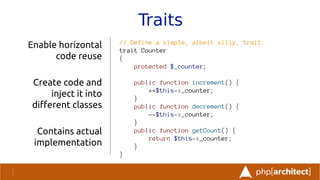
Traits
Enable horizontal
code reuse
Create code and
inject it into
diferent classes
Contains actual
implementation
// Define a simple, albeit silly, trait.
trait Counter
{
protected $_counter;
public function increment() {
++$this->_counter;
}
public function decrement() {
--$this->_counter;
}
public function getCount() {
return $this->_counter;
}
}
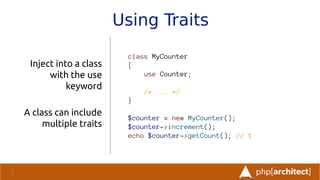
Using Traits
Inject into a class
with the use
keyword
A class can include
multiple traits
class MyCounter
{
use Counter;
/* ... */
}
$counter = new MyCounter();
$counter->increment();
echo $counter->getCount(); // 1
Late Static Binding
It’s fashionable to show up late
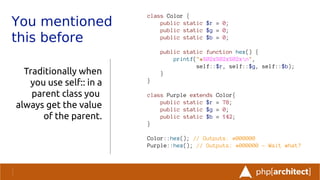
You mentioned
this before
Traditionally when
you use self:: in a
parent class you
always get the value
of the parent.
class Color {
public static $r = 0;
public static $g = 0;
public static $b = 0;
public static function hex() {
printf("#%02x%02x%02xn",
self::$r, self::$g, self::$b);
}
}
class Purple extends Color{
public static $r = 78;
public static $g = 0;
public static $b = 142;
}
Color::hex(); // Outputs: #000000
Purple::hex(); // Outputs: #000000 - Wait what?
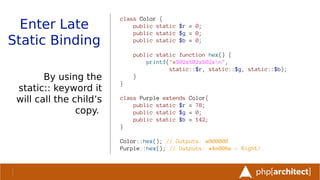
Enter Late
Static Binding
By using the
static:: keyword it
will call the child’s
copy.
class Color {
public static $r = 0;
public static $g = 0;
public static $b = 0;
public static function hex() {
printf("#%02x%02x%02xn",
static::$r, static::$g, static::$b);
}
}
class Purple extends Color{
public static $r = 78;
public static $g = 0;
public static $b = 142;
}
Color::hex(); // Outputs: #000000
Purple::hex(); // Outputs: #4e008e - Right!
Affects
Methods Too
Allows a parent to
rely on a child’s
implementation of
a static method.
const work as well
class Color {
public $hue = [0,0,0];
public function __construct(Array $values) {
$this->hue = $values;
}
public function css() {
echo static::format($this->hue), "n";
}
public static function format(Array $values) {
return vsprintf("#%02x%02x%02x", $values);
}
}
class ColorAlpha extends Color{
public static function format(Array $values) {
return vsprintf("rgba(%d,%d,%d,%0.2f)", $values);
}
}
$purple = new Color([78,0,142]);
$purple->css(); // Outputs: #4e008e
$purple50 = new ColorAlpha([78,0,142,0.5]);
$purple50->css(); // Outputs: rgba(78,0,142,0.50)
Namespaces
Who are you again?
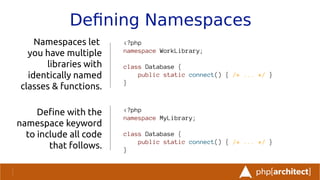
Defning Namespaces
Namespaces let
you have multiple
libraries with
identically named
classes & functions.
Defne with the
namespace keyword
to include all code
that follows.
<?php
namespace WorkLibrary;
class Database {
public static connect() { /* ... */ }
}
<?php
namespace MyLibrary;
class Database {
public static connect() { /* ... */ }
}
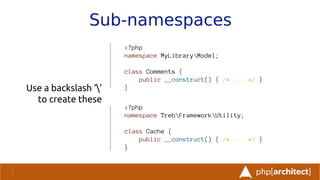
Sub-namespaces
Use a backslash ‘’
to create these
<?php
namespace MyLibraryModel;
class Comments {
public __construct() { /* ... */ }
}
<?php
namespace TrebFrameworkUtility;
class Cache {
public __construct() { /* ... */ }
}
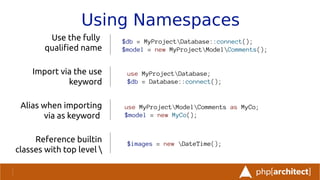
Using Namespaces
Use the fully
qualifed name
Import via the use
keyword
Alias when importing
via as keyword
Reference builtin
classes with top level 
$db = MyProjectDatabase::connect();
$model = new MyProjectModelComments();
use MyProjectDatabase;
$db = Database::connect();
$images = new DateTime();
use MyProjectModelComments as MyCo;
$model = new MyCo();
Magic Methods
Part of the fairy dust that makes PHP sparkle
Magic?
All magic methods
start with __
Allow for code that is
not directly called to run
Often have
counterparts, so just as
__construct() we have
__destruct() which runs
on object cleanup
class UserORM {
public $user;
private $db;
function __construct($id, PDO $db) {
$this->db = $db;
$sql = 'SELECT * FROM user WHERE id = ?';
$stmt = $db->prepare($sql)->execute([$id]);
$this->user = $stmt->fetchObject();
}
function __destruct() {
$sql = 'UPDATE user
SET name = ?, email = ? WHERE id = ?';
$stmt = $db->prepare();
$stmt->execute($this->user->email
$this->user->name, $this->user->id);
}
}
$oscar = new User(37);
$oscar->user->email = 'oscar@example.com';
__get and __set
__get
Called when an reading
an unknown property.
__set
Called when writing
an unknown property
Often used for storage
classes & overloading
class Data
{
protected $_data = [];
public function __set($name, $value) {
$this->_data[$name] = $value;
}
public function __get($name) {
return isset($this->_data[$name])
? $this->_data[$name] : NULL;
}
}
$o = new Data();
$o->neat = 'Something';
echo $o->neat;
__isset and __unset
__isset
Called when isset()
is requested on an
unknown property
__unset
Called when unset()
is requested on an
unknown property
class DataAll extends Data
{
public function __isset($name) {
return isset($this->_data[$name]);
}
public function __unset($name) {
unset($this->_data[$name]);
}
}
$o = new DataAll();
$o->phone = 'iPhone';
$o->desktop = true;
if (isset($o->desktop)) {
unset($o->phone);
}
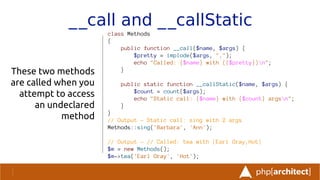
__call and __callStatic
These two methods
are called when you
attempt to access
an undeclared
method
class Methods
{
public function __call($name, $args) {
$pretty = implode($args, ",");
echo "Called: {$name} with ({$pretty})n";
}
public static function __callStatic($name, $args) {
$count = count($args);
echo "Static call: {$name} with {$count} argsn";
}
}
// Output - Static call: sing with 2 args
Methods::sing('Barbara', 'Ann');
// Output - // Called: tea with (Earl Gray,Hot)
$m = new Methods();
$m->tea('Earl Gray', 'Hot');
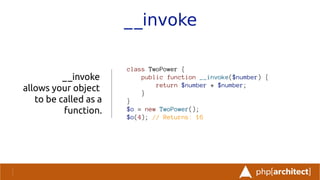
__invoke
__invoke
allows your object
to be called as a
function.
class TwoPower {
public function __invoke($number) {
return $number * $number;
}
}
$o = new TwoPower();
$o(4); // Returns: 16
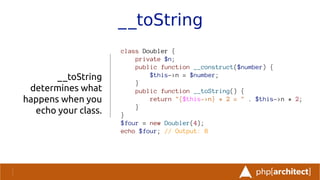
__toString
__toString
determines what
happens when you
echo your class.
class Doubler {
private $n;
public function __construct($number) {
$this->n = $number;
}
public function __toString() {
return "{$this->n} * 2 = " . $this->n * 2;
}
}
$four = new Doubler(4);
echo $four; // Output: 8
And more…
__sleep() and __wakeup()
control how your object is
serialized & unserialized.
__set_state() lets you
control exported properties
when var_export is
__debugInfo() lets you
change what a var_dump of
your object shows.
__clone() lets you modify
your object when it
becomes cloned.
php[architect]
www.phparch.com
Magazine, Books,
Conferences,
elephpants
Twitter: @omerida
@phparch

PHP OOP

  • 1.
    www.phparch.com PHP OOP An ObjectOriented Programming Primer Oscar Merida Editor-in-Chief @omerida
  • 2.
    Hang on toyour hatHang on to your hat
  • 3.
    OOP Review Just thebasics ma'am
  • 4.
    What is OOP? ObjectOriented Programming (OOP) is the idea of putting related data & methods that operate on that data, together into constructs called classes. When you create a concrete copy of a class, flled with data, the process is called instantiation. An instantiated class is called an object.
  • 5.
    Basic Class Structure Twotypes of constructs properties: The variables that hold the data methods: The functions that hold the logic class Animal { // The following are properties: public $weight; public $legs = 4; // A default value // The following is a method: public function classify() { /* ... */ } public function setFoodType($type) { /* ... */ } }
  • 6.
    Instantiation & Access instantiate byusing the new keyword access properties and methods via -> class Animal { public $weight; public $legs = 4; public function classify() { /* ... */ } public function setFoodType($type) { /* ... */ } } $horse = new Animal(); echo $horse->legs; $horse->setFoodType("grain");
  • 7.
    Constructors A class canhave a method called a constructor. This method, named __construct, allows you to pass values when instantiating. class Animal { // The following are properties: public $weight; public $legs = 4; // A default value // The following is a method: public function classify() { /* ... */ } public function setFoodType($type) { /* ... */ } // Constructor: public function __construct($weight) { $this->weight = $weight; } } $cat = new Animal(13.4);
  • 8.
    Privacy & Visibility Withina class, methods & properties have three levels of privacy public modifed & accessed by anyone private only accessed from within the class itself protected only be accessed from within the class, or within a child class Animal { protected $weight; // Accessible by children public $legs = 4; // Publicly accessible public function __construct($weight) { $this->setWeight($weight); } private function setWeight($weight) { $this->weight = $weight; } } $cat = new Animal(13.4); echo $cat->weight; // Fatal Error
  • 9.
    Static & Constants Constantsare immutable properties. Methods and properties can be static making them accessible without instantiation. Access both via :: class Math { const PI = 3.14159265359; // Constant: public static $precision = 2; // Static property: // Static method: public static function circularArea($radius) { $calc = self::PI * pow($radius, 2); return round($calc, self::$precision); } } Math::$precision = 4; $answer = Math::circularArea(5);
  • 10.
    Referencing Classes fromwithin $this-> References the object self:: Reference static & const <class_name>:: Same as self (within context) static:: Late Static Binding (more on this later) class Math { const PI = 3.14159265359; // Constant public static $precision = 2; // Static property private $last; // Private property public function circularArea($radius) { $this->last = Math::PI * pow($radius, 2); return round($this->last, self::$precision); } }
  • 11.
  • 12.
    Inheritance Through the extendskeyword, this allows one class to be a copy of another and build upon it. The new class is called the child, and the original the parent. class Person { public $first; public $last; public function __construct($first, $last) { $this->first = $first; $this->last = $last; } public function name() { return "{$this->first} {$this->last}"; } } class Employee extends Person { public $title; public function name() { return $this->title; } } class Intern extends Employee { protected $title = 'Intern'; }
  • 13.
    Accessing Your Parent Youcan also access properties & methods in the parent by using the keyword parent:: class Person { public $name; public function __construct($name) { $this->name = $name; } public function announcement() { return "{$this->name}"; } } class Employee extends Person { public $job; public function announcement() { return parent::announcement . ", " . $this->job; } }
  • 14.
    Stopping Extension Classes canprevent children overriding a method Uses fnal keyword Attempting to override a fnal causes a fatal error class A { public function __construct() { $this->notify(); } final public function notify() { echo "A"; } } // Causes a fatal error: class B extends A { public function notify() { echo "B"; } }
  • 15.
    Final Classes Entire classesmay also be declared as fnal to prevent extension completely final class A { public function __construct() { $this->notify(); } public function notify() { echo "A"; } }
  • 16.
    Abstracts & Interfaces Thecontracts that we make with ourselves
  • 17.
    Abstract Class abstract classDataStore { // These methods must be defined in the child class abstract public function save(); abstract public function load($id); // Common properties protected $data = []; // Common methods public function setValue($name, $value) { $this->data[$name] = $value; } public function getValue($name) { return $this->data[$name]; } } Defnes an ‘incomplete’ class using abstract keyword on both class & methods Children need to implement all abstract methods for the parent
  • 18.
    Abstract Contract All abstract methods mustbe implemented or this class must be abstract as well Method signatures must match exactly class FileStore extends DataStore { private $file; public function load($id) { $this->file = "/Users/eli/{$id}.json"; $input = file_get_contents($this->file); $this->data = (array)json_decode($input); } public function save() { $output = json_encode($this->data) file_put_contents($this->file, $output); } } $storage = new FileStore(); $storage->load('Ramsey White'); $storage->setValue('middleName', 'Elliott'); $storage->save();
  • 19.
    Interfaces An interface defnes methodsignatures that an implementing class must provide Similar to abstract methods, but sharable between classes No code, No properties just an interoperability framework interface Rateable { public function rate(int $stars, $user); public function getRating(); } interface Searchable { public function find($query); }
  • 20.
    Interface Implementation Uses the implements keyword Oneclass may implement multiple interfaces class StatusUpdate implements Rateable, Searchable { protected $ratings = []; public function rate(int $stars, $user) { $this->ratings[$user] = $stars; } public function getRating() { $total = array_sum($this->ratings); return $total/count($this->ratings); } public function find($query) { /* ... database query or something ... */ } }
  • 21.
    Interface Extension It ispossible for an interface to extend another interface Interfaces can provide constants interface Thumbs extends Rateable { const THUMBUP = 5; public function thumbsUp(); public function thumbsDown(); } class Chat extends StatusUpdate implements Thumbs { public function rate(int $stars, $user) { $this->ratings[] = $stars; } public function thumbsUp() { $this->rate(self::THUMBUP, null); } public function thumbsDown() { $this->rate(0, null); } }
  • 22.
    Traits When you wantmore than a template
  • 23.
    Traits Enable horizontal code reuse Createcode and inject it into diferent classes Contains actual implementation // Define a simple, albeit silly, trait. trait Counter { protected $_counter; public function increment() { ++$this->_counter; } public function decrement() { --$this->_counter; } public function getCount() { return $this->_counter; } }
  • 24.
    Using Traits Inject intoa class with the use keyword A class can include multiple traits class MyCounter { use Counter; /* ... */ } $counter = new MyCounter(); $counter->increment(); echo $counter->getCount(); // 1
  • 25.
    Late Static Binding It’sfashionable to show up late
  • 26.
    You mentioned this before Traditionallywhen you use self:: in a parent class you always get the value of the parent. class Color { public static $r = 0; public static $g = 0; public static $b = 0; public static function hex() { printf("#%02x%02x%02xn", self::$r, self::$g, self::$b); } } class Purple extends Color{ public static $r = 78; public static $g = 0; public static $b = 142; } Color::hex(); // Outputs: #000000 Purple::hex(); // Outputs: #000000 - Wait what?
  • 27.
    Enter Late Static Binding Byusing the static:: keyword it will call the child’s copy. class Color { public static $r = 0; public static $g = 0; public static $b = 0; public static function hex() { printf("#%02x%02x%02xn", static::$r, static::$g, static::$b); } } class Purple extends Color{ public static $r = 78; public static $g = 0; public static $b = 142; } Color::hex(); // Outputs: #000000 Purple::hex(); // Outputs: #4e008e - Right!
  • 28.
    Affects Methods Too Allows aparent to rely on a child’s implementation of a static method. const work as well class Color { public $hue = [0,0,0]; public function __construct(Array $values) { $this->hue = $values; } public function css() { echo static::format($this->hue), "n"; } public static function format(Array $values) { return vsprintf("#%02x%02x%02x", $values); } } class ColorAlpha extends Color{ public static function format(Array $values) { return vsprintf("rgba(%d,%d,%d,%0.2f)", $values); } } $purple = new Color([78,0,142]); $purple->css(); // Outputs: #4e008e $purple50 = new ColorAlpha([78,0,142,0.5]); $purple50->css(); // Outputs: rgba(78,0,142,0.50)
  • 29.
  • 30.
    Defning Namespaces Namespaces let youhave multiple libraries with identically named classes & functions. Defne with the namespace keyword to include all code that follows. <?php namespace WorkLibrary; class Database { public static connect() { /* ... */ } } <?php namespace MyLibrary; class Database { public static connect() { /* ... */ } }
  • 31.
    Sub-namespaces Use a backslash‘’ to create these <?php namespace MyLibraryModel; class Comments { public __construct() { /* ... */ } } <?php namespace TrebFrameworkUtility; class Cache { public __construct() { /* ... */ } }
  • 32.
    Using Namespaces Use thefully qualifed name Import via the use keyword Alias when importing via as keyword Reference builtin classes with top level $db = MyProjectDatabase::connect(); $model = new MyProjectModelComments(); use MyProjectDatabase; $db = Database::connect(); $images = new DateTime(); use MyProjectModelComments as MyCo; $model = new MyCo();
  • 33.
    Magic Methods Part ofthe fairy dust that makes PHP sparkle
  • 34.
    Magic? All magic methods startwith __ Allow for code that is not directly called to run Often have counterparts, so just as __construct() we have __destruct() which runs on object cleanup class UserORM { public $user; private $db; function __construct($id, PDO $db) { $this->db = $db; $sql = 'SELECT * FROM user WHERE id = ?'; $stmt = $db->prepare($sql)->execute([$id]); $this->user = $stmt->fetchObject(); } function __destruct() { $sql = 'UPDATE user SET name = ?, email = ? WHERE id = ?'; $stmt = $db->prepare(); $stmt->execute($this->user->email $this->user->name, $this->user->id); } } $oscar = new User(37); $oscar->user->email = 'oscar@example.com';
  • 35.
    __get and __set __get Calledwhen an reading an unknown property. __set Called when writing an unknown property Often used for storage classes & overloading class Data { protected $_data = []; public function __set($name, $value) { $this->_data[$name] = $value; } public function __get($name) { return isset($this->_data[$name]) ? $this->_data[$name] : NULL; } } $o = new Data(); $o->neat = 'Something'; echo $o->neat;
  • 36.
    __isset and __unset __isset Calledwhen isset() is requested on an unknown property __unset Called when unset() is requested on an unknown property class DataAll extends Data { public function __isset($name) { return isset($this->_data[$name]); } public function __unset($name) { unset($this->_data[$name]); } } $o = new DataAll(); $o->phone = 'iPhone'; $o->desktop = true; if (isset($o->desktop)) { unset($o->phone); }
  • 37.
    __call and __callStatic Thesetwo methods are called when you attempt to access an undeclared method class Methods { public function __call($name, $args) { $pretty = implode($args, ","); echo "Called: {$name} with ({$pretty})n"; } public static function __callStatic($name, $args) { $count = count($args); echo "Static call: {$name} with {$count} argsn"; } } // Output - Static call: sing with 2 args Methods::sing('Barbara', 'Ann'); // Output - // Called: tea with (Earl Gray,Hot) $m = new Methods(); $m->tea('Earl Gray', 'Hot');
  • 38.
    __invoke __invoke allows your object tobe called as a function. class TwoPower { public function __invoke($number) { return $number * $number; } } $o = new TwoPower(); $o(4); // Returns: 16
  • 39.
    __toString __toString determines what happens whenyou echo your class. class Doubler { private $n; public function __construct($number) { $this->n = $number; } public function __toString() { return "{$this->n} * 2 = " . $this->n * 2; } } $four = new Doubler(4); echo $four; // Output: 8
  • 40.
    And more… __sleep() and__wakeup() control how your object is serialized & unserialized. __set_state() lets you control exported properties when var_export is __debugInfo() lets you change what a var_dump of your object shows. __clone() lets you modify your object when it becomes cloned.
  • 41.