3D PRINTING
&
3D SCANNING
Rajan kumar singh
127W1A0391
Mech- 3rd year
St.Mary’s Integrated Campus
Presentation By
3DSCANNING:-
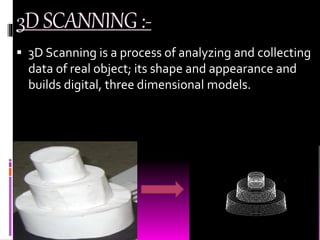
 3D Scanning is a process of analyzing and collecting
data of real object; its shape and appearance and
builds digital, three dimensional models.
HOW DOES IT WORK….
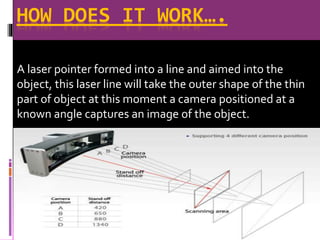
A laser pointer formed into a line and aimed into the
object, this laser line will take the outer shape of the thin
part of object at this moment a camera positioned at a
known angle captures an image of the object.
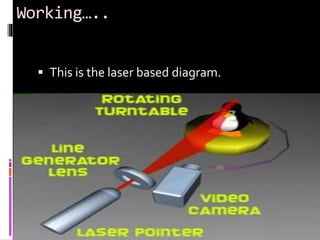
Working…..
 This is the laser based diagram.
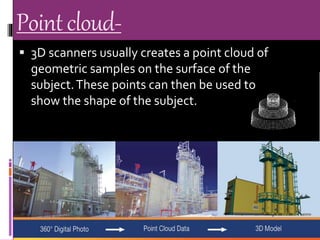
Pointcloud-
 3D scanners usually creates a point cloud of
geometric samples on the surface of the
subject.These points can then be used to
show the shape of the subject.
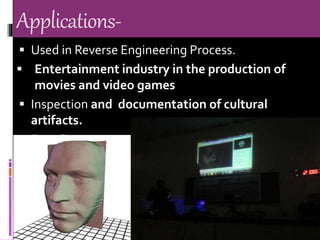
Applications-
 Used in Reverse Engineering Process.
 Entertainment industry in the production of
movies and video games
 Inspection and documentation of cultural
artifacts.
 Face Scanner:
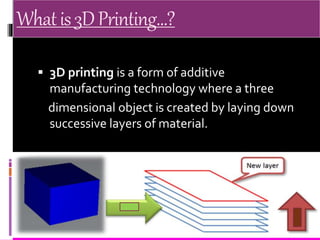
Whatis3DPrinting…?
 3D printing is a form of additive
manufacturing technology where a three
dimensional object is created by laying down
successive layers of material.
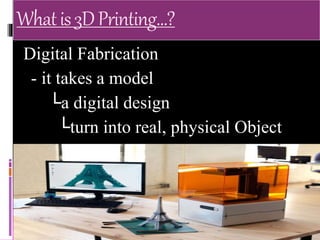
Digital Fabrication
- it takes a model
└a digital design
└turn into real, physical Object
Whatis3DPrinting…?
HistoryOf3dPrinting
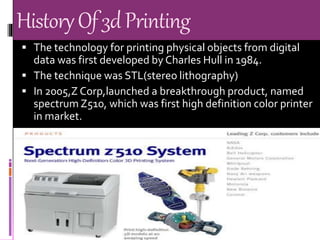
 The technology for printing physical objects from digital
data was first developed by Charles Hull in 1984.
 The technique was STL(stereo lithography)
 In 2005,Z Corp,launched a breakthrough product, named
spectrum Z510, which was first high definition color printer
in market.
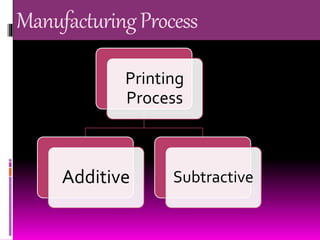
ManufacturingProcess
Printing
Process
Additive Subtractive
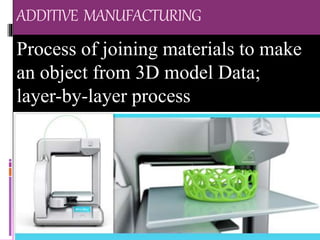
ADDITIVE MANUFACTURING
Process of joining materials to make
an object from 3D model Data;
layer-by-layer process
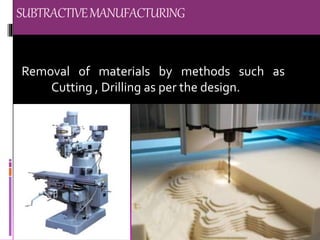
SUBTRACTIVEMANUFACTURING
Removal of materials by methods such as
Cutting , Drilling as per the design.
MaterialsRequired
 Plastics
 PLA
 ABS
 Acrylic
 Metals
 Stainless steel
 Sterling silver
 Glass
 Ceramics
 Resin
 Sandstone
 Rubber
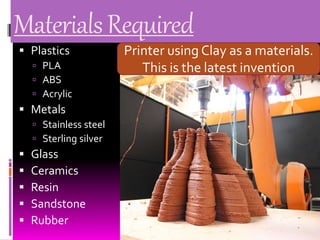
Printer using Clay as a materials.
This is the latest invention
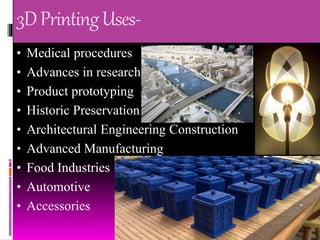
3DPrintingUses-
• Medical procedures
• Advances in research
• Product prototyping
• Historic Preservation
• Architectural Engineering Construction
• Advanced Manufacturing
• Food Industries
• Automotive
• Accessories
MedicalProcedures-
• Custom hearing aids and braces.
• Body parts, including ears, hips and even
organs, in exact proportions to fit the patient.
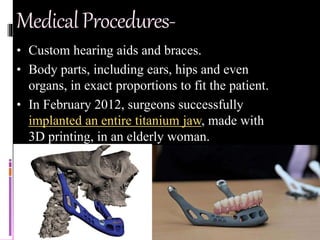
• In February 2012, surgeons successfully
implanted an entire titanium jaw, made with
3D printing, in an elderly woman.
3dprinting-MakeinINDIA
 Even a house wife/potter/a comman man can start
his own business in India with this technology.
 Replicating ancient and priceless artifacts in
archaeology.
 Reconstructing bones and body parts in india itself
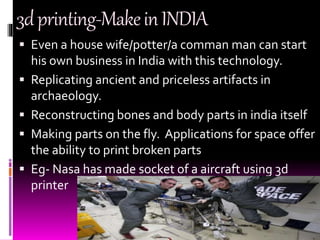
 Making parts on the fly. Applications for space offer
the ability to print broken parts
 Eg- Nasa has made socket of a aircraft using 3d
printer
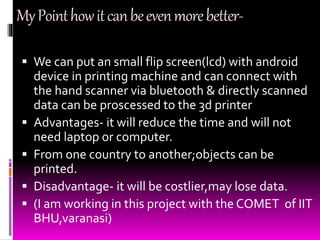
MyPointhowitcanbeevenmorebetter-
 We can put an small flip screen(lcd) with android
device in printing machine and can connect with
the hand scanner via bluetooth & directly scanned
data can be proscessed to the 3d printer
 Advantages- it will reduce the time and will not
need laptop or computer.
 From one country to another;objects can be
printed.
 Disadvantage- it will be costlier,may lose data.
 (I am working in this project with the COMET of IIT
BHU,varanasi)
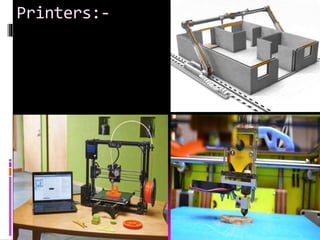
Printers:-
Questions …..???
bvrit

bvrit

  • 1.
    3D PRINTING & 3D SCANNING Rajankumar singh 127W1A0391 Mech- 3rd year St.Mary’s Integrated Campus Presentation By
  • 2.
    3DSCANNING:-  3D Scanningis a process of analyzing and collecting data of real object; its shape and appearance and builds digital, three dimensional models.
  • 3.
    HOW DOES ITWORK…. A laser pointer formed into a line and aimed into the object, this laser line will take the outer shape of the thin part of object at this moment a camera positioned at a known angle captures an image of the object.
  • 4.
    Working…..  This isthe laser based diagram.
  • 5.
    Pointcloud-  3D scannersusually creates a point cloud of geometric samples on the surface of the subject.These points can then be used to show the shape of the subject.
  • 6.
    Applications-  Used inReverse Engineering Process.  Entertainment industry in the production of movies and video games  Inspection and documentation of cultural artifacts.  Face Scanner:
  • 7.
    Whatis3DPrinting…?  3D printingis a form of additive manufacturing technology where a three dimensional object is created by laying down successive layers of material.
  • 8.
    Digital Fabrication - ittakes a model └a digital design └turn into real, physical Object Whatis3DPrinting…?
  • 9.
    HistoryOf3dPrinting  The technologyfor printing physical objects from digital data was first developed by Charles Hull in 1984.  The technique was STL(stereo lithography)  In 2005,Z Corp,launched a breakthrough product, named spectrum Z510, which was first high definition color printer in market.
  • 10.
  • 11.
    ADDITIVE MANUFACTURING Process ofjoining materials to make an object from 3D model Data; layer-by-layer process
  • 12.
    SUBTRACTIVEMANUFACTURING Removal of materialsby methods such as Cutting , Drilling as per the design.
  • 13.
    MaterialsRequired  Plastics  PLA ABS  Acrylic  Metals  Stainless steel  Sterling silver  Glass  Ceramics  Resin  Sandstone  Rubber Printer using Clay as a materials. This is the latest invention
  • 14.
    3DPrintingUses- • Medical procedures •Advances in research • Product prototyping • Historic Preservation • Architectural Engineering Construction • Advanced Manufacturing • Food Industries • Automotive • Accessories
  • 15.
    MedicalProcedures- • Custom hearingaids and braces. • Body parts, including ears, hips and even organs, in exact proportions to fit the patient. • In February 2012, surgeons successfully implanted an entire titanium jaw, made with 3D printing, in an elderly woman.
  • 16.
    3dprinting-MakeinINDIA  Even ahouse wife/potter/a comman man can start his own business in India with this technology.  Replicating ancient and priceless artifacts in archaeology.  Reconstructing bones and body parts in india itself  Making parts on the fly. Applications for space offer the ability to print broken parts  Eg- Nasa has made socket of a aircraft using 3d printer
  • 17.
    MyPointhowitcanbeevenmorebetter-  We canput an small flip screen(lcd) with android device in printing machine and can connect with the hand scanner via bluetooth & directly scanned data can be proscessed to the 3d printer  Advantages- it will reduce the time and will not need laptop or computer.  From one country to another;objects can be printed.  Disadvantage- it will be costlier,may lose data.  (I am working in this project with the COMET of IIT BHU,varanasi)
  • 18.
  • 19.