Chapter:1
The Nature of research:
Somethingthatpeople undertake inordertofindthingsoutina systematicway,therebyincreasing
theirknowledge’
• Data are collectedsystematically
• Data are interpretedsystematically
• There isa clearpurpose tofind thingsout
The feature of business andmanagement Research:
• Managers drawon knowledge fromotherdisciplines
• Managers are more likelytoallow accessif theysee
commercial orpersonal advantage
• Managers nowtendto be as educatedas the researchers
• Managers require researchtohave some practical consequence
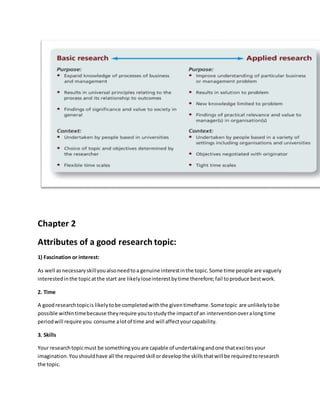
Basic andAppliedresearch:
Chapter 2
Attributes of a good research topic:
1) Fascination or interest:
As well asnecessaryskillyoualsoneedtoa genuine interestinthe topic.Some time people are vaguely
interestedinthe topicatthe start are likelyloseinterestbytime therefore;fail toproduce bestwork.
2. Time
A goodresearchtopicis likelytobe completedwiththe giventimeframe.Sometopic are unlikelytobe
possible withintimebecause theyrequire youtostudythe impactof an interventionoveralongtime
periodwill require you consume alotof time and will affectyourcapability.
3. Skills
Your researchtopicmust be somethingyouare capable of undertakingandone thatexcitesyour
imagination.Youshouldhave all the requiredskill ordevelopthe skillsthatwill be requiredtoresearch
the topic.
4. Financial resources:
Some topicsrequiredyoutotravel widelyorneedexpensive equipmentshouldbe disregardedunless
youhave financial resources.
5. Data
The data shouldbe feasible itmeansyoumustbe reasonablycertaintogainaccessto anydata you
mightneedtocollect.Youshouldavoidsensitive topicstheymightbe fascinatingbuttheymaypresent
considerable accessproblems.
6. Examination Board:
If you are undertakingyourresearchprojectaspartf a course of studythe mostimportantattribute will
be that it meetsthe examiningbody’srequirementthatitisat the correct level thatmeansthatyou
mustchoose your topicwithcare andmust checkthe assessmentcriteriaforyourprojectandensure
that yourchoice of topicenable youtomeetthese criteria.
7. CareerGoals:
Finallyitisimportanttoconsideryourcareergoals.If you wishtobecome an expertina particular
subjectareaor industrysector,itis sensibletouse the opportunitytodevelopthisexpertise.
Generating research Ideas:
1. Examining own strength and interest:
It is important to choose a topic in which you are likely to do well and already have some
academic knowledge and look at to those assignments you received good grades because these
assignments are likely to be topics in which you were interested. If you plan to work in the
financial management it would be sensible to choose a topic in the financial management field.
2. Looking at past project titles:
Scanning and Looking at the your university’s list of past projects (dissertations and theses) is a
useful way of generating research ideas. Topics that captures your imagination, that looks
interesting or which grab your attentions should be noted down but be aware you choose the
quality topic.
3. Discussion
Research project idea can be obtained by talking and discussing to colleagues friends, university
teachers and professional groups. It is important that as well as discussing possible ideals you
also make a note of them.
4. Searching the literature:
As part of your discussions, relevant literature may also be suggested. discuss types of literature
that are of particular use for generating research ideas. These include Article in academic and
professional journals; Reports; Books. These resourcescanact as pointerstowardsaspects where
furtherresearchneedstobe undertaken.
5. Scanningmedia
Keepinguptodate withthe itemsinthe Newscan be a veryrichsource of ideas. The storieswhich
occur everydayin the ‘broadsheet’or newspapers,inbothonlineandtraditional printversions,may
provide ideas.
6. Keepinga notebookof ideas:
One of the more creative techniquesthatwe all use isto keepanotebookof ideas.Itinvolvessimply
notingdownanyinterestingresearchideasasyouthinkof themand,of equal importance,whatsparked
off your thought. Youcan thenpursue the ideausingmore rational thinkingtechniqueslater.
7. Exploringpersonal preferencesusingpast projects:
Anotherwayof generatingpossible projectideasistoexplore yourpersonalpreferencesusing past
projectreportsfromyour universityandelsewhere.
1. Selectsix projectsthatyoulike
2. For eachof these six projects,note downyourfirstthoughtsinresponsetothree questions(if
responsesfordifferentprojectsare the same thisdoesnotmatter);
What appealstoyouabout the project?
What isgoodabout the project?
Whyis the projectgood?
3. Selectthree projectsyoudonot like.
4. For each of these three projectsthatyoudo not like.
What do youdislike aboutthe project?
What is badabout the project?
Why isthe projectbad?
8. Relevance trees
In this youstart witha broadconceptfrom whichyougenerate furthertopics. Eachof these topics
formsa separate branch fromwhichyou can generate further,more detailedsubbranches.Asyou
proceeddownthe sub-branchesmore ideasare generatedandrecorded.
9. Brainstorming:
1. Define yourproblem –thatis,the sortsof ideasyouare interestedin –as preciselyaspossible.
2. Askfor suggestions,relatingtothe problem
3. Recordall suggestions,observingthe followingrules:
• No suggestionshouldbe criticizedorevaluatedinanywaybefore all ideashave been
considered;
• All suggestions,howeverwild,shouldbe recordedandconsidered
• As manysuggestionsaspossibleshouldbe recorded.
4. Reviewall the suggestionsandexplorewhatismeantbyeach.
5. Analyze the listof suggestionsanddecide whichappeal to toyou mostas researchideaswhy.
Refining Search Ideas:
1. The Delphi technique
Thisinvolvesusingagroupof people whoare eitherinvolvedorinterestedinthe researchideato
generate andchoose a more specificresearchidea.Touse thistechniqueyouneed:
1. To brief the membersof the groupaboutthe researchidea;
2. At the endof the briefingtoencourage groupmemberstoseekclarification andmore
informationasappropriate;
3. To ask each memberof the groupincludingthe originatorof the researchideasbasedonthe
ideathat hasbeendescribed(justification).
4. To collectthe researchideasinuneditedandnon-attributableformandto distribute themtoall
membersof the group;
5. A secondcycle of the process(steps2 to 4)inwhichcommenton the researchideasandrevise
theirowncontributionsinthe lightof whatothershave said;
6. Subsequencecyclesof the processuntil aconsensusisreached.These eitherfollowasimilar
pattern(steps2 to 4) in or use discussion.Votingorsome othermethod.
Chap:3
The purpose of the critical review:
The purpose of your literature reviewisnottoprovide the summaryof everythingthathasbeenwritten
on the researchtopicbut to reviewthe mostrelevantandsignificantresearchonyourtopic.
 To helpyouto refine furtheryourresearchquestionsandobjectives
 To highlightresearchpossibilitiesthathave beenoverlookedimplicitlyinresearchtodate
 To discoverrecommendationsforfurtherresearch
 To avoidrepeatingworkthathas beendone already
 To sample currentopinionsonthe topic innewspapers,professional andtrade journals
 To discoverandprovide aninsightintoappropriate strategiesandmethodologies
Sources of literatureavailable:
Primary literature sources are the firstoccurrence of a piece of work.Theyinclude published sources
such as reportsandsome central and local governmentpublications.Theyalsoinclude unpublished
manuscriptsourcessuchas letters,memosandcommittee minutesthattheymaybe analyzedasdata in
theirownright.Its because primaryliteraturesourcescanbe difficulttotrace that theyare sometimes
referredtoas a grey literature.
Secondary literature sources such as booksand journalsare the subsequentpublicationof primary
literature.These publicationsare aimedatawideraudience.They are easiertolocate thanprimary
literature astheyare bettercoveredbythe tertiaryliterature.
Tertiary literature sources alsocalledsearchtoolsare designedeithertohelptolocate primaryand
secondaryliterature ortointroduce new topic.They,therefore include indexesandabstractsas well as
encyclopediasandbibliographies.
Secondary literature sources:
Journals:
Journalsare alsoknownas ‘periodical’‘serials’and‘magazines’andare publishedonaregularbasis.
Journalsare a vital literature source foranyresearch.Theyare well coveredbytertiaryliterature,and
goodselectioncanbe accessedfrommostuniversitylibraries(printedoronline)
Articlesin refereedacademicjournals (suchas Journal of managementstudies) are evaluatedbyexpert
of the same fieldbeforebeingacceptedforpublication. There will be usuallybe detailedfootnotes,an
extensive bibliography,rigorousattentiontodetail andverificationof information. The language used
may be technical orhighlyspecializedasapriorknowledge of the topicwill be assumed.
Professional Journals(suchas People Management)theyare producedfortheirmembersby
organizationsuchas the charteredInstitute of personal anddevelopment(CIPD).Theycontainamix of
newsrelateditemsandarticlesthatare more detailed.Howeveryouhave toexercise caution.
Books:
Booksare useful source of theoryina specificarea.Anadvantage of booksisthat theycan covera
broad rangesof topics much more thoroughlythanarticlescan.Hence bookoffera goodstartingpoint
theyare therefore,practicallyusefulasintroductorysourcestohelpclarifyyourresearchquestion(s)
and objectives.A downside of booksisthattheyare lessup to date than journals.
Newspapers:
Newspapersprovide uptodate businessinformation.Theyare auseful source of specificmarket,
industryora companyinformation.Notethatopinionsinnewspapersare notalwaysunbiased.
Reportingcanalso be inaccurate andyou may notpick upany subsequentamendments.
Primary literature sources:
Reports:
Reportsinclude marketresearchreportssuchasthose produced bygovernmentdepartmentsor
corporationcommissions. Itisnot easyto getaccess forthese reportsastheyare not as widelyavailable
as books.It isimportantto try to assessthe authorityof the author, and to beware of personal bias.
Conference proceedings:
It can be useful inprovidingthe latestresearchorresearchthat hasnot yetbeenpublished.Conference
proceedingare veryupto date and for thisreasonthisinformationisquite valuable if youare workingin
newarea or domain.
Theses:
Thesesare unique andsofar a majorresearchprojectcan be a goodsource of furtherreferences.
Unfortunately,theycanbe difficulttolocate and,whenfound,difficulttoaccessas there maybe only
one copy at the awardinginstitution.
Planning your literature search strategy:
Defining the parameters of your search:
For mostresearchquestionsandobjectivesyouwillhave agoodideaof whichsubjectmatterisgoingto
be relevant.Youwill,however,be lessclearaboutthe parameterswithinwhich youneedtosearch.In
particular,youneedtobe clear aboutthe following:
 Language of publication(e.g.English);
 Subjectarea(e.g.accountancy);
 Businesssector(e.g.manufacturing);
 Geographical area(e.g.Europe);
 Publicationperiod(e.g.the last 10years);
 Literature type (e.g.refereedjournalsandbooks).
Generating your key words:
It isimportantat thisstage to read botharticlesbykeyauthorsand recentreview articlesinareaof your
research.Thiswill helpyoutodefine yoursubject matterandto suggestappropriate keywords.Recent
reviewarticlesinyourresearchareaare oftenhelpful hereastheydiscussthe currentstate of research
for a particulartopicand can helpyouto refine yourkeywords. Anotherpotentiallyuseful source of
referencesisdissertationsand thesesinyouruniversity'slibrary.
Discussion:
We believe youshouldbe takingeveryopportunitytodiscussyourresearch.Indiscussingyouworkwith
others,whetherface toface,byemail or byletter, youwill be sharingyourideas,gettingfeedbackand
obtainingnewideasandapproaches.Thisprocesswill helpyoutorefine andclarifyyourtopic.
Relevance trees
In thisyoustart witha broad conceptfromwhichyou generate furthertopics. Eachof these topics
formsa separate branch fromwhichyou can generate further,more detailedsubbranches.Asyou
proceeddownthe sub-branchesmore ideasare generatedandrecorded.
Plagiarism:
It ispresentingthe workandideasof otherpeople andpassingthemoff asyourown,without
acknowledgingthe original source of ideasused.Fourcommonformof plagiarism.
• Stealingmaterial fromanothersource andpassingitoff asyours
• Submittingmaterial writtenbyanother asyours
• Copyingmaterial withoutquotationmarks
• Paraphrasingmaterial withoutdocumentation
Chapter 5
Purpose of the research:
Exploratory study:
An exploratorystudyisundertakenwhennotmuchisknownaboutthe situationatband, or no
informationis available onhowsimilarproblemsorresearch issueshave beensolvedinthe past.Insuch
cases,extensive preliminaryworkneedstobe done tounderstandwhatisoccurring,assessthe
magnitude of the problem,and orgainfamiliaritywiththe phenomenainthe situation.Basedonthis
preliminarywork,we mayeitherdecide thatfurtherresearchisnotneeded (if the problemisnotasbig
as we thought) or setup a more rigorousdesignforfurthermore comprehensiveInvestigation. The
resultof the exploratorystudiesisnotgeneralizable tothe population.Asarule it isflexible innature.
Descriptive study:
The objective of adescriptive studyistodescribe,Descriptive studiesare oftendesignedtocollectdata
that describe the characteristicsof persons,events,orsituations.Descriptive researchiseither
quantitative orqualitative innature.Itmayinvolve the collectionof quantitative datasuchas
satisfactionratings,productionfigures,salesfigures,ordemographicdata,butitmay alsoentail the
collectionof qualitativeinformation.Forinstance,qualitative datamightbe gatheredtodescribe how
consumersgothrougha decision-makingprocessortoexamine how managersresolve conflictsin
organizations.
Casual study:
Casual studyisthe heartof the scientificapproachtoresearch.Such studiestestwhetherornotone
variable anothertochange.Ina causal studythe researcherisinterestedindelineatingone ormore
factors thatare causingthe problem.
Different researchstrategies:
Survey:
A surveyisa systemforcollecting informationfromoraboutpeople todescribe,compare orexplain
theirknowledge,attitudesandbehavior.Theysurveysysteminclude settingobjectivesfordata
collection,designingthe study,preparingareliableandvalidsurveyinstrument,administeringthe
survey,managingandanalyzingthe surveydataandthe reportingthe results.The surveystrategyis
verypopularinbusinessresearchbecause itallowresearchertocollectquantitative andqualitativedata
inmany typesof researchquestions.Itis usedinexploratory,descriptive andincasual researchto
collectdataabout people,eventorsituations.
Case study:
Case studiesfocusoncollectioninformationaboutaspecificobject,eventoractivitysuchas a particular
businessunitororganization.Incase study,the case isthe individual,the group,the organizationthe
eventorthe situationthe researcherisinterestedin.The ideabehindacase studyis thatin orderto
obtaina clearpicture of a problemone mustexamine the real life situationfromvariousanglesand
prospective usingmultiple methodsof datacollection.
Action research:
Here the researcherbeginswithaproblemthatisalreadyidentifiedandgathersrelevantdatato
provide atentative problemsolution.Thissolutionisimplementedwiththe knowledgethatthere may
be unintendedconsequencesfollowingsuchimplementation.The effectsare thenevaluated,defined
and diagnosedandthe researchcontinuesonanongoingbasisuntil the problemisfullyresolved.
Archival Research:
Archival strategymakesuse of administrative recordsanddocumentsasthe principal source of data.
Data is originallycollectedfordifferentpurpose,the administrationof the organization.However,when
these dataare usedinan archival researchstrategytheyare analyzedbecause theyare a productof day
to day activities. Theyare therefore,pastof realitybeingstudiedratherthanhavingbeencollected
originallyasdatafor researchpurposes.
The role of a practitionerresearcher:
If you are currentlyworkinginanorganizationyoumaychoose toundertake yourresearchproject
withinthatorganizationthusadoptingthe role of practitionerresearcher.Asapart time studentyou
will be surroundedbyexcitingopportunitiestopurse businessandmanagementresearch.Youare
unlikelytoencounterone of the mostdifficulthurdlesthatresearcherhasto overcome thatof
negotiatingresearchaccess.Youmaybe askedto researcha particularproblembyyouremployer.
Anotheradvantage isyourknowledgeof the organizationandall thisimpliesaboutunderstandingthe
complexityof whatgoesoninthat organization.
The disadvantage isthe familiarityof the organizationthatyouwouldlesslikely toaskbasicquestions
because youandyour respondentwouldfeelthatyoushouldalreadyknow the answer.
There isalso the problemof status.If youare junioremployee youmayfeel thatworkingwithmore
seniorcolleaguesinhibitsyourinteractionasresearchpractitioner.
Multiple method choices:
Qualitative and quantitative:
Quantitative is predominantlyusedasasynonymforany data collectiontechnique(suchas
questionnaire)ordata analysisprocedure (suchasgraphor statistics) thatgeneratesorusesnumerical
data. Here statistical testare usedforanalysisanditis more generalizable.Incontrast, qualitative is
usedpredominantlyasa synonymforanydata collectiontechnique ( suchasinterview) ordataanalysis
procedure ( such as categorizingdata) thatgeneratesoruse non-numerical data.Qualitative therefore
referto data otherthanwordssuch as picturesandvideos.
Mono and multiple method:
Individual qualitative andquantitativetechniquesandproceduresdonotexistinisolation.Whenyou
adopta single approachdatacollectiontechnique andcorrespondinganalysisprocedure itis Mano
method.Or whenyouuse more than one data collectiontechnique andanalysisprocedurestoanswer
your researchquestionitis multiple method.
Mixedmethodapproach isthe general termfor whenboththe qualitativeandquantitative data
collectiontechniquesandanalysisproceduresare usedinresearchdesign.
Cross-sectional studies:
A studycan be undertakeninwhichdataare gatheredjustonce,perhapsoveraperiodof days or weeks
or monthsinorder to answera researchquestion.Suchstudiesare calledone shotorcross sectional
studies. The benefitof across-sectional studydesignisthatitallowsresearcherstocompare many
differentvariablesatthe same time.
Longitudinal studies:
In some cases,however,the researchermightwanttostudypeople orphenomenonatmore thanone
pointintime inorderto answerthe researchquestion.Forinstance,the researchermightwanttostudy
the employeesbehaviorbeforeandaftera change inthe top managementsoas to know whateffects
the change accomplished. Suchstudies,aswhendataon the dependentvariable are gatheredattwoor
more pointsintime to answerresearchquestionsare calledlongitudinal studies.
The credibility of research findings;
Reliability:
Reliabilityreferstothe extenttowhichyourdatacollectiontechniquesoranalysisprocedureswill yield
consistentfindings.Will the measure yieldthe same resultinotheroccasions?Will similarobservation
be reachedby otherobservers?Isthere anytransparencyinhow sense wasmade fromthe raw data.
Validity:isconcernedwhetherthe findingare reallyaboutwhattheyappearstobe about.
Business research Method

Business research Method

  • 1.
    Chapter:1 The Nature ofresearch: Somethingthatpeople undertake inordertofindthingsoutina systematicway,therebyincreasing theirknowledge’ • Data are collectedsystematically • Data are interpretedsystematically • There isa clearpurpose tofind thingsout The feature of business andmanagement Research: • Managers drawon knowledge fromotherdisciplines • Managers are more likelytoallow accessif theysee commercial orpersonal advantage • Managers nowtendto be as educatedas the researchers • Managers require researchtohave some practical consequence Basic andAppliedresearch:
  • 2.
    Chapter 2 Attributes ofa good research topic: 1) Fascination or interest: As well asnecessaryskillyoualsoneedtoa genuine interestinthe topic.Some time people are vaguely interestedinthe topicatthe start are likelyloseinterestbytime therefore;fail toproduce bestwork. 2. Time A goodresearchtopicis likelytobe completedwiththe giventimeframe.Sometopic are unlikelytobe possible withintimebecause theyrequire youtostudythe impactof an interventionoveralongtime periodwill require you consume alotof time and will affectyourcapability. 3. Skills Your researchtopicmust be somethingyouare capable of undertakingandone thatexcitesyour imagination.Youshouldhave all the requiredskill ordevelopthe skillsthatwill be requiredtoresearch the topic.
  • 3.
    4. Financial resources: Sometopicsrequiredyoutotravel widelyorneedexpensive equipmentshouldbe disregardedunless youhave financial resources. 5. Data The data shouldbe feasible itmeansyoumustbe reasonablycertaintogainaccessto anydata you mightneedtocollect.Youshouldavoidsensitive topicstheymightbe fascinatingbuttheymaypresent considerable accessproblems. 6. Examination Board: If you are undertakingyourresearchprojectaspartf a course of studythe mostimportantattribute will be that it meetsthe examiningbody’srequirementthatitisat the correct level thatmeansthatyou mustchoose your topicwithcare andmust checkthe assessmentcriteriaforyourprojectandensure that yourchoice of topicenable youtomeetthese criteria. 7. CareerGoals: Finallyitisimportanttoconsideryourcareergoals.If you wishtobecome an expertina particular subjectareaor industrysector,itis sensibletouse the opportunitytodevelopthisexpertise. Generating research Ideas: 1. Examining own strength and interest: It is important to choose a topic in which you are likely to do well and already have some academic knowledge and look at to those assignments you received good grades because these assignments are likely to be topics in which you were interested. If you plan to work in the financial management it would be sensible to choose a topic in the financial management field. 2. Looking at past project titles: Scanning and Looking at the your university’s list of past projects (dissertations and theses) is a useful way of generating research ideas. Topics that captures your imagination, that looks interesting or which grab your attentions should be noted down but be aware you choose the quality topic. 3. Discussion
  • 4.
    Research project ideacan be obtained by talking and discussing to colleagues friends, university teachers and professional groups. It is important that as well as discussing possible ideals you also make a note of them. 4. Searching the literature: As part of your discussions, relevant literature may also be suggested. discuss types of literature that are of particular use for generating research ideas. These include Article in academic and professional journals; Reports; Books. These resourcescanact as pointerstowardsaspects where furtherresearchneedstobe undertaken. 5. Scanningmedia Keepinguptodate withthe itemsinthe Newscan be a veryrichsource of ideas. The storieswhich occur everydayin the ‘broadsheet’or newspapers,inbothonlineandtraditional printversions,may provide ideas. 6. Keepinga notebookof ideas: One of the more creative techniquesthatwe all use isto keepanotebookof ideas.Itinvolvessimply notingdownanyinterestingresearchideasasyouthinkof themand,of equal importance,whatsparked off your thought. Youcan thenpursue the ideausingmore rational thinkingtechniqueslater. 7. Exploringpersonal preferencesusingpast projects: Anotherwayof generatingpossible projectideasistoexplore yourpersonalpreferencesusing past projectreportsfromyour universityandelsewhere. 1. Selectsix projectsthatyoulike 2. For eachof these six projects,note downyourfirstthoughtsinresponsetothree questions(if responsesfordifferentprojectsare the same thisdoesnotmatter); What appealstoyouabout the project? What isgoodabout the project? Whyis the projectgood? 3. Selectthree projectsyoudonot like. 4. For each of these three projectsthatyoudo not like.
  • 5.
    What do youdislikeaboutthe project? What is badabout the project? Why isthe projectbad? 8. Relevance trees In this youstart witha broadconceptfrom whichyougenerate furthertopics. Eachof these topics formsa separate branch fromwhichyou can generate further,more detailedsubbranches.Asyou proceeddownthe sub-branchesmore ideasare generatedandrecorded. 9. Brainstorming: 1. Define yourproblem –thatis,the sortsof ideasyouare interestedin –as preciselyaspossible. 2. Askfor suggestions,relatingtothe problem 3. Recordall suggestions,observingthe followingrules: • No suggestionshouldbe criticizedorevaluatedinanywaybefore all ideashave been considered; • All suggestions,howeverwild,shouldbe recordedandconsidered • As manysuggestionsaspossibleshouldbe recorded. 4. Reviewall the suggestionsandexplorewhatismeantbyeach. 5. Analyze the listof suggestionsanddecide whichappeal to toyou mostas researchideaswhy. Refining Search Ideas: 1. The Delphi technique Thisinvolvesusingagroupof people whoare eitherinvolvedorinterestedinthe researchideato generate andchoose a more specificresearchidea.Touse thistechniqueyouneed: 1. To brief the membersof the groupaboutthe researchidea; 2. At the endof the briefingtoencourage groupmemberstoseekclarification andmore informationasappropriate; 3. To ask each memberof the groupincludingthe originatorof the researchideasbasedonthe ideathat hasbeendescribed(justification). 4. To collectthe researchideasinuneditedandnon-attributableformandto distribute themtoall membersof the group;
  • 6.
    5. A secondcycleof the process(steps2 to 4)inwhichcommenton the researchideasandrevise theirowncontributionsinthe lightof whatothershave said; 6. Subsequencecyclesof the processuntil aconsensusisreached.These eitherfollowasimilar pattern(steps2 to 4) in or use discussion.Votingorsome othermethod. Chap:3 The purpose of the critical review: The purpose of your literature reviewisnottoprovide the summaryof everythingthathasbeenwritten on the researchtopicbut to reviewthe mostrelevantandsignificantresearchonyourtopic.  To helpyouto refine furtheryourresearchquestionsandobjectives  To highlightresearchpossibilitiesthathave beenoverlookedimplicitlyinresearchtodate  To discoverrecommendationsforfurtherresearch  To avoidrepeatingworkthathas beendone already  To sample currentopinionsonthe topic innewspapers,professional andtrade journals  To discoverandprovide aninsightintoappropriate strategiesandmethodologies Sources of literatureavailable: Primary literature sources are the firstoccurrence of a piece of work.Theyinclude published sources such as reportsandsome central and local governmentpublications.Theyalsoinclude unpublished manuscriptsourcessuchas letters,memosandcommittee minutesthattheymaybe analyzedasdata in theirownright.Its because primaryliteraturesourcescanbe difficulttotrace that theyare sometimes referredtoas a grey literature. Secondary literature sources such as booksand journalsare the subsequentpublicationof primary literature.These publicationsare aimedatawideraudience.They are easiertolocate thanprimary literature astheyare bettercoveredbythe tertiaryliterature. Tertiary literature sources alsocalledsearchtoolsare designedeithertohelptolocate primaryand secondaryliterature ortointroduce new topic.They,therefore include indexesandabstractsas well as encyclopediasandbibliographies. Secondary literature sources:
  • 7.
    Journals: Journalsare alsoknownas ‘periodical’‘serials’and‘magazines’andarepublishedonaregularbasis. Journalsare a vital literature source foranyresearch.Theyare well coveredbytertiaryliterature,and goodselectioncanbe accessedfrommostuniversitylibraries(printedoronline) Articlesin refereedacademicjournals (suchas Journal of managementstudies) are evaluatedbyexpert of the same fieldbeforebeingacceptedforpublication. There will be usuallybe detailedfootnotes,an extensive bibliography,rigorousattentiontodetail andverificationof information. The language used may be technical orhighlyspecializedasapriorknowledge of the topicwill be assumed. Professional Journals(suchas People Management)theyare producedfortheirmembersby organizationsuchas the charteredInstitute of personal anddevelopment(CIPD).Theycontainamix of newsrelateditemsandarticlesthatare more detailed.Howeveryouhave toexercise caution. Books: Booksare useful source of theoryina specificarea.Anadvantage of booksisthat theycan covera broad rangesof topics much more thoroughlythanarticlescan.Hence bookoffera goodstartingpoint theyare therefore,practicallyusefulasintroductorysourcestohelpclarifyyourresearchquestion(s) and objectives.A downside of booksisthattheyare lessup to date than journals. Newspapers: Newspapersprovide uptodate businessinformation.Theyare auseful source of specificmarket, industryora companyinformation.Notethatopinionsinnewspapersare notalwaysunbiased. Reportingcanalso be inaccurate andyou may notpick upany subsequentamendments. Primary literature sources: Reports: Reportsinclude marketresearchreportssuchasthose produced bygovernmentdepartmentsor corporationcommissions. Itisnot easyto getaccess forthese reportsastheyare not as widelyavailable as books.It isimportantto try to assessthe authorityof the author, and to beware of personal bias. Conference proceedings: It can be useful inprovidingthe latestresearchorresearchthat hasnot yetbeenpublished.Conference proceedingare veryupto date and for thisreasonthisinformationisquite valuable if youare workingin newarea or domain. Theses:
  • 8.
    Thesesare unique andsofara majorresearchprojectcan be a goodsource of furtherreferences. Unfortunately,theycanbe difficulttolocate and,whenfound,difficulttoaccessas there maybe only one copy at the awardinginstitution. Planning your literature search strategy: Defining the parameters of your search: For mostresearchquestionsandobjectivesyouwillhave agoodideaof whichsubjectmatterisgoingto be relevant.Youwill,however,be lessclearaboutthe parameterswithinwhich youneedtosearch.In particular,youneedtobe clear aboutthe following:  Language of publication(e.g.English);  Subjectarea(e.g.accountancy);  Businesssector(e.g.manufacturing);  Geographical area(e.g.Europe);  Publicationperiod(e.g.the last 10years);  Literature type (e.g.refereedjournalsandbooks). Generating your key words: It isimportantat thisstage to read botharticlesbykeyauthorsand recentreview articlesinareaof your research.Thiswill helpyoutodefine yoursubject matterandto suggestappropriate keywords.Recent reviewarticlesinyourresearchareaare oftenhelpful hereastheydiscussthe currentstate of research for a particulartopicand can helpyouto refine yourkeywords. Anotherpotentiallyuseful source of referencesisdissertationsand thesesinyouruniversity'slibrary. Discussion: We believe youshouldbe takingeveryopportunitytodiscussyourresearch.Indiscussingyouworkwith others,whetherface toface,byemail or byletter, youwill be sharingyourideas,gettingfeedbackand obtainingnewideasandapproaches.Thisprocesswill helpyoutorefine andclarifyyourtopic. Relevance trees In thisyoustart witha broad conceptfromwhichyou generate furthertopics. Eachof these topics formsa separate branch fromwhichyou can generate further,more detailedsubbranches.Asyou proceeddownthe sub-branchesmore ideasare generatedandrecorded.
  • 9.
    Plagiarism: It ispresentingthe workandideasofotherpeople andpassingthemoff asyourown,without acknowledgingthe original source of ideasused.Fourcommonformof plagiarism. • Stealingmaterial fromanothersource andpassingitoff asyours • Submittingmaterial writtenbyanother asyours • Copyingmaterial withoutquotationmarks • Paraphrasingmaterial withoutdocumentation Chapter 5 Purpose of the research: Exploratory study: An exploratorystudyisundertakenwhennotmuchisknownaboutthe situationatband, or no informationis available onhowsimilarproblemsorresearch issueshave beensolvedinthe past.Insuch cases,extensive preliminaryworkneedstobe done tounderstandwhatisoccurring,assessthe magnitude of the problem,and orgainfamiliaritywiththe phenomenainthe situation.Basedonthis preliminarywork,we mayeitherdecide thatfurtherresearchisnotneeded (if the problemisnotasbig as we thought) or setup a more rigorousdesignforfurthermore comprehensiveInvestigation. The resultof the exploratorystudiesisnotgeneralizable tothe population.Asarule it isflexible innature. Descriptive study: The objective of adescriptive studyistodescribe,Descriptive studiesare oftendesignedtocollectdata that describe the characteristicsof persons,events,orsituations.Descriptive researchiseither quantitative orqualitative innature.Itmayinvolve the collectionof quantitative datasuchas satisfactionratings,productionfigures,salesfigures,ordemographicdata,butitmay alsoentail the
  • 10.
    collectionof qualitativeinformation.Forinstance,qualitative datamightbegatheredtodescribe how consumersgothrougha decision-makingprocessortoexamine how managersresolve conflictsin organizations. Casual study: Casual studyisthe heartof the scientificapproachtoresearch.Such studiestestwhetherornotone variable anothertochange.Ina causal studythe researcherisinterestedindelineatingone ormore factors thatare causingthe problem. Different researchstrategies: Survey: A surveyisa systemforcollecting informationfromoraboutpeople todescribe,compare orexplain theirknowledge,attitudesandbehavior.Theysurveysysteminclude settingobjectivesfordata collection,designingthe study,preparingareliableandvalidsurveyinstrument,administeringthe survey,managingandanalyzingthe surveydataandthe reportingthe results.The surveystrategyis verypopularinbusinessresearchbecause itallowresearchertocollectquantitative andqualitativedata inmany typesof researchquestions.Itis usedinexploratory,descriptive andincasual researchto collectdataabout people,eventorsituations. Case study: Case studiesfocusoncollectioninformationaboutaspecificobject,eventoractivitysuchas a particular businessunitororganization.Incase study,the case isthe individual,the group,the organizationthe eventorthe situationthe researcherisinterestedin.The ideabehindacase studyis thatin orderto obtaina clearpicture of a problemone mustexamine the real life situationfromvariousanglesand prospective usingmultiple methodsof datacollection. Action research: Here the researcherbeginswithaproblemthatisalreadyidentifiedandgathersrelevantdatato provide atentative problemsolution.Thissolutionisimplementedwiththe knowledgethatthere may be unintendedconsequencesfollowingsuchimplementation.The effectsare thenevaluated,defined and diagnosedandthe researchcontinuesonanongoingbasisuntil the problemisfullyresolved. Archival Research: Archival strategymakesuse of administrative recordsanddocumentsasthe principal source of data. Data is originallycollectedfordifferentpurpose,the administrationof the organization.However,when these dataare usedinan archival researchstrategytheyare analyzedbecause theyare a productof day
  • 11.
    to day activities.Theyare therefore,pastof realitybeingstudiedratherthanhavingbeencollected originallyasdatafor researchpurposes. The role of a practitionerresearcher: If you are currentlyworkinginanorganizationyoumaychoose toundertake yourresearchproject withinthatorganizationthusadoptingthe role of practitionerresearcher.Asapart time studentyou will be surroundedbyexcitingopportunitiestopurse businessandmanagementresearch.Youare unlikelytoencounterone of the mostdifficulthurdlesthatresearcherhasto overcome thatof negotiatingresearchaccess.Youmaybe askedto researcha particularproblembyyouremployer. Anotheradvantage isyourknowledgeof the organizationandall thisimpliesaboutunderstandingthe complexityof whatgoesoninthat organization. The disadvantage isthe familiarityof the organizationthatyouwouldlesslikely toaskbasicquestions because youandyour respondentwouldfeelthatyoushouldalreadyknow the answer. There isalso the problemof status.If youare junioremployee youmayfeel thatworkingwithmore seniorcolleaguesinhibitsyourinteractionasresearchpractitioner. Multiple method choices: Qualitative and quantitative: Quantitative is predominantlyusedasasynonymforany data collectiontechnique(suchas questionnaire)ordata analysisprocedure (suchasgraphor statistics) thatgeneratesorusesnumerical data. Here statistical testare usedforanalysisanditis more generalizable.Incontrast, qualitative is usedpredominantlyasa synonymforanydata collectiontechnique ( suchasinterview) ordataanalysis procedure ( such as categorizingdata) thatgeneratesoruse non-numerical data.Qualitative therefore referto data otherthanwordssuch as picturesandvideos. Mono and multiple method: Individual qualitative andquantitativetechniquesandproceduresdonotexistinisolation.Whenyou adopta single approachdatacollectiontechnique andcorrespondinganalysisprocedure itis Mano method.Or whenyouuse more than one data collectiontechnique andanalysisprocedurestoanswer your researchquestionitis multiple method. Mixedmethodapproach isthe general termfor whenboththe qualitativeandquantitative data collectiontechniquesandanalysisproceduresare usedinresearchdesign.
  • 12.
    Cross-sectional studies: A studycanbe undertakeninwhichdataare gatheredjustonce,perhapsoveraperiodof days or weeks or monthsinorder to answera researchquestion.Suchstudiesare calledone shotorcross sectional studies. The benefitof across-sectional studydesignisthatitallowsresearcherstocompare many differentvariablesatthe same time. Longitudinal studies: In some cases,however,the researchermightwanttostudypeople orphenomenonatmore thanone pointintime inorderto answerthe researchquestion.Forinstance,the researchermightwanttostudy the employeesbehaviorbeforeandaftera change inthe top managementsoas to know whateffects the change accomplished. Suchstudies,aswhendataon the dependentvariable are gatheredattwoor more pointsintime to answerresearchquestionsare calledlongitudinal studies. The credibility of research findings; Reliability: Reliabilityreferstothe extenttowhichyourdatacollectiontechniquesoranalysisprocedureswill yield consistentfindings.Will the measure yieldthe same resultinotheroccasions?Will similarobservation be reachedby otherobservers?Isthere anytransparencyinhow sense wasmade fromthe raw data. Validity:isconcernedwhetherthe findingare reallyaboutwhattheyappearstobe about.