GUIDELINE FOR THE FORMULATION OF A GREEN SCHEME 
BUSINESS PLAN 
FOREWORD 
The outline in this document is to guide prospective Commercial Irrigation 
Farming Entrepreneurs or Investors in the submission of an Agro Business Plan 
for the purposes of entering into a Memorandum of Agreement with The 
Government of The Republic of Namibia acting through The Ministry of 
Agriculture, Water and Forestry to operate, develop and manage the specific Agro 
Irrigation Project based on THE GREEN SCHEME POLICY. The development in 
irrigation based agronomic production will contribute to the achievement of food 
security in line with Vision 2030 strategy and increase the sectors contribution to 
GDP. Please note that this outline should be followed, but each submission should 
have its own character, originality and creativity related to the specific Agro 
Project. 
The business plan is a written summary of an entrepreneur’s proposed business 
venture outlining the following; 
· Operational and financial details 
· Marketing opportunities and strategy 
· Management skills and abilities 
· Environmental and social impacts 
The Agro Business Plan can be seen as the project’s road map toward building a 
successful farming enterprise. It describes the direction the project will take, what 
its goals and objectives are, where it wants to be, how it intends to get there and 
how the small-scale farmers will be incorporated and supported by the service 
provider, depending on the farming model as stipulated in the Green Scheme 
Policy. 
The Agro Business Plan should consist of the following:
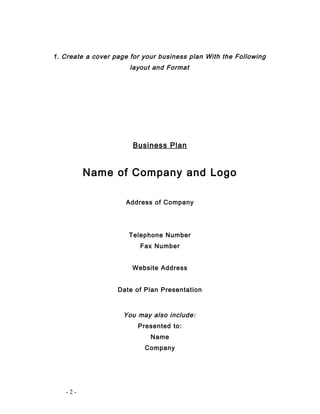
1. Create a cover page for your business plan With the Following 
layout and Format 
Business Plan 
Name of Company and Logo 
Address of Company 
Telephone Number 
Fax Number 
Website Address 
Date of Plan Presentation 
You may also include: 
Presented to: 
Name 
Company 
- 2 -
Name of Owner/Contact Person 
Address 
Telephone 
E-mail 
- 3 -
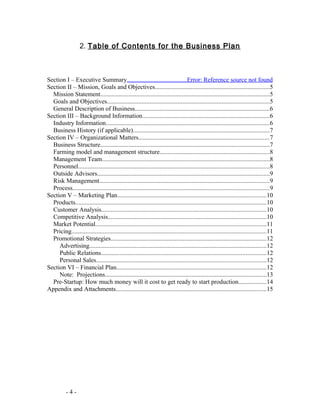
2. Table of Contents for the Business Plan 
Section I – Executive Summary . . . . . . . . . . . . . . . . . . . . . . . . . . . . . . . . . . . . . . Error: Reference source not found 
Section II – Mission, Goals and Objectives.........................................................................5 
Mission Statement............................................................................................................5 
Goals and Objectives.......................................................................................................5 
General Description of Business......................................................................................6 
Section III – Background Information.................................................................................6 
Industry Information........................................................................................................6 
Business History (if applicable).......................................................................................7 
Section IV – Organizational Matters...................................................................................7 
Business Structure............................................................................................................7 
Farming model and management structure......................................................................8 
Management Team...........................................................................................................8 
Personnel..........................................................................................................................8 
Outside Advisors..............................................................................................................9 
Risk Management............................................................................................................9 
Process.............................................................................................................................9 
Section V – Marketing Plan...............................................................................................10 
Products..........................................................................................................................10 
Customer Analysis.........................................................................................................10 
Competitive Analysis.....................................................................................................10 
Market Potential.............................................................................................................11 
Pricing............................................................................................................................11 
Promotional Strategies...................................................................................................12 
Advertising.................................................................................................................12 
Public Relations.........................................................................................................12 
Personal Sales............................................................................................................12 
Section VI – Financial Plan...............................................................................................12 
Note: Projections.......................................................................................................13 
Pre-Startup: How much money will it cost to get ready to start production..................14 
Appendix and Attachments................................................................................................15 
- 4 -
Section I – Executive Summary 
Complete this section after the rest of the business plan has been completed. 
Simply highlight the most important aspects of the plan, i.e.: 
 The business concept (what is the Business Plan is all about) 
 Define the products or services to be produced 
 The objectives of the project and the project location 
 Company Ownership, Principal owners and key personnel 
 Farming Model and Farm Management Structure adopted as 
per Green Scheme Policy Document 
 Proposed Profit Share Structure 
 Funding requirement (how much money is needed) 
 Source of funding 
 The re-payment plan 
 Environmental management plan 
 Market opportunity: expected size of the market, potential growth 
rate and any relevant market trend 
 Socio-economic benefit 
· The executive summary should be concise 
Section II – Mission, Goals and Objectives 
 Mission Statement 
· What is the vision for the future of your business? 
· What is the purpose of your business – internally and externally? 
· Include your Mission Statement 
 Goals and Objectives 
· What are your short-term (within 5 years) and long-term (5 to10 
years) goals and the objectives to reach your goals? 
- 5 -
 General Description of Business 
· Elaborate on specific technical aspects such as area to be 
cultivated, proposed area for small scale farmers, water 
requirements, type of irrigation, and benefits to surrounding 
communities. 
· What business are you in? What are the key products or 
services of your business? 
· What market do you believe exists for these products or 
services? (Describe your current market). 
· What is the location of your business? Why is this 
advantageous? 
· How do you operate your business? Who is involved in the 
operations? How much of your time is spent in the business 
· Is growth a part of your plan for your business? If so, describe 
what kind of growth you are projecting and how you think that 
growth will occur (adding products or services, expanding your 
market, changing your product or service mix, etc...) 
Section III – Background Information 
 Industry Information 
· Identify your agro business industry 
- 6 -
· What are the current agro business industry trends? Include 
growth patterns, niche markets and size of the market. 
· What are the future agro business industry trends? 
 Business History (if applicable) 
· Provide a brief history of your business, including when it was 
founded, why it was started, profitability and growth patterns 
and how the business has changed over time. 
· How does your business fall into the current and future trends of 
the agro industry? 
Section IV – Organizational Matters 
 Business Structure 
Describe the legal structure of your business (sole proprietorship, 
partnership, corporation or Limited Liability Company). Include in this 
the ownership of the business: 
· Company Directors 
· Registered Namibian Company (attach proof of registration) 
 Board of Directors of which it is recommended that one should 
be from a BEE company/partner 
· Shareholding Structure indicating the financial interests held by 
each entity i.e. 
 Total Equity 
 Capital owned by Namibians/Namibian Companies (BEE) 
- 7 -
 Capital owned by foreigners/foreign companies. 
 NOTE: In case of partnerships between Namibians 
and Foreign Investors it is strongly recommended that 
the Share Structure should be at least fifty one 
percent (51%) Namibian for all State Developed 
Irrigation Projects. It is also encouraged that 
Company ownership and Management should comply 
with Government guidelines and policies such as the 
Broad based economic empowerment, gender and 
the Employment Equity Act. 
 Farming model and management structure 
Indicate the model to be adopted as per the Green Scheme Policy and elaborate 
on both the model and the management structure you chosed 
The Profit Sharing structure amongst the Stakeholders and Social 
Responsibilities to the Traditional Authorities must also be highlighted. 
 Management Team 
Describe your management team, highlighting the company 
management structure. Include key positions and the qualifications, 
appropriate experience and the complementary skills of the 
employees. Proposed organizational structure 
 Personnel 
Describe the positions in your company, the job responsibilities and 
skills (or needed skills) of employees. 
- 8 -
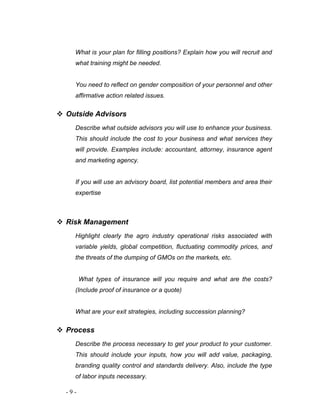
What is your plan for filling positions? Explain how you will recruit and 
what training might be needed. 
You need to reflect on gender composition of your personnel and other 
affirmative action related issues. 
 Outside Advisors 
Describe what outside advisors you will use to enhance your business. 
This should include the cost to your business and what services they 
will provide. Examples include: accountant, attorney, insurance agent 
and marketing agency. 
If you will use an advisory board, list potential members and area their 
expertise 
 Risk Management 
Highlight clearly the agro industry operational risks associated with 
variable yields, global competition, fluctuating commodity prices, and 
the threats of the dumping of GMOs on the markets, etc. 
What types of insurance will you require and what are the costs? 
(Include proof of insurance or a quote) 
What are your exit strategies, including succession planning? 
 Process 
Describe the process necessary to get your product to your customer. 
This should include your inputs, how you will add value, packaging, 
branding quality control and standards delivery. Also, include the type 
of labor inputs necessary. 
- 9 -
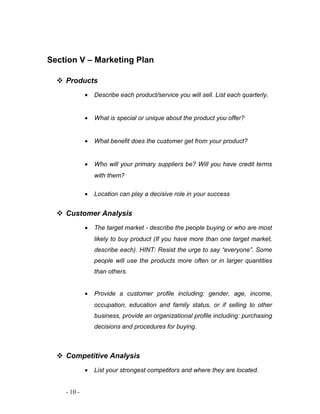
Section V – Marketing Plan 
 Products 
· Describe each product/service you will sell. List each quarterly. 
· What is special or unique about the product you offer? 
· What benefit does the customer get from your product? 
· Who will your primary suppliers be? Will you have credit terms 
with them? 
· Location can play a decisive role in your success 
 Customer Analysis 
· The target market - describe the people buying or who are most 
likely to buy product (If you have more than one target market, 
describe each). HINT: Resist the urge to say “everyone”. Some 
people will use the products more often or in larger quantities 
than others. 
· Provide a customer profile including: gender, age, income, 
occupation, education and family status, or if selling to other 
business, provide an organizational profile including: purchasing 
decisions and procedures for buying. 
 Competitive Analysis 
· List your strongest competitors and where they are located. 
- 10 -
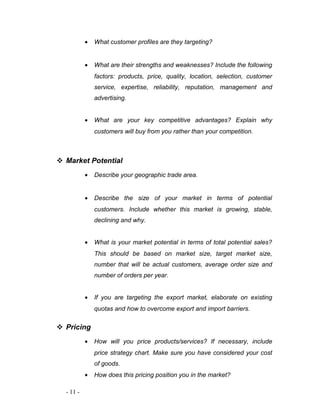
· What customer profiles are they targeting? 
· What are their strengths and weaknesses? Include the following 
factors: products, price, quality, location, selection, customer 
service, expertise, reliability, reputation, management and 
advertising. 
· What are your key competitive advantages? Explain why 
customers will buy from you rather than your competition. 
 Market Potential 
· Describe your geographic trade area. 
· Describe the size of your market in terms of potential 
customers. Include whether this market is growing, stable, 
declining and why. 
· What is your market potential in terms of total potential sales? 
This should be based on market size, target market size, 
number that will be actual customers, average order size and 
number of orders per year. 
· If you are targeting the export market, elaborate on existing 
quotas and how to overcome export and import barriers. 
 Pricing 
· How will you price products/services? If necessary, include 
price strategy chart. Make sure you have considered your cost 
of goods. 
· How does this pricing position you in the market? 
- 11 -
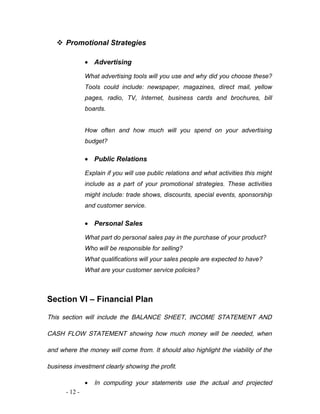
 Promotional Strategies 
· Advertising 
What advertising tools will you use and why did you choose these? 
Tools could include: newspaper, magazines, direct mail, yellow 
pages, radio, TV, Internet, business cards and brochures, bill 
boards. 
How often and how much will you spend on your advertising 
budget? 
· Public Relations 
Explain if you will use public relations and what activities this might 
include as a part of your promotional strategies. These activities 
might include: trade shows, discounts, special events, sponsorship 
and customer service. 
· Personal Sales 
What part do personal sales pay in the purchase of your product? 
Who will be responsible for selling? 
What qualifications will your sales people are expected to have? 
What are your customer service policies? 
Section VI – Financial Plan 
This section will include the BALANCE SHEET, INCOME STATEMENT AND 
CASH FLOW STATEMENT showing how much money will be needed, when 
and where the money will come from. It should also highlight the viability of the 
business investment clearly showing the profit. 
· In computing your statements use the actual and projected 
- 12 -
figures 
Note: Projections 
 What will your monthly sales be for the first year? What will your 
sales be for years 2 and 3 etc.? 
 What will your monthly expenses be for the first year? What will 
they be for years 2 and 3 etc? 
 Complete Monthly Income, Cash Flow and Balance Sheet 
Projections for Years 1, 2 and 3. Be sure to include an explanation 
of how you came up with these numbers. It is critical for you to 
provide assumptions so that development of numbers can be 
understood. 
 Break-even point – an analysis which outline clearly at what point the 
business will make profit. 
 Financial statement analysis (ratios) 
Liquidity analysis 
(a) current ratio = current assets/current liabilities 
(b) quick ratio = current assets – inventory/current liabilities 
Profitability 
Gross profit margin = gross profit/sales 
Operating profit margin = income from operation/sales 
Net profit margin = net profit/sales 
Debt measures 
Debt to asset ratio = total liabilities/ total assets 
Debt to equity = total liabilities/total assets 
- 13 -
Return on investment = net profits/total assets 
It would be proper to give a complete interpretation of the above ratio 
 Pre-Startup: How much money will it cost to get ready to 
start production 
In this section state the amount of funds you require for the following; 
a. Capital Equipment, furniture and fixture costs 
b. Working Capital (Production Costs) 
c. Attorney(s), accountant(s) and other consultants prior to 
commencement of production, etc. 
 Project Funding 
This section should clearly show the Funds required carrying out the 
project. How do you propose to finance this? Where will the funding come 
from e.g. 
a. Personal savings 
b. Bank loans 
c. Personal loans from friends or family 
d. Outside investors 
e. Other 
Loan funds usage statement 
· How funds are to be utilized 
· Loan repayment schedule 
VII SOCIO-ECONOMIC BENEFIT 
Elaborate on your project would contribution to the stimulation of the local 
economic development as far as employment and local procurement is 
concerned 
You should also elaborate one cooperate social responsibility towards the 
local communities. 
- 14 -
Elaborate on the human development of your employees and their wellbeing 
as far as some of the following issues are concerned: 
· Housing 
· Medical 
· Trading 
· Mainstreaming of HIV/AIDS issue 
VIII Environmental Plan 
Indicate how the environmental issues will be integrated in the operation of 
the business. 
Appendix and Attachments 
Following this page, attach the following documents: 
· Proof of funds availability 
· Resumes 
· Letters of endorsements 
· Copies of contracts and agreements 
· Licenses, certifications, and other credentials 
· Copies of market study material and other data used to develop 
elements in the business plan 
Recommended supporting documents to be attached: 
To make the decision process easier and relevant supporting documents that 
support the financial statements and data presented need to be included. That 
could include but not limited to: 
- Supporting studies 
- Research data 
- Maps 
- CVs 
- 15 -
- Registration certificate 
- Credit report 
- Partnership agreement 
- Article of association 
- Letters of reference 
- Supply contracts 
- Legal documents 
- 16 -

Business plan template1

  • 1.
    GUIDELINE FOR THEFORMULATION OF A GREEN SCHEME BUSINESS PLAN FOREWORD The outline in this document is to guide prospective Commercial Irrigation Farming Entrepreneurs or Investors in the submission of an Agro Business Plan for the purposes of entering into a Memorandum of Agreement with The Government of The Republic of Namibia acting through The Ministry of Agriculture, Water and Forestry to operate, develop and manage the specific Agro Irrigation Project based on THE GREEN SCHEME POLICY. The development in irrigation based agronomic production will contribute to the achievement of food security in line with Vision 2030 strategy and increase the sectors contribution to GDP. Please note that this outline should be followed, but each submission should have its own character, originality and creativity related to the specific Agro Project. The business plan is a written summary of an entrepreneur’s proposed business venture outlining the following; · Operational and financial details · Marketing opportunities and strategy · Management skills and abilities · Environmental and social impacts The Agro Business Plan can be seen as the project’s road map toward building a successful farming enterprise. It describes the direction the project will take, what its goals and objectives are, where it wants to be, how it intends to get there and how the small-scale farmers will be incorporated and supported by the service provider, depending on the farming model as stipulated in the Green Scheme Policy. The Agro Business Plan should consist of the following:
  • 2.
    1. Create acover page for your business plan With the Following layout and Format Business Plan Name of Company and Logo Address of Company Telephone Number Fax Number Website Address Date of Plan Presentation You may also include: Presented to: Name Company - 2 -
  • 3.
    Name of Owner/ContactPerson Address Telephone E-mail - 3 -
  • 4.
    2. Table ofContents for the Business Plan Section I – Executive Summary . . . . . . . . . . . . . . . . . . . . . . . . . . . . . . . . . . . . . . Error: Reference source not found Section II – Mission, Goals and Objectives.........................................................................5 Mission Statement............................................................................................................5 Goals and Objectives.......................................................................................................5 General Description of Business......................................................................................6 Section III – Background Information.................................................................................6 Industry Information........................................................................................................6 Business History (if applicable).......................................................................................7 Section IV – Organizational Matters...................................................................................7 Business Structure............................................................................................................7 Farming model and management structure......................................................................8 Management Team...........................................................................................................8 Personnel..........................................................................................................................8 Outside Advisors..............................................................................................................9 Risk Management............................................................................................................9 Process.............................................................................................................................9 Section V – Marketing Plan...............................................................................................10 Products..........................................................................................................................10 Customer Analysis.........................................................................................................10 Competitive Analysis.....................................................................................................10 Market Potential.............................................................................................................11 Pricing............................................................................................................................11 Promotional Strategies...................................................................................................12 Advertising.................................................................................................................12 Public Relations.........................................................................................................12 Personal Sales............................................................................................................12 Section VI – Financial Plan...............................................................................................12 Note: Projections.......................................................................................................13 Pre-Startup: How much money will it cost to get ready to start production..................14 Appendix and Attachments................................................................................................15 - 4 -
  • 5.
    Section I –Executive Summary Complete this section after the rest of the business plan has been completed. Simply highlight the most important aspects of the plan, i.e.:  The business concept (what is the Business Plan is all about)  Define the products or services to be produced  The objectives of the project and the project location  Company Ownership, Principal owners and key personnel  Farming Model and Farm Management Structure adopted as per Green Scheme Policy Document  Proposed Profit Share Structure  Funding requirement (how much money is needed)  Source of funding  The re-payment plan  Environmental management plan  Market opportunity: expected size of the market, potential growth rate and any relevant market trend  Socio-economic benefit · The executive summary should be concise Section II – Mission, Goals and Objectives  Mission Statement · What is the vision for the future of your business? · What is the purpose of your business – internally and externally? · Include your Mission Statement  Goals and Objectives · What are your short-term (within 5 years) and long-term (5 to10 years) goals and the objectives to reach your goals? - 5 -
  • 6.
     General Descriptionof Business · Elaborate on specific technical aspects such as area to be cultivated, proposed area for small scale farmers, water requirements, type of irrigation, and benefits to surrounding communities. · What business are you in? What are the key products or services of your business? · What market do you believe exists for these products or services? (Describe your current market). · What is the location of your business? Why is this advantageous? · How do you operate your business? Who is involved in the operations? How much of your time is spent in the business · Is growth a part of your plan for your business? If so, describe what kind of growth you are projecting and how you think that growth will occur (adding products or services, expanding your market, changing your product or service mix, etc...) Section III – Background Information  Industry Information · Identify your agro business industry - 6 -
  • 7.
    · What arethe current agro business industry trends? Include growth patterns, niche markets and size of the market. · What are the future agro business industry trends?  Business History (if applicable) · Provide a brief history of your business, including when it was founded, why it was started, profitability and growth patterns and how the business has changed over time. · How does your business fall into the current and future trends of the agro industry? Section IV – Organizational Matters  Business Structure Describe the legal structure of your business (sole proprietorship, partnership, corporation or Limited Liability Company). Include in this the ownership of the business: · Company Directors · Registered Namibian Company (attach proof of registration)  Board of Directors of which it is recommended that one should be from a BEE company/partner · Shareholding Structure indicating the financial interests held by each entity i.e.  Total Equity  Capital owned by Namibians/Namibian Companies (BEE) - 7 -
  • 8.
     Capital ownedby foreigners/foreign companies.  NOTE: In case of partnerships between Namibians and Foreign Investors it is strongly recommended that the Share Structure should be at least fifty one percent (51%) Namibian for all State Developed Irrigation Projects. It is also encouraged that Company ownership and Management should comply with Government guidelines and policies such as the Broad based economic empowerment, gender and the Employment Equity Act.  Farming model and management structure Indicate the model to be adopted as per the Green Scheme Policy and elaborate on both the model and the management structure you chosed The Profit Sharing structure amongst the Stakeholders and Social Responsibilities to the Traditional Authorities must also be highlighted.  Management Team Describe your management team, highlighting the company management structure. Include key positions and the qualifications, appropriate experience and the complementary skills of the employees. Proposed organizational structure  Personnel Describe the positions in your company, the job responsibilities and skills (or needed skills) of employees. - 8 -
  • 9.
    What is yourplan for filling positions? Explain how you will recruit and what training might be needed. You need to reflect on gender composition of your personnel and other affirmative action related issues.  Outside Advisors Describe what outside advisors you will use to enhance your business. This should include the cost to your business and what services they will provide. Examples include: accountant, attorney, insurance agent and marketing agency. If you will use an advisory board, list potential members and area their expertise  Risk Management Highlight clearly the agro industry operational risks associated with variable yields, global competition, fluctuating commodity prices, and the threats of the dumping of GMOs on the markets, etc. What types of insurance will you require and what are the costs? (Include proof of insurance or a quote) What are your exit strategies, including succession planning?  Process Describe the process necessary to get your product to your customer. This should include your inputs, how you will add value, packaging, branding quality control and standards delivery. Also, include the type of labor inputs necessary. - 9 -
  • 10.
    Section V –Marketing Plan  Products · Describe each product/service you will sell. List each quarterly. · What is special or unique about the product you offer? · What benefit does the customer get from your product? · Who will your primary suppliers be? Will you have credit terms with them? · Location can play a decisive role in your success  Customer Analysis · The target market - describe the people buying or who are most likely to buy product (If you have more than one target market, describe each). HINT: Resist the urge to say “everyone”. Some people will use the products more often or in larger quantities than others. · Provide a customer profile including: gender, age, income, occupation, education and family status, or if selling to other business, provide an organizational profile including: purchasing decisions and procedures for buying.  Competitive Analysis · List your strongest competitors and where they are located. - 10 -
  • 11.
    · What customerprofiles are they targeting? · What are their strengths and weaknesses? Include the following factors: products, price, quality, location, selection, customer service, expertise, reliability, reputation, management and advertising. · What are your key competitive advantages? Explain why customers will buy from you rather than your competition.  Market Potential · Describe your geographic trade area. · Describe the size of your market in terms of potential customers. Include whether this market is growing, stable, declining and why. · What is your market potential in terms of total potential sales? This should be based on market size, target market size, number that will be actual customers, average order size and number of orders per year. · If you are targeting the export market, elaborate on existing quotas and how to overcome export and import barriers.  Pricing · How will you price products/services? If necessary, include price strategy chart. Make sure you have considered your cost of goods. · How does this pricing position you in the market? - 11 -
  • 12.
     Promotional Strategies · Advertising What advertising tools will you use and why did you choose these? Tools could include: newspaper, magazines, direct mail, yellow pages, radio, TV, Internet, business cards and brochures, bill boards. How often and how much will you spend on your advertising budget? · Public Relations Explain if you will use public relations and what activities this might include as a part of your promotional strategies. These activities might include: trade shows, discounts, special events, sponsorship and customer service. · Personal Sales What part do personal sales pay in the purchase of your product? Who will be responsible for selling? What qualifications will your sales people are expected to have? What are your customer service policies? Section VI – Financial Plan This section will include the BALANCE SHEET, INCOME STATEMENT AND CASH FLOW STATEMENT showing how much money will be needed, when and where the money will come from. It should also highlight the viability of the business investment clearly showing the profit. · In computing your statements use the actual and projected - 12 -
  • 13.
    figures Note: Projections  What will your monthly sales be for the first year? What will your sales be for years 2 and 3 etc.?  What will your monthly expenses be for the first year? What will they be for years 2 and 3 etc?  Complete Monthly Income, Cash Flow and Balance Sheet Projections for Years 1, 2 and 3. Be sure to include an explanation of how you came up with these numbers. It is critical for you to provide assumptions so that development of numbers can be understood.  Break-even point – an analysis which outline clearly at what point the business will make profit.  Financial statement analysis (ratios) Liquidity analysis (a) current ratio = current assets/current liabilities (b) quick ratio = current assets – inventory/current liabilities Profitability Gross profit margin = gross profit/sales Operating profit margin = income from operation/sales Net profit margin = net profit/sales Debt measures Debt to asset ratio = total liabilities/ total assets Debt to equity = total liabilities/total assets - 13 -
  • 14.
    Return on investment= net profits/total assets It would be proper to give a complete interpretation of the above ratio  Pre-Startup: How much money will it cost to get ready to start production In this section state the amount of funds you require for the following; a. Capital Equipment, furniture and fixture costs b. Working Capital (Production Costs) c. Attorney(s), accountant(s) and other consultants prior to commencement of production, etc.  Project Funding This section should clearly show the Funds required carrying out the project. How do you propose to finance this? Where will the funding come from e.g. a. Personal savings b. Bank loans c. Personal loans from friends or family d. Outside investors e. Other Loan funds usage statement · How funds are to be utilized · Loan repayment schedule VII SOCIO-ECONOMIC BENEFIT Elaborate on your project would contribution to the stimulation of the local economic development as far as employment and local procurement is concerned You should also elaborate one cooperate social responsibility towards the local communities. - 14 -
  • 15.
    Elaborate on thehuman development of your employees and their wellbeing as far as some of the following issues are concerned: · Housing · Medical · Trading · Mainstreaming of HIV/AIDS issue VIII Environmental Plan Indicate how the environmental issues will be integrated in the operation of the business. Appendix and Attachments Following this page, attach the following documents: · Proof of funds availability · Resumes · Letters of endorsements · Copies of contracts and agreements · Licenses, certifications, and other credentials · Copies of market study material and other data used to develop elements in the business plan Recommended supporting documents to be attached: To make the decision process easier and relevant supporting documents that support the financial statements and data presented need to be included. That could include but not limited to: - Supporting studies - Research data - Maps - CVs - 15 -
  • 16.
    - Registration certificate - Credit report - Partnership agreement - Article of association - Letters of reference - Supply contracts - Legal documents - 16 -