1 | P a g e
ASSESMENT 1
NAME: Sumit Roy
PRN: 18020474021
SUBJECT: Supply Chain Strategy
INDEX
SR. NO. PARTICULAR PAGE NO.
1 Case 6: Disha Agri Farms 2 - 3
2 Case 15: O’Daid Group 3 - 7
2 | P a g e
Case 6: Disha Agri-farm
Given:
1. Diversification of business over period from milk to traditional crop to holiday home to
herb and organic products. Now herb become main business.
2. Farm uses for tourist attractions. Website uses for order collecting.
3. Disha currently delivers 100 parcels a week to regular locals (up to about 50 km away)
and posts 200 parcels to more distant customers.
4. Increasing in demand for products for cooking (sauces, dressings and marinades),
perfumes (posies, pot-pourri and sachets of dried herbs) and ‘healthy stuff’ (herb
mixtures traditionally said to have beneficial effects).
5. Product range could be expand by moving all processing to an industrial estate 10 km
away.
QUESTIONS:
1. How does Disha currently organize her logistics? What do you think are her aims and
priorities?
Currently Disha organizes her logistics by following functions:
a. Local deliveries (within 50 km) are made by own transportations and for distant
customers uses parcel service i.e. 3PL.
b. Order collecting i.e. information systemare processed by website.
c. Currently sourcing, pricing material handling/ packaging are done manually.
Disha want to expand by moving all processing to an industrial estate. Following would be
her priorities:
a. Organizing logistics by responsive supply chain strategy.
b. Product range expanding by moving processing to an industrial estate.
c. Standardization of product package sizes and products i.e. Made To Stock order point
shifting for better response to orders.
d. 3PL outsourcing for deliveries of products
2. What would be the effect of the expansion on logistics? What problems would Disha face,
and what options does she have to overcome them?
Expansion on logistics will leads to increase in cost to setup infrastructure for
transportations especially distributions & warehousing.
3 | P a g e
Disha will face challenges for packaging standardization for products, on time deliveries to
customers and complete material flow and information flow to be restructured (for
processing center operations).
Following options she have to overcome challenges:
a. She have to standardize product package size. She have to shift order point from MTO
to MTS.
b. She have to outsource 3PL services for better distributions.
c. She have to standardize operations for new processing systems, as her core
competencies lies in processing.
3. Identify the key drivers of supply chain that influence her supply chain strategy.
Followings are key drivers of supply chain in her supply chain strategy:
a. Own logistics for deliveries and courier for distinct deliveries i.e. 3PL transportations
b. Website to collect order i.e. information system
c. Farm for growing herbs i.e. sourcing
d. Pricing strategy are set up by based on differentiation focus
e. Inventory management, warehousing material handling and packaging resources will be
required for new processing centers considering the capacity of plant.
4. Would you recommend a responsive or efficient supply chain?
I would recommend a responsive supply chain, with standardize packaging with MTS
ordering point and 3PL logistics outsourcing for distribution of products.
Case 15: O’Daid Group
Given:
NATURAL CONDITIONER TO PLANTS BUSINESS:
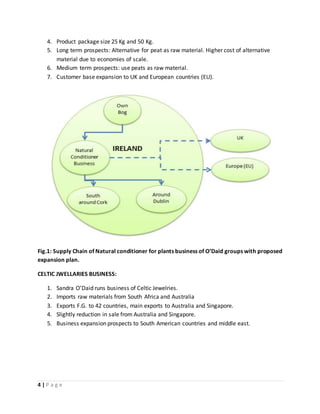
1. Sean O’Daid runs business of natural conditioner for gardening since last 20 years.
2. No scarcity of raw material i.e. peat from own bog with proximity.
3. Variation in sales due to:
a. Environmental awareness of customers (consumer behavior- psychological
impact).
b. State economy
c. TV advertisements
4 | P a g e
4. Product package size 25 Kg and 50 Kg.
5. Long term prospects: Alternative for peat as raw material. Higher cost of alternative
material due to economies of scale.
6. Medium term prospects: use peats as raw material.
7. Customer base expansion to UK and European countries (EU).
Fig.1: Supply Chain of Natural conditioner for plants business of O’Daid groups with proposed
expansion plan.
CELTIC JWELLARIES BUSINESS:
1. Sandra O’Daid runs business of Celtic Jewelries.
2. Imports raw materials from South Africa and Australia
3. Exports F.G. to 42 countries, main exports to Australia and Singapore.
4. Slightly reduction in sale from Australia and Singapore.
5. Business expansion prospects to South American countries and middle east.
5 | P a g e
Fig.2: Supply Chain of Celtic Jewelry business of O’Daid groups with proposed expansion plan.
QUESTIONS:
1. How would you compare the logistics requirements of these two parts of the family
business? What problems are they each likely to face? How can these be overcome?
For natural conditioner for gardening business requires efficient supply chain strategy. Where,
FGs to be shipped with waterways to UK and EU, for cheaper cost of transportation.
For Celtic jewelry business requires responsive supply chain strategy. Where, FGs to be shipped
with air ways to the existing and proposed customer companies.
Problems are likely to face in Natural Conditioners for gardening business:
a. Transportation facilities, warehouses and DCs will be required.
b. Competition in market may available.
c. High transportation costs, inventory costs, storage costs are problems.
d. Consumer behavior for product-as most of the European countries are ecofriendly and
focuses sustainability.
By following steps, Sean can overcome for their Natural conditioner business for Gardening:
6 | P a g e
a. No. of warehouses and distribution centers to be allocated with maximum proposed
customer bases with geographical reach.
b. As we have to opt for efficient supply chain strategy, for better responsiveness we have
rigorously focus on warehousing i.e. inventory management systems.
c. While setting up DCs demand analysis to be done with better accuracy.
d. While allocating DCs countries (in EU) natural climatic conditions to be considered.
e. Information flow system (IT) to be structured to get fast and accurate information.
f. Material handling facilities to be considered in account.
g. Best suited is outsourcing (partnership for supply and distribution) 3PL services for
supply and distributions. As core competencies of this business lies in manufacturing i.e.
operations. And in UK and EU there are various 3PL services available with cost effective
services.
h. Branding and advertisement of product to be done in such way that, it should not
affects psychology of consumer.
Problems are likely to face in Celtic jewelry business:
a. Delay in delivery- delivery time.
b. Variability in demands.
c. Order processing systemi.e. information for Middle east and South America.
By following steps, Sandra can overcome for Celtic jewelry business:
a. For better responsiveness decentralize assembly centers (for postponement with
customization i.e. ATO) to be opened with major customer countries i.e. Singapore,
Middle east and South America (Brazil).
b. Variability in demands can be addressed by decentralization and accordingly
c. E-commerce and IT infrastructure are to build for better and responsive order
processing.
d. Jewelries with less variability in demand can be produced as Made to stock products at
Cork and to avail in market with less lead time.
2. Do you think that expanding internationally is a reasonable strategy for Sean? Can he
learn anything from Sandra’s experience?
Expanding internationally could be a more challenging for Sean. But, simultaneously, its
carrying opportunities. For UK and EU it is suitable considering same tariff charges (as Ireland
part of EU). Whereas, Sean have to focus on warehousing for better inventory management
and that to be outsourced by 3PL.
7 | P a g e
Although, Sean’s business model recommends efficient supply chain and Sandra’s business
model recommends responsive supply chain. Based on Sandra’s experiences he can get
following learning:
a. Sandra already running business in 42 countries means she have better distribution
network. Sean have to develop more warehousing networks and DCs to retail or end
customer i.e. spoke supply chain.
b. Order processing i.e. IT infrastructure.

Supply Chain Strategy- case study

  • 1.
    1 | Pa g e ASSESMENT 1 NAME: Sumit Roy PRN: 18020474021 SUBJECT: Supply Chain Strategy INDEX SR. NO. PARTICULAR PAGE NO. 1 Case 6: Disha Agri Farms 2 - 3 2 Case 15: O’Daid Group 3 - 7
  • 2.
    2 | Pa g e Case 6: Disha Agri-farm Given: 1. Diversification of business over period from milk to traditional crop to holiday home to herb and organic products. Now herb become main business. 2. Farm uses for tourist attractions. Website uses for order collecting. 3. Disha currently delivers 100 parcels a week to regular locals (up to about 50 km away) and posts 200 parcels to more distant customers. 4. Increasing in demand for products for cooking (sauces, dressings and marinades), perfumes (posies, pot-pourri and sachets of dried herbs) and ‘healthy stuff’ (herb mixtures traditionally said to have beneficial effects). 5. Product range could be expand by moving all processing to an industrial estate 10 km away. QUESTIONS: 1. How does Disha currently organize her logistics? What do you think are her aims and priorities? Currently Disha organizes her logistics by following functions: a. Local deliveries (within 50 km) are made by own transportations and for distant customers uses parcel service i.e. 3PL. b. Order collecting i.e. information systemare processed by website. c. Currently sourcing, pricing material handling/ packaging are done manually. Disha want to expand by moving all processing to an industrial estate. Following would be her priorities: a. Organizing logistics by responsive supply chain strategy. b. Product range expanding by moving processing to an industrial estate. c. Standardization of product package sizes and products i.e. Made To Stock order point shifting for better response to orders. d. 3PL outsourcing for deliveries of products 2. What would be the effect of the expansion on logistics? What problems would Disha face, and what options does she have to overcome them? Expansion on logistics will leads to increase in cost to setup infrastructure for transportations especially distributions & warehousing.
  • 3.
    3 | Pa g e Disha will face challenges for packaging standardization for products, on time deliveries to customers and complete material flow and information flow to be restructured (for processing center operations). Following options she have to overcome challenges: a. She have to standardize product package size. She have to shift order point from MTO to MTS. b. She have to outsource 3PL services for better distributions. c. She have to standardize operations for new processing systems, as her core competencies lies in processing. 3. Identify the key drivers of supply chain that influence her supply chain strategy. Followings are key drivers of supply chain in her supply chain strategy: a. Own logistics for deliveries and courier for distinct deliveries i.e. 3PL transportations b. Website to collect order i.e. information system c. Farm for growing herbs i.e. sourcing d. Pricing strategy are set up by based on differentiation focus e. Inventory management, warehousing material handling and packaging resources will be required for new processing centers considering the capacity of plant. 4. Would you recommend a responsive or efficient supply chain? I would recommend a responsive supply chain, with standardize packaging with MTS ordering point and 3PL logistics outsourcing for distribution of products. Case 15: O’Daid Group Given: NATURAL CONDITIONER TO PLANTS BUSINESS: 1. Sean O’Daid runs business of natural conditioner for gardening since last 20 years. 2. No scarcity of raw material i.e. peat from own bog with proximity. 3. Variation in sales due to: a. Environmental awareness of customers (consumer behavior- psychological impact). b. State economy c. TV advertisements
  • 4.
    4 | Pa g e 4. Product package size 25 Kg and 50 Kg. 5. Long term prospects: Alternative for peat as raw material. Higher cost of alternative material due to economies of scale. 6. Medium term prospects: use peats as raw material. 7. Customer base expansion to UK and European countries (EU). Fig.1: Supply Chain of Natural conditioner for plants business of O’Daid groups with proposed expansion plan. CELTIC JWELLARIES BUSINESS: 1. Sandra O’Daid runs business of Celtic Jewelries. 2. Imports raw materials from South Africa and Australia 3. Exports F.G. to 42 countries, main exports to Australia and Singapore. 4. Slightly reduction in sale from Australia and Singapore. 5. Business expansion prospects to South American countries and middle east.
  • 5.
    5 | Pa g e Fig.2: Supply Chain of Celtic Jewelry business of O’Daid groups with proposed expansion plan. QUESTIONS: 1. How would you compare the logistics requirements of these two parts of the family business? What problems are they each likely to face? How can these be overcome? For natural conditioner for gardening business requires efficient supply chain strategy. Where, FGs to be shipped with waterways to UK and EU, for cheaper cost of transportation. For Celtic jewelry business requires responsive supply chain strategy. Where, FGs to be shipped with air ways to the existing and proposed customer companies. Problems are likely to face in Natural Conditioners for gardening business: a. Transportation facilities, warehouses and DCs will be required. b. Competition in market may available. c. High transportation costs, inventory costs, storage costs are problems. d. Consumer behavior for product-as most of the European countries are ecofriendly and focuses sustainability. By following steps, Sean can overcome for their Natural conditioner business for Gardening:
  • 6.
    6 | Pa g e a. No. of warehouses and distribution centers to be allocated with maximum proposed customer bases with geographical reach. b. As we have to opt for efficient supply chain strategy, for better responsiveness we have rigorously focus on warehousing i.e. inventory management systems. c. While setting up DCs demand analysis to be done with better accuracy. d. While allocating DCs countries (in EU) natural climatic conditions to be considered. e. Information flow system (IT) to be structured to get fast and accurate information. f. Material handling facilities to be considered in account. g. Best suited is outsourcing (partnership for supply and distribution) 3PL services for supply and distributions. As core competencies of this business lies in manufacturing i.e. operations. And in UK and EU there are various 3PL services available with cost effective services. h. Branding and advertisement of product to be done in such way that, it should not affects psychology of consumer. Problems are likely to face in Celtic jewelry business: a. Delay in delivery- delivery time. b. Variability in demands. c. Order processing systemi.e. information for Middle east and South America. By following steps, Sandra can overcome for Celtic jewelry business: a. For better responsiveness decentralize assembly centers (for postponement with customization i.e. ATO) to be opened with major customer countries i.e. Singapore, Middle east and South America (Brazil). b. Variability in demands can be addressed by decentralization and accordingly c. E-commerce and IT infrastructure are to build for better and responsive order processing. d. Jewelries with less variability in demand can be produced as Made to stock products at Cork and to avail in market with less lead time. 2. Do you think that expanding internationally is a reasonable strategy for Sean? Can he learn anything from Sandra’s experience? Expanding internationally could be a more challenging for Sean. But, simultaneously, its carrying opportunities. For UK and EU it is suitable considering same tariff charges (as Ireland part of EU). Whereas, Sean have to focus on warehousing for better inventory management and that to be outsourced by 3PL.
  • 7.
    7 | Pa g e Although, Sean’s business model recommends efficient supply chain and Sandra’s business model recommends responsive supply chain. Based on Sandra’s experiences he can get following learning: a. Sandra already running business in 42 countries means she have better distribution network. Sean have to develop more warehousing networks and DCs to retail or end customer i.e. spoke supply chain. b. Order processing i.e. IT infrastructure.