International
Trade
Chapter 37
McGraw-Hill/Irwin Copyright © 2009 by The McGraw-Hill Companies, Inc. All rights reserved.
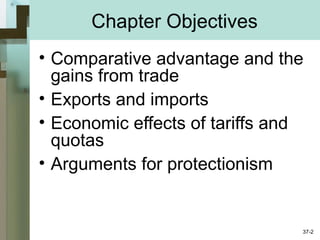
Chapter Objectives
• Comparative advantage and the
gains from trade
• Exports and imports
• Economic effects of tariffs and
quotas
• Arguments for protectionism
37-2
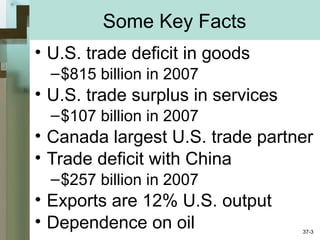
Some Key Facts
• U.S. trade deficit in goods
–$815 billion in 2007
• U.S. trade surplus in services
–$107 billion in 2007
• Canada largest U.S. trade partner
• Trade deficit with China
–$257 billion in 2007
• Exports are 12% U.S. output
• Dependence on oil 37-3
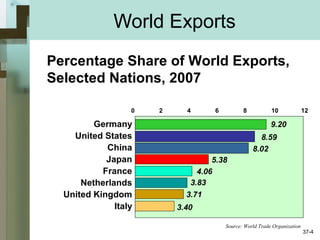
World Exports
Germany
United States
China
Japan
France
Netherlands
United Kingdom
Italy
0 2 4 6 8 10 12
9.20
8.59
8.02
5.38
4.06
3.83
3.71
3.40
Source: World Trade Organization
Percentage Share of World Exports,
Selected Nations, 2007
37-4
Economic Basis for Trade
• Nations have different resource
endowments
• Labor-intensive goods
• Land-intensive goods
• Capital-intensive goods
37-5
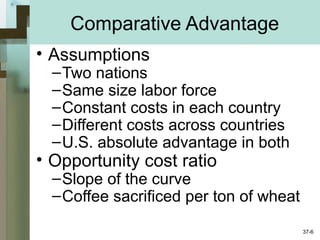
Comparative Advantage
• Assumptions
–Two nations
–Same size labor force
–Constant costs in each country
–Different costs across countries
–U.S. absolute advantage in both
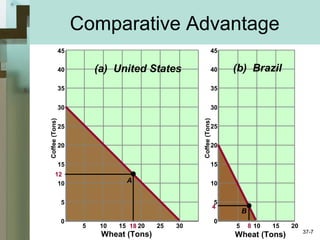
• Opportunity cost ratio
–Slope of the curve
–Coffee sacrificed per ton of wheat
37-6
Coffee(Tons)
30
25
20
15
10
5
0
35
40
45
5 10 15 20 25 30
Wheat (Tons)
Coffee(Tons)
30
25
20
15
10
5
0
35
40
45
5 10 15 20
Wheat (Tons)
(a) United States (b) Brazil
12
18 8
4
A
B
Comparative Advantage
37-7
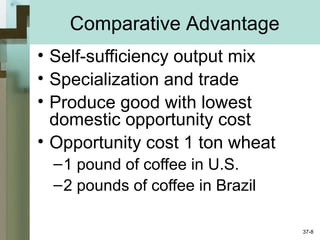
• Self-sufficiency output mix
• Specialization and trade
• Produce good with lowest
domestic opportunity cost
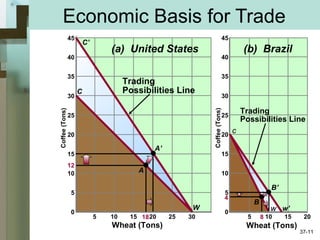
• Opportunity cost 1 ton wheat
–1 pound of coffee in U.S.
–2 pounds of coffee in Brazil
Comparative Advantage
37-8
• Terms of trade
–U.S. 1W = 1C
–U.S. will sell 1W for more than 1C
–Brazil 1W = 2C
–Brazil will pay less than 2C for 1W
–Settle between the two
–Depends on supply/demand factors
–Assume 1W = 1.5C
Comparative Advantage
37-9
• Gains from trade
–Trade possibilities line
–Slope equals terms of trade
–Improved options
• Complete specialization
• More of both goods
• More efficient resource allocation
Comparative Advantage
37-10
Economic Basis for Trade
Coffee(Tons)
30
25
20
15
10
5
0
35
40
45
5 10 15 20 25 30
Wheat (Tons)
Coffee(Tons)
30
25
20
15
10
5
0
35
40
45
5 10 15 20
Wheat (Tons)
(a) United States (b) Brazil
12
18 8
4
A
B
A’
B’
C
C’
W
c
w w’
Trading
Possibilities Line
Trading
Possibilities Line
37-11
Comparative Advantage
• Trade with increasing costs
–Concave production curve
–Resources not perfectly
substitutable
–Incomplete specialization
• The case for free trade
–Promote efficiency
–Promote competition
37-12
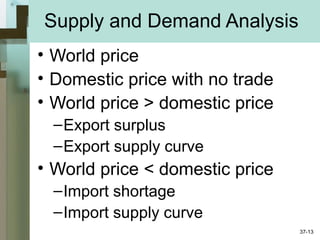
Supply and Demand Analysis
• World price
• Domestic price with no trade
• World price > domestic price
–Export surplus
–Export supply curve
• World price < domestic price
–Import shortage
–Import supply curve
37-13
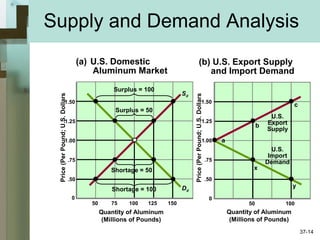
Price(PerPound;U.S.Dollars
1.50
1.25
1.00
.75
.50
0
50 75 100 125 150
Quantity of Aluminum
(Millions of Pounds)
1.50
1.25
1.00
.75
.50
0
50 100
Quantity of Aluminum
(Millions of Pounds)
Price(PerPound;U.S.Dollars
(a) U.S. Domestic
Aluminum Market
(b) U.S. Export Supply
and Import Demand
Dd
Sd
U.S.
Export
Supply
U.S.
Import
Demand
a
b
c
x
y
Surplus = 50
Surplus = 100
Shortage = 50
Shortage = 100
Supply and Demand Analysis
37-14
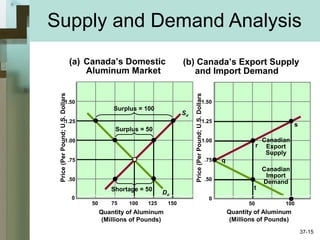
Supply and Demand Analysis
Price(PerPound;U.S.Dollars
1.50
1.25
1.00
.75
.50
0
50 75 100 125 150
Quantity of Aluminum
(Millions of Pounds)
1.50
1.25
1.00
.75
.50
0
50 100
Quantity of Aluminum
(Millions of Pounds)
Price(PerPound;U.S.Dollars
(a) Canada’s Domestic
Aluminum Market
(b) Canada’s Export Supply
and Import Demand
Dd
Sd
Canadian
Export
Supply
Canadian
Import
Demand
q
r
s
t
Surplus = 50
Surplus = 100
Shortage = 50
37-15
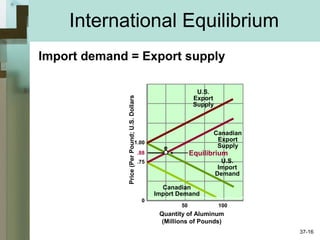
International Equilibrium
1.00
.75
.88
0
50 100
Quantity of Aluminum
(Millions of Pounds)
Price(PerPound;U.S.Dollars
Import demand = Export supply
Canadian
Export
Supply
Canadian
Import Demand
e
U.S.
Export
Supply
U.S.
Import
Demand
Equilibrium
37-16
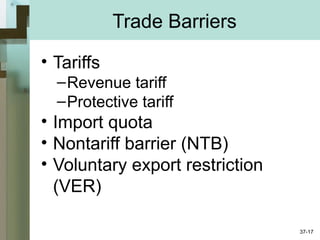
Trade Barriers
• Tariffs
–Revenue tariff
–Protective tariff
• Import quota
• Nontariff barrier (NTB)
• Voluntary export restriction
(VER)
37-17
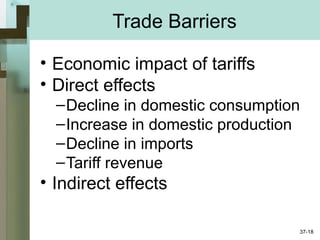
Trade Barriers
• Economic impact of tariffs
• Direct effects
–Decline in domestic consumption
–Increase in domestic production
–Decline in imports
–Tariff revenue
• Indirect effects
37-18
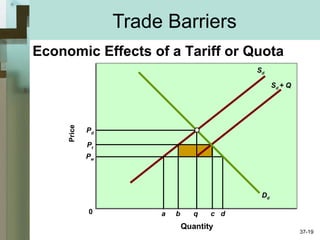
Trade Barriers
Quantity
Price
0
Dd
Sd
Pd
q
Sd + Q
Pt
Pw
a b c d
Economic Effects of a Tariff or Quota
37-19
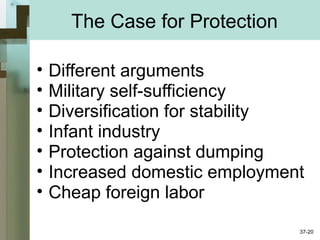
The Case for Protection
• Different arguments
• Military self-sufficiency
• Diversification for stability
• Infant industry
• Protection against dumping
• Increased domestic employment
• Cheap foreign labor
37-20
The WTO Protests
• World Trade Organization has
151 member nations
–Liberalize trade through negotiation
• Protest groups
–Labor unions, environmentalists,
socialists, anarchists
• Key issues for the protestors
–Labor protection and environmental
standards
37-21
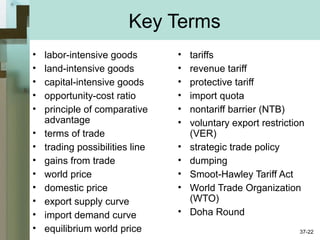
Key Terms
• labor-intensive goods
• land-intensive goods
• capital-intensive goods
• opportunity-cost ratio
• principle of comparative
advantage
• terms of trade
• trading possibilities line
• gains from trade
• world price
• domestic price
• export supply curve
• import demand curve
• equilibrium world price
• tariffs
• revenue tariff
• protective tariff
• import quota
• nontariff barrier (NTB)
• voluntary export restriction
(VER)
• strategic trade policy
• dumping
• Smoot-Hawley Tariff Act
• World Trade Organization
(WTO)
• Doha Round
37-22
Next Chapter Preview…
Exchange Rates, the
Balance of Payments,
and Trade Deficits
37-23

Chap037

  • 1.
    International Trade Chapter 37 McGraw-Hill/Irwin Copyright© 2009 by The McGraw-Hill Companies, Inc. All rights reserved.
  • 2.
    Chapter Objectives • Comparativeadvantage and the gains from trade • Exports and imports • Economic effects of tariffs and quotas • Arguments for protectionism 37-2
  • 3.
    Some Key Facts •U.S. trade deficit in goods –$815 billion in 2007 • U.S. trade surplus in services –$107 billion in 2007 • Canada largest U.S. trade partner • Trade deficit with China –$257 billion in 2007 • Exports are 12% U.S. output • Dependence on oil 37-3
  • 4.
    World Exports Germany United States China Japan France Netherlands UnitedKingdom Italy 0 2 4 6 8 10 12 9.20 8.59 8.02 5.38 4.06 3.83 3.71 3.40 Source: World Trade Organization Percentage Share of World Exports, Selected Nations, 2007 37-4
  • 5.
    Economic Basis forTrade • Nations have different resource endowments • Labor-intensive goods • Land-intensive goods • Capital-intensive goods 37-5
  • 6.
    Comparative Advantage • Assumptions –Twonations –Same size labor force –Constant costs in each country –Different costs across countries –U.S. absolute advantage in both • Opportunity cost ratio –Slope of the curve –Coffee sacrificed per ton of wheat 37-6
  • 7.
    Coffee(Tons) 30 25 20 15 10 5 0 35 40 45 5 10 1520 25 30 Wheat (Tons) Coffee(Tons) 30 25 20 15 10 5 0 35 40 45 5 10 15 20 Wheat (Tons) (a) United States (b) Brazil 12 18 8 4 A B Comparative Advantage 37-7
  • 8.
    • Self-sufficiency outputmix • Specialization and trade • Produce good with lowest domestic opportunity cost • Opportunity cost 1 ton wheat –1 pound of coffee in U.S. –2 pounds of coffee in Brazil Comparative Advantage 37-8
  • 9.
    • Terms oftrade –U.S. 1W = 1C –U.S. will sell 1W for more than 1C –Brazil 1W = 2C –Brazil will pay less than 2C for 1W –Settle between the two –Depends on supply/demand factors –Assume 1W = 1.5C Comparative Advantage 37-9
  • 10.
    • Gains fromtrade –Trade possibilities line –Slope equals terms of trade –Improved options • Complete specialization • More of both goods • More efficient resource allocation Comparative Advantage 37-10
  • 11.
    Economic Basis forTrade Coffee(Tons) 30 25 20 15 10 5 0 35 40 45 5 10 15 20 25 30 Wheat (Tons) Coffee(Tons) 30 25 20 15 10 5 0 35 40 45 5 10 15 20 Wheat (Tons) (a) United States (b) Brazil 12 18 8 4 A B A’ B’ C C’ W c w w’ Trading Possibilities Line Trading Possibilities Line 37-11
  • 12.
    Comparative Advantage • Tradewith increasing costs –Concave production curve –Resources not perfectly substitutable –Incomplete specialization • The case for free trade –Promote efficiency –Promote competition 37-12
  • 13.
    Supply and DemandAnalysis • World price • Domestic price with no trade • World price > domestic price –Export surplus –Export supply curve • World price < domestic price –Import shortage –Import supply curve 37-13
  • 14.
    Price(PerPound;U.S.Dollars 1.50 1.25 1.00 .75 .50 0 50 75 100125 150 Quantity of Aluminum (Millions of Pounds) 1.50 1.25 1.00 .75 .50 0 50 100 Quantity of Aluminum (Millions of Pounds) Price(PerPound;U.S.Dollars (a) U.S. Domestic Aluminum Market (b) U.S. Export Supply and Import Demand Dd Sd U.S. Export Supply U.S. Import Demand a b c x y Surplus = 50 Surplus = 100 Shortage = 50 Shortage = 100 Supply and Demand Analysis 37-14
  • 15.
    Supply and DemandAnalysis Price(PerPound;U.S.Dollars 1.50 1.25 1.00 .75 .50 0 50 75 100 125 150 Quantity of Aluminum (Millions of Pounds) 1.50 1.25 1.00 .75 .50 0 50 100 Quantity of Aluminum (Millions of Pounds) Price(PerPound;U.S.Dollars (a) Canada’s Domestic Aluminum Market (b) Canada’s Export Supply and Import Demand Dd Sd Canadian Export Supply Canadian Import Demand q r s t Surplus = 50 Surplus = 100 Shortage = 50 37-15
  • 16.
    International Equilibrium 1.00 .75 .88 0 50 100 Quantityof Aluminum (Millions of Pounds) Price(PerPound;U.S.Dollars Import demand = Export supply Canadian Export Supply Canadian Import Demand e U.S. Export Supply U.S. Import Demand Equilibrium 37-16
  • 17.
    Trade Barriers • Tariffs –Revenuetariff –Protective tariff • Import quota • Nontariff barrier (NTB) • Voluntary export restriction (VER) 37-17
  • 18.
    Trade Barriers • Economicimpact of tariffs • Direct effects –Decline in domestic consumption –Increase in domestic production –Decline in imports –Tariff revenue • Indirect effects 37-18
  • 19.
    Trade Barriers Quantity Price 0 Dd Sd Pd q Sd +Q Pt Pw a b c d Economic Effects of a Tariff or Quota 37-19
  • 20.
    The Case forProtection • Different arguments • Military self-sufficiency • Diversification for stability • Infant industry • Protection against dumping • Increased domestic employment • Cheap foreign labor 37-20
  • 21.
    The WTO Protests •World Trade Organization has 151 member nations –Liberalize trade through negotiation • Protest groups –Labor unions, environmentalists, socialists, anarchists • Key issues for the protestors –Labor protection and environmental standards 37-21
  • 22.
    Key Terms • labor-intensivegoods • land-intensive goods • capital-intensive goods • opportunity-cost ratio • principle of comparative advantage • terms of trade • trading possibilities line • gains from trade • world price • domestic price • export supply curve • import demand curve • equilibrium world price • tariffs • revenue tariff • protective tariff • import quota • nontariff barrier (NTB) • voluntary export restriction (VER) • strategic trade policy • dumping • Smoot-Hawley Tariff Act • World Trade Organization (WTO) • Doha Round 37-22
  • 23.
    Next Chapter Preview… ExchangeRates, the Balance of Payments, and Trade Deficits 37-23