DEVELOPING THE
BUSINESS &
BUSINESS MODELS
Developing The
Business
• There are various aspects need to be decided when a
business is developed/started, i.e:
1. Business entity
2. Type of business
3. Mode/location of business
BUSINESS
ENTITY
• Choose type of business entity
• Enterprise / sole proprietorship
• A sole proprietorship is a business that can be
owned and controlled by an individual, a
company or a limited liability partnership. There
are no partners in the business. The legal status
of a sole proprietorship can be defined as
follows: It is not a separate legal entity from the
business owner
• Eg: Ali Enterprise
Business entity
• Partnership
 A partnership is a formal arrangement by two or
more parties to manage and operate a business
and share its profits. There are several types of
partnership arrangements. In particular, in a
partnership business, all partners share liabilities
and profits equally, while in others, partners may
have limited liability.
 E.g.= Ali , Ahmad & Co
• Limited Partnership
 A limited partnership (LP) exists when two or more
partners go into business together, but the limited
partners are only liable up to the amount of their
investment. An LP is defined as having limited
partners and a general partner, which has unlimited
liability.
 E.g.= Go PLT (LLP)
Business
entity
• Private limited company (Sdn Bhd)
• A private limited company (Sendirian Berhad or Sdn Bhd) is a
separate legal entity from its owners, meaning that it can buy or
sell property, enter legal contracts and sue or get sued in courts.
• The owners are liable only to the amount they have contributed
to the company, and their personal assets or wealth will be left
untouched if something happens to the company.
• The private limited company is the most common type of entity
for foreign investors. Foreigners are permitted to own 100% of
the company. However, for some industries, they will need 50%
Malaysian ownership. These industries include agriculture,
banking, education, oil and gas.
• To establish a private limited company, you would need a
minimum of one member and a maximum of 50 members. The
shares of this type of entity is issued to the individuals or
corporate bodies.
Business entity
 Public limited company (Bhd)
• A public limited company is similar to a private
limited company, but the shares of the public
limited company can be offered to the public.
Public limited companies are usually listed on
the stock exchange and is governed by the
Securities Commission of Malaysia.
• This entity must have a minimum of two
shareholders, and the number of members is
unlimited. The public limited company must
hold annual general meetings and make reports
on their financial statements.
• There are two types of limited companies in
Malaysia:
1. Limited by shares
2. Limited by guarantee
Business
entity
 Companies limited by shares vs companies limited by guarantee
• The liability of the members of this entity is limited to the amount
contributed on their unpaid shares. If the company goes into liquidation
or in debt, the members do not have to pay for the company.
• A company limited by guarantee is mostly used for non-profit companies
such as charities, clubs or societies. Profits gained from the company will
not be distributed to the members of the company. However, profits will
be reinvested into the company. If you form a charity organisation with
more than 20 people, you must register the organisation with the SSM.
 5. Unlimited company (Sdn)
• An unlimited company provides unlimited liability to the members and
shareholders. If there is any loss or the company is in debt, the members
and shareholders will be personally responsible.
• An unlimited company may change to a limited company in the case that
they pass a special resolution and lodge a notice for conversion with the
SSM.
Business entity
• Advantages & disadvantages
• Resources –> company = more resources
• Management -> company = more complex
• Risk -> enterprise riskier – unlimited liability
• Control -> enterprise – more control
• Credibility -> company more credible &
trusted
BUSINESS MODEL DECISION
• What is a business model?
• A business model is an outline of how a
company plans to make money with its product
and customer base in a specific market. A
business model explains four things:
• What product or service a company will sell.
• How it intends to market that product or
service.
• What kind of expenses it will face.
• How it expects to turn a profit.
COMPONENTS
OF A BUSINESS
MODEL
• 10 essential components of a Business Model:
• Value proposition: A feature that makes your product attractive to customers.
• Target market: A specific group of consumers who would be interested in the product.
• Competitive advantage: A unique feature of your product or service that can’t easily
be copied by competitors.
• Cost structure: A list of the fixed and variable expenses your business requires to
function, and how these affect pricing.
• Key metrics: The ways your company measures success.
• Resources: The physical, financial, and intellectual assets of your company.
• Problem and solution: Your target customers’ pain points, and how your company
intends to meet them.
• Revenue model: A framework that identifies viable income sources to pursue.
• Revenue streams: The multiple ways your company can generate income.
• Profit margin: The amount your revenue exceeds business costs.
Types OF Business Models
• common types of business models:
1. Subscription model
2. Bundling model
3. Freemium model
4. Razor blades model
5. Product to service model
6. Leasing model
7. Crowdsourcing model
8. One-for-one model
9. Franchise model
10. Distribution model
11. Manufacturer model
12. Retailer model
Business Models
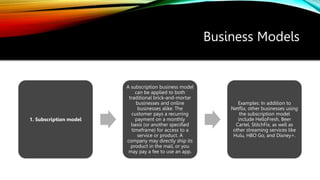
1. Subscription model
A subscription business model
can be applied to both
traditional brick-and-mortar
businesses and online
businesses alike. The
customer pays a recurring
payment on a monthly
basis (or another specified
timeframe) for access to a
service or product. A
company may directly ship its
product in the mail, or you
may pay a fee to use an app.
Examples: In addition to
Netflix, other businesses using
the subscription model
include HelloFresh, Beer
Cartel, StitchFix, as well as
other streaming services like
Hulu, HBO Go, and Disney+.
Business
Models
2. Bundling model
• Exactly like it sounds, the bundling business model
involves companies selling two or more products together
as a single unit, often for a lower price than they would
charge selling the products separately.
• This type of business model allows companies to generate
a greater volume of sales and perhaps market products or
services that are more difficult to sell. However, profit
margins often shrink since businesses sell the products for
less.
• Examples: Businesses that use the bundling model include
AT&T, Adobe Creative Suite and Burger King, as well as
other fast-food companies that offer value meals or deals.
Business Models
3. Freemium model
• The freemium business model has gained popularity with the
prevalence of online and Software-as-a-Service (SaaS)
businesses.
• The basic framework goes like this: a software company hosts
and provides a proprietary tool for their users to freely access,
such as an app or tool suite. However, the company withholds
or limits the use of certain key features that, over time, their
users will likely want to use more regularly. To gain access to
those key features, users must pay for a subscription.
• You can see how Spotify follows this model — it gives users
free and open access to its entire database of music while
sprinkling in ads between songs. At some point, many users
opt to pay a recurring monthly fee for the premium service so
they can stream music without interruption.
• Examples: Spotify, LinkedIn, Skype and MailChimp are all
businesses that use the freemium model.
Business Models
4. Razor blades model
To understand the razor blades
model, you can simply look to your
local store. You’ll notice that
replacement razor blades cost more
than razors themselves.
Companies offer a cheaper razor
with the understanding that you’ll
continue to purchase more
expensive accessories — in this case,
razor blades — in the future. For this
reason, this model is referred to as
the "razor blades model."
In addition to the traditional razor
blades model, you'll also see
companies use the reverse razor
blades model — in which they offer
customers a high-margin product
and then promote the sales of
lower-margin products that
accompany that initial product.
A classic example of this model is
Apple iPhones and Macs — you
purchase the high-margin item, the
phone or computer, and then Apple
pushes additional products, tools,
and services that accompany that
item.
Examples: On top of razor
companies, examples of the general
razor blades model include Keruig,
Brita, Xbox, and printer and ink
companies.
Business Models
5. Product to service model
Imagine that you are the owner of a
company that makes scooters. Let’s say you
need two pieces of metal welded together.
You might ask another company to weld
the pieces of metal together instead of
purchasing a welding machine yourself.
Companies that follow this type of business
model allow customers to purchase a result
rather than the equipment that delivers that
result.
Examples: Companies that use the product
to service model include Socar, Uber, Grab
and LIME
Business
Models
6. Leasing model
Under a leasing business model, a company buys a
product from a seller. That company then allows
another company to use the product they purchased
for a periodic fee. Leasing agreements work best with
big-ticket items like manufacturing and medical
equipment.
Examples: U-Haul, Enterprise and Rent-a-Center are all
examples of companies that use the leasing model.
Business Models
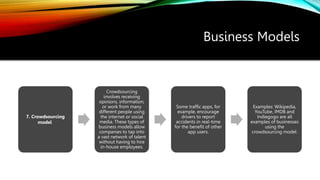
7. Crowdsourcing
model
Crowdsourcing
involves receiving
opinions, information,
or work from many
different people using
the internet or social
media. These types of
business models allow
companies to tap into
a vast network of talent
without having to hire
in-house employees.
Some traffic apps, for
example, encourage
drivers to report
accidents in real-time
for the benefit of other
app users.
Examples: Wikipedia,
YouTube, IMDB and
Indiegogo are all
examples of businesses
using the
crowdsourcing model.
Business
Models
8. One-for-one model
As the name suggests, the one-for-one business model means that a company
donates one item to a charitable cause for every item that is purchased. This
model appeals to the charitable nature and social consciousness of customers
to encourage them to purchase a product or service, while also allowing both
the business and the customer to actually engage in philanthropic efforts.
Blake Mycoskie, the founder of TOMS, pioneered this form of social
entrepreneurship.
Examples: In addition to TOMS, SoapBox, Smile Squared and Warby Parker are
all companies that use this type of business model.
Business Models
9. Franchise model
Of all the different types of business models, the
franchise model is perhaps the one that people are
most familiar with — after all, we each see and
likely visit franchise businesses often in our daily
lives.
In short, a franchise works like this: A franchise is an
established business blueprint that is simply
purchased and reproduced by the buyer, the
franchisee. The franchiser, or original owner, works
with the franchisee to help them with financing,
marketing, and other business operations to ensure
the business functions as it should. In return, the
franchisee pays the franchiser a percentage of the
profits.
Examples: Starbucks, Domino's, Subway,
McDonald's and 7 Eleven are all common examples
of the franchise model.
Business
Models
10. Distribution model
A company operating as a distributor is responsible for taking
manufactured goods to the market.
Hershey’s, for example, manufactures and packages its chocolate,
but distributors are the agents that transfer and sell the goods from
the factory to a retailer. To make a profit, distributors buy the
product in bulk and sell it to retailers at a higher price.
Examples: Other examples of companies that use the distribution
business model are HD Supply, Avent, Cheney Brothers, and ABC
Supply Co.
Business Models
11. Manufacturer model
One of the most traditional business models, the manufacturer model refers to when a
manufacturer converts raw materials into a product.
Companies like Dell Computers or Hewlett-Packard, both of which assemble computers with
parts manufactured by other companies, would still be considered manufacturers.
Examples: Additional examples of this type of business model include Intel, Magic Bullet, Black
+ Decker and LG Electronics.
Business Models
12. Retailer model
The last business model on our list is the retailer model.
A retailer is the last link in the supply chain. These businesses purchase goods from distributors and
then sell them to customers for a price that will both cover expenses and turn a profit. Retailers may
specialize in a particular niche, such as kitchenware, or carry a range of products.
Examples: This is a popular type of business model — used by big-name companies like Aeon,
Mydin, Kinokuniya and MrDIY.
Business
Platform
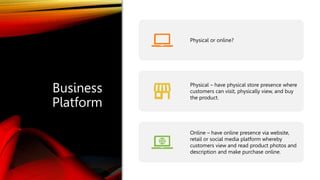
Physical or online?
Physical – have physical store presence where
customers can visit, physically view, and buy
the product.
Online – have online presence via website,
retail or social media platform whereby
customers view and read product photos and
description and make purchase online.
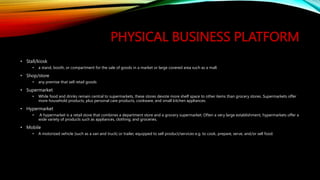
PHYSICAL BUSINESS PLATFORM
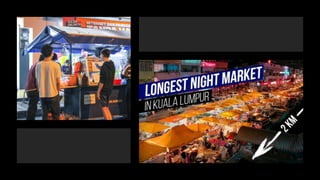
• Stall/kiosk
• a stand, booth, or compartment for the sale of goods in a market or large covered area such as a mall.
• Shop/store
• any premise that sell retail goods
• Supermarket
• While food and drinks remain central to supermarkets, these stores devote more shelf space to other items than grocery stores. Supermarkets offer
more household products, plus personal care products, cookware, and small kitchen appliances.
• Hypermarket
• A hypermarket is a retail store that combines a department store and a grocery supermarket. Often a very large establishment, hypermarkets offer a
wide variety of products such as appliances, clothing, and groceries.
• Mobile
• A motorized vehicle (such as a van and truck) or trailer, equipped to sell product/services e.g. to cook, prepare, serve, and/or sell food.
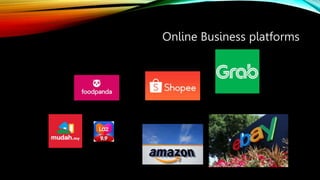
Online Business platforms
Developing the business and business models.pptx

Developing the business and business models.pptx

  • 1.
  • 2.
    Developing The Business • Thereare various aspects need to be decided when a business is developed/started, i.e: 1. Business entity 2. Type of business 3. Mode/location of business
  • 3.
    BUSINESS ENTITY • Choose typeof business entity • Enterprise / sole proprietorship • A sole proprietorship is a business that can be owned and controlled by an individual, a company or a limited liability partnership. There are no partners in the business. The legal status of a sole proprietorship can be defined as follows: It is not a separate legal entity from the business owner • Eg: Ali Enterprise
  • 4.
    Business entity • Partnership A partnership is a formal arrangement by two or more parties to manage and operate a business and share its profits. There are several types of partnership arrangements. In particular, in a partnership business, all partners share liabilities and profits equally, while in others, partners may have limited liability.  E.g.= Ali , Ahmad & Co • Limited Partnership  A limited partnership (LP) exists when two or more partners go into business together, but the limited partners are only liable up to the amount of their investment. An LP is defined as having limited partners and a general partner, which has unlimited liability.  E.g.= Go PLT (LLP)
  • 5.
    Business entity • Private limitedcompany (Sdn Bhd) • A private limited company (Sendirian Berhad or Sdn Bhd) is a separate legal entity from its owners, meaning that it can buy or sell property, enter legal contracts and sue or get sued in courts. • The owners are liable only to the amount they have contributed to the company, and their personal assets or wealth will be left untouched if something happens to the company. • The private limited company is the most common type of entity for foreign investors. Foreigners are permitted to own 100% of the company. However, for some industries, they will need 50% Malaysian ownership. These industries include agriculture, banking, education, oil and gas. • To establish a private limited company, you would need a minimum of one member and a maximum of 50 members. The shares of this type of entity is issued to the individuals or corporate bodies.
  • 6.
    Business entity  Publiclimited company (Bhd) • A public limited company is similar to a private limited company, but the shares of the public limited company can be offered to the public. Public limited companies are usually listed on the stock exchange and is governed by the Securities Commission of Malaysia. • This entity must have a minimum of two shareholders, and the number of members is unlimited. The public limited company must hold annual general meetings and make reports on their financial statements. • There are two types of limited companies in Malaysia: 1. Limited by shares 2. Limited by guarantee
  • 7.
    Business entity  Companies limitedby shares vs companies limited by guarantee • The liability of the members of this entity is limited to the amount contributed on their unpaid shares. If the company goes into liquidation or in debt, the members do not have to pay for the company. • A company limited by guarantee is mostly used for non-profit companies such as charities, clubs or societies. Profits gained from the company will not be distributed to the members of the company. However, profits will be reinvested into the company. If you form a charity organisation with more than 20 people, you must register the organisation with the SSM.  5. Unlimited company (Sdn) • An unlimited company provides unlimited liability to the members and shareholders. If there is any loss or the company is in debt, the members and shareholders will be personally responsible. • An unlimited company may change to a limited company in the case that they pass a special resolution and lodge a notice for conversion with the SSM.
  • 8.
    Business entity • Advantages& disadvantages • Resources –> company = more resources • Management -> company = more complex • Risk -> enterprise riskier – unlimited liability • Control -> enterprise – more control • Credibility -> company more credible & trusted
  • 9.
    BUSINESS MODEL DECISION •What is a business model? • A business model is an outline of how a company plans to make money with its product and customer base in a specific market. A business model explains four things: • What product or service a company will sell. • How it intends to market that product or service. • What kind of expenses it will face. • How it expects to turn a profit.
  • 10.
    COMPONENTS OF A BUSINESS MODEL •10 essential components of a Business Model: • Value proposition: A feature that makes your product attractive to customers. • Target market: A specific group of consumers who would be interested in the product. • Competitive advantage: A unique feature of your product or service that can’t easily be copied by competitors. • Cost structure: A list of the fixed and variable expenses your business requires to function, and how these affect pricing. • Key metrics: The ways your company measures success. • Resources: The physical, financial, and intellectual assets of your company. • Problem and solution: Your target customers’ pain points, and how your company intends to meet them. • Revenue model: A framework that identifies viable income sources to pursue. • Revenue streams: The multiple ways your company can generate income. • Profit margin: The amount your revenue exceeds business costs.
  • 11.
    Types OF BusinessModels • common types of business models: 1. Subscription model 2. Bundling model 3. Freemium model 4. Razor blades model 5. Product to service model 6. Leasing model 7. Crowdsourcing model 8. One-for-one model 9. Franchise model 10. Distribution model 11. Manufacturer model 12. Retailer model
  • 12.
    Business Models 1. Subscriptionmodel A subscription business model can be applied to both traditional brick-and-mortar businesses and online businesses alike. The customer pays a recurring payment on a monthly basis (or another specified timeframe) for access to a service or product. A company may directly ship its product in the mail, or you may pay a fee to use an app. Examples: In addition to Netflix, other businesses using the subscription model include HelloFresh, Beer Cartel, StitchFix, as well as other streaming services like Hulu, HBO Go, and Disney+.
  • 13.
    Business Models 2. Bundling model •Exactly like it sounds, the bundling business model involves companies selling two or more products together as a single unit, often for a lower price than they would charge selling the products separately. • This type of business model allows companies to generate a greater volume of sales and perhaps market products or services that are more difficult to sell. However, profit margins often shrink since businesses sell the products for less. • Examples: Businesses that use the bundling model include AT&T, Adobe Creative Suite and Burger King, as well as other fast-food companies that offer value meals or deals.
  • 14.
    Business Models 3. Freemiummodel • The freemium business model has gained popularity with the prevalence of online and Software-as-a-Service (SaaS) businesses. • The basic framework goes like this: a software company hosts and provides a proprietary tool for their users to freely access, such as an app or tool suite. However, the company withholds or limits the use of certain key features that, over time, their users will likely want to use more regularly. To gain access to those key features, users must pay for a subscription. • You can see how Spotify follows this model — it gives users free and open access to its entire database of music while sprinkling in ads between songs. At some point, many users opt to pay a recurring monthly fee for the premium service so they can stream music without interruption. • Examples: Spotify, LinkedIn, Skype and MailChimp are all businesses that use the freemium model.
  • 15.
    Business Models 4. Razorblades model To understand the razor blades model, you can simply look to your local store. You’ll notice that replacement razor blades cost more than razors themselves. Companies offer a cheaper razor with the understanding that you’ll continue to purchase more expensive accessories — in this case, razor blades — in the future. For this reason, this model is referred to as the "razor blades model." In addition to the traditional razor blades model, you'll also see companies use the reverse razor blades model — in which they offer customers a high-margin product and then promote the sales of lower-margin products that accompany that initial product. A classic example of this model is Apple iPhones and Macs — you purchase the high-margin item, the phone or computer, and then Apple pushes additional products, tools, and services that accompany that item. Examples: On top of razor companies, examples of the general razor blades model include Keruig, Brita, Xbox, and printer and ink companies.
  • 16.
    Business Models 5. Productto service model Imagine that you are the owner of a company that makes scooters. Let’s say you need two pieces of metal welded together. You might ask another company to weld the pieces of metal together instead of purchasing a welding machine yourself. Companies that follow this type of business model allow customers to purchase a result rather than the equipment that delivers that result. Examples: Companies that use the product to service model include Socar, Uber, Grab and LIME
  • 17.
    Business Models 6. Leasing model Undera leasing business model, a company buys a product from a seller. That company then allows another company to use the product they purchased for a periodic fee. Leasing agreements work best with big-ticket items like manufacturing and medical equipment. Examples: U-Haul, Enterprise and Rent-a-Center are all examples of companies that use the leasing model.
  • 18.
    Business Models 7. Crowdsourcing model Crowdsourcing involvesreceiving opinions, information, or work from many different people using the internet or social media. These types of business models allow companies to tap into a vast network of talent without having to hire in-house employees. Some traffic apps, for example, encourage drivers to report accidents in real-time for the benefit of other app users. Examples: Wikipedia, YouTube, IMDB and Indiegogo are all examples of businesses using the crowdsourcing model.
  • 19.
    Business Models 8. One-for-one model Asthe name suggests, the one-for-one business model means that a company donates one item to a charitable cause for every item that is purchased. This model appeals to the charitable nature and social consciousness of customers to encourage them to purchase a product or service, while also allowing both the business and the customer to actually engage in philanthropic efforts. Blake Mycoskie, the founder of TOMS, pioneered this form of social entrepreneurship. Examples: In addition to TOMS, SoapBox, Smile Squared and Warby Parker are all companies that use this type of business model.
  • 20.
    Business Models 9. Franchisemodel Of all the different types of business models, the franchise model is perhaps the one that people are most familiar with — after all, we each see and likely visit franchise businesses often in our daily lives. In short, a franchise works like this: A franchise is an established business blueprint that is simply purchased and reproduced by the buyer, the franchisee. The franchiser, or original owner, works with the franchisee to help them with financing, marketing, and other business operations to ensure the business functions as it should. In return, the franchisee pays the franchiser a percentage of the profits. Examples: Starbucks, Domino's, Subway, McDonald's and 7 Eleven are all common examples of the franchise model.
  • 21.
    Business Models 10. Distribution model Acompany operating as a distributor is responsible for taking manufactured goods to the market. Hershey’s, for example, manufactures and packages its chocolate, but distributors are the agents that transfer and sell the goods from the factory to a retailer. To make a profit, distributors buy the product in bulk and sell it to retailers at a higher price. Examples: Other examples of companies that use the distribution business model are HD Supply, Avent, Cheney Brothers, and ABC Supply Co.
  • 22.
    Business Models 11. Manufacturermodel One of the most traditional business models, the manufacturer model refers to when a manufacturer converts raw materials into a product. Companies like Dell Computers or Hewlett-Packard, both of which assemble computers with parts manufactured by other companies, would still be considered manufacturers. Examples: Additional examples of this type of business model include Intel, Magic Bullet, Black + Decker and LG Electronics.
  • 23.
    Business Models 12. Retailermodel The last business model on our list is the retailer model. A retailer is the last link in the supply chain. These businesses purchase goods from distributors and then sell them to customers for a price that will both cover expenses and turn a profit. Retailers may specialize in a particular niche, such as kitchenware, or carry a range of products. Examples: This is a popular type of business model — used by big-name companies like Aeon, Mydin, Kinokuniya and MrDIY.
  • 24.
    Business Platform Physical or online? Physical– have physical store presence where customers can visit, physically view, and buy the product. Online – have online presence via website, retail or social media platform whereby customers view and read product photos and description and make purchase online.
  • 25.
    PHYSICAL BUSINESS PLATFORM •Stall/kiosk • a stand, booth, or compartment for the sale of goods in a market or large covered area such as a mall. • Shop/store • any premise that sell retail goods • Supermarket • While food and drinks remain central to supermarkets, these stores devote more shelf space to other items than grocery stores. Supermarkets offer more household products, plus personal care products, cookware, and small kitchen appliances. • Hypermarket • A hypermarket is a retail store that combines a department store and a grocery supermarket. Often a very large establishment, hypermarkets offer a wide variety of products such as appliances, clothing, and groceries. • Mobile • A motorized vehicle (such as a van and truck) or trailer, equipped to sell product/services e.g. to cook, prepare, serve, and/or sell food.
  • 26.