
Assignments on

       TYPES OF COMPANIES


                submitted by
               Job Thomas
          Roll No. 8, Semester - 4
             MBA (PT) 2012


                submitted to
          Prof. (Dr.) M.C. Valsan


               for the subject
          SMP 2404 BUSINESS LAW


 SCHOOL OF MANAGEMENT STUDIES
Cochin University of Science and Technology
             Cochin, Kerala
                PIN 682022


                April 2012
2
TYPES OF COMPANIES


Introduction
A company is a group of individuals who come together for a common purpose, mainly
profit making and revenue sharing. The working of a business entity in India is governed
by the Companies Act, 1956. There are various types of business entities defined by the
Indian legal system, such as corporations, sole traders, cooperatives and partnerships.

Definition of a company
 The term 'company' means a group of people working together for some common object
or objects. The purpose for such group to associate are different but the term 'company' is
normally set aside for those linked with economic purpose means to work for the profit
motive. The term company as defined by Lord Justice Lindley as follows: "By a company
is meant an association of many persons who contribute money or money worth to a
common stock and employ it in some trade or business, and who share the profit and loss
(as the case may be) arising there from, The common stock so contributed is denoted in
money and is the capital of the company. The persons who contribute it, or to whom it
belongs, are called members. The proportion of capital to which each member is entitled
is his share. Shares are always transferable although the right to transfer them is often
more or less restricted."

A company is a corporate and legal entity. It is an artificial person created by law
It has a common seal and perpetual succession.


Main features of a company
A Companies Act has special features which differentiate it from the other forms of
organizations. The main characteristics of a company are as:

1) It is the creation of Law.
2) It has a separate Legal Entity:
3) It has a limited liability:
4) It has a perpetual succession:
5) Transferability of Shares:
6) It has a common seal
7) It may sue or be sued under the Company Law.

Classification of companies
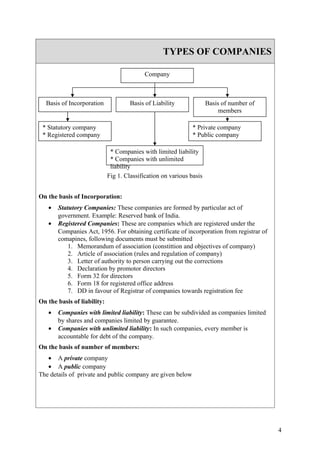
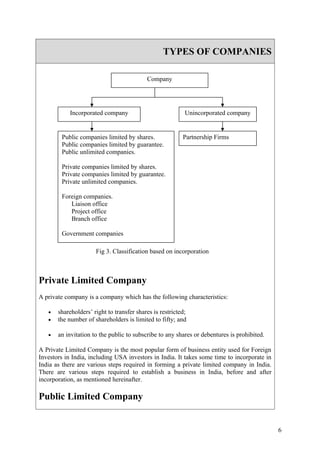
The companies are broadly classified on different basis given by Companies Act, 1956.
The ompanies are classified on the based on incorporation, liability and number of mebers


                                                                                              3
TYPES OF COMPANIES

                                           Company


  Basis of Incorporation              Basis of Liability              Basis of number of
                                                                           members

 * Statutory company                                           * Private company
 * Registered company                                          * Public company

                              * Companies with limited liability
                              * Companies with unlimited
                              liability
                             Fig 1. Classification on various basis


On the basis of Incorporation:
   •   Statutory Companies: These companies are formed by particular act of
       government. Example: Reserved bank of India.
   •   Registered Companies: These are companies which are registered under the
       Companies Act, 1956. For obtaining certificate of incorporation from registrar of
       comapines, following documents must be submitted
           1. Memorandum of association (constittion and objectives of company)
           2. Article of association (rules and regulation of company)
           3. Letter of authority to person carrying out the corrections
           4. Declaration by promotor directors
           5. Form 32 for directors
           6. Form 18 for registered office address
           7. DD in favour of Registrar of companies towards registration fee
On the basis of liability:
   •   Companies with limited liability: These can be subdivided as companies limited
       by shares and companies limited by guarantee.
   •   Companies with unlimited liability: In such companies, every member is
       accountable for debt of the company.
On the basis of number of members:
   • A private company
   • A public company
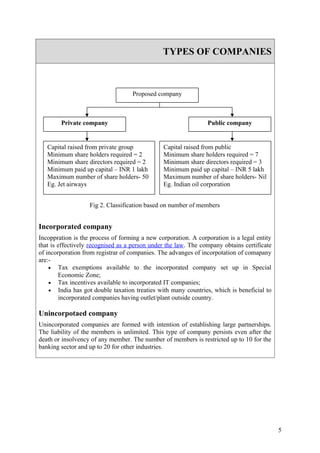
The details of private and public company are given below


                                                                                           4
TYPES OF COMPANIES


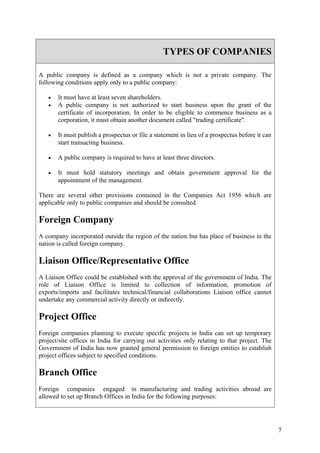
                                   Proposed company


        Private company                                         Public company


   Capital raised from private group           Capital raised from public
   Minimum share holders required = 2          Minimum share holders required = 7
   Minimum share directors required = 2        Minimum share directors required = 3
   Minimum paid up capital – INR 1 lakh        Minimum paid up capital – INR 5 lakh
   Maximum number of share holders- 50         Maximum number of share holders- Nil
   Eg. Jet airways                             Eg. Indian oil corporation


                   Fig 2. Classification based on number of members


Incorporated company
Incoppration is the process of forming a new corporation. A corporation is a legal entity
that is effectively recognised as a person under the law. The company obtains certificate
of incorporation from registrar of companies. The advanges of incorpotation of comapany
are:-
    • Tax exemptions available to the incorporated company set up in Special
        Economic Zone;
    • Tax incentives available to incorporated IT companies;
    • India has got double taxation treaties with many countries, which is beneficial to
        incorporated companies having outlet/plant outside country.

Unincorpotaed company
Unincorporated companies are formed with intention of establishing large partnerships.
The liability of the members is unlimited. This type of company persists even after the
death or insolvency of any member. The number of members is restricted up to 10 for the
banking sector and up to 20 for other industries.


                                                                                            5
TYPES OF COMPANIES

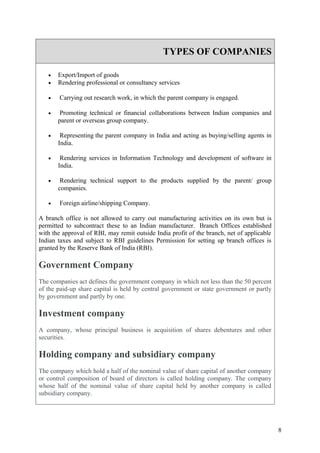
                                           Company


            Incorporated company                           Unincorporated company


        Public companies limited by shares.               Partnership Firms
        Public companies limited by guarantee.
        Public unlimited companies.

        Private companies limited by shares.
        Private companies limited by guarantee.
        Private unlimited companies.

        Foreign companies.
           Liaison office
           Project office
           Branch office

        Government companies

                      Fig 3. Classification based on incorporation


Private Limited Company
A private company is a company which has the following characteristics:

   •   shareholders’ right to transfer shares is restricted;
   •   the number of shareholders is limited to fifty; and

   •   an invitation to the public to subscribe to any shares or debentures is prohibited.

A Private Limited Company is the most popular form of business entity used for Foreign
Investors in India, including USA investors in India. It takes some time to incorporate in
India as there are various steps required in forming a private limited company in India.
There are various steps required to establish a business in India, before and after
incorporation, as mentioned hereinafter.

Public Limited Company


                                                                                             6
TYPES OF COMPANIES

A public company is defined as a company which is not a private company. The
following conditions apply only to a public company:

   •   It must have at least seven shareholders.
   •   A public company is not authorized to start business upon the grant of the
       certificate of incorporation. In order to be eligible to commence business as a
       corporation, it must obtain another document called "trading certificate".

   •   It must publish a prospectus or file a statement in lieu of a prospectus before it can
       start transacting business.

   •   A public company is required to have at least three directors.

   •   It must hold statutory meetings and obtain government approval for the
       appointment of the management.

There are several other provisions contained in the Companies Act 1956 which are
applicable only to public companies and should be consulted.

Foreign Company
A company incorporated outside the region of the nation but has place of business in the
nation is called foreign company.

Liaison Office/Representative Office
A Liaison Office could be established with the approval of the government of India. The
role of Liaison Office is limited to collection of information, promotion of
exports/imports and facilitates technical/financial collaborations Liaison office cannot
undertake any commercial activity directly or indirectly.

Project Office
Foreign companies planning to execute specific projects in India can set up temporary
project/site offices in India for carrying out activities only relating to that project. The
Government of India has now granted general permission to foreign entities to establish
project offices subject to specified conditions.

Branch Office
Foreign companies engaged in manufacturing and trading activities abroad are
allowed to set up Branch Offices in India for the following purposes:


                                                                                                7
TYPES OF COMPANIES

   •   Export/Import of goods
   •   Rendering professional or consultancy services

   •    Carrying out research work, in which the parent company is engaged.

   •    Promoting technical or financial collaborations between Indian companies and
       parent or overseas group company.

   •    Representing the parent company in India and acting as buying/selling agents in
       India.

   •    Rendering services in Information Technology and development of software in
       India.

   •    Rendering technical support to the products supplied by the parent/ group
       companies.

   •    Foreign airline/shipping Company.

A branch office is not allowed to carry out manufacturing activities on its own but is
permitted to subcontract these to an Indian manufacturer. Branch Offices established
with the approval of RBI, may remit outside India profit of the branch, net of applicable
Indian taxes and subject to RBI guidelines Permission for setting up branch offices is
granted by the Reserve Bank of India (RBI).

Government Company
The companies act defines the government company in which not less than the 50 percent
of the paid-up share capital is held by central government or state government or partly
by government and partly by one.

Investment company
A company, whose principal business is acquisition of shares debentures and other
securities.

Holding company and subsidiary company
The company which hold a half of the nominal value of share capital of another company
or control composition of board of directors is called holding company. The company
whose half of the nominal value of share capital held by another company is called
subsidiary company.


                                                                                            8
TYPES OF COMPANIES

Limited Liability Partnership (LLP)
A law to allow "Limited Liability Partnership" (LLP) in India has been enacted by the
Parliament of India recently. (Limited Liability Partnership (LLP) Act of 2008).

LLP is an alternative corporate business entity that provides the benefits of limited
liability of a company but allows its members the flexibility of organizing their internal
management on the basis of a mutually-arrived agreement, as is the case in a partnership
firm.

This format would be quite useful for small and medium enterprises in general and for the
enterprises in services sector in particular, including professionals and knowledge based
enterprises.

As proposed in the Bill, LLP shall be a body corporate and a legal entity separate from its
partners. It will have perpetual succession. While the LLP will be a separate legal entity,
liable to the full extent of its assets, the liability of the partners would be limited to their
agreed contribution in the LLP.

Further, no partner would be liable on account of the independent or unauthorized actions
of other partners, thus allowing individual partners to be shielded from joint liability
created by another partner’s wrongful business decisions or misconduct.


                                                                                                   9
Requirements for a Private Limited Company
  1. A Registered Business Name: This must be followed by the word ‘Limited' or ‘Ltd'.
     The Companies Registration Office exercises some control over the choice of name, it
     cannot be identical (or very similar to) the name of an existing company. It won't be
     considered if it is offensive or illegal and the use of certain words in a company (for
     example, `Institute', `National') can only be used in certain circumstances. The
     company name must be displayed in a conspicuous place at every office, or other
     premises where the company carries out business.


  2. A Registered Office: This need not necessarily be the same address as the business is
     conducted from. Quite frequently the address used for the registered office is that of
     the firm's solicitor or accountant. This is the address, through, where all official
     correspondence will go.


  3. Shareholders: There must be a minimum of two shareholders (also described as
     `members' or `subscribers'). A private company can have up to fifty shareholders.


  4. Share Capital: The company must be formed with a stated, nominal share capital
     divided into shares of fixed amounts. Small companies are frequently formed with a
     nominal share capital of Rs.100.


  5. Memorandum of Association: The memorandum is the company's charter. It states the
     company's name; the situation of its registered office; its share capital; the fact that
     liability is limited and, most importantly, the object for which the company has been
     formed. In theory, the company can only operate in the areas mentioned in the objects
     clause but in practice the clause is drawn to cover as wide an area as possible, and
     anyway a 75 per cent majority of the members of the company can change the objects
     whenever they like. Nevertheless, it is worth bearing in mind that directors of the
     company will incur personal liability if the company engages in a type of business
     which is not authorized by the objects clause. The memorandum must be signed by at
     least three shareholders.


  6. Articles of Association: The document contains the internal regulations of the
     company, the relationship of the company to its shareholders and the relationship
     between the individual shareholders. Many companies don't bother to draw up their
     own articles but adopt (sometimes with some modifications) articles set out in the
     Companies Act.


                                                                                          10
7. Certificate of Incorporation: This is the document, which the registrar of companies
      issues to you once he has approved your choice of name and your memorandum.
      When you receive this document your company legally exists and is ready to trade.


   8. Auditors: Every company must appoint a qualified auditor. The auditor's duty is to
      report to the treasurer whether or not the books of the company have been properly
      kept, and that the balance sheet and profit and loss account presents (or doesn't
      present) a true and fair view of the company's affairs and complies with the
      Companies Act. Auditors are appointed or re-appointed at general meetings at which
      annual accounts are presented, and they hold office from the conclusion of the
      meeting until the next general meeting.


   9. Accounts: The Companies Act lays down strict rules on accounting. Every company
      must maintain a set of records, which show the financial position at any one time with
      reasonable accuracy. The accounts comprise a profit and loss account and balance
      sheet with the auditors' and directors' reports appended. A new company's accounting
      reference period begins on its incorporation and runs until the following 31st March -
      unless the company notifies the registrar of companies otherwise. Within ten months
      of the end of an accounting reference period, an audited set of accounts must be laid
      before the shareholders at a general meeting and a set delivered to the registrar of
      companies.


   10. Registers, etc.: In addition to the accounts books, companies are required to have: a
       register of members and share ledger; a register of directors and secretaries; a register
       of share transfers; a register of charges; a register of debenture holders; a book can be
       purchased to hold all of the above. This will be provided automatically if you buy a
       running concern.


   11. Company Seal: All companies must have an engraved seal. This must be impressed
       on share certificates and must be used whenever the company has to execute a deed.
       Again, this is included in the ready-made company package.


Corporate Documents & Registration of a Company
For incorporating a company in India, an application for registration should be submitted to
the registrar of companies with the following documents:

1. Memorandum of Association;


                                                                                              11
2. Articles of Association;

3. a declaration signed by a person named in the articles of the proposed company as a
director, manager, or secretary of the company, or by an advocate of the Supreme Court or
High Court, or by an attorney entitled to appear before the High Court, or by a chartered
accountant practicing in India stating that all the requirements of the Companies Act 1956
and the applicable rules with respect to the registration and other matters have been complied
with;

4. a list of persons who have consented to act as directors of the company.

5. if the proposed company is a public company, consent of very person prepared to act as a
director must be submitted in a prescribed form;

6. information about directors, managing directors and managers and secretary must be
submitted in a prescribed form;

7. information about the registered office in a prescribed form;

8. power of attorney in favor of one of the promoters or any other person, authorizing him/her
to make corrections in the documents submitted to the registrar of the companies, if it
becomes necessary; and

9. applicable registration fee payable to the registrar of the companies.


                                                                                            12

Business Law

  • 1.
    Assignments on TYPES OF COMPANIES submitted by Job Thomas Roll No. 8, Semester - 4 MBA (PT) 2012 submitted to Prof. (Dr.) M.C. Valsan for the subject SMP 2404 BUSINESS LAW SCHOOL OF MANAGEMENT STUDIES Cochin University of Science and Technology Cochin, Kerala PIN 682022 April 2012
  • 2.
  • 3.
    TYPES OF COMPANIES Introduction Acompany is a group of individuals who come together for a common purpose, mainly profit making and revenue sharing. The working of a business entity in India is governed by the Companies Act, 1956. There are various types of business entities defined by the Indian legal system, such as corporations, sole traders, cooperatives and partnerships. Definition of a company The term 'company' means a group of people working together for some common object or objects. The purpose for such group to associate are different but the term 'company' is normally set aside for those linked with economic purpose means to work for the profit motive. The term company as defined by Lord Justice Lindley as follows: "By a company is meant an association of many persons who contribute money or money worth to a common stock and employ it in some trade or business, and who share the profit and loss (as the case may be) arising there from, The common stock so contributed is denoted in money and is the capital of the company. The persons who contribute it, or to whom it belongs, are called members. The proportion of capital to which each member is entitled is his share. Shares are always transferable although the right to transfer them is often more or less restricted." A company is a corporate and legal entity. It is an artificial person created by law It has a common seal and perpetual succession. Main features of a company A Companies Act has special features which differentiate it from the other forms of organizations. The main characteristics of a company are as: 1) It is the creation of Law. 2) It has a separate Legal Entity: 3) It has a limited liability: 4) It has a perpetual succession: 5) Transferability of Shares: 6) It has a common seal 7) It may sue or be sued under the Company Law. Classification of companies The companies are broadly classified on different basis given by Companies Act, 1956. The ompanies are classified on the based on incorporation, liability and number of mebers 3
  • 4.
    TYPES OF COMPANIES Company Basis of Incorporation Basis of Liability Basis of number of members * Statutory company * Private company * Registered company * Public company * Companies with limited liability * Companies with unlimited liability Fig 1. Classification on various basis On the basis of Incorporation: • Statutory Companies: These companies are formed by particular act of government. Example: Reserved bank of India. • Registered Companies: These are companies which are registered under the Companies Act, 1956. For obtaining certificate of incorporation from registrar of comapines, following documents must be submitted 1. Memorandum of association (constittion and objectives of company) 2. Article of association (rules and regulation of company) 3. Letter of authority to person carrying out the corrections 4. Declaration by promotor directors 5. Form 32 for directors 6. Form 18 for registered office address 7. DD in favour of Registrar of companies towards registration fee On the basis of liability: • Companies with limited liability: These can be subdivided as companies limited by shares and companies limited by guarantee. • Companies with unlimited liability: In such companies, every member is accountable for debt of the company. On the basis of number of members: • A private company • A public company The details of private and public company are given below 4
  • 5.
    TYPES OF COMPANIES Proposed company Private company Public company Capital raised from private group Capital raised from public Minimum share holders required = 2 Minimum share holders required = 7 Minimum share directors required = 2 Minimum share directors required = 3 Minimum paid up capital – INR 1 lakh Minimum paid up capital – INR 5 lakh Maximum number of share holders- 50 Maximum number of share holders- Nil Eg. Jet airways Eg. Indian oil corporation Fig 2. Classification based on number of members Incorporated company Incoppration is the process of forming a new corporation. A corporation is a legal entity that is effectively recognised as a person under the law. The company obtains certificate of incorporation from registrar of companies. The advanges of incorpotation of comapany are:- • Tax exemptions available to the incorporated company set up in Special Economic Zone; • Tax incentives available to incorporated IT companies; • India has got double taxation treaties with many countries, which is beneficial to incorporated companies having outlet/plant outside country. Unincorpotaed company Unincorporated companies are formed with intention of establishing large partnerships. The liability of the members is unlimited. This type of company persists even after the death or insolvency of any member. The number of members is restricted up to 10 for the banking sector and up to 20 for other industries. 5
  • 6.
    TYPES OF COMPANIES Company Incorporated company Unincorporated company Public companies limited by shares. Partnership Firms Public companies limited by guarantee. Public unlimited companies. Private companies limited by shares. Private companies limited by guarantee. Private unlimited companies. Foreign companies. Liaison office Project office Branch office Government companies Fig 3. Classification based on incorporation Private Limited Company A private company is a company which has the following characteristics: • shareholders’ right to transfer shares is restricted; • the number of shareholders is limited to fifty; and • an invitation to the public to subscribe to any shares or debentures is prohibited. A Private Limited Company is the most popular form of business entity used for Foreign Investors in India, including USA investors in India. It takes some time to incorporate in India as there are various steps required in forming a private limited company in India. There are various steps required to establish a business in India, before and after incorporation, as mentioned hereinafter. Public Limited Company 6
  • 7.
    TYPES OF COMPANIES Apublic company is defined as a company which is not a private company. The following conditions apply only to a public company: • It must have at least seven shareholders. • A public company is not authorized to start business upon the grant of the certificate of incorporation. In order to be eligible to commence business as a corporation, it must obtain another document called "trading certificate". • It must publish a prospectus or file a statement in lieu of a prospectus before it can start transacting business. • A public company is required to have at least three directors. • It must hold statutory meetings and obtain government approval for the appointment of the management. There are several other provisions contained in the Companies Act 1956 which are applicable only to public companies and should be consulted. Foreign Company A company incorporated outside the region of the nation but has place of business in the nation is called foreign company. Liaison Office/Representative Office A Liaison Office could be established with the approval of the government of India. The role of Liaison Office is limited to collection of information, promotion of exports/imports and facilitates technical/financial collaborations Liaison office cannot undertake any commercial activity directly or indirectly. Project Office Foreign companies planning to execute specific projects in India can set up temporary project/site offices in India for carrying out activities only relating to that project. The Government of India has now granted general permission to foreign entities to establish project offices subject to specified conditions. Branch Office Foreign companies engaged in manufacturing and trading activities abroad are allowed to set up Branch Offices in India for the following purposes: 7
  • 8.
    TYPES OF COMPANIES • Export/Import of goods • Rendering professional or consultancy services • Carrying out research work, in which the parent company is engaged. • Promoting technical or financial collaborations between Indian companies and parent or overseas group company. • Representing the parent company in India and acting as buying/selling agents in India. • Rendering services in Information Technology and development of software in India. • Rendering technical support to the products supplied by the parent/ group companies. • Foreign airline/shipping Company. A branch office is not allowed to carry out manufacturing activities on its own but is permitted to subcontract these to an Indian manufacturer. Branch Offices established with the approval of RBI, may remit outside India profit of the branch, net of applicable Indian taxes and subject to RBI guidelines Permission for setting up branch offices is granted by the Reserve Bank of India (RBI). Government Company The companies act defines the government company in which not less than the 50 percent of the paid-up share capital is held by central government or state government or partly by government and partly by one. Investment company A company, whose principal business is acquisition of shares debentures and other securities. Holding company and subsidiary company The company which hold a half of the nominal value of share capital of another company or control composition of board of directors is called holding company. The company whose half of the nominal value of share capital held by another company is called subsidiary company. 8
  • 9.
    TYPES OF COMPANIES LimitedLiability Partnership (LLP) A law to allow "Limited Liability Partnership" (LLP) in India has been enacted by the Parliament of India recently. (Limited Liability Partnership (LLP) Act of 2008). LLP is an alternative corporate business entity that provides the benefits of limited liability of a company but allows its members the flexibility of organizing their internal management on the basis of a mutually-arrived agreement, as is the case in a partnership firm. This format would be quite useful for small and medium enterprises in general and for the enterprises in services sector in particular, including professionals and knowledge based enterprises. As proposed in the Bill, LLP shall be a body corporate and a legal entity separate from its partners. It will have perpetual succession. While the LLP will be a separate legal entity, liable to the full extent of its assets, the liability of the partners would be limited to their agreed contribution in the LLP. Further, no partner would be liable on account of the independent or unauthorized actions of other partners, thus allowing individual partners to be shielded from joint liability created by another partner’s wrongful business decisions or misconduct. 9
  • 10.
    Requirements for aPrivate Limited Company 1. A Registered Business Name: This must be followed by the word ‘Limited' or ‘Ltd'. The Companies Registration Office exercises some control over the choice of name, it cannot be identical (or very similar to) the name of an existing company. It won't be considered if it is offensive or illegal and the use of certain words in a company (for example, `Institute', `National') can only be used in certain circumstances. The company name must be displayed in a conspicuous place at every office, or other premises where the company carries out business. 2. A Registered Office: This need not necessarily be the same address as the business is conducted from. Quite frequently the address used for the registered office is that of the firm's solicitor or accountant. This is the address, through, where all official correspondence will go. 3. Shareholders: There must be a minimum of two shareholders (also described as `members' or `subscribers'). A private company can have up to fifty shareholders. 4. Share Capital: The company must be formed with a stated, nominal share capital divided into shares of fixed amounts. Small companies are frequently formed with a nominal share capital of Rs.100. 5. Memorandum of Association: The memorandum is the company's charter. It states the company's name; the situation of its registered office; its share capital; the fact that liability is limited and, most importantly, the object for which the company has been formed. In theory, the company can only operate in the areas mentioned in the objects clause but in practice the clause is drawn to cover as wide an area as possible, and anyway a 75 per cent majority of the members of the company can change the objects whenever they like. Nevertheless, it is worth bearing in mind that directors of the company will incur personal liability if the company engages in a type of business which is not authorized by the objects clause. The memorandum must be signed by at least three shareholders. 6. Articles of Association: The document contains the internal regulations of the company, the relationship of the company to its shareholders and the relationship between the individual shareholders. Many companies don't bother to draw up their own articles but adopt (sometimes with some modifications) articles set out in the Companies Act. 10
  • 11.
    7. Certificate ofIncorporation: This is the document, which the registrar of companies issues to you once he has approved your choice of name and your memorandum. When you receive this document your company legally exists and is ready to trade. 8. Auditors: Every company must appoint a qualified auditor. The auditor's duty is to report to the treasurer whether or not the books of the company have been properly kept, and that the balance sheet and profit and loss account presents (or doesn't present) a true and fair view of the company's affairs and complies with the Companies Act. Auditors are appointed or re-appointed at general meetings at which annual accounts are presented, and they hold office from the conclusion of the meeting until the next general meeting. 9. Accounts: The Companies Act lays down strict rules on accounting. Every company must maintain a set of records, which show the financial position at any one time with reasonable accuracy. The accounts comprise a profit and loss account and balance sheet with the auditors' and directors' reports appended. A new company's accounting reference period begins on its incorporation and runs until the following 31st March - unless the company notifies the registrar of companies otherwise. Within ten months of the end of an accounting reference period, an audited set of accounts must be laid before the shareholders at a general meeting and a set delivered to the registrar of companies. 10. Registers, etc.: In addition to the accounts books, companies are required to have: a register of members and share ledger; a register of directors and secretaries; a register of share transfers; a register of charges; a register of debenture holders; a book can be purchased to hold all of the above. This will be provided automatically if you buy a running concern. 11. Company Seal: All companies must have an engraved seal. This must be impressed on share certificates and must be used whenever the company has to execute a deed. Again, this is included in the ready-made company package. Corporate Documents & Registration of a Company For incorporating a company in India, an application for registration should be submitted to the registrar of companies with the following documents: 1. Memorandum of Association; 11
  • 12.
    2. Articles ofAssociation; 3. a declaration signed by a person named in the articles of the proposed company as a director, manager, or secretary of the company, or by an advocate of the Supreme Court or High Court, or by an attorney entitled to appear before the High Court, or by a chartered accountant practicing in India stating that all the requirements of the Companies Act 1956 and the applicable rules with respect to the registration and other matters have been complied with; 4. a list of persons who have consented to act as directors of the company. 5. if the proposed company is a public company, consent of very person prepared to act as a director must be submitted in a prescribed form; 6. information about directors, managing directors and managers and secretary must be submitted in a prescribed form; 7. information about the registered office in a prescribed form; 8. power of attorney in favor of one of the promoters or any other person, authorizing him/her to make corrections in the documents submitted to the registrar of the companies, if it becomes necessary; and 9. applicable registration fee payable to the registrar of the companies. 12