Business Continuity

   The nine step process to develop a tactical
   business resumption plan
Do you know…
   y
  What your business critical functions and
         y
  dependencies are to deliver your products and
  services?
  Who are your key resources to support these
  critical functions? And at what level?
  What’s the threshold before it impacts your
  business? Wh t’ your plan after th
  b i        ? What’s        l   ft the
  threshold has been passed?
  The t ue impact to you bus ess To the
     e true pact your business? o t e
  company?
  What’s your appetite for risk? Is there a plan in
  place?
                                                      2
The business need…real example
                           p
  In 2007, internal audit finding recommended
          ,                     g
  that Treasury develop a more comprehensive
  BCP to cover critical cash and FX related
  functions.
  functions

  During the FY09 fiscal year end a key
                              end,
  Treasury file server was unavailable
    The cash positioning system (
             p         g y      (Chase Insight) was
                                           g )
    unavailable
    Key spreadsheets to make cash flow decisions was
    inaccessible

                                                       3
The scenarios (the by-product of a disaster)

       Loss of technology
                       gy
              Systems, applications, equipment, etc.
       Loss of resource
              Internal staff
              Internal business partner
              External business partner (vendor)
       Loss of communication
              Phone, fax, email
       Loss of facility
              Inability to get to or into the office
   There could be cases where a disaster could result in multiple combinations of these scenarios


                                                                                                    4
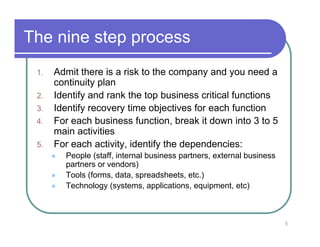
The nine step p
            p process
 1.   Admit there is a risk to the company and you need a
                                       p y       y
      continuity plan
 2.   Identify and rank the top business critical functions
 3.
 3    Identify recovery time objectives for each function
 4.   For each business function, break it down into 3 to 5
      main activities
 5.   For each activity, identify the dependencies:
        People (staff, internal business partners, external business
        partners or vendors)
        Tools (forms, data, spreadsheets, etc.)
        Technology (systems, applications, equipment, etc)


                                                                       5
The nine step process (continued)

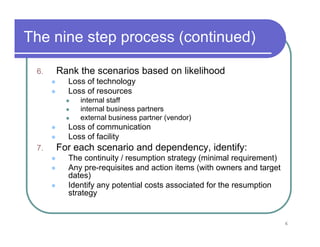
 6.   Rank the scenarios based on likelihood
        Loss of technology
        Loss of resources
           internal staff
           internal business partners
           external business partner (vendor)
        Loss of communication
        Loss of facility
 7.   For each scenario and dependency, identify:
        The continuity / resumption strategy (minimal requirement)
        Any pre requisites and action items (with owners and target
             pre-requisites
        dates)
        Identify any potential costs associated for the resumption
        strategy


                                                                      6
The nine step process (continued)

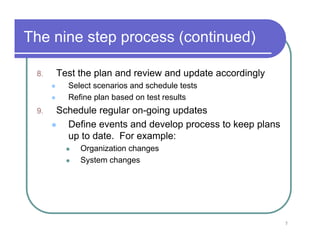
 8.   Test the plan and review and update accordingly
               p                    p             gy
        Select scenarios and schedule tests
        Refine plan based on test results
 9.
 9    Schedule
      S h d l regular on-going updates
                    l       i    d t
        Define events and develop process to keep plans
        up to date. For example:
           Organization changes
           System changes


                                                          7
Session output template (per function)


  From here, the department created detailed documents outlining procedures
  and steps and created a bi d and CD th t was di t ib t d t k resources.
    d t        d    t d binder d        that     distributed to key

                                                                         8
Lessons learned
  The business has to want to have a business
  continuity plan
      ti it l
  Don’t plan for each type a disaster, but plan for the by-
  product of the disaster (scenario)
  Keep it simple (don’t get to granular on processes,
  activities or combine scenarios, etc)
  Keep focused (don’t cross processes, activities and
  dependencies)   )
  Keep the resumption plan to the minimal. Just what’s
  needed to keep the business running
  Let the business use their own terminology
  You don’t need a official project, it can be done weekly
  across several months

                                                              9
Key findings
  y       g

   Process and system improvements
   opportunities
   Processes have many more dependencies
                        y           p
   (people, technology and tools) than you
   realized
   Many of the mitigation activities are simple –
   hard copy back-ups, documentation, training
   and communication / awareness
     d           i i
   And a real appreciation on how all this works!

                                                    10

Business Continuity The 9 Step Process

  • 1.
    Business Continuity The nine step process to develop a tactical business resumption plan
  • 2.
    Do you know… y What your business critical functions and y dependencies are to deliver your products and services? Who are your key resources to support these critical functions? And at what level? What’s the threshold before it impacts your business? Wh t’ your plan after th b i ? What’s l ft the threshold has been passed? The t ue impact to you bus ess To the e true pact your business? o t e company? What’s your appetite for risk? Is there a plan in place? 2
  • 3.
    The business need…realexample p In 2007, internal audit finding recommended , g that Treasury develop a more comprehensive BCP to cover critical cash and FX related functions. functions During the FY09 fiscal year end a key end, Treasury file server was unavailable The cash positioning system ( p g y (Chase Insight) was g ) unavailable Key spreadsheets to make cash flow decisions was inaccessible 3
  • 4.
    The scenarios (theby-product of a disaster) Loss of technology gy Systems, applications, equipment, etc. Loss of resource Internal staff Internal business partner External business partner (vendor) Loss of communication Phone, fax, email Loss of facility Inability to get to or into the office There could be cases where a disaster could result in multiple combinations of these scenarios 4
  • 5.
    The nine stepp p process 1. Admit there is a risk to the company and you need a p y y continuity plan 2. Identify and rank the top business critical functions 3. 3 Identify recovery time objectives for each function 4. For each business function, break it down into 3 to 5 main activities 5. For each activity, identify the dependencies: People (staff, internal business partners, external business partners or vendors) Tools (forms, data, spreadsheets, etc.) Technology (systems, applications, equipment, etc) 5
  • 6.
    The nine stepprocess (continued) 6. Rank the scenarios based on likelihood Loss of technology Loss of resources internal staff internal business partners external business partner (vendor) Loss of communication Loss of facility 7. For each scenario and dependency, identify: The continuity / resumption strategy (minimal requirement) Any pre requisites and action items (with owners and target pre-requisites dates) Identify any potential costs associated for the resumption strategy 6
  • 7.
    The nine stepprocess (continued) 8. Test the plan and review and update accordingly p p gy Select scenarios and schedule tests Refine plan based on test results 9. 9 Schedule S h d l regular on-going updates l i d t Define events and develop process to keep plans up to date. For example: Organization changes System changes 7
  • 8.
    Session output template(per function) From here, the department created detailed documents outlining procedures and steps and created a bi d and CD th t was di t ib t d t k resources. d t d t d binder d that distributed to key 8
  • 9.
    Lessons learned The business has to want to have a business continuity plan ti it l Don’t plan for each type a disaster, but plan for the by- product of the disaster (scenario) Keep it simple (don’t get to granular on processes, activities or combine scenarios, etc) Keep focused (don’t cross processes, activities and dependencies) ) Keep the resumption plan to the minimal. Just what’s needed to keep the business running Let the business use their own terminology You don’t need a official project, it can be done weekly across several months 9
  • 10.
    Key findings y g Process and system improvements opportunities Processes have many more dependencies y p (people, technology and tools) than you realized Many of the mitigation activities are simple – hard copy back-ups, documentation, training and communication / awareness d i i And a real appreciation on how all this works! 10