David L. Burrows &   Eleanor Stubley A  Group C   review…
David L. Burrows Book:   Sound, Speech, and Music KEY TERM : “ SOUND”  – the foundation for musical expression and thought KEY THOUGHT :  “ . . the distinctiveness of human beings as a species — in particular their capacity for free-wheeling and wide-ranging thought — is to a great extent an outgrowth of the distinctiveness of the way they use sound, itself distinctive in a number of ways among the senses."
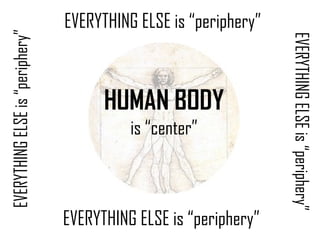
HUMAN BODY is “center” EVERYTHING ELSE is “periphery” EVERYTHING ELSE is “periphery” EVERYTHING ELSE is “periphery” EVERYTHING ELSE is “periphery”
Experiential fields of  CENTER/PERIPHERY   scheme FIELD 1  –  Physical space; the material world in which the body resides FIELD 2  –  Mental space; meta-sensory realm; opens “here & now” to “past/future” FIELD 3  –  Spirit; sense of self; center is everywhere; mystical view
In other words…. Field 1  – the view from here… Field 2   – the view from anywhere you can  imagine … Field 3   – The view from everywhere…
SOUND Sound makes human mental & spiritual life possible Speech is the ideal vehicle for shaping mental life But why  sound   and not  sight ?
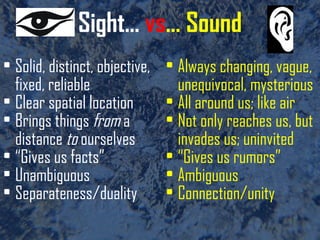
Sight…   vs … Sound Solid, distinct, objective, fixed, reliable Clear spatial location Brings things  from  a distance  to  ourselves “ Gives us facts” Unambiguous Separateness/duality Always changing, vague, unequivocal, mysterious All around us; like air Not only reaches us, but invades us; uninvited “ Gives us rumors” Ambiguous Connection/unity
Sound is more intimate “ Sight draws me out… sound finds me here.” “ Seeing is like touching… hearing is like being touched.” Can be soothing OR unsettling, but either way, it’s always invasive
Sound is more unifying Sound contributes to our sense of belonging in the world Sight emphasizes “me/you,” “I/it,” “here/there,” but sound breaks down these dualities of perception.
Sound is more human Sound reaches us… “with some of  the same surge and flux I know in myself. I am not alone in being under way, growing and fading, pausing, then starting up again, and I feel confirmed .” “Sound sends the message that we are not alone” “Music matters so much because of sound's immediacy… and inwardness: its capacity to touch the vital center of our being — who we are.”
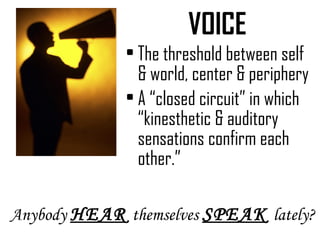
VOICE The threshold between self & world, center & periphery A “closed circuit” in which “kinesthetic & auditory sensations confirm each other.” Anybody  HEAR   themselves  SPEAK   lately?
Why do people enjoy humming? It provides "a sustaining sense of self-sufficiency and self-celebration.” “ People who hum or whistle to themselves can achieve a temporary omniscience, since they are provisionally  both self and other .” 
Innocence LOST The  written word  “leaches the voice out of articulated thought.” It takes away  spoken  words’ “sensuous particularity,” and their attachment to the “personal world.” Music scores , likewise, are selective and partial, suppressing details offered by sound.
THE  PROBLEM  WITH  PHILOSOPHICAL DESCRIPTION “ Verbal accounts — the stuff of philosophy — endeavor to explore both music's acoustic and experiential dimensions, yet encounter an immense gap when they encounter  music's dynamic, processual character .  Music… is like  "an ongoing experiment in pushing change as far as it can coherently be taken":  a fact that invariably frustrates the human need to fix and locate things.”
Innocence FOUND! The sound of music  (NOT the movie)  offers freedom from deterministic forces – the limits of books and scores (remember slide 6, the contrast b/w sight and sound?) QUOTE: “While we  talk  our way out of innocence, we can  sing  our way back in.”
Eleanor Stubley KEY TERM : “ BODY”  – music’s partner in the act of music-making KEY THOUGHT : “ A true understanding of the significance of musical performance requires that we get inside the field where the action occurs, a field that is at once physical, mental, and spiritual.”
BODY Source of movements which define a musician’s self-awareness and sense of being VOICE Our way of “being in the sound.”
At the  HEART   of music… … is a sense of play which consists in a distinctive experience of self. Playing music is "an on-going tuning process in which the self is experienced as an  identity in the making ."
BODY and MUSIC inform each other in the act of music-making Performance is not just a physical feat where the body mechanically obeys the mind Performance isn’t just intellectual interpretation of the score. Players are “trying to get a sense of who they are in relationship to the music.”
Stubley emphasizes the importance of personal experience and argues for our BODIES as a central element in musical experience… … is there a term for this approach?
“ PHENOMOLOGY” From TWO Greek words:   phainómenon ,  meaning "that which appears“ lógos , meaning "study". Personal experience  is what validates all truths - including those which purport to be “absolute” and “objective.”
PHENOMOLOGY  (grounded in personal experience) is the opposite of  PHILOSOPHY  which tries to argue “for everyone, everywhere, for all times.” NOTE:
“ PHENOMOLOGY” But subjective doesn’t always mean “private.” Phenomology studies reactions among all people in order to find  commonalities . BUT no matter what, it is DETERMINED to “ground itself in firsthand musical experience.”
MARK JOHNSON: A phenomological philosopher    Body isn’t just a container for the mind… rather, the  body  is in the  mind QUOTE:  "Our reality is shaped by the patterns of our bodily movement, the contours of our spatial and temporal orientation, and the forms of our interactions with objects. It is never merely a matter of abstract conceptualization…"
A stinging critique of the OBJECTIVIST approach “ The objectivist ideal of a god's-eye view and an experience of reality that somehow avoids perspectival situatedness and partiality is not just  a perverse piece of logic ; it fails miserably to account for the richness and multivalence of meanings, and the importance of discovering or creating new ones. A knowledge without a knower would not be a human knowledge at all. Human knowledge is never a mirror image of some free-standing, 'external' reality, but something that is   constantly being constructed and modified. ”
The structure we find in  abstract  domains is only meaningful because we  experience  structure in bodily movements and interactions with our environment. The body is no subjective contaminant of rationality, but the very thing that makes it possible… because of our imaginative ability to recognize and project into novel domains the basic structure of our bodily actions and experiences.  So where does the BODY fit in?
SENSE vs. REASON Such a dichotomy doesn’t exist for Stubley & Johnson because…  “ Sensory experience is not separable from rationality… Rationality is itself  built  from the image schemata derived from sensory experience.”
The importance of “PHENOMOLOGY” Phenomology gives power to human experience whereas objectivist approaches de-value personal experience. QUOTE:   “Tactile, kinesthetic, gestural, and perhaps even gendered attributions assume a credibility denied them under objectivist accounts - where 'the notes' can mean nothing but themselves.”
THE END “ David L. Burrows &  Eleanor Stubley” A  Group C   review… Thanks for viewing…
 

Burrows & Stubley

  • 1.
    David L. Burrows& Eleanor Stubley A Group C review…
  • 2.
    David L. BurrowsBook: Sound, Speech, and Music KEY TERM : “ SOUND” – the foundation for musical expression and thought KEY THOUGHT : “ . . the distinctiveness of human beings as a species — in particular their capacity for free-wheeling and wide-ranging thought — is to a great extent an outgrowth of the distinctiveness of the way they use sound, itself distinctive in a number of ways among the senses."
  • 3.
    HUMAN BODY is“center” EVERYTHING ELSE is “periphery” EVERYTHING ELSE is “periphery” EVERYTHING ELSE is “periphery” EVERYTHING ELSE is “periphery”
  • 4.
    Experiential fields of CENTER/PERIPHERY scheme FIELD 1 – Physical space; the material world in which the body resides FIELD 2 – Mental space; meta-sensory realm; opens “here & now” to “past/future” FIELD 3 – Spirit; sense of self; center is everywhere; mystical view
  • 5.
    In other words….Field 1 – the view from here… Field 2 – the view from anywhere you can imagine … Field 3 – The view from everywhere…
  • 6.
    SOUND Sound makeshuman mental & spiritual life possible Speech is the ideal vehicle for shaping mental life But why sound and not sight ?
  • 7.
    Sight… vs … Sound Solid, distinct, objective, fixed, reliable Clear spatial location Brings things from a distance to ourselves “ Gives us facts” Unambiguous Separateness/duality Always changing, vague, unequivocal, mysterious All around us; like air Not only reaches us, but invades us; uninvited “ Gives us rumors” Ambiguous Connection/unity
  • 8.
    Sound is moreintimate “ Sight draws me out… sound finds me here.” “ Seeing is like touching… hearing is like being touched.” Can be soothing OR unsettling, but either way, it’s always invasive
  • 9.
    Sound is moreunifying Sound contributes to our sense of belonging in the world Sight emphasizes “me/you,” “I/it,” “here/there,” but sound breaks down these dualities of perception.
  • 10.
    Sound is morehuman Sound reaches us… “with some of the same surge and flux I know in myself. I am not alone in being under way, growing and fading, pausing, then starting up again, and I feel confirmed .” “Sound sends the message that we are not alone” “Music matters so much because of sound's immediacy… and inwardness: its capacity to touch the vital center of our being — who we are.”
  • 11.
    VOICE The thresholdbetween self & world, center & periphery A “closed circuit” in which “kinesthetic & auditory sensations confirm each other.” Anybody HEAR themselves SPEAK lately?
  • 12.
    Why do peopleenjoy humming? It provides "a sustaining sense of self-sufficiency and self-celebration.” “ People who hum or whistle to themselves can achieve a temporary omniscience, since they are provisionally both self and other .” 
  • 13.
    Innocence LOST The written word “leaches the voice out of articulated thought.” It takes away spoken words’ “sensuous particularity,” and their attachment to the “personal world.” Music scores , likewise, are selective and partial, suppressing details offered by sound.
  • 14.
    THE PROBLEM WITH PHILOSOPHICAL DESCRIPTION “ Verbal accounts — the stuff of philosophy — endeavor to explore both music's acoustic and experiential dimensions, yet encounter an immense gap when they encounter music's dynamic, processual character . Music… is like "an ongoing experiment in pushing change as far as it can coherently be taken": a fact that invariably frustrates the human need to fix and locate things.”
  • 15.
    Innocence FOUND! Thesound of music (NOT the movie) offers freedom from deterministic forces – the limits of books and scores (remember slide 6, the contrast b/w sight and sound?) QUOTE: “While we talk our way out of innocence, we can sing our way back in.”
  • 16.
    Eleanor Stubley KEYTERM : “ BODY” – music’s partner in the act of music-making KEY THOUGHT : “ A true understanding of the significance of musical performance requires that we get inside the field where the action occurs, a field that is at once physical, mental, and spiritual.”
  • 17.
    BODY Source ofmovements which define a musician’s self-awareness and sense of being VOICE Our way of “being in the sound.”
  • 18.
    At the HEART of music… … is a sense of play which consists in a distinctive experience of self. Playing music is "an on-going tuning process in which the self is experienced as an identity in the making ."
  • 19.
    BODY and MUSICinform each other in the act of music-making Performance is not just a physical feat where the body mechanically obeys the mind Performance isn’t just intellectual interpretation of the score. Players are “trying to get a sense of who they are in relationship to the music.”
  • 20.
    Stubley emphasizes theimportance of personal experience and argues for our BODIES as a central element in musical experience… … is there a term for this approach?
  • 21.
    “ PHENOMOLOGY” FromTWO Greek words: phainómenon , meaning "that which appears“ lógos , meaning "study". Personal experience is what validates all truths - including those which purport to be “absolute” and “objective.”
  • 22.
    PHENOMOLOGY (groundedin personal experience) is the opposite of PHILOSOPHY which tries to argue “for everyone, everywhere, for all times.” NOTE:
  • 23.
    “ PHENOMOLOGY” Butsubjective doesn’t always mean “private.” Phenomology studies reactions among all people in order to find commonalities . BUT no matter what, it is DETERMINED to “ground itself in firsthand musical experience.”
  • 24.
    MARK JOHNSON: Aphenomological philosopher  Body isn’t just a container for the mind… rather, the body is in the mind QUOTE: "Our reality is shaped by the patterns of our bodily movement, the contours of our spatial and temporal orientation, and the forms of our interactions with objects. It is never merely a matter of abstract conceptualization…"
  • 25.
    A stinging critiqueof the OBJECTIVIST approach “ The objectivist ideal of a god's-eye view and an experience of reality that somehow avoids perspectival situatedness and partiality is not just a perverse piece of logic ; it fails miserably to account for the richness and multivalence of meanings, and the importance of discovering or creating new ones. A knowledge without a knower would not be a human knowledge at all. Human knowledge is never a mirror image of some free-standing, 'external' reality, but something that is constantly being constructed and modified. ”
  • 26.
    The structure wefind in abstract domains is only meaningful because we experience structure in bodily movements and interactions with our environment. The body is no subjective contaminant of rationality, but the very thing that makes it possible… because of our imaginative ability to recognize and project into novel domains the basic structure of our bodily actions and experiences. So where does the BODY fit in?
  • 27.
    SENSE vs. REASONSuch a dichotomy doesn’t exist for Stubley & Johnson because… “ Sensory experience is not separable from rationality… Rationality is itself built from the image schemata derived from sensory experience.”
  • 28.
    The importance of“PHENOMOLOGY” Phenomology gives power to human experience whereas objectivist approaches de-value personal experience. QUOTE: “Tactile, kinesthetic, gestural, and perhaps even gendered attributions assume a credibility denied them under objectivist accounts - where 'the notes' can mean nothing but themselves.”
  • 29.
    THE END “David L. Burrows & Eleanor Stubley” A Group C review… Thanks for viewing…
  • 30.