Building Better Humans
Through Music
Melanie Guerin
It is the mission of every educator
to help students realize their
greatest potential so that they may
lead meaningful, satisfying lives.
IMPLICATIONS:
1. We value the gifts and needs of each individual
2. We value the content we are teaching
VALUING THE INDIVIDUAL
• Celebrate individual differences
• Encourage student choice and ownership
• Value self-expression
• Create a safe and supportive environment
• Develop a sense of trust (transparency, consistency)
• Welcome differing viewpoints
• Encourage (and model) growth mindset
• Believe in (and encourage belief in) students’ potential
• Provide relatable role models
VALUING THE CONTENT
• Curriculum is available to all
• Curriculum is relevant to students’ individual goals
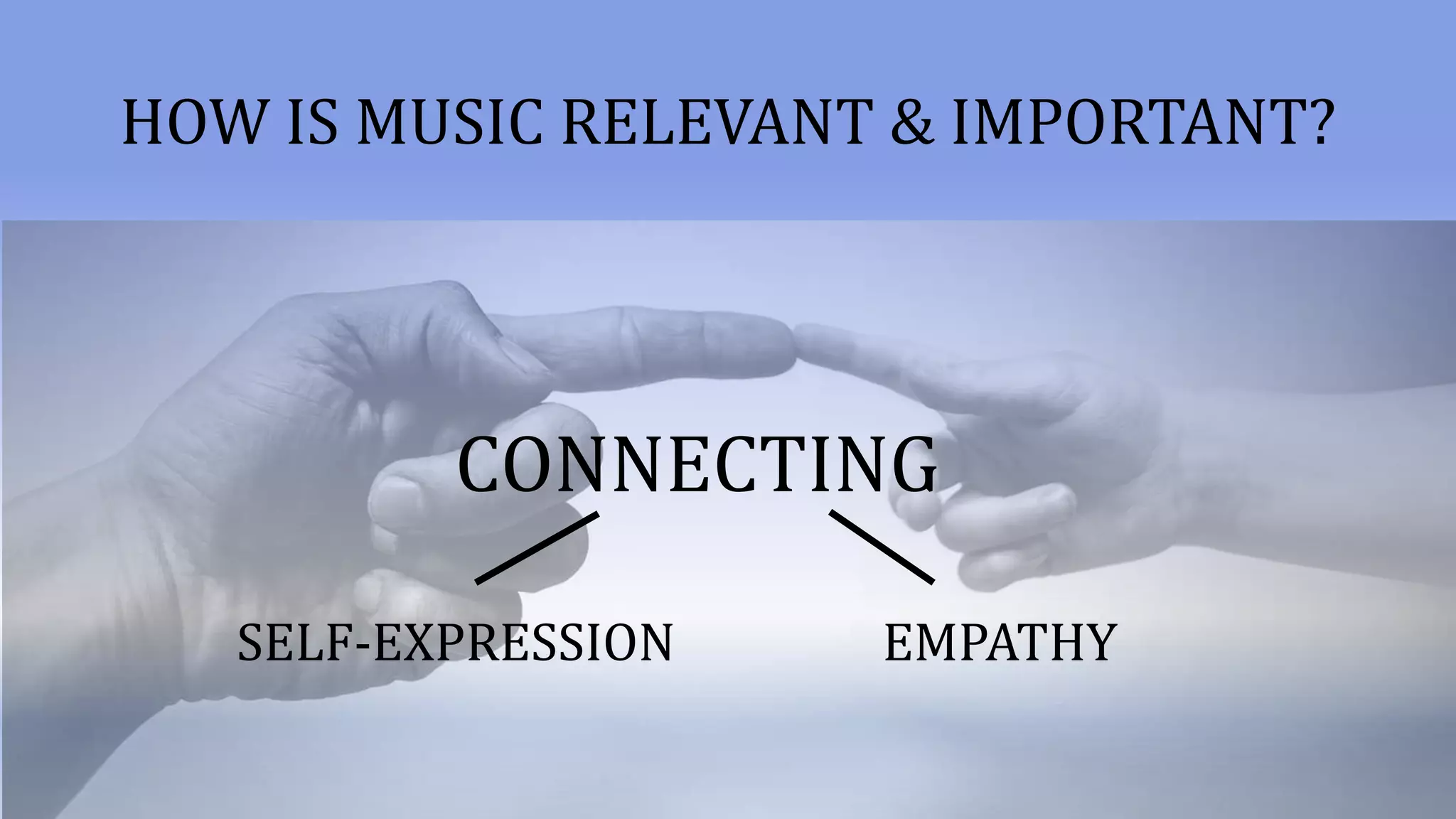
HOW IS MUSIC RELEVANT & IMPORTANT?
COLLEGE MUSIC MAJORS
•Career options
•Audition prep
•Technical proficiency
•Music literacy
•Awareness of repertoire
HOW IS MUSIC RELEVANT & IMPORTANT?
EVERYONE ELSE
•Medicine
•Law
•Engineering
•Hard science
•Soft science
•Education
•Business
•Military
•Service industry
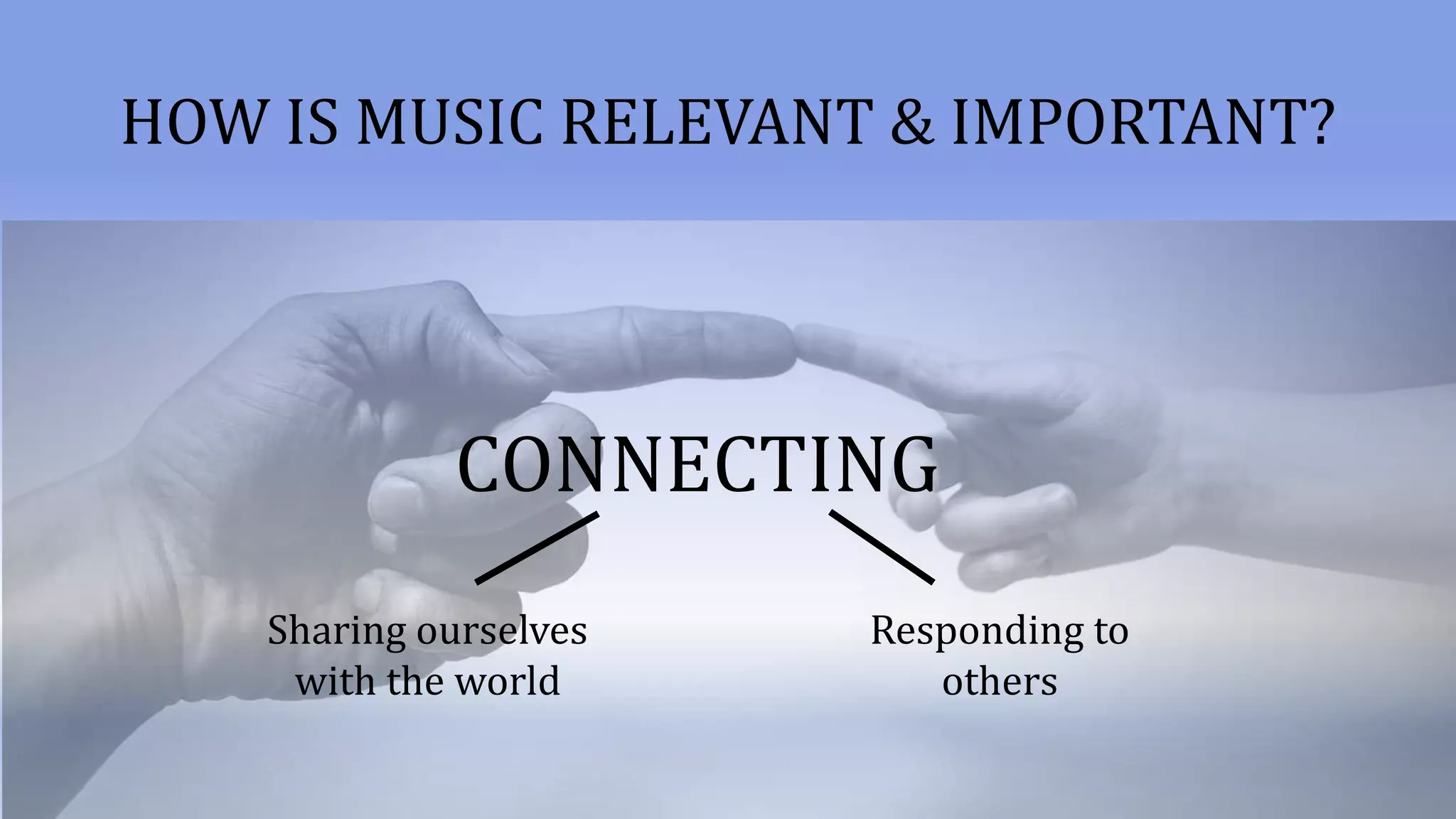
CONNECTING
HOW IS MUSIC RELEVANT & IMPORTANT?
Responding to
others
Sharing ourselves
with the world
CONNECTING
HOW IS MUSIC RELEVANT & IMPORTANT?
EMPATHYSELF-EXPRESSION
Experiencing affect more appropriate for
another person’s situation than one’s own
The ability to experience and understand
what others feel without confusion
between oneself and others
A multidimensional construct comprising
both cognitive and affective components
EMPATHY
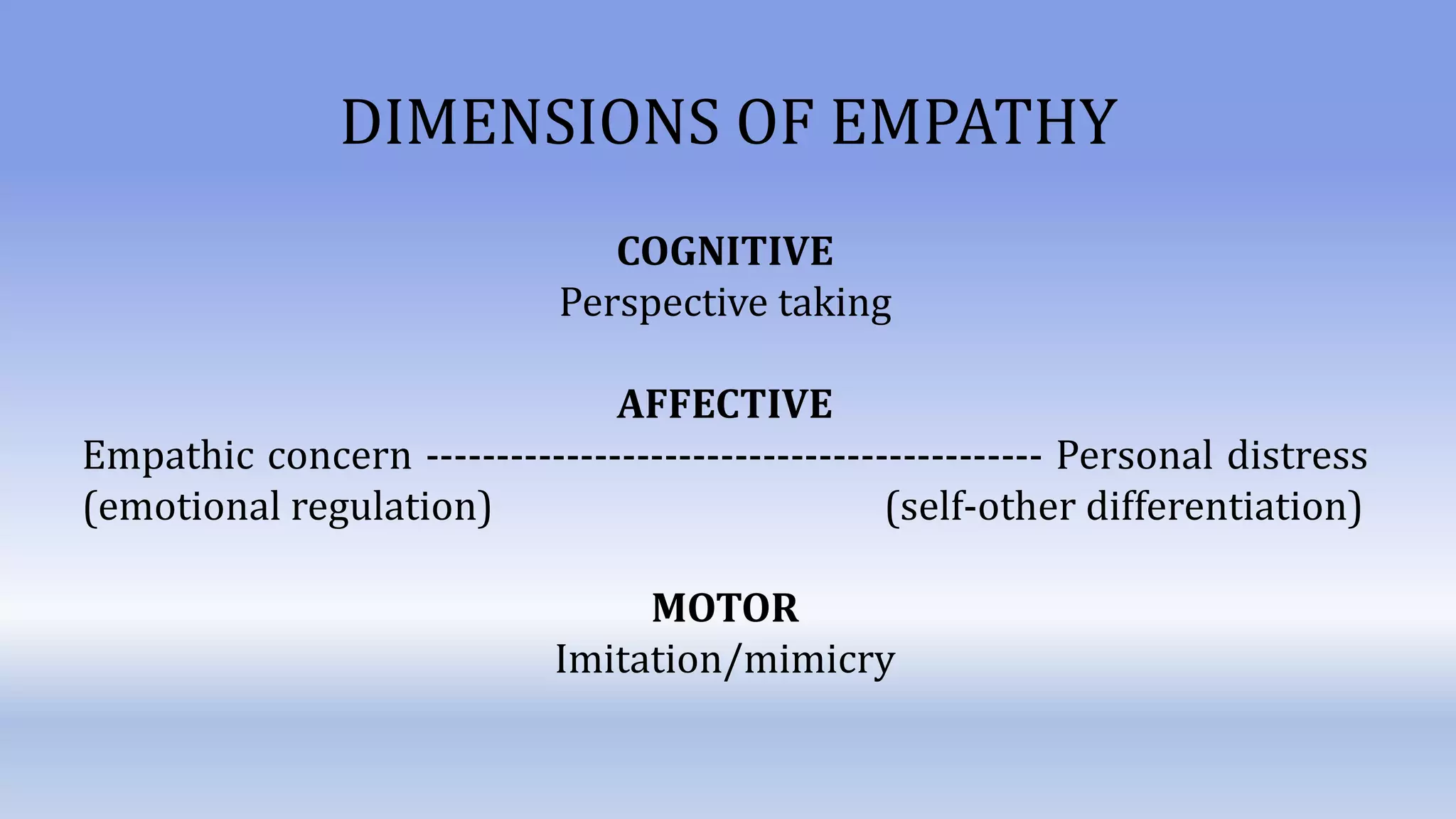
DIMENSIONS OF EMPATHY
COGNITIVE
Perspective taking
AFFECTIVE
Empathic concern -------------------------------------------- Personal distress
(emotional regulation) (self-other differentiation)
MOTOR
Imitation/mimicry
DIMENSIONS OF EMPATHY
COGNITIVE
Perspective taking
SALLY-ANNE TEST- psychological test used to measure one’s ability to
take another person’s perspective
Sally has a marble. She puts it in her basket, then goes for a walk.
While Sally is gone, Anne moves the marble to her box.
When Sally returns, where will she look for the marble?
*Perspective-taking is linked to better interpersonal skills and higher self-esteem*
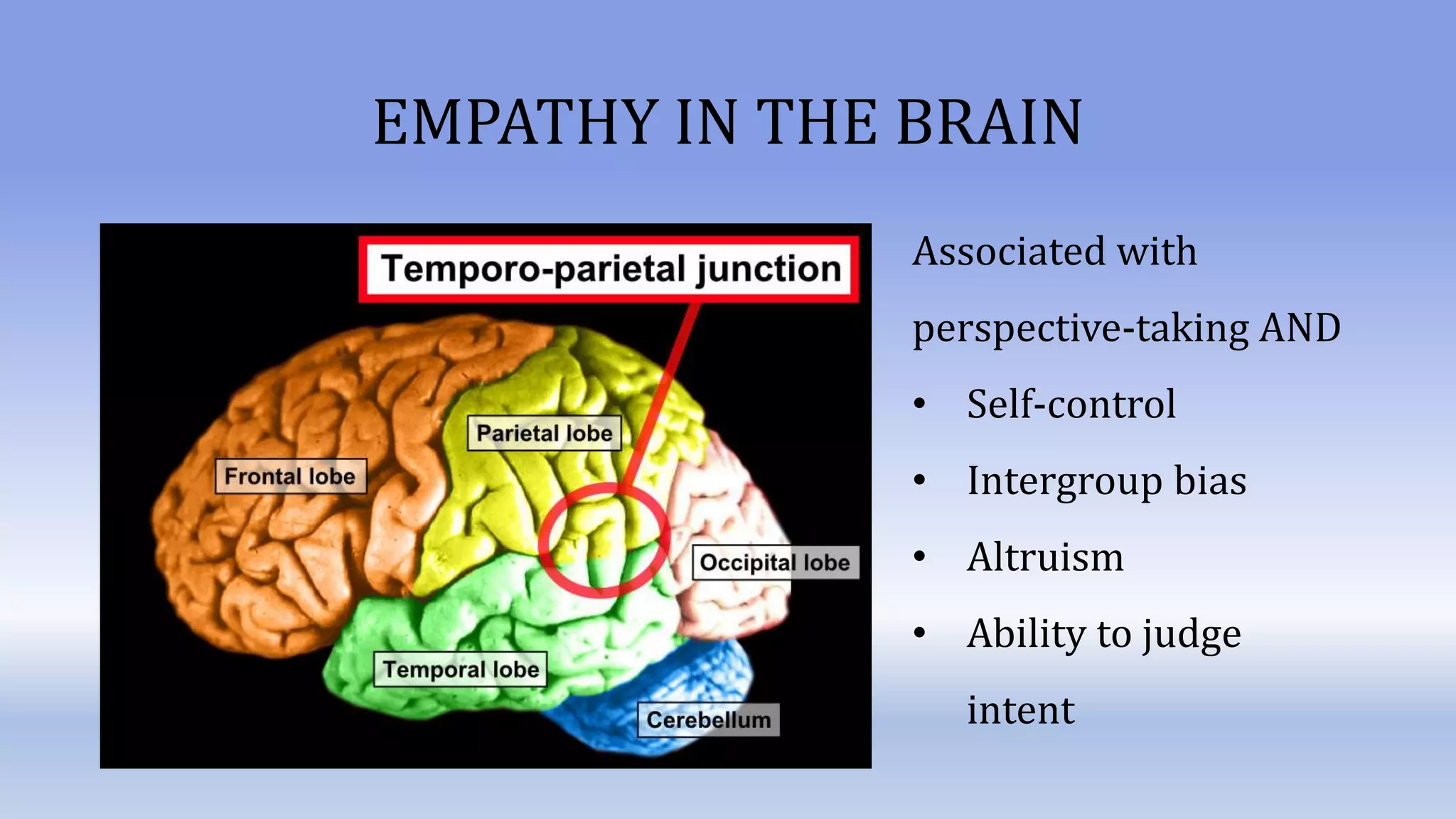
EMPATHY IN THE BRAIN
Associated with
perspective-taking AND
• Self-control
• Intergroup bias
• Altruism
• Ability to judge
intent
DIMENSIONS OF EMPATHY
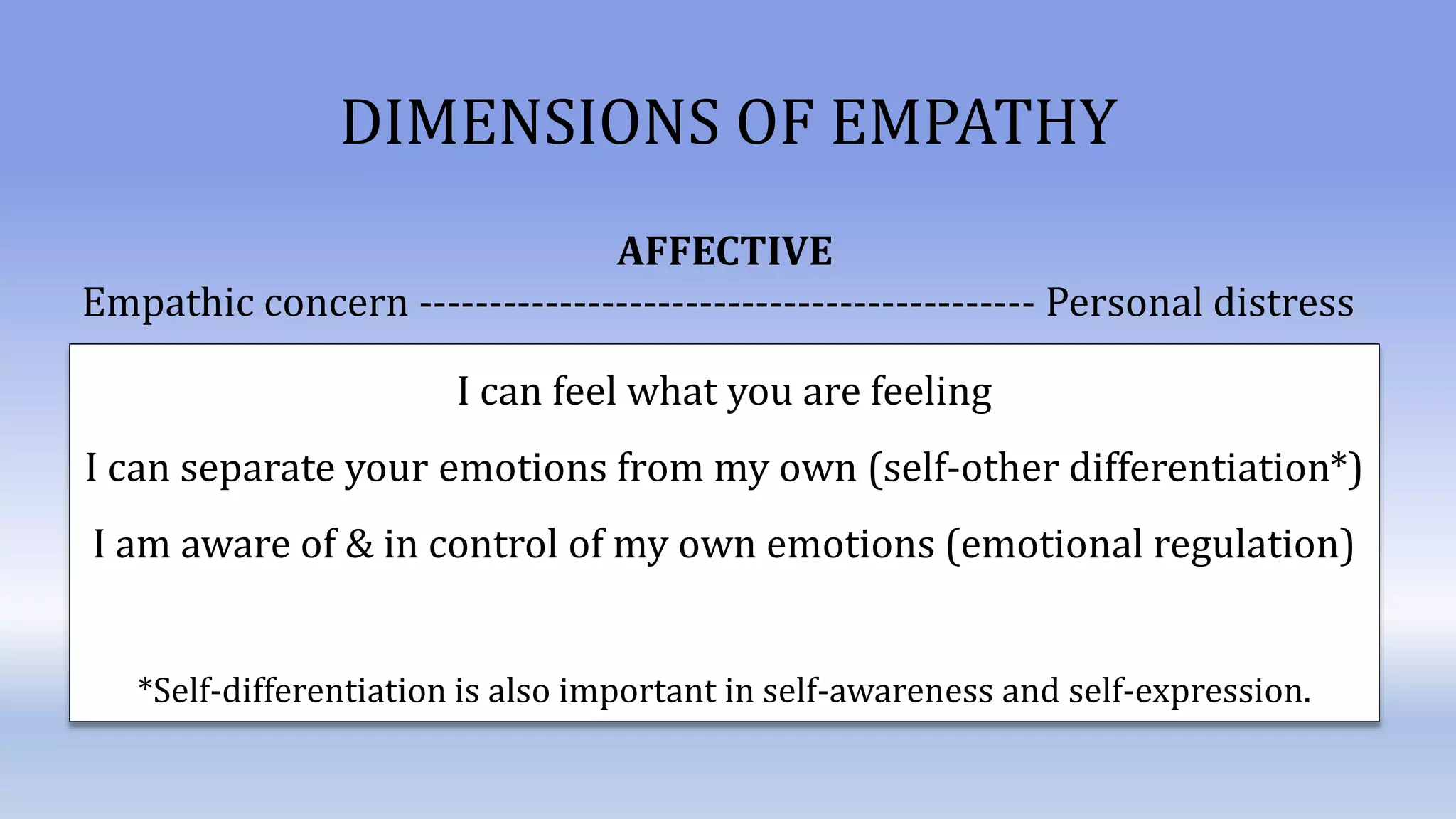
AFFECTIVE
Empathic concern -------------------------------------------- Personal distress
I can feel what you are feeling
I can separate your emotions from my own (self-other differentiation*)
I am aware of & in control of my own emotions (emotional regulation)
*Self-differentiation is also important in self-awareness and self-expression.
DIMENSIONS OF EMPATHY
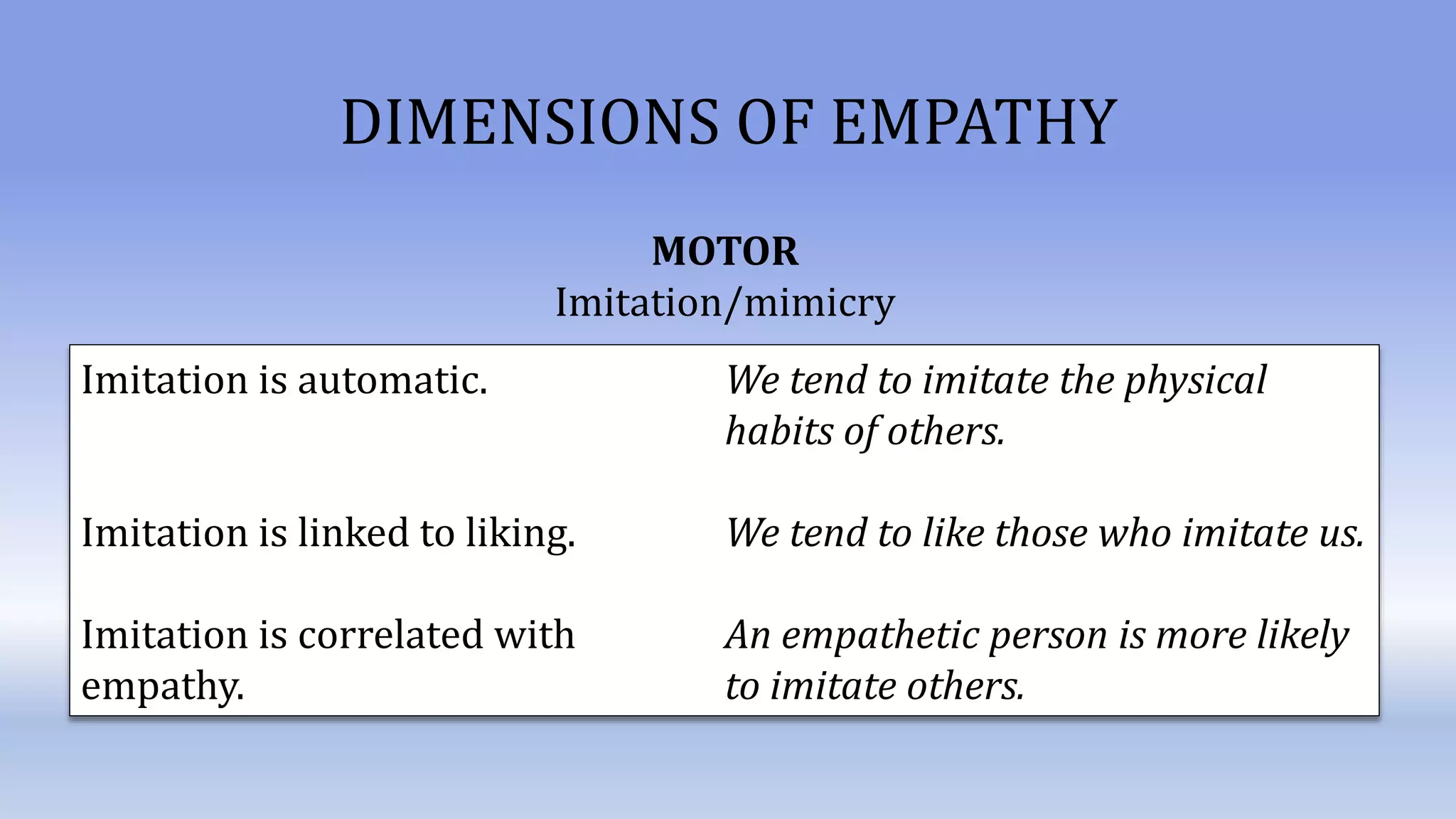
MOTOR
Imitation/mimicry
Imitation is automatic.
Imitation is linked to liking.
Imitation is correlated with
empathy.
We tend to imitate the physical
habits of others.
We tend to like those who imitate us.
An empathetic person is more likely
to imitate others.
DIMENSIONS OF EMPATHY
COGNITIVE
AFFECTIVE
MOTOR
MUSICEDUCATION
R
R
R
MUSIC AS A MEANS OF CONNECTING
IF connecting with others requires honest self-expression
and empathy,
AND empathy involves the cognitive, affective, and motor
domains,
AND music engages all three of these domains and can serve
as a vehicle for self-expression,
THEN learning music can help us connect with each other.
MUSIC AS A MEANS OF CONNECTING
Connection is not an automatic side effect of
studying music, BUT if we want to teach our
students empathy and self-expression, music is
an exceptionally well-suited vehicle.
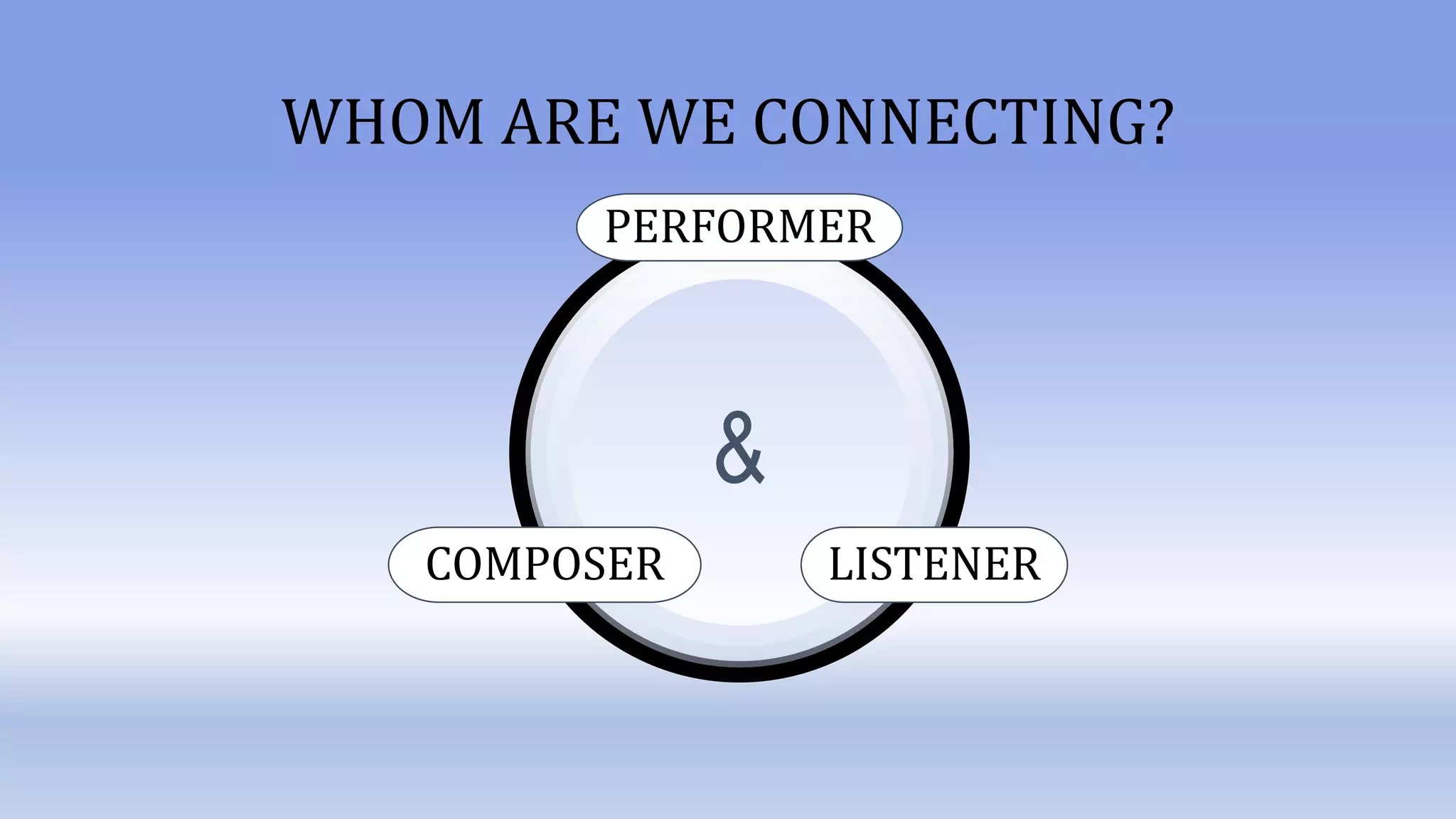
WHOM ARE WE CONNECTING?
&
PERFORMER
LISTENERCOMPOSER
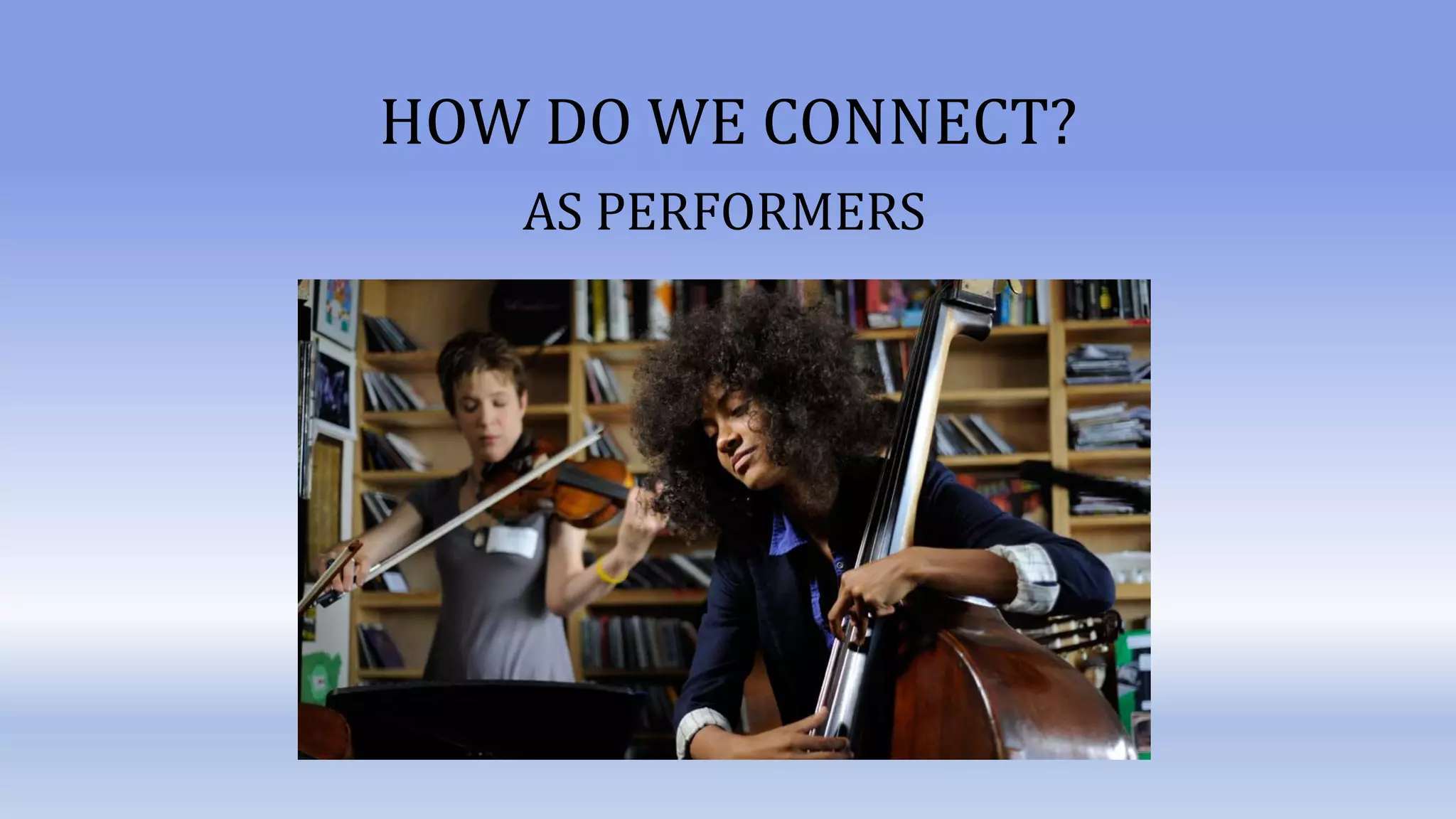
HOW DO WE CONNECT?
AS PERFORMERS
Acknowledging the audience
Collaborating with other performers
Conveying the composer’s intent
Forming an interpretation
Using music for self-expression
HOW DO WE CONNECT?
AS PERFORMERS
HOW DO WE CONNECT?
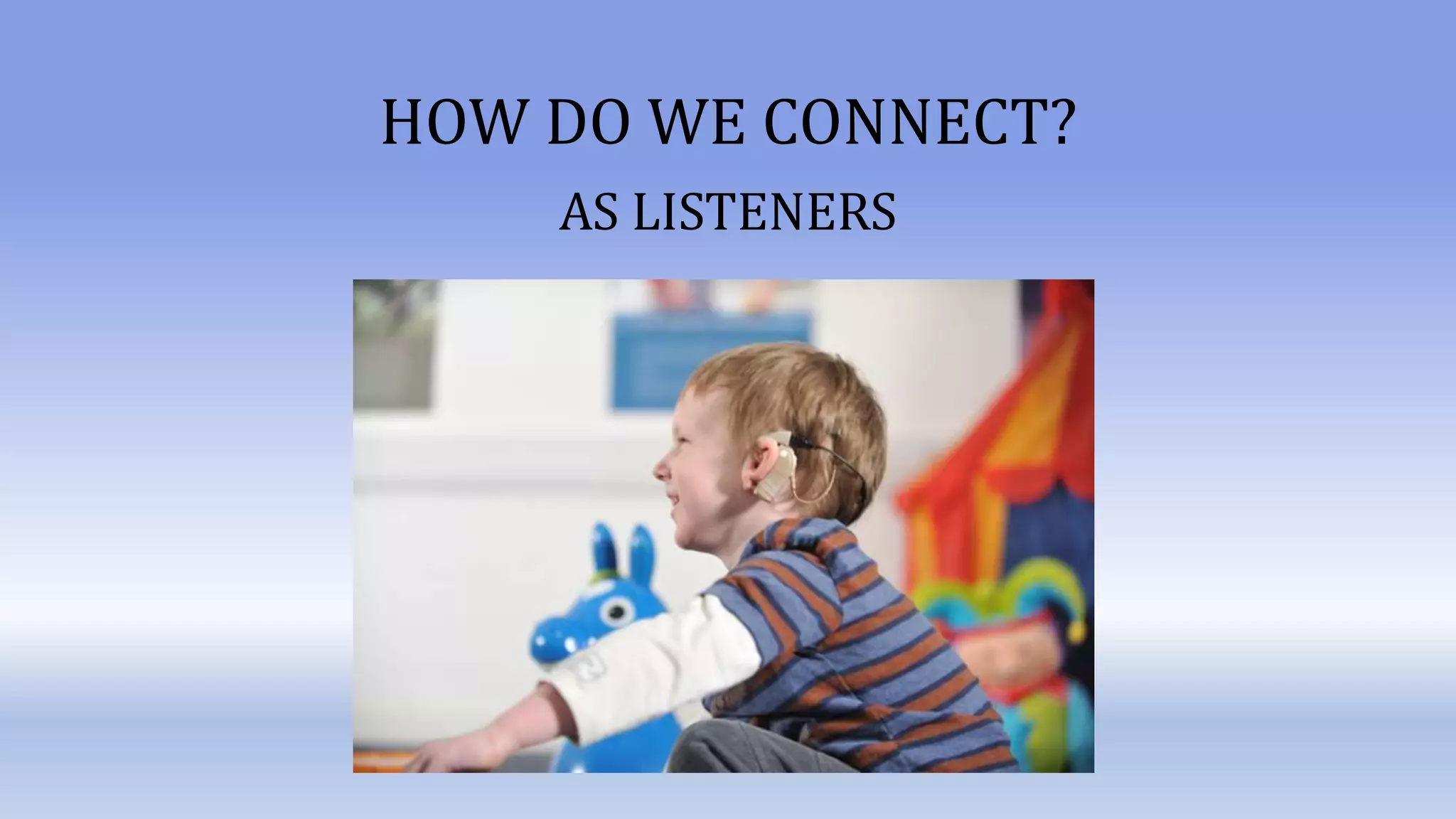
AS LISTENERS
Listening analytically
Interpreting intent
Making personal associations
HOW DO WE CONNECT?
AS LISTENERS
HOW DO WE CONNECT?
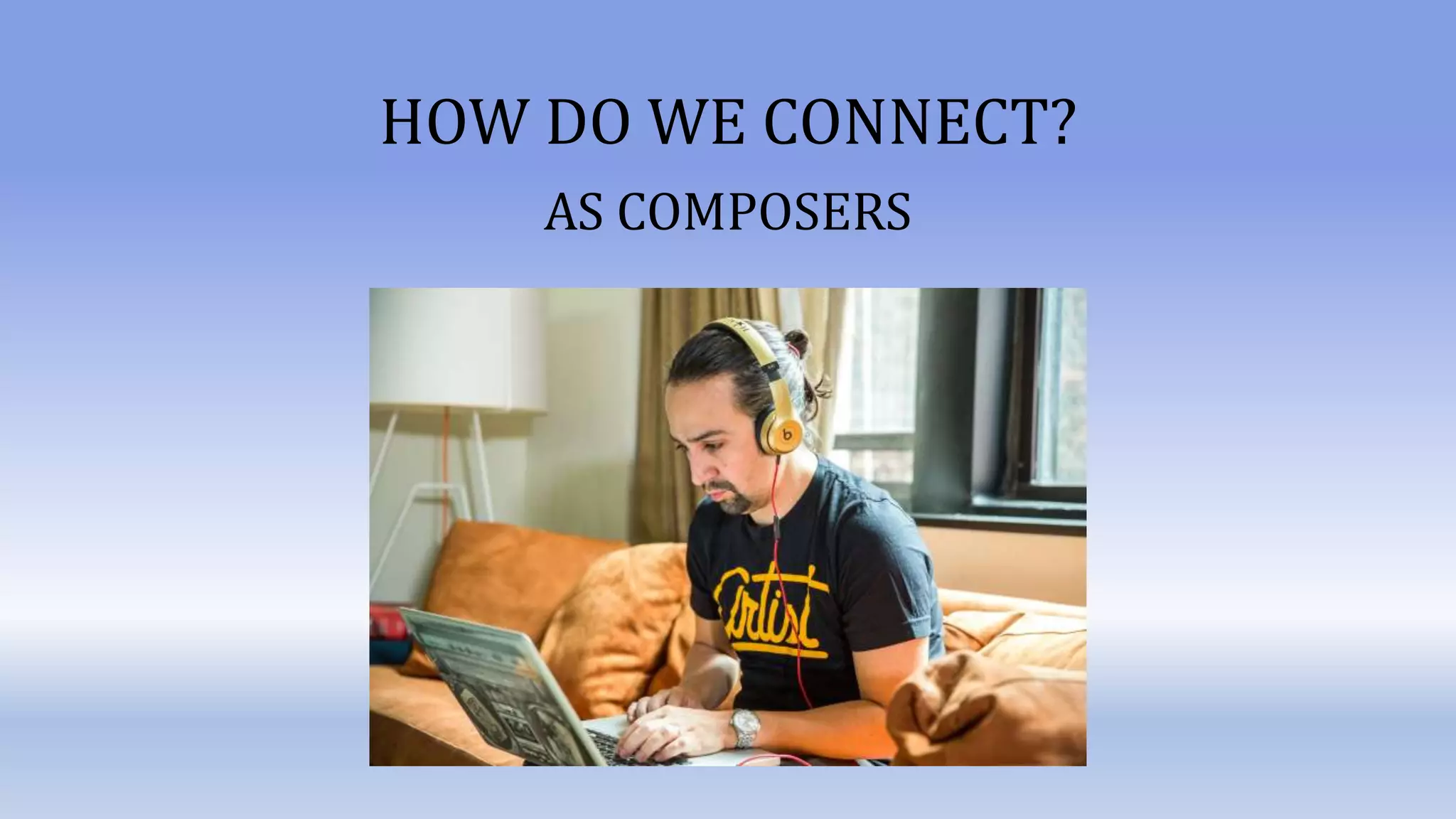
AS COMPOSERS
Communicating through notation
Using music for self-expression
Using music as a means of representation
Developing a shared a mental image
HOW DO WE CONNECT?
AS COMPOSERS
Making CONNECTING our purpose does not
diminish our musical objectives. Rather, it gives
them more meaning and relevance.
CLASS ACTIVITIES
CONNECTING AS A PERFORMER
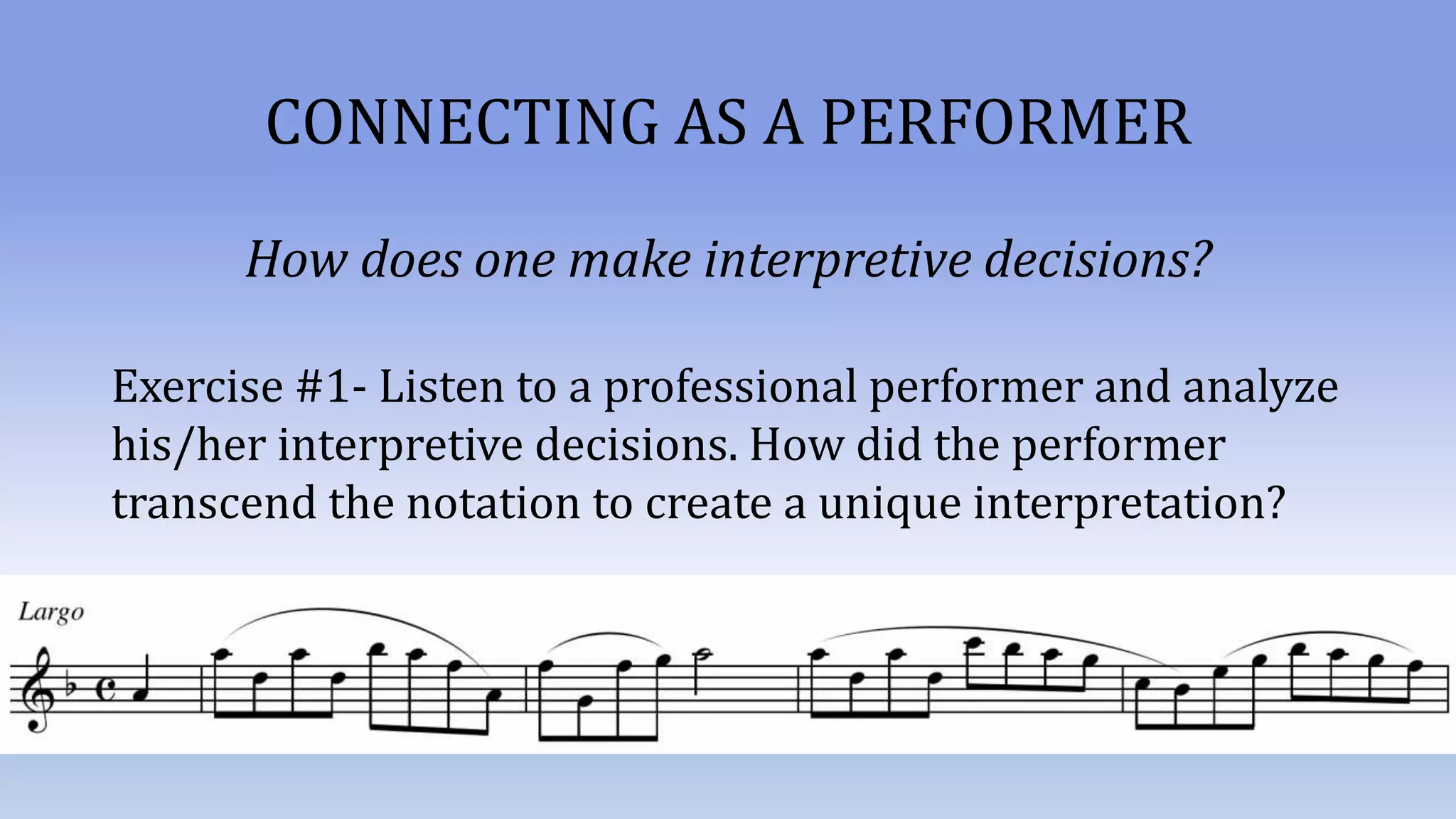
How does one make interpretive decisions?
Exercise #1- Listen to a professional performer and analyze
his/her interpretive decisions. How did the performer
transcend the notation to create a unique interpretation?
CONNECTING AS A PERFORMER
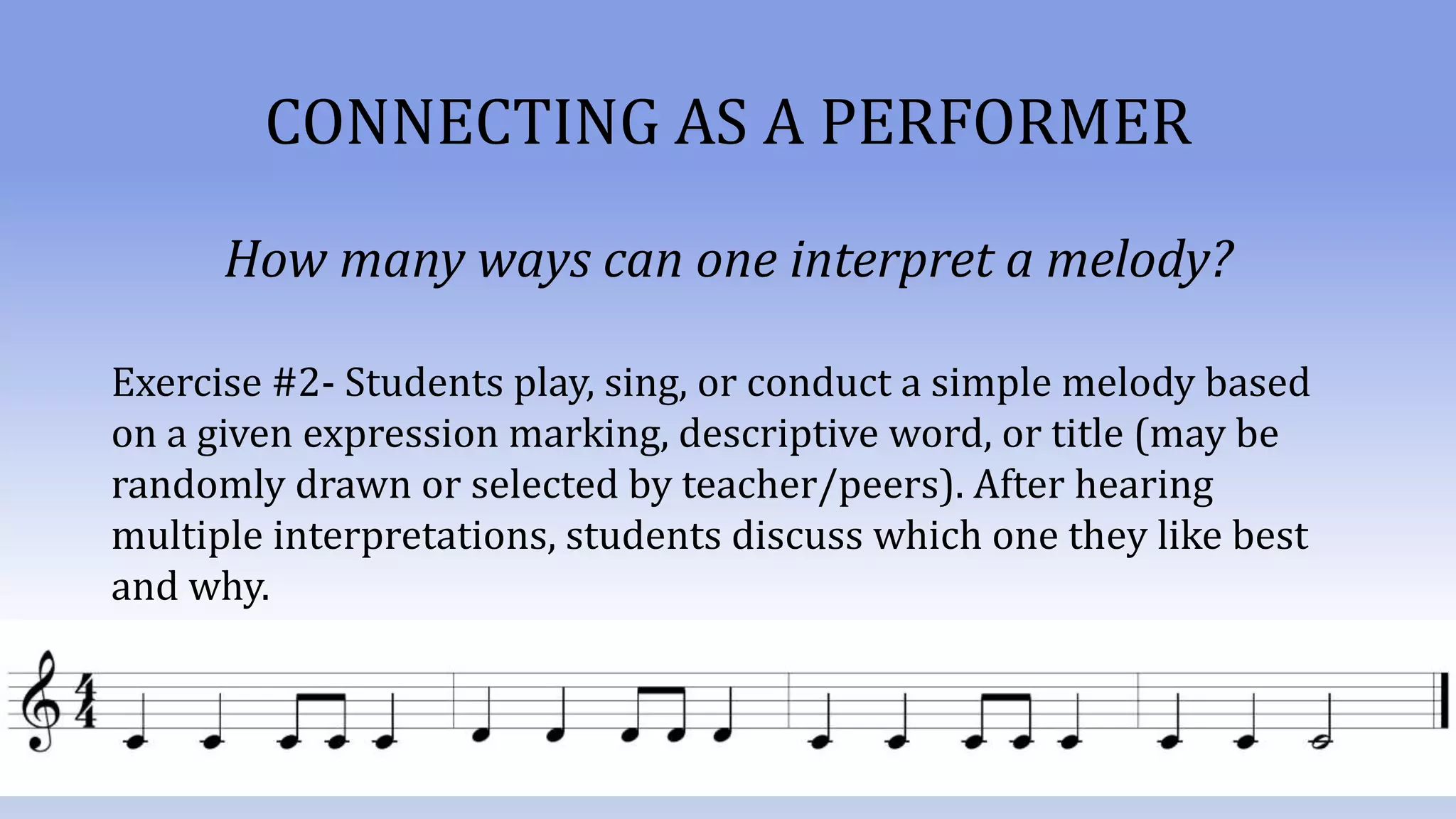
How many ways can one interpret a melody?
Exercise #2- Students play, sing, or conduct a simple melody based
on a given expression marking, descriptive word, or title (may be
randomly drawn or selected by teacher/peers). After hearing
multiple interpretations, students discuss which one they like best
and why.
CONNECTING AS A PERFORMER
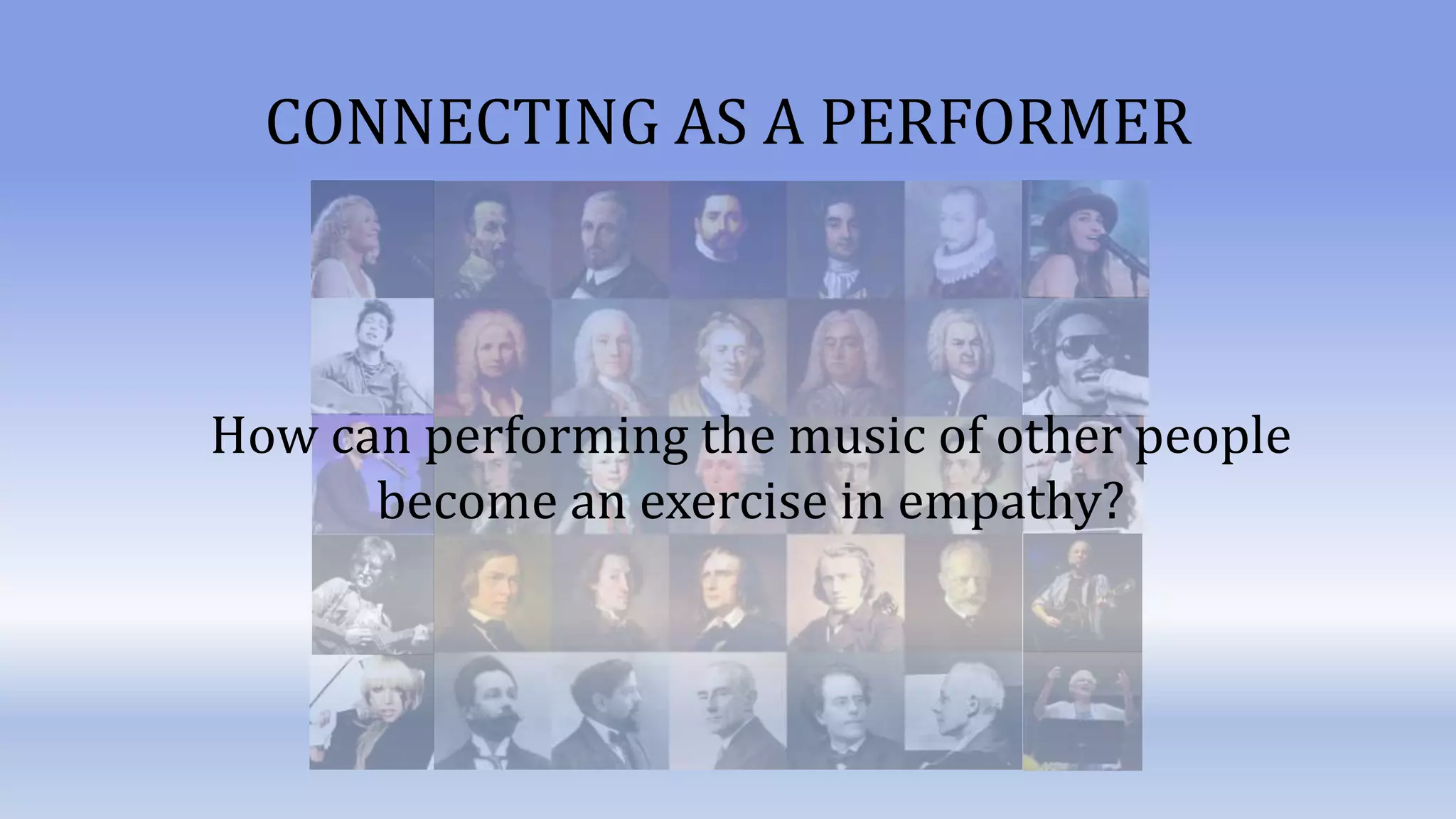
How can performing the music of other people
become an exercise in empathy?
CONNECTING AS A PERFORMER
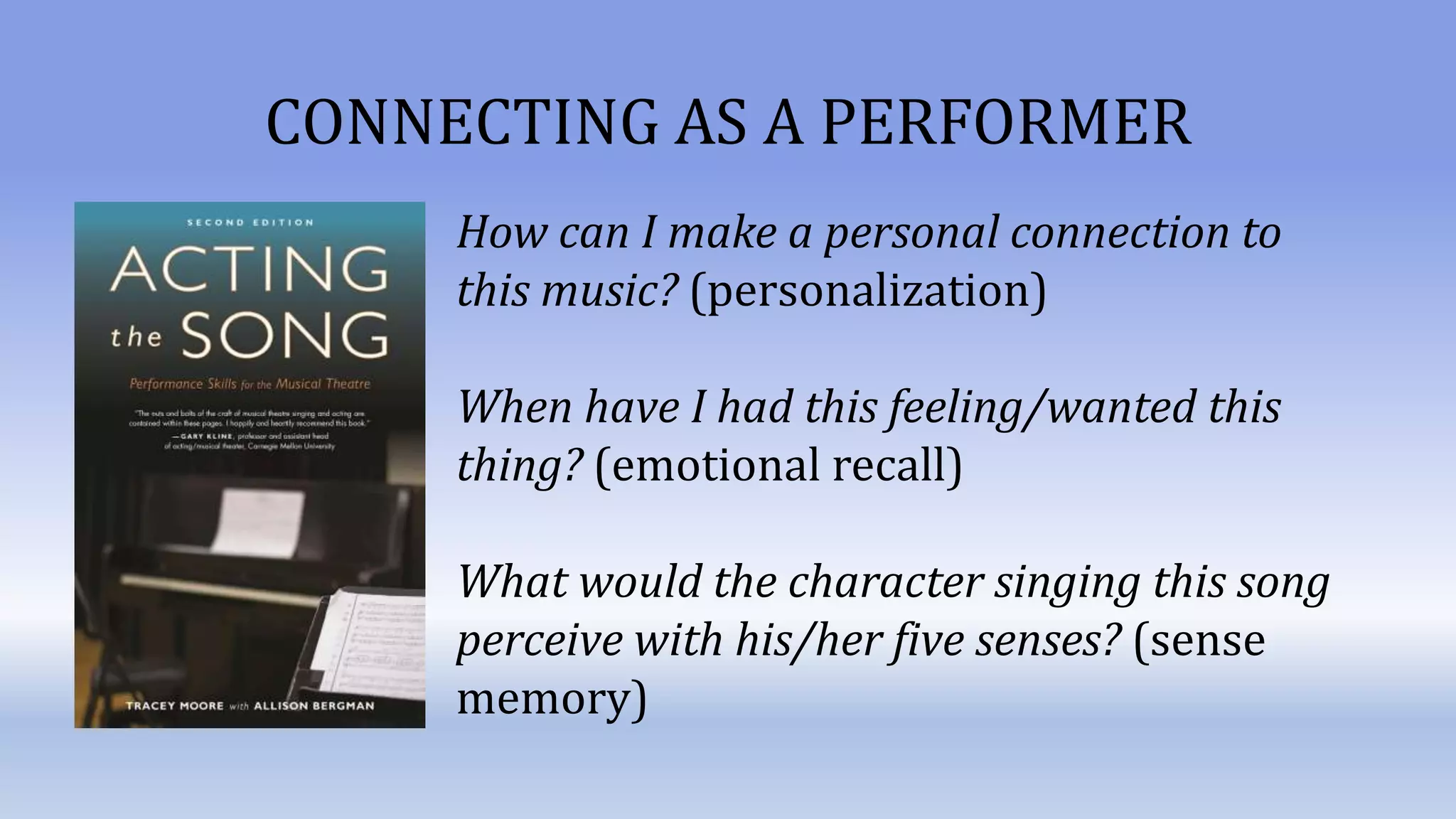
How can I make a personal connection to
this music? (personalization)
When have I had this feeling/wanted this
thing? (emotional recall)
What would the character singing this song
perceive with his/her five senses? (sense
memory)
CONNECTING AS A PERFORMER
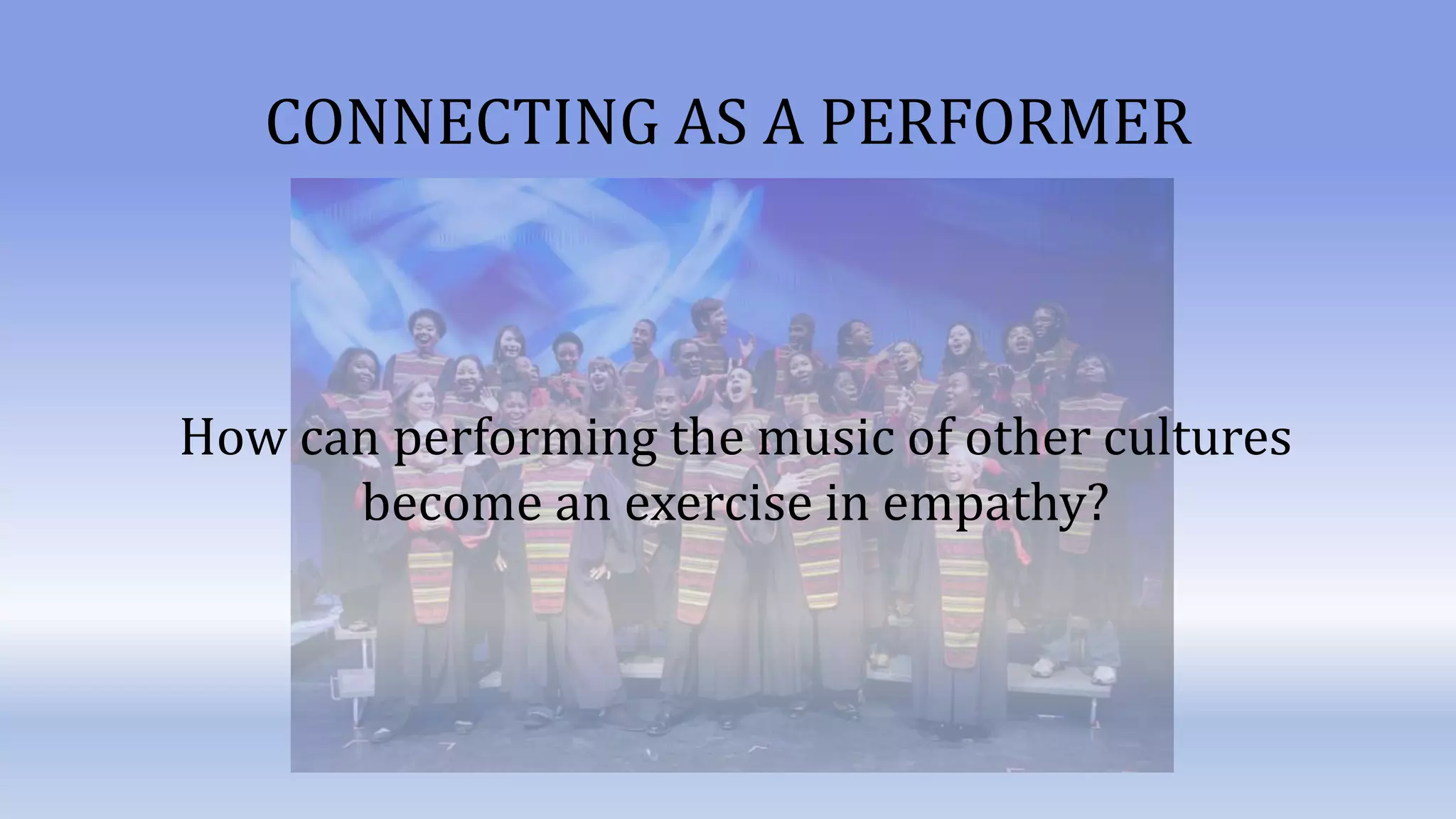
How can performing the music of other cultures
become an exercise in empathy?
CONNECTING AS A PERFORMER
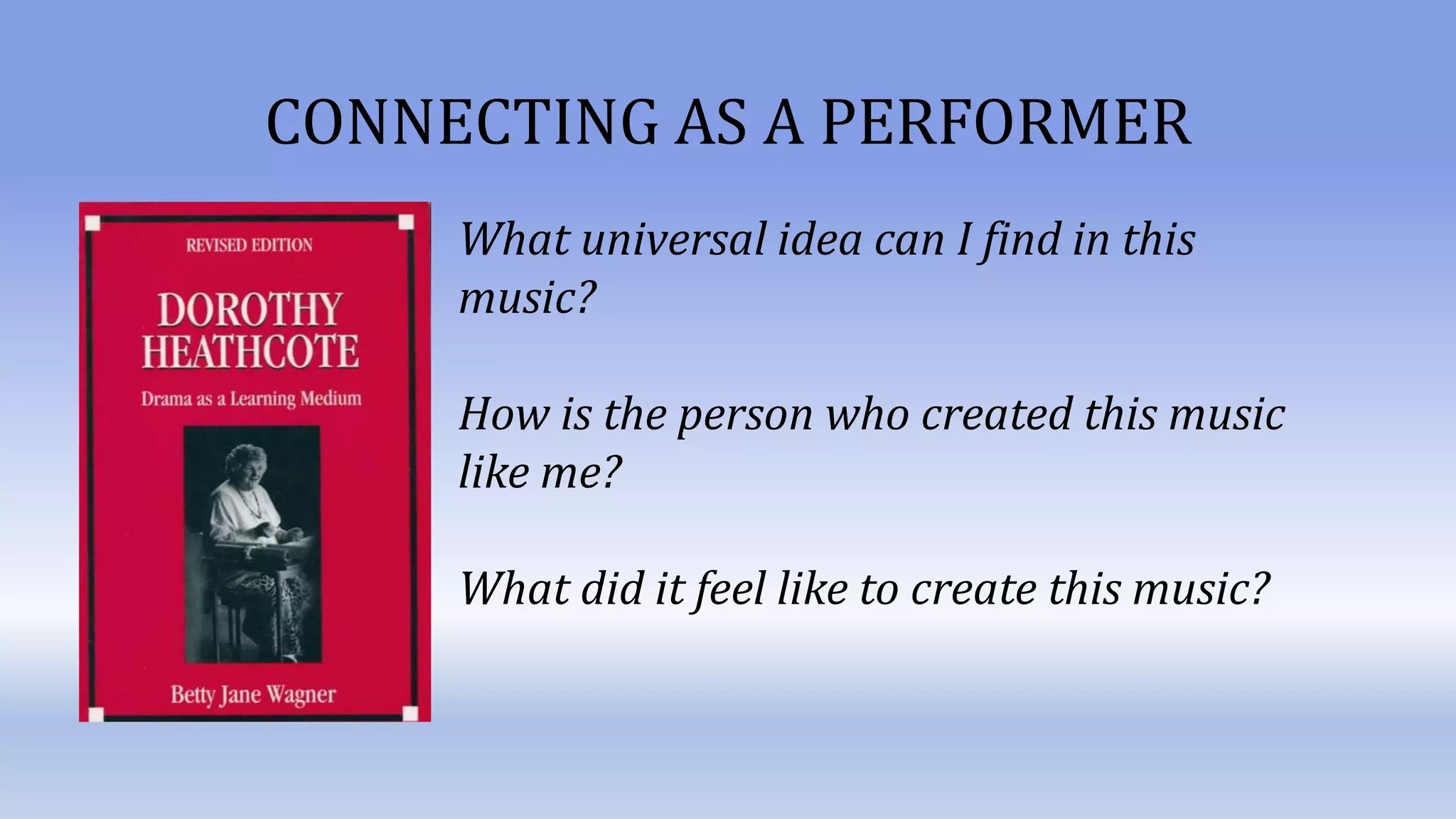
What universal idea can I find in this
music?
How is the person who created this music
like me?
What did it feel like to create this music?
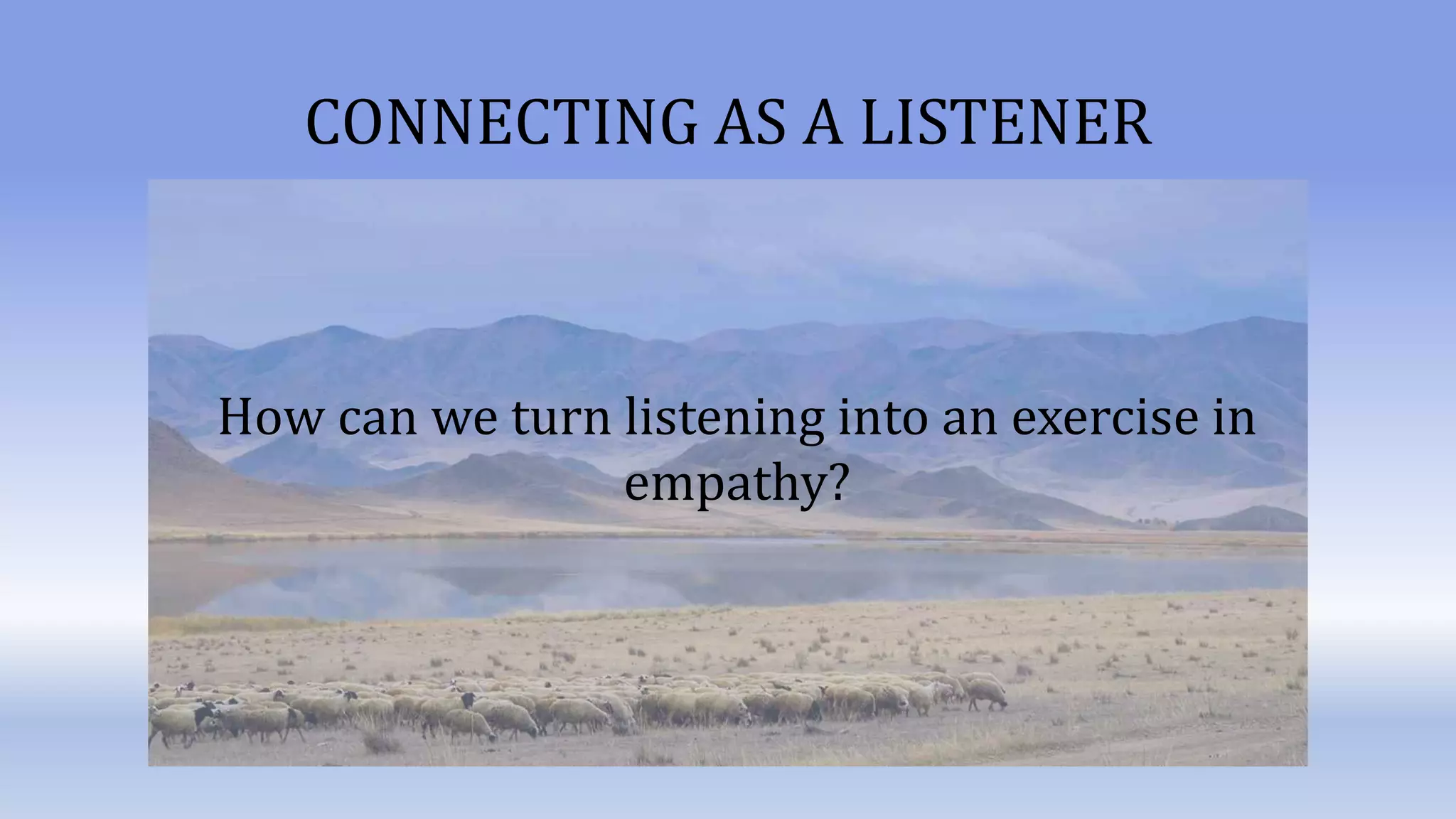
CONNECTING AS A LISTENER
How can we turn listening into an exercise in
empathy?
CONNECTING AS A LISTENER
People make music to represent things that are
important to them, such as their environment.
What natural/man-made objects define my
environment?
If I were to create music about my environment,
what elements would I include?
How might I represent them musically?
CONNECTING AS A COMPOSER
How can I use notation to communicate my musical
ideas?
• Imagine a major scale performed on a solo instrument or voice.
• Make decisions about how the scale will sound, and develop a
strong, specific aural image.
• Notate your ideas as accurately as you can.
• Listen to a classmate perform your notation, and discuss how close
their performance was to your aural image.
CLASS ACTIVITIES: COMPOSER
Why do people make songs about unhappy things?
Write a blues lyric (AAB) about something that made
you sad.
How do people represent themselves through music/art?
Set your name to a rhythm, then manipulate the elements
of music to express something about yourself.
CLASS ACTIVITIES: COMPOSER
How does the music I listen to reflect who I am?
Borrow one element from three of your favorite
songs, and use them to create a new piece.
CLASS ACTIVITIES: COMPOSER
How can a word mean different things to different
people?
Compose a short piece that uses musical elements to
represent a concept
NIGHT FEAR
FAMILY HOME
SCHOOL FRIENDSHIP
FURTHER QUESTIONS
How do we develop objectives for empathy/connecting?
How do we assess learning of empathy/connecting?
Are these skills transferrable to life beyond the music classroom?
How can we help students apply these skills?
What are the implications for advocacy?
What are the implications for musical skill/knowledge objectives?
Reference List
Atkins, P. W. B. (in press 2013). Empathy, self-other differentiation and mindfulness. In K. Pavlovich
& K. Krahnke (Eds.), Organizing Through Empathy: Routledge.
Baumgartner, T. et al (2015). Neuroanatomy of intergroup bias: a white matter microstructure study
of individual differences. Neuroimage 122 345-354.
Benzon, William (2001). Beethoven’s Anvil: Music in Mind and Culture. New York, NY: Basic.
Christensen, J.F., Gomila, A., Gaigg, S.B., Sivarajah, N., & Calvo-Merino, B. (2016). Dance expertise
modulates behavioral and psychophysiological responses to affective body movement. Journal of
Experimental Psychology: Human Perception and Performance 42(8) 1139-1147.
Davis, M. (1983). Measuring individual differences in empathy: Evidence for a multidimensional
approach. Journal of Personality and Social Psychology 44(1) 113-126.
Goldstein, T. & Winner, E. (2012). Enhancing empathy and theory of mind. Journal of Cognition and
Development 13(1) 19-37.
Reference List
Iacoboni, M. (2009). Imitation, empathy, and mirror neurons. Annual Review of Psychology
60 653-670.
Lima, C. F. & Castro, S. L. (2011). Speaking to the trained ear: Musical expertise enhances
the recognition of emotions in speech prosody. Emotion 11(5) 1021-1031.
Molnar-Szakacs, I. & Overy, K. (2006). Music and mirror neurons: From motion to
‘e’motion. Social Cognitive and Affective Neuroscience 1(3) 235-241.
Moore, T. & Bergman, A. (2016). Acting the Song (2nd ed.). New York: Allworth Press.
Moore, T. & Bergman, A. (2016). Acting the Song: Student Companion ebook. Retrieved
from www.amazon.com.
Morishima, Y. et al (2012). Linking brain structure and activation in temporoparietal
junction to explain the neurobiolgy of human altruism. Neuron 75(1) 73-79.
Reference List
Nomura, K. and Akai, S. (2012). Empathy with fictional stories: Reconsideration of
the Fantasy Scale of the Interpersonal Reactivity index. Psychological Reports
110(1) 304-314.
Petrides, K. V., Niven, L., & Mouskounti, T. (2006). The trait emotional intelligence of
ballet dancers and musicians. Psicothema 18(supp.) 101-107.
Skoe, E. E. A. (2010). The relationship between empathy-related constructs and
care-based moral development in young adulthood. The Journal of Moral Education
39(2) 191-211.
Soutschek, A. et al (2016). Brain stimulation reveals crucial role of overcoming self-
centeredness in self-control. Science Advances 2(10)
Reference List
Wagner, B. J. (1999). Dorothy Heathcote: Drama as a learning medium. (Rev. ed.).
Portland: Calendar Island Publishers.
Williams, D.D., Yanchar, S. C., Jensen, L. C., & Lewis, C. (2003). Character education
in a public high school: A multi-year inquiry into Unified Studies. Journal of Moral
Education 32(1).
Resources for Tuvan Music:
Damon Postle, University of Georgia doctoral student in Music Education
http://www.alashensemble.com/index.htm

Building Better Humans Through Music

  • 1.
    Building Better Humans ThroughMusic Melanie Guerin
  • 2.
    It is themission of every educator to help students realize their greatest potential so that they may lead meaningful, satisfying lives.
  • 3.
    IMPLICATIONS: 1. We valuethe gifts and needs of each individual 2. We value the content we are teaching
  • 4.
    VALUING THE INDIVIDUAL •Celebrate individual differences • Encourage student choice and ownership • Value self-expression • Create a safe and supportive environment • Develop a sense of trust (transparency, consistency) • Welcome differing viewpoints • Encourage (and model) growth mindset • Believe in (and encourage belief in) students’ potential • Provide relatable role models
  • 5.
    VALUING THE CONTENT •Curriculum is available to all • Curriculum is relevant to students’ individual goals
  • 6.
    HOW IS MUSICRELEVANT & IMPORTANT? COLLEGE MUSIC MAJORS •Career options •Audition prep •Technical proficiency •Music literacy •Awareness of repertoire
  • 7.
    HOW IS MUSICRELEVANT & IMPORTANT? EVERYONE ELSE •Medicine •Law •Engineering •Hard science •Soft science •Education •Business •Military •Service industry
  • 8.
    CONNECTING HOW IS MUSICRELEVANT & IMPORTANT? Responding to others Sharing ourselves with the world
  • 9.
    CONNECTING HOW IS MUSICRELEVANT & IMPORTANT? EMPATHYSELF-EXPRESSION
  • 10.
    Experiencing affect moreappropriate for another person’s situation than one’s own The ability to experience and understand what others feel without confusion between oneself and others A multidimensional construct comprising both cognitive and affective components EMPATHY
  • 11.
    DIMENSIONS OF EMPATHY COGNITIVE Perspectivetaking AFFECTIVE Empathic concern -------------------------------------------- Personal distress (emotional regulation) (self-other differentiation) MOTOR Imitation/mimicry
  • 12.
    DIMENSIONS OF EMPATHY COGNITIVE Perspectivetaking SALLY-ANNE TEST- psychological test used to measure one’s ability to take another person’s perspective Sally has a marble. She puts it in her basket, then goes for a walk. While Sally is gone, Anne moves the marble to her box. When Sally returns, where will she look for the marble? *Perspective-taking is linked to better interpersonal skills and higher self-esteem*
  • 13.
    EMPATHY IN THEBRAIN Associated with perspective-taking AND • Self-control • Intergroup bias • Altruism • Ability to judge intent
  • 14.
    DIMENSIONS OF EMPATHY AFFECTIVE Empathicconcern -------------------------------------------- Personal distress I can feel what you are feeling I can separate your emotions from my own (self-other differentiation*) I am aware of & in control of my own emotions (emotional regulation) *Self-differentiation is also important in self-awareness and self-expression.
  • 15.
    DIMENSIONS OF EMPATHY MOTOR Imitation/mimicry Imitationis automatic. Imitation is linked to liking. Imitation is correlated with empathy. We tend to imitate the physical habits of others. We tend to like those who imitate us. An empathetic person is more likely to imitate others.
  • 16.
  • 17.
    MUSIC AS AMEANS OF CONNECTING IF connecting with others requires honest self-expression and empathy, AND empathy involves the cognitive, affective, and motor domains, AND music engages all three of these domains and can serve as a vehicle for self-expression, THEN learning music can help us connect with each other.
  • 18.
    MUSIC AS AMEANS OF CONNECTING Connection is not an automatic side effect of studying music, BUT if we want to teach our students empathy and self-expression, music is an exceptionally well-suited vehicle.
  • 19.
    WHOM ARE WECONNECTING? & PERFORMER LISTENERCOMPOSER
  • 20.
    HOW DO WECONNECT? AS PERFORMERS
  • 21.
    Acknowledging the audience Collaboratingwith other performers Conveying the composer’s intent Forming an interpretation Using music for self-expression HOW DO WE CONNECT? AS PERFORMERS
  • 22.
    HOW DO WECONNECT? AS LISTENERS
  • 23.
    Listening analytically Interpreting intent Makingpersonal associations HOW DO WE CONNECT? AS LISTENERS
  • 24.
    HOW DO WECONNECT? AS COMPOSERS
  • 25.
    Communicating through notation Usingmusic for self-expression Using music as a means of representation Developing a shared a mental image HOW DO WE CONNECT? AS COMPOSERS
  • 26.
    Making CONNECTING ourpurpose does not diminish our musical objectives. Rather, it gives them more meaning and relevance. CLASS ACTIVITIES
  • 27.
    CONNECTING AS APERFORMER How does one make interpretive decisions? Exercise #1- Listen to a professional performer and analyze his/her interpretive decisions. How did the performer transcend the notation to create a unique interpretation?
  • 28.
    CONNECTING AS APERFORMER How many ways can one interpret a melody? Exercise #2- Students play, sing, or conduct a simple melody based on a given expression marking, descriptive word, or title (may be randomly drawn or selected by teacher/peers). After hearing multiple interpretations, students discuss which one they like best and why.
  • 29.
    CONNECTING AS APERFORMER How can performing the music of other people become an exercise in empathy?
  • 30.
    CONNECTING AS APERFORMER How can I make a personal connection to this music? (personalization) When have I had this feeling/wanted this thing? (emotional recall) What would the character singing this song perceive with his/her five senses? (sense memory)
  • 31.
    CONNECTING AS APERFORMER How can performing the music of other cultures become an exercise in empathy?
  • 32.
    CONNECTING AS APERFORMER What universal idea can I find in this music? How is the person who created this music like me? What did it feel like to create this music?
  • 33.
    CONNECTING AS ALISTENER How can we turn listening into an exercise in empathy?
  • 34.
    CONNECTING AS ALISTENER People make music to represent things that are important to them, such as their environment. What natural/man-made objects define my environment? If I were to create music about my environment, what elements would I include? How might I represent them musically?
  • 35.
    CONNECTING AS ACOMPOSER How can I use notation to communicate my musical ideas? • Imagine a major scale performed on a solo instrument or voice. • Make decisions about how the scale will sound, and develop a strong, specific aural image. • Notate your ideas as accurately as you can. • Listen to a classmate perform your notation, and discuss how close their performance was to your aural image.
  • 36.
    CLASS ACTIVITIES: COMPOSER Whydo people make songs about unhappy things? Write a blues lyric (AAB) about something that made you sad. How do people represent themselves through music/art? Set your name to a rhythm, then manipulate the elements of music to express something about yourself.
  • 37.
    CLASS ACTIVITIES: COMPOSER Howdoes the music I listen to reflect who I am? Borrow one element from three of your favorite songs, and use them to create a new piece.
  • 38.
    CLASS ACTIVITIES: COMPOSER Howcan a word mean different things to different people? Compose a short piece that uses musical elements to represent a concept NIGHT FEAR FAMILY HOME SCHOOL FRIENDSHIP
  • 39.
    FURTHER QUESTIONS How dowe develop objectives for empathy/connecting? How do we assess learning of empathy/connecting? Are these skills transferrable to life beyond the music classroom? How can we help students apply these skills? What are the implications for advocacy? What are the implications for musical skill/knowledge objectives?
  • 40.
    Reference List Atkins, P.W. B. (in press 2013). Empathy, self-other differentiation and mindfulness. In K. Pavlovich & K. Krahnke (Eds.), Organizing Through Empathy: Routledge. Baumgartner, T. et al (2015). Neuroanatomy of intergroup bias: a white matter microstructure study of individual differences. Neuroimage 122 345-354. Benzon, William (2001). Beethoven’s Anvil: Music in Mind and Culture. New York, NY: Basic. Christensen, J.F., Gomila, A., Gaigg, S.B., Sivarajah, N., & Calvo-Merino, B. (2016). Dance expertise modulates behavioral and psychophysiological responses to affective body movement. Journal of Experimental Psychology: Human Perception and Performance 42(8) 1139-1147. Davis, M. (1983). Measuring individual differences in empathy: Evidence for a multidimensional approach. Journal of Personality and Social Psychology 44(1) 113-126. Goldstein, T. & Winner, E. (2012). Enhancing empathy and theory of mind. Journal of Cognition and Development 13(1) 19-37.
  • 41.
    Reference List Iacoboni, M.(2009). Imitation, empathy, and mirror neurons. Annual Review of Psychology 60 653-670. Lima, C. F. & Castro, S. L. (2011). Speaking to the trained ear: Musical expertise enhances the recognition of emotions in speech prosody. Emotion 11(5) 1021-1031. Molnar-Szakacs, I. & Overy, K. (2006). Music and mirror neurons: From motion to ‘e’motion. Social Cognitive and Affective Neuroscience 1(3) 235-241. Moore, T. & Bergman, A. (2016). Acting the Song (2nd ed.). New York: Allworth Press. Moore, T. & Bergman, A. (2016). Acting the Song: Student Companion ebook. Retrieved from www.amazon.com. Morishima, Y. et al (2012). Linking brain structure and activation in temporoparietal junction to explain the neurobiolgy of human altruism. Neuron 75(1) 73-79.
  • 42.
    Reference List Nomura, K.and Akai, S. (2012). Empathy with fictional stories: Reconsideration of the Fantasy Scale of the Interpersonal Reactivity index. Psychological Reports 110(1) 304-314. Petrides, K. V., Niven, L., & Mouskounti, T. (2006). The trait emotional intelligence of ballet dancers and musicians. Psicothema 18(supp.) 101-107. Skoe, E. E. A. (2010). The relationship between empathy-related constructs and care-based moral development in young adulthood. The Journal of Moral Education 39(2) 191-211. Soutschek, A. et al (2016). Brain stimulation reveals crucial role of overcoming self- centeredness in self-control. Science Advances 2(10)
  • 43.
    Reference List Wagner, B.J. (1999). Dorothy Heathcote: Drama as a learning medium. (Rev. ed.). Portland: Calendar Island Publishers. Williams, D.D., Yanchar, S. C., Jensen, L. C., & Lewis, C. (2003). Character education in a public high school: A multi-year inquiry into Unified Studies. Journal of Moral Education 32(1). Resources for Tuvan Music: Damon Postle, University of Georgia doctoral student in Music Education http://www.alashensemble.com/index.htm

Editor's Notes

  • #2 I taught for 7 years at an arts magnet school. I taught chamber music, music theory, music history, composition. This was a public school, and in order to get public school funding there couldn’t be barriers for acceptance, so we had in our small school every level of ability, aptitude, and interest. Because in a music composition class I might have a thought about it during YPCCA Jr., watching little kids and trying to figure out what the difference was between the ones who were “with it” and those who were not.
  • #6 It’s not essential if it’s only for some If it’s an auditioned group, that implies it is not essential If it’s not for everybody, why not wait until college when people specialize?
  • #7 Talk about teaching at GHAA
  • #8 The one thing that all these career paths have in common is humanity, so if what we teach is important, it must contribute to our humanity.
  • #9 Connection should not be a “positive side effect,” but rather our primary objective.
  • #10 Connection should not be a “positive side effect,” but rather our primary objective.
  • #21 This is the most common activity in secondary school music programs, but how often do we think about the performance as the end without talking about what is the purpose of the performance?
  • #22 Connecting with composer= lyrics, performance practice Connecting with audience= imagining their perspective, as well as eye contact, etc. Music as self-expression is often a platitude (it includes forming an interpretation)
  • #23 When we listen, are we listening beyond acoustical properties (frequency/pitch, amplitude/volume, tempo) to listen for meaning?
  • #25 If we want students to understand music as the self-expression of others, then we MUST teach them to use it that way themselves. Helping them to create their own music is the most in-depth way to do this.
  • #27 Rather than treating connection as a positive “side effect,” what if we used classroom activities and discussions to actively teach these skills and make it a part of our classroom culture? Now I’ll explain a few classroom activities that also help us work toward the goal of helping students use music to connect.
  • #30 Most of the time, students will be performing someone else’s music, so it’s not about them expressing themselves as much as it is them conveying someone else’s ideas. This is one of the most obvious places where we can focus on empathy and music as a connecting force. To explain this idea, I draw from 2 books which I strongly recommend to every music teacher.
  • #37 Again, in order to understand music as a means of self-expression, we have to use it that way. I’ll now share some creation activities for different levels RE: 1st question, I think the practice of singing sad/emotional music is actually great for self-regulation (study where students who wrote about their worries before a test did better on the test. Maybe it is practicing self-regulation (writing about emotions without becoming overwhelmed by them). Or it may be because they “unloaded’ their stress (they put that energy into writing, which may mean they could put it into singing). Tracey Moore advises against the “cooling breath”
  • #38 Again, in order to understand music as a means of self-expression, we have to use it that way. I’ll now share some creation activities for different levels RE: 1st question, I think the practice of singing sad/emotional music is actually great for self-regulation (study where students who wrote about their worries before a test did better on the test. Maybe it is practicing self-regulation (writing about emotions without becoming overwhelmed by them). Or it may be because they “unloaded’ their stress (they put that energy into writing, which may mean they could put it into singing). Tracey Moore advises against the “cooling breath”
  • #39 “Short” can mean 30 or even 15 seconds