Jamal 1
4/21/2024
• Presented by:
• Asad Jamal
• Bakht Saifurahman
• Asif Hamza
• Hassan khan 2
BURNS
4/21/2024 Jamal
3
OBJECTIVES
After the completion of this presentation the learners will be able to:
• Define burns.
• Describe etiology and sign and symptoms of burns.
• Discuss rule of nine for burns.
• Describe various types of burns and their causative agents.
• Classification of burn injuries and their size and depth.
• Demonstrate understanding of pathophysiology of a major burn injury.
• Discuss the nursing management of burns.
4/21/2024 Jamal
4
Burns
"A burn is a type of injury to skin or other tissue caused by
heat, cold, electricity, chemical or radiation".
Most burns are due to heat from hot liquids, solids or fire.
4/21/2024
Jamal
5
ETIOLOGY
• Thermal burns
• Dry heat (contact burn, flame burn)
• Moist heat (steam, hot liquid)
• Chemical burns (acids and alkali)
• Electrical burns (high and low voltage)
• Cold burns (frostbite)
• Radiation (sunlight/UV)
4/21/2024
Jamal
6
SIGN AND SYMPYOMS
• Redness
• Pain
• Swelling
• Blisters
• Numbness
• Scaring
• Appearing wet or moist
4/21/2024
Jamal
7
4/21/2024
Jamal
Jamal 8
TYPES OF BURNS
There are several types of burns, classified based on their causes and
characteristics. Here are some common types of burns and their causative
agents:
1. Thermal Burns:
- Caused by heat, fire, or hot liquids.
- Examples: scalds, flame burns, contact burns.
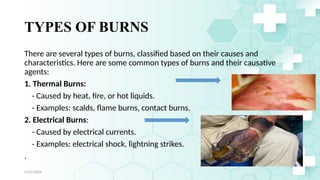
2. Electrical Burns:
- Caused by electrical currents.
- Examples: electrical shock, lightning strikes.
.
4/21/2024
Jamal 9
Cont..
4. Radiation Burns:
- Caused by ionizing radiation.
- Examples: sunburn, radiation therapy burns.
5. Friction Burns:
- Caused by friction or abrasion.
- Examples: rope burns, carpet burns.
4/21/2024
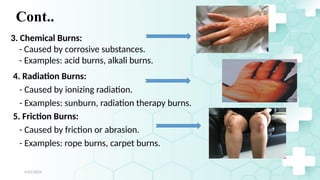
3. Chemical Burns:
- Caused by corrosive substances.
- Examples: acid burns, alkali burns.
Jamal 10
Cont..
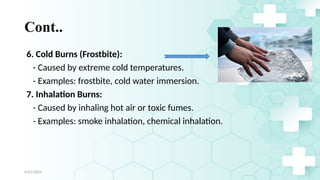
6. Cold Burns (Frostbite):
- Caused by extreme cold temperatures.
- Examples: frostbite, cold water immersion.
7. Inhalation Burns:
- Caused by inhaling hot air or toxic fumes.
- Examples: smoke inhalation, chemical inhalation.
4/21/2024
11
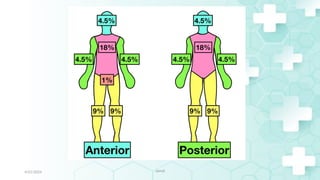
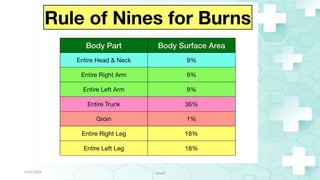
RULE OF NINE FOR BURNS
A calculation used to calculate the total body surface area (T BSA)
percentage of the body that is burn.
Just for 2nd and 3rd degree burns
4/21/2024
Jamal
12
4/21/2024 Jamal
13
4/21/2024 Jamal
Jamal 14
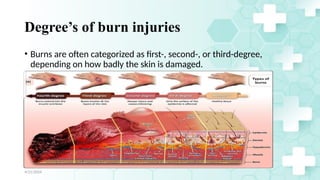
Degree’s of burn injuries
• Burns are often categorized as first-, second-, or third-degree,
depending on how badly the skin is damaged.
4/21/2024
Jamal 15
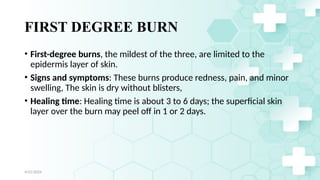
FIRST DEGREE BURN
• First-degree burns, the mildest of the three, are limited to the
epidermis layer of skin.
• Signs and symptoms: These burns produce redness, pain, and minor
swelling, The skin is dry without blisters,
• Healing time: Healing time is about 3 to 6 days; the superficial skin
layer over the burn may peel off in 1 or 2 days.
4/21/2024
Jamal 16
4/21/2024
Jamal 17
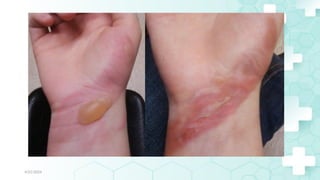
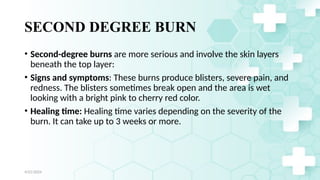
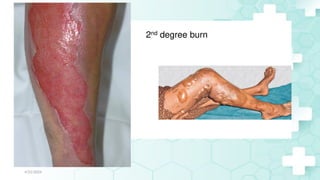
SECOND DEGREE BURN
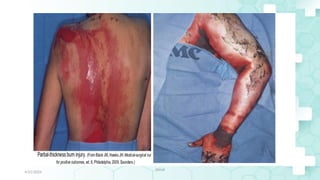
• Second-degree burns are more serious and involve the skin layers
beneath the top layer:
• Signs and symptoms: These burns produce blisters, severe pain, and
redness. The blisters sometimes break open and the area is wet
looking with a bright pink to cherry red color.
• Healing time: Healing time varies depending on the severity of the
burn. It can take up to 3 weeks or more.
4/21/2024
Jamal 18
4/21/2024
Jamal 19
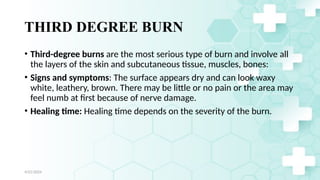
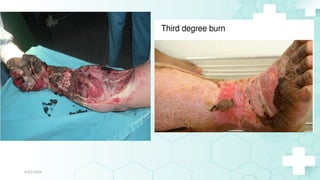
THIRD DEGREE BURN
• Third-degree burns are the most serious type of burn and involve all
the layers of the skin and subcutaneous tissue, muscles, bones:
• Signs and symptoms: The surface appears dry and can look waxy
white, leathery, brown. There may be little or no pain or the area may
feel numb at first because of nerve damage.
• Healing time: Healing time depends on the severity of the burn.
4/21/2024
Jamal 20
4/21/2024
Jamal 21
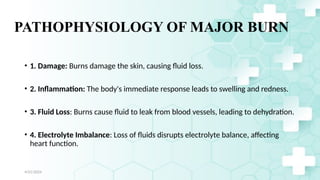
PATHOPHYSIOLOGY OF MAJOR BURN
• 1. Damage: Burns damage the skin, causing fluid loss.
• 2. Inflammation: The body's immediate response leads to swelling and redness.
• 3. Fluid Loss: Burns cause fluid to leak from blood vessels, leading to dehydration.
• 4. Electrolyte Imbalance: Loss of fluids disrupts electrolyte balance, affecting
heart function.
4/21/2024
Jamal 22
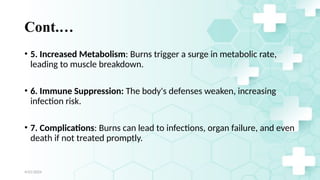
Cont.…
• 5. Increased Metabolism: Burns trigger a surge in metabolic rate,
leading to muscle breakdown.
• 6. Immune Suppression: The body's defenses weaken, increasing
infection risk.
• 7. Complications: Burns can lead to infections, organ failure, and even
death if not treated promptly.
4/21/2024
Jamal 23
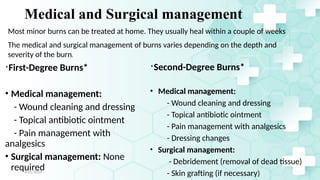
Medical and Surgical management
*First-Degree Burns*
• Medical management:
- Wound cleaning and dressing
- Topical antibiotic ointment
- Pain management with
analgesics
• Surgical management: None
required
*Second-Degree Burns*
• Medical management:
- Wound cleaning and dressing
- Topical antibiotic ointment
- Pain management with analgesics
- Dressing changes
• Surgical management:
- Debridement (removal of dead tissue)
- Skin grafting (if necessary)
4/21/2024
The medical and surgical management of burns varies depending on the depth and
severity of the burn.
Most minor burns can be treated at home. They usually heal within a couple of weeks
Jamal 24
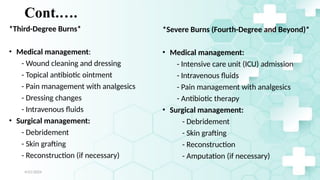
Cont.….
*Third-Degree Burns*
• Medical management:
- Wound cleaning and dressing
- Topical antibiotic ointment
- Pain management with analgesics
- Dressing changes
- Intravenous fluids
• Surgical management:
- Debridement
- Skin grafting
- Reconstruction (if necessary)
*Severe Burns (Fourth-Degree and Beyond)*
• Medical management:
- Intensive care unit (ICU) admission
- Intravenous fluids
- Pain management with analgesics
- Antibiotic therapy
• Surgical management:
- Debridement
- Skin grafting
- Reconstruction
- Amputation (if necessary)
4/21/2024
Jamal 25
IMMEDIATE MANAGEMENT AFTER BURN
• *Assessment*:
- Initial assessment: wound size, depth, location, and severity
- Vital signs: temperature, pulse, blood pressure, respiratory rate, and oxygen
saturation
- Pain level and management
• *Wound Care*:
- Clean and dress the wound with sterile gauze and antimicrobial agents
- Remove any clothing and jewelry near the burn area
- Debride blisters (if necessary)
• *Fluid Resuscitation*:
- Administer IV fluids according to the Parkland formula (4 mL/kg/%TBSA)
- Monitor fluid intake and output
4/21/2024
Nursing care of burn injuries in the immediate post-burn period (first 24-48 hours) .
Jamal 26
CONT…
• *Pain Management*:
- Administer analgesics (e.g., morphine ) as prescribed
- Use non-pharmacological techniques (e.g., relaxation, distraction)
• *Temperature Regulation*:
- Monitor body temperature
- Use cooling measures (e.g., cool compresses, cooling blankets) to prevent
hyperthermia
• *Infection Prevention*:
- Use aseptic technique when dressing the wound
- Monitor for signs of infection (e.g., redness, swelling, increased pain)
4/21/2024
Jamal 27
CONT….
• *Respiratory Support*:
- Monitor oxygen saturation and respiratory rate
- Provide oxygen therapy (if necessary)
• *Nutrition and Hydration*:
- Encourage oral intake (if possible)
- Administer IV nutrition (if necessary)
• *Psychological Support*:
- Provide emotional support and reassurance
- Encourage family support and involvement
4/21/2024
Jamal 28
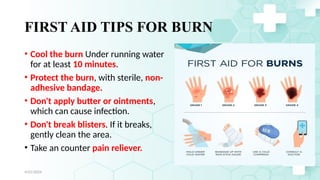
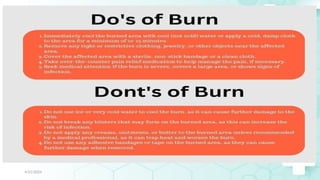
FIRST AID TIPS FOR BURN
• Cool the burn Under running water
for at least 10 minutes.
• Protect the burn, with sterile, non-
adhesive bandage.
• Don't apply butter or ointments,
which can cause infection.
• Don't break blisters. If it breaks,
gently clean the area.
• Take an counter pain reliever.
4/21/2024
Jamal 29
DON’TS
• Do not apply ice - this may cause
further damage to the skin,
• Do not use any butter, ointments or
other home remedies on the burn.
Such substances may trap the heat
in the tissue and makes the burn
worse.
• Do not break any blisters...leave
intact.
• Do not delay seeing medical
attention if the burn is larger than
the size of the victim's palm,
4/21/2024
Jamal 30
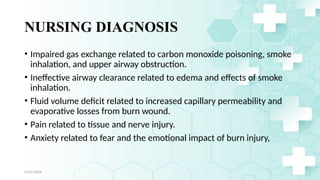
NURSING DIAGNOSIS
• Impaired gas exchange related to carbon monoxide poisoning, smoke
inhalation, and upper airway obstruction.
• Ineffective airway clearance related to edema and effects of smoke
inhalation.
• Fluid volume deficit related to increased capillary permeability and
evaporative losses from burn wound.
• Pain related to tissue and nerve injury.
• Anxiety related to fear and the emotional impact of burn injury,
4/21/2024
Jamal 31
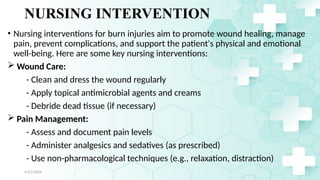
NURSING INTERVENTION
• Nursing interventions for burn injuries aim to promote wound healing, manage
pain, prevent complications, and support the patient's physical and emotional
well-being. Here are some key nursing interventions:
 Wound Care:
- Clean and dress the wound regularly
- Apply topical antimicrobial agents and creams
- Debride dead tissue (if necessary)
 Pain Management:
- Assess and document pain levels
- Administer analgesics and sedatives (as prescribed)
- Use non-pharmacological techniques (e.g., relaxation, distraction)
4/21/2024
Jamal 32
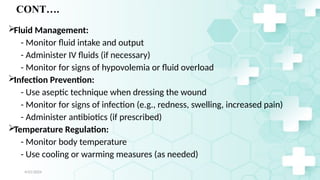
CONT….
Fluid Management:
- Monitor fluid intake and output
- Administer IV fluids (if necessary)
- Monitor for signs of hypovolemia or fluid overload
Infection Prevention:
- Use aseptic technique when dressing the wound
- Monitor for signs of infection (e.g., redness, swelling, increased pain)
- Administer antibiotics (if prescribed)
Temperature Regulation:
- Monitor body temperature
- Use cooling or warming measures (as needed)
4/21/2024
Jamal 33
Cont..
Nutrition and Hydration:
- Encourage high-calorie, high-protein diet
- Monitor for signs of malnutrition
- Ensure adequate hydration
Mobility and Exercise:
- Encourage early mobility and range-of-motion exercises
Psychological Support:
- Assess emotional and psychological status
- Provide emotional support and counseling
Monitor for Complications:
- Respiratory distress
- Renal failure
- Hepatic dysfunction
- Sepsis and multi-organ failure
4/21/2024
Jamal 34
4/21/2024

BURNS safe presentation for nursing .pptx

  • 1.
  • 2.
    • Presented by: •Asad Jamal • Bakht Saifurahman • Asif Hamza • Hassan khan 2 BURNS 4/21/2024 Jamal
  • 3.
    3 OBJECTIVES After the completionof this presentation the learners will be able to: • Define burns. • Describe etiology and sign and symptoms of burns. • Discuss rule of nine for burns. • Describe various types of burns and their causative agents. • Classification of burn injuries and their size and depth. • Demonstrate understanding of pathophysiology of a major burn injury. • Discuss the nursing management of burns. 4/21/2024 Jamal
  • 4.
    4 Burns "A burn isa type of injury to skin or other tissue caused by heat, cold, electricity, chemical or radiation". Most burns are due to heat from hot liquids, solids or fire. 4/21/2024 Jamal
  • 5.
    5 ETIOLOGY • Thermal burns •Dry heat (contact burn, flame burn) • Moist heat (steam, hot liquid) • Chemical burns (acids and alkali) • Electrical burns (high and low voltage) • Cold burns (frostbite) • Radiation (sunlight/UV) 4/21/2024 Jamal
  • 6.
    6 SIGN AND SYMPYOMS •Redness • Pain • Swelling • Blisters • Numbness • Scaring • Appearing wet or moist 4/21/2024 Jamal
  • 7.
  • 8.
    Jamal 8 TYPES OFBURNS There are several types of burns, classified based on their causes and characteristics. Here are some common types of burns and their causative agents: 1. Thermal Burns: - Caused by heat, fire, or hot liquids. - Examples: scalds, flame burns, contact burns. 2. Electrical Burns: - Caused by electrical currents. - Examples: electrical shock, lightning strikes. . 4/21/2024
  • 9.
    Jamal 9 Cont.. 4. RadiationBurns: - Caused by ionizing radiation. - Examples: sunburn, radiation therapy burns. 5. Friction Burns: - Caused by friction or abrasion. - Examples: rope burns, carpet burns. 4/21/2024 3. Chemical Burns: - Caused by corrosive substances. - Examples: acid burns, alkali burns.
  • 10.
    Jamal 10 Cont.. 6. ColdBurns (Frostbite): - Caused by extreme cold temperatures. - Examples: frostbite, cold water immersion. 7. Inhalation Burns: - Caused by inhaling hot air or toxic fumes. - Examples: smoke inhalation, chemical inhalation. 4/21/2024
  • 11.
    11 RULE OF NINEFOR BURNS A calculation used to calculate the total body surface area (T BSA) percentage of the body that is burn. Just for 2nd and 3rd degree burns 4/21/2024 Jamal
  • 12.
  • 13.
  • 14.
    Jamal 14 Degree’s ofburn injuries • Burns are often categorized as first-, second-, or third-degree, depending on how badly the skin is damaged. 4/21/2024
  • 15.
    Jamal 15 FIRST DEGREEBURN • First-degree burns, the mildest of the three, are limited to the epidermis layer of skin. • Signs and symptoms: These burns produce redness, pain, and minor swelling, The skin is dry without blisters, • Healing time: Healing time is about 3 to 6 days; the superficial skin layer over the burn may peel off in 1 or 2 days. 4/21/2024
  • 16.
  • 17.
    Jamal 17 SECOND DEGREEBURN • Second-degree burns are more serious and involve the skin layers beneath the top layer: • Signs and symptoms: These burns produce blisters, severe pain, and redness. The blisters sometimes break open and the area is wet looking with a bright pink to cherry red color. • Healing time: Healing time varies depending on the severity of the burn. It can take up to 3 weeks or more. 4/21/2024
  • 18.
  • 19.
    Jamal 19 THIRD DEGREEBURN • Third-degree burns are the most serious type of burn and involve all the layers of the skin and subcutaneous tissue, muscles, bones: • Signs and symptoms: The surface appears dry and can look waxy white, leathery, brown. There may be little or no pain or the area may feel numb at first because of nerve damage. • Healing time: Healing time depends on the severity of the burn. 4/21/2024
  • 20.
  • 21.
    Jamal 21 PATHOPHYSIOLOGY OFMAJOR BURN • 1. Damage: Burns damage the skin, causing fluid loss. • 2. Inflammation: The body's immediate response leads to swelling and redness. • 3. Fluid Loss: Burns cause fluid to leak from blood vessels, leading to dehydration. • 4. Electrolyte Imbalance: Loss of fluids disrupts electrolyte balance, affecting heart function. 4/21/2024
  • 22.
    Jamal 22 Cont.… • 5.Increased Metabolism: Burns trigger a surge in metabolic rate, leading to muscle breakdown. • 6. Immune Suppression: The body's defenses weaken, increasing infection risk. • 7. Complications: Burns can lead to infections, organ failure, and even death if not treated promptly. 4/21/2024
  • 23.
    Jamal 23 Medical andSurgical management *First-Degree Burns* • Medical management: - Wound cleaning and dressing - Topical antibiotic ointment - Pain management with analgesics • Surgical management: None required *Second-Degree Burns* • Medical management: - Wound cleaning and dressing - Topical antibiotic ointment - Pain management with analgesics - Dressing changes • Surgical management: - Debridement (removal of dead tissue) - Skin grafting (if necessary) 4/21/2024 The medical and surgical management of burns varies depending on the depth and severity of the burn. Most minor burns can be treated at home. They usually heal within a couple of weeks
  • 24.
    Jamal 24 Cont.…. *Third-Degree Burns* •Medical management: - Wound cleaning and dressing - Topical antibiotic ointment - Pain management with analgesics - Dressing changes - Intravenous fluids • Surgical management: - Debridement - Skin grafting - Reconstruction (if necessary) *Severe Burns (Fourth-Degree and Beyond)* • Medical management: - Intensive care unit (ICU) admission - Intravenous fluids - Pain management with analgesics - Antibiotic therapy • Surgical management: - Debridement - Skin grafting - Reconstruction - Amputation (if necessary) 4/21/2024
  • 25.
    Jamal 25 IMMEDIATE MANAGEMENTAFTER BURN • *Assessment*: - Initial assessment: wound size, depth, location, and severity - Vital signs: temperature, pulse, blood pressure, respiratory rate, and oxygen saturation - Pain level and management • *Wound Care*: - Clean and dress the wound with sterile gauze and antimicrobial agents - Remove any clothing and jewelry near the burn area - Debride blisters (if necessary) • *Fluid Resuscitation*: - Administer IV fluids according to the Parkland formula (4 mL/kg/%TBSA) - Monitor fluid intake and output 4/21/2024 Nursing care of burn injuries in the immediate post-burn period (first 24-48 hours) .
  • 26.
    Jamal 26 CONT… • *PainManagement*: - Administer analgesics (e.g., morphine ) as prescribed - Use non-pharmacological techniques (e.g., relaxation, distraction) • *Temperature Regulation*: - Monitor body temperature - Use cooling measures (e.g., cool compresses, cooling blankets) to prevent hyperthermia • *Infection Prevention*: - Use aseptic technique when dressing the wound - Monitor for signs of infection (e.g., redness, swelling, increased pain) 4/21/2024
  • 27.
    Jamal 27 CONT…. • *RespiratorySupport*: - Monitor oxygen saturation and respiratory rate - Provide oxygen therapy (if necessary) • *Nutrition and Hydration*: - Encourage oral intake (if possible) - Administer IV nutrition (if necessary) • *Psychological Support*: - Provide emotional support and reassurance - Encourage family support and involvement 4/21/2024
  • 28.
    Jamal 28 FIRST AIDTIPS FOR BURN • Cool the burn Under running water for at least 10 minutes. • Protect the burn, with sterile, non- adhesive bandage. • Don't apply butter or ointments, which can cause infection. • Don't break blisters. If it breaks, gently clean the area. • Take an counter pain reliever. 4/21/2024
  • 29.
    Jamal 29 DON’TS • Donot apply ice - this may cause further damage to the skin, • Do not use any butter, ointments or other home remedies on the burn. Such substances may trap the heat in the tissue and makes the burn worse. • Do not break any blisters...leave intact. • Do not delay seeing medical attention if the burn is larger than the size of the victim's palm, 4/21/2024
  • 30.
    Jamal 30 NURSING DIAGNOSIS •Impaired gas exchange related to carbon monoxide poisoning, smoke inhalation, and upper airway obstruction. • Ineffective airway clearance related to edema and effects of smoke inhalation. • Fluid volume deficit related to increased capillary permeability and evaporative losses from burn wound. • Pain related to tissue and nerve injury. • Anxiety related to fear and the emotional impact of burn injury, 4/21/2024
  • 31.
    Jamal 31 NURSING INTERVENTION •Nursing interventions for burn injuries aim to promote wound healing, manage pain, prevent complications, and support the patient's physical and emotional well-being. Here are some key nursing interventions:  Wound Care: - Clean and dress the wound regularly - Apply topical antimicrobial agents and creams - Debride dead tissue (if necessary)  Pain Management: - Assess and document pain levels - Administer analgesics and sedatives (as prescribed) - Use non-pharmacological techniques (e.g., relaxation, distraction) 4/21/2024
  • 32.
    Jamal 32 CONT…. Fluid Management: -Monitor fluid intake and output - Administer IV fluids (if necessary) - Monitor for signs of hypovolemia or fluid overload Infection Prevention: - Use aseptic technique when dressing the wound - Monitor for signs of infection (e.g., redness, swelling, increased pain) - Administer antibiotics (if prescribed) Temperature Regulation: - Monitor body temperature - Use cooling or warming measures (as needed) 4/21/2024
  • 33.
    Jamal 33 Cont.. Nutrition andHydration: - Encourage high-calorie, high-protein diet - Monitor for signs of malnutrition - Ensure adequate hydration Mobility and Exercise: - Encourage early mobility and range-of-motion exercises Psychological Support: - Assess emotional and psychological status - Provide emotional support and counseling Monitor for Complications: - Respiratory distress - Renal failure - Hepatic dysfunction - Sepsis and multi-organ failure 4/21/2024
  • 34.