Bulimia Nervosa

By: Sarah Abughrib & Adriana Hidalgo
What is Bulimia?

 Bulimia Nervosa is an eating disorder that is
 characterized by alternating episodes of binging and
 purging. The person will eat a lot of food in a short
 period of time and then purge the food by inducing
 vomiting, taking laxatives or exercising excessively.
Other Eating Disorders
 Anorexia Nervosa- An emotional disorder
  characterized by an obsessive desire to lose
  weight by refusing to eat.
 Anorexia Athletica- Anorexia athletica is an
  addiction to exercise. The person with anorexia
  athletica no longer enjoys exercising, but feels
  obligated to do so.
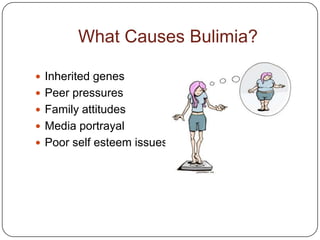
What Causes Bulimia?

 Inherited genes
 Peer pressures
 Family attitudes
 Media portrayal
 Poor self esteem issues
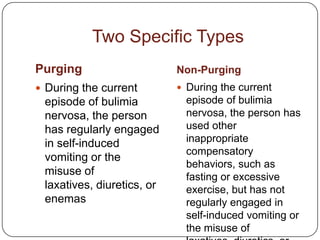
Two Specific Types
Purging                     Non-Purging
 During the current         During the current
 episode of bulimia           episode of bulimia
 nervosa, the person          nervosa, the person has
 has regularly engaged        used other
 in self-induced              inappropriate
                              compensatory
 vomiting or the
                              behaviors, such as
 misuse of                    fasting or excessive
 laxatives, diuretics, or     exercise, but has not
 enemas                       regularly engaged in
                              self-induced vomiting or
                              the misuse of
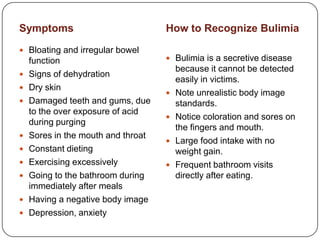
Symptoms                            How to Recognize Bulimia
 Bloating and irregular bowel
    function                         Bulimia is a secretive disease
                                        because it cannot be detected
   Signs of dehydration
                                        easily in victims.
   Dry skin
                                       Note unrealistic body image
   Damaged teeth and gums, due         standards.
    to the over exposure of acid
                                       Notice coloration and sores on
    during purging
                                        the fingers and mouth.
   Sores in the mouth and throat
                                       Large food intake with no
   Constant dieting                    weight gain.
   Exercising excessively             Frequent bathroom visits
   Going to the bathroom during        directly after eating.
    immediately after meals
   Having a negative body image
   Depression, anxiety
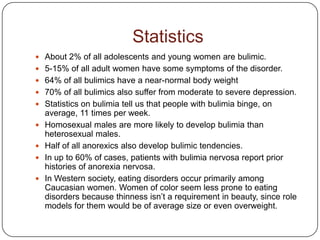
Statistics
 About 2% of all adolescents and young women are bulimic.
 5-15% of all adult women have some symptoms of the disorder.
 64% of all bulimics have a near-normal body weight
 70% of all bulimics also suffer from moderate to severe depression.
 Statistics on bulimia tell us that people with bulimia binge, on
    average, 11 times per week.
   Homosexual males are more likely to develop bulimia than
    heterosexual males.
   Half of all anorexics also develop bulimic tendencies.
   In up to 60% of cases, patients with bulimia nervosa report prior
    histories of anorexia nervosa.
   In Western society, eating disorders occur primarily among
    Caucasian women. Women of color seem less prone to eating
    disorders because thinness isn’t a requirement in beauty, since role
    models for them would be of average size or even overweight.
History of Bulimia
 Bulimia was first described in ancient Roman times
  when citizens forced themselves to purge in order to
  prolong their enjoyment of a heavy meal.
 In 1903, a French psychiatrist Pierre Janet was one of
  the first to publish a description of a patient who
  binged and purged but never lost her appetite.
 Also, an American physician Albert Stunkard, an
  expert on obesity, identified bulimia in contemporary
  terms in 1959, but for many years the illness was
  considered a variation of anorexia.
 It wasn’t until the late 1980’s that bulimia was
  recognized as a distinct disorder, and by 1987 it was
  finally given the term bulimia nervosa.
Binge Eating
 Bulimia nervosa is characterized by frequent episodes
  of binge eating associated with emotional distress and
  a sense of loss of control.
 Binge eating: Eating an extremely large amount of
  food in a short period of time. The person recognizes
  their loss of control of eating during this time.
 Overeating episode: The consumption of an unusually
  large amount of food in a defined period. The person
  doesn’t realize they’ve lost control of how much they
  eat.
 Subjective bulimic episode: The consumption of
  objectively minimal amounts of food in a defined
  period with a perception of loss of control.
Bulimic Cycle
Exams and Tests
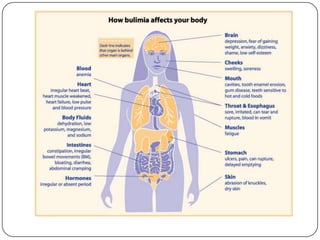
 Dental exams may show gum infections (such as gingivitis)
  Enamel of the teeth may be worn away due to the constant
  exposure of acid in the vomit.
 Doctors will:
  -Ask for your medical history reports.
  -Request a physical exam to check your heart, lungs, blood
  pressure, weight, mouth, skin, and hair for diet problems.
  -Screen questions about your eating habits and how you feel
  about your health.
  -A mental health assessment to check for depression or anxiety.
  -X-rays which can show whether your bones have weakened by
  malnutrition
Physical Activity

As it relates to Bulimia
Physical Activity
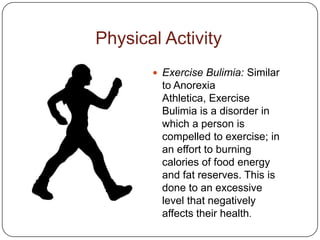
        Exercise Bulimia: Similar
         to Anorexia
         Athletica, Exercise
         Bulimia is a disorder in
         which a person is
         compelled to exercise; in
         an effort to burning
         calories of food energy
         and fat reserves. This is
         done to an excessive
         level that negatively
         affects their health.
Treatment
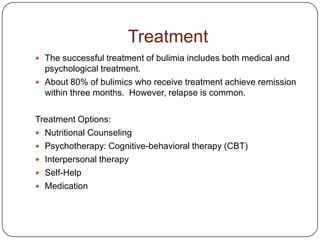
 The successful treatment of bulimia includes both medical and
  psychological treatment.
 About 80% of bulimics who receive treatment achieve remission
  within three months. However, relapse is common.

Treatment Options:
 Nutritional Counseling
 Psychotherapy: Cognitive-behavioral therapy (CBT)
 Interpersonal therapy
 Self-Help
 Medication
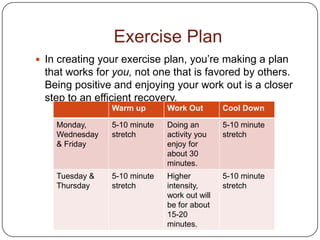
Exercise Plan
 In creating your exercise plan, you’re making a plan
  that works for you, not one that is favored by others.
  Being positive and enjoying your work out is a closer
  step to an efficient recovery.
                Warm up       Work Out        Cool Down

    Monday,     5-10 minute   Doing an        5-10 minute
    Wednesday   stretch       activity you    stretch
    & Friday                  enjoy for
                              about 30
                              minutes.
    Tuesday &   5-10 minute   Higher          5-10 minute
    Thursday    stretch       intensity,      stretch
                              work out will
                              be for about
                              15-20
                              minutes.
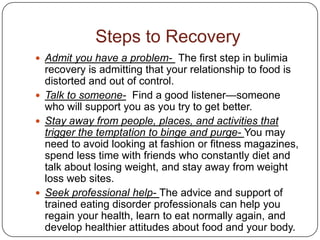
Steps to Recovery
 Admit you have a problem- The first step in bulimia
  recovery is admitting that your relationship to food is
  distorted and out of control.
 Talk to someone- Find a good listener—someone
  who will support you as you try to get better.
 Stay away from people, places, and activities that
  trigger the temptation to binge and purge- You may
  need to avoid looking at fashion or fitness magazines,
  spend less time with friends who constantly diet and
  talk about losing weight, and stay away from weight
  loss web sites.
 Seek professional help- The advice and support of
  trained eating disorder professionals can help you
  regain your health, learn to eat normally again, and
  develop healthier attitudes about food and your body.
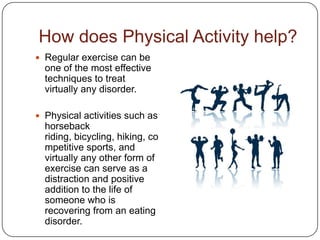
How does Physical Activity help?
 Regular exercise can be
  one of the most effective
  techniques to treat
  virtually any disorder.

 Physical activities such as
  horseback
  riding, bicycling, hiking, co
  mpetitive sports, and
  virtually any other form of
  exercise can serve as a
  distraction and positive
  addition to the life of
  someone who is
  recovering from an eating
  disorder.
Prevention
 Early treatment may be the best way to prevent
 the disorder from progressing.

Way to Prevent Bulimia:
• Balancing school, work, social life, rest, and
  exercise
• Maintenance of good mental health
• A positive self-image of the body
• Knowledge and maintenance of healthy eating
  habits
Conclusion (Bulimia in a Glance)
 Bulimia Nervosa is a psychological eating disorder.
 There are two types of bulimia: the purging and non
    purging types.
   It can have serious medical complications.
   The successful treatment of bulimia is often
    multidisciplinary, involving both medical and
    psychological approaches.
   The goals of treatment are to restore physical health
    and normal eating patterns.
   Early treatment may be the best way to prevent the
    disorder from progressing.
Thank You!

    ;)

Bulimia

  • 1.
    Bulimia Nervosa By: SarahAbughrib & Adriana Hidalgo
  • 2.
    What is Bulimia? Bulimia Nervosa is an eating disorder that is characterized by alternating episodes of binging and purging. The person will eat a lot of food in a short period of time and then purge the food by inducing vomiting, taking laxatives or exercising excessively.
  • 3.
    Other Eating Disorders Anorexia Nervosa- An emotional disorder characterized by an obsessive desire to lose weight by refusing to eat.  Anorexia Athletica- Anorexia athletica is an addiction to exercise. The person with anorexia athletica no longer enjoys exercising, but feels obligated to do so.
  • 4.
    What Causes Bulimia? Inherited genes  Peer pressures  Family attitudes  Media portrayal  Poor self esteem issues
  • 5.
    Two Specific Types Purging Non-Purging  During the current  During the current episode of bulimia episode of bulimia nervosa, the person nervosa, the person has has regularly engaged used other in self-induced inappropriate compensatory vomiting or the behaviors, such as misuse of fasting or excessive laxatives, diuretics, or exercise, but has not enemas regularly engaged in self-induced vomiting or the misuse of
  • 6.
    Symptoms How to Recognize Bulimia  Bloating and irregular bowel function  Bulimia is a secretive disease because it cannot be detected  Signs of dehydration easily in victims.  Dry skin  Note unrealistic body image  Damaged teeth and gums, due standards. to the over exposure of acid  Notice coloration and sores on during purging the fingers and mouth.  Sores in the mouth and throat  Large food intake with no  Constant dieting weight gain.  Exercising excessively  Frequent bathroom visits  Going to the bathroom during directly after eating. immediately after meals  Having a negative body image  Depression, anxiety
  • 7.
    Statistics  About 2%of all adolescents and young women are bulimic.  5-15% of all adult women have some symptoms of the disorder.  64% of all bulimics have a near-normal body weight  70% of all bulimics also suffer from moderate to severe depression.  Statistics on bulimia tell us that people with bulimia binge, on average, 11 times per week.  Homosexual males are more likely to develop bulimia than heterosexual males.  Half of all anorexics also develop bulimic tendencies.  In up to 60% of cases, patients with bulimia nervosa report prior histories of anorexia nervosa.  In Western society, eating disorders occur primarily among Caucasian women. Women of color seem less prone to eating disorders because thinness isn’t a requirement in beauty, since role models for them would be of average size or even overweight.
  • 9.
    History of Bulimia Bulimia was first described in ancient Roman times when citizens forced themselves to purge in order to prolong their enjoyment of a heavy meal.  In 1903, a French psychiatrist Pierre Janet was one of the first to publish a description of a patient who binged and purged but never lost her appetite.  Also, an American physician Albert Stunkard, an expert on obesity, identified bulimia in contemporary terms in 1959, but for many years the illness was considered a variation of anorexia.  It wasn’t until the late 1980’s that bulimia was recognized as a distinct disorder, and by 1987 it was finally given the term bulimia nervosa.
  • 10.
    Binge Eating  Bulimianervosa is characterized by frequent episodes of binge eating associated with emotional distress and a sense of loss of control.  Binge eating: Eating an extremely large amount of food in a short period of time. The person recognizes their loss of control of eating during this time.  Overeating episode: The consumption of an unusually large amount of food in a defined period. The person doesn’t realize they’ve lost control of how much they eat.  Subjective bulimic episode: The consumption of objectively minimal amounts of food in a defined period with a perception of loss of control.
  • 11.
  • 12.
    Exams and Tests Dental exams may show gum infections (such as gingivitis) Enamel of the teeth may be worn away due to the constant exposure of acid in the vomit.  Doctors will: -Ask for your medical history reports. -Request a physical exam to check your heart, lungs, blood pressure, weight, mouth, skin, and hair for diet problems. -Screen questions about your eating habits and how you feel about your health. -A mental health assessment to check for depression or anxiety. -X-rays which can show whether your bones have weakened by malnutrition
  • 13.
    Physical Activity As itrelates to Bulimia
  • 14.
    Physical Activity  Exercise Bulimia: Similar to Anorexia Athletica, Exercise Bulimia is a disorder in which a person is compelled to exercise; in an effort to burning calories of food energy and fat reserves. This is done to an excessive level that negatively affects their health.
  • 15.
    Treatment  The successfultreatment of bulimia includes both medical and psychological treatment.  About 80% of bulimics who receive treatment achieve remission within three months. However, relapse is common. Treatment Options:  Nutritional Counseling  Psychotherapy: Cognitive-behavioral therapy (CBT)  Interpersonal therapy  Self-Help  Medication
  • 16.
    Exercise Plan  Increating your exercise plan, you’re making a plan that works for you, not one that is favored by others. Being positive and enjoying your work out is a closer step to an efficient recovery. Warm up Work Out Cool Down Monday, 5-10 minute Doing an 5-10 minute Wednesday stretch activity you stretch & Friday enjoy for about 30 minutes. Tuesday & 5-10 minute Higher 5-10 minute Thursday stretch intensity, stretch work out will be for about 15-20 minutes.
  • 17.
    Steps to Recovery Admit you have a problem- The first step in bulimia recovery is admitting that your relationship to food is distorted and out of control.  Talk to someone- Find a good listener—someone who will support you as you try to get better.  Stay away from people, places, and activities that trigger the temptation to binge and purge- You may need to avoid looking at fashion or fitness magazines, spend less time with friends who constantly diet and talk about losing weight, and stay away from weight loss web sites.  Seek professional help- The advice and support of trained eating disorder professionals can help you regain your health, learn to eat normally again, and develop healthier attitudes about food and your body.
  • 18.
    How does PhysicalActivity help?  Regular exercise can be one of the most effective techniques to treat virtually any disorder.  Physical activities such as horseback riding, bicycling, hiking, co mpetitive sports, and virtually any other form of exercise can serve as a distraction and positive addition to the life of someone who is recovering from an eating disorder.
  • 19.
    Prevention  Early treatmentmay be the best way to prevent the disorder from progressing. Way to Prevent Bulimia: • Balancing school, work, social life, rest, and exercise • Maintenance of good mental health • A positive self-image of the body • Knowledge and maintenance of healthy eating habits
  • 20.
    Conclusion (Bulimia ina Glance)  Bulimia Nervosa is a psychological eating disorder.  There are two types of bulimia: the purging and non purging types.  It can have serious medical complications.  The successful treatment of bulimia is often multidisciplinary, involving both medical and psychological approaches.  The goals of treatment are to restore physical health and normal eating patterns.  Early treatment may be the best way to prevent the disorder from progressing.
  • 21.