Music of Bulgaria
Bulgarian music is part of the Balkan
 tradition,
which stretches across Southeastern
 Europe,
and has its own distinctive sound.
Traditional Bulgarian music has had
more international success, due to
the breakout international success of Le
 Mystère
des Voix Bulgares, a woman's choir that
has topped world music charts across
Bulgarian vocals are said
   to
  be "open-throated",
   though this is
   somewhat of a
misnomer. Singers
   actually
 focus their voices in a
   way that gives the
   sound a
distinctive "edge", and
   makes
the voice carry over long
distances.
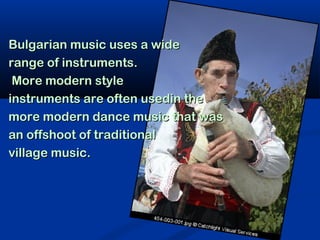
Bulgarian music uses a wide
range of instruments.
 More modern style
instruments are often usedin the
more modern dance music that was
an offshoot of traditional
village music.
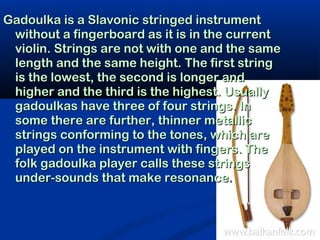
Gadoulka is a Slavonic stringed instrument
 without a fingerboard as it is in the current
 violin. Strings are not with one and the same
 length and the same height. The first string
 is the lowest, the second is longer and
 higher and the third is the highest. Usually
 gadoulkas have three of four strings. In
 some there are further, thinner metallic
 strings conforming to the tones, which are
 played on the instrument with fingers. The
 folk gadoulka player calls these strings
 under-sounds that make resonance.
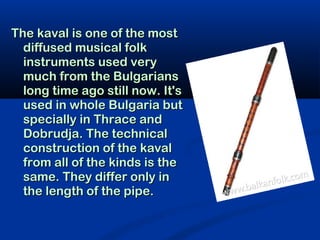
The kaval is one of the most
  diffused musical folk
  instruments used very
  much from the Bulgarians
  long time ago still now. It's
  used in whole Bulgaria but
  specially in Thrace and
  Dobrudja. The technical
  construction of the kaval
  from all of the kinds is the
  same. They differ only in
  the length of the pipe.
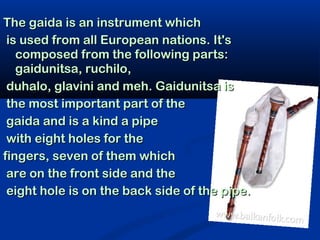
The gaida is an instrument which
 is used from all European nations. It's
   composed from the following parts:
   gaidunitsa, ruchilo,
 duhalo, glavini and meh. Gaidunitsa is
 the most important part of the
 gaida and is a kind a pipe
 with eight holes for the
fingers, seven of them which
 are on the front side and the
 eight hole is on the back side of the pipe.
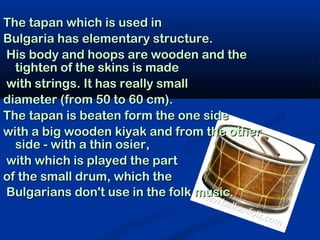
The tapan which is used in
Bulgaria has elementary structure.
His body and hoops are wooden and the
  tighten of the skins is made
with strings. It has really small
diameter (from 50 to 60 cm).
The tapan is beaten form the one side
with a big wooden kiyak and from the other
  side - with a thin osier,
with which is played the part
of the small drum, which the
Bulgarians don't use in the folk music.
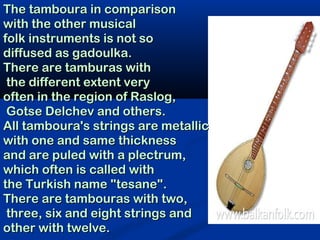
The tamboura in comparison
with the other musical
folk instruments is not so
diffused as gadoulka.
There are tamburas with
 the different extent very
often in the region of Raslog,
 Gotse Delchev and others.
All tamboura's strings are metallic
with one and same thickness
and are puled with a plectrum,
which often is called with
the Turkish name "tesane".
There are tambouras with two,
 three, six and eight strings and
other with twelve.
General Secondary School “Hristo
           Botev” - Aytos

This project has been funded with support
     from the European Commission.
This presentation reflects the views only of
the author, and the Commission cannot be
held responsible for any use which may be
made of the information contained therein.

Bulgarian i nstrument

  • 2.
    Music of Bulgaria Bulgarianmusic is part of the Balkan tradition, which stretches across Southeastern Europe, and has its own distinctive sound. Traditional Bulgarian music has had more international success, due to the breakout international success of Le Mystère des Voix Bulgares, a woman's choir that has topped world music charts across
  • 3.
    Bulgarian vocals aresaid to be "open-throated", though this is somewhat of a misnomer. Singers actually focus their voices in a way that gives the sound a distinctive "edge", and makes the voice carry over long distances.
  • 4.
    Bulgarian music usesa wide range of instruments. More modern style instruments are often usedin the more modern dance music that was an offshoot of traditional village music.
  • 5.
    Gadoulka is aSlavonic stringed instrument without a fingerboard as it is in the current violin. Strings are not with one and the same length and the same height. The first string is the lowest, the second is longer and higher and the third is the highest. Usually gadoulkas have three of four strings. In some there are further, thinner metallic strings conforming to the tones, which are played on the instrument with fingers. The folk gadoulka player calls these strings under-sounds that make resonance.
  • 6.
    The kaval isone of the most diffused musical folk instruments used very much from the Bulgarians long time ago still now. It's used in whole Bulgaria but specially in Thrace and Dobrudja. The technical construction of the kaval from all of the kinds is the same. They differ only in the length of the pipe.
  • 7.
    The gaida isan instrument which is used from all European nations. It's composed from the following parts: gaidunitsa, ruchilo, duhalo, glavini and meh. Gaidunitsa is the most important part of the gaida and is a kind a pipe with eight holes for the fingers, seven of them which are on the front side and the eight hole is on the back side of the pipe.
  • 8.
    The tapan whichis used in Bulgaria has elementary structure. His body and hoops are wooden and the tighten of the skins is made with strings. It has really small diameter (from 50 to 60 cm). The tapan is beaten form the one side with a big wooden kiyak and from the other side - with a thin osier, with which is played the part of the small drum, which the Bulgarians don't use in the folk music.
  • 9.
    The tamboura incomparison with the other musical folk instruments is not so diffused as gadoulka. There are tamburas with the different extent very often in the region of Raslog, Gotse Delchev and others. All tamboura's strings are metallic with one and same thickness and are puled with a plectrum, which often is called with the Turkish name "tesane". There are tambouras with two, three, six and eight strings and other with twelve.
  • 11.
    General Secondary School“Hristo Botev” - Aytos This project has been funded with support from the European Commission. This presentation reflects the views only of the author, and the Commission cannot be held responsible for any use which may be made of the information contained therein.