Climate change as a development challengeJariVayrynen, Sr. Environmental Specialist, World BankMeeting the challenge is not a choice between growth and climate change…a climate smart world is within reach if we act now, act together and act differently…… and build on new finance, technology and capacity at scale.
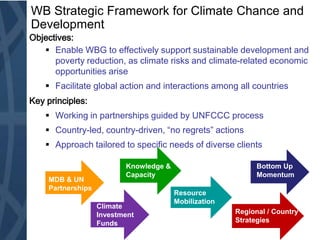
WB Strategic Framework for Climate Chance and DevelopmentObjectives:Enable WBG to effectively support sustainable development and poverty reduction, as climate risks and climate-related economic opportunities arise
Facilitate global action and interactions among all countriesKey principles:Working in partnerships guided by UNFCCC process
Country-led, country-driven, “no regrets” actions
Approach tailored to specific needs of diverse clientsKnowledge &CapacityBottom Up MomentumMDB & UNPartnershipsResource MobilizationClimate Investment FundsRegional / Country Strategies
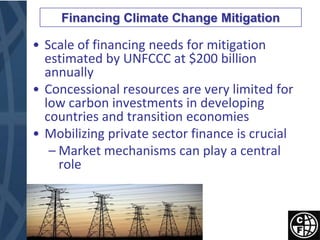
Financing Climate Change MitigationScale of financing needs for mitigation estimated by UNFCCC at $200 billion annuallyConcessional resources are very limited for low carbon investments in developing countries and transition economiesMobilizing private sector finance is crucialMarket mechanisms can play a central role
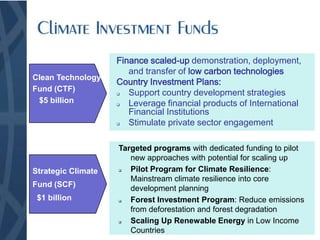
Finance scaled-up demonstration, deployment, and transfer of low carbon technologiesCountry Investment Plans:Support country development strategies
Leverage financial products of International Financial Institutions
Stimulate private sector engagementClean Technology Fund (CTF)± $5 billionTargeted programs with dedicated funding to pilot new approaches with potential for scaling upPilot Program for Climate Resilience: Mainstream climate resilience into core development planning
Forest Investment Program: Reduce emissions from deforestation and forest degradation
Scaling Up Renewable Energy in Low Income CountriesStrategic Climate Fund (SCF)±$1 billion
Investmentplans endorsed with a total funding envelope of US$1.85 billionAverage leverage US$ 1 to 10 Pledges (+/-) US$5 billionEnergy Efficiency - Replacing inefficient lighting and appliances; expectedemissions reductions of 4 million tons of CO2 per yearUrban Transport - 20 bus rapid transit corridors with low-carbon bus technologiesRenewable Energy Proposed CTF » $500 million leverages » $6.2 billionMexicoTurkeyRenewable Energy - Implementing "intelligent" grid management and control systems to support large-scale integration of wind power Renewable Energy and Energy Efficiency - Promoting private sector development through credit lines to local development banks Proposed CTF » $250 million leverages » 2.1 billion Wind Power - From <1,000 MW to 2,500 MW of electricity from wind Urban Transport - Six bus rapid transit corridors and five light rail route Proposed CTF » $300 million leverages » $1.9 billionEgypt

Bulgaria forum presentation

  • 1.
    Climate change asa development challengeJariVayrynen, Sr. Environmental Specialist, World BankMeeting the challenge is not a choice between growth and climate change…a climate smart world is within reach if we act now, act together and act differently…… and build on new finance, technology and capacity at scale.
  • 2.
    WB Strategic Frameworkfor Climate Chance and DevelopmentObjectives:Enable WBG to effectively support sustainable development and poverty reduction, as climate risks and climate-related economic opportunities arise
  • 3.
    Facilitate global actionand interactions among all countriesKey principles:Working in partnerships guided by UNFCCC process
  • 4.
  • 5.
    Approach tailored tospecific needs of diverse clientsKnowledge &CapacityBottom Up MomentumMDB & UNPartnershipsResource MobilizationClimate Investment FundsRegional / Country Strategies
  • 6.
    Financing Climate ChangeMitigationScale of financing needs for mitigation estimated by UNFCCC at $200 billion annuallyConcessional resources are very limited for low carbon investments in developing countries and transition economiesMobilizing private sector finance is crucialMarket mechanisms can play a central role
  • 7.
    Finance scaled-up demonstration,deployment, and transfer of low carbon technologiesCountry Investment Plans:Support country development strategies
  • 8.
    Leverage financial productsof International Financial Institutions
  • 9.
    Stimulate private sectorengagementClean Technology Fund (CTF)± $5 billionTargeted programs with dedicated funding to pilot new approaches with potential for scaling upPilot Program for Climate Resilience: Mainstream climate resilience into core development planning
  • 10.
    Forest Investment Program:Reduce emissions from deforestation and forest degradation
  • 11.
    Scaling Up RenewableEnergy in Low Income CountriesStrategic Climate Fund (SCF)±$1 billion
  • 12.
    Investmentplans endorsed witha total funding envelope of US$1.85 billionAverage leverage US$ 1 to 10 Pledges (+/-) US$5 billionEnergy Efficiency - Replacing inefficient lighting and appliances; expectedemissions reductions of 4 million tons of CO2 per yearUrban Transport - 20 bus rapid transit corridors with low-carbon bus technologiesRenewable Energy Proposed CTF » $500 million leverages » $6.2 billionMexicoTurkeyRenewable Energy - Implementing "intelligent" grid management and control systems to support large-scale integration of wind power Renewable Energy and Energy Efficiency - Promoting private sector development through credit lines to local development banks Proposed CTF » $250 million leverages » 2.1 billion Wind Power - From <1,000 MW to 2,500 MW of electricity from wind Urban Transport - Six bus rapid transit corridors and five light rail route Proposed CTF » $300 million leverages » $1.9 billionEgypt
  • 13.
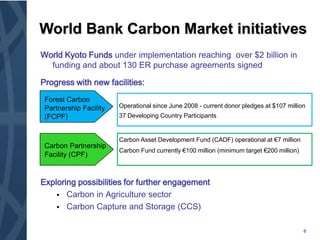
    6World Bank CarbonMarket initiativesWorld Kyoto Funds under implementation reaching over $2 billion in funding and about 130 ER purchase agreements signedProgress with new facilities:Exploring possibilities for further engagementCarbon in Agriculture sector
  • 14.
    Carbon Capture andStorage (CCS) Forest Carbon Partnership Facility (FCPF) Operational since June 2008 - current donor pledges at $107 million37 Developing Country ParticipantsCarbon Asset Development Fund (CADF) operational at €7 millionCarbon Fund currently €100 million (minimumtarget €200 million)Carbon Partnership Facility (CPF)
  • 15.
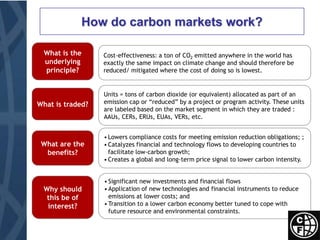
    How do carbonmarkets work?What is the underlying principle?Cost-effectiveness: a ton of CO2 emitted anywhere in the world has exactly the same impact on climate change and should therefore be reduced/ mitigated where the cost of doing so is lowest.Units = tons of carbon dioxide (or equivalent) allocated as part of an emission cap or “reduced” by a project or program activity. These units are labeled based on the market segment in which they are traded : AAUs, CERs, ERUs, EUAs, VERs, etc.What is traded?Lowers compliance costs for meeting emission reduction obligations; ;
  • 16.
    Catalyzes financial andtechnology flows to developing countries to facilitate low-carbon growth;
  • 17.
    Creates a globaland long-term price signal to lower carbon intensity.What are the benefits?Significant new investments and financial flows
  • 18.
    Application of newtechnologies and financial instruments to reduce emissions at lower costs; and
  • 19.
    Transition to alower carbon economy better tuned to cope with future resource and environmental constraints. Why should this be of interest?
  • 20.
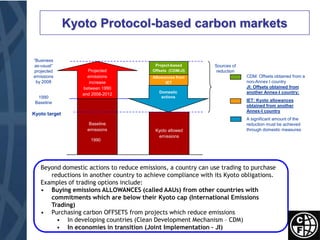
    Kyoto Protocol-based carbonmarkets“Business as-usual” projected emissions by 2008Project-based Offsets (CDM/JI)Projected emissions increase between 1990 and 2008-2012Sources of reductionCDM: Offsets obtained from a non-Annex I countryJI: Offsets obtained from another Annex-I country;Allowances from IETDomestic actions1990 BaselineIET: Kyoto allowances obtained from another Annex-I countryBaseline emissionsKyoto targetKyoto allowed emissionsA significant amount of the reduction must be achieved through domestic measures19902008-12Beyond domestic actions to reduce emissions, a country can use trading to purchase reductions in another country to achieve compliance with its Kyoto obligations.Examples of trading options include:Buying emissions ALLOWANCES (called AAUs) from other countries with commitments which are below their Kyoto cap (International Emissions Trading)
  • 21.
    Purchasing carbon OFFSETSfrom projects which reduce emissions
  • 22.
    In developing countries(Clean Development Mechanism – CDM)
  • 23.
    In economies intransition (Joint Implementation – JI)3
  • 24.
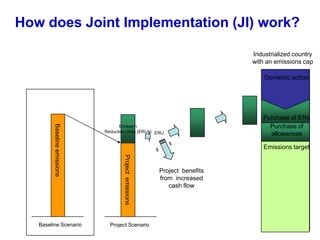
    Purchase of ERsEmissionReductionUnits (ERUs)ERUBaseline emissionsProject emissions Baseline Scenario ProjectScenarioHow does Joint Implementation (JI) work?Industrialized country with an emissions capDomestic actionPurchase of allowances$Emissions target$Project benefits from increased cash flow
  • 25.
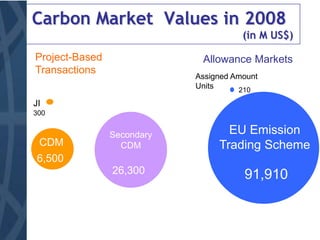
    EU Emission TradingScheme91,910Carbon Market Values in 2008 (in M US$)Project-Based TransactionsAllowance MarketsAssigned Amount Units210JI300SecondaryCDMCDM6,50026,300
  • 26.
    World Bank CarbonFinance Projects in BulgariaJoint Implementation projects:Sofia District HeatingPernik District HeatingSvilosa Biomass Green Investment Scheme (GIS)–options studyGIS is a system where revenues from AAU trades are reinvested in environmental projectsTo our knowledge Bulgarian Government has not yet concluded any GIS transactions11
  • 27.
    12ConclusionsClimate change isfundamentally a development issue, not only an environmental issueHuge financing needsCarbon markets will continue to be play a major role in catalyzing low carbon investments in developing countries and transition economiesThe World Bank, through a range of financial instruments and capacity building activities, is deeply engaged in this effort
  • 28.

Editor's Notes

  • #2 A serious and immediate threat to development prospects, affecting disproportionately the poor.Increasingly severe warnings of the scientific communityDanger starts close to 2C warming above pre-industrial (likely the best we can achieve)Impacts already being felt, falling disproportionately on the poor (developing countries could bear 75-80% of the costs of CC damages while contributing for 35% of GHGs already in the atmosphere – 2% only for low-income countries)Economic growth alone is unlikely to be fast or equitable enough to counter threats from climate change. Action or inaction is not a matter of choice between growth and climate change.A climate smart world is possible if we:Act now, under the leadership of high-income countries to stay as close as possible: to address both the urgency of the problem as well as the tremendous inertia in the climate system, in infrastructure and human systems. Any delay will reduce development options for mitigation and adaptation and raise costs of action. Besides mitigation efforts to avoid the un-manageable, immediate and substantial adaptation efforts in countries that are most vulnerable (and already suffering from first signs of CC) are required.Act together, for equity and efficiency reasons: postponing mitigation in developing countries could double mitigation costs, and that could well happen unless substantial financing is mobilized. Act differently, to call upon the tremendous ingenuity the human race is capable of, in order to tackle a complex problem that affects all dimension of development.Still, a formidable challenge:Finance [scope of this presentation]Technology [radically transform energy systems, make climate-resilient investment] Capacity [to maximize impact of climate finance: build enabling environment, grab technology, financial innovation]