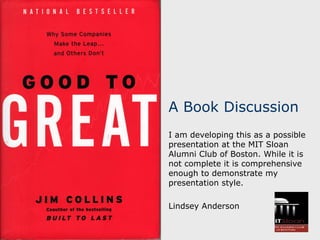
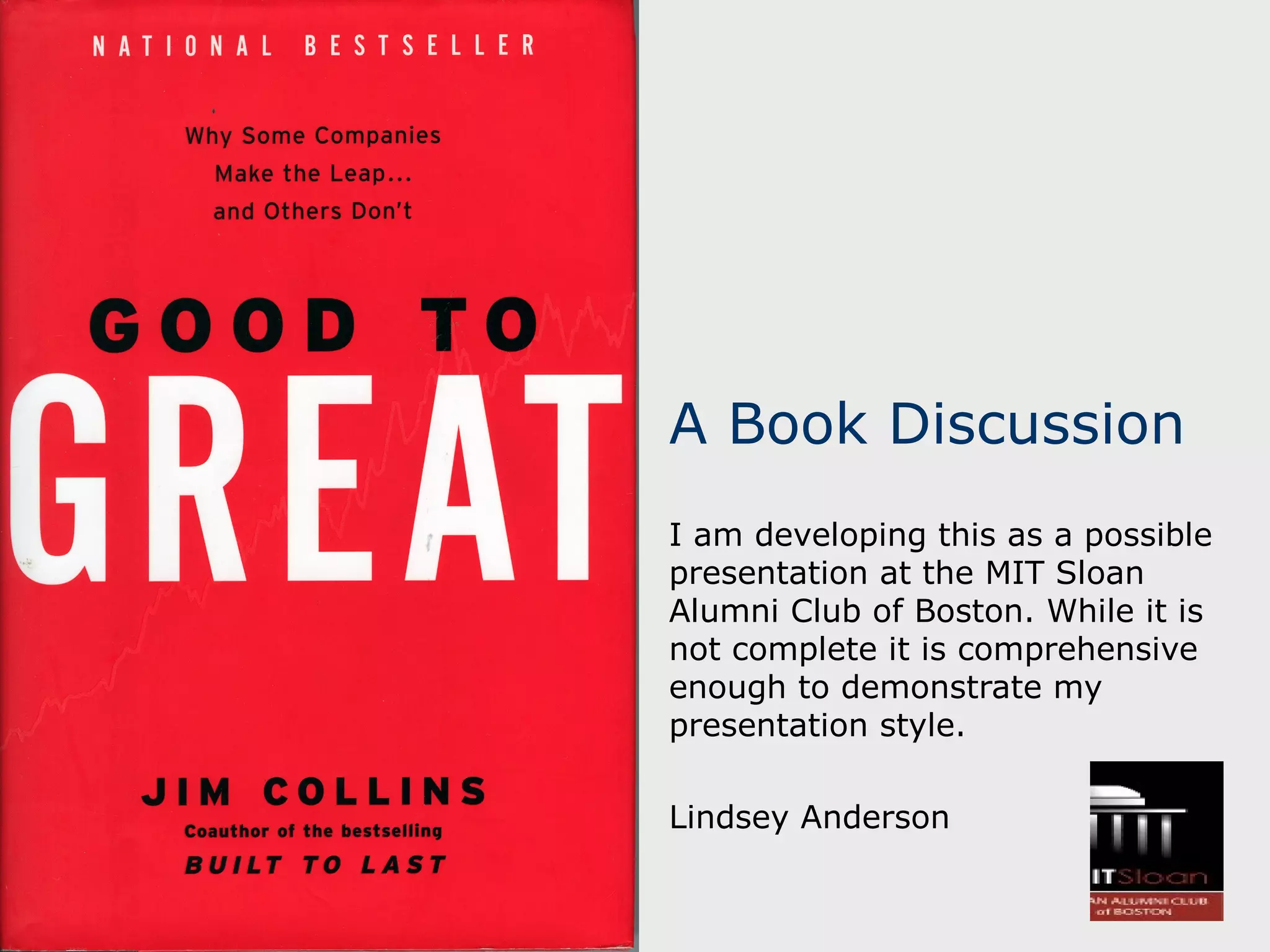
A Book Discussion
I am developing this as a possible
presentation at the MIT Sloan
Alumni Club of Boston. While it is
not complete it is comprehensive
enough to demonstrate my
presentation style.
Lindsey Anderson
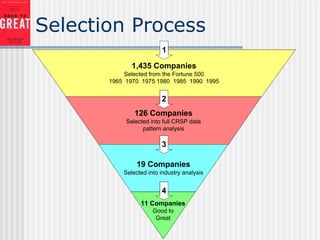
Selection Process
1,435 Companies
Selected from the Fortune 500
1965 1970 1975 1980 1985 1990 1995
126 Companies
Selected into full CRSP data
pattern analysis
19 Companies
Selected into industry analysis
11 Companies
Good to
Great
1
2
3
4
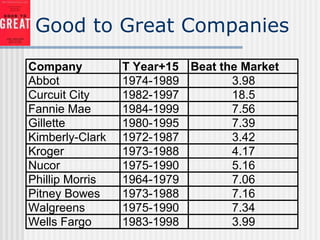
Good to Great Companies
Company T Year+15 Beat the Market
Abbot 1974-1989 3.98
Curcuit City 1982-1997 18.5
Fannie Mae 1984-1999 7.56
Gillette 1980-1995 7.39
Kimberly-Clark 1972-1987 3.42
Kroger 1973-1988 4.17
Nucor 1975-1990 5.16
Phillip Morris 1964-1979 7.06
Pitney Bowes 1973-1988 7.16
Walgreens 1975-1990 7.34
Wells Fargo 1983-1998 3.99
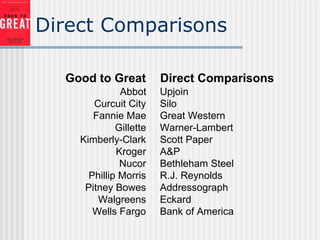
Direct Comparisons
Good to Great Direct Comparisons
Abbot Upjoin
Curcuit City Silo
Fannie Mae Great Western
Gillette Warner-Lambert
Kimberly-Clark Scott Paper
Kroger A&P
Nucor Bethleham Steel
Phillip Morris R.J. Reynolds
Pitney Bowes Addressograph
Walgreens Eckard
Wells Fargo Bank of America
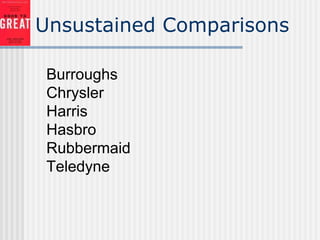
Unsustained Comparisons
Burroughs
Chrysler
Harris
Hasbro
Rubbermaid
Teledyne
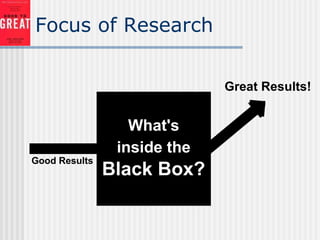
Focus of Research
What's
inside the
Black Box?
Good Results
Great Results!
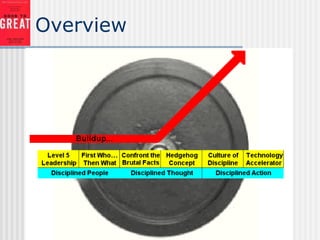
Overview
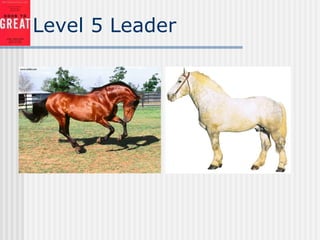
Level 5 Leader
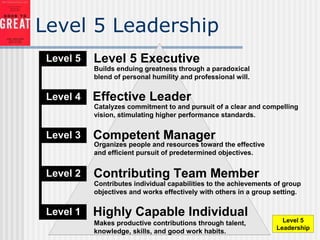
Level 5 Leadership
Level 5 Executive
Effective Leader
Competent Manager
Level 5
Level 3
Level 4
Level 2
Level 1
Organizes people and resources toward the effective
and efficient pursuit of predetermined objectives.
Contributing Team Member
Highly Capable Individual
Makes productive contributions through talent,
knowledge, skills, and good work habits.
Contributes individual capabilities to the achievements of group
objectives and works effectively with others in a group setting.
Catalyzes commitment to and pursuit of a clear and compelling
vision, stimulating higher performance standards.
Builds enduing greatness through a paradoxical
blend of personal humility and professional will.
Level 5
Leadership
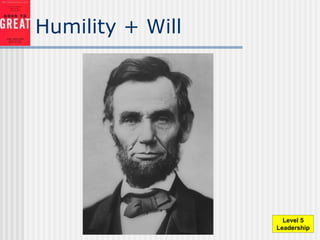
Humility + Will
Level 5
Leadership
Level 5 Leaders
 Set up successors for success
 In over 75% of Unsustained Comparison
Companies executives set up their successors
for failure or picked a weak successor
 Insiders: 10 out of 11 Good to Great
CEOs came from within the company, 3
from family inheritance
 High profile, shake-things-up outsiders
negatively correlated with Good to Great
Level 5
Leadership
Is Level 5 Learnable?
 2 Kinds of people: those who have
the seed and those who don’t
 Seed may develop under the right
circumstances—self reflection,
conscious personal development, a
mentor, a great teacher, loving
parents, level 5 boss, personal crisis
Level 5
Leadership
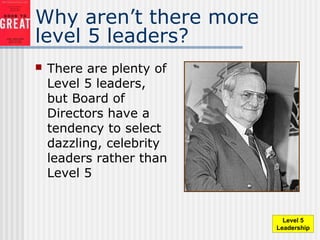
Why aren’t there more
level 5 leaders?
 There are plenty of
Level 5 leaders,
but Board of
Directors have a
tendency to select
dazzling, celebrity
leaders rather than
Level 5
Level 5
Leadership
Symbiotic Relationship
 Level 5 traits enable you to
implement the other findings, while
practicing the other traits helps you
become a Level 5 leader
 We’ve talked about what Level 5
leaders are, the rest of the talk will
be on what they do
Level 5
Leadership
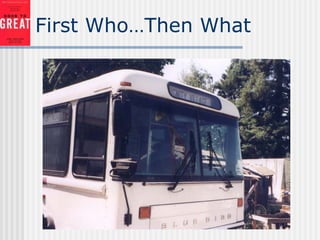
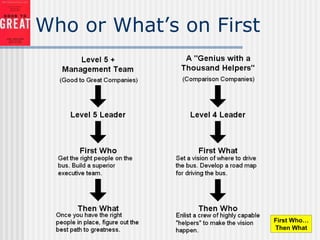
First Who…Then What
Who or What’s on First
First Who…
Then What
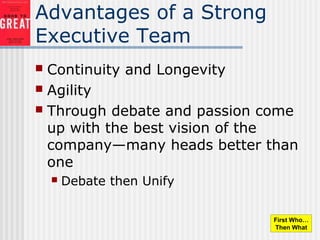
Advantages of a Strong
Executive Team
 Continuity and Longevity
 Agility
 Through debate and passion come
up with the best vision of the
company—many heads better than
one
 Debate then Unify
First Who…
Then What
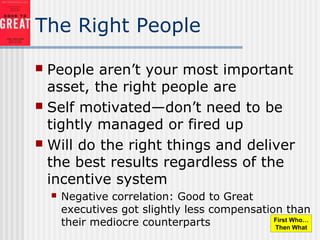
The Right People
 People aren’t your most important
asset, the right people are
 Self motivated—don’t need to be
tightly managed or fired up
 Will do the right things and deliver
the best results regardless of the
incentive system
 Negative correlation: Good to Great
executives got slightly less compensation than
their mediocre counterparts First Who…
Then What
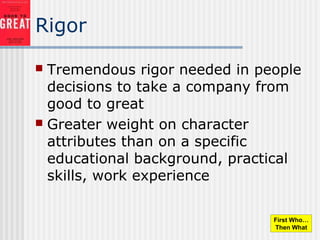
Rigor
 Tremendous rigor needed in people
decisions to take a company from
good to great
 Greater weight on character
attributes than on a specific
educational background, practical
skills, work experience
First Who…
Then What
Rigorous, not Ruthless
 Best people don’t need to worry
about their jobs and can concentrate
on their work
 6 out of 11 Good to Great had no
layoffs and 4 just had 1
 Comparison companies used layoffs 5
times more frequently than Good to
Great companies
 Lead a Great Life
First Who…
Then What
How to be Rigorous
 When in doubt, don’t hire—keep
looking
 Act when you know you need to
make a change
 Unfair to everyone to let the wrong
people hang around
 Off the Bus or move to another
seat?
First Who…
Then What
Focus on Opportunities
 Put your best people on your biggest
opportunities, not your biggest
problems
 Managing your problems can only
make you good, building your
opportunities can make you great
 When you decide to sell off your
problems don’t sell of your best
people
First Who…
Then What
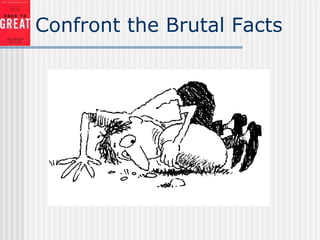
Confront the Brutal Facts
Don‘t De-Motivate
 Expending energy on motivating
people is largely a waste of time
 The key is not to de-motivate people
 Nothing more demoralizing than
ignoring the brutal facts of reality
Confront the
Brutal Facts
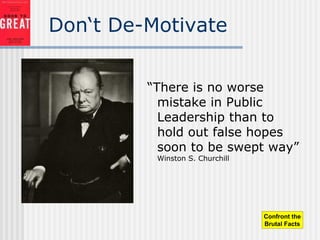
Don‘t De-Motivate
“There is no worse
mistake in Public
Leadership than to
hold out false hopes
soon to be swept way”
Winston S. Churchill
Confront the
Brutal Facts
Creating a culture where
the truth can be heard
 Lead with Questions not Answers
 Understanding and not manipulation or put downs
 Engage in dialog and debate—not coercion
 Search for the best answers
 Conduct Autopsies without Blame
 “I will take responsibility for this bad decision. But we
will all take responsibility for extracting the maximum
learning from the tuition we’ve paid” Joe Cullman,
Phillip Morris
 Build a red flag mechanisms that turn
information into information that can’t be
ignored
Confront the
Brutal Facts
Level 5 Leadership
 The strength of a leader’s personality doesn’t
deter people from bringing him or her the brutal
facts
 Leadership isn’t just vision, it’s getting people to
confront the brutal facts and act on the
implications
Confront the
Brutal Facts
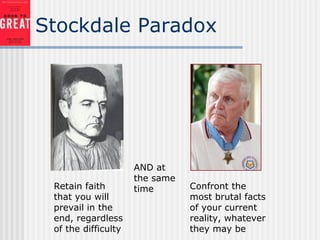
Stockdale Paradox
Retain faith
that you will
prevail in the
end, regardless
of the difficulty
Confront the
most brutal facts
of your current
reality, whatever
they may be
AND at
the same
time
Hardiness
 By hitting the realities of their
situation head-on Good-to-Great
emerged from adversity even
stronger
Confront the
Brutal Facts
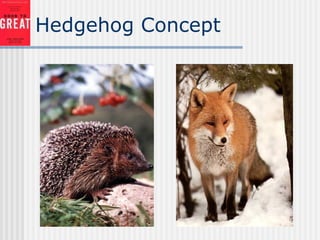
Hedgehog Concept
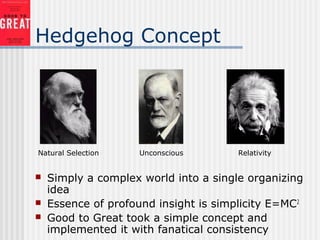
UnconsciousNatural Selection Relativity
Hedgehog Concept
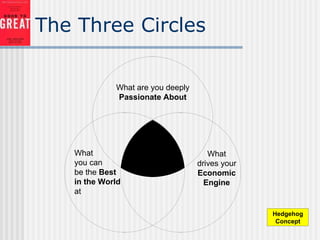
 Simply a complex world into a single organizing
idea
 Essence of profound insight is simplicity E=MC2
 Good to Great took a simple concept and
implemented it with fanatical consistency
The Three Circles
What are you deeply
Passionate About
What
you can
be the Best
in the World
at
What
drives your
Economic
Engine
Hedgehog
Concept
Being the Best
 Not a goal to be the best
 Not a strategy to be the best
 Not an intention to be the best
 Not a plan to be the best
 Understanding of what you can be the
best at
 Just because you have been doing
something for years your core business
does not necessaryily mean you can be
the best at it
 Curse of competency “Just because your
good at it--just because we’re making
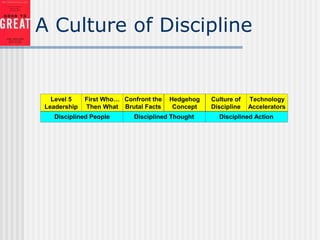
A Culture of Discipline
Technology
Accelerators
Culture of
Discipline
Hedgehog
Concept
Confront the
Brutal Facts
First Who…
Then What
Level 5
Leadership
Disciplined People Disciplined Thought Disciplined Action
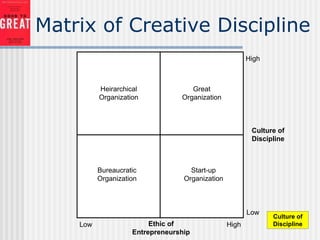
Matrix of Creative Discipline
Heirarchical
Organization
Great
Organization
Bureaucratic
Organization
Start-up
Organization
High
High
Low
Low Ethic of
Entrepreneurship
Culture of
Discipline
Culture of
Discipline
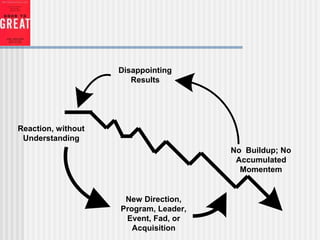
Disappointing
Results
Reaction, without
Understanding
New Direction,
Program, Leader,
Event, Fad, or
Acquisition
No Buildup; No
Accumulated
Momentem

Good to Great

  • 1.
    A Book Discussion Iam developing this as a possible presentation at the MIT Sloan Alumni Club of Boston. While it is not complete it is comprehensive enough to demonstrate my presentation style. Lindsey Anderson
  • 2.
    Selection Process 1,435 Companies Selectedfrom the Fortune 500 1965 1970 1975 1980 1985 1990 1995 126 Companies Selected into full CRSP data pattern analysis 19 Companies Selected into industry analysis 11 Companies Good to Great 1 2 3 4
  • 3.
    Good to GreatCompanies Company T Year+15 Beat the Market Abbot 1974-1989 3.98 Curcuit City 1982-1997 18.5 Fannie Mae 1984-1999 7.56 Gillette 1980-1995 7.39 Kimberly-Clark 1972-1987 3.42 Kroger 1973-1988 4.17 Nucor 1975-1990 5.16 Phillip Morris 1964-1979 7.06 Pitney Bowes 1973-1988 7.16 Walgreens 1975-1990 7.34 Wells Fargo 1983-1998 3.99
  • 4.
    Direct Comparisons Good toGreat Direct Comparisons Abbot Upjoin Curcuit City Silo Fannie Mae Great Western Gillette Warner-Lambert Kimberly-Clark Scott Paper Kroger A&P Nucor Bethleham Steel Phillip Morris R.J. Reynolds Pitney Bowes Addressograph Walgreens Eckard Wells Fargo Bank of America
  • 5.
  • 6.
    Focus of Research What's insidethe Black Box? Good Results Great Results!
  • 7.
  • 8.
  • 9.
    Level 5 Leadership Level5 Executive Effective Leader Competent Manager Level 5 Level 3 Level 4 Level 2 Level 1 Organizes people and resources toward the effective and efficient pursuit of predetermined objectives. Contributing Team Member Highly Capable Individual Makes productive contributions through talent, knowledge, skills, and good work habits. Contributes individual capabilities to the achievements of group objectives and works effectively with others in a group setting. Catalyzes commitment to and pursuit of a clear and compelling vision, stimulating higher performance standards. Builds enduing greatness through a paradoxical blend of personal humility and professional will. Level 5 Leadership
  • 10.
  • 11.
    Level 5 Leaders Set up successors for success  In over 75% of Unsustained Comparison Companies executives set up their successors for failure or picked a weak successor  Insiders: 10 out of 11 Good to Great CEOs came from within the company, 3 from family inheritance  High profile, shake-things-up outsiders negatively correlated with Good to Great Level 5 Leadership
  • 12.
    Is Level 5Learnable?  2 Kinds of people: those who have the seed and those who don’t  Seed may develop under the right circumstances—self reflection, conscious personal development, a mentor, a great teacher, loving parents, level 5 boss, personal crisis Level 5 Leadership
  • 13.
    Why aren’t theremore level 5 leaders?  There are plenty of Level 5 leaders, but Board of Directors have a tendency to select dazzling, celebrity leaders rather than Level 5 Level 5 Leadership
  • 14.
    Symbiotic Relationship  Level5 traits enable you to implement the other findings, while practicing the other traits helps you become a Level 5 leader  We’ve talked about what Level 5 leaders are, the rest of the talk will be on what they do Level 5 Leadership
  • 15.
  • 16.
    Who or What’son First First Who… Then What
  • 17.
    Advantages of aStrong Executive Team  Continuity and Longevity  Agility  Through debate and passion come up with the best vision of the company—many heads better than one  Debate then Unify First Who… Then What
  • 18.
    The Right People People aren’t your most important asset, the right people are  Self motivated—don’t need to be tightly managed or fired up  Will do the right things and deliver the best results regardless of the incentive system  Negative correlation: Good to Great executives got slightly less compensation than their mediocre counterparts First Who… Then What
  • 19.
    Rigor  Tremendous rigorneeded in people decisions to take a company from good to great  Greater weight on character attributes than on a specific educational background, practical skills, work experience First Who… Then What
  • 20.
    Rigorous, not Ruthless Best people don’t need to worry about their jobs and can concentrate on their work  6 out of 11 Good to Great had no layoffs and 4 just had 1  Comparison companies used layoffs 5 times more frequently than Good to Great companies  Lead a Great Life First Who… Then What
  • 21.
    How to beRigorous  When in doubt, don’t hire—keep looking  Act when you know you need to make a change  Unfair to everyone to let the wrong people hang around  Off the Bus or move to another seat? First Who… Then What
  • 22.
    Focus on Opportunities Put your best people on your biggest opportunities, not your biggest problems  Managing your problems can only make you good, building your opportunities can make you great  When you decide to sell off your problems don’t sell of your best people First Who… Then What
  • 23.
  • 24.
    Don‘t De-Motivate  Expendingenergy on motivating people is largely a waste of time  The key is not to de-motivate people  Nothing more demoralizing than ignoring the brutal facts of reality Confront the Brutal Facts
  • 25.
    Don‘t De-Motivate “There isno worse mistake in Public Leadership than to hold out false hopes soon to be swept way” Winston S. Churchill Confront the Brutal Facts
  • 26.
    Creating a culturewhere the truth can be heard  Lead with Questions not Answers  Understanding and not manipulation or put downs  Engage in dialog and debate—not coercion  Search for the best answers  Conduct Autopsies without Blame  “I will take responsibility for this bad decision. But we will all take responsibility for extracting the maximum learning from the tuition we’ve paid” Joe Cullman, Phillip Morris  Build a red flag mechanisms that turn information into information that can’t be ignored Confront the Brutal Facts
  • 27.
    Level 5 Leadership The strength of a leader’s personality doesn’t deter people from bringing him or her the brutal facts  Leadership isn’t just vision, it’s getting people to confront the brutal facts and act on the implications Confront the Brutal Facts
  • 28.
    Stockdale Paradox Retain faith thatyou will prevail in the end, regardless of the difficulty Confront the most brutal facts of your current reality, whatever they may be AND at the same time
  • 29.
    Hardiness  By hittingthe realities of their situation head-on Good-to-Great emerged from adversity even stronger Confront the Brutal Facts
  • 30.
  • 31.
    UnconsciousNatural Selection Relativity HedgehogConcept  Simply a complex world into a single organizing idea  Essence of profound insight is simplicity E=MC2  Good to Great took a simple concept and implemented it with fanatical consistency
  • 32.
    The Three Circles Whatare you deeply Passionate About What you can be the Best in the World at What drives your Economic Engine Hedgehog Concept
  • 33.
    Being the Best Not a goal to be the best  Not a strategy to be the best  Not an intention to be the best  Not a plan to be the best  Understanding of what you can be the best at  Just because you have been doing something for years your core business does not necessaryily mean you can be the best at it  Curse of competency “Just because your good at it--just because we’re making
  • 34.
    A Culture ofDiscipline Technology Accelerators Culture of Discipline Hedgehog Concept Confront the Brutal Facts First Who… Then What Level 5 Leadership Disciplined People Disciplined Thought Disciplined Action
  • 35.
    Matrix of CreativeDiscipline Heirarchical Organization Great Organization Bureaucratic Organization Start-up Organization High High Low Low Ethic of Entrepreneurship Culture of Discipline Culture of Discipline
  • 36.
    Disappointing Results Reaction, without Understanding New Direction, Program,Leader, Event, Fad, or Acquisition No Buildup; No Accumulated Momentem