Building the Knowledge of
Human Perception into E-Learning
Shalin Hai-Jew
SIDLIT
August 2010
Human Perception in E-Learning
• Human perceptual systems —for sight, sound,
taste, touch, and smell (and maybe even
embodied proprioception)—may offer some
guidelines for how to build multimedia e-
learning: immersive 3D simulations, imagery
for analysis, sight-and-sound distributions of
information channels, and other applications.
This will offer a brief overview of human
perception (with a little human cognition thrown
in) and some light applications to the design of
e-learning.
Human Perception in E-Learning
2
Overview
• Human Perception
• Basics
• Terminology
• The Human Senses and the Brain
• Sight, Hearing, Touch, Smell and Taste
• Perception and E -Learning
• Some Common Mistakes
• Instructional Design Issues
• Multimedia: Affordances and Constraints
Human Perception in E-Learning
3
Overview (cont.)
• Learning / Course Management Systems
(L/CMSes): Affordances and Constraints
• Virtual Worlds: 3D Immersion
• Strategies: Priming
• Strategies: Cognition
• Strategies: Short-term and Long-term Memory
• Perception, E-Learning, and Accessibility
• Resources
• Conclusion and Contact
Human Perception in E-Learning
4
Directions:
Join one of the five groups.
Choose two of the questions below for a preliminary
discussion.
Human Perception in E-Learning
5
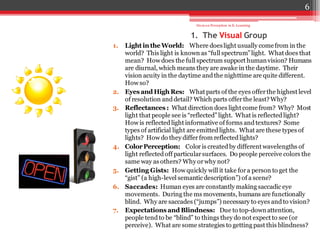
1. The Visual Group
1. LightintheWorld: Where doeslight usually comefrom in the
world? This light is known as “full spectrum”light. What does that
mean? How does the full spectrum support humanvision? Humans
are diurnal, which means they are awake in the daytime. Their
vision acuity in the daytime andthe nighttime are quite different.
How so?
2. EyesandHighRes: What parts of the eyes offerthe highest level
of resolution anddetail? Which parts offerthe least?Why?
3. Reflectances : What direction does light come from? Why? Most
light that people see is “reflected”light. What is reflectedlight?
How is reflectedlight informative of forms andtextures? Some
types of artificial light are emittedlights. What are these types of
lights? How do they differfrom reflectedlights?
4. ColorPerception: Coloris createdby different wavelengths of
light reflectedoff particularsurfaces. Do people perceive colors the
same way as others? Why orwhy not?
5. Getting Gists: How quickly will it take fora person to get the
“gist” (a high-level semantic description”) of a scene?
6. Saccades: Human eyes are constantly making saccadic eye
movements. During the ms movements, humans are functionally
blind. Why are saccades (“jumps”) necessary to eyes andto vision?
7. Expectations and Blindness: Due to top-downattention,
people tendto be “blind” to things they do not expect to see (or
perceive). What are some strategies to getting past this blindness?
Human Perception in E-Learning
6
2. The Sound Group
1. Sound: What is sound? Why do people
referto sound“waves”? How does sound
affect molecules? How does soundmove
through the air? Through solidobjects?
2. SoundLocalization: In terms of sound
localization, from which direction wouldit
be hardest fora person to detect the source
of soundinformation? What are some
strategies people can use to identify the
location of a sound?
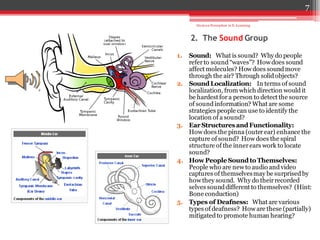
3. EarStructuresandFunctionality:
How does the pinna (outerear) enhance the
capture of sound? How does the spiral
structure of the innerears work to locate
sound?
4. How People Sound to Themselves:
People who are new to audio andvideo
captures of themselvesmay be surprisedby
how they sound. Why do theirrecorded
selves sounddifferent to themselves? (Hint:
Bone conduction)
5. Types of Deafness: What are various
types of deafness? How are these (partially)
mitigatedto promote human hearing?
Human Perception in E-Learning
7
3. The Tactual Sensations Group
1. DifferentialSensitivity: Not all parts of the
human body are equallysensitive in terms of
touch /tactual sensations. Why are there these
differences?What evolutionary benefits are there
fordifferent touch sensitivities?Whenis it a
benefit to have few sensors? When is it a benefit to
have many sensors?
2. UsefulTouchInformation: What sorts of
useful real-worldinformationmay be collected
through the senseof touch? Heat? Cold?
Tension? Texture? How is touch usedin
learning?
3. Professions: What is the role of touch in
various professions? In surgery? In nursing? In
professional cooking? In art? In geology? Other
fields?
Human Perception in E-Learning
8
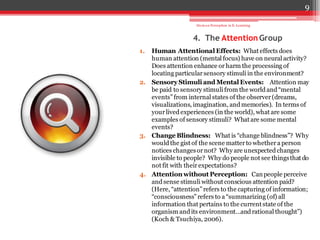
4. The Attention Group
1. Human Attentional Effects: What effects does
human attention (mental focus) have on neural activity?
Does attention enhance orharm the processing of
locating particularsensory stimuli in the environment?
2. Sensory Stimuli and Mental Events: Attention may
be paid to sensory stimuli from the worldand“mental
events”from internal states of the observer(dreams,
visualizations, imagination, andmemories). In terms of
yourlivedexperiences (in the world), what are some
examples of sensory stimuli? What are some mental
events?
3. Change Blindness: What is “change blindness”? Why
wouldthe gist of the scene matterto whethera person
notices changesornot? Why are unexpectedchanges
invisible to people? Why do people not see thingsthat do
not fit with theirexpectations?
4. Attention without Perception: Canpeople perceive
andsense stimuli without conscious attention paid?
(Here, “attention”refers to the capturing of information;
“consciousness”refers to a “summarizing (of) all
information that pertains to the current state of the
organism andits environment…andrational thought”)
(Koch & Tsuchiya, 2006).
Human Perception in E-Learning
9
5. The Sensory Information
Collection Group
1. Environment Sampling:How do humans
sample the environment forperceptual
information? When is such sampling
automatic? Whenit is purposive? (Consider
issues of sight, hearing, taste, smell, andtouch.)
2. Sensory Perception Over Time: What sorts
of sensory perception andlearning improve with
experience overtime? Why? What sorts of
sensory perceptionandlearning degrade over
time?
3. Proprioception : Describe the sensationof
embodiedsenses. How is learning “in the body”
different than learning “virtually”(through
cognition alone)? How wouldyou describe this
sixth sense?
4. Unified Senses : The brain andnervous
system collect plenty of environmental and
internal informationsimultaneously. It
coordinates the “multi-modal”sensory
information streams in a smooth way, without
any consciousperception of glitches. How do
you think this is done? On a side note, what is
“synaesthesia”?
Human Perception in E-Learning
10
… to a complex topic…
Human Perception in E-Learning
11
“Human Perception”
• A Kind of Signals Detection: Human perceptioninvolves
the capture of environmental“energy”information through
the human/ animal sensory organs and processedin the
brain. This data is capturedand transducedinto electronic
signals in the brain, whichis interpretedas sensory signals.
People have to differentiate between true signals and
backgroundnoise.
• EcologicalPerspective: Sensory information helps
animals survive and interact in their particularniche
environments.
• Mind-Body Dualism: The mind-body dualism suggests
that there are different channelsof information. The “soul”
may be one channelof information; the “brain” may be
anotherchannel. (The latteris supportedby empirical
research.)
Human Perception in E-Learning
12
“Human Perception” (cont.)
• Lower-OrderPerception: “Lower order”brain
processes capture sensory informationat the detail
level.
• Higher-Order Perception: “Higherorder” brain
processes help organize perceptualinformation.
These help direct human attention, decision-
making,and action. These analyze and organize
new information. These also control interacting
systems in the body for a “coalition”of aspects that
promote perception and action.
• Extenders: “Ego extenders” enhancehuman
perception. These may be technologiesthat serve as
intermediariesin capturinginformation.
Human Perception in E-Learning
13
“Human Perception” (cont.)
• Evolutionary Ideas: The “primitive”or ancient
brain containslow-level sensory capture. The more
evolved brain containshigherlevel color perception,
depth perception, and greater visual sensitivity—in
terms of sight. “Genetic memory”is an underlying
assumption of evolution in terms of human
perception.
• Amplification and Suppression:Some
perceptualsignals are amplified,and others are
suppressed dependingon the value of that
perceptualsignal to human survival and
functioning.
Human Perception in E-Learning
14
Basics: Perception and the World
• Environmental Energy – Perception: The perception of
energy in the environment (lightwave energy / sight, air dislocation
/ sound, pressure / touch, molecules / taste and smell) is seldom 1-
1. People perceive different sensory feedback with varying levels of
sensitivity. Much of the world’s energy is beyond the range of
human perception and is therefore undetectable without additional
aids / equipment.
• Non-veridicality of Perception: Perception is non-veridical (It
doesn’t match the world’s inputs in terms of either full accuracy or
magnitude), with subjective interpretations. (Also, “metamers”
which emulate certain stimuli may add confusion to human
perception.)
• A Continuum of Perspectives: A naïve view is that the world is
as a person perceives it—with the human limits and illusions.
Solipsism (aka mentalism) is the concept that the world only exists
in the human mind. These are the two ends of a perception
continuum.
Human Perception in E-Learning
15
Basics: Underlying Meta-Theories
Direct Perception /
Ecological Model
Indirect Perception /
Constructivism
• The world provides sufficient
information for full perception if
people would sample the
environment sufficiently and
take in the information.
• Memory is not required for
perception.
• Each animal—based on its
affordances and constraints—
will perceive the environment
differently. There is a mutuality
or synergy between the animal
and the environment.
(Michaels & Carello, 1981)
• The world does not provide
sufficient information. The
brain has to “augment” the
sensory experience with prior
experiences and analysis and
contextualization to create
sense meaning.
• The human brain interpolates
information by filling in
informational gaps.
16
Human Perception in E-Learning
Terminology
• Invariants: Objects that maintain perceptual
constancy (properties: size, brightness, shape,
and color, for example) no matter the
perspective of the viewer; objects that follow the
laws of physics; objects that are quantifiable by
math and geometry. These objects reflect
physical realities in the world.
• Optic Array: The way visual objects orient in
the world to a disappearing point on the horizon
Human Perception in E-Learning
17
The Human Senses and the Brain
• Five senses:
▫ Far senses: sight and sound
▫ Near senses: touch, smell, and taste
• The sixth sense: proprioceptive (embodied
“knowing” of the creature beyond the brain
knowledge)
▫ Nerve endings
▫ Joints
▫ Muscles
▫ Limb postures
Human Perception in E-Learning
18
The Human Senses and the Brain
(cont.)
• Brain processing: defined channels for specific sensory information
• Polysensory receptors
• Interpretive brain functions regarding perception
• Specialized cells for certain types of sensory information
• Specialized brain processing locales
• Cortical magnification of particular signals
Human Perception in E-Learning
19
The Human Senses and the Brain
(cont.)
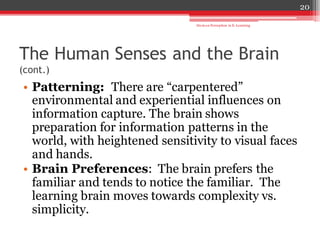
• Patterning: There are “carpentered”
environmental and experiential influences on
information capture. The brain shows
preparation for information patterns in the
world, with heightened sensitivity to visual faces
and hands.
• Brain Preferences: The brain prefers the
familiar and tends to notice the familiar. The
learning brain moves towards complexity vs.
simplicity.
Human Perception in E-Learning
20
The Human Senses and the Brain
(cont.)
• Research: Lesion studies (in vivo), varioustypes
of electrophysiologicalstudies; brain scanning and
neural cell-level / single cell recordingresearch(in
vitro), human experientialresearch(both in vivo
and in vitro)
• Internal Signaling: Dark light or intrinsiclight
refers to brain activitiesthat result in perceived
sensations(but which are not from the external
environment); “spontaneousemissions”and
“phantomtones” (illusory “Zwicker tones”) refer to
sound signals without any external sound wave.
Human Perception in E-Learning
21
•Progression of the “far” senses
•Some work with the near-sense of
touch
•Little work in smell and taste
Human Perception in E-Learning
22
Sight
• The uses of captured images and video for
detection, analysis, and planning
• Illusory motion (in films, in video games) is
created by a flashing of pixels (dots) to create a
sense of motion.
• Geometrically-sound 3D captures
Human Perception in E-Learning
23
Hearing
• Conveyance of information
• Intercommunications and information exchange
• Artistry and entertainment
• Mood setting in simulations and scenarios
Human Perception in E-Learning
24
Touch
• Haptic input / output devices for computers
• Braille devices
• Physical – digital simulations (flight simulator
rooms)
• Augmented reality (digitally -augmented learning
in physical spaces)
• Biofeedback kits (USB-connected)
Human Perception in E-Learning
25
Smell
• Plug-in chemical “boxes” to evoke smell
sensations
• “Spritzers” (as on entertainment rides)
• Long-term efforts recreating smells through
computerized devices
Human Perception in E-Learning
26
Taste
• “Kits” to enhance e -learning
• Augmented reality spaces / smart rooms
Human Perception in E-Learning
27
Some Common Mistakes
• Not considering human capabilities (the limits of
perception, cognition, memory, and learning;
concurrentcapabilities—asthroughthe “multiple
resources”theory)
• Insufficient / lossy visual information(photo-
realistic imageswithout white color balance, without
scale, and without clear depth perception;3D
imagerynot built to scale—so lacking size familiarity
and possibly resulting in “negative learning”);not
making up for the “degenerative”nature of artificial
visual depictionswith “selective fidelity” / mental
model creation
Human Perception in E-Learning
28
Some Common Mistakes (cont.)
• Insufficient capitalizing on perceptual processing
information channels(using visuals and text
strategically; using audio and text strategically);
overloading of the perceptual paths
• Triggering concurrent “time-shared” attentional
resource competitionin a task allocation / high
demand situation (leading to overload and
decrementsin performance);“sharing”non-
sharable resources(like voice with multiple vocal
streams; visual reading of two sources)
Human Perception in E-Learning
29
Some Common Mistakes (cont.)
• Triggering high emotions and stress in learners,
which dampen or suppress learning
• Not considering learner fatigue
• Not being selective in sensory stimuli
• “Masking” or covering over one sensory stimuli with
another (the first stimulus covers up the latter; the
latter stimulus covers up the first); introducing
perceptual“noise,” whichmay lead to confusion or
inaccurate receipt of the sensory “signal”
• Not designing online spaces to direct attention
(both automatic / experientialcognition and
conscious / directed cognition)
Human Perception in E-Learning
30
Instructional Design Issues
• Rich multi-sensory resources
• Designed for learning
• Creating a learning context
• Annotating for value-added
• Transcribing audio and video for value-added;
alt-texting still images for value-added
• Maximizing human perception and cognition
• Using multiple channels
• Promoting accessibility (mitigating for color -
based information, for example)
Human Perception in E-Learning
31
Instructional Design Issues (cont.)
• Allowing learners to control the speed of an
online experience, including its recordability and
its replayability (review)
Human Perception in E-Learning
32
Multimedia
Affordances and Constraints
Information Capture
Equipment
Software Editing / Authoring /
Design Tools
Affordances
• Huge information richness in
captures
• Machine-enabled specs
• Automated metadata capture
(GIS)
Constraints
• Limited capture environments
• Unwieldy equipment
Affordances
• Imaginary depictions possible
• Portability of digital files
• Integration of digital files
• Multi-sensory depictions
Constraints
• High learning curves to design
33
Human Perception in E-Learning
L/CMS Affordances and Constraints
• Types of deliverable files available (visual,
auditory, and polysensory)
• Ability to package online learning
(contextualization)
• Ability to download relevant contents
• Ability to sequence online learning
• Learner access and control
Human Perception in E-Learning
34
Virtual Worlds: 3D Immersion
• Simulated depth perception
• Full sensory immersions and experiential
“fidelity”
• Locative (location sensitive) sound creation
• Value-added annotations
• User control of some sequencing
Human Perception in E-Learning
35
Strategies: Priming
• Millisecond images and subconscious priming
• Purposive sparking of learner motivations
• Focusing learner attention (“a family of
mechanisms that restrict processing in various
ways”) (Wolfe, et al., 2008)
• Setting the context, Gestalt theory
• Using relevant information -rich visual
information (but not decorative information)
Human Perception in E-Learning
36
Strategies: Priming (cont.)
Subconscious Conscious
• Millisecond imagery or other
sensory information
• With or without the
notification of learners
• Defining learner expectations
• Explaining the limits of the
simulation
• Packaging contents
• Setting the learning context
• Asking relevant questions
• Assigning relevant research to
learners in preparation for the
multimedia learning
• Parsing and segmenting the
learning
37
Human Perception in E-Learning
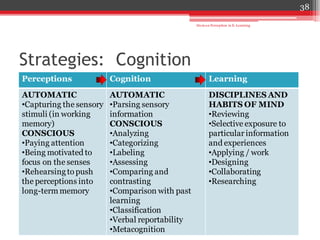
Strategies: Cognition
= New Knowledge and Skill Building
Human Perception in E-Learning
38
Perceptions Cognition Learning
AUTOMATIC
•Capturing the sensory
stimuli (in working
memory)
CONSCIOUS
•Paying attention
•Being motivated to
focus on the senses
•Rehearsingto push
the perceptions into
long-term memory
AUTOMATIC
•Parsing sensory
information
CONSCIOUS
•Analyzing
•Categorizing
•Labeling
•Assessing
•Comparing and
contrasting
•Comparison with past
learning
•Classification
•Verbal reportability
•Metacognition
DISCIPLINES AND
HABITS OF MIND
•Reviewing
•Selective exposure to
particular information
and experiences
•Applying / work
•Designing
•Collaborating
•Researching
Strategies:
Short-term and Long-Term Memory
• Short-termperceptualmemory is fleeting and easily
forgotten;it is malleable and sensitive to various
manipulations.
• “The world it its own memory…” (O’Regan,1992, as
cited in Ware, 2004).
• Information may be moved from short-term
memoryto long-term with reinforcementand strong
exposure. Practice and review may also enhance
this shift into the long-term.
• Long-termmemorytends to be more stable.
Retrieval, though,may be faulty and incomplete. A
digital version of the perceptualinformationmay
enhance learning.
Human Perception in E-Learning
39
Perception, E-Learning, and
Accessibility
Perception Perceptual Loss
Sight Visual acuity, color-blindness, night vision
Hearing Conduction loss, sensory/neural loss; loss of high
frequency perceptions with age
Touch Loss of feeling
Smell Loss of acuity
Taste Loss of sensitivity
Proprioception /
physical motion
Mobility, disembodiment in e-learning
Human Perception in E-Learning
40
…
Cognition: And mental processing…symbolic processing…
And spatial logic…
References
• Blake,R.& Sekuler,R. (2006). Perception. 5th Ed. Boston: McGraw
Hill.
• Clark, R.C. & Mayer, R.E. (2003). E -learning and the science of
instruction. San Francisco: Pfeiffer.
• Koch, C. & Tsuchiya, N. (2006). Attention and consciousness: Two
distinct brain processes. ScienceDirect: 11(1), 16 - 22.
• Michaels, C.F. & Carello, C. (1981). Direct Perception. Englewood
Cliffs: Prentice-Hall,Inc.
• Ware, C. (2004). Foundation for a science of data visualization. (Ch. 1).
Information Visualization: Perception for Design. 2nd Ed. San
Francisco: Morgan Kaufmann Publishers, Elsevier.14.
• Wickens, C. D. (2002). Multiple resources and performance
prediction. Theoretical Issues in Ergonomics Science: 3(2), 159 – 177.
• Wolfe, J.M., Kluender,K.R., Levi, D.M., Bartoshuk, L.M., Hertz, R.S.,
Klatzy, R.L., Lederman, S.J., & Merfeld,D.M. (2008). Sensation &
Perception. 2nd Ed. Sunderland: Sinauer Associates.
Human Perception in E-Learning
41
Conclusion and Contact
Dr. Shalin Hai-Jew
Kansas State University
iTAC
shalin@k-state.edu
(785) 532-5262 (work phone)
(785) 532-3199 (fax number)
Instructional Design Open Studio (IDOS) Blog
Human Perception in E-Learning
42

Building the Knowledge of Human Perception into E-Learning

  • 1.
    Building the Knowledgeof Human Perception into E-Learning Shalin Hai-Jew SIDLIT August 2010
  • 2.
    Human Perception inE-Learning • Human perceptual systems —for sight, sound, taste, touch, and smell (and maybe even embodied proprioception)—may offer some guidelines for how to build multimedia e- learning: immersive 3D simulations, imagery for analysis, sight-and-sound distributions of information channels, and other applications. This will offer a brief overview of human perception (with a little human cognition thrown in) and some light applications to the design of e-learning. Human Perception in E-Learning 2
  • 3.
    Overview • Human Perception •Basics • Terminology • The Human Senses and the Brain • Sight, Hearing, Touch, Smell and Taste • Perception and E -Learning • Some Common Mistakes • Instructional Design Issues • Multimedia: Affordances and Constraints Human Perception in E-Learning 3
  • 4.
    Overview (cont.) • Learning/ Course Management Systems (L/CMSes): Affordances and Constraints • Virtual Worlds: 3D Immersion • Strategies: Priming • Strategies: Cognition • Strategies: Short-term and Long-term Memory • Perception, E-Learning, and Accessibility • Resources • Conclusion and Contact Human Perception in E-Learning 4
  • 5.
    Directions: Join one ofthe five groups. Choose two of the questions below for a preliminary discussion. Human Perception in E-Learning 5
  • 6.
    1. The VisualGroup 1. LightintheWorld: Where doeslight usually comefrom in the world? This light is known as “full spectrum”light. What does that mean? How does the full spectrum support humanvision? Humans are diurnal, which means they are awake in the daytime. Their vision acuity in the daytime andthe nighttime are quite different. How so? 2. EyesandHighRes: What parts of the eyes offerthe highest level of resolution anddetail? Which parts offerthe least?Why? 3. Reflectances : What direction does light come from? Why? Most light that people see is “reflected”light. What is reflectedlight? How is reflectedlight informative of forms andtextures? Some types of artificial light are emittedlights. What are these types of lights? How do they differfrom reflectedlights? 4. ColorPerception: Coloris createdby different wavelengths of light reflectedoff particularsurfaces. Do people perceive colors the same way as others? Why orwhy not? 5. Getting Gists: How quickly will it take fora person to get the “gist” (a high-level semantic description”) of a scene? 6. Saccades: Human eyes are constantly making saccadic eye movements. During the ms movements, humans are functionally blind. Why are saccades (“jumps”) necessary to eyes andto vision? 7. Expectations and Blindness: Due to top-downattention, people tendto be “blind” to things they do not expect to see (or perceive). What are some strategies to getting past this blindness? Human Perception in E-Learning 6
  • 7.
    2. The SoundGroup 1. Sound: What is sound? Why do people referto sound“waves”? How does sound affect molecules? How does soundmove through the air? Through solidobjects? 2. SoundLocalization: In terms of sound localization, from which direction wouldit be hardest fora person to detect the source of soundinformation? What are some strategies people can use to identify the location of a sound? 3. EarStructuresandFunctionality: How does the pinna (outerear) enhance the capture of sound? How does the spiral structure of the innerears work to locate sound? 4. How People Sound to Themselves: People who are new to audio andvideo captures of themselvesmay be surprisedby how they sound. Why do theirrecorded selves sounddifferent to themselves? (Hint: Bone conduction) 5. Types of Deafness: What are various types of deafness? How are these (partially) mitigatedto promote human hearing? Human Perception in E-Learning 7
  • 8.
    3. The TactualSensations Group 1. DifferentialSensitivity: Not all parts of the human body are equallysensitive in terms of touch /tactual sensations. Why are there these differences?What evolutionary benefits are there fordifferent touch sensitivities?Whenis it a benefit to have few sensors? When is it a benefit to have many sensors? 2. UsefulTouchInformation: What sorts of useful real-worldinformationmay be collected through the senseof touch? Heat? Cold? Tension? Texture? How is touch usedin learning? 3. Professions: What is the role of touch in various professions? In surgery? In nursing? In professional cooking? In art? In geology? Other fields? Human Perception in E-Learning 8
  • 9.
    4. The AttentionGroup 1. Human Attentional Effects: What effects does human attention (mental focus) have on neural activity? Does attention enhance orharm the processing of locating particularsensory stimuli in the environment? 2. Sensory Stimuli and Mental Events: Attention may be paid to sensory stimuli from the worldand“mental events”from internal states of the observer(dreams, visualizations, imagination, andmemories). In terms of yourlivedexperiences (in the world), what are some examples of sensory stimuli? What are some mental events? 3. Change Blindness: What is “change blindness”? Why wouldthe gist of the scene matterto whethera person notices changesornot? Why are unexpectedchanges invisible to people? Why do people not see thingsthat do not fit with theirexpectations? 4. Attention without Perception: Canpeople perceive andsense stimuli without conscious attention paid? (Here, “attention”refers to the capturing of information; “consciousness”refers to a “summarizing (of) all information that pertains to the current state of the organism andits environment…andrational thought”) (Koch & Tsuchiya, 2006). Human Perception in E-Learning 9
  • 10.
    5. The SensoryInformation Collection Group 1. Environment Sampling:How do humans sample the environment forperceptual information? When is such sampling automatic? Whenit is purposive? (Consider issues of sight, hearing, taste, smell, andtouch.) 2. Sensory Perception Over Time: What sorts of sensory perception andlearning improve with experience overtime? Why? What sorts of sensory perceptionandlearning degrade over time? 3. Proprioception : Describe the sensationof embodiedsenses. How is learning “in the body” different than learning “virtually”(through cognition alone)? How wouldyou describe this sixth sense? 4. Unified Senses : The brain andnervous system collect plenty of environmental and internal informationsimultaneously. It coordinates the “multi-modal”sensory information streams in a smooth way, without any consciousperception of glitches. How do you think this is done? On a side note, what is “synaesthesia”? Human Perception in E-Learning 10
  • 11.
    … to acomplex topic… Human Perception in E-Learning 11
  • 12.
    “Human Perception” • AKind of Signals Detection: Human perceptioninvolves the capture of environmental“energy”information through the human/ animal sensory organs and processedin the brain. This data is capturedand transducedinto electronic signals in the brain, whichis interpretedas sensory signals. People have to differentiate between true signals and backgroundnoise. • EcologicalPerspective: Sensory information helps animals survive and interact in their particularniche environments. • Mind-Body Dualism: The mind-body dualism suggests that there are different channelsof information. The “soul” may be one channelof information; the “brain” may be anotherchannel. (The latteris supportedby empirical research.) Human Perception in E-Learning 12
  • 13.
    “Human Perception” (cont.) •Lower-OrderPerception: “Lower order”brain processes capture sensory informationat the detail level. • Higher-Order Perception: “Higherorder” brain processes help organize perceptualinformation. These help direct human attention, decision- making,and action. These analyze and organize new information. These also control interacting systems in the body for a “coalition”of aspects that promote perception and action. • Extenders: “Ego extenders” enhancehuman perception. These may be technologiesthat serve as intermediariesin capturinginformation. Human Perception in E-Learning 13
  • 14.
    “Human Perception” (cont.) •Evolutionary Ideas: The “primitive”or ancient brain containslow-level sensory capture. The more evolved brain containshigherlevel color perception, depth perception, and greater visual sensitivity—in terms of sight. “Genetic memory”is an underlying assumption of evolution in terms of human perception. • Amplification and Suppression:Some perceptualsignals are amplified,and others are suppressed dependingon the value of that perceptualsignal to human survival and functioning. Human Perception in E-Learning 14
  • 15.
    Basics: Perception andthe World • Environmental Energy – Perception: The perception of energy in the environment (lightwave energy / sight, air dislocation / sound, pressure / touch, molecules / taste and smell) is seldom 1- 1. People perceive different sensory feedback with varying levels of sensitivity. Much of the world’s energy is beyond the range of human perception and is therefore undetectable without additional aids / equipment. • Non-veridicality of Perception: Perception is non-veridical (It doesn’t match the world’s inputs in terms of either full accuracy or magnitude), with subjective interpretations. (Also, “metamers” which emulate certain stimuli may add confusion to human perception.) • A Continuum of Perspectives: A naïve view is that the world is as a person perceives it—with the human limits and illusions. Solipsism (aka mentalism) is the concept that the world only exists in the human mind. These are the two ends of a perception continuum. Human Perception in E-Learning 15
  • 16.
    Basics: Underlying Meta-Theories DirectPerception / Ecological Model Indirect Perception / Constructivism • The world provides sufficient information for full perception if people would sample the environment sufficiently and take in the information. • Memory is not required for perception. • Each animal—based on its affordances and constraints— will perceive the environment differently. There is a mutuality or synergy between the animal and the environment. (Michaels & Carello, 1981) • The world does not provide sufficient information. The brain has to “augment” the sensory experience with prior experiences and analysis and contextualization to create sense meaning. • The human brain interpolates information by filling in informational gaps. 16 Human Perception in E-Learning
  • 17.
    Terminology • Invariants: Objectsthat maintain perceptual constancy (properties: size, brightness, shape, and color, for example) no matter the perspective of the viewer; objects that follow the laws of physics; objects that are quantifiable by math and geometry. These objects reflect physical realities in the world. • Optic Array: The way visual objects orient in the world to a disappearing point on the horizon Human Perception in E-Learning 17
  • 18.
    The Human Sensesand the Brain • Five senses: ▫ Far senses: sight and sound ▫ Near senses: touch, smell, and taste • The sixth sense: proprioceptive (embodied “knowing” of the creature beyond the brain knowledge) ▫ Nerve endings ▫ Joints ▫ Muscles ▫ Limb postures Human Perception in E-Learning 18
  • 19.
    The Human Sensesand the Brain (cont.) • Brain processing: defined channels for specific sensory information • Polysensory receptors • Interpretive brain functions regarding perception • Specialized cells for certain types of sensory information • Specialized brain processing locales • Cortical magnification of particular signals Human Perception in E-Learning 19
  • 20.
    The Human Sensesand the Brain (cont.) • Patterning: There are “carpentered” environmental and experiential influences on information capture. The brain shows preparation for information patterns in the world, with heightened sensitivity to visual faces and hands. • Brain Preferences: The brain prefers the familiar and tends to notice the familiar. The learning brain moves towards complexity vs. simplicity. Human Perception in E-Learning 20
  • 21.
    The Human Sensesand the Brain (cont.) • Research: Lesion studies (in vivo), varioustypes of electrophysiologicalstudies; brain scanning and neural cell-level / single cell recordingresearch(in vitro), human experientialresearch(both in vivo and in vitro) • Internal Signaling: Dark light or intrinsiclight refers to brain activitiesthat result in perceived sensations(but which are not from the external environment); “spontaneousemissions”and “phantomtones” (illusory “Zwicker tones”) refer to sound signals without any external sound wave. Human Perception in E-Learning 21
  • 22.
    •Progression of the“far” senses •Some work with the near-sense of touch •Little work in smell and taste Human Perception in E-Learning 22
  • 23.
    Sight • The usesof captured images and video for detection, analysis, and planning • Illusory motion (in films, in video games) is created by a flashing of pixels (dots) to create a sense of motion. • Geometrically-sound 3D captures Human Perception in E-Learning 23
  • 24.
    Hearing • Conveyance ofinformation • Intercommunications and information exchange • Artistry and entertainment • Mood setting in simulations and scenarios Human Perception in E-Learning 24
  • 25.
    Touch • Haptic input/ output devices for computers • Braille devices • Physical – digital simulations (flight simulator rooms) • Augmented reality (digitally -augmented learning in physical spaces) • Biofeedback kits (USB-connected) Human Perception in E-Learning 25
  • 26.
    Smell • Plug-in chemical“boxes” to evoke smell sensations • “Spritzers” (as on entertainment rides) • Long-term efforts recreating smells through computerized devices Human Perception in E-Learning 26
  • 27.
    Taste • “Kits” toenhance e -learning • Augmented reality spaces / smart rooms Human Perception in E-Learning 27
  • 28.
    Some Common Mistakes •Not considering human capabilities (the limits of perception, cognition, memory, and learning; concurrentcapabilities—asthroughthe “multiple resources”theory) • Insufficient / lossy visual information(photo- realistic imageswithout white color balance, without scale, and without clear depth perception;3D imagerynot built to scale—so lacking size familiarity and possibly resulting in “negative learning”);not making up for the “degenerative”nature of artificial visual depictionswith “selective fidelity” / mental model creation Human Perception in E-Learning 28
  • 29.
    Some Common Mistakes(cont.) • Insufficient capitalizing on perceptual processing information channels(using visuals and text strategically; using audio and text strategically); overloading of the perceptual paths • Triggering concurrent “time-shared” attentional resource competitionin a task allocation / high demand situation (leading to overload and decrementsin performance);“sharing”non- sharable resources(like voice with multiple vocal streams; visual reading of two sources) Human Perception in E-Learning 29
  • 30.
    Some Common Mistakes(cont.) • Triggering high emotions and stress in learners, which dampen or suppress learning • Not considering learner fatigue • Not being selective in sensory stimuli • “Masking” or covering over one sensory stimuli with another (the first stimulus covers up the latter; the latter stimulus covers up the first); introducing perceptual“noise,” whichmay lead to confusion or inaccurate receipt of the sensory “signal” • Not designing online spaces to direct attention (both automatic / experientialcognition and conscious / directed cognition) Human Perception in E-Learning 30
  • 31.
    Instructional Design Issues •Rich multi-sensory resources • Designed for learning • Creating a learning context • Annotating for value-added • Transcribing audio and video for value-added; alt-texting still images for value-added • Maximizing human perception and cognition • Using multiple channels • Promoting accessibility (mitigating for color - based information, for example) Human Perception in E-Learning 31
  • 32.
    Instructional Design Issues(cont.) • Allowing learners to control the speed of an online experience, including its recordability and its replayability (review) Human Perception in E-Learning 32
  • 33.
    Multimedia Affordances and Constraints InformationCapture Equipment Software Editing / Authoring / Design Tools Affordances • Huge information richness in captures • Machine-enabled specs • Automated metadata capture (GIS) Constraints • Limited capture environments • Unwieldy equipment Affordances • Imaginary depictions possible • Portability of digital files • Integration of digital files • Multi-sensory depictions Constraints • High learning curves to design 33 Human Perception in E-Learning
  • 34.
    L/CMS Affordances andConstraints • Types of deliverable files available (visual, auditory, and polysensory) • Ability to package online learning (contextualization) • Ability to download relevant contents • Ability to sequence online learning • Learner access and control Human Perception in E-Learning 34
  • 35.
    Virtual Worlds: 3DImmersion • Simulated depth perception • Full sensory immersions and experiential “fidelity” • Locative (location sensitive) sound creation • Value-added annotations • User control of some sequencing Human Perception in E-Learning 35
  • 36.
    Strategies: Priming • Millisecondimages and subconscious priming • Purposive sparking of learner motivations • Focusing learner attention (“a family of mechanisms that restrict processing in various ways”) (Wolfe, et al., 2008) • Setting the context, Gestalt theory • Using relevant information -rich visual information (but not decorative information) Human Perception in E-Learning 36
  • 37.
    Strategies: Priming (cont.) SubconsciousConscious • Millisecond imagery or other sensory information • With or without the notification of learners • Defining learner expectations • Explaining the limits of the simulation • Packaging contents • Setting the learning context • Asking relevant questions • Assigning relevant research to learners in preparation for the multimedia learning • Parsing and segmenting the learning 37 Human Perception in E-Learning
  • 38.
    Strategies: Cognition = NewKnowledge and Skill Building Human Perception in E-Learning 38 Perceptions Cognition Learning AUTOMATIC •Capturing the sensory stimuli (in working memory) CONSCIOUS •Paying attention •Being motivated to focus on the senses •Rehearsingto push the perceptions into long-term memory AUTOMATIC •Parsing sensory information CONSCIOUS •Analyzing •Categorizing •Labeling •Assessing •Comparing and contrasting •Comparison with past learning •Classification •Verbal reportability •Metacognition DISCIPLINES AND HABITS OF MIND •Reviewing •Selective exposure to particular information and experiences •Applying / work •Designing •Collaborating •Researching
  • 39.
    Strategies: Short-term and Long-TermMemory • Short-termperceptualmemory is fleeting and easily forgotten;it is malleable and sensitive to various manipulations. • “The world it its own memory…” (O’Regan,1992, as cited in Ware, 2004). • Information may be moved from short-term memoryto long-term with reinforcementand strong exposure. Practice and review may also enhance this shift into the long-term. • Long-termmemorytends to be more stable. Retrieval, though,may be faulty and incomplete. A digital version of the perceptualinformationmay enhance learning. Human Perception in E-Learning 39
  • 40.
    Perception, E-Learning, and Accessibility PerceptionPerceptual Loss Sight Visual acuity, color-blindness, night vision Hearing Conduction loss, sensory/neural loss; loss of high frequency perceptions with age Touch Loss of feeling Smell Loss of acuity Taste Loss of sensitivity Proprioception / physical motion Mobility, disembodiment in e-learning Human Perception in E-Learning 40 … Cognition: And mental processing…symbolic processing… And spatial logic…
  • 41.
    References • Blake,R.& Sekuler,R.(2006). Perception. 5th Ed. Boston: McGraw Hill. • Clark, R.C. & Mayer, R.E. (2003). E -learning and the science of instruction. San Francisco: Pfeiffer. • Koch, C. & Tsuchiya, N. (2006). Attention and consciousness: Two distinct brain processes. ScienceDirect: 11(1), 16 - 22. • Michaels, C.F. & Carello, C. (1981). Direct Perception. Englewood Cliffs: Prentice-Hall,Inc. • Ware, C. (2004). Foundation for a science of data visualization. (Ch. 1). Information Visualization: Perception for Design. 2nd Ed. San Francisco: Morgan Kaufmann Publishers, Elsevier.14. • Wickens, C. D. (2002). Multiple resources and performance prediction. Theoretical Issues in Ergonomics Science: 3(2), 159 – 177. • Wolfe, J.M., Kluender,K.R., Levi, D.M., Bartoshuk, L.M., Hertz, R.S., Klatzy, R.L., Lederman, S.J., & Merfeld,D.M. (2008). Sensation & Perception. 2nd Ed. Sunderland: Sinauer Associates. Human Perception in E-Learning 41
  • 42.
    Conclusion and Contact Dr.Shalin Hai-Jew Kansas State University iTAC shalin@k-state.edu (785) 532-5262 (work phone) (785) 532-3199 (fax number) Instructional Design Open Studio (IDOS) Blog Human Perception in E-Learning 42

Editor's Notes

  • #8 This image has been released for use through Wikipedia. http://en.wikipedia.org/wiki/File:Anatomy_of_the_Human_Ear.svg